
A English
Appendicular skeleton Questions in English
Class 11 Biology · Locomotion and Movement · Appendicular skeleton
132+
Questions
English
Language
100%
With Solutions
Showing 50 of 132 questions in English
51
EasyMCQ
What is the phalangeal formula for the human toes?
A
$0, 3, 3, 3, 3$
B
$2, 3, 3, 3, 3$
C
$0, 3, 3, 2, 2$
D
$2, 3, 3, 3, 2$
Solution
(B) The phalangeal formula represents the number of phalanges in each digit of the hand or foot.
In humans,the toes (digits of the foot) follow the same pattern as the fingers.
The big toe (hallux) has $2$ phalanges (proximal and distal).
The remaining four toes each have $3$ phalanges (proximal,middle,and distal).
Therefore,the phalangeal formula for the human toes is $2, 3, 3, 3, 3$.
In humans,the toes (digits of the foot) follow the same pattern as the fingers.
The big toe (hallux) has $2$ phalanges (proximal and distal).
The remaining four toes each have $3$ phalanges (proximal,middle,and distal).
Therefore,the phalangeal formula for the human toes is $2, 3, 3, 3, 3$.
0 likes
View Solution52
EasyMCQ
What is the phalangeal formula for the human hand?
A
$2, 3, 3, 3, 3$
B
$0, 3, 3, 2, 2$
C
$3, 3, 3, 3, 2$
D
$0, 2, 2, 3, 3$
Solution
(A) The human hand consists of five digits (fingers).
Each finger contains bones called phalanges.
The thumb (pollex) consists of two phalanges (proximal and distal).
The remaining four fingers (index,middle,ring,and little finger) each consist of three phalanges (proximal,middle,and distal).
Therefore,the phalangeal formula for the human hand,starting from the thumb to the little finger,is $2, 3, 3, 3, 3$.
Each finger contains bones called phalanges.
The thumb (pollex) consists of two phalanges (proximal and distal).
The remaining four fingers (index,middle,ring,and little finger) each consist of three phalanges (proximal,middle,and distal).
Therefore,the phalangeal formula for the human hand,starting from the thumb to the little finger,is $2, 3, 3, 3, 3$.
0 likes
View Solution53
EasyMCQ
The obturator foramen is located between which of the following?
A
Ilium and Ischium
B
Ischium and Pubis
C
Ilium and Pubis
D
None of the above
Solution
(B) The obturator foramen is a large opening in the hip bone (coxal bone).
It is formed by the rami of the ischium and the pubis bones.
Therefore,the correct location is between the ischium and the pubis.
It is formed by the rami of the ischium and the pubis bones.
Therefore,the correct location is between the ischium and the pubis.
0 likes
View Solution54
EasyMCQ
How many bones are present in the appendicular skeleton of a human?
A
$126$
B
$80$
C
$44$
D
$33$
Solution
(A) The human skeletal system is divided into two main parts: the axial skeleton and the appendicular skeleton.
$1$. The axial skeleton consists of $80$ bones,which include the skull,vertebral column,ribs,and sternum.
$2$. The appendicular skeleton consists of $126$ bones,which include the bones of the limbs (arms and legs) along with their respective girdles (pectoral and pelvic girdles).
Therefore,the total number of bones in the appendicular skeleton is $126$.
$1$. The axial skeleton consists of $80$ bones,which include the skull,vertebral column,ribs,and sternum.
$2$. The appendicular skeleton consists of $126$ bones,which include the bones of the limbs (arms and legs) along with their respective girdles (pectoral and pelvic girdles).
Therefore,the total number of bones in the appendicular skeleton is $126$.
0 likes
View Solution55
MediumMCQ
Which cup-shaped cavity is responsible for the articulation of the head of the femur?
A
Acetabulum
B
Glenoid cavity
C
Sigmoid notch
D
Obturator foramen
Solution
(A) The $Acetabulum$ is a cup-shaped depression located on the lateral surface of the hip bone (coxal bone).
It serves as the socket for the articulation of the head of the $Femur$ (thigh bone),forming the hip joint.
$Glenoid$ $cavity$ is for the humerus,$Sigmoid$ $notch$ is in the ulna,and $Obturator$ $foramen$ is an opening in the pelvic girdle.
It serves as the socket for the articulation of the head of the $Femur$ (thigh bone),forming the hip joint.
$Glenoid$ $cavity$ is for the humerus,$Sigmoid$ $notch$ is in the ulna,and $Obturator$ $foramen$ is an opening in the pelvic girdle.
0 likes
View Solution56
MediumMCQ
The trochlear notch of the ulna articulates with the trochlea of which bone?
A
Humerus
B
Radius
C
Femur
D
Carpals
Solution
(A) The elbow joint is a hinge joint formed by the articulation between the trochlea of the $Humerus$ and the trochlear notch of the $Ulna$.
Therefore,the trochlear notch of the $Ulna$ fits into the trochlea of the $Humerus$.
Therefore,the trochlear notch of the $Ulna$ fits into the trochlea of the $Humerus$.
0 likes
View Solution57
EasyMCQ
State the number of bones in the human forelimb.
A
$30$
B
$32$
C
$35$
D
$40$
Solution
(A) Each human forelimb consists of $30$ bones.
These bones are distributed as follows:
$1$ Humerus (arm bone)
$1$ Radius and $1$ Ulna (forearm bones)
$8$ Carpals (wrist bones)
$5$ Metacarpals (palm bones)
$14$ Phalanges (digits/finger bones)
Total = $1 + 1 + 1 + 8 + 5 + 14 = 30$ bones.
These bones are distributed as follows:
$1$ Humerus (arm bone)
$1$ Radius and $1$ Ulna (forearm bones)
$8$ Carpals (wrist bones)
$5$ Metacarpals (palm bones)
$14$ Phalanges (digits/finger bones)
Total = $1 + 1 + 1 + 8 + 5 + 14 = 30$ bones.
0 likes
View Solution58
EasyMCQ
The pectoral girdle,pelvic girdle,and the bones of the limbs together form which of the following?
A
Endoskeleton
B
Exoskeleton
C
Axial skeleton
D
Appendicular skeleton
Solution
(D) The human skeletal system is divided into two main parts: the axial skeleton and the appendicular skeleton.
$1$. The axial skeleton consists of the skull,vertebral column,ribs,and sternum.
$2$. The appendicular skeleton consists of the pectoral girdle,pelvic girdle,and the bones of the limbs (arms and legs).
Therefore,the pectoral girdle,pelvic girdle,and limb bones together constitute the appendicular skeleton.
$1$. The axial skeleton consists of the skull,vertebral column,ribs,and sternum.
$2$. The appendicular skeleton consists of the pectoral girdle,pelvic girdle,and the bones of the limbs (arms and legs).
Therefore,the pectoral girdle,pelvic girdle,and limb bones together constitute the appendicular skeleton.
0 likes
View Solution59
EasyMCQ
What is the number of tarsal bones in the human hind limb?
A
$7$
B
$14$
C
$6$
D
$5$
Solution
(A) In the human skeletal system,the hind limb (leg) consists of several bones.
The bones of the ankle are known as tarsals.
Each human foot contains $7$ tarsal bones.
These bones are the talus,calcaneus,navicular,medial cuneiform,intermediate cuneiform,lateral cuneiform,and cuboid.
Therefore,the correct number of tarsal bones in one hind limb is $7$.
The bones of the ankle are known as tarsals.
Each human foot contains $7$ tarsal bones.
These bones are the talus,calcaneus,navicular,medial cuneiform,intermediate cuneiform,lateral cuneiform,and cuboid.
Therefore,the correct number of tarsal bones in one hind limb is $7$.
0 likes
View Solution60
EasyMCQ
Which type of bone is formed by the ossification of tendons?
A
Membrane bone
B
Sesamoid bone
C
Dermal bone
D
Cartilage bone
Solution
(B) Sesamoid bones are small,nodular bones that develop within tendons or ligaments. They are formed by the process of ossification of tendons. $A$ classic example of a sesamoid bone is the patella (kneecap),which develops within the tendon of the quadriceps muscle.
0 likes
View Solution61
EasyMCQ
What type of bone is the patella (kneecap) considered to be?
A
Membrane bone (Dermal bone)
B
Cartilage bone (Replacing bone)
C
Visceral bone (Heterotopic bone)
D
Sesamoid bone (Developed within a tendon)
Solution
(D) The patella is a classic example of a $Sesamoid$ bone.
Sesamoid bones are small,nodular bones that develop within the tendons of muscles,typically where the tendon passes over a joint.
They function to protect the tendon from excessive wear and to increase the mechanical advantage of the muscle by altering the angle of pull.
The patella is the largest $Sesamoid$ bone in the human body,embedded within the tendon of the quadriceps femoris muscle.
Sesamoid bones are small,nodular bones that develop within the tendons of muscles,typically where the tendon passes over a joint.
They function to protect the tendon from excessive wear and to increase the mechanical advantage of the muscle by altering the angle of pull.
The patella is the largest $Sesamoid$ bone in the human body,embedded within the tendon of the quadriceps femoris muscle.
0 likes
View Solution62
EasyMCQ
Which bone is a sesamoid bone?
A
Patella
B
Femur
C
Ulna
D
Scapula
Solution
(A) sesamoid bone is a bone embedded within a tendon or a muscle. The $Patella$ (kneecap) is the largest and most well-known sesamoid bone in the human body. It develops within the tendon of the quadriceps femoris muscle,which helps in protecting the knee joint and increasing the leverage of the muscle.
0 likes
View Solution63
MediumMCQ
The glenoid cavity articulates:
A
clavicle with scapula
B
humerus with scapula
C
clavicle with acromion
D
scapula with acromion
Solution
(B) The correct answer is $B$. The glenoid cavity is a shallow,pyriform articular surface located on the lateral angle of the scapula. It articulates with the head of the humerus to form the shoulder joint (glenohumeral joint). This ball-and-socket joint allows for a wide range of movement in the upper limb.
0 likes
View Solution64
MediumMCQ
Three of the following pairs of human skeletal parts are correctly matched with their respective inclusive skeletal category,and one pair is not matched. Identify the non-matching pair.
A
Sternum and ribs $\Rightarrow$ Axial skeleton
B
Clavicle and glenoid cavity $\Rightarrow$ Pelvic girdle
C
Humerus and ulna $\Rightarrow$ Appendicular skeleton
D
Malleus and stapes $\Rightarrow$ Ear ossicles
Solution
(B) : Each pectoral girdle consists of two bones,the clavicle and the scapula.
The scapula (shoulder blade) is a large triangular bone that features a shallow articular surface called the glenoid cavity,which articulates with the head of the humerus.
The clavicle and the glenoid cavity are parts of the pectoral girdle,not the pelvic girdle.
The pelvic girdle consists of two coxal bones,each formed by the fusion of three bones: the ilium,ischium,and pubis.
The scapula (shoulder blade) is a large triangular bone that features a shallow articular surface called the glenoid cavity,which articulates with the head of the humerus.
The clavicle and the glenoid cavity are parts of the pectoral girdle,not the pelvic girdle.
The pelvic girdle consists of two coxal bones,each formed by the fusion of three bones: the ilium,ischium,and pubis.
0 likes
View Solution65
MediumMCQ
Which one of the following is the correct matching of three items and their grouping category?
A
Ilium,ischium,pubis $\to$ Coxal bones of pelvic girdle
B
Actin,myosin,rhodopsin $\to$ Muscle proteins
C
Cytosine,uracil,thiamine $\to$ Pyrimidines
D
Malleus,incus,cochlea $\to$ Ear ossicles
Solution
(A) The correct answer is $A$.
The pelvic girdle is formed by two coxal bones (also known as innominate or hip bones).
Each coxal bone is formed by the fusion of three bones: ilium,ischium,and pubis.
Option $B$ is incorrect because rhodopsin is a visual pigment,not a muscle protein.
Option $C$ is incorrect because thiamine is a vitamin,not a pyrimidine (thymine is a pyrimidine).
Option $D$ is incorrect because the cochlea is a part of the inner ear,not an ear ossicle (the ossicles are malleus,incus,and stapes).
The pelvic girdle is formed by two coxal bones (also known as innominate or hip bones).
Each coxal bone is formed by the fusion of three bones: ilium,ischium,and pubis.
Option $B$ is incorrect because rhodopsin is a visual pigment,not a muscle protein.
Option $C$ is incorrect because thiamine is a vitamin,not a pyrimidine (thymine is a pyrimidine).
Option $D$ is incorrect because the cochlea is a part of the inner ear,not an ear ossicle (the ossicles are malleus,incus,and stapes).
0 likes
View Solution66
MediumMCQ
Which is a part of the pectoral girdle?
A
Glenoid cavity
B
Sternum
C
Ilium
D
Acetabulum
Solution
(A) The pectoral girdle consists of two bones: the clavicle and the scapula.
Each scapula contains a depression called the $Glenoid$ $\text{cavity}$, which articulates with the head of the humerus to form the shoulder joint.
$Sternum$ is part of the axial skeleton (rib cage).
$Ilium$ and $Acetabulum$ are parts of the pelvic girdle.
Each scapula contains a depression called the $Glenoid$ $\text{cavity}$, which articulates with the head of the humerus to form the shoulder joint.
$Sternum$ is part of the axial skeleton (rib cage).
$Ilium$ and $Acetabulum$ are parts of the pelvic girdle.
0 likes
View Solution67
MediumMCQ
An acromion process is characteristically found in the
A
pelvic girdle of human
B
pectoral girdle of human
C
skull of frog
D
sperm of mammals
Solution
(B) The pectoral girdle in humans consists of two bones: the clavicle (collar bone) and the scapula (shoulder blade).
Each scapula is a large,triangular,flat bone situated in the dorsal part of the thorax between the second and the seventh ribs.
The dorsal,flat,triangular body of the scapula has a slightly elevated ridge called the spine,which projects as a flat,expanded process called the acromion process.
The clavicle articulates with this acromion process.
Each scapula is a large,triangular,flat bone situated in the dorsal part of the thorax between the second and the seventh ribs.
The dorsal,flat,triangular body of the scapula has a slightly elevated ridge called the spine,which projects as a flat,expanded process called the acromion process.
The clavicle articulates with this acromion process.
0 likes
View Solution68
MediumMCQ
Look at the diagram given below. The parts labelled as $A, B, C, D$ and $E$ respectively indicate:
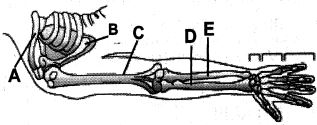
A
$A-$ Clavicle,$B-$ Scapula,$C-$ Humerus,$D-$ Radius and $E-$ Ulna
B
$A-$ Scapula,$B-$ Humerus,$C-$ Radius,$D-$ Ulna and $E-$ Clavicle
C
$A-$ Humerus,$B-$ Scapula,$C-$ Radius,$D-$ Ulna and $E-$ Clavicle
D
$A-$ Scapula,$B-$ Ulna,$C-$ Radius,$D-$ Humerus and $E-$ Clavicle
Solution
(A) Based on the anatomical structure of the human pectoral girdle and the forelimb:
$A$ points to the collar bone,known as the Clavicle.
$B$ points to the shoulder blade,known as the Scapula.
$C$ points to the upper arm bone,known as the Humerus.
$D$ points to the bone on the thumb side of the forearm,known as the Radius.
$E$ points to the bone on the little finger side of the forearm,known as the Ulna.
Therefore,the correct sequence is $A-$ Clavicle,$B-$ Scapula,$C-$ Humerus,$D-$ Radius and $E-$ Ulna.
$A$ points to the collar bone,known as the Clavicle.
$B$ points to the shoulder blade,known as the Scapula.
$C$ points to the upper arm bone,known as the Humerus.
$D$ points to the bone on the thumb side of the forearm,known as the Radius.
$E$ points to the bone on the little finger side of the forearm,known as the Ulna.
Therefore,the correct sequence is $A-$ Clavicle,$B-$ Scapula,$C-$ Humerus,$D-$ Radius and $E-$ Ulna.
0 likes
View Solution69
DifficultMCQ
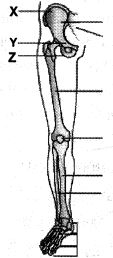
In the given figure,the fusion of $X, Y$,and $Z$ bones forms:
A
Ilium
B
Coxal bone
C
Scapula
D
Coccyx
Solution
(B) The provided figure shows the pelvic girdle and the bones of the lower limb.
In the pelvic girdle,the $X, Y$,and $Z$ represent the three bones: Ilium,Ischium,and Pubis.
These three bones fuse together to form a single bone known as the Coxal bone (or hip bone).
Therefore,the fusion of $X, Y$,and $Z$ results in the formation of the Coxal bone.
In the pelvic girdle,the $X, Y$,and $Z$ represent the three bones: Ilium,Ischium,and Pubis.
These three bones fuse together to form a single bone known as the Coxal bone (or hip bone).
Therefore,the fusion of $X, Y$,and $Z$ results in the formation of the Coxal bone.
0 likes
View Solution70
MediumMCQ
Three of the following pairs of human skeletal parts are correctly matched with their respective inclusive skeletal category, and one pair is not matched. Identify the non-matching pair:
A
Sternum and Ribs $-$ Axial skeleton
B
Clavicle and glenoid cavity $-$ Pelvic girdle
C
Humerus and Ulna $-$ Appendicular skeleton
D
Malleus and Stapes $-$ Ear ossicles
Solution
(B) The human skeletal system is divided into two main parts: the $Axial$ skeleton and the $Appendicular$ skeleton.
$1$. The $Axial$ skeleton consists of the skull, vertebral column, sternum, and ribs. Thus, $Sternum$ and $Ribs$ are correctly matched.
$2$. The $Appendicular$ skeleton consists of the limbs and the girdles (pectoral and pelvic). The $Clavicle$ (collar bone) and $Glenoid$ cavity are parts of the $Pectoral$ girdle, not the $Pelvic$ girdle. Therefore, this pair is incorrectly matched.
$3$. $Humerus$ and $Ulna$ are bones of the forelimb, which is part of the $Appendicular$ skeleton. This is correctly matched.
$4$. $Malleus$ and $Stapes$ are ear ossicles, which are part of the skull (axial skeleton). This is correctly matched.
$1$. The $Axial$ skeleton consists of the skull, vertebral column, sternum, and ribs. Thus, $Sternum$ and $Ribs$ are correctly matched.
$2$. The $Appendicular$ skeleton consists of the limbs and the girdles (pectoral and pelvic). The $Clavicle$ (collar bone) and $Glenoid$ cavity are parts of the $Pectoral$ girdle, not the $Pelvic$ girdle. Therefore, this pair is incorrectly matched.
$3$. $Humerus$ and $Ulna$ are bones of the forelimb, which is part of the $Appendicular$ skeleton. This is correctly matched.
$4$. $Malleus$ and $Stapes$ are ear ossicles, which are part of the skull (axial skeleton). This is correctly matched.
0 likes
View Solution71
MediumMCQ
The phalangeal (digital) formula for the human hand or foot is:
A
$0, 2, 2, 3, 3$
B
$0, 2, 3, 3, 3$
C
$2, 2, 3, 3, 3$
D
$2, 3, 3, 3, 3$
Solution
(D) The human hand and foot consist of five digits.
Each digit contains bones called phalanges.
The thumb (pollex) and the big toe (hallux) have two phalanges (proximal and distal).
The remaining four digits each have three phalanges (proximal,middle,and distal).
Therefore,the phalangeal formula for both the hand and the foot is $2, 3, 3, 3, 3$.
Each digit contains bones called phalanges.
The thumb (pollex) and the big toe (hallux) have two phalanges (proximal and distal).
The remaining four digits each have three phalanges (proximal,middle,and distal).
Therefore,the phalangeal formula for both the hand and the foot is $2, 3, 3, 3, 3$.
0 likes
View Solution72
MediumMCQ
Identify the odd one out in terms of their anatomical relationship.
A
Scapula
B
Humerus
C
Radius,ulna
D
Ilium
Solution
(D) The skeletal system is divided into the axial skeleton and the appendicular skeleton.
$1$. Scapula,Humerus,and Radius/Ulna are all bones belonging to the appendicular skeleton (specifically the pectoral girdle and the upper limb).
$2$. The Ilium is a part of the pelvic girdle,which is also part of the appendicular skeleton,but in the context of typical anatomical grouping questions,the Ilium is often associated with the hip bone (coxal bone) of the pelvic girdle,whereas the others are associated with the pectoral girdle and free upper limb.
$3$. However,looking at the options,Scapula,Humerus,and Radius/Ulna are all components of the upper limb assembly,while the Ilium is a component of the pelvic girdle (lower limb assembly).
Therefore,Ilium is the odd one out as it belongs to the pelvic girdle.
$1$. Scapula,Humerus,and Radius/Ulna are all bones belonging to the appendicular skeleton (specifically the pectoral girdle and the upper limb).
$2$. The Ilium is a part of the pelvic girdle,which is also part of the appendicular skeleton,but in the context of typical anatomical grouping questions,the Ilium is often associated with the hip bone (coxal bone) of the pelvic girdle,whereas the others are associated with the pectoral girdle and free upper limb.
$3$. However,looking at the options,Scapula,Humerus,and Radius/Ulna are all components of the upper limb assembly,while the Ilium is a component of the pelvic girdle (lower limb assembly).
Therefore,Ilium is the odd one out as it belongs to the pelvic girdle.
0 likes
View Solution73
EasyMCQ
The phalangeal formula for the human hand is:
A
$2, 3, 3, 3, 3$
B
$3, 3, 3, 3, 3$
C
$3, 2, 3, 2, 3$
D
$3, 3, 3, 2, 2$
Solution
(A) The human hand consists of $5$ digits (fingers).
Each finger contains bones called phalanges.
The thumb (pollex) consists of $2$ phalanges (proximal and distal).
The remaining four fingers (index,middle,ring,and little finger) each consist of $3$ phalanges (proximal,middle,and distal).
Therefore,the phalangeal formula for the hand is $2, 3, 3, 3, 3$.
Each finger contains bones called phalanges.
The thumb (pollex) consists of $2$ phalanges (proximal and distal).
The remaining four fingers (index,middle,ring,and little finger) each consist of $3$ phalanges (proximal,middle,and distal).
Therefore,the phalangeal formula for the hand is $2, 3, 3, 3, 3$.
0 likes
View Solution74
MediumMCQ
Which of the following bones are involved in the formation of the coxal bone?
A
$1$ and $2$ only
B
$2$ and $4$ only
C
$1, 2$ and $3$
D
$1, 3$ and $4$
Solution
(C) The coxal bone (hip bone) is a large,irregular bone that forms part of the pelvic girdle.
It is formed by the fusion of three bones: the ilium,the ischium,and the pubis.
These three bones fuse together at the acetabulum,which is a cup-shaped cavity that articulates with the head of the femur.
The femur is a bone of the thigh,not a component of the coxal bone itself.
Therefore,the correct components are $1$ (ilium),$2$ (pubis),and $3$ (ischium).
It is formed by the fusion of three bones: the ilium,the ischium,and the pubis.
These three bones fuse together at the acetabulum,which is a cup-shaped cavity that articulates with the head of the femur.
The femur is a bone of the thigh,not a component of the coxal bone itself.
Therefore,the correct components are $1$ (ilium),$2$ (pubis),and $3$ (ischium).
0 likes
View Solution75
MediumMCQ
Which of the following bones is not involved in the formation of the coxal bone?
A
Sacrum
B
Coccyx
C
Ilium
D
Ischium
Solution
(A) The coxal bone (hip bone) is formed by the fusion of three bones: the $Ilium$,$Ischium$,and $Pubis$.
These three bones fuse together at the acetabulum,which is a cup-shaped cavity for the articulation of the head of the femur.
The $Sacrum$ and $Coccyx$ are parts of the vertebral column and are not components of the coxal bone itself,although they articulate with the pelvic girdle.
These three bones fuse together at the acetabulum,which is a cup-shaped cavity for the articulation of the head of the femur.
The $Sacrum$ and $Coccyx$ are parts of the vertebral column and are not components of the coxal bone itself,although they articulate with the pelvic girdle.
0 likes
View Solution76
MediumMCQ
Match the following columns:
| Column-$I$ | Column-$II$ |
| $(a)$ Fibula | $(1)$ Fore limb |
| $(b)$ Pubis | $(2)$ Face |
| $(c)$ Radius | $(3)$ Hind limb |
| $(d)$ Lacrymal | $(4)$ Pelvic girdle |
| $(e)$ Temporal bones | $(5)$ Cranium |
A
$a-1, b-3, c-1, d-4, e-5$
B
$a-3, b-4, c-1, d-2, e-5$
C
$a-3, b-1, c-4, d-2, e-5$
D
$a-4, b-3, c-5, d-1, e-2$
Solution
(B) The correct matches are as follows:
$(a)$ Fibula is a bone of the hind limb.
$(b)$ Pubis is a part of the pelvic girdle.
$(c)$ Radius is a bone of the fore limb.
$(d)$ Lacrymal is a facial bone.
$(e)$ Temporal bones are part of the cranium.
Therefore,the correct matching is $a-3, b-4, c-1, d-2, e-5$.
$(a)$ Fibula is a bone of the hind limb.
$(b)$ Pubis is a part of the pelvic girdle.
$(c)$ Radius is a bone of the fore limb.
$(d)$ Lacrymal is a facial bone.
$(e)$ Temporal bones are part of the cranium.
Therefore,the correct matching is $a-3, b-4, c-1, d-2, e-5$.
0 likes
View Solution77
MediumMCQ
In humans,the pelvic girdle consists of ...... coxal bones.
A
$4$
B
$2$
C
$7$
D
$8$
Solution
(B) The pelvic girdle in humans is composed of two coxal bones.
Each coxal bone is formed by the fusion of three bones: the ilium,ischium,and pubis.
These two coxal bones meet ventrally to form the pubic symphysis containing fibrous cartilage.
Therefore,the correct answer is $2$.
Each coxal bone is formed by the fusion of three bones: the ilium,ischium,and pubis.
These two coxal bones meet ventrally to form the pubic symphysis containing fibrous cartilage.
Therefore,the correct answer is $2$.
0 likes
View Solution78
EasyMCQ
In birds,the wishbone is formed from the ...........
A
Pelvic girdle
B
Skull
C
Hind limb
D
Pectoral girdle/Clavicle
Solution
(D) In birds,the wishbone,also known as the furcula,is a forked bone found in the chest area. It is formed by the fusion of the two clavicles (collarbones) of the pectoral girdle. This structure provides structural support for the wings during flight.
0 likes
View Solution79
EasyMCQ
The deltoid tuberosity is found in the ...... .
A
Radius
B
Ulna
C
Femur
D
Humerus
Solution
(D) The deltoid tuberosity is a rough,triangular area on the lateral surface of the shaft of the $Humerus$ bone.
It serves as the insertion point for the deltoid muscle,which is responsible for the abduction of the arm at the shoulder joint.
It serves as the insertion point for the deltoid muscle,which is responsible for the abduction of the arm at the shoulder joint.
0 likes
View Solution80
DifficultMCQ
Which of the following is a part of the pectoral girdle?
A
Glenoid cavity
B
Sternum
C
Coxal bone
D
Acetabulum
Solution
(A) The pectoral girdle (shoulder girdle) consists of two bones: the clavicle (collar bone) and the scapula (shoulder blade).
The scapula is a large,triangular,flat bone situated in the dorsal part of the thorax between the second and the seventh ribs.
It contains a depression called the glenoid cavity,which articulates with the head of the humerus to form the shoulder joint.
Sternum is part of the axial skeleton.
Coxal bone and acetabulum are parts of the pelvic girdle.
The scapula is a large,triangular,flat bone situated in the dorsal part of the thorax between the second and the seventh ribs.
It contains a depression called the glenoid cavity,which articulates with the head of the humerus to form the shoulder joint.
Sternum is part of the axial skeleton.
Coxal bone and acetabulum are parts of the pelvic girdle.
0 likes
View Solution81
MediumMCQ
The total number of bones in the hind limb of a human is ........
A
$14$
B
$30$
C
$24$
D
$21$
Solution
(B) Each hind limb of a human consists of $30$ bones.
These bones are distributed as follows:
$1$ Femur (thigh bone),
$1$ Patella (knee cap),
$1$ Tibia,
$1$ Fibula,
$7$ Tarsals (ankle bones),
$5$ Metatarsals (sole bones),
$14$ Phalanges (digits).
Total = $1 + 1 + 1 + 1 + 7 + 5 + 14 = 30$ bones.
These bones are distributed as follows:
$1$ Femur (thigh bone),
$1$ Patella (knee cap),
$1$ Tibia,
$1$ Fibula,
$7$ Tarsals (ankle bones),
$5$ Metatarsals (sole bones),
$14$ Phalanges (digits).
Total = $1 + 1 + 1 + 1 + 7 + 5 + 14 = 30$ bones.
0 likes
View Solution82
DifficultMCQ
Typically,the $acromion$ process is found in:
A
Pelvic girdle of mammals
B
Pectoral girdle of mammals
C
Skull of frogs
D
Sperm of mammals
Solution
(B) The $acromion$ process is a bony projection on the scapula (shoulder blade).
It articulates with the clavicle (collarbone) to form the acromioclavicular joint.
The scapula is a key component of the pectoral girdle (shoulder girdle) in mammals.
Therefore,the correct option is $B$.
It articulates with the clavicle (collarbone) to form the acromioclavicular joint.
The scapula is a key component of the pectoral girdle (shoulder girdle) in mammals.
Therefore,the correct option is $B$.
0 likes
View Solution83
MediumMCQ
$A$ cricket player is fast chasing a ball in the field. Which one of the following groups of bones are directly contributing in this movement?
A
Femur,malleus,tibia,metatarsals
B
Pelvis,ulna,patella,tarsals
C
Sternum,femur,tibia,fibula
D
Tarsals,femur,metatarsals,tibia
Solution
(D) During fast running or chasing,the lower limbs are primarily involved in locomotion.
The bones of the lower limb include the $Femur$ (thigh bone),$Tibia$ (shin bone),$Tarsals$ (ankle bones),and $Metatarsals$ (foot bones).
These bones work together to provide support,balance,and propulsion during rapid movement.
$Malleus$ is an ear ossicle,$Sternum$ is a chest bone,and $Ulna$ is a forearm bone,which are not directly involved in the locomotion of the legs.
The bones of the lower limb include the $Femur$ (thigh bone),$Tibia$ (shin bone),$Tarsals$ (ankle bones),and $Metatarsals$ (foot bones).
These bones work together to provide support,balance,and propulsion during rapid movement.
$Malleus$ is an ear ossicle,$Sternum$ is a chest bone,and $Ulna$ is a forearm bone,which are not directly involved in the locomotion of the legs.
0 likes
View Solution84
EasyMCQ
The shoulder blade is made of
A
clavicle
B
humerus
C
ilium
D
scapula
Solution
(D) The shoulder blade is known as the $scapula$.
It is a large,flat,triangular bone situated in the dorsal part of the thorax between the $2^{nd}$ and the $7^{th}$ ribs.
It forms a part of the pectoral girdle.
The $scapula$ articulates with the $clavicle$ (collar bone) anteriorly and the $humerus$ (arm bone) laterally.
It is a large,flat,triangular bone situated in the dorsal part of the thorax between the $2^{nd}$ and the $7^{th}$ ribs.
It forms a part of the pectoral girdle.
The $scapula$ articulates with the $clavicle$ (collar bone) anteriorly and the $humerus$ (arm bone) laterally.
0 likes
View Solution85
EasyMCQ
Sesamoid bone is derived from
A
Cartilage
B
Areolar tissue
C
Tendon
D
Ligament
Solution
(C) Sesamoid bones are small,rounded bones that are embedded within certain tendons.
These bones are typically found where a tendon passes over a joint,such as in the hand,knee (e.g.,the patella),and foot.
Functionally,they act to protect the tendon from excessive wear and tear and improve the mechanical advantage of the joint by increasing the leverage of the muscle.
These bones are typically found where a tendon passes over a joint,such as in the hand,knee (e.g.,the patella),and foot.
Functionally,they act to protect the tendon from excessive wear and tear and improve the mechanical advantage of the joint by increasing the leverage of the muscle.
0 likes
View Solution86
Easy
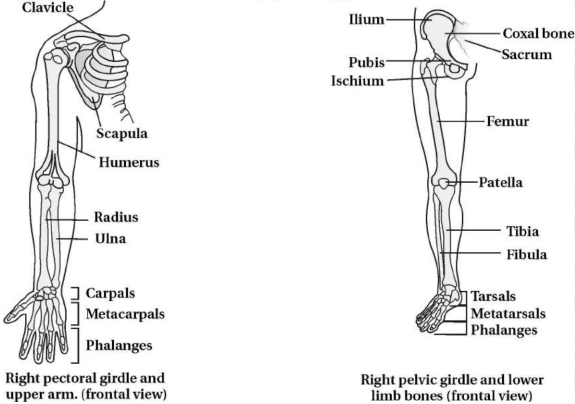
How is the appendicular skeleton formed? Describe its various parts with a diagram.
Solution
(N/A) The bones of the limbs along with their girdles constitute the appendicular skeleton.
$(i)$ Forelimb - Each limb is made up of $30$ bones.
Bones of forelimb:
- Humerus: $1$
- Radius and Ulna: $2$
- Carpals (wrist bones): $8$
- Metacarpals (palm bones): $5$
- Phalanges (digits): $14$
Total = $30$ bones.
(ii) Hind limb - Each limb has $30$ bones.
- Femur (thigh bone): $1$
- Patella (knee cap): $1$
- Tibia and Fibula: $2$
- Tarsals (ankle bones): $7$
- Metatarsals: $5$
- Phalanges (digits): $14$
Total = $30$ bones.
Femur is the longest and strongest bone of the body.
(iii) Girdles: These help in the articulation of the upper and lower limbs with the axial skeleton.
- Pectoral girdle: Each half consists of a clavicle and a scapula. The scapula is a large triangular flat bone situated in the dorsal part of the thorax between the $2^{nd}$ and $7^{th}$ ribs. It has a spine that projects as a flat,expanded process called the acromion. Below the acromion is the glenoid cavity,which articulates with the head of the humerus. The clavicle is a long,slender bone with two curvatures,commonly called the collar bone.
- Pelvic girdle: Consists of two coxal bones. Each coxal bone is formed by the fusion of three bones: ilium,ischium,and pubis. At the point of fusion,there is a cavity called the acetabulum to which the thigh bone (femur) articulates. The two halves of the pelvic girdle meet ventrally to form the pubic symphysis containing fibrous cartilage.
$(i)$ Forelimb - Each limb is made up of $30$ bones.
Bones of forelimb:
- Humerus: $1$
- Radius and Ulna: $2$
- Carpals (wrist bones): $8$
- Metacarpals (palm bones): $5$
- Phalanges (digits): $14$
Total = $30$ bones.
(ii) Hind limb - Each limb has $30$ bones.
- Femur (thigh bone): $1$
- Patella (knee cap): $1$
- Tibia and Fibula: $2$
- Tarsals (ankle bones): $7$
- Metatarsals: $5$
- Phalanges (digits): $14$
Total = $30$ bones.
Femur is the longest and strongest bone of the body.
(iii) Girdles: These help in the articulation of the upper and lower limbs with the axial skeleton.
- Pectoral girdle: Each half consists of a clavicle and a scapula. The scapula is a large triangular flat bone situated in the dorsal part of the thorax between the $2^{nd}$ and $7^{th}$ ribs. It has a spine that projects as a flat,expanded process called the acromion. Below the acromion is the glenoid cavity,which articulates with the head of the humerus. The clavicle is a long,slender bone with two curvatures,commonly called the collar bone.
- Pelvic girdle: Consists of two coxal bones. Each coxal bone is formed by the fusion of three bones: ilium,ischium,and pubis. At the point of fusion,there is a cavity called the acetabulum to which the thigh bone (femur) articulates. The two halves of the pelvic girdle meet ventrally to form the pubic symphysis containing fibrous cartilage.
0 likes
View Solution87
Easy
Explain: Pectoral girdle and Pelvic girdle.
Solution
(N/A) The $Pectoral$ and $Pelvic$ girdles are components of the appendicular skeleton that help in the articulation of the upper and lower limbs respectively with the axial skeleton.
$1$. $Pectoral$ $Girdle$: It consists of two halves. Each half is made up of a $Clavicle$ (collar bone) and a $Scapula$ (shoulder blade). The $Scapula$ is a large,triangular,flat bone situated in the dorsal part of the thorax between the $2^{nd}$ and $7^{th}$ ribs. It has a slightly elevated ridge called the $Spine$ which projects as a flat,expanded process called the $Acromion$. The $Clavicle$ articulates with this process. Below the $Acromion$ is a depression called the $Glenoid$ $cavity$ which articulates with the head of the $Humerus$ to form the shoulder joint.
$2$. $Pelvic$ $Girdle$: It consists of two coxal bones. Each coxal bone is formed by the fusion of three bones: $Ilium$,$Ischium$,and $Pubis$. At the point of fusion of these bones,there is a cavity called the $Acetabulum$ to which the thigh bone $(Femur)$ articulates. The two halves of the pelvic girdle meet ventrally to form the $Pubic$ $symphysis$ containing fibrous cartilage.
$1$. $Pectoral$ $Girdle$: It consists of two halves. Each half is made up of a $Clavicle$ (collar bone) and a $Scapula$ (shoulder blade). The $Scapula$ is a large,triangular,flat bone situated in the dorsal part of the thorax between the $2^{nd}$ and $7^{th}$ ribs. It has a slightly elevated ridge called the $Spine$ which projects as a flat,expanded process called the $Acromion$. The $Clavicle$ articulates with this process. Below the $Acromion$ is a depression called the $Glenoid$ $cavity$ which articulates with the head of the $Humerus$ to form the shoulder joint.
$2$. $Pelvic$ $Girdle$: It consists of two coxal bones. Each coxal bone is formed by the fusion of three bones: $Ilium$,$Ischium$,and $Pubis$. At the point of fusion of these bones,there is a cavity called the $Acetabulum$ to which the thigh bone $(Femur)$ articulates. The two halves of the pelvic girdle meet ventrally to form the $Pubic$ $symphysis$ containing fibrous cartilage.
0 likes
View Solution88
Easy
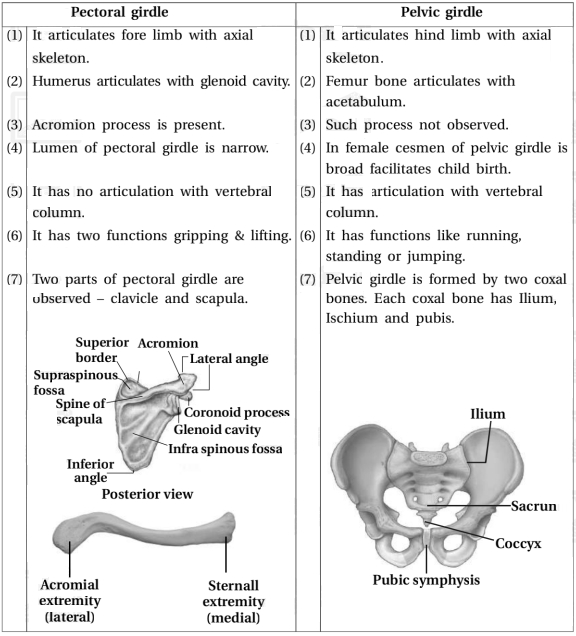
Give differences: Pectoral girdle and Pelvic girdle.
Solution
(N/A) The differences between the Pectoral girdle and the Pelvic girdle are as follows:
| Feature | Pectoral Girdle | Pelvic Girdle |
| :--- | :--- | :--- |
| $(1)$ Function | Articulates the forelimb with the axial skeleton. | Articulates the hind limb with the axial skeleton. |
| $(2)$ Articulation | The humerus articulates with the glenoid cavity. | The femur articulates with the acetabulum. |
| $(3)$ Processes | Acromion process is present. | Such a process is not observed. |
| $(4)$ Structure | The lumen of the pectoral girdle is narrow. | In females,the pelvic cavity (true pelvis) is broad to facilitate childbirth. |
| $(5)$ Vertebral Connection | It has no direct articulation with the vertebral column. | It articulates with the vertebral column (sacrum). |
| $(6)$ Primary Role | Functions in gripping and lifting. | Functions in locomotion like running,standing,or jumping. |
| $(7)$ Composition | Formed by two parts: clavicle and scapula. | Formed by two coxal bones. Each coxal bone consists of ilium,ischium,and pubis. |
| Feature | Pectoral Girdle | Pelvic Girdle |
| :--- | :--- | :--- |
| $(1)$ Function | Articulates the forelimb with the axial skeleton. | Articulates the hind limb with the axial skeleton. |
| $(2)$ Articulation | The humerus articulates with the glenoid cavity. | The femur articulates with the acetabulum. |
| $(3)$ Processes | Acromion process is present. | Such a process is not observed. |
| $(4)$ Structure | The lumen of the pectoral girdle is narrow. | In females,the pelvic cavity (true pelvis) is broad to facilitate childbirth. |
| $(5)$ Vertebral Connection | It has no direct articulation with the vertebral column. | It articulates with the vertebral column (sacrum). |
| $(6)$ Primary Role | Functions in gripping and lifting. | Functions in locomotion like running,standing,or jumping. |
| $(7)$ Composition | Formed by two parts: clavicle and scapula. | Formed by two coxal bones. Each coxal bone consists of ilium,ischium,and pubis. |
0 likes
View Solution89
Easy
Differentiate between the bones of the forelimb and the bones of the hindlimb.
Solution
(N/A)
| Bones of forelimb | Bones of hindlimb |
|---|---|
| $(1)$ $Humerus$ is the bone of the upper arm. | $(1)$ $Femur$ is the bone of the thigh. |
| $(2)$ $Radius$ and $Ulna$ are the bones of the forearm. | $(2)$ $Tibia$ and $Fibula$ are the bones of the shank. |
| $(3)$ The wrist contains $8$ carpals. | $(3)$ The ankle contains $7$ tarsals. |
| $(4)$ Primarily adapted for manipulation,gripping,and writing. | $(4)$ Primarily adapted for locomotion,walking,running,and supporting body weight. |
0 likes
View Solution90
Easy
Our forearm is made of three different bones. Comment.
Solution
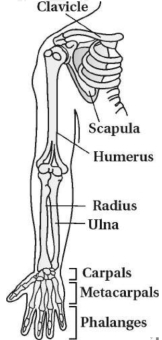
(N/A) The statement is anatomically incorrect. The human forearm (antebrachium) consists of only two bones: the $Radius$ and the $Ulna$.
$1$. $Radius$: Located on the lateral side (thumb side) of the forearm.
$2$. $Ulna$: Located on the medial side (little finger side) of the forearm.
The $Humerus$ is the bone of the upper arm,not the forearm. The $Carpals$ are the bones of the wrist,not the forearm.
$1$. $Radius$: Located on the lateral side (thumb side) of the forearm.
$2$. $Ulna$: Located on the medial side (little finger side) of the forearm.
The $Humerus$ is the bone of the upper arm,not the forearm. The $Carpals$ are the bones of the wrist,not the forearm.
0 likes
View Solution91
EasyMCQ
What are the points of articulation for the pectoral and pelvic girdles?
A
Glenoid cavity and Acetabulum
B
Acetabulum and Glenoid cavity
C
Acromion and Ilium
D
Scapula and Ischium
Solution
(A) Pectoral girdle: Each half of the pectoral girdle consists of a scapula and a clavicle. The scapula has a dorsal,flat,triangular portion with a projection called the acromion process,where the clavicle articulates. Below the acromion is the glenoid cavity,which articulates with the head of the humerus to form the shoulder joint.
Pelvic girdle: It consists of two coxal bones. Each coxal bone is formed by the fusion of three bones: Ilium,Ischium,and Pubis. The acetabulum is a cavity formed at the junction of these three bones,where the head of the femur articulates to form the hip joint.
Pelvic girdle: It consists of two coxal bones. Each coxal bone is formed by the fusion of three bones: Ilium,Ischium,and Pubis. The acetabulum is a cavity formed at the junction of these three bones,where the head of the femur articulates to form the hip joint.
0 likes
View Solution92
MediumMCQ
What is the acromion process?
A
$A$ part of the humerus bone.
B
$A$ projection of the scapula.
C
$A$ part of the pelvic girdle.
D
$A$ type of synovial joint.
Solution
(B) The dorsal,flat,triangular body of the scapula has a slightly elevated ridge called the spine,which projects as a flat,expanded process called the Acromion process. It articulates with the clavicle.
0 likes
View Solution93
EasyMCQ
The pelvic girdle of a rabbit consists of:
A
Ilium
B
Ischium
C
Pubis
D
All of the above
Solution
(D) The pelvic girdle of a rabbit consists of two halves known as innominate bones. Each innominate bone is formed by the fusion of $3$ distinct bones: the ilium,the ischium,and the pubis.
0 likes
View Solution94
MediumMCQ
The longest bone of the human body is
A
Humerus
B
Tibia
C
Vertebra
D
Femur
Solution
(D) In humans,the $Femur$ or the thigh bone is the longest bone of the body.
It articulates with the $acetabulum$ of the pelvic girdle to form the hip joint.
It articulates with the $acetabulum$ of the pelvic girdle to form the hip joint.
0 likes
View Solution95
MediumMCQ
Bones of pectoral and pelvic girdle help in the articulation of:
A
Upper limbs
B
Lower limbs
C
Both $(a)$ and $(b)$
D
None of these
Solution
(C) The appendicular skeleton consists of the limbs and their girdles.
$1$. The pectoral girdle (shoulder girdle) consists of the clavicle and scapula,which provide the site for the articulation of the upper limbs.
$2$. The pelvic girdle (hip girdle) consists of two coxal bones,which provide the site for the articulation of the lower limbs.
Therefore,the bones of the pectoral and pelvic girdles help in the articulation of both the upper and lower limbs.
$1$. The pectoral girdle (shoulder girdle) consists of the clavicle and scapula,which provide the site for the articulation of the upper limbs.
$2$. The pelvic girdle (hip girdle) consists of two coxal bones,which provide the site for the articulation of the lower limbs.
Therefore,the bones of the pectoral and pelvic girdles help in the articulation of both the upper and lower limbs.
0 likes
View Solution96
MediumMCQ
An acromion process is characteristically found in the
A
Pelvic girdle of mammals
B
Skull of frog
C
Pectoral girdle of mammals
D
Sperm of mammals
Solution
(C) The acromion process is a bony projection on the scapula (shoulder blade). The scapula is a key component of the pectoral girdle in mammals. It provides an attachment point for muscles and articulates with the clavicle.
0 likes
View Solution97
MediumMCQ
Acetabulum is a deep depression on the outer surface of:
A
Ilium and incus
B
Ilium and ischium
C
Incus and ischium
D
Ilium,ischium and pubis
Solution
(D) The pelvic girdle consists of two coxal bones. Each coxal bone is formed by the fusion of three bones: $Ilium$,$Ischium$,and $Pubis$.
At the point of fusion of these three bones,there is a cavity called the $Acetabulum$ to which the thigh bone $(Femur)$ articulates.
Therefore,the $Acetabulum$ is a deep depression formed by the fusion of the $Ilium$,$Ischium$,and $Pubis$.
At the point of fusion of these three bones,there is a cavity called the $Acetabulum$ to which the thigh bone $(Femur)$ articulates.
Therefore,the $Acetabulum$ is a deep depression formed by the fusion of the $Ilium$,$Ischium$,and $Pubis$.
0 likes
View Solution98
EasyMCQ
Which one of the following is a sesamoid bone?
A
Pelvis
B
Patella
C
Pterygoid
D
Pectoral girdle
Solution
(B) The bones which are formed by the ossification of tendons (fibrous connective tissue that attaches muscles to bone) are called sesamoid bones,$e.g.$,the patella.
The patella,also known as the knee cap,is a small triangular bone that is embedded within the tendon of the quadriceps femoris muscle and sits in front of the knee joint formed by the femur,tibia,and fibula.
The patella,also known as the knee cap,is a small triangular bone that is embedded within the tendon of the quadriceps femoris muscle and sits in front of the knee joint formed by the femur,tibia,and fibula.
0 likes
View Solution99
MediumMCQ
Each human limb is made of (in $bones$)
A
$60$
B
$50$
C
$40$
D
$30$
Solution
(D) Each human limb (forelimb or hindlimb) consists of $30$ bones.
Specifically,the forelimb contains the humerus $(1)$,radius $(1)$,ulna $(1)$,carpals $(8)$,metacarpals $(5)$,and phalanges $(14)$.
The hindlimb contains the femur $(1)$,patella $(1)$,tibia $(1)$,fibula $(1)$,tarsals $(7)$,metatarsals $(5)$,and phalanges $(14)$.
Therefore,each limb is composed of $30$ bones,making a total of $120$ bones in all four limbs $(30 \times 4 = 120)$.
Specifically,the forelimb contains the humerus $(1)$,radius $(1)$,ulna $(1)$,carpals $(8)$,metacarpals $(5)$,and phalanges $(14)$.
The hindlimb contains the femur $(1)$,patella $(1)$,tibia $(1)$,fibula $(1)$,tarsals $(7)$,metatarsals $(5)$,and phalanges $(14)$.
Therefore,each limb is composed of $30$ bones,making a total of $120$ bones in all four limbs $(30 \times 4 = 120)$.
0 likes
View Solution100
MediumMCQ
The clavicle articulates with ......... of the scapula.
A
Acromion process
B
Glenoid cavity
C
Acetabulum cavity
D
Ball and socket joint
Solution
(A) The pectoral girdle consists of two bones,the scapula and the clavicle.
The scapula is a large,triangular,flat bone situated in the dorsal part of the thorax between the second and the seventh ribs.
The dorsal,flat,triangular body of the scapula has a slightly elevated ridge called the spine which projects as a flat,expanded process called the acromion process.
The clavicle (collar bone) articulates with the acromion process of the scapula.
The scapula is a large,triangular,flat bone situated in the dorsal part of the thorax between the second and the seventh ribs.
The dorsal,flat,triangular body of the scapula has a slightly elevated ridge called the spine which projects as a flat,expanded process called the acromion process.
The clavicle (collar bone) articulates with the acromion process of the scapula.
0 likes
View SolutionLocomotion and Movement — Appendicular skeleton · Frequently Asked Questions
1Are these Locomotion and Movement questions useful for JEE and NEET?
Yes. All questions in this section are mapped to JEE Main and NEET exam patterns. Previous year questions from JEE Main, NEET, GUJCET and state-level exams are included with full solutions.
2Can I switch to Hindi or Gujarati for these questions?
Yes. Use the language tabs in the hero section or the sidebar to view the same questions and solutions in English, Hindi or Gujarati.
3How do I generate a question paper from this subtopic?
Use the Vedclass Exam Paper Generator — select the chapter and subtopic, set difficulty, and generate Sets A, B, C, D automatically. First 3 chapters of every subject are free.
Vedclass Products
For Students
Vedclass Test Series
Mock tests in real JEE/NEET style with performance analysis. 5-day free trial.
Start Free TrialFor Teachers
Exam Paper Generator
Generate Set A/B/C/D papers from this chapter in 2 minutes. 3 chapters free.
Try FreeFor Institutes
Online Exam Module
Live online exams with unlimited students, 360° analytics & white-label branding.
See DemoFor Teachers & Institutes
Generate a Locomotion and Movement Exam Paper in 2 Minutes
Select subtopic & difficulty — Sets A, B, C, D auto-generated with No Repeat logic.
First 3 chapters of every subject are free — no payment required.