
A English
Mix Examples- Locomotion and Movement Questions in English
Class 11 Biology · Locomotion and Movement · Mix Examples- Locomotion and Movement
56+
Questions
English
Language
100%
With Solutions
Showing 50 of 56 questions in English
1
MediumMCQ
If juvenile hormone is absent when a silkworm moults,it will:
A
Moult into another larval stage
B
Moult into a pupa
C
Moult into an adult
D
Die
Solution
(B) In insects,the metamorphosis process is regulated by hormones. Juvenile hormone $(JH)$ maintains the larval characteristics during each moult. When the level of $JH$ is high,the larva moults into another larval stage. As the larva grows,the concentration of $JH$ decreases. When $JH$ is absent or at a very low level during a moult,the larva undergoes metamorphosis and transforms into a pupa.
0 likes
View Solution2
MediumMCQ
When an electric shock is given to the leg of a pithed frog,what happens?
A
Blinks its eyes
B
Shows no response
C
Puts out its tongue
D
None of these
Solution
(B) pithed frog is one in which the brain and spinal cord have been destroyed or rendered non-functional to eliminate pain perception.
Since the central nervous system is destroyed,the frog cannot process sensory input or initiate voluntary or reflex motor responses.
Therefore,when an electric shock is applied to the leg,the frog shows no response.
Since the central nervous system is destroyed,the frog cannot process sensory input or initiate voluntary or reflex motor responses.
Therefore,when an electric shock is applied to the leg,the frog shows no response.
0 likes
View Solution3
MediumMCQ
$A$ femur is kept in dilute $HCl$ for three days,it becomes
A
Brittle
B
Soft and elastic
C
Remains as it is
D
Harder
Solution
(B) When a bone is placed in dilute $HCl$ for a few days,the calcium salts (calcium phosphate and calcium carbonate) present in the bone matrix are dissolved by the acid.
This process is known as decalcification.
As a result,the bone loses its hardness and becomes soft,flexible,and elastic,as only the organic collagen fibers remain.
This process is known as decalcification.
As a result,the bone loses its hardness and becomes soft,flexible,and elastic,as only the organic collagen fibers remain.
0 likes
View Solution4
MediumMCQ
Teeth are:
A
Living structure
B
Dead structure
C
Partly dead and partly living structure
D
Exact nature is not known
Solution
(A) Teeth are considered living structures because they contain living tissues such as the pulp,which consists of blood vessels,nerves,and connective tissues. While the outer enamel is non-living (acellular and avascular),the overall tooth structure is supported by living components that maintain its health and sensitivity.
0 likes
View Solution5
MediumMCQ
The rumen in a camel functions as:
A
Cudding organ
B
Water storing organ
C
Both $(a)$ and $(b)$
D
None of these
Solution
(C) The rumen in camels,in addition to its role in cudding (rumination),also serves as a storage site for water. Camels can store up to eight gallons of water in their rumen,which is derived from metabolic processes and ingested fluids,helping them survive in arid environments.
0 likes
View Solution6
EasyMCQ
The bone of mammals contains Haversian canals which are connected by transverse canals known as
A
Bidder's canal
B
Inguinal canal
C
Volkmann's canal
D
Semicircular canal
Solution
(C) In mammalian compact bone,the $Haversian$ canals run parallel to the long axis of the bone.
These canals are interconnected by transverse or oblique channels known as $Volkmann's$ canals.
$Volkmann's$ canals connect the $Haversian$ canals to each other,as well as to the periosteum and the marrow cavity,allowing for the passage of blood vessels and nerves.
These canals are interconnected by transverse or oblique channels known as $Volkmann's$ canals.
$Volkmann's$ canals connect the $Haversian$ canals to each other,as well as to the periosteum and the marrow cavity,allowing for the passage of blood vessels and nerves.
0 likes
View Solution7
MediumMCQ
In children,the bones are more flexible and less brittle because their bones have:
A
Large quantity of salts and little organic substances
B
Large quantity of organic substances and little salts
C
Well-developed Haversian system
D
Large number of osteoblasts
Solution
(B) Bones are composed of an organic matrix (primarily collagen) and inorganic mineral salts (primarily calcium phosphate).
Collagen provides flexibility and tensile strength,while mineral salts provide hardness and rigidity.
In children,the proportion of organic substances (collagen) is higher relative to mineral salts compared to adults.
This higher organic content makes the bones more flexible and less brittle,allowing them to withstand more stress without fracturing easily.
As a person ages,the mineral content increases,making the bones harder but also more brittle.
Collagen provides flexibility and tensile strength,while mineral salts provide hardness and rigidity.
In children,the proportion of organic substances (collagen) is higher relative to mineral salts compared to adults.
This higher organic content makes the bones more flexible and less brittle,allowing them to withstand more stress without fracturing easily.
As a person ages,the mineral content increases,making the bones harder but also more brittle.
0 likes
View Solution8
EasyMCQ
Bones act as a reservoir of which mineral salts?
A
Sodium and magnesium
B
Calcium and sodium
C
Calcium and magnesium
D
Copper and iron
Solution
(C) Bone is a metabolically dynamic tissue that functions as a homeostatic reservoir for various mineral ions.
Specifically,it stores significant amounts of calcium,magnesium,and phosphorus.
These minerals are released into the blood when the body requires them to maintain physiological homeostasis.
Therefore,the correct option is $C$.
Specifically,it stores significant amounts of calcium,magnesium,and phosphorus.
These minerals are released into the blood when the body requires them to maintain physiological homeostasis.
Therefore,the correct option is $C$.
0 likes
View Solution9
EasyMCQ
Rigor Mortis was first noticed in
A
Limbs
B
Neck
C
Jaw
D
Forehead
Solution
(C) $Rigor \text{ } Mortis$ is the post-mortem stiffening of the body's muscles due to chemical changes in the myofibrils.
It typically begins in the smaller muscles of the body.
The muscles of the jaw are the first to be affected, followed by the neck, trunk, and finally the limbs.
It typically begins in the smaller muscles of the body.
The muscles of the jaw are the first to be affected, followed by the neck, trunk, and finally the limbs.
0 likes
View Solution10
MediumMCQ
Endoplasmic reticulum or sarcoplasmic reticulum plays a major role during
A
Muscle contraction
B
Muscle excitement
C
Muscle relaxation
D
All the above
Solution
(D) The sarcoplasmic reticulum $(SR)$ is a specialized type of endoplasmic reticulum found in muscle cells.
It acts as a storage site for calcium ions $(Ca^{2+})$.
During muscle excitement,calcium ions are released from the $SR$ into the sarcoplasm,which triggers muscle contraction.
During muscle relaxation,these calcium ions are actively pumped back into the $SR$.
Since the $SR$ is involved in all these processes,the correct answer is $D$.
It acts as a storage site for calcium ions $(Ca^{2+})$.
During muscle excitement,calcium ions are released from the $SR$ into the sarcoplasm,which triggers muscle contraction.
During muscle relaxation,these calcium ions are actively pumped back into the $SR$.
Since the $SR$ is involved in all these processes,the correct answer is $D$.
0 likes
View Solution11
MediumMCQ
$A$ curved bone is structurally designed to
A
Accommodate easily in the body
B
Absorb the stress of the body weight at several different points so that the stress is evenly distributed
C
Provide more area for the attachment of muscles
D
All of the above
Solution
(D) The structural curvature of bones,such as the femur or the vertebral column,serves multiple mechanical functions.
$1$. It allows for better accommodation of organs and structures within the body cavity.
$2$. The curvature helps in distributing the mechanical stress caused by body weight across multiple points,preventing localized fractures and ensuring stability.
$3$. The increased surface area provided by the curved shape allows for the attachment of various muscles,which is essential for movement and support.
Therefore,all the given options are correct.
$1$. It allows for better accommodation of organs and structures within the body cavity.
$2$. The curvature helps in distributing the mechanical stress caused by body weight across multiple points,preventing localized fractures and ensuring stability.
$3$. The increased surface area provided by the curved shape allows for the attachment of various muscles,which is essential for movement and support.
Therefore,all the given options are correct.
0 likes
View Solution12
EasyMCQ
The receptors found in the muscles,tendons,and joints are:
A
Teloreceptors
B
Proprioreceptors
C
Interoceptors
D
None of these
Solution
(B) The correct answer is $B$. Proprioreceptors are specialized sensory nerve endings located deep within muscles,tendons,joints,and the vestibular apparatus. They respond to stimuli originating from within the body,providing information regarding movement,body posture,and spatial position.
0 likes
View Solution13
MediumMCQ
What is the function of the iris in the eye of a frog?
A
Refraction of light rays
B
Regulating the size of the pupil
C
Moving the nictitating membrane
D
Moving the lens forward and backward
Solution
(B) In the eye of a frog,the iris is a pigmented,muscular structure that surrounds the pupil. Its primary function is to control the amount of light entering the eye by adjusting the size of the pupil. When light intensity is high,the iris constricts the pupil,and when light intensity is low,it dilates the pupil. Therefore,the correct option is $B$.
0 likes
View Solution14
EasyMCQ
When the entire sole rests on the ground during walking as in the case of a man,it is known as
A
Plantigrade
B
Digitigrade
C
Perikaryon
D
Hallux
Solution
(A) Locomotion in mammals is classified based on the part of the foot that touches the ground during walking.
$1$. $Plantigrade$: In this type of locomotion,the entire sole of the foot,including the heel and digits,rests on the ground. Humans,bears,and primates exhibit this type of locomotion.
$2$. $Digitigrade$: In this type,only the digits (toes) touch the ground while the heel remains elevated. Examples include cats and dogs.
$3$. $Unguligrade$: In this type,only the tips of the digits (hooves) touch the ground,as seen in horses and deer.
$4$. $Perikaryon$ refers to the cell body of a neuron,and $Hallux$ refers to the big toe of the foot. Therefore,the correct term for walking on the entire sole is $Plantigrade$.
$1$. $Plantigrade$: In this type of locomotion,the entire sole of the foot,including the heel and digits,rests on the ground. Humans,bears,and primates exhibit this type of locomotion.
$2$. $Digitigrade$: In this type,only the digits (toes) touch the ground while the heel remains elevated. Examples include cats and dogs.
$3$. $Unguligrade$: In this type,only the tips of the digits (hooves) touch the ground,as seen in horses and deer.
$4$. $Perikaryon$ refers to the cell body of a neuron,and $Hallux$ refers to the big toe of the foot. Therefore,the correct term for walking on the entire sole is $Plantigrade$.
0 likes
View Solution15
MediumMCQ
While at ease,some monkeys spend their time searching for something in each other's fur,which they then eat. What are they actually searching for?
A
The ticks attached to body fur
B
The body lice
C
The salt granules that deposit when perspiration dries up
D
The dust particles entangled in the fur
Solution
(C) The behavior described is known as grooming. While monkeys do remove parasites like ticks or lice,a significant portion of this social grooming involves searching for and consuming salt crystals that accumulate on the skin and fur as sweat (perspiration) evaporates. This provides them with essential minerals.
0 likes
View Solution16
MediumMCQ
$Ca^{2+}$ is required in which of the following processes?
A
Muscle contraction
B
Blood clotting
C
Bone formation
D
All of the above
Solution
(D) $Ca^{2+}$ (calcium ions) play a vital role in various physiological processes:
$1$. Muscle contraction: $Ca^{2+}$ binds to troponin,exposing the active sites on actin filaments to allow myosin binding.
$2$. Blood clotting: $Ca^{2+}$ acts as a cofactor for several clotting factors in the coagulation cascade.
$3$. Bone formation: Calcium phosphate (hydroxyapatite) is the primary mineral component of bones and teeth.
Therefore,all the given options are correct.
$1$. Muscle contraction: $Ca^{2+}$ binds to troponin,exposing the active sites on actin filaments to allow myosin binding.
$2$. Blood clotting: $Ca^{2+}$ acts as a cofactor for several clotting factors in the coagulation cascade.
$3$. Bone formation: Calcium phosphate (hydroxyapatite) is the primary mineral component of bones and teeth.
Therefore,all the given options are correct.
0 likes
View Solution17
EasyMCQ
Which of the following sets of three names and groups is correctly matched?
A
Cytosine,Uracil,Thymine - Pyrimidines
B
Malleus,Incus,Stapes - Ear ossicles
C
Ilium,Ischium,Pubis - Bones of the pelvic girdle
D
Actin,Myosin,Rhodopsin - Muscle proteins
Solution
(A, B, C) Let us analyze each option:
$1$. $Cytosine$,$Uracil$,and $Thymine$ are indeed $Pyrimidines$. This is a correct statement.
$2$. $Malleus$,$Incus$,and $Stapes$ are the three ear ossicles. This is also a correct statement.
$3$. $Ilium$,$Ischium$,and $Pubis$ are the three bones that fuse to form the coxal bone of the pelvic girdle. This is also a correct statement.
$4$. $Actin$ and $Myosin$ are contractile muscle proteins,but $Rhodopsin$ is a visual pigment found in the retina of the eye,not a muscle protein. Thus,this set is incorrect.
Note: In many standard biology examinations,this question is presented as a multiple-choice question where options $A$,$B$,and $C$ are all scientifically accurate. However,if the question implies selecting the most comprehensive set or if it is a multiple-correct type,all three $(A, B, C)$ are correct. Given the standard format,$A, B,$ and $C$ are all correct groupings.
$1$. $Cytosine$,$Uracil$,and $Thymine$ are indeed $Pyrimidines$. This is a correct statement.
$2$. $Malleus$,$Incus$,and $Stapes$ are the three ear ossicles. This is also a correct statement.
$3$. $Ilium$,$Ischium$,and $Pubis$ are the three bones that fuse to form the coxal bone of the pelvic girdle. This is also a correct statement.
$4$. $Actin$ and $Myosin$ are contractile muscle proteins,but $Rhodopsin$ is a visual pigment found in the retina of the eye,not a muscle protein. Thus,this set is incorrect.
Note: In many standard biology examinations,this question is presented as a multiple-choice question where options $A$,$B$,and $C$ are all scientifically accurate. However,if the question implies selecting the most comprehensive set or if it is a multiple-correct type,all three $(A, B, C)$ are correct. Given the standard format,$A, B,$ and $C$ are all correct groupings.
0 likes
View Solution18
EasyMCQ
We swing our arms while walking for $......$.
A
Faster movement
B
Balance
C
Increased blood circulation
D
Relieving stress
Solution
(B) When we walk,the swinging of our arms acts as a counter-balance to the movement of our legs. This mechanism helps in maintaining the $center$ of $gravity$ and provides stability to the body,thereby assisting in $balance$ while walking.
0 likes
View Solution19
EasyMCQ
What are the primary inorganic components of bone?
A
Calcium phosphate
B
Calcium carbonate
C
Sodium hydroxide
D
Potassium hydroxide
Solution
(A) The bone matrix is composed of both organic and inorganic substances.
The organic component is primarily collagen fibers.
The inorganic component,which provides hardness and rigidity to the bone,consists mainly of calcium salts,specifically calcium phosphate (hydroxyapatite) and calcium carbonate.
Among these,calcium phosphate is the most abundant inorganic component found in the bone matrix.
Therefore,the correct option is $A$.
The organic component is primarily collagen fibers.
The inorganic component,which provides hardness and rigidity to the bone,consists mainly of calcium salts,specifically calcium phosphate (hydroxyapatite) and calcium carbonate.
Among these,calcium phosphate is the most abundant inorganic component found in the bone matrix.
Therefore,the correct option is $A$.
0 likes
View Solution20
MediumMCQ
Which of the following is involved in the formation of endochondral bone?
A
Bone matrix is deposited by osteoblasts and reabsorbed by osteoclasts.
B
Bone matrix is deposited only by osteoblasts.
C
Bone matrix is deposited by osteoclasts and reabsorbed by osteoblasts.
D
None of these
Solution
(A) Endochondral ossification is the process by which cartilage is replaced by bone tissue.
$1$. $Osteoblasts$ are the cells responsible for the synthesis and deposition of the bone matrix (osteoid).
$2$. $Osteoclasts$ are large,multinucleated cells responsible for the resorption (breakdown) of bone tissue.
$3$. During bone remodeling and development,a balance between the activity of $osteoblasts$ (bone formation) and $osteoclasts$ (bone resorption) is essential.
$4$. Therefore,the formation and remodeling of endochondral bone involve the deposition of matrix by $osteoblasts$ and its reabsorption by $osteoclasts$.
$1$. $Osteoblasts$ are the cells responsible for the synthesis and deposition of the bone matrix (osteoid).
$2$. $Osteoclasts$ are large,multinucleated cells responsible for the resorption (breakdown) of bone tissue.
$3$. During bone remodeling and development,a balance between the activity of $osteoblasts$ (bone formation) and $osteoclasts$ (bone resorption) is essential.
$4$. Therefore,the formation and remodeling of endochondral bone involve the deposition of matrix by $osteoblasts$ and its reabsorption by $osteoclasts$.
0 likes
View Solution21
EasyMCQ
Volkmann's canals are found in:
A
Bones of birds
B
Bones of amphibians
C
Bones of mammals
D
Cartilage of mammals
Solution
(C) Volkmann's canals (also known as perforating canals) are small channels in the bone that transmit blood vessels from the periosteum into the bone and communicate with the Haversian canals. These canals are a characteristic feature of the compact bone tissue found in mammals.
0 likes
View Solution22
MediumMCQ
The teeth of a rabbit are . . . . . . .
A
Thecodont
B
Diphyodont
C
Heterodont
D
All of the above
Solution
(D) The teeth of a rabbit exhibit the following characteristics:
$1$. Thecodont: Teeth are embedded in the sockets of the jaw bone.
$2$. Diphyodont: Teeth appear twice in a lifetime (milk teeth and permanent teeth).
$3$. Heterodont: Teeth are of different types,such as incisors,canines,premolars,and molars.
Therefore,the correct answer is $D$.
$1$. Thecodont: Teeth are embedded in the sockets of the jaw bone.
$2$. Diphyodont: Teeth appear twice in a lifetime (milk teeth and permanent teeth).
$3$. Heterodont: Teeth are of different types,such as incisors,canines,premolars,and molars.
Therefore,the correct answer is $D$.
0 likes
View Solution23
MediumMCQ
In rabbits,the pigmented connective tissue is present in the.....
A
Eyelid
B
Choroid of the eye
C
Adipose tissue of the skin
D
Iris and choroid of the eye
Solution
(D) In rabbits,the pigmented connective tissue is found in the iris and the choroid of the eye. The choroid is the vascular,pigmented layer of the eyeball that provides nourishment and prevents internal reflection of light. The iris is the pigmented,contractile structure that regulates the size of the pupil. Both structures contain melanocytes,which provide the characteristic pigmentation.
0 likes
View Solution24
EasyMCQ
Which teeth fall out in mammals?
A
Permanent teeth
B
Deciduous teeth
C
Milk teeth
D
Both $(B)$ and $(C)$
Solution
(D) In mammals,the dentition is diphyodont,meaning they have two sets of teeth during their lifetime.
$1$. The first set is known as deciduous teeth,milk teeth,or primary teeth.
$2$. These teeth appear during infancy and are eventually shed and replaced by the second set,known as permanent teeth.
$3$. Since 'deciduous teeth' and 'milk teeth' are synonymous terms for the same set of teeth that fall out,the correct answer is both $(B)$ and $(C)$.
$1$. The first set is known as deciduous teeth,milk teeth,or primary teeth.
$2$. These teeth appear during infancy and are eventually shed and replaced by the second set,known as permanent teeth.
$3$. Since 'deciduous teeth' and 'milk teeth' are synonymous terms for the same set of teeth that fall out,the correct answer is both $(B)$ and $(C)$.
0 likes
View Solution25
EasyMCQ
Ureters act as urinogenital ducts in
A
human males
B
human females
C
both male and female frogs
D
male frogs
Solution
(D) The correct answer is $D$.
In male frogs,the ureters serve as urinogenital ducts.
These ducts emerge from the kidneys and transport both urine and sperms to the cloaca.
In contrast,in female frogs,the ureters carry only urine,while the ova are transported through separate oviducts.
In male frogs,the ureters serve as urinogenital ducts.
These ducts emerge from the kidneys and transport both urine and sperms to the cloaca.
In contrast,in female frogs,the ureters carry only urine,while the ova are transported through separate oviducts.
0 likes
View Solution26
MediumMCQ
Which one of the following pairs of structures is correctly matched with their description?
| Description | Structures |
| $a$. Tibia and fibula | Both form parts of knee joint |
| $b$. Cartilage and cornea | No blood supply but do require oxygen for respiratory need |
| $c$. Shoulder joint and elbow joint | Ball and socket type of joint |
| $d$. Premolars and molars | $20$ in all and $3$ rooted |
A
$a$
B
$b$
C
$c$
D
$d$
Solution
(B) The correct option is $b$.
Cartilage is an avascular connective tissue, meaning it lacks a direct blood supply. Nutrients and oxygen reach the chondrocytes via diffusion from the surrounding perichondrium.
Similarly, the cornea of the eye is also avascular to maintain its transparency, receiving oxygen directly from the atmosphere and nutrients from the aqueous humor.
Analysis of other options:
$a$. Only the tibia articulates with the femur to form the knee joint; the fibula does not.
$c$. The shoulder is a ball and socket joint, but the elbow is a hinge joint.
$d$. In an adult human, there are $8$ premolars and $12$ molars, totaling $20$ teeth, but they do not all have $3$ roots (premolars usually have $1$ or $2$ roots).
Cartilage is an avascular connective tissue, meaning it lacks a direct blood supply. Nutrients and oxygen reach the chondrocytes via diffusion from the surrounding perichondrium.
Similarly, the cornea of the eye is also avascular to maintain its transparency, receiving oxygen directly from the atmosphere and nutrients from the aqueous humor.
Analysis of other options:
$a$. Only the tibia articulates with the femur to form the knee joint; the fibula does not.
$c$. The shoulder is a ball and socket joint, but the elbow is a hinge joint.
$d$. In an adult human, there are $8$ premolars and $12$ molars, totaling $20$ teeth, but they do not all have $3$ roots (premolars usually have $1$ or $2$ roots).
0 likes
View Solution27
MediumMCQ
Which of the following is not a function of the skeletal system?
A
Production of body heat
B
Locomotion
C
Production of erythrocytes
D
Storage of minerals
Solution
(A) The skeletal system performs several vital functions,including providing structural support,protecting internal organs,facilitating movement (locomotion) through its attachment to muscles,storing minerals like $Ca^{2+}$ and $PO_4^{3-}$,and producing blood cells (hematopoiesis) in the red bone marrow.
Production of body heat is primarily a function of the muscular system through metabolic processes and muscle contraction,not the skeletal system.
Therefore,the correct option is $A$.
Production of body heat is primarily a function of the muscular system through metabolic processes and muscle contraction,not the skeletal system.
Therefore,the correct option is $A$.
0 likes
View Solution28
MediumMCQ
Which one of the following is the correct description of a certain part of a normal human skeleton?
A
Parietal bone and the temporal bone of the skull are joined by a fibrous joint.
B
First vertebra is axis which articulates with the occipital condyles.
C
The $9^{th}$ and $10^{th}$ pairs of ribs are called the floating ribs.
D
Glenoid cavity is a depression to which the thigh bone articulates.
Solution
(A) : The bones of the skull are joined by white fibrous tissue which allows no movement between the skull bones. This kind of joint is classified as a fibrous or immovable joint. Thus,the parietal and temporal bones of the skull are joined by fibrous joints.
$B$: The first cervical vertebra is the atlas,not the axis. The atlas articulates with the occipital condyles.
$C$: The last two pairs ($11^{th}$ and $12^{th}$) of ribs are called floating ribs because their anterior ends are not attached to either the sternum or the cartilage of the anterior rib.
$D$: The glenoid cavity is a depression to which the humerus (arm bone) articulates,not the thigh bone (femur).
$B$: The first cervical vertebra is the atlas,not the axis. The atlas articulates with the occipital condyles.
$C$: The last two pairs ($11^{th}$ and $12^{th}$) of ribs are called floating ribs because their anterior ends are not attached to either the sternum or the cartilage of the anterior rib.
$D$: The glenoid cavity is a depression to which the humerus (arm bone) articulates,not the thigh bone (femur).
0 likes
View Solution29
MediumMCQ
Which of the following is not a function of the skeletal system?
A
Storage of minerals
B
Production of body heat
C
Locomotion
D
None of the above
Solution
(B) The skeletal system performs several vital functions,including structural support,protection of internal organs,storage of minerals (such as calcium and phosphorus),and production of blood cells (hematopoiesis).
Locomotion is achieved through the interaction between the skeletal system and the muscular system.
Production of body heat is primarily a function of the muscular system through metabolic processes and muscle contraction,not the skeletal system itself.
Therefore,the production of body heat is not a direct function of the skeletal system.
Locomotion is achieved through the interaction between the skeletal system and the muscular system.
Production of body heat is primarily a function of the muscular system through metabolic processes and muscle contraction,not the skeletal system itself.
Therefore,the production of body heat is not a direct function of the skeletal system.
0 likes
View Solution30
MediumMCQ
Identify the parts $A$ and $B$ from the given diagram.
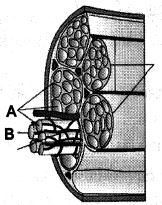
A
Muscle fibre and sarcolemma
B
Sarcolemma and blood capillary
C
Blood capillary and fascicle
D
Fascicle and blood capillary
Solution
(D) In the provided diagram of the skeletal muscle structure:
$A$ points to the fascicle,which is a bundle of muscle fibres.
$B$ points to the blood capillary,which supplies oxygen and nutrients to the muscle tissue.
Therefore,the correct identification is $A$ as fascicle and $B$ as blood capillary.
$A$ points to the fascicle,which is a bundle of muscle fibres.
$B$ points to the blood capillary,which supplies oxygen and nutrients to the muscle tissue.
Therefore,the correct identification is $A$ as fascicle and $B$ as blood capillary.
0 likes
View Solution31
MediumMCQ
Long bones function as ........
A
Support
B
Support,synthesis of red blood cells and white blood cells
C
Support and erythropoiesis
D
Erythropoiesis
Solution
(B) Long bones serve two primary functions in the human body:
$1$. Support: They provide structural framework and support for the body,allowing for posture and movement.
$2$. Erythropoiesis: The bone marrow located within the cavity of long bones is the primary site for the production of red blood cells (erythropoiesis),as well as white blood cells and platelets.
$1$. Support: They provide structural framework and support for the body,allowing for posture and movement.
$2$. Erythropoiesis: The bone marrow located within the cavity of long bones is the primary site for the production of red blood cells (erythropoiesis),as well as white blood cells and platelets.
0 likes
View Solution32
MediumMCQ
Which of the following is $NOT$ a function of the skeletal system?
A
Locomotion
B
Production of red blood cells
C
Storage of minerals
D
Production of body heat
Solution
(D) The skeletal system performs several vital functions,including providing structural support,facilitating locomotion (movement),protecting internal organs,storing minerals (like calcium and phosphorus),and housing bone marrow for hematopoiesis (production of red blood cells,white blood cells,and platelets).
Production of body heat is primarily a function of the muscular system through metabolic processes and muscle contractions,not the skeletal system itself.
Production of body heat is primarily a function of the muscular system through metabolic processes and muscle contractions,not the skeletal system itself.
0 likes
View Solution33
Difficult
Write true or false. If false,correct the statement to make it true.
$(a)$ Actin is present in thin filament.
$(b)$ $H$-zone of striated muscle fibre represents both thick and thin filaments.
$(c)$ Human skeleton has $206$ bones.
$(d)$ There are $11$ pairs of ribs in man.
$(e)$ Sternum is present on the ventral side of the body.
$(a)$ Actin is present in thin filament.
$(b)$ $H$-zone of striated muscle fibre represents both thick and thin filaments.
$(c)$ Human skeleton has $206$ bones.
$(d)$ There are $11$ pairs of ribs in man.
$(e)$ Sternum is present on the ventral side of the body.
Solution
(A) True.
$(b)$ False. The $H$-zone of a striated muscle fibre represents only the central part of the thick filament,where thin filaments do not overlap.
$(c)$ True.
$(d)$ False. There are $12$ pairs of ribs in man.
$(e)$ True.
$(b)$ False. The $H$-zone of a striated muscle fibre represents only the central part of the thick filament,where thin filaments do not overlap.
$(c)$ True.
$(d)$ False. There are $12$ pairs of ribs in man.
$(e)$ True.
0 likes
View Solution34
Difficult
Write the difference between (Any two):
$(a)$ Actin and Myosin
$(b)$ Red and White muscle fibres
$(c)$ Pectoral and Pelvic girdle
$(a)$ Actin and Myosin
$(b)$ Red and White muscle fibres
$(c)$ Pectoral and Pelvic girdle
Solution
(N/A) Actin and Myosin
$(b)$ Red and White muscle fibres
$(c)$ Pectoral and Pelvic girdle
| Actin | Myosin |
|---|---|
| $(1)$ Actin is a thin contractile protein. | $(1)$ Myosin is a thick contractile protein. |
| $(2)$ It is present in light bands and is called an isotropic band. | $(2)$ It is present in dark bands and is called an anisotropic band. |
$(b)$ Red and White muscle fibres
| Red muscle fibres | White muscle fibres |
|---|---|
| $(1)$ These are thin and smaller in size. | $(1)$ These are thick and larger in size. |
| $(2)$ They are red in colour due to high myoglobin content. | $(2)$ They are white in colour due to low myoglobin content. |
| $(3)$ They contain numerous mitochondria. | $(3)$ They contain fewer mitochondria. |
| $(4)$ They perform slow and sustained contractions for a long period. | $(4)$ They perform fast work for a short duration. |
| $(5)$ They generate energy primarily by aerobic respiration. | $(5)$ They generate energy primarily by anaerobic respiration. |
$(c)$ Pectoral and Pelvic girdle
| Pectoral girdle | Pelvic girdle |
|---|---|
| $(1)$ It provides skeletal support for the attachment of forelimbs. | $(1)$ It provides skeletal support for the attachment of hind limbs. |
| $(2)$ It consists of two bones: the clavicle and the scapula. | $(2)$ It consists of three fused bones: the ilium,ischium,and pubis. |
0 likes
View Solution35
EasyMCQ
Match Column $I$ with Column $II$.
| Column $I$ | Column $II$ |
|---|---|
| $(a)$ Smooth muscle | $(i)$ Myoglobin |
| $(b)$ Tropomyosin | $(ii)$ Thin filament |
| $(c)$ Red muscle | $(iii)$ Sutures |
| $(d)$ Skull | $(iv)$ Involuntary |
A
$a-iv, b-ii, c-i, d-iii$
B
$a-iii, b-ii, c-i, d-iv$
C
$a-iv, b-i, c-ii, d-iii$
D
$a-i, b-ii, c-iii, d-iv$
Solution
(A) The correct matching is as follows:
$1$. $(a)$ Smooth muscle: These are involuntary muscles found in the walls of internal organs. Thus,$(a-iv)$.
$2$. $(b)$ Tropomyosin: It is a regulatory protein that is a component of the thin filament in muscle fibers. Thus,$(b-ii)$.
$3$. $(c)$ Red muscle: These muscle fibers contain abundant myoglobin,which provides a reddish appearance and stores oxygen. Thus,$(c-i)$.
$4$. $(d)$ Skull: The bones of the skull are joined by fibrous joints called sutures,which are immovable. Thus,$(d-iii)$.
Therefore,the correct sequence is $a-iv, b-ii, c-i, d-iii$.
$1$. $(a)$ Smooth muscle: These are involuntary muscles found in the walls of internal organs. Thus,$(a-iv)$.
$2$. $(b)$ Tropomyosin: It is a regulatory protein that is a component of the thin filament in muscle fibers. Thus,$(b-ii)$.
$3$. $(c)$ Red muscle: These muscle fibers contain abundant myoglobin,which provides a reddish appearance and stores oxygen. Thus,$(c-i)$.
$4$. $(d)$ Skull: The bones of the skull are joined by fibrous joints called sutures,which are immovable. Thus,$(d-iii)$.
Therefore,the correct sequence is $a-iv, b-ii, c-i, d-iii$.
0 likes
View Solution36
Difficult
Fill in the blank spaces:
$(a)$ All mammals (except a few) have ............. cervical vertebra.
$(b)$ The number of phalanges in each limb of human is ............. .
$(c)$ Thin filament of myofibril contains $2 \,'F'$ actins and two other proteins namely .............. and ........... .
$(d)$ In a muscle fibre $Ca^{++}$ is stored in ............. .
$(e)$ .............. and .............. pairs of ribs are called floating ribs.
$(f)$ The human cranium is made of .............. bones.
$(a)$ All mammals (except a few) have ............. cervical vertebra.
$(b)$ The number of phalanges in each limb of human is ............. .
$(c)$ Thin filament of myofibril contains $2 \,'F'$ actins and two other proteins namely .............. and ........... .
$(d)$ In a muscle fibre $Ca^{++}$ is stored in ............. .
$(e)$ .............. and .............. pairs of ribs are called floating ribs.
$(f)$ The human cranium is made of .............. bones.
Solution
(N/A) All mammals (except a few) have $7$ cervical vertebrae.
$(b)$ The number of phalanges in each limb of a human is $14$.
$(c)$ Thin filament of myofibril contains $2 \,'F'$ actins and two other proteins,namely troponin and tropomyosin.
$(d)$ In a muscle fibre,$Ca^{++}$ is stored in the sarcoplasmic reticulum.
$(e)$ $11^{th}$ and $12^{th}$ pairs of ribs are called floating ribs.
$(f)$ The human cranium is made up of $8$ bones.
$(b)$ The number of phalanges in each limb of a human is $14$.
$(c)$ Thin filament of myofibril contains $2 \,'F'$ actins and two other proteins,namely troponin and tropomyosin.
$(d)$ In a muscle fibre,$Ca^{++}$ is stored in the sarcoplasmic reticulum.
$(e)$ $11^{th}$ and $12^{th}$ pairs of ribs are called floating ribs.
$(f)$ The human cranium is made up of $8$ bones.
0 likes
View Solution37
Easy
What is the skeletal system? Explain.
Solution
(N/A) $\Rightarrow$ The hard,supporting,and protective component of an animal body forms the skeleton or skeletal system.
$\Rightarrow$ The study of the skeletal system is known as $\text{Osteology}$. The skeletal system is composed of bones and a few cartilages.
$\Rightarrow$ It plays a significant role in the movement exhibited by the body.
$\Rightarrow$ Bone and cartilage are specialized types of connective tissue.
- Bone has a very hard matrix due to the presence of calcium salts,whereas cartilage has a slightly pliable matrix due to chondroitin salts.
In human beings,this system consists of $206$ bones and a few cartilages.
It is categorized into two principal divisions: $(i)$ the $\text{axial}$ skeleton and $(ii)$ the $\text{appendicular}$ skeleton.
$\Rightarrow$ The study of the skeletal system is known as $\text{Osteology}$. The skeletal system is composed of bones and a few cartilages.
$\Rightarrow$ It plays a significant role in the movement exhibited by the body.
$\Rightarrow$ Bone and cartilage are specialized types of connective tissue.
- Bone has a very hard matrix due to the presence of calcium salts,whereas cartilage has a slightly pliable matrix due to chondroitin salts.
In human beings,this system consists of $206$ bones and a few cartilages.
It is categorized into two principal divisions: $(i)$ the $\text{axial}$ skeleton and $(ii)$ the $\text{appendicular}$ skeleton.
0 likes
View Solution38
EasyMCQ
Locomotion requires a perfect coordinated activity of muscular system with $.......$ systems.
A
Skeletal
B
Nervous
C
Skeletal and Nervous
D
Digestive
Solution
(C) Locomotion is the voluntary movement of an organism from one place to another.
It requires the coordinated activity of three main systems:
$1$. Muscular system: Provides the force for movement.
$2$. Skeletal system: Provides the framework and points of attachment for muscles.
$3$. Nervous system: Provides the signals and coordination required for the movement.
Therefore,locomotion requires a perfect coordinated activity of the muscular system with skeletal and nervous systems.
It requires the coordinated activity of three main systems:
$1$. Muscular system: Provides the force for movement.
$2$. Skeletal system: Provides the framework and points of attachment for muscles.
$3$. Nervous system: Provides the signals and coordination required for the movement.
Therefore,locomotion requires a perfect coordinated activity of the muscular system with skeletal and nervous systems.
0 likes
View Solution39
EasyMCQ
Differentiate between Pectoral and Pelvic girdle.
A
Pectoral girdle supports the upper limbs; Pelvic girdle supports the lower limbs.
B
Pectoral girdle consists of scapula and clavicle; Pelvic girdle consists of two coxal bones.
C
Pectoral girdle is light and flexible; Pelvic girdle is heavy and rigid.
D
All of the above.
Solution
(D) The differences between the pectoral and pelvic girdles are as follows:
$1$. Function: The pectoral girdle supports the upper limbs (arms),while the pelvic girdle supports the lower limbs (legs) and protects the pelvic organs.
$2$. Composition: The pectoral girdle is composed of two bones on each side: the scapula and the clavicle. The pelvic girdle is composed of two coxal bones,each formed by the fusion of three bones: ilium,ischium,and pubis.
$3$. Structure: The pectoral girdle is designed for mobility and flexibility to allow a wide range of movement for the arms. In contrast,the pelvic girdle is designed for stability and weight-bearing,making it heavier and more rigid to support the body's weight.
$1$. Function: The pectoral girdle supports the upper limbs (arms),while the pelvic girdle supports the lower limbs (legs) and protects the pelvic organs.
$2$. Composition: The pectoral girdle is composed of two bones on each side: the scapula and the clavicle. The pelvic girdle is composed of two coxal bones,each formed by the fusion of three bones: ilium,ischium,and pubis.
$3$. Structure: The pectoral girdle is designed for mobility and flexibility to allow a wide range of movement for the arms. In contrast,the pelvic girdle is designed for stability and weight-bearing,making it heavier and more rigid to support the body's weight.
0 likes
View Solution40
MediumMCQ
Analogy type questions:
$(1)$ All locomotion : movement :: all movement : ...........
$(2)$ Cilia in trachea : help in removing dust particles :: Ciliated cells of female reproductive system : .........
$(1)$ All locomotion : movement :: all movement : ...........
$(2)$ Cilia in trachea : help in removing dust particles :: Ciliated cells of female reproductive system : .........
A
Not locomotion
B
Transport of ovum
C
Both $A$ and $B$
D
None of these
Solution
(C) $(1)$ All locomotion is movement, but all movement is not locomotion. Therefore, the answer is $not \ locomotion$.
$(2)$ Cilia in the trachea help in removing dust particles, whereas the ciliated epithelium in the fallopian tubes (female reproductive system) helps in the $transport \ of \ the \ ovum$ towards the uterus.
$(2)$ Cilia in the trachea help in removing dust particles, whereas the ciliated epithelium in the fallopian tubes (female reproductive system) helps in the $transport \ of \ the \ ovum$ towards the uterus.
0 likes
View Solution41
MediumMCQ
Analogy type questions:
$(1)$ Carpals : $8$ :: Tarsals : ...........
$(2)$ Cartilaginous joints : Between vertebrae of the vertebral column :: Hinge joint : ...........
$(1)$ Carpals : $8$ :: Tarsals : ...........
$(2)$ Cartilaginous joints : Between vertebrae of the vertebral column :: Hinge joint : ...........
A
$(1)$ $7$,$(2)$ Knee joint
B
$(1)$ $7$,$(2)$ Elbow joint
C
$(1)$ $5$,$(2)$ Shoulder joint
D
$(1)$ $6$,$(2)$ Hip joint
Solution
(B) $(1)$ The wrist bones (carpals) are $8$ in number,while the ankle bones (tarsals) are $7$ in number.
$(2)$ Cartilaginous joints are found between the vertebrae of the vertebral column. Hinge joints allow movement in one plane,such as the elbow joint or knee joint. Given the context of standard biological examples,the elbow joint is the most common representative for a hinge joint.
$(2)$ Cartilaginous joints are found between the vertebrae of the vertebral column. Hinge joints allow movement in one plane,such as the elbow joint or knee joint. Given the context of standard biological examples,the elbow joint is the most common representative for a hinge joint.
0 likes
View Solution42
MediumMCQ
Analogy type questions:
$(1)$ Active site for actin is present on the tail of myosin / head of myosin.
$(2)$ Movement of body parts in living organisms is induced / spontaneous.
$(1)$ Active site for actin is present on the tail of myosin / head of myosin.
$(2)$ Movement of body parts in living organisms is induced / spontaneous.
A
$(1)$ Tail of myosin,$(2)$ Induced
B
$(1)$ Head of myosin,$(2)$ Spontaneous
C
$(1)$ Tail of myosin,$(2)$ Spontaneous
D
$(1)$ Head of myosin,$(2)$ Induced
Solution
(B) $(1)$ The myosin head contains an active site for actin binding,which allows the formation of cross-bridges during muscle contraction.
$(2)$ The movement of body parts in living organisms is spontaneous,meaning it occurs due to internal physiological processes rather than being induced by external forces.
$(2)$ The movement of body parts in living organisms is spontaneous,meaning it occurs due to internal physiological processes rather than being induced by external forces.
0 likes
View Solution43
MediumMCQ
Analogy type questions:
$(1)$ During muscle contraction,the $A$-band does not change in length.
$(2)$ The $8^{th}$,$9^{th}$,and $10^{th}$ pairs of ribs are attached to the $7^{th}$ pair of ribs with the help of hyaline cartilage. Identify the terms.
$(1)$ During muscle contraction,the $A$-band does not change in length.
$(2)$ The $8^{th}$,$9^{th}$,and $10^{th}$ pairs of ribs are attached to the $7^{th}$ pair of ribs with the help of hyaline cartilage. Identify the terms.
A
$(1)$ $A$-band,$(2)$ False ribs
B
$(1)$ $I$-band,$(2)$ Floating ribs
C
$(1)$ $Z$-line,$(2)$ True ribs
D
$(1)$ $H$-zone,$(2)$ Vertebrosternal ribs
Solution
(A) $(1)$ During muscle contraction,the length of the $A$-band remains constant because the myosin filaments do not change their length.
$(2)$ The $8^{th}$,$9^{th}$,and $10^{th}$ pairs of ribs do not articulate directly with the sternum but are attached to the $7^{th}$ rib via hyaline cartilage; these are known as false ribs (vertebrochondral ribs).
$(2)$ The $8^{th}$,$9^{th}$,and $10^{th}$ pairs of ribs do not articulate directly with the sternum but are attached to the $7^{th}$ rib via hyaline cartilage; these are known as false ribs (vertebrochondral ribs).
0 likes
View Solution44
EasyMCQ
Match the following columns and select the correct option.
$(a) \quad (b) \quad (c) \quad (d)$
| Column-$I$ | Column-$II$ |
| $(a)$ Floating Ribs | $(i)$ Located between second and seventh ribs |
| $(b)$ Acromion | $(ii)$ Head of the Humerus |
| $(c)$ Scapula | $(iii)$ Clavicle |
| $(d)$ Glenoid cavity | $(iv)$ Do not connect with the sternum |
$(a) \quad (b) \quad (c) \quad (d)$
A
$(iv) \quad (iii) \quad (i) \quad (ii)$
B
$(ii) \quad (iv) \quad (i) \quad (iii)$
C
$(i) \quad (iii) \quad (ii) \quad (iv)$
D
$(iii) \quad (ii) \quad (iv) \quad (i)$
Solution
(A) The correct matches are as follows:
$(a)$ Floating Ribs: These are the $11^{th}$ and $12^{th}$ pairs of ribs that do not connect with the sternum, hence $(iv)$.
$(b)$ Acromion: It is a bony process on the scapula that articulates with the clavicle, hence $(iii)$.
$(c)$ Scapula: It is a large triangular bone situated in the dorsal part of the thorax between the second and seventh ribs, hence $(i)$.
$(d)$ Glenoid cavity: It is a depression in the scapula that articulates with the head of the humerus, hence $(ii)$.
Therefore, the correct sequence is $(a)-(iv), (b)-(iii), (c)-(i), (d)-(ii)$.
$(a)$ Floating Ribs: These are the $11^{th}$ and $12^{th}$ pairs of ribs that do not connect with the sternum, hence $(iv)$.
$(b)$ Acromion: It is a bony process on the scapula that articulates with the clavicle, hence $(iii)$.
$(c)$ Scapula: It is a large triangular bone situated in the dorsal part of the thorax between the second and seventh ribs, hence $(i)$.
$(d)$ Glenoid cavity: It is a depression in the scapula that articulates with the head of the humerus, hence $(ii)$.
Therefore, the correct sequence is $(a)-(iv), (b)-(iii), (c)-(i), (d)-(ii)$.
0 likes
View Solution45
EasyMCQ
Salamander can regenerate:
A
Tail
B
External gills
C
Limbs
D
All of these
Solution
(D) Salamanders are well-known for their remarkable regenerative capabilities. They can regenerate various body parts,including their tail,limbs,and external gills,following an injury or amputation.
0 likes
View Solution46
EasyMCQ
Which of the following sets of characters are applicable in the metamorphosis of the tadpole larva of frogs and toads?
A
Reabsorption of gills and reabsorption of tail
B
Reabsorption of gills and lengthening of tail
C
Complete development of gills and reabsorption of tail
D
Complex development of gills and lengthening of tail
Solution
(A) The tadpole larva of frogs and toads is aquatic and possesses gills for respiration and a tail for swimming. During the process of metamorphosis,these larval structures are no longer required for the terrestrial adult stage. Therefore,the gills are reabsorbed,and the tail is also reabsorbed to facilitate the transition to an adult form.
0 likes
View Solution47
MediumMCQ
Which is not the function of the endoskeleton?
A
Sight
B
Hearing
C
Locomotion
D
Production of $RBCs$
Solution
(A) Sight is not a function of the endoskeleton,as vision or image formation does not involve the bony skeleton.
$1)$ Hearing involves the ear ossicles ($malleus$,$incus$,and $stapes$) for the amplification of sound waves,which are part of the skeletal system.
$2)$ Locomotion involves the movement of the appendicular skeleton,which provides the framework for muscle attachment.
$3)$ The bone marrow within the endoskeleton is responsible for $haemopoiesis$ (the production of blood cells,including $RBCs$).
$1)$ Hearing involves the ear ossicles ($malleus$,$incus$,and $stapes$) for the amplification of sound waves,which are part of the skeletal system.
$2)$ Locomotion involves the movement of the appendicular skeleton,which provides the framework for muscle attachment.
$3)$ The bone marrow within the endoskeleton is responsible for $haemopoiesis$ (the production of blood cells,including $RBCs$).
0 likes
View Solution48
MediumMCQ
The human skeletal system consists of:
A
$200 \; \text{bones}$
B
$300 \; \text{bones}$
C
$206 \; \text{bones}$
D
$250 \; \text{bones}$
Solution
(C) The adult human skeletal system consists of $206$ bones.
At birth, the human skeleton contains approximately $270$ bones, but as the body grows, many of these bones fuse together.
These $206$ bones are categorized into two main divisions: the axial skeleton ($80$ bones) and the appendicular skeleton ($126$ bones).
The ear ossicles (malleus, incus, and stapes) are included in this count.
At birth, the human skeleton contains approximately $270$ bones, but as the body grows, many of these bones fuse together.
These $206$ bones are categorized into two main divisions: the axial skeleton ($80$ bones) and the appendicular skeleton ($126$ bones).
The ear ossicles (malleus, incus, and stapes) are included in this count.
0 likes
View Solution49
MediumMCQ
Locomotion requires a perfectly coordinated activity of:
A
Muscular system
B
Skeletal system
C
Neural system
D
All of these
Solution
(D) Locomotion is a complex process that involves the integrated functioning of multiple systems in the body.
$1$. The $\text{Muscular system}$ provides the force and contraction necessary for movement.
$2$. The $\text{Skeletal system}$ provides the structural framework and leverage points for muscles to act upon.
$3$. The $\text{Neural system}$ provides the necessary signals and coordination to ensure that muscles contract in the correct sequence and intensity.
Therefore, all these systems must work together in a perfectly coordinated manner to achieve locomotion.
$1$. The $\text{Muscular system}$ provides the force and contraction necessary for movement.
$2$. The $\text{Skeletal system}$ provides the structural framework and leverage points for muscles to act upon.
$3$. The $\text{Neural system}$ provides the necessary signals and coordination to ensure that muscles contract in the correct sequence and intensity.
Therefore, all these systems must work together in a perfectly coordinated manner to achieve locomotion.
0 likes
View Solution50
MediumMCQ
Which of the following statements is correct?
A
Movable skull bone is mandible.
B
We move our hands while walking for balancing.
C
Cartilaginous joints have little mobility.
D
All of the above.
Solution
(D) The mandible is the only movable bone in the skull,which allows for chewing and speech.
When walking,the swinging motion of the arms helps in maintaining balance and counteracting the rotation of the torso.
Cartilaginous joints,such as those between adjacent vertebrae,allow for limited movement due to the presence of cartilage between the bones.
Since all three statements are scientifically accurate,the correct option is $D$.
When walking,the swinging motion of the arms helps in maintaining balance and counteracting the rotation of the torso.
Cartilaginous joints,such as those between adjacent vertebrae,allow for limited movement due to the presence of cartilage between the bones.
Since all three statements are scientifically accurate,the correct option is $D$.
0 likes
View SolutionLocomotion and Movement — Mix Examples- Locomotion and Movement · Frequently Asked Questions
1Are these Locomotion and Movement questions useful for JEE and NEET?
Yes. All questions in this section are mapped to JEE Main and NEET exam patterns. Previous year questions from JEE Main, NEET, GUJCET and state-level exams are included with full solutions.
2Can I switch to Hindi or Gujarati for these questions?
Yes. Use the language tabs in the hero section or the sidebar to view the same questions and solutions in English, Hindi or Gujarati.
3How do I generate a question paper from this subtopic?
Use the Vedclass Exam Paper Generator — select the chapter and subtopic, set difficulty, and generate Sets A, B, C, D automatically. First 3 chapters of every subject are free.
Vedclass Products
For Students
Vedclass Test Series
Mock tests in real JEE/NEET style with performance analysis. 5-day free trial.
Start Free TrialFor Teachers
Exam Paper Generator
Generate Set A/B/C/D papers from this chapter in 2 minutes. 3 chapters free.
Try FreeFor Institutes
Online Exam Module
Live online exams with unlimited students, 360° analytics & white-label branding.
See DemoFor Teachers & Institutes
Generate a Locomotion and Movement Exam Paper in 2 Minutes
Select subtopic & difficulty — Sets A, B, C, D auto-generated with No Repeat logic.
First 3 chapters of every subject are free — no payment required.