
A English
Appendicular skeleton Questions in English
Class 11 Biology · Locomotion and Movement · Appendicular skeleton
132+
Questions
English
Language
100%
With Solutions
Showing 50 of 132 questions in English
1
MediumMCQ
In mammals,the name $''Innominate''$ has been applied to:
A
$A$ nerve and an artery
B
$A$ part of skeleton and an artery
C
$A$ bone and a nerve
D
$A$ vein and a kidney tubule
Solution
(B) The term $''Innominate''$ is used in two contexts in mammalian anatomy:
$1$. $Innominate$ $bone$: Each half of the pelvic girdle is known as the $innominate$ bone (or $coxal$ bone),which is formed by the fusion of the $ilium$,$ischium$,and $pubis$.
$2$. $Innominate$ $artery$: This is another name for the $brachiocephalic$ trunk,which is the first branch of the aortic arch.
Therefore,it refers to a part of the skeleton and an artery.
$1$. $Innominate$ $bone$: Each half of the pelvic girdle is known as the $innominate$ bone (or $coxal$ bone),which is formed by the fusion of the $ilium$,$ischium$,and $pubis$.
$2$. $Innominate$ $artery$: This is another name for the $brachiocephalic$ trunk,which is the first branch of the aortic arch.
Therefore,it refers to a part of the skeleton and an artery.
0 likes
View Solution2
EasyMCQ
Innominate is a
A
Nerve
B
Muscle
C
Animal
D
Part of skeleton
Solution
(D) The correct answer is $D$. The pelvic girdle of vertebrates consists of two coxal bones. Each coxal bone (innominate bone or hip bone) is formed by the fusion of three bones: the ilium,ischium,and pubis. These bones fuse together in the adult to form a single structure,which is a part of the appendicular skeleton.
0 likes
View Solution3
MediumMCQ
The acromion process articulates with the
A
Clavicle
B
Scapula
C
Ribs
D
Vertebral column
Solution
(A) The $Scapula$ is a large,triangular bone situated in the dorsal part of the thorax between the $2^{nd}$ and the $7^{th}$ ribs.
Each $Scapula$ has a slightly elevated ridge called the spine which projects as a flat,expanded process called the $Acromion$ process.
The $Clavicle$ (collar bone) articulates with this $Acromion$ process to form the shoulder joint structure.
Each $Scapula$ has a slightly elevated ridge called the spine which projects as a flat,expanded process called the $Acromion$ process.
The $Clavicle$ (collar bone) articulates with this $Acromion$ process to form the shoulder joint structure.
0 likes
View Solution4
EasyMCQ
In rabbit,radius and ulna are:
A
Completely fused together
B
Completely separated
C
Fused in middle and separated at both the ends
D
Separated but united at both the ends
Solution
(D) In rabbit,the radius and ulna are separate bones,but they are united at both the proximal and distal ends by ligaments. This arrangement allows for limited rotation of the forearm.
0 likes
View Solution5
MediumMCQ
$A$ shallow depression in the scapula which receives the head of the upper arm bone is known as the
A
Acetabulum
B
Neural arch
C
Glenoid cavity
D
None of the above
Solution
(C) The scapula is a large,triangular,flat bone situated in the dorsal part of the thorax between the $2^{nd}$ and the $7^{th}$ ribs.
It contains a shallow articular surface called the glenoid cavity.
The glenoid cavity articulates with the head of the humerus (the upper arm bone) to form the shoulder joint.
It contains a shallow articular surface called the glenoid cavity.
The glenoid cavity articulates with the head of the humerus (the upper arm bone) to form the shoulder joint.
0 likes
View Solution6
EasyMCQ
Patella, the knee cap, is an example of:
A
Cartilage gland
B
Replacing bone
C
Sesamoid bone
D
None of the above
Solution
(C) The patella, commonly known as the knee cap, is a classic example of a sesamoid bone.
Sesamoid bones are small, nodular bones embedded within tendons or joint capsules.
The patella develops within the tendon of the $quadriceps \text{ } femoris$ muscle, providing protection to the knee joint and increasing the leverage of the muscle.
Sesamoid bones are small, nodular bones embedded within tendons or joint capsules.
The patella develops within the tendon of the $quadriceps \text{ } femoris$ muscle, providing protection to the knee joint and increasing the leverage of the muscle.
0 likes
View Solution7
MediumMCQ
The $Humerus$ bone is situated in:
A
Thigh
B
Lower arm
C
Upper arm
D
Shank
Solution
(C) The correct answer is $C$.
Each upper arm or brachium of mammals contains a single long bone known as the $Humerus$.
The proximal end of the $Humerus$ is swollen,spherical,and smooth,forming the 'head' of the bone.
This head fits into the glenoid cavity of the pectoral girdle to form the shoulder joint.
Each upper arm or brachium of mammals contains a single long bone known as the $Humerus$.
The proximal end of the $Humerus$ is swollen,spherical,and smooth,forming the 'head' of the bone.
This head fits into the glenoid cavity of the pectoral girdle to form the shoulder joint.
0 likes
View Solution8
MediumMCQ
The cup-shaped cavity for the articulation of the head of the femur is called:
A
Glenoid cavity
B
Acetabulum
C
Obturator
D
Sigmoid notch
Solution
(B) The $Acetabulum$ is a cup-shaped depression located on the lateral surface of the hip bone (pelvic girdle).
It is formed by the fusion of three bones: the $ilium$,$ischium$,and $pubis$.
This cavity provides the site for the articulation of the head of the $femur$ (thigh bone),forming the hip joint.
It is formed by the fusion of three bones: the $ilium$,$ischium$,and $pubis$.
This cavity provides the site for the articulation of the head of the $femur$ (thigh bone),forming the hip joint.
0 likes
View Solution9
EasyMCQ
Which is modified to form a sesamoid bone?
A
Tendon
B
Ilium
C
Pubic
D
Coracoid
Solution
(A) sesamoid bone is a small,round bone embedded within a tendon or a muscle.
It develops through the process of ossification within the tendon where it passes over a joint,serving to reduce friction and modify pressure.
The most common example of a sesamoid bone in the human body is the patella (kneecap),which is embedded in the tendon of the quadriceps muscle.
It develops through the process of ossification within the tendon where it passes over a joint,serving to reduce friction and modify pressure.
The most common example of a sesamoid bone in the human body is the patella (kneecap),which is embedded in the tendon of the quadriceps muscle.
0 likes
View Solution10
MediumMCQ
The transverse processes of the sacral vertebrae are attached to which part of the pelvic girdle?
A
Mastoid process
B
Ilium
C
Ischium
D
Pubis
Solution
(B) The pelvic girdle consists of two coxal bones. Each coxal bone is formed by the fusion of three bones: $Ilium$,$Ischium$,and $Pubis$. The sacrum is a large,triangular bone at the base of the spine,formed by the fusion of five sacral vertebrae. The transverse processes of the sacral vertebrae articulate with the $Ilium$ part of the pelvic girdle to form the sacro-iliac joint,which provides stability to the pelvic region.
0 likes
View Solution11
MediumMCQ
The cup-shaped structure of the pelvic girdle,the acetabulum in man,is formed by:
A
Ilium,ischium,and pubis
B
Ilium,ischium,and cotyloid
C
Ilium and ischium
D
Ilium and cotyloid
Solution
(A) The pelvic girdle consists of two coxal bones. Each coxal bone is formed by the fusion of three bones: $Ilium$,$Ischium$,and $Pubis$.
At the point of fusion of these three bones,there is a cavity called the $Acetabulum$ to which the thigh bone (femur) articulates.
At the point of fusion of these three bones,there is a cavity called the $Acetabulum$ to which the thigh bone (femur) articulates.
0 likes
View Solution12
MediumMCQ
The pectoral and pelvic girdles and the bones of limbs form:
A
Axial skeleton
B
Appendicular skeleton
C
Visceral skeleton
D
Outer skeleton
Solution
(B) The human skeletal system is divided into two parts: the axial skeleton and the appendicular skeleton.
$(1)$ The axial skeleton consists of the skull,vertebral column,ribs,and sternum.
$(2)$ The appendicular skeleton consists of the pectoral girdle,pelvic girdle,and the bones of the limbs (arms and legs).
Therefore,the pectoral and pelvic girdles and the bones of the limbs form the appendicular skeleton.
$(1)$ The axial skeleton consists of the skull,vertebral column,ribs,and sternum.
$(2)$ The appendicular skeleton consists of the pectoral girdle,pelvic girdle,and the bones of the limbs (arms and legs).
Therefore,the pectoral and pelvic girdles and the bones of the limbs form the appendicular skeleton.
0 likes
View Solution13
MediumMCQ
The cavity between the coracoid and scapula is known as:
A
Vomer
B
Acetabulum
C
Glenoid
D
Orbital
Solution
(C) The scapula is a large triangular flat bone situated in the dorsal part of the thorax between the second and the seventh ribs. The dorsal,flat,triangular body of the scapula has a slightly elevated ridge called the spine which projects as a flat,expanded process called the acromion. Below the acromion is a depression called the glenoid cavity which articulates with the head of the humerus to form the shoulder joint. The coracoid process is a small hook-like structure on the lateral edge of the superior anterior portion of the scapula.
0 likes
View Solution14
MediumMCQ
The total number of bones in your right arm is
A
$30$
B
$32$
C
$35$
D
$40$
Solution
(A) The human arm consists of the following bones:
$1$ Humerus (upper arm bone),
$1$ Radius and $1$ Ulna (forearm bones),
$8$ Carpals (wrist bones),
$5$ Metacarpals (palm bones),and
$14$ Phalanges (finger bones).
Total = $1 + 1 + 1 + 8 + 5 + 14 = 30$ bones.
Therefore,the total number of bones in the right arm is $30$.
$1$ Humerus (upper arm bone),
$1$ Radius and $1$ Ulna (forearm bones),
$8$ Carpals (wrist bones),
$5$ Metacarpals (palm bones),and
$14$ Phalanges (finger bones).
Total = $1 + 1 + 1 + 8 + 5 + 14 = 30$ bones.
Therefore,the total number of bones in the right arm is $30$.
0 likes
View Solution15
EasyMCQ
$A$ bone that is formed by ossification within the tendon of a muscle is called:
A
Investing
B
Cartilaginous
C
Sesamoid
D
Membranous
Solution
(C) $Sesamoid$ bone is a small,round bone that is embedded within a tendon or a muscle. These bones typically form in response to strain or friction,providing a smooth surface for tendons to slide over,which increases the mechanical advantage of the joint. The most common example of a $Sesamoid$ bone in the human body is the $Patella$ (kneecap),which develops within the tendon of the quadriceps femoris muscle.
0 likes
View Solution16
EasyMCQ
An acromion process is characteristically found in mammals in the:
A
Pelvic girdle
B
Pectoral girdle
C
Skull
D
Sternum
Solution
(B) The pectoral girdle in mammals consists of two bones: the clavicle and the scapula.
Each scapula is a large,triangular,flat bone situated in the dorsal part of the thorax between the second and the seventh ribs.
The dorsal,flat,triangular body of the scapula has a slightly elevated ridge called the spine which projects as a flat,expanded process called the acromion process.
The clavicle articulates with this acromion process.
Each scapula is a large,triangular,flat bone situated in the dorsal part of the thorax between the second and the seventh ribs.
The dorsal,flat,triangular body of the scapula has a slightly elevated ridge called the spine which projects as a flat,expanded process called the acromion process.
The clavicle articulates with this acromion process.
0 likes
View Solution17
MediumMCQ
Which one of the following components is a part of the pectoral girdle?
A
Acetabulum
B
Hilum
C
Sternum
D
Glenoid cavity
Solution
(D) The pectoral girdle (shoulder girdle) consists of two bones: the clavicle and the scapula.
Each scapula contains a depression called the glenoid cavity,which articulates with the head of the humerus to form the shoulder joint.
In contrast,the acetabulum is a cup-like depression found in the pelvic girdle that articulates with the head of the femur.
The sternum is a part of the axial skeleton,and the hilum is a general anatomical term for a depression or pit where vessels and nerves enter an organ.
Each scapula contains a depression called the glenoid cavity,which articulates with the head of the humerus to form the shoulder joint.
In contrast,the acetabulum is a cup-like depression found in the pelvic girdle that articulates with the head of the femur.
The sternum is a part of the axial skeleton,and the hilum is a general anatomical term for a depression or pit where vessels and nerves enter an organ.
0 likes
View Solution18
EasyMCQ
The olecranon process is found in:
A
Proximal end of ulna
B
Distal end of ulna
C
Proximal end of tibia
D
Proximal end of humerus
Solution
(A) The $ulna$ bone of the forearm possesses a large,prominent projection at its proximal end known as the $olecranon$ $process$.
This process fits into the $olecranon$ $fossa$ of the $humerus$ when the elbow is extended,forming a hinge joint that allows for the movement of the forearm.
This process fits into the $olecranon$ $fossa$ of the $humerus$ when the elbow is extended,forming a hinge joint that allows for the movement of the forearm.
0 likes
View Solution19
MediumMCQ
Which part of the mammalian body has a single pair of bones?
A
External ear
B
Lower jaw
C
Pelvic girdle
D
Wrist
Solution
(C) The correct answer is $C$. The pelvic girdle in mammals consists of two coxal bones (hip bones). Each coxal bone is formed by the fusion of three bones: the $Ilium$,$Pubis$,and $Ischium$. Together,these two coxal bones form a single pair of bones that make up the pelvic girdle.
0 likes
View Solution20
MediumMCQ
The ventral wall of the pubis has a small bone called:
A
Coracoid
B
Cotyloid
C
Pubic symphysis
D
Epipubic bone
Solution
(D) In many vertebrates,particularly in amphibians and some reptiles,the ventral wall of the pubis possesses a small,cartilaginous or bony structure known as the $Epipubic$ bone (also called the $marsupial$ bone in some mammals). The other options provided are incorrect: $Coracoid$ is part of the pectoral girdle,$Cotyloid$ refers to the acetabulum cavity,and $Pubic$ $symphysis$ is the cartilaginous joint between the two pubic bones.
0 likes
View Solution21
EasyMCQ
The deltoid ridge is found in which one of the following bones?
A
Radius
B
Tibia
C
Femur
D
Humerus
Solution
(D) . The $Humerus$ is differentiated into three parts: the head,the shaft,and the lower end. The shaft features a $V$-shaped deltoid ridge located at its middle,which serves as the attachment site for the deltoid muscle.
0 likes
View Solution22
EasyMCQ
The pelvic girdle of a rabbit consists of:
A
Ilium,ischium,and pubis
B
Ilium,ischium,and coracoid
C
Coracoid,scapula,and clavicle
D
Ilium,coracoid,and scapula
Solution
(A) The pelvic girdle of a rabbit,like other mammals,is composed of two symmetrical halves. Each half is formed by the fusion of three bones: the ilium,the ischium,and the pubis. These three bones fuse together to form a single structure known as the innominate bone or hip bone.
0 likes
View Solution23
EasyMCQ
Which of the following bones forms the heel in a rabbit?
A
Tarsus
B
Calcaneum
C
Calcaneal process
D
Metatarsal
Solution
(B) In the hind limb of a rabbit,the tarsal bones are arranged in two rows. The proximal row consists of two large bones: the tibiale (astragalus) and the fibulare (calcaneum). The calcaneum is the largest tarsal bone and it projects backward to form the heel bone of the rabbit.
0 likes
View Solution24
EasyMCQ
The innominate or hip bone is formed by the fusion of how many bones?
A
$2$
B
$3$
C
$4$
D
$5$
Solution
(B) The hip bone (coxal bone) is formed by the fusion of three bones: the ilium,the ischium,and the pubis.
These three bones fuse together at the acetabulum,which is a cup-like cavity that articulates with the head of the femur to form the hip joint.
These three bones fuse together at the acetabulum,which is a cup-like cavity that articulates with the head of the femur to form the hip joint.
0 likes
View Solution25
MediumMCQ
The pelvic girdles of females are ...... than those of males.
A
Narrower
B
Broader
C
Stouter
D
$(A)$ and $(B)$ both
Solution
(B) The correct option is $(B)$. The pelvic girdle in females is broader and shallower compared to males. This anatomical adaptation is essential to facilitate the process of parturition (childbirth) by providing a larger birth canal.
0 likes
View Solution26
MediumMCQ
The phalangeal formula of the human hand is:
A
$1, 2, 2, 2, 2$
B
$2, 1, 1, 1, 1$
C
$2, 3, 3, 3, 3$
D
$2, 3, 3, 2, 2$
Solution
(C) The human hand consists of $5$ digits.
Each finger (index,middle,ring,and little finger) contains $3$ phalanges,while the thumb contains $2$ phalanges.
Therefore,the phalangeal formula for the human hand is $2, 3, 3, 3, 3$.
Each finger (index,middle,ring,and little finger) contains $3$ phalanges,while the thumb contains $2$ phalanges.
Therefore,the phalangeal formula for the human hand is $2, 3, 3, 3, 3$.
0 likes
View Solution27
EasyMCQ
The thumb (great toe) of the foot is called:
A
Pollex
B
Hollex
C
Pallux
D
Hallux
Solution
(D) The correct answer is $D$. The thumb (great finger) of the hand is known as the $Pollex$,whereas the great toe of the foot is known as the $Hallux$.
0 likes
View Solution28
MediumMCQ
The obturator foramen in the pelvic girdle of a mammal is formed by:
A
Pubis and ischium
B
Pubis and ilium
C
Ilium and ischium
D
Ilium,ischium,and pubis
Solution
(D) The pelvic girdle of a mammal consists of two coxal bones. Each coxal bone is formed by the fusion of three bones: the $Ilium$,$Ischium$,and $Pubis$.
These three bones meet at a cavity called the acetabulum,to which the head of the femur articulates.
Between the $Pubis$ and the $Ischium$ bones,there is a large,oval-shaped opening known as the obturator foramen,which allows for the passage of nerves and blood vessels.
These three bones meet at a cavity called the acetabulum,to which the head of the femur articulates.
Between the $Pubis$ and the $Ischium$ bones,there is a large,oval-shaped opening known as the obturator foramen,which allows for the passage of nerves and blood vessels.
0 likes
View Solution29
MediumMCQ
The appendicular skeleton includes all of the following $EXCEPT$:
A
Hind limb
B
Fore limb
C
Amphicoelous vertebra
D
Pectoral and pelvic girdle
Solution
(C) The human skeletal system is divided into two main parts: the axial skeleton and the appendicular skeleton.
$1$. The axial skeleton consists of the skull,vertebral column,sternum,and ribs.
$2$. The appendicular skeleton consists of the bones of the limbs (fore limbs and hind limbs) along with their respective girdles (pectoral and pelvic girdles).
$3$. An amphicoelous vertebra is a part of the vertebral column,which belongs to the axial skeleton.
Therefore,the correct answer is $C$.
$1$. The axial skeleton consists of the skull,vertebral column,sternum,and ribs.
$2$. The appendicular skeleton consists of the bones of the limbs (fore limbs and hind limbs) along with their respective girdles (pectoral and pelvic girdles).
$3$. An amphicoelous vertebra is a part of the vertebral column,which belongs to the axial skeleton.
Therefore,the correct answer is $C$.
0 likes
View Solution30
EasyMCQ
The sigmoid notch is present in
A
Femur
B
Tibio-fibula
C
Humerus
D
Ulna
Solution
(D) The $Ulna$ is a bone in the forearm that is thicker and longer. It features a subterminal,cup-like receptacle known as the $sigmoid$ $notch$ (or $olecranon$ $notch$),which facilitates articulation with the distal end of the $Humerus$ to form the elbow joint.
0 likes
View Solution31
MediumMCQ
The ankle bones consist of $6$ tarsals arranged in three rows. What does the $1^{st}$ row contain?
A
Astragalus and calcaneum
B
Pterygoid and astragalus
C
Pterygoid and calcaneum
D
None of these
Solution
(A) The ankle,also known as the tarsus,consists of $6$ tarsal bones arranged in three rows connected by gliding joints.
The $1^{st}$ (proximal) row contains two bones: the outer calcaneum (heel bone) and the inner talus (also known as the astragalus).
Therefore,the correct option is $A$.
The $1^{st}$ (proximal) row contains two bones: the outer calcaneum (heel bone) and the inner talus (also known as the astragalus).
Therefore,the correct option is $A$.
0 likes
View Solution32
MediumMCQ
Patella is associated with
A
Elbow
B
Knee
C
Neck
D
Wrist
Solution
(B) . The patella is a flat,triangular bone that covers and protects the knee joint. It is commonly known as the knee cap.
0 likes
View Solution33
MediumMCQ
The $Olecranon$ process is a type of:
A
Investing bone
B
Membrane bone
C
Cartilaginous bone
D
Sesamoid bone
Solution
(C) The $Olecranon$ process is a large,thick,curved bony eminence at the proximal end of the $Ulna$ (the forearm bone).
It is formed through the process of endochondral ossification,where cartilage is replaced by bone tissue.
Therefore,it is classified as a cartilaginous bone.
It is formed through the process of endochondral ossification,where cartilage is replaced by bone tissue.
Therefore,it is classified as a cartilaginous bone.
0 likes
View Solution34
MediumMCQ
In mammals,each half of the pectoral girdle consists of:
A
Supra scapula
B
Scapula
C
Coracoid
D
All the above
Solution
(D) The correct answer is $D$. In mammals,each half of the pectoral girdle is composed of three primary skeletal components: the scapula,the supra scapula,and the coracoid process. These elements collectively form the structure that supports the forelimbs.
0 likes
View Solution35
MediumMCQ
In mammals,each half of the pelvic girdle consists of:
A
Ilium
B
Ischium
C
Pubis
D
All the above
Solution
(D) Each half of the pelvic girdle (coxal bone) is formed by the fusion of three bones: the ilium,ischium,and pubis. These three bones fuse together during embryonic development to form a single coxal bone.
0 likes
View Solution36
MediumMCQ
Total number of bones in the hind limb of a man is
A
$14$
B
$21$
C
$24$
D
$30$
Solution
(D) The correct answer is $(d)$.
Each hind limb of a human consists of $30$ bones.
The distribution of these bones is as follows:
$1$ Femur (thigh bone),
$1$ Patella (knee cap),
$1$ Tibia (shin bone),
$1$ Fibula,
$7$ Tarsals (ankle bones),
$5$ Metatarsals (sole bones),
$14$ Phalanges (toe bones).
Total = $1 + 1 + 1 + 1 + 7 + 5 + 14 = 30$ bones.
Each hind limb of a human consists of $30$ bones.
The distribution of these bones is as follows:
$1$ Femur (thigh bone),
$1$ Patella (knee cap),
$1$ Tibia (shin bone),
$1$ Fibula,
$7$ Tarsals (ankle bones),
$5$ Metatarsals (sole bones),
$14$ Phalanges (toe bones).
Total = $1 + 1 + 1 + 1 + 7 + 5 + 14 = 30$ bones.
0 likes
View Solution37
MediumMCQ
Astragalus and calcaneum are present in
A
Fore limb
B
Hind limb
C
Scapula
D
Clavicle
Solution
(B) The $Astragalus$ (also known as the $talus$) and $calcaneum$ (heel bone) are tarsal bones found in the ankle region of the $Hind$ limb of humans and other mammals. These bones are part of the tarsus, which consists of $7$ bones in total.
0 likes
View Solution38
EasyMCQ
Which of the following is an example of the appendicular skeleton?
A
Bones of the skull
B
Bones of the vertebral column
C
Ribs
D
Bones of fore and hind limbs
Solution
(D) The human skeleton is divided into two parts: the axial skeleton and the appendicular skeleton.
$(1)$ The axial skeleton consists of the skull,vertebral column,sternum,and ribs.
$(2)$ The appendicular skeleton consists of the pectoral and pelvic girdles,along with the bones of the forelimbs (arms) and hind limbs (legs).
Therefore,the bones of the fore and hind limbs are part of the appendicular skeleton.
$(1)$ The axial skeleton consists of the skull,vertebral column,sternum,and ribs.
$(2)$ The appendicular skeleton consists of the pectoral and pelvic girdles,along with the bones of the forelimbs (arms) and hind limbs (legs).
Therefore,the bones of the fore and hind limbs are part of the appendicular skeleton.
0 likes
View Solution39
MediumMCQ
The appendicular skeleton consists of:
A
Girdles and limbs
B
Vertebrae
C
Ribs and sternum
D
Skull
Solution
(A) The human skeletal system is divided into two main parts: the axial skeleton and the appendicular skeleton.
$1$. The axial skeleton consists of the skull,vertebral column,ribs,and sternum,which form the central axis of the body.
$2$. The appendicular skeleton consists of the limbs (arms and legs) and the girdles (pectoral and pelvic girdles) that attach the limbs to the axial skeleton.
Therefore,the correct option is $A$.
$1$. The axial skeleton consists of the skull,vertebral column,ribs,and sternum,which form the central axis of the body.
$2$. The appendicular skeleton consists of the limbs (arms and legs) and the girdles (pectoral and pelvic girdles) that attach the limbs to the axial skeleton.
Therefore,the correct option is $A$.
0 likes
View Solution40
EasyMCQ
Olecranon fossa is present over
A
Scapula
B
Ulna
C
Radius
D
Humerus
Solution
(D) The $Humerus$ is the bone of the upper arm. It articulates with the $Ulna$ of the forearm.
Two depressions located just above the $Trochlea$ on the anterior aspect are the $Coronoid$ $fossa$ and the $Radial$ $fossa$,which receive the $Coronoid$ $process$ of the $Ulna$ and the head of the $Radius$,respectively.
One large depression on the posterior aspect is the $Olecranon$ $fossa$,which receives the $Olecranon$ $process$ of the $Ulna$ during the extension of the elbow.
Two depressions located just above the $Trochlea$ on the anterior aspect are the $Coronoid$ $fossa$ and the $Radial$ $fossa$,which receive the $Coronoid$ $process$ of the $Ulna$ and the head of the $Radius$,respectively.
One large depression on the posterior aspect is the $Olecranon$ $fossa$,which receives the $Olecranon$ $process$ of the $Ulna$ during the extension of the elbow.
0 likes
View Solution41
MediumMCQ
Which structure is responsible for the formation of the sigmoid notch?
A
Olecranon process of humerus
B
Olecranon process of femur
C
Olecranon process of ulna
D
Olecranon process of tibia
Solution
(C) The ulna bone in the forearm features a prominent projection known as the olecranon process. This process,along with the coronoid process,forms the deep,$C$-shaped depression called the sigmoid notch (or trochlear notch). This notch articulates with the trochlea of the humerus to form the elbow joint.
0 likes
View Solution42
EasyMCQ
The vertebral column is connected to the pelvic girdle in the:
A
Coccygeal region
B
Sacral region
C
Lumbar region
D
Cervical region
Solution
(B) The pelvic girdle consists of two coxal bones. Each coxal bone is formed by the fusion of three bones: ilium,ischium,and pubis. The pelvic girdle articulates with the sacral region of the vertebral column through the sacroiliac joint. The sacrum is a large,triangular bone at the base of the spine that connects the vertebral column to the pelvic girdle,providing stability to the lower body.
0 likes
View Solution43
MediumMCQ
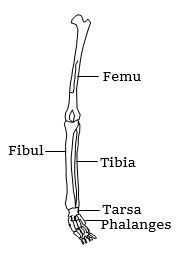
Given below is a diagram of the left human hindlimb as seen from the front. It has certain mistakes in labeling. Two of the wrongly labelled bones are
A
Tibia and tarsals
B
Femur and fibula
C
Fibula and phalanges
D
Tarsals and femur
Solution
(B) In the provided diagram,the labels are as follows:
$1$. The thigh bone is labeled as 'Femu',which is a misspelling of 'Femur'.
$2$. The lateral bone of the lower leg is labeled as 'Fibul',which is a misspelling of 'Fibula'.
$3$. The medial bone of the lower leg is correctly labeled as 'Tibia'.
$4$. The ankle bones are labeled as 'Tarsa',which is a misspelling of 'Tarsals'.
$5$. The toe bones are correctly labeled as 'Phalanges'.
Comparing the labels with the anatomical positions:
- The label 'Femu' points to the Femur (correct bone,incorrect spelling).
- The label 'Fibul' points to the Fibula (correct bone,incorrect spelling).
- The label 'Tibia' points to the Tibia (correct bone,correct spelling).
- The label 'Tarsa' points to the Tarsals (correct bone,incorrect spelling).
- The label 'Phalanges' points to the Phalanges (correct bone,correct spelling).
However,looking at the anatomical orientation of the left hindlimb:
- The Fibula is the lateral bone,and the Tibia is the medial bone. In the diagram,the labels for 'Fibula' and 'Tibia' are swapped. The label 'Fibul' is pointing to the medial side (Tibia),and the label 'Tibia' is pointing to the lateral side (Fibula).
- Therefore,the bones that are wrongly labeled in terms of their anatomical position are the Fibula and the Tibia. Among the given options,the most appropriate choice identifying the mislabeled bones is 'Femur and fibula' (due to the spelling error and positional swap) or 'Tibia and tarsals'. Given the standard interpretation of this specific diagram in textbooks,the labels for 'Femur' and 'Fibula' are the ones typically highlighted as having errors.
$1$. The thigh bone is labeled as 'Femu',which is a misspelling of 'Femur'.
$2$. The lateral bone of the lower leg is labeled as 'Fibul',which is a misspelling of 'Fibula'.
$3$. The medial bone of the lower leg is correctly labeled as 'Tibia'.
$4$. The ankle bones are labeled as 'Tarsa',which is a misspelling of 'Tarsals'.
$5$. The toe bones are correctly labeled as 'Phalanges'.
Comparing the labels with the anatomical positions:
- The label 'Femu' points to the Femur (correct bone,incorrect spelling).
- The label 'Fibul' points to the Fibula (correct bone,incorrect spelling).
- The label 'Tibia' points to the Tibia (correct bone,correct spelling).
- The label 'Tarsa' points to the Tarsals (correct bone,incorrect spelling).
- The label 'Phalanges' points to the Phalanges (correct bone,correct spelling).
However,looking at the anatomical orientation of the left hindlimb:
- The Fibula is the lateral bone,and the Tibia is the medial bone. In the diagram,the labels for 'Fibula' and 'Tibia' are swapped. The label 'Fibul' is pointing to the medial side (Tibia),and the label 'Tibia' is pointing to the lateral side (Fibula).
- Therefore,the bones that are wrongly labeled in terms of their anatomical position are the Fibula and the Tibia. Among the given options,the most appropriate choice identifying the mislabeled bones is 'Femur and fibula' (due to the spelling error and positional swap) or 'Tibia and tarsals'. Given the standard interpretation of this specific diagram in textbooks,the labels for 'Femur' and 'Fibula' are the ones typically highlighted as having errors.
0 likes
View Solution44
EasyMCQ
$A$ greater trochanter is found in
A
Femur
B
Humerus
C
Ulna
D
Radius
Solution
(A) The greater trochanter and lesser trochanter are bony projections located at the proximal end of the $Femur$.
These structures serve as attachment sites for the tendons of various muscles of the thigh and buttock regions.
Therefore,the correct option is $A$.
These structures serve as attachment sites for the tendons of various muscles of the thigh and buttock regions.
Therefore,the correct option is $A$.
0 likes
View Solution45
EasyMCQ
The shoulder joint is formed by the articulation of which of the following?
A
Glenoid cavity of the pectoral girdle and the head of the humerus
B
Acromion process of the pectoral girdle and the head of the humerus
C
Sigmoid notch of the ulna and the olecranon process
D
Sigmoid notch and the trochlea of the humerus
Solution
(A) The shoulder joint is a ball-and-socket joint.
It is formed by the articulation of the head of the humerus with the glenoid cavity of the pectoral girdle (scapula).
The glenoid cavity is a shallow depression on the scapula that allows for a wide range of movement at the shoulder joint.
It is formed by the articulation of the head of the humerus with the glenoid cavity of the pectoral girdle (scapula).
The glenoid cavity is a shallow depression on the scapula that allows for a wide range of movement at the shoulder joint.
0 likes
View Solution46
EasyMCQ
Which of the following is a bone of the forelimb?
A
Humerus
B
Femur
C
Tibia
D
Fibula
Solution
(A) The human appendicular skeleton consists of the limbs and their girdles.
The forelimb (arm) consists of the $Humerus$ (upper arm),$Radius$ and $Ulna$ (forearm),$Carpals$ (wrist bones),$Metacarpals$ (palm bones),and $Phalanges$ (digits).
The $Femur$ (thigh bone),$Tibia$,and $Fibula$ (lower leg bones) are components of the hindlimb.
Therefore,$Humerus$ is the correct bone belonging to the forelimb.
The forelimb (arm) consists of the $Humerus$ (upper arm),$Radius$ and $Ulna$ (forearm),$Carpals$ (wrist bones),$Metacarpals$ (palm bones),and $Phalanges$ (digits).
The $Femur$ (thigh bone),$Tibia$,and $Fibula$ (lower leg bones) are components of the hindlimb.
Therefore,$Humerus$ is the correct bone belonging to the forelimb.
0 likes
View Solution47
EasyMCQ
Among the following four pairs of human skeletal structures,three are correct and one is incorrect. Identify the incorrect pair.
A
Pairs of bones: Malleus and Incus,Category: Ear ossicles
B
Pairs of bones: Sternum and Ribs,Category: Axial skeleton
C
Pairs of bones: Clavicle and Scapula,Category: Pelvic girdle
D
Pairs of bones: Humerus and Ulna,Category: Appendicular skeleton
Solution
(C) The human skeletal system is divided into two main parts: the axial skeleton and the appendicular skeleton.
$1$. Malleus and Incus are ear ossicles,which is correct.
$2$. Sternum and Ribs are part of the axial skeleton,which is correct.
$3$. Clavicle and Scapula are part of the pectoral girdle (shoulder girdle),not the pelvic girdle. Therefore,this pair is incorrect.
$4$. Humerus and Ulna are bones of the forelimb,which is part of the appendicular skeleton,which is correct.
$1$. Malleus and Incus are ear ossicles,which is correct.
$2$. Sternum and Ribs are part of the axial skeleton,which is correct.
$3$. Clavicle and Scapula are part of the pectoral girdle (shoulder girdle),not the pelvic girdle. Therefore,this pair is incorrect.
$4$. Humerus and Ulna are bones of the forelimb,which is part of the appendicular skeleton,which is correct.
0 likes
View Solution48
MediumMCQ
In which bone is the patellar groove found?
A
Femur
B
Tibia-fibula
C
Between tibia and fibula
D
Tarsals
Solution
(A) The patellar groove,also known as the patellar surface or trochlear groove,is a smooth,articular depression located on the anterior distal end of the $Femur$. This groove allows the $Patella$ (kneecap) to glide smoothly during the flexion and extension of the knee joint. Therefore,the correct option is $A$.
0 likes
View Solution49
EasyMCQ
The pelvic girdle (coxal bone) is composed of which of the following?
A
Ilium
B
Ischium
C
Pubis
D
All of the above
Solution
(D) The pelvic girdle consists of two coxal bones. Each coxal bone is formed by the fusion of three bones: $Ilium$,$Ischium$,and $Pubis$. These three bones fuse together to form the acetabulum,which is a cavity to which the thigh bone $(femur)$ articulates. Therefore,all the given options are correct.
0 likes
View Solution50
EasyMCQ
Which is the longest bone in the human skeletal system?
A
Femur
B
Humerus
C
Tibia
D
Radius
Solution
(A) The human skeletal system consists of $206$ bones. The longest,strongest,and heaviest bone in the human body is the femur,also known as the thigh bone. It extends from the hip to the knee and supports the weight of the body during movement.
0 likes
View SolutionLocomotion and Movement — Appendicular skeleton · Frequently Asked Questions
1Are these Locomotion and Movement questions useful for JEE and NEET?
Yes. All questions in this section are mapped to JEE Main and NEET exam patterns. Previous year questions from JEE Main, NEET, GUJCET and state-level exams are included with full solutions.
2Can I switch to Hindi or Gujarati for these questions?
Yes. Use the language tabs in the hero section or the sidebar to view the same questions and solutions in English, Hindi or Gujarati.
3How do I generate a question paper from this subtopic?
Use the Vedclass Exam Paper Generator — select the chapter and subtopic, set difficulty, and generate Sets A, B, C, D automatically. First 3 chapters of every subject are free.
Vedclass Products
For Students
Vedclass Test Series
Mock tests in real JEE/NEET style with performance analysis. 5-day free trial.
Start Free TrialFor Teachers
Exam Paper Generator
Generate Set A/B/C/D papers from this chapter in 2 minutes. 3 chapters free.
Try FreeFor Institutes
Online Exam Module
Live online exams with unlimited students, 360° analytics & white-label branding.
See DemoFor Teachers & Institutes
Generate a Locomotion and Movement Exam Paper in 2 Minutes
Select subtopic & difficulty — Sets A, B, C, D auto-generated with No Repeat logic.
First 3 chapters of every subject are free — no payment required.