
A English
Urine Formation Questions in English
Class 11 Biology · Excretory Products and their Elimination · Urine Formation
111+
Questions
English
Language
100%
With Solutions
Showing 49 of 111 questions in English
51
MediumMCQ
The net filtration pressure that causes the filtration of blood plasma into the Bowman's capsule is . . . . . . .
A
$20 \, mm \, Hg$
B
$50 \, mm \, Hg$
C
$75 \, mm \, Hg$
D
$10 \, mm \, Hg$
Solution
(D) The net filtration pressure $(NFP)$ is calculated by subtracting the opposing pressures from the glomerular capillary blood pressure.
$1$. Glomerular capillary blood pressure = $60 \, mm \, Hg$.
$2$. Blood colloidal osmotic pressure = $30 \, mm \, Hg$.
$3$. Capsular hydrostatic pressure = $20 \, mm \, Hg$.
$NFP$ = $60 - (30 + 20) = 60 - 50 = 10 \, mm \, Hg$.
$1$. Glomerular capillary blood pressure = $60 \, mm \, Hg$.
$2$. Blood colloidal osmotic pressure = $30 \, mm \, Hg$.
$3$. Capsular hydrostatic pressure = $20 \, mm \, Hg$.
$NFP$ = $60 - (30 + 20) = 60 - 50 = 10 \, mm \, Hg$.
0 likes
View Solution52
MediumMCQ
Which one of the following statements in regard to the excretion by the human kidneys is correct?
A
Descending limb of loop of Henle is impermeable to water.
B
Distal convoluted tubule is incapable of reabsorbing $HCO_3^-$.
C
Nearly $99$ percent of the glomerular filtrate is reabsorbed by the renal tubules.
D
Ascending limb of loop of Henle is impermeable to electrolytes.
Solution
(C) : Urine formation involves three main processes namely,glomerular filtration,reabsorption,and secretion,which take place in different parts of the nephron.
$A$ comparison of the volume of the filtrate formed per day ($180$ litres per day) with that of the urine released ($1.5$ litres) suggests that nearly $99$ percent of the filtrate is reabsorbed by the renal tubules.
The descending limb of the loop of Henle is permeable to water but almost impermeable to electrolytes.
The ascending limb is impermeable to water but allows the transport of electrolytes actively or passively.
Conditional reabsorption of $Na^+$ and water takes place in the distal convoluted tubule $(DCT)$. It is also capable of reabsorption of $HCO_3^-$.
$A$ comparison of the volume of the filtrate formed per day ($180$ litres per day) with that of the urine released ($1.5$ litres) suggests that nearly $99$ percent of the filtrate is reabsorbed by the renal tubules.
The descending limb of the loop of Henle is permeable to water but almost impermeable to electrolytes.
The ascending limb is impermeable to water but allows the transport of electrolytes actively or passively.
Conditional reabsorption of $Na^+$ and water takes place in the distal convoluted tubule $(DCT)$. It is also capable of reabsorption of $HCO_3^-$.
0 likes
View Solution53
MediumMCQ
The first phase of urine formation takes place here.
A
Descending loop of Henle
B
Glomerulus
C
$DCT$
D
Collecting duct
Solution
(B) The process of urine formation involves three main steps: glomerular filtration,reabsorption,and secretion.
$1$. The first phase,glomerular filtration,occurs in the $Glomerulus$.
$2$. Blood is filtered under high pressure through the glomerular capillaries into the Bowman's capsule,forming the glomerular filtrate.
$3$. Therefore,the correct site for the first phase of urine formation is the $Glomerulus$.
$1$. The first phase,glomerular filtration,occurs in the $Glomerulus$.
$2$. Blood is filtered under high pressure through the glomerular capillaries into the Bowman's capsule,forming the glomerular filtrate.
$3$. Therefore,the correct site for the first phase of urine formation is the $Glomerulus$.
0 likes
View Solution54
MediumMCQ
On an average,how much blood is filtered by the kidneys per minute?
A
$100 - 200 \, ml$
B
$500 - 1000 \, ml$
C
$1100 - 1200 \, ml$
D
$1500 - 2000 \, ml$
Solution
(C) The kidneys receive a significant portion of the cardiac output.
On average,$1100 - 1200 \, ml$ of blood is filtered by the kidneys per minute,which constitutes approximately $1/5$th of the blood pumped out by each ventricle of the heart in a minute.
On average,$1100 - 1200 \, ml$ of blood is filtered by the kidneys per minute,which constitutes approximately $1/5$th of the blood pumped out by each ventricle of the heart in a minute.
0 likes
View Solution55
MediumMCQ
$GFR$ stands for:
A
The amount of filtrate formed by the kidneys per $10$ minutes.
B
The amount of filtrate formed by the kidneys per hour.
C
The amount of filtrate formed by the kidneys per minute.
D
The amount of filtrate formed by one kidney per minute.
Solution
(C) $GFR$ stands for Glomerular Filtration Rate.
It is defined as the total amount of filtrate formed by both kidneys in the nephrons per minute.
In a healthy individual,the $GFR$ is approximately $125 \ mL/min$,which totals about $180 \ L$ per day.
It is defined as the total amount of filtrate formed by both kidneys in the nephrons per minute.
In a healthy individual,the $GFR$ is approximately $125 \ mL/min$,which totals about $180 \ L$ per day.
0 likes
View Solution56
MediumMCQ
$A$ large amount of about $180\,L$ of fluid is filtered by the human kidneys per day. Which one of the following renal corpuscle features does not justify this?
A
The glomerular capillaries have a large surface area.
B
The glomerular capillaries are fenestrated and hence leakier than other capillaries.
C
The glomerular capillaries have a higher blood pressure than the other capillaries of the body.
D
The efferent arteriole is wider than the afferent arteriole causing easier outflow of blood from glomerulus.
Solution
(D) The human kidneys filter approximately $180\,L$ of fluid per day,which is known as the Glomerular Filtration Rate $(GFR)$.
This high rate of filtration is facilitated by several structural and physiological features of the renal corpuscle:
$1$. The glomerular capillaries possess a very large surface area for filtration.
$2$. These capillaries are fenestrated (contain pores),making them significantly more permeable (leakier) than typical systemic capillaries.
$3$. The blood pressure in the glomerular capillaries is higher than in other capillaries because the diameter of the afferent arteriole is wider than that of the efferent arteriole.
Option $D$ states that the efferent arteriole is wider than the afferent arteriole,which is incorrect. In reality,the afferent arteriole is wider,which creates a high-pressure environment within the glomerulus to force fluid out. Therefore,option $D$ does not justify the high filtration rate.
This high rate of filtration is facilitated by several structural and physiological features of the renal corpuscle:
$1$. The glomerular capillaries possess a very large surface area for filtration.
$2$. These capillaries are fenestrated (contain pores),making them significantly more permeable (leakier) than typical systemic capillaries.
$3$. The blood pressure in the glomerular capillaries is higher than in other capillaries because the diameter of the afferent arteriole is wider than that of the efferent arteriole.
Option $D$ states that the efferent arteriole is wider than the afferent arteriole,which is incorrect. In reality,the afferent arteriole is wider,which creates a high-pressure environment within the glomerulus to force fluid out. Therefore,option $D$ does not justify the high filtration rate.
0 likes
View Solution57
MediumMCQ
What is the $GFR$ in a healthy person?
A
$1100 - 1200 \, ml/min$
B
$125 \, ml/min$
C
$180 \, ml/min$
D
$410 \, ml/min$
Solution
(B) The Glomerular Filtration Rate $(GFR)$ is the amount of filtrate formed by the kidneys per minute.
In a healthy individual,the $GFR$ is approximately $125 \, ml/min$,which translates to about $180 \, liters$ per day.
Therefore,the correct option is $B$.
In a healthy individual,the $GFR$ is approximately $125 \, ml/min$,which translates to about $180 \, liters$ per day.
Therefore,the correct option is $B$.
0 likes
View Solution58
MediumMCQ
The net filtration pressure that causes the fluid to filter out from the glomerulus into the Bowman's capsule is:
A
$10 \, mm \, Hg$
B
$75 \, mm \, Hg$
C
$20 \, mm \, Hg$
D
$30 \, mm \, Hg$
Solution
(A) The net filtration pressure $(NFP)$ is calculated by subtracting the opposing pressures from the glomerular hydrostatic pressure.
Glomerular hydrostatic pressure $(GHP)$ = $60 \, mm \, Hg$.
Blood colloidal osmotic pressure $(BCOP)$ = $30 \, mm \, Hg$.
Capsular hydrostatic pressure $(CHP)$ = $20 \, mm \, Hg$.
$NFP = GHP - (BCOP + CHP) = 60 - (30 + 20) = 60 - 50 = 10 \, mm \, Hg$.
Glomerular hydrostatic pressure $(GHP)$ = $60 \, mm \, Hg$.
Blood colloidal osmotic pressure $(BCOP)$ = $30 \, mm \, Hg$.
Capsular hydrostatic pressure $(CHP)$ = $20 \, mm \, Hg$.
$NFP = GHP - (BCOP + CHP) = 60 - (30 + 20) = 60 - 50 = 10 \, mm \, Hg$.
0 likes
View Solution59
EasyMCQ
In the ornithine cycle,the enzyme arginase breaks down arginine into:
A
Citrulline and ammonia
B
Ornithine and ammonia
C
Ornithine and urea
D
Citrulline and urea
Solution
(C) The ornithine cycle (also known as the urea cycle) is a series of biochemical reactions that occur in the liver to convert toxic ammonia into urea.
In the final step of this cycle,the enzyme arginase catalyzes the hydrolysis of arginine.
This reaction produces ornithine and urea.
Ornithine is then recycled back into the mitochondria to continue the cycle,while urea is excreted from the body.
In the final step of this cycle,the enzyme arginase catalyzes the hydrolysis of arginine.
This reaction produces ornithine and urea.
Ornithine is then recycled back into the mitochondria to continue the cycle,while urea is excreted from the body.
0 likes
View Solution60
MediumMCQ
Assertion: Ultrafiltration takes place in the presence of effective filtration pressure.
Reason: In the ultrafiltration process,blood is filtered in Bowman's capsule; the filtered fluid contains protein and blood corpuscles also.
Reason: In the ultrafiltration process,blood is filtered in Bowman's capsule; the filtered fluid contains protein and blood corpuscles also.
A
If both Assertion and Reason are correct and the Reason is a correct explanation of the Assertion.
B
If both Assertion and Reason are correct but Reason is not a correct explanation of the Assertion.
C
If the Assertion is correct but Reason is incorrect.
D
If both the Assertion and Reason are incorrect.
Solution
(C) Ultrafiltration occurs in the renal corpuscle of the nephron. It is driven by the effective filtration pressure $(EFP)$.
During this process,blood is filtered through the glomerular capillary wall,the basement membrane,and the podocytes of Bowman's capsule.
The resulting glomerular filtrate is essentially protein-free and lacks blood corpuscles.
Therefore,the statement that the filtered fluid contains proteins and blood corpuscles is incorrect.
Thus,the Assertion is correct,but the Reason is incorrect.
During this process,blood is filtered through the glomerular capillary wall,the basement membrane,and the podocytes of Bowman's capsule.
The resulting glomerular filtrate is essentially protein-free and lacks blood corpuscles.
Therefore,the statement that the filtered fluid contains proteins and blood corpuscles is incorrect.
Thus,the Assertion is correct,but the Reason is incorrect.
0 likes
View Solution61
Easy
Define Glomerular Filtration Rate $(GFR)$.
Solution
(N/A) Glomerular filtration rate $(GFR)$ is defined as the total volume of glomerular filtrate formed by all the nephrons in both kidneys per minute.
In a healthy individual,the $GFR$ is approximately $125 \, mL/minute$,which amounts to about $180 \, liters$ per day.
The glomerular filtrate is essentially blood plasma minus the proteins,containing substances like glucose,amino acids,sodium,potassium,urea,uric acid,ketone bodies,and a large volume of water.
In a healthy individual,the $GFR$ is approximately $125 \, mL/minute$,which amounts to about $180 \, liters$ per day.
The glomerular filtrate is essentially blood plasma minus the proteins,containing substances like glucose,amino acids,sodium,potassium,urea,uric acid,ketone bodies,and a large volume of water.
1 likes
View Solution62
EasyMCQ
Indicate whether the following statement is true or false:
Protein-free fluid is filtered from blood plasma into the Bowman's capsule.
Protein-free fluid is filtered from blood plasma into the Bowman's capsule.
A
True
B
False
Solution
(A) The statement is True.
During the process of ultrafiltration in the kidneys,blood flows through the glomerulus under high pressure.
The glomerular capillary wall and the inner membrane of the Bowman's capsule allow the passage of water and small solutes (like glucose,amino acids,urea,and salts) while retaining large molecules such as plasma proteins and blood cells.
Therefore,the filtrate formed in the Bowman's capsule is essentially protein-free.
During the process of ultrafiltration in the kidneys,blood flows through the glomerulus under high pressure.
The glomerular capillary wall and the inner membrane of the Bowman's capsule allow the passage of water and small solutes (like glucose,amino acids,urea,and salts) while retaining large molecules such as plasma proteins and blood cells.
Therefore,the filtrate formed in the Bowman's capsule is essentially protein-free.
0 likes
View Solution63
Easy
Describe the main phases of urine formation.
Solution
(A) Urine formation involves three main processes:
$(1)$ Glomerular Filtration,$(2)$ Reabsorption,$(3)$ Secretion.
These processes take place in different parts of the nephron.
$(1)$ Glomerular Filtration: Blood is filtered in the glomerulus. On average,$1100-1200 \text{ ml}$ of blood is filtered by the kidneys per minute,which constitutes roughly $1/5$ of the blood pumped out by each ventricle of the heart in a minute. The difference in the diameter of the afferent arteriole (wider) and efferent arteriole (narrower) creates pressure,facilitating filtration. Blood is filtered through three layers: the endothelium of glomerular blood vessels,the epithelium of Bowman's capsule (podocytes),and a basement membrane. The glomerular filtration rate $(GFR)$ in a healthy individual is approximately $125 \text{ ml/minute}$ $(180 \text{ liters/day})$. The juxtaglomerular apparatus $(JGA)$ regulates $GFR$.
$(2)$ Reabsorption: Nearly $99\%$ of the filtrate $(180 \text{ liters/day})$ is reabsorbed by the renal tubules,leaving only about $1.5 \text{ liters}$ of urine. Substances like glucose,amino acids,and $Na^{+}$ are reabsorbed actively,while nitrogenous wastes are absorbed by passive transport in the proximal convoluted tubule $(PCT)$. The Henle's loop helps in concentrating the filtrate.
$(3)$ Secretion: Tubular cells in the distal convoluted tubule $(DCT)$ secrete substances like $H^{+}$,$K^{+}$,and ammonia into the filtrate. These substances were not filtered during glomerular filtration. This process helps in maintaining the ionic and acid-base balance of body fluids. Finally,the urine is transported to the collecting duct,where water is reabsorbed to produce concentrated urine.
$(1)$ Glomerular Filtration,$(2)$ Reabsorption,$(3)$ Secretion.
These processes take place in different parts of the nephron.
$(1)$ Glomerular Filtration: Blood is filtered in the glomerulus. On average,$1100-1200 \text{ ml}$ of blood is filtered by the kidneys per minute,which constitutes roughly $1/5$ of the blood pumped out by each ventricle of the heart in a minute. The difference in the diameter of the afferent arteriole (wider) and efferent arteriole (narrower) creates pressure,facilitating filtration. Blood is filtered through three layers: the endothelium of glomerular blood vessels,the epithelium of Bowman's capsule (podocytes),and a basement membrane. The glomerular filtration rate $(GFR)$ in a healthy individual is approximately $125 \text{ ml/minute}$ $(180 \text{ liters/day})$. The juxtaglomerular apparatus $(JGA)$ regulates $GFR$.
$(2)$ Reabsorption: Nearly $99\%$ of the filtrate $(180 \text{ liters/day})$ is reabsorbed by the renal tubules,leaving only about $1.5 \text{ liters}$ of urine. Substances like glucose,amino acids,and $Na^{+}$ are reabsorbed actively,while nitrogenous wastes are absorbed by passive transport in the proximal convoluted tubule $(PCT)$. The Henle's loop helps in concentrating the filtrate.
$(3)$ Secretion: Tubular cells in the distal convoluted tubule $(DCT)$ secrete substances like $H^{+}$,$K^{+}$,and ammonia into the filtrate. These substances were not filtered during glomerular filtration. This process helps in maintaining the ionic and acid-base balance of body fluids. Finally,the urine is transported to the collecting duct,where water is reabsorbed to produce concentrated urine.
0 likes
View Solution64
Medium
Show in tabular form the phases of urine formation and the substances involved.
Solution
(N/A)
| Phase | Process and Substances Involved |
|---|---|
| $(1)$ Ultrafiltration | Due to high blood pressure,small molecules are pushed from the glomerulus into the lumen of Bowman's capsule. Substances: $H_{2}O$,glucose,amino acids,minerals,urea,uric acid,creatinine. |
| $(2)$ Selective Reabsorption | Due to active transport in the $PCT$,essential molecules re-enter the blood. Substances: $H_{2}O$,glucose,amino acids,minerals. |
| $(3)$ Tubular Secretion | By active transport,molecules from the blood are emptied into the lumen of the $DCT$. Substances: Uric acid,urea,creatinine,$H^{+}$,Ammonia,penicillin. |
| $(4)$ Reabsorption of $H_{2}O$ | $H_{2}O$ enters the loop of Henle and collecting duct by osmosis; minerals are actively absorbed. Substances: $H_{2}O$,minerals. |
| $(5)$ Excretion | Metabolic and excretory substances are eliminated from the body as urine. Substances: $H_{2}O$,minerals,urea,uric acid,ammonia,creatinine. |
0 likes
View Solution65
Easy
Provide the full forms of the following abbreviations:
$(1)$ $GFR$
$(2)$ $mosmol/L$
$(1)$ $GFR$
$(2)$ $mosmol/L$
Solution
(N/A) $(1)$ $GFR$ stands for Glomerular Filtration Rate. It is the volume of filtrate formed by the kidneys per minute.
$(2)$ $mosmol/L$ stands for Milli Osmol Per Liter. It is a unit used to measure the osmotic concentration of body fluids.
$(2)$ $mosmol/L$ stands for Milli Osmol Per Liter. It is a unit used to measure the osmotic concentration of body fluids.
0 likes
View Solution66
MediumMCQ
What are the main processes of urine formation?
A
Ultrafiltration,Reabsorption,Secretion
B
Filtration,Excretion,Digestion
C
Absorption,Secretion,Excretion
D
Ultrafiltration,Secretion,Excretion
Solution
(A) The three main processes involved in urine formation are:
$1$. $Ultrafiltration$: Occurs in the glomerulus where blood is filtered.
$2$. $Reabsorption$: Occurs in the renal tubules where essential substances like water,glucose,and ions are reabsorbed into the blood.
$3$. $Secretion$: Occurs in the renal tubules where waste products like $H^+$,$K^+$,and ammonia are added to the filtrate.
$1$. $Ultrafiltration$: Occurs in the glomerulus where blood is filtered.
$2$. $Reabsorption$: Occurs in the renal tubules where essential substances like water,glucose,and ions are reabsorbed into the blood.
$3$. $Secretion$: Occurs in the renal tubules where waste products like $H^+$,$K^+$,and ammonia are added to the filtrate.
0 likes
View Solution67
Easy
The composition of glomerular filtrate and urine is not the same. Comment.
Solution
(N/A) $\Rightarrow$ Glomerular filtrate is formed by the process of ultrafiltration in the glomerulus. It contains a large amount of $H_{2}O$,glucose,amino acids,urea,uric acid,creatinine,$Na^{+}$,$K^{+}$,vitamins,and hormones.
- Urine is the final product formed after the processes of selective reabsorption and tubular secretion in the renal tubules.
- During these processes,essential substances like glucose,amino acids,and a significant portion of water and electrolytes are reabsorbed back into the blood,while additional wastes like ammonia and hydrogen ions are secreted into the filtrate.
- Consequently,the composition of urine is significantly different from that of the glomerular filtrate,as it is more concentrated and contains specific metabolic waste products.
- Urine is the final product formed after the processes of selective reabsorption and tubular secretion in the renal tubules.
- During these processes,essential substances like glucose,amino acids,and a significant portion of water and electrolytes are reabsorbed back into the blood,while additional wastes like ammonia and hydrogen ions are secreted into the filtrate.
- Consequently,the composition of urine is significantly different from that of the glomerular filtrate,as it is more concentrated and contains specific metabolic waste products.
0 likes
View Solution68
MediumMCQ
What is the function of Bowman's capsule and Glomerulus?
A
Filtration of blood
B
Reabsorption of ions from blood
C
Reabsorption of hormones from blood
D
Reabsorption of water from blood
Solution
(A) The Bowman's capsule and glomerulus together form the renal corpuscle,which is the essential part of the nephron responsible for the ultrafiltration of blood.
In the glomerulus,blood pressure forces water and small solutes out of the blood and into the Bowman's capsule.
This process creates a filtrate that is further processed along the nephron to eventually form urine.
In the glomerulus,blood pressure forces water and small solutes out of the blood and into the Bowman's capsule.
This process creates a filtrate that is further processed along the nephron to eventually form urine.
0 likes
View Solution69
MediumMCQ
The $GFR$ in a healthy individual is
A
$125\, mL / min$
B
$150\, L / \text{day}$
C
$125\, mL / \text{sec}$
D
$135\, L / \text{day}$
Solution
(A) The Glomerular Filtration Rate $(GFR)$ in a healthy individual is approximately $125\, mL / min$.
This amounts to about $180\, L$ of filtrate formed by the kidneys per day.
This amounts to about $180\, L$ of filtrate formed by the kidneys per day.
0 likes
View Solution70
EasyMCQ
An adult human excretes,on an average,how much urine per day?
A
$2-3$ litres of urine per day
B
$1-1.5$ litres of urine per day
C
$2-5$ litres of urine per day
D
$4-5$ litres of urine per day
Solution
(B) An adult human excretes,on an average,$1-1.5$ litres of urine per day.
The volume of urine produced depends on several factors such as the intake of fluids,the external temperature,and the level of physical activity of the individual.
The volume of urine produced depends on several factors such as the intake of fluids,the external temperature,and the level of physical activity of the individual.
0 likes
View Solution71
EasyMCQ
In $24$ hours, the total glomerular filtrate formed in the human kidney is
A
$1.7$ litres
B
$7$ litres
C
$17$ litres
D
$170$ litres
Solution
(D) The blood pressure in the glomerular capillaries is very high, which facilitates a continuous process of ultrafiltration.
Glomerular filtrate contains a large amount of water and other dissolved substances such as urea, uric acid, creatinine, amino acids, glucose, sodium, potassium, and vitamins.
The glomerular filtration rate $(GFR)$ is approximately $125 \, mL$ per minute.
Therefore, in $24$ hours, the total volume of filtrate produced is approximately $125 \, mL \times 60 \, min \times 24 \, hours = 180,000 \, mL$, which is equal to $180 \, L$.
Given the options, $170 \, L$ is the closest standard value accepted in textbooks for the daily glomerular filtrate production.
Glomerular filtrate contains a large amount of water and other dissolved substances such as urea, uric acid, creatinine, amino acids, glucose, sodium, potassium, and vitamins.
The glomerular filtration rate $(GFR)$ is approximately $125 \, mL$ per minute.
Therefore, in $24$ hours, the total volume of filtrate produced is approximately $125 \, mL \times 60 \, min \times 24 \, hours = 180,000 \, mL$, which is equal to $180 \, L$.
Given the options, $170 \, L$ is the closest standard value accepted in textbooks for the daily glomerular filtrate production.
0 likes
View Solution72
MediumMCQ
Glomerular filtration rate per day is (in $, L$)
A
$150$
B
$190$
C
$170$
D
$180$
Solution
(D) The $GFR$ (Glomerular Filtration Rate) in a healthy adult is approximately $125 \, mL$ per minute.
To calculate the daily rate,we multiply the per-minute rate by the total number of minutes in a day $(24 \text{ hours} \times 60 \text{ minutes} = 1440 \text{ minutes})$.
$125 \, mL/min \times 1440 \, min/day = 180,000 \, mL/day$.
Converting this to litres,we get $180 \, L$ per day.
To calculate the daily rate,we multiply the per-minute rate by the total number of minutes in a day $(24 \text{ hours} \times 60 \text{ minutes} = 1440 \text{ minutes})$.
$125 \, mL/min \times 1440 \, min/day = 180,000 \, mL/day$.
Converting this to litres,we get $180 \, L$ per day.
0 likes
View Solution73
EasyMCQ
The stage of the ornithine cycle at which the arginase enzyme is used?
A
Ornithine $\rightarrow$ Citrulline
B
Arginine $\rightarrow$ Ornithine
C
Citrulline $\rightarrow$ Argininosuccinic acid
D
Ornithine $\rightarrow$ Urea
Solution
(B) The enzyme arginase catalyzes the hydrolysis of arginine to produce urea and ornithine.
This is the final step of the ornithine cycle (also known as the urea cycle).
In this reaction,arginine is converted into ornithine,and urea is released as a byproduct.
Urea is then transported to the kidneys for excretion.
The cycle was discovered by Hans Krebs and Kurt Henseleit in $1932$.
This is the final step of the ornithine cycle (also known as the urea cycle).
In this reaction,arginine is converted into ornithine,and urea is released as a byproduct.
Urea is then transported to the kidneys for excretion.
The cycle was discovered by Hans Krebs and Kurt Henseleit in $1932$.
0 likes
View Solution74
MediumMCQ
Filtration in the Malpighian body of the nephrons involves
A
One layer
B
Two layers
C
Three layers
D
Four layers
Solution
(C) Glomerular capillary blood pressure causes the filtration of blood through three layers,$i.e.,$
$(i)$ The endothelium of the glomerular blood vessels.
$(ii)$ The epithelium of Bowman's capsule.
$(iii)$ The basement membrane between these two layers.
The epithelial cells of Bowman's capsule,called podocytes,are arranged in an intricate manner so as to leave some minute spaces called filtration slits or slit pores.
$(i)$ The endothelium of the glomerular blood vessels.
$(ii)$ The epithelium of Bowman's capsule.
$(iii)$ The basement membrane between these two layers.
The epithelial cells of Bowman's capsule,called podocytes,are arranged in an intricate manner so as to leave some minute spaces called filtration slits or slit pores.
0 likes
View Solution75
MediumMCQ
The ultrafiltrate generated by the glomerulus contains all the constituents of blood plasma except:
A
Proteins
B
$RBC$
C
$WBC$
D
All of these
Solution
(D) Blood is filtered so finely through the glomerular filtration membrane (consisting of three layers) that almost all constituents of the plasma,except for proteins,$RBCs$,and $WBCs$,pass into the lumen of the Bowman's capsule.
This process is known as ultrafiltration.
Since proteins,$RBCs$,and $WBCs$ are too large to pass through the filtration slits and basement membrane,they are excluded from the filtrate.
This process is known as ultrafiltration.
Since proteins,$RBCs$,and $WBCs$ are too large to pass through the filtration slits and basement membrane,they are excluded from the filtrate.
0 likes
View Solution76
MediumMCQ
Choose the correct order of urine formation in human.
A
$PCT \rightarrow ALH \rightarrow DLH \rightarrow DCT \rightarrow CD$
B
$ALH \rightarrow DLH \rightarrow PCT \rightarrow DCT \rightarrow CD$
C
$PCT \rightarrow DLH \rightarrow ALH \rightarrow DCT \rightarrow CD$
D
$CD \rightarrow DCT \rightarrow ALH \rightarrow DLH \rightarrow PCT$
Solution
(C) The process of urine formation involves the flow of filtrate through the nephron in the following sequence:
$1$. Proximal Convoluted Tubule $(PCT)$: Primary site of reabsorption.
$2$. Descending Loop of Henle $(DLH)$: Permeable to water,impermeable to electrolytes.
$3$. Ascending Loop of Henle $(ALH)$: Impermeable to water,permeable to electrolytes.
$4$. Distal Convoluted Tubule $(DCT)$: Site of conditional reabsorption.
$5$. Collecting Duct $(CD)$: Final concentration of urine.
Therefore,the correct order is: $PCT \rightarrow DLH \rightarrow ALH \rightarrow DCT \rightarrow CD$.
$1$. Proximal Convoluted Tubule $(PCT)$: Primary site of reabsorption.
$2$. Descending Loop of Henle $(DLH)$: Permeable to water,impermeable to electrolytes.
$3$. Ascending Loop of Henle $(ALH)$: Impermeable to water,permeable to electrolytes.
$4$. Distal Convoluted Tubule $(DCT)$: Site of conditional reabsorption.
$5$. Collecting Duct $(CD)$: Final concentration of urine.
Therefore,the correct order is: $PCT \rightarrow DLH \rightarrow ALH \rightarrow DCT \rightarrow CD$.
0 likes
View Solution77
EasyMCQ
Urine formation involves:
$I.$ Glomerular filtration
$II.$ Selective reabsorption
$III.$ Tubular secretion
Choose the correct option for the above statements.
$I.$ Glomerular filtration
$II.$ Selective reabsorption
$III.$ Tubular secretion
Choose the correct option for the above statements.
A
$I$ and $II$
B
$II$ and $III$
C
$I$ and $III$
D
$I, II$ and $III$
Solution
(D) Urine formation involves three main processes that occur in the nephron:
$1.$ Glomerular filtration (Ultrafiltration): This is the first step where blood is filtered in the glomerulus.
$2.$ Selective reabsorption: Essential substances like glucose,amino acids,and water are reabsorbed back into the blood from the renal tubules.
$3.$ Tubular secretion: Waste products like $H^+$,$K^+$,and ammonia are secreted into the filtrate by the tubular cells.
Therefore,all three processes ($I, II,$ and $III$) are involved in urine formation.
$1.$ Glomerular filtration (Ultrafiltration): This is the first step where blood is filtered in the glomerulus.
$2.$ Selective reabsorption: Essential substances like glucose,amino acids,and water are reabsorbed back into the blood from the renal tubules.
$3.$ Tubular secretion: Waste products like $H^+$,$K^+$,and ammonia are secreted into the filtrate by the tubular cells.
Therefore,all three processes ($I, II,$ and $III$) are involved in urine formation.
0 likes
View Solution78
EasyMCQ
$GFR$ (Glomerular Filtration Rate) is the amount of filtrate formed by the kidney per
A
Hour
B
Second
C
Minute
D
$10 \, \text{seconds}$
Solution
(C) $GFR$ (Glomerular Filtration Rate) is defined as the amount of filtrate formed by the kidneys per minute.
In a healthy individual, the $GFR$ is approximately $125 \, \text{mL/minute}$, which amounts to about $180 \, \text{litres}$ per day.
In a healthy individual, the $GFR$ is approximately $125 \, \text{mL/minute}$, which amounts to about $180 \, \text{litres}$ per day.
0 likes
View Solution79
MediumMCQ
What is the obligatory water reabsorption?
A
Reabsorption of water from $PCT$
B
Reabsorption of water from loop of Henle
C
Both $(a)$ and $(b)$
D
Water secretion by Bowman's capsule
Solution
(C) large quantity of water is reabsorbed in the $PCT$ and the loop of Henle.
About $80 \%$ of water is reabsorbed in the $PCT$ and the loop of Henle.
This process is called obligatory water reabsorption because it is essential for maintaining osmotic balance and is not regulated by hormones like $ADH$.
About $80 \%$ of water is reabsorbed in the $PCT$ and the loop of Henle.
This process is called obligatory water reabsorption because it is essential for maintaining osmotic balance and is not regulated by hormones like $ADH$.
0 likes
View Solution80
MediumMCQ
Composition of urine:
$I.$ Water ...$A\%$
$II.$ Urea ...$B\%$
$III.$ Uric acid ...$C\%$
$IV.$ Salt ...$D\%$
Choose the right options for $A, B, C$ and $D$ from the given options.
$I.$ Water ...$A\%$
$II.$ Urea ...$B\%$
$III.$ Uric acid ...$C\%$
$IV.$ Salt ...$D\%$
Choose the right options for $A, B, C$ and $D$ from the given options.
A
$A-90; B-2.0; C-1; D-2$
B
$A-95; B-2.6; C-0.3; D-1.5$
C
$A-80; B-2.6; C-0.3; D-1.5$
D
$A-85; B-2.6; C-0.3; D-1.5$
Solution
(B) The typical composition of human urine is as follows:
$1$. Water: Approximately $95\%$.
$2$. Urea: Approximately $2.6\%$.
$3$. Uric acid: Approximately $0.3\%$ (derived from nucleic acid metabolism).
$4$. Salts (mainly $NaCl$): Approximately $1.5\%$.
Therefore,the correct values are $A=95, B=2.6, C=0.3, D=1.5$.
$1$. Water: Approximately $95\%$.
$2$. Urea: Approximately $2.6\%$.
$3$. Uric acid: Approximately $0.3\%$ (derived from nucleic acid metabolism).
$4$. Salts (mainly $NaCl$): Approximately $1.5\%$.
Therefore,the correct values are $A=95, B=2.6, C=0.3, D=1.5$.
0 likes
View Solution81
MediumMCQ
Layers between the glomerular and Bowman's capsule through which the filtration takes place are:
$I.$ Endothelium of the glomerular blood vessel
$II.$ Middle lamella
$III.$ Basement membrane between the endothelium of glomerular blood vessels and epithelium of the Bowman's capsule
$IV.$ Epithelium of the Bowman's capsule
$I.$ Endothelium of the glomerular blood vessel
$II.$ Middle lamella
$III.$ Basement membrane between the endothelium of glomerular blood vessels and epithelium of the Bowman's capsule
$IV.$ Epithelium of the Bowman's capsule
A
$I, II$ and $III$
B
$II, III$ and $IV$
C
$I, III$ and $IV$
D
$I, II$ and $IV$
Solution
(C) The correct answer is $I, III$ and $IV$.
Glomerular capillary blood pressure causes the filtration of blood through three layers,which are:
$(i)$ The endothelium of the glomerular blood vessels.
$(ii)$ The basement membrane between the endothelium of glomerular blood vessels and the epithelium of the Bowman's capsule.
$(iii)$ The epithelium of the Bowman's capsule,which consists of specialized cells called podocytes.
These podocytes are arranged in an intricate manner so as to leave some minute spaces called filtration slits or slit pores. The middle lamella is not a component of the filtration membrane.
Glomerular capillary blood pressure causes the filtration of blood through three layers,which are:
$(i)$ The endothelium of the glomerular blood vessels.
$(ii)$ The basement membrane between the endothelium of glomerular blood vessels and the epithelium of the Bowman's capsule.
$(iii)$ The epithelium of the Bowman's capsule,which consists of specialized cells called podocytes.
These podocytes are arranged in an intricate manner so as to leave some minute spaces called filtration slits or slit pores. The middle lamella is not a component of the filtration membrane.
0 likes
View Solution82
MediumMCQ
When does glomerular filtration occur in Bowman's capsule?
A
When hydrostatic pressure of blood in the glomerulus is higher than capsular hydrostatic pressure & osmotic pressure
B
When hydrostatic pressure of blood in the glomerulus is less than capsular hydrostatic pressure & osmotic pressure
C
When hydrostatic pressure of blood in the glomerulus is equal to capsular hydrostatic pressure & osmotic pressure
D
When capsular hydrostatic pressure & osmotic pressure is higher than glomerular blood hydrostatic pressure
Solution
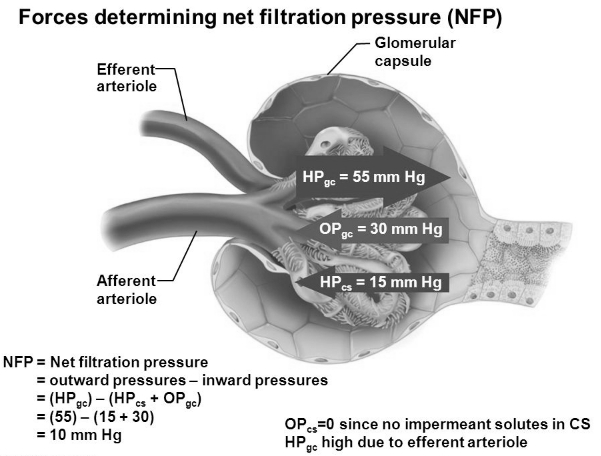
(A) Glomerular filtration is a process driven by the Net Filtration Pressure $(NFP)$.
$NFP$ is calculated as the difference between the outward glomerular hydrostatic pressure $(HP_{gc})$ and the sum of the inward pressures,which are the capsular hydrostatic pressure $(HP_{cs})$ and the blood colloid osmotic pressure $(OP_{gc})$.
Mathematically,$NFP = HP_{gc} - (HP_{cs} + OP_{gc})$.
Based on the provided values: $NFP = 55 \, mm \, Hg - (15 \, mm \, Hg + 30 \, mm \, Hg) = 10 \, mm \, Hg$.
Since the $NFP$ is positive $(10 \, mm \, Hg)$,filtration occurs because the glomerular hydrostatic pressure is higher than the sum of the opposing pressures.
$NFP$ is calculated as the difference between the outward glomerular hydrostatic pressure $(HP_{gc})$ and the sum of the inward pressures,which are the capsular hydrostatic pressure $(HP_{cs})$ and the blood colloid osmotic pressure $(OP_{gc})$.
Mathematically,$NFP = HP_{gc} - (HP_{cs} + OP_{gc})$.
Based on the provided values: $NFP = 55 \, mm \, Hg - (15 \, mm \, Hg + 30 \, mm \, Hg) = 10 \, mm \, Hg$.
Since the $NFP$ is positive $(10 \, mm \, Hg)$,filtration occurs because the glomerular hydrostatic pressure is higher than the sum of the opposing pressures.
0 likes
View Solution83
MediumMCQ
If one liter of water is introduced into human blood,then:
A
$GFR$ decreases
B
$RBC$ collapses and urine production increases
C
$RBC$ bursts and urine production increases
D
$GFR$ shows no change
Solution
(C) When one liter of water is introduced into the human blood,the blood plasma becomes hypotonic relative to the cytoplasm of the $RBCs$.
Due to osmosis,water enters the $RBCs$,causing them to swell and eventually burst (hemolysis).
Additionally,the excess water in the blood leads to an increase in the volume of the glomerular filtrate,which results in increased urine production by the kidneys.
Due to osmosis,water enters the $RBCs$,causing them to swell and eventually burst (hemolysis).
Additionally,the excess water in the blood leads to an increase in the volume of the glomerular filtrate,which results in increased urine production by the kidneys.
0 likes
View Solution84
EasyMCQ
The first step in the urine formation is the filtration of the blood,which is carried by the ...$A$... and is called ...$B$.... On an average ...$C$... $mL$ of blood is filtered by the kidneys per minute,which constitutes ...$D$... of the blood pumped out by each ventricle of the heart in a minute. Choose the correct options for the blanks $A$ to $D$ to complete the given $NCERT$ statement.
A
$A-$glomerulus; $B-$filtration,$C-800-900, D-1/4^{th}$
B
$A-$glomerulus; $B-$filtration,$C-1100-1200, D-1/5^{th}$
C
$A-$glomerulus; $B-$filtration,$C-1100-1300, D-1/6^{th}$
D
$A-$glomerulus; $B-$filtration,$C-1100-1500, D-1/5^{th}$
Solution
(B) The process of urine formation begins with the filtration of blood in the kidneys.
$A$: The filtration of blood occurs in the glomerulus.
$B$: This process is known as glomerular filtration.
$C$: On an average,$1100-1200 \ mL$ of blood is filtered by the kidneys per minute.
$D$: This volume constitutes roughly $1/5^{th}$ of the total blood pumped out by each ventricle of the heart in a minute (cardiac output is approximately $5000 \ mL$ per minute,and $1/5^{th}$ of $5000$ is $1000-1200 \ mL$).
Therefore,the correct option is $B$.
$A$: The filtration of blood occurs in the glomerulus.
$B$: This process is known as glomerular filtration.
$C$: On an average,$1100-1200 \ mL$ of blood is filtered by the kidneys per minute.
$D$: This volume constitutes roughly $1/5^{th}$ of the total blood pumped out by each ventricle of the heart in a minute (cardiac output is approximately $5000 \ mL$ per minute,and $1/5^{th}$ of $5000$ is $1000-1200 \ mL$).
Therefore,the correct option is $B$.
0 likes
View Solution85
MediumMCQ
Glomerular filtrate is
A
Blood minus blood corpuscles and plasma proteins
B
Blood minus corpuscles
C
Mixture of water,ammonia and corpuscles
D
Urine
Solution
(A) The glomerular filtrate is formed by the process of ultrafiltration in the glomerulus.
During this process,blood is filtered under high pressure.
Since the pores of the glomerular capillaries are very small,blood cells (corpuscles) and large plasma proteins cannot pass through them.
Therefore,the glomerular filtrate consists of water,glucose,amino acids,salts,and nitrogenous wastes,which is essentially plasma minus the plasma proteins.
Thus,Glomerular filtrate = Blood $-$ (Blood cells $+$ Plasma proteins).
During this process,blood is filtered under high pressure.
Since the pores of the glomerular capillaries are very small,blood cells (corpuscles) and large plasma proteins cannot pass through them.
Therefore,the glomerular filtrate consists of water,glucose,amino acids,salts,and nitrogenous wastes,which is essentially plasma minus the plasma proteins.
Thus,Glomerular filtrate = Blood $-$ (Blood cells $+$ Plasma proteins).
0 likes
View Solution86
EasyMCQ
An adult human excretes,on an average, . . . . . . litres of urine per day.
A
$1$ to $1.5$
B
$2$ to $2.5$
C
$2.5$ to $3$
D
$3$ to $3.5$
Solution
(A) An adult human excretes,on an average,$1$ to $1.5$ litres of urine per day. The kidneys play a vital role in the elimination of metabolic wastes and the regulation of water and electrolyte balance in the body.
0 likes
View Solution87
EasyMCQ
Which is the first step of urine formation?
A
Ultrafiltration
B
Tubular secretion
C
Selective secretion
D
Tubular reabsorption
Solution
(A) Ultrafiltration is the first step of urine formation.
In this process,blood is filtered under high pressure inside the glomerular capsule (Bowman's capsule).
Filtrate = Blood - (Formed elements + Proteins).
Filtrate = Plasma - Blood proteins.
In this process,blood is filtered under high pressure inside the glomerular capsule (Bowman's capsule).
Filtrate = Blood - (Formed elements + Proteins).
Filtrate = Plasma - Blood proteins.
0 likes
View Solution88
MediumMCQ
Which of the following components of blood does not enter into the nephron?
A
Water
B
Glucose
C
Urea
D
Plasma proteins
Solution
(D) During the process of ultrafiltration in the glomerulus,blood is filtered under high pressure.
Small molecules like water,glucose,amino acids,and urea pass through the glomerular membrane into the Bowman's capsule to form the glomerular filtrate.
However,large molecules such as plasma proteins (e.g.,albumin,globulin) are too large to pass through the filtration slits of the glomerular membrane.
Therefore,plasma proteins do not enter the nephron and remain in the blood.
Small molecules like water,glucose,amino acids,and urea pass through the glomerular membrane into the Bowman's capsule to form the glomerular filtrate.
However,large molecules such as plasma proteins (e.g.,albumin,globulin) are too large to pass through the filtration slits of the glomerular membrane.
Therefore,plasma proteins do not enter the nephron and remain in the blood.
0 likes
View Solution89
MediumMCQ
The cause of glomerular filtration is
A
$Osmosis$
B
$GFP$
C
$Hemodialysis$
D
$Acidic \;pH$
Solution
(B) Glomerular filtration is driven by the Glomerular Filtration Pressure $(GFP)$.
$GFP$ is the net pressure resulting from the balance of hydrostatic and osmotic pressures in the glomerulus.
The formula for $GFP$ is: $GFP = GHP - (BCOP + CHP)$.
Substituting the standard values: $GFP = 60 \; mmHg - (30 \; mmHg + 20 \; mmHg) = 10 \; mmHg$.
Since $GFP$ is the net effective pressure that forces fluid out of the glomerular capillaries into the Bowman's capsule,it is the primary cause of filtration.
$GFP$ is the net pressure resulting from the balance of hydrostatic and osmotic pressures in the glomerulus.
The formula for $GFP$ is: $GFP = GHP - (BCOP + CHP)$.
Substituting the standard values: $GFP = 60 \; mmHg - (30 \; mmHg + 20 \; mmHg) = 10 \; mmHg$.
Since $GFP$ is the net effective pressure that forces fluid out of the glomerular capillaries into the Bowman's capsule,it is the primary cause of filtration.
0 likes
View Solution90
EasyMCQ
Which of the following defines the net filtration pressure $(NFP)$?
A
$BCOP - (GHP + CHP)$
B
$GHP - (BCOP + CHP)$
C
$(BCOP + GHP) - CHP$
D
$(GHP - CHP) + BCOP$
Solution
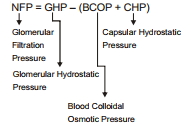
(B) The net filtration pressure $(NFP)$ is the pressure that drives the filtration of blood in the glomerulus.
It is calculated by subtracting the opposing pressures (Blood Colloidal Osmotic Pressure $(BCOP)$ and Capsular Hydrostatic Pressure $(CHP)$) from the Glomerular Hydrostatic Pressure $(GHP)$.
The formula is: $NFP = GHP - (BCOP + CHP)$.
It is calculated by subtracting the opposing pressures (Blood Colloidal Osmotic Pressure $(BCOP)$ and Capsular Hydrostatic Pressure $(CHP)$) from the Glomerular Hydrostatic Pressure $(GHP)$.
The formula is: $NFP = GHP - (BCOP + CHP)$.
0 likes
View Solution91
MediumMCQ
$A :$ Inulin is used in testing kidney function,especially glomerular filtration rate $(GFR)$.
$R :$ Inulin is a fructan storage polysaccharide.
$R :$ Inulin is a fructan storage polysaccharide.
A
Assertion and Reason both are correct and Reason is the correct explanation of Assertion.
B
Assertion and Reason both are correct but Reason is not the correct explanation of Assertion.
C
Assertion is correct,but Reason is incorrect.
D
Both Assertion and Reason are incorrect.
Solution
(A) Inulin is a polymer of fructose known as a fructan,which acts as a storage polysaccharide in certain plants.
It is an ideal substance for measuring the glomerular filtration rate $(GFR)$ because it is freely filtered by the glomerulus,is neither reabsorbed nor secreted by the renal tubules,and is not metabolized by the human body.
Since it is completely excreted in the urine,its clearance rate provides an accurate measure of $GFR$.
It is an ideal substance for measuring the glomerular filtration rate $(GFR)$ because it is freely filtered by the glomerulus,is neither reabsorbed nor secreted by the renal tubules,and is not metabolized by the human body.
Since it is completely excreted in the urine,its clearance rate provides an accurate measure of $GFR$.
0 likes
View Solution92
EasyMCQ
What is the $GFR$ of a normal healthy person?
A
$100 \; ml/min$
B
$125 \; ml/min$
C
$150 \; ml/min$
D
$180 \; ml/min$
Solution
(B) The Glomerular Filtration Rate $(GFR)$ is the amount of the filtrate formed by the kidneys per minute.
In a normal healthy individual,the $GFR$ is approximately $125 \; ml/min$,which amounts to $180 \; liters$ per day.
In a normal healthy individual,the $GFR$ is approximately $125 \; ml/min$,which amounts to $180 \; liters$ per day.
0 likes
View Solution93
MediumMCQ
Which major process occurs in the given structure?
A
Reabsorption
B
Secretion
C
Filtration
D
All of the above
Solution
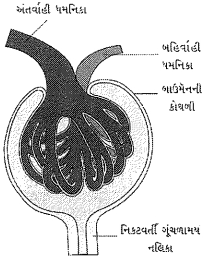
(C) The given image shows the Malpighian body (renal corpuscle),which consists of the glomerulus and Bowman's capsule.
The primary function of the glomerulus and Bowman's capsule is the filtration of blood,which is the first step in urine formation.
This process is known as glomerular filtration (ultrafiltration).
Therefore,the correct option is $C$.
The primary function of the glomerulus and Bowman's capsule is the filtration of blood,which is the first step in urine formation.
This process is known as glomerular filtration (ultrafiltration).
Therefore,the correct option is $C$.
0 likes
View Solution94
EasyMCQ
Identify the sequential processes involved in urine formation.
A
Glomerular filtration $\rightarrow$ Reabsorption $\rightarrow$ Secretion
B
Secretion $\rightarrow$ Reabsorption $\rightarrow$ Glomerular filtration
C
Glomerular filtration $\rightarrow$ Secretion $\rightarrow$ Reabsorption
D
Reabsorption $\rightarrow$ Secretion $\rightarrow$ Glomerular filtration
Solution
(A) Urine formation involves three main processes that take place in different parts of the nephron:
$1$. Glomerular filtration: Blood is filtered in the glomerulus,forming the glomerular filtrate.
$2$. Reabsorption: Essential substances like glucose,amino acids,and water are reabsorbed from the filtrate back into the blood.
$3$. Secretion: Tubular cells secrete substances like $H^+$,$K^+$,and ammonia into the filtrate to maintain ionic and acid-base balance.
Therefore,the correct sequence is Glomerular filtration $\rightarrow$ Reabsorption $\rightarrow$ Secretion.
$1$. Glomerular filtration: Blood is filtered in the glomerulus,forming the glomerular filtrate.
$2$. Reabsorption: Essential substances like glucose,amino acids,and water are reabsorbed from the filtrate back into the blood.
$3$. Secretion: Tubular cells secrete substances like $H^+$,$K^+$,and ammonia into the filtrate to maintain ionic and acid-base balance.
Therefore,the correct sequence is Glomerular filtration $\rightarrow$ Reabsorption $\rightarrow$ Secretion.
0 likes
View Solution95
MediumMCQ
What is the volume of blood filtered by both kidneys per minute?
A
$125 \text{ mL/min}$
B
$1100-1200 \text{ mL/min}$
C
$1100-1200 \text{ mL/hour}$
D
$125 \text{ mL/hour}$
Solution
(B) The kidneys receive approximately $1100-1200 \text{ mL}$ of blood per minute,which constitutes about $1/5$th of the blood pumped out by each ventricle of the heart in a minute.
This volume of blood is filtered by the glomeruli to form the glomerular filtrate.
In contrast,$125 \text{ mL/min}$ refers to the Glomerular Filtration Rate $(GFR)$,which is the amount of filtrate formed by the kidneys per minute.
This volume of blood is filtered by the glomeruli to form the glomerular filtrate.
In contrast,$125 \text{ mL/min}$ refers to the Glomerular Filtration Rate $(GFR)$,which is the amount of filtrate formed by the kidneys per minute.
0 likes
View Solution96
MediumMCQ
What is the composition of the filtrate present in the lumen of Bowman's capsule?
A
Blood plasma without proteins
B
Blood without proteins
C
Water and urea
D
Blood without blood cells
Solution
(A) The process of urine formation begins with ultrafiltration in the glomerulus.
During this process,blood is filtered through three layers: the endothelium of glomerular blood vessels,the epithelium of Bowman's capsule (podocytes),and a basement membrane between these two layers.
Due to the high pressure in the glomerular capillaries,almost all constituents of the blood plasma,except for the large plasma proteins,pass into the lumen of Bowman's capsule.
Therefore,the glomerular filtrate is essentially blood plasma that is devoid of proteins.
During this process,blood is filtered through three layers: the endothelium of glomerular blood vessels,the epithelium of Bowman's capsule (podocytes),and a basement membrane between these two layers.
Due to the high pressure in the glomerular capillaries,almost all constituents of the blood plasma,except for the large plasma proteins,pass into the lumen of Bowman's capsule.
Therefore,the glomerular filtrate is essentially blood plasma that is devoid of proteins.
0 likes
View Solution97
MediumMCQ
What is the full form of $GFR$?
A
Globular Filtrate Rate
B
Glomerular Filtrate Rate
C
Glomerular Filtration Rate
D
Globular Filtration Rate
Solution
(C) $GFR$ stands for $Glomerular$ $Filtration$ $Rate$.
It is defined as the total amount of filtrate formed by the kidneys per minute.
In a healthy individual,the average $GFR$ is approximately $125 \ mL/minute$,which amounts to $180 \ litres$ per day.
It is defined as the total amount of filtrate formed by the kidneys per minute.
In a healthy individual,the average $GFR$ is approximately $125 \ mL/minute$,which amounts to $180 \ litres$ per day.
0 likes
View Solution98
MediumMCQ
What is the approximate $GFR$ in a healthy individual?
A
$125 \ mL/min$
B
$1100-1200 \ mL/min$
C
$1100-1200 \ mL/hour$
D
$125 \ mL/hour$
Solution
(A) The Glomerular Filtration Rate $(GFR)$ is the amount of filtrate formed by the kidneys per minute.
In a healthy individual,the $GFR$ is approximately $125 \ mL/min$,which translates to about $180 \ liters$ per day.
Option $A$ correctly represents this value.
In a healthy individual,the $GFR$ is approximately $125 \ mL/min$,which translates to about $180 \ liters$ per day.
Option $A$ correctly represents this value.
0 likes
View Solution99
MediumMCQ
In humans,the amount of filtrate produced per day is ........
A
$125$ ml
B
$180$ liters
C
$1.5$ liters
D
$15$ liters
Solution
(B) The kidneys perform the process of ultrafiltration to produce a filtrate from the blood.
In a healthy human,the Glomerular Filtration Rate $(GFR)$ is approximately $125$ ml per minute.
To calculate the daily filtrate production: $125$ ml/minute $\times$ $60$ minutes/hour $\times$ $24$ hours/day = $180,000$ ml/day.
Therefore,the total volume of filtrate formed by the kidneys in a day is $180$ liters.
In a healthy human,the Glomerular Filtration Rate $(GFR)$ is approximately $125$ ml per minute.
To calculate the daily filtrate production: $125$ ml/minute $\times$ $60$ minutes/hour $\times$ $24$ hours/day = $180,000$ ml/day.
Therefore,the total volume of filtrate formed by the kidneys in a day is $180$ liters.
0 likes
View SolutionExcretory Products and their Elimination — Urine Formation · Frequently Asked Questions
1Are these Excretory Products and their Elimination questions useful for JEE and NEET?
Yes. All questions in this section are mapped to JEE Main and NEET exam patterns. Previous year questions from JEE Main, NEET, GUJCET and state-level exams are included with full solutions.
2Can I switch to Hindi or Gujarati for these questions?
Yes. Use the language tabs in the hero section or the sidebar to view the same questions and solutions in English, Hindi or Gujarati.
3How do I generate a question paper from this subtopic?
Use the Vedclass Exam Paper Generator — select the chapter and subtopic, set difficulty, and generate Sets A, B, C, D automatically. First 3 chapters of every subject are free.
Vedclass Products
For Students
Vedclass Test Series
Mock tests in real JEE/NEET style with performance analysis. 5-day free trial.
Start Free TrialFor Teachers
Exam Paper Generator
Generate Set A/B/C/D papers from this chapter in 2 minutes. 3 chapters free.
Try FreeFor Institutes
Online Exam Module
Live online exams with unlimited students, 360° analytics & white-label branding.
See DemoFor Teachers & Institutes
Generate a Excretory Products and their Elimination Exam Paper in 2 Minutes
Select subtopic & difficulty — Sets A, B, C, D auto-generated with No Repeat logic.
First 3 chapters of every subject are free — no payment required.