
A English
Physiology of digestion Questions in English
Class 11 Biology · Digestion and Absorption · Physiology of digestion
255+
Questions
English
Language
100%
With Solutions
Showing 49 of 255 questions in English
151
EasyMCQ
Which of the following valves guards the opening of the hepatopancreatic duct into the duodenum?
A
Ileocaecal valve
B
Pyloric sphincter
C
Sphincter of Oddi
D
Semilunar valve
Solution
(C) The bile duct and the pancreatic duct open together into the duodenum as the common hepatopancreatic duct.
This duct is guarded by a muscular valve called the $Sphincter$ $of$ $Oddi$.
$A)$ The $Ileocaecal$ $valve$ prevents the backflow of faecal matter from the large intestine into the small intestine.
$B)$ The $Pyloric$ $sphincter$ regulates the passage of food from the stomach into the duodenum.
$D)$ The $Semilunar$ $valve$ is found in the heart and prevents the backflow of blood from the arteries into the ventricles.
This duct is guarded by a muscular valve called the $Sphincter$ $of$ $Oddi$.
$A)$ The $Ileocaecal$ $valve$ prevents the backflow of faecal matter from the large intestine into the small intestine.
$B)$ The $Pyloric$ $sphincter$ regulates the passage of food from the stomach into the duodenum.
$D)$ The $Semilunar$ $valve$ is found in the heart and prevents the backflow of blood from the arteries into the ventricles.
0 likes
View Solution152
MediumMCQ
If for some reason the parietal cells of the gut epithelium become partially non-functional,what is likely to happen?
A
The pancreatic enzymes and specially the trypsin and lipase will not work efficiently.
B
The $pH$ of stomach will fall abruptly.
C
Steapsin will be more effective.
D
Proteins will not be adequately hydrolysed by pepsin into proteoses and peptones.
Solution
(D) Parietal cells (also known as oxyntic cells) in the stomach lining are responsible for secreting hydrochloric acid $(HCl)$ and intrinsic factor.
$HCl$ is essential for converting the inactive enzyme pepsinogen into its active form,pepsin.
Pepsin is the primary enzyme responsible for the digestion of proteins into proteoses and peptones in the acidic environment of the stomach.
If parietal cells become non-functional,$HCl$ secretion decreases,leading to a higher (less acidic) $pH$ in the stomach.
Consequently,pepsinogen cannot be activated efficiently,and proteins will not be adequately hydrolyzed by pepsin.
$HCl$ is essential for converting the inactive enzyme pepsinogen into its active form,pepsin.
Pepsin is the primary enzyme responsible for the digestion of proteins into proteoses and peptones in the acidic environment of the stomach.
If parietal cells become non-functional,$HCl$ secretion decreases,leading to a higher (less acidic) $pH$ in the stomach.
Consequently,pepsinogen cannot be activated efficiently,and proteins will not be adequately hydrolyzed by pepsin.
0 likes
View Solution153
Medium
State the role of pancreatic juice in the digestion of proteins.
Solution
(N/A) Pancreatic juice contains inactive enzymes such as $Trypsinogen$, $Chymotrypsinogen$, and $Procarboxypeptidases$. These enzymes are essential for protein digestion.
$1$. $Enterokinase$, secreted by the intestinal mucosa, activates $Trypsinogen$ into $Trypsin$:
$Trypsinogen \xrightarrow{Enterokinase} Trypsin + \text{Inactive peptide}$
$2$. $Trypsin$ then activates $Chymotrypsinogen$ and $Procarboxypeptidase$:
$\text{Chymotrypsinogen} \xrightarrow{Trypsin} \text{Chymotrypsin}$
$\text{Procarboxypeptidase} \xrightarrow{Trypsin} \text{Carboxypeptidase}$
$3$. $Chymotrypsin$ converts proteins into peptides:
$\text{Proteins} \xrightarrow{Chymotrypsin} \text{Peptides}$
$4$. $Carboxypeptidase$ acts on the carboxyl end of the peptide chain, releasing the terminal amino acids:
$\text{Peptides} \xrightarrow{Carboxypeptidase} \text{Smaller peptide chains} + \text{Amino acids}$
In summary, partially hydrolyzed proteins (peptones and proteoses) in the chyme are acted upon by these proteolytic enzymes for complete digestion into dipeptides and amino acids:
$\text{Proteins, Peptones, Proteoses} \xrightarrow[Carboxypeptidase]{Trypsin/Chymotrypsin} \text{Dipeptides}$
$1$. $Enterokinase$, secreted by the intestinal mucosa, activates $Trypsinogen$ into $Trypsin$:
$Trypsinogen \xrightarrow{Enterokinase} Trypsin + \text{Inactive peptide}$
$2$. $Trypsin$ then activates $Chymotrypsinogen$ and $Procarboxypeptidase$:
$\text{Chymotrypsinogen} \xrightarrow{Trypsin} \text{Chymotrypsin}$
$\text{Procarboxypeptidase} \xrightarrow{Trypsin} \text{Carboxypeptidase}$
$3$. $Chymotrypsin$ converts proteins into peptides:
$\text{Proteins} \xrightarrow{Chymotrypsin} \text{Peptides}$
$4$. $Carboxypeptidase$ acts on the carboxyl end of the peptide chain, releasing the terminal amino acids:
$\text{Peptides} \xrightarrow{Carboxypeptidase} \text{Smaller peptide chains} + \text{Amino acids}$
In summary, partially hydrolyzed proteins (peptones and proteoses) in the chyme are acted upon by these proteolytic enzymes for complete digestion into dipeptides and amino acids:
$\text{Proteins, Peptones, Proteoses} \xrightarrow[Carboxypeptidase]{Trypsin/Chymotrypsin} \text{Dipeptides}$
0 likes
View Solution154
Medium
Describe the process of digestion of protein in the stomach.
Solution
(N/A) The digestion of proteins begins in the stomach and is completed in the small intestine.
The digestive juice secreted by the gastric glands present in the stomach wall is called gastric juice. The food that enters the stomach becomes acidic upon mixing with this gastric juice.
The main components of gastric juice are hydrochloric acid $(HCl)$, pepsinogen, mucus, and rennin (in infants). Hydrochloric acid creates an acidic medium $(pH \approx 1.8)$ so that the inactive enzyme pepsinogen is converted into its active form, pepsin.
$Pepsinogen \xrightarrow{HCl} Pepsin$
Pepsin is a proteolytic enzyme that converts proteins into proteoses and peptones.
$Proteins \xrightarrow{Pepsin} Proteoses + Peptones$
Rennin is a proteolytic enzyme found in gastric juice of infants, which helps in the digestion of milk proteins. It is released in an inactive form called prorennin, which is activated by $HCl$.
$Prorennin \xrightarrow{HCl} Rennin$
$Casein (milk protein) \xrightarrow{Rennin} Paracasein \to Calcium \ Paracaseinate$
The digestive juice secreted by the gastric glands present in the stomach wall is called gastric juice. The food that enters the stomach becomes acidic upon mixing with this gastric juice.
The main components of gastric juice are hydrochloric acid $(HCl)$, pepsinogen, mucus, and rennin (in infants). Hydrochloric acid creates an acidic medium $(pH \approx 1.8)$ so that the inactive enzyme pepsinogen is converted into its active form, pepsin.
$Pepsinogen \xrightarrow{HCl} Pepsin$
Pepsin is a proteolytic enzyme that converts proteins into proteoses and peptones.
$Proteins \xrightarrow{Pepsin} Proteoses + Peptones$
Rennin is a proteolytic enzyme found in gastric juice of infants, which helps in the digestion of milk proteins. It is released in an inactive form called prorennin, which is activated by $HCl$.
$Prorennin \xrightarrow{HCl} Rennin$
$Casein (milk protein) \xrightarrow{Rennin} Paracasein \to Calcium \ Paracaseinate$
0 likes
View Solution155
Medium
Bile juice contains no digestive enzymes,yet it is important for digestion. Why?
Solution
(N/A) Bile is a digestive juice secreted by the liver. Although it does not contain any digestive enzymes,it plays an important role in the digestion of fats. Bile juice contains bile salts,bilirubin,and biliverdin. These break down large fat globules into smaller globules so that the pancreatic enzymes can easily act on them. This process is known as emulsification of fats. Bile juice also makes the medium alkaline and activates lipase.
0 likes
View Solution156
Medium
How are polysaccharides and disaccharides digested?
Solution
(N/A) The digestion of carbohydrates occurs in the mouth and the small intestine of the alimentary canal. Enzymes acting on carbohydrates are collectively known as carbohydrases.
Digestion in the mouth:
As food enters the mouth,it mixes with saliva. Saliva,secreted by salivary glands,contains salivary amylase. This enzyme breaks down starch into sugar at $pH\, 6.8$.
$Starch \xrightarrow[pH\, 6.8]{\text{Salivary amylase}} \text{Maltose} + \text{Isomaltose} + \text{Limit dextrins}$
Salivary amylase continues to act in the oesophagus,but its action stops in the stomach due to the acidic environment.
Digestion in the small intestine:
Carbohydrate digestion resumes in the small intestine. Pancreatic juice contains pancreatic amylase,which hydrolyses polysaccharides into disaccharides.
$Starch \xrightarrow{\text{Pancreatic amylase}} \text{Disaccharides}$
Intestinal juice contains disaccharidases (maltase,lactase,sucrase,etc.) which complete the digestion of disaccharides into monosaccharides:
$Maltose \xrightarrow{\text{Maltase}} 2 \text{ Glucose}$
$Lactose \xrightarrow{\text{Lactase}} \text{Glucose} + \text{Galactose}$
$Sucrose \xrightarrow{\text{Sucrase}} \text{Glucose} + \text{Fructose}$
Digestion in the mouth:
As food enters the mouth,it mixes with saliva. Saliva,secreted by salivary glands,contains salivary amylase. This enzyme breaks down starch into sugar at $pH\, 6.8$.
$Starch \xrightarrow[pH\, 6.8]{\text{Salivary amylase}} \text{Maltose} + \text{Isomaltose} + \text{Limit dextrins}$
Salivary amylase continues to act in the oesophagus,but its action stops in the stomach due to the acidic environment.
Digestion in the small intestine:
Carbohydrate digestion resumes in the small intestine. Pancreatic juice contains pancreatic amylase,which hydrolyses polysaccharides into disaccharides.
$Starch \xrightarrow{\text{Pancreatic amylase}} \text{Disaccharides}$
Intestinal juice contains disaccharidases (maltase,lactase,sucrase,etc.) which complete the digestion of disaccharides into monosaccharides:
$Maltose \xrightarrow{\text{Maltase}} 2 \text{ Glucose}$
$Lactose \xrightarrow{\text{Lactase}} \text{Glucose} + \text{Galactose}$
$Sucrose \xrightarrow{\text{Sucrase}} \text{Glucose} + \text{Fructose}$
0 likes
View Solution157
MediumMCQ
What would happen if $HCl$ were not secreted in the stomach?
A
Protein digestion would be severely affected.
B
Pepsinogen would be converted into pepsin.
C
The stomach would become more alkaline.
D
Digestion of fats would increase.
Solution
(A) Hydrochloric acid $(HCl)$ is secreted by the oxyntic or parietal cells present in the stomach lining. It performs two main functions: it creates an acidic medium (pH $1.8$) and kills bacteria present in the food.
The acidic medium is essential for the activation of the enzyme pepsinogen into its active form,pepsin. Pepsin is a proteolytic enzyme responsible for the digestion of proteins into peptides.
If $HCl$ were not secreted,the stomach environment would not become acidic. Consequently,pepsinogen would not be converted into active pepsin,which would severely impair the digestion of proteins in the stomach.
The acidic medium is essential for the activation of the enzyme pepsinogen into its active form,pepsin. Pepsin is a proteolytic enzyme responsible for the digestion of proteins into peptides.
If $HCl$ were not secreted,the stomach environment would not become acidic. Consequently,pepsinogen would not be converted into active pepsin,which would severely impair the digestion of proteins in the stomach.
0 likes
View Solution158
Medium
Discuss the main steps in the digestion of proteins as the food passes through different parts of the alimentary canal.
Solution
(N/A) The digestion of proteins begins in the stomach and is completed in the small intestine.
The enzymes that act on proteins are known as proteases.
Digestion in the stomach:
The gastric glands in the stomach wall secrete gastric juice, which contains $HCl$, pepsinogen, and rennin. The acidic medium converts inactive pepsinogen into active pepsin. Active pepsin converts proteins into proteases and peptides.
$Proteins \xrightarrow{Pepsin} Proteases + Peptides$
Rennin is involved in the coagulation of milk proteins.
Digestion in the small intestine:
In the small intestine, pancreatic juice and intestinal juice act on the food.
Action of pancreatic juice:
Pancreatic juice contains inactive enzymes: trypsinogen, chymotrypsinogen, and procarboxypeptidases. Enterokinase, secreted by the intestinal mucosa, activates trypsinogen into trypsin.
$Trypsinogen \xrightarrow{Enterokinase} Trypsin + \text{Inactive peptide}$
Activated trypsin then activates chymotrypsinogen into chymotrypsin and procarboxypeptidases into carboxypeptidases.
$Proteins \xrightarrow{Chymotrypsin} Peptides$
$Peptides \xrightarrow{Carboxypeptidase} \text{Smaller peptide chains} + \text{Amino acids}$
Action of intestinal juice:
Intestinal juice (succus entericus) contains dipeptidases that complete the digestion of proteins.
$Dipeptides \xrightarrow{Dipeptidases} \text{Amino acids}$
The enzymes that act on proteins are known as proteases.
Digestion in the stomach:
The gastric glands in the stomach wall secrete gastric juice, which contains $HCl$, pepsinogen, and rennin. The acidic medium converts inactive pepsinogen into active pepsin. Active pepsin converts proteins into proteases and peptides.
$Proteins \xrightarrow{Pepsin} Proteases + Peptides$
Rennin is involved in the coagulation of milk proteins.
Digestion in the small intestine:
In the small intestine, pancreatic juice and intestinal juice act on the food.
Action of pancreatic juice:
Pancreatic juice contains inactive enzymes: trypsinogen, chymotrypsinogen, and procarboxypeptidases. Enterokinase, secreted by the intestinal mucosa, activates trypsinogen into trypsin.
$Trypsinogen \xrightarrow{Enterokinase} Trypsin + \text{Inactive peptide}$
Activated trypsin then activates chymotrypsinogen into chymotrypsin and procarboxypeptidases into carboxypeptidases.
$Proteins \xrightarrow{Chymotrypsin} Peptides$
$Peptides \xrightarrow{Carboxypeptidase} \text{Smaller peptide chains} + \text{Amino acids}$
Action of intestinal juice:
Intestinal juice (succus entericus) contains dipeptidases that complete the digestion of proteins.
$Dipeptides \xrightarrow{Dipeptidases} \text{Amino acids}$
0 likes
View Solution159
Easy
Answer briefly: How does pepsinogen change into its active form?
Solution
(N/A) Pepsinogen is an inactive proenzyme (zymogen) secreted by the chief cells of the gastric glands in the stomach. It is converted into its active form,pepsin,by the action of hydrochloric acid $(HCl)$. The reaction is as follows:
$\text{Pepsinogen (Inactive)} \xrightarrow{HCl} \text{Pepsin (Active)} + \text{Inactive peptide}$
$\text{Pepsinogen (Inactive)} \xrightarrow{HCl} \text{Pepsin (Active)} + \text{Inactive peptide}$
0 likes
View Solution160
Medium
Answer briefly: How does bile help in the digestion of fats?
Solution
(N/A) Bile is a digestive juice secreted by the liver and stored in the gall bladder. Bile contains bile salts (such as bilirubin and biliverdin). These salts break down large fat globules into smaller globules,increasing the surface area for pancreatic enzymes to act upon. This process is known as the emulsification of fats. Additionally,bile makes the medium alkaline,which is necessary for the activation of lipase.
0 likes
View Solution161
Medium
Describe the process of digestion occurring in the oral cavity.
Solution
(N/A) The oral cavity performs two major functions: mastication of food and facilitation of swallowing.
Teeth and tongue,with the help of saliva,masticate and mix the food thoroughly.
Mucus in saliva helps in lubricating and adhering the masticated food particles into a bolus.
The bolus is then conveyed into the pharynx and subsequently into the oesophagus by the process of swallowing or deglutition.
The bolus passes down through the oesophagus by successive waves of muscular contractions known as peristalsis.
The gastro-oesophageal sphincter controls the passage of food into the stomach.
Saliva secreted into the oral cavity contains electrolytes $(Na^{+}, K^{+}, Cl^{-}, HCO_{3}^{-})$ and enzymes,specifically salivary amylase and lysozyme.
The chemical process of digestion is initiated in the oral cavity by the hydrolytic action of the carbohydrate-splitting enzyme,salivary amylase.
Approximately $30\%$ of starch is hydrolysed here by this enzyme into the disaccharide maltose.
$\text{Starch} \xrightarrow{\text{Salivary Amylase}, \text{pH } 6.8} \text{Maltose}$
Lysozyme present in saliva acts as an antibacterial agent that prevents infections.
Teeth and tongue,with the help of saliva,masticate and mix the food thoroughly.
Mucus in saliva helps in lubricating and adhering the masticated food particles into a bolus.
The bolus is then conveyed into the pharynx and subsequently into the oesophagus by the process of swallowing or deglutition.
The bolus passes down through the oesophagus by successive waves of muscular contractions known as peristalsis.
The gastro-oesophageal sphincter controls the passage of food into the stomach.
Saliva secreted into the oral cavity contains electrolytes $(Na^{+}, K^{+}, Cl^{-}, HCO_{3}^{-})$ and enzymes,specifically salivary amylase and lysozyme.
The chemical process of digestion is initiated in the oral cavity by the hydrolytic action of the carbohydrate-splitting enzyme,salivary amylase.
Approximately $30\%$ of starch is hydrolysed here by this enzyme into the disaccharide maltose.
$\text{Starch} \xrightarrow{\text{Salivary Amylase}, \text{pH } 6.8} \text{Maltose}$
Lysozyme present in saliva acts as an antibacterial agent that prevents infections.
0 likes
View Solution162
Medium
Describe the process of digestion occurring in the stomach.
Solution
(N/A) The stomach mucosa contains gastric glands. Gastric glands have three major types of cells:
$(1)$ Mucous neck cells which secrete mucus.
$(2)$ Peptic or chief cells which secrete the proenzyme pepsinogen.
$(3)$ Parietal or oxyntic cells which secrete $HCl$ and intrinsic factor (essential for the absorption of vitamin $B_{12}$).
When food enters the stomach,the hormone gastrin is secreted into the blood by the pyloric region,which stimulates the secretion of gastric juice from the gastric glands.
The stomach stores food for $4-5$ hours. The food mixes thoroughly with the acidic gastric juice through the churning movements of the muscular wall,forming a semi-digested acidic mass called chyme.
The proenzyme pepsinogen,upon exposure to hydrochloric acid,is converted into the active enzyme pepsin. Pepsin converts proteins into proteoses and peptones.
$\text{Pepsinogen} \xrightarrow{HCl} \text{Pepsin} \rightarrow \text{Proteins} \rightarrow \text{Proteoses} + \text{Peptones}$.
The mucus and bicarbonates present in the gastric juice play an important role in lubrication and protection of the mucosal epithelium from excoriation by the highly concentrated $HCl$.
$HCl$ provides the acidic pH optimal for pepsin activity. Rennin is a proteolytic enzyme found in the gastric juice of infants,which helps in the digestion of milk proteins.
Small amounts of lipases are also secreted by gastric glands.
$(1)$ Mucous neck cells which secrete mucus.
$(2)$ Peptic or chief cells which secrete the proenzyme pepsinogen.
$(3)$ Parietal or oxyntic cells which secrete $HCl$ and intrinsic factor (essential for the absorption of vitamin $B_{12}$).
When food enters the stomach,the hormone gastrin is secreted into the blood by the pyloric region,which stimulates the secretion of gastric juice from the gastric glands.
The stomach stores food for $4-5$ hours. The food mixes thoroughly with the acidic gastric juice through the churning movements of the muscular wall,forming a semi-digested acidic mass called chyme.
The proenzyme pepsinogen,upon exposure to hydrochloric acid,is converted into the active enzyme pepsin. Pepsin converts proteins into proteoses and peptones.
$\text{Pepsinogen} \xrightarrow{HCl} \text{Pepsin} \rightarrow \text{Proteins} \rightarrow \text{Proteoses} + \text{Peptones}$.
The mucus and bicarbonates present in the gastric juice play an important role in lubrication and protection of the mucosal epithelium from excoriation by the highly concentrated $HCl$.
$HCl$ provides the acidic pH optimal for pepsin activity. Rennin is a proteolytic enzyme found in the gastric juice of infants,which helps in the digestion of milk proteins.
Small amounts of lipases are also secreted by gastric glands.
0 likes
View Solution163
Medium
Give the composition and function of gastric juice.
Solution
(N/A) The mucosa of the stomach contains gastric glands. Gastric glands consist of three major types of cells:
$(1)$ Mucous neck cells which secrete mucus.
$(2)$ Peptic or chief cells which secrete the proenzyme pepsinogen.
$(3)$ Parietal or oxyntic cells which secrete $HCl$ and intrinsic factor (essential for the absorption of vitamin $B_{12}$).
When food enters the stomach,the hormone gastrin is secreted into the blood by the pyloric region,which stimulates the secretion of gastric juice from the gastric glands.
The stomach stores food for $4-5$ hours. The food mixes thoroughly with the acidic gastric juice through the churning movements of the muscular wall,forming a mass called chyme. The proenzyme pepsinogen,upon exposure to hydrochloric acid,is converted into the active enzyme pepsin. Pepsin converts proteins into proteoses and peptones.
$\text{Pepsinogen} \xrightarrow{HCl} \text{Pepsin} \rightarrow \text{Proteins} \rightarrow \text{Proteoses} + \text{Peptones}$
The mucus and bicarbonates present in the gastric juice play an important role in lubrication and protection of the mucosal epithelium from excoriation by the highly concentrated $HCl$.
$HCl$ provides the acidic $pH$ optimal for pepsin activity. Rennin is a proteolytic enzyme found in the gastric juice of infants,which helps in the digestion of milk proteins. Small amounts of lipases are also secreted by gastric glands.
$(1)$ Mucous neck cells which secrete mucus.
$(2)$ Peptic or chief cells which secrete the proenzyme pepsinogen.
$(3)$ Parietal or oxyntic cells which secrete $HCl$ and intrinsic factor (essential for the absorption of vitamin $B_{12}$).
When food enters the stomach,the hormone gastrin is secreted into the blood by the pyloric region,which stimulates the secretion of gastric juice from the gastric glands.
The stomach stores food for $4-5$ hours. The food mixes thoroughly with the acidic gastric juice through the churning movements of the muscular wall,forming a mass called chyme. The proenzyme pepsinogen,upon exposure to hydrochloric acid,is converted into the active enzyme pepsin. Pepsin converts proteins into proteoses and peptones.
$\text{Pepsinogen} \xrightarrow{HCl} \text{Pepsin} \rightarrow \text{Proteins} \rightarrow \text{Proteoses} + \text{Peptones}$
The mucus and bicarbonates present in the gastric juice play an important role in lubrication and protection of the mucosal epithelium from excoriation by the highly concentrated $HCl$.
$HCl$ provides the acidic $pH$ optimal for pepsin activity. Rennin is a proteolytic enzyme found in the gastric juice of infants,which helps in the digestion of milk proteins. Small amounts of lipases are also secreted by gastric glands.
0 likes
View Solution164
Difficult
Describe the process of digestion in the small intestine in detail.
Solution
(N/A) The semi-digested food,known as chyme,enters the small intestine from the stomach through the pyloric sphincter. In the small intestine,chyme comes into contact with three major secretions: pancreatic juice,bile juice,and intestinal juice.
$1$. Mechanical Digestion: The muscularis layer of the small intestine generates various movements (peristalsis and segmentation) that facilitate the thorough mixing of food with these secretions.
$2$. Pancreatic Juice Action: Pancreatic juice contains inactive enzymes: trypsinogen,chymotrypsinogen,and procarboxypeptidases,along with amylases,lipases,and nucleases. Trypsinogen is activated by enterokinase (secreted by the intestinal mucosa) into active trypsin,which then activates other pancreatic enzymes.
- Proteins,peptones,and proteoses are acted upon by trypsin,chymotrypsin,and carboxypeptidase to form dipeptides.
- Carbohydrates (starch) are hydrolyzed by pancreatic amylase into disaccharides.
- Fats are broken down by lipases into diglycerides and monoglycerides.
- Nucleic acids are acted upon by nucleases to form nucleotides and nucleosides.
$3$. Bile Action: Bile contains bile pigments (bilirubin and biliverdin),bile salts,cholesterol,and phospholipids,but no enzymes. It aids in the emulsification of fats,breaking them down into small micelles,which increases the surface area for lipase action.
$4$. Intestinal Juice (Succus Entericus) Action: The final steps of digestion occur in the jejunum and ileum,where enzymes in the intestinal juice convert complex molecules into absorbable simple forms:
- Dipeptides $\xrightarrow{\text{Dipeptidases}}$ Amino acids
- Maltose $\xrightarrow{\text{Maltase}}$ Glucose + Glucose
- Lactose $\xrightarrow{\text{Lactase}}$ Glucose + Galactose
- Sucrose $\xrightarrow{\text{Sucrase}}$ Glucose + Fructose
- Nucleotides $\xrightarrow{\text{Nucleotidases}}$ Nucleosides $\xrightarrow{\text{Nucleosidases}}$ Sugars + Nitrogenous bases
- Di and Monoglycerides $\xrightarrow{\text{Lipases}}$ Fatty acids + Glycerol
The resulting simple components are absorbed in the jejunum and ileum,while undigested and unabsorbed substances pass into the large intestine.
$1$. Mechanical Digestion: The muscularis layer of the small intestine generates various movements (peristalsis and segmentation) that facilitate the thorough mixing of food with these secretions.
$2$. Pancreatic Juice Action: Pancreatic juice contains inactive enzymes: trypsinogen,chymotrypsinogen,and procarboxypeptidases,along with amylases,lipases,and nucleases. Trypsinogen is activated by enterokinase (secreted by the intestinal mucosa) into active trypsin,which then activates other pancreatic enzymes.
- Proteins,peptones,and proteoses are acted upon by trypsin,chymotrypsin,and carboxypeptidase to form dipeptides.
- Carbohydrates (starch) are hydrolyzed by pancreatic amylase into disaccharides.
- Fats are broken down by lipases into diglycerides and monoglycerides.
- Nucleic acids are acted upon by nucleases to form nucleotides and nucleosides.
$3$. Bile Action: Bile contains bile pigments (bilirubin and biliverdin),bile salts,cholesterol,and phospholipids,but no enzymes. It aids in the emulsification of fats,breaking them down into small micelles,which increases the surface area for lipase action.
$4$. Intestinal Juice (Succus Entericus) Action: The final steps of digestion occur in the jejunum and ileum,where enzymes in the intestinal juice convert complex molecules into absorbable simple forms:
- Dipeptides $\xrightarrow{\text{Dipeptidases}}$ Amino acids
- Maltose $\xrightarrow{\text{Maltase}}$ Glucose + Glucose
- Lactose $\xrightarrow{\text{Lactase}}$ Glucose + Galactose
- Sucrose $\xrightarrow{\text{Sucrase}}$ Glucose + Fructose
- Nucleotides $\xrightarrow{\text{Nucleotidases}}$ Nucleosides $\xrightarrow{\text{Nucleosidases}}$ Sugars + Nitrogenous bases
- Di and Monoglycerides $\xrightarrow{\text{Lipases}}$ Fatty acids + Glycerol
The resulting simple components are absorbed in the jejunum and ileum,while undigested and unabsorbed substances pass into the large intestine.
0 likes
View Solution165
EasyMCQ
What is called digestion?
A
The process of breaking down complex food into simple absorbable forms.
B
The process of synthesizing complex molecules from simple ones.
C
The process of eliminating waste from the body.
D
The process of absorbing nutrients into the bloodstream.
Solution
(A) The process of conversion of complex food substances into simple absorbable forms is called digestion. This process is carried out by our digestive system by mechanical and biochemical methods.
0 likes
View Solution166
EasyMCQ
How does pepsinogen get converted into its active form?
A
By the action of bile salts
B
By the action of hydrochloric acid $(HCl)$
C
By the action of trypsin
D
By the action of mucus
Solution
(B) The proenzyme pepsinogen is secreted by the chief cells of the stomach.
When pepsinogen comes in contact with hydrochloric acid $(HCl)$ secreted by the parietal cells,it undergoes a conformational change.
This process converts the inactive proenzyme pepsinogen into the active proteolytic enzyme pepsin.
This active pepsin then helps in the digestion of proteins into proteoses and peptones.
When pepsinogen comes in contact with hydrochloric acid $(HCl)$ secreted by the parietal cells,it undergoes a conformational change.
This process converts the inactive proenzyme pepsinogen into the active proteolytic enzyme pepsin.
This active pepsin then helps in the digestion of proteins into proteoses and peptones.
0 likes
View Solution167
Medium
Clarify the contribution of pancreatic juice in the digestion of proteins.
Solution
(N/A) Pancreatic juice contains inactive enzymes: $Trypsinogen$, $Chymotrypsinogen$, and $Procarboxypeptidases$, along with $Amylase$, $Lipase$, and $Nuclease$.
$Trypsinogen$ is activated by $Enterokinase$ (secreted by the intestinal mucosa) into active $Trypsin$, which subsequently activates the other proteolytic enzymes in the pancreatic juice.
$Trypsin$ acts on proteins, $Proteoses$, and $Peptones$ to convert them into $Polypeptides$.
$Chymotrypsin$ converts $Proteoses$ and $Polypeptides$ into smaller $Peptides$.
$Carboxypeptidase$ acts on the terminal ends of $Polypeptides$ to release individual $Amino acids$ and smaller $Peptides$.
$Trypsinogen$ is activated by $Enterokinase$ (secreted by the intestinal mucosa) into active $Trypsin$, which subsequently activates the other proteolytic enzymes in the pancreatic juice.
$Trypsin$ acts on proteins, $Proteoses$, and $Peptones$ to convert them into $Polypeptides$.
$Chymotrypsin$ converts $Proteoses$ and $Polypeptides$ into smaller $Peptides$.
$Carboxypeptidase$ acts on the terminal ends of $Polypeptides$ to release individual $Amino acids$ and smaller $Peptides$.
0 likes
View Solution168
Medium
What is Chyme? Explain.
Solution
(N/A) Chyme is the semi-digested,acidic,and pulpy mass of food that passes from the stomach into the small intestine.
It is formed in the stomach through the mechanical churning of food and its chemical breakdown by gastric juices,which include $HCl$ and enzymes like pepsin.
The acidic nature of chyme helps in the activation of pepsinogen into pepsin and kills bacteria present in the food.
Once the food is converted into chyme,the pyloric sphincter relaxes to allow it to enter the duodenum for further digestion and absorption.
It is formed in the stomach through the mechanical churning of food and its chemical breakdown by gastric juices,which include $HCl$ and enzymes like pepsin.
The acidic nature of chyme helps in the activation of pepsinogen into pepsin and kills bacteria present in the food.
Once the food is converted into chyme,the pyloric sphincter relaxes to allow it to enter the duodenum for further digestion and absorption.
0 likes
View Solution169
MediumMCQ
How does bile help in the digestion of fat?
A
By activating lipase enzymes
B
By emulsifying fats into small micelles
C
By chemically breaking down fats into fatty acids
D
By neutralizing stomach acid
Solution
(B) Bile salts present in bile help in the emulsification of fats,which is the process of breaking down large fat globules into very small micelles.
This process increases the surface area of the fats,allowing lipases to act more efficiently on them.
The breakdown process is as follows:
$1.$ Emulsification: Large fat globules $\longrightarrow$ Small micelles.
$2.$ Enzymatic action: Fats $\xrightarrow{\text{Lipases}}$ Diglycerides $\longrightarrow$ Monoglycerides.
Additionally,nucleases in the pancreatic juice act on nucleic acids to form nucleotides and nucleosides:
Nucleic acids $\xrightarrow{\text{Nucleases}}$ Nucleotides $\longrightarrow$ Nucleosides.
This process increases the surface area of the fats,allowing lipases to act more efficiently on them.
The breakdown process is as follows:
$1.$ Emulsification: Large fat globules $\longrightarrow$ Small micelles.
$2.$ Enzymatic action: Fats $\xrightarrow{\text{Lipases}}$ Diglycerides $\longrightarrow$ Monoglycerides.
Additionally,nucleases in the pancreatic juice act on nucleic acids to form nucleotides and nucleosides:
Nucleic acids $\xrightarrow{\text{Nucleases}}$ Nucleotides $\longrightarrow$ Nucleosides.
0 likes
View Solution170
Medium
Differentiate between Chyme and completely digested food.
Solution
(N/A)
| Chyme | Completely digested food |
|---|---|
| $(1)$ It is the semi-solid and acidic food present in the stomach. | $(1)$ It is the completely digested,liquid,and alkaline (basic) food. |
| $(2)$ It represents the partial digestion of food. | $(2)$ It represents the conversion of food into simple absorbable components. |
| $(3)$ It is acidic in nature. | $(3)$ It is alkaline (basic) in nature. |
| $(4)$ Proteins are converted into peptones and proteoses; these are not absorbed. | $(4)$ Simple compounds like amino acids,glucose,fructose,and monoglycerides are formed; these are absorbed. |
0 likes
View Solution171
Easy
Provide definitions/explanations for the following terms:
$(1)$ Digestion
$(2)$ Peristalsis
$(1)$ Digestion
$(2)$ Peristalsis
Solution
(N/A) $(1)$ The process of converting complex food components into simple and absorbable forms with the help of enzymes is called digestion.
$(2)$ The rhythmic contraction and relaxation of the muscular walls of the digestive tract that pushes food forward,particularly in the oesophagus,is called peristalsis.
$(2)$ The rhythmic contraction and relaxation of the muscular walls of the digestive tract that pushes food forward,particularly in the oesophagus,is called peristalsis.
0 likes
View Solution172
Medium
Definition / Explanation :
$(1)$ Emulsification
$(1)$ Emulsification
Solution
(N/A) Emulsification is the process in which bile salts,present in bile juice,break down large fat globules into smaller fat droplets,thereby increasing the surface area for the action of lipase enzymes and facilitating the digestion of fats.
0 likes
View Solution173
Medium
Correct the statement given below by choosing the right option shown in the bracket against it:
Dipeptides,disaccharides,and glycerides are broken down into simple substances in the region of the small intestine. (jejunum/duodenum).
Dipeptides,disaccharides,and glycerides are broken down into simple substances in the region of the small intestine. (jejunum/duodenum).
Solution
(DUODENUM) The breakdown of complex food molecules like dipeptides,disaccharides,and glycerides into simpler absorbable forms (amino acids,monosaccharides,and fatty acids/glycerol) occurs primarily in the duodenum. The pancreatic enzymes and bile salts released into the duodenum facilitate these chemical digestion processes.
0 likes
View Solution174
MediumMCQ
How is the intestinal mucosa protected from the acidic food entering from the stomach?
A
By the secretion of mucus from goblet cells.
B
By the neutralization of acid by alkaline secretions from the pancreas and Brunner's glands.
C
By the presence of a thick layer of keratinized epithelium.
D
By the rapid regeneration of the intestinal lining.
Solution
(B) The intestinal mucosa is protected from the highly acidic chyme entering from the stomach primarily by the alkaline secretions.
$1$. The pancreas secretes pancreatic juice containing bicarbonate ions $(HCO_3^-)$,which neutralizes the acidic chyme.
$2$. Brunner's glands (submucosal glands) present in the duodenum secrete an alkaline,mucus-rich fluid that further neutralizes the acid and protects the intestinal wall.
$3$. Goblet cells in the intestinal mucosa secrete mucus,which provides a physical barrier and lubrication for the lining.
$1$. The pancreas secretes pancreatic juice containing bicarbonate ions $(HCO_3^-)$,which neutralizes the acidic chyme.
$2$. Brunner's glands (submucosal glands) present in the duodenum secrete an alkaline,mucus-rich fluid that further neutralizes the acid and protects the intestinal wall.
$3$. Goblet cells in the intestinal mucosa secrete mucus,which provides a physical barrier and lubrication for the lining.
0 likes
View Solution175
Medium
Describe the enzymatic action on fats in the duodenum.
Solution
(N/A) In the duodenum,fats are first emulsified by bile salts,which increases the surface area for enzyme action.
The enzyme pancreatic lipase,secreted by the pancreas,acts on these emulsified fats.
Fats are broken down into diglycerides and subsequently into monoglycerides.
Finally,these are broken down into fatty acids and glycerol.
The process is represented as:
$1. \text{Fats} \xrightarrow{\text{Lipases}} \text{Diglycerides} \rightarrow \text{Monoglycerides}$
$2. \text{Diglycerides/Monoglycerides} \xrightarrow{\text{Lipases}} \text{Fatty acids} + \text{Glycerol}$
The enzyme pancreatic lipase,secreted by the pancreas,acts on these emulsified fats.
Fats are broken down into diglycerides and subsequently into monoglycerides.
Finally,these are broken down into fatty acids and glycerol.
The process is represented as:
$1. \text{Fats} \xrightarrow{\text{Lipases}} \text{Diglycerides} \rightarrow \text{Monoglycerides}$
$2. \text{Diglycerides/Monoglycerides} \xrightarrow{\text{Lipases}} \text{Fatty acids} + \text{Glycerol}$
0 likes
View Solution176
Medium
Discuss the role of the hepato-pancreatic complex in the digestion of carbohydrate,protein,and fat components of food.
Solution
(N/A) The hepato-pancreatic complex consists of the liver and the pancreas,which release their secretions into the duodenum via the hepato-pancreatic duct.
$1$. Bile (from the liver): Bile contains bile salts (bilirubin and biliverdin) which do not contain enzymes. Its primary role is the emulsification of fats,breaking down large fat globules into smaller micelles,thereby increasing the surface area for lipase action.
$2$. Pancreatic Juice (from the pancreas): This contains inactive enzymes like trypsinogen,chymotrypsinogen,and procarboxypeptidases,along with active enzymes like pancreatic amylase,lipases,and nucleases.
- Carbohydrate digestion: Pancreatic amylase breaks down polysaccharides into disaccharides.
- Protein digestion: Trypsinogen is activated by enterokinase to trypsin,which then activates other proteases. These enzymes break down proteins,proteoses,and peptones into dipeptides.
- Fat digestion: Pancreatic lipases,aided by bile,break down emulsified fats into diglycerides and monoglycerides.
$1$. Bile (from the liver): Bile contains bile salts (bilirubin and biliverdin) which do not contain enzymes. Its primary role is the emulsification of fats,breaking down large fat globules into smaller micelles,thereby increasing the surface area for lipase action.
$2$. Pancreatic Juice (from the pancreas): This contains inactive enzymes like trypsinogen,chymotrypsinogen,and procarboxypeptidases,along with active enzymes like pancreatic amylase,lipases,and nucleases.
- Carbohydrate digestion: Pancreatic amylase breaks down polysaccharides into disaccharides.
- Protein digestion: Trypsinogen is activated by enterokinase to trypsin,which then activates other proteases. These enzymes break down proteins,proteoses,and peptones into dipeptides.
- Fat digestion: Pancreatic lipases,aided by bile,break down emulsified fats into diglycerides and monoglycerides.
0 likes
View Solution177
Medium
Explain the process of digestion in the buccal cavity with a note on the arrangement of teeth.
Solution
(N/A) The digestion of carbohydrates begins in the mouth,where food mixes with saliva.
This makes the food soft and moist. Food components are broken down into smaller pieces due to the process of chewing (mastication).
Saliva contains the enzyme salivary amylase. This enzyme converts starch into maltose,isomaltose,and $\alpha$-dextrin. Approximately $30\%$ of the starch in food is hydrolyzed in the mouth.
$\text{Starch} \xrightarrow{\text{Salivary Amylase}} \text{Maltose} + \text{Isomaltose} + \alpha\text{-Dextrin}$
Saliva does not contain any enzymes for the digestion of proteins or fats,so they are not digested in the mouth.
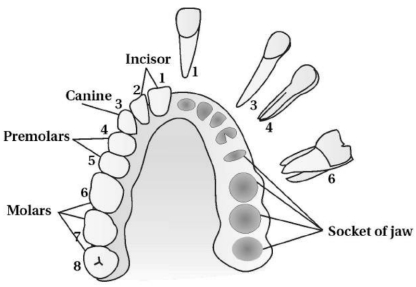
In the mouth,teeth are embedded in the sockets of the jawbone. This type of dental arrangement is called thecodont.
There are four types of teeth arranged in the order of $2, 1, 2, 3$ in each half of each jaw. These are incisors,canines,premolars,and molars,respectively. They form the dental formula: $\frac{2123}{2123}$.
This makes the food soft and moist. Food components are broken down into smaller pieces due to the process of chewing (mastication).
Saliva contains the enzyme salivary amylase. This enzyme converts starch into maltose,isomaltose,and $\alpha$-dextrin. Approximately $30\%$ of the starch in food is hydrolyzed in the mouth.
$\text{Starch} \xrightarrow{\text{Salivary Amylase}} \text{Maltose} + \text{Isomaltose} + \alpha\text{-Dextrin}$
Saliva does not contain any enzymes for the digestion of proteins or fats,so they are not digested in the mouth.
In the mouth,teeth are embedded in the sockets of the jawbone. This type of dental arrangement is called thecodont.
There are four types of teeth arranged in the order of $2, 1, 2, 3$ in each half of each jaw. These are incisors,canines,premolars,and molars,respectively. They form the dental formula: $\frac{2123}{2123}$.
0 likes
View Solution178
EasyMCQ
Choose the correct option regarding the activation of trypsinogen.
A
Trypsinogen is activated by $HCl$.
B
Trypsinogen is activated by enterokinase.
C
Trypsinogen is activated by bile salts.
D
Trypsinogen is activated by pepsin.
Solution
(B) Trypsinogen is an inactive enzyme secreted by the pancreas into the small intestine. It is activated into its active form,trypsin,by an enzyme called enterokinase (also known as enteropeptidase),which is secreted by the intestinal mucosa.
0 likes
View Solution179
EasyMCQ
The proteolytic enzyme rennin is found in
A
Pancreatic juice
B
Intestinal juice
C
Bile juice
D
Gastric juice
Solution
(D) The correct answer is option $D$ because $Rennin$ is a proteolytic enzyme found in the gastric juice of infants,which helps in the digestion of milk proteins.
Option $A$ is incorrect as the proteolytic enzymes found in pancreatic juice are $Trypsin$,$Chymotrypsin$,$Carboxypeptidase$,etc.
Option $B$ is incorrect as the proteolytic enzymes found in intestinal juice are $Dipeptidases$.
Option $C$ is incorrect as no enzymes are present in bile juice.
Option $A$ is incorrect as the proteolytic enzymes found in pancreatic juice are $Trypsin$,$Chymotrypsin$,$Carboxypeptidase$,etc.
Option $B$ is incorrect as the proteolytic enzymes found in intestinal juice are $Dipeptidases$.
Option $C$ is incorrect as no enzymes are present in bile juice.
0 likes
View Solution180
MediumMCQ
The term 'Digestion' means:
A
Burning of food
B
Oxidation of food
C
Hydrolysis of food
D
Physical breakdown of food
Solution
(C) Digestion is the process in which non-diffusible food substances are converted into diffusible forms with the help of digestive enzymes.
Digestion is primarily carried out by the process of hydrolysis,which involves the use of water molecules to break chemical bonds.
Therefore,digestive enzymes are classified as hydrolases.
Digestion is primarily carried out by the process of hydrolysis,which involves the use of water molecules to break chemical bonds.
Therefore,digestive enzymes are classified as hydrolases.
0 likes
View Solution181
EasyMCQ
In human beings,digestion of carbohydrates starts from the mouth. How much percentage of it is digested in the mouth?
A
$10-20 \%$
B
$25-30 \%$
C
$60-75 \%$
D
About $85 \%$
Solution
(B) In human beings,the digestion process starts in the mouth,continues in the stomach,and is completed in the small intestine of the alimentary canal.
About $25-30 \%$ of carbohydrates (polysaccharides like starch) are digested or converted into disaccharides (maltose) in the buccal cavity by the action of salivary amylase.
The remaining digestion of carbohydrates is completed in the small intestine.
About $25-30 \%$ of carbohydrates (polysaccharides like starch) are digested or converted into disaccharides (maltose) in the buccal cavity by the action of salivary amylase.
The remaining digestion of carbohydrates is completed in the small intestine.
0 likes
View Solution182
EasyMCQ
Succus entericus is
A
Intestinal juice
B
Gastric juice
C
Bile juice
D
Salivary juice
Solution
(A) The secretions of the intestinal mucosal goblet cells and the secretions of the brush border cells of the mucosa constitute the intestinal juice,which is also known as succus entericus.
This juice contains a variety of enzymes like disaccharidases (e.g.,maltase),dipeptidases,lipases,and nucleosidases,which complete the final stages of digestion.
This juice contains a variety of enzymes like disaccharidases (e.g.,maltase),dipeptidases,lipases,and nucleosidases,which complete the final stages of digestion.
0 likes
View Solution183
MediumMCQ
Which one of the following equations correctly matches the action of enzymes on the given substrate and the end product of the reaction?
A
Stomach $\longrightarrow$ Fats $\xrightarrow{\text{Lipase}}$ Micelles
B
Small intestine $\longrightarrow$ Protein $\xrightarrow{\text{Pepsin}}$ Amino acid
C
Small intestine $\longrightarrow$ Starch $\xrightarrow{\text{Amylase}}$ Disaccharides
D
Duodenum $\longrightarrow$ Triglycerides $\xrightarrow{\text{Trypsin}}$ Monoglycerides
Solution
(C) Pancreatic $\alpha$-amylase is secreted into the small intestine. It acts on starch and converts it into disaccharides like maltose,isomaltose,and dextrins.
Equation $(a)$ is incorrect because the stomach does not contain significant fat-emulsifying agents or lipase for effective fat digestion.
Equation $(b)$ is incorrect because pepsin acts in the stomach,not the small intestine,and it converts proteins into proteoses and peptones,not directly into amino acids.
Equation $(d)$ is incorrect because triglycerides are broken down into monoglycerides and fatty acids by the enzyme lipase,not trypsin (which acts on proteins).
Equation $(a)$ is incorrect because the stomach does not contain significant fat-emulsifying agents or lipase for effective fat digestion.
Equation $(b)$ is incorrect because pepsin acts in the stomach,not the small intestine,and it converts proteins into proteoses and peptones,not directly into amino acids.
Equation $(d)$ is incorrect because triglycerides are broken down into monoglycerides and fatty acids by the enzyme lipase,not trypsin (which acts on proteins).
0 likes
View Solution184
MediumMCQ
In which part of the small intestine is starch digested?
A
Duodenum
B
Jejunum
C
Ileum
D
All of these
Solution
(A) Polysaccharides (starch) are partially digested in the buccal cavity and stomach.
They are completely digested in the small intestine through the action of various enzymes,primarily pancreatic amylase.
The digestion of starch mainly occurs in the proximal part of the small intestine,known as the duodenum.
They are completely digested in the small intestine through the action of various enzymes,primarily pancreatic amylase.
The digestion of starch mainly occurs in the proximal part of the small intestine,known as the duodenum.
0 likes
View Solution185
EasyMCQ
What do you mean by the process of digestion?
A
Conversion of complex substances into simpler form
B
Absorption of monomers by the body
C
Conversion of monomers into polymers
D
Absorption of water and food
Solution
(A) Digestion involves both mechanical and biochemical processing of food.
Basically,it is the breakdown of complex organic substances of food like carbohydrates,proteins,and fats (macronutrients) into simple,soluble,and absorbable forms.
Therefore,it is defined as the conversion of insoluble polymers of food into their soluble monomers.
Basically,it is the breakdown of complex organic substances of food like carbohydrates,proteins,and fats (macronutrients) into simple,soluble,and absorbable forms.
Therefore,it is defined as the conversion of insoluble polymers of food into their soluble monomers.
0 likes
View Solution186
EasyMCQ
Enterokinase converts
A
Trypsinogen to trypsin
B
Pepsinogen to pepsin
C
Chymotrypsin to pepsinogen
D
Pepsin to chymotrypsin
Solution
(A) The enzyme enterokinase (also known as enteropeptidase) is secreted by the intestinal mucosa.
It acts on the inactive proenzyme trypsinogen,which is secreted by the pancreas into the duodenum.
Enterokinase activates trypsinogen by converting it into its active form,trypsin.
Trypsin then further activates other pancreatic enzymes like chymotrypsinogen and procarboxypeptidase.
It acts on the inactive proenzyme trypsinogen,which is secreted by the pancreas into the duodenum.
Enterokinase activates trypsinogen by converting it into its active form,trypsin.
Trypsin then further activates other pancreatic enzymes like chymotrypsinogen and procarboxypeptidase.
0 likes
View Solution187
EasyMCQ
Digestion is accomplished by
A
Mechanical and chemical processes
B
Chemical processes only
C
Mechanical processes only
D
None of the above
Solution
(A) The process of digestion is carried out by both mechanical and chemical means.
Mechanical digestion involves the mastication (chewing) of food in the buccal cavity and the churning movements in the stomach.
Chemical digestion involves the action of various enzymes (like salivary amylase,pepsin,etc.) that break down complex food substances into simpler absorbable forms.
Therefore,digestion is a combined process of mechanical and chemical breakdown.
Mechanical digestion involves the mastication (chewing) of food in the buccal cavity and the churning movements in the stomach.
Chemical digestion involves the action of various enzymes (like salivary amylase,pepsin,etc.) that break down complex food substances into simpler absorbable forms.
Therefore,digestion is a combined process of mechanical and chemical breakdown.
0 likes
View Solution188
EasyMCQ
What name would you suggest for food that is thoroughly mixed with gastric juices by the churning movements of the muscular stomach wall?
A
Bolus
B
Chyme
C
Either bolus or chyme
D
None of these
Solution
(B) When food in the form of $Bolus$ reaches the stomach through the involuntary movements of the muscular coat of the oesophagus,it mixes thoroughly with the gastric juices present in the stomach.
This thoroughly mixed food is called $Chyme$.
This thoroughly mixed food is called $Chyme$.
0 likes
View Solution189
EasyMCQ
Digestion of protein is completed in
A
Stomach
B
Small Intestine
C
Large Intestine
D
All of these
Solution
(B) The digestion of protein begins in the stomach with the action of pepsin and is completed in the small intestine. In the small intestine,pancreatic enzymes like trypsin,chymotrypsin,and carboxypeptidase,along with intestinal peptidases,break down polypeptides into amino acids.
0 likes
View Solution190
EasyMCQ
Which of the following enzymes digests protein in the stomach?
A
Trypsin
B
Pepsin
C
Erepsin
D
None of these
Solution
(B) Protein-digesting enzymes are known as proteases.
In the stomach,the gastric glands secrete gastric juice which contains the proenzyme pepsinogen.
This proenzyme is converted into its active form,pepsin,in the presence of $HCl$.
Pepsin is the primary enzyme responsible for the digestion of proteins into proteoses and peptones within the stomach.
Trypsin is secreted by the pancreas into the small intestine,and erepsin is found in the intestinal juice.
In the stomach,the gastric glands secrete gastric juice which contains the proenzyme pepsinogen.
This proenzyme is converted into its active form,pepsin,in the presence of $HCl$.
Pepsin is the primary enzyme responsible for the digestion of proteins into proteoses and peptones within the stomach.
Trypsin is secreted by the pancreas into the small intestine,and erepsin is found in the intestinal juice.
0 likes
View Solution191
MediumMCQ
Bile helps in the digestion of fat through:
A
Emulsification
B
Alkalinity
C
Forming micelles
D
All of these
Solution
(D) Bile does not contain any digestive enzymes,yet it plays a crucial role in fat digestion.
$1$. Emulsification: Bile salts reduce the surface tension of large fat globules and break them down into smaller droplets,increasing the surface area for lipase action.
$2$. Alkalinity: Bile salts provide an alkaline medium to the chyme,which is necessary for the optimal activity of pancreatic enzymes and inactivates gastric pepsin.
$3$. Micelle formation: Bile salts combine with fatty acids and monoglycerides to form micelles,which are essential for the transport of fat digestion products from the intestinal lumen to the absorptive cells of the intestinal mucosa.
$1$. Emulsification: Bile salts reduce the surface tension of large fat globules and break them down into smaller droplets,increasing the surface area for lipase action.
$2$. Alkalinity: Bile salts provide an alkaline medium to the chyme,which is necessary for the optimal activity of pancreatic enzymes and inactivates gastric pepsin.
$3$. Micelle formation: Bile salts combine with fatty acids and monoglycerides to form micelles,which are essential for the transport of fat digestion products from the intestinal lumen to the absorptive cells of the intestinal mucosa.
0 likes
View Solution192
MediumMCQ
In the absence of $Enterokinase$,the digestion of $...$ would be affected in our intestine.
A
Maltose
B
Amino acid
C
Albumin
D
Starch
Solution
(C) In the small intestine,the enzyme $Enterokinase$ (also known as $Enteropeptidase$) is secreted by the intestinal mucosa.
It plays a crucial role in activating $Trypsinogen$ into its active form,$Trypsin$.
$Trypsin$ is a proteolytic enzyme that further activates other pancreatic zymogens like $Chymotrypsinogen$ and $Procarboxypeptidase$.
Since $Albumin$ is a protein,its digestion relies on the action of these pancreatic proteases.
Therefore,in the absence of $Enterokinase$,the activation of these enzymes is inhibited,and the digestion of proteins like $Albumin$ is significantly affected.
It plays a crucial role in activating $Trypsinogen$ into its active form,$Trypsin$.
$Trypsin$ is a proteolytic enzyme that further activates other pancreatic zymogens like $Chymotrypsinogen$ and $Procarboxypeptidase$.
Since $Albumin$ is a protein,its digestion relies on the action of these pancreatic proteases.
Therefore,in the absence of $Enterokinase$,the activation of these enzymes is inhibited,and the digestion of proteins like $Albumin$ is significantly affected.
0 likes
View Solution193
EasyMCQ
Pepsinogen (inactive form) is converted into the active form of the enzyme pepsin with the help of which of the following compounds?
A
Proenzyme
B
Hydrochloric acid
C
Electrolyte
D
Bicarbonates
Solution
(B) Pepsinogen is an inactive proenzyme (zymogen) secreted by the chief cells or zymogenic cells of the gastric glands.
It is converted into its active form,pepsin,by the action of hydrochloric acid $(HCl)$.
$HCl$ is secreted by the oxyntic or parietal cells of the gastric glands,which provides the acidic medium necessary for the activation of pepsinogen.
It is converted into its active form,pepsin,by the action of hydrochloric acid $(HCl)$.
$HCl$ is secreted by the oxyntic or parietal cells of the gastric glands,which provides the acidic medium necessary for the activation of pepsinogen.
0 likes
View Solution194
EasyMCQ
Digestion of starch starts from the mouth, whereas $A$ is the site of digestion mainly for $B$. Choose the correct combination of options to complete the given statement.
A
$A-stomach; B-protein$
B
$A-stomach; B-starch$
C
$A-small intestine; B-protein$
D
$A-small intestine; B-starch$
Solution
(A) Digestion of starch (polysaccharides) begins in the mouth due to the action of salivary amylase.
However, the stomach is the primary site for the digestion of proteins, where enzymes like pepsin break down proteins into peptides.
Therefore, $A$ is the stomach and $B$ is protein.
However, the stomach is the primary site for the digestion of proteins, where enzymes like pepsin break down proteins into peptides.
Therefore, $A$ is the stomach and $B$ is protein.
0 likes
View Solution195
MediumMCQ
Which of the following secretions gets mixed with the food (hydrolysed) in the small intestine?
A
Bile,pancreatic juices and intestinal juices
B
Pancreatic juices,intestinal juices and gastric juices
C
Gastric juices,intestinal juices and bile
D
Bile,gastric juices and salivary juices
Solution
(A) In the small intestine,the partially hydrolysed food (chyme) coming from the stomach is acted upon by three main secretions:
$1$. Bile: Secreted by the liver and stored in the gallbladder,it helps in the emulsification of fats.
$2$. Pancreatic juice: Secreted by the exocrine part of the pancreas,it contains enzymes like trypsinogen,chymotrypsinogen,procarboxypeptidases,amylases,lipases,and nucleases.
$3$. Intestinal juice (Succus entericus): Secreted by the goblet cells of the mucosa and the brush border cells of the intestinal mucosa,it contains various enzymes like disaccharidases,dipeptidases,lipases,and nucleosidases.
These three secretions mix with the chyme to complete the process of digestion.
$1$. Bile: Secreted by the liver and stored in the gallbladder,it helps in the emulsification of fats.
$2$. Pancreatic juice: Secreted by the exocrine part of the pancreas,it contains enzymes like trypsinogen,chymotrypsinogen,procarboxypeptidases,amylases,lipases,and nucleases.
$3$. Intestinal juice (Succus entericus): Secreted by the goblet cells of the mucosa and the brush border cells of the intestinal mucosa,it contains various enzymes like disaccharidases,dipeptidases,lipases,and nucleosidases.
These three secretions mix with the chyme to complete the process of digestion.
0 likes
View Solution196
MediumMCQ
In human beings,which of the following parts of the alimentary canal act as the site of initiation of digestion of proteins,fats and carbohydrates,respectively?
A
Stomach,intestine and mouth,respectively
B
Only from stomach
C
Intestine,stomach and mouth,respectively
D
Only from intestine
Solution
(A) In human beings,the process of digestion begins in the mouth.
$1$. Carbohydrate digestion initiates in the mouth,where salivary amylase breaks down polysaccharides into disaccharides like maltose.
$2$. Protein digestion initiates in the stomach,where pepsin acts on proteins to convert them into proteoses and peptones.
$3$. Fat digestion initiates in the small intestine,primarily through the action of bile salts (emulsification) and pancreatic lipase.
Therefore,the correct sequence for the initiation of digestion of proteins,fats,and carbohydrates is stomach,intestine,and mouth,respectively.
$1$. Carbohydrate digestion initiates in the mouth,where salivary amylase breaks down polysaccharides into disaccharides like maltose.
$2$. Protein digestion initiates in the stomach,where pepsin acts on proteins to convert them into proteoses and peptones.
$3$. Fat digestion initiates in the small intestine,primarily through the action of bile salts (emulsification) and pancreatic lipase.
Therefore,the correct sequence for the initiation of digestion of proteins,fats,and carbohydrates is stomach,intestine,and mouth,respectively.
0 likes
View Solution197
EasyMCQ
Name the process by which swallowed food is conveyed to the pharynx and oesophagus,respectively.
A
Deglutition
B
Peristalsis
C
Ingestion
D
Succus entericus
Solution
(A) The process of swallowing is known as deglutition.
Through deglutition,the bolus (masticated food) is moved from the mouth into the pharynx and subsequently into the oesophagus.
Peristalsis is the wave-like muscular contraction that moves food through the alimentary canal.
Ingestion is the intake of food.
Succus entericus refers to the intestinal juice secreted by the glands of the small intestine.
Through deglutition,the bolus (masticated food) is moved from the mouth into the pharynx and subsequently into the oesophagus.
Peristalsis is the wave-like muscular contraction that moves food through the alimentary canal.
Ingestion is the intake of food.
Succus entericus refers to the intestinal juice secreted by the glands of the small intestine.
0 likes
View Solution198
EasyMCQ
For how much duration,food is stored in the stomach?
A
$3-4$ hours
B
$2-4$ hours
C
$4-5$ hours
D
More than $5$ hours but less than $6$ hours
Solution
(C) The food remains in the stomach for a duration of $4-5$ hours.
During this time,the food is mixed thoroughly with the acidic gastric juice of the stomach by the churning movements of its muscular wall.
The resulting acidic semi-digested food is called chyme.
During this time,the food is mixed thoroughly with the acidic gastric juice of the stomach by the churning movements of its muscular wall.
The resulting acidic semi-digested food is called chyme.
0 likes
View Solution199
EasyMCQ
Which component of gastric juices inactivates salivary amylase?
A
Mucous
B
Rennin
C
$HCl$
D
Pepsin
Solution
(C) Saliva contains a starch-splitting enzyme called salivary amylase or ptyalin.
When food reaches the stomach,the highly acidic environment created by $HCl$ (hydrochloric acid) in the gastric juice denatures and inactivates the ptyalin,as it functions optimally at a neutral $pH$.
When food reaches the stomach,the highly acidic environment created by $HCl$ (hydrochloric acid) in the gastric juice denatures and inactivates the ptyalin,as it functions optimally at a neutral $pH$.
0 likes
View SolutionDigestion and Absorption — Physiology of digestion · Frequently Asked Questions
1Are these Digestion and Absorption questions useful for JEE and NEET?
Yes. All questions in this section are mapped to JEE Main and NEET exam patterns. Previous year questions from JEE Main, NEET, GUJCET and state-level exams are included with full solutions.
2Can I switch to Hindi or Gujarati for these questions?
Yes. Use the language tabs in the hero section or the sidebar to view the same questions and solutions in English, Hindi or Gujarati.
3How do I generate a question paper from this subtopic?
Use the Vedclass Exam Paper Generator — select the chapter and subtopic, set difficulty, and generate Sets A, B, C, D automatically. First 3 chapters of every subject are free.
Vedclass Products
For Students
Vedclass Test Series
Mock tests in real JEE/NEET style with performance analysis. 5-day free trial.
Start Free TrialFor Teachers
Exam Paper Generator
Generate Set A/B/C/D papers from this chapter in 2 minutes. 3 chapters free.
Try FreeFor Institutes
Online Exam Module
Live online exams with unlimited students, 360° analytics & white-label branding.
See DemoFor Teachers & Institutes
Generate a Digestion and Absorption Exam Paper in 2 Minutes
Select subtopic & difficulty — Sets A, B, C, D auto-generated with No Repeat logic.
First 3 chapters of every subject are free — no payment required.