
A English
Mix Examples- Digestion and Absorption Questions in English
Class 11 Biology · Digestion and Absorption · Mix Examples- Digestion and Absorption
65+
Questions
English
Language
100%
With Solutions
Showing 46 of 65 questions in English
1
EasyMCQ
Animals that eat their own faecal matter are known as:
A
Sanguivorous
B
Frugivorous
C
Coprophagous
D
Detritivorous
Solution
(C) Animals that consume their own faecal matter are called coprophagous,and this phenomenon is known as coprophagy or pseudo-rumination.
Examples include rabbits and guinea pigs.
This behavior allows these animals to re-ingest nutrients that were not fully absorbed during the first passage through the digestive tract.
Examples include rabbits and guinea pigs.
This behavior allows these animals to re-ingest nutrients that were not fully absorbed during the first passage through the digestive tract.
0 likes
View Solution2
MediumMCQ
Match the following and choose the correct combination from the options given:
| Column-$I$ | Column-$II$ |
|---|---|
| $(A)$ Ptyalin | $(1)$ Lipids |
| $(B)$ Pepsin | $(2)$ Starch |
| $(C)$ Steapsin | $(3)$ $DNA$ |
| $(D)$ Nuclease | $(4)$ Proteins |
A
$A-1, B-3, C-2, D-4$
B
$A-1, B-4, C-3, B-2$
C
$A-2, B-4, C-1, D-3$
D
$A-2, B-3, C-1, D-4$
Solution
(C) The correct matches are as follows:
$(A)$ Ptyalin (Salivary amylase) acts on $(2)$ Starch.
$(B)$ Pepsin acts on $(4)$ Proteins.
$(C)$ Steapsin (Pancreatic lipase) acts on $(1)$ Lipids.
$(D)$ Nuclease acts on $(3)$ $DNA$.
Therefore,the correct combination is $A-2, B-4, C-1, D-3$.
$(A)$ Ptyalin (Salivary amylase) acts on $(2)$ Starch.
$(B)$ Pepsin acts on $(4)$ Proteins.
$(C)$ Steapsin (Pancreatic lipase) acts on $(1)$ Lipids.
$(D)$ Nuclease acts on $(3)$ $DNA$.
Therefore,the correct combination is $A-2, B-4, C-1, D-3$.
0 likes
View Solution3
EasyMCQ
Which one of the following vitamins can be synthesized by bacteria inside the gut?
A
$B_1$
B
$A$
C
$D$
D
$K$
Solution
(D) The human gut microbiome,particularly in the large intestine,contains symbiotic bacteria such as $Escherichia \ coli$.
These bacteria are capable of synthesizing certain essential vitamins,most notably Vitamin $K$ and various $B$ vitamins (such as $B_{12}$,$B_7$,and $B_9$).
Among the given options,Vitamin $K$ is the most well-known vitamin synthesized by gut flora.
Note: While some $B$ vitamins are synthesized,$B_1$ (thiamine) is primarily obtained through diet,making $K$ the most accurate answer in the context of typical biological curriculum.
These bacteria are capable of synthesizing certain essential vitamins,most notably Vitamin $K$ and various $B$ vitamins (such as $B_{12}$,$B_7$,and $B_9$).
Among the given options,Vitamin $K$ is the most well-known vitamin synthesized by gut flora.
Note: While some $B$ vitamins are synthesized,$B_1$ (thiamine) is primarily obtained through diet,making $K$ the most accurate answer in the context of typical biological curriculum.
0 likes
View Solution4
EasyMCQ
Pseudorumination is
A
False digestion
B
Eating the faeces
C
Coprophagy
D
$(b)$ and $(c)$ both
Solution
(D) Animals that consume their own faeces are referred to as pseudoruminants or coprophagous animals. This biological phenomenon is known as pseudorumination or coprophagy. Therefore,both options $(b)$ and $(c)$ describe the same process.
0 likes
View Solution5
EasyMCQ
Some animals eat their feces to digest the cellulose contents again; such animals are known as:
A
Omnivorous
B
Coprophagous
C
Microphagous
D
Macrophagous
Solution
(B) The process of consuming feces to re-digest cellulose and other nutrients is known as coprophagy.
Animals that exhibit this behavior are called coprophagous animals.
This is commonly observed in lagomorphs (like rabbits) and some rodents,where the initial digestion of cellulose by symbiotic bacteria in the cecum results in soft feces (cecotropes) that are re-ingested to maximize nutrient absorption.
Animals that exhibit this behavior are called coprophagous animals.
This is commonly observed in lagomorphs (like rabbits) and some rodents,where the initial digestion of cellulose by symbiotic bacteria in the cecum results in soft feces (cecotropes) that are re-ingested to maximize nutrient absorption.
0 likes
View Solution6
MediumMCQ
We feel sleepy just after taking meals because
A
Blood is diverted towards the alimentary canal. Therefore,the blood pressure in the brain decreases.
B
Blood pressure decreases.
C
Body weight increases.
D
We feel lethargic.
Solution
(A) After a meal,the body directs a significant amount of blood flow towards the alimentary canal (digestive system) to facilitate the process of digestion and absorption of nutrients.
This redistribution of blood flow leads to a temporary reduction in the volume of blood reaching the brain,which results in a slight decrease in blood pressure within the brain.
This physiological response is one of the primary reasons why individuals often feel sleepy or drowsy shortly after consuming a heavy meal.
This redistribution of blood flow leads to a temporary reduction in the volume of blood reaching the brain,which results in a slight decrease in blood pressure within the brain.
This physiological response is one of the primary reasons why individuals often feel sleepy or drowsy shortly after consuming a heavy meal.
0 likes
View Solution7
MediumMCQ
Increase in gastro-intestinal secretion and movement after ingestion of food is mainly brought about by
A
Sympathetic nervous system
B
Parasympathetic nervous system
C
Central nervous system
D
Hormone secreted by thyroid
Solution
(B) The gastro-intestinal tract is regulated by the autonomic nervous system.
Specifically,the parasympathetic nervous system stimulates gastro-intestinal activities,including increased secretion of digestive juices and enhanced peristaltic movements (motility) to facilitate digestion after food ingestion.
In contrast,the sympathetic nervous system generally inhibits these activities.
Specifically,the parasympathetic nervous system stimulates gastro-intestinal activities,including increased secretion of digestive juices and enhanced peristaltic movements (motility) to facilitate digestion after food ingestion.
In contrast,the sympathetic nervous system generally inhibits these activities.
0 likes
View Solution8
MediumMCQ
Select the correct statement.
A
Salivary glands are located below the buccal cavity.
B
The liver is the largest digestive gland.
C
The hepatic duct does not originate from the gallbladder.
D
The sphincter of Oddi regulates the opening of the common hepato-pancreatic duct into the duodenum.
Solution
(B) The correct statements are $B$ and $D$. However,in standard multiple-choice contexts where only one is selected,$B$ is a fundamental fact.
$1$. Salivary glands are located outside the buccal cavity.
$2$. The liver is the largest digestive gland in the human body,weighing approximately $1.2$ to $1.5 \ kg$ in an adult.
$3$. The hepatic duct originates from the liver,while the cystic duct originates from the gallbladder.
$4$. The sphincter of Oddi guards the opening of the common hepato-pancreatic duct into the duodenum,regulating the flow of bile and pancreatic juice.
$1$. Salivary glands are located outside the buccal cavity.
$2$. The liver is the largest digestive gland in the human body,weighing approximately $1.2$ to $1.5 \ kg$ in an adult.
$3$. The hepatic duct originates from the liver,while the cystic duct originates from the gallbladder.
$4$. The sphincter of Oddi guards the opening of the common hepato-pancreatic duct into the duodenum,regulating the flow of bile and pancreatic juice.
0 likes
View Solution9
EasyMCQ
Identify the incorrect statement.
A
The esophagus does not secrete any enzymes.
B
The gallbladder is absent in horses.
C
Human teeth are of the thecodont type.
D
There are two pairs of salivary glands in humans.
Solution
(D) The correct answer is $D$. Humans possess $3$ pairs of salivary glands: the parotid,submandibular,and sublingual glands. The statement claiming there are only two pairs is incorrect. The esophagus is a muscular tube that transports food to the stomach and does not secrete digestive enzymes. Horses lack a gallbladder,as they are continuous grazers and do not require concentrated bile for large meals. Human teeth are embedded in sockets of the jaw bone,which is known as the thecodont type of dentition.
0 likes
View Solution10
MediumMCQ
Mucus is secreted by:
A
Stomach
B
Duodenum
C
Large intestine
D
All of the above
Solution
(D) Mucus is a protective secretion produced by goblet cells found throughout the gastrointestinal tract.
$1$. In the $Stomach$, mucus is secreted by the mucous neck cells to protect the stomach lining from the highly acidic gastric juice.
$2$. In the $Duodenum$, Brunner's glands (submucosal glands) secrete mucus to protect the intestinal wall from acidic chyme coming from the stomach.
$3$. In the $Large \text{ } intestine$, numerous goblet cells secrete mucus to lubricate the fecal matter for easy passage.
Therefore, all the mentioned organs secrete mucus.
$1$. In the $Stomach$, mucus is secreted by the mucous neck cells to protect the stomach lining from the highly acidic gastric juice.
$2$. In the $Duodenum$, Brunner's glands (submucosal glands) secrete mucus to protect the intestinal wall from acidic chyme coming from the stomach.
$3$. In the $Large \text{ } intestine$, numerous goblet cells secrete mucus to lubricate the fecal matter for easy passage.
Therefore, all the mentioned organs secrete mucus.
0 likes
View Solution11
MediumMCQ
Select the correct match.
| List-$I$ | List-$II$ |
|---|---|
| $(A)$ Hepatic lobule | $(i)$ Submucosal gland |
| $(B)$ Brunner's gland | $(ii)$ Base of villi |
| $(C)$ Crypts of Lieberkuhn | $(iii)$ Glisson's capsule |
| $(D)$ Sphincter of Oddi | $(iv)$ Gall bladder |
| $(v)$ Hepato-pancreatic duct |
A
$A \rightarrow iii, B \rightarrow i, C \rightarrow ii, D \rightarrow v$
B
$A \rightarrow iii, B \rightarrow ii, C \rightarrow i, D \rightarrow v$
C
$A \rightarrow iv, B \rightarrow i, C \rightarrow ii, D \rightarrow v$
D
$A \rightarrow iii, B \rightarrow i, C \rightarrow v, D \rightarrow ii$
Solution
(A) The correct matches are as follows:
$(A)$ Hepatic lobule is the structural and functional unit of the liver,covered by a thin connective tissue sheath called Glisson's capsule $(iii)$.
$(B)$ Brunner's glands are located in the submucosa of the duodenum $(i)$.
$(C)$ Crypts of Lieberkuhn are found at the base of the villi in the small intestine $(ii)$.
$(D)$ Sphincter of Oddi guards the opening of the hepato-pancreatic duct into the duodenum $(v)$.
Therefore,the correct sequence is $A \rightarrow iii, B \rightarrow i, C \rightarrow ii, D \rightarrow v$.
$(A)$ Hepatic lobule is the structural and functional unit of the liver,covered by a thin connective tissue sheath called Glisson's capsule $(iii)$.
$(B)$ Brunner's glands are located in the submucosa of the duodenum $(i)$.
$(C)$ Crypts of Lieberkuhn are found at the base of the villi in the small intestine $(ii)$.
$(D)$ Sphincter of Oddi guards the opening of the hepato-pancreatic duct into the duodenum $(v)$.
Therefore,the correct sequence is $A \rightarrow iii, B \rightarrow i, C \rightarrow ii, D \rightarrow v$.
0 likes
View Solution12
EasyMCQ
Which of the following electrolytes is present in human saliva?
A
$Na^+$
B
$K^+$
C
$Cl^-$
D
All of the above
Solution
(D) Human saliva is a complex fluid that contains water,mucus,enzymes (like salivary amylase and lysozyme),and various electrolytes.
The primary electrolytes present in human saliva include sodium ions $(Na^+)$,potassium ions $(K^+)$,chloride ions $(Cl^-)$,and bicarbonate ions $(HCO_3^-)$.
These electrolytes help in maintaining the $pH$ of the mouth and are essential for the proper functioning of salivary enzymes.
Therefore,all the given options are correct.
The primary electrolytes present in human saliva include sodium ions $(Na^+)$,potassium ions $(K^+)$,chloride ions $(Cl^-)$,and bicarbonate ions $(HCO_3^-)$.
These electrolytes help in maintaining the $pH$ of the mouth and are essential for the proper functioning of salivary enzymes.
Therefore,all the given options are correct.
0 likes
View Solution13
MediumMCQ
Vitamin $A$ is synthesized from carotene in the ...... .
A
Spleen
B
Skin
C
Pancreas
D
None of these
Solution
(D) The liver is the primary site for the conversion of provitamin $A$ (carotene) into active vitamin $A$ (retinol).
Carotene is absorbed from the diet and transported to the liver,where it undergoes enzymatic conversion.
Since the liver is not listed among the options (Spleen,Skin,Pancreas),the correct answer is $D$.
Carotene is absorbed from the diet and transported to the liver,where it undergoes enzymatic conversion.
Since the liver is not listed among the options (Spleen,Skin,Pancreas),the correct answer is $D$.
0 likes
View Solution14
MediumMCQ
Which of the following statements is incorrect regarding the human digestive system?
A
The colon consists of ascending,descending,and transverse parts.
B
The duodenum is a $C$-shaped structure.
C
Teniae and haustra are present throughout the entire length of the intestine.
D
Highly developed villi are restricted to the small intestine.
Solution
(C) The large intestine (colon) is characterized by the presence of longitudinal muscle bands called $Teniae$ $coli$ and sac-like pouches called $Haustra$.
These structures are specific to the large intestine and are not present in the small intestine.
Therefore,the statement that teniae and haustra are present throughout the entire length of the intestine is incorrect.
All other statements are anatomically correct: the colon has ascending,transverse,and descending segments; the duodenum is $C$-shaped; and villi are primarily found in the small intestine for absorption.
These structures are specific to the large intestine and are not present in the small intestine.
Therefore,the statement that teniae and haustra are present throughout the entire length of the intestine is incorrect.
All other statements are anatomically correct: the colon has ascending,transverse,and descending segments; the duodenum is $C$-shaped; and villi are primarily found in the small intestine for absorption.
0 likes
View Solution15
MediumMCQ
What does heterotrophic nutrition include?
A
Absorption and assimilation
B
Ingestion and decomposition
C
Absorption and ingestion
D
Assimilation and ingestion
Solution
(C) Heterotrophic nutrition is a mode of nutrition in which organisms depend on other organisms for food. The process typically involves several steps:
$1$. Ingestion: Taking in food.
$2$. Digestion: Breaking down complex food substances into simpler forms.
$3$. Absorption: The process by which the products of digestion are absorbed into the body cells.
$4$. Assimilation: The utilization of absorbed food for energy,growth,and repair.
Among the given options,ingestion and absorption are fundamental processes involved in the heterotrophic mode of nutrition.
$1$. Ingestion: Taking in food.
$2$. Digestion: Breaking down complex food substances into simpler forms.
$3$. Absorption: The process by which the products of digestion are absorbed into the body cells.
$4$. Assimilation: The utilization of absorbed food for energy,growth,and repair.
Among the given options,ingestion and absorption are fundamental processes involved in the heterotrophic mode of nutrition.
0 likes
View Solution16
MediumMCQ
$S$ - Statement: The end product of starch digestion is galactose.
$R$ - Reason: Boron is a structural component of vitamins.
$R$ - Reason: Boron is a structural component of vitamins.
A
$S$ and $R$ are both true,$R$ is the correct explanation of $S$.
B
$S$ and $R$ are both true,but $R$ is not the correct explanation of $S$.
C
$R$ is true and $S$ is false.
D
$S$ and $R$ are both false.
Solution
(D) $1$. Starch is a polysaccharide made of glucose units. Its digestion by amylase results in maltose,which is further broken down into glucose. Therefore,the end product of starch digestion is glucose,not galactose. Thus,statement $S$ is false.
$2$. Boron is an essential micronutrient for plants,primarily involved in cell wall formation and sugar transport,but it is not a structural component of vitamins in animals or humans. Thus,statement $R$ is false.
$3$. Since both statements are incorrect,the correct option is $D$.
$2$. Boron is an essential micronutrient for plants,primarily involved in cell wall formation and sugar transport,but it is not a structural component of vitamins in animals or humans. Thus,statement $R$ is false.
$3$. Since both statements are incorrect,the correct option is $D$.
0 likes
View Solution17
EasyMCQ
The enzyme that is not present in succus entericus is
A
nucleosidase
B
lipase
C
maltase
D
nuclease
Solution
(D) : Succus entericus or intestinal juice $(pH = 7.8)$ refers to the secretions of the glands of the small intestine.
It contains many enzymes such as maltase,isomaltase,lipase,lactase,$\alpha$-dextrinase,enterokinase,aminopeptidase,nucleotidase,and nucleosidase for the digestion of carbohydrates,proteins,fats,and nucleic acids.
Nuclease is not a digestive enzyme found in intestinal juice; it is primarily associated with pancreatic secretions or intracellular processes.
It contains many enzymes such as maltase,isomaltase,lipase,lactase,$\alpha$-dextrinase,enterokinase,aminopeptidase,nucleotidase,and nucleosidase for the digestion of carbohydrates,proteins,fats,and nucleic acids.
Nuclease is not a digestive enzyme found in intestinal juice; it is primarily associated with pancreatic secretions or intracellular processes.
0 likes
View Solution18
MediumMCQ
$X$ is a statement and $Y$ is the reason. Give your opinion of the following: $X -$ Absorption takes place only in the small intestine. $Y -$ Stomach secretes Trypsinogen.
A
$X$ is false,$Y$ is also false.
B
$X$ is true,$Y$ is true.
C
$X$ is false,$Y$ is true.
D
$X$ is true,$Y$ is false.
Solution
(A) $X$ is false because absorption of water,simple sugars,and alcohol also takes place in the stomach,and absorption of water,minerals,and certain drugs occurs in the large intestine.
$Y$ is false because Trypsinogen is secreted by the pancreas,not the stomach. The stomach secretes Pepsinogen.
$Y$ is false because Trypsinogen is secreted by the pancreas,not the stomach. The stomach secretes Pepsinogen.
0 likes
View Solution19
MediumMCQ
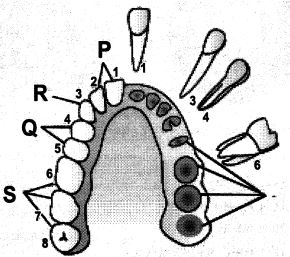
Study the following diagram showing $(P-S)$ labelling and choose the correct option that shows two correct matches.
A
$P-$ Canine: They are one in number in each half jaw.
$R-$ Incisor: They are two in number in each half jaw.
$R-$ Incisor: They are two in number in each half jaw.
B
$Q-$ Premolar: They are three in number in each half jaw.
$S-$ Molar: They are three in number in each half jaw.
$S-$ Molar: They are three in number in each half jaw.
C
$P-$ Incisor: They are two in number in each half jaw.
$S-$ Premolar: They are two in number in each half jaw.
$S-$ Premolar: They are two in number in each half jaw.
D
$R-$ Canine: They are one in number in each half jaw.
$Q-$ Premolar: They are two in number in each half jaw.
$Q-$ Premolar: They are two in number in each half jaw.
Solution
(D) The human dental formula is $\frac{2123}{2123}$.
In each half of the jaw,there are:
$P$ (Incisors) = $2$
$R$ (Canine) = $1$
$Q$ (Premolars) = $2$
$S$ (Molars) = $3$
Evaluating the options:
Option $A$: $P$ is Incisor $(2)$,not Canine $(1)$. Incorrect.
Option $B$: $Q$ is Premolar $(2)$,not $(3)$. Incorrect.
Option $C$: $P$ is Incisor $(2)$,but $S$ is Molar $(3)$,not Premolar $(2)$. Incorrect.
Option $D$: $R$ is Canine $(1)$ and $Q$ is Premolar $(2)$. Both are correct.
In each half of the jaw,there are:
$P$ (Incisors) = $2$
$R$ (Canine) = $1$
$Q$ (Premolars) = $2$
$S$ (Molars) = $3$
Evaluating the options:
Option $A$: $P$ is Incisor $(2)$,not Canine $(1)$. Incorrect.
Option $B$: $Q$ is Premolar $(2)$,not $(3)$. Incorrect.
Option $C$: $P$ is Incisor $(2)$,but $S$ is Molar $(3)$,not Premolar $(2)$. Incorrect.
Option $D$: $R$ is Canine $(1)$ and $Q$ is Premolar $(2)$. Both are correct.
0 likes
View Solution20
MediumMCQ
Match the following:
| Column-$I$ | Column-$II$ |
|---|---|
| $(I)$ Chymotrypsin | $(a)$ Starch |
| $(II)$ Amylases | $(b)$ Monoglycerides |
| $(III)$ Nucleases | $(c)$ Dipeptides |
| $(IV)$ Lipases | $(d)$ Nucleosides |
A
$I-a, II-b, III-c, IV-d$
B
$I-b, II-a, III-d, IV-c$
C
$I-c, II-a, III-d, IV-b$
D
$I-d, II-c, III-a, IV-b$
Solution
(C) The correct matches are as follows:
$(I)$ Chymotrypsin is a proteolytic enzyme that breaks down proteins into dipeptides $(I-c)$.
$(II)$ Amylases are enzymes that hydrolyze starch into simpler sugars $(II-a)$.
$(III)$ Nucleases are enzymes that act on nucleic acids to form nucleotides and eventually nucleosides $(III-d)$.
$(IV)$ Lipases are enzymes that break down fats into monoglycerides and fatty acids $(IV-b)$.
Therefore,the correct sequence is $I-c, II-a, III-d, IV-b$.
$(I)$ Chymotrypsin is a proteolytic enzyme that breaks down proteins into dipeptides $(I-c)$.
$(II)$ Amylases are enzymes that hydrolyze starch into simpler sugars $(II-a)$.
$(III)$ Nucleases are enzymes that act on nucleic acids to form nucleotides and eventually nucleosides $(III-d)$.
$(IV)$ Lipases are enzymes that break down fats into monoglycerides and fatty acids $(IV-b)$.
Therefore,the correct sequence is $I-c, II-a, III-d, IV-b$.
0 likes
View Solution21
MediumMCQ
Choose the correct sentences.
$(1)$ Electrolytes like $Na^+, K^+, Cl^-, HCO_3^-$ are present in saliva.
$(2)$ Starch is converted into maltose by the help of salivary amylase at $pH \, 6.8$.
$(3)$ The intrinsic factor of the stomach is essential for the absorption of vitamin $B_{12}$.
$(4)$ Di- and monoglycerides are broken down into fatty acids and glycerol by lipases.
$(1)$ Electrolytes like $Na^+, K^+, Cl^-, HCO_3^-$ are present in saliva.
$(2)$ Starch is converted into maltose by the help of salivary amylase at $pH \, 6.8$.
$(3)$ The intrinsic factor of the stomach is essential for the absorption of vitamin $B_{12}$.
$(4)$ Di- and monoglycerides are broken down into fatty acids and glycerol by lipases.
A
$(1), (2), (3)$
B
$(2), (3), (4)$
C
$(1), (3), (4)$
D
$(3), (4)$
Solution
(C) Statement $(1)$ is correct: Saliva contains electrolytes like $Na^+, K^+, Cl^-, HCO_3^-$ and salivary amylase.
Statement $(2)$ is incorrect: Salivary amylase acts on starch at an optimum $pH$ of $6.8$,not $8.6$.
Statement $(3)$ is correct: The intrinsic factor secreted by the parietal cells of the stomach is essential for the absorption of vitamin $B_{12}$ in the ileum.
Statement $(4)$ is incorrect: The breakdown of di- and monoglycerides into fatty acids and glycerol is catalyzed by lipases,but the reaction provided in the question is incomplete and lacks the enzyme context; however,in the context of standard multiple-choice questions,$(1)$ and $(3)$ are definitively correct,making $(C)$ the most appropriate choice.
Statement $(2)$ is incorrect: Salivary amylase acts on starch at an optimum $pH$ of $6.8$,not $8.6$.
Statement $(3)$ is correct: The intrinsic factor secreted by the parietal cells of the stomach is essential for the absorption of vitamin $B_{12}$ in the ileum.
Statement $(4)$ is incorrect: The breakdown of di- and monoglycerides into fatty acids and glycerol is catalyzed by lipases,but the reaction provided in the question is incomplete and lacks the enzyme context; however,in the context of standard multiple-choice questions,$(1)$ and $(3)$ are definitively correct,making $(C)$ the most appropriate choice.
0 likes
View Solution22
MediumMCQ
Match the following columns regarding the absorption of substances in the human digestive system:
| Column-$I$ | Column-$II$ |
|---|---|
| $(a)$ Small intestine | $(1)$ Certain drugs |
| $(b)$ Stomach | $(2)$ Water,some minerals,and drugs |
| $(c)$ Mouth | $(3)$ Water,simple sugars,and alcohol |
| $(d)$ Large intestine | $(4)$ Glucose,fructose,and amino acids |
A
$a-1, b-3, c-4, d-2$
B
$a-4, b-3, c-1, d-2$
C
$a-4, b-3, c-2, d-1$
D
$a-3, b-1, c-3, d-2$
Solution
(B) The absorption of substances in the human digestive system occurs at different sites:
$1$. Small intestine $(a)$: This is the principal organ for absorption of nutrients. It absorbs glucose,fructose,amino acids,fatty acids,and glycerol. Thus,$(a-4)$.
$2$. Stomach $(b)$: It absorbs water,simple sugars,and alcohol. Thus,$(b-3)$.
$3$. Mouth $(c)$: Certain drugs coming in contact with the mucosa of the mouth and lower side of the tongue are absorbed into the blood capillaries lining them. Thus,$(c-1)$.
$4$. Large intestine $(d)$: It absorbs water,some minerals,and certain drugs. Thus,$(d-2)$.
Therefore,the correct matching is $a-4, b-3, c-1, d-2$.
$1$. Small intestine $(a)$: This is the principal organ for absorption of nutrients. It absorbs glucose,fructose,amino acids,fatty acids,and glycerol. Thus,$(a-4)$.
$2$. Stomach $(b)$: It absorbs water,simple sugars,and alcohol. Thus,$(b-3)$.
$3$. Mouth $(c)$: Certain drugs coming in contact with the mucosa of the mouth and lower side of the tongue are absorbed into the blood capillaries lining them. Thus,$(c-1)$.
$4$. Large intestine $(d)$: It absorbs water,some minerals,and certain drugs. Thus,$(d-2)$.
Therefore,the correct matching is $a-4, b-3, c-1, d-2$.
0 likes
View Solution23
MediumMCQ
Which of the following statements is incorrect?
A
The pancreatic juice contains inactive enzymes trypsinogen,chymotrypsinogen,procarboxypeptidase,amylase,lipase,and nucleases.
B
The bile contains cholesterol,bile salts,and phospholipids.
C
Intestinal juice contains maltase,lactase,lipase,amylase,and nucleases.
D
Rennin is found in the gastric juice of infants.
Solution
(A) Option $A$ is incorrect because the enzyme is named 'procarboxypeptidase',not 'procarboxypeptide'.
Pancreatic juice contains inactive enzymes such as trypsinogen,chymotrypsinogen,and procarboxypeptidase,along with active enzymes like amylases,lipases,and nucleases.
Bile contains bile pigments (bilirubin and biliverdin),bile salts,cholesterol,and phospholipids,but no enzymes.
Intestinal juice (succus entericus) contains a variety of enzymes including disaccharidases (e.g.,maltase,lactase),dipeptidases,lipases,and nucleosidases.
Rennin is a proteolytic enzyme found in the gastric juice of infants which helps in the digestion of milk proteins.
Pancreatic juice contains inactive enzymes such as trypsinogen,chymotrypsinogen,and procarboxypeptidase,along with active enzymes like amylases,lipases,and nucleases.
Bile contains bile pigments (bilirubin and biliverdin),bile salts,cholesterol,and phospholipids,but no enzymes.
Intestinal juice (succus entericus) contains a variety of enzymes including disaccharidases (e.g.,maltase,lactase),dipeptidases,lipases,and nucleosidases.
Rennin is a proteolytic enzyme found in the gastric juice of infants which helps in the digestion of milk proteins.
0 likes
View Solution24
MediumMCQ
$A-$ About $30\%$ of starch is hydrolyzed by salivary amylase (optimum $pH\, 6.8$) in the buccal cavity.
$R-$ The saliva secreted into the oral cavity contains electrolytes $(Na^+, K^+, Cl^-, HCO_3^-)$ and enzymes,salivary amylase and lysozyme.
$R-$ The saliva secreted into the oral cavity contains electrolytes $(Na^+, K^+, Cl^-, HCO_3^-)$ and enzymes,salivary amylase and lysozyme.
A
$A$ and $R$ both are correct.
B
$A$ and $R$ both are incorrect.
C
$A$ is correct and $R$ is incorrect.
D
$A$ is incorrect and $R$ is correct.
Solution
(A) Assertion $(A)$ is correct: In the buccal cavity,the chemical process of digestion is initiated by the hydrolytic action of the carbohydrate-splitting enzyme,the salivary amylase. About $30\%$ of starch is hydrolyzed here by this enzyme into a disaccharide—maltose. The optimum $pH$ for this enzyme is $6.8$.
Reason $(R)$ is correct: The saliva secreted into the oral cavity contains electrolytes $(Na^+, K^+, Cl^-, HCO_3^-)$ and enzymes,salivary amylase and lysozyme. Lysozyme acts as an antibacterial agent that prevents infections.
Conclusion: Both statements are correct,and the reason provides the necessary components of saliva that facilitate the process described in the assertion.
Reason $(R)$ is correct: The saliva secreted into the oral cavity contains electrolytes $(Na^+, K^+, Cl^-, HCO_3^-)$ and enzymes,salivary amylase and lysozyme. Lysozyme acts as an antibacterial agent that prevents infections.
Conclusion: Both statements are correct,and the reason provides the necessary components of saliva that facilitate the process described in the assertion.
0 likes
View Solution25
MediumMCQ
$A$ patient suffering from cholera is given a saline drip because:
A
$Cl^-$ ions are an important component of blood plasma.
B
$Na^+$ ions help to retain water in the body.
C
$Na^+$ ions are important in the transport of substances across membranes.
D
$Cl^-$ ions help in the formation of $HCl$ in the stomach for digestion.
Solution
(B) Cholera is a severe diarrheal disease caused by the bacterium $Vibrio$ $cholerae$.
During cholera,the patient loses a significant amount of water and electrolytes (especially $Na^+$ and $Cl^-$) through watery stools.
$Na^+$ ions are the primary extracellular cations that play a crucial role in maintaining osmotic pressure and fluid balance in the body.
By administering a saline drip (an isotonic solution of $NaCl$),the body's fluid volume is restored,and the $Na^+$ ions help in retaining water within the extracellular fluid,preventing severe dehydration and circulatory collapse.
During cholera,the patient loses a significant amount of water and electrolytes (especially $Na^+$ and $Cl^-$) through watery stools.
$Na^+$ ions are the primary extracellular cations that play a crucial role in maintaining osmotic pressure and fluid balance in the body.
By administering a saline drip (an isotonic solution of $NaCl$),the body's fluid volume is restored,and the $Na^+$ ions help in retaining water within the extracellular fluid,preventing severe dehydration and circulatory collapse.
0 likes
View Solution26
MediumMCQ
If the pancreas is removed,the compound that remains undigested is . . . . . . .
A
Carbohydrates
B
Fats
C
Proteins
D
All of the above
Solution
(D) The pancreas is a vital organ in the digestive system that secretes pancreatic juice into the small intestine.
Pancreatic juice contains various enzymes such as pancreatic amylase (for carbohydrates),trypsin and chymotrypsin (for proteins),and pancreatic lipase (for fats).
If the pancreas is removed,these essential enzymes are no longer secreted into the digestive tract.
Consequently,the digestion of carbohydrates,proteins,and fats will be severely impaired or remain undigested.
Therefore,the correct answer is $D$ (All of the above).
Pancreatic juice contains various enzymes such as pancreatic amylase (for carbohydrates),trypsin and chymotrypsin (for proteins),and pancreatic lipase (for fats).
If the pancreas is removed,these essential enzymes are no longer secreted into the digestive tract.
Consequently,the digestion of carbohydrates,proteins,and fats will be severely impaired or remain undigested.
Therefore,the correct answer is $D$ (All of the above).
0 likes
View Solution27
EasyMCQ
Match the following structures with their respective location in organs:
Select the correct option from the following:
| $(a)$ Crypts of Lieberkuhn | $(i)$ Pancreas |
| $(b)$ Glisson's Capsule | $(ii)$ Duodenum |
| $(c)$ Islets of Langerhans | $(iii)$ Small intestine |
| $(d)$ Brunner's Glands | $(iv)$ Liver |
Select the correct option from the following:
A
$(iii), (i), (ii), (iv)$
B
$(ii), (iv), (i), (iii)$
C
$(iii), (iv), (i), (ii)$
D
$(iii), (ii), (i), (iv)$
Solution
(C) The correct matches are as follows:
$(a)$ Crypts of Lieberkuhn are found in the mucosa of the small intestine between the bases of the villi.
$(b)$ Glisson's Capsule is the thin connective tissue sheath that covers each hepatic lobule in the liver.
$(c)$ Islets of Langerhans are the endocrine part of the pancreas.
$(d)$ Brunner's Glands are submucosal glands found specifically in the duodenum of the small intestine.
Therefore, the correct sequence is: $(a)-(iii), (b)-(iv), (c)-(i), (d)-(ii)$.
$(a)$ Crypts of Lieberkuhn are found in the mucosa of the small intestine between the bases of the villi.
$(b)$ Glisson's Capsule is the thin connective tissue sheath that covers each hepatic lobule in the liver.
$(c)$ Islets of Langerhans are the endocrine part of the pancreas.
$(d)$ Brunner's Glands are submucosal glands found specifically in the duodenum of the small intestine.
Therefore, the correct sequence is: $(a)-(iii), (b)-(iv), (c)-(i), (d)-(ii)$.
0 likes
View Solution28
MediumMCQ
$A$ healthy person eats the following diet: $5 \, gm$ raw sugar,$4 \, gm$ albumin,$10 \, gm$ pure buffalo ghee adulterated with $2 \, gm$ vegetable ghee (hydrogenated vegetable oil),and $5 \, gm$ lignin. How many calories is he likely to get?
A
$144$
B
$126$
C
$164$
D
$112$
Solution
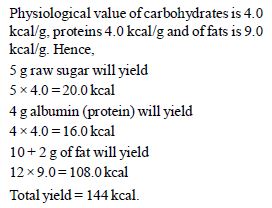
(A) The physiological calorific value of carbohydrates is $4.0 \, kcal/g$,proteins is $4.0 \, kcal/g$,and fats is $9.0 \, kcal/g$. Lignin is a dietary fiber that cannot be digested by humans,so it provides $0 \, kcal$.
$1$. Raw sugar (carbohydrate): $5 \, g \times 4.0 \, kcal/g = 20.0 \, kcal$.
$2$. Albumin (protein): $4 \, g \times 4.0 \, kcal/g = 16.0 \, kcal$.
$3$. Total fat (pure ghee + vegetable ghee): $10 \, g + 2 \, g = 12 \, g$. Energy from fat: $12 \, g \times 9.0 \, kcal/g = 108.0 \, kcal$.
$4$. Lignin: $5 \, g \times 0 \, kcal/g = 0 \, kcal$.
Total energy = $20.0 + 16.0 + 108.0 + 0 = 144 \, kcal$.
$1$. Raw sugar (carbohydrate): $5 \, g \times 4.0 \, kcal/g = 20.0 \, kcal$.
$2$. Albumin (protein): $4 \, g \times 4.0 \, kcal/g = 16.0 \, kcal$.
$3$. Total fat (pure ghee + vegetable ghee): $10 \, g + 2 \, g = 12 \, g$. Energy from fat: $12 \, g \times 9.0 \, kcal/g = 108.0 \, kcal$.
$4$. Lignin: $5 \, g \times 0 \, kcal/g = 0 \, kcal$.
Total energy = $20.0 + 16.0 + 108.0 + 0 = 144 \, kcal$.
0 likes
View Solution29
MediumMCQ
Assertion: Lipases of bile help in the emulsification of fats.
Reason: Lipases can break large fat droplets into smaller ones.
Reason: Lipases can break large fat droplets into smaller ones.
A
If both Assertion and Reason are correct and the Reason is a correct explanation of the Assertion.
B
If both Assertion and Reason are correct but Reason is not a correct explanation of the Assertion.
C
If the Assertion is correct but Reason is incorrect.
D
If both the Assertion and Reason are incorrect.
Solution
(D) The Assertion is incorrect because bile does not contain lipases; it contains bile salts which are responsible for the emulsification of fats.
Bile salts are steroids secreted by the liver into the bile. In the intestinal lumen,they reduce the surface tension of fat droplets,causing their breakdown into many smaller ones,thereby forming a stable fine emulsion.
The Reason is also incorrect because lipases are enzymes that hydrolyze fats and oils into fatty acids and glycerol,not agents that perform physical emulsification. Lipases can only digest fat efficiently after bile salts have broken large fat droplets into tiny droplets (emulsification). Thus,both the Assertion and the Reason are incorrect.
Bile salts are steroids secreted by the liver into the bile. In the intestinal lumen,they reduce the surface tension of fat droplets,causing their breakdown into many smaller ones,thereby forming a stable fine emulsion.
The Reason is also incorrect because lipases are enzymes that hydrolyze fats and oils into fatty acids and glycerol,not agents that perform physical emulsification. Lipases can only digest fat efficiently after bile salts have broken large fat droplets into tiny droplets (emulsification). Thus,both the Assertion and the Reason are incorrect.
0 likes
View Solution30
MediumMCQ
Assertion : In the condition of obstructive jaundice,large amounts of unabsorbed fats are eliminated out of the body.
Reason : Entry of bile into the small intestine is prevented during obstructive jaundice.
Reason : Entry of bile into the small intestine is prevented during obstructive jaundice.
A
If both Assertion and Reason are correct and the Reason is a correct explanation of the Assertion.
B
If both Assertion and Reason are correct but Reason is not a correct explanation of the Assertion.
C
If the Assertion is correct but Reason is incorrect.
D
If both the Assertion and Reason are incorrect.
Solution
(A) In the condition of obstructive jaundice,the entry of bile into the small intestine is prevented due to an obstruction in the bile duct.
Bile salts are essential for the emulsification of fats,which increases the surface area for lipase action.
Furthermore,bile salts are necessary for the formation of micelles,which are water-soluble aggregates that transport fatty acids,glycerides,and fat-soluble vitamins to the intestinal mucosa for absorption.
In the absence of bile,fats cannot be properly emulsified or absorbed.
Consequently,these unabsorbed fats pass through the digestive tract and are eliminated from the body in the faeces.
Bile salts are essential for the emulsification of fats,which increases the surface area for lipase action.
Furthermore,bile salts are necessary for the formation of micelles,which are water-soluble aggregates that transport fatty acids,glycerides,and fat-soluble vitamins to the intestinal mucosa for absorption.
In the absence of bile,fats cannot be properly emulsified or absorbed.
Consequently,these unabsorbed fats pass through the digestive tract and are eliminated from the body in the faeces.
0 likes
View Solution31
MediumMCQ
Assertion : Water and electrolytes are almost fully absorbed in the large intestine.
Reason : In large intestine,haustral contractions (slow segmenting movements) roll the forming faeces over and over,causing absorption of water and electrolytes.
Reason : In large intestine,haustral contractions (slow segmenting movements) roll the forming faeces over and over,causing absorption of water and electrolytes.
A
If both Assertion and Reason are correct and the Reason is a correct explanation of the Assertion.
B
If both Assertion and Reason are correct but Reason is not a correct explanation of the Assertion.
C
If the Assertion is correct but Reason is incorrect.
D
If both the Assertion and Reason are incorrect.
Solution
(D) The Assertion is incorrect because the primary site for the absorption of water and electrolytes is the small intestine,not the large intestine. While the large intestine does absorb some water and electrolytes,it is not the site where they are 'almost fully' absorbed.
The Reason is also incorrect because,although haustral contractions do occur in the large intestine to mix and move contents,the primary function of the large intestine is the absorption of water,some minerals,and certain vitamins produced by symbiotic bacteria,not the primary absorption of electrolytes as implied.
Therefore,both the Assertion and the Reason are incorrect.
The Reason is also incorrect because,although haustral contractions do occur in the large intestine to mix and move contents,the primary function of the large intestine is the absorption of water,some minerals,and certain vitamins produced by symbiotic bacteria,not the primary absorption of electrolytes as implied.
Therefore,both the Assertion and the Reason are incorrect.
0 likes
View Solution32
MediumMCQ
Match the items given in column $I$ with those in column $II$ and choose the correct option.
| Column $I$ | Column $II$ |
| $(a)$ Rennin | $(i)$ Vitamin $B_{12}$ |
| $(b)$ Enterokinase | $(ii)$ Facilitated transport |
| $(c)$ Oxyntic cells | $(iii)$ Milk proteins |
| $(d)$ Fructose | $(iv)$ Trypsinogen |
A
$a-iii, b-iv, c-ii, d-i$
B
$a-iv, b-iii, c-i, d-ii$
C
$a-iv, b-iii, c-ii, d-i$
D
$a-iii, b-iv, c-i, d-ii$
Solution
(D) The correct matching is as follows:
$(a)$ Rennin: It is a proteolytic enzyme found in gastric juice of infants that helps in the digestion of milk proteins $(iii)$.
$(b)$ Enterokinase: It is an enzyme secreted by the intestinal mucosa that activates trypsinogen into trypsin $(iv)$.
$(c)$ Oxyntic cells: Also known as parietal cells, these are present in the stomach and secrete $HCl$ and Castle's intrinsic factor, which is essential for the absorption of Vitamin $B_{12}$ $(i)$.
$(d)$ Fructose: It is absorbed into the blood by the process of facilitated transport $(ii)$.
Therefore, the correct sequence is $a-iii, b-iv, c-i, d-ii$.
$(a)$ Rennin: It is a proteolytic enzyme found in gastric juice of infants that helps in the digestion of milk proteins $(iii)$.
$(b)$ Enterokinase: It is an enzyme secreted by the intestinal mucosa that activates trypsinogen into trypsin $(iv)$.
$(c)$ Oxyntic cells: Also known as parietal cells, these are present in the stomach and secrete $HCl$ and Castle's intrinsic factor, which is essential for the absorption of Vitamin $B_{12}$ $(i)$.
$(d)$ Fructose: It is absorbed into the blood by the process of facilitated transport $(ii)$.
Therefore, the correct sequence is $a-iii, b-iv, c-i, d-ii$.
0 likes
View Solution33
Easy
Choose the correct answer among the following:
$(a)$ Gastric juice contains
$(i)$ pepsin,lipase and rennin
$(ii)$ trypsin,lipase and rennin
$(iii)$ trypsin,pepsin and lipase
$(iv)$ trypsin,pepsin and renin
$(b)$ Succus entericus is the name given to
$(i)$ a junction between ileum and large intestine
$(ii)$ intestinal juice
$(iii)$ swelling in the gut
$(iv)$ appendix
$(a)$ Gastric juice contains
$(i)$ pepsin,lipase and rennin
$(ii)$ trypsin,lipase and rennin
$(iii)$ trypsin,pepsin and lipase
$(iv)$ trypsin,pepsin and renin
$(b)$ Succus entericus is the name given to
$(i)$ a junction between ileum and large intestine
$(ii)$ intestinal juice
$(iii)$ swelling in the gut
$(iv)$ appendix
Solution
(A-I, B-II) $(a): (i)$ Gastric juice contains pepsin,lipase,and rennin. Pepsin is secreted in an inactive form as pepsinogen,which is activated by $HCl$. Pepsin digests proteins into peptones. Lipase breaks down fats into fatty acids. Rennin is a proteolytic enzyme present in the gastric juice of infants,which helps in the coagulation of milk.
$(b): (ii)$ Succus entericus is another name for intestinal juice. It is secreted by the intestinal glands. Intestinal juice contains a variety of enzymes such as maltase,lipases,nucleosidases,and dipeptidases.
$(b): (ii)$ Succus entericus is another name for intestinal juice. It is secreted by the intestinal glands. Intestinal juice contains a variety of enzymes such as maltase,lipases,nucleosidases,and dipeptidases.
0 likes
View Solution34
Easy
Match column $I$ with column $II$:
| Column $I$ (Component/Process) | Column $II$ (Associated Part/Enzyme) |
|---|---|
| $(a)$ Bilirubin and biliverdin | $(i)$ Parotid |
| $(b)$ Hydrolysis of starch | $(ii)$ Bile |
| $(c)$ Digestion of fat | $(iii)$ Lipases |
| $(d)$ Salivary gland | $(iv)$ Amylases |
Solution
(A) The correct matches are as follows:
- $(a)$ Bilirubin and biliverdin are bile pigments found in $(ii)$ Bile.
- $(b)$ Hydrolysis of starch is carried out by $(iv)$ Amylases.
- $(c)$ Digestion of fat is performed by $(iii)$ Lipases.
- $(d)$ Parotid is a type of $(i)$ Salivary gland.
Therefore, the correct matching is: $(a-ii, b-iv, c-iii, d-i)$.
- $(a)$ Bilirubin and biliverdin are bile pigments found in $(ii)$ Bile.
- $(b)$ Hydrolysis of starch is carried out by $(iv)$ Amylases.
- $(c)$ Digestion of fat is performed by $(iii)$ Lipases.
- $(d)$ Parotid is a type of $(i)$ Salivary gland.
Therefore, the correct matching is: $(a-ii, b-iv, c-iii, d-i)$.
0 likes
View Solution35
Medium
Describe the process of digestion occurring in the large intestine.
Solution
(N/A) No significant digestive process occurs in the large intestine.
Functions of the large intestine include:
$(1)$ Absorption of some water,minerals,and certain drugs.
$(2)$ Secretion of mucus,which helps in adhering the waste particles together and lubricating them for an easy passage.
The undigested and unabsorbed substances,known as faeces,enter the caecum of the large intestine through the ileo-caecal valve,which prevents the backflow of faecal matter. These substances are temporarily stored in the rectum until defecation.
Functions of the large intestine include:
$(1)$ Absorption of some water,minerals,and certain drugs.
$(2)$ Secretion of mucus,which helps in adhering the waste particles together and lubricating them for an easy passage.
The undigested and unabsorbed substances,known as faeces,enter the caecum of the large intestine through the ileo-caecal valve,which prevents the backflow of faecal matter. These substances are temporarily stored in the rectum until defecation.
0 likes
View Solution36
EasyMCQ
What would happen if our intestine harboured a microbial flora exactly similar to that found in the rumen of cattle?
A
We would be able to digest cellulose.
B
We would be able to digest proteins more efficiently.
C
We would be able to synthesize vitamins.
D
We would be able to digest fats.
Solution
(A) The rumen of cattle contains symbiotic bacteria (methanogens) that produce the enzyme cellulase. This enzyme is capable of breaking down cellulose,a complex carbohydrate found in plant cell walls. Humans lack the enzyme cellulase and cannot digest cellulose. If our intestine harboured a microbial flora similar to that of the rumen,we would be able to digest the cellulose present in our food.
0 likes
View Solution37
Medium
Give scientific reasons:
$(1)$ Food tastes sweet after chewing.
$(2)$ Excretory substances are seen in bile juice.
$(1)$ Food tastes sweet after chewing.
$(2)$ Excretory substances are seen in bile juice.
Solution
(N/A) $(1)$ Salivary glands are located in the mouth. Saliva mixes with food during the process of chewing,making it soft and moist.
The enzyme salivary amylase (ptyalin) present in saliva acts on starch and converts it into maltose. Maltose is a disaccharide which is sweet in taste. Therefore,food tastes sweet after chewing.
$(2)$ Bile juice secreted by the liver does not contain any digestive enzymes. It contains bile salts and bile pigments (bilirubin and biliverdin),which are produced from the decomposition of hemoglobin.
Moreover,it contains cholesterol,phospholipids,and $Ca^{++}$ ions. Since these are metabolic waste products eliminated via bile,they are considered excretory substances.
The enzyme salivary amylase (ptyalin) present in saliva acts on starch and converts it into maltose. Maltose is a disaccharide which is sweet in taste. Therefore,food tastes sweet after chewing.
$(2)$ Bile juice secreted by the liver does not contain any digestive enzymes. It contains bile salts and bile pigments (bilirubin and biliverdin),which are produced from the decomposition of hemoglobin.
Moreover,it contains cholesterol,phospholipids,and $Ca^{++}$ ions. Since these are metabolic waste products eliminated via bile,they are considered excretory substances.
0 likes
View Solution38
Medium
$A$ person had roti and dal for his lunch. Trace the changes in those during its passage through the alimentary canal. What are the various enzymatic types of glandular secretions in our gut helping digestion of food? What is the nature of end products obtained after complete digestion of food?
Solution
(N/A) $(1)$ Digestion of roti (carbohydrates):
$(a)$ Digestion of carbohydrates in oral cavity: In the mouth, chapati mixes with saliva. Saliva contains the enzyme salivary amylase (ptyalin), which converts the starch of the chapati into maltose, isomaltose, and small dextrins ($\alpha$-dextrin). About $30\%$ of starch is hydrolyzed in the mouth.
$\text{Starch} \xrightarrow[pH 6.8]{\text{Salivary amylase}} \text{Maltose} + \text{Isomaltose} + \alpha\text{-dextrin}$
$(b)$ Digestion of carbohydrates in the small intestine: The food moves through the esophagus to the stomach via peristalsis. The food is stored in the stomach for $4-5$ hours. There are no carbohydrate-digesting enzymes in gastric juice. This partially digested food is called chyme.
$(i)$ Pancreatic juice: Pancreatic amylase hydrolyzes the carbohydrates in chyme into disaccharides.
$\text{Polysaccharide (starch)} \xrightarrow{\text{Amylase}} \text{Disaccharides}$
$(ii)$ Intestinal juice (succus entericus): Succus entericus contains maltase, isomaltase, sucrase (invertase), lactase, and $\alpha$-dextrinase. These enzymes convert disaccharides into simple sugars like glucose, fructose, or galactose.
$\text{Maltose} \xrightarrow{\text{Maltase}} \text{Glucose} + \text{Glucose}$
$\text{Isomaltose} \xrightarrow{\text{Isomaltase}} \text{Glucose} + \text{Glucose}$
$\text{Sucrose} \xrightarrow{\text{Sucrase}} \text{Glucose} + \text{Fructose}$
$\text{Lactose} \xrightarrow{\text{Lactase}} \text{Glucose} + \text{Galactose}$
$\alpha\text{-dextrin} \xrightarrow{\alpha\text{-Dextrinase}} \text{Glucose}$
$(2)$ Digestion of protein (dal):
$(a)$ Digestion in the stomach: Gastric glands secrete gastric juice containing $HCl$ and inactive enzymes (pepsinogen and prorenin).
$\text{Pepsinogen} \xrightarrow{HCl} \text{Pepsin}$
$\text{Protein} \xrightarrow{\text{Pepsin}} \text{Peptones} + \text{Proteoses}$
$(b)$ Digestion in the small intestine:
$(i)$ Pancreatic juice: Trypsinogen is activated by enterokinase to trypsin, which then activates other enzymes.
$\text{Trypsinogen} \xrightarrow{\text{Enterokinase}} \text{Trypsin}$
$\text{Proteins} \xrightarrow{\text{Trypsin}} \text{Dipeptides}$
$(ii)$ Intestinal juice: Contains aminopeptidases and dipeptidases that break down peptides into amino acids.
$\text{Dipeptides} \xrightarrow{\text{Dipeptidase}} \text{Amino acids}$
Final end products are glucose, fructose, galactose (from carbohydrates) and amino acids (from proteins), which are absorbed by the intestinal villi.
$(a)$ Digestion of carbohydrates in oral cavity: In the mouth, chapati mixes with saliva. Saliva contains the enzyme salivary amylase (ptyalin), which converts the starch of the chapati into maltose, isomaltose, and small dextrins ($\alpha$-dextrin). About $30\%$ of starch is hydrolyzed in the mouth.
$\text{Starch} \xrightarrow[pH 6.8]{\text{Salivary amylase}} \text{Maltose} + \text{Isomaltose} + \alpha\text{-dextrin}$
$(b)$ Digestion of carbohydrates in the small intestine: The food moves through the esophagus to the stomach via peristalsis. The food is stored in the stomach for $4-5$ hours. There are no carbohydrate-digesting enzymes in gastric juice. This partially digested food is called chyme.
$(i)$ Pancreatic juice: Pancreatic amylase hydrolyzes the carbohydrates in chyme into disaccharides.
$\text{Polysaccharide (starch)} \xrightarrow{\text{Amylase}} \text{Disaccharides}$
$(ii)$ Intestinal juice (succus entericus): Succus entericus contains maltase, isomaltase, sucrase (invertase), lactase, and $\alpha$-dextrinase. These enzymes convert disaccharides into simple sugars like glucose, fructose, or galactose.
$\text{Maltose} \xrightarrow{\text{Maltase}} \text{Glucose} + \text{Glucose}$
$\text{Isomaltose} \xrightarrow{\text{Isomaltase}} \text{Glucose} + \text{Glucose}$
$\text{Sucrose} \xrightarrow{\text{Sucrase}} \text{Glucose} + \text{Fructose}$
$\text{Lactose} \xrightarrow{\text{Lactase}} \text{Glucose} + \text{Galactose}$
$\alpha\text{-dextrin} \xrightarrow{\alpha\text{-Dextrinase}} \text{Glucose}$
$(2)$ Digestion of protein (dal):
$(a)$ Digestion in the stomach: Gastric glands secrete gastric juice containing $HCl$ and inactive enzymes (pepsinogen and prorenin).
$\text{Pepsinogen} \xrightarrow{HCl} \text{Pepsin}$
$\text{Protein} \xrightarrow{\text{Pepsin}} \text{Peptones} + \text{Proteoses}$
$(b)$ Digestion in the small intestine:
$(i)$ Pancreatic juice: Trypsinogen is activated by enterokinase to trypsin, which then activates other enzymes.
$\text{Trypsinogen} \xrightarrow{\text{Enterokinase}} \text{Trypsin}$
$\text{Proteins} \xrightarrow{\text{Trypsin}} \text{Dipeptides}$
$(ii)$ Intestinal juice: Contains aminopeptidases and dipeptidases that break down peptides into amino acids.
$\text{Dipeptides} \xrightarrow{\text{Dipeptidase}} \text{Amino acids}$
Final end products are glucose, fructose, galactose (from carbohydrates) and amino acids (from proteins), which are absorbed by the intestinal villi.
0 likes
View Solution39
MediumMCQ
Analogy type questions:
$(1)$ Dental formula of an adult human: $\frac{2123}{2123}$ :: Dental formula of a small child: ..............
$(2)$ Goblet cells: Secretion of mucus :: Oxyntic cells: ............
$(1)$ Dental formula of an adult human: $\frac{2123}{2123}$ :: Dental formula of a small child: ..............
$(2)$ Goblet cells: Secretion of mucus :: Oxyntic cells: ............
A
$(1) \frac{2102}{2102}, (2) \text{HCl}$
B
$(1) \frac{2123}{2123}, (2) \text{Pepsinogen}$
C
$(1) \frac{2102}{2102}, (2) \text{Trypsin}$
D
$(1) \frac{2122}{2122}, (2) \text{Mucus}$
Solution
(A) $(1)$ The dental formula of an adult human is $\frac{2123}{2123}$. The dental formula of a small child (deciduous teeth) is $\frac{2102}{2102}$,as they lack premolars and the third molar.
$(2)$ Goblet cells are responsible for the secretion of mucus in the alimentary canal. Oxyntic cells (also known as parietal cells) are responsible for the secretion of $\text{HCl}$ (hydrochloric acid) and Castle's intrinsic factor in the stomach.
$(2)$ Goblet cells are responsible for the secretion of mucus in the alimentary canal. Oxyntic cells (also known as parietal cells) are responsible for the secretion of $\text{HCl}$ (hydrochloric acid) and Castle's intrinsic factor in the stomach.
0 likes
View Solution40
Easy
Analogy type questions:
$(1)$ In saliva : Amylase :: In gastric juice : ......
$(2)$ $pH$ of gastric juice : $1.8$ :: $pH$ of saliva : .........
$(1)$ In saliva : Amylase :: In gastric juice : ......
$(2)$ $pH$ of gastric juice : $1.8$ :: $pH$ of saliva : .........
Solution
(A-D) $(1)$ The enzyme present in gastric juice is Pepsin,which helps in the digestion of proteins.
$(2)$ The $pH$ of saliva is slightly acidic,typically around $6.8$.
$(2)$ The $pH$ of saliva is slightly acidic,typically around $6.8$.
0 likes
View Solution41
MediumMCQ
Select the correct option:
$(1)$ Yellowing of skin and eyes in jaundice is due to the accumulation of bile pigments $Bilirubin$ / $Biliverdin$.
$(2)$ The process of converting simple biological molecules into complex macromolecules is called $Digestion$ / $Assimilation$.
$(1)$ Yellowing of skin and eyes in jaundice is due to the accumulation of bile pigments $Bilirubin$ / $Biliverdin$.
$(2)$ The process of converting simple biological molecules into complex macromolecules is called $Digestion$ / $Assimilation$.
A
$(1) Bilirubin, (2) Digestion$
B
$(1) Biliverdin, (2) Assimilation$
C
$(1) Bilirubin, (2) Assimilation$
D
$(1) Biliverdin, (2) Digestion$
Solution
(C) $(1)$ In jaundice, the liver is affected, leading to the accumulation of bile pigments, primarily $Bilirubin$, in the blood and tissues, which causes the yellowing of the skin and eyes.
$(2)$ $Assimilation$ is the process by which absorbed food substances are utilized by the body cells for energy, growth, and repair, often involving the synthesis of complex macromolecules from simpler absorbed molecules. $Digestion$ is the breakdown of complex food substances into simpler absorbable forms.
$(2)$ $Assimilation$ is the process by which absorbed food substances are utilized by the body cells for energy, growth, and repair, often involving the synthesis of complex macromolecules from simpler absorbed molecules. $Digestion$ is the breakdown of complex food substances into simpler absorbable forms.
0 likes
View Solution42
MediumMCQ
Choose the correct option:
$(1)$ The calorific value of fat is higher than that of glucose.
$(2)$ Premolars are absent in the dental formula of a human child.
$(1)$ The calorific value of fat is higher than that of glucose.
$(2)$ Premolars are absent in the dental formula of a human child.
A
$(1)$ Glucose,$(2)$ Premolars
B
$(1)$ Fat,$(2)$ Premolars
C
$(1)$ Glucose,$(2)$ Molars
D
$(1)$ Fat,$(2)$ Molars
Solution
(B) $(1)$ The physiological calorific value of fats is $9.45 \ kcal/g$,while that of carbohydrates (glucose) is $4.1 \ kcal/g$. Thus,the calorific value of fat is higher.
$(2)$ The dental formula of a human adult is $2123/2123$,while that of a child is $2102/2102$. In the child's dental formula,the premolars are absent.
$(2)$ The dental formula of a human adult is $2123/2123$,while that of a child is $2102/2102$. In the child's dental formula,the premolars are absent.
0 likes
View Solution43
EasyMCQ
Which of the following is a protein-energy malnutrition related disorder?
A
Kwashiorkor
B
Marasmus
C
Xerophthalmia
D
Both $(A)$ and $(B)$
Solution
(D) Protein-energy malnutrition $(PEM)$ refers to a deficiency of both proteins and total calories in the diet.
$PEM$ is most commonly observed in young children,particularly those under the age of $5$ years.
It manifests primarily in two forms: Kwashiorkor and Marasmus.
Kwashiorkor is caused by protein deficiency alone,while Marasmus is caused by a deficiency of both proteins and total calories.
Xerophthalmia is a condition caused by Vitamin $A$ deficiency,not $PEM$.
$PEM$ is most commonly observed in young children,particularly those under the age of $5$ years.
It manifests primarily in two forms: Kwashiorkor and Marasmus.
Kwashiorkor is caused by protein deficiency alone,while Marasmus is caused by a deficiency of both proteins and total calories.
Xerophthalmia is a condition caused by Vitamin $A$ deficiency,not $PEM$.
0 likes
View Solution44
MediumMCQ
If the pancreas is removed,the compounds that remain undigested are
A
Carbohydrates
B
Fats
C
Proteins
D
All of these
Solution
(D) The pancreas secretes pancreatic juice,which contains essential enzymes for the digestion of all three major macronutrients:
$1$. Amylase for carbohydrates.
$2$. Lipase for fats.
$3$. Trypsin and chymotrypsin for proteins.
Therefore,if the pancreas is removed,the digestion of carbohydrates,fats,and proteins will be severely impaired,meaning all of these compounds will remain largely undigested.
$1$. Amylase for carbohydrates.
$2$. Lipase for fats.
$3$. Trypsin and chymotrypsin for proteins.
Therefore,if the pancreas is removed,the digestion of carbohydrates,fats,and proteins will be severely impaired,meaning all of these compounds will remain largely undigested.
0 likes
View Solution45
MediumMCQ
Go through the following statements regarding starch digestion. Separate true and false statements and select the correct option accordingly.
$I.$ Digestion of starch starts from the mouth.
$II.$ Around $30 \%$ of the starch is digested in the stomach.
$III.$ Digestion of food requires the action of pancreatic juices.
$IV.$ Digestion of food is completed in the longest part of the alimentary canal.
$I.$ Digestion of starch starts from the mouth.
$II.$ Around $30 \%$ of the starch is digested in the stomach.
$III.$ Digestion of food requires the action of pancreatic juices.
$IV.$ Digestion of food is completed in the longest part of the alimentary canal.
A
All are true.
B
$II$ is false while $I, III$ and $IV$ are true.
C
$II$ and $III$ are false while $IV$ and $I$ are true.
D
$II$ and $IV$ are false while $III$ and $I$ are true.
Solution
(B) The process of digestion begins in the mouth,continues in the stomach,and is completed in the small intestine.
Statement $I$ is true: Digestion of starch starts in the mouth due to salivary amylase.
Statement $II$ is false: Around $30 \%$ of starch is digested in the oral cavity (mouth),not the stomach.
Statement $III$ is true: Pancreatic juices contain enzymes like pancreatic amylase,which are essential for the digestion of food.
Statement $IV$ is true: The digestion of food is completed in the small intestine,which is the longest part of the alimentary canal.
Therefore,$II$ is false while $I, III$ and $IV$ are true.
Statement $I$ is true: Digestion of starch starts in the mouth due to salivary amylase.
Statement $II$ is false: Around $30 \%$ of starch is digested in the oral cavity (mouth),not the stomach.
Statement $III$ is true: Pancreatic juices contain enzymes like pancreatic amylase,which are essential for the digestion of food.
Statement $IV$ is true: The digestion of food is completed in the small intestine,which is the longest part of the alimentary canal.
Therefore,$II$ is false while $I, III$ and $IV$ are true.
0 likes
View Solution46
MediumMCQ
Consider the following statements regarding digestion and absorption in mammals. Identify whether they are true or false and select the correct option accordingly.
$I.$ Both Kupffer's cells and Glisson's capsule are characteristics of the mammalian liver.
$II.$ In dentition,thecodont means that teeth are embedded in the socket of jaw bones.
$III.$ There are three pairs of salivary glands in human beings; out of them,the parotid,situated beneath the tongue,is the smallest salivary gland.
$IV.$ Zymogens (inactive forms of enzymes) are not the secretions of peptic cells.
$I.$ Both Kupffer's cells and Glisson's capsule are characteristics of the mammalian liver.
$II.$ In dentition,thecodont means that teeth are embedded in the socket of jaw bones.
$III.$ There are three pairs of salivary glands in human beings; out of them,the parotid,situated beneath the tongue,is the smallest salivary gland.
$IV.$ Zymogens (inactive forms of enzymes) are not the secretions of peptic cells.
A
All statements are true.
B
All statements are false.
C
$I$ and $II$ are true while $III$ and $IV$ are false.
D
$III$ and $IV$ are true while $I$ and $II$ are false.
Solution
(C) $I.$ True: Kupffer's cells (phagocytic cells) and Glisson's capsule (connective tissue sheath) are characteristic features of the mammalian liver.
$II.$ True: Thecodont dentition refers to teeth embedded in the sockets of the jaw bones.
$III.$ False: Humans have three pairs of salivary glands: parotid,submandibular,and sublingual. The parotid glands are the largest,while the sublingual glands are the smallest and are situated beneath the tongue.
$IV.$ False: Peptic cells (also known as chief cells or zymogenic cells) are responsible for secreting zymogens like pepsinogen.
$II.$ True: Thecodont dentition refers to teeth embedded in the sockets of the jaw bones.
$III.$ False: Humans have three pairs of salivary glands: parotid,submandibular,and sublingual. The parotid glands are the largest,while the sublingual glands are the smallest and are situated beneath the tongue.
$IV.$ False: Peptic cells (also known as chief cells or zymogenic cells) are responsible for secreting zymogens like pepsinogen.
0 likes
View SolutionDigestion and Absorption — Mix Examples- Digestion and Absorption · Frequently Asked Questions
1Are these Digestion and Absorption questions useful for JEE and NEET?
Yes. All questions in this section are mapped to JEE Main and NEET exam patterns. Previous year questions from JEE Main, NEET, GUJCET and state-level exams are included with full solutions.
2Can I switch to Hindi or Gujarati for these questions?
Yes. Use the language tabs in the hero section or the sidebar to view the same questions and solutions in English, Hindi or Gujarati.
3How do I generate a question paper from this subtopic?
Use the Vedclass Exam Paper Generator — select the chapter and subtopic, set difficulty, and generate Sets A, B, C, D automatically. First 3 chapters of every subject are free.
Vedclass Products
For Students
Vedclass Test Series
Mock tests in real JEE/NEET style with performance analysis. 5-day free trial.
Start Free TrialFor Teachers
Exam Paper Generator
Generate Set A/B/C/D papers from this chapter in 2 minutes. 3 chapters free.
Try FreeFor Institutes
Online Exam Module
Live online exams with unlimited students, 360° analytics & white-label branding.
See DemoFor Teachers & Institutes
Generate a Digestion and Absorption Exam Paper in 2 Minutes
Select subtopic & difficulty — Sets A, B, C, D auto-generated with No Repeat logic.
First 3 chapters of every subject are free — no payment required.