
A English
Digestive system Questions in English
Class 11 Biology · Digestion and Absorption · Digestive system
272+
Questions
English
Language
100%
With Solutions
Showing 50 of 272 questions in English
101
EasyMCQ
Glisson's capsule is associated with the .......
A
Liver
B
Lungs
C
Kidney
D
Adrenal gland
Solution
(A) Glisson's capsule is a thin connective tissue sheath that covers the hepatic lobules,which are the structural and functional units of the liver.
Each hepatic lobule is covered by this thin connective tissue sheath known as Glisson's capsule.
Therefore,it is specifically associated with the liver.
Each hepatic lobule is covered by this thin connective tissue sheath known as Glisson's capsule.
Therefore,it is specifically associated with the liver.
0 likes
View Solution102
EasyMCQ
The water content in enamel is approximately .......
A
$90-92$%
B
$75-80$%
C
$40-50$%
D
$\approx 3$%
Solution
(D) Enamel is the hardest substance in the human body, covering the crown of the teeth. It is primarily composed of inorganic salts, specifically hydroxyapatite (calcium phosphate). Due to its highly mineralized nature, it contains very little water, approximately $3$% by weight.
0 likes
View Solution103
EasyMCQ
The esophagus is a thin,long tube which extends posteriorly passing through the neck,thorax,and diaphragm to lead to a '$J$' shaped bag-like structure called the stomach.
A
Anteriorly
B
Posteriorly
C
Transversely
D
Obliquely
Solution
(B) The esophagus is a thin,long tube that extends posteriorly,passing through the neck,thorax,and diaphragm,and finally opens into the stomach. Therefore,the correct direction of extension is posteriorly.
0 likes
View Solution104
EasyMCQ
Pernicious anemia is caused by the deficiency of which vitamin?
A
$C$
B
$B_1$
C
$B_{12}$
D
$B_6$
Solution
(C) Pernicious anemia is a type of megaloblastic anemia caused by the deficiency of vitamin $B_{12}$ (cobalamin).
This deficiency often occurs due to the lack of intrinsic factor,a protein produced by the stomach lining that is necessary for the absorption of vitamin $B_{12}$ in the small intestine.
Without sufficient vitamin $B_{12}$,the body cannot produce enough healthy red blood cells.
This deficiency often occurs due to the lack of intrinsic factor,a protein produced by the stomach lining that is necessary for the absorption of vitamin $B_{12}$ in the small intestine.
Without sufficient vitamin $B_{12}$,the body cannot produce enough healthy red blood cells.
0 likes
View Solution105
MediumMCQ
In humans,approximately $35,000,000$ digestive pits are located in the ....... (in $/mm^2$)
A
$200$
B
$300$
C
$1000$
D
$100$
Solution
(D) The human stomach contains approximately $35$ million gastric pits. These pits are invaginations of the gastric mucosa. The density of these gastric pits is approximately $100$ per $mm^2$ of the mucosal surface area. Therefore,the correct option is $D$.
0 likes
View Solution106
EasyMCQ
In humans,the Sphincter of Oddi is located in the .......
A
Common bile duct
B
Ampulla of Vater
C
Main pancreatic duct
D
Common hepatic duct
Solution
(B) The Sphincter of Oddi is a muscular valve that controls the flow of digestive juices (bile and pancreatic juice) through the Ampulla of Vater into the duodenum.
It regulates the entry of bile and pancreatic enzymes into the small intestine.
Therefore,it is located at the junction where the common bile duct and the main pancreatic duct join to form the Ampulla of Vater.
It regulates the entry of bile and pancreatic enzymes into the small intestine.
Therefore,it is located at the junction where the common bile duct and the main pancreatic duct join to form the Ampulla of Vater.
0 likes
View Solution107
EasyMCQ
How many teeth in humans grow twice in a lifetime?
A
$32$
B
$28$
C
$12$
D
$20$
Solution
(D) Humans are diphyodont,meaning they develop two sets of teeth during their lifetime.
$1$. The first set is the deciduous or milk teeth,which consists of $20$ teeth.
$2$. The second set is the permanent teeth,which consists of $32$ teeth.
$3$. The teeth that grow twice are the deciduous teeth,which are replaced by permanent teeth. These are $20$ in number (incisors,canines,and premolars).
Therefore,the correct answer is $20$.
$1$. The first set is the deciduous or milk teeth,which consists of $20$ teeth.
$2$. The second set is the permanent teeth,which consists of $32$ teeth.
$3$. The teeth that grow twice are the deciduous teeth,which are replaced by permanent teeth. These are $20$ in number (incisors,canines,and premolars).
Therefore,the correct answer is $20$.
0 likes
View Solution108
EasyMCQ
The rumen in cows is a part of the .......
A
Intestine
B
Stomach
C
Caecum
D
Rectum
Solution
(B) The stomach of ruminants like cows is complex and consists of four chambers: the rumen,reticulum,omasum,and abomasum.
The rumen is the largest chamber of the ruminant stomach,where fermentation of plant material occurs by symbiotic microorganisms.
Therefore,the rumen is a part of the stomach.
The rumen is the largest chamber of the ruminant stomach,where fermentation of plant material occurs by symbiotic microorganisms.
Therefore,the rumen is a part of the stomach.
0 likes
View Solution109
EasyMCQ
The longitudinal folds present in the inner wall of the stomach are called ......
A
Villi
B
Rugae
C
Microvilli
D
Fissures
Solution
(B) The stomach wall contains several layers. The innermost layer,the mucosa,is thrown into irregular,longitudinal folds when the stomach is empty. These folds are known as $Rugae$. $Rugae$ allow the stomach to expand significantly when food is ingested,increasing its capacity to hold food. In contrast,$Villi$ and $Microvilli$ are structures found in the small intestine for absorption,and $Fissures$ are not anatomical terms used for stomach lining.
0 likes
View Solution110
MediumMCQ
The teeth of rabbits are ......
A
Thecodont
B
Diphyodont
C
Heterodont
D
All of the above
Solution
(D) The teeth of rabbits exhibit the following characteristics:
$1$. $\text{Thecodont}$: Teeth are embedded in the sockets of the jaw bone.
$2$. $\text{Diphyodont}$: Two sets of teeth are formed during their lifetime (deciduous or milk teeth followed by permanent teeth).
$3$. $\text{Heterodont}$: Teeth are of different types (incisors, premolars, and molars) based on their structure and function.
Since rabbits possess all these characteristics, the correct option is $D$.
$1$. $\text{Thecodont}$: Teeth are embedded in the sockets of the jaw bone.
$2$. $\text{Diphyodont}$: Two sets of teeth are formed during their lifetime (deciduous or milk teeth followed by permanent teeth).
$3$. $\text{Heterodont}$: Teeth are of different types (incisors, premolars, and molars) based on their structure and function.
Since rabbits possess all these characteristics, the correct option is $D$.
0 likes
View Solution111
EasyMCQ
Brunner's glands are found in the . . . . . . .
A
Oesophagus
B
Duodenum
C
Ileum
D
Stomach
Solution
(B) Brunner's glands (also known as duodenal glands) are characteristic features of the submucosa of the duodenum.
These glands secrete an alkaline,mucus-rich fluid that helps to neutralize the acidic chyme coming from the stomach and protects the intestinal mucosa from damage.
Therefore,the correct answer is $B$ (Duodenum).
These glands secrete an alkaline,mucus-rich fluid that helps to neutralize the acidic chyme coming from the stomach and protects the intestinal mucosa from damage.
Therefore,the correct answer is $B$ (Duodenum).
0 likes
View Solution112
EasyMCQ
The posterior part of the soft palate hangs down into the pharynx as a small,finger-like projection called the .......
A
Palatine
B
Tonsils
C
Uvula
D
Jacobson's organ
Solution
(C) The soft palate is the muscular part at the back of the roof of the mouth. The posterior,fleshy,finger-like extension of the soft palate that hangs down into the pharynx is known as the $Uvula$. It plays a role in preventing food from entering the nasal cavity during swallowing.
0 likes
View Solution113
EasyMCQ
Which of the following vitamins is synthesized by bacteria in the animal body?
A
$B_1$
B
$A$
C
$E$
D
$B_{12}$
Solution
(D) Vitamin $B_{12}$ (cobalamin) is synthesized by the symbiotic bacteria present in the large intestine (colon) of the human body. While the absorption of $B_{12}$ primarily occurs in the ileum,the synthesis by gut microbiota is a well-documented biological process.
0 likes
View Solution114
MediumMCQ
What is the dental formula of a $3$-year-old child?
A
$\frac{2102}{2102}$
B
$\frac{2123}{2123}$
C
$\frac{2122}{2122}$
D
$\frac{2023}{1023}$
Solution
(A) The dental formula represents the arrangement of teeth in one half of the upper and lower jaw.
For a child,the set of teeth is known as deciduous or milk teeth.
$A$ $3$-year-old child has a complete set of deciduous teeth,which consists of $2$ incisors,$1$ canine,and $2$ molars in each quadrant (half of each jaw).
There are no premolars in a child's dentition.
Therefore,the dental formula is $\frac{2102}{2102}$.
For a child,the set of teeth is known as deciduous or milk teeth.
$A$ $3$-year-old child has a complete set of deciduous teeth,which consists of $2$ incisors,$1$ canine,and $2$ molars in each quadrant (half of each jaw).
There are no premolars in a child's dentition.
Therefore,the dental formula is $\frac{2102}{2102}$.
0 likes
View Solution115
MediumMCQ
The vagus nerve is composed of parasympathetic fibers. What is the network formed by preganglionic fibers called?
A
Capillary plexus
B
Nerve plexus
C
$Auerbach's$ plexus
D
Branchial plexus
Solution
(C) The vagus nerve ($CN$ $X$) provides parasympathetic innervation to the thoracic and abdominal viscera.
Preganglionic parasympathetic fibers from the vagus nerve synapse with postganglionic neurons located within the walls of the target organs.
These networks of neurons and fibers located within the walls of the gastrointestinal tract are specifically known as the enteric nervous system,which includes the $Auerbach's$ plexus (myenteric plexus) and the $Meissner's$ plexus (submucosal plexus).
Therefore,the network formed by these fibers is referred to as $Auerbach's$ plexus.
Preganglionic parasympathetic fibers from the vagus nerve synapse with postganglionic neurons located within the walls of the target organs.
These networks of neurons and fibers located within the walls of the gastrointestinal tract are specifically known as the enteric nervous system,which includes the $Auerbach's$ plexus (myenteric plexus) and the $Meissner's$ plexus (submucosal plexus).
Therefore,the network formed by these fibers is referred to as $Auerbach's$ plexus.
0 likes
View Solution116
EasyMCQ
The condition where teeth are embedded in a socket of the jaw bone is called:
A
Thecodont
B
Acrodont
C
Pleurodont
D
Heterodont
Solution
(A) The condition in which each tooth is embedded in a socket of the jaw bone is known as thecodont dentition. This type of dentition is a characteristic feature of mammals,including humans. In contrast,acrodont teeth are attached to the surface of the jaw,and pleurodont teeth are attached to the inner side of the jaw bone.
0 likes
View Solution117
MediumMCQ
Assertion $A$: Mammals are heterodont.
Reason $R$: In mammals,permanent teeth replace temporary milk teeth.
Reason $R$: In mammals,permanent teeth replace temporary milk teeth.
A
$A$ and $R$ are both true and $R$ is the correct explanation of $A$.
B
$A$ and $R$ are both true but $R$ is not the correct explanation of $A$.
C
$A$ is true and $R$ is false.
D
$A$ is false and $R$ is true.
Solution
(B) Assertion $A$ is true because mammals possess different types of teeth (incisors,canines,premolars,and molars),which is defined as heterodont dentition.
Reason $R$ is also true because mammals typically exhibit diphyodont dentition,where a set of temporary milk teeth is replaced by a set of permanent adult teeth.
However,the reason $R$ explains the diphyodont nature of mammals,not the heterodont nature. Therefore,$R$ is not the correct explanation of $A$.
Reason $R$ is also true because mammals typically exhibit diphyodont dentition,where a set of temporary milk teeth is replaced by a set of permanent adult teeth.
However,the reason $R$ explains the diphyodont nature of mammals,not the heterodont nature. Therefore,$R$ is not the correct explanation of $A$.
0 likes
View Solution118
EasyMCQ
Which teeth fall out in humans?
A
Thecodont teeth
B
Deciduous teeth
C
Heterodont teeth
D
Permanent teeth
Solution
(B) In humans,the teeth that fall out during childhood and are replaced by permanent teeth are known as deciduous teeth,also called milk teeth or primary teeth.
$A$. Thecodont refers to teeth embedded in the jaw bone sockets.
$B$. Deciduous teeth are the temporary set of teeth that fall out.
$C$. Heterodont refers to the presence of different types of teeth (incisors,canines,premolars,molars).
$D$. Permanent teeth are the final set of teeth that replace the deciduous teeth and do not fall out naturally.
$A$. Thecodont refers to teeth embedded in the jaw bone sockets.
$B$. Deciduous teeth are the temporary set of teeth that fall out.
$C$. Heterodont refers to the presence of different types of teeth (incisors,canines,premolars,molars).
$D$. Permanent teeth are the final set of teeth that replace the deciduous teeth and do not fall out naturally.
0 likes
View Solution119
EasyMCQ
Where is food stored in the digestive tract of a peacock?
A
Contractile vacuole
B
Crop
C
Stomach
D
Gizzard
Solution
(B) In birds like the peacock,the digestive system includes a specialized structure called the $Crop$.
The $Crop$ is an expanded,muscular pouch located along the esophagus.
Its primary function is to store food temporarily before it passes into the stomach (proventriculus and gizzard) for digestion.
Therefore,the correct answer is $B$.
The $Crop$ is an expanded,muscular pouch located along the esophagus.
Its primary function is to store food temporarily before it passes into the stomach (proventriculus and gizzard) for digestion.
Therefore,the correct answer is $B$.
0 likes
View Solution120
MediumMCQ
$A$ baby boy aged two years is admitted to play school and undergoes a dental check-up. The dentist observed that the boy had twenty teeth. Which teeth were absent?
A
Canines
B
Premolars
C
Molars
D
Incisors
Solution
(B) The dental formula for a child (deciduous or milk teeth) is $2102/2102$,which totals $20$ teeth.
In this set,there are $8$ incisors,$4$ canines,and $8$ molars.
Premolars are completely absent in the primary (milk) dentition of a two-year-old child.
Therefore,the correct answer is $B$.
In this set,there are $8$ incisors,$4$ canines,and $8$ molars.
Premolars are completely absent in the primary (milk) dentition of a two-year-old child.
Therefore,the correct answer is $B$.
0 likes
View Solution121
EasyMCQ
The primary dentition in human differs from permanent dentition in not having one of the following type of teeth.
A
Molars
B
Incisors
C
Canines
D
Premolars
Solution
(D) The correct answer is $D$.
In humans,the primary dentition (milk teeth) consists of $20$ teeth in total,which include $8$ incisors,$4$ canines,and $8$ molars.
Premolars are completely absent in the primary dentition.
In contrast,the permanent dentition consists of $32$ teeth,which include $8$ incisors,$4$ canines,$8$ premolars,and $12$ molars.
Therefore,premolars are the type of teeth that are not present in the primary dentition.
In humans,the primary dentition (milk teeth) consists of $20$ teeth in total,which include $8$ incisors,$4$ canines,and $8$ molars.
Premolars are completely absent in the primary dentition.
In contrast,the permanent dentition consists of $32$ teeth,which include $8$ incisors,$4$ canines,$8$ premolars,and $12$ molars.
Therefore,premolars are the type of teeth that are not present in the primary dentition.
0 likes
View Solution122
EasyMCQ
Where do certain symbiotic microorganisms normally occur in the human body?
A
Caecum
B
Oral lining and tongue surface
C
Vermiform appendix and rectum
D
Duodenum
Solution
(A) The human $Caecum$ is a small blind sac which hosts some symbiotic microorganisms. These microorganisms play a role in the digestion of certain substances and the synthesis of vitamins. While the large intestine as a whole contains a vast microbiome,the $Caecum$ is specifically noted in biological texts as a site for these symbiotic organisms.
0 likes
View Solution123
EasyMCQ
Which one of the following correctly represents the normal adult human dental formula?
A
$\frac{3}{3}, \frac{1}{1}, \frac{3}{2}, \frac{1}{1}$
B
$\frac{2}{2}, \frac{1}{1}, \frac{3}{2}, \frac{3}{3}$
C
$\frac{2}{2}, \frac{1}{1}, \frac{2}{2}, \frac{3}{3}$
D
$\frac{3}{3}, \frac{1}{1}, \frac{3}{3}, \frac{3}{3}$
Solution
(C) The correct answer is $C$. An adult human has $32$ permanent teeth which are of four different types (heterodont dentition),namely,incisors $(I)$,canines $(C)$,premolars $(PM)$,and molars $(M)$.
The arrangement of teeth in each half of the upper and lower jaw in the order $I, C, PM, M$ is represented by a dental formula.
For an adult human,the dental formula is $\frac{2123}{2123}$,which means $2$ incisors,$1$ canine,$2$ premolars,and $3$ molars in each half of the jaw.
This corresponds to the representation $\frac{2}{2}, \frac{1}{1}, \frac{2}{2}, \frac{3}{3}$.
The arrangement of teeth in each half of the upper and lower jaw in the order $I, C, PM, M$ is represented by a dental formula.
For an adult human,the dental formula is $\frac{2123}{2123}$,which means $2$ incisors,$1$ canine,$2$ premolars,and $3$ molars in each half of the jaw.
This corresponds to the representation $\frac{2}{2}, \frac{1}{1}, \frac{2}{2}, \frac{3}{3}$.
0 likes
View Solution124
MediumMCQ
If for some reason our goblet cells are non-functional,this will adversely affect
A
production of somatostatin
B
secretion of sebum from the sebaceous glands
C
maturation of sperms
D
smooth movement of food down the intestine.
Solution
(D) : The intestinal mucosal epithelium contains goblet cells which secrete mucus.
This mucus lubricates the food to facilitate its easy passage through the alimentary canal.
Therefore,if goblet cells become non-functional,it will adversely affect the smooth movement of food down the intestine.
Additionally,the mucus,along with bicarbonates from the pancreas,protects the intestinal mucosa from gastric acid and provides an alkaline medium necessary for enzymatic activities.
This mucus lubricates the food to facilitate its easy passage through the alimentary canal.
Therefore,if goblet cells become non-functional,it will adversely affect the smooth movement of food down the intestine.
Additionally,the mucus,along with bicarbonates from the pancreas,protects the intestinal mucosa from gastric acid and provides an alkaline medium necessary for enzymatic activities.
0 likes
View Solution125
EasyMCQ
The dental formula in an adult human is:
A
$\frac{2123}{2123}$
B
$\frac{2123}{2124}$
C
$\frac{2122}{2122}$
D
$\frac{2132}{2132}$
Solution
(A) The dental formula represents the arrangement of teeth in one half of the upper and lower jaw.
For an adult human,the total number of teeth is $32$.
The dental formula is expressed as $\frac{\text{Incisors (I)}, \text{Canines (C)}, \text{Premolars (PM)}, \text{Molars (M)}}{\text{Incisors (I)}, \text{Canines (C)}, \text{Premolars (PM)}, \text{Molars (M)}}$.
In an adult human,each half of the jaw contains $2$ incisors,$1$ canine,$2$ premolars,and $3$ molars.
Thus,the formula is $\frac{2123}{2123}$.
For an adult human,the total number of teeth is $32$.
The dental formula is expressed as $\frac{\text{Incisors (I)}, \text{Canines (C)}, \text{Premolars (PM)}, \text{Molars (M)}}{\text{Incisors (I)}, \text{Canines (C)}, \text{Premolars (PM)}, \text{Molars (M)}}$.
In an adult human,each half of the jaw contains $2$ incisors,$1$ canine,$2$ premolars,and $3$ molars.
Thus,the formula is $\frac{2123}{2123}$.
0 likes
View Solution126
EasyMCQ
Identify the parts $A$ and $B$ from the given cross-sectional diagram of the alimentary canal.
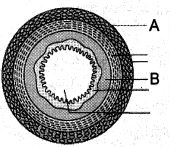
A
Serosa $-$ Submucosa
B
Mucosa $-$ Lumen
C
Submucosa $-$ Mucosa
D
Serosa $-$ Lumen
Solution
(A) The wall of the alimentary canal from the esophagus to the rectum possesses four layers: Serosa,Muscularis,Submucosa,and Mucosa.
$1$. The outermost layer is the Serosa $(A)$,which is made of a thin mesothelium with some connective tissues.
$2$. The innermost layer lining the lumen of the alimentary canal is the Mucosa $(B)$.
Therefore,$A$ represents the Serosa and $B$ represents the Mucosa.
$1$. The outermost layer is the Serosa $(A)$,which is made of a thin mesothelium with some connective tissues.
$2$. The innermost layer lining the lumen of the alimentary canal is the Mucosa $(B)$.
Therefore,$A$ represents the Serosa and $B$ represents the Mucosa.
0 likes
View Solution127
EasyMCQ
Where do certain symbiotic microorganisms normally occur in the human body?
A
Cecum
B
Pancreas
C
Vermiform appendix
D
Duodenum
Solution
(A) In the human digestive system, the $Cecum$ is a small blind sac which hosts some symbiotic microorganisms.
These microorganisms play a role in the digestion of cellulose and the synthesis of certain vitamins.
While the $Vermiform \text{ } appendix$ is attached to the $Cecum$, the primary site for these symbiotic bacteria in the human gut is the $Cecum$ itself.
These microorganisms play a role in the digestion of cellulose and the synthesis of certain vitamins.
While the $Vermiform \text{ } appendix$ is attached to the $Cecum$, the primary site for these symbiotic bacteria in the human gut is the $Cecum$ itself.
0 likes
View Solution128
MediumMCQ
Which is the correct path for bile that is synthesized by hepatic cells and poured into the duodenum without entering the gall bladder?
A
Liver $\rightarrow$ cystic duct $\rightarrow$ hepatic duct $\rightarrow$ hepatopancreatic duct $\rightarrow$ duodenum
B
Liver $\rightarrow$ hepatic duct $\rightarrow$ cystic duct $\rightarrow$ common bile duct $\rightarrow$ hepatopancreatic duct
C
Liver $\rightarrow$ hepatic lobule $\rightarrow$ hepatic duct $\rightarrow$ common bile duct $\rightarrow$ cystic duct $\rightarrow$ duodenum
D
Liver $\rightarrow$ hepatic duct $\rightarrow$ common bile duct $\rightarrow$ hepatopancreatic duct $\rightarrow$ duodenum
Solution
(D) Bile is synthesized by the hepatic cells (hepatocytes) of the liver.
It travels through the hepatic ducts.
When bile does not enter the gall bladder,it flows directly through the common bile duct.
The common bile duct and the pancreatic duct join to form the hepatopancreatic duct,which opens into the duodenum.
The opening is guarded by the sphincter of Oddi.
Therefore,the correct path is: Liver $\rightarrow$ hepatic duct $\rightarrow$ common bile duct $\rightarrow$ hepatopancreatic duct $\rightarrow$ duodenum.
It travels through the hepatic ducts.
When bile does not enter the gall bladder,it flows directly through the common bile duct.
The common bile duct and the pancreatic duct join to form the hepatopancreatic duct,which opens into the duodenum.
The opening is guarded by the sphincter of Oddi.
Therefore,the correct path is: Liver $\rightarrow$ hepatic duct $\rightarrow$ common bile duct $\rightarrow$ hepatopancreatic duct $\rightarrow$ duodenum.
0 likes
View Solution129
EasyMCQ
The layer of the wall of the alimentary canal which consists of nerves,blood and lymph vessels,and Brunner's glands is:
A
Submucosa in the stomach
B
Serosa in the pancreas
C
Muscularis in the duodenum
D
Submucosa in the duodenum
Solution
(D) The wall of the alimentary canal consists of four layers: Serosa,Muscularis,Submucosa,and Mucosa.
$1$. The Submucosa layer is formed of loose connective tissue containing nerves,blood,and lymph vessels.
$2$. In the duodenum,the Submucosa also contains Brunner's glands,which secrete mucus and enzymes to aid in digestion.
$3$. Therefore,the layer containing nerves,blood vessels,lymph vessels,and Brunner's glands is the Submucosa of the duodenum.
$1$. The Submucosa layer is formed of loose connective tissue containing nerves,blood,and lymph vessels.
$2$. In the duodenum,the Submucosa also contains Brunner's glands,which secrete mucus and enzymes to aid in digestion.
$3$. Therefore,the layer containing nerves,blood vessels,lymph vessels,and Brunner's glands is the Submucosa of the duodenum.
0 likes
View Solution130
MediumMCQ
Identify $X, Y$ and $Z$ from the following figure.
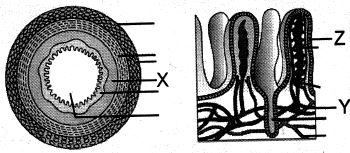
A
$X-$ Sub-mucosa,$Y-$ Artery,$Z-$ Villi
B
$X-$ Artery,$Y-$ Villi,$Z-$ Sub-mucosa
C
$X-$ Villi,$Y-$ Artery,$Z-$ Sub-mucosa
D
$X-$ Sub-mucosa,$Y-$ Villi,$Z-$ Artery
Solution
(A) Based on the cross-section of the small intestine wall,the layers from outside to inside are serosa,muscularis,submucosa,and mucosa.
In the provided figure,$X$ points to the submucosa layer.
The magnified view of the mucosa shows finger-like projections called villi.
In this magnified view,$Y$ points to the artery (part of the blood vessel network) and $Z$ points to the villi.
Therefore,the correct identification is $X-$ Sub-mucosa,$Y-$ Artery,$Z-$ Villi.
In the provided figure,$X$ points to the submucosa layer.
The magnified view of the mucosa shows finger-like projections called villi.
In this magnified view,$Y$ points to the artery (part of the blood vessel network) and $Z$ points to the villi.
Therefore,the correct identification is $X-$ Sub-mucosa,$Y-$ Artery,$Z-$ Villi.
0 likes
View Solution131
EasyMCQ
Brunner's glands occur in
A
Submucosa of duodenum
B
Submucosa of stomach
C
Mucosa of oesophagus
D
Mucosa of ileum
Solution
(A) Brunner's glands (also known as duodenal glands) are characteristic features of the duodenum.
These glands are located in the submucosa layer of the duodenum.
Their primary function is to secrete an alkaline,mucus-rich fluid that protects the duodenal wall from the acidic chyme coming from the stomach and provides an optimal pH for the activity of digestive enzymes.
These glands are located in the submucosa layer of the duodenum.
Their primary function is to secrete an alkaline,mucus-rich fluid that protects the duodenal wall from the acidic chyme coming from the stomach and provides an optimal pH for the activity of digestive enzymes.
0 likes
View Solution132
MediumMCQ
Which of the following prevents the layer of epithelial cells in the stomach of chordates from being damaged?
A
Mucous secretion
B
Acidic medium
C
Dilute $HCl$
D
Renin secretion
Solution
(A) The stomach lining is protected from the highly acidic environment created by $HCl$ through a thick coating of mucus secreted by the goblet cells of the gastric epithelium.
This mucus layer acts as a physical and chemical barrier,neutralizing the acid near the cell surface and preventing the self-digestion of the stomach wall by pepsin and $HCl$.
This mucus layer acts as a physical and chemical barrier,neutralizing the acid near the cell surface and preventing the self-digestion of the stomach wall by pepsin and $HCl$.
0 likes
View Solution133
EasyMCQ
Food is masticated with the help of which part of teeth?
A
Enamel
B
Sockets
C
Root of teeth
D
Pulp
Solution
(A) The process of mastication (chewing) involves the mechanical breakdown of food into smaller particles.
Enamel is the hardest,outermost layer of the tooth that covers the crown.
It provides the necessary hardness and durability required to crush and grind food particles during mastication.
Therefore,enamel is the part of the tooth primarily responsible for the mechanical action of chewing.
Enamel is the hardest,outermost layer of the tooth that covers the crown.
It provides the necessary hardness and durability required to crush and grind food particles during mastication.
Therefore,enamel is the part of the tooth primarily responsible for the mechanical action of chewing.
0 likes
View Solution134
EasyMCQ
Which is the correct sequence of $4$ layers of wall of alimentary canal from periphery to center?
A
Muscularis $\rightarrow$ Serosa $\rightarrow$ Mucosa $\rightarrow$ Submucosa
B
Serosa $\rightarrow$ Mucosa $\rightarrow$ Muscularis $\rightarrow$ Submucosa
C
Serosa $\rightarrow$ Muscularis $\rightarrow$ Submucosa $\rightarrow$ Mucosa
D
Serosa $\rightarrow$ Mucosa $\rightarrow$ Submucosa $\rightarrow$ Muscularis
Solution
(C) The wall of the human alimentary canal is composed of $4$ main layers.
From the periphery (outermost) to the center (innermost),these layers are:
$1$. Serosa: The outermost layer made of a thin mesothelium with some connective tissues.
$2$. Muscularis: Formed by smooth muscles,usually arranged into an inner circular and an outer longitudinal layer.
$3$. Submucosa: Formed of loose connective tissues containing nerves,blood,and lymph vessels.
$4$. Mucosa: The innermost lining of the lumen,which forms irregular folds (rugae) in the stomach and villi in the small intestine.
Therefore,the correct sequence is Serosa $\rightarrow$ Muscularis $\rightarrow$ Submucosa $\rightarrow$ Mucosa.
From the periphery (outermost) to the center (innermost),these layers are:
$1$. Serosa: The outermost layer made of a thin mesothelium with some connective tissues.
$2$. Muscularis: Formed by smooth muscles,usually arranged into an inner circular and an outer longitudinal layer.
$3$. Submucosa: Formed of loose connective tissues containing nerves,blood,and lymph vessels.
$4$. Mucosa: The innermost lining of the lumen,which forms irregular folds (rugae) in the stomach and villi in the small intestine.
Therefore,the correct sequence is Serosa $\rightarrow$ Muscularis $\rightarrow$ Submucosa $\rightarrow$ Mucosa.
0 likes
View Solution135
EasyMCQ
Crypts of Lieberkühn are located in:
A
Mucosa of small intestine
B
Serosa of small intestine
C
Mucosa of stomach
D
Muscularis of stomach
Solution
(A) The $Crypts$ $of$ $Lieberkühn$ are tubular glands found at the base of the villi in the small intestine.
These glands are located in the $Mucosa$ layer of the small intestine.
They are responsible for secreting intestinal juice ($succus$ $entericus$),which contains various enzymes that aid in the final stages of digestion.
These glands are located in the $Mucosa$ layer of the small intestine.
They are responsible for secreting intestinal juice ($succus$ $entericus$),which contains various enzymes that aid in the final stages of digestion.
0 likes
View Solution136
EasyMCQ
$A-$ The permanent teeth begin to replace the temporary ones at about the age of six years.
$R-$ This type of dentition is called diphyodont.
$R-$ This type of dentition is called diphyodont.
A
$A$ and $R$ are correct.
B
$A$ and $R$ are incorrect.
C
$A$ is correct,$R$ is incorrect.
D
$A$ is incorrect,$R$ is correct.
Solution
(A) Assertion $(A)$ is correct because the process of replacing deciduous (temporary) teeth with permanent teeth typically starts around the age of $6$ years.
Reason $(R)$ is correct because humans possess two sets of teeth during their lifetime: a set of temporary milk teeth replaced by a set of permanent or adult teeth. This type of dentition is scientifically termed as diphyodont.
Therefore,both $A$ and $R$ are correct.
Reason $(R)$ is correct because humans possess two sets of teeth during their lifetime: a set of temporary milk teeth replaced by a set of permanent or adult teeth. This type of dentition is scientifically termed as diphyodont.
Therefore,both $A$ and $R$ are correct.
0 likes
View Solution137
EasyMCQ
Where is the ileocecal valve located?
A
Stomach-duodenum
B
Ileum-caecum
C
Caecum-large intestine
D
Oesophagus-stomach
Solution
(B) The ileocecal valve is a sphincter muscle situated at the junction of the small intestine and the large intestine.
Specifically,it connects the terminal part of the ileum (the final section of the small intestine) to the caecum (the beginning of the large intestine).
Its primary function is to prevent the backflow of fecal contents from the large intestine into the small intestine.
Specifically,it connects the terminal part of the ileum (the final section of the small intestine) to the caecum (the beginning of the large intestine).
Its primary function is to prevent the backflow of fecal contents from the large intestine into the small intestine.
0 likes
View Solution138
EasyMCQ
Symbiotic microorganisms are present in.......
A
Small intestine
B
Caecum
C
Large intestine
D
Rectum
Solution
(B) The $Caecum$ is a small blind sac which hosts some symbiotic microorganisms.
It is a part of the large intestine and is vestigial in humans.
These microorganisms help in the digestion of cellulose in herbivores,but in humans,they are present in small numbers.
It is a part of the large intestine and is vestigial in humans.
These microorganisms help in the digestion of cellulose in herbivores,but in humans,they are present in small numbers.
0 likes
View Solution139
MediumMCQ
$A-$ The human digestive system consists of the alimentary canal and the associated glands.
$R -$ Liver,pancreas,and salivary glands are associated digestive glands.
$R -$ Liver,pancreas,and salivary glands are associated digestive glands.
A
$A$ and $R$ both are correct.
B
$A$ and $R$ both are incorrect.
C
$A$ is correct and $R$ is incorrect.
D
$A$ is incorrect and $R$ is correct.
Solution
(C) Assertion $(A)$ is correct because the human digestive system is indeed composed of the alimentary canal and associated digestive glands.
Reason $(R)$ is incorrect because the pineal gland is an endocrine gland located in the brain,not a digestive gland. The primary digestive glands associated with the alimentary canal are the salivary glands,liver,and pancreas.
Reason $(R)$ is incorrect because the pineal gland is an endocrine gland located in the brain,not a digestive gland. The primary digestive glands associated with the alimentary canal are the salivary glands,liver,and pancreas.
0 likes
View Solution140
MediumMCQ
Which of the following statements is inappropriate?
A
The majority of mammals,including human beings,form two sets of teeth during their life: a set of temporary milk or deciduous teeth and a set of permanent or adult teeth.
B
The oral cavity leads into the pharynx,which serves as a common passage for food and air.
C
Each tooth is embedded in a socket of the jawbone. This type of attachment is called diphyodont.
D
The hard chewing surface of the teeth is made up of enamel.
Solution
(C) The correct answer is $C$.
In humans,the type of attachment where each tooth is embedded in a socket of the jawbone is called 'thecodont',not 'diphyodont'.
'Diphyodont' refers to the formation of two sets of teeth during a lifetime (milk teeth and permanent teeth).
Therefore,the statement in option $C$ is scientifically incorrect.
In humans,the type of attachment where each tooth is embedded in a socket of the jawbone is called 'thecodont',not 'diphyodont'.
'Diphyodont' refers to the formation of two sets of teeth during a lifetime (milk teeth and permanent teeth).
Therefore,the statement in option $C$ is scientifically incorrect.
0 likes
View Solution141
MediumMCQ
Choose the incorrect sentence.
A
The stomach secretes digestive juice.
B
The small intestine is distinguishable into three regions.
C
The large intestine is divided into three parts.
D
The colon is divided into three parts.
Solution
(D) The correct answer is $D$. The colon is a part of the large intestine,but it is not divided into three parts; rather,the large intestine itself is divided into three parts: cecum,colon,and rectum. The colon is further divided into four regions: ascending,transverse,descending,and sigmoid colon. Therefore,the statement that the colon is divided into three parts is incorrect.
0 likes
View Solution142
EasyMCQ
Which is the dental formula of a $5$ year old child?
A
$\frac{2102}{2102}$
B
$\frac{2123}{2123}$
C
$\frac{2102}{2105}$
D
$\frac{2120}{2120}$
Solution
(A) The dental formula represents the arrangement of teeth in one half of the upper and lower jaw.
For a child of $5$ years,the primary dentition (milk teeth) is present.
The dental formula for a child is $\frac{2102}{2102}$,which means $2$ incisors,$1$ canine,$0$ premolars,and $2$ molars in each half of the jaw.
Therefore,the total number of teeth is $(2+1+0+2) \times 2 = 10$ teeth in each jaw,totaling $20$ teeth.
For a child of $5$ years,the primary dentition (milk teeth) is present.
The dental formula for a child is $\frac{2102}{2102}$,which means $2$ incisors,$1$ canine,$0$ premolars,and $2$ molars in each half of the jaw.
Therefore,the total number of teeth is $(2+1+0+2) \times 2 = 10$ teeth in each jaw,totaling $20$ teeth.
0 likes
View Solution143
EasyMCQ
The function of the ........ is the re-absorption of water and the preparation and storage of faeces.
A
Duodenum
B
Pancreas
C
Ileum
D
Large intestine
Solution
(D) The $Large \text{ } intestine$ is responsible for the re-absorption of water, minerals, and certain vitamins from the undigested food material.
It also plays a crucial role in the formation, preparation, and temporary storage of faeces before they are eliminated from the body through the anus.
It also plays a crucial role in the formation, preparation, and temporary storage of faeces before they are eliminated from the body through the anus.
0 likes
View Solution144
MediumMCQ
The lamina propria is associated with ............ .
A
Villi
B
Liver
C
Graafian follicle
D
Intestine
Solution
(D) The lamina propria is a thin layer of connective tissue that forms part of the moist linings known as mucous membranes or mucosa.
It is found in various organs,including the respiratory tract,the urinary tract,and the gastrointestinal tract.
In the context of the digestive system,the lamina propria is a component of the mucosa of the intestine,providing structural support and housing blood vessels and immune cells.
Therefore,it is most directly associated with the wall of the intestine.
It is found in various organs,including the respiratory tract,the urinary tract,and the gastrointestinal tract.
In the context of the digestive system,the lamina propria is a component of the mucosa of the intestine,providing structural support and housing blood vessels and immune cells.
Therefore,it is most directly associated with the wall of the intestine.
0 likes
View Solution145
EasyMCQ
Brunner's glands are found in the . . . . . . .
A
Submucosa of the duodenum
B
Submucosa of the stomach
C
Submucosa of the oesophagus
D
Mucosa of the ileum
Solution
(A) Brunner's glands (also known as duodenal glands) are characteristic features of the duodenum.
These glands are located in the submucosal layer of the duodenum.
Their primary function is to secrete an alkaline fluid that protects the duodenal mucosa from the acidic chyme coming from the stomach and provides an optimal pH for the action of pancreatic enzymes.
These glands are located in the submucosal layer of the duodenum.
Their primary function is to secrete an alkaline fluid that protects the duodenal mucosa from the acidic chyme coming from the stomach and provides an optimal pH for the action of pancreatic enzymes.
0 likes
View Solution146
EasyMCQ
Which of the following vitamins is synthesized by bacteria present in the human alimentary canal?
A
$B_1$
B
$C$
C
$D$
D
$K$
Solution
(D) The human large intestine contains a symbiotic microflora,primarily consisting of bacteria such as $Escherichia \ coli$.
These bacteria play a crucial role in the synthesis of certain vitamins,most notably Vitamin $K$ and various $B$-complex vitamins (such as $B_{12}$ and biotin).
Vitamin $K$ is essential for the synthesis of blood clotting factors in the liver.
Therefore,among the given options,Vitamin $K$ is the correct answer.
These bacteria play a crucial role in the synthesis of certain vitamins,most notably Vitamin $K$ and various $B$-complex vitamins (such as $B_{12}$ and biotin).
Vitamin $K$ is essential for the synthesis of blood clotting factors in the liver.
Therefore,among the given options,Vitamin $K$ is the correct answer.
0 likes
View Solution147
EasyMCQ
Which layer of cells secretes the enamel of the teeth?
A
Dentoblasts
B
Ameloblasts
C
Osteoblasts
D
Odontoblasts
Solution
(B) The enamel of the teeth is the hardest substance in the human body. It is secreted by specialized epithelial cells known as $Ameloblasts$. These cells are derived from the enamel organ during tooth development. Once the enamel is fully formed,these cells typically degenerate. In contrast,$Odontoblasts$ are responsible for the secretion of dentin,while $Osteoblasts$ are involved in bone formation.
0 likes
View Solution148
EasyMCQ
How does the primary dentition in humans differ from the permanent dentition,specifically regarding the absence of which type of teeth?
A
Incisors
B
Canines
C
Premolars
D
Molars
Solution
(C) The dental formula for primary (deciduous) teeth in humans is $2102/2102$,while the dental formula for permanent teeth is $2123/2123$.
Comparing these,the primary dentition lacks premolars entirely.
Therefore,the correct answer is $C$ (Premolars).
Comparing these,the primary dentition lacks premolars entirely.
Therefore,the correct answer is $C$ (Premolars).
0 likes
View Solution149
MediumMCQ
$A$ $2$-year-old boy is admitted to play school. During a dental check-up,the dentist observes that the boy has $20$ teeth. Which teeth are absent?
A
Incisors
B
Canines
C
Premolars
D
Molars
Solution
(C) The total number of deciduous (milk) teeth in humans is $20$. The dental formula for deciduous teeth is $\frac{2102}{2102}$. According to this formula,each half of the jaw contains $2$ incisors,$1$ canine,and $2$ molars. The dental formula for permanent teeth is $\frac{2123}{2123}$,which includes premolars. Therefore,premolars are completely absent in a $2$-year-old child.
0 likes
View Solution150
EasyMCQ
Which of the following terms describes human dentition?
A
Pleurodont,Diphyodont,Heterodont
B
Thecodont,Diphyodont,homodont
C
Pleurodont,monophyodont,homodont
D
Thecodont,Diphyodont,Heterodont
Solution
(D) Human dentition is characterized by three main features:
$1$. $Thecodont$: The teeth are embedded in the sockets of the jaw bone.
$2$. $Diphyodont$: Two sets of teeth are formed during the life of an individual,a set of temporary milk or deciduous teeth replaced by a set of permanent or adult teeth.
$3$. $Heterodont$: An adult human has different types of teeth,namely incisors $(I)$,canines $(C)$,premolars $(PM)$,and molars $(M)$,which serve different functions.
$1$. $Thecodont$: The teeth are embedded in the sockets of the jaw bone.
$2$. $Diphyodont$: Two sets of teeth are formed during the life of an individual,a set of temporary milk or deciduous teeth replaced by a set of permanent or adult teeth.
$3$. $Heterodont$: An adult human has different types of teeth,namely incisors $(I)$,canines $(C)$,premolars $(PM)$,and molars $(M)$,which serve different functions.
0 likes
View SolutionDigestion and Absorption — Digestive system · Frequently Asked Questions
1Are these Digestion and Absorption questions useful for JEE and NEET?
Yes. All questions in this section are mapped to JEE Main and NEET exam patterns. Previous year questions from JEE Main, NEET, GUJCET and state-level exams are included with full solutions.
2Can I switch to Hindi or Gujarati for these questions?
Yes. Use the language tabs in the hero section or the sidebar to view the same questions and solutions in English, Hindi or Gujarati.
3How do I generate a question paper from this subtopic?
Use the Vedclass Exam Paper Generator — select the chapter and subtopic, set difficulty, and generate Sets A, B, C, D automatically. First 3 chapters of every subject are free.
Vedclass Products
For Students
Vedclass Test Series
Mock tests in real JEE/NEET style with performance analysis. 5-day free trial.
Start Free TrialFor Teachers
Exam Paper Generator
Generate Set A/B/C/D papers from this chapter in 2 minutes. 3 chapters free.
Try FreeFor Institutes
Online Exam Module
Live online exams with unlimited students, 360° analytics & white-label branding.
See DemoFor Teachers & Institutes
Generate a Digestion and Absorption Exam Paper in 2 Minutes
Select subtopic & difficulty — Sets A, B, C, D auto-generated with No Repeat logic.
First 3 chapters of every subject are free — no payment required.