
A English
Digestive glands Questions in English
Class 11 Biology · Digestion and Absorption · Digestive glands
218+
Questions
English
Language
100%
With Solutions
Showing 50 of 218 questions in English
151
Medium
Write a note on the liver,gall bladder,and pancreas.
Solution
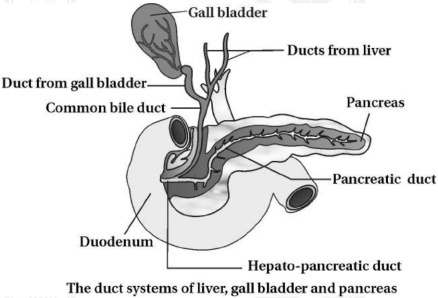
(N/A) Liver: The liver is the largest gland of the body,weighing about $1.2$ to $1.5 \ kg$ in an adult human. It is situated in the abdominal cavity,just below the diaphragm,and has two lobes. The hepatic lobules are the structural and functional units of the liver containing hepatic cells arranged in the form of cords. Each lobule is covered by a thin connective tissue sheath called the Glisson's capsule.
Gall Bladder: The bile secreted by the hepatic cells passes through the hepatic ducts and is stored and concentrated in a thin,muscular sac called the gall bladder. The duct of the gall bladder (cystic duct) along with the hepatic duct from the liver forms the common bile duct.
Pancreas: The pancreas is a compound (both exocrine and endocrine) elongated organ situated between the limbs of the $'U'$-shaped duodenum. The exocrine portion secretes an alkaline pancreatic juice containing enzymes,and the endocrine portion secretes hormones,such as insulin and glucagon.
Common Duct System: The bile duct and the pancreatic duct open together into the duodenum as the common hepato-pancreatic duct,which is guarded by a sphincter called the sphincter of Oddi.
Gall Bladder: The bile secreted by the hepatic cells passes through the hepatic ducts and is stored and concentrated in a thin,muscular sac called the gall bladder. The duct of the gall bladder (cystic duct) along with the hepatic duct from the liver forms the common bile duct.
Pancreas: The pancreas is a compound (both exocrine and endocrine) elongated organ situated between the limbs of the $'U'$-shaped duodenum. The exocrine portion secretes an alkaline pancreatic juice containing enzymes,and the endocrine portion secretes hormones,such as insulin and glucagon.
Common Duct System: The bile duct and the pancreatic duct open together into the duodenum as the common hepato-pancreatic duct,which is guarded by a sphincter called the sphincter of Oddi.
0 likes
View Solution152
Medium
Describe the various components present in pancreatic juice.
Solution
(N/A) Pancreatic juice is a vital digestive secretion produced by the pancreas and released into the duodenum. It contains several inactive enzymes, active enzymes, and bicarbonate ions.
$1$. Inactive Enzymes (Zymogens): These include $Trypsinogen$, $Chymotrypsinogen$, and $Procarboxypeptidases$. $Trypsinogen$ is activated by $Enterokinase$ (secreted by the intestinal mucosa) into $Trypsin$, which subsequently activates the other zymogens.
$2$. Active Enzymes:
- $Pancreatic \text{ } Amylase$: Hydrolyzes polysaccharides (starch) into disaccharides.
- $Pancreatic \text{ } Lipase$: Acts on emulsified fats to break them down into diglycerides and monoglycerides.
- $Nucleases$: Break down nucleic acids ($DNA$ and $RNA$) into nucleotides and nucleosides.
$3$. Bicarbonate Ions: These provide an alkaline $pH$ (approximately $7.8 - 8.4$) to the chyme, which is necessary for the optimal activity of pancreatic enzymes and to neutralize the acidic chyme coming from the stomach.
$1$. Inactive Enzymes (Zymogens): These include $Trypsinogen$, $Chymotrypsinogen$, and $Procarboxypeptidases$. $Trypsinogen$ is activated by $Enterokinase$ (secreted by the intestinal mucosa) into $Trypsin$, which subsequently activates the other zymogens.
$2$. Active Enzymes:
- $Pancreatic \text{ } Amylase$: Hydrolyzes polysaccharides (starch) into disaccharides.
- $Pancreatic \text{ } Lipase$: Acts on emulsified fats to break them down into diglycerides and monoglycerides.
- $Nucleases$: Break down nucleic acids ($DNA$ and $RNA$) into nucleotides and nucleosides.
$3$. Bicarbonate Ions: These provide an alkaline $pH$ (approximately $7.8 - 8.4$) to the chyme, which is necessary for the optimal activity of pancreatic enzymes and to neutralize the acidic chyme coming from the stomach.
0 likes
View Solution153
Medium
Describe the compositional elements present in bile juice.
Solution
(N/A) Bile juice is produced by the liver and stored in the gall bladder. It is released into the duodenum to aid in digestion.
The composition of bile juice includes:
$1$. Bile pigments: Bilirubin and biliverdin (breakdown products of hemoglobin).
$2$. Bile salts: Sodium glycocholate and sodium taurocholate,which are essential for the emulsification of fats.
$3$. Cholesterol: $A$ lipid component.
$4$. Phospholipids: Such as lecithin.
$5$. Water and electrolytes: Bile juice does not contain any digestive enzymes.
Function: Bile salts help in the emulsification of fats,which involves breaking down large fat globules into smaller micelles,thereby increasing the surface area for the action of the enzyme lipase.
The composition of bile juice includes:
$1$. Bile pigments: Bilirubin and biliverdin (breakdown products of hemoglobin).
$2$. Bile salts: Sodium glycocholate and sodium taurocholate,which are essential for the emulsification of fats.
$3$. Cholesterol: $A$ lipid component.
$4$. Phospholipids: Such as lecithin.
$5$. Water and electrolytes: Bile juice does not contain any digestive enzymes.
Function: Bile salts help in the emulsification of fats,which involves breaking down large fat globules into smaller micelles,thereby increasing the surface area for the action of the enzyme lipase.
0 likes
View Solution154
MediumMCQ
What is the primary function of the liver in the human body?
A
Production of insulin
B
Secretion of bile for fat emulsification
C
Storage of urine
D
Production of red blood cells in adults
Solution
(B) The liver is the largest accessory digestive gland in the human body.
Its primary functions include the secretion of bile,which is essential for the emulsification of fats.
It also plays a crucial role in detoxification,where it converts toxic waste products into less harmful substances for excretion.
Additionally,it is involved in the metabolism of carbohydrates,proteins,and fats,and the storage of glycogen,vitamins,and minerals.
Its primary functions include the secretion of bile,which is essential for the emulsification of fats.
It also plays a crucial role in detoxification,where it converts toxic waste products into less harmful substances for excretion.
Additionally,it is involved in the metabolism of carbohydrates,proteins,and fats,and the storage of glycogen,vitamins,and minerals.
0 likes
View Solution155
EasyMCQ
Give names of cells seen in the gastric glands of the stomach.
A
Mucous neck cells,Chief cells,Parietal cells
B
Goblet cells,Enterocytes,Paneth cells
C
Kupffer cells,Chief cells,Parietal cells
D
Mucous neck cells,Argentaffin cells,Goblet cells
Solution
(A) The mucosa of the stomach contains gastric glands. Gastric glands consist of three major types of cells:
$(1)$ Mucous neck cells: These cells secrete mucus,which protects the stomach lining from the acidic environment.
$(2)$ Peptic or Chief cells: These cells secrete the proenzyme pepsinogen,which is converted into active pepsin for protein digestion.
$(3)$ Parietal or Oxyntic cells: These cells secrete $HCl$ (hydrochloric acid) and the intrinsic factor,which is essential for the absorption of vitamin $B_{12}$.
$(1)$ Mucous neck cells: These cells secrete mucus,which protects the stomach lining from the acidic environment.
$(2)$ Peptic or Chief cells: These cells secrete the proenzyme pepsinogen,which is converted into active pepsin for protein digestion.
$(3)$ Parietal or Oxyntic cells: These cells secrete $HCl$ (hydrochloric acid) and the intrinsic factor,which is essential for the absorption of vitamin $B_{12}$.
0 likes
View Solution156
Medium
Give the differences between the liver and the pancreas.
Solution
(N/A)
| Liver | Pancreas |
|---|---|
| $(1)$ It is the largest accessory digestive gland in the body. | $(1)$ It is a soft,light pink-colored gland that functions as both an endocrine and an exocrine gland. |
| $(2)$ It is located in the upper right portion of the abdominal cavity. | $(2)$ It is located in the loop of the $U$-shaped duodenum. |
| $(3)$ It secretes bile juice. | $(3)$ It secretes pancreatic juice. |
| $(4)$ Bile pigments,excretory substances,and organic-inorganic salts are present in its bile juice. | $(4)$ It secretes digestive enzymes and hormones (insulin and glucagon). |
| $(5)$ It does not contain digestive enzymes; bile helps in the emulsification of fats. | $(5)$ Enzymes take part in the digestion of carbohydrates,proteins,and fats. Hormones maintain blood glucose levels. |
0 likes
View Solution157
Medium
Give scientific reasons:
$(1)$ The pancreas is an exocrine as well as an endocrine gland.
$(2)$ The liver,although not taking part in the process of digestion directly,is an important accessory digestive gland.
$(1)$ The pancreas is an exocrine as well as an endocrine gland.
$(2)$ The liver,although not taking part in the process of digestion directly,is an important accessory digestive gland.
Solution
(N/A) $(1)$ The Islets of Langerhans located in the pancreas secrete hormones like Glucagon and Insulin. These hormones are transported by the blood to their target organs,making it a ductless endocrine gland. Simultaneously,the pancreas secretes pancreatic juice containing various digestive enzymes,which is transported to the duodenum via the pancreatic duct. Thus,it functions as an exocrine gland.
$(2)$ The liver secretes bile juice,which contains inorganic salts like $Na_{2}CO_{3}$ and $NaHCO_{3}$. These salts provide an alkaline medium in the duodenum,which is essential for the activation of pancreatic enzymes. Additionally,bile juice contains organic salts like sodium taurocholate and sodium glycocholate,which help in the emulsification and digestion of fats. Therefore,although the liver does not secrete digestive enzymes,it plays a crucial role in digestion,making it an important accessory digestive gland.
$(2)$ The liver secretes bile juice,which contains inorganic salts like $Na_{2}CO_{3}$ and $NaHCO_{3}$. These salts provide an alkaline medium in the duodenum,which is essential for the activation of pancreatic enzymes. Additionally,bile juice contains organic salts like sodium taurocholate and sodium glycocholate,which help in the emulsification and digestion of fats. Therefore,although the liver does not secrete digestive enzymes,it plays a crucial role in digestion,making it an important accessory digestive gland.
0 likes
View Solution158
EasyMCQ
What is the location and function of the gall bladder?
A
Located in the right lobe of the liver; stores bile juice.
B
Located in the left lobe of the liver; stores bile juice.
C
Located below the stomach; produces digestive enzymes.
D
Located in the pancreas; stores pancreatic juice.
Solution
(A) The gall bladder is a small,sac-like structure located on the posterior surface of the right lobe of the liver.
Its primary function is to store and concentrate the bile juice secreted by the liver until it is needed for the digestion of fats in the small intestine.
Its primary function is to store and concentrate the bile juice secreted by the liver until it is needed for the digestion of fats in the small intestine.
0 likes
View Solution159
Medium
What is the pancreas? Mention the major secretions of the pancreas that are helpful in digestion.
Solution
(N/A) The pancreas is a compound (both exocrine and endocrine) elongated organ situated between the limbs of the '$C$'-shaped duodenum.
$1$. Exocrine function: The exocrine portion secretes an alkaline pancreatic juice containing enzymes.
$2$. Major secretions helpful in digestion include:
- Trypsinogen and Chymotrypsinogen: Inactive enzymes that are activated to digest proteins.
- Procarboxypeptidase: Activated to digest proteins.
- Pancreatic Amylase: Breaks down carbohydrates into disaccharides.
- Pancreatic Lipases: Break down fats into fatty acids and glycerol.
- Nucleases: Break down nucleic acids into nucleotides.
$1$. Exocrine function: The exocrine portion secretes an alkaline pancreatic juice containing enzymes.
$2$. Major secretions helpful in digestion include:
- Trypsinogen and Chymotrypsinogen: Inactive enzymes that are activated to digest proteins.
- Procarboxypeptidase: Activated to digest proteins.
- Pancreatic Amylase: Breaks down carbohydrates into disaccharides.
- Pancreatic Lipases: Break down fats into fatty acids and glycerol.
- Nucleases: Break down nucleic acids into nucleotides.
0 likes
View Solution160
Medium
What is the role of the gall bladder? What may happen if it stops functioning or is removed?
Solution
(N/A) The gall bladder is a small,sac-like structure connected to the liver that stores and concentrates bile secreted by the liver.
Its primary role is to release concentrated bile into the small intestine during digestion to emulsify fats.
If the gall bladder stops functioning or is removed (cholecystectomy),bile is no longer stored or concentrated; instead,it flows continuously into the intestine.
While the body gradually adapts to this continuous flow,the bile becomes less effective at emulsifying large amounts of fat.
Consequently,individuals who have had their gall bladder removed are advised to follow a low-fat diet to avoid digestive discomfort,as the efficiency of fat digestion is significantly reduced.
Its primary role is to release concentrated bile into the small intestine during digestion to emulsify fats.
If the gall bladder stops functioning or is removed (cholecystectomy),bile is no longer stored or concentrated; instead,it flows continuously into the intestine.
While the body gradually adapts to this continuous flow,the bile becomes less effective at emulsifying large amounts of fat.
Consequently,individuals who have had their gall bladder removed are advised to follow a low-fat diet to avoid digestive discomfort,as the efficiency of fat digestion is significantly reduced.
0 likes
View Solution161
EasyMCQ
Correct the statement given below by choosing the right option shown in the bracket:
Renin is a proteolytic enzyme found in gastric juice in (infants/adults).
Renin is a proteolytic enzyme found in gastric juice in (infants/adults).
A
Infants
B
Adults
C
Both
D
None
Solution
(A) Renin is a proteolytic enzyme found in the gastric juice of infants.
It helps in the digestion of milk proteins (casein) into paracasein.
As a person grows into an adult,the secretion of renin decreases significantly or stops,as the digestive system matures.
It helps in the digestion of milk proteins (casein) into paracasein.
As a person grows into an adult,the secretion of renin decreases significantly or stops,as the digestive system matures.
0 likes
View Solution162
EasyMCQ
Correct the statement given below by choosing the right option shown in the bracket against it:
Pancreatic juice and bile are released through (intestine/hepato-pancreatic duct).
Pancreatic juice and bile are released through (intestine/hepato-pancreatic duct).
A
Intestine
B
Hepato-pancreatic duct
Solution
(B) The pancreatic juice and bile are released into the duodenum of the small intestine through the hepato-pancreatic duct. This duct is guarded by the sphincter of Oddi,which regulates the flow of these secretions.
0 likes
View Solution163
Medium
What are the three major types of cells found in the gastric gland? Name their secretions.
Solution
(N/A) $(1)$ Goblet cells: Secrete mucus.
$(2)$ Peptic or chief cells (Zymogenic cells): Secrete proenzymes pepsinogen and prorenin.
$(3)$ Oxyntic or parietal cells: Secrete hydrochloric acid $(HCl)$ and Castle's intrinsic factor.
$(2)$ Peptic or chief cells (Zymogenic cells): Secrete proenzymes pepsinogen and prorenin.
$(3)$ Oxyntic or parietal cells: Secrete hydrochloric acid $(HCl)$ and Castle's intrinsic factor.
0 likes
View Solution164
EasyMCQ
Select the correct option:
$(1)$ The enzyme in saliva that breaks down starch is Ptyalin / Steapsin.
$(2)$ The Oxyntic cells / Peptic cells of the gastric glands secrete $HCl$.
$(1)$ The enzyme in saliva that breaks down starch is Ptyalin / Steapsin.
$(2)$ The Oxyntic cells / Peptic cells of the gastric glands secrete $HCl$.
A
$(1)$ Ptyalin,$(2)$ Oxyntic cells
B
$(1)$ Steapsin,$(2)$ Peptic cells
C
$(1)$ Ptyalin,$(2)$ Peptic cells
D
$(1)$ Steapsin,$(2)$ Oxyntic cells
Solution
(A) $(1)$ The enzyme present in saliva is salivary amylase,also known as Ptyalin,which acts on starch to convert it into maltose. Steapsin is a lipase found in pancreatic juice.
$(2)$ Gastric glands contain Oxyntic cells (also called Parietal cells),which secrete $HCl$ and Castle's intrinsic factor. Peptic cells (also called Chief cells) secrete proenzymes like pepsinogen.
$(2)$ Gastric glands contain Oxyntic cells (also called Parietal cells),which secrete $HCl$ and Castle's intrinsic factor. Peptic cells (also called Chief cells) secrete proenzymes like pepsinogen.
0 likes
View Solution165
Easy
Which are the types of salivary glands? Give names only.
Solution
(N/A) The main salivary glands are of three types:
$(i)$ Parotid gland
$(ii)$ Submandibular gland
$(iii)$ Sublingual gland
$(i)$ Parotid gland
$(ii)$ Submandibular gland
$(iii)$ Sublingual gland
0 likes
View Solution166
EasyMCQ
Intrinsic factor that helps in the absorption of vitamin $B_{12}$ is secreted by
A
Chief cells
B
Goblet cells
C
Hepatic cells
D
Oxyntic cells
Solution
(D) The correct answer is option $D$ because parietal or oxyntic cells secrete $HCl$ and intrinsic factor,which is essential for the absorption of vitamin $B_{12}$.
Peptic or chief cells secrete the proenzyme pepsinogen.
Goblet cells secrete mucus.
Hepatic cells secrete bile.
Peptic or chief cells secrete the proenzyme pepsinogen.
Goblet cells secrete mucus.
Hepatic cells secrete bile.
0 likes
View Solution167
EasyMCQ
Which cell is found in mucus-secreting organs?
A
Goblet cells
B
Paneth cells
C
Oxyntic cells
D
Peptic cells
Solution
(A) Goblet cells are specialized glandular epithelial cells found in the lining of the respiratory and digestive tracts.
Their primary function is to synthesize and secrete mucus,which acts as a lubricant and protective barrier for the underlying tissues.
Their primary function is to synthesize and secrete mucus,which acts as a lubricant and protective barrier for the underlying tissues.
0 likes
View Solution168
EasyMCQ
Types of salivary glands present in rabbit are
A
One
B
Two
C
Three
D
Four
Solution
(D) In rabbits,there are four pairs of salivary glands present:
$1.$ Sublingual glands
$2.$ Infra-orbital glands
$3.$ Parotid glands
$4.$ Sub-maxillary glands
Therefore,the total number of types of salivary glands is four.
$1.$ Sublingual glands
$2.$ Infra-orbital glands
$3.$ Parotid glands
$4.$ Sub-maxillary glands
Therefore,the total number of types of salivary glands is four.
0 likes
View Solution169
EasyMCQ
The enzyme present in saliva is:
A
Pepsin
B
Peptidase
C
Lipase
D
Ptyalin
Solution
(D) Saliva contains the enzyme salivary amylase,which is also known as $Ptyalin$.
It is responsible for the initial breakdown of starch into maltose in the oral cavity.
It is responsible for the initial breakdown of starch into maltose in the oral cavity.
0 likes
View Solution170
EasyMCQ
Choose the most appropriate option to describe the composition of human saliva.
A
Amylase,hydrolase
B
Electrolytes,amylase/ptyalin,lysozymes,and mucus
C
Amylase/ptyalin,mucus
D
Ptyalin only
Solution
(B) The secretion of salivary glands is called saliva.
The medium of saliva is slightly acidic.
The quantity of saliva produced in an adult is $1000-1500 \; mL$ per day.
Chemically,saliva is a mixture of water and electrolytes $(Na^+, K^+, Cl^-, HCO_3^-)$.
Additionally,enzymes like salivary amylase (ptyalin) and lysozyme (an anti-bacterial agent) are also found in saliva,along with mucus which helps in lubricating the food.
The medium of saliva is slightly acidic.
The quantity of saliva produced in an adult is $1000-1500 \; mL$ per day.
Chemically,saliva is a mixture of water and electrolytes $(Na^+, K^+, Cl^-, HCO_3^-)$.
Additionally,enzymes like salivary amylase (ptyalin) and lysozyme (an anti-bacterial agent) are also found in saliva,along with mucus which helps in lubricating the food.
0 likes
View Solution171
EasyMCQ
Lysozyme,one of the constituents of human saliva,acts as:
A
Antibacterial agent
B
Zymogen
C
Amylase
D
Lipase
Solution
(A) The fluid secreted by the salivary glands is known as saliva.
Saliva is chemically a mixture of water,electrolytes (salts of sodium,potassium,chloride,and bicarbonates),salivary amylase (ptyalin),and lysozyme.
Lysozyme is an enzyme that functions as an antibacterial agent by breaking down the cell walls of bacteria,thereby preventing infections in the oral cavity.
Saliva is chemically a mixture of water,electrolytes (salts of sodium,potassium,chloride,and bicarbonates),salivary amylase (ptyalin),and lysozyme.
Lysozyme is an enzyme that functions as an antibacterial agent by breaking down the cell walls of bacteria,thereby preventing infections in the oral cavity.
0 likes
View Solution172
EasyMCQ
Which one is not associated with the secretion of saliva?
A
Parotid
B
Sublingual
C
Supra optic
D
Sub-maxillary
Solution
(C) In humans,there are three pairs of salivary glands responsible for the secretion of saliva: the parotid glands,the sublingual glands,and the submaxillary (or submandibular) glands.
$Supra$ $optic$ refers to a region in the hypothalamus,which is involved in neuroendocrine functions and is not a salivary gland.
Therefore,the $Supra$ $optic$ region is not associated with the secretion of saliva.
$Supra$ $optic$ refers to a region in the hypothalamus,which is involved in neuroendocrine functions and is not a salivary gland.
Therefore,the $Supra$ $optic$ region is not associated with the secretion of saliva.
0 likes
View Solution173
EasyMCQ
Which of the following cells produce $HCl$?
A
$\beta$-cells
B
$\alpha$-cells
C
Oxyntic cells
D
Chief cells
Solution
(C) Oxyntic cells,also known as parietal cells,are present in the gastric glands of the stomach wall.
They are responsible for the secretion of hydrochloric acid $(HCl)$ and intrinsic factor.
$HCl$ maintains a low $pH$ (approximately $1.8$ to $2.0$) in the stomach,which is essential for the activation of proenzymes like pepsinogen into pepsin and prorennin into rennin.
They are responsible for the secretion of hydrochloric acid $(HCl)$ and intrinsic factor.
$HCl$ maintains a low $pH$ (approximately $1.8$ to $2.0$) in the stomach,which is essential for the activation of proenzymes like pepsinogen into pepsin and prorennin into rennin.
0 likes
View Solution174
EasyMCQ
The liver of a human is:
A
Two-lobed
B
Three-lobed
C
Four-lobed
D
Five-lobed
Solution
(A) The human liver is anatomically divided into $2$ main lobes,the left and the right lobe. These lobes are further subdivided into $8$ segments,which are composed of thousands of hepatic lobules,the functional units of the liver.
0 likes
View Solution175
EasyMCQ
Which of the following chemicals represent bile salts?
A
Haemoglobin and biliverdin
B
Bilirubin and biliverdin
C
Bilirubin and haemoglobin
D
Sodium glycocholate and taurocholate
Solution
(D) The liver secretes bile,which is stored in the gall bladder. Bile contains bile salts such as sodium glycocholate and sodium taurocholate. These salts help in the digestion of fats in the small intestine by bringing about the emulsification of fat,which is the conversion of large fat droplets into small ones.
0 likes
View Solution176
EasyMCQ
What is the $pH$ of human saliva?
A
Acidic
B
Basic
C
Neutral
D
Highly acidic
Solution
(A) Saliva,the secretion of salivary glands in humans,consists of a mixture of water,salts,and electrolytes.
Its medium is slightly acidic with a $pH$ of $6.8$.
Saliva also contains an antibacterial agent known as lysozyme.
Its medium is slightly acidic with a $pH$ of $6.8$.
Saliva also contains an antibacterial agent known as lysozyme.
0 likes
View Solution177
EasyMCQ
Kupffer's cells are:
A
Phagocytic
B
Non-phagocytic
C
Myosin
D
Fibrin
Solution
(A) Kupffer's cells are specialized macrophages located in the liver sinusoids.
They play a crucial role in the body's immune system by performing phagocytosis,which involves engulfing and destroying foreign particles,bacteria,and damaged red blood cells.
Therefore,they are classified as phagocytic cells.
They play a crucial role in the body's immune system by performing phagocytosis,which involves engulfing and destroying foreign particles,bacteria,and damaged red blood cells.
Therefore,they are classified as phagocytic cells.
0 likes
View Solution178
EasyMCQ
Glisson's capsules are found in which organ of mammals?
A
Stomach
B
Kidney
C
Testis
D
Liver
Solution
(D) Glisson's capsule is a thin layer of connective tissue that surrounds the liver and ensheathes the hepatic artery,portal vein,and bile ducts within the liver.
It was named after the British physician and biologist Francis Glisson $(1597-1677)$.
Therefore,Glisson's capsules are a characteristic feature of the mammalian liver.
It was named after the British physician and biologist Francis Glisson $(1597-1677)$.
Therefore,Glisson's capsules are a characteristic feature of the mammalian liver.
0 likes
View Solution179
EasyMCQ
Succus entericus is secreted by
A
Submucosal Glands
B
Crypt of Lieberkuhn
C
Islets of Langerhans
D
Intestinal Villi
Solution
(B) Succus entericus,also known as intestinal juice,is the collective secretion of the intestinal glands.
These glands include the crypts of Lieberkühn,which are located between the bases of the villi in the small intestine.
The crypts of Lieberkühn secrete enzymes and mucus that facilitate the final stages of digestion.
Therefore,succus entericus is primarily considered the secretion of the crypts of Lieberkühn.
These glands include the crypts of Lieberkühn,which are located between the bases of the villi in the small intestine.
The crypts of Lieberkühn secrete enzymes and mucus that facilitate the final stages of digestion.
Therefore,succus entericus is primarily considered the secretion of the crypts of Lieberkühn.
0 likes
View Solution180
MediumMCQ
Which of the following has the highest $pH$?
A
Gastric juice
B
Bile
C
Pancreatic juice
D
Secretions of the intestinal glands
Solution
(B) To determine which secretion has the highest $pH$,we compare the typical $pH$ values of the digestive juices:
Based on the physiological ranges,Bile typically exhibits the highest $pH$ value (often reaching up to $8.6$),making it the most alkaline among the options provided.
| Digestive juice | $pH$ Range |
| Gastric juice | $1.5 - 3.5$ |
| Bile | $7.6 - 8.6$ |
| Pancreatic juice | $7.5 - 8.3$ |
| Intestinal juice | $7.5 - 8.0$ |
Based on the physiological ranges,Bile typically exhibits the highest $pH$ value (often reaching up to $8.6$),making it the most alkaline among the options provided.
0 likes
View Solution181
MediumMCQ
Which of the following is the constituent of pancreatic juices?
A
Sodium bicarbonate and one proenzyme
B
Sodium bicarbonate and two proenzymes
C
Sodium bicarbonate and three proenzymes
D
Sodium bicarbonate and four proenzymes
Solution
(C) The pancreas is a yellowish,leaf-like mixed gland located posterior to the stomach in the abdominal cavity.
It consists of two parts: an exocrine part and an endocrine part.
The exocrine part secretes a slightly alkaline fluid known as pancreatic juice.
Pancreatic juice contains sodium bicarbonate and three main proenzymes: $Trypsinogen$,$Chymotrypsinogen$,and $Procarboxypeptidase$.
These proenzymes are inactive precursors that are activated in the small intestine to aid in protein digestion.
It consists of two parts: an exocrine part and an endocrine part.
The exocrine part secretes a slightly alkaline fluid known as pancreatic juice.
Pancreatic juice contains sodium bicarbonate and three main proenzymes: $Trypsinogen$,$Chymotrypsinogen$,and $Procarboxypeptidase$.
These proenzymes are inactive precursors that are activated in the small intestine to aid in protein digestion.
0 likes
View Solution182
MediumMCQ
Find out the correctly matched pair.
A
Pepsinogen - Zymogenic cells
B
$HCl$ - Goblet cells
C
Mucus - Oxyntic cells
D
Pancreatic juice - Salivary glands
Solution
(A) The correct match is: Pepsinogen - Zymogenic cells.
Detailed analysis of the options:
$1$. Pepsinogen is secreted by the Zymogenic (or Chief) cells of the stomach.
$2$. $HCl$ (Hydrochloric acid) is secreted by the Oxyntic (or Parietal) cells of the stomach.
$3$. Mucus is secreted by the Goblet cells.
$4$. Pancreatic juice is secreted by the Acinar cells of the pancreas,not by the salivary glands.
Therefore,option $A$ is the only correctly matched pair.
Detailed analysis of the options:
$1$. Pepsinogen is secreted by the Zymogenic (or Chief) cells of the stomach.
$2$. $HCl$ (Hydrochloric acid) is secreted by the Oxyntic (or Parietal) cells of the stomach.
$3$. Mucus is secreted by the Goblet cells.
$4$. Pancreatic juice is secreted by the Acinar cells of the pancreas,not by the salivary glands.
Therefore,option $A$ is the only correctly matched pair.
0 likes
View Solution183
MediumMCQ
Study thoroughly the following statements and identify which of the following is/are correct and incorrect?
$I.$ Bile salt present in bile is responsible for emulsifying the fats in the small intestine.
$II.$ Sodium and potassium salts of glycocholic and taurocholic acid are bile salts.
$III.$ The $pH$ of hepatic bile is $8.6$,while the $pH$ of gall bladder bile is $7.6$ or $7.5$.
$IV.$ The flow of bile from the liver takes place through the hepatic duct,common bile duct,hepatopancreatic ampulla,and finally to the first part of the small intestine.
$V.$ Rats and horses do not require a gall bladder to store bile.
Choose the correct option.
$I.$ Bile salt present in bile is responsible for emulsifying the fats in the small intestine.
$II.$ Sodium and potassium salts of glycocholic and taurocholic acid are bile salts.
$III.$ The $pH$ of hepatic bile is $8.6$,while the $pH$ of gall bladder bile is $7.6$ or $7.5$.
$IV.$ The flow of bile from the liver takes place through the hepatic duct,common bile duct,hepatopancreatic ampulla,and finally to the first part of the small intestine.
$V.$ Rats and horses do not require a gall bladder to store bile.
Choose the correct option.
A
$I, III$ and $IV$ are incorrect,while $II$ and $V$ are correct.
B
All statements are correct.
C
Statement $II$ and $V$ are incorrect while $I, III$ and $IV$ are correct.
D
All statements are incorrect.
Solution
(B) All the given statements are scientifically correct.
$I.$ Bile salts (glycocholate and taurocholate) emulsify fats in the small intestine,increasing the surface area for lipase action.
$II.$ Bile salts are indeed the sodium and potassium salts of glycocholic and taurocholic acids.
$III.$ Hepatic bile is alkaline ($pH$ $8.6$),but as it is stored and concentrated in the gall bladder,its $pH$ drops to $7.6$ or $7.5$.
$IV.$ The pathway of bile is: Liver $\rightarrow$ Hepatic ducts $\rightarrow$ Common bile duct $\rightarrow$ Hepatopancreatic ampulla (Ampulla of Vater) $\rightarrow$ Duodenum (first part of small intestine).
$V.$ Certain animals like rats and horses lack a gall bladder; they secrete bile directly into the intestine.
$I.$ Bile salts (glycocholate and taurocholate) emulsify fats in the small intestine,increasing the surface area for lipase action.
$II.$ Bile salts are indeed the sodium and potassium salts of glycocholic and taurocholic acids.
$III.$ Hepatic bile is alkaline ($pH$ $8.6$),but as it is stored and concentrated in the gall bladder,its $pH$ drops to $7.6$ or $7.5$.
$IV.$ The pathway of bile is: Liver $\rightarrow$ Hepatic ducts $\rightarrow$ Common bile duct $\rightarrow$ Hepatopancreatic ampulla (Ampulla of Vater) $\rightarrow$ Duodenum (first part of small intestine).
$V.$ Certain animals like rats and horses lack a gall bladder; they secrete bile directly into the intestine.
0 likes
View Solution184
EasyMCQ
How many pairs of salivary glands are present in human beings?
A
$2 \; \text{pairs}$
B
$3 \; \text{pairs}$
C
$4 \; \text{pairs}$
D
$5 \; \text{pairs}$
Solution
(B) There are three pairs of salivary glands in humans:
$(1)$ Parotid glands $(1 \; \text{pair})$
$(2)$ Sub-maxillary or sub-mandibular glands $(1 \; \text{pair})$
$(3)$ Sub-lingual glands $(1 \; \text{pair})$
These glands are situated just outside the buccal cavity and secrete salivary juice into the buccal cavity.
$(1)$ Parotid glands $(1 \; \text{pair})$
$(2)$ Sub-maxillary or sub-mandibular glands $(1 \; \text{pair})$
$(3)$ Sub-lingual glands $(1 \; \text{pair})$
These glands are situated just outside the buccal cavity and secrete salivary juice into the buccal cavity.
0 likes
View Solution185
EasyMCQ
Glisson's capsule is related to
A
Liver
B
Pancreas
C
Lung
D
Pharynx
Solution
(A) Glisson's capsule is a thin connective tissue sheath that covers the hepatic lobules of the liver. It is composed of dense irregular connective tissue and is essential for maintaining the structural integrity of the liver lobules.
0 likes
View Solution186
EasyMCQ
Bile is stored and concentrated in
A
Liver
B
Pancreas
C
Lungs
D
Gall bladder
Solution
(D) The gall bladder is a small,pear-shaped organ located under the liver.
It serves as a storage site for bile produced by the liver.
While stored in the gall bladder,bile is concentrated through the absorption of water and certain electrolytes from the fluid.
It serves as a storage site for bile produced by the liver.
While stored in the gall bladder,bile is concentrated through the absorption of water and certain electrolytes from the fluid.
0 likes
View Solution187
EasyMCQ
Which is the largest gland of the human body?
A
Liver
B
Pancreas
C
Gall bladder
D
Lung
Solution
(A) The liver is the largest gland of the human body.
It is located in the upper right portion of the abdominal cavity.
In an adult human,it weighs approximately $1.2$ to $1.5 \;kg$.
It is located in the upper right portion of the abdominal cavity.
In an adult human,it weighs approximately $1.2$ to $1.5 \;kg$.
0 likes
View Solution188
EasyMCQ
The antibacterial enzyme present in the saliva that prevents infections is
A
Maltose
B
Salivary amylase
C
Lysozyme
D
Pepsinogen
Solution
(C) $Maltose$ is a disaccharide sugar.
$Salivary \text{ } amylase$ is an enzyme that helps in the digestion of carbohydrates.
$Lysozyme$ is an antibacterial enzyme present in saliva that prevents infections by breaking down the cell walls of bacteria.
$Pepsinogen$ is the inactive precursor of pepsin, which helps in the digestion of proteins in the stomach.
$Salivary \text{ } amylase$ is an enzyme that helps in the digestion of carbohydrates.
$Lysozyme$ is an antibacterial enzyme present in saliva that prevents infections by breaking down the cell walls of bacteria.
$Pepsinogen$ is the inactive precursor of pepsin, which helps in the digestion of proteins in the stomach.
0 likes
View Solution189
EasyMCQ
$HCl$ secreting cells present in the stomach are
A
Oxyntic cells
B
Peptic cells
C
Chief cells
D
Mucus neck cells
Solution
(A) The stomach lining contains various types of cells that perform specific secretory functions:
$1$. Oxyntic cells (also known as parietal cells): These cells are responsible for secreting $HCl$ (hydrochloric acid) and the intrinsic factor,which is essential for the absorption of vitamin $B_{12}$.
$2$. Peptic cells (also known as chief cells): These cells secrete the proenzyme pepsinogen.
$3$. Mucus neck cells: These cells secrete mucus,which protects the stomach lining from the corrosive action of $HCl$.
$1$. Oxyntic cells (also known as parietal cells): These cells are responsible for secreting $HCl$ (hydrochloric acid) and the intrinsic factor,which is essential for the absorption of vitamin $B_{12}$.
$2$. Peptic cells (also known as chief cells): These cells secrete the proenzyme pepsinogen.
$3$. Mucus neck cells: These cells secrete mucus,which protects the stomach lining from the corrosive action of $HCl$.
0 likes
View Solution190
EasyMCQ
All of the following juices contain enzymes,except:
A
Pancreatic juice
B
Intestinal juice
C
Bile juice
D
Gastric juice
Solution
(C) Bile juice does not contain any digestive enzymes. It consists of bile pigments ($bilirubin$ and $biliverdin$),bile salts ($sodium$ $bicarbonate$,$sodium$ $glycocholate$,$sodium$ $taurocholate$),$cholesterol$,and phospholipids. Its primary function is the emulsification of fats.
0 likes
View Solution191
EasyMCQ
The enzyme $Trypsinogen$ is a component of:
A
Mucus
B
Saliva
C
Pancreatic juice
D
Intestinal juice
Solution
(C) $Trypsinogen$ is an inactive zymogen (proenzyme) secreted by the pancreas. It is a key component of pancreatic juice. Once it reaches the small intestine,it is activated into $Trypsin$ by the enzyme $Enterokinase$,which is secreted by the intestinal mucosa.
0 likes
View Solution192
EasyMCQ
Match the following:
| Column-$I$ (Salivary gland) | Column-$II$ (Location) |
| $a.$ Parotids | $(i)$ Below tongue |
| $b.$ Sub-maxillary/sub-mandibular | $(ii)$ Lower jaw |
| $c.$ Sub-linguals | $(iii)$ Cheek |
A
$a(i), b(ii), c(iii)$
B
$a(i), b(iii), c(ii)$
C
$a(ii), b(i), c(iii)$
D
$a(iii), b(ii), c(i)$
Solution
(D) The correct matches are as follows:
$a.$ Parotid glands are located near the cheek.
$b.$ Sub-maxillary or sub-mandibular glands are located at the lower jaw.
$c.$ Sub-lingual glands are located below the tongue.
Therefore, the correct sequence is $a(iii), b(ii), c(i)$.
$a.$ Parotid glands are located near the cheek.
$b.$ Sub-maxillary or sub-mandibular glands are located at the lower jaw.
$c.$ Sub-lingual glands are located below the tongue.
Therefore, the correct sequence is $a(iii), b(ii), c(i)$.
0 likes
View Solution193
EasyMCQ
The type of cells present in the gastric glands which secretes intrinsic factor?
A
Peptic cells
B
Chief cells
C
Parietal cells
D
Both $(a) \;\& \;(b)$
Solution
(C) Peptic cells or chief cells secrete pepsinogen.
Parietal cells or oxyntic cells secrete $HCl$ and intrinsic factor,which is essential for the absorption of Vitamin $B_{12}$.
Parietal cells or oxyntic cells secrete $HCl$ and intrinsic factor,which is essential for the absorption of Vitamin $B_{12}$.
0 likes
View Solution194
EasyMCQ
The pancreatic juice contains various enzymes,except
A
Pepsinogen
B
Trypsinogen
C
Chymotrypsinogen
D
Procarboxypeptidase
Solution
(A) Pancreatic juice contains inactive enzymes like $Trypsinogen$,$Chymotrypsinogen$,and $Procarboxypeptidase$.
$Pepsinogen$ is an inactive enzyme secreted by the chief cells (or peptic cells) of the gastric glands located in the stomach,not by the pancreas.
$Pepsinogen$ is an inactive enzyme secreted by the chief cells (or peptic cells) of the gastric glands located in the stomach,not by the pancreas.
0 likes
View Solution195
MediumMCQ
Select the incorrect option.
A
Bilirubin and biliverdin are the bile pigments.
B
Emulsification is the breakdown of the fats into very small droplets.
C
Rennin is a proteolytic enzyme found in the pancreatic juice of infants which helps in the digestion of milk protein.
D
Mucus and bicarbonates protect mucosal epithelium from excoriation by highly conc. $HCl$.
Solution
(C) The correct answer is $C$. Rennin is a proteolytic enzyme found in the gastric juice of infants,not in the pancreatic juice. It is responsible for the digestion of milk protein (casein).
0 likes
View Solution196
MediumMCQ
$A$: Aptyalism patients have higher than normal incidences of dental caries.
$R$: Aptyalism is caused by the action of the parasympathetic nervous system.
$R$: Aptyalism is caused by the action of the parasympathetic nervous system.
A
Assertion and Reason both are correct and Reason is the correct explanation of Assertion.
B
Assertion and Reason both are correct but Reason is not the correct explanation of Assertion.
C
Assertion is correct,but Reason is incorrect.
D
Both Assertion and Reason are incorrect.
Solution
(C) Aptyalism is a condition characterized by the absence of saliva production.
Saliva contains lysozyme,which possesses anti-microbial properties and helps prevent dental caries.
Therefore,in the absence of saliva,the risk of dental caries increases significantly.
Thus,the Assertion is correct.
However,the Reason is incorrect because the parasympathetic nervous system actually stimulates salivary secretion,whereas aptyalism is typically caused by damage to salivary glands or other pathological conditions,not by the parasympathetic nervous system itself.
Saliva contains lysozyme,which possesses anti-microbial properties and helps prevent dental caries.
Therefore,in the absence of saliva,the risk of dental caries increases significantly.
Thus,the Assertion is correct.
However,the Reason is incorrect because the parasympathetic nervous system actually stimulates salivary secretion,whereas aptyalism is typically caused by damage to salivary glands or other pathological conditions,not by the parasympathetic nervous system itself.
0 likes
View Solution197
MediumMCQ
$A$: In humans,the duct of Wirsung from the pancreas combines with the bile duct before opening into the duodenum.
$R$: Blockage in the duct of Wirsung will prevent the endocrine function of the pancreas.
$R$: Blockage in the duct of Wirsung will prevent the endocrine function of the pancreas.
A
Assertion and Reason both are correct and Reason is the correct explanation of Assertion.
B
Assertion and Reason both are correct but Reason is not the correct explanation of Assertion.
C
Assertion is correct,but Reason is incorrect.
D
Both Assertion and Reason are incorrect.
Solution
(C) The duct of Wirsung (main pancreatic duct) carries pancreatic juice (digestive enzymes) to the duodenum,which is an exocrine function.
Therefore,the assertion is correct as it describes the anatomical path of the pancreatic duct.
However,the reason is incorrect because the endocrine function of the pancreas (secretion of hormones like insulin and glucagon) occurs directly into the blood,not through the duct of Wirsung.
Blockage of the duct of Wirsung only affects the exocrine function (digestion),not the endocrine function.
Therefore,the assertion is correct as it describes the anatomical path of the pancreatic duct.
However,the reason is incorrect because the endocrine function of the pancreas (secretion of hormones like insulin and glucagon) occurs directly into the blood,not through the duct of Wirsung.
Blockage of the duct of Wirsung only affects the exocrine function (digestion),not the endocrine function.
0 likes
View Solution198
MediumMCQ
$A$: Trypsin is secreted in pancreatic juice as trypsinogen.
$R$: Zymogenic forms protect the pancreas from autodigestion.
$R$: Zymogenic forms protect the pancreas from autodigestion.
A
Assertion and Reason both are correct and Reason is the correct explanation of Assertion.
B
Assertion and Reason both are correct but Reason is not the correct explanation of Assertion.
C
Assertion is correct,but Reason is incorrect.
D
Both Assertion and Reason are incorrect.
Solution
(A) Trypsinogen is the inactive precursor (zymogen) of the enzyme trypsin.
Pancreatic enzymes are secreted in their inactive forms (zymogens) to prevent the digestion of the pancreatic tissue itself,a process known as autodigestion.
Therefore,the secretion of trypsin as trypsinogen is a protective mechanism for the pancreas.
Thus,both the Assertion and the Reason are correct,and the Reason is the correct explanation of the Assertion.
Pancreatic enzymes are secreted in their inactive forms (zymogens) to prevent the digestion of the pancreatic tissue itself,a process known as autodigestion.
Therefore,the secretion of trypsin as trypsinogen is a protective mechanism for the pancreas.
Thus,both the Assertion and the Reason are correct,and the Reason is the correct explanation of the Assertion.
0 likes
View Solution199
EasyMCQ
Which is the largest digestive gland of our body?
A
Liver
B
Lung
C
Brain
D
Stomach
Solution
(A) The liver is the largest digestive gland in the human body. It plays a crucial role in digestion by producing bile,which helps in the emulsification of fats.
0 likes
View Solution200
EasyMCQ
Does the gall bladder form bile?
A
Yes
B
No
C
Only during digestion
D
Only during fasting
Solution
(B) The gall bladder is not involved in the production of bile.
Bile is synthesized and secreted by the hepatocytes (liver cells).
The gall bladder serves only to store and concentrate the bile until it is required for the digestion of fats in the small intestine.
Bile is synthesized and secreted by the hepatocytes (liver cells).
The gall bladder serves only to store and concentrate the bile until it is required for the digestion of fats in the small intestine.
0 likes
View SolutionDigestion and Absorption — Digestive glands · Frequently Asked Questions
1Are these Digestion and Absorption questions useful for JEE and NEET?
Yes. All questions in this section are mapped to JEE Main and NEET exam patterns. Previous year questions from JEE Main, NEET, GUJCET and state-level exams are included with full solutions.
2Can I switch to Hindi or Gujarati for these questions?
Yes. Use the language tabs in the hero section or the sidebar to view the same questions and solutions in English, Hindi or Gujarati.
3How do I generate a question paper from this subtopic?
Use the Vedclass Exam Paper Generator — select the chapter and subtopic, set difficulty, and generate Sets A, B, C, D automatically. First 3 chapters of every subject are free.
Vedclass Products
For Students
Vedclass Test Series
Mock tests in real JEE/NEET style with performance analysis. 5-day free trial.
Start Free TrialFor Teachers
Exam Paper Generator
Generate Set A/B/C/D papers from this chapter in 2 minutes. 3 chapters free.
Try FreeFor Institutes
Online Exam Module
Live online exams with unlimited students, 360° analytics & white-label branding.
See DemoFor Teachers & Institutes
Generate a Digestion and Absorption Exam Paper in 2 Minutes
Select subtopic & difficulty — Sets A, B, C, D auto-generated with No Repeat logic.
First 3 chapters of every subject are free — no payment required.