
A English
Pancreas Questions in English
Class 11 Biology · Chemical Coordination and Integration · Pancreas
124+
Questions
English
Language
100%
With Solutions
Showing 24 of 124 questions in English
101
EasyMCQ
Pancreas acts as
A
Exocrine gland
B
Endocrine gland
C
Both $(a)$ and $(b)$
D
Holocrine gland
Solution
(C) The pancreas is a composite gland,which functions as both an exocrine and an endocrine gland.
Its exocrine portion secretes pancreatic enzymes into the duodenum,while the endocrine portion consists of the islets of Langerhans.
There are about $1$ to $2$ million islets of Langerhans in a normal human pancreas,representing only $1$ to $2 \%$ of the pancreatic tissue.
Its exocrine portion secretes pancreatic enzymes into the duodenum,while the endocrine portion consists of the islets of Langerhans.
There are about $1$ to $2$ million islets of Langerhans in a normal human pancreas,representing only $1$ to $2 \%$ of the pancreatic tissue.
0 likes
View Solution102
MediumMCQ
Diabetic patients are successfully treated by
A
Glucagon therapy
B
Insulin therapy
C
Combination of glucagon and insulin therapy
D
All of the above
Solution
(B) Diabetes mellitus is a condition characterized by high blood glucose levels due to either insufficient production of insulin by the pancreas or the body's inability to effectively use the insulin produced. Insulin is a peptide hormone secreted by the $\beta$-cells of the Islets of Langerhans in the pancreas,which facilitates the uptake of glucose into cells. Therefore,diabetic patients are treated by administering insulin therapy to regulate their blood glucose levels.
0 likes
View Solution103
EasyMCQ
How many Islets of Langerhans are present in a normal human pancreas?
A
$1$ to $2$ million
B
$2$ to $3$ million
C
$3$ to $4$ million
D
$4$ to $5$ million
Solution
(A) The pancreas is a composite gland which acts as both an exocrine and endocrine gland. The endocrine part of the pancreas consists of clusters of cells called Islets of Langerhans. There are about $1$ to $2$ million Islets of Langerhans in a normal human pancreas,which represent only $1-2$ percent of the pancreatic tissue.
0 likes
View Solution104
MediumMCQ
Which of the following are the symptoms of hypersecretion of insulin?
$I$. Hypoglycemia $II$. Sweating $III$. Irritability $IV$. Glycosuria
Select the correct combination:
$I$. Hypoglycemia $II$. Sweating $III$. Irritability $IV$. Glycosuria
Select the correct combination:
A
$I$ and $II$
B
$II$ and $III$
C
$I, III$ and $IV$
D
$I, II$ and $III$
Solution
(D) Hypersecretion of insulin leads to an excessive decrease in blood glucose levels,a condition known as hypoglycemia.
Common symptoms of hypoglycemia include:
$1$. Sweating
$2$. Irritability
$3$. Tremors or shakiness
$4$. Confusion or double vision
$5$. Palpitations
Glycosuria (presence of glucose in urine) is a symptom of diabetes mellitus,which is caused by the hyposecretion of insulin,not hypersecretion.
Therefore,the correct combination of symptoms for hypersecretion of insulin is $I, II$ and $III$.
Common symptoms of hypoglycemia include:
$1$. Sweating
$2$. Irritability
$3$. Tremors or shakiness
$4$. Confusion or double vision
$5$. Palpitations
Glycosuria (presence of glucose in urine) is a symptom of diabetes mellitus,which is caused by the hyposecretion of insulin,not hypersecretion.
Therefore,the correct combination of symptoms for hypersecretion of insulin is $I, II$ and $III$.
0 likes
View Solution105
EasyMCQ
What is the function of pancreatic somatostatin?
A
Stimulates glucagon release while inhibits insulin release.
B
Stimulates the release of insulin and glucagon.
C
Inhibits the release of insulin and glucagon.
D
Inhibits glucagon release while stimulates insulin release.
Solution
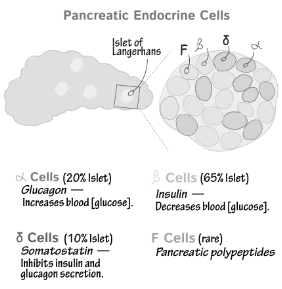
(C) The $\delta$ (delta) cells of the pancreas secrete a peptide hormone called somatostatin. Its primary function is to inhibit the secretion of both insulin (from $\beta$ cells) and glucagon (from $\alpha$ cells). It also acts to decrease the secretion,motility,and absorption in the digestive tract.
0 likes
View Solution106
MediumMCQ
Which one affects liver,muscle and adipose tissue?
A
Androgen
B
Insulin
C
Progesterone
D
Glucagon
Solution
(B) Insulin,secreted from the $\beta$-cells of the islets of Langerhans (endocrine part of the pancreas),affects the liver,muscle,and adipose tissue.
In muscular tissue,it promotes carbohydrate metabolism and the storage of glycogen.
In liver cells,it favors glycogenesis,glycolysis,and increases lipogenesis.
In adipose tissue,it enhances the membrane transfer of glucose and promotes lipogenesis.
In muscular tissue,it promotes carbohydrate metabolism and the storage of glycogen.
In liver cells,it favors glycogenesis,glycolysis,and increases lipogenesis.
In adipose tissue,it enhances the membrane transfer of glucose and promotes lipogenesis.
0 likes
View Solution107
MediumMCQ
Choose the correct option for $A$ to $C$:
| Types of cells (Langerhans) | Hormones |
|---|---|
| $\alpha$-cells secrete | $A$ |
| $\beta$-cells secrete | $B$ |
| $\delta$-cells secrete | $C$ |
A
$A-Glucagon, B-Insulin, C-Somatostatin$
B
$A-Insulin, B-Glucagon, C-Gastrin$
C
$A-Insulin, B-Glucagon, C-Enterokinase$
D
$A-Glucagon, B-Insulin, C-Steapsin$
Solution
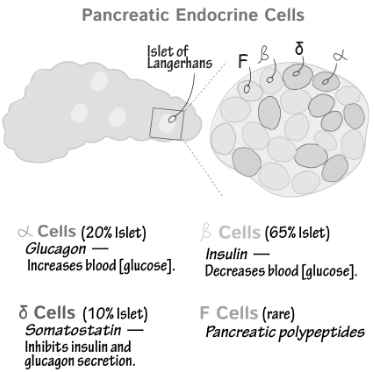
(A) The pancreas acts as a composite gland,functioning as both an exocrine and an endocrine gland.
The endocrine part of the pancreas consists of the Islets of Langerhans,which contain different types of cells that secrete specific hormones:
$1$. $\alpha$-cells (alpha cells) secrete the hormone Glucagon,which increases blood glucose levels.
$2$. $\beta$-cells (beta cells) secrete the hormone Insulin,which decreases blood glucose levels.
$3$. $\delta$-cells (delta cells) secrete the hormone Somatostatin,which inhibits the secretion of both insulin and glucagon.
Therefore,the correct mapping is $A-Glucagon, B-Insulin, C-Somatostatin$.
The endocrine part of the pancreas consists of the Islets of Langerhans,which contain different types of cells that secrete specific hormones:
$1$. $\alpha$-cells (alpha cells) secrete the hormone Glucagon,which increases blood glucose levels.
$2$. $\beta$-cells (beta cells) secrete the hormone Insulin,which decreases blood glucose levels.
$3$. $\delta$-cells (delta cells) secrete the hormone Somatostatin,which inhibits the secretion of both insulin and glucagon.
Therefore,the correct mapping is $A-Glucagon, B-Insulin, C-Somatostatin$.
0 likes
View Solution108
MediumMCQ
Treatment with alloxan destroys
A
$STH$ cells
B
Alpha cells of islets of Langerhans
C
Beta cells of islets of Langerhans
D
Cells of Leydig
Solution
(C) Alloxan is a toxic glucose analogue that selectively destroys insulin-producing beta cells in the pancreas.
It is widely used in research to induce experimental diabetes mellitus in laboratory animals.
Therefore,treatment with alloxan leads to the destruction of the beta cells of the islets of Langerhans.
It is widely used in research to induce experimental diabetes mellitus in laboratory animals.
Therefore,treatment with alloxan leads to the destruction of the beta cells of the islets of Langerhans.
0 likes
View Solution109
MediumMCQ
Which of the following is the function of Insulin?
A
Promote synthesis of fats from glucose by adipose tissue
B
Promote protein synthesis by promoting uptake of amino acids by liver and muscle cells
C
Promote conversion of glucose into glycogen
D
All of these
Solution
(D) Insulin is a peptide hormone secreted by the beta cells of the Islets of Langerhans in the pancreas.
It performs several metabolic functions:
$1$. It promotes the uptake of glucose by adipose tissue and stimulates the synthesis of fats (lipogenesis).
$2$. It promotes protein synthesis by facilitating the uptake of amino acids by liver and muscle cells.
$3$. It promotes glycogenesis,which is the conversion of glucose into glycogen in the liver and muscles.
Therefore,all the given options are correct functions of insulin.
It performs several metabolic functions:
$1$. It promotes the uptake of glucose by adipose tissue and stimulates the synthesis of fats (lipogenesis).
$2$. It promotes protein synthesis by facilitating the uptake of amino acids by liver and muscle cells.
$3$. It promotes glycogenesis,which is the conversion of glucose into glycogen in the liver and muscles.
Therefore,all the given options are correct functions of insulin.
0 likes
View Solution110
MediumMCQ
Which gland is both endocrine and exocrine in nature?
A
Thyroid
B
Adrenal
C
Pancreas
D
Pineal
Solution
(C) The pancreas is a heterocrine or mixed gland,meaning it functions as both an endocrine and an exocrine gland.
$1$. Exocrine function: It secretes digestive enzymes (like trypsin,lipase,and amylase) into the duodenum via the pancreatic duct.
$2$. Endocrine function: It secretes hormones (like insulin and glucagon) directly into the blood to regulate blood glucose levels.
$1$. Exocrine function: It secretes digestive enzymes (like trypsin,lipase,and amylase) into the duodenum via the pancreatic duct.
$2$. Endocrine function: It secretes hormones (like insulin and glucagon) directly into the blood to regulate blood glucose levels.
0 likes
View Solution111
MediumMCQ
Select the correct options for the pancreas:
$I-$ Compound gland
$II-$ Elongated organ
$III-$ Situated between the limbs of the $U$-shaped duodenum
$IV-$ The exocrine portion secretes an acidic pancreatic juice containing enzymes
$V-$ The endocrine portion secretes hormones,insulin and glucagon
$I-$ Compound gland
$II-$ Elongated organ
$III-$ Situated between the limbs of the $U$-shaped duodenum
$IV-$ The exocrine portion secretes an acidic pancreatic juice containing enzymes
$V-$ The endocrine portion secretes hormones,insulin and glucagon
A
$I, II, III, IV, V$
B
$I, II, III, V$
C
$II, III, V$
D
$II, III, IV, V$
Solution
(B) The pancreas is a compound (both exocrine and endocrine) elongated organ situated between the limbs of the $U$-shaped duodenum.
The exocrine portion of the pancreas secretes an alkaline pancreatic juice containing enzymes,not an acidic one.
The endocrine portion secretes hormones,insulin and glucagon.
Therefore,statements $I, II, III,$ and $V$ are correct,while statement $IV$ is incorrect because the pancreatic juice is alkaline,not acidic.
Thus,the correct option is $B$.
The exocrine portion of the pancreas secretes an alkaline pancreatic juice containing enzymes,not an acidic one.
The endocrine portion secretes hormones,insulin and glucagon.
Therefore,statements $I, II, III,$ and $V$ are correct,while statement $IV$ is incorrect because the pancreatic juice is alkaline,not acidic.
Thus,the correct option is $B$.
0 likes
View Solution112
MediumMCQ
The pancreas produces $..........$ enzymes and $...........$ hormones.
A
$2, 6$
B
$6, 2$
C
$5, 2$
D
$2, 5$
Solution
(B) The pancreas is a heterocrine (mixed) gland.
It functions as an exocrine gland by secreting pancreatic juice containing $6$ major types of digestive enzymes (trypsinogen,chymotrypsinogen,procarboxypeptidase,amylase,lipase,and nucleases).
It functions as an endocrine gland by secreting $2$ major hormones (insulin and glucagon) directly into the blood to regulate blood glucose levels.
Therefore,the correct sequence is $6$ enzymes and $2$ hormones.
It functions as an exocrine gland by secreting pancreatic juice containing $6$ major types of digestive enzymes (trypsinogen,chymotrypsinogen,procarboxypeptidase,amylase,lipase,and nucleases).
It functions as an endocrine gland by secreting $2$ major hormones (insulin and glucagon) directly into the blood to regulate blood glucose levels.
Therefore,the correct sequence is $6$ enzymes and $2$ hormones.
0 likes
View Solution113
EasyMCQ
Which of the following glands acts as both an endocrine and an exocrine gland?
A
Hypothalamus
B
Pituitary gland
C
Adrenal gland
D
Pancreas
Solution
(D) The $Pancreas$ is a unique organ that functions as both an endocrine and an exocrine gland.
As an exocrine gland,it secretes digestive enzymes into the duodenum through the pancreatic duct.
As an endocrine gland,it contains the $Islets$ of $Langerhans$,which secrete hormones like $Insulin$ and $Glucagon$ directly into the blood to regulate blood glucose levels.
As an exocrine gland,it secretes digestive enzymes into the duodenum through the pancreatic duct.
As an endocrine gland,it contains the $Islets$ of $Langerhans$,which secrete hormones like $Insulin$ and $Glucagon$ directly into the blood to regulate blood glucose levels.
0 likes
View Solution114
EasyMCQ
Which of the following is a hypoglycemic hormone?
A
Glucagon
B
Cortisol
C
Insulin
D
Aldosterone
Solution
(C) hypoglycemic hormone is one that lowers the blood glucose level in the body.
$1$. Insulin is secreted by the $\beta$-cells of the Islets of Langerhans in the pancreas.
$2$. It acts mainly on hepatocytes and adipocytes and enhances cellular glucose uptake and utilization.
$3$. As a result,there is a rapid movement of glucose from the blood to hepatocytes and adipocytes,resulting in decreased blood glucose levels (hypoglycemia).
$4$. Glucagon,cortisol,and aldosterone are hyperglycemic or have other metabolic functions,but they do not lower blood glucose levels.
$1$. Insulin is secreted by the $\beta$-cells of the Islets of Langerhans in the pancreas.
$2$. It acts mainly on hepatocytes and adipocytes and enhances cellular glucose uptake and utilization.
$3$. As a result,there is a rapid movement of glucose from the blood to hepatocytes and adipocytes,resulting in decreased blood glucose levels (hypoglycemia).
$4$. Glucagon,cortisol,and aldosterone are hyperglycemic or have other metabolic functions,but they do not lower blood glucose levels.
0 likes
View Solution115
MediumMCQ
Select the incorrect statement for $Glucagon$.
A
Stimulates $Glycogenolysis$.
B
Increases cellular glucose uptake and utilization.
C
Stimulates $Gluconeogenesis$.
D
Increases blood sugar levels.
Solution
(B) $Glucagon$ is a peptide hormone secreted by the $\alpha$-cells of the $Pancreas$.
It plays a major role in maintaining normal blood glucose levels.
$Glucagon$ acts mainly on the liver cells $(Hepatocytes)$ and stimulates $Glycogenolysis$ (breakdown of glycogen to glucose),resulting in an increased blood sugar level $(Hyperglycemia)$.
It also stimulates the process of $Gluconeogenesis$ (formation of glucose from non-carbohydrate sources),which also contributes to hyperglycemia.
However,$Glucagon$ reduces cellular glucose uptake and utilization.
Therefore,the statement that it increases cellular glucose uptake and utilization is incorrect.
It plays a major role in maintaining normal blood glucose levels.
$Glucagon$ acts mainly on the liver cells $(Hepatocytes)$ and stimulates $Glycogenolysis$ (breakdown of glycogen to glucose),resulting in an increased blood sugar level $(Hyperglycemia)$.
It also stimulates the process of $Gluconeogenesis$ (formation of glucose from non-carbohydrate sources),which also contributes to hyperglycemia.
However,$Glucagon$ reduces cellular glucose uptake and utilization.
Therefore,the statement that it increases cellular glucose uptake and utilization is incorrect.
0 likes
View Solution116
MediumMCQ
Match the following columns:
| Column-$I$ | Column-$II$ |
| $P$. $\alpha$-cells | $I$. Glucagon |
| $Q$. $\beta$-cells | $II$. Somatostatin |
| $R$. $\delta$-cells | $III$. Insulin |
A
$(P-II), (Q-I), (R-III)$
B
$(P-II), (Q-III), (R-I)$
C
$(P-III), (Q-I), (R-II)$
D
$(P-I), (Q-III), (R-II)$
Solution
(D) The pancreas acts as both an exocrine and an endocrine gland.
The endocrine part of the pancreas consists of the Islets of Langerhans, which contain different types of cells:
$1$. $\alpha$-cells (Alpha cells) secrete the hormone Glucagon, which increases blood glucose levels.
$2$. $\beta$-cells (Beta cells) secrete the hormone Insulin, which decreases blood glucose levels.
$3$. $\delta$-cells (Delta cells) secrete the hormone Somatostatin, which inhibits the release of both insulin and glucagon.
Therefore, the correct matching is:
$P$ ($\alpha$-cells) $\rightarrow$ $I$ (Glucagon)
$Q$ ($\beta$-cells) $\rightarrow$ $III$ (Insulin)
$R$ ($\delta$-cells) $\rightarrow$ $II$ (Somatostatin)
Thus, the correct sequence is $(P-I), (Q-III), (R-II)$.
The endocrine part of the pancreas consists of the Islets of Langerhans, which contain different types of cells:
$1$. $\alpha$-cells (Alpha cells) secrete the hormone Glucagon, which increases blood glucose levels.
$2$. $\beta$-cells (Beta cells) secrete the hormone Insulin, which decreases blood glucose levels.
$3$. $\delta$-cells (Delta cells) secrete the hormone Somatostatin, which inhibits the release of both insulin and glucagon.
Therefore, the correct matching is:
$P$ ($\alpha$-cells) $\rightarrow$ $I$ (Glucagon)
$Q$ ($\beta$-cells) $\rightarrow$ $III$ (Insulin)
$R$ ($\delta$-cells) $\rightarrow$ $II$ (Somatostatin)
Thus, the correct sequence is $(P-I), (Q-III), (R-II)$.
0 likes
View Solution117
EasyMCQ
Hyperglycemia leads to which of the following diseases?
A
Diabetes insipidus
B
Diabetes mellitus
C
Addison's disease
D
Graves' disease
Solution
(B) Hyperglycemia refers to an abnormally high level of glucose in the blood.
Diabetes mellitus is a metabolic disorder characterized by persistent hyperglycemia,which occurs due to the deficiency or ineffective action of the hormone insulin.
Diabetes insipidus is caused by a deficiency of $ADH$ (vasopressin).
Addison's disease is caused by the under-secretion of adrenal cortex hormones.
Graves' disease is a form of hyperthyroidism.
Therefore,the correct option is $B$.
Diabetes mellitus is a metabolic disorder characterized by persistent hyperglycemia,which occurs due to the deficiency or ineffective action of the hormone insulin.
Diabetes insipidus is caused by a deficiency of $ADH$ (vasopressin).
Addison's disease is caused by the under-secretion of adrenal cortex hormones.
Graves' disease is a form of hyperthyroidism.
Therefore,the correct option is $B$.
0 likes
View Solution118
MediumMCQ
Glucagon is?
A
Hypoglycemic hormone
B
Hyperglycemic hormone
C
Steroidal hormone
D
Digestive hormone
Solution
(B) Glucagon is a peptide hormone secreted by the $\alpha$-cells of the Islets of Langerhans in the pancreas.
It plays a crucial role in maintaining blood glucose levels.
Glucagon acts mainly on the liver cells (hepatocytes) and stimulates glycogenolysis (breakdown of glycogen to glucose), resulting in an increased blood sugar level.
Therefore, it is known as a hyperglycemic hormone.
It plays a crucial role in maintaining blood glucose levels.
Glucagon acts mainly on the liver cells (hepatocytes) and stimulates glycogenolysis (breakdown of glycogen to glucose), resulting in an increased blood sugar level.
Therefore, it is known as a hyperglycemic hormone.
0 likes
View Solution119
MediumMCQ
$..............$ acts mainly on the liver cells and stimulates glycogenolysis resulting in hyperglycemia.
A
Thymosin
B
Insulin
C
Glucagon
D
Oxytocin
Solution
(C) $Glucagon$ is a peptide hormone secreted by the $\alpha$-cells of the $Islets$ $of$ $Langerhans$ in the pancreas.
It acts mainly on the liver cells (hepatocytes) and stimulates $glycogenolysis$ (the breakdown of glycogen into glucose).
This process increases the blood glucose level, a condition known as $hyperglycemia$.
Therefore, $Glucagon$ is considered a hyperglycemic hormone.
It acts mainly on the liver cells (hepatocytes) and stimulates $glycogenolysis$ (the breakdown of glycogen into glucose).
This process increases the blood glucose level, a condition known as $hyperglycemia$.
Therefore, $Glucagon$ is considered a hyperglycemic hormone.
0 likes
View Solution120
MediumMCQ
Assertion $(A):$ Insulin is a hypoglycemic hormone.
Reason $(R):$ Insulin increases the cellular uptake and utilisation of glucose.
Reason $(R):$ Insulin increases the cellular uptake and utilisation of glucose.
A
Both $A$ and $R$ are correct and $R$ is correct explanation of $A$
B
Both $A$ and $R$ are correct but $R$ is not the correct explanation of $A$
C
$A$ is true but $R$ is false
D
$A$ is false but $R$ is true
Solution
(A) Insulin is a peptide hormone secreted by the $\beta$-cells of the Islets of Langerhans in the pancreas.
It plays a major role in the regulation of glucose homeostasis in the blood.
Insulin acts mainly on hepatocytes and adipocytes and enhances cellular glucose uptake and utilisation.
As a result,there is a rapid movement of glucose from the blood to hepatocytes and adipocytes,resulting in decreased blood glucose levels (hypoglycemia).
Therefore,insulin is called a hypoglycemic hormone.
Since the reason explains why insulin is hypoglycemic,both $A$ and $R$ are true and $R$ is the correct explanation of $A$.
It plays a major role in the regulation of glucose homeostasis in the blood.
Insulin acts mainly on hepatocytes and adipocytes and enhances cellular glucose uptake and utilisation.
As a result,there is a rapid movement of glucose from the blood to hepatocytes and adipocytes,resulting in decreased blood glucose levels (hypoglycemia).
Therefore,insulin is called a hypoglycemic hormone.
Since the reason explains why insulin is hypoglycemic,both $A$ and $R$ are true and $R$ is the correct explanation of $A$.
0 likes
View Solution121
EasyMCQ
Select the correct statement regarding the pancreas.
A
The exocrine part of the pancreas is the islets of Langerhans.
B
Delta cells of the islets secrete glucagon.
C
Somatostatin hormone inhibits glucagon and insulin hormone secretion.
D
Pancreatic juice imparts colour to faecal matter.
Solution
(C) . The endocrine part of the pancreas is the islets of Langerhans,while the exocrine part secretes pancreatic enzymes.
$B$. Alpha cells of the islets secrete glucagon,whereas delta cells secrete somatostatin.
$C$. Somatostatin is a hormone that inhibits the secretion of both glucagon and insulin,making this the correct statement.
$D$. Bile pigments (bilirubin and biliverdin) impart colour to faecal matter,not pancreatic juice.
$B$. Alpha cells of the islets secrete glucagon,whereas delta cells secrete somatostatin.
$C$. Somatostatin is a hormone that inhibits the secretion of both glucagon and insulin,making this the correct statement.
$D$. Bile pigments (bilirubin and biliverdin) impart colour to faecal matter,not pancreatic juice.
0 likes
View Solution122
EasyMCQ
Type $I$ $(IDDM)$ hyperglycemia is caused due to . . . . . . .
A
Underactivity of beta cells resulting in reduced secretion of insulin in children
B
Hyposecretion of thyroid hormones in children
C
Hyposecretion of growth hormones in childhood
D
Hyposecretion of parathormone in women
Solution
(A) Type $I$ Diabetes Mellitus $(IDDM)$,also known as insulin-dependent diabetes mellitus,is an autoimmune condition.
It occurs due to the destruction of beta cells in the Islets of Langerhans of the pancreas.
This destruction leads to a severe deficiency or complete lack of insulin secretion.
Since insulin is required to facilitate the uptake of glucose by cells,its absence leads to high blood glucose levels,known as hyperglycemia.
It occurs due to the destruction of beta cells in the Islets of Langerhans of the pancreas.
This destruction leads to a severe deficiency or complete lack of insulin secretion.
Since insulin is required to facilitate the uptake of glucose by cells,its absence leads to high blood glucose levels,known as hyperglycemia.
0 likes
View Solution123
EasyMCQ
Match different cells of Islets of Langerhans in Column-$I$ with their role in Column-$II$. Select the correct answer from the options given below.
| Column-$I$ | Column-$II$ |
| $A$. Alpha cells | $I$. Stimulates muscles for glycogenesis. |
| $B$. Beta cells | $II$. Decreases gastric secretions and absorption in digestive tract. |
| $C$. Delta cells | $III$. Inhibits the release of pancreatic juice. |
| $D$. $F$ cells | $IV$. Stimulates liver for glycogenolysis. |
A
$A-III, B-II, C-IV, D-I$
B
$A-I, B-IV, C-III, D-II$
C
$A-II, B-III, C-I, D-IV$
D
$A-IV, B-I, C-II, D-III$
Solution
(D) The Islets of Langerhans contain different types of endocrine cells:
$1$. Alpha cells $(A)$ secrete glucagon,which stimulates the liver to perform glycogenolysis (breakdown of glycogen to glucose),matching with $IV$.
$2$. Beta cells $(B)$ secrete insulin,which stimulates cells (including muscles) to take up glucose and promotes glycogenesis (formation of glycogen),matching with $I$.
$3$. Delta cells $(C)$ secrete somatostatin,which inhibits the release of other pancreatic hormones and also decreases gastric secretions and absorption in the digestive tract,matching with $II$.
$4$. $F$ cells (or $PP$ cells) $(D)$ secrete pancreatic polypeptide,which inhibits the release of pancreatic juice,matching with $III$.
Therefore,the correct matching is $A-IV, B-I, C-II, D-III$.
$1$. Alpha cells $(A)$ secrete glucagon,which stimulates the liver to perform glycogenolysis (breakdown of glycogen to glucose),matching with $IV$.
$2$. Beta cells $(B)$ secrete insulin,which stimulates cells (including muscles) to take up glucose and promotes glycogenesis (formation of glycogen),matching with $I$.
$3$. Delta cells $(C)$ secrete somatostatin,which inhibits the release of other pancreatic hormones and also decreases gastric secretions and absorption in the digestive tract,matching with $II$.
$4$. $F$ cells (or $PP$ cells) $(D)$ secrete pancreatic polypeptide,which inhibits the release of pancreatic juice,matching with $III$.
Therefore,the correct matching is $A-IV, B-I, C-II, D-III$.
0 likes
View Solution124
EasyMCQ
Which one of the following hormones is produced by the $\beta$-cells of the Islets of Langerhans in the pancreas?
A
Oxytocin
B
Insulin
C
Glucagon
D
Vasopressin
Solution
(B) The pancreas acts as both an exocrine and an endocrine gland. The endocrine part consists of the Islets of Langerhans.
These islets contain different types of cells,primarily $\alpha$-cells and $\beta$-cells.
The $\alpha$-cells secrete a hormone called glucagon,which increases blood glucose levels.
The $\beta$-cells secrete a hormone called insulin,which plays a major role in the regulation of glucose homeostasis by lowering blood glucose levels.
Therefore,the correct answer is insulin.
These islets contain different types of cells,primarily $\alpha$-cells and $\beta$-cells.
The $\alpha$-cells secrete a hormone called glucagon,which increases blood glucose levels.
The $\beta$-cells secrete a hormone called insulin,which plays a major role in the regulation of glucose homeostasis by lowering blood glucose levels.
Therefore,the correct answer is insulin.
0 likes
View SolutionChemical Coordination and Integration — Pancreas · Frequently Asked Questions
1Are these Chemical Coordination and Integration questions useful for JEE and NEET?
Yes. All questions in this section are mapped to JEE Main and NEET exam patterns. Previous year questions from JEE Main, NEET, GUJCET and state-level exams are included with full solutions.
2Can I switch to Hindi or Gujarati for these questions?
Yes. Use the language tabs in the hero section or the sidebar to view the same questions and solutions in English, Hindi or Gujarati.
3How do I generate a question paper from this subtopic?
Use the Vedclass Exam Paper Generator — select the chapter and subtopic, set difficulty, and generate Sets A, B, C, D automatically. First 3 chapters of every subject are free.
Vedclass Products
For Students
Vedclass Test Series
Mock tests in real JEE/NEET style with performance analysis. 5-day free trial.
Start Free TrialFor Teachers
Exam Paper Generator
Generate Set A/B/C/D papers from this chapter in 2 minutes. 3 chapters free.
Try FreeFor Institutes
Online Exam Module
Live online exams with unlimited students, 360° analytics & white-label branding.
See DemoFor Teachers & Institutes
Generate a Chemical Coordination and Integration Exam Paper in 2 Minutes
Select subtopic & difficulty — Sets A, B, C, D auto-generated with No Repeat logic.
First 3 chapters of every subject are free — no payment required.