
A English
Hormones and their mechanism Questions in English
Class 11 Biology · Chemical Coordination and Integration · Hormones and their mechanism
138+
Questions
English
Language
100%
With Solutions
Showing 50 of 138 questions in English
51
MediumMCQ
What does the given diagram of enzyme action represent?
A
Process of cleavage
B
Isomerization
C
Mechanism of enzyme action
D
Structure of enzyme
Solution
(C) The diagram typically illustrates the 'Lock and Key' hypothesis or the 'Induced Fit' model,which explains the mechanism of enzyme action.
In this process,the substrate binds to the active site of the enzyme to form an enzyme-substrate complex,which then converts into products.
Therefore,the diagram represents the mechanism of enzyme action.
In this process,the substrate binds to the active site of the enzyme to form an enzyme-substrate complex,which then converts into products.
Therefore,the diagram represents the mechanism of enzyme action.
0 likes
View Solution52
MediumMCQ
Which one of the following pairs of hormones are the examples of those that can easily pass through the cell membrane of the target cell and bind to a receptor inside it (mostly in the nucleus)?
A
Insulin,glucagon
B
Thyroxine,insulin
C
Somatostatin,oxytocin
D
Cortisol,testosterone
Solution
(D) The correct answer is $D$.
Steroid hormones,such as $Cortisol$,$Testosterone$,$Estradiol$,and $Progesterone$,are lipid-soluble.
Because they are lipid-soluble,they can easily pass through the lipid bilayer of the target cell membrane.
Once inside the cell,they bind to intracellular receptors,which are often located in the nucleus.
This hormone-receptor complex then interacts with the genome to regulate gene expression or chromosome function.
In contrast,peptide hormones like $Insulin$,$Glucagon$,$Somatostatin$,and $Oxytocin$ are water-soluble and bind to membrane-bound receptors on the cell surface.
Steroid hormones,such as $Cortisol$,$Testosterone$,$Estradiol$,and $Progesterone$,are lipid-soluble.
Because they are lipid-soluble,they can easily pass through the lipid bilayer of the target cell membrane.
Once inside the cell,they bind to intracellular receptors,which are often located in the nucleus.
This hormone-receptor complex then interacts with the genome to regulate gene expression or chromosome function.
In contrast,peptide hormones like $Insulin$,$Glucagon$,$Somatostatin$,and $Oxytocin$ are water-soluble and bind to membrane-bound receptors on the cell surface.
0 likes
View Solution53
MediumMCQ
What is correct to say about the hormone action in humans?
A
Glucagon is secreted by $\beta$-cells of islets of Langerhans and stimulates glycogenolysis.
B
Secretion of thymosins is stimulated with aging.
C
In females,$FSH$ first binds with specific receptors on ovarian cell membrane.
D
$FSH$ stimulates the secretion of estrogen and progesterone.
Solution
(C) The correct statement is $(c)$.
Hormone action involves their reception by target cells.
Specific proteins called hormone receptors,which are located in target tissues,bind with these hormones.
$FSH$ (Follicle Stimulating Hormone) is a peptide hormone that cannot pass through the cell membrane.
Therefore,it binds to specific membrane-bound receptors located on the surface of ovarian cells to initiate its action.
Glucagon is secreted by $\alpha$-cells,not $\beta$-cells.
Thymosin secretion decreases with aging.
$FSH$ primarily stimulates follicular development and estrogen secretion,but progesterone is mainly stimulated by $LH$.
Hormone action involves their reception by target cells.
Specific proteins called hormone receptors,which are located in target tissues,bind with these hormones.
$FSH$ (Follicle Stimulating Hormone) is a peptide hormone that cannot pass through the cell membrane.
Therefore,it binds to specific membrane-bound receptors located on the surface of ovarian cells to initiate its action.
Glucagon is secreted by $\alpha$-cells,not $\beta$-cells.
Thymosin secretion decreases with aging.
$FSH$ primarily stimulates follicular development and estrogen secretion,but progesterone is mainly stimulated by $LH$.
0 likes
View Solution54
MediumMCQ
Which one of the following is not a secondary messenger in hormone action?
A
$cAMP$
B
$cGMP$
C
Calcium
D
Sodium
Solution
(D) The correct answer is $D$.
Secondary messengers are low-molecular-weight,diffusible molecules used to relay signals within a cell.
They are synthesized or released by specific enzymatic reactions,usually as a result of an external signal received by a transmembrane receptor.
$cAMP$,$cGMP$,and $Ca^{2+}$ act as secondary messengers and are located within the cytoplasm.
Sodium $(Na^+)$ is an essential mineral ion involved in maintaining membrane potential and nerve impulse conduction,but it does not function as a secondary messenger in hormone signaling pathways.
Secondary messengers are low-molecular-weight,diffusible molecules used to relay signals within a cell.
They are synthesized or released by specific enzymatic reactions,usually as a result of an external signal received by a transmembrane receptor.
$cAMP$,$cGMP$,and $Ca^{2+}$ act as secondary messengers and are located within the cytoplasm.
Sodium $(Na^+)$ is an essential mineral ion involved in maintaining membrane potential and nerve impulse conduction,but it does not function as a secondary messenger in hormone signaling pathways.
0 likes
View Solution55
MediumMCQ
Select the incorrect pair:
A
Protein hormones: Insulin,glucagon,pituitary hormones
B
Steroids: Hypothalamic hormones
C
Iodothyronines: Thyroid hormones
D
Amino acid derivatives: Epinephrine
Solution
(B) Hormones are classified based on their chemical nature:
$1$. Peptide,polypeptide,protein hormones include insulin,glucagon,and pituitary hormones.
$2$. Steroids include cortisol,testosterone,estradiol,and progesterone. Hypothalamic hormones are primarily peptide hormones (e.g.,$GnRH$,$TRH$).
$3$. Iodothyronines include thyroid hormones ($T_3$ and $T_4$).
$4$. Amino acid derivatives include epinephrine and norepinephrine.
Therefore,the pair 'Steroids: Hypothalamic hormones' is incorrect because hypothalamic hormones are peptide-based,not steroids.
$1$. Peptide,polypeptide,protein hormones include insulin,glucagon,and pituitary hormones.
$2$. Steroids include cortisol,testosterone,estradiol,and progesterone. Hypothalamic hormones are primarily peptide hormones (e.g.,$GnRH$,$TRH$).
$3$. Iodothyronines include thyroid hormones ($T_3$ and $T_4$).
$4$. Amino acid derivatives include epinephrine and norepinephrine.
Therefore,the pair 'Steroids: Hypothalamic hormones' is incorrect because hypothalamic hormones are peptide-based,not steroids.
0 likes
View Solution56
MediumMCQ
Which of the following is not a secondary messenger?
A
Cyclic $AMP$
B
$IP_3$
C
$Ca^{++}$
D
Iodothyronines
Solution
(D) Secondary messengers are molecules that relay signals received at receptors on the cell surface to target molecules in the cytosol and/or nucleus.
Common examples of secondary messengers include cyclic $AMP$ $(cAMP)$,cyclic $GMP$ $(cGMP)$,inositol triphosphate $(IP_3)$,diacylglycerol $(DAG)$,and calcium ions $(Ca^{++})$.
Iodothyronines (thyroid hormones like $T_3$ and $T_4$) are lipid-soluble hormones that pass directly through the plasma membrane to bind with intracellular receptors.
Therefore,iodothyronines are not secondary messengers.
Common examples of secondary messengers include cyclic $AMP$ $(cAMP)$,cyclic $GMP$ $(cGMP)$,inositol triphosphate $(IP_3)$,diacylglycerol $(DAG)$,and calcium ions $(Ca^{++})$.
Iodothyronines (thyroid hormones like $T_3$ and $T_4$) are lipid-soluble hormones that pass directly through the plasma membrane to bind with intracellular receptors.
Therefore,iodothyronines are not secondary messengers.
0 likes
View Solution57
MediumMCQ
Hormones are non-nutrient chemicals,which act as ....... messengers and are produced in trace amounts.
A
Intercellular
B
Intracellular
C
Toxic
D
Always inhibitor
Solution
(A) Hormones are defined as non-nutrient chemicals that act as intercellular messengers and are produced in trace amounts.
They are secreted by endocrine glands and travel through the blood to target organs to regulate physiological processes.
Therefore,the correct term to fill in the blank is 'Intercellular'.
They are secreted by endocrine glands and travel through the blood to target organs to regulate physiological processes.
Therefore,the correct term to fill in the blank is 'Intercellular'.
0 likes
View Solution58
MediumMCQ
$I.$ Insulin,$II.$ Epinephrine,$III.$ Oestradiol,$IV.$ Progesterone,$V.$ Testosterone,$VI.$ Glucagon. Which of the above hormones are amino acid derivatives?
A
$I$ and $II$
B
$III$ and $IV$
C
$V$ and $VI$
D
Only $II$
Solution
(D) Hormones are classified based on their chemical nature:
$1$. Peptide,polypeptide,protein hormones: Insulin,Glucagon,Pituitary hormones,Hypothalamic hormones.
$2$. Steroids: Cortisol,Testosterone,Estradiol,Progesterone.
$3$. Iodothyronines: Thyroid hormones.
$4$. Amino acid derivatives: Epinephrine (adrenaline) and Norepinephrine.
Among the given list:
- Insulin $(I)$ and Glucagon $(VI)$ are peptide hormones.
- Estradiol $(III)$,Progesterone $(IV)$,and Testosterone $(V)$ are steroid hormones.
- Epinephrine $(II)$ is an amino acid derivative (derived from tyrosine).
Therefore,only $II$ is an amino acid derivative.
$1$. Peptide,polypeptide,protein hormones: Insulin,Glucagon,Pituitary hormones,Hypothalamic hormones.
$2$. Steroids: Cortisol,Testosterone,Estradiol,Progesterone.
$3$. Iodothyronines: Thyroid hormones.
$4$. Amino acid derivatives: Epinephrine (adrenaline) and Norepinephrine.
Among the given list:
- Insulin $(I)$ and Glucagon $(VI)$ are peptide hormones.
- Estradiol $(III)$,Progesterone $(IV)$,and Testosterone $(V)$ are steroid hormones.
- Epinephrine $(II)$ is an amino acid derivative (derived from tyrosine).
Therefore,only $II$ is an amino acid derivative.
0 likes
View Solution59
MediumMCQ
Hormones produce their effect on target tissue by binding to specific proteins called as
A
Target proteins
B
Activator proteins
C
Inhibitor proteins
D
Hormone receptors
Solution
(D) Hormones are chemical messengers that regulate physiological processes in the body.
They exert their biological effects by binding to specific proteins known as hormone receptors.
These receptors are located either on the cell membrane (for peptide hormones) or inside the cell (for steroid hormones).
Upon binding,the hormone-receptor complex initiates a series of biochemical reactions within the target cell,leading to the desired physiological response.
They exert their biological effects by binding to specific proteins known as hormone receptors.
These receptors are located either on the cell membrane (for peptide hormones) or inside the cell (for steroid hormones).
Upon binding,the hormone-receptor complex initiates a series of biochemical reactions within the target cell,leading to the desired physiological response.
0 likes
View Solution60
EasyMCQ
Which of the following is a steroid hormone?
A
Epinephrine
B
Glucagon
C
Thyroid hormones
D
Cortisol
Solution
(D) Hormones are classified based on their chemical nature into peptide,steroid,iodothyronines,and amino-acid derivatives.
$1$. Epinephrine is an amino-acid derivative.
$2$. Glucagon is a peptide hormone.
$3$. Thyroid hormones are iodothyronines.
$4$. Cortisol is a glucocorticoid,which is a type of steroid hormone derived from cholesterol.
$1$. Epinephrine is an amino-acid derivative.
$2$. Glucagon is a peptide hormone.
$3$. Thyroid hormones are iodothyronines.
$4$. Cortisol is a glucocorticoid,which is a type of steroid hormone derived from cholesterol.
0 likes
View Solution61
EasyMCQ
$A:$ Hormones are non-nutrient chemicals.
$B:$ They act as intercellular messengers and are produced in trace amounts.
$B:$ They act as intercellular messengers and are produced in trace amounts.
A
$A$ and $B$ both are correct
B
$A$ and $B$ both are incorrect
C
$A$ is correct and $B$ is incorrect
D
$A$ is incorrect and $B$ is correct
Solution
(C) Statement $A$ is correct because hormones are defined as non-nutrient chemicals which act as intercellular messengers.
Statement $B$ is incorrect because hormones are produced in trace amounts (very small quantities),not in large amounts.
Statement $B$ is incorrect because hormones are produced in trace amounts (very small quantities),not in large amounts.
0 likes
View Solution62
EasyMCQ
Which of the following is an amino acid derivative?
A
Iodothyronines
B
Cortisol
C
Epinephrine
D
Estradiol
Solution
(C) Hormones are classified based on their chemical nature into several groups:
$1$. Peptide,polypeptide,protein hormones (e.g.,insulin,glucagon,pituitary hormones).
$2$. Steroids (e.g.,cortisol,testosterone,estradiol,progesterone).
$3$. Iodothyronines (thyroid hormones,e.g.,$T_3$ and $T_4$).
$4$. Amino acid derivatives (e.g.,epinephrine and norepinephrine).
Both $A$ (Iodothyronines) and $C$ (Epinephrine) are amino acid derivatives. However,in the context of standard biology curricula,epinephrine is the classic example of an amino acid derivative (derived from tyrosine),while iodothyronines are often classified as a separate category due to their unique structure. Given the options,$C$ is the most direct answer for an amino acid derivative.
$1$. Peptide,polypeptide,protein hormones (e.g.,insulin,glucagon,pituitary hormones).
$2$. Steroids (e.g.,cortisol,testosterone,estradiol,progesterone).
$3$. Iodothyronines (thyroid hormones,e.g.,$T_3$ and $T_4$).
$4$. Amino acid derivatives (e.g.,epinephrine and norepinephrine).
Both $A$ (Iodothyronines) and $C$ (Epinephrine) are amino acid derivatives. However,in the context of standard biology curricula,epinephrine is the classic example of an amino acid derivative (derived from tyrosine),while iodothyronines are often classified as a separate category due to their unique structure. Given the options,$C$ is the most direct answer for an amino acid derivative.
0 likes
View Solution63
MediumMCQ
Choose the correct pair of hormones which interact with membrane-bound receptors.
A
$TSH, TCT, ACTH, FSH, \text{Estrogen}$
B
$RH, STH, TSH, FSH, \text{Insulin}$
C
$RH, STH, TCT, \text{Aldosterone}$
D
$STH, FSH, \text{Testosterone, Estrogens}$
Solution
(B) Hormones are classified based on their chemical nature into two groups regarding their mechanism of action:
$1$. Peptide, polypeptide, and protein hormones (e.g., $Insulin, Glucagon, TSH, FSH, LH, ACTH, STH, TCT, RH$) interact with membrane-bound receptors because they are not lipid-soluble and cannot enter the cell.
$2$. Steroid hormones (e.g., $Cortisol, Testosterone, Estrogen, Progesterone, Aldosterone$) and thyroid hormones $(T_3, T_4)$ are lipid-soluble and interact with intracellular receptors.
In option $B$, $RH$ (Releasing Hormones), $STH$ (Somatotropic Hormone), $TSH$ (Thyroid Stimulating Hormone), $FSH$ (Follicle Stimulating Hormone), and $Insulin$ are all peptide/protein hormones that interact with membrane-bound receptors.
$1$. Peptide, polypeptide, and protein hormones (e.g., $Insulin, Glucagon, TSH, FSH, LH, ACTH, STH, TCT, RH$) interact with membrane-bound receptors because they are not lipid-soluble and cannot enter the cell.
$2$. Steroid hormones (e.g., $Cortisol, Testosterone, Estrogen, Progesterone, Aldosterone$) and thyroid hormones $(T_3, T_4)$ are lipid-soluble and interact with intracellular receptors.
In option $B$, $RH$ (Releasing Hormones), $STH$ (Somatotropic Hormone), $TSH$ (Thyroid Stimulating Hormone), $FSH$ (Follicle Stimulating Hormone), and $Insulin$ are all peptide/protein hormones that interact with membrane-bound receptors.
0 likes
View Solution64
EasyMCQ
Epinephrine is.....
A
Steroid hormone
B
Iodothyronines
C
Amino-acid derivatives
D
None of the above
Solution
(C) Epinephrine,also known as adrenaline,is a hormone secreted by the adrenal medulla.
Chemically,it is derived from the amino acid tyrosine.
Therefore,it is classified as an amino-acid derivative.
Steroid hormones include cortisol and testosterone,while iodothyronines include thyroid hormones like $T_3$ and $T_4$.
Chemically,it is derived from the amino acid tyrosine.
Therefore,it is classified as an amino-acid derivative.
Steroid hormones include cortisol and testosterone,while iodothyronines include thyroid hormones like $T_3$ and $T_4$.
0 likes
View Solution65
MediumMCQ
Which of the following is an example of negative feedback control in humans?
A
Constriction of skin blood vessels and shivering of skeletal muscles during extreme cold.
B
Secretion of tears when sand particles enter the eye.
C
Salivation in the mouth upon seeing delicious food.
D
Secretion from sweat glands and dilation of skin blood vessels during extreme heat.
Solution
(A) Negative feedback is a regulatory mechanism in which a stimulus causes an opposite output in order to maintain homeostasis.
$A$ is an example of negative feedback because when the body temperature drops (stimulus),the body responds by constricting blood vessels and shivering (response) to increase heat production and conserve body temperature.
$B$ and $C$ are examples of reflex actions or conditioned responses,not homeostatic negative feedback.
$D$ is incorrect because dilation of blood vessels (not constriction) occurs during heat to release heat.
$A$ is an example of negative feedback because when the body temperature drops (stimulus),the body responds by constricting blood vessels and shivering (response) to increase heat production and conserve body temperature.
$B$ and $C$ are examples of reflex actions or conditioned responses,not homeostatic negative feedback.
$D$ is incorrect because dilation of blood vessels (not constriction) occurs during heat to release heat.
0 likes
View Solution66
MediumMCQ
According to the mechanism of hormone action,if the receptor molecule is removed from the target organ,the target organ will:
A
not respond to the hormone.
B
respond to the hormone without any change.
C
show a contradictory response to the hormone.
D
respond to the hormone,but will require a higher concentration.
Solution
(A) Hormones exert their physiological effects by binding to specific proteins called hormone receptors located in the target tissues.
These receptors are either present on the cell membrane (for peptide hormones) or inside the cell (for steroid hormones).
The hormone-receptor complex formation is essential for triggering the biochemical changes within the target cell that lead to the physiological response.
If the receptor molecule is removed or absent,the hormone cannot bind to the target cell,and consequently,the target organ will not be able to recognize or respond to the hormone.
These receptors are either present on the cell membrane (for peptide hormones) or inside the cell (for steroid hormones).
The hormone-receptor complex formation is essential for triggering the biochemical changes within the target cell that lead to the physiological response.
If the receptor molecule is removed or absent,the hormone cannot bind to the target cell,and consequently,the target organ will not be able to recognize or respond to the hormone.
0 likes
View Solution67
EasyMCQ
Which of the following hormones is derived from an amino acid?
A
Epinephrine
B
Progesterone
C
Prostaglandin
D
Estrogen
Solution
(A) Hormones are classified based on their chemical nature.
$1$. Epinephrine (also known as Adrenaline) is derived from the amino acid Tyrosine.
$2$. Progesterone and Estrogen are steroid hormones derived from cholesterol.
$3$. Prostaglandins are lipid derivatives (fatty acids).
Therefore,Epinephrine is the correct answer.
$1$. Epinephrine (also known as Adrenaline) is derived from the amino acid Tyrosine.
$2$. Progesterone and Estrogen are steroid hormones derived from cholesterol.
$3$. Prostaglandins are lipid derivatives (fatty acids).
Therefore,Epinephrine is the correct answer.
0 likes
View Solution68
MediumMCQ
Chemically,hormones are composed of ........
A
Only biogenic amines
B
Proteins,steroids,and biogenic amines
C
Only proteins
D
Only steroids
Solution
(B) Hormones are chemical messengers that regulate various physiological processes in the body. Based on their chemical nature,hormones are classified into three main categories:
$1$. Peptide,polypeptide,and protein hormones (e.g.,insulin,glucagon,pituitary hormones).
$2$. Steroid hormones (e.g.,cortisol,testosterone,estrogen,progesterone).
$3$. Iodothyronines (thyroid hormones) and amino acid derivatives (biogenic amines like epinephrine and norepinephrine).
Therefore,hormones are chemically composed of proteins,steroids,and biogenic amines.
$1$. Peptide,polypeptide,and protein hormones (e.g.,insulin,glucagon,pituitary hormones).
$2$. Steroid hormones (e.g.,cortisol,testosterone,estrogen,progesterone).
$3$. Iodothyronines (thyroid hormones) and amino acid derivatives (biogenic amines like epinephrine and norepinephrine).
Therefore,hormones are chemically composed of proteins,steroids,and biogenic amines.
0 likes
View Solution69
MediumMCQ
Which of the following statements is correct regarding the endocrine system?
A
Stimulating and inhibiting hormones are produced by the pituitary gland.
B
The adenohypophysis is under the direct neural control of the hypothalamus.
C
Body organs like the gastrointestinal tract,heart,kidney,and liver do not produce any hormones.
D
Non-nutrient chemicals which are produced in trace amounts in the body and act as intercellular messengers are known as hormones.
Solution
(D) The correct statement is $D$. Hormones are defined as non-nutrient chemicals that act as intercellular messengers and are produced in trace amounts.
Option $A$ is incorrect because stimulating and inhibiting hormones are primarily produced by the hypothalamus,not the pituitary gland.
Option $B$ is incorrect because the adenohypophysis (anterior pituitary) is regulated by the hypothalamus through hypophyseal portal blood vessels,whereas the neurohypophysis (posterior pituitary) is under direct neural control.
Option $C$ is incorrect because organs like the gastrointestinal tract,heart,kidney,and liver are known to produce specific hormones (e.g.,$ANF$ from the heart,erythropoietin from the kidney).
Option $A$ is incorrect because stimulating and inhibiting hormones are primarily produced by the hypothalamus,not the pituitary gland.
Option $B$ is incorrect because the adenohypophysis (anterior pituitary) is regulated by the hypothalamus through hypophyseal portal blood vessels,whereas the neurohypophysis (posterior pituitary) is under direct neural control.
Option $C$ is incorrect because organs like the gastrointestinal tract,heart,kidney,and liver are known to produce specific hormones (e.g.,$ANF$ from the heart,erythropoietin from the kidney).
0 likes
View Solution70
MediumMCQ
Which of the following is an amino acid derived hormone?
A
Estriol
B
Epinephrine
C
Estradiol
D
Ecdysone
Solution
(B) Hormones are classified based on their chemical nature into peptide,steroid,iodothyronines,and amino acid derivatives.
$1$. $Estriol$ and $Estradiol$ are steroid hormones derived from cholesterol.
$2$. $Ecdysone$ is a steroid hormone found in insects.
$3$. $Epinephrine$ (also known as adrenaline) is an amino acid derivative,specifically synthesized from the amino acid $Tyrosine$.
Therefore,the correct option is $B$.
$1$. $Estriol$ and $Estradiol$ are steroid hormones derived from cholesterol.
$2$. $Ecdysone$ is a steroid hormone found in insects.
$3$. $Epinephrine$ (also known as adrenaline) is an amino acid derivative,specifically synthesized from the amino acid $Tyrosine$.
Therefore,the correct option is $B$.
0 likes
View Solution71
DifficultMCQ
How does steroid hormone influence the cellular activities?
A
Changing the permeability of the cell membrane.
B
Binding to $DNA$ and forming a gene-hormone complex.
C
Activating cyclic $AMP$ located on the cell membrane.
D
Using aquaporin channels as second messenger.
Solution
(B) Steroid hormones are lipid-soluble and can easily pass through the plasma membrane of target cells.
Once inside the cytoplasm,they bind to specific intracellular receptors (usually present in the cytoplasm or nucleus) to form a hormone-receptor complex.
This hormone-receptor complex then enters the nucleus and binds to specific sequences of $DNA$ (hormone response elements).
This binding regulates gene expression by promoting or inhibiting the transcription of specific genes into $mRNA$,which subsequently leads to the synthesis of specific proteins that alter cellular activities.
Once inside the cytoplasm,they bind to specific intracellular receptors (usually present in the cytoplasm or nucleus) to form a hormone-receptor complex.
This hormone-receptor complex then enters the nucleus and binds to specific sequences of $DNA$ (hormone response elements).
This binding regulates gene expression by promoting or inhibiting the transcription of specific genes into $mRNA$,which subsequently leads to the synthesis of specific proteins that alter cellular activities.
0 likes
View Solution72
MediumMCQ
Which row in the chart contains the words that best complete this statement? The $(I)$ glands produce $(II)$, which are transported by the $(III)$ system.
| Row | $I, II, III$ |
| $A$. digestive, hormones, circulatory | |
| $B$. endocrine, enzymes, lymphatic | |
| $C$. endocrine, hormones, circulatory | |
| $D$. digestive, enzymes, lymphatic |
A
$A$
B
$B$
C
$C$
D
$D$
Solution
$(C)$ Endocrine glands are ductless glands that secrete their chemical messengers, known as hormones, directly into the blood.
The circulatory system (blood) then transports these hormones to their target organs or tissues to exert their physiological effects.
In contrast, digestive glands produce enzymes, which are typically transported through ducts to the site of action in the digestive tract, not primarily by the circulatory system.
Therefore, the correct sequence is: $(I)$ Endocrine glands, $(II)$ Hormones, $(III)$ Circulatory system. This corresponds to row $C$.
The circulatory system (blood) then transports these hormones to their target organs or tissues to exert their physiological effects.
In contrast, digestive glands produce enzymes, which are typically transported through ducts to the site of action in the digestive tract, not primarily by the circulatory system.
Therefore, the correct sequence is: $(I)$ Endocrine glands, $(II)$ Hormones, $(III)$ Circulatory system. This corresponds to row $C$.
0 likes
View Solution73
EasyMCQ
Identify $A, B$ and $C$ in the diagrammatic representation of the mechanism of hormone action.
Select the correct option from the following:
Select the correct option from the following:
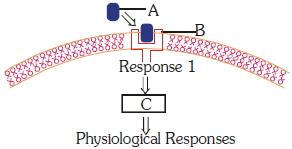
A
$A-$Steroid Hormone; $B-$Hormone-receptor Complex; $C-$Protein
B
$A-$Protein Hormone; $B-$Receptor; $C-$Cyclic $AMP$
C
$A-$Steroid Hormone; $B-$Receptor; $C-$Second Messenger
D
$A-$Protein Hormone; $B-$Cyclic $AMP$; $C-$Hormone-receptor Complex
Solution
(B) The diagram illustrates the mechanism of action of protein hormones.
$1$. Protein hormones are water-soluble and cannot cross the lipid bilayer of the plasma membrane.
$2$. Therefore,they bind to specific receptors $(B)$ located on the outer surface of the plasma membrane.
$3$. The hormone $(A)$ binds to the receptor to form a hormone-receptor complex.
$4$. This binding triggers the generation of second messengers like cyclic $AMP$ $(C)$ inside the cell,which then carry out the physiological responses.
Thus,$A$ is a Protein Hormone,$B$ is a Receptor,and $C$ is a Second Messenger (like cyclic $AMP$). Option $B$ correctly identifies these components.
$1$. Protein hormones are water-soluble and cannot cross the lipid bilayer of the plasma membrane.
$2$. Therefore,they bind to specific receptors $(B)$ located on the outer surface of the plasma membrane.
$3$. The hormone $(A)$ binds to the receptor to form a hormone-receptor complex.
$4$. This binding triggers the generation of second messengers like cyclic $AMP$ $(C)$ inside the cell,which then carry out the physiological responses.
Thus,$A$ is a Protein Hormone,$B$ is a Receptor,and $C$ is a Second Messenger (like cyclic $AMP$). Option $B$ correctly identifies these components.
0 likes
View Solution74
Medium
Briefly mention the mechanism of action of $FSH$.
Solution
(N/A) $FSH$ (Follicle Stimulating Hormone),being a glycoprotein,is insoluble in lipids and therefore cannot enter the target cells.
It binds to specific receptor molecules located on the surface of the cell membrane to form a hormone-receptor complex.
This complex triggers the release of the enzyme adenylate cyclase from the receptor site.
This enzyme catalyzes the conversion of $ATP$ into cyclic adenosine monophosphate $(cAMP)$ within the cell.
The $cAMP$ then activates the existing enzyme system of the cell,which accelerates metabolic reactions.
The hormone is referred to as the first messenger,while $cAMP$ is termed the second messenger.
Additionally,the hormone-receptor complex alters the permeability of the cell membrane to facilitate the transport of materials,thereby increasing cellular activity.
It binds to specific receptor molecules located on the surface of the cell membrane to form a hormone-receptor complex.
This complex triggers the release of the enzyme adenylate cyclase from the receptor site.
This enzyme catalyzes the conversion of $ATP$ into cyclic adenosine monophosphate $(cAMP)$ within the cell.
The $cAMP$ then activates the existing enzyme system of the cell,which accelerates metabolic reactions.
The hormone is referred to as the first messenger,while $cAMP$ is termed the second messenger.
Additionally,the hormone-receptor complex alters the permeability of the cell membrane to facilitate the transport of materials,thereby increasing cellular activity.
0 likes
View Solution75
MediumMCQ
Chemically,hormones are divided into which groups?
A
Peptide,polypeptide,protein hormones
B
Steroids
C
Iodothyronines and amino-acid derivatives
D
All of the above
Solution
(D) On the basis of their chemical nature,hormones can be divided into the following groups:
$(i)$ Peptide,polypeptide,protein hormones (e.g.,insulin,glucagon,pituitary hormones,hypothalamic hormones,etc.)
$(ii)$ Steroids (e.g.,cortisol,testosterone,estradiol,and progesterone)
$(iii)$ Iodothyronines (thyroid hormones)
$(iv)$ Amino-acid derivatives (e.g.,epinephrine)
Therefore,all the mentioned groups are correct categories for the chemical classification of hormones.
$(i)$ Peptide,polypeptide,protein hormones (e.g.,insulin,glucagon,pituitary hormones,hypothalamic hormones,etc.)
$(ii)$ Steroids (e.g.,cortisol,testosterone,estradiol,and progesterone)
$(iii)$ Iodothyronines (thyroid hormones)
$(iv)$ Amino-acid derivatives (e.g.,epinephrine)
Therefore,all the mentioned groups are correct categories for the chemical classification of hormones.
0 likes
View Solution76
Medium
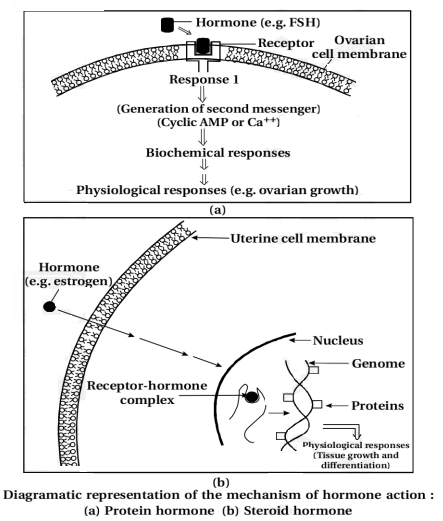
Describe the mechanism of steroid and peptide hormone action with a diagram.
Solution
(N/A) Hormones produce their effects on target tissues by binding to specific proteins called hormone receptors located in the target tissues only.
Hormone receptors present on the cell membrane of the target cells are called membrane-bound receptors,and the receptors present inside the target cell are called intracellular receptors,mostly nuclear receptors. Binding of a hormone to its receptor leads to the formation of a hormone-receptor complex.
Each receptor is specific to one hormone only and hence receptors are specific.
Hormone-receptor complex formation leads to certain biochemical changes in the target tissue.
$\Rightarrow$ Target tissue metabolism and hence physiological functions are regulated by hormones.
On the basis of their chemical nature,hormones can be divided into:
$(i)$ Peptide,polypeptide,protein hormones (e.g.,insulin,glucagon,pituitary hormones,hypothalamic hormones,etc.)
$(ii)$ Steroids (e.g.,cortisol,testosterone,estradiol,and progesterone)
$(iii)$ Iodothyronines (thyroid hormones)
$(iv)$ Amino-acid derivatives (e.g.,epinephrine).
Hormones which interact with membrane-bound receptors normally do not enter the target cell but generate second messengers (e.g.,cyclic $AMP$,$IP_3$,$Ca^{++}$,etc.) which in turn regulate cellular metabolism.
Hormones which interact with intracellular receptors (steroid,iodothyronines,etc.) mostly regulate gene expression or chromosome function by the interaction of the hormone-receptor complex with the genome.
$\Rightarrow$ Cumulative biochemical actions result in physiological and developmental effects.
Hormone receptors present on the cell membrane of the target cells are called membrane-bound receptors,and the receptors present inside the target cell are called intracellular receptors,mostly nuclear receptors. Binding of a hormone to its receptor leads to the formation of a hormone-receptor complex.
Each receptor is specific to one hormone only and hence receptors are specific.
Hormone-receptor complex formation leads to certain biochemical changes in the target tissue.
$\Rightarrow$ Target tissue metabolism and hence physiological functions are regulated by hormones.
On the basis of their chemical nature,hormones can be divided into:
$(i)$ Peptide,polypeptide,protein hormones (e.g.,insulin,glucagon,pituitary hormones,hypothalamic hormones,etc.)
$(ii)$ Steroids (e.g.,cortisol,testosterone,estradiol,and progesterone)
$(iii)$ Iodothyronines (thyroid hormones)
$(iv)$ Amino-acid derivatives (e.g.,epinephrine).
Hormones which interact with membrane-bound receptors normally do not enter the target cell but generate second messengers (e.g.,cyclic $AMP$,$IP_3$,$Ca^{++}$,etc.) which in turn regulate cellular metabolism.
Hormones which interact with intracellular receptors (steroid,iodothyronines,etc.) mostly regulate gene expression or chromosome function by the interaction of the hormone-receptor complex with the genome.
$\Rightarrow$ Cumulative biochemical actions result in physiological and developmental effects.
0 likes
View Solution77
MediumMCQ
Based on chemical nature,how many groups of hormones are formed?
A
$2$
B
$3$
C
$4$
D
$5$
Solution
(C) On the basis of their chemical nature,hormones are classified into $4$ main groups:
$(i)$ Peptide,polypeptide,and protein hormones (e.g.,insulin,glucagon,pituitary hormones,hypothalamic hormones,etc.).
$(ii)$ Steroids (e.g.,cortisol,testosterone,estradiol,and progesterone).
$(iii)$ Iodothyronines (thyroid hormones).
$(iv)$ Amino-acid derivatives (e.g.,epinephrine).
$(i)$ Peptide,polypeptide,and protein hormones (e.g.,insulin,glucagon,pituitary hormones,hypothalamic hormones,etc.).
$(ii)$ Steroids (e.g.,cortisol,testosterone,estradiol,and progesterone).
$(iii)$ Iodothyronines (thyroid hormones).
$(iv)$ Amino-acid derivatives (e.g.,epinephrine).
0 likes
View Solution78
Medium
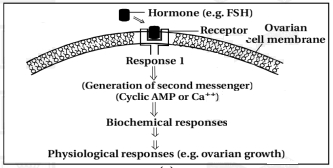
What is the role of a second messenger in the mechanism of protein hormone action?
Solution
(N/A) Protein hormones cannot enter the target cell because they are not lipid-soluble. Instead,they act by binding to specific receptors located on the outer surface of the plasma membrane,forming a hormone-receptor complex.
This complex stimulates the enzyme adenylate cyclase located on the inner surface of the plasma membrane. The activated adenylate cyclase enzyme converts $ATP$ into cyclic $AMP$ $(cAMP)$.
$cAMP$ acts as a second messenger,which carries the hormonal signal into the target cell. It then induces a specific enzyme system through a cascade effect,leading to the desired physiological or biochemical response within the cell.
This complex stimulates the enzyme adenylate cyclase located on the inner surface of the plasma membrane. The activated adenylate cyclase enzyme converts $ATP$ into cyclic $AMP$ $(cAMP)$.
$cAMP$ acts as a second messenger,which carries the hormonal signal into the target cell. It then induces a specific enzyme system through a cascade effect,leading to the desired physiological or biochemical response within the cell.
0 likes
View Solution79
MediumMCQ
Match the following columns.
| Column-$I$ | Column-$II$ |
| $(A)$ Oxytocin | $(1)$ Amino acid derivatives |
| $(B)$ Epinephrine | $(2)$ Steroid |
| $(C)$ Progesterone | $(3)$ Protein |
| $(D)$ Growth hormone | $(4)$ Peptide |
A
$(A-4), (B-1), (C-2), (D-3)$
B
$(A-3), (B-1), (C-2), (D-4)$
C
$(A-4), (B-2), (C-1), (D-3)$
D
$(A-1), (B-4), (C-2), (D-3)$
Solution
(A) The chemical nature of hormones is as follows:
$1$. Oxytocin is a peptide hormone.
$2$. Epinephrine is an amino acid derivative (derived from tyrosine).
$3$. Progesterone is a steroid hormone.
$4$. Growth hormone is a protein hormone.
Therefore, the correct matching is $(A-4), (B-1), (C-2), (D-3)$.
$1$. Oxytocin is a peptide hormone.
$2$. Epinephrine is an amino acid derivative (derived from tyrosine).
$3$. Progesterone is a steroid hormone.
$4$. Growth hormone is a protein hormone.
Therefore, the correct matching is $(A-4), (B-1), (C-2), (D-3)$.
0 likes
View Solution80
MediumMCQ
What is the role of the second messenger in hormone action?
A
To transport the hormone into the nucleus.
B
To bind directly to the $DNA$ to initiate transcription.
C
To transmit the hormonal signal from the cell surface to the intracellular metabolic machinery.
D
To degrade the hormone after its action is complete.
Solution
(C) Hormones that are water-soluble,such as peptide and amine hormones,cannot cross the lipid bilayer of the plasma membrane.
They bind to specific receptors located on the surface of the target cell membrane.
This binding triggers the generation of a second messenger (e.g.,$cAMP$,$IP_3$,or $Ca^{2+}$) inside the cell.
The role of the second messenger is to relay the signal from the cell surface to the intracellular metabolic machinery,thereby triggering the appropriate physiological response within the cell.
They bind to specific receptors located on the surface of the target cell membrane.
This binding triggers the generation of a second messenger (e.g.,$cAMP$,$IP_3$,or $Ca^{2+}$) inside the cell.
The role of the second messenger is to relay the signal from the cell surface to the intracellular metabolic machinery,thereby triggering the appropriate physiological response within the cell.
0 likes
View Solution81
Medium
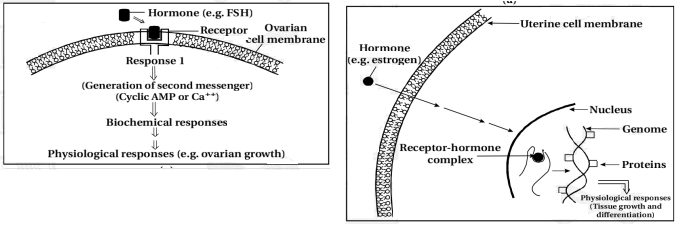
Illustrate the differences between the mechanism of action of a protein and a steroid hormone.
Solution
(N/A) The differences between the mechanism of action of protein hormones and steroid hormones are as follows:
| Protein Hormone Mechanism | Steroid Hormone Mechanism |
|---|---|
| $(1)$ These hormones bind to specific receptors located on the surface of the plasma membrane. | $(1)$ These hormones are lipid-soluble and pass through the plasma membrane to bind with intracellular receptors. |
| $(2)$ They generate secondary messengers such as $cAMP$ or $Ca^{2+}$ to trigger cellular responses. | $(2)$ The hormone-receptor complex directly interacts with the genome to regulate gene expression. |
| $(3)$ They typically regulate cellular metabolism and physiological activities through a cascade of biochemical reactions. | $(3)$ They primarily regulate physiological processes like growth and development by controlling protein synthesis. |
0 likes
View Solution82
Medium
Give the recent definition of hormones.
Solution
(N/A) The current scientific definition is as follows: Hormones are non-nutrient chemicals which act as intercellular messengers and are produced in trace amounts.
0 likes
View Solution83
EasyMCQ
Match the following columns and select the correct option.
| Column $I$ | Column $II$ |
| $(a)$ Pituitary hormone | $(i)$ Steroid |
| $(b)$ Epinephrine | $(ii)$ Neuropeptides |
| $(c)$ Endorphins | $(iii)$ Peptides,proteins |
| $(d)$ Cortisol | $(iv)$ Biogenic amines |
A
$(a)-(iii), (b)-(iv), (c)-(i), (d)-(ii)$
B
$(a)-(iv), (b)-(i), (c)-(ii), (d)-(iii)$
C
$(a)-(iii), (b)-(iv), (c)-(ii), (d)-(i)$
D
$(a)-(iv), (b)-(iii), (c)-(i), (d)-(ii)$
Solution
(C) The correct matching is as follows:
$(a)$ Pituitary hormones are primarily peptide or protein-based hormones,so $(a)$ matches with $(iii)$.
$(b)$ Epinephrine is a catecholamine derived from tyrosine,classified as a biogenic amine,so $(b)$ matches with $(iv)$.
$(c)$ Endorphins are endogenous opioid neuropeptides,so $(c)$ matches with $(ii)$.
$(d)$ Cortisol is a glucocorticoid hormone synthesized from cholesterol,which is a steroid,so $(d)$ matches with $(i)$.
Therefore,the correct sequence is $(a)-(iii), (b)-(iv), (c)-(ii), (d)-(i)$.
$(a)$ Pituitary hormones are primarily peptide or protein-based hormones,so $(a)$ matches with $(iii)$.
$(b)$ Epinephrine is a catecholamine derived from tyrosine,classified as a biogenic amine,so $(b)$ matches with $(iv)$.
$(c)$ Endorphins are endogenous opioid neuropeptides,so $(c)$ matches with $(ii)$.
$(d)$ Cortisol is a glucocorticoid hormone synthesized from cholesterol,which is a steroid,so $(d)$ matches with $(i)$.
Therefore,the correct sequence is $(a)-(iii), (b)-(iv), (c)-(ii), (d)-(i)$.
0 likes
View Solution84
MediumMCQ
Which one of the following is a non-steroidal hormone?
A
Estradiol
B
Prostaglandin
C
Progesterone
D
Estrone
Solution
(B) Prostaglandin is a non-steroidal hormone. It is derived from fatty acids,specifically arachidonic acid. In contrast,Estradiol,Progesterone,and Estrone are all steroid hormones derived from cholesterol.
0 likes
View Solution85
MediumMCQ
In heart cells,which one serves as a second messenger speeding up muscle cell contraction in response to adrenaline?
A
$cAMP$
B
$cGMP$
C
$GTP$
D
$ATP$
Solution
(A) Second messengers are signaling molecules that relay signals from receptors on the cell surface to target molecules inside the cell,thereby amplifying the effect of the first messenger (hormone).
$cAMP$ (Cyclic adenosine $3',5'$-monophosphate) is synthesized from $ATP$ by the enzyme adenylate cyclase. It acts as a second messenger for various physiological processes,including adrenaline-mediated glycogenolysis and the acceleration of heart muscle cell contraction.
$cAMP$ (Cyclic adenosine $3',5'$-monophosphate) is synthesized from $ATP$ by the enzyme adenylate cyclase. It acts as a second messenger for various physiological processes,including adrenaline-mediated glycogenolysis and the acceleration of heart muscle cell contraction.
0 likes
View Solution86
MediumMCQ
Which of the following is the correct function of the endocrine system with reference to chemical coordination?
A
Provides neural integration through hormones
B
Provides chemical integration through hormones
C
Provides an organized network of point to point connections for a quick coordination
D
None of the above
Solution
(B) The endocrine system is responsible for chemical coordination in the body. It achieves this by secreting hormones directly into the bloodstream,which act as chemical messengers to regulate various physiological processes. Unlike the nervous system,which provides point-to-point rapid neural coordination,the endocrine system provides chemical integration.
0 likes
View Solution87
MediumMCQ
Select the correct statement regarding the interaction between the nervous and endocrine systems.
A
Neurons regulate endocrine activity,but not vice-versa.
B
Endocrine glands regulate neural activity,but not vice-versa.
C
Neither hormones control neural activity nor do neurons control endocrine activity.
D
All of these.
Solution
(A) The nervous system and the endocrine system work together to coordinate and regulate the physiological functions of the body. Neurons (nervous system) regulate the activity of endocrine glands (e.g.,the hypothalamus controls the pituitary gland). However,the endocrine system does not directly regulate the functioning of individual neurons in the same manner. Therefore,the statement that neurons regulate endocrine activity but not vice-versa is the most accurate description of this specific regulatory relationship.
0 likes
View Solution88
EasyMCQ
Hormone is a/an
A
Enzyme
B
Chemical messenger
C
Excretory product
D
Protein
Solution
(B) hormone is a non-nutrient chemical that acts as an intercellular messenger and is produced in trace amounts.
0 likes
View Solution89
MediumMCQ
Hormone receptors are present
A
On the cell membrane
B
Outside the target cell
C
Inside the target cell
D
Both $(a)$ and $(c)$
Solution
(D) Hormones produce their effects on target tissues by binding to specific proteins called hormone receptors,which are located in the target tissue only.
Membrane-bound receptors are present on the cell membrane of the target cells.
Intracellular receptors are present inside the target cell,which are mostly nuclear receptors (present in the nucleus).
Therefore,hormone receptors can be present either on the cell membrane or inside the target cell.
Membrane-bound receptors are present on the cell membrane of the target cells.
Intracellular receptors are present inside the target cell,which are mostly nuclear receptors (present in the nucleus).
Therefore,hormone receptors can be present either on the cell membrane or inside the target cell.
0 likes
View Solution90
MediumMCQ
Each receptor is ...$A$... to one hormone only and hence,receptors are ...$B$... Hormone receptor complex formation leads to certain biochemical changes in the ...$C$.... Choose the option containing correct combination of $A, B$ and $C$.
A
$A-specific, B-non-specific, C-target tissue$
B
$A-specific, B-specific, C-target tissue$
C
$A-non-specific, B-specific, C-target tissue$
D
$A-non-specific, B-non-specific, C-target tissue$
Solution
(B) Hormones produce their effects on target tissues by binding to specific proteins called hormone receptors located in the target tissues only.
Each receptor is specific to one hormone only and hence,receptors are specific.
Hormone-receptor complex formation leads to certain biochemical changes in the target tissue,which results in the regulation of metabolism and physiological functions.
Each receptor is specific to one hormone only and hence,receptors are specific.
Hormone-receptor complex formation leads to certain biochemical changes in the target tissue,which results in the regulation of metabolism and physiological functions.
0 likes
View Solution91
MediumMCQ
Hormones which interact with intracellular receptors are:
$I. Steroid hormones$
$II. ACTH$
$III. Iodothyronines$
$IV. MSH$
Choose the option with the correct combination.
$I. Steroid hormones$
$II. ACTH$
$III. Iodothyronines$
$IV. MSH$
Choose the option with the correct combination.
A
$I$ and $III$
B
$II$ and $IV$
C
$II$ and $III$
D
$I$ and $IV$
Solution
(A) Hormones that interact with intracellular receptors, such as steroid hormones and iodothyronines, primarily regulate gene expression or chromosome function through the interaction of the hormone-receptor complex with the genome.
These hormones are lipid-soluble and can easily cross the plasma membrane to bind with receptors located inside the cell (cytoplasm or nucleus).
In contrast, peptide hormones like $ACTH$ and $MSH$ are water-soluble and interact with membrane-bound receptors on the cell surface.
Therefore, the correct combination is $I$ and $III$.
These hormones are lipid-soluble and can easily cross the plasma membrane to bind with receptors located inside the cell (cytoplasm or nucleus).
In contrast, peptide hormones like $ACTH$ and $MSH$ are water-soluble and interact with membrane-bound receptors on the cell surface.
Therefore, the correct combination is $I$ and $III$.
0 likes
View Solution92
MediumMCQ
$I. ACTH$,$II. GH$,$III. MSH$,$IV. FSH$,$V. LH$,$VI. Oxytocin$. Which of the above hormones are polypeptide in nature?
A
$I, II, III$ and $IV$
B
$I, II, III$ and $VI$
C
$III, IV, V$ and $VI$
D
$I, II, III, IV, V$ and $VI$
Solution
(B) The chemical nature of hormones is classified as follows:
$1$. Peptide,polypeptide,or protein hormones: These include $ACTH$,$GH$,$MSH$,$ADH$ (vasopressin),$Oxytocin$,insulin,glucagon,etc.
$2$. Glycoprotein hormones: These include $FSH$,$LH$,and $TSH$.
$3$. Steroid hormones: These include cortisol,testosterone,progesterone,and estrogen.
$4$. Iodothyronines: These include thyroid hormones $(T_3, T_4)$.
Based on this classification,$ACTH$ $(I)$,$GH$ $(II)$,$MSH$ $(III)$,and $Oxytocin$ $(VI)$ are polypeptide in nature. Therefore,the correct set is $I, II, III$ and $VI$.
$1$. Peptide,polypeptide,or protein hormones: These include $ACTH$,$GH$,$MSH$,$ADH$ (vasopressin),$Oxytocin$,insulin,glucagon,etc.
$2$. Glycoprotein hormones: These include $FSH$,$LH$,and $TSH$.
$3$. Steroid hormones: These include cortisol,testosterone,progesterone,and estrogen.
$4$. Iodothyronines: These include thyroid hormones $(T_3, T_4)$.
Based on this classification,$ACTH$ $(I)$,$GH$ $(II)$,$MSH$ $(III)$,and $Oxytocin$ $(VI)$ are polypeptide in nature. Therefore,the correct set is $I, II, III$ and $VI$.
0 likes
View Solution93
MediumMCQ
Identify $A$ to $D$ in the given diagrammatic representation of the mechanism of hormone action and choose the correct combination.
A
$A-DNA, B-Nucleus, C-Hormone\, receptor\, complex, D-Hormone$
B
$A-mRNA, B-Nucleus, C-Hormone\, receptor\, complex, D-Hormone$
C
$A-mRNA, B-Nucleus, C-Hormone\, receptor\, complex, D-Protein$
D
$A-DNA, B-Nucleus, C-Hormone\, receptor\, complex, D-Protein$
Solution
(A) The mechanism of action of steroid hormones involves the hormone entering the cell and binding to an intracellular receptor to form a $Hormone-receptor\, complex$.
This complex then enters the $Nucleus$ and binds to the $DNA$ to regulate gene expression, leading to the synthesis of $mRNA$ and subsequently $Protein$.
In the standard diagram for this process:
$A$ represents $DNA$,
$B$ represents the $Nucleus$,
$C$ represents the $Hormone-receptor\, complex$,
$D$ represents the $Hormone$ (steroid hormone).
Therefore, the correct combination is $A-DNA, B-Nucleus, C-Hormone\, receptor\, complex, D-Hormone$.
This complex then enters the $Nucleus$ and binds to the $DNA$ to regulate gene expression, leading to the synthesis of $mRNA$ and subsequently $Protein$.
In the standard diagram for this process:
$A$ represents $DNA$,
$B$ represents the $Nucleus$,
$C$ represents the $Hormone-receptor\, complex$,
$D$ represents the $Hormone$ (steroid hormone).
Therefore, the correct combination is $A-DNA, B-Nucleus, C-Hormone\, receptor\, complex, D-Hormone$.
0 likes
View Solution94
MediumMCQ
$A$ molecule that binds to a receptor and induces post-receptor events in a cell is called ...$A$... and a molecule that binds to the receptor and inhibits all post-receptor events is called ...$B$....
A
$A$-antagonist,$B$-agonist
B
$A$-agonist,$B$-enzyme
C
$A$-antagonist,$B$-hormone
D
$A$-agonist,$B$-antagonist
Solution
(D) In cell signaling,molecules that bind to specific receptors and activate them to initiate a biological response are known as agonists.
Conversely,molecules that bind to the same receptors but block or inhibit the biological response are known as antagonists.
Therefore,the molecule that induces post-receptor events is an agonist $(A)$,and the molecule that inhibits these events is an antagonist $(B)$.
Conversely,molecules that bind to the same receptors but block or inhibit the biological response are known as antagonists.
Therefore,the molecule that induces post-receptor events is an agonist $(A)$,and the molecule that inhibits these events is an antagonist $(B)$.
0 likes
View Solution95
MediumMCQ
Which of the following hormones are amino acid derivatives?
$I.$ Insulin $II.$ Epinephrine $III.$ Oestradiol $IV.$ Norepinephrine $V.$ Testosterone $VI.$ Glucagon
$I.$ Insulin $II.$ Epinephrine $III.$ Oestradiol $IV.$ Norepinephrine $V.$ Testosterone $VI.$ Glucagon
A
$I$ and $II$
B
$III$ and $IV$
C
$V$ and $VI$
D
$II$ and $IV$
Solution
(D) Hormones are classified based on their chemical nature into several groups:
$1$. Amino acid derivatives: These are derived from the amino acid tyrosine. Examples include Epinephrine (Adrenaline) and Norepinephrine (Noradrenaline).
$2$. Peptide/Protein hormones: These consist of chains of amino acids. Examples include Insulin,Glucagon,$ACTH$,$GH$,$ADH$,$PTH$,$TCT$,and $MSH$.
$3$. Steroid hormones: These are derived from cholesterol. Examples include Oestradiol (an estrogen) and Testosterone (an androgen).
Based on this classification,Epinephrine $(II)$ and Norepinephrine $(IV)$ are amino acid derivatives.
Therefore,the correct option is $D$.
$1$. Amino acid derivatives: These are derived from the amino acid tyrosine. Examples include Epinephrine (Adrenaline) and Norepinephrine (Noradrenaline).
$2$. Peptide/Protein hormones: These consist of chains of amino acids. Examples include Insulin,Glucagon,$ACTH$,$GH$,$ADH$,$PTH$,$TCT$,and $MSH$.
$3$. Steroid hormones: These are derived from cholesterol. Examples include Oestradiol (an estrogen) and Testosterone (an androgen).
Based on this classification,Epinephrine $(II)$ and Norepinephrine $(IV)$ are amino acid derivatives.
Therefore,the correct option is $D$.
0 likes
View Solution96
MediumMCQ
Receptor-hormone complex is formed when the binding of:
A
Hormone to its respective receptor takes place
B
Enzyme to its respective receptor takes place
C
Both $(a)$ and $(b)$
D
Proteins to $ER$ takes place
Solution
(A) The binding of a hormone to its specific receptor leads to the formation of a hormone-receptor complex.
Each receptor is specific to only one hormone,which ensures the specificity of the hormonal action.
Therefore,the correct condition for the formation of a receptor-hormone complex is the binding of a hormone to its respective receptor.
Each receptor is specific to only one hormone,which ensures the specificity of the hormonal action.
Therefore,the correct condition for the formation of a receptor-hormone complex is the binding of a hormone to its respective receptor.
0 likes
View Solution97
EasyMCQ
Steroid hormones are derived from
A
Corticoid
B
Cholesterol
C
Amino acid derivatives
D
Protein
Solution
(B) Steroid hormones are secreted by the cells of the adrenal cortex and the endocrine cells of the gonads. All steroid hormones are lipids that are derived from cholesterol.
0 likes
View Solution98
MediumMCQ
Which of the following are second messengers?
$I.$ Cyclic $AMP$
$II.$ $IP_3$
$III.$ $Ca^{2+}$
The correct option is:
$I.$ Cyclic $AMP$
$II.$ $IP_3$
$III.$ $Ca^{2+}$
The correct option is:
A
$I$ and $II$
B
$II$ and $III$
C
$I$ and $III$
D
$I, II$ and $III$
Solution
(D) Second messengers are molecules that relay signals received at receptors on the cell surface to target molecules in the cytosol and/or nucleus.
$I.$ Cyclic $AMP$ $(cAMP)$ is a well-known second messenger involved in various signaling pathways.
$II.$ $IP_3$ (Inositol triphosphate) is generated from the hydrolysis of membrane phospholipids and acts as a second messenger to release calcium ions.
$III.$ $Ca^{2+}$ (Calcium ions) act as important second messengers in many cellular processes,including muscle contraction and hormone secretion.
Therefore,all three ($I, II,$ and $III$) are recognized as second messengers.
$I.$ Cyclic $AMP$ $(cAMP)$ is a well-known second messenger involved in various signaling pathways.
$II.$ $IP_3$ (Inositol triphosphate) is generated from the hydrolysis of membrane phospholipids and acts as a second messenger to release calcium ions.
$III.$ $Ca^{2+}$ (Calcium ions) act as important second messengers in many cellular processes,including muscle contraction and hormone secretion.
Therefore,all three ($I, II,$ and $III$) are recognized as second messengers.
0 likes
View Solution99
MediumMCQ
Steroid hormones typically alter the activity of target cells by
A
Activating primary messenger
B
Activating secondary messenger
C
Interacting with intracellular receptors
D
None of the above
Solution
(C) Steroid hormones are lipid-soluble hormones,also categorized as hydrophobic hormones.
Because they are lipid-soluble,they can easily pass through the lipid bilayer of the cell membrane.
Once inside the cell,they interact with intracellular receptors,which are typically located in the cytoplasm or the nucleus.
This hormone-receptor complex then binds to specific $DNA$ sequences to regulate gene expression.
Generally,steroid hormones are derived from the cholesterol ring structure.
Because they are lipid-soluble,they can easily pass through the lipid bilayer of the cell membrane.
Once inside the cell,they interact with intracellular receptors,which are typically located in the cytoplasm or the nucleus.
This hormone-receptor complex then binds to specific $DNA$ sequences to regulate gene expression.
Generally,steroid hormones are derived from the cholesterol ring structure.
0 likes
View Solution100
MediumMCQ
Steroid hormones work as:
A
They enter into target cells and bind with specific receptors and activate specific genes to form proteins.
B
They bind to the cell membrane.
C
They catalyze the formation of $cAMP$.
D
None of the above.
Solution
(A) Steroid hormones are lipid-soluble. Therefore,they can pass freely across the lipid bilayer of the plasma membrane.
After entering the cytoplasm,molecules of steroid hormones bind to receptor molecules located within the cytoplasm or nucleus of the target cell,forming a hormone-receptor complex.
This complex then moves into the nucleus of the cell and interacts with the genome to activate specific genes.
These activated genes ultimately lead to the transcription of $mRNA$ and the synthesis of specific proteins.
After entering the cytoplasm,molecules of steroid hormones bind to receptor molecules located within the cytoplasm or nucleus of the target cell,forming a hormone-receptor complex.
This complex then moves into the nucleus of the cell and interacts with the genome to activate specific genes.
These activated genes ultimately lead to the transcription of $mRNA$ and the synthesis of specific proteins.
0 likes
View SolutionChemical Coordination and Integration — Hormones and their mechanism · Frequently Asked Questions
1Are these Chemical Coordination and Integration questions useful for JEE and NEET?
Yes. All questions in this section are mapped to JEE Main and NEET exam patterns. Previous year questions from JEE Main, NEET, GUJCET and state-level exams are included with full solutions.
2Can I switch to Hindi or Gujarati for these questions?
Yes. Use the language tabs in the hero section or the sidebar to view the same questions and solutions in English, Hindi or Gujarati.
3How do I generate a question paper from this subtopic?
Use the Vedclass Exam Paper Generator — select the chapter and subtopic, set difficulty, and generate Sets A, B, C, D automatically. First 3 chapters of every subject are free.
Vedclass Products
For Students
Vedclass Test Series
Mock tests in real JEE/NEET style with performance analysis. 5-day free trial.
Start Free TrialFor Teachers
Exam Paper Generator
Generate Set A/B/C/D papers from this chapter in 2 minutes. 3 chapters free.
Try FreeFor Institutes
Online Exam Module
Live online exams with unlimited students, 360° analytics & white-label branding.
See DemoFor Teachers & Institutes
Generate a Chemical Coordination and Integration Exam Paper in 2 Minutes
Select subtopic & difficulty — Sets A, B, C, D auto-generated with No Repeat logic.
First 3 chapters of every subject are free — no payment required.