
A English
Hormones and their mechanism Questions in English
Class 11 Biology · Chemical Coordination and Integration · Hormones and their mechanism
138+
Questions
English
Language
100%
With Solutions
Showing 38 of 138 questions in English
101
MediumMCQ
$I.$ Autocrine hormones $II.$ Endocrine hormones $III.$ Paracrine hormones
Among them, which one is/are local regulator(s) and do not travel through the blood?
Among them, which one is/are local regulator(s) and do not travel through the blood?
A
$Only \; I$
B
$I \; and \; II$
C
$I \; and \; III$
D
$Only \; II$
Solution
(C) Local regulators are signaling molecules that act over short distances and do not travel through the bloodstream to reach their target cells.
$I.$ Autocrine hormones act on the same cell that secretes them.
$III.$ Paracrine hormones act on neighboring cells near the site of secretion.
$II.$ Endocrine hormones are secreted into the bloodstream and travel to distant target organs.
Therefore, both autocrine and paracrine hormones function as local regulators.
$I.$ Autocrine hormones act on the same cell that secretes them.
$III.$ Paracrine hormones act on neighboring cells near the site of secretion.
$II.$ Endocrine hormones are secreted into the bloodstream and travel to distant target organs.
Therefore, both autocrine and paracrine hormones function as local regulators.
0 likes
View Solution102
EasyMCQ
Pheromones are also called:
$I.$ Ectohormone
$II.$ Sex attractants
$III.$ Semichemicals
The correct option is:
$I.$ Ectohormone
$II.$ Sex attractants
$III.$ Semichemicals
The correct option is:
A
$I$ and $III$
B
$I$ and $II$
C
$I, II$ and $III$
D
$II$ and $III$
Solution
(C) Pheromones are chemical substances secreted by an organism that trigger a social response in members of the same species.
They are known as ectohormones because they act outside the body of the secreting individual.
They are often referred to as sex attractants because they play a crucial role in mating behavior.
They are also classified as semichemicals,which are chemicals that mediate interactions between organisms.
Therefore,all three terms ($I, II,$ and $III$) are correct descriptions of pheromones.
They are known as ectohormones because they act outside the body of the secreting individual.
They are often referred to as sex attractants because they play a crucial role in mating behavior.
They are also classified as semichemicals,which are chemicals that mediate interactions between organisms.
Therefore,all three terms ($I, II,$ and $III$) are correct descriptions of pheromones.
0 likes
View Solution103
MediumMCQ
Some hormones need a secondary messenger because:
A
They need an activator
B
They cannot cross the cell membrane
C
They can cross the cell membrane
D
They need a prosthetic group
Solution
(B) Hormones that are proteinaceous or peptide in nature are generally water-soluble and cannot pass through the lipid bilayer of the cell membrane. Therefore,they bind to specific receptors on the cell surface and generate secondary messengers (such as $cAMP$,$IP_3$,or $Ca^{2+}$) inside the cell to regulate physiological processes.
0 likes
View Solution104
MediumMCQ
Which of the following is not true for hormones?
A
They are not available again after the process is over.
B
Hormones are directly poured into blood.
C
They induce or inhibit biochemical processes.
D
Each and every hormone of human is always chemically protein.
Solution
(D) Hormones are chemical messengers secreted by endocrine glands directly into the bloodstream,which transports them to target organs.
They regulate,induce,or inhibit various biochemical processes.
Once their function is completed,they are metabolized or degraded and are not available again.
Chemically,hormones are not exclusively proteins; they can be classified into four main categories: $1.$ Protein and polypeptide hormones (e.g.,insulin),$2.$ Steroid hormones (e.g.,cortisol),$3.$ Monoamines (e.g.,adrenaline),and $4.$ Lipid-based hormones (e.g.,prostaglandins).
Therefore,the statement that every human hormone is always chemically a protein is incorrect.
They regulate,induce,or inhibit various biochemical processes.
Once their function is completed,they are metabolized or degraded and are not available again.
Chemically,hormones are not exclusively proteins; they can be classified into four main categories: $1.$ Protein and polypeptide hormones (e.g.,insulin),$2.$ Steroid hormones (e.g.,cortisol),$3.$ Monoamines (e.g.,adrenaline),and $4.$ Lipid-based hormones (e.g.,prostaglandins).
Therefore,the statement that every human hormone is always chemically a protein is incorrect.
0 likes
View Solution105
MediumMCQ
Intracellular receptors are mostly
A
Cytoplasmic receptors
B
Membrane receptors
C
Nuclear receptors
D
$ER$ receptors
Solution
(C) Intracellular receptors are mostly nuclear receptors.
Hormones produce their effects on target tissues by binding to specific proteins called hormone receptors,which are located in the target tissue only.
Hormone receptors present on the cell membrane of the target cells are called membrane-bound receptors,and receptors present inside the target cell are called intracellular receptors.
Intracellular receptors are mostly nuclear receptors (present in the nucleus).
Hormones produce their effects on target tissues by binding to specific proteins called hormone receptors,which are located in the target tissue only.
Hormone receptors present on the cell membrane of the target cells are called membrane-bound receptors,and receptors present inside the target cell are called intracellular receptors.
Intracellular receptors are mostly nuclear receptors (present in the nucleus).
0 likes
View Solution106
MediumMCQ
. . . . . . are responsible for chemical coordination.
A
Neurons
B
Nephrons
C
Hormones
D
Enzymes
Solution
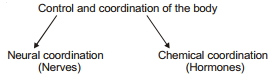
(C) The control and coordination of the body are achieved through two systems: the neural system and the endocrine system.
Neural coordination is provided by the nervous system,which uses neurons to transmit signals.
Chemical coordination is provided by the endocrine system,which uses hormones as chemical messengers to regulate various physiological processes in the body.
Therefore,hormones are responsible for chemical coordination.
Neural coordination is provided by the nervous system,which uses neurons to transmit signals.
Chemical coordination is provided by the endocrine system,which uses hormones as chemical messengers to regulate various physiological processes in the body.
Therefore,hormones are responsible for chemical coordination.
0 likes
View Solution107
MediumMCQ
Which of the following is an incorrect statement?
A
Hormones are required in trace amounts.
B
Hormones are intra-cellular messengers.
C
Hormones are secreted by endocrine glandular cells.
D
Hormones are secreted in response to a particular stimulus.
Solution
(B) Hormones are chemical substances that act as inter-cellular messengers,not intra-cellular messengers. They are produced in trace amounts by endocrine glands and are released into the blood to act on target tissues in response to specific stimuli.
0 likes
View Solution108
MediumMCQ
Progesterone and estradiol are
A
Peptide hormones
B
Amino acid derivatives
C
Iodothyronines
D
Steroid hormones
Solution
(D) Steroid hormones are derived from cholesterol. Progesterone and estradiol are examples of steroid hormones.
Peptide hormones include hormones like oxytocin and vasopressin.
Amino acid derivatives include hormones like thyroxine,norepinephrine,and epinephrine.
Iodothyronines include $T_3$ (triiodothyronine) and $T_4$ (thyroxine).
Peptide hormones include hormones like oxytocin and vasopressin.
Amino acid derivatives include hormones like thyroxine,norepinephrine,and epinephrine.
Iodothyronines include $T_3$ (triiodothyronine) and $T_4$ (thyroxine).
0 likes
View Solution109
MediumMCQ
Which of the following forms a hormone receptor complex on the cell membrane?
A
Cortisol
B
Testosterone
C
Insulin
D
Progesterone
Solution
(C) Hormones are classified based on their solubility. Steroid hormones like $Cortisol$,$Testosterone$,and $Progesterone$ are lipid-soluble and can easily cross the cell membrane to bind with intracellular receptors.
In contrast,peptide hormones like $Insulin$ are water-soluble and cannot cross the lipid bilayer of the cell membrane.
Therefore,$Insulin$ binds to specific receptors located on the surface of the cell membrane,forming a hormone-receptor complex.
This binding triggers the generation of second messengers such as $Ca^{2+}$,$cAMP$,or $IP_3$,which regulate cellular metabolism.
In contrast,peptide hormones like $Insulin$ are water-soluble and cannot cross the lipid bilayer of the cell membrane.
Therefore,$Insulin$ binds to specific receptors located on the surface of the cell membrane,forming a hormone-receptor complex.
This binding triggers the generation of second messengers such as $Ca^{2+}$,$cAMP$,or $IP_3$,which regulate cellular metabolism.
0 likes
View Solution110
MediumMCQ
"Secondary messenger" is
A
$cAMP$
B
$ATP$
C
$ADP$
D
$DNA$
Solution
(A) Secondary messengers are molecules that relay signals received at receptors on the cell surface to target molecules in the cytosol and/or nucleus.
Common examples of secondary messengers include $cAMP$, $cGMP$, $IP_3$ (inositol triphosphate), $DAG$ (diacylglycerol), and $Ca^{2+}$ ions.
Among the given options, $cAMP$ (cyclic Adenosine Monophosphate) is a well-known secondary messenger.
Common examples of secondary messengers include $cAMP$, $cGMP$, $IP_3$ (inositol triphosphate), $DAG$ (diacylglycerol), and $Ca^{2+}$ ions.
Among the given options, $cAMP$ (cyclic Adenosine Monophosphate) is a well-known secondary messenger.
0 likes
View Solution111
MediumMCQ
The secondary messenger which shows an antagonistic effect to $cAMP$ in heart muscle is
A
$Ca^{2+}$
B
$Inositol$ $triphosphate$ $(IP_3)$
C
$DAG$
D
$cGMP$
Solution
(D) $cAMP$ (cyclic adenosine monophosphate) regulates cardiac ion channels in response to sympathetic stimulation,which increases heart rate and contractility.
$cGMP$ (cyclic guanosine monophosphate) acts as an antagonist to the $cAMP$ pathway in the heart muscle.
It is known to inhibit the effects mediated by $cAMP$,thereby helping to modulate cardiac function.
$cGMP$ (cyclic guanosine monophosphate) acts as an antagonist to the $cAMP$ pathway in the heart muscle.
It is known to inhibit the effects mediated by $cAMP$,thereby helping to modulate cardiac function.
0 likes
View Solution112
MediumMCQ
The hormone which acts through intracellular receptor protein is
A
Growth hormone
B
Prolactin
C
Thyroxine
D
Adrenaline
Solution
(C) Hormones are classified based on their mechanism of action:
$1$. Hormones acting via intracellular receptors: These are lipid-soluble hormones that can easily cross the plasma membrane. Examples include steroid hormones and thyroid hormones like Thyroxine ($T_3$ and $T_4$).
$2$. Hormones acting via extracellular (membrane-bound) receptors: These are water-soluble hormones that cannot cross the plasma membrane. They bind to receptors on the cell surface. Examples include peptide,polypeptide,and protein hormones (e.g.,Growth hormone,Prolactin) and amino acid derivatives (e.g.,Adrenaline).
$1$. Hormones acting via intracellular receptors: These are lipid-soluble hormones that can easily cross the plasma membrane. Examples include steroid hormones and thyroid hormones like Thyroxine ($T_3$ and $T_4$).
$2$. Hormones acting via extracellular (membrane-bound) receptors: These are water-soluble hormones that cannot cross the plasma membrane. They bind to receptors on the cell surface. Examples include peptide,polypeptide,and protein hormones (e.g.,Growth hormone,Prolactin) and amino acid derivatives (e.g.,Adrenaline).
0 likes
View Solution113
MediumMCQ
$A$ : Insulin is not given orally.
$R$ : Insulin hormone is lipid soluble and directly enters inside the cell membrane.
$R$ : Insulin hormone is lipid soluble and directly enters inside the cell membrane.
A
Assertion and Reason both are correct and Reason is the correct explanation of Assertion.
B
Assertion and Reason both are correct but Reason is not the correct explanation of Assertion.
C
Assertion is correct,but Reason is incorrect.
D
Both Assertion and Reason are incorrect.
Solution
(C) Insulin is a peptide hormone composed of amino acids.
Because it is a proteinaceous hormone,it cannot be administered orally as it would be digested by the proteolytic enzymes in the gastrointestinal tract.
Furthermore,insulin is not lipid-soluble; it acts by binding to specific receptors on the surface of the cell membrane,as it cannot cross the lipid bilayer directly.
Therefore,the Assertion is correct,but the Reason is incorrect.
Because it is a proteinaceous hormone,it cannot be administered orally as it would be digested by the proteolytic enzymes in the gastrointestinal tract.
Furthermore,insulin is not lipid-soluble; it acts by binding to specific receptors on the surface of the cell membrane,as it cannot cross the lipid bilayer directly.
Therefore,the Assertion is correct,but the Reason is incorrect.
0 likes
View Solution114
Medium
What are intracellular receptors?
Solution
(N/A) Hormone receptors present on the cell membrane of the target cells are called membrane-bound receptors,whereas the receptors present inside the target cell (usually in the cytoplasm or nucleus) are called intracellular receptors.
0 likes
View Solution115
MediumMCQ
Hormones reach their target organs through .......
A
Lymph
B
Ducts
C
Interstitial fluid
D
Blood
Solution
(D) Hormones are chemical messengers secreted by endocrine glands directly into the bloodstream. Since endocrine glands are ductless,they rely on the circulatory system to transport these hormones to their specific target organs or tissues located at a distance from the site of secretion. Therefore,blood is the primary medium for hormone transport.
0 likes
View Solution116
MediumMCQ
Select the incorrect option regarding hormones.
A
Produced by endocrine glands.
B
Released into the blood.
C
Affect nearby organs.
D
Are chemical regulators.
Solution
(C) Hormones are non-nutrient chemicals which act as intercellular messengers and are produced in trace amounts.
They are secreted by endocrine glands directly into the blood.
They travel through the circulatory system to reach target organs,which are often located far away from the site of secretion.
Therefore,the statement that they affect 'nearby' organs is incorrect,as they typically act on distant target tissues or organs.
They are secreted by endocrine glands directly into the blood.
They travel through the circulatory system to reach target organs,which are often located far away from the site of secretion.
Therefore,the statement that they affect 'nearby' organs is incorrect,as they typically act on distant target tissues or organs.
0 likes
View Solution117
MediumMCQ
Which of the following statements are applicable to hormones?
$I -$ Neural messengers
$II -$ Intercellular messengers
$III -$ Produced in trace amounts
$IV -$ Nutrient chemicals
$V -$ Released into the blood after production.
$I -$ Neural messengers
$II -$ Intercellular messengers
$III -$ Produced in trace amounts
$IV -$ Nutrient chemicals
$V -$ Released into the blood after production.
A
$I, II, III, IV, V$
B
$II, III, V$
C
$II, III, IV, V$
D
$II, V$
Solution
(B) Hormones are defined as non-nutrient chemicals which act as intercellular messengers and are produced in trace amounts.
They are secreted by endocrine glands and are released directly into the blood to reach target organs.
Statement $I$ is incorrect because hormones are chemical messengers,not neural messengers.
Statement $IV$ is incorrect because hormones are non-nutrient chemicals.
Therefore,statements $II, III,$ and $V$ are correct.
They are secreted by endocrine glands and are released directly into the blood to reach target organs.
Statement $I$ is incorrect because hormones are chemical messengers,not neural messengers.
Statement $IV$ is incorrect because hormones are non-nutrient chemicals.
Therefore,statements $II, III,$ and $V$ are correct.
0 likes
View Solution118
MediumMCQ
Match the following columns:
| Column-$I$ | Column-$II$ |
| $P$. Peptide, polypeptide, protein hormones | $I$. Epinephrine |
| $Q$. Steroids | $II$. Thyroid hormones |
| $R$. Iodothyronines | $III$. Cortisol, testosterone, estradiol, progesterone |
| $S$. Amino acid derivatives | $IV$. Hormones of pancreas, pituitary, and hypothalamus |
A
$(P-III), (Q-II), (R-I), (S-IV)$
B
$(P-IV), (Q-III), (R-II), (S-I)$
C
$(P-I), (Q-II), (R-III), (S-IV)$
D
$(P-IV), (Q-I), (R-II), (S-III)$
Solution
(B) The classification of hormones based on their chemical nature is as follows:
$1$. Peptide, polypeptide, and protein hormones $(P)$ include insulin, glucagon, pituitary hormones, and hypothalamic hormones. Thus, $P-IV$.
$2$. Steroid hormones $(Q)$ include cortisol, testosterone, estradiol, and progesterone. Thus, $Q-III$.
$3$. Iodothyronines $(R)$ are thyroid hormones ($T_3$ and $T_4$). Thus, $R-II$.
$4$. Amino acid derivatives $(S)$ include epinephrine (adrenaline). Thus, $S-I$.
Therefore, the correct matching is $(P-IV), (Q-III), (R-II), (S-I)$.
$1$. Peptide, polypeptide, and protein hormones $(P)$ include insulin, glucagon, pituitary hormones, and hypothalamic hormones. Thus, $P-IV$.
$2$. Steroid hormones $(Q)$ include cortisol, testosterone, estradiol, and progesterone. Thus, $Q-III$.
$3$. Iodothyronines $(R)$ are thyroid hormones ($T_3$ and $T_4$). Thus, $R-II$.
$4$. Amino acid derivatives $(S)$ include epinephrine (adrenaline). Thus, $S-I$.
Therefore, the correct matching is $(P-IV), (Q-III), (R-II), (S-I)$.
0 likes
View Solution119
DifficultMCQ
Which of the following hormones never enters the cytoplasm of the target cell?
A
Insulin
B
$T_3$ (Triiodothyronine)
C
Estrogen
D
Cortisol
Solution
(A) Hormones are classified based on their chemical nature and their mechanism of action.
Peptide,polypeptide,and protein hormones (e.g.,Insulin,Glucagon,Pituitary hormones) are water-soluble and cannot cross the lipid bilayer of the plasma membrane.
Therefore,they bind to specific receptors located on the surface of the target cell membrane and generate secondary messengers (like $cAMP$,$IP_3$,$Ca^{2+}$) to regulate cellular metabolism.
In contrast,steroid hormones (e.g.,Estrogen,Cortisol) and thyroid hormones (e.g.,$T_3$,$T_4$) are lipid-soluble and can easily cross the plasma membrane to bind with intracellular receptors located in the cytoplasm or nucleus.
Since Insulin is a peptide hormone,it does not enter the cytoplasm.
Peptide,polypeptide,and protein hormones (e.g.,Insulin,Glucagon,Pituitary hormones) are water-soluble and cannot cross the lipid bilayer of the plasma membrane.
Therefore,they bind to specific receptors located on the surface of the target cell membrane and generate secondary messengers (like $cAMP$,$IP_3$,$Ca^{2+}$) to regulate cellular metabolism.
In contrast,steroid hormones (e.g.,Estrogen,Cortisol) and thyroid hormones (e.g.,$T_3$,$T_4$) are lipid-soluble and can easily cross the plasma membrane to bind with intracellular receptors located in the cytoplasm or nucleus.
Since Insulin is a peptide hormone,it does not enter the cytoplasm.
0 likes
View Solution120
MediumMCQ
What will happen if the receptor is removed from the target cell?
A
The target cell will respond continuously.
B
The target cell will not show any response.
C
The target cell will show a greater response than before.
D
There will be no change in the target cell.
Solution
(B) Hormones exert their biological effects by binding to specific proteins called receptors,which are located either on the cell membrane or inside the target cell.
When a hormone binds to its specific receptor,it forms a hormone-receptor complex,which triggers a series of biochemical reactions leading to a physiological response.
If the receptor is removed from the target cell,the hormone cannot bind to the cell,and consequently,the signal transduction pathway cannot be initiated.
Therefore,the target cell will fail to recognize the hormonal signal and will not show any response.
When a hormone binds to its specific receptor,it forms a hormone-receptor complex,which triggers a series of biochemical reactions leading to a physiological response.
If the receptor is removed from the target cell,the hormone cannot bind to the cell,and consequently,the signal transduction pathway cannot be initiated.
Therefore,the target cell will fail to recognize the hormonal signal and will not show any response.
0 likes
View Solution121
EasyMCQ
Which of the following is not a secondary messenger?
A
$IP_3$
B
$Ca^{++}$
C
$Na^+$
D
$cAMP$
Solution
(C) Secondary messengers are molecules that relay signals received at receptors on the cell surface to target molecules in the cytosol and/or nucleus.
Common examples of secondary messengers include $cAMP$,$cGMP$,$IP_3$ (Inositol triphosphate),$DAG$ (Diacylglycerol),and $Ca^{++}$ ions.
$Na^+$ ions are primary electrolytes involved in maintaining membrane potential and action potentials,but they do not function as secondary messengers in hormone signaling pathways.
Common examples of secondary messengers include $cAMP$,$cGMP$,$IP_3$ (Inositol triphosphate),$DAG$ (Diacylglycerol),and $Ca^{++}$ ions.
$Na^+$ ions are primary electrolytes involved in maintaining membrane potential and action potentials,but they do not function as secondary messengers in hormone signaling pathways.
0 likes
View Solution122
MediumMCQ
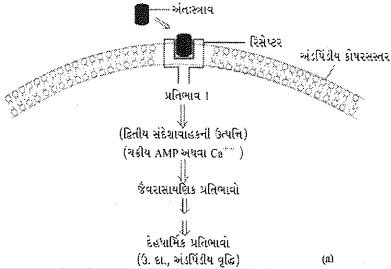
Which hormone's mechanism of action is shown in the given diagram?
A
Insulin
B
$PTH$
C
Thymosin
D
$FSH$
Solution
(D) The diagram illustrates the mechanism of action of protein/peptide hormones that are not lipid-soluble and therefore cannot enter the target cell.
These hormones bind to specific receptors located on the surface of the plasma membrane,forming a hormone-receptor complex.
This binding triggers the generation of second messengers (such as $cAMP$ or $Ca^{++}$) within the cell,which then regulate cellular metabolism and physiological responses.
Among the given options,$FSH$ (Follicle Stimulating Hormone) is a peptide hormone that acts via this membrane-bound receptor mechanism.
Insulin also acts via membrane receptors,but $FSH$ is a classic example often associated with this specific diagram in $NCERT$ textbooks.
These hormones bind to specific receptors located on the surface of the plasma membrane,forming a hormone-receptor complex.
This binding triggers the generation of second messengers (such as $cAMP$ or $Ca^{++}$) within the cell,which then regulate cellular metabolism and physiological responses.
Among the given options,$FSH$ (Follicle Stimulating Hormone) is a peptide hormone that acts via this membrane-bound receptor mechanism.
Insulin also acts via membrane receptors,but $FSH$ is a classic example often associated with this specific diagram in $NCERT$ textbooks.
0 likes
View Solution123
EasyMCQ
Receptors are made up of $.......$.
A
Hormones
B
Enzymes
C
Proteins
D
Carbohydrates
Solution
(C) Receptors are specialized structures,typically located on the cell membrane or within the cell,that bind to specific signaling molecules like hormones. Chemically,these receptors are primarily composed of $Proteins$. These proteins undergo conformational changes upon binding with a ligand,which initiates a signal transduction pathway within the cell.
0 likes
View Solution124
MediumMCQ
Identify the correct receptors for the following hormones:
$\quad$ $\quad$ Peptide hormone $\quad$ $\quad$ Epinephrine
$\quad$ $\quad$ Peptide hormone $\quad$ $\quad$ Epinephrine
A
Membrane-bound receptor $\quad$ $\quad$ Intracellular receptor
B
Membrane-bound receptor $\quad$ $\quad$ Membrane-bound receptor
C
Intracellular receptor $\quad$ $\quad$ Intracellular receptor
D
Intracellular receptor $\quad$ $\quad$ Membrane-bound receptor
Solution
(B) Hormones are classified based on their chemical nature and their mechanism of action.
$1$. Peptide hormones (e.g.,insulin,glucagon) are water-soluble and cannot cross the lipid bilayer of the plasma membrane. Therefore,they bind to membrane-bound receptors on the cell surface to initiate a signal transduction pathway.
$2$. Epinephrine (an amino acid derivative) also acts via membrane-bound receptors on the cell surface to trigger secondary messengers like $cAMP$.
$3$. Steroid hormones and thyroid hormones are lipid-soluble and can easily cross the plasma membrane to bind with intracellular receptors (nuclear or cytoplasmic receptors).
Since both peptide hormones and epinephrine interact with receptors located on the cell membrane,the correct option is $B$.
$1$. Peptide hormones (e.g.,insulin,glucagon) are water-soluble and cannot cross the lipid bilayer of the plasma membrane. Therefore,they bind to membrane-bound receptors on the cell surface to initiate a signal transduction pathway.
$2$. Epinephrine (an amino acid derivative) also acts via membrane-bound receptors on the cell surface to trigger secondary messengers like $cAMP$.
$3$. Steroid hormones and thyroid hormones are lipid-soluble and can easily cross the plasma membrane to bind with intracellular receptors (nuclear or cytoplasmic receptors).
Since both peptide hormones and epinephrine interact with receptors located on the cell membrane,the correct option is $B$.
0 likes
View Solution125
MediumMCQ
Which of the following hormones regulates gene expression?
A
Estrogen
B
$TCT$
C
Epinephrine
D
Both $A$ and $B$
Solution
(A) Steroid hormones like Estrogen are lipid-soluble and can easily cross the plasma membrane of target cells.
Once inside the cell,they bind to specific intracellular receptors (usually in the cytoplasm or nucleus) to form a hormone-receptor complex.
This complex then binds to specific $DNA$ sequences in the nucleus,thereby regulating gene expression by promoting or inhibiting the transcription of specific genes.
$TCT$ (Thyrocalcitonin) is a peptide hormone that acts via membrane-bound receptors and second messengers,not by direct gene regulation.
Once inside the cell,they bind to specific intracellular receptors (usually in the cytoplasm or nucleus) to form a hormone-receptor complex.
This complex then binds to specific $DNA$ sequences in the nucleus,thereby regulating gene expression by promoting or inhibiting the transcription of specific genes.
$TCT$ (Thyrocalcitonin) is a peptide hormone that acts via membrane-bound receptors and second messengers,not by direct gene regulation.
0 likes
View Solution126
MediumMCQ
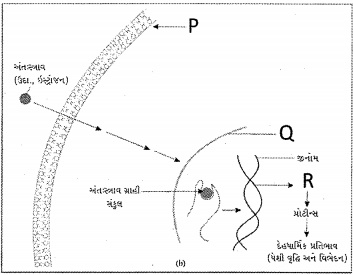
The mechanism of action of a steroid hormone is given below. What are $P, Q$ and $R$?
$\quad\quad\quad P\quad\quad\quad Q\quad\quad\quad R$
$\quad\quad\quad P\quad\quad\quad Q\quad\quad\quad R$
A
Plasma membrane $\quad\quad$ Nucleus $\quad \quad m-RNA$
B
Nucleus $\quad\quad$ Plasma membrane $\quad\quad m-RNA$
C
Plasma membrane $\quad\quad$ Nucleus $\quad\quad r-RNA$
D
Nucleus $\quad\quad$ Plasma membrane $\quad\quad r-RNA$
Solution
(A) Steroid hormones are lipid-soluble and can easily pass through the plasma membrane $(P)$ to enter the target cell.
Inside the cell,they bind to specific intracellular receptors,often located within the nucleus $(Q)$.
The hormone-receptor complex then interacts with the genome $(DNA)$ to regulate gene expression.
This process leads to the transcription of specific genes,resulting in the synthesis of $m-RNA$ $(R)$.
Finally,this $m-RNA$ is translated into proteins,which then produce the physiological response (e.g.,tissue growth and differentiation).
Therefore,$P$ is the plasma membrane,$Q$ is the nucleus,and $R$ is $m-RNA$.
Inside the cell,they bind to specific intracellular receptors,often located within the nucleus $(Q)$.
The hormone-receptor complex then interacts with the genome $(DNA)$ to regulate gene expression.
This process leads to the transcription of specific genes,resulting in the synthesis of $m-RNA$ $(R)$.
Finally,this $m-RNA$ is translated into proteins,which then produce the physiological response (e.g.,tissue growth and differentiation).
Therefore,$P$ is the plasma membrane,$Q$ is the nucleus,and $R$ is $m-RNA$.
0 likes
View Solution127
MediumMCQ
What is the optimal temperature of the human body (in $^{\circ} C$)?
A
$25$
B
$30$
C
$37$
D
$40$
Solution
(C) The human body maintains a constant internal temperature to ensure that metabolic processes and enzymatic activities function efficiently.
The average normal body temperature for a healthy human is approximately $37^{\circ} C$ $(98.6^{\circ} F)$.
This temperature is considered the optimal range for the physiological functions of the human body.
The average normal body temperature for a healthy human is approximately $37^{\circ} C$ $(98.6^{\circ} F)$.
This temperature is considered the optimal range for the physiological functions of the human body.
0 likes
View Solution128
DifficultMCQ
Given below are two statements: one is labelled as Assertion $(A)$ and the other is labelled as Reason $(R)$.
Assertion $(A)$: $FSH$,which interacts with membrane-bound receptors,does not enter the target cell.
Reason $(R)$: Binding of $FSH$ to its receptors generates a second messenger (cyclic $AMP$) for its biochemical and physiological responses.
In the light of the above statements,choose the most appropriate answer from the options given below:
Assertion $(A)$: $FSH$,which interacts with membrane-bound receptors,does not enter the target cell.
Reason $(R)$: Binding of $FSH$ to its receptors generates a second messenger (cyclic $AMP$) for its biochemical and physiological responses.
In the light of the above statements,choose the most appropriate answer from the options given below:
A
Both $(A)$ and $(R)$ are correct and $(R)$ is the correct explanation of $(A)$
B
Both $(A)$ and $(R)$ are correct but $(R)$ is not the correct explanation of $(A)$
C
$(A)$ is correct but $(R)$ is not correct
D
$(A)$ is not correct but $(R)$ is correct
Solution
(A) $FSH$ (Follicle Stimulating Hormone) is a peptide hormone. Peptide hormones are water-soluble and cannot pass through the lipid bilayer of the plasma membrane of target cells.
Therefore,they interact with specific membrane-bound receptors present on the surface of the target cell,which is stated in Assertion $(A)$.
Upon binding to the receptor,these hormones trigger the formation of second messengers like cyclic $AMP$ $(cAMP)$ or $Ca^{2+}$ inside the cell,which then regulate the cellular metabolism and physiological responses. This mechanism is correctly described in Reason $(R)$.
Since the inability of the hormone to enter the cell necessitates the use of a second messenger system to transmit the signal,Reason $(R)$ is the correct explanation for Assertion $(A)$.
Therefore,they interact with specific membrane-bound receptors present on the surface of the target cell,which is stated in Assertion $(A)$.
Upon binding to the receptor,these hormones trigger the formation of second messengers like cyclic $AMP$ $(cAMP)$ or $Ca^{2+}$ inside the cell,which then regulate the cellular metabolism and physiological responses. This mechanism is correctly described in Reason $(R)$.
Since the inability of the hormone to enter the cell necessitates the use of a second messenger system to transmit the signal,Reason $(R)$ is the correct explanation for Assertion $(A)$.
0 likes
View Solution129
MediumMCQ
Which one of the following hormones never reaches the cytoplasm of target cells?
A
Estrogen
B
$FSH$
C
Progesterone
D
Testosterone
Solution
(B) Hormones are classified based on their chemical nature into lipid-soluble and water-soluble hormones.
$1$. Lipid-soluble hormones (e.g.,Estrogen,Progesterone,Testosterone,Cortisol) can easily cross the lipid bilayer of the plasma membrane and bind to intracellular receptors located in the cytoplasm or nucleus.
$2$. Water-soluble hormones (e.g.,$FSH$,$LH$,Insulin,Epinephrine) cannot cross the lipid bilayer of the plasma membrane.
$3$. Therefore,water-soluble hormones bind to specific receptors present on the surface of the target cell membrane and generate secondary messengers (like $cAMP$,$IP_3$,$Ca^{2+}$) to carry out their physiological effects.
$4$. Since $FSH$ (Follicle Stimulating Hormone) is a peptide hormone (water-soluble),it does not enter the cytoplasm of the target cell.
$1$. Lipid-soluble hormones (e.g.,Estrogen,Progesterone,Testosterone,Cortisol) can easily cross the lipid bilayer of the plasma membrane and bind to intracellular receptors located in the cytoplasm or nucleus.
$2$. Water-soluble hormones (e.g.,$FSH$,$LH$,Insulin,Epinephrine) cannot cross the lipid bilayer of the plasma membrane.
$3$. Therefore,water-soluble hormones bind to specific receptors present on the surface of the target cell membrane and generate secondary messengers (like $cAMP$,$IP_3$,$Ca^{2+}$) to carry out their physiological effects.
$4$. Since $FSH$ (Follicle Stimulating Hormone) is a peptide hormone (water-soluble),it does not enter the cytoplasm of the target cell.
0 likes
View Solution130
MediumMCQ
Statement $-I :$ Iodothyronines can cross the plasma membrane of a cell.
Statement $-II :$ Receptors of iodothyronines are present on the plasma membrane.
Statement $-II :$ Receptors of iodothyronines are present on the plasma membrane.
A
Statement $I$ and $II$ both are correct
B
Statement $I$ and $II$ both are incorrect
C
Statement $-I$ is correct but Statement $-II$ is incorrect.
D
Statement $-I$ is incorrect but Statement $-II$ is correct.
Solution
(C) Iodothyronines (thyroid hormones like $T_3$ and $T_4$) are lipophilic in nature.
Because they are lipophilic,they can easily cross the lipid bilayer of the plasma membrane of target cells.
Once inside the cell,they bind to intracellular receptors (specifically nuclear receptors) to regulate gene expression.
Therefore,Statement $-I$ is correct.
Since iodothyronines bind to intracellular receptors,they do not require receptors on the plasma membrane.
Therefore,Statement $-II$ is incorrect.
Because they are lipophilic,they can easily cross the lipid bilayer of the plasma membrane of target cells.
Once inside the cell,they bind to intracellular receptors (specifically nuclear receptors) to regulate gene expression.
Therefore,Statement $-I$ is correct.
Since iodothyronines bind to intracellular receptors,they do not require receptors on the plasma membrane.
Therefore,Statement $-II$ is incorrect.
0 likes
View Solution131
EasyMCQ
Find out the odd one with respect to chemical nature$-$
A
Testosterone
B
Estrogen
C
Cortisol
D
Insulin
Solution
(D) The chemical nature of hormones is classified into steroids,peptides,amino acid derivatives,and iodothyronines.
$1$. Testosterone,Estrogen,and Cortisol are steroid hormones,which are lipid-soluble and derived from cholesterol.
$2$. Insulin is a peptide hormone,which is water-soluble and composed of amino acid chains.
Therefore,Insulin is the odd one out because it is a peptide hormone,while the others are steroid hormones.
$1$. Testosterone,Estrogen,and Cortisol are steroid hormones,which are lipid-soluble and derived from cholesterol.
$2$. Insulin is a peptide hormone,which is water-soluble and composed of amino acid chains.
Therefore,Insulin is the odd one out because it is a peptide hormone,while the others are steroid hormones.
0 likes
View Solution132
MediumMCQ
The steroid hormones transmit their information by:
A
Stimulating the receptors present on cell membrane
B
Entering into the cell and modifying cellular contents
C
Entering into the cell and modifying nuclear organization
D
The help of an intracellular secondary messenger
Solution
(C) Steroid hormones are lipid-soluble molecules derived from cholesterol.
Because they are lipophilic,they can easily pass through the lipid bilayer of the plasma membrane of target cells.
Once inside the cell,they bind to specific intracellular receptors (usually located in the cytoplasm or the nucleus).
This hormone-receptor complex then binds to specific sequences of $DNA$ in the nucleus,thereby regulating gene expression and modifying nuclear organization to influence cellular function.
Because they are lipophilic,they can easily pass through the lipid bilayer of the plasma membrane of target cells.
Once inside the cell,they bind to specific intracellular receptors (usually located in the cytoplasm or the nucleus).
This hormone-receptor complex then binds to specific sequences of $DNA$ in the nucleus,thereby regulating gene expression and modifying nuclear organization to influence cellular function.
0 likes
View Solution133
MediumMCQ
Which of the following statements is false $:-$
A
Hormones produce their effects on target tissues by binding to specific proteins called hormone receptors.
B
Each receptor is specific to one hormone only and hence receptors are specific.
C
Target tissue metabolism and hence physiological functions are regulated by hormones.
D
Hormones which interact with intracellular receptors generate second messengers.
Solution
(D) Hormones that interact with membrane-bound receptors (usually peptide hormones) generate second messengers like $cAMP$,$IP_3$,or $Ca^{2+}$ to regulate cellular metabolism.
In contrast,hormones that interact with intracellular receptors (usually steroid hormones) directly regulate gene expression or chromosome function by interacting with the genome.
Therefore,the statement that hormones interacting with intracellular receptors generate second messengers is false.
In contrast,hormones that interact with intracellular receptors (usually steroid hormones) directly regulate gene expression or chromosome function by interacting with the genome.
Therefore,the statement that hormones interacting with intracellular receptors generate second messengers is false.
0 likes
View Solution134
EasyMCQ
Which one of the following is $NOT$ a second messenger?
A
$IP_3$
B
$cGMP$
C
$Ca^{++}$
D
$Mg^{++}$
Solution
(D) Second messengers are intracellular signaling molecules released by the cell in response to exposure to extracellular signaling molecules (the first messengers).
Common examples of second messengers include $cAMP$,$cGMP$,$IP_3$ (inositol trisphosphate),$DAG$ (diacylglycerol),and $Ca^{++}$ ions.
$Mg^{++}$ ions act as essential cofactors for many enzymes and stabilize various cellular structures,but they do not function as second messengers in signal transduction pathways.
Common examples of second messengers include $cAMP$,$cGMP$,$IP_3$ (inositol trisphosphate),$DAG$ (diacylglycerol),and $Ca^{++}$ ions.
$Mg^{++}$ ions act as essential cofactors for many enzymes and stabilize various cellular structures,but they do not function as second messengers in signal transduction pathways.
0 likes
View Solution135
EasyMCQ
Which of the following hormones bind with intracellular receptors?
A
Aldosterone and thyroxine
B
Thyroxine and insulin
C
$GH$ and GnRH
D
Estrogen and oxytocin
Solution
(A) Hormones that are lipid-soluble,such as steroid hormones (e.g.,$Aldosterone$,$Estrogen$) and thyroid hormones (e.g.,$Thyroxine$),can easily cross the plasma membrane of target cells.
Once inside the cell,they bind to intracellular receptors located in the cytoplasm or the nucleus to form a hormone-receptor complex.
In contrast,peptide hormones like $Insulin$,$GH$ (Growth Hormone),$GnRH$,and $Oxytocin$ are water-soluble and bind to membrane-bound receptors on the cell surface.
Once inside the cell,they bind to intracellular receptors located in the cytoplasm or the nucleus to form a hormone-receptor complex.
In contrast,peptide hormones like $Insulin$,$GH$ (Growth Hormone),$GnRH$,and $Oxytocin$ are water-soluble and bind to membrane-bound receptors on the cell surface.
0 likes
View Solution136
EasyMCQ
Given below are two statements.
Statement $I$: Mode of action of catecholamines,peptide and polypeptide hormones is through cell membrane receptors.
Statement $II$: These hormones are non-steroid,water soluble and lipid insoluble hormones.
In the light of above statements,choose the correct option from below:
Statement $I$: Mode of action of catecholamines,peptide and polypeptide hormones is through cell membrane receptors.
Statement $II$: These hormones are non-steroid,water soluble and lipid insoluble hormones.
In the light of above statements,choose the correct option from below:
A
Both statement $I$ and statement $II$ are correct.
B
Both statement $I$ and statement $II$ are incorrect.
C
Statement $I$ is correct but statement $II$ is incorrect.
D
Statement $I$ is incorrect but statement $II$ is correct.
Solution
(A) Hormones are classified based on their chemical nature into steroid and non-steroid hormones.
Catecholamines (e.g.,epinephrine),peptide hormones (e.g.,insulin),and polypeptide hormones are non-steroid in nature.
Because they are water-soluble and lipid-insoluble,they cannot cross the lipid bilayer of the cell membrane.
Therefore,they bind to specific receptors located on the surface of the cell membrane to initiate a signaling cascade (second messenger system).
Thus,both Statement $I$ and Statement $II$ are scientifically correct.
Catecholamines (e.g.,epinephrine),peptide hormones (e.g.,insulin),and polypeptide hormones are non-steroid in nature.
Because they are water-soluble and lipid-insoluble,they cannot cross the lipid bilayer of the cell membrane.
Therefore,they bind to specific receptors located on the surface of the cell membrane to initiate a signaling cascade (second messenger system).
Thus,both Statement $I$ and Statement $II$ are scientifically correct.
0 likes
View Solution137
EasyMCQ
Select the correct match of hormone and its type.
A
Thyroxine - Polypeptide
B
$ADH$ - Amine
C
Insulin - Protein hormone
D
Calcitonin - Mineralocorticoid
Solution
(C) Hormones are classified based on their chemical nature into peptide,steroid,iodothyronines,and amino acid derivatives.
$1$. Thyroxine is an iodothyronine (derived from tyrosine).
$2$. $ADH$ (Antidiuretic Hormone) is a peptide hormone.
$3$. Insulin is a protein hormone (specifically a polypeptide).
$4$. Calcitonin is a polypeptide hormone.
Therefore,the correct match is Insulin - Protein hormone.
$1$. Thyroxine is an iodothyronine (derived from tyrosine).
$2$. $ADH$ (Antidiuretic Hormone) is a peptide hormone.
$3$. Insulin is a protein hormone (specifically a polypeptide).
$4$. Calcitonin is a polypeptide hormone.
Therefore,the correct match is Insulin - Protein hormone.
0 likes
View Solution138
EasyMCQ
In the mechanism of hormone action,which of the following is $NOT$ a second messenger?
A
Cyclic $AMP$
B
$IP_3$
C
$Ca^{++}$
D
$Mg^{++}$
Solution
(D) Hormones that interact with membrane-bound receptors normally do not enter the target cell,but generate second messengers in the cytoplasm to regulate cellular metabolism.
Common second messengers include cyclic $AMP$ $(cAMP)$,cyclic $GMP$ $(cGMP)$,inositol triphosphate $(IP_3)$,and calcium ions $(Ca^{++})$.
$Mg^{++}$ acts as a cofactor for many enzymes but is not classified as a second messenger in hormone signaling pathways.
Therefore,the correct option is $D$.
Common second messengers include cyclic $AMP$ $(cAMP)$,cyclic $GMP$ $(cGMP)$,inositol triphosphate $(IP_3)$,and calcium ions $(Ca^{++})$.
$Mg^{++}$ acts as a cofactor for many enzymes but is not classified as a second messenger in hormone signaling pathways.
Therefore,the correct option is $D$.
0 likes
View SolutionChemical Coordination and Integration — Hormones and their mechanism · Frequently Asked Questions
1Are these Chemical Coordination and Integration questions useful for JEE and NEET?
Yes. All questions in this section are mapped to JEE Main and NEET exam patterns. Previous year questions from JEE Main, NEET, GUJCET and state-level exams are included with full solutions.
2Can I switch to Hindi or Gujarati for these questions?
Yes. Use the language tabs in the hero section or the sidebar to view the same questions and solutions in English, Hindi or Gujarati.
3How do I generate a question paper from this subtopic?
Use the Vedclass Exam Paper Generator — select the chapter and subtopic, set difficulty, and generate Sets A, B, C, D automatically. First 3 chapters of every subject are free.
Vedclass Products
For Students
Vedclass Test Series
Mock tests in real JEE/NEET style with performance analysis. 5-day free trial.
Start Free TrialFor Teachers
Exam Paper Generator
Generate Set A/B/C/D papers from this chapter in 2 minutes. 3 chapters free.
Try FreeFor Institutes
Online Exam Module
Live online exams with unlimited students, 360° analytics & white-label branding.
See DemoFor Teachers & Institutes
Generate a Chemical Coordination and Integration Exam Paper in 2 Minutes
Select subtopic & difficulty — Sets A, B, C, D auto-generated with No Repeat logic.
First 3 chapters of every subject are free — no payment required.