
A English
Different glands and their hormones Questions in English
Class 11 Biology · Chemical Coordination and Integration · Different glands and their hormones
119+
Questions
English
Language
100%
With Solutions
Showing 19 of 119 questions in English
101
MediumMCQ
Which of the following can be included under heterocrine glands?
A
Thyroid and parathyroid
B
Pineal gland
C
Gonads and pancreas
D
Thymus
Solution
(C) Gonads and pancreas are included under heterocrine glands.
Heterocrine glands,also known as mixed glands,perform both exocrine and endocrine functions.
Exocrine glands release their secretions through ducts,whereas endocrine glands release their secretions directly into the blood without ducts.
Heterocrine glands release their secretions through a duct system as well as directly into the blood.
Thyroid,parathyroid,pineal,and thymus glands are purely endocrine in function.
Heterocrine glands,also known as mixed glands,perform both exocrine and endocrine functions.
Exocrine glands release their secretions through ducts,whereas endocrine glands release their secretions directly into the blood without ducts.
Heterocrine glands release their secretions through a duct system as well as directly into the blood.
Thyroid,parathyroid,pineal,and thymus glands are purely endocrine in function.
0 likes
View Solution102
MediumMCQ
After receiving a hormonal shot,an asthma patient will get relief in exhaling the air. The hormone injected will be
A
Oxytocin
B
Adrenalin
C
Insulin
D
Thyroxine
Solution
(B) During an allergic reaction,$histamine$ is released,which acts as a vasodilator. This increases plasma flow and leads to the narrowing of the lumen of the bronchioles,causing difficulty in breathing,which is characteristic of asthma.
Adrenaline (epinephrine) is administered because it acts as a potent bronchodilator and vasoconstrictor. It relaxes the smooth muscles of the bronchioles,thereby widening the airway and providing relief in exhaling the air.
Adrenaline (epinephrine) is administered because it acts as a potent bronchodilator and vasoconstrictor. It relaxes the smooth muscles of the bronchioles,thereby widening the airway and providing relief in exhaling the air.
0 likes
View Solution103
MediumMCQ
The products of glands are given below:
Mucus,Saliva,Prolactin,Earwax,Oil,Testosterone,Milk,Digestive enzymes
Products of exocrine glands = $P$
Products of endocrine glands = $Q$
Select the correct option for $P$ and $Q$.
Mucus,Saliva,Prolactin,Earwax,Oil,Testosterone,Milk,Digestive enzymes
Products of exocrine glands = $P$
Products of endocrine glands = $Q$
Select the correct option for $P$ and $Q$.
A
$P = 6, Q = 2$
B
$P = 2, Q = 6$
C
$P = 5, Q = 3$
D
$P = 3, Q = 5$
Solution
(A) Exocrine glands secrete their products through ducts. The products listed are: Mucus,Saliva,Earwax,Oil,Milk,and Digestive enzymes. Total count of $P = 6$.
Endocrine glands are ductless and secrete hormones directly into the blood. The products listed are: Prolactin and Testosterone. Total count of $Q = 2$.
Therefore,$P = 6$ and $Q = 2$.
Endocrine glands are ductless and secrete hormones directly into the blood. The products listed are: Prolactin and Testosterone. Total count of $Q = 2$.
Therefore,$P = 6$ and $Q = 2$.
0 likes
View Solution104
MediumMCQ
Which of the following is a ductless gland?
A
Salivary gland
B
Exocrine gland
C
Endocrine gland
D
Both $A$ and $B$
Solution
(C) Glands are classified into two types based on the presence or absence of ducts:
$1$. Exocrine glands: These glands possess ducts to transport their secretions (e.g.,salivary glands,sweat glands).
$2$. Endocrine glands: These are ductless glands that secrete their products,known as hormones,directly into the bloodstream.
Therefore,endocrine glands are ductless glands.
$1$. Exocrine glands: These glands possess ducts to transport their secretions (e.g.,salivary glands,sweat glands).
$2$. Endocrine glands: These are ductless glands that secrete their products,known as hormones,directly into the bloodstream.
Therefore,endocrine glands are ductless glands.
0 likes
View Solution105
MediumMCQ
Which gland secretes Gonadotropin-Releasing Hormone $(GnRH)$ and Gonadotropins,respectively?
A
Hypothalamus,Pituitary gland
B
Hypothalamus,Hypothalamus
C
Pituitary gland,Pituitary gland
D
Pituitary gland,Hypothalamus
Solution
(A) The Gonadotropin-Releasing Hormone $(GnRH)$ is a peptide hormone synthesized and secreted by the hypothalamus.
It travels to the anterior pituitary gland via the hypophyseal portal system.
In response to $GnRH$,the anterior pituitary gland secretes gonadotropins,which include Luteinizing Hormone $(LH)$ and Follicle-Stimulating Hormone $(FSH)$.
Therefore,$GnRH$ is secreted by the hypothalamus and gonadotropins are secreted by the pituitary gland.
It travels to the anterior pituitary gland via the hypophyseal portal system.
In response to $GnRH$,the anterior pituitary gland secretes gonadotropins,which include Luteinizing Hormone $(LH)$ and Follicle-Stimulating Hormone $(FSH)$.
Therefore,$GnRH$ is secreted by the hypothalamus and gonadotropins are secreted by the pituitary gland.
0 likes
View Solution106
MediumMCQ
Which of the following is not a steroid hormone?
A
Testosterone
B
Progesterone
C
Glucagon
D
Cortisol
Solution
(C) The correct answer is option $C$ because glucagon is a peptide (proteinaceous) hormone secreted by the alpha cells of the pancreas.
Steroid hormones are derived from cholesterol. Testosterone,progesterone,and cortisol are all steroid hormones.
Therefore,glucagon is the only hormone listed that is not a steroid hormone.
Steroid hormones are derived from cholesterol. Testosterone,progesterone,and cortisol are all steroid hormones.
Therefore,glucagon is the only hormone listed that is not a steroid hormone.
0 likes
View Solution107
MediumMCQ
Match List-$I$ with List-$II$:
Choose the correct answer from the options given below:
| List-$I$ | List-$II$ |
| $A.$ Progesterone | $I.$ Pars intermedia |
| $B.$ Relaxin | $II.$ Ovary |
| $C.$ Melanocyte stimulating hormone | $III.$ Adrenal Medulla |
| $D.$ Catecholamines | $IV.$ Corpus luteum |
Choose the correct answer from the options given below:
A
$A-IV, B-II, C-I, D-III$
B
$A-IV, B-II, C-III, D-I$
C
$A-II, B-IV, C-I, D-III$
D
$A-III, B-II, C-IV, D-I$
Solution
(A) The correct matching is as follows:
$A.$ Progesterone is secreted by the $IV.$ Corpus luteum.
$B.$ Relaxin is produced by the $II.$ Ovary (specifically during pregnancy).
$C.$ Melanocyte stimulating hormone $(MSH)$ is secreted by the $I.$ Pars intermedia of the pituitary gland.
$D.$ Catecholamines (Adrenaline and Noradrenaline) are secreted by the $III.$ Adrenal Medulla.
Therefore,the correct sequence is $A-IV, B-II, C-I, D-III$.
$A.$ Progesterone is secreted by the $IV.$ Corpus luteum.
$B.$ Relaxin is produced by the $II.$ Ovary (specifically during pregnancy).
$C.$ Melanocyte stimulating hormone $(MSH)$ is secreted by the $I.$ Pars intermedia of the pituitary gland.
$D.$ Catecholamines (Adrenaline and Noradrenaline) are secreted by the $III.$ Adrenal Medulla.
Therefore,the correct sequence is $A-IV, B-II, C-I, D-III$.
0 likes
View Solution108
MediumMCQ
Select the correct matching of a hormone,its source,and its function.
A
Hormone $\rightarrow$ Norepinephrine,Source $\rightarrow$ Adrenal medulla,Function $\rightarrow$ Increases heart beat,rate of respiration,and alertness
B
Hormone $\rightarrow$ Glucagon,Source $\rightarrow$ Beta-cells of Islets of Langerhans,Function $\rightarrow$ Stimulates glycogenolysis
C
Hormone $\rightarrow$ Prolactin,Source $\rightarrow$ Posterior pituitary,Function $\rightarrow$ Regulates growth of mammary glands and milk formation in females
D
Hormone $\rightarrow$ Vasopressin,Source $\rightarrow$ Posterior pituitary,Function $\rightarrow$ Increases loss of water through urine
Solution
(A) Option $A$ is correct. Norepinephrine is secreted by the adrenal medulla and acts as a neurotransmitter and hormone that increases heart rate,respiratory rate,and alertness during stress.
Option $B$ is incorrect because Glucagon is secreted by the Alpha-cells,not Beta-cells.
Option $C$ is incorrect because Prolactin is secreted by the Anterior pituitary,not the Posterior pituitary.
Option $D$ is incorrect because Vasopressin $(ADH)$ decreases the loss of water through urine by promoting water reabsorption in the kidneys.
Option $B$ is incorrect because Glucagon is secreted by the Alpha-cells,not Beta-cells.
Option $C$ is incorrect because Prolactin is secreted by the Anterior pituitary,not the Posterior pituitary.
Option $D$ is incorrect because Vasopressin $(ADH)$ decreases the loss of water through urine by promoting water reabsorption in the kidneys.
0 likes
View Solution109
EasyMCQ
Which one of the following groups of hormones controls glycolysis?
A
Ethylene,cytokinins and Gibberellic acid
B
Glucagon,epinephrine and insulin
C
Cholecystokinin,cortisol and somatostatin
D
$GIP$,secretin and thyroxine
Solution
(B) Glycolysis is the metabolic pathway that converts glucose into pyruvate.
In the human body,blood glucose levels are tightly regulated by hormones.
$Glucagon$ increases blood glucose levels by stimulating glycogenolysis and gluconeogenesis.
$Insulin$ decreases blood glucose levels by promoting glucose uptake into cells and stimulating glycolysis.
$Epinephrine$ (adrenaline) also stimulates glycogenolysis and glycolysis in muscles to provide energy during stress.
Therefore,$Glucagon$,$epinephrine$,and $insulin$ are the primary hormones involved in the regulation of glucose metabolism and glycolysis.
In the human body,blood glucose levels are tightly regulated by hormones.
$Glucagon$ increases blood glucose levels by stimulating glycogenolysis and gluconeogenesis.
$Insulin$ decreases blood glucose levels by promoting glucose uptake into cells and stimulating glycolysis.
$Epinephrine$ (adrenaline) also stimulates glycogenolysis and glycolysis in muscles to provide energy during stress.
Therefore,$Glucagon$,$epinephrine$,and $insulin$ are the primary hormones involved in the regulation of glucose metabolism and glycolysis.
0 likes
View Solution110
EasyMCQ
Select a correct match of deficiency disease and respective hormone.
A
Graves disease - Thyroxine
B
Cushing's disease - Glucocorticoid
C
Acromegaly - Somatotropin
D
Diabetes insipidus - $ADH$
Solution
(D) $i$. Graves disease is caused by the hypersecretion of thyroid hormones.
$ii$. Cushing's disease is caused by the hypersecretion of glucocorticoids.
$iii$. Acromegaly is caused by the hypersecretion of growth hormone (somatotropin) in adults.
$iv$. Diabetes insipidus is caused by the deficiency (hyposecretion) of Antidiuretic Hormone $(ADH)$ or vasopressin. Therefore,the correct match is $D$.
$ii$. Cushing's disease is caused by the hypersecretion of glucocorticoids.
$iii$. Acromegaly is caused by the hypersecretion of growth hormone (somatotropin) in adults.
$iv$. Diabetes insipidus is caused by the deficiency (hyposecretion) of Antidiuretic Hormone $(ADH)$ or vasopressin. Therefore,the correct match is $D$.
0 likes
View Solution111
EasyMCQ
Which of the following is the correct match of a hormone and its target organ?
A
$ADH$ - Proximal convoluted tubule
B
Oxytocin - Fallopian tube
C
Relaxin - Cervix of uterus
D
Secretin - Stomach
Solution
(C) $i$. $ADH$ acts on the distal convoluted tubule and collecting ducts of the kidney to facilitate water reabsorption.
$ii$. Oxytocin acts on the smooth muscles of the uterus to cause contractions and on the mammary glands to stimulate milk ejection.
$iii$. Relaxin is produced by the corpus luteum and placenta,and it acts on the cervix of the uterus to soften and dilate it during childbirth.
$iv$. Secretin acts primarily on the pancreas to stimulate the secretion of water and bicarbonate ions,and on the liver to stimulate bile secretion.
$ii$. Oxytocin acts on the smooth muscles of the uterus to cause contractions and on the mammary glands to stimulate milk ejection.
$iii$. Relaxin is produced by the corpus luteum and placenta,and it acts on the cervix of the uterus to soften and dilate it during childbirth.
$iv$. Secretin acts primarily on the pancreas to stimulate the secretion of water and bicarbonate ions,and on the liver to stimulate bile secretion.
0 likes
View Solution112
EasyMCQ
Select the mismatch pair with respect to hormones.
A
Milk ejecting hormone - Oxytocin
B
Sleep inducing hormone - Melatonin
C
Salt retaining hormone - Thyroxine
D
Emergency hormone - Adrenaline
Solution
(C) The correct match for the salt-retaining hormone is Aldosterone,which is secreted by the adrenal cortex. Thyroxine is primarily responsible for regulating the basal metabolic rate,not salt retention. Therefore,the pair 'Salt retaining hormone - Thyroxine' is the mismatch.
0 likes
View Solution113
EasyMCQ
The hormones involved in maintaining calcium balance in the human body are
A
$PTH$ and $TCT$
B
$PTH$ and $LTH$
C
$TCT$ and $FSH$
D
$MSH$ and $ACTH$
Solution
(A) The correct answer is $A$.
Parathyroid hormone $(PTH)$ and Thyrocalcitonin $(TCT)$ are the two hormones responsible for maintaining calcium homeostasis in the human body.
$PTH$ is secreted by the parathyroid glands and is a hypercalcemic hormone,meaning it increases blood $Ca^{2+}$ levels by stimulating bone resorption,renal reabsorption of $Ca^{2+}$,and intestinal absorption of $Ca^{2+}$.
$TCT$ is secreted by the thyroid gland and is a hypocalcemic hormone,which lowers blood $Ca^{2+}$ levels.
Together,these two hormones act antagonistically to maintain the precise balance of calcium in the blood.
Parathyroid hormone $(PTH)$ and Thyrocalcitonin $(TCT)$ are the two hormones responsible for maintaining calcium homeostasis in the human body.
$PTH$ is secreted by the parathyroid glands and is a hypercalcemic hormone,meaning it increases blood $Ca^{2+}$ levels by stimulating bone resorption,renal reabsorption of $Ca^{2+}$,and intestinal absorption of $Ca^{2+}$.
$TCT$ is secreted by the thyroid gland and is a hypocalcemic hormone,which lowers blood $Ca^{2+}$ levels.
Together,these two hormones act antagonistically to maintain the precise balance of calcium in the blood.
0 likes
View Solution114
EasyMCQ
Select the mismatch pair from the following.
A
Oxytocin - Contraction of uterine muscles
B
Insulin - Gluconeogenesis
C
Prolactin - Milk production in mammary glands
D
Glucagon - Glycogenolysis
Solution
(B) is the incorrect pair.
$Gluconeogenesis$ is the process of synthesizing glucose from non-carbohydrate sources like amino acids and glycerol.
$Insulin$ is a hypoglycemic hormone that promotes $glycogenesis$ (conversion of glucose to glycogen) and glucose uptake by cells,thereby lowering blood glucose levels.
$Gluconeogenesis$ is actually promoted by hormones like $glucagon$ and $cortisol$.
$Gluconeogenesis$ is the process of synthesizing glucose from non-carbohydrate sources like amino acids and glycerol.
$Insulin$ is a hypoglycemic hormone that promotes $glycogenesis$ (conversion of glucose to glycogen) and glucose uptake by cells,thereby lowering blood glucose levels.
$Gluconeogenesis$ is actually promoted by hormones like $glucagon$ and $cortisol$.
0 likes
View Solution115
EasyMCQ
Choose the mismatched pair from the following:
A
Insulin-Gluconeogenesis
B
Glucagon-Glycogenolysis
C
Oxytocin-Contraction of uterine muscles
D
Prolactin-Milk production in mammary glands
Solution
(A) is the mismatched pair.
Insulin is a hormone that lowers blood glucose levels by primarily promoting glucose uptake into cells and glycogen synthesis,while simultaneously inhibiting gluconeogenesis.
Gluconeogenesis,which is the synthesis of glucose from non-carbohydrate sources,is stimulated by hormones like glucagon and cortisol,not insulin.
Insulin is a hormone that lowers blood glucose levels by primarily promoting glucose uptake into cells and glycogen synthesis,while simultaneously inhibiting gluconeogenesis.
Gluconeogenesis,which is the synthesis of glucose from non-carbohydrate sources,is stimulated by hormones like glucagon and cortisol,not insulin.
0 likes
View Solution116
EasyMCQ
Which of the following hormones is a steroid?
A
Estrogen
B
Insulin
C
Glucagon
D
Thyroxine
Solution
(A) Estrogen.
Steroid hormones are derived from cholesterol. Examples include estrogens,androgens,and glucocorticoids.
Estrogens are involved in regulating secondary sexual characteristics in females,the menstrual cycle,and the overall health of the reproductive system.
Insulin and Glucagon are peptide hormones,while Thyroxine is an amino acid derivative (iodinated tyrosine).
Steroid hormones are derived from cholesterol. Examples include estrogens,androgens,and glucocorticoids.
Estrogens are involved in regulating secondary sexual characteristics in females,the menstrual cycle,and the overall health of the reproductive system.
Insulin and Glucagon are peptide hormones,while Thyroxine is an amino acid derivative (iodinated tyrosine).
0 likes
View Solution117
EasyMCQ
Which one of the following is not the function of insulin?
A
Increases the permeability of cell membrane to glucose
B
Increases the oxidation of glucose in the cells
C
Initiates the conversion of glycogen to glucose
D
Initiates the formation of hepatic glycogen from excess of glucose.
Solution
(C) The correct answer is $C$.
Insulin is a hypoglycemic hormone that lowers blood glucose levels.
It increases the permeability of cell membranes to glucose and promotes the oxidation of glucose in cells.
It also stimulates glycogenesis,which is the formation of glycogen from excess glucose in the liver and muscles.
Option $C$ is incorrect because the conversion of glycogen to glucose (glycogenolysis) is stimulated by the hormone glucagon,not insulin.
Insulin is a hypoglycemic hormone that lowers blood glucose levels.
It increases the permeability of cell membranes to glucose and promotes the oxidation of glucose in cells.
It also stimulates glycogenesis,which is the formation of glycogen from excess glucose in the liver and muscles.
Option $C$ is incorrect because the conversion of glycogen to glucose (glycogenolysis) is stimulated by the hormone glucagon,not insulin.
0 likes
View Solution118
EasyMCQ
Which of the following hormones does not contain a polypeptide?
A
Insulin
B
Antidiuretic hormone
C
Prostaglandin
D
Oxytocin
Solution
(C) Prostaglandin.
Prostaglandins are not polypeptides; they are lipid compounds derived from fatty acids.
Insulin,antidiuretic hormone $(ADH)$,and oxytocin are all peptide hormones,which are composed of amino acids.
Prostaglandins are not polypeptides; they are lipid compounds derived from fatty acids.
Insulin,antidiuretic hormone $(ADH)$,and oxytocin are all peptide hormones,which are composed of amino acids.
0 likes
View Solution119
EasyMCQ
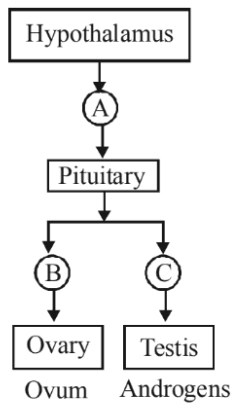
Identify the hormones '$A$','$B$',and '$C$' that are labelled in the given flow chart.
A
$A - GnRH, B - PRL, C - ICSH$
B
$A - GnRH, B - ICSH, C - ISH$
C
$A - GnRH, B - FSH, C - LH$
D
$A - GnRH, B - FSH, C - LHH$
Solution
(C) The correct option is $C$.
$A$ represents $GnRH$ (Gonadotropin-releasing hormone),which is secreted by the hypothalamus.
$GnRH$ stimulates the anterior pituitary gland to release gonadotropins,which are $FSH$ (Follicle-stimulating hormone) and $LH$ (Luteinizing hormone).
$B$ represents $FSH$,which acts on the ovaries to stimulate the growth of ovarian follicles.
$C$ represents $LH$,which acts on the testes to stimulate Leydig cells to secrete androgens (testosterone).
$A$ represents $GnRH$ (Gonadotropin-releasing hormone),which is secreted by the hypothalamus.
$GnRH$ stimulates the anterior pituitary gland to release gonadotropins,which are $FSH$ (Follicle-stimulating hormone) and $LH$ (Luteinizing hormone).
$B$ represents $FSH$,which acts on the ovaries to stimulate the growth of ovarian follicles.
$C$ represents $LH$,which acts on the testes to stimulate Leydig cells to secrete androgens (testosterone).
0 likes
View SolutionChemical Coordination and Integration — Different glands and their hormones · Frequently Asked Questions
1Are these Chemical Coordination and Integration questions useful for JEE and NEET?
Yes. All questions in this section are mapped to JEE Main and NEET exam patterns. Previous year questions from JEE Main, NEET, GUJCET and state-level exams are included with full solutions.
2Can I switch to Hindi or Gujarati for these questions?
Yes. Use the language tabs in the hero section or the sidebar to view the same questions and solutions in English, Hindi or Gujarati.
3How do I generate a question paper from this subtopic?
Use the Vedclass Exam Paper Generator — select the chapter and subtopic, set difficulty, and generate Sets A, B, C, D automatically. First 3 chapters of every subject are free.
Vedclass Products
For Students
Vedclass Test Series
Mock tests in real JEE/NEET style with performance analysis. 5-day free trial.
Start Free TrialFor Teachers
Exam Paper Generator
Generate Set A/B/C/D papers from this chapter in 2 minutes. 3 chapters free.
Try FreeFor Institutes
Online Exam Module
Live online exams with unlimited students, 360° analytics & white-label branding.
See DemoFor Teachers & Institutes
Generate a Chemical Coordination and Integration Exam Paper in 2 Minutes
Select subtopic & difficulty — Sets A, B, C, D auto-generated with No Repeat logic.
First 3 chapters of every subject are free — no payment required.