
A English
Different glands and their hormones Questions in English
Class 11 Biology · Chemical Coordination and Integration · Different glands and their hormones
119+
Questions
English
Language
100%
With Solutions
Showing 50 of 119 questions in English
51
MediumMCQ
Identify the incorrect pair.
A
$ACTH -$ Anterior pituitary gland
B
Catecholamines - Adrenal gland
C
Oxytocin - Hypophysis
D
Melatonin - Pineal gland
Solution
(C) The correct answer is $C$.
$ACTH$ (Adrenocorticotropic hormone) is secreted by the anterior pituitary gland.
Catecholamines (epinephrine and norepinephrine) are secreted by the adrenal medulla of the adrenal gland.
Melatonin is secreted by the pineal gland.
Oxytocin is synthesized by the hypothalamus and stored/released by the posterior pituitary (neurohypophysis),not the hypophysis (which generally refers to the entire pituitary gland). Therefore,the pairing of Oxytocin with 'hypophysis' is imprecise compared to the specific anatomical source,making it the incorrect pair in this context.
$ACTH$ (Adrenocorticotropic hormone) is secreted by the anterior pituitary gland.
Catecholamines (epinephrine and norepinephrine) are secreted by the adrenal medulla of the adrenal gland.
Melatonin is secreted by the pineal gland.
Oxytocin is synthesized by the hypothalamus and stored/released by the posterior pituitary (neurohypophysis),not the hypophysis (which generally refers to the entire pituitary gland). Therefore,the pairing of Oxytocin with 'hypophysis' is imprecise compared to the specific anatomical source,making it the incorrect pair in this context.
0 likes
View Solution52
MediumMCQ
Identify the steroid hormone.
A
Iodothyronines
B
Cortisol
C
Epinephrine
D
Melatonin
Solution
(B) Steroid hormones are derived from cholesterol.
Examples of steroid hormones include cortisol,testosterone,estrogen,and progesterone.
Iodothyronines (thyroid hormones) are amino acid derivatives.
Epinephrine is an amino acid derivative (catecholamine).
Melatonin is an amino acid derivative (derived from tryptophan).
Therefore,cortisol is the correct answer.
Examples of steroid hormones include cortisol,testosterone,estrogen,and progesterone.
Iodothyronines (thyroid hormones) are amino acid derivatives.
Epinephrine is an amino acid derivative (catecholamine).
Melatonin is an amino acid derivative (derived from tryptophan).
Therefore,cortisol is the correct answer.
0 likes
View Solution53
MediumMCQ
Which of the following pairs of hormones are not antagonistic (having opposite effects) to each other?
A
Aldosterone - Atrial Natriuretic Factor
B
Relaxin - Inhibin
C
Parathormone - Calcitonin
D
Insulin - Glucagon
Solution
(B) Antagonistic hormones are those that have opposite effects on a physiological process.
$1$. $Aldosterone$ increases blood pressure by retaining sodium, while $Atrial \text{ } Natriuretic \text{ } Factor$ $(ANF)$ decreases blood pressure by promoting sodium excretion. They are antagonistic.
$2$. $Parathormone$ increases blood calcium levels, while $Calcitonin$ decreases blood calcium levels. They are antagonistic.
$3$. $Insulin$ decreases blood glucose levels, while $Glucagon$ increases blood glucose levels. They are antagonistic.
$4$. $Relaxin$ is involved in relaxing the pelvic ligaments during childbirth, while $Inhibin$ inhibits the secretion of $FSH$. They do not have opposite physiological effects on the same target process; therefore, they are not antagonistic.
$1$. $Aldosterone$ increases blood pressure by retaining sodium, while $Atrial \text{ } Natriuretic \text{ } Factor$ $(ANF)$ decreases blood pressure by promoting sodium excretion. They are antagonistic.
$2$. $Parathormone$ increases blood calcium levels, while $Calcitonin$ decreases blood calcium levels. They are antagonistic.
$3$. $Insulin$ decreases blood glucose levels, while $Glucagon$ increases blood glucose levels. They are antagonistic.
$4$. $Relaxin$ is involved in relaxing the pelvic ligaments during childbirth, while $Inhibin$ inhibits the secretion of $FSH$. They do not have opposite physiological effects on the same target process; therefore, they are not antagonistic.
0 likes
View Solution54
MediumMCQ
Identify which of the following are endocrine glands?
$I.$ Liver,$II.$ Salivary gland
$III.$ Pituitary gland,$IV.$ Thyroid
Choose the correct option.
$I.$ Liver,$II.$ Salivary gland
$III.$ Pituitary gland,$IV.$ Thyroid
Choose the correct option.
A
$I$ and $II$
B
$III$ and $IV$
C
$I$ and $IV$
D
$II$ and $IV$ only
Solution
(B) Endocrine glands are ductless glands that secrete hormones directly into the bloodstream.
$I.$ Liver is an exocrine gland (secretes bile into the digestive tract).
$II.$ Salivary gland is an exocrine gland (secretes saliva into the oral cavity via ducts).
$III.$ Pituitary gland is a major endocrine gland that secretes various hormones like $GH$,$TSH$,etc.
$IV.$ Thyroid is an endocrine gland that secretes hormones like thyroxine $(T_4)$ and triiodothyronine $(T_3)$.
Therefore,$III$ and $IV$ are endocrine glands.
$I.$ Liver is an exocrine gland (secretes bile into the digestive tract).
$II.$ Salivary gland is an exocrine gland (secretes saliva into the oral cavity via ducts).
$III.$ Pituitary gland is a major endocrine gland that secretes various hormones like $GH$,$TSH$,etc.
$IV.$ Thyroid is an endocrine gland that secretes hormones like thyroxine $(T_4)$ and triiodothyronine $(T_3)$.
Therefore,$III$ and $IV$ are endocrine glands.
0 likes
View Solution55
MediumMCQ
Match the following columns.
| Column-$I$ | Column-$II$ |
| $A$. $PRL$ | $1$. Gonadotropin |
| $B$. $TSH$ | $2$. Glucocorticoid |
| $C$. $ACTH$ | $3$. Thyroid hormone |
| $D$. $LH$ and $FSH$ | $4$. Mammary glands |
A
$A-1, B-2, C-3, D-4$
B
$A-2, B-1, C-3, D-4$
C
$A-4, B-3, C-2, D-1$
D
$A-4, B-3, C-1, D-2$
Solution
(C) The correct matches are as follows:
$A$. $PRL$ (Prolactin) stimulates the growth of mammary glands and milk production,so $A-4$.
$B$. $TSH$ (Thyroid Stimulating Hormone) stimulates the synthesis and secretion of thyroid hormones,so $B-3$.
$C$. $ACTH$ (Adrenocorticotropic Hormone) stimulates the synthesis and secretion of steroid hormones called glucocorticoids from the adrenal cortex,so $C-2$.
$D$. $LH$ (Luteinizing Hormone) and $FSH$ (Follicle Stimulating Hormone) are collectively known as gonadotropins,so $D-1$.
Therefore,the correct sequence is $A-4, B-3, C-2, D-1$.
$A$. $PRL$ (Prolactin) stimulates the growth of mammary glands and milk production,so $A-4$.
$B$. $TSH$ (Thyroid Stimulating Hormone) stimulates the synthesis and secretion of thyroid hormones,so $B-3$.
$C$. $ACTH$ (Adrenocorticotropic Hormone) stimulates the synthesis and secretion of steroid hormones called glucocorticoids from the adrenal cortex,so $C-2$.
$D$. $LH$ (Luteinizing Hormone) and $FSH$ (Follicle Stimulating Hormone) are collectively known as gonadotropins,so $D-1$.
Therefore,the correct sequence is $A-4, B-3, C-2, D-1$.
0 likes
View Solution56
EasyMCQ
Match the following:
| Column-$I$ | Column-$II$ |
| $1$. Pituitary gland | $p$. Trachea |
| $2$. Thyroid gland | $q$. Bony cavity (Sella tursica) |
| $3$. Thymus | $r$. Anterior part of kidney |
| $4$. Adrenal gland | $s$. Dorsal side of the heart and aorta |
A
$(1-q), (2-p), (3-s), (4-r)$
B
$(1-q), (2-r), (3-s), (4-p)$
C
$(1-r), (2-s), (3-p), (4-q)$
D
$(1-s), (2-p), (3-q), (4-r)$
Solution
(A) The correct matches are as follows:
$1$. Pituitary gland is located in a bony cavity called Sella tursica $(1-q)$.
$2$. Thyroid gland is located in front of the trachea $(2-p)$.
$3$. Thymus is located on the dorsal side of the heart and the aorta $(3-s)$.
$4$. Adrenal gland is located at the anterior part of each kidney $(4-r)$.
Therefore,the correct sequence is $(1-q), (2-p), (3-s), (4-r)$.
$1$. Pituitary gland is located in a bony cavity called Sella tursica $(1-q)$.
$2$. Thyroid gland is located in front of the trachea $(2-p)$.
$3$. Thymus is located on the dorsal side of the heart and the aorta $(3-s)$.
$4$. Adrenal gland is located at the anterior part of each kidney $(4-r)$.
Therefore,the correct sequence is $(1-q), (2-p), (3-s), (4-r)$.
0 likes
View Solution57
MediumMCQ
Match the following:
| Column-$I$ | Column-$II$ |
| $(1)$ Oxytocin | $(p)$ Stimulates the secretion of thyroid hormone |
| $(2)$ Vasopressin | $(q)$ Act on the smooth muscles |
| $(3)$ $FSH$ and androgens | $(r)$ Stimulates resorption of water |
| $(4)$ $TSH$ | $(s)$ Regulate spermatogenesis |
A
$(1-p), (2-q), (3-r), (4-s)$
B
$(1-q), (2-r), (3-s), (4-p)$
C
$(1-r), (2-s), (3-p), (4-q)$
D
$(1-s), (2-p), (3-q), (4-r)$
Solution
(B) $(1)$ Oxytocin acts on the smooth muscles of our body and stimulates their contraction. Thus,$(1-q)$.
$(2)$ Vasopressin,also known as Antidiuretic Hormone $(ADH)$,acts mainly at the kidney and stimulates the resorption of water and electrolytes by the distal tubules. Thus,$(2-r)$.
$(3)$ $FSH$ and androgens regulate spermatogenesis in males. Thus,$(3-s)$.
$(4)$ $TSH$ (Thyroid Stimulating Hormone) stimulates the synthesis and secretion of thyroid hormones from the thyroid gland. Thus,$(4-p)$.
Therefore,the correct matching is $(1-q), (2-r), (3-s), (4-p)$.
$(2)$ Vasopressin,also known as Antidiuretic Hormone $(ADH)$,acts mainly at the kidney and stimulates the resorption of water and electrolytes by the distal tubules. Thus,$(2-r)$.
$(3)$ $FSH$ and androgens regulate spermatogenesis in males. Thus,$(3-s)$.
$(4)$ $TSH$ (Thyroid Stimulating Hormone) stimulates the synthesis and secretion of thyroid hormones from the thyroid gland. Thus,$(4-p)$.
Therefore,the correct matching is $(1-q), (2-r), (3-s), (4-p)$.
0 likes
View Solution58
MediumMCQ
Choose the incorrect statement.
A
$GHRH -$ Stimulates secretion of growth hormone from the pituitary.
B
$LH -$ In males,it stimulates the synthesis and secretion of hormones called androgens from the testis.
C
$STH -$ Promotes development of all tissues by increasing cell division and protein synthesis.
D
$GHRIH -$ Stimulates secretion of growth hormone from the pituitary.
Solution
(D) $GHRH$ (Growth Hormone Releasing Hormone) stimulates the secretion of growth hormone from the pituitary gland.
$LH$ (Luteinizing Hormone) in males stimulates the synthesis and secretion of androgens from the testis.
$STH$ (Somatotropic Hormone),also known as Growth Hormone $(GH)$,promotes the development of tissues by increasing cell division and protein synthesis.
$GHRIH$ (Growth Hormone Release Inhibiting Hormone),also known as Somatostatin,inhibits the secretion of growth hormone from the pituitary gland,not stimulates it. Therefore,option $D$ is the incorrect statement.
$LH$ (Luteinizing Hormone) in males stimulates the synthesis and secretion of androgens from the testis.
$STH$ (Somatotropic Hormone),also known as Growth Hormone $(GH)$,promotes the development of tissues by increasing cell division and protein synthesis.
$GHRIH$ (Growth Hormone Release Inhibiting Hormone),also known as Somatostatin,inhibits the secretion of growth hormone from the pituitary gland,not stimulates it. Therefore,option $D$ is the incorrect statement.
0 likes
View Solution59
EasyMCQ
The metamorphosis of insects is controlled by the hormone $..........$.
A
Pheromone
B
Thyroxine
C
Ecdysone
D
All of the above
Solution
(C) Metamorphosis in insects is a biological process by which an animal physically develops after birth or hatching.
This process is primarily regulated by the hormone $Ecdysone$,which is secreted by the prothoracic glands.
$Ecdysone$ triggers the molting process and the transition between different developmental stages (larva to pupa to adult).
$Pheromones$ are chemical signals used for communication,and $Thyroxine$ is a hormone found in vertebrates,not insects.
This process is primarily regulated by the hormone $Ecdysone$,which is secreted by the prothoracic glands.
$Ecdysone$ triggers the molting process and the transition between different developmental stages (larva to pupa to adult).
$Pheromones$ are chemical signals used for communication,and $Thyroxine$ is a hormone found in vertebrates,not insects.
0 likes
View Solution60
MediumMCQ
Which of the following pairs is correctly matched with the hormone and the disease resulting from its deficiency?
A
Luteinizing hormone - Failure of ovulation
B
Insulin - Diabetes insipidus
C
Thyroxine - Tetany
D
Parathyroid hormone - Diabetes mellitus
Solution
(A) $1$. $Luteinizing$ $hormone$ $(LH)$ is essential for ovulation in females. Its deficiency leads to the failure of ovulation.
$2$. $Diabetes$ $insipidus$ is caused by the deficiency of $Vasopressin$ $(ADH)$,not $Insulin$.
$3$. $Tetany$ is caused by the deficiency of $Parathyroid$ $hormone$ $(PTH)$,not $Thyroxine$.
$4$. $Diabetes$ $mellitus$ is caused by the deficiency of $Insulin$,not $Parathyroid$ $hormone$.
Therefore,the correct match is $Luteinizing$ $hormone$ and failure of ovulation.
$2$. $Diabetes$ $insipidus$ is caused by the deficiency of $Vasopressin$ $(ADH)$,not $Insulin$.
$3$. $Tetany$ is caused by the deficiency of $Parathyroid$ $hormone$ $(PTH)$,not $Thyroxine$.
$4$. $Diabetes$ $mellitus$ is caused by the deficiency of $Insulin$,not $Parathyroid$ $hormone$.
Therefore,the correct match is $Luteinizing$ $hormone$ and failure of ovulation.
0 likes
View Solution61
MediumMCQ
Which of the following pairs of organs consists only of endocrine glands?
A
Parathyroid and Adrenal
B
Pancreas and Parathyroid
C
Thymus and Testis
D
Adrenal and Ovary
Solution
(A) Endocrine glands are ductless glands that secrete hormones directly into the bloodstream.
$1$. Parathyroid glands are purely endocrine glands.
$2$. Adrenal glands are also purely endocrine glands.
$3$. Pancreas,Testis,and Ovary are heterocrine (mixed) glands because they have both exocrine and endocrine functions.
$4$. Thymus is a primary lymphoid organ and also acts as an endocrine gland.
Therefore,the pair consisting only of endocrine glands is Parathyroid and Adrenal.
$1$. Parathyroid glands are purely endocrine glands.
$2$. Adrenal glands are also purely endocrine glands.
$3$. Pancreas,Testis,and Ovary are heterocrine (mixed) glands because they have both exocrine and endocrine functions.
$4$. Thymus is a primary lymphoid organ and also acts as an endocrine gland.
Therefore,the pair consisting only of endocrine glands is Parathyroid and Adrenal.
0 likes
View Solution62
MediumMCQ
Which of the following pairs is incorrectly matched?
A
Glucagon - Beta cells (Origin)
B
Somatostatin - Delta cells (Origin)
C
Corpus luteum - Relaxin (Secretion)
D
Insulin - Diabetes mellitus (Disease)
Solution
(A) The correct answer is $A$.
Glucagon is secreted by the $Alpha$ $(A)$ cells of the Islets of Langerhans in the pancreas,not by the Beta cells.
Beta cells are responsible for the secretion of insulin.
Somatostatin is indeed secreted by the Delta cells of the pancreas.
The corpus luteum secretes progesterone and,during the later stages of pregnancy,it also secretes relaxin.
Deficiency or improper functioning of insulin leads to diabetes mellitus.
Glucagon is secreted by the $Alpha$ $(A)$ cells of the Islets of Langerhans in the pancreas,not by the Beta cells.
Beta cells are responsible for the secretion of insulin.
Somatostatin is indeed secreted by the Delta cells of the pancreas.
The corpus luteum secretes progesterone and,during the later stages of pregnancy,it also secretes relaxin.
Deficiency or improper functioning of insulin leads to diabetes mellitus.
0 likes
View Solution63
MediumMCQ
Which of the following statements is correct regarding the mechanism of hormone action in humans?
A
Glucagon is secreted by the $\alpha$-cells of the Islets of Langerhans and stimulates glycogenolysis.
B
Secretion of thymosins is stimulated with aging.
C
In females,$FSH$ binds to specific receptor molecules in the cytoplasm of ovarian cells.
D
$FSH$ stimulates the secretion of estrogen and progesterone.
Solution
(A) The correct answer is $A$.
$1$. Glucagon is secreted by the $\alpha$-cells of the Islets of Langerhans,while $\beta$-cells secrete insulin. Glucagon stimulates glycogenolysis (breakdown of glycogen to glucose) in the liver.
$2$. The secretion of thymosins decreases with aging,it does not increase.
$3$. $FSH$ is a peptide hormone and binds to membrane-bound receptors on the surface of target cells,not to receptors in the cytoplasm.
$4$. $FSH$ primarily stimulates the growth of ovarian follicles and the secretion of estrogen,while $LH$ is primarily responsible for ovulation and the secretion of progesterone.
$1$. Glucagon is secreted by the $\alpha$-cells of the Islets of Langerhans,while $\beta$-cells secrete insulin. Glucagon stimulates glycogenolysis (breakdown of glycogen to glucose) in the liver.
$2$. The secretion of thymosins decreases with aging,it does not increase.
$3$. $FSH$ is a peptide hormone and binds to membrane-bound receptors on the surface of target cells,not to receptors in the cytoplasm.
$4$. $FSH$ primarily stimulates the growth of ovarian follicles and the secretion of estrogen,while $LH$ is primarily responsible for ovulation and the secretion of progesterone.
0 likes
View Solution64
MediumMCQ
Which of the following hormones is not involved in the metabolism of carbohydrates?
A
Glucagon
B
Cortisol
C
Aldosterone
D
Insulin
Solution
(C) $1$. $Glucagon$ is secreted by the pancreas and increases blood glucose levels by stimulating glycogenolysis and gluconeogenesis.
$2$. $Cortisol$ is a glucocorticoid secreted by the adrenal cortex that stimulates gluconeogenesis,lipolysis,and proteolysis,thus playing a major role in carbohydrate metabolism.
$3$. $Insulin$ is secreted by the pancreas and decreases blood glucose levels by facilitating cellular glucose uptake and utilization.
$4$. $Aldosterone$ is a mineralocorticoid secreted by the adrenal cortex. Its primary function is to regulate water and electrolyte balance (sodium and potassium) in the body,not carbohydrate metabolism.
$2$. $Cortisol$ is a glucocorticoid secreted by the adrenal cortex that stimulates gluconeogenesis,lipolysis,and proteolysis,thus playing a major role in carbohydrate metabolism.
$3$. $Insulin$ is secreted by the pancreas and decreases blood glucose levels by facilitating cellular glucose uptake and utilization.
$4$. $Aldosterone$ is a mineralocorticoid secreted by the adrenal cortex. Its primary function is to regulate water and electrolyte balance (sodium and potassium) in the body,not carbohydrate metabolism.
0 likes
View Solution65
MediumMCQ
Which of the following pairs of hormones does not exhibit an antagonistic effect on each other?
A
Insulin - Glucagon
B
Aldosterone - Atrial Natriuretic Factor $(ANF)$
C
Relaxin - Inhibin
D
Parathormone - Calcitonin
Solution
(C) Antagonistic hormones are those that have opposite effects on a physiological process.
$1$. Insulin and Glucagon: Insulin lowers blood glucose levels,while Glucagon increases them. They are antagonistic.
$2$. Aldosterone and $ANF$: Aldosterone increases blood pressure by retaining sodium,while $ANF$ decreases blood pressure by promoting sodium excretion. They are antagonistic.
$3$. Parathormone and Calcitonin: Parathormone increases blood calcium levels,while Calcitonin decreases them. They are antagonistic.
$4$. Relaxin and Inhibin: Relaxin is involved in relaxing pelvic ligaments during childbirth,while Inhibin inhibits the secretion of Follicle Stimulating Hormone $(FSH)$. They do not have opposite physiological effects on the same target; therefore,they are not antagonistic.
$1$. Insulin and Glucagon: Insulin lowers blood glucose levels,while Glucagon increases them. They are antagonistic.
$2$. Aldosterone and $ANF$: Aldosterone increases blood pressure by retaining sodium,while $ANF$ decreases blood pressure by promoting sodium excretion. They are antagonistic.
$3$. Parathormone and Calcitonin: Parathormone increases blood calcium levels,while Calcitonin decreases them. They are antagonistic.
$4$. Relaxin and Inhibin: Relaxin is involved in relaxing pelvic ligaments during childbirth,while Inhibin inhibits the secretion of Follicle Stimulating Hormone $(FSH)$. They do not have opposite physiological effects on the same target; therefore,they are not antagonistic.
0 likes
View Solution66
MediumMCQ
The amino acid $Tryptophan$ is a precursor for the synthesis of which of the following?
A
$Thyroxine$ and $Triiodothyronine$
B
$Estrogen$ and $Progesterone$
C
$Cortisol$ and $Cortisone$
D
$Melatonin$ and $Serotonin$
Solution
(D) The amino acid $Tryptophan$ serves as the biochemical precursor for the synthesis of the neurotransmitter $Serotonin$ and the hormone $Melatonin$ in the human body.
$Serotonin$ is synthesized from $Tryptophan$ via the $5-hydroxytryptophan$ pathway.
$Melatonin$ is subsequently synthesized from $Serotonin$ in the pineal gland.
In contrast,$Thyroxine$ and $Triiodothyronine$ are derived from the amino acid $Tyrosine$,while $Estrogen$,$Progesterone$,$Cortisol$,and $Cortisone$ are steroid hormones derived from $Cholesterol$.
$Serotonin$ is synthesized from $Tryptophan$ via the $5-hydroxytryptophan$ pathway.
$Melatonin$ is subsequently synthesized from $Serotonin$ in the pineal gland.
In contrast,$Thyroxine$ and $Triiodothyronine$ are derived from the amino acid $Tyrosine$,while $Estrogen$,$Progesterone$,$Cortisol$,and $Cortisone$ are steroid hormones derived from $Cholesterol$.
0 likes
View Solution67
MediumMCQ
Which of the following hormones can play a significant role in osteoporosis?
A
Estrogen and parathyroid hormone
B
Aldosterone and Prolactin
C
Parathyroid hormone and prolactin
D
Progesterone and Aldosterone
Solution
(A) Osteoporosis is a condition characterized by a decrease in bone mass and increased fragility of bones.
$1$. Estrogen is crucial for maintaining bone density in women; a decline in estrogen levels after menopause leads to increased bone resorption.
$2$. Parathyroid hormone $(PTH)$ regulates calcium levels in the blood. Excess $PTH$ stimulates osteoclasts to break down bone tissue to release calcium into the bloodstream,which can lead to bone loss.
Therefore,both estrogen and parathyroid hormone play a significant role in the development of osteoporosis.
$1$. Estrogen is crucial for maintaining bone density in women; a decline in estrogen levels after menopause leads to increased bone resorption.
$2$. Parathyroid hormone $(PTH)$ regulates calcium levels in the blood. Excess $PTH$ stimulates osteoclasts to break down bone tissue to release calcium into the bloodstream,which can lead to bone loss.
Therefore,both estrogen and parathyroid hormone play a significant role in the development of osteoporosis.
0 likes
View Solution68
MediumMCQ
Match List $-I$ (Endocrine glands) with List $-II$ (Hormones secreted) and select the correct answer using the codes given below:
| List $-I$ | List $-II$ |
| $A$. Gonads | $I$. Insulin |
| $B$. Pituitary | $II$. Progesterone |
| $C$. Pancreas | $III$. Growth hormone |
| $D$. Adrenal | $IV$. Cortisone |
A
$A-III, B-II, C-IV, D-I$
B
$A-II, B-III, C-IV, D-I$
C
$A-II, B-III, C-I, D-IV$
D
$A-III, B-II, C-I, D-IV$
Solution
(C) The correct matching is as follows:
$A$. Gonads secrete sex hormones like Progesterone $(II)$.
$B$. Pituitary gland secretes Growth hormone $(III)$.
$C$. Pancreas secretes Insulin $(I)$.
$D$. Adrenal gland secretes Cortisone $(IV)$.
Therefore, the correct sequence is $A-II, B-III, C-I, D-IV$.
$A$. Gonads secrete sex hormones like Progesterone $(II)$.
$B$. Pituitary gland secretes Growth hormone $(III)$.
$C$. Pancreas secretes Insulin $(I)$.
$D$. Adrenal gland secretes Cortisone $(IV)$.
Therefore, the correct sequence is $A-II, B-III, C-I, D-IV$.
0 likes
View Solution69
Difficult
Define the following:
$(a)$ Exocrine gland,
$(b)$ Endocrine gland,
$(c)$ Hormone.
$(a)$ Exocrine gland,
$(b)$ Endocrine gland,
$(c)$ Hormone.
Solution
(N/A) Exocrine gland is a gland that pours its secretion on the surface or into a particular region by means of ducts for performing a metabolic activity,e.g.,sebaceous glands,sweat glands,salivary glands,and intestinal glands.
$(b)$ Endocrine gland is an isolated gland (separates even from the epithelium forming it) which secretes informational molecules or hormones that are poured into venous blood or lymph for reaching the target organ because the gland is not connected with the target organ by any duct. Therefore,an endocrine gland is also called a ductless gland,e.g.,thyroid gland.
$(c)$ Hormone is a substance that is manufactured and secreted in very small quantities into the blood stream by an endocrine gland or a specialized nerve cell and regulates the growth or functioning of a specific tissue or organ in a distant part of the body,e.g.,insulin.
$(b)$ Endocrine gland is an isolated gland (separates even from the epithelium forming it) which secretes informational molecules or hormones that are poured into venous blood or lymph for reaching the target organ because the gland is not connected with the target organ by any duct. Therefore,an endocrine gland is also called a ductless gland,e.g.,thyroid gland.
$(c)$ Hormone is a substance that is manufactured and secreted in very small quantities into the blood stream by an endocrine gland or a specialized nerve cell and regulates the growth or functioning of a specific tissue or organ in a distant part of the body,e.g.,insulin.
0 likes
View Solution70
Medium
List the hormones secreted by the following:
$(a)$ Hypothalamus $(b)$ Pituitary $(c)$ Thyroid $(d)$ Parathyroid $(e)$ Adrenal $(f)$ Pancreas $(g)$ Testis $(h)$ Ovary $(i)$ Thymus $(j)$ Atrium $(k)$ Kidney
$(a)$ Hypothalamus $(b)$ Pituitary $(c)$ Thyroid $(d)$ Parathyroid $(e)$ Adrenal $(f)$ Pancreas $(g)$ Testis $(h)$ Ovary $(i)$ Thymus $(j)$ Atrium $(k)$ Kidney
Solution
(N/A) Hypothalamus: Produces releasing hormones (e.g.,$TRH, CRH, GnRH, GHRH$) and inhibiting hormones (e.g.,$Somatostatin, PIH$).
$(b)$ Pituitary: Anterior lobe secretes $GH, PRL, TSH, ACTH, LH, FSH$. Intermediate lobe secretes $MSH$. Posterior lobe stores and releases $Oxytocin$ and $Vasopressin$ $(ADH)$.
$(c)$ Thyroid: Secretes $Thyroxine$ $(T_4)$,$Triiodothyronine$ $(T_3)$,and $Calcitonin$.
$(d)$ Parathyroid: Secretes $Parathormone$ $(PTH)$.
$(e)$ Adrenal: Adrenal cortex secretes $Glucocorticoids$ (e.g.,$Cortisol$),$Mineralocorticoids$ (e.g.,$Aldosterone$),and $Sex$ $corticoids$. Adrenal medulla secretes $Epinephrine$ and $Norepinephrine$.
$(f)$ Pancreas: Secretes $Insulin$,$Glucagon$,and $Somatostatin$.
$(g)$ Testis: Secretes $Androgens$ (mainly $Testosterone$).
$(h)$ Ovary: Secretes $Estrogens$ (e.g.,$Estradiol$),$Progesterone$,and $Relaxin$.
$(i)$ Thymus: Secretes $Thymosins$.
$(j)$ Atrium: Secretes $Atrial$ $Natriuretic$ $Factor$ $(ANF)$.
$(k)$ Kidney: Secretes $Renin$,$Erythropoietin$,and $Calcitriol$.
$(b)$ Pituitary: Anterior lobe secretes $GH, PRL, TSH, ACTH, LH, FSH$. Intermediate lobe secretes $MSH$. Posterior lobe stores and releases $Oxytocin$ and $Vasopressin$ $(ADH)$.
$(c)$ Thyroid: Secretes $Thyroxine$ $(T_4)$,$Triiodothyronine$ $(T_3)$,and $Calcitonin$.
$(d)$ Parathyroid: Secretes $Parathormone$ $(PTH)$.
$(e)$ Adrenal: Adrenal cortex secretes $Glucocorticoids$ (e.g.,$Cortisol$),$Mineralocorticoids$ (e.g.,$Aldosterone$),and $Sex$ $corticoids$. Adrenal medulla secretes $Epinephrine$ and $Norepinephrine$.
$(f)$ Pancreas: Secretes $Insulin$,$Glucagon$,and $Somatostatin$.
$(g)$ Testis: Secretes $Androgens$ (mainly $Testosterone$).
$(h)$ Ovary: Secretes $Estrogens$ (e.g.,$Estradiol$),$Progesterone$,and $Relaxin$.
$(i)$ Thymus: Secretes $Thymosins$.
$(j)$ Atrium: Secretes $Atrial$ $Natriuretic$ $Factor$ $(ANF)$.
$(k)$ Kidney: Secretes $Renin$,$Erythropoietin$,and $Calcitriol$.
0 likes
View Solution71
Medium
Fill in the blanks:
$Hormones$ $Target$ $gland$
$(a)$ $Hypothalamic$ $hormones$ .....................
$(b)$ $Thyrotrophin$ $(TSH)$ .....................
$(c)$ $Corticotrophin$ $(ACTH)$ .....................
$(d)$ $Gonadotrophins$ $(LH, FSH)$ .....................
$(e)$ $Melanotrophin$ $(MSH)$ .....................
$Hormones$ $Target$ $gland$
$(a)$ $Hypothalamic$ $hormones$ .....................
$(b)$ $Thyrotrophin$ $(TSH)$ .....................
$(c)$ $Corticotrophin$ $(ACTH)$ .....................
$(d)$ $Gonadotrophins$ $(LH, FSH)$ .....................
$(e)$ $Melanotrophin$ $(MSH)$ .....................
Solution
(A) $Pituitary$ $gland$
$(b)$ $Thyroid$ $gland$
$(c)$ $Adrenal$ $cortex$
$(d)$ $Gonads$ ($Testes$ in $males$ and $ovaries$ in $females$)
$(e)$ $Skin$ $(Melanocytes)$
$(b)$ $Thyroid$ $gland$
$(c)$ $Adrenal$ $cortex$
$(d)$ $Gonads$ ($Testes$ in $males$ and $ovaries$ in $females$)
$(e)$ $Skin$ $(Melanocytes)$
0 likes
View Solution72
Difficult
Give example$(s)$ of:
$(a)$ Hyperglycemic hormone and hypoglycemic hormone
$(b)$ Hypercalcemic hormone
$(c)$ Gonadotrophic hormones
$(d)$ Progestational hormone
$(e)$ Blood pressure lowering hormone
$(f)$ Androgens and estrogens.
$(a)$ Hyperglycemic hormone and hypoglycemic hormone
$(b)$ Hypercalcemic hormone
$(c)$ Gonadotrophic hormones
$(d)$ Progestational hormone
$(e)$ Blood pressure lowering hormone
$(f)$ Androgens and estrogens.
Solution
(N/A) Hyperglycemic hormone: Glucagon; Hypoglycemic hormone: Insulin.
$(b)$ Hypercalcemic hormone: Parathormone $(PTH)$.
$(c)$ Gonadotrophic hormones: Follicle-stimulating hormone $(FSH)$ and Luteinizing hormone $(LH)$.
$(d)$ Progestational hormone: Progesterone.
$(e)$ Blood pressure lowering hormone: Atrial natriuretic factor $(ANF)$.
$(f)$ Androgens: Testosterone; Estrogens: Estradiol.
$(b)$ Hypercalcemic hormone: Parathormone $(PTH)$.
$(c)$ Gonadotrophic hormones: Follicle-stimulating hormone $(FSH)$ and Luteinizing hormone $(LH)$.
$(d)$ Progestational hormone: Progesterone.
$(e)$ Blood pressure lowering hormone: Atrial natriuretic factor $(ANF)$.
$(f)$ Androgens: Testosterone; Estrogens: Estradiol.
0 likes
View Solution73
EasyMCQ
Match the hormones in Column $I$ with their associated glands/sources in Column $II$:
| Column $I$ (Hormone) | Column $II$ (Associated Gland/Source) |
|---|---|
| $(a)$ $T_{4}$ | $(i)$ Hypothalamus |
| $(b)$ $PTH$ | $(ii)$ Thyroid |
| $(c)$ $GnRH$ | $(iii)$ Pituitary |
| $(d)$ $LH$ | $(iv)$ Parathyroid |
A
$(a)-(ii), (b)-(iv), (c)-(i), (d)-(iii)$
B
$(a)-(ii), (b)-(i), (c)-(iv), (d)-(iii)$
C
$(a)-(iv), (b)-(ii), (c)-(i), (d)-(iii)$
D
$(a)-(ii), (b)-(iv), (c)-(iii), (d)-(i)$
Solution
(A) The correct matching is as follows:
$(a)$ $T_{4}$ (Thyroxine) is secreted by the Thyroid gland $(ii)$.
$(b)$ $PTH$ (Parathyroid hormone) is secreted by the Parathyroid gland $(iv)$.
$(c)$ $GnRH$ (Gonadotropin-releasing hormone) is secreted by the Hypothalamus $(i)$.
$(d)$ $LH$ (Luteinizing hormone) is secreted by the Anterior Pituitary gland $(iii)$.
Therefore,the correct sequence is $(a)-(ii), (b)-(iv), (c)-(i), (d)-(iii)$.
$(a)$ $T_{4}$ (Thyroxine) is secreted by the Thyroid gland $(ii)$.
$(b)$ $PTH$ (Parathyroid hormone) is secreted by the Parathyroid gland $(iv)$.
$(c)$ $GnRH$ (Gonadotropin-releasing hormone) is secreted by the Hypothalamus $(i)$.
$(d)$ $LH$ (Luteinizing hormone) is secreted by the Anterior Pituitary gland $(iii)$.
Therefore,the correct sequence is $(a)-(ii), (b)-(iv), (c)-(i), (d)-(iii)$.
0 likes
View Solution74
Medium
Provide information about endocrine glands and hormones.
Solution
(N/A) Endocrine glands are ductless glands,and their secretions are called hormones.
The classical definition of a hormone is that they are produced by endocrine glands,released into the blood,and transported to a distantly located target organ.
The current scientific definition is as follows: Hormones are non-nutrient chemicals which act as intercellular messengers and are produced in trace amounts.
This new definition covers a number of new molecules in addition to the hormones secreted by the organized endocrine glands.
Invertebrates possess very simple endocrine systems with few hormones,whereas a large number of chemicals act as hormones and provide coordination in vertebrates.
The classical definition of a hormone is that they are produced by endocrine glands,released into the blood,and transported to a distantly located target organ.
The current scientific definition is as follows: Hormones are non-nutrient chemicals which act as intercellular messengers and are produced in trace amounts.
This new definition covers a number of new molecules in addition to the hormones secreted by the organized endocrine glands.
Invertebrates possess very simple endocrine systems with few hormones,whereas a large number of chemicals act as hormones and provide coordination in vertebrates.
0 likes
View Solution75
Medium
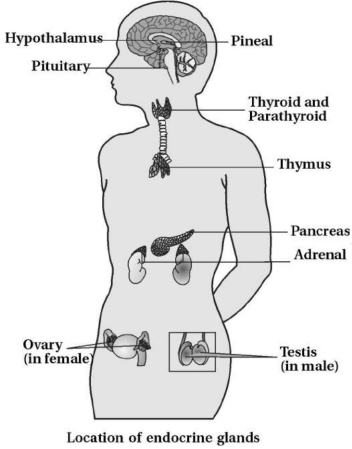
Provide brief information about the location and names of endocrine glands in humans.
Solution
(N/A) The endocrine glands and hormone-producing diffused tissues/cells located in different parts of our body constitute the endocrine system.
The organized endocrine glands in our body include the pituitary,pineal,thyroid,adrenal,pancreas,parathyroid,thymus,and gonads (testis in males and ovary in females).
Besides these,some other organs,such as the gastrointestinal tract,liver,kidney,and heart,also produce hormones.
The organized endocrine glands in our body include the pituitary,pineal,thyroid,adrenal,pancreas,parathyroid,thymus,and gonads (testis in males and ovary in females).
Besides these,some other organs,such as the gastrointestinal tract,liver,kidney,and heart,also produce hormones.
0 likes
View Solution76
Medium
Mention the names of the endocrine glands present in humans.
Solution
(N/A) The organized endocrine glands present in the human body include the pituitary,pineal,thyroid,adrenal,pancreas,parathyroid,thymus,and gonads (testis in males and ovary in females).
0 likes
View Solution77
Medium
Draw a labeled diagram showing the location of endocrine glands in the human body.
Solution
(N/A) The endocrine system consists of various glands that secrete hormones directly into the bloodstream. The major endocrine glands and their locations are as follows:
$1$. Hypothalamus: Located in the forebrain.
$2$. Pineal gland: Located on the dorsal side of the forebrain.
$3$. Pituitary gland: Located in the sella turcica of the sphenoid bone in the skull.
$4$. Thyroid and Parathyroid glands: Located on the ventral side of the trachea in the neck region.
$5$. Thymus: Located between the lungs behind the sternum.
$6$. Adrenal glands: Located on the anterior part of each kidney.
$7$. Pancreas: Located behind the stomach.
$8$. Gonads (Ovary in females and Testis in males): Located in the pelvic region.
$1$. Hypothalamus: Located in the forebrain.
$2$. Pineal gland: Located on the dorsal side of the forebrain.
$3$. Pituitary gland: Located in the sella turcica of the sphenoid bone in the skull.
$4$. Thyroid and Parathyroid glands: Located on the ventral side of the trachea in the neck region.
$5$. Thymus: Located between the lungs behind the sternum.
$6$. Adrenal glands: Located on the anterior part of each kidney.
$7$. Pancreas: Located behind the stomach.
$8$. Gonads (Ovary in females and Testis in males): Located in the pelvic region.
0 likes
View Solution78
Easy
Identify the location and primary function of the following: $(1)$ Prolactin,$(2)$ $ADH$,$(3)$ Pineal gland.
Solution
(N/A) $(1)$ Prolactin: Located in the anterior pituitary gland. Its primary function is to regulate the growth of mammary glands and milk production in mammals.
$(2)$ $ADH$ (Antidiuretic Hormone/Vasopressin): Synthesized by the hypothalamus and stored/released by the posterior pituitary gland. Its primary function is to stimulate the reabsorption of water and electrolytes by the distal tubules of the kidney,thereby reducing water loss through urine.
$(3)$ Pineal gland: Located on the dorsal side of the forebrain. Its primary function is to secrete melatonin,which plays a crucial role in regulating the $24-$hour (diurnal) rhythm of our body,such as the sleep-wake cycle and body temperature.
$(2)$ $ADH$ (Antidiuretic Hormone/Vasopressin): Synthesized by the hypothalamus and stored/released by the posterior pituitary gland. Its primary function is to stimulate the reabsorption of water and electrolytes by the distal tubules of the kidney,thereby reducing water loss through urine.
$(3)$ Pineal gland: Located on the dorsal side of the forebrain. Its primary function is to secrete melatonin,which plays a crucial role in regulating the $24-$hour (diurnal) rhythm of our body,such as the sleep-wake cycle and body temperature.
0 likes
View Solution79
Easy
Identify the location of secretion and the primary function for the following hormones:
$(1)$ Relaxin
$(2)$ Thyrocalcitonin
$(1)$ Relaxin
$(2)$ Thyrocalcitonin
Solution
(N/A) $(1)$ Relaxin:
- Location: It is secreted by the corpus luteum (in the ovary) and the placenta during pregnancy.
- Function: It facilitates parturition by relaxing the pelvic ligaments and softening the cervix.
$(2)$ Thyrocalcitonin $(TCT)$:
- Location: It is secreted by the parafollicular cells ($C$-cells) of the thyroid gland.
- Function: It regulates blood calcium levels by lowering them,acting as an antagonist to the Parathyroid Hormone $(PTH)$.
- Location: It is secreted by the corpus luteum (in the ovary) and the placenta during pregnancy.
- Function: It facilitates parturition by relaxing the pelvic ligaments and softening the cervix.
$(2)$ Thyrocalcitonin $(TCT)$:
- Location: It is secreted by the parafollicular cells ($C$-cells) of the thyroid gland.
- Function: It regulates blood calcium levels by lowering them,acting as an antagonist to the Parathyroid Hormone $(PTH)$.
0 likes
View Solution80
Medium
Correct the following statements by replacing the incorrect terms:
$(a)$ Insulin is a steroid hormone.
$(b)$ $TSH$ is secreted from the corpus luteum.
$(c)$ Tetraiodothyronine is an emergency hormone.
$(d)$ The pineal gland is located on the anterior part of the kidney.
$(a)$ Insulin is a steroid hormone.
$(b)$ $TSH$ is secreted from the corpus luteum.
$(c)$ Tetraiodothyronine is an emergency hormone.
$(d)$ The pineal gland is located on the anterior part of the kidney.
Solution
(A) Insulin is a peptide hormone.
$(b)$ $TSH$ is secreted by the pars distalis of the pituitary gland.
$(c)$ Adrenaline is an emergency hormone.
$(d)$ The adrenal gland is located on the anterior part of the kidney.
$(b)$ $TSH$ is secreted by the pars distalis of the pituitary gland.
$(c)$ Adrenaline is an emergency hormone.
$(d)$ The adrenal gland is located on the anterior part of the kidney.
0 likes
View Solution81
Medium
Complete the following analogy-based questions:
$1$. Hyperglycemia : Diabetes Mellitus :: Beta cells : ....
$2$. Excess Growth Hormone : Gigantism :: Low secretion : .......
$3$. Pineal gland : Melatonin :: Somatostatin : .....
$1$. Hyperglycemia : Diabetes Mellitus :: Beta cells : ....
$2$. Excess Growth Hormone : Gigantism :: Low secretion : .......
$3$. Pineal gland : Melatonin :: Somatostatin : .....
Solution
(A) $1$. Hyperglycemia is caused by a deficiency of insulin,which is secreted by the Beta cells of the Islets of Langerhans. Therefore,the analogy relates the condition to the source of the hormone. The answer is Insulin.
$2$. Excess growth hormone leads to Gigantism. Conversely,low secretion of growth hormone during childhood leads to Dwarfism (or stunted growth).
$3$. The Pineal gland secretes Melatonin. Somatostatin is a hormone secreted by the Hypothalamus (it inhibits the release of growth hormone from the anterior pituitary).
$2$. Excess growth hormone leads to Gigantism. Conversely,low secretion of growth hormone during childhood leads to Dwarfism (or stunted growth).
$3$. The Pineal gland secretes Melatonin. Somatostatin is a hormone secreted by the Hypothalamus (it inhibits the release of growth hormone from the anterior pituitary).
0 likes
View Solution82
MediumMCQ
Identify the odd one out from the following.
A
Testosterone
B
Estrogen
C
Progesterone
D
Relaxin
Solution
(A) The correct answer is $A$.
$Testosterone$ is a male sex hormone (androgen) produced primarily by the testes.
$Estrogen$,$Progesterone$,and $Relaxin$ are female sex hormones.
$Estrogen$ and $Progesterone$ are produced by the ovaries,and $Relaxin$ is also produced by the ovaries and placenta during pregnancy.
Therefore,$Testosterone$ is the odd one out as it is the only male hormone listed.
$Testosterone$ is a male sex hormone (androgen) produced primarily by the testes.
$Estrogen$,$Progesterone$,and $Relaxin$ are female sex hormones.
$Estrogen$ and $Progesterone$ are produced by the ovaries,and $Relaxin$ is also produced by the ovaries and placenta during pregnancy.
Therefore,$Testosterone$ is the odd one out as it is the only male hormone listed.
0 likes
View Solution83
MediumMCQ
Select the odd one out.
A
Ovary
B
Testis
C
Adrenal
D
Placenta
Solution
(C) The $Ovary$, $Testis$, and $Placenta$ are organs directly involved in the reproductive system of humans.
$Ovary$ and $Testis$ are primary sex organs (gonads) responsible for gamete production and hormone secretion.
$Placenta$ is a temporary endocrine organ formed during pregnancy to support the fetus.
$Adrenal$ gland is an endocrine gland located above the kidneys, which is part of the endocrine system and not directly part of the reproductive system.
$Ovary$ and $Testis$ are primary sex organs (gonads) responsible for gamete production and hormone secretion.
$Placenta$ is a temporary endocrine organ formed during pregnancy to support the fetus.
$Adrenal$ gland is an endocrine gland located above the kidneys, which is part of the endocrine system and not directly part of the reproductive system.
0 likes
View Solution84
MediumMCQ
Which gland in mammals secretes a scent-producing secretion?
A
Bartholin's gland
B
Prostate gland
C
Perineal gland
D
Liver
Solution
(C) The $Perineal$ $gland$ (also known as the $Anal$ $gland$) is responsible for secreting scent-producing substances in many mammals.
These secretions are often used for territorial marking,communication,and attracting mates.
$Bartholin's$ $glands$ are involved in lubrication in females.
$Prostate$ $glands$ contribute to seminal fluid.
The $Liver$ is a digestive organ and does not produce scent secretions.
These secretions are often used for territorial marking,communication,and attracting mates.
$Bartholin's$ $glands$ are involved in lubrication in females.
$Prostate$ $glands$ contribute to seminal fluid.
The $Liver$ is a digestive organ and does not produce scent secretions.
0 likes
View Solution85
MediumMCQ
The secretions of endocrine glands are released directly
A
into the skin surface
B
into the blood stream
C
into a gland duct
D
into the brain tissue
Solution
(B) On the basis of the mode of secretion,glands are divided into $(a)$ exocrine and $(b)$ endocrine glands.
Exocrine glands secrete substances like mucus,saliva,oil,and digestive enzymes,which are released through ducts or tubes.
In contrast,endocrine glands are ductless glands.
Their products,known as hormones,are secreted directly into the fluid bathing the gland,which then enters the blood stream to reach target organs.
Exocrine glands secrete substances like mucus,saliva,oil,and digestive enzymes,which are released through ducts or tubes.
In contrast,endocrine glands are ductless glands.
Their products,known as hormones,are secreted directly into the fluid bathing the gland,which then enters the blood stream to reach target organs.
0 likes
View Solution86
MediumMCQ
The general function of a gland is to
A
protect the body.
B
control the function of epithelial tissues.
C
produce and secrete specialized compounds to control and maintain different body functions.
D
help to maintain blood pressure and nerve actions.
Solution
(C) gland is an organ in the human or animal body that synthesizes and secretes specific chemical substances,such as hormones,enzymes,or mucus,for use within the body or for discharge into the external environment. These secretions are essential for regulating and maintaining various physiological processes.
0 likes
View Solution87
MediumMCQ
The chemical messengers produced in ductless glands are:
A
Vitamins
B
Lipids
C
Antibiotics
D
Hormones
Solution
(D) Hormones are chemical messengers produced by endocrine glands,which are ductless glands.
These substances are secreted directly into the bloodstream.
Once in the blood,they are transported to various target organs throughout the body,where they regulate diverse metabolic functions and physiological processes.
These substances are secreted directly into the bloodstream.
Once in the blood,they are transported to various target organs throughout the body,where they regulate diverse metabolic functions and physiological processes.
0 likes
View Solution88
EasyMCQ
Vitamin-$D$ is produced in the human body in
A
Muscles
B
Nerves
C
Skin
D
Bone-marrow
Solution
(C) Vitamin-$D$ is a fat-soluble vitamin. It is synthesized in the skin when it is exposed to ultraviolet $(UV)$ rays from sunlight. The $UV$ radiation converts $7$-dehydrocholesterol present in the skin into cholecalciferol (Vitamin-$D_3$).
0 likes
View Solution89
MediumMCQ
Identify which of the following are major endocrine glands?
$I$. Liver $II$. Gastric gland $III$. Pituitary gland $IV$. Thyroid
Choose the correct option.
$I$. Liver $II$. Gastric gland $III$. Pituitary gland $IV$. Thyroid
Choose the correct option.
A
$I$ and $II$
B
$III$ and $IV$
C
$I$ and $IV$
D
$II$ and $IV$
Solution
(B) Endocrine glands are ductless glands that secrete hormones directly into the bloodstream.
$I$. Liver is an accessory digestive organ and a gland,but it is not primarily an endocrine gland.
$II$. Gastric glands are exocrine glands located in the stomach lining that secrete gastric juice.
$III$. Pituitary gland is a major endocrine gland located at the base of the brain.
$IV$. Thyroid is a major endocrine gland located in the neck.
Therefore,$III$ and $IV$ are the major endocrine glands.
$I$. Liver is an accessory digestive organ and a gland,but it is not primarily an endocrine gland.
$II$. Gastric glands are exocrine glands located in the stomach lining that secrete gastric juice.
$III$. Pituitary gland is a major endocrine gland located at the base of the brain.
$IV$. Thyroid is a major endocrine gland located in the neck.
Therefore,$III$ and $IV$ are the major endocrine glands.
0 likes
View Solution90
EasyMCQ
Which of the following is the largest gland in an adult man?
A
Thymus
B
Liver
C
Thyroid
D
Pancreas
Solution
(B) $Liver$ is endodermal in origin and is the largest gland in the human body.
It acts as the busiest and largest chemical factory in the body.
It acts as the busiest and largest chemical factory in the body.
0 likes
View Solution91
MediumMCQ
Endocrine glands are
A
Ductless glands whose secretions pour directly into blood
B
Have ducts and pour their secretions into blood directly
C
Have ducts which straightway pour secretions into target organs
D
All of the above
Solution
(A) Endocrine glands are also known as ductless glands.
They do not possess any ducts to transport their secretions (hormones).
Instead,their secretions are poured directly into the surrounding blood circulation.
From the blood,these hormones are transported to specific target organs to initiate particular metabolic changes.
They do not possess any ducts to transport their secretions (hormones).
Instead,their secretions are poured directly into the surrounding blood circulation.
From the blood,these hormones are transported to specific target organs to initiate particular metabolic changes.
0 likes
View Solution92
EasyMCQ
Heterocrine glands are the glands,which
A
Work as exocrine glands
B
Work as endocrine glands
C
Have dual (exo and endocrine) mode of function
D
Are present in the hypothalamus region of brain
Solution
(C) Heterocrine glands,also known as mixed glands,are those that possess both exocrine and endocrine functions.
An exocrine gland secretes its products into ducts,while an endocrine gland is ductless and secretes hormones directly into the bloodstream.
$A$ classic example of a heterocrine gland is the pancreas,which secretes digestive enzymes (exocrine) and hormones like insulin and glucagon (endocrine).
An exocrine gland secretes its products into ducts,while an endocrine gland is ductless and secretes hormones directly into the bloodstream.
$A$ classic example of a heterocrine gland is the pancreas,which secretes digestive enzymes (exocrine) and hormones like insulin and glucagon (endocrine).
0 likes
View Solution93
EasyMCQ
Which one of the following is not an endocrine gland?
A
Kidney
B
Thyroid
C
Adrenal
D
Pituitary
Solution
(A) The thyroid gland,adrenal gland,and pituitary gland are classified as endocrine glands because they secrete hormones directly into the bloodstream.
In contrast,the kidney is primarily an excretory organ responsible for filtering blood and producing urine,although it does produce some hormones like erythropoietin,it is not categorized as an endocrine gland in the classical sense.
In contrast,the kidney is primarily an excretory organ responsible for filtering blood and producing urine,although it does produce some hormones like erythropoietin,it is not categorized as an endocrine gland in the classical sense.
0 likes
View Solution94
MediumMCQ
Identify the correctly matched pairs of endocrine glands, their hormones, and their associated deficiency disorders from the table below:
| $I$. Neurohypophysis | Vasopressin | Diabetes insipidus |
| $II$. Adrenal Cortex | Corticosteroids | Addison's disease |
| $III$. Parathyroid glands | Parathormone | Myxoedema |
| $IV$. Thyroid gland | Calcitonin | Acromegaly |
A
$II$ and $III$
B
$I$ and $II$
C
$III$ and $IV$
D
$I$ and $IV$
Solution
(B) $1$. $I$. Neurohypophysis secretes Vasopressin (or $ADH$). Its deficiency leads to Diabetes insipidus, which is characterized by the excretion of dilute urine due to reduced water reabsorption in the renal tubules. This is a correct match.
$2$. $II$. Adrenal cortex secretes corticosteroids. Its hyposecretion leads to Addison's disease, a condition of chronic adrenal insufficiency. This is a correct match.
$3$. $III$. Parathyroid glands secrete Parathormone. Its deficiency leads to Tetany (characterized by low blood calcium levels causing muscle spasms), not Myxoedema. Myxoedema is caused by hypothyroidism. This is an incorrect match.
$4$. $IV$. Thyroid gland secretes Calcitonin. Its deficiency does not cause Acromegaly. Acromegaly is caused by the hypersecretion of Growth Hormone $(GH)$ in adults. This is an incorrect match.
Therefore, the correctly matched pairs are $I$ and $II$.
$2$. $II$. Adrenal cortex secretes corticosteroids. Its hyposecretion leads to Addison's disease, a condition of chronic adrenal insufficiency. This is a correct match.
$3$. $III$. Parathyroid glands secrete Parathormone. Its deficiency leads to Tetany (characterized by low blood calcium levels causing muscle spasms), not Myxoedema. Myxoedema is caused by hypothyroidism. This is an incorrect match.
$4$. $IV$. Thyroid gland secretes Calcitonin. Its deficiency does not cause Acromegaly. Acromegaly is caused by the hypersecretion of Growth Hormone $(GH)$ in adults. This is an incorrect match.
Therefore, the correctly matched pairs are $I$ and $II$.
0 likes
View Solution95
MediumMCQ
Significant role in calcium balance in the body is performed by
$I$. $PTH$
$II$. $T_{4}$ and $T_{3}$
$III$. $TCT$
The correct option is
$I$. $PTH$
$II$. $T_{4}$ and $T_{3}$
$III$. $TCT$
The correct option is
A
$I$ and $II$
B
$II$ and $III$
C
$I$ and $III$
D
$I, II$ and $III$
Solution
(C) The calcium balance in the human body is primarily regulated by two hormones:
$1$. Parathyroid hormone $(PTH)$: Secreted by the parathyroid gland,it increases blood calcium levels.
$2$. Thyrocalcitonin $(TCT)$: Secreted by the thyroid gland,it decreases blood calcium levels.
$T_{3}$ (triiodothyronine) and $T_{4}$ (thyroxine) are thyroid hormones primarily involved in regulating the basal metabolic rate and do not play a direct role in calcium homeostasis.
Therefore,$I$ and $III$ are the correct components.
$1$. Parathyroid hormone $(PTH)$: Secreted by the parathyroid gland,it increases blood calcium levels.
$2$. Thyrocalcitonin $(TCT)$: Secreted by the thyroid gland,it decreases blood calcium levels.
$T_{3}$ (triiodothyronine) and $T_{4}$ (thyroxine) are thyroid hormones primarily involved in regulating the basal metabolic rate and do not play a direct role in calcium homeostasis.
Therefore,$I$ and $III$ are the correct components.
0 likes
View Solution96
MediumMCQ
Which one of the following pairs correctly matches a hormone with a disease resulting from its deficiency?
A
Luteinizing hormone - Failure of ovulation
B
Insulin - Diabetes insipidus
C
Thyroxine - Tetany
D
Parathyroid hormone - Diabetes mellitus
Solution
(A) The correct match is $A$. Luteinizing hormone $(LH)$ is essential for the process of ovulation in females. Its deficiency leads to the failure of ovulation.
$B$ is incorrect because insulin deficiency causes Diabetes mellitus,not Diabetes insipidus (which is caused by $ADH$ deficiency).
$C$ is incorrect because Tetany is caused by the deficiency of Parathyroid hormone,not Thyroxine.
$D$ is incorrect because Diabetes mellitus is caused by insulin deficiency,not Parathyroid hormone deficiency.
$B$ is incorrect because insulin deficiency causes Diabetes mellitus,not Diabetes insipidus (which is caused by $ADH$ deficiency).
$C$ is incorrect because Tetany is caused by the deficiency of Parathyroid hormone,not Thyroxine.
$D$ is incorrect because Diabetes mellitus is caused by insulin deficiency,not Parathyroid hormone deficiency.
0 likes
View Solution97
MediumMCQ
The ductless glands:
A
Produce non-nutrient intercellular messengers
B
Found only in non-chordates
C
Are absent in human body
D
Are called exocrine glands
Solution
(A) Ductless glands are known as endocrine glands.
These glands secrete hormones,which are defined as:
$1$. Non-nutrient chemicals.
$2$. Intercellular messengers.
$3$. Produced in trace amounts.
Therefore,option $A$ is the correct statement.
These glands secrete hormones,which are defined as:
$1$. Non-nutrient chemicals.
$2$. Intercellular messengers.
$3$. Produced in trace amounts.
Therefore,option $A$ is the correct statement.
0 likes
View Solution98
MediumMCQ
The two glands located in the neck region are
A
Thyroid gland and parathyroid gland
B
Pituitary gland and pineal gland
C
Adrenal gland and thymus
D
Pineal gland and thyroid gland
Solution
(A)
The $thyroid$ gland is situated on either side of the trachea in the neck region. The $parathyroid$ glands are present on the dorsal side of the $thyroid$ gland. Therefore, both are located in the neck region.
| Gland | Location |
|---|---|
| $Thyroid$ and $parathyroid$ gland | Neck region |
| $Pituitary$ gland and $pineal$ gland | Brain |
| $Adrenal$ gland | Above the kidney |
| $Thymus$ gland | Dorsal surface of the heart |
The $thyroid$ gland is situated on either side of the trachea in the neck region. The $parathyroid$ glands are present on the dorsal side of the $thyroid$ gland. Therefore, both are located in the neck region.
0 likes
View Solution99
MediumMCQ
If $X$ is a hormone which controls the carbohydrate metabolism in the body and $Y$ is a hormone which controls the secretion of $X$,then $X$ and $Y$ are
A
Insulin and somatotrophin
B
Aldosterone and growth hormone
C
Glucocorticoid and $ACTH$ respectively
D
Glucocorticoid and $GHRH$
Solution
(C) Carbohydrate metabolism is primarily regulated by glucocorticoids (such as cortisol) released by the adrenal cortex of the adrenal gland.
The secretion of glucocorticoids is stimulated by the Adrenocorticotropic hormone $(ACTH)$,which is secreted by the anterior pituitary gland.
Therefore,$X$ is a glucocorticoid and $Y$ is $ACTH$.
Other options are incorrect because insulin regulates blood glucose levels but is not controlled by $ACTH$,and aldosterone regulates electrolyte balance rather than carbohydrate metabolism.
The secretion of glucocorticoids is stimulated by the Adrenocorticotropic hormone $(ACTH)$,which is secreted by the anterior pituitary gland.
Therefore,$X$ is a glucocorticoid and $Y$ is $ACTH$.
Other options are incorrect because insulin regulates blood glucose levels but is not controlled by $ACTH$,and aldosterone regulates electrolyte balance rather than carbohydrate metabolism.
0 likes
View Solution100
MediumMCQ
$X \stackrel{GnRH}{\longrightarrow} Y \stackrel{LH}{\longrightarrow} Z$
The glands which are represented as $X$,$Y$ and $Z$ are
The glands which are represented as $X$,$Y$ and $Z$ are
A
Pituitary gland,ovary and testis,respectively
B
Hypothalamus,adrenal gland and liver,respectively
C
Hypothalamus,pituitary gland and testis/ovary,respectively
D
Pituitary gland,thyroid gland and parathyroid gland,respectively
Solution
(C) The $GnRH$ (Gonadotropin-Releasing Hormone) is secreted by the hypothalamus $(X)$.
This hormone acts on the anterior pituitary gland $(Y)$ to stimulate the release of gonadotropins,specifically $LH$ (Luteinizing Hormone) and $FSH$.
$LH$ then acts on the gonads,which are the testes in males or ovaries in females $(Z)$,to stimulate the production of sex hormones.
This hormone acts on the anterior pituitary gland $(Y)$ to stimulate the release of gonadotropins,specifically $LH$ (Luteinizing Hormone) and $FSH$.
$LH$ then acts on the gonads,which are the testes in males or ovaries in females $(Z)$,to stimulate the production of sex hormones.
0 likes
View SolutionChemical Coordination and Integration — Different glands and their hormones · Frequently Asked Questions
1Are these Chemical Coordination and Integration questions useful for JEE and NEET?
Yes. All questions in this section are mapped to JEE Main and NEET exam patterns. Previous year questions from JEE Main, NEET, GUJCET and state-level exams are included with full solutions.
2Can I switch to Hindi or Gujarati for these questions?
Yes. Use the language tabs in the hero section or the sidebar to view the same questions and solutions in English, Hindi or Gujarati.
3How do I generate a question paper from this subtopic?
Use the Vedclass Exam Paper Generator — select the chapter and subtopic, set difficulty, and generate Sets A, B, C, D automatically. First 3 chapters of every subject are free.
Vedclass Products
For Students
Vedclass Test Series
Mock tests in real JEE/NEET style with performance analysis. 5-day free trial.
Start Free TrialFor Teachers
Exam Paper Generator
Generate Set A/B/C/D papers from this chapter in 2 minutes. 3 chapters free.
Try FreeFor Institutes
Online Exam Module
Live online exams with unlimited students, 360° analytics & white-label branding.
See DemoFor Teachers & Institutes
Generate a Chemical Coordination and Integration Exam Paper in 2 Minutes
Select subtopic & difficulty — Sets A, B, C, D auto-generated with No Repeat logic.
First 3 chapters of every subject are free — no payment required.