
A English
Adrenal Gland Questions in English
Class 11 Biology · Chemical Coordination and Integration · Adrenal Gland
191+
Questions
English
Language
100%
With Solutions
Showing 41 of 191 questions in English
151
MediumMCQ
Conn's syndrome happens due to
A
Hyposecretion of aldosterone
B
Hypersecretion of aldosterone
C
Hypersecretion of cortisol
D
Hyposecretion of cortisol
Solution
(B) Conn's syndrome,also known as primary aldosteronism,is caused by the hypersecretion of the mineralocorticoid hormone aldosterone,typically due to an adrenal cortical tumor.
It is characterized by:
$(i)$ An increase in blood volume and blood pressure.
$(ii)$ Muscular weakness.
$(iii)$ High $Na^+$ and low $K^+$ levels in the blood plasma,which can lead to kidney damage,polyuria,tetany,and metabolic disorders.
It is characterized by:
$(i)$ An increase in blood volume and blood pressure.
$(ii)$ Muscular weakness.
$(iii)$ High $Na^+$ and low $K^+$ levels in the blood plasma,which can lead to kidney damage,polyuria,tetany,and metabolic disorders.
0 likes
View Solution152
MediumMCQ
$I$. Increase of heart beat
$II$. Increase of respiration rate
$III$. Stimulate breakdown of glycogen
$IV$. Stimulate breakdown of lipid and protein
Which hormone is responsible for the features mentioned above?
$II$. Increase of respiration rate
$III$. Stimulate breakdown of glycogen
$IV$. Stimulate breakdown of lipid and protein
Which hormone is responsible for the features mentioned above?
A
$PTH$
B
$TCT$
C
Thymosin
D
Catecholamine
Solution
(D) Noradrenaline and adrenaline,commonly known as catecholamines,control the mentioned activities.
The physiological effects of adrenaline and noradrenaline include:
$(i)$ Increase in blood pressure.
$(ii)$ Increase in basal metabolic rate.
$(iii)$ Increase in respiration rate.
$(iv)$ Increase in blood sugar level (by stimulating glycogen breakdown).
$(v)$ Lipolysis (breakdown of lipids) and proteolysis (breakdown of proteins).
The physiological effects of adrenaline and noradrenaline include:
$(i)$ Increase in blood pressure.
$(ii)$ Increase in basal metabolic rate.
$(iii)$ Increase in respiration rate.
$(iv)$ Increase in blood sugar level (by stimulating glycogen breakdown).
$(v)$ Lipolysis (breakdown of lipids) and proteolysis (breakdown of proteins).
0 likes
View Solution153
MediumMCQ
Small amount of $A$ steroids are also secreted by $B$ cortex which play a role in the growth of axial hair, pubic hair, and facial hair during puberty.
Choose the correct combination for $A$ and $B$.
Choose the correct combination for $A$ and $B$.
A
$A-glucocorticoids; B-adrenal$
B
$A-androgenic; B-adrenal$
C
$A-mineralocorticoids; B-adrenal$
D
$A-cortisol; B-adrenal$
Solution
(B) The adrenal cortex secretes three main types of hormones: glucocorticoids, mineralocorticoids, and sex corticoids (androgens).
The adrenal cortex produces small amounts of androgenic steroids.
These androgens play a significant role in the growth of axial hair, pubic hair, and facial hair during puberty.
Therefore, $A$ is androgenic and $B$ is adrenal.
The adrenal cortex produces small amounts of androgenic steroids.
These androgens play a significant role in the growth of axial hair, pubic hair, and facial hair during puberty.
Therefore, $A$ is androgenic and $B$ is adrenal.
0 likes
View Solution154
MediumMCQ
Which of the following hormones have a direct effect on $BP$ (Blood Pressure)?
$I.$ Thymosin
$II.$ $PRL$
$III.$ $MSH$
$IV.$ Adrenaline
$V.$ Noradrenaline
Select the option containing the correct pair.
$I.$ Thymosin
$II.$ $PRL$
$III.$ $MSH$
$IV.$ Adrenaline
$V.$ Noradrenaline
Select the option containing the correct pair.
A
$I$ and $II$
B
$III$ and $IV$
C
$IV$ and $V$
D
$I$ and $IV$
Solution
(C) Adrenaline and noradrenaline are hormones secreted by the adrenal medulla.
They are known as catecholamines.
These hormones have a direct effect on several physiological processes,including:
$(i)$ Increasing blood pressure $(BP)$
$(ii)$ Increasing the basal metabolic rate
$(iii)$ Increasing the respiration rate
$(iv)$ Increasing blood sugar levels (glycogenolysis)
$(v)$ Stimulating lipolysis (breakdown of lipids)
Therefore,$IV$ (Adrenaline) and $V$ (Noradrenaline) are the correct hormones that directly affect blood pressure.
They are known as catecholamines.
These hormones have a direct effect on several physiological processes,including:
$(i)$ Increasing blood pressure $(BP)$
$(ii)$ Increasing the basal metabolic rate
$(iii)$ Increasing the respiration rate
$(iv)$ Increasing blood sugar levels (glycogenolysis)
$(v)$ Stimulating lipolysis (breakdown of lipids)
Therefore,$IV$ (Adrenaline) and $V$ (Noradrenaline) are the correct hormones that directly affect blood pressure.
0 likes
View Solution155
MediumMCQ
Tyrosine is the precursor of
A
Adrenaline
B
Noradrenaline
C
Testosterone
D
Both $(a)$ and $(b)$
Solution
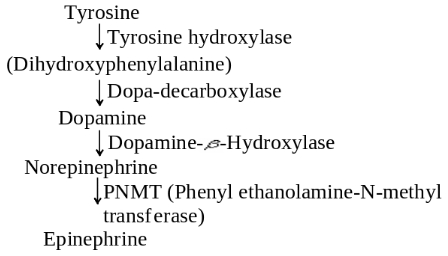
(D) Tyrosine is an amino acid that serves as the precursor for the synthesis of catecholamines,which include dopamine,norepinephrine (noradrenaline),and epinephrine (adrenaline).
The biosynthetic pathway is as follows:
Tyrosine $\rightarrow$ Dihydroxyphenylalanine $(DOPA)$ $\rightarrow$ Dopamine $\rightarrow$ Norepinephrine $\rightarrow$ Epinephrine.
Since both adrenaline (epinephrine) and noradrenaline (norepinephrine) are derived from tyrosine,the correct answer is both $(a)$ and $(b)$.
The biosynthetic pathway is as follows:
Tyrosine $\rightarrow$ Dihydroxyphenylalanine $(DOPA)$ $\rightarrow$ Dopamine $\rightarrow$ Norepinephrine $\rightarrow$ Epinephrine.
Since both adrenaline (epinephrine) and noradrenaline (norepinephrine) are derived from tyrosine,the correct answer is both $(a)$ and $(b)$.
0 likes
View Solution156
EasyMCQ
$ACTH$ controls the secretion of
A
Insulin
B
Norepinephrine
C
Epinephrine
D
Glucocorticoids
Solution
(D) $ACTH$ (Adrenocorticotropic hormone) controls the secretion of glucocorticoid hormones from the adrenal cortex.
$ACTH$ acts by binding to specific receptors located primarily on the cells of the adrenal cortex.
Epinephrine and norepinephrine are secreted by the adrenal medulla.
Insulin is secreted by the pancreas.
$ACTH$ acts by binding to specific receptors located primarily on the cells of the adrenal cortex.
Epinephrine and norepinephrine are secreted by the adrenal medulla.
Insulin is secreted by the pancreas.
0 likes
View Solution157
MediumMCQ
Which hormone is secreted during an allergy?
A
Glucocorticoid
B
Mineralocorticoid
C
Insulin
D
Thyroxine
Solution
(A) Glucocorticoids are a class of steroid hormones secreted by the adrenal cortex.
They play a crucial role in suppressing the immune system and reducing inflammation.
During an allergic reaction,the body releases various inflammatory mediators.
Glucocorticoids (such as cortisol) are released to counteract these inflammatory responses,acting as potent anti-inflammatory agents.
They play a crucial role in suppressing the immune system and reducing inflammation.
During an allergic reaction,the body releases various inflammatory mediators.
Glucocorticoids (such as cortisol) are released to counteract these inflammatory responses,acting as potent anti-inflammatory agents.
0 likes
View Solution158
EasyMCQ
Deficiency of the adrenal cortex activity leads to
A
Cushing's disease
B
Conn's syndrome
C
Addison's disease
D
Simmond's disease
Solution
(C) Addison's disease is caused by the hyposecretion of hormones from the adrenal cortex. This condition results in a deficiency of glucocorticoids and mineralocorticoids,leading to symptoms such as fatigue,weight loss,and low blood pressure.
0 likes
View Solution159
MediumMCQ
One of the following symptoms pertains to Addison's disease.
A
Low plasma $Na^+$,high plasma $K^+$,increased urinary $Na^+$,low blood sugar,vomiting,nausea,and diarrhea.
B
High blood sugar,obesity,wasting of limb muscles,fall in plasma $K^+$,high blood $Na^+$,rise in blood volume,and high blood pressure.
C
Stunted growth,retarded sexual development,mental backwardness.
D
Increase of heart beat,rise in blood pressure,nervousness,bulging eyes,warm skin.
Solution
(A) Addison's disease is caused by the destruction of the adrenal cortex,leading to a deficiency of both glucocorticoids and mineralocorticoids.
$1$. Mineralocorticoids (like aldosterone) normally increase blood levels of $Na^+$ and water while promoting the excretion of $K^+$. Deficiency leads to low plasma $Na^+$,high plasma $K^+$,and increased urinary $Na^+$ excretion.
$2$. Glucocorticoids are essential for maintaining blood glucose levels. Their deficiency results in low blood sugar (hypoglycemia).
$3$. The electrolyte imbalance and metabolic disturbances lead to clinical symptoms such as vomiting,nausea,and diarrhea.
Therefore,option $A$ correctly describes the symptoms associated with Addison's disease.
$1$. Mineralocorticoids (like aldosterone) normally increase blood levels of $Na^+$ and water while promoting the excretion of $K^+$. Deficiency leads to low plasma $Na^+$,high plasma $K^+$,and increased urinary $Na^+$ excretion.
$2$. Glucocorticoids are essential for maintaining blood glucose levels. Their deficiency results in low blood sugar (hypoglycemia).
$3$. The electrolyte imbalance and metabolic disturbances lead to clinical symptoms such as vomiting,nausea,and diarrhea.
Therefore,option $A$ correctly describes the symptoms associated with Addison's disease.
0 likes
View Solution160
MediumMCQ
Adrenal virilism results due to
A
Poor secretion of sex corticoids
B
Excess secretion of sex corticoids
C
Excess secretion of aldosterone
D
Poor secretion of aldosterone
Solution
(B) Adrenal virilism is caused by the excessive secretion of sex corticoids (androgens) released by the $zona$ $reticulata$ of the adrenal cortex.
Symptoms: It leads to the development of male-type external secondary sexual characteristics in women,such as the growth of facial hair (beard and moustaches) and a deepening of the voice.
Symptoms: It leads to the development of male-type external secondary sexual characteristics in women,such as the growth of facial hair (beard and moustaches) and a deepening of the voice.
0 likes
View Solution161
MediumMCQ
Secretion of aldosterone in birds,man and other mammals is stimulated by
A
Fall in concentration of $Na^+$ in blood plasma
B
Rise in concentration of $K^+$ in blood plasma
C
Both $(a)$ & $(b)$
D
Fall in $Ca^{++}$ concentration in blood plasma
Solution
(C) Aldosterone is a mineralocorticoid hormone secreted by the adrenal cortex. Its primary function is to regulate electrolyte balance by promoting the reabsorption of $Na^+$ and water from the distal convoluted tubules and collecting ducts of the nephrons,while simultaneously promoting the excretion of $K^+$. The secretion of aldosterone is stimulated by two main factors: $(1)$ $A$ decrease in the concentration of $Na^+$ in the blood plasma,which is often detected via the Renin-Angiotensin-Aldosterone System $(RAAS)$,and $(2)$ An increase in the concentration of $K^+$ in the blood plasma,which directly acts on the adrenal cortex to trigger aldosterone release. Therefore,both factors contribute to the stimulation of its secretion.
0 likes
View Solution162
MediumMCQ
$A$ patient who excretes a large quantity of sodium in urine has:
A
Diseased adrenal medulla
B
Diseased adrenal cortex
C
Diseased pancreas
D
Diseased thymus
Solution
(B) The adrenal cortex secretes mineralocorticoids,primarily aldosterone,which regulate electrolyte balance.
These hormones increase $Na^+$ reabsorption and $K^+$ excretion in the renal tubules.
If the adrenal cortex is diseased,it leads to a deficiency of these hormones.
Consequently,$Na^+$ is not reabsorbed efficiently and is excreted in large quantities in the urine.
These hormones increase $Na^+$ reabsorption and $K^+$ excretion in the renal tubules.
If the adrenal cortex is diseased,it leads to a deficiency of these hormones.
Consequently,$Na^+$ is not reabsorbed efficiently and is excreted in large quantities in the urine.
0 likes
View Solution163
EasyMCQ
The hormone produced during emotional stress is
A
Melatonin
B
Thyroxine
C
Calcitonin
D
Adrenaline
Solution
(D) Adrenaline,also known as epinephrine,is a hormone secreted by the adrenal medulla in response to stress,fear,or excitement. It is often referred to as the 'fight-or-flight' hormone because it prepares the body for immediate physical action.
0 likes
View Solution164
MediumMCQ
$A$ : Our body secretes adrenaline in intense cold.
$R$ : Adrenaline raises metabolic rate.
$R$ : Adrenaline raises metabolic rate.
A
Assertion and Reason both are correct and Reason is the correct explanation of Assertion.
B
Assertion and Reason both are correct but Reason is not the correct explanation of Assertion.
C
Assertion is correct,but Reason is incorrect.
D
Both Assertion and Reason are incorrect.
Solution
(A) Exposure to intense cold acts as a stressor on the human body.
In response to this stress,the adrenal medulla secretes the hormone adrenaline (epinephrine).
Adrenaline increases the metabolic rate,which in turn promotes thermogenesis (heat production) to help maintain the body's core temperature.
Therefore,both the Assertion and the Reason are correct,and the Reason provides the correct explanation for the Assertion.
In response to this stress,the adrenal medulla secretes the hormone adrenaline (epinephrine).
Adrenaline increases the metabolic rate,which in turn promotes thermogenesis (heat production) to help maintain the body's core temperature.
Therefore,both the Assertion and the Reason are correct,and the Reason provides the correct explanation for the Assertion.
0 likes
View Solution165
EasyMCQ
Which of the following secretes glucocorticoid hormones?
A
Hypothalamus
B
Pituitary gland
C
Adrenal medulla
D
Adrenal cortex
Solution
(D) The adrenal gland is composed of two parts: the outer adrenal cortex and the inner adrenal medulla.
The adrenal cortex is divided into three layers: $zona$ $glomerulosa$,$zona$ $fasciculata$,and $zona$ $reticularis$.
The $zona$ $fasciculata$ is responsible for the secretion of glucocorticoids,such as cortisol,which are essential for carbohydrate metabolism and stress response.
Therefore,glucocorticoids are secreted by the adrenal cortex.
The adrenal cortex is divided into three layers: $zona$ $glomerulosa$,$zona$ $fasciculata$,and $zona$ $reticularis$.
The $zona$ $fasciculata$ is responsible for the secretion of glucocorticoids,such as cortisol,which are essential for carbohydrate metabolism and stress response.
Therefore,glucocorticoids are secreted by the adrenal cortex.
0 likes
View Solution166
EasyMCQ
Identify the layers of the adrenal cortex from the outside to the inside.
A
Zona reticularis $\rightarrow$ Zona fasciculata $\rightarrow$ Zona glomerulosa
B
Zona fasciculata $\rightarrow$ Zona reticularis $\rightarrow$ Zona glomerulosa
C
Zona glomerulosa $\rightarrow$ Zona reticularis $\rightarrow$ Zona fasciculata
D
Zona glomerulosa $\rightarrow$ Zona fasciculata $\rightarrow$ Zona reticularis
Solution
(D) The adrenal cortex is divided into three distinct layers based on cell arrangement and function. From the outermost layer to the innermost layer,they are:
$1$. $Zona \ glomerulosa$: The outermost layer,which secretes mineralocorticoids like aldosterone.
$2$. $Zona \ fasciculata$: The middle layer,which secretes glucocorticoids like cortisol.
$3$. $Zona \ reticularis$: The innermost layer,which secretes small amounts of sex steroids (androgens).
Therefore,the correct sequence from outside to inside is $Zona \ glomerulosa \rightarrow Zona \ fasciculata \rightarrow Zona \ reticularis$.
$1$. $Zona \ glomerulosa$: The outermost layer,which secretes mineralocorticoids like aldosterone.
$2$. $Zona \ fasciculata$: The middle layer,which secretes glucocorticoids like cortisol.
$3$. $Zona \ reticularis$: The innermost layer,which secretes small amounts of sex steroids (androgens).
Therefore,the correct sequence from outside to inside is $Zona \ glomerulosa \rightarrow Zona \ fasciculata \rightarrow Zona \ reticularis$.
0 likes
View Solution167
EasyMCQ
Which hormones are known as the emergency hormones?
A
Adrenaline and Noradrenaline
B
Insulin and Glucagon
C
Aldosterone and Cortisol
D
$GH$ and $FSH$
Solution
(A) Adrenaline (epinephrine) and Noradrenaline (norepinephrine) are secreted by the adrenal medulla in response to stress or emergency situations.
These hormones are collectively known as emergency hormones or hormones of 'fight or flight' because they prepare the body to deal with stressful conditions by increasing heart rate,blood pressure,and blood glucose levels.
These hormones are collectively known as emergency hormones or hormones of 'fight or flight' because they prepare the body to deal with stressful conditions by increasing heart rate,blood pressure,and blood glucose levels.
0 likes
View Solution168
MediumMCQ
Select the incorrect option for glucocorticoids.
A
Maintenance of kidney functions
B
Stimulates $RBC$ production
C
Induces immune response
D
Cortisol is the main glucocorticoid in the body.
Solution
(C) Glucocorticoids are hormones secreted by the adrenal cortex.
Their primary functions include:
$1$. Regulation of carbohydrate metabolism.
$2$. Stimulation of gluconeogenesis,lipolysis,and proteolysis.
$3$. Inhibition of cellular uptake and utilization of amino acids.
$4$. Maintenance of cardiovascular system and kidney functions.
$5$. Stimulation of $RBC$ production.
$6$. Glucocorticoids,particularly cortisol,produce anti-inflammatory reactions and suppress the immune response.
Therefore,the statement 'Induces immune response' is incorrect because they actually suppress the immune system.
Their primary functions include:
$1$. Regulation of carbohydrate metabolism.
$2$. Stimulation of gluconeogenesis,lipolysis,and proteolysis.
$3$. Inhibition of cellular uptake and utilization of amino acids.
$4$. Maintenance of cardiovascular system and kidney functions.
$5$. Stimulation of $RBC$ production.
$6$. Glucocorticoids,particularly cortisol,produce anti-inflammatory reactions and suppress the immune response.
Therefore,the statement 'Induces immune response' is incorrect because they actually suppress the immune system.
0 likes
View Solution169
MediumMCQ
The main mineralocorticoid in our body is:
A
Cortisol
B
Epinephrine
C
Aldosterone
D
All of the above
Solution
(C) The adrenal cortex secretes various hormones known as corticosteroids. These are divided into two main groups: glucocorticoids and mineralocorticoids.
$1$. Glucocorticoids,such as cortisol,are primarily involved in carbohydrate metabolism.
$2$. Mineralocorticoids,such as aldosterone,regulate the balance of water and electrolytes in the body,particularly sodium and potassium ions.
Therefore,aldosterone is the primary mineralocorticoid in the human body.
$1$. Glucocorticoids,such as cortisol,are primarily involved in carbohydrate metabolism.
$2$. Mineralocorticoids,such as aldosterone,regulate the balance of water and electrolytes in the body,particularly sodium and potassium ions.
Therefore,aldosterone is the primary mineralocorticoid in the human body.
0 likes
View Solution170
MediumMCQ
Which disease is caused by the underproduction of hormones by the adrenal cortex?
A
Dwarfism
B
Graves' disease
C
Addison's disease
D
Diabetes mellitus
Solution
(C) The adrenal cortex produces essential steroid hormones,including glucocorticoids (like cortisol) and mineralocorticoids (like aldosterone).
When the adrenal cortex fails to produce sufficient amounts of these hormones,it leads to a condition known as Addison's disease.
This condition is characterized by symptoms such as fatigue,muscle weakness,weight loss,low blood pressure,and hyperpigmentation of the skin.
In contrast,Dwarfism is caused by a deficiency of growth hormone,Graves' disease is caused by hyperthyroidism,and Diabetes mellitus is caused by insulin deficiency or resistance.
When the adrenal cortex fails to produce sufficient amounts of these hormones,it leads to a condition known as Addison's disease.
This condition is characterized by symptoms such as fatigue,muscle weakness,weight loss,low blood pressure,and hyperpigmentation of the skin.
In contrast,Dwarfism is caused by a deficiency of growth hormone,Graves' disease is caused by hyperthyroidism,and Diabetes mellitus is caused by insulin deficiency or resistance.
0 likes
View Solution171
MediumMCQ
Which corticoid is responsible for the regulation of water and electrolytes?
A
Androgenic corticoid
B
Glucocorticoid
C
Mineralocorticoid
D
All of the above
Solution
(C) The adrenal cortex secretes various hormones known as corticoids.
These are classified into three main categories:
$1$. Glucocorticoids: Involved in carbohydrate metabolism.
$2$. Mineralocorticoids: These regulate the balance of water and electrolytes in the body. Aldosterone is the main mineralocorticoid.
$3$. Sex corticoids (Androgenic corticoids): Involved in the development of secondary sexual characteristics.
Therefore,mineralocorticoids are responsible for the regulation of water and electrolyte balance.
These are classified into three main categories:
$1$. Glucocorticoids: Involved in carbohydrate metabolism.
$2$. Mineralocorticoids: These regulate the balance of water and electrolytes in the body. Aldosterone is the main mineralocorticoid.
$3$. Sex corticoids (Androgenic corticoids): Involved in the development of secondary sexual characteristics.
Therefore,mineralocorticoids are responsible for the regulation of water and electrolyte balance.
0 likes
View Solution172
MediumMCQ
What are the effects of cortisol on lipids,proteins,and blood glucose levels?
A
Lipolysis,Protein synthesis,Increases blood glucose
B
Lipogenesis,Protein catabolism,Increases blood glucose
C
Lipogenesis,Protein synthesis,Decreases blood glucose
D
Lipolysis,Protein catabolism,Increases blood glucose
Solution
(D) Cortisol is a glucocorticoid hormone secreted by the adrenal cortex.
It stimulates gluconeogenesis,lipolysis,and proteolysis.
$1$. Lipolysis: It promotes the breakdown of lipids into fatty acids.
$2$. Proteolysis: It promotes the breakdown of proteins into amino acids.
$3$. Blood Glucose: It increases blood glucose levels (hyperglycemic effect) by inhibiting cellular uptake and utilization of amino acids and promoting gluconeogenesis in the liver.
Therefore,the correct sequence is Lipolysis,Proteolysis,and an increase in blood glucose.
It stimulates gluconeogenesis,lipolysis,and proteolysis.
$1$. Lipolysis: It promotes the breakdown of lipids into fatty acids.
$2$. Proteolysis: It promotes the breakdown of proteins into amino acids.
$3$. Blood Glucose: It increases blood glucose levels (hyperglycemic effect) by inhibiting cellular uptake and utilization of amino acids and promoting gluconeogenesis in the liver.
Therefore,the correct sequence is Lipolysis,Proteolysis,and an increase in blood glucose.
0 likes
View Solution173
MediumMCQ
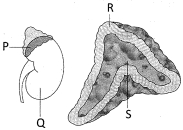
In a 'fight or flight' situation,which part produces the hormones?
A
$P$
B
$Q$
C
$R$
D
$S$
Solution
(D) The 'fight or flight' response is mediated by the hormones adrenaline (epinephrine) and noradrenaline (norepinephrine).
These hormones are secreted by the adrenal medulla.
In the provided diagram,$P$ represents the adrenal gland,$Q$ represents the kidney,$R$ represents the adrenal cortex,and $S$ represents the adrenal medulla.
Therefore,the correct part is $S$.
These hormones are secreted by the adrenal medulla.
In the provided diagram,$P$ represents the adrenal gland,$Q$ represents the kidney,$R$ represents the adrenal cortex,and $S$ represents the adrenal medulla.
Therefore,the correct part is $S$.
0 likes
View Solution174
MediumMCQ
Select the incorrect option for emergency hormones.
A
Increased alertness
B
Constriction of pupils
C
Piloerection and sweating
D
Increase in heartbeat,heart contraction strength,and rate of respiration
Solution
(B) Emergency hormones,specifically $Adrenaline$ and $Noradrenaline$ (secreted by the adrenal medulla),are released during stress or emergency situations (fight-or-flight response).
These hormones cause several physiological changes to prepare the body for action:
$1$. Increased alertness.
$2$. Dilation of pupils (mydriasis) to allow more light to enter,not constriction.
$3$. Piloerection (goosebumps) and sweating.
$4$. Increase in heartbeat,strength of heart contraction,and rate of respiration to supply more oxygen to tissues.
Therefore,the incorrect option is the constriction of pupils.
These hormones cause several physiological changes to prepare the body for action:
$1$. Increased alertness.
$2$. Dilation of pupils (mydriasis) to allow more light to enter,not constriction.
$3$. Piloerection (goosebumps) and sweating.
$4$. Increase in heartbeat,strength of heart contraction,and rate of respiration to supply more oxygen to tissues.
Therefore,the incorrect option is the constriction of pupils.
0 likes
View Solution175
MediumMCQ
Select the correct option for catecholamines.
A
Adrenaline and noradrenaline are types of catecholamine hormones.
B
They increase blood glucose levels by stimulating glycogen breakdown.
C
They stimulate the breakdown of lipids and proteins.
D
All of the above.
Solution
(D) The adrenal medulla secretes two hormones called adrenaline (epinephrine) and noradrenaline (norepinephrine),which are collectively known as catecholamines.
These hormones are rapidly secreted in response to stress of any kind and during emergency situations and are called emergency hormones or hormones of Fight or Flight.
Catecholamines increase the alertness,pupilary dilation,piloerection (raising of hairs),and sweating.
They also increase the heartbeat,the strength of heart contraction,and the rate of respiration.
Catecholamines also stimulate the breakdown of glycogen resulting in an increased concentration of glucose in the blood.
In addition,they also stimulate the breakdown of lipids and proteins.
These hormones are rapidly secreted in response to stress of any kind and during emergency situations and are called emergency hormones or hormones of Fight or Flight.
Catecholamines increase the alertness,pupilary dilation,piloerection (raising of hairs),and sweating.
They also increase the heartbeat,the strength of heart contraction,and the rate of respiration.
Catecholamines also stimulate the breakdown of glycogen resulting in an increased concentration of glucose in the blood.
In addition,they also stimulate the breakdown of lipids and proteins.
0 likes
View Solution176
MediumMCQ
Match the following columns:
| Column-$I$ | Column-$II$ |
|---|---|
| $P$. Cortisol | $I$. Mineralocorticoid |
| $Q$. Aldosterone | $II$. Glucocorticoid |
| $R$. Androgenic steroids | $III$. Sex corticoids |
A
$P-III, Q-I, R-II$
B
$P-II, Q-I, R-III$
C
$P-I, Q-II, R-III$
D
$P-III, Q-II, R-I$
Solution
(B) The adrenal cortex secretes various hormones known as corticosteroids,which are classified into three main groups:
$1$. Glucocorticoids: Cortisol is the main glucocorticoid involved in carbohydrate metabolism.
$2$. Mineralocorticoids: Aldosterone is the main mineralocorticoid that regulates water and electrolyte balance.
$3$. Sex corticoids (Androgenic steroids): These are responsible for the development of secondary sexual characteristics.
Matching the columns:
- $P$ (Cortisol) matches with $II$ (Glucocorticoid).
- $Q$ (Aldosterone) matches with $I$ (Mineralocorticoid).
- $R$ (Androgenic steroids) matches with $III$ (Sex corticoids).
Therefore,the correct matching is $P-II, Q-I, R-III$.
$1$. Glucocorticoids: Cortisol is the main glucocorticoid involved in carbohydrate metabolism.
$2$. Mineralocorticoids: Aldosterone is the main mineralocorticoid that regulates water and electrolyte balance.
$3$. Sex corticoids (Androgenic steroids): These are responsible for the development of secondary sexual characteristics.
Matching the columns:
- $P$ (Cortisol) matches with $II$ (Glucocorticoid).
- $Q$ (Aldosterone) matches with $I$ (Mineralocorticoid).
- $R$ (Androgenic steroids) matches with $III$ (Sex corticoids).
Therefore,the correct matching is $P-II, Q-I, R-III$.
0 likes
View Solution177
MediumMCQ
Select the incorrect option regarding aldosterone.
A
It is also called a glucocorticoid.
B
It controls the balance of water and electrolytes in the body.
C
It acts on the renal tubules and stimulates the reabsorption of $Na^+$ and water and excretion of $K^+$ and phosphate ions.
D
It helps in maintaining body fluid volume,osmotic pressure,and blood pressure.
Solution
(A) Aldosterone is the main mineralocorticoid secreted by the adrenal cortex,not a glucocorticoid. Glucocorticoids,such as cortisol,are involved in carbohydrate metabolism. Therefore,option $A$ is incorrect. Aldosterone acts on the renal tubules to stimulate the reabsorption of $Na^+$ and water and the excretion of $K^+$ and phosphate ions. This process helps in maintaining body fluid volume,osmotic pressure,and blood pressure.
0 likes
View Solution178
EasyMCQ
Addison's disease is caused by the deficiency of hormones secreted by the:
A
Excess production of adrenal cortex hormones
B
Excess production of adrenal medulla hormones
C
Deficiency of adrenal medulla hormones
D
Deficiency of adrenal cortex hormones
Solution
(D) Addison's disease is a rare disorder that occurs when the adrenal glands do not produce enough of certain hormones. Specifically,it is caused by the hyposecretion (deficiency) of glucocorticoids and mineralocorticoids secreted by the adrenal cortex. This leads to symptoms such as fatigue,muscle weakness,weight loss,and low blood pressure.
0 likes
View Solution179
MediumMCQ
Which hormone plays a significant role in the growth of axillary hair,pubic hair,and facial hair during puberty?
A
Mineralocorticoids
B
Glucocorticoids
C
Sex corticoids
D
All of the above
Solution
(C) The adrenal cortex secretes small amounts of androgenic steroids,also known as sex corticoids (or adrenal androgens).
These hormones play a significant role in the growth of axial hair,pubic hair,and facial hair during puberty.
Therefore,the correct option is $C$.
These hormones play a significant role in the growth of axial hair,pubic hair,and facial hair during puberty.
Therefore,the correct option is $C$.
0 likes
View Solution180
DifficultMCQ
Consider the following statements regarding the function of adrenal medullary hormones:
$A.$ It causes pupillary constriction.
$B.$ It is a hyperglycemic hormone.
$C.$ It causes piloerection.
$D.$ It increases the strength of heart contraction.
Choose the correct answer from the options given below.
$A.$ It causes pupillary constriction.
$B.$ It is a hyperglycemic hormone.
$C.$ It causes piloerection.
$D.$ It increases the strength of heart contraction.
Choose the correct answer from the options given below.
A
$C$ and $D$ Only
B
$B, C$ and $D$ Only
C
$A, C$ and $D$ Only
D
$D$ Only
Solution
(B) Adrenal medullary hormones,specifically epinephrine (adrenaline) and norepinephrine (noradrenaline),are known as emergency hormones or hormones of fight or flight.
$A.$ Incorrect: These hormones cause pupillary dilation (mydriasis),not constriction.
$B.$ Correct: They are hyperglycemic because they stimulate the breakdown of glycogen into glucose in the liver,increasing blood glucose levels.
$C.$ Correct: They cause piloerection (goosebumps) by stimulating the arrector pili muscles.
$D.$ Correct: They increase the strength of heart contraction and the rate of heartbeat to increase cardiac output.
Therefore,statements $B, C,$ and $D$ are correct.
$A.$ Incorrect: These hormones cause pupillary dilation (mydriasis),not constriction.
$B.$ Correct: They are hyperglycemic because they stimulate the breakdown of glycogen into glucose in the liver,increasing blood glucose levels.
$C.$ Correct: They cause piloerection (goosebumps) by stimulating the arrector pili muscles.
$D.$ Correct: They increase the strength of heart contraction and the rate of heartbeat to increase cardiac output.
Therefore,statements $B, C,$ and $D$ are correct.
0 likes
View Solution181
MediumMCQ
For secretion of aldosterone,adrenal cortex is stimulated by $-$
A
$ADH$
B
Angiotensin $-II$
C
Angiotensin $-I$
D
Vasopressin
Solution
(B) The secretion of aldosterone is regulated by the Renin-Angiotensin-Aldosterone System $(RAAS)$.
When blood pressure or blood volume decreases,the juxtaglomerular $(JG)$ cells release renin.
Renin converts angiotensinogen in the blood to Angiotensin $-I$,which is then converted to Angiotensin $-II$ by the Angiotensin-Converting Enzyme $(ACE)$.
Angiotensin $-II$ acts as a powerful vasoconstrictor and also stimulates the adrenal cortex to secrete aldosterone.
Aldosterone promotes the reabsorption of $Na^+$ and water from the distal convoluted tubule $(DCT)$ and collecting duct,thereby increasing blood volume and blood pressure.
When blood pressure or blood volume decreases,the juxtaglomerular $(JG)$ cells release renin.
Renin converts angiotensinogen in the blood to Angiotensin $-I$,which is then converted to Angiotensin $-II$ by the Angiotensin-Converting Enzyme $(ACE)$.
Angiotensin $-II$ acts as a powerful vasoconstrictor and also stimulates the adrenal cortex to secrete aldosterone.
Aldosterone promotes the reabsorption of $Na^+$ and water from the distal convoluted tubule $(DCT)$ and collecting duct,thereby increasing blood volume and blood pressure.
0 likes
View Solution182
EasyMCQ
In our bodies,which steroid regulates water and electrolytes?
A
Insulin
B
Melatonin
C
Testosterone
D
Aldosterone
Solution
(D) Aldosterone is a steroid hormone produced by the adrenal cortex of the adrenal glands.
It plays a crucial role in the regulation of water and electrolyte balance in the body.
It acts primarily on the distal tubules and collecting ducts of the kidneys to promote the reabsorption of sodium $(Na^+)$ and water,and the excretion of potassium $(K^+)$ and hydrogen $(H^+)$ ions.
Therefore,it helps in maintaining blood pressure and electrolyte homeostasis.
It plays a crucial role in the regulation of water and electrolyte balance in the body.
It acts primarily on the distal tubules and collecting ducts of the kidneys to promote the reabsorption of sodium $(Na^+)$ and water,and the excretion of potassium $(K^+)$ and hydrogen $(H^+)$ ions.
Therefore,it helps in maintaining blood pressure and electrolyte homeostasis.
0 likes
View Solution183
MediumMCQ
The class of adrenal gland hormones which are related to alertness,piloerection,and increased glucose levels in the blood is:
A
Glucocorticoids
B
Mineralocorticoids
C
Catecholamines
D
Gonadocorticoids
Solution
(C) The adrenal medulla secretes two hormones called adrenaline (epinephrine) and noradrenaline (norepinephrine). These are commonly referred to as catecholamines.
These hormones are rapidly secreted in response to stress of any kind and during emergency situations and are called emergency hormones or hormones of Fight or Flight.
These hormones increase alertness,cause pupillary dilation,piloerection (raising of hairs),and sweating.
Catecholamines also stimulate the breakdown of glycogen resulting in an increased concentration of glucose in the blood.
These hormones are rapidly secreted in response to stress of any kind and during emergency situations and are called emergency hormones or hormones of Fight or Flight.
These hormones increase alertness,cause pupillary dilation,piloerection (raising of hairs),and sweating.
Catecholamines also stimulate the breakdown of glycogen resulting in an increased concentration of glucose in the blood.
0 likes
View Solution184
MediumMCQ
Which of the following is not correct for the adrenal gland $:-$
A
Adrenal gland is ectomesodermal in origin
B
Adrenal cortex produces steroid hormones
C
Adrenal medulla produces steroid hormones
D
Adrenal medulla is ectodermal in origin
Solution
(C) The adrenal gland is composed of two distinct tissues: the adrenal cortex and the adrenal medulla.
$1$. The adrenal cortex is mesodermal in origin and secretes steroid hormones (e.g.,cortisol,aldosterone).
$2$. The adrenal medulla is ectodermal in origin (derived from neural crest cells) and secretes catecholamines (e.g.,adrenaline and noradrenaline),which are amino acid derivatives,not steroids.
Therefore,the statement that the adrenal medulla produces steroid hormones is incorrect.
$1$. The adrenal cortex is mesodermal in origin and secretes steroid hormones (e.g.,cortisol,aldosterone).
$2$. The adrenal medulla is ectodermal in origin (derived from neural crest cells) and secretes catecholamines (e.g.,adrenaline and noradrenaline),which are amino acid derivatives,not steroids.
Therefore,the statement that the adrenal medulla produces steroid hormones is incorrect.
0 likes
View Solution185
MediumMCQ
Statement-$1$: Cortisol hormone helps in erythropoiesis.
Statement-$2$: Cortisol hormone increases $\text{BMR}$.
Statement-$2$: Cortisol hormone increases $\text{BMR}$.
A
Statement-$1$ is correct & statement-$2$ is incorrect.
B
Statement-$2$ is correct & statement-$1$ is incorrect.
C
Both statements are correct.
D
Both statements are incorrect.
Solution
(A) Statement-$1$ is correct: Cortisol is a glucocorticoid that,along with other hormones,supports the process of erythropoiesis (the production of red blood cells).
Statement-$2$ is incorrect: While cortisol has many metabolic effects,it is the thyroid hormones (like thyroxine) that primarily increase the Basal Metabolic Rate $(\text{BMR})$. Cortisol generally promotes gluconeogenesis and protein catabolism but does not directly increase $\text{BMR}$ in the same manner as thyroid hormones.
Statement-$2$ is incorrect: While cortisol has many metabolic effects,it is the thyroid hormones (like thyroxine) that primarily increase the Basal Metabolic Rate $(\text{BMR})$. Cortisol generally promotes gluconeogenesis and protein catabolism but does not directly increase $\text{BMR}$ in the same manner as thyroid hormones.
0 likes
View Solution186
EasyMCQ
Which one of the following is $NOT$ a characteristic feature of Addison's disease?
A
Low blood sugar level
B
Low $Na^{+}$ and high $K^{+}$ in plasma
C
Weakness,nausea and weight loss
D
Excretion of less amount of urine
Solution
(D) Addison's disease is caused by the hyposecretion of glucocorticoids and mineralocorticoids from the adrenal cortex.
Glucocorticoid deficiency leads to hypoglycemia (low blood sugar),weakness,nausea,and weight loss.
Mineralocorticoid (aldosterone) deficiency leads to a decrease in $Na^{+}$ reabsorption and an increase in $K^{+}$ retention in the plasma.
Due to the loss of $Na^{+}$ and water,the patient experiences dehydration and increased urine output (polyuria),not decreased urine excretion.
Therefore,the excretion of a smaller amount of urine is $NOT$ a characteristic feature of this disease.
Glucocorticoid deficiency leads to hypoglycemia (low blood sugar),weakness,nausea,and weight loss.
Mineralocorticoid (aldosterone) deficiency leads to a decrease in $Na^{+}$ reabsorption and an increase in $K^{+}$ retention in the plasma.
Due to the loss of $Na^{+}$ and water,the patient experiences dehydration and increased urine output (polyuria),not decreased urine excretion.
Therefore,the excretion of a smaller amount of urine is $NOT$ a characteristic feature of this disease.
0 likes
View Solution187
EasyMCQ
Mineralocorticoids are secreted by . . . . . . .
A
Zona fasciculata
B
Zona reticularis
C
Zona pellucida
D
Zona glomerulosa
Solution
(D) The adrenal cortex is divided into three distinct layers: the outer $Zona$ $glomerulosa$,the middle $Zona$ $fasciculata$,and the inner $Zona$ $reticularis$.
$1$. $Zona$ $glomerulosa$ is responsible for the secretion of mineralocorticoids,primarily aldosterone,which regulates water and electrolyte balance.
$2$. $Zona$ $fasciculata$ secretes glucocorticoids like cortisol.
$3$. $Zona$ $reticularis$ secretes small amounts of sex steroids (androgens).
$4$. $Zona$ $pellucida$ is a glycoprotein layer surrounding the plasma membrane of an oocyte,not a part of the adrenal gland.
Therefore,the correct option is $D$.
$1$. $Zona$ $glomerulosa$ is responsible for the secretion of mineralocorticoids,primarily aldosterone,which regulates water and electrolyte balance.
$2$. $Zona$ $fasciculata$ secretes glucocorticoids like cortisol.
$3$. $Zona$ $reticularis$ secretes small amounts of sex steroids (androgens).
$4$. $Zona$ $pellucida$ is a glycoprotein layer surrounding the plasma membrane of an oocyte,not a part of the adrenal gland.
Therefore,the correct option is $D$.
0 likes
View Solution188
EasyMCQ
Given below are two statements.
Statement $I$: Cortisol decreases blood glucose level.
Statement $II$: Cortisol is used in the treatment of allergy as it suppresses the synthesis of antibodies.
In light of the above statements,select the correct answer from the options given below.
Statement $I$: Cortisol decreases blood glucose level.
Statement $II$: Cortisol is used in the treatment of allergy as it suppresses the synthesis of antibodies.
In light of the above statements,select the correct answer from the options given below.
A
Statement $I$ is incorrect and statement $II$ is correct.
B
Both statement $I$ and statement $II$ are correct.
C
Both statement $I$ and statement $II$ are incorrect.
D
Statement $I$ is correct and statement $II$ is incorrect.
Solution
(A) Statement $I$ is incorrect because cortisol is a glucocorticoid that increases blood glucose levels by stimulating gluconeogenesis,lipolysis,and proteolysis.
Statement $II$ is correct because cortisol has potent anti-inflammatory and immunosuppressive properties,which inhibit the immune response and the synthesis of antibodies,making it useful in treating allergies and inflammatory conditions.
Therefore,statement $I$ is incorrect and statement $II$ is correct.
Statement $II$ is correct because cortisol has potent anti-inflammatory and immunosuppressive properties,which inhibit the immune response and the synthesis of antibodies,making it useful in treating allergies and inflammatory conditions.
Therefore,statement $I$ is incorrect and statement $II$ is correct.
0 likes
View Solution189
EasyMCQ
Identify the statement/s given below that does not correspond to the functions of $Cortisol$:
$(i)$ Maintains cardiovascular system and kidney functions
$(ii)$ Produces anti-inflammatory reactions
$(iii)$ Maintains electrolyte balance,osmosis and blood pressure
$(iv)$ Suppresses immune response
$(v)$ Stimulates $RBC$ production
$(i)$ Maintains cardiovascular system and kidney functions
$(ii)$ Produces anti-inflammatory reactions
$(iii)$ Maintains electrolyte balance,osmosis and blood pressure
$(iv)$ Suppresses immune response
$(v)$ Stimulates $RBC$ production
A
$iii$ only
B
$iv$ only
C
$i$ and $ii$ only
D
$iii$ and $iv$ only
Solution
(A) $Cortisol$ is a glucocorticoid primarily involved in carbohydrate metabolism,anti-inflammatory reactions,and immune suppression.
Statement $(i)$ is correct as $Cortisol$ supports cardiovascular and kidney functions.
Statement $(ii)$ is correct as it produces anti-inflammatory reactions.
Statement $(iii)$ is incorrect because the maintenance of electrolyte balance,body fluid volume,osmotic pressure,and blood pressure is primarily the function of $Aldosterone$ (a mineralocorticoid),not $Cortisol$.
Statement $(iv)$ is correct as it suppresses the immune response.
Statement $(v)$ is correct as it stimulates $RBC$ production.
Therefore,only statement $(iii)$ does not correspond to the functions of $Cortisol$.
Statement $(i)$ is correct as $Cortisol$ supports cardiovascular and kidney functions.
Statement $(ii)$ is correct as it produces anti-inflammatory reactions.
Statement $(iii)$ is incorrect because the maintenance of electrolyte balance,body fluid volume,osmotic pressure,and blood pressure is primarily the function of $Aldosterone$ (a mineralocorticoid),not $Cortisol$.
Statement $(iv)$ is correct as it suppresses the immune response.
Statement $(v)$ is correct as it stimulates $RBC$ production.
Therefore,only statement $(iii)$ does not correspond to the functions of $Cortisol$.
0 likes
View Solution190
EasyMCQ
The hormones of "Fright, Fight and Flight" are
A
thyroxine and oxytocin
B
thyroxine and melatonin
C
adrenaline and noradrenaline
D
gastrin and secretin
Solution
(C) $Adrenaline$ and $noradrenaline$ are secreted rapidly in response to stress of any kind and during emergency situations.
Because of their role in these situations, they are commonly referred to as emergency hormones or the hormones of $Fright, Fight$ and $Flight$.
Because of their role in these situations, they are commonly referred to as emergency hormones or the hormones of $Fright, Fight$ and $Flight$.
0 likes
View Solution191
EasyMCQ
Which one of the following hormones also produces anti-inflammatory reactions in man and suppresses the immune response in addition to its primary functions?
A
Thyrocalcitonin
B
Cortisol
C
Erythropoietin
D
Thymosin
Solution
(B) The correct answer is $B$ (Cortisol).
$1$. Cortisol is a glucocorticoid secreted by the adrenal cortex.
$2$. In addition to its primary role in carbohydrate metabolism,it plays a crucial role in maintaining the cardiovascular system and kidney functions.
$3$. Cortisol is well-known for producing anti-inflammatory reactions and suppressing the immune response,which is why it is often used clinically to treat inflammatory conditions and autoimmune diseases.
$4$. It also stimulates the production of red blood cells $(RBCs)$.
$1$. Cortisol is a glucocorticoid secreted by the adrenal cortex.
$2$. In addition to its primary role in carbohydrate metabolism,it plays a crucial role in maintaining the cardiovascular system and kidney functions.
$3$. Cortisol is well-known for producing anti-inflammatory reactions and suppressing the immune response,which is why it is often used clinically to treat inflammatory conditions and autoimmune diseases.
$4$. It also stimulates the production of red blood cells $(RBCs)$.
0 likes
View SolutionChemical Coordination and Integration — Adrenal Gland · Frequently Asked Questions
1Are these Chemical Coordination and Integration questions useful for JEE and NEET?
Yes. All questions in this section are mapped to JEE Main and NEET exam patterns. Previous year questions from JEE Main, NEET, GUJCET and state-level exams are included with full solutions.
2Can I switch to Hindi or Gujarati for these questions?
Yes. Use the language tabs in the hero section or the sidebar to view the same questions and solutions in English, Hindi or Gujarati.
3How do I generate a question paper from this subtopic?
Use the Vedclass Exam Paper Generator — select the chapter and subtopic, set difficulty, and generate Sets A, B, C, D automatically. First 3 chapters of every subject are free.
Vedclass Products
For Students
Vedclass Test Series
Mock tests in real JEE/NEET style with performance analysis. 5-day free trial.
Start Free TrialFor Teachers
Exam Paper Generator
Generate Set A/B/C/D papers from this chapter in 2 minutes. 3 chapters free.
Try FreeFor Institutes
Online Exam Module
Live online exams with unlimited students, 360° analytics & white-label branding.
See DemoFor Teachers & Institutes
Generate a Chemical Coordination and Integration Exam Paper in 2 Minutes
Select subtopic & difficulty — Sets A, B, C, D auto-generated with No Repeat logic.
First 3 chapters of every subject are free — no payment required.