
A English
Adrenal Gland Questions in English
Class 11 Biology · Chemical Coordination and Integration · Adrenal Gland
191+
Questions
English
Language
100%
With Solutions
Showing 49 of 191 questions in English
101
MediumMCQ
Fight-or-flight reactions cause activation of
A
the parathyroid glands,leading to increased metabolic rate
B
the kidney,leading to suppression of renin-angiotensin-aldosterone pathway
C
the adrenal medulla,leading to increased secretion of epinephrine and norepinephrine
D
the pancreas leading to a reduction in the blood sugar levels.
Solution
(C) The correct answer is $C$.
Fight-or-flight reactions are mediated by the sympathetic nervous system,which triggers the adrenal medulla to secrete catecholamines,specifically epinephrine (adrenaline) and norepinephrine (noradrenaline).
These hormones are known as emergency hormones or hormones of fight-or-flight.
They prepare the body to deal with stress by increasing heart rate,blood pressure,and blood glucose levels to provide energy for immediate action.
Fight-or-flight reactions are mediated by the sympathetic nervous system,which triggers the adrenal medulla to secrete catecholamines,specifically epinephrine (adrenaline) and norepinephrine (noradrenaline).
These hormones are known as emergency hormones or hormones of fight-or-flight.
They prepare the body to deal with stress by increasing heart rate,blood pressure,and blood glucose levels to provide energy for immediate action.
0 likes
View Solution102
MediumMCQ
Norepinephrine:
$(i)$ is released by sympathetic fibers
$(ii)$ is released by parasympathetic fibers
$(iii)$ increases the heart rate
$(iv)$ decreases blood pressure.
Which of the above statements are correct?
$(i)$ is released by sympathetic fibers
$(ii)$ is released by parasympathetic fibers
$(iii)$ increases the heart rate
$(iv)$ decreases blood pressure.
Which of the above statements are correct?
A
$(i)$ and $(iii)$
B
$(ii)$ and $(iii)$
C
$(ii)$ and $(iv)$
D
$(i)$ and $(iv)$
Solution
(A) Norepinephrine is a neurotransmitter released by the postganglionic fibers of the sympathetic nervous system.
It is also secreted by the adrenal medulla along with epinephrine.
It acts to increase the heart rate and force of contraction.
It generally causes vasoconstriction,which leads to an increase in blood pressure,not a decrease.
Therefore,statements $(i)$ and $(iii)$ are correct.
It is also secreted by the adrenal medulla along with epinephrine.
It acts to increase the heart rate and force of contraction.
It generally causes vasoconstriction,which leads to an increase in blood pressure,not a decrease.
Therefore,statements $(i)$ and $(iii)$ are correct.
0 likes
View Solution103
MediumMCQ
$A$ person entering an empty room suddenly finds a snake right in front on opening the door. Which one of the following is likely to happen in his neuro-hormonal control system?
A
Sympathetic nervous system is activated releasing epinephrine and norepinephrine from adrenal medulla.
B
Neurotransmitters diffuse rapidly across the cleft and transmit a nerve impulse.
C
Hypothalamus activates the parasympathetic division of brain.
D
Sympathetic nervous system is activated releasing epinephrine and norepinephrine from adrenal cortex.
Solution
(A) The correct answer is $A$.
When a person encounters a sudden threat like a snake,the body initiates a 'fight-or-flight' response.
This response is mediated by the sympathetic nervous system.
The sympathetic nervous system stimulates the adrenal medulla to secrete emergency hormones,specifically epinephrine (adrenaline) and norepinephrine (noradrenaline).
These hormones prepare the body for immediate physical action by increasing heart rate,blood pressure,and alertness.
Note that these hormones are secreted by the adrenal medulla,not the adrenal cortex.
When a person encounters a sudden threat like a snake,the body initiates a 'fight-or-flight' response.
This response is mediated by the sympathetic nervous system.
The sympathetic nervous system stimulates the adrenal medulla to secrete emergency hormones,specifically epinephrine (adrenaline) and norepinephrine (noradrenaline).
These hormones prepare the body for immediate physical action by increasing heart rate,blood pressure,and alertness.
Note that these hormones are secreted by the adrenal medulla,not the adrenal cortex.
0 likes
View Solution104
MediumMCQ
Injury to the adrenal cortex is not likely to affect the secretion of which one of the following?
A
Aldosterone
B
Both androstenedione and dehydroepiandrosterone
C
Adrenaline
D
Cortisol
Solution
(C) The adrenal glands (suprarenal glands) are two triangular endocrine glands,each situated on the superior surface of a kidney. Each gland consists of two distinct parts: the medulla and the cortex.
$1$. The medulla forms the inner core of the gland. It consists mainly of chromaffin tissue and is stimulated by the sympathetic nervous system to produce catecholamines,specifically adrenaline (epinephrine) and noradrenaline (norepinephrine).
$2$. The cortex is the outer yellowish tissue surrounding the medulla. It is stimulated by pituitary hormones (principally $ACTH$) to produce three types of corticosteroid hormones: glucocorticoids (e.g.,cortisol),mineralocorticoids (e.g.,aldosterone),and sex corticoids (androgens and oestrogens).
Since adrenaline is secreted by the adrenal medulla and not the adrenal cortex,an injury to the adrenal cortex will not affect the secretion of adrenaline.
$1$. The medulla forms the inner core of the gland. It consists mainly of chromaffin tissue and is stimulated by the sympathetic nervous system to produce catecholamines,specifically adrenaline (epinephrine) and noradrenaline (norepinephrine).
$2$. The cortex is the outer yellowish tissue surrounding the medulla. It is stimulated by pituitary hormones (principally $ACTH$) to produce three types of corticosteroid hormones: glucocorticoids (e.g.,cortisol),mineralocorticoids (e.g.,aldosterone),and sex corticoids (androgens and oestrogens).
Since adrenaline is secreted by the adrenal medulla and not the adrenal cortex,an injury to the adrenal cortex will not affect the secretion of adrenaline.
0 likes
View Solution105
MediumMCQ
Select the correct matching of a hormone,its source,and its function.
A
Vasopressin $\Rightarrow$ Posterior pituitary $\Rightarrow$ Increases loss of water through urine
B
Norepinephrine $\Rightarrow$ Adrenal medulla $\Rightarrow$ Increases heart beat,rate of respiration,and alertness
C
Glucagon $\Rightarrow$ Beta-cells of Islets of Langerhans $\Rightarrow$ Stimulates glycogenolysis
D
Prolactin $\Rightarrow$ Posterior pituitary $\Rightarrow$ Regulates growth of mammary glands and milk formation in females
Solution
(B) is the correct answer.
$1$. Vasopressin (Antidiuretic hormone) is released from the posterior pituitary and it decreases water loss through urine by stimulating water reabsorption in the distal tubules of the kidney.
$2$. Norepinephrine is secreted by the adrenal medulla and it increases heart rate,respiration rate,and alertness during stress.
$3$. Glucagon is secreted by the $\alpha$-cells of the Islets of Langerhans,not the $\beta$-cells.
$4$. Prolactin is produced by the anterior pituitary,not the posterior pituitary.
$1$. Vasopressin (Antidiuretic hormone) is released from the posterior pituitary and it decreases water loss through urine by stimulating water reabsorption in the distal tubules of the kidney.
$2$. Norepinephrine is secreted by the adrenal medulla and it increases heart rate,respiration rate,and alertness during stress.
$3$. Glucagon is secreted by the $\alpha$-cells of the Islets of Langerhans,not the $\beta$-cells.
$4$. Prolactin is produced by the anterior pituitary,not the posterior pituitary.
0 likes
View Solution106
MediumMCQ
Feeling the tremors of an earthquake,a scared resident of the seventh floor of a multistory building starts climbing down the stairs rapidly. Which hormone initiated this action?
A
Adrenaline
B
Glucagon
C
Gastrin
D
Thyroxine
Solution
(A) : Adrenaline (epinephrine),also known as the emergency hormone,is produced by the adrenal medulla. It prepares the body for '$fright, flight, or fight$' responses by increasing heart rate,improving muscle power,and increasing the rate and depth of breathing. It also inhibits non-essential processes like digestion during an emergency. These effects are similar to the stimulation of the sympathetic nervous system.
0 likes
View Solution107
MediumMCQ
Which hormone causes dilation of blood vessels,increased oxygen consumption and glucogenesis?
A
Glucagon
B
$ACTH$
C
Insulin
D
Adrenaline
Solution
(D) : Adrenaline is the hormone secreted by the adrenal medulla. It prepares the body to face special conditions created by physical stress.
These conditions require more energy,which is provided by increasing heart rate,blood pressure,respiratory rate,blood glucose levels,and blood supply to the heart,skeletal muscles,and brain through the dilation of their small arteries.
It also increases oxidative metabolism and stimulates the breakdown of liver and muscle glycogen (glycogenolysis) to provide glucose for cellular respiration.
These conditions require more energy,which is provided by increasing heart rate,blood pressure,respiratory rate,blood glucose levels,and blood supply to the heart,skeletal muscles,and brain through the dilation of their small arteries.
It also increases oxidative metabolism and stimulates the breakdown of liver and muscle glycogen (glycogenolysis) to provide glucose for cellular respiration.
0 likes
View Solution108
MediumMCQ
$A$ steroid hormone which regulates glucose metabolism is
A
cortisone
B
cortisol
C
corticosterone
D
$11$-deoxycorticosterone
Solution
(B) The adrenal cortex produces glucocorticoids, which are involved in carbohydrate metabolism.
Cortisol is the primary glucocorticoid in humans and plays a crucial role in regulating glucose metabolism by stimulating gluconeogenesis, lipolysis, and proteolysis.
It helps maintain blood glucose levels during stress.
Therefore, the correct answer is $cortisol$.
Cortisol is the primary glucocorticoid in humans and plays a crucial role in regulating glucose metabolism by stimulating gluconeogenesis, lipolysis, and proteolysis.
It helps maintain blood glucose levels during stress.
Therefore, the correct answer is $cortisol$.
0 likes
View Solution109
MediumMCQ
What is incorrect about glucocorticoids?
A
Stimulate gluconeogenesis
B
Inhibit cellular uptake
C
Inhibit utilisation of amino acid
D
Increase the pupillary dilation
Solution
(D) Glucocorticoids are hormones secreted by the adrenal cortex that play a significant role in carbohydrate metabolism.
$1$. They stimulate gluconeogenesis,lipolysis,and proteolysis.
$2$. They inhibit cellular uptake and utilization of amino acids.
$3$. They maintain the cardiovascular system and kidney functions.
$4$. Glucocorticoids,particularly cortisol,produce anti-inflammatory reactions and suppress the immune response.
$5$. Pupillary dilation is primarily controlled by the sympathetic nervous system (via epinephrine/norepinephrine),not by glucocorticoids. Therefore,option $D$ is incorrect.
$1$. They stimulate gluconeogenesis,lipolysis,and proteolysis.
$2$. They inhibit cellular uptake and utilization of amino acids.
$3$. They maintain the cardiovascular system and kidney functions.
$4$. Glucocorticoids,particularly cortisol,produce anti-inflammatory reactions and suppress the immune response.
$5$. Pupillary dilation is primarily controlled by the sympathetic nervous system (via epinephrine/norepinephrine),not by glucocorticoids. Therefore,option $D$ is incorrect.
0 likes
View Solution110
MediumMCQ
Select the correct option on the basis of the following sentences regarding a gland's functions:
$(I)$ Hormones increase alertness.
$(II)$ Hormones increase the heart beat.
$(III)$ Stimulate the breakdown of glycogen.
$(IV)$ Stimulate the breakdown of lipids and proteins.
$(I)$ Hormones increase alertness.
$(II)$ Hormones increase the heart beat.
$(III)$ Stimulate the breakdown of glycogen.
$(IV)$ Stimulate the breakdown of lipids and proteins.
A
Adrenal gland
B
Thymus
C
Parathyroid gland
D
Pancreas
Solution
(A) The functions described correspond to the hormones epinephrine (adrenaline) and norepinephrine (noradrenaline),which are secreted by the adrenal medulla of the adrenal gland.
$(I)$ These hormones are known as emergency hormones or hormones of fight or flight,which increase alertness.
$(II)$ They increase the heart beat and the strength of heart contraction.
$(III)$ They stimulate the breakdown of glycogen in the liver to increase blood glucose levels.
$(IV)$ They also stimulate the breakdown of lipids and proteins to provide energy during stress.
Therefore,the correct option is the adrenal gland.
$(I)$ These hormones are known as emergency hormones or hormones of fight or flight,which increase alertness.
$(II)$ They increase the heart beat and the strength of heart contraction.
$(III)$ They stimulate the breakdown of glycogen in the liver to increase blood glucose levels.
$(IV)$ They also stimulate the breakdown of lipids and proteins to provide energy during stress.
Therefore,the correct option is the adrenal gland.
0 likes
View Solution111
MediumMCQ
Match the following.
| Column-$I$ | Column-$II$ |
| $A$. Zona reticularis | $1$. Outer layer (adrenal cortex) |
| $B$. Zona fasciculata | $2$. Inner layer (adrenal cortex) |
| $C$. Zona glomerulosa | $3$. Middle layer (adrenal cortex) |
A
$A-3, B-2, C-1$
B
$A-1, B-2, C-3$
C
$A-2, B-3, C-1$
D
$A-2, B-1, C-3$
Solution
(C) The adrenal cortex is divided into three distinct layers based on the arrangement of cells:
$1$. Zona glomerulosa: This is the outermost layer of the adrenal cortex.
$2$. Zona fasciculata: This is the middle layer of the adrenal cortex.
$3$. Zona reticularis: This is the innermost layer of the adrenal cortex.
Matching these with the given options:
$A$. Zona reticularis corresponds to $2$. Inner layer.
$B$. Zona fasciculata corresponds to $3$. Middle layer.
$C$. Zona glomerulosa corresponds to $1$. Outer layer.
Therefore, the correct match is $A-2, B-3, C-1$.
$1$. Zona glomerulosa: This is the outermost layer of the adrenal cortex.
$2$. Zona fasciculata: This is the middle layer of the adrenal cortex.
$3$. Zona reticularis: This is the innermost layer of the adrenal cortex.
Matching these with the given options:
$A$. Zona reticularis corresponds to $2$. Inner layer.
$B$. Zona fasciculata corresponds to $3$. Middle layer.
$C$. Zona glomerulosa corresponds to $1$. Outer layer.
Therefore, the correct match is $A-2, B-3, C-1$.
0 likes
View Solution112
MediumMCQ
Which of the following statements is incorrect regarding glucocorticoids?
A
Stimulate gluconeogenesis
B
Inhibit cellular uptake and utilization of amino acids
C
Stimulate lipolysis and proteolysis
D
Increase pupillary dilation
Solution
(D) Glucocorticoids are hormones secreted by the adrenal cortex. They are primarily involved in carbohydrate metabolism. They stimulate gluconeogenesis,lipolysis,and proteolysis. They inhibit the cellular uptake and utilization of amino acids. Pupillary dilation is a function of the hormone epinephrine (adrenaline),which is secreted by the adrenal medulla,not by glucocorticoids. Therefore,statement $D$ is incorrect.
0 likes
View Solution113
MediumMCQ
........ is the middle layer of the adrenal cortex.
A
Zona fasciculata
B
Zona reticularis
C
Zona glomerulosa
D
None
Solution
(A) The adrenal cortex is divided into three distinct layers based on the arrangement of cells:
$1$. $Zona \ glomerulosa$: The outermost layer,which secretes mineralocorticoids like aldosterone.
$2$. $Zona \ fasciculata$: The middle layer,which is the thickest layer and secretes glucocorticoids like cortisol.
$3$. $Zona \ reticularis$: The innermost layer,which secretes small amounts of sex steroids (androgens).
Therefore,the $Zona \ fasciculata$ is the middle layer of the adrenal cortex.
$1$. $Zona \ glomerulosa$: The outermost layer,which secretes mineralocorticoids like aldosterone.
$2$. $Zona \ fasciculata$: The middle layer,which is the thickest layer and secretes glucocorticoids like cortisol.
$3$. $Zona \ reticularis$: The innermost layer,which secretes small amounts of sex steroids (androgens).
Therefore,the $Zona \ fasciculata$ is the middle layer of the adrenal cortex.
0 likes
View Solution114
MediumMCQ
Choose the incorrect sentence.
A
The corticoids,which are involved in carbohydrate metabolism,are called glucocorticoids.
B
Corticoids,which regulate the water balance and electrolytes in our body,are called mineralocorticoids.
C
Cortisol stimulates $RBC$ production.
D
Cortisol is the main mineralocorticoid.
Solution
(D) The adrenal cortex secretes hormones called corticoids.
These are classified into two main types:
$1$. Glucocorticoids: These are involved in carbohydrate metabolism (e.g.,cortisol).
$2$. Mineralocorticoids: These regulate the balance of water and electrolytes in our body (e.g.,aldosterone).
Cortisol is the main glucocorticoid,not a mineralocorticoid.
Therefore,the statement '$Cortisol$ is the main mineralocorticoid' is incorrect.
These are classified into two main types:
$1$. Glucocorticoids: These are involved in carbohydrate metabolism (e.g.,cortisol).
$2$. Mineralocorticoids: These regulate the balance of water and electrolytes in our body (e.g.,aldosterone).
Cortisol is the main glucocorticoid,not a mineralocorticoid.
Therefore,the statement '$Cortisol$ is the main mineralocorticoid' is incorrect.
0 likes
View Solution115
MediumMCQ
Injury to the adrenal cortex does not affect the secretion of which of the following?
A
Aldosterone
B
Androstenedione and Dehydroepiandrosterone
C
Adrenaline
D
Cortisol
Solution
(C) The adrenal gland is divided into two parts: the adrenal cortex and the adrenal medulla.
$1$. The adrenal cortex is the outer part and secretes steroid hormones such as glucocorticoids (e.g.,$Cortisol$),mineralocorticoids (e.g.,$Aldosterone$),and sex corticoids (e.g.,$Androstenedione$ and $Dehydroepiandrosterone$).
$2$. The adrenal medulla is the inner part and secretes catecholamines,which include $Adrenaline$ (epinephrine) and $Noradrenaline$ (norepinephrine).
$3$. Since $Adrenaline$ is secreted by the adrenal medulla,an injury to the adrenal cortex will not affect its secretion.
$1$. The adrenal cortex is the outer part and secretes steroid hormones such as glucocorticoids (e.g.,$Cortisol$),mineralocorticoids (e.g.,$Aldosterone$),and sex corticoids (e.g.,$Androstenedione$ and $Dehydroepiandrosterone$).
$2$. The adrenal medulla is the inner part and secretes catecholamines,which include $Adrenaline$ (epinephrine) and $Noradrenaline$ (norepinephrine).
$3$. Since $Adrenaline$ is secreted by the adrenal medulla,an injury to the adrenal cortex will not affect its secretion.
0 likes
View Solution116
MediumMCQ
Which hormone exhibits an anti-insulin effect?
A
Cortisol
B
Calcitonin
C
Oxytocin
D
Aldosterone
Solution
(A) The hormone that exhibits an anti-insulin effect is $Cortisol$.
Insulin is a hypoglycemic hormone that lowers blood glucose levels by promoting the uptake of glucose into cells.
In contrast,$Cortisol$ is a glucocorticoid that acts as a hyperglycemic agent.
It stimulates gluconeogenesis (the production of glucose from non-carbohydrate sources) and inhibits the cellular uptake and utilization of glucose,thereby increasing blood glucose levels.
Thus,$Cortisol$ opposes the action of insulin.
Insulin is a hypoglycemic hormone that lowers blood glucose levels by promoting the uptake of glucose into cells.
In contrast,$Cortisol$ is a glucocorticoid that acts as a hyperglycemic agent.
It stimulates gluconeogenesis (the production of glucose from non-carbohydrate sources) and inhibits the cellular uptake and utilization of glucose,thereby increasing blood glucose levels.
Thus,$Cortisol$ opposes the action of insulin.
0 likes
View Solution117
MediumMCQ
Adrenaline directly affects the . . . . . . .
A
$SA$ node
B
$\beta$-cells of Islets of Langerhans
C
Dorsal root of the spinal cord
D
Epithelial cells of the stomach
Solution
(A) Adrenaline (also known as epinephrine) is a hormone secreted by the adrenal medulla during stress or emergency situations.
It acts on various target organs to prepare the body for 'fight or flight' responses.
One of its primary targets is the heart,specifically the $SA$ (Sinoatrial) node,which acts as the natural pacemaker.
By stimulating the $SA$ node,adrenaline increases the heart rate and the force of contraction,thereby increasing cardiac output to supply more oxygenated blood to the muscles.
It acts on various target organs to prepare the body for 'fight or flight' responses.
One of its primary targets is the heart,specifically the $SA$ (Sinoatrial) node,which acts as the natural pacemaker.
By stimulating the $SA$ node,adrenaline increases the heart rate and the force of contraction,thereby increasing cardiac output to supply more oxygenated blood to the muscles.
0 likes
View Solution118
MediumMCQ
Which of the following is a steroid hormone that regulates glucose metabolism?
A
Corticosterone
B
$11-$Deoxycorticosterone
C
Cortisone
D
Cortisol
Solution
(D) Cortisol is a glucocorticoid hormone produced by the adrenal cortex. It plays a primary role in the regulation of glucose metabolism by stimulating gluconeogenesis,lipolysis,and proteolysis. While other options like Corticosterone and Cortisone are also glucocorticoids,Cortisol is the primary glucocorticoid in humans responsible for glucose homeostasis.
0 likes
View Solution119
MediumMCQ
Which hormone is responsible for the dilation of blood vessels,increased oxygen consumption,and glycogenolysis?
A
Insulin
B
Adrenaline
C
Glucagon
D
$ACTH$
Solution
(B) Adrenaline (also known as epinephrine) is a hormone secreted by the adrenal medulla during stress or emergency situations (fight-or-flight response).
It causes the dilation of blood vessels in skeletal muscles to increase blood flow.
It increases the rate of oxygen consumption to support higher metabolic activity.
It stimulates glycogenolysis (the breakdown of glycogen into glucose) in the liver and muscles to provide a rapid supply of energy to the body.
It causes the dilation of blood vessels in skeletal muscles to increase blood flow.
It increases the rate of oxygen consumption to support higher metabolic activity.
It stimulates glycogenolysis (the breakdown of glycogen into glucose) in the liver and muscles to provide a rapid supply of energy to the body.
0 likes
View Solution120
MediumMCQ
$A$ frightened resident living on the seventh floor of a high-rise building quickly runs down the stairs after feeling earthquake tremors. Which hormone is responsible for initiating this action?
A
Adrenaline
B
Glucagon
C
Gastrin
D
Thyroxine
Solution
(A) The situation described is a classic 'fight-or-flight' response triggered by an emergency or stressful situation (earthquake).
Adrenaline (also known as epinephrine) is secreted by the adrenal medulla in response to stress.
It prepares the body for immediate physical action by increasing heart rate,blood pressure,and blood glucose levels,and by diverting blood flow to skeletal muscles.
Therefore,adrenaline is the hormone responsible for initiating the rapid response to the emergency.
Adrenaline (also known as epinephrine) is secreted by the adrenal medulla in response to stress.
It prepares the body for immediate physical action by increasing heart rate,blood pressure,and blood glucose levels,and by diverting blood flow to skeletal muscles.
Therefore,adrenaline is the hormone responsible for initiating the rapid response to the emergency.
0 likes
View Solution121
MediumMCQ
$A$ person entering an empty room suddenly finds a snake right in front on the right side. Which one of the following is likely to happen in his neuroendocrine system?
A
Sympathetic nervous system is activated,releasing epinephrine and norepinephrine from the adrenal medulla.
B
Neurotransmitters diffuse rapidly across the cleft and transmit a nerve impulse.
C
Hypothalamus activates the parasympathetic division of the brain.
D
Sympathetic nervous system is activated,releasing epinephrine and norepinephrine from the adrenal cortex.
Solution
(A) When a person encounters a sudden threat (like a snake),the body initiates the '$fight-or-flight$' response.
This response is mediated by the sympathetic nervous system.
The sympathetic nerves stimulate the adrenal medulla to secrete catecholamines,specifically epinephrine (adrenaline) and norepinephrine (noradrenaline).
These hormones prepare the body for immediate action by increasing heart rate,blood pressure,and alertness.
Therefore,option $A$ is correct because the adrenal medulla is the site of secretion for these hormones,not the adrenal cortex.
This response is mediated by the sympathetic nervous system.
The sympathetic nerves stimulate the adrenal medulla to secrete catecholamines,specifically epinephrine (adrenaline) and norepinephrine (noradrenaline).
These hormones prepare the body for immediate action by increasing heart rate,blood pressure,and alertness.
Therefore,option $A$ is correct because the adrenal medulla is the site of secretion for these hormones,not the adrenal cortex.
0 likes
View Solution122
MediumMCQ
The 'fight-or-flight' response is caused by:
A
Parathyroid gland - increases metabolic rate.
B
Kidney - inhibits the renin-angiotensin-aldosterone pathway.
C
Adrenal medulla - stimulates the secretion of epinephrine and norepinephrine.
D
Pancreas - decreases blood glucose levels.
Solution
(C) The 'fight-or-flight' response is an immediate physiological reaction to a stressful or dangerous situation.
This response is primarily mediated by the adrenal medulla.
Upon stimulation by the sympathetic nervous system,the adrenal medulla secretes catecholamines,specifically epinephrine (adrenaline) and norepinephrine (noradrenaline).
These hormones prepare the body for immediate physical action by increasing heart rate,dilating airways,and mobilizing energy reserves.
This response is primarily mediated by the adrenal medulla.
Upon stimulation by the sympathetic nervous system,the adrenal medulla secretes catecholamines,specifically epinephrine (adrenaline) and norepinephrine (noradrenaline).
These hormones prepare the body for immediate physical action by increasing heart rate,dilating airways,and mobilizing energy reserves.
0 likes
View Solution123
DifficultMCQ
Assertion : Aldosterone is a steroid hormone and is important in the control of sodium and potassium ion concentration in mammals.
Reason : It upgrades sodium ion concentration in the $ECF$ by promoting reabsorption of sodium ions from renal tubules and excretion of potassium ions in urine.
Reason : It upgrades sodium ion concentration in the $ECF$ by promoting reabsorption of sodium ions from renal tubules and excretion of potassium ions in urine.
A
If both Assertion and Reason are correct and the Reason is a correct explanation of the Assertion.
B
If both Assertion and Reason are correct but Reason is not a correct explanation of the Assertion.
C
If the Assertion is correct but Reason is incorrect.
D
If both the Assertion and Reason are incorrect.
Solution
(A) Aldosterone is a steroid hormone (mineralocorticoid) secreted by the adrenal cortex.
It plays a crucial role in maintaining electrolyte balance,specifically sodium $(Na^+)$ and potassium $(K^+)$ ions in mammals.
It acts on the distal convoluted tubules and collecting ducts of the nephron to promote the reabsorption of sodium ions and water,while simultaneously promoting the excretion of potassium ions.
This process increases the sodium ion concentration in the extracellular fluid $(ECF)$ and blood,thereby regulating blood pressure and blood volume.
Therefore,both the Assertion and the Reason are correct,and the Reason provides a correct explanation for the Assertion.
It plays a crucial role in maintaining electrolyte balance,specifically sodium $(Na^+)$ and potassium $(K^+)$ ions in mammals.
It acts on the distal convoluted tubules and collecting ducts of the nephron to promote the reabsorption of sodium ions and water,while simultaneously promoting the excretion of potassium ions.
This process increases the sodium ion concentration in the extracellular fluid $(ECF)$ and blood,thereby regulating blood pressure and blood volume.
Therefore,both the Assertion and the Reason are correct,and the Reason provides a correct explanation for the Assertion.
0 likes
View Solution124
MediumMCQ
Which gland is concerned with salt equilibrium in the body?
A
Anterior pituitary
B
Pancreas
C
Adrenal
D
Thyroid
Solution
(C) Adrenal glands are concerned with salt equilibrium in the body.
Mineralocorticoids are secreted from the adrenal cortex.
Aldosterone is the main mineralocorticoid in our body.
Aldosterone acts mainly at the renal tubules and stimulates the reabsorption of $Na^+$ and water and the excretion of $K^+$ and phosphate ions.
Mineralocorticoids are secreted from the adrenal cortex.
Aldosterone is the main mineralocorticoid in our body.
Aldosterone acts mainly at the renal tubules and stimulates the reabsorption of $Na^+$ and water and the excretion of $K^+$ and phosphate ions.
0 likes
View Solution125
EasyMCQ
Assertion : Our body secretes adrenaline in intense cold.
Reason : Adrenaline raises metabolic rate.
Reason : Adrenaline raises metabolic rate.
A
If both Assertion and Reason are correct and the Reason is a correct explanation of the Assertion.
B
If both Assertion and Reason are correct but Reason is not a correct explanation of the Assertion.
C
If the Assertion is correct but Reason is incorrect.
D
If both the Assertion and Reason are incorrect.
Solution
(A) Adrenaline is an emergency hormone,also known as the fight-or-flight hormone,which is secreted by the adrenal medulla during stress conditions such as intense cold,fear,or anger.
Adrenaline increases the metabolic rate by stimulating glycogenolysis (breakdown of glycogen to glucose) and increasing oxygen consumption,which helps in thermogenesis (heat production) to maintain body temperature in cold conditions.
Therefore,the secretion of adrenaline in intense cold is a physiological response to increase the metabolic rate and generate heat.
Thus,both the Assertion and the Reason are correct,and the Reason is the correct explanation of the Assertion.
Adrenaline increases the metabolic rate by stimulating glycogenolysis (breakdown of glycogen to glucose) and increasing oxygen consumption,which helps in thermogenesis (heat production) to maintain body temperature in cold conditions.
Therefore,the secretion of adrenaline in intense cold is a physiological response to increase the metabolic rate and generate heat.
Thus,both the Assertion and the Reason are correct,and the Reason is the correct explanation of the Assertion.
0 likes
View Solution126
Medium
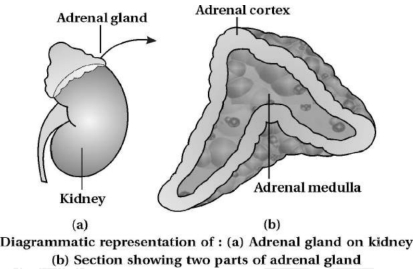
State the location and types of tissues in the adrenal gland.
Solution
(N/A) Location: Our body has one pair of adrenal glands,with one gland situated at the anterior part of each kidney.
Types of Tissues: The gland is composed of two types of tissues:
$1$. Adrenal Medulla: The centrally located tissue.
$2$. Adrenal Cortex: The tissue lying outside the medulla.
Functions of Adrenal Medulla:
- It secretes two hormones: adrenaline (epinephrine) and nor-adrenaline (norepinephrine),collectively called catecholamines.
- These are emergency hormones or hormones of 'fight or flight',secreted in response to stress.
- They increase alertness,pupillary dilation,piloerection,sweating,heart rate,strength of heart contraction,and rate of respiration.
- They stimulate the breakdown of glycogen,lipids,and proteins.
Functions of Adrenal Cortex:
- It is divided into three layers: zona glomerulosa (outer),zona fasciculata (middle),and zona reticularis (inner).
- It secretes hormones called corticoids,mainly glucocorticoids and mineralocorticoids.
- Glucocorticoids (e.g.,cortisol) are involved in carbohydrate metabolism,stimulate gluconeogenesis,lipolysis,and proteolysis,and suppress the immune response.
- Mineralocorticoids (e.g.,aldosterone) regulate the balance of water and electrolytes by stimulating the reabsorption of $Na^{+}$ and water,and the excretion of $K^{+}$ and phosphate ions in renal tubules.
- It also secretes small amounts of androgenic steroids,which play a role in the growth of axial,pubic,and facial hair during puberty.
- Underproduction of adrenal cortex hormones leads to Addison's disease.
Types of Tissues: The gland is composed of two types of tissues:
$1$. Adrenal Medulla: The centrally located tissue.
$2$. Adrenal Cortex: The tissue lying outside the medulla.
Functions of Adrenal Medulla:
- It secretes two hormones: adrenaline (epinephrine) and nor-adrenaline (norepinephrine),collectively called catecholamines.
- These are emergency hormones or hormones of 'fight or flight',secreted in response to stress.
- They increase alertness,pupillary dilation,piloerection,sweating,heart rate,strength of heart contraction,and rate of respiration.
- They stimulate the breakdown of glycogen,lipids,and proteins.
Functions of Adrenal Cortex:
- It is divided into three layers: zona glomerulosa (outer),zona fasciculata (middle),and zona reticularis (inner).
- It secretes hormones called corticoids,mainly glucocorticoids and mineralocorticoids.
- Glucocorticoids (e.g.,cortisol) are involved in carbohydrate metabolism,stimulate gluconeogenesis,lipolysis,and proteolysis,and suppress the immune response.
- Mineralocorticoids (e.g.,aldosterone) regulate the balance of water and electrolytes by stimulating the reabsorption of $Na^{+}$ and water,and the excretion of $K^{+}$ and phosphate ions in renal tubules.
- It also secretes small amounts of androgenic steroids,which play a role in the growth of axial,pubic,and facial hair during puberty.
- Underproduction of adrenal cortex hormones leads to Addison's disease.
0 likes
View Solution127
Medium
Describe the hormones of the adrenal gland,their functions,and the disorders due to their deficiency.
Solution
(N/A) Location: Our body has one pair of adrenal glands,one at the anterior part of each kidney. The gland is composed of two types of tissues: the centrally located adrenal medulla and the outer adrenal cortex.
Adrenal Medulla:
- Secretes two hormones: adrenaline (epinephrine) and nor-adrenaline (norepinephrine),collectively called catecholamines.
- These are emergency hormones or hormones of 'fight or flight'.
- They increase alertness,pupillary dilation,piloerection (raising of hairs),sweating,heart rate,strength of heart contraction,and rate of respiration.
- They stimulate the breakdown of glycogen,lipids,and proteins,increasing blood glucose levels.
Adrenal Cortex:
- Divided into three layers: zona glomerulosa (outer),zona fasciculata (middle),and zona reticularis (inner).
- Secretes hormones called corticoids:
$1$. Glucocorticoids (e.g.,cortisol): Involved in carbohydrate metabolism,stimulate gluconeogenesis,lipolysis,and proteolysis; inhibit cellular uptake of amino acids; maintain cardiovascular and kidney functions; produce anti-inflammatory reactions; suppress the immune response; and stimulate $RBC$ production.
$2$. Mineralocorticoids (e.g.,aldosterone): Regulate water and electrolyte balance. Aldosterone acts on renal tubules to stimulate reabsorption of $Na^{+}$ and water,and excretion of $K^{+}$ and phosphate ions,thus maintaining electrolytes,body fluid volume,osmotic pressure,and blood pressure.
$3$. Sex corticoids (androgenic steroids): Play a role in the growth of axial,pubic,and facial hair during puberty.
Disorders:
- Deficiency of adrenal cortex hormones leads to Addison's disease,characterized by altered carbohydrate metabolism,weakness,and fatigue.
Adrenal Medulla:
- Secretes two hormones: adrenaline (epinephrine) and nor-adrenaline (norepinephrine),collectively called catecholamines.
- These are emergency hormones or hormones of 'fight or flight'.
- They increase alertness,pupillary dilation,piloerection (raising of hairs),sweating,heart rate,strength of heart contraction,and rate of respiration.
- They stimulate the breakdown of glycogen,lipids,and proteins,increasing blood glucose levels.
Adrenal Cortex:
- Divided into three layers: zona glomerulosa (outer),zona fasciculata (middle),and zona reticularis (inner).
- Secretes hormones called corticoids:
$1$. Glucocorticoids (e.g.,cortisol): Involved in carbohydrate metabolism,stimulate gluconeogenesis,lipolysis,and proteolysis; inhibit cellular uptake of amino acids; maintain cardiovascular and kidney functions; produce anti-inflammatory reactions; suppress the immune response; and stimulate $RBC$ production.
$2$. Mineralocorticoids (e.g.,aldosterone): Regulate water and electrolyte balance. Aldosterone acts on renal tubules to stimulate reabsorption of $Na^{+}$ and water,and excretion of $K^{+}$ and phosphate ions,thus maintaining electrolytes,body fluid volume,osmotic pressure,and blood pressure.
$3$. Sex corticoids (androgenic steroids): Play a role in the growth of axial,pubic,and facial hair during puberty.
Disorders:
- Deficiency of adrenal cortex hormones leads to Addison's disease,characterized by altered carbohydrate metabolism,weakness,and fatigue.
0 likes
View Solution128
EasyMCQ
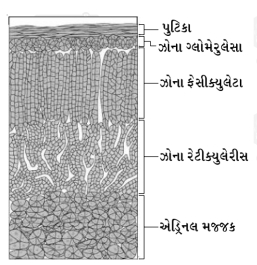
Which of the two adrenocortical layers, $zona glomerulosa$ and $zona reticularis$, lies outside, enveloping the other?
A
$zona glomerulosa$
B
$zona reticularis$
C
Both are at the same level
D
None of the above
Solution
(A) The adrenal cortex is organized into three distinct layers from the outside to the inside:
$1$. $Zona glomerulosa$ (outermost layer)
$2$. $Zona fasciculata$ (middle layer)
$3$. $Zona reticularis$ (innermost layer)
Since the $zona glomerulosa$ is the outermost layer of the adrenal cortex, it lies outside the $zona reticularis$.
$1$. $Zona glomerulosa$ (outermost layer)
$2$. $Zona fasciculata$ (middle layer)
$3$. $Zona reticularis$ (innermost layer)
Since the $zona glomerulosa$ is the outermost layer of the adrenal cortex, it lies outside the $zona reticularis$.
0 likes
View Solution129
Medium
Inflammatory responses can be controlled by a certain steroid. Name the steroid,its source,and its other important functions.
Solution
(N/A) The steroid that controls inflammatory responses is $Glucocorticoid$.
It is secreted by the $zona$ $fasciculata$ layer of the $adrenal$ $cortex$.
Its other important functions include:
$1$. It stimulates $gluconeogenesis$,$lipolysis$,and $proteolysis$.
$2$. It inhibits the cellular uptake and utilization of amino acids.
$3$. It maintains the cardiovascular system and kidney functions.
$4$. It is often referred to as a $stress$ $hormone$ as it helps the body cope with stressful conditions.
It is secreted by the $zona$ $fasciculata$ layer of the $adrenal$ $cortex$.
Its other important functions include:
$1$. It stimulates $gluconeogenesis$,$lipolysis$,and $proteolysis$.
$2$. It inhibits the cellular uptake and utilization of amino acids.
$3$. It maintains the cardiovascular system and kidney functions.
$4$. It is often referred to as a $stress$ $hormone$ as it helps the body cope with stressful conditions.
0 likes
View Solution130
EasyMCQ
What are the effects of adrenaline on the body?
A
Increased heart rate and blood pressure
B
Dilation of pupils
C
Increased alertness and glucose release
D
All of the above
Solution
(D) Adrenaline and noradrenaline are rapidly secreted in response to stress and during emergency situations,often called the $fight-or-flight$ response.
These hormones increase the heart rate,the strength of heart contraction,and the rate of respiration.
They also cause the dilation of pupils,increase the blood glucose level by stimulating the breakdown of glycogen,and promote the breakdown of lipids and proteins.
These hormones increase the heart rate,the strength of heart contraction,and the rate of respiration.
They also cause the dilation of pupils,increase the blood glucose level by stimulating the breakdown of glycogen,and promote the breakdown of lipids and proteins.
0 likes
View Solution131
EasyMCQ
Name the hormones known as flight or fight hormones.
A
Adrenaline and Noradrenaline
B
Insulin and Glucagon
C
Thyroxine and Calcitonin
D
Cortisol and Aldosterone
Solution
(A) The hormones known as flight or fight hormones are Adrenaline (Epinephrine) and Noradrenaline (Norepinephrine).
These hormones are secreted by the adrenal medulla in response to stress,fear,or excitement.
They prepare the body to either face the threat or flee from it by increasing heart rate,blood pressure,and blood glucose levels.
These hormones are secreted by the adrenal medulla in response to stress,fear,or excitement.
They prepare the body to either face the threat or flee from it by increasing heart rate,blood pressure,and blood glucose levels.
0 likes
View Solution132
EasyMCQ
Name the three main regions of the adrenal cortex.
A
Zona glomerulosa,Zona fasciculata,Zona reticularis
B
Zona fasciculata,Zona reticularis,Medulla
C
Cortex,Medulla,Capsule
D
Zona glomerulosa,Medulla,Zona reticularis
Solution
(A) The adrenal cortex is organized into three distinct histological layers from the outside to the inside:
$1$. $Zona \ glomerulosa$: The outermost layer,which primarily secretes mineralocorticoids like aldosterone.
$2$. $Zona \ fasciculata$: The middle and thickest layer,which primarily secretes glucocorticoids like cortisol.
$3$. $Zona \ reticularis$: The innermost layer,which primarily secretes small amounts of sex steroids (androgens).
$1$. $Zona \ glomerulosa$: The outermost layer,which primarily secretes mineralocorticoids like aldosterone.
$2$. $Zona \ fasciculata$: The middle and thickest layer,which primarily secretes glucocorticoids like cortisol.
$3$. $Zona \ reticularis$: The innermost layer,which primarily secretes small amounts of sex steroids (androgens).
0 likes
View Solution133
EasyMCQ
What are the functions of glucocorticoids?
A
Stimulate gluconeogenesis,lipolysis,and proteolysis.
B
Inhibit cellular uptake and utilization of amino acids.
C
Maintain cardiovascular system and kidney functions.
D
All of the above.
Solution
(D) Glucocorticoids,such as $Cortisol$,perform several vital functions:
$1$. They stimulate $Gluconeogenesis$,$Lipolysis$,and $Proteolysis$.
$2$. They inhibit the cellular uptake and utilization of amino acids.
$3$. They maintain the cardiovascular system and kidney functions.
$4$. $Glucocorticoids$,particularly $Cortisol$,produce anti-inflammatory reactions and suppress the immune response.
$5$. They also stimulate $RBC$ production.
$1$. They stimulate $Gluconeogenesis$,$Lipolysis$,and $Proteolysis$.
$2$. They inhibit the cellular uptake and utilization of amino acids.
$3$. They maintain the cardiovascular system and kidney functions.
$4$. $Glucocorticoids$,particularly $Cortisol$,produce anti-inflammatory reactions and suppress the immune response.
$5$. They also stimulate $RBC$ production.
0 likes
View Solution134
Easy
State the function of aldosterone.
Solution
(N/A) Aldosterone is a steroid hormone produced by the adrenal cortex.
It acts primarily on the renal tubules of the kidneys.
It stimulates the reabsorption of $Na^{+}$ ions and water from the filtrate back into the blood.
Simultaneously,it promotes the excretion of $K^{+}$ ions and phosphate ions into the urine.
This process helps in maintaining electrolyte balance,body fluid volume,osmotic pressure,and blood pressure.
It acts primarily on the renal tubules of the kidneys.
It stimulates the reabsorption of $Na^{+}$ ions and water from the filtrate back into the blood.
Simultaneously,it promotes the excretion of $K^{+}$ ions and phosphate ions into the urine.
This process helps in maintaining electrolyte balance,body fluid volume,osmotic pressure,and blood pressure.
0 likes
View Solution135
EasyMCQ
What is the cause of Addison's disease?
A
Hypersecretion of adrenal cortex hormones
B
Hyposecretion of adrenal cortex hormones
C
Hypersecretion of adrenal medulla hormones
D
Hyposecretion of adrenal medulla hormones
Solution
(B) Addison's disease is caused by the hyposecretion (under-production) of hormones,specifically glucocorticoids and mineralocorticoids,by the adrenal cortex.
This deficiency leads to altered carbohydrate metabolism,which results in symptoms such as muscle weakness,fatigue,low blood pressure,and weight loss.
This deficiency leads to altered carbohydrate metabolism,which results in symptoms such as muscle weakness,fatigue,low blood pressure,and weight loss.
0 likes
View Solution136
EasyMCQ
Select the correct statement.
A
Insulin is associated with hyperglycemia.
B
Glucocorticoids stimulate gluconeogenesis.
C
Glucagon is associated with hypoglycemia.
D
Insulin acts on pancreatic cells and adipocytes.
Solution
(B) Glucocorticoids,such as cortisol,are hormones produced by the adrenal cortex. They stimulate the process of gluconeogenesis,which is the synthesis of glucose from non-carbohydrate sources like amino acids and glycerol. This helps in maintaining blood glucose levels. Insulin is hypoglycemic (lowers blood glucose),while glucagon is hyperglycemic (raises blood glucose).
0 likes
View Solution137
MediumMCQ
Excessive consumption of nicotine stimulates the release of which hormone?
A
Thyroid
B
Adrenal medulla
C
$ANF$
D
Hypothalamus
Solution
(B) Nicotine acts as a stimulant that affects the nervous system. It stimulates the adrenal glands,specifically the adrenal medulla,to release hormones like adrenaline (epinephrine) and noradrenaline (norepinephrine) into the blood circulation. This leads to an increase in blood pressure and heart rate.
0 likes
View Solution138
MediumMCQ
Which one of the following is the hormone of the adrenal medulla?
A
Prolactin
B
$ACTH$
C
Corticosterone
D
Epinephrine
Solution
(D) The adrenal gland is composed of two parts: the adrenal cortex and the adrenal medulla.
The adrenal medulla secretes two hormones,known as catecholamines: $Epinephrine$ (adrenaline) and $Norepinephrine$ (noradrenaline).
$Prolactin$ is secreted by the anterior pituitary gland.
$ACTH$ (Adrenocorticotropic hormone) is also secreted by the anterior pituitary gland.
$Corticosterone$ is a glucocorticoid hormone secreted by the adrenal cortex.
Therefore,$Epinephrine$ is the hormone of the adrenal medulla.
The adrenal medulla secretes two hormones,known as catecholamines: $Epinephrine$ (adrenaline) and $Norepinephrine$ (noradrenaline).
$Prolactin$ is secreted by the anterior pituitary gland.
$ACTH$ (Adrenocorticotropic hormone) is also secreted by the anterior pituitary gland.
$Corticosterone$ is a glucocorticoid hormone secreted by the adrenal cortex.
Therefore,$Epinephrine$ is the hormone of the adrenal medulla.
0 likes
View Solution139
MediumMCQ
Which is the function of norepinephrine?
A
Increase blood pressure
B
Urine formation
C
Increase secretion of adrenaline
D
None of the above
Solution
(A) Norepinephrine is secreted from the adrenal medulla. It acts as a vasoconstrictor and increases blood pressure by stimulating the sympathetic nervous system.
0 likes
View Solution140
MediumMCQ
Corticoids are the hormones,which are secreted by
A
Kidney
B
Adrenal cortex
C
Adrenal medulla
D
Hypothalamus
Solution
(B) The adrenal cortex is divided into three layers: $zona$ $reticularis$ (inner layer),$zona$ $fasciculata$ (middle layer),and $zona$ $glomerulosa$ (outer layer).
These layers are responsible for the secretion of various hormones,which are collectively known as corticoids.
These layers are responsible for the secretion of various hormones,which are collectively known as corticoids.
0 likes
View Solution141
MediumMCQ
Addison's disease results from
A
Hypertrophy of gonads
B
Hyposecretion of adrenal cortex
C
Hyperactivity of cells of Leydig
D
None of the above
Solution
(B) Addison's disease is caused by the hyposecretion of hormones from the adrenal cortex.
It is characterized by the excessive loss of $Na^{+}$,$Cl^{-}$,and $HCO_{3}^{-}$ ions from the body.
This condition also leads to an increased $K^{+}$ level in the blood,low blood pressure $(BP)$,and hypoglycemia.
It is characterized by the excessive loss of $Na^{+}$,$Cl^{-}$,and $HCO_{3}^{-}$ ions from the body.
This condition also leads to an increased $K^{+}$ level in the blood,low blood pressure $(BP)$,and hypoglycemia.
0 likes
View Solution142
MediumMCQ
The hormone responsible for the fight,fright,and flight response is:
A
Adrenaline
B
Thyroxine
C
$ADH$
D
Oxytocin
Solution
(A) The hormones $Adrenaline$ (epinephrine) and $Noradrenaline$ (norepinephrine) are secreted by the adrenal medulla.
These hormones are commonly referred to as catecholamines.
They are rapidly secreted in response to stress of any kind and during emergency situations and are called emergency hormones or hormones of Fight,Fright,and Flight ($3F$ response).
Therefore,$Adrenaline$ is the correct answer.
These hormones are commonly referred to as catecholamines.
They are rapidly secreted in response to stress of any kind and during emergency situations and are called emergency hormones or hormones of Fight,Fright,and Flight ($3F$ response).
Therefore,$Adrenaline$ is the correct answer.
0 likes
View Solution143
MediumMCQ
The adrenal medulla secretes two hormones called adrenaline or $A$ and noradrenaline or $B$. These are commonly called as $C$. Adrenaline and noradrenaline are rapidly secreted in response to stress of any kind and during $D$ situations and are called emergency hormones or hormones of fight or flight. Identify $A$ to $D$ and choose the correct option.
A
$A$-norepinephrine,$B$-epinephrine,$C$-catecholamines,$D$-emergency
B
$A$-epinephrine,$B$-norepinephrine,$C$-catecholamines,$D$-emergency
C
$A$-epinephrine,$B$-norepinephrine,$C$-emergency,$D$-catecholamines
D
$A$-norepinephrine,$B$-epinephrine,$C$-emergency,$D$-catecholamines
Solution
(B) The adrenal medulla secretes two hormones: adrenaline (also known as epinephrine) and noradrenaline (also known as norepinephrine).
These two hormones are collectively referred to as catecholamines.
They are secreted rapidly in response to stress and during emergency situations,which is why they are known as emergency hormones or hormones of fight or flight.
Therefore,$A = \text{epinephrine}$,$B = \text{norepinephrine}$,$C = \text{catecholamines}$,and $D = \text{emergency}$.
These two hormones are collectively referred to as catecholamines.
They are secreted rapidly in response to stress and during emergency situations,which is why they are known as emergency hormones or hormones of fight or flight.
Therefore,$A = \text{epinephrine}$,$B = \text{norepinephrine}$,$C = \text{catecholamines}$,and $D = \text{emergency}$.
0 likes
View Solution144
MediumMCQ
$I.$ The adrenal cortex secretes many hormones called corticoids.
$II.$ Corticoids involved in carbohydrate metabolism are called glucocorticoids.
$III.$ Cortisol is the main glucocorticoid.
$IV.$ Aldosterone is the main mineralocorticoid.
Select the correct combination from the given options.
$II.$ Corticoids involved in carbohydrate metabolism are called glucocorticoids.
$III.$ Cortisol is the main glucocorticoid.
$IV.$ Aldosterone is the main mineralocorticoid.
Select the correct combination from the given options.
A
$I, II \text{ and } III$
B
$II, III \text{ and } IV$
C
$I, III \text{ and } IV$
D
$I, II, III \text{ and } IV$
Solution
(D) All the given statements are correct.
$I.$ The adrenal cortex produces hormones known as corticoids.
$II.$ Glucocorticoids are specifically involved in the metabolism of carbohydrates.
$III.$ Cortisol is the primary glucocorticoid secreted by the adrenal cortex.
$IV.$ Aldosterone is the primary mineralocorticoid,which regulates water and electrolyte balance.
Therefore,all statements are accurate.
$I.$ The adrenal cortex produces hormones known as corticoids.
$II.$ Glucocorticoids are specifically involved in the metabolism of carbohydrates.
$III.$ Cortisol is the primary glucocorticoid secreted by the adrenal cortex.
$IV.$ Aldosterone is the primary mineralocorticoid,which regulates water and electrolyte balance.
Therefore,all statements are accurate.
0 likes
View Solution145
MediumMCQ
Which hormone causes dilation of blood vessels,increased oxygen consumption and glycogenolysis?
A
$ACTH$
B
Insulin
C
Adrenaline
D
Glucagon
Solution
(C) Adrenaline (epinephrine) is a hormone produced by the adrenal medulla and is secreted in large amounts during emotional stress.
It elevates the glucose level in the bloodstream by stimulating glycogenolysis (breakdown of glycogen into glucose).
This process is accompanied by an increase in oxygen consumption,body temperature,and heat production.
Additionally,adrenaline causes the dilation of blood vessels,which increases blood flow to vital organs.
It elevates the glucose level in the bloodstream by stimulating glycogenolysis (breakdown of glycogen into glucose).
This process is accompanied by an increase in oxygen consumption,body temperature,and heat production.
Additionally,adrenaline causes the dilation of blood vessels,which increases blood flow to vital organs.
0 likes
View Solution146
MediumMCQ
$I.$ Increased alertness
$II.$ Pupillary dilation
$III.$ Raising of hairs
$IV.$ Sweating
All of the above written physiological processes are regulated by:
$II.$ Pupillary dilation
$III.$ Raising of hairs
$IV.$ Sweating
All of the above written physiological processes are regulated by:
A
Adrenaline
B
Melatonin
C
Cortisol
D
Thymosin
Solution
(A) The adrenal medulla secretes two hormones,namely adrenaline (epinephrine) and noradrenaline (norepinephrine).
These are commonly referred to as catecholamines.
During stress conditions or emergencies,these hormones are secreted in large quantities,which is why they are often called 'emergency hormones' or hormones of 'fight or flight'.
These hormones are responsible for physiological responses such as increased alertness,pupillary dilation (widening of the pupil),piloerection (raising of hairs),and sweating.
Additionally,they increase the heart rate,the strength of heart contraction,and the rate of respiration.
They also stimulate the breakdown of glycogen,resulting in an increased concentration of glucose in the blood,and promote the breakdown of lipids and proteins.
These are commonly referred to as catecholamines.
During stress conditions or emergencies,these hormones are secreted in large quantities,which is why they are often called 'emergency hormones' or hormones of 'fight or flight'.
These hormones are responsible for physiological responses such as increased alertness,pupillary dilation (widening of the pupil),piloerection (raising of hairs),and sweating.
Additionally,they increase the heart rate,the strength of heart contraction,and the rate of respiration.
They also stimulate the breakdown of glycogen,resulting in an increased concentration of glucose in the blood,and promote the breakdown of lipids and proteins.
0 likes
View Solution147
MediumMCQ
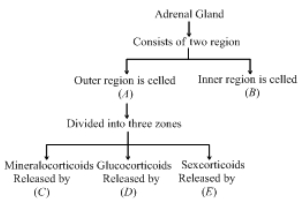
Study the given flow chart and identify $A, B, C, D$ and $E$.
A
$A$-Cortex,$B$-Medulla,$C$-Zona glomerulosa,$D$-Zona fasciculata,$E$-Zona reticularis
B
$A$-Cortex,$B$-Medulla,$C$-Zona glomerulosa,$D$-Zona reticularis,$E$-Zona reticularis
C
$A$-Medulla,$B$-Cortex,$C$-Zona glomerulosa,$D$-Zona reticularis,$E$-Zona reticularis
D
$A$-Medulla,$B$-Cortex,$C$-Zona glomerulosa,$D$-Zona reticularis,$E$-Zona fasciculata
Solution
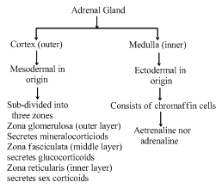
(A) The adrenal gland consists of two regions: the outer region is the $A$-Cortex and the inner region is the $B$-Medulla.
The adrenal cortex is further divided into three layers:
$1$. The outer layer is $C$-Zona glomerulosa,which secretes mineralocorticoids.
$2$. The middle layer is $D$-Zona fasciculata,which secretes glucocorticoids.
$3$. The inner layer is $E$-Zona reticularis,which secretes sex corticoids (androgens).
Therefore,the correct identification is $A$-Cortex,$B$-Medulla,$C$-Zona glomerulosa,$D$-Zona fasciculata,and $E$-Zona reticularis.
The adrenal cortex is further divided into three layers:
$1$. The outer layer is $C$-Zona glomerulosa,which secretes mineralocorticoids.
$2$. The middle layer is $D$-Zona fasciculata,which secretes glucocorticoids.
$3$. The inner layer is $E$-Zona reticularis,which secretes sex corticoids (androgens).
Therefore,the correct identification is $A$-Cortex,$B$-Medulla,$C$-Zona glomerulosa,$D$-Zona fasciculata,and $E$-Zona reticularis.
0 likes
View Solution148
MediumMCQ
Identify $A$ to $E$ in the following figure and choose the correct option.
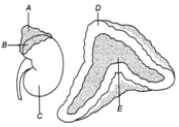
A
$A$-Adrenal gland,$B$-Fat,$C$-Kidney,$D$-Adrenal cortex,$E$-Adrenal medulla
B
$A$-Fat,$B$-Adrenal gland,$C$-Kidney,$D$-Adrenal cortex,$E$-Adrenal medulla
C
$A$-Fat,$B$-Adrenal gland,$C$-Kidney,$D$-Adrenal medulla,$E$-Adrenal cortex
D
$A$-Adrenal gland,$B$-Fat,$C$-Kidney,$D$-Adrenal medulla,$E$-Adrenal cortex
Solution
(A) Based on the anatomical structure of the adrenal gland:
$A$ represents the Adrenal gland,which is located on the superior aspect of the kidney.
$B$ represents the Fat tissue surrounding the gland.
$C$ represents the Kidney.
$D$ represents the outer layer of the adrenal gland,known as the Adrenal cortex.
$E$ represents the inner core of the adrenal gland,known as the Adrenal medulla.
Therefore,the correct sequence is $A$-Adrenal gland,$B$-Fat,$C$-Kidney,$D$-Adrenal cortex,$E$-Adrenal medulla.
$A$ represents the Adrenal gland,which is located on the superior aspect of the kidney.
$B$ represents the Fat tissue surrounding the gland.
$C$ represents the Kidney.
$D$ represents the outer layer of the adrenal gland,known as the Adrenal cortex.
$E$ represents the inner core of the adrenal gland,known as the Adrenal medulla.
Therefore,the correct sequence is $A$-Adrenal gland,$B$-Fat,$C$-Kidney,$D$-Adrenal cortex,$E$-Adrenal medulla.
0 likes
View Solution149
MediumMCQ
The hyposecretion of which hormone leads to loss of sodium and water through urine,low blood pressure and hypotension?
A
Thyrotropic hormones
B
Hormones of adrenal cortex
C
Hormones of adrenal medulla
D
Luteotrophic hormones
Solution
(B) The adrenal cortex secretes mineralocorticoids,primarily aldosterone,which regulates the balance of water and electrolytes in the body.
Hyposecretion of these hormones leads to a decrease in the reabsorption of sodium and water in the kidneys.
Consequently,this results in the excessive loss of sodium and water through urine,leading to a decrease in blood volume and blood pressure,a condition known as hypotension.
Hyposecretion of these hormones leads to a decrease in the reabsorption of sodium and water in the kidneys.
Consequently,this results in the excessive loss of sodium and water through urine,leading to a decrease in blood volume and blood pressure,a condition known as hypotension.
0 likes
View SolutionChemical Coordination and Integration — Adrenal Gland · Frequently Asked Questions
1Are these Chemical Coordination and Integration questions useful for JEE and NEET?
Yes. All questions in this section are mapped to JEE Main and NEET exam patterns. Previous year questions from JEE Main, NEET, GUJCET and state-level exams are included with full solutions.
2Can I switch to Hindi or Gujarati for these questions?
Yes. Use the language tabs in the hero section or the sidebar to view the same questions and solutions in English, Hindi or Gujarati.
3How do I generate a question paper from this subtopic?
Use the Vedclass Exam Paper Generator — select the chapter and subtopic, set difficulty, and generate Sets A, B, C, D automatically. First 3 chapters of every subject are free.
Vedclass Products
For Students
Vedclass Test Series
Mock tests in real JEE/NEET style with performance analysis. 5-day free trial.
Start Free TrialFor Teachers
Exam Paper Generator
Generate Set A/B/C/D papers from this chapter in 2 minutes. 3 chapters free.
Try FreeFor Institutes
Online Exam Module
Live online exams with unlimited students, 360° analytics & white-label branding.
See DemoFor Teachers & Institutes
Generate a Chemical Coordination and Integration Exam Paper in 2 Minutes
Select subtopic & difficulty — Sets A, B, C, D auto-generated with No Repeat logic.
First 3 chapters of every subject are free — no payment required.