
A English
Vacuoles and Microbodies Questions in English
Class 11 Biology · Cell: The Unit of Life · Vacuoles and Microbodies
105+
Questions
English
Language
100%
With Solutions
Showing 50 of 105 questions in English
51
MediumMCQ
Which structure in plant and animal cells contains various enzymes?
A
Lysosome
B
Mitochondria
C
Microbodies
D
Phagosome
Solution
(C) Microbodies are membrane-bound,minute vesicles found in both plant and animal cells. They contain various enzymes,such as oxidases and catalases,which are involved in metabolic processes like photorespiration and the breakdown of fatty acids. Lysosomes are primarily associated with hydrolytic enzymes,while mitochondria are the sites of cellular respiration.
0 likes
View Solution52
EasyMCQ
In plant cells,the vacuole is:
A
$A$ membrane-less structure.
B
$A$ membrane-less structure containing stored proteins and lipids.
C
$A$ membrane-bound structure containing stored proteins and lipids.
D
$A$ membrane-bound structure in which various substances are stored and excreted.
Solution
(D) In plant cells,the vacuole is a membrane-bound space found in the cytoplasm. It is bound by a single membrane called the $tonoplast$. The vacuole contains water,sap,excretory products,and other materials not useful for the cell. It acts as a storage organelle for various substances,including water,ions,and nutrients,and helps in maintaining turgor pressure. Therefore,it is a membrane-bound structure that stores various substances.
0 likes
View Solution53
EasyMCQ
Which of the following organelles is bounded by a single membrane?
A
Nucleus
B
Mitochondria
C
Chloroplast
D
Sphaerosome
Solution
(D) Organelles can be classified based on the number of membranes surrounding them:
$1$. Double membrane-bound organelles include the $Nucleus$,$Mitochondria$,and $Chloroplast$.
$2$. Single membrane-bound organelles include the $Lysosome$,$Vacuole$,$Golgi$ $apparatus$,$Endoplasmic$ $reticulum$,and $Sphaerosome$.
$3$. Non-membrane-bound organelles include $Ribosomes$ and $Centrosomes$.
Therefore,the $Sphaerosome$ is a single membrane-bound organelle.
$1$. Double membrane-bound organelles include the $Nucleus$,$Mitochondria$,and $Chloroplast$.
$2$. Single membrane-bound organelles include the $Lysosome$,$Vacuole$,$Golgi$ $apparatus$,$Endoplasmic$ $reticulum$,and $Sphaerosome$.
$3$. Non-membrane-bound organelles include $Ribosomes$ and $Centrosomes$.
Therefore,the $Sphaerosome$ is a single membrane-bound organelle.
0 likes
View Solution54
EasyMCQ
The membrane-bound space found in the cytoplasm is called .........
A
Lysosome
B
Peroxisome
C
Vacuole
D
Golgi apparatus
Solution
(C) The membrane-bound space found in the cytoplasm is called a $Vacuole$.
Vacuoles are storage sacs for solid or liquid contents.
They are bound by a single membrane called the $tonoplast$.
Vacuoles are storage sacs for solid or liquid contents.
They are bound by a single membrane called the $tonoplast$.
0 likes
View Solution55
EasyMCQ
Which option correctly identifies parts $a$ and $b$ in the given figure?
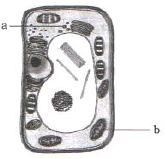
A
$a -$ Lysosome,$b -$ Mitochondrion
B
$a -$ Starch grain,$b -$ Vacuolar membrane
C
$a -$ Lysosome,$b -$ Tonoplast
D
$a -$ Small vacuole,$b -$ Vacuolar membrane
Solution
(D) The provided figure represents a plant cell.
In the diagram,label $a$ points to a small vesicle-like structure,which is a small vacuole.
Label $b$ points to the membrane surrounding the large central vacuole,which is known as the tonoplast or vacuolar membrane.
Therefore,the correct identification is $a -$ small vacuole and $b -$ vacuolar membrane.
In the diagram,label $a$ points to a small vesicle-like structure,which is a small vacuole.
Label $b$ points to the membrane surrounding the large central vacuole,which is known as the tonoplast or vacuolar membrane.
Therefore,the correct identification is $a -$ small vacuole and $b -$ vacuolar membrane.
0 likes
View Solution56
MediumMCQ
The organelle responsible for osmoregulation in protists is ........
A
Vacuole
B
Lysosome
C
Golgi apparatus
D
Endoplasmic reticulum
Solution
(A) In many protists,such as $Amoeba$,the contractile vacuole is a specialized organelle responsible for osmoregulation and excretion. It collects excess water from the cytoplasm and expels it out of the cell to maintain the internal osmotic pressure,preventing the cell from bursting.
0 likes
View Solution57
MediumMCQ
Select the mismatch.
A
Gas vacuoles - Green bacteria
B
Large central vacuoles - Animal cells
C
Protists - Eukaryotes
D
Methanogens - Prokaryotes
Solution
(B) is the correct answer because a large central vacuole is a characteristic feature of plant cells. Animal cells typically contain many small,scattered vacuoles or lack them entirely.
0 likes
View Solution58
MediumMCQ
The osmotic expansion of a cell kept in water is chiefly regulated by
A
mitochondria
B
vacuoles
C
plastids
D
ribosomes
Solution
(B) The correct answer is $B$.
Vacuoles are membrane-bound organelles found in the cytoplasm of plant cells,separated from the cytoplasm by a single membrane called the tonoplast.
In mature plant cells,a large central vacuole occupies a significant portion of the cell volume.
These vacuoles store water,ions,and solutes,which create turgor pressure against the cell wall.
This turgor pressure is responsible for the osmotic expansion and maintenance of the cell's shape and rigidity.
Vacuoles are membrane-bound organelles found in the cytoplasm of plant cells,separated from the cytoplasm by a single membrane called the tonoplast.
In mature plant cells,a large central vacuole occupies a significant portion of the cell volume.
These vacuoles store water,ions,and solutes,which create turgor pressure against the cell wall.
This turgor pressure is responsible for the osmotic expansion and maintenance of the cell's shape and rigidity.
0 likes
View Solution59
MediumMCQ
In germinating seeds,fatty acids are degraded exclusively in the
A
peroxisomes
B
mitochondria
C
proplastids
D
glyoxysomes
Solution
(D) The correct answer is $D$. Glyoxysomes are specialized peroxisomes found in the cells of germinating fatty seeds. They contain enzymes of the glyoxylate cycle,which allows the conversion of stored fatty acids into carbohydrates (gluconeogenesis) to provide energy and carbon skeletons for the growing embryo.
0 likes
View Solution60
MediumMCQ
Vacuole in a plant cell
A
lacks membrane and contains air
B
lacks membrane and contains water and excretory substances
C
is membrane-bound and contains storage proteins and lipids
D
is membrane-bound and contains water and excretory substances.
Solution
(D) : In a plant cell,a vacuole is a membrane-bound organelle. The membrane surrounding the vacuole is called the tonoplast,which is selectively permeable. The vacuole contains cell sap,which is a solution of water,minerals,sugars,amino acids,and various excretory substances or metabolic waste products.
0 likes
View Solution61
MediumMCQ
The function of the vacuole is
A
Excretion
B
Respiration
C
Circulation
D
Reproduction
Solution
(A) Vacuoles are membrane-bound spaces found in the cytoplasm. They contain water, sap, excretory products, and other materials not useful for the cell.
In many plant cells, the vacuole can occupy up to $90\%$ of the volume of the cell.
The membrane surrounding the vacuole is called the tonoplast.
The tonoplast facilitates the transport of a number of ions and other materials against concentration gradients into the vacuole, thereby maintaining a higher concentration in the vacuole than in the cytoplasm.
Thus, vacuoles play a significant role in the storage of waste products and their subsequent removal from the cell, which is a form of excretion.
In many plant cells, the vacuole can occupy up to $90\%$ of the volume of the cell.
The membrane surrounding the vacuole is called the tonoplast.
The tonoplast facilitates the transport of a number of ions and other materials against concentration gradients into the vacuole, thereby maintaining a higher concentration in the vacuole than in the cytoplasm.
Thus, vacuoles play a significant role in the storage of waste products and their subsequent removal from the cell, which is a form of excretion.
0 likes
View Solution62
MediumMCQ
Tonoplast is
A
Double layer of vacuole
B
single layer of vacuole
C
Sap present in Vacuole
D
None
Solution
(B) The $Tonoplast$ is the cytoplasmic membrane that surrounds the vacuole in plant cells.
It is a $single$ membrane that separates the vacuolar contents from the cytoplasm.
This membrane is selectively permeable and plays a crucial role in maintaining the turgor pressure of the cell by controlling the transport of ions and other materials between the vacuole and the cytoplasm.
It is a $single$ membrane that separates the vacuolar contents from the cytoplasm.
This membrane is selectively permeable and plays a crucial role in maintaining the turgor pressure of the cell by controlling the transport of ions and other materials between the vacuole and the cytoplasm.
0 likes
View Solution63
MediumMCQ
In plant cells,the vacuoles can occupy up to .............. of the volume of the cell. (in $\%$)
A
$30$
B
$80$
C
$100$
D
$90$
Solution
(D) In plant cells,the vacuole is a large,membrane-bound organelle that stores water,nutrients,and waste products.
Due to its large size,it pushes the nucleus and other organelles to the periphery of the cell.
According to the $NCERT$ textbook,in plant cells,the vacuoles can occupy up to $90\%$ of the volume of the cell.
Due to its large size,it pushes the nucleus and other organelles to the periphery of the cell.
According to the $NCERT$ textbook,in plant cells,the vacuoles can occupy up to $90\%$ of the volume of the cell.
0 likes
View Solution64
MediumMCQ
Identify the correct pair regarding cell organelles and their membrane structure.
A
Mitochondria - single layer
B
Vacuole - single layer
C
Lysosome - double layer
D
Golgi body - Leuvan Hawk
Solution
(B) $1$. Mitochondria are double-membrane bound organelles.
$2$. Vacuoles are bound by a single membrane called the tonoplast.
$3$. Lysosomes are single-membrane bound organelles containing hydrolytic enzymes.
$4$. Golgi bodies were discovered by Camillo Golgi,not Leuvan Hawk.
Therefore,the correct pair is Vacuole - single layer.
$2$. Vacuoles are bound by a single membrane called the tonoplast.
$3$. Lysosomes are single-membrane bound organelles containing hydrolytic enzymes.
$4$. Golgi bodies were discovered by Camillo Golgi,not Leuvan Hawk.
Therefore,the correct pair is Vacuole - single layer.
0 likes
View Solution65
MediumMCQ
What is present in $Amoeba$ for excretion?
A
$ER$
B
Golgi body
C
Vacuole
D
Mitochondria
Solution
(C) In $Amoeba$,excretion and osmoregulation are primarily carried out by the contractile vacuole.
When the contractile vacuole reaches its maximum size,it moves to the plasma membrane and discharges its contents (waste products and excess water) to the outside environment through a process called exocytosis.
Therefore,the vacuole is the organelle responsible for excretion in $Amoeba$.
When the contractile vacuole reaches its maximum size,it moves to the plasma membrane and discharges its contents (waste products and excess water) to the outside environment through a process called exocytosis.
Therefore,the vacuole is the organelle responsible for excretion in $Amoeba$.
0 likes
View Solution66
MediumMCQ
Which of the following is not concerned with protein synthesis?
A
Ribosome
B
$RER$
C
Vacuole
D
All of the above
Solution
(C) Protein synthesis is primarily carried out by ribosomes.
$RER$ (Rough Endoplasmic Reticulum) is studded with ribosomes and is involved in the synthesis and transport of proteins.
Vacuoles are membrane-bound organelles primarily involved in storage,waste disposal,and maintaining turgor pressure in plant cells; they are not involved in protein synthesis.
Therefore,the correct answer is Vacuole.
$RER$ (Rough Endoplasmic Reticulum) is studded with ribosomes and is involved in the synthesis and transport of proteins.
Vacuoles are membrane-bound organelles primarily involved in storage,waste disposal,and maintaining turgor pressure in plant cells; they are not involved in protein synthesis.
Therefore,the correct answer is Vacuole.
0 likes
View Solution67
EasyMCQ
The vacuole is bound by a single membrane called.....
A
Tonoplast
B
Inner membrane
C
$A$ and $B$ both
D
None of the above
Solution
(A) The vacuole is a membrane-bound space found in the cytoplasm of plant and fungal cells,as well as some protist,animal,and bacterial cells.
It contains water,sap,excretory products,and other materials not useful for the cell.
The vacuole is bound by a single membrane called the $Tonoplast$.
Therefore,the correct option is $A$.
It contains water,sap,excretory products,and other materials not useful for the cell.
The vacuole is bound by a single membrane called the $Tonoplast$.
Therefore,the correct option is $A$.
0 likes
View Solution68
MediumMCQ
Which of the following cell organelles is not considered part of the endomembrane system?
A
Peroxisome
B
Lysosome
C
Vacuole
D
Golgi body
Solution
(A) The endomembrane system includes organelles that work together to modify,package,and transport lipids and proteins.
These include the endoplasmic reticulum,Golgi complex,lysosomes,and vacuoles.
Peroxisomes are not part of the endomembrane system because their functions (such as lipid metabolism and detoxification) are independent of the coordinated membrane flow between the other organelles.
These include the endoplasmic reticulum,Golgi complex,lysosomes,and vacuoles.
Peroxisomes are not part of the endomembrane system because their functions (such as lipid metabolism and detoxification) are independent of the coordinated membrane flow between the other organelles.
0 likes
View Solution69
MediumMCQ
Which organelles contain enzymes that convert fats into carbohydrates?
A
Liposomes
B
Golgi bodies
C
Microsomes
D
Glyoxysomes
Solution
(D) Glyoxysomes are specialized peroxisomes found in plants,particularly in the germinating seeds of oil-rich plants.
They contain enzymes for the glyoxylate cycle,which allows the conversion of stored fatty acids into carbohydrates (sugars) through gluconeogenesis.
This process provides the necessary energy and carbon skeletons for the growth of the embryo before it becomes photosynthetically active.
They contain enzymes for the glyoxylate cycle,which allows the conversion of stored fatty acids into carbohydrates (sugars) through gluconeogenesis.
This process provides the necessary energy and carbon skeletons for the growth of the embryo before it becomes photosynthetically active.
0 likes
View Solution70
MediumMCQ
In germinating seeds,the complete breakdown of fatty acids occurs in . . . . . . .
A
Proplastids
B
Glyoxysomes
C
Peroxisomes
D
Mitochondria
Solution
(B) In germinating seeds,fatty acids are converted into carbohydrates through a process called the glyoxylate cycle. This cycle takes place in specialized organelles known as $Glyoxysomes$. These organelles are a type of microbody found in the endosperm of germinating seeds,which allow the plant to utilize stored fats as an energy source for growth before photosynthesis begins.
0 likes
View Solution71
MediumMCQ
In plant cells,the vacuole is a/an ...........
A
membrane-bound structure that stores lipids and proteins.
B
membrane-bound structure that contains water and excretory products.
C
non-membrane-bound structure that contains air.
D
non-membrane-bound structure that contains water and excretory products.
Solution
(B) In plant cells,the vacuole is a membrane-bound space found in the cytoplasm. It contains water,sap,excretory products,and other materials not useful for the cell. The vacuole is bound by a single membrane called the tonoplast. Therefore,it is a membrane-bound structure that contains water and excretory products.
0 likes
View Solution72
MediumMCQ
Which organelle controls the expansion of a cell's volume due to osmosis when placed in water?
A
Mitochondria
B
Vacuole
C
Chloroplast
D
Ribosomes
Solution
(B) When a plant cell is placed in water,water enters the cell due to osmosis. The vacuole,which contains cell sap,plays a crucial role in maintaining the turgor pressure of the cell. The tonoplast (membrane of the vacuole) facilitates the transport of ions and other materials against concentration gradients into the vacuole,thereby regulating the water potential and the expansion of the cell volume.
0 likes
View Solution73
MediumMCQ
Identify the incorrect match.
A
Protista - Eukaryotes
B
Methanogens - Prokaryotes
C
Gas vacuoles - Green bacteria
D
Large central vacuoles - Animal cells
Solution
(D) The correct answer is $D$.
$A$. Protists are eukaryotic organisms,which is correct.
$B$. Methanogens are archaebacteria,which are prokaryotic,which is correct.
$C$. Gas vacuoles are found in blue-green,purple,and green photosynthetic bacteria,which is correct.
$D$. Large central vacuoles are characteristic of plant cells,not animal cells. Animal cells typically have small,temporary vacuoles or lack them entirely. Therefore,this is the incorrect match.
$A$. Protists are eukaryotic organisms,which is correct.
$B$. Methanogens are archaebacteria,which are prokaryotic,which is correct.
$C$. Gas vacuoles are found in blue-green,purple,and green photosynthetic bacteria,which is correct.
$D$. Large central vacuoles are characteristic of plant cells,not animal cells. Animal cells typically have small,temporary vacuoles or lack them entirely. Therefore,this is the incorrect match.
0 likes
View Solution74
EasyMCQ
Where are the water-soluble pigments found in the vacuoles of plant cells?
A
Chlorophyll
B
Carotenoids
C
Anthocyanins
D
Xanthophylls
Solution
(C) In plant cells,the vacuole is a membrane-bound organelle that stores various substances. Water-soluble pigments,such as anthocyanins,are dissolved in the cell sap within the vacuole. These pigments are responsible for the red,purple,or blue colors in many flowers and fruits. Chlorophyll,carotenoids,and xanthophylls are typically found in plastids (like chloroplasts) and are generally fat-soluble,not water-soluble.
0 likes
View Solution75
MediumMCQ
In protozoans like $Amoeba$ or $Paramecium$,the organelle responsible for osmoregulation is ....... .
A
Contractile vacuole
B
Mitochondria
C
Nucleus
D
Vacuole
Solution
(A) In many freshwater protozoans like $Amoeba$ and $Paramecium$,the contractile vacuole is the specialized organelle responsible for osmoregulation and excretion.
It collects excess water from the cytoplasm and expels it out of the cell to maintain the internal osmotic balance.
Therefore,the correct option is $A$.
It collects excess water from the cytoplasm and expels it out of the cell to maintain the internal osmotic balance.
Therefore,the correct option is $A$.
0 likes
View Solution76
Difficult
Both lysosomes and vacuoles are endomembrane structures,yet they differ in terms of their functions. Comment.
Solution
(N/A) Lysosomes are membrane-bound vesicular structures containing a variety of hydrolytic enzymes such as lipases,proteases,and carbohydrases. Their primary function is the digestion of worn-out cell organelles and foreign materials,earning them the name 'suicidal bags' or 'waste disposal systems' of the cell.
In contrast,vacuoles are membrane-bound storage sacs. In plant cells,they occupy a large volume and store water,sap,and excretory products. In unicellular organisms like Amoeba,food vacuoles are involved in the digestion of food,while contractile vacuoles play a role in osmoregulation and the excretion of excess water and waste.
In contrast,vacuoles are membrane-bound storage sacs. In plant cells,they occupy a large volume and store water,sap,and excretory products. In unicellular organisms like Amoeba,food vacuoles are involved in the digestion of food,while contractile vacuoles play a role in osmoregulation and the excretion of excess water and waste.
0 likes
View Solution77
Easy
Give the name and function of the membrane-bound structure that occupies most of the space in a plant cell.
Solution
(A) $\Rightarrow$ The structure is called the $Vacuole$.
$\Rightarrow$ The vacuole is a membrane-bound space found in the cytoplasm. It contains water, sap, excretory products, and other materials not useful for the cell.
$\Rightarrow$ The vacuole is bound by a single membrane called the $Tonoplast$.
$\Rightarrow$ In plant cells, the vacuoles can occupy up to $90\%$ of the volume of the cell.
$\Rightarrow$ In plants, the $Tonoplast$ facilitates the transport of a number of ions and other materials against concentration gradients into the vacuole; hence, their concentration is significantly higher in the vacuole than in the cytoplasm.
$\Rightarrow$ In $Amoeba$, the contractile vacuole is important for excretion. In many cells, such as in protists, food vacuoles are formed by engulfing food particles.
$\Rightarrow$ The vacuole is a membrane-bound space found in the cytoplasm. It contains water, sap, excretory products, and other materials not useful for the cell.
$\Rightarrow$ The vacuole is bound by a single membrane called the $Tonoplast$.
$\Rightarrow$ In plant cells, the vacuoles can occupy up to $90\%$ of the volume of the cell.
$\Rightarrow$ In plants, the $Tonoplast$ facilitates the transport of a number of ions and other materials against concentration gradients into the vacuole; hence, their concentration is significantly higher in the vacuole than in the cytoplasm.
$\Rightarrow$ In $Amoeba$, the contractile vacuole is important for excretion. In many cells, such as in protists, food vacuoles are formed by engulfing food particles.
0 likes
View Solution78
Easy
Write a note on vacuole.
Solution
(N/A) $\Rightarrow$ The vacuole is the membrane-bound space found in the cytoplasm. It contains water,sap,excretory products,and other materials not useful for the cell.
$\Rightarrow$ The vacuole is bound by a single membrane called the tonoplast.
$\Rightarrow$ In plant cells,the vacuoles can occupy up to $90\%$ of the volume of the cell. In plants,the tonoplast facilitates the transport of a number of ions and other materials against concentration gradients into the vacuole; hence,their concentration is significantly higher in the vacuole than in the cytoplasm.
$\Rightarrow$ In $Amoeba$,the contractile vacuole is important for excretion. In many cells,such as in protists,food vacuoles are formed by engulfing food particles.
$\Rightarrow$ The vacuole is bound by a single membrane called the tonoplast.
$\Rightarrow$ In plant cells,the vacuoles can occupy up to $90\%$ of the volume of the cell. In plants,the tonoplast facilitates the transport of a number of ions and other materials against concentration gradients into the vacuole; hence,their concentration is significantly higher in the vacuole than in the cytoplasm.
$\Rightarrow$ In $Amoeba$,the contractile vacuole is important for excretion. In many cells,such as in protists,food vacuoles are formed by engulfing food particles.
0 likes
View Solution79
EasyMCQ
What do microbodies contain?
A
$DNA$ and $RNA$
B
Various enzymes
C
Ribosomes
D
Chlorophyll
Solution
(B) Microbodies are small,membrane-bound organelles found in the cytoplasm of plant and animal cells.
They contain various enzymes,such as oxidases and catalases,which are involved in metabolic reactions like photorespiration and the breakdown of hydrogen peroxide.
Therefore,the correct answer is that they contain various enzymes.
They contain various enzymes,such as oxidases and catalases,which are involved in metabolic reactions like photorespiration and the breakdown of hydrogen peroxide.
Therefore,the correct answer is that they contain various enzymes.
0 likes
View Solution80
MediumMCQ
Why do all fresh water organisms have contractile vacuoles whereas the majority of marine organisms lack them?
A
Fresh water organisms are hypertonic to their environment.
B
Marine organisms are isotonic to their environment.
C
Contractile vacuoles are used for excretion in marine organisms.
D
Fresh water organisms need to conserve water.
Solution
(A) Fresh water organisms live in a hypotonic environment,meaning the concentration of solutes inside their cells is higher than that of the surrounding water. Due to osmosis,water constantly enters their bodies. The contractile vacuole acts as a pump to expel this excess water,preventing the cell from bursting. In contrast,marine organisms live in a hypertonic or isotonic environment where the osmotic pressure is balanced,so they do not face the problem of excess water influx and thus do not require contractile vacuoles.
0 likes
View Solution81
Medium
Define the location and function of the following structures:
$(1)$ Vacuole
$(2)$ Plasmodesmata
$(3)$ Stomata
$(1)$ Vacuole
$(2)$ Plasmodesmata
$(3)$ Stomata
Solution
(N/A) $(1)$ Vacuole:
Location: Found in plant cells,occupying a large portion of the cytoplasm.
Function: Maintains turgor pressure and regulates osmosis.
$(2)$ Plasmodesmata:
Location: Microscopic channels traversing the cell walls of plant cells.
Function: Acts as a pathway for the transport of water,nutrients,and signaling molecules between neighboring cells.
$(3)$ Stomata:
Location: Small pores located primarily on the epidermis of leaves.
Function: Facilitates the exchange of respiratory gases ($CO_2$ and $O_2$) and regulates the rate of transpiration.
Location: Found in plant cells,occupying a large portion of the cytoplasm.
Function: Maintains turgor pressure and regulates osmosis.
$(2)$ Plasmodesmata:
Location: Microscopic channels traversing the cell walls of plant cells.
Function: Acts as a pathway for the transport of water,nutrients,and signaling molecules between neighboring cells.
$(3)$ Stomata:
Location: Small pores located primarily on the epidermis of leaves.
Function: Facilitates the exchange of respiratory gases ($CO_2$ and $O_2$) and regulates the rate of transpiration.
0 likes
View Solution82
MediumMCQ
Which of the following is a Semipermeable Membrane $(SP)$ and which is Selectively Permeable $(SL)$? : Tonoplast
A
Tonoplast is Semipermeable $(SP)$
B
Tonoplast is Selectively Permeable $(SL)$
C
Tonoplast is both $(SP)$ and $(SL)$
D
Tonoplast is neither $(SP)$ nor $(SL)$
Solution
(B) The tonoplast is the vacuolar membrane that surrounds the central vacuole of a plant cell.
It is biologically classified as a selectively permeable membrane $(SL)$ because it actively regulates the transport of ions and other materials into and out of the vacuole to maintain cellular homeostasis.
Therefore,the correct classification for the tonoplast is Selectively Permeable $(SL)$.
It is biologically classified as a selectively permeable membrane $(SL)$ because it actively regulates the transport of ions and other materials into and out of the vacuole to maintain cellular homeostasis.
Therefore,the correct classification for the tonoplast is Selectively Permeable $(SL)$.
0 likes
View Solution83
MediumMCQ
Most of the water in mature plant cells occurs in
A
nucleus
B
cell wall
C
vacuoles
D
cytoplasm
Solution
(C) In mature plant cells,the vacuoles are large and can occupy up to $90$ percent of the volume of the cell.
These vacuoles store water,sap,excretory products,and other materials not useful for the cell.
The vacuole is bound by a single membrane called the tonoplast.
These vacuoles store water,sap,excretory products,and other materials not useful for the cell.
The vacuole is bound by a single membrane called the tonoplast.
0 likes
View Solution84
EasyMCQ
Cell sap is a
A
living content of cytoplasm.
B
nonliving content of cytoplasm.
C
nonliving content of vacuole.
D
living content of vacuole.
Solution
(C) Cell sap is a non-living fluid found within the vacuole of a plant cell.
It is produced by the cytoplasm and consists of water,minerals,sugars,amino acids,and various metabolic waste products.
Since it is a fluid mixture of solutes and water,it is considered a non-living component of the vacuole.
It plays a crucial role in maintaining the turgor pressure and osmotic potential of the cell.
It is produced by the cytoplasm and consists of water,minerals,sugars,amino acids,and various metabolic waste products.
Since it is a fluid mixture of solutes and water,it is considered a non-living component of the vacuole.
It plays a crucial role in maintaining the turgor pressure and osmotic potential of the cell.
0 likes
View Solution85
MediumMCQ
The $pH$ of vacuolar cell sap is
A
neutral and isotonic.
B
alkaline and isotonic.
C
acidic and hypertonic.
D
equal to cytoplasm and isotonic.
Solution
(C) The vacuole is a membrane-bound organelle found in plant cells,bounded by a selectively permeable membrane called the $tonoplast$.
It contains a highly concentrated fluid known as cell sap or vacuolar sap.
Due to the active transport of ions and other solutes into the vacuole against the concentration gradient,the cell sap is typically $hypertonic$ compared to the surrounding cytoplasm.
Furthermore,the accumulation of various organic acids and protons ($H^+$ ions) within the vacuole results in an $acidic$ $pH$ for the cell sap.
It contains a highly concentrated fluid known as cell sap or vacuolar sap.
Due to the active transport of ions and other solutes into the vacuole against the concentration gradient,the cell sap is typically $hypertonic$ compared to the surrounding cytoplasm.
Furthermore,the accumulation of various organic acids and protons ($H^+$ ions) within the vacuole results in an $acidic$ $pH$ for the cell sap.
0 likes
View Solution86
MediumMCQ
Which of the following statements is correct regarding the vacuole?
A
It is membrane-bound and contains storage proteins and lipids.
B
It is membrane-bound and contains water and excretory substances.
C
It lacks a membrane and contains air.
D
It lacks a membrane and contains water and excretory substances.
Solution
(B) The vacuole is a membrane-bound organelle found in both animal and plant cells,although they are significantly larger in plant cells.
Vacuoles are essentially enclosed compartments filled with water containing inorganic and organic molecules,including enzymes in solution.
They store food or various nutrients that a cell needs to survive.
They can also store waste products,protecting the rest of the cell from contamination.
Vacuoles are essentially enclosed compartments filled with water containing inorganic and organic molecules,including enzymes in solution.
They store food or various nutrients that a cell needs to survive.
They can also store waste products,protecting the rest of the cell from contamination.
0 likes
View Solution87
MediumMCQ
Read the following statements and identify the correct option.
$(i)$ Contractile vacuole takes part in osmoregulation and excretion.
$(ii)$ Food vacuole is formed by engulfing the food particles.
$(iii)$ The vacuole is bound by a double membrane called tonoplast.
$(iv)$ Vacuole can occupy up to $90$ percent of the volume of the cell.
$(i)$ Contractile vacuole takes part in osmoregulation and excretion.
$(ii)$ Food vacuole is formed by engulfing the food particles.
$(iii)$ The vacuole is bound by a double membrane called tonoplast.
$(iv)$ Vacuole can occupy up to $90$ percent of the volume of the cell.
A
$(i)$ and $(ii)$
B
$(ii)$ and $(iv)$
C
$(i), (ii)$ and $(iv)$
D
None of the above
Solution
(C) Statement $(i)$ is correct: In many organisms like Amoeba,contractile vacuoles are involved in osmoregulation and excretion.
Statement $(ii)$ is correct: Food vacuoles are formed in many protists by engulfing food particles through phagocytosis.
Statement $(iii)$ is incorrect: The vacuole is bound by a single membrane called the tonoplast,not a double membrane.
Statement $(iv)$ is correct: In plant cells,the vacuole can occupy up to $90$ percent of the volume of the cell.
Therefore,statements $(i), (ii),$ and $(iv)$ are correct.
Statement $(ii)$ is correct: Food vacuoles are formed in many protists by engulfing food particles through phagocytosis.
Statement $(iii)$ is incorrect: The vacuole is bound by a single membrane called the tonoplast,not a double membrane.
Statement $(iv)$ is correct: In plant cells,the vacuole can occupy up to $90$ percent of the volume of the cell.
Therefore,statements $(i), (ii),$ and $(iv)$ are correct.
0 likes
View Solution88
MediumMCQ
Given below are some characters of a cell organelle. Identify the correct organelle which shows all the characters described above.
$(i)$ It is a membrane bound space found in the cytoplasm.
$(ii)$ It is bound by a single membrane called tonoplast.
$(iii)$ It contains water,sap,excretory products and other materials not useful to the cell.
$(iv)$ It has higher concentration of sap than the cytoplasm.
$(i)$ It is a membrane bound space found in the cytoplasm.
$(ii)$ It is bound by a single membrane called tonoplast.
$(iii)$ It contains water,sap,excretory products and other materials not useful to the cell.
$(iv)$ It has higher concentration of sap than the cytoplasm.
A
Golgi apparatus
B
Lysosomes
C
Endoplasmic reticulum
D
Vacuoles
Solution
(D) The given characters describe the vacuole.
$(i)$ Vacuoles are membrane-bound spaces found in the cytoplasm.
$(ii)$ They are bounded by a single membrane known as the tonoplast.
$(iii)$ The vacuole contains water,sap,excretory products,and other materials not useful for the cell.
$(iv)$ In plant cells,the concentration of ions and other materials is significantly higher in the vacuole than in the cytoplasm,which helps in maintaining turgor pressure.
$(i)$ Vacuoles are membrane-bound spaces found in the cytoplasm.
$(ii)$ They are bounded by a single membrane known as the tonoplast.
$(iii)$ The vacuole contains water,sap,excretory products,and other materials not useful for the cell.
$(iv)$ In plant cells,the concentration of ions and other materials is significantly higher in the vacuole than in the cytoplasm,which helps in maintaining turgor pressure.
0 likes
View Solution89
EasyMCQ
Which type of vacuoles provide buoyancy to bacteria?
A
Sap vacuoles
B
Contractile vacuoles
C
Gas vacuoles
D
Food vacuoles
Solution
(C) Gas vacuoles $\rightarrow$ Provide buoyancy to bacteria and help in floating.
Sap vacuoles $\rightarrow$ Found in plant cells.
Contractile vacuoles $\rightarrow$ Involved in osmoregulation.
Food vacuoles $\rightarrow$ Involved in digestion.
Sap vacuoles $\rightarrow$ Found in plant cells.
Contractile vacuoles $\rightarrow$ Involved in osmoregulation.
Food vacuoles $\rightarrow$ Involved in digestion.
0 likes
View Solution90
EasyMCQ
Which of the following vacuoles help in osmoregulation in $Amoeba$?
A
Gas vacuoles
B
Food vacuoles
C
Contractile vacuoles
D
Sap vacuoles
Solution
(C) Contractile vacuoles are specialized organelles found in freshwater protozoans like $Amoeba$.
They function in osmoregulation by collecting excess water from the cytoplasm and expelling it out of the cell to maintain internal water balance.
Therefore,the correct option is $C$.
They function in osmoregulation by collecting excess water from the cytoplasm and expelling it out of the cell to maintain internal water balance.
Therefore,the correct option is $C$.
0 likes
View Solution91
EasyMCQ
The vacuoles which help in the digestion of food particles engulfed by protists are:
A
Contractile vacuoles
B
Gas vacuoles
C
Sap vacuoles
D
Food vacuoles
Solution
(D) Food vacuoles are specialized organelles formed by the fusion of lysosomes with phagosomes. They help in the digestion of food particles engulfed by protists through the action of digestive enzymes.
0 likes
View Solution92
MediumMCQ
Microbodies are
A
Membrane bound minute vesicles
B
Non-membrane bound organelles
C
Present only in animals
D
Present only in plants
Solution
(A) Microbodies are small,membrane-bound,vesicular organelles found in both plant and animal cells. They contain various enzymes,such as peroxidases and catalases,which are involved in metabolic reactions like photorespiration and the breakdown of hydrogen peroxide.
0 likes
View Solution93
MediumMCQ
In plants,the tonoplast facilitates the transport of a number of ions and other materials:
A
Against concentration gradient into vacuole
B
Along concentration gradient into vacuole
C
Along concentration gradient into gas vacuoles
D
Against concentration gradient in contractile vacuole
Solution
(A) In plant cells,the tonoplast is the membrane surrounding the vacuole.
It facilitates the transport of a number of ions and other materials against the concentration gradient into the vacuole.
Because this transport occurs against the concentration gradient,it requires energy.
Plant cells do not contain gas vacuoles or contractile vacuoles.
It facilitates the transport of a number of ions and other materials against the concentration gradient into the vacuole.
Because this transport occurs against the concentration gradient,it requires energy.
Plant cells do not contain gas vacuoles or contractile vacuoles.
0 likes
View Solution94
MediumMCQ
All the following statements are correct,except:
A
Peroxisomes are quite common in photosynthetic cells. Their number can be $70-100$ per mesophyll cell,where they interact with mitochondria and chloroplasts to take part in photorespiration.
B
Glyoxysomes are numerous in the endosperm of wheat.
C
The $ER$-bound ribosomes synthesize secretory,membrane,and lysosomal proteins.
D
Ribosomes,when associated with $ER$,are attached with their $60S$ subunit.
Solution
(B) Glyoxysomes are specialized peroxisomes found in germinating seeds that convert stored fats into sugars. They are abundant in the endosperm of oil-rich seeds like castor,peanuts,and sunflower,not in wheat (which is a starchy endosperm). Therefore,the statement in option $B$ is incorrect.
0 likes
View Solution95
MediumMCQ
The glyoxylate cycle helps in the metabolism of triglycerides to convert fats into carbohydrates. The organelle responsible for this process is found in:
A
Rice seeds
B
Castor seeds
C
Wheat seeds
D
More than one option is correct
Solution
(B) The glyoxylate cycle occurs in specialized peroxisomes known as glyoxysomes. These organelles are primarily found in the endosperm of germinating fatty seeds, such as castor seeds $(Ricinus communis)$, where they facilitate the conversion of stored fats into carbohydrates to provide energy for the developing embryo. While some studies suggest their presence in other oil-bearing seeds, castor seeds are the classic textbook example for the occurrence of the glyoxylate cycle.
0 likes
View Solution96
MediumMCQ
Catalase and urate oxidase enzymes are associated with the organelle which is also involved in:
A
Gluconeogenesis
B
Photorespiration
C
Glycolate oxidation
D
More than one option is correct
Solution
(D) Catalase and urate oxidase are marker enzymes of peroxisomes. Peroxisomes are involved in photorespiration and the oxidation of glycolate. Since both photorespiration and glycolate oxidation are correct,the correct answer is option $D$.
0 likes
View Solution97
EasyMCQ
What is the significance of the vacuole in a plant cell?
A
It stores genetic material.
B
It helps in protein synthesis.
C
It maintains turgidity and stores waste products.
D
It is the site of cellular respiration.
Solution
(C) $\Rightarrow$ The vacuole is a membrane-bound organelle found in the cytoplasm of plant cells.
$\Rightarrow$ It contains water,cell sap,excretory products,and other materials that are not useful for the cell.
$\Rightarrow$ In plant cells,the vacuole can occupy up to $90\%$ of the volume of the cell.
$\Rightarrow$ It plays a crucial role in maintaining the turgor pressure (turgidity) and structural shape of the plant cell.
$\Rightarrow$ It contains water,cell sap,excretory products,and other materials that are not useful for the cell.
$\Rightarrow$ In plant cells,the vacuole can occupy up to $90\%$ of the volume of the cell.
$\Rightarrow$ It plays a crucial role in maintaining the turgor pressure (turgidity) and structural shape of the plant cell.
0 likes
View Solution98
Easy
What are gas vacuoles? State their functions.
Solution
(N/A) Gas vacuoles,also known as pseudo-vacuoles or air vacuoles,are specialized structures found in certain prokaryotes,such as cyanobacteria,purple and green photosynthetic bacteria.
Each gas vacuole is composed of numerous sub-microscopic,hollow,cylindrical,or hexagonal vesicles.
These vesicles are enclosed by a thin,rigid protein membrane that is permeable to gases but impermeable to water.
Their primary function is to regulate buoyancy,allowing the organism to float at an optimal depth for photosynthesis or nutrient acquisition.
Each gas vacuole is composed of numerous sub-microscopic,hollow,cylindrical,or hexagonal vesicles.
These vesicles are enclosed by a thin,rigid protein membrane that is permeable to gases but impermeable to water.
Their primary function is to regulate buoyancy,allowing the organism to float at an optimal depth for photosynthesis or nutrient acquisition.
0 likes
View Solution99
Medium
Give scientific reasons: Majority of fresh water organisms have contractile vacuoles while marine organisms lack them.
Solution
(N/A) The osmotic concentration of fresh water organisms like $Amoeba$ and $Paramoecium$ is hypertonic to the surrounding water,causing water to enter their bodies via endosmosis. This excess water must be expelled to prevent the cell from bursting,which is achieved by contractile vacuoles; thus,they play a crucial role in osmoregulation. In contrast,marine protozoans are isotonic to sea water,meaning there is no net movement of water into the cell,and therefore,they do not require contractile vacuoles.
0 likes
View Solution100
EasyMCQ
In a plant cell,the vacuole can occupy up to $....$ of the volume of the cell. (in $\%$)
A
$70$
B
$80$
C
$90$
D
$95$
Solution
(C) In plant cells,the vacuole is a membrane-bound space found in the cytoplasm. It contains water,sap,excretory products,and other materials not useful for the cell. The vacuole is bound by a single membrane called the tonoplast. In plant cells,the vacuoles can occupy up to $90 \%$ of the volume of the cell.
0 likes
View SolutionCell: The Unit of Life — Vacuoles and Microbodies · Frequently Asked Questions
1Are these Cell: The Unit of Life questions useful for JEE and NEET?
Yes. All questions in this section are mapped to JEE Main and NEET exam patterns. Previous year questions from JEE Main, NEET, GUJCET and state-level exams are included with full solutions.
2Can I switch to Hindi or Gujarati for these questions?
Yes. Use the language tabs in the hero section or the sidebar to view the same questions and solutions in English, Hindi or Gujarati.
3How do I generate a question paper from this subtopic?
Use the Vedclass Exam Paper Generator — select the chapter and subtopic, set difficulty, and generate Sets A, B, C, D automatically. First 3 chapters of every subject are free.
Vedclass Products
For Students
Vedclass Test Series
Mock tests in real JEE/NEET style with performance analysis. 5-day free trial.
Start Free TrialFor Teachers
Exam Paper Generator
Generate Set A/B/C/D papers from this chapter in 2 minutes. 3 chapters free.
Try FreeFor Institutes
Online Exam Module
Live online exams with unlimited students, 360° analytics & white-label branding.
See DemoFor Teachers & Institutes
Generate a Cell: The Unit of Life Exam Paper in 2 Minutes
Select subtopic & difficulty — Sets A, B, C, D auto-generated with No Repeat logic.
First 3 chapters of every subject are free — no payment required.