
A English
Centrosomes , CentrioleCilia Questions in English
Class 11 Biology · Cell: The Unit of Life · Centrosomes , CentrioleCilia
121+
Questions
English
Language
100%
With Solutions
Showing 21 of 121 questions in English
101
EasyMCQ
Basal bodies are associated with the formation of
A
phragmoplast
B
cilia and flagella
C
cell plate
D
kinetochore
Solution
(B) Basal bodies are short,cylindrical structures composed of microtubules. They are derived from centrioles and are responsible for the formation of cilia and flagella. Located at the base of eukaryotic cilia and flagella,they serve as the anchoring site. Structurally,they represent a continuation of the $9$ outer-axonemal microtubule doublets,with the addition of a $C$ tubule to form a centriole-like triplet. Basal bodies act as a nucleating center for axonemal assembly and are anchored in the cytoplasm by rootlets.
0 likes
View Solution102
MediumMCQ
Centrioles and centrosomes occur in the cells of
A
green plants
B
animals
C
bacteria and cyanobacteria
D
both $(b)$ and $(c)$
Solution
(B) Centrioles and centrosomes are specialized cell structures involved in organizing microtubules during cell division.
They are characteristically found in most animal cells.
They are typically absent in higher plants,fungi,and prokaryotes like bacteria and cyanobacteria.
Therefore,the correct option is $(b)$.
They are characteristically found in most animal cells.
They are typically absent in higher plants,fungi,and prokaryotes like bacteria and cyanobacteria.
Therefore,the correct option is $(b)$.
0 likes
View Solution103
MediumMCQ
Study the following statements on cilium or flagellum and answer the question.
$(i)$ Cilium / Flagellum contains an outer ring of nine doublet microtubules surrounding two singlet microtubules.
$(ii)$ Cilia are smaller which work like oars,causing the movement of either the cells or surrounding fluid.
$(iii)$ Flagella are comparatively longer and responsible for cell movement.
$(iv)$ Cilium and flagellum are covered with plasma membrane. Which of the above statements are correct?
$(i)$ Cilium / Flagellum contains an outer ring of nine doublet microtubules surrounding two singlet microtubules.
$(ii)$ Cilia are smaller which work like oars,causing the movement of either the cells or surrounding fluid.
$(iii)$ Flagella are comparatively longer and responsible for cell movement.
$(iv)$ Cilium and flagellum are covered with plasma membrane. Which of the above statements are correct?
A
$(i)$ and $(ii)$
B
$(i), (ii), (iii)$ and $(iv)$
C
$(i)$ and $(iv)$
D
$(ii)$ and $(iii)$
Solution
(B) Statement $(i)$ is correct as the axoneme of cilia and flagella exhibits a $9+2$ arrangement of microtubules.
Statement $(ii)$ is correct because cilia are small structures that work like oars,moving the cell or the surrounding fluid.
Statement $(iii)$ is correct as flagella are longer than cilia and are primarily responsible for cell movement.
Statement $(iv)$ is correct because both cilia and flagella are extensions of the cell membrane and are covered by the plasma membrane.
Therefore,all the given statements are correct.
Statement $(ii)$ is correct because cilia are small structures that work like oars,moving the cell or the surrounding fluid.
Statement $(iii)$ is correct as flagella are longer than cilia and are primarily responsible for cell movement.
Statement $(iv)$ is correct because both cilia and flagella are extensions of the cell membrane and are covered by the plasma membrane.
Therefore,all the given statements are correct.
0 likes
View Solution104
MediumMCQ
The animal cell is different from a plant cell in having
A
Ribosomes
B
Nucleus
C
Golgi apparatus
D
Centrosomes
Solution
(D) Centrosomes or centrioles are specialized organelles found exclusively in animal cells. They play a crucial role in cell division by organizing microtubules to form the spindle apparatus. Plant cells lack centrosomes,although they can still organize microtubules using other mechanisms.
0 likes
View Solution105
MediumMCQ
Centrosome is an organelle containing two cylindrical structures called
A
Cristae
B
Cisternae
C
Centrioles
D
Thylakoids
Solution
(C) centrosome is an organelle usually containing two cylindrical structures called centrioles. These centrioles are surrounded by amorphous pericentriolar materials. Both the centrioles in a centrosome lie perpendicular to each other and are made up of nine evenly spaced peripheral fibrils of tubulin protein.

0 likes
View Solution106
MediumMCQ
Which organelle lacks $DNA$ but is capable of duplication?
A
Ribosome
B
Centriole
C
Chloroplast
D
Nucleus
Solution
(B) The $Centriole$ is a non-membrane-bound organelle found in animal cells that lacks $DNA$.
Despite the absence of $DNA$,it is capable of self-duplication during the $S$ phase of the cell cycle to form a new pair of centrioles for cell division.
Despite the absence of $DNA$,it is capable of self-duplication during the $S$ phase of the cell cycle to form a new pair of centrioles for cell division.
0 likes
View Solution107
MediumMCQ
Each centriole has a cartwheel organization having a whorl of tubulin fibrils at the periphery. These peripheral fibrils are composed of how many microtubules?
A
$11$
B
$18$
C
$9$
D
$27$
Solution
(D) Centrioles exhibit a cartwheel organization,consisting of nine evenly spaced peripheral fibrils made of tubulin protein.
Each of these peripheral fibrils is a triplet,meaning it is composed of three microtubules.
Therefore,the total number of microtubules in the peripheral fibrils is $9 \times 3 = 27$.
Each of these peripheral fibrils is a triplet,meaning it is composed of three microtubules.
Therefore,the total number of microtubules in the peripheral fibrils is $9 \times 3 = 27$.
0 likes
View Solution108
MediumMCQ
$A$: Centriole does not form any compartment in a cell.
$R$: Centriole is a non-membranous cell organelle.
$R$: Centriole is a non-membranous cell organelle.
A
Assertion and Reason both are correct and Reason is the correct explanation of Assertion.
B
Assertion and Reason both are correct but Reason is not the correct explanation of Assertion.
C
Assertion is correct,but Reason is incorrect.
D
Both Assertion and Reason are incorrect.
Solution
(A) In a eukaryotic cell,compartmentalization is achieved by the presence of membrane-bound organelles (e.g.,nucleus,mitochondria,endoplasmic reticulum).
Centrioles are non-membranous organelles composed of microtubules arranged in a $9+0$ pattern.
Since centrioles lack a surrounding membrane,they do not contribute to the formation of cellular compartments.
Therefore,both the Assertion and the Reason are correct,and the Reason provides the correct explanation for the Assertion.
Centrioles are non-membranous organelles composed of microtubules arranged in a $9+0$ pattern.
Since centrioles lack a surrounding membrane,they do not contribute to the formation of cellular compartments.
Therefore,both the Assertion and the Reason are correct,and the Reason provides the correct explanation for the Assertion.
0 likes
View Solution109
MediumMCQ
$A$: The axoneme of a eukaryotic flagellum possesses a number of microtubules running parallel to the long axis.
$R$: It has a pair of peripheral doublet and a pair of centrally located microtubules.
$R$: It has a pair of peripheral doublet and a pair of centrally located microtubules.
A
Assertion and Reason both are correct and Reason is the correct explanation of Assertion.
B
Assertion and Reason both are correct but Reason is not the correct explanation of Assertion.
C
Assertion is correct,but Reason is incorrect.
D
Both Assertion and Reason are incorrect.
Solution
(C) The axoneme of a eukaryotic flagellum consists of microtubules arranged in a $9+2$ array.
This means there are $9$ pairs of peripheral doublets and $2$ centrally located microtubules.
The Assertion is correct because the axoneme does contain microtubules running parallel to the long axis.
The Reason is incorrect because it states there is only 'a pair' of peripheral doublets,whereas there are actually $9$ pairs of peripheral doublets.
Therefore,the correct option is $C$.
This means there are $9$ pairs of peripheral doublets and $2$ centrally located microtubules.
The Assertion is correct because the axoneme does contain microtubules running parallel to the long axis.
The Reason is incorrect because it states there is only 'a pair' of peripheral doublets,whereas there are actually $9$ pairs of peripheral doublets.
Therefore,the correct option is $C$.
0 likes
View Solution110
EasyMCQ
Nerve cells do not divide because they do not have
A
Nucleus
B
Centrosome
C
Golgi body
D
Mitochondria
Solution
(B) Centrosome,or cell centre,is situated close to the nuclear envelope and is also called the microtubule-organizing centre $(MTOC)$.
It plays an important role in animal cell division by producing microtubules or bipolar mitotic spindles.
Since nerve cells lack a centrosome,they are not capable of division.
It plays an important role in animal cell division by producing microtubules or bipolar mitotic spindles.
Since nerve cells lack a centrosome,they are not capable of division.
0 likes
View Solution111
MediumMCQ
Which organelle helps in cell division in animal cells?
A
Ribosomes
B
Centrosome
C
Nucleus
D
Endoplasmic reticulum
Solution
(B) The $Centrosome$ is a non-membrane-bound organelle found in animal cells.
It consists of two cylindrical structures called $Centrioles$.
During cell division, the centrosome organizes the $Microtubules$ to form the $Spindle$ apparatus, which is essential for the separation of chromosomes.
Therefore, the centrosome plays a crucial role in animal cell division.
It consists of two cylindrical structures called $Centrioles$.
During cell division, the centrosome organizes the $Microtubules$ to form the $Spindle$ apparatus, which is essential for the separation of chromosomes.
Therefore, the centrosome plays a crucial role in animal cell division.
0 likes
View Solution112
MediumMCQ
The given structure functions like an oar.
A
Cilia
B
Flagella
C
Pili
D
Fimbriae
Solution
(A) Cilia are small,hair-like outgrowths of the cell membrane that function like oars,causing the movement of either the cell or the surrounding fluid. In contrast,flagella are longer and responsible for cell movement. Pili and fimbriae are surface structures of bacteria that do not function like oars.
0 likes
View Solution113
EasyMCQ
The arrangement of microtubules in cilia and flagella is known as:
A
$9+0$
B
$9+2$
C
$8+2$
D
$8+0$
Solution
(B) Cilia and flagella are hair-like outgrowths of the cell membrane.
Their core,called the axoneme,possesses a number of microtubules running parallel to the long axis.
The axoneme usually has nine pairs of doublets of radially arranged peripheral microtubules and a pair of centrally located microtubules.
This arrangement is referred to as the $9+2$ array.
Their core,called the axoneme,possesses a number of microtubules running parallel to the long axis.
The axoneme usually has nine pairs of doublets of radially arranged peripheral microtubules and a pair of centrally located microtubules.
This arrangement is referred to as the $9+2$ array.
0 likes
View Solution114
MediumMCQ
The basal body of cilia and flagella is formed by .............
A
$9+2$ arrangement
B
Centriole
C
Centrosome
D
Nucleus
Solution
(B) The basal body of cilia and flagella is derived from the centriole.
It possesses a $9+0$ arrangement of microtubule triplets,which is similar to the structure of a centriole.
This structure acts as an anchor for the axoneme (which has a $9+2$ arrangement) to emerge from the cell surface.
It possesses a $9+0$ arrangement of microtubule triplets,which is similar to the structure of a centriole.
This structure acts as an anchor for the axoneme (which has a $9+2$ arrangement) to emerge from the cell surface.
0 likes
View Solution115
MediumMCQ
What is the number of radial spokes in the structure of cilia and flagella?
A
$9$
B
$18$
C
$20$
D
$2$
Solution
(A) The axoneme of cilia and flagella consists of a $9+2$ arrangement of microtubules.
In this structure,there are $9$ peripheral microtubule doublets and $2$ central microtubule singlets.
Each of the $9$ peripheral doublets is connected to the central sheath by a radial spoke.
Therefore,there are $9$ radial spokes in total.
In this structure,there are $9$ peripheral microtubule doublets and $2$ central microtubule singlets.
Each of the $9$ peripheral doublets is connected to the central sheath by a radial spoke.
Therefore,there are $9$ radial spokes in total.
0 likes
View Solution116
MediumMCQ
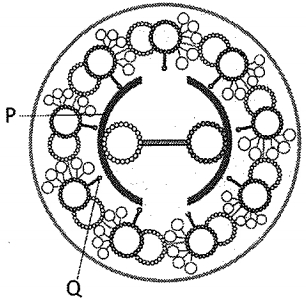
What is $Q$ in the given structure of a cilium/flagellum?
A
Plasma membrane
B
Radial spoke
C
Interdoublet bridge
D
Central sheath
Solution
(B) The given diagram represents the cross-section of a cilium or flagellum,which shows a $9+2$ arrangement of microtubules.
In this structure:
- The outer circle represents the Plasma membrane.
- The $9$ peripheral doublets are connected to the central pair by radial spokes.
- $Q$ points to the radial spoke,which connects the peripheral microtubule doublets to the central sheath.
- $P$ points to the central sheath,which encloses the central pair of microtubules.
Therefore,$Q$ represents the radial spoke.
In this structure:
- The outer circle represents the Plasma membrane.
- The $9$ peripheral doublets are connected to the central pair by radial spokes.
- $Q$ points to the radial spoke,which connects the peripheral microtubule doublets to the central sheath.
- $P$ points to the central sheath,which encloses the central pair of microtubules.
Therefore,$Q$ represents the radial spoke.
0 likes
View Solution117
MediumMCQ
The arrangement of $..............$ is like a cartwheel.
A
Cilia
B
Flagella
C
Centriole
D
Centrosome
Solution
(C) The centriole is a cylindrical structure composed of $9$ microtubule triplets arranged in a peripheral ring.
This specific arrangement of microtubules in the centriole is often described as a 'cartwheel' structure.
Each triplet is connected to the central hub by radial spokes made of protein.
Therefore,the centriole exhibits a cartwheel-like organization.
This specific arrangement of microtubules in the centriole is often described as a 'cartwheel' structure.
Each triplet is connected to the central hub by radial spokes made of protein.
Therefore,the centriole exhibits a cartwheel-like organization.
0 likes
View Solution118
MediumMCQ
What is the number of microtubules in a centrosome?
A
$18$
B
$20$
C
$27$
D
$28$
Solution
(C) centrosome consists of two centrioles arranged at right angles to each other.
Each centriole is composed of $9$ sets of microtubule triplets arranged in a ring.
Since there are $3$ microtubules per triplet and $9$ triplets per centriole,one centriole contains $9 \times 3 = 27$ microtubules.
Therefore,the total number of microtubules in a centrosome (containing two centrioles) is $27 \times 2 = 54$. However,in the context of standard biology questions regarding the structure of a single centriole unit within the centrosome,the value $27$ is the standard answer.
Each centriole is composed of $9$ sets of microtubule triplets arranged in a ring.
Since there are $3$ microtubules per triplet and $9$ triplets per centriole,one centriole contains $9 \times 3 = 27$ microtubules.
Therefore,the total number of microtubules in a centrosome (containing two centrioles) is $27 \times 2 = 54$. However,in the context of standard biology questions regarding the structure of a single centriole unit within the centrosome,the value $27$ is the standard answer.
0 likes
View Solution119
EasyMCQ
The central part of the centriole is made up of:
A
Central microtubule
B
Hub
C
Middle piece
D
Triplet
Solution
(B) The centriole consists of a central proteinaceous rod-like structure known as the $Hub$.
From this $Hub$,radial spokes made of protein extend outwards and connect to the peripheral microtubule triplets.
Therefore,the central part of the centriole is the $Hub$.
From this $Hub$,radial spokes made of protein extend outwards and connect to the peripheral microtubule triplets.
Therefore,the central part of the centriole is the $Hub$.
0 likes
View Solution120
MediumMCQ
What is the function of the centrosome?
A
Forms the basal body of cilia.
B
Forms the basal body of flagella.
C
Forms the bipolar spindle during cell division.
D
All of the above.
Solution
(D) The centrosome is an organelle found in animal cells that performs several critical functions:
$1$. During cell division,it organizes microtubules to form the bipolar spindle,which is essential for chromosome segregation.
$2$. It acts as the basal body for cilia and flagella,providing the structural foundation for their formation and movement.
Since all these functions are performed by the centrosome,the correct option is $D$.
$1$. During cell division,it organizes microtubules to form the bipolar spindle,which is essential for chromosome segregation.
$2$. It acts as the basal body for cilia and flagella,providing the structural foundation for their formation and movement.
Since all these functions are performed by the centrosome,the correct option is $D$.
0 likes
View Solution121
EasyMCQ
The arrangement of microtubules in a centriole is described as $...........$.
A
$9+0$
B
$9+2$
C
$8+2$
D
$8+0$
Solution
(A) Centrioles are cylindrical structures composed mainly of the protein tubulin. Each centriole is made up of $9$ evenly spaced peripheral fibrils of tubulin protein. Each of the peripheral fibrils is a triplet. The adjacent triplets are linked to each other. The central part of the proximal region of the centriole is also proteinaceous and is called the hub,from which radial spokes made of protein extend and connect to the triplets. The centriole does not have any central microtubules. Therefore,the arrangement of microtubules in a centriole is referred to as the $9+0$ arrangement.
0 likes
View SolutionCell: The Unit of Life — Centrosomes , CentrioleCilia · Frequently Asked Questions
1Are these Cell: The Unit of Life questions useful for JEE and NEET?
Yes. All questions in this section are mapped to JEE Main and NEET exam patterns. Previous year questions from JEE Main, NEET, GUJCET and state-level exams are included with full solutions.
2Can I switch to Hindi or Gujarati for these questions?
Yes. Use the language tabs in the hero section or the sidebar to view the same questions and solutions in English, Hindi or Gujarati.
3How do I generate a question paper from this subtopic?
Use the Vedclass Exam Paper Generator — select the chapter and subtopic, set difficulty, and generate Sets A, B, C, D automatically. First 3 chapters of every subject are free.
Vedclass Products
For Students
Vedclass Test Series
Mock tests in real JEE/NEET style with performance analysis. 5-day free trial.
Start Free TrialFor Teachers
Exam Paper Generator
Generate Set A/B/C/D papers from this chapter in 2 minutes. 3 chapters free.
Try FreeFor Institutes
Online Exam Module
Live online exams with unlimited students, 360° analytics & white-label branding.
See DemoFor Teachers & Institutes
Generate a Cell: The Unit of Life Exam Paper in 2 Minutes
Select subtopic & difficulty — Sets A, B, C, D auto-generated with No Repeat logic.
First 3 chapters of every subject are free — no payment required.