
A English
Cell theory and What is cell ? Questions in English
Class 11 Biology · Cell: The Unit of Life · Cell theory and What is cell ?
197+
Questions
English
Language
100%
With Solutions
Showing 47 of 197 questions in English
151
MediumMCQ
Match the following:
| Column-$I$ | Column-$II$ |
| $A$. Schleiden | $1$. Nucleus |
| $B$. Schwann | $2$. German botanist |
| $C$. Robert Brown | $3$. Living cell |
| $D$. Leeuwenhoek | $4$. British Zoologist |
A
$(A-4), (B-2), (C-3), (D-1)$
B
$(A-1), (B-4), (C-3), (D-2)$
C
$(A-2), (B-4), (C-1), (D-3)$
D
$(A-3), (B-1), (C-4), (D-2)$
Solution
(C) The correct matches are as follows:
$A$. Matthias Schleiden was a German botanist $(A-2)$.
$B$. Theodor Schwann was a British Zoologist $(B-4)$.
$C$. Robert Brown discovered the nucleus $(C-1)$.
$D$. Antonie van Leeuwenhoek was the first to describe a living cell $(D-3)$.
Therefore,the correct sequence is $(A-2), (B-4), (C-1), (D-3)$.
$A$. Matthias Schleiden was a German botanist $(A-2)$.
$B$. Theodor Schwann was a British Zoologist $(B-4)$.
$C$. Robert Brown discovered the nucleus $(C-1)$.
$D$. Antonie van Leeuwenhoek was the first to describe a living cell $(D-3)$.
Therefore,the correct sequence is $(A-2), (B-4), (C-1), (D-3)$.
0 likes
View Solution152
MediumMCQ
Which of the following statements was not explained in the cell theory given jointly by Schleiden and Schwann?
A
All living organisms are composed of cells and their products.
B
Cell is the structural and functional unit of living organisms.
C
Formation of new cells.
D
None of the above.
Solution
(C) The cell theory was formulated by Matthias Schleiden $(1838)$ and Theodor Schwann $(1839)$.
They proposed that all living organisms are composed of cells and products of cells.
They also stated that the cell is the structural and functional unit of living organisms.
However,their theory failed to explain how new cells are formed.
This was later explained by Rudolf Virchow in $1855$ with the concept of 'Omnis cellula-e cellula',which states that all cells arise from pre-existing cells.
They proposed that all living organisms are composed of cells and products of cells.
They also stated that the cell is the structural and functional unit of living organisms.
However,their theory failed to explain how new cells are formed.
This was later explained by Rudolf Virchow in $1855$ with the concept of 'Omnis cellula-e cellula',which states that all cells arise from pre-existing cells.
0 likes
View Solution153
MediumMCQ
Arrange the following cells in an ascending order of their size and select the correct option:
$I.$ Ostrich eggs
$II.$ Mycoplasma
$III.$ Bacteria
$IV.$ Human $RBCs$
$I.$ Ostrich eggs
$II.$ Mycoplasma
$III.$ Bacteria
$IV.$ Human $RBCs$
A
$II-III-IV-I$
B
$I-IV-III-II$
C
$II-I-IV-III$
D
$I-II-IV-III$
Solution
(A) To arrange the cells in ascending order of size,we compare their approximate dimensions:
$1$. $Mycoplasma$ are the smallest known cells,measuring about $0.3 \ \mu m$ in length.
$2$. Typical $Bacteria$ range from $3$ to $5 \ \mu m$ in length.
$3$. Human $RBCs$ are about $7.0 \ \mu m$ in diameter.
$4$. The egg of an Ostrich is the largest isolated single cell,which is significantly larger than the others.
Therefore,the correct ascending order is $Mycoplasma (II) < Bacteria (III) < Human \ RBCs (IV) < Ostrich \ egg (I)$.
Thus,the correct sequence is $II-III-IV-I$.
$1$. $Mycoplasma$ are the smallest known cells,measuring about $0.3 \ \mu m$ in length.
$2$. Typical $Bacteria$ range from $3$ to $5 \ \mu m$ in length.
$3$. Human $RBCs$ are about $7.0 \ \mu m$ in diameter.
$4$. The egg of an Ostrich is the largest isolated single cell,which is significantly larger than the others.
Therefore,the correct ascending order is $Mycoplasma (II) < Bacteria (III) < Human \ RBCs (IV) < Ostrich \ egg (I)$.
Thus,the correct sequence is $II-III-IV-I$.
0 likes
View Solution154
MediumMCQ
The organization of living organisms starts with which level?
A
Cellular level
B
Organismal level
C
Atomic level
D
Sub-microscopic molecular level
Solution
(D) The biological organization of living organisms begins at the sub-microscopic molecular level. Atoms combine to form molecules,which then form macromolecules,organelles,and eventually cells. Therefore,the fundamental basis of life's organization starts at the sub-microscopic molecular level.
0 likes
View Solution155
EasyMCQ
One $\mathring{A} = $ ............... . (in $\mu m$)
A
$0.01$
B
$0.001$
C
$0.0001$
D
$0.00001$
Solution
(C) The $\mathring{A}$ is a unit of length equal to $10^{-10} \, m$.
One micrometer $(\mu m)$ is equal to $10^{-6} \, m$.
To convert $\mathring{A}$ to micrometers:
$1 \, \mathring{A} = 10^{-10} \, m = 10^{-4} \times 10^{-6} \, m = 10^{-4} \, \mu m$.
$10^{-4} \, \mu m = 0.0001 \, \mu m$.
Therefore, $1 \, \mathring{A} = 0.0001 \, \mu m$.
One micrometer $(\mu m)$ is equal to $10^{-6} \, m$.
To convert $\mathring{A}$ to micrometers:
$1 \, \mathring{A} = 10^{-10} \, m = 10^{-4} \times 10^{-6} \, m = 10^{-4} \, \mu m$.
$10^{-4} \, \mu m = 0.0001 \, \mu m$.
Therefore, $1 \, \mathring{A} = 0.0001 \, \mu m$.
0 likes
View Solution156
EasyMCQ
The names of $Schleiden$ and $Schwann$ are associated with which of the following?
A
Protoplasm is the physical basis of life.
B
Cell Theory
C
Theory of linear cell structure
D
Regulation of cell functions by the nucleus
Solution
(B) $Matthias$ $Schleiden$ (a German botanist) in $1838$ and $Theodor$ $Schwann$ (a British zoologist) in $1839$ independently formulated the $Cell$ $Theory$.
$Schleiden$ observed that all plants are composed of cells,and $Schwann$ reported that animal cells have a thin outer layer (plasma membrane) and plant cells have a cell wall.
Together,they proposed that the bodies of plants and animals are composed of cells and products of cells.
Therefore,their names are associated with the $Cell$ $Theory$.
$Schleiden$ observed that all plants are composed of cells,and $Schwann$ reported that animal cells have a thin outer layer (plasma membrane) and plant cells have a cell wall.
Together,they proposed that the bodies of plants and animals are composed of cells and products of cells.
Therefore,their names are associated with the $Cell$ $Theory$.
0 likes
View Solution157
MediumMCQ
According to the Cell Theory,which statement is true regarding cell structure?
A
It is adapted due to the discovery of sub-cellular structures like chloroplasts and mitochondria.
B
All living organisms' cells have the capacity for reproduction,which is the basis of the modern Cell Theory.
C
Cell Theory is not true because all organisms cannot form cellular structures (e.g.,viruses).
D
Cell Theory means that all cells of all organisms have the capacity for reproduction or not.
Solution
(A) The modern Cell Theory (Cell Principle) states that all living organisms are composed of cells and products of cells. Furthermore,all cells arise from pre-existing cells ($Omnis$ $cellula-e$ $cellula$). The discovery of organelles like mitochondria and chloroplasts,which contain their own $DNA$ and can replicate independently,supports the idea that cells are the fundamental units of life and that they possess the machinery for reproduction and self-maintenance. Thus,the theory has been refined over time to include these observations.
0 likes
View Solution158
MediumMCQ
The study of cells has been greatly advanced by the use of an electron microscope. This is primarily because:
A
The resolving power of an electron microscope is $200-300 \ nm$,compared to $0.1-0.2 \ nm$ for a light microscope.
B
Light microscopes require thin sections,whereas electron beams can pass through thick specimens.
C
Electron beams have a longer wavelength than photons,making electron microscopes more powerful than light microscopes.
D
The electron microscope has a much higher resolving power than a light microscope.
Solution
(D) The primary advantage of an electron microscope over a light microscope is its significantly higher resolving power.
Resolving power is the ability to distinguish between two closely placed objects.
$A$ light microscope uses visible light (photons) which has a relatively long wavelength,limiting its resolution to about $200-300 \ nm$.
An electron microscope uses a beam of electrons,which has a much shorter wavelength than visible light,allowing it to achieve a resolution of about $0.1-0.2 \ nm$.
This high resolution allows scientists to observe fine details of cellular organelles that are invisible under a light microscope.
Resolving power is the ability to distinguish between two closely placed objects.
$A$ light microscope uses visible light (photons) which has a relatively long wavelength,limiting its resolution to about $200-300 \ nm$.
An electron microscope uses a beam of electrons,which has a much shorter wavelength than visible light,allowing it to achieve a resolution of about $0.1-0.2 \ nm$.
This high resolution allows scientists to observe fine details of cellular organelles that are invisible under a light microscope.
0 likes
View Solution159
EasyMCQ
The concept of "Omnis cellula-e cellula" regarding cell division was first proposed by
A
Rudolf Virchow
B
Theodore Schwann
C
Schleiden
D
Aristotle
Solution
(A) The concept of "Omnis cellula-e cellula" means that all cells arise from pre-existing cells.
This concept was first proposed by Rudolf Virchow in $1855$.
He modified the hypothesis of cell theory proposed by Schleiden and Schwann to give it a final shape.
This concept was first proposed by Rudolf Virchow in $1855$.
He modified the hypothesis of cell theory proposed by Schleiden and Schwann to give it a final shape.
0 likes
View Solution160
MediumMCQ
"Omnis-cellula-e-cellula" was given by
A
Virchow
B
Hooke
C
Leeuwenhoek
D
Brown
Solution
(A) The cell is the basic structural and functional unit of living organisms.
In $1855$, Rudolf Virchow explained that all cells arise from pre-existing cells through cell division, a concept he summarized as "Omnis-cellula-e-cellula".
Robert Hooke was the first to discover the basic units of life and termed them "cells".
Anton van Leeuwenhoek was the first to observe living unicellular organisms, including bacteria.
Robert Brown described the nucleus as a characteristic spherical body found in plant cells.
In $1855$, Rudolf Virchow explained that all cells arise from pre-existing cells through cell division, a concept he summarized as "Omnis-cellula-e-cellula".
Robert Hooke was the first to discover the basic units of life and termed them "cells".
Anton van Leeuwenhoek was the first to observe living unicellular organisms, including bacteria.
Robert Brown described the nucleus as a characteristic spherical body found in plant cells.
0 likes
View Solution161
DifficultMCQ
Assertion: Organisms are made up of cells.
Reason: Cells are the structural unit of living organisms. $A$ cell keeps its chemical composition steady within its boundary.
Reason: Cells are the structural unit of living organisms. $A$ cell keeps its chemical composition steady within its boundary.
A
If both Assertion and Reason are correct and the Reason is a correct explanation of the Assertion.
B
If both Assertion and Reason are correct but Reason is not a correct explanation of the Assertion.
C
If the Assertion is correct but Reason is incorrect.
D
If both the Assertion and Reason are incorrect.
Solution
(A) The Assertion states that organisms are made up of cells,which is a fundamental principle of the Cell Theory.
The Reason states that cells are the structural units of living organisms and maintain a steady chemical composition within their boundaries (homeostasis).
Since the structural organization of an organism is derived from its cellular composition,the Reason correctly explains why organisms are made up of cells.
The Reason states that cells are the structural units of living organisms and maintain a steady chemical composition within their boundaries (homeostasis).
Since the structural organization of an organism is derived from its cellular composition,the Reason correctly explains why organisms are made up of cells.
0 likes
View Solution162
EasyMCQ
Which of the following statements is not correct?
A
Robert Brown discovered the cell.
B
Schleiden and Schwann formulated the cell theory.
C
Virchow explained that cells are formed from pre-existing cells.
D
$A$ unicellular organism carries out its life activities within a single cell.
Solution
(A) The statement $(a)$ is incorrect because Robert Brown did not discover the cell; he discovered the nucleus in $1831$.
Robert Hooke discovered the cell in $1665$ while examining a thin slice of cork.
Schleiden and Schwann proposed the cell theory,which states that all living organisms are composed of cells and products of cells.
Rudolf Virchow later expanded the cell theory by explaining that all cells arise from pre-existing cells (Omnis cellula-e cellula).
Unicellular organisms are indeed capable of independent existence and perform all essential life functions within a single cell.
Robert Hooke discovered the cell in $1665$ while examining a thin slice of cork.
Schleiden and Schwann proposed the cell theory,which states that all living organisms are composed of cells and products of cells.
Rudolf Virchow later expanded the cell theory by explaining that all cells arise from pre-existing cells (Omnis cellula-e cellula).
Unicellular organisms are indeed capable of independent existence and perform all essential life functions within a single cell.
0 likes
View Solution163
EasyMCQ
New cells generate from
A
bacterial fermentation
B
pre-existing cells
C
regeneration of old cells
D
abiotic materials
Solution
(B) According to the cell theory,specifically the concept of $Omnis$ $cellula-e$ $cellula$ proposed by Rudolf Virchow,new cells arise only from pre-existing cells through the process of cell division.
This principle states that cells do not originate from abiotic materials or spontaneous generation,but rather from the division of already existing living cells.
This principle states that cells do not originate from abiotic materials or spontaneous generation,but rather from the division of already existing living cells.
0 likes
View Solution164
Medium
Multicellular organisms have division of labour. Explain.
Solution
(N/A) Multicellular organisms are composed of millions to trillions of cells.
Each cell or group of cells is specialized to perform a specific function.
Cells that are specialized to perform similar functions are grouped together to form tissues.
Consequently,a particular physiological function is carried out by a specific group of cells at a definite location within the body.
Since different groups of cells perform different tasks,this organization is referred to as the division of labour in multicellular organisms.
Each cell or group of cells is specialized to perform a specific function.
Cells that are specialized to perform similar functions are grouped together to form tissues.
Consequently,a particular physiological function is carried out by a specific group of cells at a definite location within the body.
Since different groups of cells perform different tasks,this organization is referred to as the division of labour in multicellular organisms.
0 likes
View Solution165
Medium
Cell is the basic unit of life. Discuss in brief.
Solution
(N/A) Cells are the fundamental structural and functional units of all living organisms.
They are capable of performing all essential biochemical processes required for survival,such as respiration,digestion,and excretion.
Since all metabolic activities occur within the cell to maintain life,the cell is considered the functional unit of life.
Furthermore,because all organisms are composed of one or more cells,it is also defined as the structural unit of life.
They are capable of performing all essential biochemical processes required for survival,such as respiration,digestion,and excretion.
Since all metabolic activities occur within the cell to maintain life,the cell is considered the functional unit of life.
Furthermore,because all organisms are composed of one or more cells,it is also defined as the structural unit of life.
0 likes
View Solution166
MediumMCQ
What is a cell? Explain it briefly.
A
$A$ structural unit
B
$A$ functional unit
C
Both $A$ and $B$
D
None of the above
Solution
(C) $\Rightarrow$ $A$ cell is the fundamental structural and functional unit of all living organisms.
$\Rightarrow$ All physiological and biochemical processes within an organism depend on the structure, type, and number of cells present. Thus, the cell is the basic unit of life.
$\Rightarrow$ The life of every multicellular organism begins from a single-celled structure called the $Zygote$. New cells are generated through the repeated division of this $Zygote$.
$\Rightarrow$ These cells subsequently differentiate to form tissues, organs, organ systems, and eventually the entire body of the organism.
$\Rightarrow$ $Totipotency$: It is the ability of a single cell to divide and produce all the differentiated cells required to form a complete organism.
$\Rightarrow$ Historical Context:
$\Rightarrow$ $Anton$ $van$ $Leeuwenhoek$ was the first to observe and describe a living cell.
$\Rightarrow$ $Robert$ $Hooke$ $(1665)$ observed a thin slice of cork under a microscope. He described the honeycomb-like structures as 'cells'.
$\Rightarrow$ $Robert$ $Brown$ $(1831)$ discovered the nucleus. The subsequent invention and improvement of the microscope, leading to the electron microscope, revealed the complex structural details of the cell.
$\Rightarrow$ All physiological and biochemical processes within an organism depend on the structure, type, and number of cells present. Thus, the cell is the basic unit of life.
$\Rightarrow$ The life of every multicellular organism begins from a single-celled structure called the $Zygote$. New cells are generated through the repeated division of this $Zygote$.
$\Rightarrow$ These cells subsequently differentiate to form tissues, organs, organ systems, and eventually the entire body of the organism.
$\Rightarrow$ $Totipotency$: It is the ability of a single cell to divide and produce all the differentiated cells required to form a complete organism.
$\Rightarrow$ Historical Context:
$\Rightarrow$ $Anton$ $van$ $Leeuwenhoek$ was the first to observe and describe a living cell.
$\Rightarrow$ $Robert$ $Hooke$ $(1665)$ observed a thin slice of cork under a microscope. He described the honeycomb-like structures as 'cells'.
$\Rightarrow$ $Robert$ $Brown$ $(1831)$ discovered the nucleus. The subsequent invention and improvement of the microscope, leading to the electron microscope, revealed the complex structural details of the cell.
0 likes
View Solution167
Easy
What is meant by cell theory? Who presented its principles? Which improvements were done in it? Describe them.
Solution
(N/A) $\Rightarrow$ In $1838$,Matthias Schleiden and Theodore Schwann presented the cell theory.
$\Rightarrow$ Matthias Schleiden was a German botanist. He observed that all plants are composed of different kinds of cells which form the tissues of the plant.
$\Rightarrow$ $A$ British zoologist,Theodore Schwann,studied different types of animals and reported that cells had a thin outer layer,which is now known as the plasma membrane. He also concluded that the presence of a cell wall is a unique character of plant cells.
$\Rightarrow$ Both scientists together formulated the cell theory,which stated:
$(a)$ All living organisms are composed of cells and their products.
$(b)$ The cell is the structural and functional unit of all living organisms.
$\Rightarrow$ However,this theory did not explain how new cells were formed.
$\Rightarrow$ Rudolf Virchow (in $1855$) first explained that cells divide and new cells are formed from pre-existing cells (Omnis cellula-e cellula).
$\Rightarrow$ He modified the hypothesis of Schleiden and Schwann to give the cell theory its final shape:
$(i)$ All living organisms are composed of cells and products of cells.
$(ii)$ All cells arise from pre-existing cells.
$\Rightarrow$ Matthias Schleiden was a German botanist. He observed that all plants are composed of different kinds of cells which form the tissues of the plant.
$\Rightarrow$ $A$ British zoologist,Theodore Schwann,studied different types of animals and reported that cells had a thin outer layer,which is now known as the plasma membrane. He also concluded that the presence of a cell wall is a unique character of plant cells.
$\Rightarrow$ Both scientists together formulated the cell theory,which stated:
$(a)$ All living organisms are composed of cells and their products.
$(b)$ The cell is the structural and functional unit of all living organisms.
$\Rightarrow$ However,this theory did not explain how new cells were formed.
$\Rightarrow$ Rudolf Virchow (in $1855$) first explained that cells divide and new cells are formed from pre-existing cells (Omnis cellula-e cellula).
$\Rightarrow$ He modified the hypothesis of Schleiden and Schwann to give the cell theory its final shape:
$(i)$ All living organisms are composed of cells and products of cells.
$(ii)$ All cells arise from pre-existing cells.
0 likes
View Solution168
MediumMCQ
Explain the cell theory.
A
All living organisms are composed of cells and products of cells.
B
All cells arise from pre-existing cells.
C
Both $A$ and $B$.
D
Cells are the basic unit of energy production.
Solution
(C) The cell theory was formulated by Matthias Schleiden and Theodor Schwann.
$1$. It states that all living organisms are composed of cells and products of cells.
$2$. Later,Rudolf Virchow added the concept of 'Omnis cellula-e cellula',which means all cells arise from pre-existing cells.
Therefore,both statements $A$ and $B$ are correct components of the cell theory.
$1$. It states that all living organisms are composed of cells and products of cells.
$2$. Later,Rudolf Virchow added the concept of 'Omnis cellula-e cellula',which means all cells arise from pre-existing cells.
Therefore,both statements $A$ and $B$ are correct components of the cell theory.
0 likes
View Solution169
EasyMCQ
What was the contribution of the scientist Robert Hook in $1665$?
A
Discovery of the nucleus
B
Discovery of the cell
C
Formulation of the cell theory
D
Discovery of mitochondria
Solution
(B) In $1665$,the English scientist Robert Hooke examined a thin slice of cork under a primitive microscope.
He observed that the cork was composed of small,box-like compartments which he termed 'cells' (Latin for 'little rooms').
This was the first time that the term 'cell' was used in a biological context,marking the discovery of the cell.
He observed that the cork was composed of small,box-like compartments which he termed 'cells' (Latin for 'little rooms').
This was the first time that the term 'cell' was used in a biological context,marking the discovery of the cell.
0 likes
View Solution170
EasyMCQ
What was the contribution of the scientists Schleiden and Schwann in $1838$?
A
Discovery of the nucleus
B
Formulation of the Cell Theory
C
Discovery of the Golgi apparatus
D
Discovery of the mitochondria
Solution
(B) In $1838$,Matthias Schleiden,a German botanist,examined a large number of plants and observed that all plants are composed of different kinds of cells which form the tissues of the plant.
At about the same time $(1839)$,Theodore Schwann,a British zoologist,studied different types of animal cells and reported that cells had a thin outer layer which is today known as the 'plasma membrane'.
Together,Schleiden and Schwann formulated the 'Cell Theory',which states that all living organisms are composed of cells and products of cells.
At about the same time $(1839)$,Theodore Schwann,a British zoologist,studied different types of animal cells and reported that cells had a thin outer layer which is today known as the 'plasma membrane'.
Together,Schleiden and Schwann formulated the 'Cell Theory',which states that all living organisms are composed of cells and products of cells.
0 likes
View Solution171
EasyMCQ
What was the contribution of the scientist Rudolf Virchow $(1855)$ to cell biology?
A
He proposed the cell theory.
B
He explained that cells divide and new cells are formed from pre-existing cells.
C
He discovered the nucleus in the cell.
D
He observed the first living cell.
Solution
(B) Rudolf Virchow $(1855)$ first explained that cells divide and new cells are formed from pre-existing cells.
This concept is famously known as 'Omnis cellula-e cellula'.
He modified the hypothesis of the cell theory proposed by Schleiden and Schwann to give it a final shape.
This concept is famously known as 'Omnis cellula-e cellula'.
He modified the hypothesis of the cell theory proposed by Schleiden and Schwann to give it a final shape.
0 likes
View Solution172
Medium
Briefly describe the cell theory.
Solution
(N/A) $\Rightarrow$ In $1838$,Matthias Schleiden and Theodore Schwann presented the cell theory.
$\Rightarrow$ Matthias Schleiden was a German botanist. He observed that all plants are composed of different kinds of cells which form the tissues of the plant.
$\Rightarrow$ $A$ British zoologist,Theodore Schwann,studied different types of animals and reported that cells had a thin outer layer,which is now known as the plasma membrane. He also concluded that the presence of a cell wall is a unique character of plant cells.
$\Rightarrow$ Together,these scientists formulated the cell theory,which states:
$(a)$ All living organisms are composed of cells and products of cells.
$(b)$ The cell is the structural and functional unit of all living organisms.
$\Rightarrow$ However,this theory did not explain how new cells were formed.
$\Rightarrow$ Rudolf Virchow (in $1855$) first explained that cells divide and new cells are formed from pre-existing cells (Omnis cellula-e cellula).
$\Rightarrow$ He modified the hypothesis of Schleiden and Schwann to give the cell theory its final shape:
$(i)$ All living organisms are composed of cells and products of cells.
$(ii)$ All cells arise from pre-existing cells.
$\Rightarrow$ Matthias Schleiden was a German botanist. He observed that all plants are composed of different kinds of cells which form the tissues of the plant.
$\Rightarrow$ $A$ British zoologist,Theodore Schwann,studied different types of animals and reported that cells had a thin outer layer,which is now known as the plasma membrane. He also concluded that the presence of a cell wall is a unique character of plant cells.
$\Rightarrow$ Together,these scientists formulated the cell theory,which states:
$(a)$ All living organisms are composed of cells and products of cells.
$(b)$ The cell is the structural and functional unit of all living organisms.
$\Rightarrow$ However,this theory did not explain how new cells were formed.
$\Rightarrow$ Rudolf Virchow (in $1855$) first explained that cells divide and new cells are formed from pre-existing cells (Omnis cellula-e cellula).
$\Rightarrow$ He modified the hypothesis of Schleiden and Schwann to give the cell theory its final shape:
$(i)$ All living organisms are composed of cells and products of cells.
$(ii)$ All cells arise from pre-existing cells.
0 likes
View Solution173
MediumMCQ
What structural and functional attributes must a cell have to be called a living cell?
A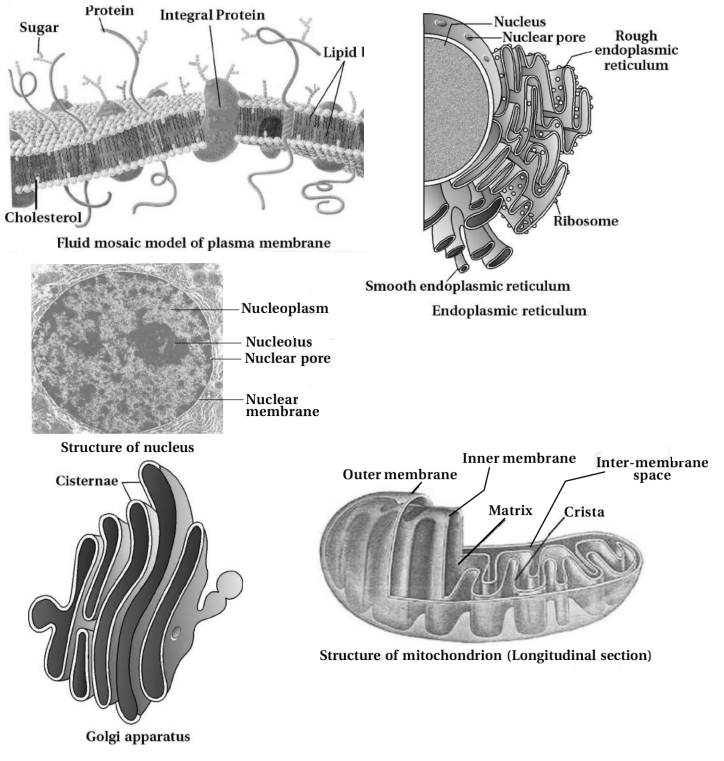
Solution
(N/A) cell is defined as the fundamental structural and functional unit of all living organisms. To be considered a living cell,it must possess the following attributes:
$1$. Cell Membrane: $A$ semi-permeable boundary made of a phospholipid bilayer that regulates the entry and exit of substances.
$2$. Cytoplasm: $A$ semi-fluid matrix that serves as the site for various metabolic reactions essential for life.
$3$. Genetic Material: Presence of $DNA$ (or $RNA$ in some cases) that stores and transmits hereditary information,enabling growth,development,and reproduction.
$4$. Metabolic Machinery: Presence of organelles like ribosomes for protein synthesis,mitochondria for energy production $(ATP)$,and enzymes for biochemical pathways.
$5$. Division of Labour: Different cell organelles perform specific functions (e.g.,Golgi bodies for packaging,Endoplasmic Reticulum for synthesis,Lysosomes for digestion) to maintain cellular homeostasis.
$6$. Ability to Reproduce: The capacity to divide and produce new cells,which is the basis for the continuity of life.
$1$. Cell Membrane: $A$ semi-permeable boundary made of a phospholipid bilayer that regulates the entry and exit of substances.
$2$. Cytoplasm: $A$ semi-fluid matrix that serves as the site for various metabolic reactions essential for life.
$3$. Genetic Material: Presence of $DNA$ (or $RNA$ in some cases) that stores and transmits hereditary information,enabling growth,development,and reproduction.
$4$. Metabolic Machinery: Presence of organelles like ribosomes for protein synthesis,mitochondria for energy production $(ATP)$,and enzymes for biochemical pathways.
$5$. Division of Labour: Different cell organelles perform specific functions (e.g.,Golgi bodies for packaging,Endoplasmic Reticulum for synthesis,Lysosomes for digestion) to maintain cellular homeostasis.
$6$. Ability to Reproduce: The capacity to divide and produce new cells,which is the basis for the continuity of life.
0 likes
View Solution174
Easy
Briefly describe the contributions of the following scientists in the formulation of the cell theory:
$(a)$ Rudolf Virchow
$(b)$ Schleiden and Schwann
$(a)$ Rudolf Virchow
$(b)$ Schleiden and Schwann
Solution
(N/A) Rudolf Virchow $(1855)$: He modified the hypothesis of cell theory by explaining that cells divide and new cells are formed from pre-existing cells,famously stated as 'Omnis cellula-e cellula'.
$(b)$ Schleiden and Schwann: Matthias Schleiden $(1838)$ observed that all plants are composed of different kinds of cells which form the tissues of the plant. Theodor Schwann $(1839)$ reported that animal cells had a thin outer layer which is today known as the 'plasma membrane'. Together,they formulated the cell theory,which states that all living organisms are composed of cells and products of cells.
$(b)$ Schleiden and Schwann: Matthias Schleiden $(1838)$ observed that all plants are composed of different kinds of cells which form the tissues of the plant. Theodor Schwann $(1839)$ reported that animal cells had a thin outer layer which is today known as the 'plasma membrane'. Together,they formulated the cell theory,which states that all living organisms are composed of cells and products of cells.
0 likes
View Solution175
EasyMCQ
Which information about the cell was given by Rudolf Virchow?
A
Cells are the basic unit of life.
B
All cells arise from pre-existing cells.
C
Cells contain genetic material.
D
Cells are composed of organelles.
Solution
(B) $\Rightarrow$ Rudolf Virchow (in $1855$) first explained that cells divide and new cells are formed from pre-existing cells.
$\Rightarrow$ He modified the hypothesis of Schleiden and Schwann to give the cell theory its final shape.
$\Rightarrow$ The two main postulates of the cell theory are:
$(i)$ All living organisms are composed of cells and products of cells.
$(ii)$ All cells arise from pre-existing cells (Omnis cellula-e cellula).
$\Rightarrow$ He modified the hypothesis of Schleiden and Schwann to give the cell theory its final shape.
$\Rightarrow$ The two main postulates of the cell theory are:
$(i)$ All living organisms are composed of cells and products of cells.
$(ii)$ All cells arise from pre-existing cells (Omnis cellula-e cellula).
0 likes
View Solution176
EasyMCQ
The size of Pleuropneumonia-like organism $(PPLO)$ is
A
$0.1 \; \mu m$
B
$0.02 \; \mu m$
C
$1-2 \; \mu m$
D
$10-20 \; \ "\mu m$
Solution
(A) The size of $PPLO$ (Pleuropneumonia-like organism),also known as Mycoplasma,is approximately $0.1 \; \mu m$.
It is recognized as the smallest known living cell capable of independent existence.
It is recognized as the smallest known living cell capable of independent existence.
0 likes
View Solution177
MediumMCQ
The cell theory was proposed in the year $1839$ by Schleiden and Schwann. According to this theory,all organisms are composed of cells,and cells are the basic unit of life. How did this theory contribute to the field of science?
A
It helped to study the working of cells.
B
It helped in curing diseases caused by cell dysfunction.
C
It helped in restating the earlier theories on cells.
D
It helped in introducing the use of microscopes to study cells.
Solution
(A) The cell theory provided a unified framework for understanding the biological structure of all living organisms by establishing that the cell is the fundamental unit of life.
By defining the cell as the basic unit,it directed scientific research toward investigating the internal mechanisms and functional processes occurring within cells.
While microscopes were already in use before $1839$,the cell theory gave a specific purpose to microscopic studies,leading to advancements in cell biology.
By defining the cell as the basic unit,it directed scientific research toward investigating the internal mechanisms and functional processes occurring within cells.
While microscopes were already in use before $1839$,the cell theory gave a specific purpose to microscopic studies,leading to advancements in cell biology.
0 likes
View Solution178
MediumMCQ
Match column-$I$ (scientists) with column-$II$ (discovery) and select the correct option.
| Column-$I$ | Column-$II$ |
| $A$. Leeuwenhoek | $I$. First saw and described a living cell |
| $B$. Robert Brown | $II$. Presence of cell wall is unique to plant cells |
| $C$. Schleiden | $III$. Discovered the nucleus |
| $D$. Schwann | $IV$. All plants are composed of different kind of cells |
A
$A-I, B-III, C-IV, D-II$
B
$A-I, B-III, C-II, D-IV$
C
$A-III, B-I, C-IV, D-II$
D
$A-I, B-IV, C-II, D-III$
Solution
$(A)$ The correct matches are as follows:
$A$. Leeuwenhoek: He was the first to observe and describe a living cell $(I)$.
$B$. Robert Brown: He discovered the nucleus in the cell $(III)$.
$C$. Schleiden: He concluded that all plants are composed of different kinds of cells $(IV)$.
$D$. Schwann: He reported that the presence of a cell wall is a unique character of plant cells $(II)$.
Therefore, the correct sequence is $A-I, B-III, C-IV, D-II$.
$A$. Leeuwenhoek: He was the first to observe and describe a living cell $(I)$.
$B$. Robert Brown: He discovered the nucleus in the cell $(III)$.
$C$. Schleiden: He concluded that all plants are composed of different kinds of cells $(IV)$.
$D$. Schwann: He reported that the presence of a cell wall is a unique character of plant cells $(II)$.
Therefore, the correct sequence is $A-I, B-III, C-IV, D-II$.
0 likes
View Solution179
MediumMCQ
Select the statements which are related to Schwann.
$(i)$ He reported that cells have a thin outer layer which is today known as plasma membrane.
$(ii)$ Cell wall is a unique character of the plant cell.
$(iii)$ Body of plants and animals are composed of cells and products of cells.
$(i)$ He reported that cells have a thin outer layer which is today known as plasma membrane.
$(ii)$ Cell wall is a unique character of the plant cell.
$(iii)$ Body of plants and animals are composed of cells and products of cells.
A
Only $(i)$
B
Only $(iii)$
C
$(i)$ and $(iii)$
D
All of these
Solution
(D) Theodor Schwann,a British Zoologist,studied animal cells and reported that cells had a thin outer layer which is today known as the 'plasma membrane'.
He also concluded,based on his studies on plant tissues,that the presence of a cell wall is a unique character of the plant cells.
Schwann proposed the hypothesis that the bodies of animals and plants are composed of cells and products of cells.
Therefore,all the given statements $(i)$,$(ii)$,and $(iii)$ are related to Schwann.
He also concluded,based on his studies on plant tissues,that the presence of a cell wall is a unique character of the plant cells.
Schwann proposed the hypothesis that the bodies of animals and plants are composed of cells and products of cells.
Therefore,all the given statements $(i)$,$(ii)$,and $(iii)$ are related to Schwann.
0 likes
View Solution180
EasyMCQ
The statement "Omnis cellula-e cellula", which means all cells arise from pre-existing cells, was given by
A
Rudolf Virchow
B
Schleiden
C
Robert Brown
D
Anton Von Leeuwenhoek
Solution
(A) The concept of "Omnis cellula-e cellula" was proposed by Rudolf Virchow in $1855$. This statement is a fundamental part of the Cell Theory, which explains that new cells are formed by the division of pre-existing cells (Cell Lineage theory).
0 likes
View Solution181
MediumMCQ
The smallest cell of $0.3 \; \mu m$ in length is
A
Ostrich egg
B
Cyanobacteria
C
Bacteria
D
Mycoplasma
Solution
(D) The size of a typical bacterium ranges from $3 \; \mu m$ to $5 \; \mu m$.
Mycoplasmas are the smallest known cells,with a length of approximately $0.3 \; \mu m$.
Ostrich egg is the largest isolated single cell.
Therefore,the correct answer is $D$.
Mycoplasmas are the smallest known cells,with a length of approximately $0.3 \; \mu m$.
Ostrich egg is the largest isolated single cell.
Therefore,the correct answer is $D$.
0 likes
View Solution182
MediumMCQ
$A$ cell is the fundamental,structural,and functional unit of all living organisms because
A
Unicellular organisms are incapable of independent existence
B
The cell is the basic unit of life
C
Anything less than a complete structure of a cell does not ensure independent living
D
Essential life functions can be performed only in multicellular organisms
Solution
(C) cell is defined as the fundamental,structural,and functional unit of all living organisms because anything less than a complete structure of a cell does not ensure independent living. This means that for an organism to exist independently,it must possess at least one complete cell.
0 likes
View Solution183
MediumMCQ
The properties of organelles are not present in the molecular constituents of the organelle but arise as a result of $.......$?
A
Interactions among organs
B
Interactions among cells
C
Interactions among molecular components
D
Interactions among organelles
Solution
(C) Biological systems exhibit emergent properties. The properties of organelles are not present in the molecular constituents of the organelle but arise as a result of interactions among the molecular components comprising the organelle. Similarly,the properties of cellular organelles are present in the molecular constituents of the organelle but arise as a result of interactions among the molecular components comprising the organelle. This principle of emergent properties applies to all levels of biological organization.
0 likes
View Solution184
EasyMCQ
Who first coined the term 'cell'?
A
Robert Hooke
B
Robert Brown
C
Anton van Leeuwenhoek
D
Fleming
Solution
(A) The term 'cell' was first coined by the English scientist $Robert \ Hooke$ in $1665$. He observed thin slices of cork under a primitive microscope and noticed small,box-like compartments that resembled the cells of a monastery,which he named 'cells'.
0 likes
View Solution185
MediumMCQ
Which of the following is incorrect for a unicellular organism?
A
It can exist independently.
B
It cannot perform all essential functions of life.
C
The cell is the structural and functional unit of life.
D
Nothing less than a complete structure of a cell can ensure independent living.
Solution
(B) Unicellular organisms are capable of independent existence because they perform all essential functions of life within a single cell.
Option $A$ is correct as they exist independently.
Option $C$ is correct as the cell is the fundamental unit of life.
Option $D$ is correct as the cell theory states that nothing less than a complete cell can ensure independent living.
Option $B$ is incorrect because unicellular organisms are fully capable of performing all essential life functions like respiration,excretion,and reproduction within their single cell.
Option $A$ is correct as they exist independently.
Option $C$ is correct as the cell is the fundamental unit of life.
Option $D$ is correct as the cell theory states that nothing less than a complete cell can ensure independent living.
Option $B$ is incorrect because unicellular organisms are fully capable of performing all essential life functions like respiration,excretion,and reproduction within their single cell.
0 likes
View Solution186
EasyMCQ
Which scientist observed and described living cells for the first time?
A
Robert Hooke
B
Robert Brown
C
Antonie van Leeuwenhoek
D
Fleming
Solution
(C) Antonie van Leeuwenhoek was the first scientist to observe and describe living cells,such as bacteria,protozoa,and spermatozoa,using a self-designed microscope. Robert Hooke is credited with discovering the cell in $1665$,but he observed dead cork cells. Robert Brown discovered the nucleus,and Fleming is known for the discovery of penicillin.
0 likes
View Solution187
EasyMCQ
To which of the following is the $Cell$ $Theory$ not applicable?
A
Algae
B
Bacteria
C
Viruses
D
Fungi
Solution
(C) The $Cell$ $Theory$ states that all living organisms are composed of cells and that all cells arise from pre-existing cells.
Viruses are considered to be at the boundary between living and non-living things.
They lack a cellular structure,as they do not possess a cell membrane,cytoplasm,or organelles like ribosomes.
They consist only of genetic material ($DNA$ or $RNA$) enclosed within a protein coat (capsid).
Because they are acellular,the $Cell$ $Theory$ is not applicable to viruses.
Viruses are considered to be at the boundary between living and non-living things.
They lack a cellular structure,as they do not possess a cell membrane,cytoplasm,or organelles like ribosomes.
They consist only of genetic material ($DNA$ or $RNA$) enclosed within a protein coat (capsid).
Because they are acellular,the $Cell$ $Theory$ is not applicable to viruses.
0 likes
View Solution188
EasyMCQ
Which scientist proposed the cell theory for animals?
A
Robert Brown
B
Matthias Schleiden
C
Theodor Schwann
D
Rudolf Virchow
Solution
(C) In $1839$,Theodor Schwann,a British Zoologist,studied different types of animal cells and reported that cells had a thin outer layer which is today known as the 'plasma membrane'.
He also concluded,based on his studies on plant tissues,that the presence of a cell wall is a unique character of the plant cells.
On the basis of this,Schwann proposed the hypothesis that the bodies of animals and plants are composed of cells and products of cells.
He also concluded,based on his studies on plant tissues,that the presence of a cell wall is a unique character of the plant cells.
On the basis of this,Schwann proposed the hypothesis that the bodies of animals and plants are composed of cells and products of cells.
0 likes
View Solution189
EasyMCQ
Which scientist proposed the cell theory for plants?
A
Robert Brown
B
Matthias Schleiden
C
Theodor Schwann
D
Rudolf Virchow
Solution
(B) In $1838$,Matthias Schleiden,a German botanist,examined a large number of plants and observed that all plants are composed of different kinds of cells which form the tissues of the plant. Thus,he proposed the cell theory for plants.
0 likes
View Solution190
MediumMCQ
Who proposed the statement '$Omnis cellula-e cellula$'?
A
Robert Brown
B
Matthias Schleiden
C
Theodor Schwann
D
Rudolf Virchow
Solution
(D) The statement '$Omnis cellula-e cellula$' was proposed by Rudolf Virchow in $1855$.
This Latin phrase means that all cells arise from pre-existing cells.
This concept refined the cell theory,which was originally proposed by Matthias Schleiden and Theodor Schwann,by explaining how new cells are formed.
This Latin phrase means that all cells arise from pre-existing cells.
This concept refined the cell theory,which was originally proposed by Matthias Schleiden and Theodor Schwann,by explaining how new cells are formed.
0 likes
View Solution191
MediumMCQ
What is the meaning of the phrase '$Omnis$ $cellula-e-cellula$'?
A
The cell is the structural and functional unit of life.
B
All living organisms are composed of cells and products of cells.
C
All cells arise from pre-existing cells through cell division.
D
All of the above.
Solution
(C) The phrase '$Omnis$ $cellula-e-cellula$' was proposed by $Rudolf$ $Virchow$ in $1855$.
It translates to '$All$ $cells$ $arise$ $from$ $pre-existing$ $cells$'.
This concept is a fundamental part of the modern Cell Theory,which explains that new cells are formed by the division of previously existing cells.
It translates to '$All$ $cells$ $arise$ $from$ $pre-existing$ $cells$'.
This concept is a fundamental part of the modern Cell Theory,which explains that new cells are formed by the division of previously existing cells.
0 likes
View Solution192
MediumMCQ
Match the following columns:
| Column-$I$ | Column-$II$ |
|---|---|
| $P$. Matthias Schleiden | $I$. Cell theory in plant cells |
| $Q$. Theodor Schwann | $II$. Final shape of cell theory |
| $R$. Rudolf Virchow | $III$. Cell wall is a unique character of plant cells |
A
$(P-II), (Q-I), (R-III)$
B
$(P-II), (Q-III), (R-I)$
C
$(P-I), (Q-III), (R-II)$
D
$(P-I), (Q-II), (R-III)$
Solution
(C) $1$. Matthias Schleiden $(1838)$ examined a large number of plants and observed that all plants are composed of different kinds of cells which form the tissues of the plant. Thus,$P-I$.
$2$. Theodor Schwann $(1839)$ reported that animal cells had a thin outer layer which is today known as the 'plasma membrane'. He also concluded,based on his studies on plant tissues,that the presence of cell wall is a unique character of the plant cells. Thus,$Q-III$.
$3$. Rudolf Virchow $(1855)$ first explained that cells divided and new cells are formed from pre-existing cells ($Omnis$ $cellula-e$ $cellula$). He modified the hypothesis of Schleiden and Schwann to give the cell theory a final shape. Thus,$R-II$.
Therefore,the correct matching is $(P-I), (Q-III), (R-II)$.
$2$. Theodor Schwann $(1839)$ reported that animal cells had a thin outer layer which is today known as the 'plasma membrane'. He also concluded,based on his studies on plant tissues,that the presence of cell wall is a unique character of the plant cells. Thus,$Q-III$.
$3$. Rudolf Virchow $(1855)$ first explained that cells divided and new cells are formed from pre-existing cells ($Omnis$ $cellula-e$ $cellula$). He modified the hypothesis of Schleiden and Schwann to give the cell theory a final shape. Thus,$R-II$.
Therefore,the correct matching is $(P-I), (Q-III), (R-II)$.
0 likes
View Solution193
MediumMCQ
Match the following columns:
| Column-$I$ | Column-$II$ |
|---|---|
| $P$. Mycoplasma | $I$. $7 \ \mu m$ |
| $Q$. Bacteria | $II$. $3-5 \ \mu m$ |
| $R$. Human Red Blood Cells | $III$. $0.3 \ \mu m$ |
A
$(P-III), (Q-II), (R-I)$
B
$(P-II), (Q-III), (R-I)$
C
$(P-I), (Q-II), (R-III)$
D
$(P-II), (Q-I), (R-III)$
Solution
(A) The sizes of various cells are as follows:
$1$. Mycoplasma is the smallest known cell,with a length of about $0.3 \ \mu m$ $(P-III)$.
$2$. Bacteria typically range from $3-5 \ \mu m$ in length $(Q-II)$.
$3$. Human Red Blood Cells (RBCs) are approximately $7 \ \mu m$ in diameter $(R-I)$.
Therefore,the correct matching is $(P-III), (Q-II), (R-I)$.
$1$. Mycoplasma is the smallest known cell,with a length of about $0.3 \ \mu m$ $(P-III)$.
$2$. Bacteria typically range from $3-5 \ \mu m$ in length $(Q-II)$.
$3$. Human Red Blood Cells (RBCs) are approximately $7 \ \mu m$ in diameter $(R-I)$.
Therefore,the correct matching is $(P-III), (Q-II), (R-I)$.
0 likes
View Solution194
MediumMCQ
The smallest cell $= P$, the largest cell $= Q$, and the longest cell $= R$. What do $P$, $Q$, and $R$ represent in the blanks above?
A
Virus, Neuron, Ostrich egg
B
Mycoplasma, Neuron, Ostrich egg
C
Mycoplasma, Ostrich egg, Neuron
D
Virus, Ostrich egg, Neuron
Solution
(C) The smallest cells are $Mycoplasma$ (also known as $PPLO$ - Pleuro Pneumonia Like Organisms), which are about $0.3 \, \mu m$ in length.
The largest isolated single cell is the egg of an ostrich.
The longest cells in the human body are the neurons (nerve cells).
Therefore, $P = Mycoplasma$, $Q = \text{Ostrich egg}$, and $R = \text{Neuron}$.
The largest isolated single cell is the egg of an ostrich.
The longest cells in the human body are the neurons (nerve cells).
Therefore, $P = Mycoplasma$, $Q = \text{Ostrich egg}$, and $R = \text{Neuron}$.
0 likes
View Solution195
MediumMCQ
$A.$ Mycoplasma, the smallest cells, are only $0.3 \mu m$ in length.
$B.$ Size of bacteria could be $3$ to $5 \mu m$.
$C.$ Human red blood cells are about $7.0 \mu m$ in radius.
$B.$ Size of bacteria could be $3$ to $5 \mu m$.
$C.$ Human red blood cells are about $7.0 \mu m$ in radius.
A
Only $A$ is correct
B
Only $B$ is correct
C
Only $C$ is incorrect
D
Only $C$ is correct
Solution
(C) $A.$ Mycoplasma are indeed the smallest known cells, and their length is approximately $0.3 \mu m$. This statement is correct.
$B.$ Typical bacteria range in size from $3$ to $5 \mu m$. This statement is correct.
$C.$ Human red blood cells (RBCs) have a diameter of about $7.0 \mu m$, not a radius. Therefore, the statement claiming they are $7.0 \mu m$ in radius is incorrect.
Since $A$ and $B$ are correct and $C$ is incorrect, the statement "Only $C$ is incorrect" is the correct choice.
$B.$ Typical bacteria range in size from $3$ to $5 \mu m$. This statement is correct.
$C.$ Human red blood cells (RBCs) have a diameter of about $7.0 \mu m$, not a radius. Therefore, the statement claiming they are $7.0 \mu m$ in radius is incorrect.
Since $A$ and $B$ are correct and $C$ is incorrect, the statement "Only $C$ is incorrect" is the correct choice.
0 likes
View Solution196
MediumMCQ
Cell theory was proposed by $:-$
A
Robert Brown
B
George Palade
C
Flemming
D
Schleiden and Schwann
Solution
(D) The cell theory was proposed by Matthias Schleiden and Theodor Schwann.
In $1838$,Matthias Schleiden,a German botanist,examined a large number of plants and observed that all plants are composed of different kinds of cells which form the tissues of the plant.
In $1839$,Theodor Schwann,a British zoologist,reported that cells had a thin outer layer which is today known as the 'plasma membrane'.
Together,they formulated the cell theory,which states that all living organisms are composed of cells and products of cells.
In $1838$,Matthias Schleiden,a German botanist,examined a large number of plants and observed that all plants are composed of different kinds of cells which form the tissues of the plant.
In $1839$,Theodor Schwann,a British zoologist,reported that cells had a thin outer layer which is today known as the 'plasma membrane'.
Together,they formulated the cell theory,which states that all living organisms are composed of cells and products of cells.
0 likes
View Solution197
EasyMCQ
Cell theory was formulated by
A
Schleiden and Robert Brown
B
Schleiden and Schwann
C
Schwann and Robert Brown
D
Robert Hooke and Robert Brown
Solution
(B) The correct option is $B$.
In $1838$, $Matthias \ Schleiden$, a German botanist, examined a large number of plants and observed that all plants are composed of different kinds of cells which form the tissues of the plant.
At about the same time $(1839)$, $Theodor \ Schwann$, a British zoologist, reported that cells had a thin outer layer which is today known as the '$plasma \ membrane$'.
He also concluded, based on his studies on plant tissues, that the presence of cell wall is a unique character of the plant cells.
On the basis of this, $Schwann$ proposed the hypothesis that the bodies of animals and plants are composed of cells and products of cells.
Together, $Schleiden$ and $Schwann$ formulated the cell theory.
In $1838$, $Matthias \ Schleiden$, a German botanist, examined a large number of plants and observed that all plants are composed of different kinds of cells which form the tissues of the plant.
At about the same time $(1839)$, $Theodor \ Schwann$, a British zoologist, reported that cells had a thin outer layer which is today known as the '$plasma \ membrane$'.
He also concluded, based on his studies on plant tissues, that the presence of cell wall is a unique character of the plant cells.
On the basis of this, $Schwann$ proposed the hypothesis that the bodies of animals and plants are composed of cells and products of cells.
Together, $Schleiden$ and $Schwann$ formulated the cell theory.
0 likes
View SolutionCell: The Unit of Life — Cell theory and What is cell ? · Frequently Asked Questions
1Are these Cell: The Unit of Life questions useful for JEE and NEET?
Yes. All questions in this section are mapped to JEE Main and NEET exam patterns. Previous year questions from JEE Main, NEET, GUJCET and state-level exams are included with full solutions.
2Can I switch to Hindi or Gujarati for these questions?
Yes. Use the language tabs in the hero section or the sidebar to view the same questions and solutions in English, Hindi or Gujarati.
3How do I generate a question paper from this subtopic?
Use the Vedclass Exam Paper Generator — select the chapter and subtopic, set difficulty, and generate Sets A, B, C, D automatically. First 3 chapters of every subject are free.
Vedclass Products
For Students
Vedclass Test Series
Mock tests in real JEE/NEET style with performance analysis. 5-day free trial.
Start Free TrialFor Teachers
Exam Paper Generator
Generate Set A/B/C/D papers from this chapter in 2 minutes. 3 chapters free.
Try FreeFor Institutes
Online Exam Module
Live online exams with unlimited students, 360° analytics & white-label branding.
See DemoFor Teachers & Institutes
Generate a Cell: The Unit of Life Exam Paper in 2 Minutes
Select subtopic & difficulty — Sets A, B, C, D auto-generated with No Repeat logic.
First 3 chapters of every subject are free — no payment required.