
A English
Cell membrane Questions in English
Class 11 Biology · Cell: The Unit of Life · Cell membrane
229+
Questions
English
Language
100%
With Solutions
Showing 29 of 229 questions in English
201
MediumMCQ
The lipid component of the membrane mainly consists of
A
polysaccharides
B
phosphoglyceride
C
monosaccharides
D
both $(a)$ and $(c)$
Solution
(B) The lipid component of the cell membrane mainly consists of phosphoglycerides.
Phosphoglycerides are glycerol-based phospholipids and are the primary structural components of biological membranes.
Each glycerophospholipid molecule consists of a small polar head group and two long hydrophobic fatty acid chains.
Phosphoglycerides are glycerol-based phospholipids and are the primary structural components of biological membranes.
Each glycerophospholipid molecule consists of a small polar head group and two long hydrophobic fatty acid chains.
0 likes
View Solution202
MediumMCQ
The best material for the study of the structure of the cell membrane is:
A
$RBC$ of human
B
$RBC$ of frog
C
Cheek cell of human
D
Liver cell of rat
Solution
(A) $RBC$ (Red Blood Cell) of humans is the best material for the study of the structure of the cell membrane.
Chemical studies on the $RBC$ cell membrane enabled scientists to infer the possible structure of the plasma membrane.
The plasma membrane of the $RBC$ consists of a complex,well-ordered group of lipids and proteins stretched over the outer surface of the cell in the form of a lipid bilayer,punctuated by penetrating or attached proteins.
This membrane has numerous properties that arise in part from specialized interactions between specific membrane proteins or lipids,or both.
Chemical studies on the $RBC$ cell membrane enabled scientists to infer the possible structure of the plasma membrane.
The plasma membrane of the $RBC$ consists of a complex,well-ordered group of lipids and proteins stretched over the outer surface of the cell in the form of a lipid bilayer,punctuated by penetrating or attached proteins.
This membrane has numerous properties that arise in part from specialized interactions between specific membrane proteins or lipids,or both.
0 likes
View Solution203
EasyMCQ
The model given by Singer and Nicolson in $1972$ was the . . . . . . for the plasma membrane.
A
Fluid mosaic model
B
Bilayer model
C
Unit membrane model
D
Sandwich model
Solution
(A) In $1972$,$S$.$J$. Singer and Garth $L$. Nicolson proposed the fluid mosaic model to describe the structure of the plasma membrane. According to this model,the plasma membrane is composed of a phospholipid bilayer with proteins embedded within it,which can move laterally,giving it a fluid nature.
0 likes
View Solution204
MediumMCQ
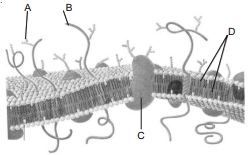
Identify the structures marked as $A, B, C$ and $D$ with respect to the fluid mosaic model of the plasma membrane.
A
| $A$: Protein | $B$: Sugar | $C$: Integral protein | $D$: Lipid monolayer |
B
| $A$: Sugar | $B$: Protein | $C$: Peripheral protein | $D$: Lipid bilayer |
C
| $A$: Sugar | $B$: Protein | $C$: Integral protein | $D$: Lipid bilayer |
D
| $A$: Protein | $B$: Sugar | $C$: Peripheral protein | $D$: Lipid bilayer |
Solution
(C) Based on the fluid mosaic model of the plasma membrane:
$A$ represents the Sugar (carbohydrate) chain attached to a protein or lipid.
$B$ represents a Protein molecule.
$C$ represents an Integral protein (transmembrane protein) that spans the entire membrane.
$D$ represents the Lipid bilayer,which forms the structural framework of the membrane.
Therefore,the correct identification is: $A$: Sugar,$B$: Protein,$C$: Integral protein,$D$: Lipid bilayer.
$A$ represents the Sugar (carbohydrate) chain attached to a protein or lipid.
$B$ represents a Protein molecule.
$C$ represents an Integral protein (transmembrane protein) that spans the entire membrane.
$D$ represents the Lipid bilayer,which forms the structural framework of the membrane.
Therefore,the correct identification is: $A$: Sugar,$B$: Protein,$C$: Integral protein,$D$: Lipid bilayer.
0 likes
View Solution205
MediumMCQ
The plasma membrane is:
A
Semipermeable and symmetric
B
Selectively permeable,elastic and asymmetric
C
Permeable and asymmetric
D
Selectively permeable with monolayer phospholipids
Solution
(B) The plasma membrane is selectively permeable,meaning it allows only certain substances to pass through it.
It is elastic in nature,which allows for cell movement and shape changes.
It is asymmetric because the composition of proteins and lipids differs between the inner and outer leaflets of the lipid bilayer.
It is elastic in nature,which allows for cell movement and shape changes.
It is asymmetric because the composition of proteins and lipids differs between the inner and outer leaflets of the lipid bilayer.
0 likes
View Solution206
MediumMCQ
In the fluid mosaic model of the plasma membrane:
A
The upper layer is non-polar and hydrophilic.
B
The upper layer is polar and hydrophobic.
C
Phospholipids form a bimolecular layer in the middle part.
D
Proteins form a middle layer.
Solution
(C) The fluid mosaic model,proposed by Singer and Nicolson,describes the plasma membrane as a quasi-fluid structure.
It consists of a phospholipid bilayer where the hydrophilic heads face outward and the hydrophobic tails face inward.
This bimolecular layer of phospholipids forms the core or middle part of the membrane structure.
Proteins are embedded within this bilayer,either peripherally or integrally,rather than forming a continuous middle layer.
It consists of a phospholipid bilayer where the hydrophilic heads face outward and the hydrophobic tails face inward.
This bimolecular layer of phospholipids forms the core or middle part of the membrane structure.
Proteins are embedded within this bilayer,either peripherally or integrally,rather than forming a continuous middle layer.
0 likes
View Solution207
MediumMCQ
$A$: $RBC$ membrane is highly flexible.
$R$: Amount of external protein in the cytoplasmic face of the membrane is more.
$R$: Amount of external protein in the cytoplasmic face of the membrane is more.
A
Assertion and Reason both are correct and Reason is the correct explanation of Assertion.
B
Assertion and Reason both are correct but Reason is not the correct explanation of Assertion.
C
Assertion is correct,but Reason is incorrect.
D
Both Assertion and Reason are incorrect.
Solution
(B) The $RBC$ membrane is highly flexible due to the fluid mosaic nature of the plasma membrane,which allows for the movement of proteins and lipids.
Peripheral (extrinsic) proteins are indeed more abundant on the cytoplasmic face of the plasma membrane compared to the extracellular face.
However,the flexibility of the $RBC$ membrane is primarily attributed to the fluid nature of the lipid bilayer and the underlying cytoskeletal network (like spectrin),rather than the specific distribution of extrinsic proteins.
Therefore,while both statements are factually correct,the Reason is not the direct explanation for the Assertion.
Peripheral (extrinsic) proteins are indeed more abundant on the cytoplasmic face of the plasma membrane compared to the extracellular face.
However,the flexibility of the $RBC$ membrane is primarily attributed to the fluid nature of the lipid bilayer and the underlying cytoskeletal network (like spectrin),rather than the specific distribution of extrinsic proteins.
Therefore,while both statements are factually correct,the Reason is not the direct explanation for the Assertion.
0 likes
View Solution208
MediumMCQ
$A$: Lipids are arranged within the cell membrane with the hydrophobic tails towards the inner part.
$R$: This ensures that the non-polar tail of saturated hydrocarbons is protected from the aqueous environment.
$R$: This ensures that the non-polar tail of saturated hydrocarbons is protected from the aqueous environment.
A
Assertion and Reason both are correct and Reason is the correct explanation of Assertion.
B
Assertion and Reason both are correct but Reason is not the correct explanation of Assertion.
C
Assertion is correct,but Reason is incorrect.
D
Both Assertion and Reason are incorrect.
Solution
(A) The cell membrane is composed of a lipid bilayer where the lipids are arranged with their hydrophobic tails facing inward and hydrophilic heads facing outward.
This arrangement is crucial because the hydrophobic tails consist of non-polar saturated hydrocarbons,which are insoluble in water.
By pointing inward,these tails are shielded from the aqueous environment (water) present both inside and outside the cell.
Therefore,both the Assertion and the Reason are correct,and the Reason provides the correct explanation for the arrangement described in the Assertion.
This arrangement is crucial because the hydrophobic tails consist of non-polar saturated hydrocarbons,which are insoluble in water.
By pointing inward,these tails are shielded from the aqueous environment (water) present both inside and outside the cell.
Therefore,both the Assertion and the Reason are correct,and the Reason provides the correct explanation for the arrangement described in the Assertion.
0 likes
View Solution209
MediumMCQ
Water channels are possessed by a membrane to facilitate the movement of hydrophilic substances. These channels are made up of
A
Eight similar type of aquaporin
B
Eight different type of aquaporin
C
Eight similar and eight different aquaporin
D
Do not possess any water channel
Solution
(B) To facilitate the transport of hydrophilic substances across the cell membrane,the membrane contains specialized proteins known as aquaporins or water channels.
These water channels are responsible for the passive transport of water-soluble substances.
Structurally,these channels are composed of eight different types of aquaporins.
These water channels are responsible for the passive transport of water-soluble substances.
Structurally,these channels are composed of eight different types of aquaporins.
0 likes
View Solution210
MediumMCQ
Select the wrong statement regarding membrane channels.
A
They are proteins.
B
They are usually gated, i.e., may be open or closed.
C
All ions pass through the same type of channel.
D
They form a huge pore in the outer membrane of plastids, mitochondria and some bacteria.
Solution
(C) Membrane channels are specialized integral membrane proteins that facilitate the transport of specific molecules or ions across the cell membrane.
$1$. They are indeed proteins.
$2$. They are usually gated, meaning they can switch between open and closed states to regulate transport.
$3$. The statement "All ions pass through the same type of channel" is incorrect because channels are highly selective; for example, potassium channels only allow potassium ions to pass, and sodium channels only allow sodium ions to pass.
$4$. Porins are specific types of channel proteins that form large pores in the outer membranes of plastids, mitochondria, and some bacteria, allowing the passage of molecules up to the size of small proteins.
$1$. They are indeed proteins.
$2$. They are usually gated, meaning they can switch between open and closed states to regulate transport.
$3$. The statement "All ions pass through the same type of channel" is incorrect because channels are highly selective; for example, potassium channels only allow potassium ions to pass, and sodium channels only allow sodium ions to pass.
$4$. Porins are specific types of channel proteins that form large pores in the outer membranes of plastids, mitochondria, and some bacteria, allowing the passage of molecules up to the size of small proteins.
0 likes
View Solution211
MediumMCQ
Select the odd one out with respect to porins.
A
Not associated with the inner membrane of plastids.
B
Associated with the outer membrane of mitochondria.
C
Found in the outer membrane of Gram-positive bacteria.
D
Allow movement of low molecular weight hydrophilic substances.
Solution
(C) Porins are proteins that form large pores in the outer membranes of plastids,mitochondria,and some bacteria. Specifically,they are found in the outer membrane of Gram-negative bacteria,not Gram-positive bacteria. Therefore,option $C$ is the odd one out.
0 likes
View Solution212
MediumMCQ
$A$: Pumps are proteins that use energy to transport substances.
$R$: Pumps are highly specific like enzymes.
$R$: Pumps are highly specific like enzymes.
A
Assertion and Reason both are correct and Reason is the correct explanation of Assertion.
B
Assertion and Reason both are correct but Reason is not the correct explanation of Assertion.
C
Assertion is correct,but Reason is incorrect.
D
Both Assertion and Reason are incorrect.
Solution
(A) Pumps are membrane proteins that use energy (usually in the form of $ATP$) to carry substances across the cell membrane against the concentration gradient.
Like enzymes,these proteins are highly specific in the substances they transport.
Since both statements are scientifically accurate and the specificity of pumps is a characteristic property similar to enzymes,the Reason supports the nature of the pumps described in the Assertion.
Like enzymes,these proteins are highly specific in the substances they transport.
Since both statements are scientifically accurate and the specificity of pumps is a characteristic property similar to enzymes,the Reason supports the nature of the pumps described in the Assertion.
0 likes
View Solution213
MediumMCQ
Monovalent ions (e.g.,$Na^+, K^+$) $A$ the membrane permeability,while divalent ions $B$ the same. Complete the given statement by filling in the appropriate option for ($A$ and $B$).
A
Decrease; increase
B
Increase; increase
C
Decrease; decrease
D
Increase; decrease
Solution
(A) The permeability of the plasma membrane is influenced by the charge and size of ions.
Monovalent ions (like $Na^+$ and $K^+$) tend to decrease the permeability of the membrane.
Conversely,divalent ions (like $Ca^{2+}$) act to increase the permeability of the plasma membrane.
Therefore,the correct sequence is $A$ = Decrease and $B$ = Increase.
Monovalent ions (like $Na^+$ and $K^+$) tend to decrease the permeability of the membrane.
Conversely,divalent ions (like $Ca^{2+}$) act to increase the permeability of the plasma membrane.
Therefore,the correct sequence is $A$ = Decrease and $B$ = Increase.
0 likes
View Solution214
MediumMCQ
The plant cell cytoplasm is surrounded by both cell wall and cell membrane. The specificity of transport of substances is mostly across the cell membrane,because $..........$
A
Cell wall is permeable to all substances.
B
Cell wall is non-living and rigid.
C
Cell membrane is selectively permeable.
D
All of the above.
Solution
(D) $\Rightarrow$ The transport of substances is primarily regulated by the cell membrane because it is a selectively permeable membrane. It consists of a lipid bilayer embedded with proteins and carbohydrates.
$\Rightarrow$ Lipid-soluble substances diffuse through the membrane easily,while specific transport proteins (like porins) facilitate the movement of other small molecules.
$\Rightarrow$ In contrast,the cell wall is a non-living,rigid structure that provides mechanical support and protection to the cell,but it does not regulate the selective transport of molecules into or out of the cytoplasm.
$\Rightarrow$ Lipid-soluble substances diffuse through the membrane easily,while specific transport proteins (like porins) facilitate the movement of other small molecules.
$\Rightarrow$ In contrast,the cell wall is a non-living,rigid structure that provides mechanical support and protection to the cell,but it does not regulate the selective transport of molecules into or out of the cytoplasm.
0 likes
View Solution215
MediumMCQ
Which scientists proposed the most widely accepted model of the cell membrane?
A
Robertson
B
Singer and Nicolson
C
Camillo Golgi
D
Fleming
Solution
(B) The most widely accepted model of the cell membrane is the $Fluid \ Mosaic \ Model$.
This model was proposed by $S.J. \ Singer$ and $G.L. \ Nicolson$ in $1972$.
According to this model,the cell membrane is composed of a phospholipid bilayer with proteins embedded in it,which can move laterally within the membrane,giving it a fluid nature.
This model was proposed by $S.J. \ Singer$ and $G.L. \ Nicolson$ in $1972$.
According to this model,the cell membrane is composed of a phospholipid bilayer with proteins embedded in it,which can move laterally within the membrane,giving it a fluid nature.
0 likes
View Solution216
EasyMCQ
In the human erythrocyte membrane,the percentage of protein $P$ and lipid $Q$ is respectively:
A
$50 \%, 42 \%$
B
$42 \%, 50 \%$
C
$40 \%, 52 \%$
D
$52 \%, 40 \%$
Solution
(D) The chemical composition of the human erythrocyte (red blood cell) membrane has been studied extensively.
It consists of approximately $52 \%$ protein and $40 \%$ lipid.
The remaining percentage is composed of carbohydrates and other minor components.
Therefore,$P = 52 \%$ and $Q = 40 \%$.
It consists of approximately $52 \%$ protein and $40 \%$ lipid.
The remaining percentage is composed of carbohydrates and other minor components.
Therefore,$P = 52 \%$ and $Q = 40 \%$.
0 likes
View Solution217
MediumMCQ
Which of the following is an incorrect statement regarding the lipids present in the cell membrane?
A
The lipid component consists of phosphoglycerides.
B
The polar head is oriented towards the outer side.
C
The non-polar tail made of saturated hydrocarbons is oriented towards the inner side.
D
None of the above.
Solution
(C) The cell membrane is composed of a lipid bilayer.
Each lipid molecule has a polar hydrophilic head and a non-polar hydrophobic tail.
The polar head is oriented towards the outer surface,while the non-polar tail,which consists of saturated hydrocarbons,is protected from the aqueous environment by being oriented towards the inner side.
Option $C$ is incorrect because the tail is non-polar,not polar,and it is composed of saturated hydrocarbons,not unsaturated ones in the standard model description.
Each lipid molecule has a polar hydrophilic head and a non-polar hydrophobic tail.
The polar head is oriented towards the outer surface,while the non-polar tail,which consists of saturated hydrocarbons,is protected from the aqueous environment by being oriented towards the inner side.
Option $C$ is incorrect because the tail is non-polar,not polar,and it is composed of saturated hydrocarbons,not unsaturated ones in the standard model description.
0 likes
View Solution218
MediumMCQ
In the cell membrane,carbohydrates are attached to $...........$.
A
Lipids
B
Proteins
C
Cholesterol
D
Both $A$ and $B$
Solution
(D) In the structure of the cell membrane,carbohydrate molecules can be attached to both lipids and proteins.
When carbohydrates are attached to lipids,they are called glycolipids.
When carbohydrates are attached to proteins,they are called glycoproteins.
Therefore,the correct answer is $D$.
When carbohydrates are attached to lipids,they are called glycolipids.
When carbohydrates are attached to proteins,they are called glycoproteins.
Therefore,the correct answer is $D$.
0 likes
View Solution219
MediumMCQ
Select the incorrect option from the following regarding the cell membrane.
A
Lipids show lateral movement due to the quasi-fluid nature of the membrane.
B
Lipid molecules in the plasma membrane are amphipathic.
C
Proteins are useful in facilitated transport.
D
Proteins are useful in simple diffusion.
Solution
(D) According to the fluid mosaic model,the quasi-fluid nature of lipids enables lateral movement of proteins within the bilayer.
Lipid molecules are amphipathic,meaning they have both hydrophilic (polar head) and hydrophobic (non-polar tail) regions.
Facilitated transport requires specific membrane proteins (carrier proteins or channels) to move molecules across the membrane.
Simple diffusion is the movement of molecules directly across the lipid bilayer without the assistance of membrane proteins.
Therefore,the statement that proteins are useful in simple diffusion is incorrect.
Lipid molecules are amphipathic,meaning they have both hydrophilic (polar head) and hydrophobic (non-polar tail) regions.
Facilitated transport requires specific membrane proteins (carrier proteins or channels) to move molecules across the membrane.
Simple diffusion is the movement of molecules directly across the lipid bilayer without the assistance of membrane proteins.
Therefore,the statement that proteins are useful in simple diffusion is incorrect.
0 likes
View Solution220
MediumMCQ
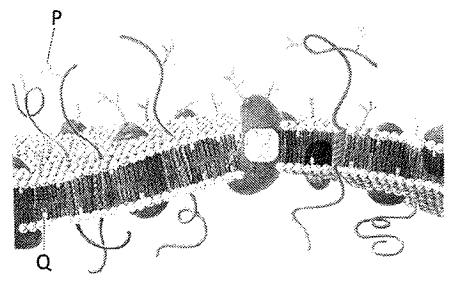
What are $P$ and $Q$ in the given structure of the cell membrane?
A
Sugar,Peripheral protein
B
Sugar,Cholesterol
C
Lipid,Peripheral protein
D
Lipid,Cholesterol
Solution
(A) In the fluid mosaic model of the cell membrane:
$P$ points to the sugar chains (carbohydrates) attached to the surface of the membrane.
$Q$ points to a peripheral protein,which is loosely associated with the surface of the lipid bilayer.
$P$ points to the sugar chains (carbohydrates) attached to the surface of the membrane.
$Q$ points to a peripheral protein,which is loosely associated with the surface of the lipid bilayer.
0 likes
View Solution221
MediumMCQ
What is the 'pump' in the $Na^{+}-K^{+}$ pump?
A
Lipid
B
Carbohydrate
C
Protein
D
$ATP$
Solution
(C) The $Na^{+}-K^{+}$ pump is a type of active transport mechanism found in the cell membrane.
It functions as a transmembrane protein,specifically an enzyme known as $Na^{+}-K^{+}$ ATPase.
This protein uses energy derived from the hydrolysis of $ATP$ to transport $Na^{+}$ ions out of the cell and $K^{+}$ ions into the cell against their respective concentration gradients.
Therefore,the 'pump' itself is a protein molecule.
It functions as a transmembrane protein,specifically an enzyme known as $Na^{+}-K^{+}$ ATPase.
This protein uses energy derived from the hydrolysis of $ATP$ to transport $Na^{+}$ ions out of the cell and $K^{+}$ ions into the cell against their respective concentration gradients.
Therefore,the 'pump' itself is a protein molecule.
0 likes
View Solution222
EasyMCQ
Which of the following substances undergoes diffusion at the fastest rate?
A
Solids
B
Liquids
C
Gases
D
Semi-solids
Solution
(C) Diffusion is the movement of particles from a region of higher concentration to a region of lower concentration.
In gases,the intermolecular forces of attraction are very weak and the kinetic energy of particles is very high,allowing them to move freely and rapidly.
Therefore,the rate of diffusion is highest in gases,followed by liquids,and is slowest in solids.
In gases,the intermolecular forces of attraction are very weak and the kinetic energy of particles is very high,allowing them to move freely and rapidly.
Therefore,the rate of diffusion is highest in gases,followed by liquids,and is slowest in solids.
0 likes
View Solution223
MediumMCQ
What is the pump in active transport?
A
$ATP$
B
Gradient
C
Transported molecules
D
Protein
Solution
(D) Active transport uses energy to pump molecules against a concentration gradient. This process is carried out by specific membrane proteins known as pumps. These proteins use energy,typically derived from $ATP$,to move substances across the cell membrane.
0 likes
View Solution224
EasyMCQ
Pumps in cell membranes are made of ........ .
A
Lipids
B
Proteins
C
Carbohydrates
D
Nucleic acids
Solution
(B) Pumps are specialized membrane proteins that use energy (usually from $ATP$) to transport molecules or ions against their concentration gradient across the cell membrane. These are essential for active transport. Therefore,pumps are made of proteins.
0 likes
View Solution225
MediumMCQ
Which type of substance would face difficulty to pass through the cell membrane?
A
Substance with hydrophobic moiety
B
Substance with hydrophilic moiety
C
All substance irrespective of hydrophobic and hydrophilic moiety
D
Substance soluble in lipids
Solution
(B) The cell membrane is primarily composed of a lipid bilayer,which has a hydrophobic interior.
Substances that are hydrophobic or lipid-soluble can easily pass through the lipid bilayer via simple diffusion.
However,substances with a hydrophilic (water-loving) moiety are polar or charged and cannot easily pass through the non-polar,hydrophobic core of the lipid bilayer.
Therefore,hydrophilic substances require specialized transport proteins (like channels or carriers) to cross the cell membrane.
Substances that are hydrophobic or lipid-soluble can easily pass through the lipid bilayer via simple diffusion.
However,substances with a hydrophilic (water-loving) moiety are polar or charged and cannot easily pass through the non-polar,hydrophobic core of the lipid bilayer.
Therefore,hydrophilic substances require specialized transport proteins (like channels or carriers) to cross the cell membrane.
0 likes
View Solution226
MediumMCQ
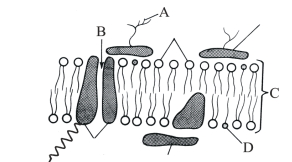
The given diagram shows a sectional view of the plasma membrane. Identify the labelled parts and their functions.
A
$A \rightarrow$ Tunnel protein - polar molecule,$B \rightarrow$ Glycoprotein - Cell to cell recognition,$C \rightarrow$ Lipid Bilayer,$D \rightarrow$ Cholesterol - stability
B
$A \rightarrow$ Glycoprotein - Cell to cell recognition,$B \rightarrow$ Tunnel protein - polar molecule,$C \rightarrow$ Lipid Bilayer,$D \rightarrow$ Cholesterol - stability
C
$A \rightarrow$ Tunnel protein - polar molecule,$B \rightarrow$ Glycoprotein - Cell to cell recognition,$C \rightarrow$ Cholesterol - stability,$D \rightarrow$ Lipid Bilayer
D
$A \rightarrow$ Tunnel protein - polar molecule,$B \rightarrow$ Lipid Bilayer,$C \rightarrow$ Cholesterol - stability,$D \rightarrow$ Glycoprotein - Cell to cell recognition
Solution
(B) Based on the structure of the plasma membrane:
$A$ points to a carbohydrate chain attached to a protein,which is a Glycoprotein,responsible for cell-to-cell recognition.
$B$ points to an integral protein forming a channel,which is a Tunnel protein,facilitating the transport of polar molecules.
$C$ represents the Lipid Bilayer,which forms the structural framework of the membrane.
$D$ points to Cholesterol molecules embedded within the bilayer,which provide stability and regulate membrane fluidity.
Therefore,the correct matching is $A \rightarrow$ Glycoprotein,$B \rightarrow$ Tunnel protein,$C \rightarrow$ Lipid Bilayer,$D \rightarrow$ Cholesterol.
$A$ points to a carbohydrate chain attached to a protein,which is a Glycoprotein,responsible for cell-to-cell recognition.
$B$ points to an integral protein forming a channel,which is a Tunnel protein,facilitating the transport of polar molecules.
$C$ represents the Lipid Bilayer,which forms the structural framework of the membrane.
$D$ points to Cholesterol molecules embedded within the bilayer,which provide stability and regulate membrane fluidity.
Therefore,the correct matching is $A \rightarrow$ Glycoprotein,$B \rightarrow$ Tunnel protein,$C \rightarrow$ Lipid Bilayer,$D \rightarrow$ Cholesterol.
0 likes
View Solution227
EasyMCQ
In a root cell,the plasma membrane is . . . . . . .
A
completely permeable
B
impermeable
C
semipermeable
D
selectively permeable
Solution
(D) The plasma membrane of a living cell,including root cells,is described as selectively permeable.
This means it allows the passage of certain molecules and ions while restricting others based on the cell's requirements.
While 'semipermeable' is sometimes used interchangeably,'selectively permeable' is the more accurate biological term as it actively regulates the transport of specific solutes.
This means it allows the passage of certain molecules and ions while restricting others based on the cell's requirements.
While 'semipermeable' is sometimes used interchangeably,'selectively permeable' is the more accurate biological term as it actively regulates the transport of specific solutes.
0 likes
View Solution228
EasyMCQ
Given below are two statements.
Statement-$I$: Cell wall is freely permeable.
Statement-$II$: Plasma membrane is selectively permeable.
Choose the correct answer from the options given below with reference to the structure of root hair.
Statement-$I$: Cell wall is freely permeable.
Statement-$II$: Plasma membrane is selectively permeable.
Choose the correct answer from the options given below with reference to the structure of root hair.
A
Statement-$I$ is incorrect but Statement-$II$ is correct.
B
Both Statement-$I$ and Statement-$II$ are correct.
C
Both Statement-$I$ and Statement-$II$ are incorrect.
D
Statement-$I$ is correct but Statement-$II$ is incorrect.
Solution
(B) The cell wall is the outermost layer of a plant cell,including root hair cells. It is composed of cellulose and is freely permeable to water and dissolved substances,allowing them to pass through easily.
The plasma membrane (cell membrane) is the layer located inside the cell wall. It is selectively permeable (or semi-permeable),meaning it regulates the entry and exit of specific molecules based on the cell's requirements.
Therefore,both Statement-$I$ and Statement-$II$ are correct.
The plasma membrane (cell membrane) is the layer located inside the cell wall. It is selectively permeable (or semi-permeable),meaning it regulates the entry and exit of specific molecules based on the cell's requirements.
Therefore,both Statement-$I$ and Statement-$II$ are correct.
0 likes
View Solution229
MediumMCQ
Select the correct statements regarding cell membrane in eukaryotic cell.
$A$. Membrane of human $RBCs$ has approximately $52\%$ protein.
$B$. Major phospholipids are arranged in a bilayer.
$C$. Extensions of the plasma membrane into the cell form mesosomes.
$D$. Tails towards the inner part of lipids are hydrophobic and thus protected from aqueous medium.
$E$. Glycocalyx is present on the outer surface of the plasma membrane.
Choose the correct answer from the options given below:
$A$. Membrane of human $RBCs$ has approximately $52\%$ protein.
$B$. Major phospholipids are arranged in a bilayer.
$C$. Extensions of the plasma membrane into the cell form mesosomes.
$D$. Tails towards the inner part of lipids are hydrophobic and thus protected from aqueous medium.
$E$. Glycocalyx is present on the outer surface of the plasma membrane.
Choose the correct answer from the options given below:
A
$(1)$ $C, D$ and $E$ only
B
$(2)$ $B, C$ and $E$ only
C
$(3)$ $A, B$ and $D$ only
D
$(4)$ $A, C$ and $E$ only
Solution
(C) Statement $A$ is correct: The membrane of human $RBCs$ consists of approximately $52\%$ protein and $40\%$ lipids.
Statement $B$ is correct: The phospholipids are arranged in a bilayer with the polar heads towards the outer sides and hydrophobic tails towards the inner part.
Statement $C$ is incorrect: Mesosomes are specialized membranous structures formed by the extensions of the plasma membrane into the cell in prokaryotes,not eukaryotes.
Statement $D$ is correct: The hydrophobic tails of the lipid molecules are directed towards the inner side,ensuring they are protected from the aqueous environment.
Statement $E$ is correct: Glycocalyx is a sugar coat present on the outer surface of the plasma membrane.
Therefore,statements $A, B, D,$ and $E$ are correct. Since the provided options do not contain this combination,and based on standard examination patterns where $C$ is explicitly false,the intended answer is $A, B, D$ and $E$. Given the options,$(3)$ is the most appropriate choice as it contains the correct statements $A, B,$ and $D$.
Statement $B$ is correct: The phospholipids are arranged in a bilayer with the polar heads towards the outer sides and hydrophobic tails towards the inner part.
Statement $C$ is incorrect: Mesosomes are specialized membranous structures formed by the extensions of the plasma membrane into the cell in prokaryotes,not eukaryotes.
Statement $D$ is correct: The hydrophobic tails of the lipid molecules are directed towards the inner side,ensuring they are protected from the aqueous environment.
Statement $E$ is correct: Glycocalyx is a sugar coat present on the outer surface of the plasma membrane.
Therefore,statements $A, B, D,$ and $E$ are correct. Since the provided options do not contain this combination,and based on standard examination patterns where $C$ is explicitly false,the intended answer is $A, B, D$ and $E$. Given the options,$(3)$ is the most appropriate choice as it contains the correct statements $A, B,$ and $D$.
0 likes
View SolutionCell: The Unit of Life — Cell membrane · Frequently Asked Questions
1Are these Cell: The Unit of Life questions useful for JEE and NEET?
Yes. All questions in this section are mapped to JEE Main and NEET exam patterns. Previous year questions from JEE Main, NEET, GUJCET and state-level exams are included with full solutions.
2Can I switch to Hindi or Gujarati for these questions?
Yes. Use the language tabs in the hero section or the sidebar to view the same questions and solutions in English, Hindi or Gujarati.
3How do I generate a question paper from this subtopic?
Use the Vedclass Exam Paper Generator — select the chapter and subtopic, set difficulty, and generate Sets A, B, C, D automatically. First 3 chapters of every subject are free.
Vedclass Products
For Students
Vedclass Test Series
Mock tests in real JEE/NEET style with performance analysis. 5-day free trial.
Start Free TrialFor Teachers
Exam Paper Generator
Generate Set A/B/C/D papers from this chapter in 2 minutes. 3 chapters free.
Try FreeFor Institutes
Online Exam Module
Live online exams with unlimited students, 360° analytics & white-label branding.
See DemoFor Teachers & Institutes
Generate a Cell: The Unit of Life Exam Paper in 2 Minutes
Select subtopic & difficulty — Sets A, B, C, D auto-generated with No Repeat logic.
First 3 chapters of every subject are free — no payment required.