
A English
Cell membrane Questions in English
Class 11 Biology · Cell: The Unit of Life · Cell membrane
229+
Questions
English
Language
100%
With Solutions
Showing 50 of 229 questions in English
101
EasyMCQ
Which structural component of the cell membrane can be easily removed?
A
Lipid bilayer
B
Integral protein
C
Peripheral protein
D
All of the above
Solution
(C) The cell membrane consists of a lipid bilayer,integral proteins,and peripheral proteins.
Peripheral proteins (also known as extrinsic proteins) are located on the surface of the lipid bilayer and are held by weak electrostatic forces.
Because of these weak interactions,peripheral proteins can be easily extracted or removed from the membrane without disrupting the lipid bilayer structure.
In contrast,integral proteins (intrinsic proteins) are partially or totally embedded in the membrane and are difficult to remove.
Peripheral proteins (also known as extrinsic proteins) are located on the surface of the lipid bilayer and are held by weak electrostatic forces.
Because of these weak interactions,peripheral proteins can be easily extracted or removed from the membrane without disrupting the lipid bilayer structure.
In contrast,integral proteins (intrinsic proteins) are partially or totally embedded in the membrane and are difficult to remove.
0 likes
View Solution102
EasyMCQ
Which is the most widely accepted model to explain the structure of the cell membrane?
A
Unit Membrane Concept
B
Fluid Mosaic Model
C
Lipid and Protein Bilayer Model
D
Lipid Bilayer Model
Solution
(B) The $Fluid$ $Mosaic$ $Model$ was proposed by $S.J.$ $Singer$ and $G.L.$ $Nicolson$ in $1972$.
This model describes the cell membrane as a quasi-fluid structure where proteins are embedded in a phospholipid bilayer.
It is the most widely accepted model because it explains both the structural integrity and the dynamic nature (fluidity) of the cell membrane,which allows for functions like cell growth,secretion,endocytosis,and cell division.
This model describes the cell membrane as a quasi-fluid structure where proteins are embedded in a phospholipid bilayer.
It is the most widely accepted model because it explains both the structural integrity and the dynamic nature (fluidity) of the cell membrane,which allows for functions like cell growth,secretion,endocytosis,and cell division.
0 likes
View Solution103
MediumMCQ
According to the unit membrane concept,the plasma membrane consists of...
A
an asymmetrical layer of protein on both sides of a lipid bilayer.
B
an asymmetrical layer of protein on only one side of a lipid bilayer.
C
an asymmetrical layer of lipid on both sides of a protein bilayer.
D
a symmetrical layer of lipid on both sides of a protein bilayer.
Solution
(A) The unit membrane concept,proposed by $J$.$D$. Robertson,suggests that all cellular membranes have a common structure. According to this model,the plasma membrane is composed of a central lipid bilayer sandwiched between two layers of protein. These protein layers are asymmetrical,meaning the composition or arrangement of proteins on the outer surface differs from that on the inner surface of the membrane.
0 likes
View Solution104
MediumMCQ
The $Na^+-K^+$ pump is an example of:
A
Simple diffusion.
B
Facilitated diffusion.
C
Active transport.
D
Passive transport.
Solution
(C) The $Na^+-K^+$ pump is a membrane protein that moves ions against their concentration gradient.
It requires energy in the form of $ATP$ to pump $3$ $Na^+$ ions out of the cell and $2$ $K^+$ ions into the cell.
Since the movement occurs against the concentration gradient and requires metabolic energy,it is classified as active transport.
It requires energy in the form of $ATP$ to pump $3$ $Na^+$ ions out of the cell and $2$ $K^+$ ions into the cell.
Since the movement occurs against the concentration gradient and requires metabolic energy,it is classified as active transport.
0 likes
View Solution105
MediumMCQ
What is responsible for the quasi-fluid nature of the cell membrane?
A
Hydrophobic interaction between proteins and lipids
B
Hydrophilic interaction between proteins and lipids
C
Peripheral proteins
D
Interaction between integral and peripheral proteins
Solution
(A) The fluid mosaic model,proposed by Singer and Nicolson in $1972$,describes the cell membrane as a quasi-fluid structure.
This quasi-fluid nature is primarily due to the lateral movement of lipids and proteins within the bilayer.
The stability and the fluid nature of the membrane are maintained by the hydrophobic interactions between the lipid tails and the hydrophobic regions of the membrane proteins.
These interactions allow the membrane to remain flexible and dynamic,which is essential for cell growth,secretion,endocytosis,and cell division.
This quasi-fluid nature is primarily due to the lateral movement of lipids and proteins within the bilayer.
The stability and the fluid nature of the membrane are maintained by the hydrophobic interactions between the lipid tails and the hydrophobic regions of the membrane proteins.
These interactions allow the membrane to remain flexible and dynamic,which is essential for cell growth,secretion,endocytosis,and cell division.
0 likes
View Solution106
EasyMCQ
The cell membrane is composed of which substances?
A
Cellulose and hemicellulose
B
Lipids only
C
Lipids and proteins
D
Glycocalyx
Solution
(C) The cell membrane (plasma membrane) is primarily composed of lipids and proteins.
According to the fluid mosaic model proposed by Singer and Nicolson,the membrane consists of a phospholipid bilayer with embedded proteins.
Lipids are arranged within the membrane with the polar head towards the outer sides and the hydrophobic tails towards the inner part.
Proteins are present as integral or peripheral proteins within this lipid bilayer.
According to the fluid mosaic model proposed by Singer and Nicolson,the membrane consists of a phospholipid bilayer with embedded proteins.
Lipids are arranged within the membrane with the polar head towards the outer sides and the hydrophobic tails towards the inner part.
Proteins are present as integral or peripheral proteins within this lipid bilayer.
0 likes
View Solution107
MediumMCQ
Which statement is correct regarding the arrangement of lipid molecules in the cell membrane?
A
The polar hydrophilic head of each lipid molecule is directed towards the inside,and the non-polar hydrophobic tail is directed towards the outer surface.
B
The polar hydrophobic head of each lipid molecule is directed towards the inside,and the non-polar hydrophilic tail is directed towards the outer surface.
C
The polar hydrophilic head of each lipid molecule is directed towards the outer surface,and the non-polar hydrophobic tail is directed towards the inside.
D
The polar hydrophobic head of each lipid molecule is directed towards the outer surface,and the non-polar hydrophilic tail is directed towards the inside.
Solution
(C) The cell membrane is composed of a lipid bilayer.
Each lipid molecule is amphipathic,meaning it has both a polar hydrophilic (water-loving) head and a non-polar hydrophobic (water-fearing) tail.
In the bilayer structure,the polar hydrophilic heads are oriented towards the aqueous environment (the outer surface and the inner cytoplasm),while the non-polar hydrophobic tails are protected from the aqueous environment by being oriented towards the interior of the membrane.
Each lipid molecule is amphipathic,meaning it has both a polar hydrophilic (water-loving) head and a non-polar hydrophobic (water-fearing) tail.
In the bilayer structure,the polar hydrophilic heads are oriented towards the aqueous environment (the outer surface and the inner cytoplasm),while the non-polar hydrophobic tails are protected from the aqueous environment by being oriented towards the interior of the membrane.
0 likes
View Solution108
EasyMCQ
Who proposed the Unit Membrane Concept?
A
Robertson
B
Singer
C
Nicholson
D
Singer and Nicholson
Solution
(A) The Unit Membrane Concept was proposed by $J.D. Robertson$ in $1959$.
According to this concept,all cellular membranes (plasma membrane and organelle membranes) have a similar trilaminar structure consisting of a bimolecular lipid layer sandwiched between two protein layers.
According to this concept,all cellular membranes (plasma membrane and organelle membranes) have a similar trilaminar structure consisting of a bimolecular lipid layer sandwiched between two protein layers.
0 likes
View Solution109
EasyMCQ
Which scientists proposed the $Fluid-Mosaic$ model?
A
Robertson and Nicolson
B
Singer and Nicolson
C
Singer and Robertson
D
Schleiden and Schwann
Solution
(B) The $Fluid-Mosaic$ model of the plasma membrane was proposed by $S.J. Singer$ and $G.L. Nicolson$ in $1972$. According to this model,the membrane is a quasi-fluid structure where proteins are embedded in a phospholipid bilayer.
0 likes
View Solution110
MediumMCQ
Which type of membrane allows the movement of some molecules into and out of the cell while restricting the movement of others?
A
Impermeable
B
Permeable
C
Semi-permeable
D
Selectively permeable
Solution
(D) The plasma membrane is described as a $Selectively \ permeable$ membrane because it does not allow all substances to pass through it.
It allows the movement of certain specific molecules or ions into and out of the cell while restricting the movement of others based on the cell's requirements.
While 'semi-permeable' refers to membranes that allow only solvent molecules (like water) to pass,'selectively permeable' is the more accurate biological term for the plasma membrane's ability to regulate the transport of specific solutes.
It allows the movement of certain specific molecules or ions into and out of the cell while restricting the movement of others based on the cell's requirements.
While 'semi-permeable' refers to membranes that allow only solvent molecules (like water) to pass,'selectively permeable' is the more accurate biological term for the plasma membrane's ability to regulate the transport of specific solutes.
0 likes
View Solution111
EasyMCQ
According to the fluid-mosaic model,what does the structure of the cell membrane consist of?
A
Phospholipids and oligosaccharides
B
Phospholipids and hemicellulose
C
Phospholipids and integral proteins
D
Phospholipids,extrinsic proteins,and integral proteins
Solution
(D) The fluid-mosaic model,proposed by $Singer$ and $Nicolson$ in $1972$,describes the cell membrane as a mosaic of various components.
According to this model,the cell membrane is primarily composed of a phospholipid bilayer.
Embedded within this bilayer are various proteins,which are classified as either integral (intrinsic) proteins,which span the membrane,or peripheral (extrinsic) proteins,which are attached to the surface.
Therefore,the structure consists of phospholipids,extrinsic proteins,and integral proteins.
According to this model,the cell membrane is primarily composed of a phospholipid bilayer.
Embedded within this bilayer are various proteins,which are classified as either integral (intrinsic) proteins,which span the membrane,or peripheral (extrinsic) proteins,which are attached to the surface.
Therefore,the structure consists of phospholipids,extrinsic proteins,and integral proteins.
0 likes
View Solution112
EasyMCQ
The membrane that covers the cytoplasm on the outermost side is:
A
Plasma membrane
B
Cell wall
C
Extracellular boundary
D
Tonoplast
Solution
(A) The plasma membrane (also known as the cell membrane) is the outermost boundary of the cytoplasm in animal cells. In plant cells,it lies just inside the cell wall. It acts as a selectively permeable barrier that regulates the movement of substances in and out of the cell.
0 likes
View Solution113
EasyMCQ
The cell membrane is composed of .........
A
Proteins
B
Lipids
C
Both $A$ and $B$
D
Nucleic acids
Solution
(C) The cell membrane is primarily composed of lipids and proteins.
According to the fluid mosaic model,the membrane consists of a lipid bilayer with embedded proteins.
Therefore,both lipids and proteins are essential components of the cell membrane structure.
According to the fluid mosaic model,the membrane consists of a lipid bilayer with embedded proteins.
Therefore,both lipids and proteins are essential components of the cell membrane structure.
0 likes
View Solution114
MediumMCQ
In the structure of the cell membrane,the outer head of the lipid molecule is:
A
Polar hydrophobic
B
Polar hydrophilic
C
Non-polar hydrophilic
D
Non-polar hydrophobic
Solution
(B) The cell membrane is composed of a phospholipid bilayer.
Each phospholipid molecule consists of a polar head and two non-polar tails.
The polar head is hydrophilic (water-loving),which faces the aqueous environment outside and inside the cell.
The non-polar tails are hydrophobic (water-fearing) and are directed towards the interior of the membrane,away from water.
Therefore,the outer head of the lipid molecule is polar and hydrophilic.
Each phospholipid molecule consists of a polar head and two non-polar tails.
The polar head is hydrophilic (water-loving),which faces the aqueous environment outside and inside the cell.
The non-polar tails are hydrophobic (water-fearing) and are directed towards the interior of the membrane,away from water.
Therefore,the outer head of the lipid molecule is polar and hydrophilic.
0 likes
View Solution115
EasyMCQ
Proteins associated with the surface of the cell membrane are known as:
A
Peripheral proteins
B
Integral proteins
C
Both $(A)$ and $(B)$
D
None of these
Solution
(A) The cell membrane consists of proteins and lipids. Based on the ease of extraction,membrane proteins are classified into two types:
$1$. Peripheral proteins: These are located on the surface of the membrane and can be easily separated.
$2$. Integral proteins: These are partially or totally buried in the membrane and are difficult to extract.
Therefore,proteins associated with the surface are peripheral proteins.
$1$. Peripheral proteins: These are located on the surface of the membrane and can be easily separated.
$2$. Integral proteins: These are partially or totally buried in the membrane and are difficult to extract.
Therefore,proteins associated with the surface are peripheral proteins.
0 likes
View Solution116
EasyMCQ
The Unit Membrane concept was proposed by:
A
Singer
B
Nicholson
C
Robertson
D
Schleiden
Solution
(C) The Unit Membrane concept was proposed by $J.D. Robertson$ in $1959$.
According to this concept,all cellular membranes (plasma membrane and organelle membranes) have a similar tripartite structure consisting of a central lipid bilayer sandwiched between two protein layers.
According to this concept,all cellular membranes (plasma membrane and organelle membranes) have a similar tripartite structure consisting of a central lipid bilayer sandwiched between two protein layers.
0 likes
View Solution117
MediumMCQ
Who proposed the most widely accepted model of the plasma membrane?
A
Robertson
B
Singer
C
Nicolson
D
Both $(B)$ and $(C)$
Solution
(D) The most widely accepted model of the plasma membrane is the Fluid Mosaic Model.
This model was proposed by $S$.$J$. Singer and Garth $L$. Nicolson in $1972$.
According to this model,the membrane is a quasi-fluid structure of lipids and proteins.
Therefore,both Singer and Nicolson are credited with this proposal.
This model was proposed by $S$.$J$. Singer and Garth $L$. Nicolson in $1972$.
According to this model,the membrane is a quasi-fluid structure of lipids and proteins.
Therefore,both Singer and Nicolson are credited with this proposal.
0 likes
View Solution118
MediumMCQ
When was the widely accepted model of the cell membrane proposed?
A
$1977$
B
$1831$
C
$1965$
D
$1972$
Solution
(D) The fluid mosaic model of the cell membrane was proposed by $S$.$J$. Singer and $G$.$L$. Nicolson in $1972$. This model describes the cell membrane as a fluid structure with a mosaic of proteins embedded in a phospholipid bilayer.
0 likes
View Solution119
MediumMCQ
Which of the following is described as a quasi-fluid and functionally dynamic membrane?
A
Cell wall
B
Tonoplast
C
Plasma membrane
D
Impermeable membrane
Solution
(C) The plasma membrane is described as a quasi-fluid and functionally dynamic structure according to the Fluid Mosaic Model proposed by Singer and Nicolson in $1972$.
It consists of a lipid bilayer with embedded proteins,allowing for lateral movement of molecules,which gives it its quasi-fluid nature.
This fluidity is essential for cell growth,formation of intercellular junctions,secretion,endocytosis,and cell division.
It consists of a lipid bilayer with embedded proteins,allowing for lateral movement of molecules,which gives it its quasi-fluid nature.
This fluidity is essential for cell growth,formation of intercellular junctions,secretion,endocytosis,and cell division.
0 likes
View Solution120
MediumMCQ
Which of the following is $NOT$ associated with peripheral proteins?
A
They have a loose and superficial arrangement.
B
They can be easily removed.
C
They are extrinsic proteins.
D
They have an integral arrangement.
0 likes
View Solution121
MediumMCQ
What is the nature of the association between proteins and lipids in the cell membrane?
A
Polar
B
Hydrophilic
C
Hydrophobic
D
Non-polar
Solution
(C) The cell membrane is composed of a lipid bilayer where the lipids are amphipathic,meaning they have both hydrophilic (polar) heads and hydrophobic (non-polar) tails. Proteins are embedded within this lipid bilayer. The association between the hydrophobic tails of the lipids and the hydrophobic regions of the integral membrane proteins is primarily driven by hydrophobic interactions. These interactions are essential for the stability and structural integrity of the cell membrane.
0 likes
View Solution122
EasyMCQ
Which of the following is a selectively permeable membrane?
A
Tonoplast
B
Plasma membrane
C
Cell wall
D
Suberized cell wall
Solution
(B) The plasma membrane (cell membrane) is known as a selectively permeable membrane because it allows only certain molecules or ions to pass through it while restricting others.
$1$. The tonoplast is the membrane surrounding the vacuole.
$2$. The cell wall is generally permeable to most substances.
$3$. $A$ suberized cell wall is impermeable to water and gases.
Therefore,the correct answer is the plasma membrane.
$1$. The tonoplast is the membrane surrounding the vacuole.
$2$. The cell wall is generally permeable to most substances.
$3$. $A$ suberized cell wall is impermeable to water and gases.
Therefore,the correct answer is the plasma membrane.
0 likes
View Solution123
MediumMCQ
The $Na^+/K^+$ pump is an example of which of the following?
A
Passive transport
B
Simple diffusion
C
Facilitated diffusion
D
Active transport
Solution
(D) The $Na^+/K^+$ pump is a membrane protein that uses energy in the form of $ATP$ to transport ions against their concentration gradient.
Specifically,it pumps $3$ $Na^+$ ions out of the cell and $2$ $K^+$ ions into the cell.
Since this process requires energy to move substances against the concentration gradient,it is classified as active transport.
Specifically,it pumps $3$ $Na^+$ ions out of the cell and $2$ $K^+$ ions into the cell.
Since this process requires energy to move substances against the concentration gradient,it is classified as active transport.
0 likes
View Solution124
EasyMCQ
Who proposed the concept of the unit membrane?
A
Singer
B
Nicolson
C
Robert Brown
D
Robertson
Solution
(D) The concept of the unit membrane was proposed by $J.D. Robertson$ in $1959$.
He suggested that all cellular membranes (plasma membrane,nuclear membrane,etc.) have a similar trilaminar structure consisting of a bimolecular lipid layer sandwiched between two protein layers.
He suggested that all cellular membranes (plasma membrane,nuclear membrane,etc.) have a similar trilaminar structure consisting of a bimolecular lipid layer sandwiched between two protein layers.
0 likes
View Solution125
EasyMCQ
Who are the scientists that proposed the fluid mosaic model?
A
Singer and Robertson
B
Robert Hooke and Robert Brown
C
Nicolson and Robertson
D
Singer and Nicolson
Solution
(D) The fluid mosaic model of the plasma membrane was proposed by $S.J. Singer$ and $G.L. Nicolson$ in $1972$. This model describes the plasma membrane as a mosaic of protein molecules floating in a fluid bilayer of phospholipids.
0 likes
View Solution126
EasyMCQ
Who proposed the fluid-mosaic model?
A
Singer and Nicolson
B
Beadle and Tatum
C
Watson and Crick
D
Robertson and Miller
Solution
(A) The fluid-mosaic model of the plasma membrane was proposed by $S.J. Singer$ and $G.L. Nicolson$ in $1972$. According to this model,the membrane is a mosaic of proteins embedded in a fluid phospholipid bilayer.
0 likes
View Solution127
EasyMCQ
What is the cell membrane composed of?
A
Carbohydrates and fats
B
Carbohydrates and proteins
C
Proteins and lipids
D
Only lipids
Solution
(C) The cell membrane (plasma membrane) is primarily composed of lipids and proteins.
According to the fluid mosaic model,the membrane consists of a lipid bilayer with embedded proteins.
Carbohydrates are also present but in smaller amounts,usually attached to proteins (glycoproteins) or lipids (glycolipids).
According to the fluid mosaic model,the membrane consists of a lipid bilayer with embedded proteins.
Carbohydrates are also present but in smaller amounts,usually attached to proteins (glycoproteins) or lipids (glycolipids).
0 likes
View Solution128
EasyMCQ
What does the fluid mosaic model of the cell membrane $NOT$ contain?
A
$A$ bilayer of peripheral proteins
B
$A$ bilayer of phospholipids
C
Hydrophobic non-polar tails
D
Hydrophilic polar heads
Solution
(A) The fluid mosaic model,proposed by $Singer$ and $Nicolson$ in $1972$,describes the cell membrane as a mosaic of proteins embedded in a fluid phospholipid bilayer.
According to this model,the membrane consists of a phospholipid bilayer where the hydrophilic polar heads face outward and the hydrophobic non-polar tails face inward.
Peripheral proteins are present on the surface or partially embedded,but they do not form a bilayer.
Therefore,the cell membrane does not contain a bilayer of peripheral proteins.
According to this model,the membrane consists of a phospholipid bilayer where the hydrophilic polar heads face outward and the hydrophobic non-polar tails face inward.
Peripheral proteins are present on the surface or partially embedded,but they do not form a bilayer.
Therefore,the cell membrane does not contain a bilayer of peripheral proteins.
0 likes
View Solution129
EasyMCQ
What is true about the fluid-mosaic model of the cell membrane?
A
$A$ layer of phospholipid is present on the layer of protein.
B
$A$ bilayer of phospholipid is present on the layer of protein.
C
Proteins are embedded in the phospholipid bilayer.
D
Phospholipids are sandwiched between two layers of protein.
Solution
(C) The fluid-mosaic model,proposed by $S.J. Singer$ and $G.L. Nicolson$ in $1972$,describes the cell membrane as a mosaic of protein molecules floating in a fluid bilayer of phospholipids.
According to this model,the quasi-fluid nature of lipids enables lateral movement of proteins within the overall bilayer.
Therefore,the correct statement is that proteins are embedded in the phospholipid bilayer.
According to this model,the quasi-fluid nature of lipids enables lateral movement of proteins within the overall bilayer.
Therefore,the correct statement is that proteins are embedded in the phospholipid bilayer.
0 likes
View Solution130
DifficultMCQ
The type of fatty acids present in the cell membrane is/are ........
A
Unsaturated
B
Saturated
C
Both $(A)$ and $(B)$
D
None of these
Solution
(C) The cell membrane is composed of a phospholipid bilayer.
These phospholipids consist of a hydrophilic head and two hydrophobic fatty acid tails.
In the cell membrane,these fatty acid tails can be either saturated (having no double bonds) or unsaturated (having one or more double bonds).
The presence of both types of fatty acids is essential for maintaining the fluidity and structural integrity of the membrane.
Therefore,both saturated and unsaturated fatty acids are present in the cell membrane.
These phospholipids consist of a hydrophilic head and two hydrophobic fatty acid tails.
In the cell membrane,these fatty acid tails can be either saturated (having no double bonds) or unsaturated (having one or more double bonds).
The presence of both types of fatty acids is essential for maintaining the fluidity and structural integrity of the membrane.
Therefore,both saturated and unsaturated fatty acids are present in the cell membrane.
0 likes
View Solution131
EasyMCQ
The proteins that provide a pathway for the transport of water-soluble substances across the cell membrane are:
A
Located on the outer surface of the membrane.
B
Located on the inner surface of the membrane.
C
Embedded partially in the membrane.
D
Spanning across the entire membrane.
Solution
(D) The cell membrane is composed of a lipid bilayer with embedded proteins.
Water-soluble substances cannot pass through the hydrophobic lipid bilayer directly.
To facilitate their transport,integral membrane proteins,also known as transmembrane proteins,span across the entire lipid bilayer.
These proteins form channels or pores that provide a pathway for the movement of water-soluble substances,ions,and polar molecules across the membrane.
Therefore,these proteins are described as spanning across the entire membrane.
Water-soluble substances cannot pass through the hydrophobic lipid bilayer directly.
To facilitate their transport,integral membrane proteins,also known as transmembrane proteins,span across the entire lipid bilayer.
These proteins form channels or pores that provide a pathway for the movement of water-soluble substances,ions,and polar molecules across the membrane.
Therefore,these proteins are described as spanning across the entire membrane.
0 likes
View Solution132
EasyMCQ
The given figure represents the structure of which cell organelle?
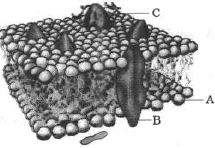
A
Cell wall
B
Plasma membrane
C
Nuclear envelope
D
Nucleolus
Solution
(B) The provided figure illustrates the fluid mosaic model of the plasma membrane.
It shows a phospholipid bilayer with embedded integral and peripheral proteins.
Label $A$ points to the phospholipid bilayer,label $B$ points to an integral protein,and label $C$ points to a peripheral protein.
Therefore,the correct option is $B$.
It shows a phospholipid bilayer with embedded integral and peripheral proteins.
Label $A$ points to the phospholipid bilayer,label $B$ points to an integral protein,and label $C$ points to a peripheral protein.
Therefore,the correct option is $B$.
0 likes
View Solution133
EasyMCQ
The given figure represents which model of the cell membrane?
A
Unit membrane model
B
Sandwich model
C
Fluid mosaic model
D
All of the above
Solution
(C) The provided figure illustrates the structure of the cell membrane as proposed by Singer and Nicolson in $1972$.
This model is known as the Fluid Mosaic Model.
In this model,the membrane consists of a phospholipid bilayer with embedded integral and peripheral proteins,which gives it a fluid and mosaic-like appearance.
Label $A$ represents the phospholipid bilayer,label $B$ represents an integral protein,and label $C$ represents a peripheral protein or sugar chain,all of which are characteristic components of the Fluid Mosaic Model.
This model is known as the Fluid Mosaic Model.
In this model,the membrane consists of a phospholipid bilayer with embedded integral and peripheral proteins,which gives it a fluid and mosaic-like appearance.
Label $A$ represents the phospholipid bilayer,label $B$ represents an integral protein,and label $C$ represents a peripheral protein or sugar chain,all of which are characteristic components of the Fluid Mosaic Model.
0 likes
View Solution134
EasyMCQ
In the given figure,what does $A$ indicate?
A
Peripheral protein
B
Integral protein
C
Lipid molecules
D
Glycolipid
Solution
(C) The provided figure represents the fluid mosaic model of the plasma membrane.
In this model,$A$ points to the lipid molecules (specifically the phospholipid bilayer),which form the structural framework of the membrane.
$B$ represents an integral protein that spans the entire membrane.
$C$ represents a peripheral protein or a sugar chain attached to the surface.
Therefore,$A$ indicates the lipid molecules.
In this model,$A$ points to the lipid molecules (specifically the phospholipid bilayer),which form the structural framework of the membrane.
$B$ represents an integral protein that spans the entire membrane.
$C$ represents a peripheral protein or a sugar chain attached to the surface.
Therefore,$A$ indicates the lipid molecules.
0 likes
View Solution135
EasyMCQ
In the given figure,what does $B$ represent?
A
Peripheral protein
B
Integral protein
C
Lipid molecules
D
Glycolipid
Solution
(B) The provided figure represents the fluid mosaic model of the cell membrane.
In this model:
$A$ points to the phospholipid bilayer (lipid molecules).
$B$ points to an integral protein (or transmembrane protein) that spans across the lipid bilayer.
$C$ points to a peripheral protein located on the surface of the membrane.
Therefore,$B$ represents an integral protein.
In this model:
$A$ points to the phospholipid bilayer (lipid molecules).
$B$ points to an integral protein (or transmembrane protein) that spans across the lipid bilayer.
$C$ points to a peripheral protein located on the surface of the membrane.
Therefore,$B$ represents an integral protein.
0 likes
View Solution136
EasyMCQ
In the given figure,what does $C$ represent?
A
Peripheral protein
B
Integral protein
C
Lipid molecules
D
Glycolipid
Solution
(D) The provided figure represents the fluid mosaic model of the plasma membrane.
In this diagram:
- $A$ points to the phospholipid bilayer (lipid molecules).
- $B$ points to an integral protein that spans across the membrane.
- $C$ points to a sugar chain attached to a lipid molecule,which is identified as a glycolipid.
Therefore,$C$ represents a glycolipid.
In this diagram:
- $A$ points to the phospholipid bilayer (lipid molecules).
- $B$ points to an integral protein that spans across the membrane.
- $C$ points to a sugar chain attached to a lipid molecule,which is identified as a glycolipid.
Therefore,$C$ represents a glycolipid.
0 likes
View Solution137
EasyMCQ
Which statement is incorrect regarding the cell membrane?
A
It forms the covering of the cell.
B
It holds the outer parts of the cell in their place.
C
It provides protection to the cell.
D
It determines the outer boundary of a plant cell.
Solution
(D) The cell membrane (plasma membrane) is a selectively permeable membrane that surrounds the cytoplasm of all cells.
Option $A$ is correct as it forms the boundary of the cell.
Option $B$ is incorrect because the cell membrane does not hold the 'outer parts' of the cell in place; rather,it encloses the cytoplasm and organelles.
Option $C$ is correct as it acts as a protective barrier.
Option $D$ is incorrect in the context of plant cells because the outermost boundary of a plant cell is the cell wall,not the cell membrane.
Option $A$ is correct as it forms the boundary of the cell.
Option $B$ is incorrect because the cell membrane does not hold the 'outer parts' of the cell in place; rather,it encloses the cytoplasm and organelles.
Option $C$ is correct as it acts as a protective barrier.
Option $D$ is incorrect in the context of plant cells because the outermost boundary of a plant cell is the cell wall,not the cell membrane.
0 likes
View Solution138
MediumMCQ
Statement $X$: The cell membrane is the main structural component.
Statement $Y$: It is the site for electron transport and is a selectively permeable membrane.
Statement $Y$: It is the site for electron transport and is a selectively permeable membrane.
A
Both Statement $X$ and Statement $Y$ are correct.
B
Statement $X$ is correct but Statement $Y$ is incorrect.
C
Statement $X$ is incorrect but Statement $Y$ is correct.
D
Both Statement $X$ and Statement $Y$ are incorrect.
Solution
(A) The cell membrane (plasma membrane) is a fundamental structural component of the cell,defining its boundary.
In prokaryotes,the plasma membrane acts as the site for electron transport (respiratory chain) because they lack mitochondria.
It is also a selectively permeable membrane that regulates the movement of substances in and out of the cell.
Therefore,both statements are scientifically accurate.
In prokaryotes,the plasma membrane acts as the site for electron transport (respiratory chain) because they lack mitochondria.
It is also a selectively permeable membrane that regulates the movement of substances in and out of the cell.
Therefore,both statements are scientifically accurate.
0 likes
View Solution139
MediumMCQ
In the structure of the cell membrane,$........$ is essential,and in determining the permeability of the cell membrane,$........$ mineral element is important.
A
Calcium,Phosphorus
B
Phosphorus,Nitrogen
C
Calcium,Nitrogen
D
Phosphorus,Calcium
Solution
(D) The cell membrane is primarily composed of a phospholipid bilayer,making $Phosphorus$ an essential component of its structure.
$Calcium$ ions $(Ca^{2+})$ play a crucial role in regulating the permeability of the cell membrane and maintaining its integrity.
Therefore,the correct sequence is $Phosphorus$ and $Calcium$.
$Calcium$ ions $(Ca^{2+})$ play a crucial role in regulating the permeability of the cell membrane and maintaining its integrity.
Therefore,the correct sequence is $Phosphorus$ and $Calcium$.
0 likes
View Solution140
MediumMCQ
Where are phospholipids found?
A
In the myelin sheath
B
In the plasma membrane and organelle membranes
C
In the subcutaneous layer
D
On the surface of aerial parts of plants
Solution
(B) Phospholipids are a class of lipids that are major components of all cell membranes.
They form a lipid bilayer in the plasma membrane and the membranes of various cell organelles (such as mitochondria,endoplasmic reticulum,etc.).
They consist of a hydrophilic (water-loving) head and two hydrophobic (water-fearing) fatty acid tails,which allow them to form stable bilayers in an aqueous environment.
They form a lipid bilayer in the plasma membrane and the membranes of various cell organelles (such as mitochondria,endoplasmic reticulum,etc.).
They consist of a hydrophilic (water-loving) head and two hydrophobic (water-fearing) fatty acid tails,which allow them to form stable bilayers in an aqueous environment.
0 likes
View Solution141
EasyMCQ
What is present in the structure of the plasma membrane and organelle membranes?
A
Waxes
B
Oils
C
Phospholipids
D
Cellulose
Solution
(C) The plasma membrane and the membranes of cell organelles are primarily composed of a lipid bilayer,specifically $Phospholipids$.
These $Phospholipids$ are amphipathic molecules,meaning they have both a hydrophilic (water-loving) head and a hydrophobic (water-fearing) tail.
This structure allows them to form a stable barrier that separates the internal environment of the cell or organelle from the external environment.
These $Phospholipids$ are amphipathic molecules,meaning they have both a hydrophilic (water-loving) head and a hydrophobic (water-fearing) tail.
This structure allows them to form a stable barrier that separates the internal environment of the cell or organelle from the external environment.
0 likes
View Solution142
EasyMCQ
The plasma membrane and the membranes of organelles are primarily composed of which substance?
A
Glycolipid
B
Phospholipid
C
Sterol
D
Sterone
Solution
(B) The plasma membrane and the membranes of cell organelles (such as mitochondria,endoplasmic reticulum,etc.) are primarily composed of a lipid bilayer. The most abundant lipids in these membranes are phospholipids. These phospholipids are amphipathic,meaning they have both hydrophilic (water-loving) heads and hydrophobic (water-fearing) tails,which allow them to form the structural bilayer of the cell membrane.
0 likes
View Solution143
MediumMCQ
Assertion $(S)$: The plasma membrane and organelle membranes are composed of phospholipids.
Reason $(R)$: The structural component of cellular organelles is lipid.
Reason $(R)$: The structural component of cellular organelles is lipid.
A
$S$ and $R$ are both true,and $R$ is the correct explanation of $S$.
B
$S$ and $R$ are both true,but $R$ is not the correct explanation of $S$.
C
$S$ is true and $R$ is false.
D
$S$ is false and $R$ is true.
Solution
(A) The plasma membrane and the membranes of various cell organelles (like mitochondria,endoplasmic reticulum,etc.) are primarily composed of a phospholipid bilayer.
This structure is essential for maintaining the integrity and selective permeability of the cell and its organelles.
Therefore,Assertion $(S)$ is true.
While lipids are a major structural component of these membranes,they are not the only component; proteins and carbohydrates are also present.
However,the reason provided $(R)$ states that the structural component of cellular organelles is lipid,which is a generalized and partially correct statement regarding membrane composition,but it does not fully explain why membranes are specifically made of phospholipids.
In the context of standard biological questions,$R$ is considered a correct explanation for $S$ because the phospholipid bilayer is the fundamental structural basis of these membranes.
Thus,the correct option is $A$.
This structure is essential for maintaining the integrity and selective permeability of the cell and its organelles.
Therefore,Assertion $(S)$ is true.
While lipids are a major structural component of these membranes,they are not the only component; proteins and carbohydrates are also present.
However,the reason provided $(R)$ states that the structural component of cellular organelles is lipid,which is a generalized and partially correct statement regarding membrane composition,but it does not fully explain why membranes are specifically made of phospholipids.
In the context of standard biological questions,$R$ is considered a correct explanation for $S$ because the phospholipid bilayer is the fundamental structural basis of these membranes.
Thus,the correct option is $A$.
0 likes
View Solution144
MediumMCQ
The main structural component of the plasma membrane of various cellular organelles is:
A
Carbohydrates
B
Starch
C
Proteins
D
Nucleic acids
Solution
(C) The plasma membrane of various cellular organelles is primarily composed of a lipid bilayer and proteins.
According to the fluid mosaic model,proteins are embedded within or attached to the lipid bilayer.
Proteins play a crucial role in the structural integrity,transport,and enzymatic activities of the membrane.
While lipids provide the basic framework,proteins are the primary functional and structural components that define the membrane's specific properties.
According to the fluid mosaic model,proteins are embedded within or attached to the lipid bilayer.
Proteins play a crucial role in the structural integrity,transport,and enzymatic activities of the membrane.
While lipids provide the basic framework,proteins are the primary functional and structural components that define the membrane's specific properties.
0 likes
View Solution145
EasyMCQ
Where are some proteins arranged in the cell to facilitate the transport of substances?
A
Cell wall
B
Cell membrane
C
Nucleus
D
Cytoplasm
Solution
(B) The cell membrane (plasma membrane) is a selectively permeable membrane that regulates the movement of substances in and out of the cell.
It consists of a lipid bilayer with embedded integral and peripheral proteins.
These integral proteins act as channels,carriers,or pumps to facilitate the transport of specific molecules,such as ions,glucose,and amino acids,across the membrane.
It consists of a lipid bilayer with embedded integral and peripheral proteins.
These integral proteins act as channels,carriers,or pumps to facilitate the transport of specific molecules,such as ions,glucose,and amino acids,across the membrane.
0 likes
View Solution146
MediumMCQ
$A$: The main structural component of the membranes of various cellular organelles is protein.
$R$: Protein is an important component of protoplasm.
$R$: Protein is an important component of protoplasm.
A
$A$ and $R$ are both true and $R$ is the correct explanation of $A$.
B
$A$ and $R$ are both true,but $R$ is not the correct explanation of $A$.
C
$A$ is true and $R$ is false.
D
$A$ is false and $R$ is true.
Solution
(D) Assertion $(A)$ is false because the main structural component of biological membranes (like the plasma membrane and organelle membranes) is the lipid bilayer,not protein. While proteins are embedded in the lipid bilayer,they are not the primary structural component.
Reason $(R)$ is true because proteins are essential components of protoplasm,serving various functions such as enzymatic activity,structural support,and transport.
Reason $(R)$ is true because proteins are essential components of protoplasm,serving various functions such as enzymatic activity,structural support,and transport.
0 likes
View Solution147
MediumMCQ
Select the correct statement from the following regarding the cell membrane.
A
$Na^+$ and $K^+$ ions move across the cell membrane by passive transport.
B
Proteins make up $60$ to $70\%$ of the cell membrane.
C
Lipids are arranged in a bilayer with polar heads towards the inner part.
D
The fluid mosaic model of the cell membrane was proposed by Singer and Nicolson.
Solution
(D) The correct statement is $(D)$.
According to the fluid mosaic model of cell membrane structure proposed by $Singer$ and $Nicolson$ $(1972)$,the plasma membrane consists of approximately $50-60\%$ proteins and $40-50\%$ lipids.
Lipids are arranged in a bilayer with the hydrophilic (polar) heads pointing outwards and the hydrophobic (non-polar) tails pointing inwards.
$Na^+$ and $K^+$ ions are transported across the cell membrane primarily via active transport (e.g.,$Na^+/K^+$ pump),not passive transport.
Therefore,the statement that the fluid mosaic model was proposed by $Singer$ and $Nicolson$ is the only correct statement.
According to the fluid mosaic model of cell membrane structure proposed by $Singer$ and $Nicolson$ $(1972)$,the plasma membrane consists of approximately $50-60\%$ proteins and $40-50\%$ lipids.
Lipids are arranged in a bilayer with the hydrophilic (polar) heads pointing outwards and the hydrophobic (non-polar) tails pointing inwards.
$Na^+$ and $K^+$ ions are transported across the cell membrane primarily via active transport (e.g.,$Na^+/K^+$ pump),not passive transport.
Therefore,the statement that the fluid mosaic model was proposed by $Singer$ and $Nicolson$ is the only correct statement.
0 likes
View Solution148
MediumMCQ
Which one of the following does not differ in $E. coli$ and $Chlamydomonas$?
A
Ribosomes
B
Chromosomal organization
C
Cell wall
D
Cell membrane
Solution
(D) $E. coli$ (bacteria) is a prokaryote,while $Chlamydomonas$ (algae) is a eukaryote.
Ribosomes of both groups differ,being $70S$ in prokaryotes and $80S$ in eukaryotes.
Prokaryotic chromosomes lack histone proteins,unlike eukaryotic chromosomes.
Cell wall organization also differs; the bacterial cell wall is rich in peptidoglycan (muramic acid),while the algal cell wall is primarily cellulosic.
It is the cell membrane that has a similar fluid mosaic organization in both groups.
Ribosomes of both groups differ,being $70S$ in prokaryotes and $80S$ in eukaryotes.
Prokaryotic chromosomes lack histone proteins,unlike eukaryotic chromosomes.
Cell wall organization also differs; the bacterial cell wall is rich in peptidoglycan (muramic acid),while the algal cell wall is primarily cellulosic.
It is the cell membrane that has a similar fluid mosaic organization in both groups.
0 likes
View Solution149
EasyMCQ
The plasma membrane consists mainly of
A
phospholipids embedded in a protein bilayer
B
proteins embedded in a phospholipid bilayer
C
proteins embedded in a polymer of glucose molecules
D
proteins embedded in a carbohydrate bilayer.
Solution
(B) The correct answer is $(B)$.
According to the fluid mosaic model,the plasma membrane is composed of a phospholipid bilayer in which protein molecules are embedded.
Lipids $(20-79\%)$,proteins $(20-70\%)$,carbohydrates $(1-5\%)$,and water $(20\%)$ are the main components of the plasma membrane.
Lipid molecules,primarily phospholipids,are amphipathic (having both hydrophobic and hydrophilic ends) and form a bilayer structure.
Protein molecules are distributed throughout this bilayer,either partially or totally embedded (intrinsic/integral proteins) or attached to the surface (extrinsic/peripheral proteins).
According to the fluid mosaic model,the plasma membrane is composed of a phospholipid bilayer in which protein molecules are embedded.
Lipids $(20-79\%)$,proteins $(20-70\%)$,carbohydrates $(1-5\%)$,and water $(20\%)$ are the main components of the plasma membrane.
Lipid molecules,primarily phospholipids,are amphipathic (having both hydrophobic and hydrophilic ends) and form a bilayer structure.
Protein molecules are distributed throughout this bilayer,either partially or totally embedded (intrinsic/integral proteins) or attached to the surface (extrinsic/peripheral proteins).
0 likes
View Solution150
MediumMCQ
Keeping in view the 'fluid mosaic model' for the structure of the cell membrane,which one of the following statements is correct with respect to the movements of lipids and proteins from one lipid monolayer to the other (described as flip-flop movement)?
A
While proteins can flip-flop,lipids can not.
B
Neither lipids,nor proteins can flip-flop.
C
Both lipids and proteins can flip-flop.
D
While lipids can rarely flip-flop,proteins cannot.
Solution
(D) The correct answer is $D$.
According to the 'fluid mosaic model',the cell membrane exhibits rapid internal motion involving flexing within each lipid molecule.
$A$ rapid lateral diffusion of lipids within the same monolayer is possible.
$A$ slow 'flip-flop' motion,i.e.,the transfer of lipid molecules from one side of the bilayer to the other,is rare but possible.
In contrast,proteins are generally too large and amphipathic to undergo 'flip-flop' movement across the lipid bilayer,as this would require the hydrophilic regions of the protein to pass through the hydrophobic core of the membrane,which is energetically unfavorable.
According to the 'fluid mosaic model',the cell membrane exhibits rapid internal motion involving flexing within each lipid molecule.
$A$ rapid lateral diffusion of lipids within the same monolayer is possible.
$A$ slow 'flip-flop' motion,i.e.,the transfer of lipid molecules from one side of the bilayer to the other,is rare but possible.
In contrast,proteins are generally too large and amphipathic to undergo 'flip-flop' movement across the lipid bilayer,as this would require the hydrophilic regions of the protein to pass through the hydrophobic core of the membrane,which is energetically unfavorable.
0 likes
View SolutionCell: The Unit of Life — Cell membrane · Frequently Asked Questions
1Are these Cell: The Unit of Life questions useful for JEE and NEET?
Yes. All questions in this section are mapped to JEE Main and NEET exam patterns. Previous year questions from JEE Main, NEET, GUJCET and state-level exams are included with full solutions.
2Can I switch to Hindi or Gujarati for these questions?
Yes. Use the language tabs in the hero section or the sidebar to view the same questions and solutions in English, Hindi or Gujarati.
3How do I generate a question paper from this subtopic?
Use the Vedclass Exam Paper Generator — select the chapter and subtopic, set difficulty, and generate Sets A, B, C, D automatically. First 3 chapters of every subject are free.
Vedclass Products
For Students
Vedclass Test Series
Mock tests in real JEE/NEET style with performance analysis. 5-day free trial.
Start Free TrialFor Teachers
Exam Paper Generator
Generate Set A/B/C/D papers from this chapter in 2 minutes. 3 chapters free.
Try FreeFor Institutes
Online Exam Module
Live online exams with unlimited students, 360° analytics & white-label branding.
See DemoFor Teachers & Institutes
Generate a Cell: The Unit of Life Exam Paper in 2 Minutes
Select subtopic & difficulty — Sets A, B, C, D auto-generated with No Repeat logic.
First 3 chapters of every subject are free — no payment required.