
A English
Cell membrane Questions in English
Class 11 Biology · Cell: The Unit of Life · Cell membrane
229+
Questions
English
Language
100%
With Solutions
Showing 48 of 229 questions in English
151
EasyMCQ
Which one of the following is not a constituent of cell membrane?
A
Glycolipids
B
Proline
C
Phospholipids
D
Cholesterol
Solution
(B) The correct answer is $(b)$.
Chemically,a biomembrane consists of lipids $(20-70\%)$,proteins $(20-70\%)$,carbohydrates $(1-5\%)$,and water $(20\%)$.
The primary lipids found in the cell membrane include phospholipids,sterols (such as cholesterol),glycolipids,and sphingolipids (such as sphingomyelin and cerebrosides).
Proline is an amino acid,which is a building block of proteins,but it is not a structural constituent of the cell membrane itself in the same way that lipids or membrane proteins are.
Chemically,a biomembrane consists of lipids $(20-70\%)$,proteins $(20-70\%)$,carbohydrates $(1-5\%)$,and water $(20\%)$.
The primary lipids found in the cell membrane include phospholipids,sterols (such as cholesterol),glycolipids,and sphingolipids (such as sphingomyelin and cerebrosides).
Proline is an amino acid,which is a building block of proteins,but it is not a structural constituent of the cell membrane itself in the same way that lipids or membrane proteins are.
0 likes
View Solution152
EasyMCQ
What are porins?
A
Carbohydrates
B
Lipid
C
Protein
D
Enzymes
Solution
(C) Porins are large $ \text{proteins} $ that form large pores in the outer membranes of the plastids, mitochondria, and some bacteria.
They allow molecules up to the size of small proteins to pass through the membrane.
Therefore, porins are classified as $ \text{proteins} $.
They allow molecules up to the size of small proteins to pass through the membrane.
Therefore, porins are classified as $ \text{proteins} $.
0 likes
View Solution153
EasyMCQ
What are porins?
A
Carbohydrates
B
Fat
C
Protein
D
Enzyme
Solution
(C) Porins are large $ \text{proteins} $ that form large pores in the outer membranes of the plastids, mitochondria, and some bacteria.
They allow molecules up to the size of small proteins to pass through the membrane.
Therefore, porins are essentially $ \text{proteinaceous} $ channels.
They allow molecules up to the size of small proteins to pass through the membrane.
Therefore, porins are essentially $ \text{proteinaceous} $ channels.
0 likes
View Solution154
MediumMCQ
The cell envelope is a chemically complex structure consisting of a tightly bound three-layered structure. Which layer is semi-permeable in nature?
A
Slime layer
B
Capsule
C
Cell wall
D
Plasma membrane
Solution
(D) The bacterial cell envelope consists of three layers: the outermost glycocalyx (slime layer or capsule),the middle cell wall,and the innermost plasma membrane.
$1$. The glycocalyx (slime layer or capsule) provides protection and helps in adhesion.
$2$. The cell wall determines the shape of the cell and provides structural support.
$3$. The plasma membrane is the innermost layer and is selectively permeable (semi-permeable) in nature,controlling the entry and exit of substances in and out of the cell.
$1$. The glycocalyx (slime layer or capsule) provides protection and helps in adhesion.
$2$. The cell wall determines the shape of the cell and provides structural support.
$3$. The plasma membrane is the innermost layer and is selectively permeable (semi-permeable) in nature,controlling the entry and exit of substances in and out of the cell.
0 likes
View Solution155
EasyMCQ
Solid form of food engulfing by cell membrane is called ........
A
Endosmosis
B
Pinocytosis
C
Cytokinesis
D
Phagocytosis
Solution
(D) Phagocytosis is the process by which a cell engulfs solid particles or large molecules from the extracellular environment using its cell membrane.
This process involves the formation of a vesicle known as a phagosome.
Pinocytosis refers to the ingestion of liquid or small dissolved particles (cell drinking).
Endosmosis is the movement of water into a cell.
Cytokinesis is the division of the cytoplasm during cell division.
This process involves the formation of a vesicle known as a phagosome.
Pinocytosis refers to the ingestion of liquid or small dissolved particles (cell drinking).
Endosmosis is the movement of water into a cell.
Cytokinesis is the division of the cytoplasm during cell division.
0 likes
View Solution156
MediumMCQ
Tubulin protein is not present in......
A
Cell membrane
B
Pinocytosis
C
Cytokinesis
D
Microtubule
Solution
(A) Tubulin is a globular protein that polymerizes to form microtubules,which are essential components of the cytoskeleton.
Microtubules are involved in various cellular processes such as intracellular transport,maintaining cell shape,and the formation of the mitotic spindle during cell division (cytokinesis).
Pinocytosis is a process of endocytosis where the cell membrane invaginates to ingest extracellular fluid; while the cytoskeleton (containing tubulin) may assist in the movement of vesicles,tubulin itself is not a structural component of the cell membrane.
Therefore,tubulin protein is not present in the cell membrane.
Microtubules are involved in various cellular processes such as intracellular transport,maintaining cell shape,and the formation of the mitotic spindle during cell division (cytokinesis).
Pinocytosis is a process of endocytosis where the cell membrane invaginates to ingest extracellular fluid; while the cytoskeleton (containing tubulin) may assist in the movement of vesicles,tubulin itself is not a structural component of the cell membrane.
Therefore,tubulin protein is not present in the cell membrane.
0 likes
View Solution157
EasyMCQ
According to the fluid mosaic model (proposed by Singer and Nicolson),the plasma membrane is composed of:
A
Cellulose and Hemicellulose
B
Phospholipid,integral protein,and suberin
C
Phospholipid,peripheral protein,and integral protein
D
Phospholipid and Hemicellulose
Solution
(C) The fluid mosaic model,proposed by $S.J. Singer$ and $G.L. Nicolson$ in $1972$,describes the structure of the plasma membrane.
According to this model,the plasma membrane is composed of a lipid bilayer (primarily phospholipids) in which proteins are embedded.
These proteins are classified into two types based on their ease of extraction: $1.$ Peripheral proteins (lie on the surface of the membrane) and $2.$ Integral proteins (partially or totally buried in the membrane).
Therefore,the correct composition includes phospholipids,peripheral proteins,and integral proteins.
According to this model,the plasma membrane is composed of a lipid bilayer (primarily phospholipids) in which proteins are embedded.
These proteins are classified into two types based on their ease of extraction: $1.$ Peripheral proteins (lie on the surface of the membrane) and $2.$ Integral proteins (partially or totally buried in the membrane).
Therefore,the correct composition includes phospholipids,peripheral proteins,and integral proteins.
0 likes
View Solution158
MediumMCQ
Which components present in the plasma membrane result in it having a fluid structure?
A
Carbohydrates
B
Lipids
C
Glycoproteins
D
Polysaccharides
Solution
(B) The fluid mosaic model,proposed by $Singer$ and $Nicolson$ in $1973$,describes the plasma membrane as a fluid structure.
The fluidity of the membrane is primarily due to the nature of the lipid bilayer.
The phospholipids are arranged in a bilayer with their hydrophobic tails facing inward and hydrophilic heads facing outward.
These lipid molecules are capable of lateral movement within the membrane,which provides the fluid nature to the plasma membrane.
Proteins are embedded within this lipid bilayer,but the overall fluidity is a characteristic property of the lipid component.
The fluidity of the membrane is primarily due to the nature of the lipid bilayer.
The phospholipids are arranged in a bilayer with their hydrophobic tails facing inward and hydrophilic heads facing outward.
These lipid molecules are capable of lateral movement within the membrane,which provides the fluid nature to the plasma membrane.
Proteins are embedded within this lipid bilayer,but the overall fluidity is a characteristic property of the lipid component.
0 likes
View Solution159
EasyMCQ
In human beings,the membrane of the erythrocytes has approximately ...... percent protein and ....... percent lipids.
A
$52, 40$
B
$62, 50$
C
$42, 50$
D
$40, 40$
Solution
(A) According to the $NCERT$ textbook,the chemical composition of the human erythrocyte (red blood cell) membrane has been studied extensively.
It is found that the membrane consists of approximately $52\%$ protein and $40\%$ lipids.
The remaining percentage consists of carbohydrates and other minor components.
Therefore,the correct values are $52$ percent protein and $40$ percent lipids.
It is found that the membrane consists of approximately $52\%$ protein and $40\%$ lipids.
The remaining percentage consists of carbohydrates and other minor components.
Therefore,the correct values are $52$ percent protein and $40$ percent lipids.
0 likes
View Solution160
MediumMCQ
$A -$ $A$ cell is a closed compartment for all substances.
$R -$ Plasma membrane of a cell is selectively permeable.
$R -$ Plasma membrane of a cell is selectively permeable.
A
Both $A$ and $R$ are true.
B
Both $A$ and $R$ are false.
C
$A$ is true,but $R$ is false.
D
$A$ is false,but $R$ is true.
Solution
(D) Assertion $(A)$ is false because a cell is not a closed compartment for all substances. It is an open system that constantly exchanges materials (nutrients,waste,gases) with its environment.
Reason $(R)$ is true because the plasma membrane is selectively permeable,meaning it allows only certain molecules or ions to pass through it by means of active or passive transport.
Reason $(R)$ is true because the plasma membrane is selectively permeable,meaning it allows only certain molecules or ions to pass through it by means of active or passive transport.
0 likes
View Solution161
MediumMCQ
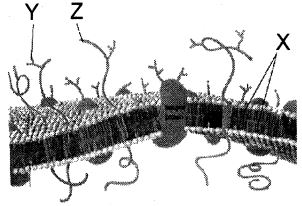
Identify $X, Y, Z$ from the given figure of the cell membrane:
A
$X-$ Sugar,$Y-$ Protein,$Z-$ Lipid bilayer
B
$X-$ Protein,$Y-$ Lipid bilayer,$Z-$ Sugar
C
$X-$ Cholesterol,$Y-$ Protein,$Z-$ Sugar
D
$X-$ Lipid bilayer,$Y-$ Sugar,$Z-$ Protein
Solution
(B) In the fluid mosaic model of the cell membrane:
$1$. $X$ points to the globular proteins embedded in or associated with the lipid bilayer.
$2$. $Y$ points to the sugar chains (oligosaccharides) attached to the proteins,forming glycoproteins.
$3$. $Z$ points to the sugar chains (oligosaccharides) attached to the lipids,forming glycolipids.
Therefore,the correct identification is $X-$ Protein,$Y-$ Sugar,$Z-$ Sugar. However,looking at the options provided,option $B$ is the most appropriate as it correctly identifies the protein $(X)$ and the sugar component $(Z)$. Note: In the provided diagram,$Y$ and $Z$ both represent sugar chains attached to different components. Based on standard diagrams,$X$ is Protein,$Y$ is Sugar (on protein),and $Z$ is Sugar (on lipid). Thus,$X-$ Protein,$Y-$ Sugar,$Z-$ Sugar is the accurate description. Given the options,$B$ is the best fit.
$1$. $X$ points to the globular proteins embedded in or associated with the lipid bilayer.
$2$. $Y$ points to the sugar chains (oligosaccharides) attached to the proteins,forming glycoproteins.
$3$. $Z$ points to the sugar chains (oligosaccharides) attached to the lipids,forming glycolipids.
Therefore,the correct identification is $X-$ Protein,$Y-$ Sugar,$Z-$ Sugar. However,looking at the options provided,option $B$ is the most appropriate as it correctly identifies the protein $(X)$ and the sugar component $(Z)$. Note: In the provided diagram,$Y$ and $Z$ both represent sugar chains attached to different components. Based on standard diagrams,$X$ is Protein,$Y$ is Sugar (on protein),and $Z$ is Sugar (on lipid). Thus,$X-$ Protein,$Y-$ Sugar,$Z-$ Sugar is the accurate description. Given the options,$B$ is the best fit.
0 likes
View Solution162
MediumMCQ
According to the fluid mosaic model,the cell membrane consists of:
A
Phospholipids and oligosaccharides
B
Phospholipids and hemicellulose
C
Phospholipids and integral proteins
D
Phospholipids,extrinsic proteins,and integral proteins
Solution
(D) The fluid mosaic model,proposed by $Singer$ and $Nicolson$ in $1972$,describes the cell membrane as a mosaic of various components.
These components primarily include a phospholipid bilayer,which provides the fluid structure,and proteins that are embedded within or attached to the surface.
The proteins are classified into two types: integral (or intrinsic) proteins,which are embedded in the bilayer,and peripheral (or extrinsic) proteins,which lie on the surface of the membrane.
Therefore,the cell membrane is composed of phospholipids,extrinsic proteins,and integral proteins.
These components primarily include a phospholipid bilayer,which provides the fluid structure,and proteins that are embedded within or attached to the surface.
The proteins are classified into two types: integral (or intrinsic) proteins,which are embedded in the bilayer,and peripheral (or extrinsic) proteins,which lie on the surface of the membrane.
Therefore,the cell membrane is composed of phospholipids,extrinsic proteins,and integral proteins.
0 likes
View Solution163
EasyMCQ
What is the cell membrane composed of?
A
Proteins and carbohydrates
B
Proteins and lipids
C
Proteins,lipids,and carbohydrates
D
Proteins,lipids,and some nucleic acids
Solution
(C) The cell membrane (plasma membrane) is primarily composed of lipids and proteins. The lipid bilayer forms the structural framework,while proteins are embedded within it. Additionally,carbohydrates are present on the outer surface of the membrane,attached to proteins (glycoproteins) or lipids (glycolipids). Therefore,the cell membrane is composed of proteins,lipids,and carbohydrates.
0 likes
View Solution164
MediumMCQ
Who proposed the $Fluid$ $Mosaic$ $Model$ for the cell membrane?
A
Danielli and Davson
B
Singer and Nicolson
C
Garner and Allard
D
Watson and Crick
Solution
(B) The $Fluid$ $Mosaic$ $Model$ of the cell membrane was proposed by $S.J.$ $Singer$ and $G.L.$ $Nicolson$ in $1972$.
According to this model,the cell membrane consists of a phospholipid bilayer with proteins embedded in it,which gives it a fluid-like appearance and dynamic nature.
According to this model,the cell membrane consists of a phospholipid bilayer with proteins embedded in it,which gives it a fluid-like appearance and dynamic nature.
0 likes
View Solution165
MediumMCQ
The cell membrane,which is a component of the endomembrane system,is primarily composed of which biochemicals?
A
Proteins
B
Lipids
C
Proteins and lipids
D
Glycoproteins and glycolipids
Solution
(C) The cell membrane (plasma membrane) is primarily composed of lipids and proteins.
According to the fluid mosaic model,the membrane consists of a lipid bilayer in which protein molecules are embedded.
Lipids are arranged within the membrane with the polar head towards the outer sides and the hydrophobic tails towards the inner part.
Therefore,the correct answer is proteins and lipids.
According to the fluid mosaic model,the membrane consists of a lipid bilayer in which protein molecules are embedded.
Lipids are arranged within the membrane with the polar head towards the outer sides and the hydrophobic tails towards the inner part.
Therefore,the correct answer is proteins and lipids.
0 likes
View Solution166
EasyMCQ
Desmosomes are associated with which of the following?
A
Cytoplasmic streaming
B
Cell division
C
Cell adhesion
D
Cellular excretion
Solution
(C) Desmosomes are specialized structures found in animal cells that function as intercellular junctions.
They act as 'spot welds' or anchoring junctions that provide mechanical strength to tissues by firmly attaching adjacent cells to one another.
Therefore,they are primarily associated with cell adhesion.
They act as 'spot welds' or anchoring junctions that provide mechanical strength to tissues by firmly attaching adjacent cells to one another.
Therefore,they are primarily associated with cell adhesion.
0 likes
View Solution167
MediumMCQ
In the fluid mosaic model of the cell membrane,which of the following is true?
A
The outer layer is non-polar and hydrophilic.
B
The outer layer is polar and hydrophobic.
C
The phospholipid bilayer forms the central part of the membrane.
D
Proteins form the middle layer.
Solution
(C) According to the fluid mosaic model,the cell membrane is primarily composed of a phospholipid bilayer.
These phospholipid molecules are arranged such that their hydrophilic polar heads face outward,while their hydrophobic non-polar tails face inward (toward the center).
Thus,the phospholipid bilayer forms the central structural core of the membrane,within which protein molecules are embedded like a mosaic.
These phospholipid molecules are arranged such that their hydrophilic polar heads face outward,while their hydrophobic non-polar tails face inward (toward the center).
Thus,the phospholipid bilayer forms the central structural core of the membrane,within which protein molecules are embedded like a mosaic.
0 likes
View Solution168
MediumMCQ
The most accepted Fluid Mosaic Model describes the cell membrane as a quasi-fluid structure where lipids and integral proteins are arranged in a mosaic pattern. In recent years,this model has been refined. Which of the following statements is incorrect regarding this model?
A
Proteins flow within the lipid bilayer of the cell membrane.
B
Proteins also exhibit flip-flop movement within the lipid bilayer.
C
Proteins are present in the membrane of some regions.
D
Many proteins are projected along with the lipid bilayer.
Solution
(B) According to the Fluid Mosaic Model,lipids and proteins are dynamic within the membrane. However,protein molecules do not exhibit 'flip-flop' movement (transverse diffusion from one leaflet to the other) within the lipid bilayer. This is because proteins are large in size and possess hydrophilic regions that would need to pass through the hydrophobic core of the lipid bilayer,which is energetically unfavorable. Therefore,statement $B$ is incorrect.
0 likes
View Solution169
MediumMCQ
Considering the fluid mosaic model of the plasma membrane,which of the following statements is true regarding the movement of lipids and proteins from one monolayer to the other? (The movement is described as flip-flop.)
A
Both lipids and proteins exhibit flip-flop movement.
B
Lipids occasionally exhibit flip-flop movement,while proteins do not.
C
Proteins exhibit flip-flop movement,while lipids do not.
D
Neither lipids nor proteins exhibit flip-flop movement.
Solution
(B) According to the fluid mosaic model,the plasma membrane is a fluid structure.
Lipids can move laterally within the membrane,and they can also undergo 'flip-flop' movement (transverse diffusion) from one leaflet to the other,although this process is slow and often requires enzymes called flippases.
Proteins,due to their large size and amphipathic nature,are generally unable to undergo flip-flop movement across the lipid bilayer.
Therefore,lipids can occasionally exhibit flip-flop movement,but proteins do not.
Lipids can move laterally within the membrane,and they can also undergo 'flip-flop' movement (transverse diffusion) from one leaflet to the other,although this process is slow and often requires enzymes called flippases.
Proteins,due to their large size and amphipathic nature,are generally unable to undergo flip-flop movement across the lipid bilayer.
Therefore,lipids can occasionally exhibit flip-flop movement,but proteins do not.
0 likes
View Solution170
MediumMCQ
The cell membrane is primarily composed of:
A
Proteins embedded in a bilayer of phospholipids.
B
Phospholipids embedded in a bilayer of proteins.
C
Proteins embedded in a polymer of glucose molecules.
D
Proteins embedded in a bilayer of carbohydrates.
Solution
(A) According to the $Fluid \ Mosaic \ Model$ proposed by $Singer$ and $Nicolson$ in $1972$,the cell membrane is composed of a lipid bilayer in which protein molecules are embedded. The lipid bilayer consists primarily of phospholipids,which provide the fluid nature to the membrane,while the proteins are embedded within this bilayer,either peripherally or integrally,to perform various functions such as transport and signaling.
0 likes
View Solution171
MediumMCQ
Select the correct statement regarding the cell membrane.
A
$Na^+$ and $K^+$ ions pass through the cell membrane by passive transport.
B
The cell membrane contains $60-70\%$ protein.
C
Lipids are arranged in a bilayer with the polar heads pointing inwards.
D
The fluid mosaic model of the cell membrane was proposed by Singer and Nicolson.
Solution
(D) The fluid mosaic model of the cell membrane was proposed by $S.J. Singer$ and $G.L. Nicolson$ in $1972$.
$Na^+$ and $K^+$ ions require active transport (using energy) to move across the membrane against the concentration gradient.
The protein content in the cell membrane varies; for example,in human erythrocytes,it is about $52\%$ protein and $40\%$ lipids.
In the lipid bilayer,the polar (hydrophilic) heads are directed towards the outer sides,while the hydrophobic tails are directed towards the inner side.
$Na^+$ and $K^+$ ions require active transport (using energy) to move across the membrane against the concentration gradient.
The protein content in the cell membrane varies; for example,in human erythrocytes,it is about $52\%$ protein and $40\%$ lipids.
In the lipid bilayer,the polar (hydrophilic) heads are directed towards the outer sides,while the hydrophobic tails are directed towards the inner side.
0 likes
View Solution172
MediumMCQ
Which of the following is not a component of the cell membrane?
A
Cholesterol
B
Glycolipid
C
Proline
D
Phospholipid
Solution
(C) The cell membrane is primarily composed of a lipid bilayer,which consists of phospholipids,cholesterol,and various proteins.
Glycolipids are also present on the outer surface of the cell membrane.
Proline is an amino acid,which is a building block of proteins. While proteins are components of the cell membrane,proline itself is not a structural component of the membrane in the same way that lipids or cholesterol are; it is merely one of the many amino acids that make up membrane proteins.
Glycolipids are also present on the outer surface of the cell membrane.
Proline is an amino acid,which is a building block of proteins. While proteins are components of the cell membrane,proline itself is not a structural component of the membrane in the same way that lipids or cholesterol are; it is merely one of the many amino acids that make up membrane proteins.
0 likes
View Solution173
EasyMCQ
Molecules that are too large to pass through the pores of a cell membrane may enter the cell by a process known as
A
hydrolysis
B
pinocytosis
C
cyclosis
D
synthesis
Solution
(B) Pinocytosis,often described as 'cell drinking' or the pinching in of the cell membrane,allows cells to engulf and internalize larger molecules or extracellular fluid that cannot pass through membrane pores.
Hydrolysis is the chemical breakdown of a compound due to reaction with water.
Cyclosis (or cytoplasmic streaming) is the directed flow of cytosol and organelles around the large central vacuole of a plant cell.
Synthesis is the process of building complex molecules from simpler ones within the cell.
Hydrolysis is the chemical breakdown of a compound due to reaction with water.
Cyclosis (or cytoplasmic streaming) is the directed flow of cytosol and organelles around the large central vacuole of a plant cell.
Synthesis is the process of building complex molecules from simpler ones within the cell.
0 likes
View Solution174
MediumMCQ
Assertion : Lipids present in the outer and inner side of the bilayer membrane are commonly different.
Reason : Oligosaccharides are attached to external surface as well as inner surface of a biomembrane.
Reason : Oligosaccharides are attached to external surface as well as inner surface of a biomembrane.
A
If both Assertion and Reason are correct and the Reason is a correct explanation of the Assertion.
B
If both Assertion and Reason are correct but Reason is not a correct explanation of the Assertion.
C
If the Assertion is correct but Reason is incorrect.
D
If both the Assertion and Reason are incorrect.
Solution
(C) The Assertion is correct because the lipid composition of the two leaflets of the bilayer membrane is asymmetric. For example,in the erythrocyte membrane,lecithin (phosphatidylcholine) is primarily found on the outer leaflet,while cephalin (phosphatidylethanolamine) is more abundant on the inner leaflet.
The Reason is incorrect because oligosaccharides (forming the glycocalyx) are exclusively attached to the external surface of the plasma membrane,facing the extracellular environment. They are not present on the inner cytoplasmic surface of the biomembrane.
The Reason is incorrect because oligosaccharides (forming the glycocalyx) are exclusively attached to the external surface of the plasma membrane,facing the extracellular environment. They are not present on the inner cytoplasmic surface of the biomembrane.
0 likes
View Solution175
MediumMCQ
Assertion : $A$ cell membrane shows fluid behaviour.
Reason : $A$ membrane is a mosaic or composite of diverse lipids and proteins.
Reason : $A$ membrane is a mosaic or composite of diverse lipids and proteins.
A
If both Assertion and Reason are correct and the Reason is a correct explanation of the Assertion.
B
If both Assertion and Reason are correct but Reason is not a correct explanation of the Assertion.
C
If the Assertion is correct but Reason is incorrect.
D
If both the Assertion and Reason are incorrect.
Solution
(A) The fluid mosaic model,proposed by $Singer$ and $Nicolson$ in $1972$,describes the cell membrane as a fluid structure.
The fluidity of the membrane is due to the lateral movement of lipids and proteins within the bilayer.
The membrane is described as a mosaic because it is composed of a diverse arrangement of proteins embedded in a phospholipid bilayer.
Since the fluid nature of the membrane allows for the movement of these embedded proteins and lipids,the mosaic composition is directly related to its fluid behavior.
Therefore,both the Assertion and Reason are correct,and the Reason is the correct explanation of the Assertion.
The fluidity of the membrane is due to the lateral movement of lipids and proteins within the bilayer.
The membrane is described as a mosaic because it is composed of a diverse arrangement of proteins embedded in a phospholipid bilayer.
Since the fluid nature of the membrane allows for the movement of these embedded proteins and lipids,the mosaic composition is directly related to its fluid behavior.
Therefore,both the Assertion and Reason are correct,and the Reason is the correct explanation of the Assertion.
0 likes
View Solution176
EasyMCQ
During the $Na^+ - K^+$ pump mechanism,which of the following occurs?
A
$3Na^+$ and $2K^+$ are transported.
B
$1Na^+$ and $2K^+$ are transported.
C
$3Na^+$ and $3K^+$ are transported.
D
It depends on the requirement of the cell.
Solution
(A) The $Na^+ - K^+$ pump is an active transport mechanism that maintains the electrochemical gradient across the cell membrane.
During one cycle of this pump,$3Na^+$ ions are transported out of the cell,and $2K^+$ ions are transported into the cell.
This process requires energy in the form of $ATP$ to move these ions against their respective concentration gradients.
During one cycle of this pump,$3Na^+$ ions are transported out of the cell,and $2K^+$ ions are transported into the cell.
This process requires energy in the form of $ATP$ to move these ions against their respective concentration gradients.
0 likes
View Solution177
MediumMCQ
$A$ boy is studying the transport of a certain type of molecule into a cell. He finds that the transport slows down when the cells are poisoned with a chemical that inhibits energy production. Under normal circumstances,the molecules studied by the boy are probably transported by
A
simple diffusion
B
osmosis
C
active transport
D
facilitated diffusion
Solution
(C) Active transport is a process that requires energy in the form of $ATP$ to move molecules against their concentration gradient.
Since the transport process slows down when energy production is inhibited,it indicates that the process is energy-dependent.
Therefore,the molecules are transported by active transport.
Since the transport process slows down when energy production is inhibited,it indicates that the process is energy-dependent.
Therefore,the molecules are transported by active transport.
0 likes
View Solution178
MediumMCQ
The main difference between active and passive transport across the cell membrane is:
A
Passive transport is non-selective whereas active transport is selective.
B
Passive transport requires a concentration gradient across a biological membrane,whereas active transport requires energy to move solutes.
C
Passive transport is confined to anionic carrier proteins,whereas active transport is confined to cationic channel proteins.
D
Active transport occurs more rapidly than passive transport.
Solution
(B) Passive transport is the movement of molecules along the concentration gradient (from higher to lower concentration) without the expenditure of metabolic energy $(ATP)$.
Active transport involves the movement of molecules against the concentration gradient (from lower to higher concentration),which requires the expenditure of metabolic energy in the form of $ATP$ and specific membrane proteins (pumps).
Active transport involves the movement of molecules against the concentration gradient (from lower to higher concentration),which requires the expenditure of metabolic energy in the form of $ATP$ and specific membrane proteins (pumps).
0 likes
View Solution179
Medium
How do neutral solutes move across the plasma membrane? Can the polar molecules also move across it in the same way? If not,then how are these transported across the membrane?
Solution
(N/A) The plasma membrane is the outermost covering of the cell that separates it from the environment. It regulates the movement of substances into and out of the cell. It allows the entry of only some substances and prevents the movement of others.
Hence,the membrane is selectively permeable.
Movement of neutral solutes: Neutral molecules move across the plasma membrane by simple passive diffusion. Diffusion is the movement of molecules from a region of higher concentration to a region of lower concentration.
Movement of polar molecules: The cell membrane is made up of a phospholipid bilayer and proteins. The movement of polar molecules across the non-polar lipid bilayer requires carrier proteins. Carrier proteins are integral protein particles having a specific affinity for certain solutes. As a result,they facilitate the transport of these molecules across the membrane.
Hence,the membrane is selectively permeable.
Movement of neutral solutes: Neutral molecules move across the plasma membrane by simple passive diffusion. Diffusion is the movement of molecules from a region of higher concentration to a region of lower concentration.
Movement of polar molecules: The cell membrane is made up of a phospholipid bilayer and proteins. The movement of polar molecules across the non-polar lipid bilayer requires carrier proteins. Carrier proteins are integral protein particles having a specific affinity for certain solutes. As a result,they facilitate the transport of these molecules across the membrane.
0 likes
View Solution180
Medium
Discuss in detail the structure of the plasma membrane with a diagram.
Solution
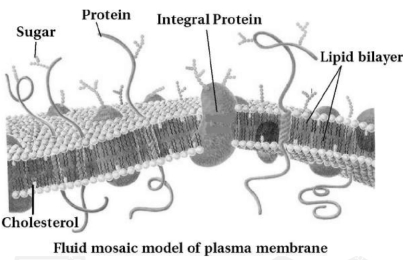
(N/A) The detailed structure of the plasma membrane was studied only after the advent of the electron microscope.
First,the study of the plasma membrane of human $RBC$ was conducted.
The plasma membrane is composed of lipids that are arranged within the membrane with the polar head towards the outer sides and the hydrophobic tails towards the inner part.
This ensures that the nonpolar tail of saturated hydrocarbons is protected from the aqueous environment. The lipid component of the membrane mainly consists of phosphoglycerides.
Biochemical investigation clearly revealed that the cell membranes also possess protein and carbohydrate. The ratio of protein and lipid varies considerably in different cell types.
In human beings,the membrane of the erythrocyte has approximately $52\%$ protein and $40\%$ lipids.
Depending on the ease of extraction,membrane proteins can be classified as integral or peripheral. Peripheral proteins lie on the surface of the membrane,while the integral proteins are partially or totally buried in the membrane.
An improved model of the structure of the cell membrane was proposed by Singer and Nicolson $(1972)$,widely accepted as the fluid mosaic model. According to this,the quasi-fluid nature of lipid enables lateral movement of proteins within the overall bilayer. This ability to move within the membrane is measured as its fluidity.
First,the study of the plasma membrane of human $RBC$ was conducted.
The plasma membrane is composed of lipids that are arranged within the membrane with the polar head towards the outer sides and the hydrophobic tails towards the inner part.
This ensures that the nonpolar tail of saturated hydrocarbons is protected from the aqueous environment. The lipid component of the membrane mainly consists of phosphoglycerides.
Biochemical investigation clearly revealed that the cell membranes also possess protein and carbohydrate. The ratio of protein and lipid varies considerably in different cell types.
In human beings,the membrane of the erythrocyte has approximately $52\%$ protein and $40\%$ lipids.
Depending on the ease of extraction,membrane proteins can be classified as integral or peripheral. Peripheral proteins lie on the surface of the membrane,while the integral proteins are partially or totally buried in the membrane.
An improved model of the structure of the cell membrane was proposed by Singer and Nicolson $(1972)$,widely accepted as the fluid mosaic model. According to this,the quasi-fluid nature of lipid enables lateral movement of proteins within the overall bilayer. This ability to move within the membrane is measured as its fluidity.
0 likes
View Solution181
Easy
Explain: On what basis are substances transported by the plasma membrane/cell membrane?
Solution
(A) $\Rightarrow$ One of the most important functions of the plasma membrane is the transport of molecules across it.
$\Rightarrow$ The membrane is selectively permeable to some molecules present on either side of it.
$\Rightarrow$ Many molecules can move briefly across the membrane without any requirement of energy,and this is called passive transport.
$\Rightarrow$ Neutral solutes may move across the membrane by the process of simple diffusion along the concentration gradient,i.e.,from higher concentration to lower. Water may also move across this membrane from higher to lower concentration. The movement of water by diffusion is called osmosis.
$\Rightarrow$ As polar molecules cannot pass through the nonpolar lipid bilayer,they require a carrier protein of the membrane to facilitate their transport across the membrane.
$\Rightarrow$ $A$ few ions or molecules are transported across the membrane against their concentration gradient,i.e.,from lower to higher concentration. Such transport is an energy-dependent process in which $ATP$ is utilized,and it is called active transport,e.g.,the $Na^{+}/K^{+}$ pump.
$\Rightarrow$ The membrane is selectively permeable to some molecules present on either side of it.
$\Rightarrow$ Many molecules can move briefly across the membrane without any requirement of energy,and this is called passive transport.
$\Rightarrow$ Neutral solutes may move across the membrane by the process of simple diffusion along the concentration gradient,i.e.,from higher concentration to lower. Water may also move across this membrane from higher to lower concentration. The movement of water by diffusion is called osmosis.
$\Rightarrow$ As polar molecules cannot pass through the nonpolar lipid bilayer,they require a carrier protein of the membrane to facilitate their transport across the membrane.
$\Rightarrow$ $A$ few ions or molecules are transported across the membrane against their concentration gradient,i.e.,from lower to higher concentration. Such transport is an energy-dependent process in which $ATP$ is utilized,and it is called active transport,e.g.,the $Na^{+}/K^{+}$ pump.
0 likes
View Solution182
MediumMCQ
What are porins? What role do they play in diffusion?
A
Proteins that form small channels in the plasma membrane.
B
Proteins that form large pores in the outer membranes of plastids,mitochondria,and bacteria.
C
Lipids that facilitate active transport across membranes.
D
Carbohydrates that act as receptors on the cell surface.
Solution
(B) Porins are specialized proteins that form large-sized pores in the outer membranes of plastids (such as chloroplasts),mitochondria,and the cell membranes of some bacteria.
They play a crucial role in diffusion by facilitating the passive transport of small-sized molecules,including certain proteins,across these membranes.
They play a crucial role in diffusion by facilitating the passive transport of small-sized molecules,including certain proteins,across these membranes.
0 likes
View Solution183
EasyMCQ
What was the contribution of the scientist $J.D. Robertson$ regarding the cell membrane?
A
Fluid Mosaic Model
B
Unit Membrane Concept
C
Sandwich Model
D
Micellar Theory
Solution
(B) The scientist $J.D. Robertson$ proposed the $Unit \text{ } Membrane \text{ } Concept$ in $1959$.
According to this concept, all cellular membranes (plasma membrane and membranes of cell organelles) have a similar structure.
He described the membrane as a trilaminar structure consisting of a central lipid bilayer sandwiched between two protein layers.
This model suggests that the protein layers are non-uniform and cover both sides of the lipid bilayer.
According to this concept, all cellular membranes (plasma membrane and membranes of cell organelles) have a similar structure.
He described the membrane as a trilaminar structure consisting of a central lipid bilayer sandwiched between two protein layers.
This model suggests that the protein layers are non-uniform and cover both sides of the lipid bilayer.
0 likes
View Solution184
EasyMCQ
What was the contribution of the scientists Singer and Nicolson $(1972)$?
A
Proposed the Cell Theory
B
Proposed the Fluid Mosaic Model of the cell membrane
C
Discovered the nucleus in the cell
D
Proposed the Endosymbiotic Theory
Solution
(B) Singer and Nicolson $(1972)$ proposed the Fluid Mosaic Model of the cell membrane.
According to this model,the quasi-fluid nature of lipids enables the lateral movement of proteins within the overall bilayer.
This model is the most widely accepted structure for the plasma membrane.
According to this model,the quasi-fluid nature of lipids enables the lateral movement of proteins within the overall bilayer.
This model is the most widely accepted structure for the plasma membrane.
0 likes
View Solution185
Medium
Explain the association of carbohydrates with the plasma membrane and their significance.
Solution
(N/A) $\Rightarrow$ Carbohydrates account for approximately $2-10 \%$ of the total mass of the plasma membrane. They are covalently linked to proteins (forming glycoproteins) or lipids (forming glycolipids).
$\Rightarrow$ Cellular identification: The specific arrangement of carbohydrate chains on the surface of cells,such as $RBCs$,determines blood group antigens,which are crucial for cell-cell recognition.
$\Rightarrow$ Biological significance: These carbohydrate moieties act as receptors for hormones,neurotransmitters,and signaling molecules. They also play a vital role in the interaction of cells with viruses,bacteria,and various drugs,ensuring the specificity of cellular responses.
$\Rightarrow$ Cellular identification: The specific arrangement of carbohydrate chains on the surface of cells,such as $RBCs$,determines blood group antigens,which are crucial for cell-cell recognition.
$\Rightarrow$ Biological significance: These carbohydrate moieties act as receptors for hormones,neurotransmitters,and signaling molecules. They also play a vital role in the interaction of cells with viruses,bacteria,and various drugs,ensuring the specificity of cellular responses.
0 likes
View Solution186
Easy
Give the biochemical composition of the plasma membrane. How are lipid molecules arranged in the membrane?
Solution
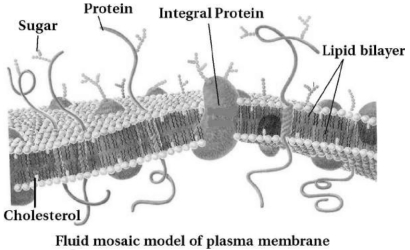
(N/A) The biochemical composition of the plasma membrane includes lipids,proteins,and carbohydrates.
$1$. Lipids: The lipid component mainly consists of phosphoglycerides. These lipid molecules are arranged within the membrane in a bilayer,with the polar hydrophilic heads facing the outer sides (aqueous environment) and the non-polar hydrophobic tails facing the inner part. This arrangement protects the non-polar tails of saturated hydrocarbons from the aqueous environment.
$2$. Proteins: Depending on the ease of extraction,membrane proteins are classified as integral or peripheral. Peripheral proteins lie on the surface of the membrane,while integral proteins are partially or totally buried in the membrane.
$3$. Carbohydrates: These are also present in the membrane,often attached to proteins (glycoproteins) or lipids (glycolipids).
In human erythrocytes,the membrane composition is approximately $52\%$ protein and $40\%$ lipids. According to the fluid mosaic model proposed by Singer and Nicolson $(1972)$,the quasi-fluid nature of lipids enables the lateral movement of proteins within the overall bilayer,which is referred to as membrane fluidity.
$1$. Lipids: The lipid component mainly consists of phosphoglycerides. These lipid molecules are arranged within the membrane in a bilayer,with the polar hydrophilic heads facing the outer sides (aqueous environment) and the non-polar hydrophobic tails facing the inner part. This arrangement protects the non-polar tails of saturated hydrocarbons from the aqueous environment.
$2$. Proteins: Depending on the ease of extraction,membrane proteins are classified as integral or peripheral. Peripheral proteins lie on the surface of the membrane,while integral proteins are partially or totally buried in the membrane.
$3$. Carbohydrates: These are also present in the membrane,often attached to proteins (glycoproteins) or lipids (glycolipids).
In human erythrocytes,the membrane composition is approximately $52\%$ protein and $40\%$ lipids. According to the fluid mosaic model proposed by Singer and Nicolson $(1972)$,the quasi-fluid nature of lipids enables the lateral movement of proteins within the overall bilayer,which is referred to as membrane fluidity.
0 likes
View Solution187
Medium
Structure and function are correlatable in living organisms. Can you justify this by taking the plasma membrane as an example?
Solution
(N/A) $\Rightarrow$ The structure and function of the plasma membrane are closely related. The membrane consists of a lipid bilayer,proteins,and carbohydrates.
$\Rightarrow$ Integral proteins act as channels or carriers for the transport of ions and molecules across the membrane. For example,in active transport,proteins function as carriers to move minerals against the concentration gradient.
$\Rightarrow$ Carbohydrates (oligosaccharides) attached to the membrane surface act as recognition sites for cell-to-cell signaling and identification,preventing the entry of unwanted external substances.
$\Rightarrow$ The amphipathic nature of phospholipids,with polar hydrophilic heads facing the aqueous environment and non-polar hydrophobic tails facing inward,creates a stable barrier that allows for the selective permeability and fluidity of the membrane.
$\Rightarrow$ Integral proteins act as channels or carriers for the transport of ions and molecules across the membrane. For example,in active transport,proteins function as carriers to move minerals against the concentration gradient.
$\Rightarrow$ Carbohydrates (oligosaccharides) attached to the membrane surface act as recognition sites for cell-to-cell signaling and identification,preventing the entry of unwanted external substances.
$\Rightarrow$ The amphipathic nature of phospholipids,with polar hydrophilic heads facing the aqueous environment and non-polar hydrophobic tails facing inward,creates a stable barrier that allows for the selective permeability and fluidity of the membrane.
0 likes
View Solution188
MediumMCQ
How does a gap junction facilitate intercellular communication?
A
By allowing the passage of large macromolecules between cells.
B
By facilitating the transfer of ions,small molecules,and chemical signals between adjacent cells.
C
By physically anchoring cells together to prevent separation.
D
By sealing the space between cells to prevent leakage.
Solution
(B) $\Rightarrow$ Gap junctions facilitate the movement of ions,small molecules,and chemical signals between adjacent cells through intercellular channels.
$\Rightarrow$ These are hydrophilic pathways between two animal cells,composed of two protein cylinders called connexons.
$\Rightarrow$ Each connexon consists of six protein subunits that surround a central hydrophilic pore.
$\Rightarrow$ The opening and closing of these pathways are regulated by the $pH$ level and the concentration of $Ca^{+2}$ ions.
$\Rightarrow$ These are hydrophilic pathways between two animal cells,composed of two protein cylinders called connexons.
$\Rightarrow$ Each connexon consists of six protein subunits that surround a central hydrophilic pore.
$\Rightarrow$ The opening and closing of these pathways are regulated by the $pH$ level and the concentration of $Ca^{+2}$ ions.
0 likes
View Solution189
MediumMCQ
How is it that the intracellular levels of $K^+$ are higher than extracellular levels in animal cells?
A
Due to passive diffusion of $K^+$ ions.
B
Due to the action of $Na^+/K^+$-ATPase pump.
C
Due to the presence of high concentration of $Cl^-$ ions outside.
D
Due to the osmotic pressure of the cytoplasm.
Solution
(B) The intracellular concentration of $K^+$ is maintained higher than the extracellular concentration primarily through the action of the $Na^+/K^+$-ATPase pump.
This pump actively transports $3$ $Na^+$ ions out of the cell for every $2$ $K^+$ ions it brings into the cell,utilizing energy from $ATP$ hydrolysis.
Because more positive charges $(Na^+)$ are pumped out than are brought in $(K^+)$,the interior of the cell becomes negatively charged relative to the exterior.
This electrochemical gradient,combined with the continuous activity of the pump,ensures that $K^+$ ions accumulate inside the cell at higher concentrations than in the extracellular fluid.
This pump actively transports $3$ $Na^+$ ions out of the cell for every $2$ $K^+$ ions it brings into the cell,utilizing energy from $ATP$ hydrolysis.
Because more positive charges $(Na^+)$ are pumped out than are brought in $(K^+)$,the interior of the cell becomes negatively charged relative to the exterior.
This electrochemical gradient,combined with the continuous activity of the pump,ensures that $K^+$ ions accumulate inside the cell at higher concentrations than in the extracellular fluid.
0 likes
View Solution190
Medium
Cut pieces of beetroot do not leave the colour in cold water but do so in hot water. Explain.
Solution
(N/A) The cell membrane of beetroot cells acts as a semi-permeable barrier that prevents the leakage of pigments (betalains) at room temperature.
When placed in cold water,the membrane remains intact and the pigments stay within the cells.
However,when placed in hot water,the high temperature causes the denaturation of membrane proteins and increases the fluidity of the lipid bilayer.
This leads to the disruption of the cell membrane,making it permeable,which allows the red pigments to diffuse out of the cells into the surrounding water.
When placed in cold water,the membrane remains intact and the pigments stay within the cells.
However,when placed in hot water,the high temperature causes the denaturation of membrane proteins and increases the fluidity of the lipid bilayer.
This leads to the disruption of the cell membrane,making it permeable,which allows the red pigments to diffuse out of the cells into the surrounding water.
0 likes
View Solution191
MediumMCQ
Which of these is a Semipermeable Membrane $(SP)$ and which is Selectively Permeable $(SL)$? : Plasmalemma
A
Semipermeable Membrane $(SP)$
B
Selectively Permeable $(SL)$
C
Impermeable Membrane
D
Freely Permeable Membrane
Solution
(B) The plasmalemma (cell membrane) is a selectively permeable membrane.
It allows the passage of certain molecules and ions while restricting others based on the cell's requirements.
Therefore,the correct classification for the plasmalemma is Selectively Permeable $(SL)$.
It allows the passage of certain molecules and ions while restricting others based on the cell's requirements.
Therefore,the correct classification for the plasmalemma is Selectively Permeable $(SL)$.
0 likes
View Solution192
MediumMCQ
Smaller,lipid-soluble molecules diffuse faster through the cell membrane,but the movement of hydrophilic substances is facilitated by certain transporters which are chemically $.......$
A
$A$. Carbohydrates
B
$B$. Proteins
C
$C$. Lipids
D
$D$. Nucleic acids
Solution
(B) $\Rightarrow$ The correct answer is $B$. Proteins.
Substances that have a hydrophilic moiety find it difficult to pass through the lipid bilayer of the cell membrane.
Their movement across the membrane is facilitated by specific membrane proteins,which act as transporters or channels.
Substances that have a hydrophilic moiety find it difficult to pass through the lipid bilayer of the cell membrane.
Their movement across the membrane is facilitated by specific membrane proteins,which act as transporters or channels.
0 likes
View Solution193
MediumMCQ
The fluidity of membranes in a plant in cold weather may be maintained by
A
increasing the number of phospholipids with unsaturated hydrocarbon tails.
B
increasing the proportion of integral proteins.
C
increasing concentration of cholesterol in membrane.
D
increasing the number of phospholipids with saturated hydrocarbon tails.
Solution
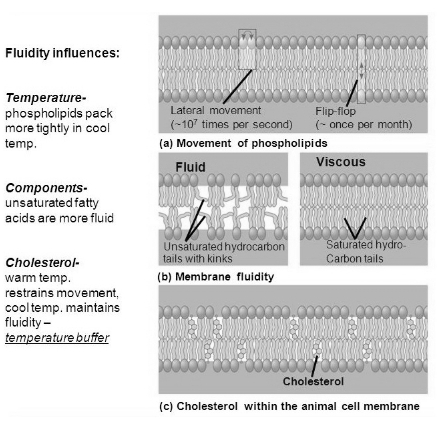
(A) Membrane fluidity refers to the ability of lipids and proteins to move laterally within the bilayer.
In cold weather,phospholipids tend to pack more tightly,which decreases fluidity.
Plants adapt to cold temperatures by increasing the proportion of unsaturated fatty acids in their membrane phospholipids.
The 'kinks' in the unsaturated hydrocarbon tails prevent the phospholipids from packing too tightly,thereby maintaining membrane fluidity.
Cholesterol,which acts as a temperature buffer,is primarily found in animal cell membranes,not plant cell membranes.
In cold weather,phospholipids tend to pack more tightly,which decreases fluidity.
Plants adapt to cold temperatures by increasing the proportion of unsaturated fatty acids in their membrane phospholipids.
The 'kinks' in the unsaturated hydrocarbon tails prevent the phospholipids from packing too tightly,thereby maintaining membrane fluidity.
Cholesterol,which acts as a temperature buffer,is primarily found in animal cell membranes,not plant cell membranes.
0 likes
View Solution194
MediumMCQ
The diagram given below represents a fluid mosaic model of the plasma membrane. Match the components marked as $A, B, C, D$ and $E$ in the diagram below from the list $(i)$ to $(vii)$.
$(i)$ Sugar $(ii)$ Protein $(iii)$ Lipid bilayer $(iv)$ Integral protein $(v)$ Cytoplasm $(vi)$ Cell wall $(vii)$ External protein
$(i)$ Sugar $(ii)$ Protein $(iii)$ Lipid bilayer $(iv)$ Integral protein $(v)$ Cytoplasm $(vi)$ Cell wall $(vii)$ External protein
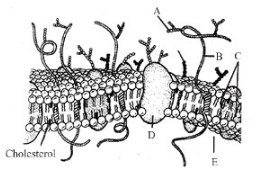
A
$A-(i), B-(ii), C-(iii), D-(iv), E-(v)$
B
$A-(ii), B-(i), C-(iii), D-(iv), E-(v)$
C
$A-(i), B-(ii), C-(iii), D-(iv), E-(vi)$
D
$A-(i), B-(ii), C-(iii), D-(vii), E-(v)$
Solution
(A) The given diagram shows the fluid mosaic model of the cell membrane.
In the diagram,the components marked as $A, B, C, D$ and $E$ are respectively:
$A$ - Sugar (oligosaccharide chain),
$B$ - Protein (peripheral protein),
$C$ - Lipid bilayer,
$D$ - Integral protein,
$E$ - Cytoplasm.
The fluid mosaic model was proposed by $SJ$ Singer and $GL$ Nicolson in $1972$. It describes the cell membrane as a two-dimensional liquid in which phospholipid and protein molecules can diffuse easily.
In the diagram,the components marked as $A, B, C, D$ and $E$ are respectively:
$A$ - Sugar (oligosaccharide chain),
$B$ - Protein (peripheral protein),
$C$ - Lipid bilayer,
$D$ - Integral protein,
$E$ - Cytoplasm.
The fluid mosaic model was proposed by $SJ$ Singer and $GL$ Nicolson in $1972$. It describes the cell membrane as a two-dimensional liquid in which phospholipid and protein molecules can diffuse easily.
0 likes
View Solution195
EasyMCQ
Which function is carried out by the cell organelle '$X$'?
A
helps control the movement of substances in and out of the cell
B
passes information from the parent cell to newly formed cells
C
maintains the proper shape of the cell and serves as a protective barrier
D
helps the cell to make food with the help of chlorophyll and sunlight
Solution
(A) The cell membrane (marked as $X$) helps control the entry and exit of substances into the cell.
Nucleus passes the genetic information from the parent cell to the new cell; it is also called the control center of the cell.
$A$ cell wall is the tough,rigid layer present outside the plant cell,which provides structural support and protection.
Chloroplasts occur in plant cells and contain chlorophyll,which helps the cell in synthesizing food through photosynthesis.
Nucleus passes the genetic information from the parent cell to the new cell; it is also called the control center of the cell.
$A$ cell wall is the tough,rigid layer present outside the plant cell,which provides structural support and protection.
Chloroplasts occur in plant cells and contain chlorophyll,which helps the cell in synthesizing food through photosynthesis.
0 likes
View Solution196
MediumMCQ
Integral proteins of the cell membrane occur on/in
A
inner surfaces
B
outer surfaces
C
phospholipid matrix
D
inner and outer surfaces
Solution
(C) Integral proteins (also known as intrinsic proteins) are embedded within the lipid bilayer of the cell membrane.
They can be partially or totally buried in the phospholipid matrix.
Some of these proteins,known as transmembrane proteins,span the entire thickness of the membrane.
They can be partially or totally buried in the phospholipid matrix.
Some of these proteins,known as transmembrane proteins,span the entire thickness of the membrane.
0 likes
View Solution197
MediumMCQ
Active transport across a biomembrane involves
A
production of $ATP$
B
requirement of energy
C
production of toxin
D
release of energy
Solution
(B) Active transport is an energy-dependent process in which $ATP$ is utilized to move molecules against their concentration gradient.
For example,the $Na^+/K^+$ pump uses energy to maintain ion gradients across the cell membrane.
For example,the $Na^+/K^+$ pump uses energy to maintain ion gradients across the cell membrane.
0 likes
View Solution198
MediumMCQ
The membrane of the erythrocytes has approximately . . . . . . $\%$ of proteins and . . . . . . $\%$ lipids.
A
$42, 50$
B
$52, 40$
C
$50, 50$
D
$60, 40$
Solution
(B) The ratio of proteins and lipids varies considerably in different cell types.
In the human erythrocyte membrane, the composition is approximately $52 \%$ proteins and $40 \%$ lipids.
The remaining percentage consists of carbohydrates and other components.
In the human erythrocyte membrane, the composition is approximately $52 \%$ proteins and $40 \%$ lipids.
The remaining percentage consists of carbohydrates and other components.
0 likes
View SolutionCell: The Unit of Life — Cell membrane · Frequently Asked Questions
1Are these Cell: The Unit of Life questions useful for JEE and NEET?
Yes. All questions in this section are mapped to JEE Main and NEET exam patterns. Previous year questions from JEE Main, NEET, GUJCET and state-level exams are included with full solutions.
2Can I switch to Hindi or Gujarati for these questions?
Yes. Use the language tabs in the hero section or the sidebar to view the same questions and solutions in English, Hindi or Gujarati.
3How do I generate a question paper from this subtopic?
Use the Vedclass Exam Paper Generator — select the chapter and subtopic, set difficulty, and generate Sets A, B, C, D automatically. First 3 chapters of every subject are free.
Vedclass Products
For Students
Vedclass Test Series
Mock tests in real JEE/NEET style with performance analysis. 5-day free trial.
Start Free TrialFor Teachers
Exam Paper Generator
Generate Set A/B/C/D papers from this chapter in 2 minutes. 3 chapters free.
Try FreeFor Institutes
Online Exam Module
Live online exams with unlimited students, 360° analytics & white-label branding.
See DemoFor Teachers & Institutes
Generate a Cell: The Unit of Life Exam Paper in 2 Minutes
Select subtopic & difficulty — Sets A, B, C, D auto-generated with No Repeat logic.
First 3 chapters of every subject are free — no payment required.