
A English
Mix Examples-Cell Cycle and Cell Division Questions in English
Class 11 Biology · Cell Cycle and Cell Division · Mix Examples-Cell Cycle and Cell Division
190+
Questions
English
Language
100%
With Solutions
Showing 50 of 190 questions in English
101
MediumMCQ
During which phase$(s)$ of the cell cycle does the amount of $DNA$ in a cell remain at the $4C$ level,if the initial amount is denoted as $2C$?
A
$G_0$ and $G_1$
B
$G_1$ and $S$
C
Only $G_2$
D
$G_2$ and $M$
Solution
(D) The cell cycle consists of $G_1$,$S$,$G_2$,and $M$ phases.
In the $G_1$ phase,the $DNA$ content is $2C$.
During the $S$ phase,$DNA$ replication occurs,causing the $DNA$ content to increase from $2C$ to $4C$.
In the $G_2$ phase,the cell prepares for division,and the $DNA$ content remains at $4C$.
During the $M$ phase (mitosis),the $DNA$ is distributed into two daughter cells,returning the content to $2C$ in each cell.
Therefore,the $DNA$ amount remains at the $4C$ level throughout the $G_2$ phase and the early stages of the $M$ phase (prophase and metaphase) before the chromatids separate.
In the $G_1$ phase,the $DNA$ content is $2C$.
During the $S$ phase,$DNA$ replication occurs,causing the $DNA$ content to increase from $2C$ to $4C$.
In the $G_2$ phase,the cell prepares for division,and the $DNA$ content remains at $4C$.
During the $M$ phase (mitosis),the $DNA$ is distributed into two daughter cells,returning the content to $2C$ in each cell.
Therefore,the $DNA$ amount remains at the $4C$ level throughout the $G_2$ phase and the early stages of the $M$ phase (prophase and metaphase) before the chromatids separate.
0 likes
View Solution102
MediumMCQ
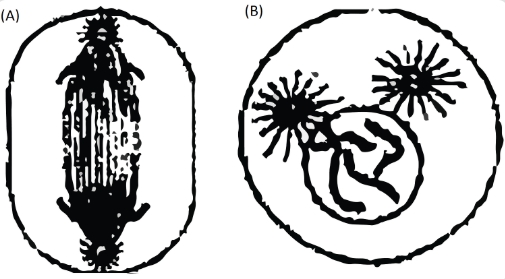
Which stages of cell division do the following figures $A$ and $B$ represent respectively?
| Option | Figure $A$ | Figure $B$ |
|---|---|---|
| $(a)$ | Metaphase | Telophase |
| $(b)$ | Telophase | Metaphase |
| $(c)$ | Late anaphase | Prophase |
| $(d)$ | Prophase | Anaphase |
A
$(a)$
B
$(b)$
C
$(c)$
D
$(d)$
Solution
(C) In figure $A$,the chromosomes have separated and are moving towards opposite poles,which is characteristic of the late anaphase stage of mitosis.
In figure $B$,the chromosomes are condensing and the nuclear envelope is beginning to disappear,which is characteristic of the prophase stage of mitosis.
Therefore,figure $A$ represents late anaphase and figure $B$ represents prophase. The correct option is $(c)$.
In figure $B$,the chromosomes are condensing and the nuclear envelope is beginning to disappear,which is characteristic of the prophase stage of mitosis.
Therefore,figure $A$ represents late anaphase and figure $B$ represents prophase. The correct option is $(c)$.
0 likes
View Solution103
MediumMCQ
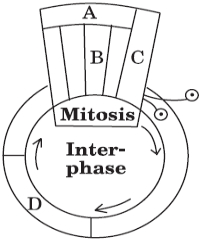
Given below is a schematic representation of the phases/stages of the cell cycle. Which one of the following is the correct indication of the stage/phase in the cell cycle?
A
$C$ - Cytokinesis
B
$D$ - Synthetic phase ($S$ phase)
C
$A$ - Prophase
D
$B$ - Metaphase
Solution
(B) The cell cycle is divided into two main phases: Interphase and $M$-phase (Mitosis).
Interphase consists of three stages: $G_1$ phase,$S$ phase (Synthetic phase),and $G_2$ phase.
In the provided diagram,$D$ represents the $S$ phase (Synthetic phase) within the Interphase.
Mitosis is further divided into Prophase $(A)$,Metaphase $(B)$,Anaphase,and Telophase ($C$ represents Cytokinesis).
Therefore,$D$ corresponds to the Synthetic phase.
Interphase consists of three stages: $G_1$ phase,$S$ phase (Synthetic phase),and $G_2$ phase.
In the provided diagram,$D$ represents the $S$ phase (Synthetic phase) within the Interphase.
Mitosis is further divided into Prophase $(A)$,Metaphase $(B)$,Anaphase,and Telophase ($C$ represents Cytokinesis).
Therefore,$D$ corresponds to the Synthetic phase.
0 likes
View Solution104
MediumMCQ
$A$ cell at the telophase stage is observed by a student in a plant brought from the field. He tells his teacher that this cell is not like other cells at the telophase stage. There is no formation of a cell plate,and thus the cell contains a higher number of chromosomes compared to other dividing cells. This would result in:
A
somaclonal variation
B
polyteny
C
aneuploidy
D
polyploidy
Solution
(D) : Polyploidy is the phenomenon of the occurrence of more than two sets of chromosomes in the nucleus of a cell.
Polyploidy is more common in plants.
It arises as a result of the total non-disjunction of chromosomes during mitosis or meiosis,where the cell fails to divide after the replication of chromosomes,leading to an increase in the ploidy level.
Polyploidy is more common in plants.
It arises as a result of the total non-disjunction of chromosomes during mitosis or meiosis,where the cell fails to divide after the replication of chromosomes,leading to an increase in the ploidy level.
0 likes
View Solution105
MediumMCQ
Match the following:
| Column-$I$ | Column-$II$ |
| $A$. $G_2$-phase | $1$. First phase of prophase-$I$ |
| $B$. Anaphase | $2$. Proteins are synthesized in preparation for mitosis |
| $C$. Leptotene | $3$. Terminalisation of chiasmata |
| $D$. Diakinesis | $4$. Centromeres split and chromatids separate |
A
$A-1, B-2, C-3, D-4$
B
$A-2, B-4, C-1, D-3$
C
$A-3, B-1, C-2, D-4$
D
$A-4, B-3, C-2, D-1$
Solution
(B) . $G_2$-phase: During this phase,proteins and $RNA$ are synthesized in preparation for mitosis $(A-2)$.
$B$. Anaphase: During this stage,centromeres split and sister chromatids separate,moving towards opposite poles $(B-4)$.
$C$. Leptotene: This is the first stage of prophase-$I$ of meiosis,where chromosomes become visible $(C-1)$.
$D$. Diakinesis: This is the final stage of prophase-$I$,characterized by the terminalisation of chiasmata $(D-3)$.
Therefore,the correct matching is $A-2, B-4, C-1, D-3$.
$B$. Anaphase: During this stage,centromeres split and sister chromatids separate,moving towards opposite poles $(B-4)$.
$C$. Leptotene: This is the first stage of prophase-$I$ of meiosis,where chromosomes become visible $(C-1)$.
$D$. Diakinesis: This is the final stage of prophase-$I$,characterized by the terminalisation of chiasmata $(D-3)$.
Therefore,the correct matching is $A-2, B-4, C-1, D-3$.
0 likes
View Solution106
MediumMCQ
Identify the odd one out:
A
Leptotene
B
Zygotene
C
Pachytene
D
$G_1$ phase
Solution
(D) $Leptotene$,$Zygotene$,and $Pachytene$ are all sub-stages of $Prophase-I$ during $Meiosis$.
$G_1$ phase is a stage of $Interphase$ in the $Cell Cycle$ (mitosis or meiosis).
Therefore,$G_1$ phase is the odd one out as it does not belong to the stages of $Meiosis-I$.
$G_1$ phase is a stage of $Interphase$ in the $Cell Cycle$ (mitosis or meiosis).
Therefore,$G_1$ phase is the odd one out as it does not belong to the stages of $Meiosis-I$.
0 likes
View Solution107
EasyMCQ
Choose the correct sequence of two main events in mitosis.
A
Karyokinesis followed by cytokinesis
B
Cytokinesis followed by karyokinesis
C
Karyokinesis followed by separation of the daughter cells
D
Cytokinesis followed by separation of the daughter cells
Solution
(A) Mitosis is the process of cell division in which a single cell divides into two identical daughter cells.
It consists of two main stages:
$1$. $Karyokinesis$: This is the division of the nucleus,which involves the separation of replicated chromosomes into two new nuclei.
$2$. $Cytokinesis$: This is the division of the cytoplasm,which follows $Karyokinesis$ and results in the physical separation of the cell into two distinct daughter cells.
Therefore,the correct sequence is $Karyokinesis$ followed by $Cytokinesis$.
It consists of two main stages:
$1$. $Karyokinesis$: This is the division of the nucleus,which involves the separation of replicated chromosomes into two new nuclei.
$2$. $Cytokinesis$: This is the division of the cytoplasm,which follows $Karyokinesis$ and results in the physical separation of the cell into two distinct daughter cells.
Therefore,the correct sequence is $Karyokinesis$ followed by $Cytokinesis$.
0 likes
View Solution108
EasyMCQ
Which of the following does not occur during interphase?
A
Cell growth
B
$DNA$ replication
C
Centromere splits
D
Protein synthesis
Solution
(C) Interphase is the phase of the cell cycle where the cell prepares for division. It consists of three sub-phases: $G_1$ phase,$S$ phase,and $G_2$ phase.
$1$. $G_1$ phase: Cell growth and protein synthesis occur.
$2$. $S$ phase: $DNA$ replication occurs.
$3$. $G_2$ phase: Further growth and preparation for mitosis occur.
Centromere splitting is a characteristic event of the Anaphase stage of Mitosis,not Interphase.
$1$. $G_1$ phase: Cell growth and protein synthesis occur.
$2$. $S$ phase: $DNA$ replication occurs.
$3$. $G_2$ phase: Further growth and preparation for mitosis occur.
Centromere splitting is a characteristic event of the Anaphase stage of Mitosis,not Interphase.
0 likes
View Solution109
MediumMCQ
Choose the incorrect statement.
A
Diakinesis is marked by the terminalization of chiasmata.
B
In oocytes of some vertebrates,diplotene can last for months or years.
C
In animal cells,cytokinesis starts in the center of the cell and grows outward.
D
Prophase-$I$ is further divided into five phases based on chromosomal behavior.
Solution
(C) The incorrect statement is $C$. In animal cells,cytokinesis occurs by the formation of a cleavage furrow in the plasma membrane,which starts at the periphery and moves inward toward the center of the cell.
Option $A$ is correct: Diakinesis is the final stage of meiotic prophase-$I$ where chiasmata terminalize.
Option $B$ is correct: In many vertebrates,oocytes remain arrested in the diplotene stage (dictyotene) for extended periods.
Option $D$ is correct: Prophase-$I$ is subdivided into five stages: leptotene,zygotene,pachytene,diplotene,and diakinesis,based on chromosomal morphology and behavior.
Option $A$ is correct: Diakinesis is the final stage of meiotic prophase-$I$ where chiasmata terminalize.
Option $B$ is correct: In many vertebrates,oocytes remain arrested in the diplotene stage (dictyotene) for extended periods.
Option $D$ is correct: Prophase-$I$ is subdivided into five stages: leptotene,zygotene,pachytene,diplotene,and diakinesis,based on chromosomal morphology and behavior.
0 likes
View Solution110
MediumMCQ
Which of the following statements are correct?
$a -$ Cell cycle duration can vary from organism to organism and also from cell type to cell type.
$b -$ $DNA$ synthesis occurs only in pachytene.
$c - G_1$ phase corresponds to the interval between mitosis and initiation of $DNA$ replication.
$a -$ Cell cycle duration can vary from organism to organism and also from cell type to cell type.
$b -$ $DNA$ synthesis occurs only in pachytene.
$c - G_1$ phase corresponds to the interval between mitosis and initiation of $DNA$ replication.
A
$b$ and $c$
B
$a$ and $c$
C
$a$ and $b$
D
All given
Solution
(B) Statement $a$ is correct: The duration of the cell cycle varies significantly between different organisms and even between different cell types within the same organism.
Statement $b$ is incorrect: $DNA$ synthesis (replication) occurs during the $S$-phase (Synthesis phase) of interphase,not during pachytene (which is a stage of prophase-$I$ in meiosis).
Statement $c$ is correct: The $G_1$ phase (Gap $1$) represents the period between the end of mitosis and the beginning of $DNA$ replication ($S$-phase).
Therefore,statements $a$ and $c$ are correct.
Statement $b$ is incorrect: $DNA$ synthesis (replication) occurs during the $S$-phase (Synthesis phase) of interphase,not during pachytene (which is a stage of prophase-$I$ in meiosis).
Statement $c$ is correct: The $G_1$ phase (Gap $1$) represents the period between the end of mitosis and the beginning of $DNA$ replication ($S$-phase).
Therefore,statements $a$ and $c$ are correct.
0 likes
View Solution111
MediumMCQ
$A$ bacterium divides every $35$ minutes. If a culture containing $10^5$ cells per $ml$ is grown for $175$ minutes,what will be the cell concentration per $ml$ after $175$ minutes?
A
$5 \times 10^5$ cells per $ml$
B
$35 \times 10^5$ cells per $ml$
C
$32 \times 10^5$ cells per $ml$
D
$175 \times 10^5$ cells per $ml$
Solution
(C) The number of generations $(n)$ is calculated by dividing the total time by the time taken for one division.
$n = \frac{\text{Total time}}{\text{Generation time}} = \frac{175 \text{ min}}{35 \text{ min}} = 5$.
The final number of cells $(N_f)$ is calculated using the formula $N_f = N_i \times 2^n$,where $N_i$ is the initial number of cells.
$N_f = 10^5 \times 2^5$.
Since $2^5 = 32$,the final concentration is $N_f = 10^5 \times 32 = 32 \times 10^5$ cells per $ml$.
$n = \frac{\text{Total time}}{\text{Generation time}} = \frac{175 \text{ min}}{35 \text{ min}} = 5$.
The final number of cells $(N_f)$ is calculated using the formula $N_f = N_i \times 2^n$,where $N_i$ is the initial number of cells.
$N_f = 10^5 \times 2^5$.
Since $2^5 = 32$,the final concentration is $N_f = 10^5 \times 32 = 32 \times 10^5$ cells per $ml$.
0 likes
View Solution112
MediumMCQ
Arrange these events of mitosis in their correct sequence:
$a -$ Nuclear envelope assembles around chromosome clusters.
$b -$ Spindle fibers attach to kinetochores of chromosomes.
$c -$ Condensation of chromosomes.
$d -$ Centromeres split and chromatids separate.
$a -$ Nuclear envelope assembles around chromosome clusters.
$b -$ Spindle fibers attach to kinetochores of chromosomes.
$c -$ Condensation of chromosomes.
$d -$ Centromeres split and chromatids separate.
A
$b \rightarrow c \rightarrow a \rightarrow d$
B
$a \rightarrow b \rightarrow d \rightarrow c$
C
$c \rightarrow d \rightarrow b \rightarrow a$
D
$c \rightarrow b \rightarrow d \rightarrow a$
Solution
(D) The correct sequence of events in mitosis is as follows:
$1$. $c -$ Condensation of chromosomes occurs during Prophase.
$2$. $b -$ Spindle fibers attach to kinetochores of chromosomes occurs during Prometaphase.
$3$. $d -$ Centromeres split and chromatids separate occurs during Anaphase.
$4$. $a -$ Nuclear envelope assembles around chromosome clusters occurs during Telophase.
Therefore,the correct sequence is $c \rightarrow b \rightarrow d \rightarrow a$.
$1$. $c -$ Condensation of chromosomes occurs during Prophase.
$2$. $b -$ Spindle fibers attach to kinetochores of chromosomes occurs during Prometaphase.
$3$. $d -$ Centromeres split and chromatids separate occurs during Anaphase.
$4$. $a -$ Nuclear envelope assembles around chromosome clusters occurs during Telophase.
Therefore,the correct sequence is $c \rightarrow b \rightarrow d \rightarrow a$.
0 likes
View Solution113
MediumMCQ
Match the following:
| Column-$I$ | Column-$II$ |
| $(1)$ $G_2$ phase | $(p)$ Quiescent stage |
| $(2)$ Centriole duplicates | $(q)$ Protein are synthesized |
| $(3)$ Cell cycle | $(r)$ $S$ phase |
| $(4)$ Heart cells | $(s)$ Growth and division |
A
$(1-p), (2-q), (3-r), (4-s)$
B
$(1-q), (2-r), (3-s), (4-p)$
C
$(1-r), (2-p), (3-q), (4-s)$
D
$(1-s), (2-p), (3-q), (4-r)$
Solution
(B) The correct matching is as follows:
$(1)$ $G_2$ phase: During the $G_2$ phase,proteins are synthesized in preparation for mitosis,and cell growth continues. Thus,$(1-q)$.
$(2)$ Centriole duplicates: The duplication of centrioles occurs during the $S$ phase (Synthesis phase) of the cell cycle. Thus,$(2-r)$.
$(3)$ Cell cycle: The cell cycle is the series of events involving cell growth and division that leads to the formation of two daughter cells. Thus,$(3-s)$.
$(4)$ Heart cells: Heart cells (cardiac myocytes) in adults do not divide and enter a quiescent stage known as the $G_0$ phase. Thus,$(4-p)$.
Therefore,the correct sequence is $(1-q), (2-r), (3-s), (4-p)$.
$(1)$ $G_2$ phase: During the $G_2$ phase,proteins are synthesized in preparation for mitosis,and cell growth continues. Thus,$(1-q)$.
$(2)$ Centriole duplicates: The duplication of centrioles occurs during the $S$ phase (Synthesis phase) of the cell cycle. Thus,$(2-r)$.
$(3)$ Cell cycle: The cell cycle is the series of events involving cell growth and division that leads to the formation of two daughter cells. Thus,$(3-s)$.
$(4)$ Heart cells: Heart cells (cardiac myocytes) in adults do not divide and enter a quiescent stage known as the $G_0$ phase. Thus,$(4-p)$.
Therefore,the correct sequence is $(1-q), (2-r), (3-s), (4-p)$.
0 likes
View Solution114
MediumMCQ
Match the following.
| Column-$I$ | Column-$II$ |
| $i$. $G_1$ phase | $P$. Production of proteins and microtubules |
| $ii$. $S$ phase | $Q$. Karyokinesis and cytokinesis |
| $iii$. $G_2$ phase | $R$. $1^{st}$ phase of interphase |
| $iv$. $M$ phase | $S$. Synthesis of $DNA$ |
A
$(i-S), (ii-R), (iii-Q), (iv-P)$
B
$(i-R), (ii-S), (iii-P), (iv-Q)$
C
$(i-Q), (ii-S), (iii-P), (iv-R)$
D
$(i-P), (ii-R), (iii-Q), (iv-S)$
Solution
(B) The cell cycle consists of two main phases: Interphase and $M$ phase.
$i$. $G_1$ phase is the $1^{st}$ phase of interphase,where the cell grows and prepares for $DNA$ replication $(i-R)$.
$ii$. $S$ phase is the synthesis phase where $DNA$ replication occurs $(ii-S)$.
$iii$. $G_2$ phase is the second growth phase where proteins and microtubules are synthesized for cell division $(iii-P)$.
$iv$. $M$ phase is the mitotic phase involving Karyokinesis (nuclear division) and Cytokinesis (cytoplasmic division) $(iv-Q)$.
Therefore,the correct match is $(i-R), (ii-S), (iii-P), (iv-Q)$.
$i$. $G_1$ phase is the $1^{st}$ phase of interphase,where the cell grows and prepares for $DNA$ replication $(i-R)$.
$ii$. $S$ phase is the synthesis phase where $DNA$ replication occurs $(ii-S)$.
$iii$. $G_2$ phase is the second growth phase where proteins and microtubules are synthesized for cell division $(iii-P)$.
$iv$. $M$ phase is the mitotic phase involving Karyokinesis (nuclear division) and Cytokinesis (cytoplasmic division) $(iv-Q)$.
Therefore,the correct match is $(i-R), (ii-S), (iii-P), (iv-Q)$.
0 likes
View Solution115
MediumMCQ
$A-$ Genetic material cannot replicate between two meiotic divisions.
$R-$ The second meiotic division is similar to mitosis.
$R-$ The second meiotic division is similar to mitosis.
A
$A$ and $R$ both are correct
B
$A$ and $R$ both are incorrect
C
$A$ is correct and $R$ is incorrect
D
$A$ is incorrect and $R$ is correct
Solution
(A) Assertion $(A)$: During meiosis,there are two successive nuclear divisions,meiosis-$I$ and meiosis-$II$. Between these two divisions,there is a short resting phase called interkinesis. During interkinesis,there is no replication of $DNA$. Thus,the statement is correct.
Reason $(R)$: Meiosis-$II$ is known as equational division because it involves the separation of sister chromatids,similar to the process of mitosis. Thus,the statement is correct.
Since both statements are correct,the correct option is $A$ and $R$ both are correct.
Reason $(R)$: Meiosis-$II$ is known as equational division because it involves the separation of sister chromatids,similar to the process of mitosis. Thus,the statement is correct.
Since both statements are correct,the correct option is $A$ and $R$ both are correct.
0 likes
View Solution116
MediumMCQ
$A$: $DNA$ replication occurs only once in meiosis.
$R$: Exchange of $DNA$ in chromosomes is seen in mitosis.
$R$: Exchange of $DNA$ in chromosomes is seen in mitosis.
A
$A$ is correct and $R$ is incorrect.
B
$A$ and $R$ both are incorrect.
C
$A$ and $R$ both are correct.
D
$A$ is incorrect and $R$ is correct.
Solution
(A) : In meiosis,$DNA$ replication occurs only once during the $S$-phase of interphase,preceding meiosis $I$. This is correct.
$R$: Exchange of $DNA$ segments (crossing over) occurs between non-sister chromatids of homologous chromosomes during the pachytene stage of prophase $I$ in meiosis. It does not occur in mitosis. Therefore,$R$ is incorrect.
$R$: Exchange of $DNA$ segments (crossing over) occurs between non-sister chromatids of homologous chromosomes during the pachytene stage of prophase $I$ in meiosis. It does not occur in mitosis. Therefore,$R$ is incorrect.
0 likes
View Solution117
MediumMCQ
$A-$ In the cell cycle,the division of a cell,$DNA$ replication,and cell growth occur.
$R-$ At the end of meiosis,there are $4$ daughter cells with a new genetic composition.
$R-$ At the end of meiosis,there are $4$ daughter cells with a new genetic composition.
A
$A$ and $R$ both are correct
B
$A$ and $R$ both are incorrect
C
$A$ is correct and $R$ is incorrect
D
$A$ is incorrect and $R$ is correct
Solution
(A) Assertion $(A)$ is correct: The cell cycle is a series of events involving cell growth,$DNA$ replication,and cell division that leads to the production of new cells.
Reason $(R)$ is correct: Meiosis is a reductional division that results in $4$ haploid daughter cells,each genetically distinct from the parent cell and from each other due to crossing over and independent assortment.
Both statements are scientifically accurate descriptions of these biological processes.
Reason $(R)$ is correct: Meiosis is a reductional division that results in $4$ haploid daughter cells,each genetically distinct from the parent cell and from each other due to crossing over and independent assortment.
Both statements are scientifically accurate descriptions of these biological processes.
0 likes
View Solution118
MediumMCQ
What is the number of diploid chromosomes in humans?
A
$46$
B
$4$
C
$18$
D
$12$
Solution
(A) In humans,the somatic cells are diploid $(2n)$,meaning they contain two sets of chromosomes,one inherited from each parent.
Each set consists of $23$ chromosomes.
Therefore,the total number of diploid chromosomes in a human cell is $23 \times 2 = 46$.
This includes $22$ pairs of autosomes and $1$ pair of sex chromosomes.
Each set consists of $23$ chromosomes.
Therefore,the total number of diploid chromosomes in a human cell is $23 \times 2 = 46$.
This includes $22$ pairs of autosomes and $1$ pair of sex chromosomes.
0 likes
View Solution119
MediumMCQ
When radioactive thymine is added to the medium during the synthesis of new $DNA$ in human cells,which of the following chromatids will become radioactive in cells that enter the phase immediately upon contact with radioactive thymine?
A
Heterochromatin
B
Euchromatin
C
Both heterochromatin and euchromatin
D
Neither heterochromatin nor euchromatin,but only the nucleus
Solution
(C) During the $S$-phase of the cell cycle,$DNA$ replication occurs.
$DNA$ is composed of euchromatin (transcriptionally active,loosely packed) and heterochromatin (transcriptionally inactive,tightly packed).
Both types of chromatin undergo replication during the $S$-phase to ensure that the daughter cells receive a complete set of genetic material.
Since radioactive thymine is a precursor for $DNA$ synthesis,it will be incorporated into the newly synthesized $DNA$ strands of both euchromatin and heterochromatin.
Therefore,both types of chromatids will become radioactive.
$DNA$ is composed of euchromatin (transcriptionally active,loosely packed) and heterochromatin (transcriptionally inactive,tightly packed).
Both types of chromatin undergo replication during the $S$-phase to ensure that the daughter cells receive a complete set of genetic material.
Since radioactive thymine is a precursor for $DNA$ synthesis,it will be incorporated into the newly synthesized $DNA$ strands of both euchromatin and heterochromatin.
Therefore,both types of chromatids will become radioactive.
0 likes
View Solution120
MediumMCQ
What is the number of chromatids in a chromosome during metaphase?
A
Two in both mitosis and meiosis.
B
Two in mitosis and one in meiosis.
C
Two in mitosis and four in meiosis.
D
One in mitosis and two in meiosis.
Solution
(A) During the $S$-phase of interphase,$DNA$ replication occurs,resulting in each chromosome consisting of two sister chromatids joined at the centromere.
In mitosis,the chromosomes align at the metaphase plate,and each chromosome still consists of two chromatids.
In meiosis $I$,homologous chromosomes pair up and align at the metaphase plate; each chromosome still consists of two chromatids.
Therefore,in both mitosis and meiosis (specifically metaphase $I$),each chromosome consists of two chromatids.
In mitosis,the chromosomes align at the metaphase plate,and each chromosome still consists of two chromatids.
In meiosis $I$,homologous chromosomes pair up and align at the metaphase plate; each chromosome still consists of two chromatids.
Therefore,in both mitosis and meiosis (specifically metaphase $I$),each chromosome consists of two chromatids.
0 likes
View Solution121
DifficultMCQ
Bacteria divide every $35$ minutes. If a culture containing $10^5$ cells $/ ml$ grows for $175$ minutes,what will be the cell concentration per $ml$ after $175$ minutes?
A
$5 \times 10^5$ cells
B
$35 \times 10^5$ cells
C
$32 \times 10^5$ cells
D
$175 \times 10^5$ cells
Solution
(C) The number of divisions $(n)$ is calculated by dividing the total time by the time taken for one division: $n = 175 / 35 = 5$.
After $n$ divisions,the number of cells is given by the formula $N = N_0 \times 2^n$,where $N_0$ is the initial concentration.
Given $N_0 = 10^5$ cells $/ ml$ and $n = 5$,the final concentration $N = 10^5 \times 2^5$.
Since $2^5 = 32$,the final concentration $N = 10^5 \times 32 = 32 \times 10^5$ cells $/ ml$.
After $n$ divisions,the number of cells is given by the formula $N = N_0 \times 2^n$,where $N_0$ is the initial concentration.
Given $N_0 = 10^5$ cells $/ ml$ and $n = 5$,the final concentration $N = 10^5 \times 2^5$.
Since $2^5 = 32$,the final concentration $N = 10^5 \times 32 = 32 \times 10^5$ cells $/ ml$.
0 likes
View Solution122
MediumMCQ
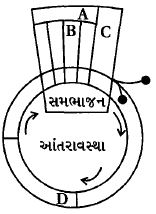
The phases of the cell cycle are given below. Which of the following options correctly identifies the phase represented by the labels?
A
$C$ - Cytokinesis
B
$D$ - Synthesis phase ($S$-phase)
C
$A$ - Karyokinesis
D
$B$ - Mitosis phase ($M$-phase)
Solution
(B) The cell cycle consists of two main phases: Interphase and $M$-phase (Mitosis).
Interphase is divided into $G_1$,$S$,and $G_2$ phases.
In the provided diagram,$D$ represents the $S$-phase (Synthesis phase) where $DNA$ replication occurs.
The $M$-phase consists of Karyokinesis (nuclear division) and Cytokinesis (cytoplasmic division).
In the diagram,the $M$-phase is subdivided into $A$,$B$,and $C$. Based on standard cell cycle diagrams:
$A$ represents Cytokinesis,
$B$ represents Karyokinesis,
$C$ represents the overall Mitosis phase (or specific stages like Prophase/Metaphase/Anaphase/Telophase).
However,looking at the options provided,$D$ correctly corresponds to the $S$-phase (Synthesis phase) within the Interphase.
Interphase is divided into $G_1$,$S$,and $G_2$ phases.
In the provided diagram,$D$ represents the $S$-phase (Synthesis phase) where $DNA$ replication occurs.
The $M$-phase consists of Karyokinesis (nuclear division) and Cytokinesis (cytoplasmic division).
In the diagram,the $M$-phase is subdivided into $A$,$B$,and $C$. Based on standard cell cycle diagrams:
$A$ represents Cytokinesis,
$B$ represents Karyokinesis,
$C$ represents the overall Mitosis phase (or specific stages like Prophase/Metaphase/Anaphase/Telophase).
However,looking at the options provided,$D$ correctly corresponds to the $S$-phase (Synthesis phase) within the Interphase.
0 likes
View Solution123
MediumMCQ
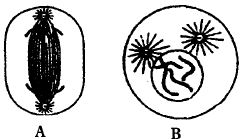
The two figures $A$ and $B$ given below represent which stages of cell division respectively?
A
Metaphase $-$ Anaphase
B
Telophase $-$ Metaphase
C
Anaphase $-$ Prophase
D
Metaphase $-$ Prophase
Solution
(D) In figure $A$,the chromosomes are aligned at the equatorial plate of the cell,which is the characteristic feature of the Metaphase stage of mitosis.
In figure $B$,the chromosomes are condensing within the nucleus,and the centrosomes are moving towards opposite poles,which is the characteristic feature of the Prophase stage of mitosis.
Therefore,figure $A$ represents Metaphase and figure $B$ represents Prophase. The correct option is $D$.
In figure $B$,the chromosomes are condensing within the nucleus,and the centrosomes are moving towards opposite poles,which is the characteristic feature of the Prophase stage of mitosis.
Therefore,figure $A$ represents Metaphase and figure $B$ represents Prophase. The correct option is $D$.
0 likes
View Solution124
MediumMCQ
Which of the following options represents the correct sequence of events during mitosis?
A
Condensation $\rightarrow$ Nuclear membrane reformation $\rightarrow$ Crossing over $\rightarrow$ Segregation $\rightarrow$ Telophase
B
Condensation $\rightarrow$ Nuclear membrane reformation $\rightarrow$ Alignment at equator $\rightarrow$ Splitting of centromere $\rightarrow$ Segregation $\rightarrow$ Telophase
C
Condensation $\rightarrow$ Crossing over $\rightarrow$ Nuclear membrane reformation $\rightarrow$ Segregation $\rightarrow$ Telophase
D
Condensation $\rightarrow$ Alignment at equator $\rightarrow$ Splitting of centromere $\rightarrow$ Segregation
Solution
(D) The correct sequence of events during mitosis is as follows:
$1$. Condensation: Chromatin condenses into compact chromosomes during Prophase.
$2$. Alignment at equator: Chromosomes align at the metaphase plate during Metaphase.
$3$. Splitting of centromere: The centromere of each chromosome splits during Anaphase.
$4$. Segregation: Sister chromatids move towards opposite poles during Anaphase.
$5$. Telophase: Chromosomes reach the poles and the nuclear membrane reforms.
Option $D$ represents the logical progression of the mitotic stages (Prophase $\rightarrow$ Metaphase $\rightarrow$ Anaphase).
$1$. Condensation: Chromatin condenses into compact chromosomes during Prophase.
$2$. Alignment at equator: Chromosomes align at the metaphase plate during Metaphase.
$3$. Splitting of centromere: The centromere of each chromosome splits during Anaphase.
$4$. Segregation: Sister chromatids move towards opposite poles during Anaphase.
$5$. Telophase: Chromosomes reach the poles and the nuclear membrane reforms.
Option $D$ represents the logical progression of the mitotic stages (Prophase $\rightarrow$ Metaphase $\rightarrow$ Anaphase).
0 likes
View Solution125
MediumMCQ
Which chromosome may be lost during cell division?
A
Giant chromosome
B
Acentric chromosome
C
Polycentric chromosome
D
Telocentric chromosome
Solution
(B) An acentric chromosome is a chromosome that lacks a centromere.
Because it lacks a centromere,it cannot attach to the spindle fibers during cell division.
Consequently,it fails to move to the poles during anaphase and is often lost or excluded from the daughter nuclei.
Because it lacks a centromere,it cannot attach to the spindle fibers during cell division.
Consequently,it fails to move to the poles during anaphase and is often lost or excluded from the daughter nuclei.
0 likes
View Solution126
MediumMCQ
Match the description (given in Column $I$) with the correct stage (given in Column $II$) and choose the correct option.
| Column $I$ | Column $II$ |
| $A$. Chromosomes are moved to spindle equator | $I$. Pachytene |
| $B$. Centromere splits and chromatids move apart | $II$. Zygotene |
| $C$. Pairing between homologous chromosomes takes place | $III$. Anaphase |
| $D$. Crossing over between homologous chromosomes | $IV$. Metaphase |
A
$A-I, B-II, C-III, D-IV$
B
$A-II, B-III, C-IV, D-I$
C
$A-IV, B-III, C-II, D-I$
D
$A-III, B-I, C-IV, D-II$
Solution
(C) $A-IV, B-III, C-II, D-I$
$1$. Metaphase $(IV)$: During metaphase, the chromosomes align at the spindle equator.
$2$. Anaphase $(III)$: During anaphase, the centromere splits, and the sister chromatids separate and move toward opposite poles.
$3$. Zygotene $(II)$: During the zygotene stage of prophase $I$, homologous chromosomes undergo pairing, a process known as synapsis.
$4$. Pachytene $(I)$: During the pachytene stage of prophase $I$, crossing over occurs between non-sister chromatids of homologous chromosomes.
$1$. Metaphase $(IV)$: During metaphase, the chromosomes align at the spindle equator.
$2$. Anaphase $(III)$: During anaphase, the centromere splits, and the sister chromatids separate and move toward opposite poles.
$3$. Zygotene $(II)$: During the zygotene stage of prophase $I$, homologous chromosomes undergo pairing, a process known as synapsis.
$4$. Pachytene $(I)$: During the pachytene stage of prophase $I$, crossing over occurs between non-sister chromatids of homologous chromosomes.
0 likes
View Solution127
Medium
Distinguish between cytokinesis and karyokinesis.
Solution
(N/A)
| Cytokinesis | Karyokinesis |
|---|---|
| $(i)$ It is the division of the cytoplasm of a cell. | $(i)$ It is the division of the nucleus of a cell. |
| $(ii)$ It occurs after the completion of nuclear division. | $(ii)$ It occurs before the division of the cytoplasm. |
| $(iii)$ It involves the formation of a cell plate in plants or a cleavage furrow in animals. | $(iii)$ It involves the segregation of chromosomes into two daughter nuclei. |
0 likes
View Solution128
Easy
Name the stage of the cell cycle at which the following events occur:
$(i)$ Chromosomes are moved to the spindle equator
$(ii)$ Centromere splits and chromatids separate
$(iii)$ Pairing between homologous chromosomes takes place
$(iv)$ Crossing over between homologous chromosomes takes place
$(i)$ Chromosomes are moved to the spindle equator
$(ii)$ Centromere splits and chromatids separate
$(iii)$ Pairing between homologous chromosomes takes place
$(iv)$ Crossing over between homologous chromosomes takes place
Solution
(N/A) $(i)$ Metaphase: Chromosomes align at the equatorial plate.
$(ii)$ Anaphase: The centromere of each chromosome splits,allowing sister chromatids to separate and move toward opposite poles.
$(iii)$ Zygotene of meiosis $I$: Homologous chromosomes undergo pairing,a process known as synapsis.
$(iv)$ Pachytene of meiosis $I$: Crossing over occurs between non-sister chromatids of homologous chromosomes.
$(ii)$ Anaphase: The centromere of each chromosome splits,allowing sister chromatids to separate and move toward opposite poles.
$(iii)$ Zygotene of meiosis $I$: Homologous chromosomes undergo pairing,a process known as synapsis.
$(iv)$ Pachytene of meiosis $I$: Crossing over occurs between non-sister chromatids of homologous chromosomes.
0 likes
View Solution129
Medium
Distinguish between the anaphase of mitosis and the anaphase $I$ of meiosis.
Solution
(N/A)
| Anaphase of mitosis | Anaphase $I$ of meiosis |
|---|---|
| Anaphase is the stage during which the centromere splits and the sister chromatids separate. | During anaphase $I$,the homologous chromosomes separate,while the sister chromatids remain attached at their centromeres. |
| The separated chromatids (now daughter chromosomes) move toward the opposite poles. | The homologous chromosomes move toward the opposite poles. |
| These chromosomes are genetically identical to each other. | The chromosomes moving to opposite poles are genetically different due to crossing over. |
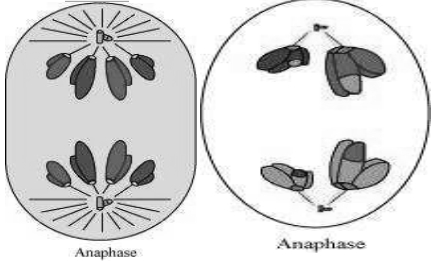
0 likes
View Solution130
Medium
List the main differences between mitosis and meiosis.
Solution
(A)
| Mitosis | Meiosis |
| $(1)$ In mitotic division, a single division results in two daughter cells. | $(1)$ Meiotic division involves two successive divisions - meiosis $I$ and meiosis $II$. These divisions result in four daughter cells. |
| $(2)$ Mitosis is known as equational division. This is because the daughter cells have the same diploid number of chromosomes as the parent. | $(2)$ Meiosis $I$ is known as reductional division because the chromosome number is reduced to half. Meiosis $II$ is known as equational division because the sister chromatids separate and the chromosome number remains the same. |
| $(3)$ Prophase is short and does not comprise any sub-phases. | $(3)$ Prophase $I$ is very long and comprises $5$ phases: leptotene, zygotene, pachytene, diplotene, and diakinesis. |
| $(4)$ There is no pairing of chromosomes, crossing-over, or chiasmata formation. | $(4)$ In the zygotene stage of prophase $I$, the pairing of chromosomes occurs. During pachytene, crossing-over occurs. Chiasmata are formed in the diplotene stage. |
| $(5)$ Synaptonemal complex is not formed. | $(5)$ Synaptonemal complex is formed during the zygotene stage of prophase $I$. |
| $(6)$ Anaphase involves the separation of the chromatids of each chromosome. | $(6)$ During anaphase $I$, homologous chromosomes separate, while chromatids remain attached at their centromeres. During anaphase $II$, chromatids separate due to the splitting of the centromere. |
| $(7)$ Mitosis plays a significant role in the healing, repair, and growth of an organism. | $(7)$ Meiosis brings about genetic variation and maintains the chromosome number across generations. |
1 likes
View Solution131
Medium
Analyse the events during every stage of the cell cycle and notice how the following two parameters change:
$(i)$ Number of chromosomes $(N)$ per cell
$(ii)$ Amount of $DNA$ content $(C)$ per cell
$(i)$ Number of chromosomes $(N)$ per cell
$(ii)$ Amount of $DNA$ content $(C)$ per cell
Solution
(N/A) During the cell cycle,the number of chromosomes $(N)$ and the amount of $DNA$ $(C)$ change depending on the type of division (mitosis or meiosis).
$(i)$ Number of chromosomes $(N)$ per cell:
In mitosis,the number of chromosomes remains constant throughout the cycle because sister chromatids separate but do not change the ploidy. In meiosis $I$,the homologous chromosomes separate,reducing the chromosome number to half $(N/2)$ in the daughter cells.
$(ii)$ Amount of $DNA$ content $(C)$ per cell:
During the $S$ phase of interphase,the $DNA$ content doubles $(2C$ to $4C)$. In mitosis,this $4C$ amount is divided equally between two daughter cells during anaphase,returning to $2C$. In meiosis $II$,the sister chromatids separate,reducing the $DNA$ content to half $(C)$ in each of the four haploid daughter cells.
$(i)$ Number of chromosomes $(N)$ per cell:
In mitosis,the number of chromosomes remains constant throughout the cycle because sister chromatids separate but do not change the ploidy. In meiosis $I$,the homologous chromosomes separate,reducing the chromosome number to half $(N/2)$ in the daughter cells.
$(ii)$ Amount of $DNA$ content $(C)$ per cell:
During the $S$ phase of interphase,the $DNA$ content doubles $(2C$ to $4C)$. In mitosis,this $4C$ amount is divided equally between two daughter cells during anaphase,returning to $2C$. In meiosis $II$,the sister chromatids separate,reducing the $DNA$ content to half $(C)$ in each of the four haploid daughter cells.
0 likes
View Solution132
MediumMCQ
In which phase does $RNA$ and protein synthesis occur?
A
$G_1$ phase
B
$S$ phase
C
$G_2$ phase
D
Both $G_1$ and $G_2$ phases
Solution
(D) During the cell cycle,$RNA$ and protein synthesis occur in both the $G_1$ and $G_2$ phases.
In the $G_1$ phase,the cell prepares for $DNA$ replication by synthesizing necessary enzymes and proteins.
In the $G_2$ phase,the cell continues to grow and synthesizes proteins (such as tubulin for spindle fibers) and $RNA$ required for mitosis.
Therefore,both $G_1$ and $G_2$ phases are characterized by active metabolic processes including $RNA$ and protein synthesis.
In the $G_1$ phase,the cell prepares for $DNA$ replication by synthesizing necessary enzymes and proteins.
In the $G_2$ phase,the cell continues to grow and synthesizes proteins (such as tubulin for spindle fibers) and $RNA$ required for mitosis.
Therefore,both $G_1$ and $G_2$ phases are characterized by active metabolic processes including $RNA$ and protein synthesis.
0 likes
View Solution133
Medium
Differentiate between the Prophase of Mitosis and the Prophase of Meiosis.
Solution
(N/A)
| Prophase of Mitosis | Prophase of Meiosis |
|---|---|
| $(i)$ Short duration compared to the entire cell cycle. | $(i)$ Prophase-$I$ of Meiosis is significantly longer in duration. |
| $(ii)$ It does not have any sub-phases. | $(ii)$ It is divided into five sub-phases: Leptotene,Zygotene,Pachytene,Diplotene,and Diakinesis. |
| $(iii)$ Chromosomes consist of two sister chromatids attached at the centromere. | $(iii)$ Homologous chromosomes pair up to form bivalents or tetrads. |
| $(iv)$ No crossing over or chiasmata formation occurs. | $(iv)$ Crossing over and chiasmata formation are characteristic features. |
0 likes
View Solution134
Medium
$(1)$ Give scientific reason: Meiosis is called reductional division.
$(2)$ Give scientific reason: Mitosis is necessary for growth,development,and repair of the cell.
$(2)$ Give scientific reason: Mitosis is necessary for growth,development,and repair of the cell.
Solution
(N/A) $(1)$ During meiosis,the chromosome number is reduced to half in the daughter cells compared to the parent cell. Therefore,it is known as reductional division. The cells transition from a diploid $(2n)$ state to a haploid $(n)$ state.
$(2)$ The life of a living organism begins from a single-celled zygote. Cell division adds new cells to the body,which is essential for growth and development. Mitosis produces genetically identical daughter cells,which replace damaged or dead cells,thereby facilitating tissue repair and maintenance.
$(2)$ The life of a living organism begins from a single-celled zygote. Cell division adds new cells to the body,which is essential for growth and development. Mitosis produces genetically identical daughter cells,which replace damaged or dead cells,thereby facilitating tissue repair and maintenance.
0 likes
View Solution135
Medium
$(1)$ Definition / Explanation: Mitosis
$(2)$ Definition / Explanation: Meiosis
$(2)$ Definition / Explanation: Meiosis
Solution
(N/A) $(1)$ Mitosis is a type of cell division in which a parent cell divides to produce two identical daughter cells,each having the same number of chromosomes as the parent cell.
$(2)$ Meiosis is a specialized type of cell division that reduces the chromosome number by half,resulting in the production of four haploid daughter cells (gametes),each containing half the number of chromosomes compared to the parent cell.
$(2)$ Meiosis is a specialized type of cell division that reduces the chromosome number by half,resulting in the production of four haploid daughter cells (gametes),each containing half the number of chromosomes compared to the parent cell.
0 likes
View Solution136
Medium
$(1)$ Definition / Explanation: Chiasmata
$(2)$ Definition / Explanation: Syncytium
$(2)$ Definition / Explanation: Syncytium
Solution
(N/A) $(1)$ During the diplotene phase of meiosis-$I$,the homologous chromosomes begin to separate from each other except at the sites of crossovers. These $X$-shaped structures are called chiasmata.
$(2)$ In some organisms,karyokinesis (nuclear division) is not followed by cytokinesis (cytoplasmic division),as a result of which a multinucleate condition arises,leading to the formation of a syncytium.
$(2)$ In some organisms,karyokinesis (nuclear division) is not followed by cytokinesis (cytoplasmic division),as a result of which a multinucleate condition arises,leading to the formation of a syncytium.
0 likes
View Solution137
Medium
$A$ cell has $32$ chromosomes. It undergoes mitotic division. What will be the chromosome number $(n)$ during metaphase? What would be the $DNA$ content $(c)$ during anaphase?
Solution
(A) $\Rightarrow$ In mitosis,the number of chromosomes remains constant throughout the process. Therefore,during metaphase,the chromosome number remains $32$.
$\Rightarrow$ During the $S$ phase of interphase,the $DNA$ content doubles. If the initial $DNA$ content is $2c$,it becomes $4c$ after replication. During anaphase,the sister chromatids separate,but the total $DNA$ content of the cell remains $4c$ until cytokinesis is completed.
$\Rightarrow$ During the $S$ phase of interphase,the $DNA$ content doubles. If the initial $DNA$ content is $2c$,it becomes $4c$ after replication. During anaphase,the sister chromatids separate,but the total $DNA$ content of the cell remains $4c$ until cytokinesis is completed.
0 likes
View Solution138
Medium
While examining the mitotic stage in a tissue,one finds some cells with $16$ chromosomes and some with $32$ chromosomes. What possible reasons could you assign to this difference in chromosome number? Do you think cells with $16$ chromosomes could have arisen from cells with $32$ chromosomes or vice versa?
Solution
(N/A) $\Rightarrow$ The presence of cells with different chromosome numbers ($16$ and $32$) in the same tissue is known as mosaicism. This occurs due to errors during cell division,such as non-disjunction,anaphase lagging,or endoreduplication (inter-replication) during development.
$\Rightarrow$ Yes,cells with $16$ chromosomes could have arisen from cells with $32$ chromosomes through a process like non-disjunction or chromosome loss during mitosis. Conversely,cells with $32$ chromosomes could arise from cells with $16$ chromosomes through endoreduplication,where $DNA$ replicates without subsequent cell division.
$\Rightarrow$ Yes,cells with $16$ chromosomes could have arisen from cells with $32$ chromosomes through a process like non-disjunction or chromosome loss during mitosis. Conversely,cells with $32$ chromosomes could arise from cells with $16$ chromosomes through endoreduplication,where $DNA$ replicates without subsequent cell division.
0 likes
View Solution139
Medium
The following events occur during the various phases of the cell cycle. Name the phase against each of the events.
$(a)$ Disintegration of nuclear membrane .........
$(b)$ Appearance of nucleolus
$(c)$ Division of centromere
$(d)$ Replication of $DNA$
$(a)$ Disintegration of nuclear membrane .........
$(b)$ Appearance of nucleolus
$(c)$ Division of centromere
$(d)$ Replication of $DNA$
Solution
(N/A) Prophase: The nuclear membrane and nucleolus disappear.
$(b)$ Telophase: The nuclear envelope reforms and the nucleolus reappears.
$(c)$ Anaphase: The centromere splits,and chromatids separate.
$(d)$ $S$-phase (Synthesis phase): $DNA$ replication occurs within the nucleus.
$(b)$ Telophase: The nuclear envelope reforms and the nucleolus reappears.
$(c)$ Anaphase: The centromere splits,and chromatids separate.
$(d)$ $S$-phase (Synthesis phase): $DNA$ replication occurs within the nucleus.
0 likes
View Solution140
Difficult
Mitosis results in producing two cells which are similar to each other. What would be the consequence if each of the following irregularities occur during mitosis?
$(a)$ Nuclear membrane fails to disintegrate
$(b)$ Duplication of $DNA$ does not occur
$(c)$ Centromeres do not divide
$(d)$ Cytokinesis does not occur
$(a)$ Nuclear membrane fails to disintegrate
$(b)$ Duplication of $DNA$ does not occur
$(c)$ Centromeres do not divide
$(d)$ Cytokinesis does not occur
Solution
(N/A) If the nuclear membrane fails to disintegrate,spindle fibers cannot interact with the chromosomes to pull them toward opposite poles. In some protozoans,this is a normal process called intranuclear mitosis,but in typical somatic cells,it prevents proper segregation.
$(b)$ If $DNA$ replication does not occur during the $S$-phase,the cell will lack the necessary genetic material to divide. Consequently,the cell cannot enter the $M$-phase,and the cycle arrests.
$(c)$ If centromeres do not divide,the sister chromatids will not separate. One daughter cell will receive both chromatids,while the other will receive none,leading to aneuploidy (such as trisomy or monosomy) in the resulting cells.
$(d)$ If cytokinesis does not occur after nuclear division,the cell will contain multiple nuclei within a single cytoplasm,resulting in a multinucleated condition known as a coenocyte or syncytium,as seen in organisms like $Rhizopus$ and $Vaucheria$.
$(b)$ If $DNA$ replication does not occur during the $S$-phase,the cell will lack the necessary genetic material to divide. Consequently,the cell cannot enter the $M$-phase,and the cycle arrests.
$(c)$ If centromeres do not divide,the sister chromatids will not separate. One daughter cell will receive both chromatids,while the other will receive none,leading to aneuploidy (such as trisomy or monosomy) in the resulting cells.
$(d)$ If cytokinesis does not occur after nuclear division,the cell will contain multiple nuclei within a single cytoplasm,resulting in a multinucleated condition known as a coenocyte or syncytium,as seen in organisms like $Rhizopus$ and $Vaucheria$.
0 likes
View Solution141
Medium
Differentiate between the events of mitosis and meiosis.
Solution
(N/A)
| Mitosis | Meiosis |
|---|---|
| $(1)$ It occurs in somatic cells. | $(1)$ It occurs in germ cells (gamete formation). |
| $(2)$ Two daughter cells are produced at the end. | $(2)$ Four daughter cells are produced at the end. |
| $(3)$ The number of chromosomes in daughter cells is equal to the parent cell. | $(3)$ The number of chromosomes in daughter cells is half that of the parent cell. |
| $(4)$ It is a single-step division process. | $(4)$ It is a complex process involving two successive divisions ($Meiosis-I$ and $Meiosis-II$). |
0 likes
View Solution142
Medium
Write briefly the significance of mitosis and meiosis in multicellular organisms.
Solution
(N/A) $\Rightarrow$ Mitosis (equational division) is essential for the growth of multicellular organisms by producing genetically identical diploid daughter cells.
$\Rightarrow$ It helps in restoring the nucleo-cytoplasmic ratio,which is disturbed during cell growth.
$\Rightarrow$ It plays a crucial role in cell repair and regeneration,such as replacing cells in the epidermis,gut lining,and blood cells.
$\Rightarrow$ In plants,mitotic divisions in meristematic tissues (apical and lateral cambium) ensure continuous growth throughout their life.
$\Rightarrow$ Meiosis is a specialized cell division that reduces the chromosome number by half,resulting in haploid daughter cells.
$\Rightarrow$ It is essential for sexual reproduction as it produces haploid gametes,ensuring the maintenance of the species-specific chromosome number after fertilization.
$\Rightarrow$ Meiosis introduces genetic variation through recombination between homologous chromosomes,which is vital for evolution.
$\Rightarrow$ It involves two sequential nuclear divisions (Meiosis $I$ and $II$) but only one cycle of $DNA$ replication,resulting in four haploid cells.
$\Rightarrow$ It helps in restoring the nucleo-cytoplasmic ratio,which is disturbed during cell growth.
$\Rightarrow$ It plays a crucial role in cell repair and regeneration,such as replacing cells in the epidermis,gut lining,and blood cells.
$\Rightarrow$ In plants,mitotic divisions in meristematic tissues (apical and lateral cambium) ensure continuous growth throughout their life.
$\Rightarrow$ Meiosis is a specialized cell division that reduces the chromosome number by half,resulting in haploid daughter cells.
$\Rightarrow$ It is essential for sexual reproduction as it produces haploid gametes,ensuring the maintenance of the species-specific chromosome number after fertilization.
$\Rightarrow$ Meiosis introduces genetic variation through recombination between homologous chromosomes,which is vital for evolution.
$\Rightarrow$ It involves two sequential nuclear divisions (Meiosis $I$ and $II$) but only one cycle of $DNA$ replication,resulting in four haploid cells.
0 likes
View Solution143
EasyMCQ
Analogy type questions:
$(1)$ Human cells : Divide once in $24$ hours :: Yeast cells : .......
$(2)$ Nuclear division : Karyokinesis :: Cytoplasmic division : .......
$(1)$ Human cells : Divide once in $24$ hours :: Yeast cells : .......
$(2)$ Nuclear division : Karyokinesis :: Cytoplasmic division : .......
A
$(1)$ $90$ minutes,$(2)$ Cytokinesis
B
$(1)$ $60$ minutes,$(2)$ Cytokinesis
C
$(1)$ $90$ minutes,$(2)$ Karyokinesis
D
$(1)$ $30$ minutes,$(2)$ Cytokinesis
Solution
(A) $(1)$ Yeast cells are known to divide once in approximately $90$ minutes under optimal conditions.
$(2)$ Karyokinesis refers to the division of the nucleus,while the division of the cytoplasm is termed as Cytokinesis.
$(2)$ Karyokinesis refers to the division of the nucleus,while the division of the cytoplasm is termed as Cytokinesis.
0 likes
View Solution144
Easy
Analogy type questions:
$(1)$ $S$-phase : $DNA$ synthesis :: $G_0$ phase : ...........
$(2)$ Cleavage furrow in animal cells : Periphery to center :: In plant cells : ................
$(1)$ $S$-phase : $DNA$ synthesis :: $G_0$ phase : ...........
$(2)$ Cleavage furrow in animal cells : Periphery to center :: In plant cells : ................
Solution
(A) $(1)$ $G_0$ phase is known as the quiescent stage or inactive stage where cells remain metabolically active but do not proliferate unless called upon to do so.
$(2)$ In animal cells,cytokinesis occurs by the formation of a cleavage furrow that moves from the periphery to the center. In plant cells,cytokinesis occurs by the formation of a cell plate that grows from the center towards the periphery.
$(2)$ In animal cells,cytokinesis occurs by the formation of a cleavage furrow that moves from the periphery to the center. In plant cells,cytokinesis occurs by the formation of a cell plate that grows from the center towards the periphery.
0 likes
View Solution145
Medium
Analogy type question:
$(1)$ Zygotene : Synapsis :: Pachytene : .......
$(2)$ Prophase-$I$ : Diakinesis :: Interval between two successive meiotic divisions : .......
$(1)$ Zygotene : Synapsis :: Pachytene : .......
$(2)$ Prophase-$I$ : Diakinesis :: Interval between two successive meiotic divisions : .......
Solution
(A) $(1)$ During the Zygotene stage of Prophase-$I$,homologous chromosomes pair up,a process known as Synapsis. Similarly,during the Pachytene stage,the phenomenon of Crossing Over occurs between non-sister chromatids of homologous chromosomes.
$(2)$ Diakinesis is the final stage of Prophase-$I$ in meiosis. The interval or phase between two successive meiotic divisions (Meiosis-$I$ and Meiosis-$II$) is known as Interkinesis.
$(2)$ Diakinesis is the final stage of Prophase-$I$ in meiosis. The interval or phase between two successive meiotic divisions (Meiosis-$I$ and Meiosis-$II$) is known as Interkinesis.
0 likes
View Solution146
Medium
Select the correct option:
$(1)$ In animal cells,cytokinesis occurs by cell plate / cell furrow.
$(2)$ Mitosis occurs only in somatic cells / both somatic and germ cells.
$(1)$ In animal cells,cytokinesis occurs by cell plate / cell furrow.
$(2)$ Mitosis occurs only in somatic cells / both somatic and germ cells.
Solution
(A) $(1)$ In animal cells,cytokinesis occurs by the formation of a cell furrow (cleavage furrow) that deepens centripetally.
$(2)$ Mitosis occurs in both somatic cells (for growth and repair) and germ cells (for the proliferation of germinal epithelium) in many organisms.
$(2)$ Mitosis occurs in both somatic cells (for growth and repair) and germ cells (for the proliferation of germinal epithelium) in many organisms.
0 likes
View Solution147
MediumMCQ
Given that the average duplication time of $E. coli$ is $20$ minutes, how much time will two $E. coli$ cells take to become $32$ cells?
A
$60$ minutes
B
$80$ minutes
C
$100$ minutes
D
$120$ minutes
Solution
(B) The number of cells after $n$ divisions is given by the formula: $N = N_0 \times 2^n$, where $N_0$ is the initial number of cells and $N$ is the final number of cells.
Given: $N_0 = 2$, $N = 32$.
Substituting the values: $32 = 2 \times 2^n \Rightarrow 16 = 2^n \Rightarrow 2^4 = 2^n$.
Therefore, $n = 4$ divisions are required.
Since each division takes $20$ minutes, the total time required is: $4 \times 20 = 80$ minutes.
Given: $N_0 = 2$, $N = 32$.
Substituting the values: $32 = 2 \times 2^n \Rightarrow 16 = 2^n \Rightarrow 2^4 = 2^n$.
Therefore, $n = 4$ divisions are required.
Since each division takes $20$ minutes, the total time required is: $4 \times 20 = 80$ minutes.
0 likes
View Solution148
MediumMCQ
What is produced as a result of cell division following $DNA$ replication?
A
Haploidy
B
Diploidy
C
Polyploidy
D
Both $A$ and $B$
Solution
(D) $DNA$ replication is an essential process preceding cell division. During $DNA$ replication,the amount of $DNA$ in the cell doubles. In the subsequent cell division,this $DNA$ is distributed equally into two daughter cells. If the parent cell is diploid $(2n)$,mitosis results in diploid $(2n)$ daughter cells. If meiosis occurs,haploid $(n)$ cells are produced. Therefore,depending on the type of cell division,both haploidy and diploidy can be produced.
0 likes
View Solution149
EasyMCQ
Match the following events that occur in their respective phases of cell cycle and select the correct option:
| Column $I$ | Column $II$ |
| $(a)$ $G_{1}$ phase | $(i)$ Cell grows and organelle duplication |
| $(b)$ $S$ phase | $(ii)$ $DNA$ replication and chromosome duplication |
| $(c)$ $G_{2}$ phase | $(iii)$ Cytoplasmic growth |
| $(d)$ Metaphase in $M$-phase | $(iv)$ Alignment of chromosomes |
A
$(a)-(i), (b)-(ii), (c)-(iii), (d)-(iv)$
B
$(a)-(ii), (b)-(iii), (c)-(iv), (d)-(i)$
C
$(a)-(iii), (b)-(iv), (c)-(i), (d)-(ii)$
D
$(a)-(iv), (b)-(i), (c)-(ii), (d)-(iii)$
Solution
(A) The phases of the cell cycle and their respective events are as follows:
$(a)$ $G_{1}$ phase: During this phase, the cell grows and organelles are duplicated.
$(b)$ $S$ phase: This is the synthesis phase where $DNA$ replication and chromosome duplication occur.
$(c)$ $G_{2}$ phase: During this phase, there is further cytoplasmic growth and preparation for mitosis.
$(d)$ Metaphase in $M$-phase: During metaphase, chromosomes align at the equatorial plate.
Therefore, the correct matching is $(a)-(i), (b)-(ii), (c)-(iii), (d)-(iv)$.
$(a)$ $G_{1}$ phase: During this phase, the cell grows and organelles are duplicated.
$(b)$ $S$ phase: This is the synthesis phase where $DNA$ replication and chromosome duplication occur.
$(c)$ $G_{2}$ phase: During this phase, there is further cytoplasmic growth and preparation for mitosis.
$(d)$ Metaphase in $M$-phase: During metaphase, chromosomes align at the equatorial plate.
Therefore, the correct matching is $(a)-(i), (b)-(ii), (c)-(iii), (d)-(iv)$.
0 likes
View Solution150
MediumMCQ
Cell division occurs in plants and animals respectively as:
A
continuously,only up to a certain age
B
only up to a certain age,continuously
C
continuously,never
D
once,twice
Solution
(A) All cells arise from pre-existing cells by a process of cell division.
Cell division is the phenomenon of the production of daughter cells from a parent cell.
In plants,cell division occurs continuously throughout their lifespan,which allows for indeterminate growth.
In animals,cell division occurs only up to a certain age or stage of development,after which it is restricted to specific tissues for repair and replacement.
Therefore,the correct sequence is continuously in plants and only up to a certain age in animals.
Cell division is the phenomenon of the production of daughter cells from a parent cell.
In plants,cell division occurs continuously throughout their lifespan,which allows for indeterminate growth.
In animals,cell division occurs only up to a certain age or stage of development,after which it is restricted to specific tissues for repair and replacement.
Therefore,the correct sequence is continuously in plants and only up to a certain age in animals.
0 likes
View SolutionCell Cycle and Cell Division — Mix Examples-Cell Cycle and Cell Division · Frequently Asked Questions
1Are these Cell Cycle and Cell Division questions useful for JEE and NEET?
Yes. All questions in this section are mapped to JEE Main and NEET exam patterns. Previous year questions from JEE Main, NEET, GUJCET and state-level exams are included with full solutions.
2Can I switch to Hindi or Gujarati for these questions?
Yes. Use the language tabs in the hero section or the sidebar to view the same questions and solutions in English, Hindi or Gujarati.
3How do I generate a question paper from this subtopic?
Use the Vedclass Exam Paper Generator — select the chapter and subtopic, set difficulty, and generate Sets A, B, C, D automatically. First 3 chapters of every subject are free.
Vedclass Products
For Students
Vedclass Test Series
Mock tests in real JEE/NEET style with performance analysis. 5-day free trial.
Start Free TrialFor Teachers
Exam Paper Generator
Generate Set A/B/C/D papers from this chapter in 2 minutes. 3 chapters free.
Try FreeFor Institutes
Online Exam Module
Live online exams with unlimited students, 360° analytics & white-label branding.
See DemoFor Teachers & Institutes
Generate a Cell Cycle and Cell Division Exam Paper in 2 Minutes
Select subtopic & difficulty — Sets A, B, C, D auto-generated with No Repeat logic.
First 3 chapters of every subject are free — no payment required.