
A English
Mix Examples-Cell Cycle and Cell Division Questions in English
Class 11 Biology · Cell Cycle and Cell Division · Mix Examples-Cell Cycle and Cell Division
190+
Questions
English
Language
100%
With Solutions
Showing 40 of 190 questions in English
151
EasyMCQ
Cell division occurs . . . . . . in plants and . . . . . . in animals.
A
continuously,only up to a certain age
B
only up to a certain age,continuously
C
continuously,never
D
once,twice
Solution
(A) All cells arise from pre-existing cells by a process of cell division. Cell division is the phenomenon of the production of daughter cells from a parent cell. In plants,cell division occurs continuously throughout their lifespan,allowing for indeterminate growth. In contrast,in animals,cell division occurs only up to a certain age,after which it is restricted to replacing lost or damaged cells.
0 likes
View Solution152
EasyMCQ
Which of the following is not a result of cell division?
A
Growth
B
Repair
C
Metabolism
D
Reproduction
Solution
(C) Cell division is a fundamental process that leads to growth,tissue repair,and reproduction in living organisms.
Metabolism,on the other hand,refers to the sum total of all chemical reactions occurring within a cell or organism to maintain life,such as energy production and synthesis of biomolecules.
Therefore,metabolism is not a direct result of cell division.
Metabolism,on the other hand,refers to the sum total of all chemical reactions occurring within a cell or organism to maintain life,such as energy production and synthesis of biomolecules.
Therefore,metabolism is not a direct result of cell division.
0 likes
View Solution153
MediumMCQ
In ...$A$.... phase,there is synthesis of $RNAs$ and proteins that are needed for cell growth and replication of $DNA$. While it is ...$B$... phase,where synthesis of protein occurs that is needed for spindle formation and mitosis to continue.
Identify $A$ and $B$ to complete the given statement.
Identify $A$ and $B$ to complete the given statement.
A
$A - G_{1} ; B - S$
B
$A - G_{2} ; B - S$
C
$A - G_{1} ; B - G_{2}$
D
None of these
Solution
(C) The cell cycle consists of $G_{1}$,$S$,$G_{2}$,and $M$ phases.
$1$. In the $G_{1}$ phase (Gap $1$),the cell grows and synthesizes $RNAs$ and proteins required for $DNA$ replication.
$2$. In the $S$ phase (Synthesis),$DNA$ replication occurs.
$3$. In the $G_{2}$ phase (Gap $2$),the cell synthesizes proteins (such as tubulin) necessary for spindle fiber formation and prepares for mitosis.
Therefore,$A$ is $G_{1}$ phase and $B$ is $G_{2}$ phase.
$1$. In the $G_{1}$ phase (Gap $1$),the cell grows and synthesizes $RNAs$ and proteins required for $DNA$ replication.
$2$. In the $S$ phase (Synthesis),$DNA$ replication occurs.
$3$. In the $G_{2}$ phase (Gap $2$),the cell synthesizes proteins (such as tubulin) necessary for spindle fiber formation and prepares for mitosis.
Therefore,$A$ is $G_{1}$ phase and $B$ is $G_{2}$ phase.
0 likes
View Solution154
MediumMCQ
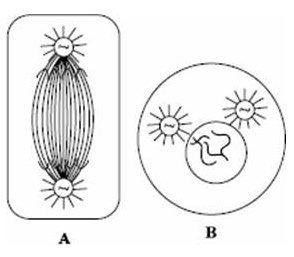
Which stages of cell division do the following figures '$A$' and '$B$' represent respectively?
A
Metaphase - Telophase
B
Telophase - Metaphase
C
Late anaphase - Prophase
D
Prophase - Anaphase
Solution
(C) Figure '$A$' shows chromosomes moving towards opposite poles,which is characteristic of the late anaphase stage of mitosis.
Figure '$B$' shows the condensation of chromatin material into chromosomes and the migration of centrioles towards opposite poles,which is characteristic of the prophase stage of mitosis.
Therefore,the figures represent late anaphase and prophase respectively.
Figure '$B$' shows the condensation of chromatin material into chromosomes and the migration of centrioles towards opposite poles,which is characteristic of the prophase stage of mitosis.
Therefore,the figures represent late anaphase and prophase respectively.
0 likes
View Solution155
MediumMCQ
Select the matched ones.
$I.$ $S$-phase - $DNA$ replication
$II.$ Zygotene - Synapsis
$III.$ Diplotene - Crossing over
$IV.$ Meiosis - Shown by haploid and diploid cells
$V.$ $G_{2}$-phase - Quiescent stage
$I.$ $S$-phase - $DNA$ replication
$II.$ Zygotene - Synapsis
$III.$ Diplotene - Crossing over
$IV.$ Meiosis - Shown by haploid and diploid cells
$V.$ $G_{2}$-phase - Quiescent stage
A
$I$ and $II$ only
B
$III$ and $IV$ only
C
$III$ and $V$ only
D
$I, III$ and $V$ only
Solution
(A) $S$ or synthetic phase is the period during which $DNA$ synthesis or replication takes place. Thus,$I$ is correct.
Zygotene is the second stage of prophase-$I$,where homologous chromosomes pair together,a process known as synapsis. Thus,$II$ is correct.
Crossing over occurs during the pachytene stage of prophase-$I$,not diplotene. Thus,$III$ is incorrect.
Meiosis occurs only in diploid cells,not haploid cells. Thus,$IV$ is incorrect.
$G_{0}$ phase (quiescent stage) is the inactive stage,not $G_{2}$-phase. Thus,$V$ is incorrect.
Therefore,only $I$ and $II$ are correctly matched.
Zygotene is the second stage of prophase-$I$,where homologous chromosomes pair together,a process known as synapsis. Thus,$II$ is correct.
Crossing over occurs during the pachytene stage of prophase-$I$,not diplotene. Thus,$III$ is incorrect.
Meiosis occurs only in diploid cells,not haploid cells. Thus,$IV$ is incorrect.
$G_{0}$ phase (quiescent stage) is the inactive stage,not $G_{2}$-phase. Thus,$V$ is incorrect.
Therefore,only $I$ and $II$ are correctly matched.
0 likes
View Solution156
MediumMCQ
How many chromosomes will the cell have at $G_{1}$,after $S$ and after $M$-phase respectively,if it has $14$ chromosomes at interphase?
A
$14, 14, 7$
B
$14, 14, 14$
C
$7, 7, 7$
D
$7, 14, 14$
Solution
(B) In the cell cycle,the number of chromosomes remains constant during the $G_{1}$ phase,$S$ phase,and $G_{2}$ phase.
During the $S$ phase,the amount of $DNA$ doubles,but the number of chromosomes remains the same because the sister chromatids remain attached at the centromere.
In mitosis ($M$-phase),the sister chromatids separate,but each chromatid is considered a chromosome,so the chromosome number in the daughter cells remains equal to the parent cell.
Therefore,if a cell has $14$ chromosomes at interphase,it will have $14$ chromosomes at $G_{1}$,$14$ chromosomes after the $S$ phase,and $14$ chromosomes after the $M$-phase.
During the $S$ phase,the amount of $DNA$ doubles,but the number of chromosomes remains the same because the sister chromatids remain attached at the centromere.
In mitosis ($M$-phase),the sister chromatids separate,but each chromatid is considered a chromosome,so the chromosome number in the daughter cells remains equal to the parent cell.
Therefore,if a cell has $14$ chromosomes at interphase,it will have $14$ chromosomes at $G_{1}$,$14$ chromosomes after the $S$ phase,and $14$ chromosomes after the $M$-phase.
0 likes
View Solution157
MediumMCQ
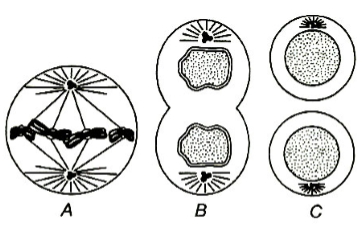
Observe the diagrams carefully and identify the different stages of mitosis $(A-C)$ by choosing the appropriate options given below.
A
$A-$Metaphase; $B-$Telophase; $C-$Interphase
B
$A-$Telophase; $B-$Metaphase; $C-$Prophase
C
$A-$Anaphase; $B-$Telophase; $C-$Interphase
D
$A-$Telophase; $B-$Anaphase; $C-$Prophase
Solution
(A) $A.$ Metaphase: Spindle fibres attach to the kinetochores of chromosomes. Chromosomes are moved to the spindle equator and get aligned along the metaphase plate through spindle fibres of both poles.
$B.$ Telophase: Chromosomes cluster at opposite spindle poles and their identity is lost as discrete elements. The nuclear envelope assembles around the chromosome clusters. The nucleolus,Golgi complex,and $ER$ reform.
$C.$ Interphase: This is the duration which is variable depending on the function of the cell. Just before nuclear division,the $DNA$ of the chromosome replicates,thus it becomes doubled. During this phase,chromosome material is in the form of very loosely coiled threads called chromatin.
$B.$ Telophase: Chromosomes cluster at opposite spindle poles and their identity is lost as discrete elements. The nuclear envelope assembles around the chromosome clusters. The nucleolus,Golgi complex,and $ER$ reform.
$C.$ Interphase: This is the duration which is variable depending on the function of the cell. Just before nuclear division,the $DNA$ of the chromosome replicates,thus it becomes doubled. During this phase,chromosome material is in the form of very loosely coiled threads called chromatin.
0 likes
View Solution158
MediumMCQ
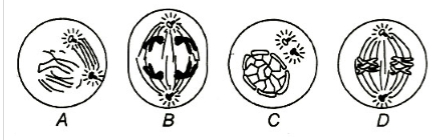
Identify the following figures $(A-D)$ and choose the correct option.
A
$A-$Metaphase-$II$,$B-$Anaphase-$I$,$C-$Prophase-$I$,$D-$Anaphase-$II$
B
$A-$Prophase-$I$,$B-$Anaphase-$I$,$C-$Interphase,$D-$Metaphase-$I$
C
$A-$Metaphase-$I$,$B-$Anaphase-$I$,$C-$Prophase-$I$,$D-$Anaphase-$II$
D
$A-$Prophase-$II$,$B-$Anaphase-$I$,$C-$Interphase,$D-$Metaphase-$II$
Solution
(B) represents Prophase-$I$,where chromosomes are condensing.
$B$ represents Anaphase-$I$,where homologous chromosomes are separating.
$C$ represents Interphase,showing the nucleus with chromatin network.
$D$ represents Metaphase-$I$,where bivalents are aligned at the equatorial plate.
$B$ represents Anaphase-$I$,where homologous chromosomes are separating.
$C$ represents Interphase,showing the nucleus with chromatin network.
$D$ represents Metaphase-$I$,where bivalents are aligned at the equatorial plate.
0 likes
View Solution159
MediumMCQ
Mitosis occurs in
A
Meristematic cells
B
Undifferentiated germ cells
C
Somatic cells
D
More than one option is correct
Solution
(D) Mitosis is the process of equational division that occurs in somatic cells to facilitate growth and repair. It also occurs in undifferentiated germ cells during the early stages of gametogenesis before meiosis begins. In plants,meristematic cells are actively dividing somatic cells that undergo mitosis. Therefore,since mitosis occurs in all these cell types,the correct answer is that more than one option is correct.
0 likes
View Solution160
EasyMCQ
$A$ single cell containing a large number of nuclei is called:
A
Syncytium
B
Cell plate
C
Monad
D
Bivalent
Solution
(A) single cell containing a large number of nuclei is known as a $Syncytium$. This condition arises when karyokinesis (nuclear division) is not followed by cytokinesis (cytoplasmic division). Examples include the liquid endosperm in coconut and certain fungal hyphae.
0 likes
View Solution161
MediumMCQ
Agglutination of chromosomes is caused by a mitotic poison called
A
Mustard gas
B
Ribonuclease
C
Azide
D
Chalones
Solution
(A) Agglutination or clumping of chromosomes is a phenomenon where chromosomes stick together during cell division. This effect is specifically induced by mitotic poisons. Among the given options, $Mustard gas$ is a well-known alkylating agent that acts as a mitotic poison, causing the agglutination of chromosomes.
0 likes
View Solution162
MediumMCQ
Select an incorrect statement with respect to the cell cycle.
A
Duplication of genes occurs twice in meiosis.
B
Karyokinesis occurs twice during meiotic division.
C
Cyclins are proteins that activate protein kinases to regulate the cell cycle.
D
After telophase-$I$,chromosome number is reduced to half.
Solution
(A) The duplication of $DNA$ (genes) occurs only once during the $S$-phase of interphase,regardless of whether the cell undergoes mitosis or meiosis. Therefore,the statement that gene duplication occurs twice in meiosis is incorrect.
0 likes
View Solution163
EasyMCQ
The best stages to study the morphology and shape of a chromosome are respectively:
A
Metaphase,Telophase
B
Prophase,Anaphase
C
Telophase,Anaphase
D
Metaphase,Anaphase
Solution
(D) The morphology of chromosomes is best studied during the $Metaphase$ stage because chromosomes are most condensed and clearly visible at the equatorial plate.
The shape of chromosomes is best studied during the $Anaphase$ stage because the centromere splits and chromatids move towards opposite poles,revealing their characteristic shapes (e.g.,$V, L, J, I$ shapes) based on the position of the centromere.
The shape of chromosomes is best studied during the $Anaphase$ stage because the centromere splits and chromatids move towards opposite poles,revealing their characteristic shapes (e.g.,$V, L, J, I$ shapes) based on the position of the centromere.
0 likes
View Solution164
MediumMCQ
$A$ : Endomitosis does not cause karyokinesis or cytokinesis.
$R$ : In endomitosis,mitosis occurs within the nucleus.
$R$ : In endomitosis,mitosis occurs within the nucleus.
A
Assertion and Reason both are correct and Reason is the correct explanation of Assertion.
B
Assertion and Reason both are correct but Reason is not the correct explanation of Assertion.
C
Assertion is correct,but Reason is incorrect.
D
Both Assertion and Reason are incorrect.
Solution
(C) Endomitosis is a process where the chromosomes replicate without the division of the nucleus $(karyokinesis)$ or the cytoplasm $(cytokinesis)$.
This results in polyploidy,where the cell contains multiple sets of chromosomes.
Since the nuclear envelope does not break down and the cell does not divide,the statement in the Reason $(R)$ that 'mitosis occurs within the nucleus' is factually incorrect as true mitosis involves the breakdown of the nuclear envelope and subsequent division of the nucleus.
Therefore,the Assertion $(A)$ is correct,but the Reason $(R)$ is incorrect.
This results in polyploidy,where the cell contains multiple sets of chromosomes.
Since the nuclear envelope does not break down and the cell does not divide,the statement in the Reason $(R)$ that 'mitosis occurs within the nucleus' is factually incorrect as true mitosis involves the breakdown of the nuclear envelope and subsequent division of the nucleus.
Therefore,the Assertion $(A)$ is correct,but the Reason $(R)$ is incorrect.
0 likes
View Solution165
MediumMCQ
$A$: During anaphase-$II$,chromatids of a chromosome separate.
$R$: Centromere of a mitotic chromosome divides during anaphase.
$R$: Centromere of a mitotic chromosome divides during anaphase.
A
Assertion and Reason both are correct and Reason is the correct explanation of Assertion.
B
Assertion and Reason both are correct but Reason is not the correct explanation of Assertion.
C
Assertion is correct,but Reason is incorrect.
D
Both Assertion and Reason are incorrect.
Solution
(A) In meiosis-$II$,the sister chromatids separate during anaphase-$II$ due to the splitting of the centromere.
Similarly,in mitosis,the centromere splits during anaphase,allowing the sister chromatids to move toward opposite poles.
Both processes are equational divisions where the centromere division is a key event.
Therefore,both the Assertion and the Reason are correct,and the Reason correctly explains the mechanism involved in the Assertion.
Similarly,in mitosis,the centromere splits during anaphase,allowing the sister chromatids to move toward opposite poles.
Both processes are equational divisions where the centromere division is a key event.
Therefore,both the Assertion and the Reason are correct,and the Reason correctly explains the mechanism involved in the Assertion.
0 likes
View Solution166
MediumMCQ
$A$ : Golgi bodies and $ER$ disappear in early prophase.
$R$ : Their reorganisation stage is anaphase.
$R$ : Their reorganisation stage is anaphase.
A
Assertion and Reason both are correct and also correct explanation.
B
Assertion and Reason both are correct but not explanation of assertion.
C
Assertion is correct,but Reason is incorrect.
D
Both Assertion and Reason are incorrect.
Solution
(D) The Assertion is incorrect because Golgi bodies and $ER$ (Endoplasmic Reticulum) do not disappear in early prophase; they typically begin to disappear during late prophase.
The Reason is also incorrect because the reorganisation of Golgi bodies and $ER$ occurs during telophase,not anaphase.
Therefore,both the Assertion and the Reason are incorrect.
The Reason is also incorrect because the reorganisation of Golgi bodies and $ER$ occurs during telophase,not anaphase.
Therefore,both the Assertion and the Reason are incorrect.
0 likes
View Solution167
EasyMCQ
Programmed cell death is scientifically termed as
A
Autotomy
B
Cell lysis
C
Apoptosis
D
None of these
Solution
(C) Apoptosis is an active process of programmed cell death characterized by the cleavage of chromosomal $DNA$,chromatin condensation,and the fragmentation of both the nucleus and the cell.
0 likes
View Solution168
MediumMCQ
Polytene chromosomes in salivary glands are formed as a result of:
A
Endoduplication
B
Duplication without separation
C
Replication of $DNA$ without cell division
D
All of the above
Solution
(D) Polytene chromosomes are giant chromosomes formed by the process of endoreduplication or endomitosis.
In this process,the $DNA$ undergoes repeated rounds of replication without the subsequent division of the cell or the nucleus.
This results in the formation of many parallel chromatids (strands) within a single chromosome,which is why they are called polytene (many-stranded).
Since endoduplication,duplication without separation,and replication of $DNA$ without cell division describe the same phenomenon,all the given options are correct.
In this process,the $DNA$ undergoes repeated rounds of replication without the subsequent division of the cell or the nucleus.
This results in the formation of many parallel chromatids (strands) within a single chromosome,which is why they are called polytene (many-stranded).
Since endoduplication,duplication without separation,and replication of $DNA$ without cell division describe the same phenomenon,all the given options are correct.
0 likes
View Solution169
MediumMCQ
Match List-$I$ with List-$II$.
Choose the correct answer from the options given below.
| List-$I$ | List-$II$ |
| $(a)$ $S$ phase | $(i)$ Proteins are synthesized |
| $(b)$ $G_2$ phase | $(ii)$ Inactive phase |
| $(c)$ Quiescent stage | $(iii)$ Interval between mitosis and initiation of $DNA$ replication |
| $(d)$ $G_1$ phase | $(iv)$ $DNA$ replication |
Choose the correct answer from the options given below.
A
$(iii)-(ii)-(i)-(iv)$
B
$(iv)-(ii)-(iii)-(i)$
C
$(iv)-(i)-(ii)-(iii)$
D
$(ii)-(iv)-(iii)-(i)$
Solution
(C) The correct matching is as follows:
$(a)$ $S$ phase: In this phase, $DNA$ replication occurs. So, $(a)-(iv)$.
$(b)$ $G_2$ phase: In this phase, proteins are synthesized in preparation for mitosis. So, $(b)-(i)$.
$(c)$ Quiescent stage $(G_0)$: Cells in this stage remain metabolically active but do not proliferate unless called upon to do so, often referred to as an inactive phase regarding cell division. So, $(c)-(ii)$.
$(d)$ $G_1$ phase: This is the interval between mitosis and the initiation of $DNA$ replication. So, $(d)-(iii)$.
Therefore, the correct sequence is $(a)-(iv), (b)-(i), (c)-(ii), (d)-(iii)$.
$(a)$ $S$ phase: In this phase, $DNA$ replication occurs. So, $(a)-(iv)$.
$(b)$ $G_2$ phase: In this phase, proteins are synthesized in preparation for mitosis. So, $(b)-(i)$.
$(c)$ Quiescent stage $(G_0)$: Cells in this stage remain metabolically active but do not proliferate unless called upon to do so, often referred to as an inactive phase regarding cell division. So, $(c)-(ii)$.
$(d)$ $G_1$ phase: This is the interval between mitosis and the initiation of $DNA$ replication. So, $(d)-(iii)$.
Therefore, the correct sequence is $(a)-(iv), (b)-(i), (c)-(ii), (d)-(iii)$.
0 likes
View Solution170
MediumMCQ
Which one of the following never occurs during mitotic cell division?
A
Movement of centrioles towards opposite poles
B
Pairing of homologous chromosomes
C
Coiling and condensation of the chromatids
D
Spindle fibres attach to kinetochores of chromosomes
Solution
(B) Mitosis is a type of cell division that results in two daughter cells each having the same number and kind of chromosomes as the parent nucleus.
Pairing of homologous chromosomes,also known as synapsis,is a characteristic feature of Prophase-$I$ of meiosis,not mitosis.
During mitosis,chromosomes behave independently and do not pair up.
Movement of centrioles,coiling/condensation of chromatids,and attachment of spindle fibres to kinetochores are all standard events occurring during the various phases of mitosis (Prophase,Metaphase,etc.).
Therefore,the correct answer is $B$.
Pairing of homologous chromosomes,also known as synapsis,is a characteristic feature of Prophase-$I$ of meiosis,not mitosis.
During mitosis,chromosomes behave independently and do not pair up.
Movement of centrioles,coiling/condensation of chromatids,and attachment of spindle fibres to kinetochores are all standard events occurring during the various phases of mitosis (Prophase,Metaphase,etc.).
Therefore,the correct answer is $B$.
0 likes
View Solution171
MediumMCQ
Karyokinesis $= P$
Cytokinesis $= Q$
Select the correct option for $P$ and $Q$.
$P$ and $Q$ are respectively:
Cytokinesis $= Q$
Select the correct option for $P$ and $Q$.
$P$ and $Q$ are respectively:
A
Interphase,Mitotic phase
B
Mitotic phase,Interphase
C
Nuclear division,Cytoplasmic division
D
Cytoplasmic division,Nuclear division
Solution
(C) The cell cycle is divided into two main phases: Interphase and $M$-phase (Mitotic phase).
The $M$-phase involves two major processes:
$1$. Karyokinesis $(P)$: This refers to the division of the nucleus,where the genetic material is segregated into two daughter nuclei.
$2$. Cytokinesis $(Q)$: This refers to the division of the cytoplasm,which results in the physical separation of the cell into two daughter cells.
Therefore,$P$ is Nuclear division and $Q$ is Cytoplasmic division.
The $M$-phase involves two major processes:
$1$. Karyokinesis $(P)$: This refers to the division of the nucleus,where the genetic material is segregated into two daughter nuclei.
$2$. Cytokinesis $(Q)$: This refers to the division of the cytoplasm,which results in the physical separation of the cell into two daughter cells.
Therefore,$P$ is Nuclear division and $Q$ is Cytoplasmic division.
0 likes
View Solution172
MediumMCQ
Which of the following statements are correct?
$I -$ Mitosis occurs in both haploid and diploid cells.
$II -$ Meiosis occurs in both haploid and diploid cells.
$III -$ Mitosis occurs only in haploid cells.
$IV -$ Mitosis occurs only in diploid cells.
$V -$ Meiosis occurs only in haploid cells.
$VI -$ Meiosis occurs only in diploid cells.
$I -$ Mitosis occurs in both haploid and diploid cells.
$II -$ Meiosis occurs in both haploid and diploid cells.
$III -$ Mitosis occurs only in haploid cells.
$IV -$ Mitosis occurs only in diploid cells.
$V -$ Meiosis occurs only in haploid cells.
$VI -$ Meiosis occurs only in diploid cells.
A
$I, VI$
B
$I, V$
C
$II, III$
D
$II, IV$
Solution
(A) Mitosis is an equational division that occurs in both haploid and diploid cells to maintain the chromosome number.
Meiosis is a reductional division that occurs only in diploid cells (germ cells) to produce haploid gametes,except in certain organisms like haplontic life cycles where meiosis occurs in the zygote (which is diploid) to produce haploid spores.
Therefore,statement $I$ (Mitosis occurs in both haploid and diploid cells) is correct.
Statement $VI$ (Meiosis occurs only in diploid cells) is correct in the context of standard biological processes in multicellular organisms.
Thus,the correct combination is $I$ and $VI$.
Meiosis is a reductional division that occurs only in diploid cells (germ cells) to produce haploid gametes,except in certain organisms like haplontic life cycles where meiosis occurs in the zygote (which is diploid) to produce haploid spores.
Therefore,statement $I$ (Mitosis occurs in both haploid and diploid cells) is correct.
Statement $VI$ (Meiosis occurs only in diploid cells) is correct in the context of standard biological processes in multicellular organisms.
Thus,the correct combination is $I$ and $VI$.
0 likes
View Solution173
MediumMCQ
Choose the correct option for the formation and disappearance of the bipolar spindle in a cell,respectively.
A
Telophase,Prophase
B
Prophase,Telophase
C
Metaphase,Anaphase
D
Anaphase,Metaphase
Solution
(B) In the cell cycle,the process of mitosis involves several stages.
$1$. During $Prophase$,the chromatin condenses into chromosomes,and the mitotic apparatus,specifically the bipolar spindle,begins to form as the centrosomes move to opposite poles.
$2$. During $Telophase$,the chromosomes decondense,the nuclear envelope reforms,and the mitotic spindle apparatus disappears as the cell prepares for cytokinesis.
Therefore,the bipolar spindle forms during $Prophase$ and disappears during $Telophase$.
$1$. During $Prophase$,the chromatin condenses into chromosomes,and the mitotic apparatus,specifically the bipolar spindle,begins to form as the centrosomes move to opposite poles.
$2$. During $Telophase$,the chromosomes decondense,the nuclear envelope reforms,and the mitotic spindle apparatus disappears as the cell prepares for cytokinesis.
Therefore,the bipolar spindle forms during $Prophase$ and disappears during $Telophase$.
0 likes
View Solution174
MediumMCQ
Select the incorrect statement from the following.
A
Karyokinesis is followed by cytokinesis.
B
Cytokinesis is followed by karyokinesis.
C
Cytokinesis always occurs after karyokinesis.
D
Both $B$ and $C$.
Solution
(D) In the cell cycle,the process of division begins with the division of the nucleus,known as $Karyokinesis$.
This is followed by the division of the cytoplasm,known as $Cytokinesis$.
Therefore,$Karyokinesis$ is followed by $Cytokinesis$.
Statement $A$ is correct.
Statement $B$ is incorrect because $Cytokinesis$ does not precede $Karyokinesis$.
Statement $C$ is incorrect because,in some organisms (like certain fungi),$Karyokinesis$ is not followed by $Cytokinesis$,leading to a multinucleated condition (syncytium).
Since both $B$ and $C$ are incorrect,the correct option is $D$.
This is followed by the division of the cytoplasm,known as $Cytokinesis$.
Therefore,$Karyokinesis$ is followed by $Cytokinesis$.
Statement $A$ is correct.
Statement $B$ is incorrect because $Cytokinesis$ does not precede $Karyokinesis$.
Statement $C$ is incorrect because,in some organisms (like certain fungi),$Karyokinesis$ is not followed by $Cytokinesis$,leading to a multinucleated condition (syncytium).
Since both $B$ and $C$ are incorrect,the correct option is $D$.
0 likes
View Solution175
MediumMCQ
For a cell,$n \rightarrow 2n$ $(P)$ and $2n \rightarrow n$ $(Q)$. What are $P$ and $Q$?
A
Meiosis,Fertilization
B
Fertilization,Meiosis
C
Meiosis,Mitosis
D
Mitosis,Meiosis
Solution
(B) In biological cycles,the transition from a haploid state $(n)$ to a diploid state $(2n)$ is achieved through the process of fertilization $(P)$,where two gametes fuse to form a zygote.
Conversely,the transition from a diploid state $(2n)$ to a haploid state $(n)$ is achieved through the process of meiosis $(Q)$,which reduces the chromosome number by half during gamete formation.
Therefore,$P$ is fertilization and $Q$ is meiosis.
Conversely,the transition from a diploid state $(2n)$ to a haploid state $(n)$ is achieved through the process of meiosis $(Q)$,which reduces the chromosome number by half during gamete formation.
Therefore,$P$ is fertilization and $Q$ is meiosis.
0 likes
View Solution176
MediumMCQ
What is the number of chromosomes in human cells during the following phases: Metaphase,Metaphase-$I$,and Metaphase-$II$,respectively?
A
$46, 23, 23$
B
$46, 46, 46$
C
$46, 46, 23$
D
$23, 23, 23$
Solution
(C) In human somatic cells,the diploid number of chromosomes is $2n = 46$.
During Mitotic Metaphase,the chromosomes align at the equator,and the number remains $46$.
During Metaphase-$I$ of meiosis,homologous pairs align at the equator,but the total number of chromosomes in the cell is still $46$ (diploid).
During Metaphase-$II$ of meiosis,the cell has already undergone meiosis-$I$ (reduction division),so each daughter cell contains only $n = 23$ chromosomes.
Therefore,the sequence is $46, 46, 23$.
During Mitotic Metaphase,the chromosomes align at the equator,and the number remains $46$.
During Metaphase-$I$ of meiosis,homologous pairs align at the equator,but the total number of chromosomes in the cell is still $46$ (diploid).
During Metaphase-$II$ of meiosis,the cell has already undergone meiosis-$I$ (reduction division),so each daughter cell contains only $n = 23$ chromosomes.
Therefore,the sequence is $46, 46, 23$.
0 likes
View Solution177
MediumMCQ
What is the number of chromosomes in human cells during the following stages,respectively: Anaphase and Anaphase-$I$?
A
$46, 46$
B
$92, 92$
C
$92, 46$
D
$46, 92$
Solution
(C) In human cells,the diploid number of chromosomes is $2n = 46$.
During $Anaphase$ of mitosis,the centromeres split and sister chromatids separate,moving to opposite poles. This temporarily doubles the number of chromosomes in the cell,resulting in $92$ chromosomes.
During $Anaphase-I$ of meiosis,homologous chromosomes separate,but the centromeres do not split. Therefore,each pole receives half the original number of chromosomes,maintaining the count at $46$ chromosomes per cell.
Thus,the number of chromosomes in $Anaphase$ is $92$ and in $Anaphase-I$ is $46$.
During $Anaphase$ of mitosis,the centromeres split and sister chromatids separate,moving to opposite poles. This temporarily doubles the number of chromosomes in the cell,resulting in $92$ chromosomes.
During $Anaphase-I$ of meiosis,homologous chromosomes separate,but the centromeres do not split. Therefore,each pole receives half the original number of chromosomes,maintaining the count at $46$ chromosomes per cell.
Thus,the number of chromosomes in $Anaphase$ is $92$ and in $Anaphase-I$ is $46$.
0 likes
View Solution178
EasyMCQ
Which element is required for the formation of the bipolar spindle during cell division?
A
Chlorine
B
Manganese
C
Calcium
D
Iron
Solution
(C) Calcium $(Ca^{2+})$ is essential for the formation of the mitotic spindle during cell division. It plays a crucial role in the organization of microtubules and the stability of the spindle apparatus. Additionally,it is involved in the formation of the middle lamella during cell wall formation.
0 likes
View Solution179
MediumMCQ
Match List $I$ with List $II$:
Choose the correct answer from the options given below:
| List $I$ | List $II$ |
| $A$. $M$ Phase | $I$. Proteins are synthesized |
| $B$. $G_2$ Phase | $II$. Inactive phase |
| $C$. Quiescent stage $(G_0)$ | $III$. Interval between mitosis and initiation of $DNA$ replication |
| $D$. $G_1$ Phase | $IV$. Equational division |
Choose the correct answer from the options given below:
A
$A-II, B-IV, C-I, D-III$
B
$A-III, B-II, C-IV, D-I$
C
$A-IV, B-I, C-II, D-III$
D
$A-IV, B-I, C-II, D-III$
Solution
(C) $M$ phase (Mitosis) is the phase where actual cell division occurs, often called equational division $(A-IV)$.
During $G_2$ phase, the cell synthesizes proteins and $RNA$ required for mitosis $(B-I)$.
Quiescent stage $(G_0)$ is the inactive phase where cells that do not divide further enter $(C-II)$.
$G_1$ phase is the interval between mitosis and the initiation of $DNA$ replication $(D-III)$.
Therefore, the correct matching is $A-IV, B-I, C-II, D-III$.
During $G_2$ phase, the cell synthesizes proteins and $RNA$ required for mitosis $(B-I)$.
Quiescent stage $(G_0)$ is the inactive phase where cells that do not divide further enter $(C-II)$.
$G_1$ phase is the interval between mitosis and the initiation of $DNA$ replication $(D-III)$.
Therefore, the correct matching is $A-IV, B-I, C-II, D-III$.
0 likes
View Solution180
MediumMCQ
Given below are two statements:
Statement $I$: During $G_0$ phase of cell cycle,the cell is metabolically inactive.
Statement $II$: The centrosome undergoes duplication during $S$ phase of interphase.
In the light of the above statements,choose the most appropriate answer from the options given below:
Statement $I$: During $G_0$ phase of cell cycle,the cell is metabolically inactive.
Statement $II$: The centrosome undergoes duplication during $S$ phase of interphase.
In the light of the above statements,choose the most appropriate answer from the options given below:
A
Statement $I$ is incorrect but Statement $II$ is correct.
B
Both Statement $I$ and Statement $II$ are correct.
C
Both Statement $I$ and Statement $II$ are incorrect.
D
Statement $I$ is correct but Statement $II$ is incorrect.
Solution
(A) Statement $I$ is incorrect because cells in the $G_0$ phase (quiescent stage) remain metabolically active,although they do not proliferate unless required by the organism.
Statement $II$ is correct because,in animal cells,$DNA$ replication occurs in the nucleus and centrosome duplication occurs in the cytoplasm during the $S$ phase of interphase.
Therefore,Statement $I$ is incorrect and Statement $II$ is correct.
Statement $II$ is correct because,in animal cells,$DNA$ replication occurs in the nucleus and centrosome duplication occurs in the cytoplasm during the $S$ phase of interphase.
Therefore,Statement $I$ is incorrect and Statement $II$ is correct.
0 likes
View Solution181
MediumMCQ
Select the correct statements.
$A$. Tetrad formation is seen during Leptotene.
$B$. During Anaphase,the centromeres split and chromatids separate.
$C$. Terminalization takes place during Pachytene.
$D$. Nucleolus,Golgi complex and $ER$ are reformed during Telophase.
$E$. Crossing over takes place between sister chromatids of homologous chromosomes.
Choose the correct answer from the options given below:
$A$. Tetrad formation is seen during Leptotene.
$B$. During Anaphase,the centromeres split and chromatids separate.
$C$. Terminalization takes place during Pachytene.
$D$. Nucleolus,Golgi complex and $ER$ are reformed during Telophase.
$E$. Crossing over takes place between sister chromatids of homologous chromosomes.
Choose the correct answer from the options given below:
A
$B$ and $D$ only
B
$A$ and $C$ only
C
$B$ and $E$ only
D
$A, C$ and $E$ only
Solution
(A) - Statement $A$ is incorrect: Tetrad formation occurs during the Zygotene stage of Prophase-$I$.
- Statement $B$ is correct: During Anaphase (specifically Anaphase-$II$ or Mitotic Anaphase),the centromeres split,allowing sister chromatids to separate and move toward opposite poles.
- Statement $C$ is incorrect: Terminalization of chiasmata occurs during the Diakinesis stage of Prophase-$I$.
- Statement $D$ is correct: During Telophase,the nuclear envelope reforms,and the nucleolus,Golgi complex,and Endoplasmic Reticulum $(ER)$ reappear.
- Statement $E$ is incorrect: Crossing over occurs between non-sister chromatids of homologous chromosomes during the Pachytene stage.
Therefore,statements $B$ and $D$ are correct.
- Statement $B$ is correct: During Anaphase (specifically Anaphase-$II$ or Mitotic Anaphase),the centromeres split,allowing sister chromatids to separate and move toward opposite poles.
- Statement $C$ is incorrect: Terminalization of chiasmata occurs during the Diakinesis stage of Prophase-$I$.
- Statement $D$ is correct: During Telophase,the nuclear envelope reforms,and the nucleolus,Golgi complex,and Endoplasmic Reticulum $(ER)$ reappear.
- Statement $E$ is incorrect: Crossing over occurs between non-sister chromatids of homologous chromosomes during the Pachytene stage.
Therefore,statements $B$ and $D$ are correct.
0 likes
View Solution182
MediumMCQ
Following are the stages of cell division :
$A$. Gap $2$ phase $B$. Cytokinesis
$C$. Synthesis phase $D$. Karyokinesis
$E$. Gap $1$ phase
Choose the correct sequence of stages from the options given below :
$A$. Gap $2$ phase $B$. Cytokinesis
$C$. Synthesis phase $D$. Karyokinesis
$E$. Gap $1$ phase
Choose the correct sequence of stages from the options given below :
A
$E-B-D-A-C$
B
$B-D-E-A-C$
C
$E-C-A-D-B$
D
$C-E-D-A-B$
Solution
(C) The cell cycle consists of two main phases: Interphase and $M$-phase (Mitotic phase).
$1$. Interphase includes three sub-stages: Gap $1$ phase $(E)$,Synthesis phase $(C)$,and Gap $2$ phase $(A)$.
$2$. $M$-phase includes Karyokinesis (division of the nucleus,$D$) followed by Cytokinesis (division of the cytoplasm,$B$).
Therefore,the correct sequence is $E \rightarrow C \rightarrow A \rightarrow D \rightarrow B$.
$1$. Interphase includes three sub-stages: Gap $1$ phase $(E)$,Synthesis phase $(C)$,and Gap $2$ phase $(A)$.
$2$. $M$-phase includes Karyokinesis (division of the nucleus,$D$) followed by Cytokinesis (division of the cytoplasm,$B$).
Therefore,the correct sequence is $E \rightarrow C \rightarrow A \rightarrow D \rightarrow B$.
0 likes
View Solution183
MediumMCQ
Arrange the following events of mitosis in correct order and select the correct option from options given below :
$a.$ Movements of chromosome towards opposite pole
$b.$ Movement of centriole towards opposite poles
$c.$ Chromosome align on equator
$d.$ Reformation of nuclear membrane and nucleolus
$a.$ Movements of chromosome towards opposite pole
$b.$ Movement of centriole towards opposite poles
$c.$ Chromosome align on equator
$d.$ Reformation of nuclear membrane and nucleolus
A
$a, b, c, d$
B
$b, c, a, d$
C
$c, a, b, d$
D
$c, b, d, a$
Solution
(B) The correct sequence of events in mitosis is as follows:
$1$. $b.$ Movement of centriole towards opposite poles: This occurs during Prophase.
$2$. $c.$ Chromosome align on equator: This occurs during Metaphase.
$3$. $a.$ Movements of chromosome towards opposite pole: This occurs during Anaphase.
$4$. $d.$ Reformation of nuclear membrane and nucleolus: This occurs during Telophase.
Therefore,the correct order is $b, c, a, d$.
$1$. $b.$ Movement of centriole towards opposite poles: This occurs during Prophase.
$2$. $c.$ Chromosome align on equator: This occurs during Metaphase.
$3$. $a.$ Movements of chromosome towards opposite pole: This occurs during Anaphase.
$4$. $d.$ Reformation of nuclear membrane and nucleolus: This occurs during Telophase.
Therefore,the correct order is $b, c, a, d$.
0 likes
View Solution184
MediumMCQ
Match the Column-$I$,Column-$II$ and Column-$III$ and select the correct option:
| Column-$I$ (Stage of cell) | Column-$II$ (Phase of cell division) | Column-$III$ (Characteristics) |
| $(A)$ Metaphase | $(I)$ Anaphase | $(a)$ Best stage to study morphology of chromosome |
| $(B)$ Anaphase | $(II)$ Telophase | $(b)$ Comes after cytokinesis |
| $(C)$ Telophase | $(III)$ Interphase | $(c)$ Separation of chromatid |
| $(D)$ Interphase | $(IV)$ Metaphase | $(d)$ Nuclear membrane and nucleolus reappears |

A
$A-IV-a, B-I-c, C-II-d, D-III-b$
B
$A-I-c, B-II-d, C-III-a, D-IV-d$
C
$A-II-c, B-I-a, C-III-d, D-IV-b$
D
$A-III-b, B-II-d, C-I-c, D-IV-a$
Solution
(A) The correct matching is as follows:
$1$. $(A)$ Metaphase (image $1$) corresponds to $(IV)$ Metaphase in Column-$II$,which is characterized by $(a)$ being the best stage to study the morphology of chromosomes.
$2$. $(B)$ Anaphase (image $2$) corresponds to $(I)$ Anaphase in Column-$II$,which is characterized by $(c)$ the separation of chromatids.
$3$. $(C)$ Telophase (image $3$) corresponds to $(II)$ Telophase in Column-$II$,which is characterized by $(d)$ the reappearance of the nuclear membrane and nucleolus.
$4$. $(D)$ Interphase (image $4$) corresponds to $(III)$ Interphase in Column-$II$,which is characterized by $(b)$ occurring after cytokinesis (as it is the resting phase before the next division).
Thus,the correct sequence is $A-IV-a, B-I-c, C-II-d, D-III-b$.
$1$. $(A)$ Metaphase (image $1$) corresponds to $(IV)$ Metaphase in Column-$II$,which is characterized by $(a)$ being the best stage to study the morphology of chromosomes.
$2$. $(B)$ Anaphase (image $2$) corresponds to $(I)$ Anaphase in Column-$II$,which is characterized by $(c)$ the separation of chromatids.
$3$. $(C)$ Telophase (image $3$) corresponds to $(II)$ Telophase in Column-$II$,which is characterized by $(d)$ the reappearance of the nuclear membrane and nucleolus.
$4$. $(D)$ Interphase (image $4$) corresponds to $(III)$ Interphase in Column-$II$,which is characterized by $(b)$ occurring after cytokinesis (as it is the resting phase before the next division).
Thus,the correct sequence is $A-IV-a, B-I-c, C-II-d, D-III-b$.
0 likes
View Solution185
MediumMCQ
Read the following four statements $[A-D]$:
$(A)$ Growth and reproduction are characteristics of cells,indeed of all living organisms.
$(B)$ In plant cells,during $S$ phase centriole duplicates in the cytoplasm.
$(C)$ Prophase is marked by the initiation of condensation of chromosomal material.
$(D)$ Metaphase - centromere split
How many statements are correct?
$(A)$ Growth and reproduction are characteristics of cells,indeed of all living organisms.
$(B)$ In plant cells,during $S$ phase centriole duplicates in the cytoplasm.
$(C)$ Prophase is marked by the initiation of condensation of chromosomal material.
$(D)$ Metaphase - centromere split
How many statements are correct?
A
$4$
B
$2$
C
$1$
D
$3$
Solution
(B) Statement $(A)$ is correct: Growth and reproduction are fundamental characteristics of all living organisms.
Statement $(B)$ is incorrect: Plant cells do not contain centrioles; centrioles are typically found in animal cells.
Statement $(C)$ is correct: Prophase is the first stage of mitosis,characterized by the condensation of chromatin into compact chromosomes.
Statement $(D)$ is incorrect: The splitting of the centromere occurs during Anaphase,not Metaphase.
Thus,only statements $(A)$ and $(C)$ are correct. Therefore,the total number of correct statements is $2$.
Statement $(B)$ is incorrect: Plant cells do not contain centrioles; centrioles are typically found in animal cells.
Statement $(C)$ is correct: Prophase is the first stage of mitosis,characterized by the condensation of chromatin into compact chromosomes.
Statement $(D)$ is incorrect: The splitting of the centromere occurs during Anaphase,not Metaphase.
Thus,only statements $(A)$ and $(C)$ are correct. Therefore,the total number of correct statements is $2$.
0 likes
View Solution186
MediumMCQ
Match the Column-$I$ with Column-$II$:
| Column-$I$ | Column-$II$ |
|---|---|
| $(I)$ $M$ phase | $(i)$ Nucleolus,golgi complex and $\text{ER}$ reform |
| $(II)$ Telophase | $(ii)$ No replication of $\text{DNA}$ |
| $(III)$ Diakinesis | $(iii)$ Most dramatic period of the cell cycle |
| $(IV)$ Interkinesis | $(iv)$ Terminalisation of chiasmata |
A
$I-ii, II-iii, III-iv, IV-i$
B
$I-i, II-iv, III-ii, IV-iii$
C
$I-iii, II-i, III-iv, IV-ii$
D
$I-iii, II-ii, III-i, IV-iv$
Solution
(C) The correct matching is as follows:
$1$. $M$ phase $(I)$ is known as the most dramatic period of the cell cycle $(iii)$ because it involves the actual division of the cell.
$2$. Telophase $(II)$ is the stage where the nucleolus,golgi complex,and $\text{ER}$ reform $(i)$ around the daughter chromosomes.
$3$. Diakinesis $(III)$ is the final stage of prophase-$I$ of meiosis,characterized by the terminalisation of chiasmata $(iv)$.
$4$. Interkinesis $(IV)$ is the stage between meiosis-$I$ and meiosis-$II$,during which there is no replication of $\text{DNA}$ $(ii)$.
Therefore,the correct sequence is $I-iii, II-i, III-iv, IV-ii$.
$1$. $M$ phase $(I)$ is known as the most dramatic period of the cell cycle $(iii)$ because it involves the actual division of the cell.
$2$. Telophase $(II)$ is the stage where the nucleolus,golgi complex,and $\text{ER}$ reform $(i)$ around the daughter chromosomes.
$3$. Diakinesis $(III)$ is the final stage of prophase-$I$ of meiosis,characterized by the terminalisation of chiasmata $(iv)$.
$4$. Interkinesis $(IV)$ is the stage between meiosis-$I$ and meiosis-$II$,during which there is no replication of $\text{DNA}$ $(ii)$.
Therefore,the correct sequence is $I-iii, II-i, III-iv, IV-ii$.
0 likes
View Solution187
MediumMCQ
Select the correct option $:-$
| Column $-I$ | Column $-II$ |
|---|---|
| $(a)$ Synapsis aligns homologous chromosomes | $(i)$ Anaphase$-I$ |
| $(b)$ Synthesis of tubulin protein | $(ii)$ Zygotene |
| $(c)$ Action of enzyme recombinase | $(iii)$ $G_2$-phase |
| $(d)$ Centromeres split and chromatids move towards opposite poles | $(iv)$ Anaphase$-II$ |
| $(v)$ Pachytene |
A
$(a) \rightarrow (ii), (b) \rightarrow (iii), (c) \rightarrow (v), (d) \rightarrow (iv)$
B
$(a) \rightarrow (i), (b) \rightarrow (ii), (c) \rightarrow (v), (d) \rightarrow (iii)$
C
$(a) \rightarrow (ii), (b) \rightarrow (iii), (c) \rightarrow (iv), (d) \rightarrow (i)$
D
$(a) \rightarrow (ii), (b) \rightarrow (i), (c) \rightarrow (iii), (d) \rightarrow (iv)$
Solution
(A) The correct matching is as follows:
$(a)$ Synapsis (pairing of homologous chromosomes) occurs during the Zygotene stage of Prophase$-I$ of meiosis. Thus,$(a) \rightarrow (ii)$.
$(b)$ Synthesis of tubulin protein required for spindle fiber formation occurs during the $G_2$-phase of the cell cycle. Thus,$(b) \rightarrow (iii)$.
$(c)$ The enzyme recombinase mediates crossing over between non-sister chromatids,which occurs during the Pachytene stage of Prophase$-I$. Thus,$(c) \rightarrow (v)$.
$(d)$ During Anaphase$-II$,centromeres split and sister chromatids move towards opposite poles. Thus,$(d) \rightarrow (iv)$.
Therefore,the correct sequence is $(a) \rightarrow (ii), (b) \rightarrow (iii), (c) \rightarrow (v), (d) \rightarrow (iv)$.
$(a)$ Synapsis (pairing of homologous chromosomes) occurs during the Zygotene stage of Prophase$-I$ of meiosis. Thus,$(a) \rightarrow (ii)$.
$(b)$ Synthesis of tubulin protein required for spindle fiber formation occurs during the $G_2$-phase of the cell cycle. Thus,$(b) \rightarrow (iii)$.
$(c)$ The enzyme recombinase mediates crossing over between non-sister chromatids,which occurs during the Pachytene stage of Prophase$-I$. Thus,$(c) \rightarrow (v)$.
$(d)$ During Anaphase$-II$,centromeres split and sister chromatids move towards opposite poles. Thus,$(d) \rightarrow (iv)$.
Therefore,the correct sequence is $(a) \rightarrow (ii), (b) \rightarrow (iii), (c) \rightarrow (v), (d) \rightarrow (iv)$.
0 likes
View Solution188
EasyMCQ
Normally a somatic cell in human beings contains . . . . . . number of chromosomes.
A
$16$
B
$8$
C
$32$
D
$46$
Solution
(D) In human beings,the diploid number of chromosomes in a somatic cell is $46$.
These $46$ chromosomes are organized into $23$ pairs,consisting of $22$ pairs of autosomes and $1$ pair of sex chromosomes.
Gametes (sperm and egg cells) are haploid and contain $23$ chromosomes.
These $46$ chromosomes are organized into $23$ pairs,consisting of $22$ pairs of autosomes and $1$ pair of sex chromosomes.
Gametes (sperm and egg cells) are haploid and contain $23$ chromosomes.
0 likes
View Solution189
EasyMCQ
Compare the statements $A$ and $B$.
$Statement A$: Synthesis of $DNA$ takes place in the $S$-phase of interphase.
$Statement B$: Every chromosome,during metaphase,has two chromatids.
Choose the correct description.
$Statement A$: Synthesis of $DNA$ takes place in the $S$-phase of interphase.
$Statement B$: Every chromosome,during metaphase,has two chromatids.
Choose the correct description.
A
Statement $A$ is wrong and $B$ is correct.
B
Statement $A$ is correct and $B$ is wrong.
C
Both the statements $A$ and $B$ are correct and $A$ is the reason for $B$.
D
Both the statements $A$ and $B$ are correct and $A$ is not the reason for $B$.
Solution
(D) Both the statements $A$ and $B$ are correct and $A$ is not the reason for $B$.
$Statement A$ is correct; $DNA$ synthesis occurs during the $S$-phase of interphase. During this time,the amount of $DNA$ per cell doubles.
$Statement B$ is also correct; each chromosome consists of two sister chromatids joined at the centromere during metaphase.
However,$Statement A$ is not the direct reason for $Statement B$,as the formation of two chromatids involves the replication of the entire chromosome structure,not just $DNA$ synthesis alone.
$Statement A$ is correct; $DNA$ synthesis occurs during the $S$-phase of interphase. During this time,the amount of $DNA$ per cell doubles.
$Statement B$ is also correct; each chromosome consists of two sister chromatids joined at the centromere during metaphase.
However,$Statement A$ is not the direct reason for $Statement B$,as the formation of two chromatids involves the replication of the entire chromosome structure,not just $DNA$ synthesis alone.
0 likes
View Solution190
MediumMCQ
Match List-$I$ with List-$II$ :
Choose the correct answer from the options given below :
| List-$I$ (Phase of cell cycle) | List-$II$ (Activity) |
| $A$. $G_1$ phase | $I$. Actual cell division occurs |
| $B$. $S$ phase | $II$. Cell is metabolically active and continuously grows but does not replicate its $DNA$ |
| $C$. $G_2$ phase | $III$. Synthesis of $DNA$ occurs and the amount of $DNA$ per cell doubles |
| $D$. $M$ phase | $IV$. Proteins are synthesized while cell growth continues |
Choose the correct answer from the options given below :
A
$(1)$ $A-III, B-IV, C-I, D-II$
B
$(2)$ $A-IV, B-I, C-II, D-III$
C
$(3)$ $A-I, B-II, C-III, D-IV$
D
$(4)$ $A-II, B-III, C-IV, D-I$
Solution
(D) . $G_1$ phase $(II)$ - The cell is metabolically active and continuously grows but does not replicate its $DNA$.
$B$. $S$ phase $(III)$ - $DNA$ synthesis occurs,and the amount of $DNA$ per cell doubles.
$C$. $G_2$ phase $(IV)$ - Proteins are synthesized while cell growth continues in preparation for mitosis.
$D$. $M$ phase $(I)$ - Actual cell division (mitosis or meiosis) occurs.
Therefore,the correct matching is $A-II, B-III, C-IV, D-I$.
$B$. $S$ phase $(III)$ - $DNA$ synthesis occurs,and the amount of $DNA$ per cell doubles.
$C$. $G_2$ phase $(IV)$ - Proteins are synthesized while cell growth continues in preparation for mitosis.
$D$. $M$ phase $(I)$ - Actual cell division (mitosis or meiosis) occurs.
Therefore,the correct matching is $A-II, B-III, C-IV, D-I$.
0 likes
View SolutionCell Cycle and Cell Division — Mix Examples-Cell Cycle and Cell Division · Frequently Asked Questions
1Are these Cell Cycle and Cell Division questions useful for JEE and NEET?
Yes. All questions in this section are mapped to JEE Main and NEET exam patterns. Previous year questions from JEE Main, NEET, GUJCET and state-level exams are included with full solutions.
2Can I switch to Hindi or Gujarati for these questions?
Yes. Use the language tabs in the hero section or the sidebar to view the same questions and solutions in English, Hindi or Gujarati.
3How do I generate a question paper from this subtopic?
Use the Vedclass Exam Paper Generator — select the chapter and subtopic, set difficulty, and generate Sets A, B, C, D automatically. First 3 chapters of every subject are free.
Vedclass Products
For Students
Vedclass Test Series
Mock tests in real JEE/NEET style with performance analysis. 5-day free trial.
Start Free TrialFor Teachers
Exam Paper Generator
Generate Set A/B/C/D papers from this chapter in 2 minutes. 3 chapters free.
Try FreeFor Institutes
Online Exam Module
Live online exams with unlimited students, 360° analytics & white-label branding.
See DemoFor Teachers & Institutes
Generate a Cell Cycle and Cell Division Exam Paper in 2 Minutes
Select subtopic & difficulty — Sets A, B, C, D auto-generated with No Repeat logic.
First 3 chapters of every subject are free — no payment required.