
A English
Mix Examples-Cell Cycle and Cell Division Questions in English
Class 11 Biology · Cell Cycle and Cell Division · Mix Examples-Cell Cycle and Cell Division
190+
Questions
English
Language
100%
With Solutions
Showing 50 of 190 questions in English
51
EasyMCQ
Cellular multiplication occurs through which process?
A
Cell elongation
B
Cell division
C
Cellular transport
D
Cell differentiation
Solution
(B) Cellular multiplication,or the increase in the number of cells,occurs through the process of $Cell \ division$. During this process,a parent cell divides into two or more daughter cells. This is a fundamental biological process essential for growth,development,and reproduction in living organisms.
0 likes
View Solution52
MediumMCQ
Statement $P$: The $G_1$ phase is the final phase of interphase.
Statement $Q$: $DNA$ synthesis occurs in the $G_2$ phase.
Statement $Q$: $DNA$ synthesis occurs in the $G_2$ phase.
A
Both statements $P$ and $Q$ are correct.
B
Statement $P$ is correct. Statement $Q$ is incorrect.
C
Statement $P$ is incorrect and statement $Q$ is correct.
D
Both statements $P$ and $Q$ are incorrect.
Solution
(D) The cell cycle consists of two main phases: Interphase and $M$ phase (Mitosis).
Interphase is divided into three sub-phases: $G_1$ phase,$S$ phase,and $G_2$ phase.
Statement $P$ is incorrect because the $G_1$ phase is the first phase of interphase,not the final one. The final phase of interphase is the $G_2$ phase.
Statement $Q$ is incorrect because $DNA$ synthesis (replication) occurs during the $S$ phase (Synthesis phase),not the $G_2$ phase.
Therefore,both statements $P$ and $Q$ are incorrect.
Interphase is divided into three sub-phases: $G_1$ phase,$S$ phase,and $G_2$ phase.
Statement $P$ is incorrect because the $G_1$ phase is the first phase of interphase,not the final one. The final phase of interphase is the $G_2$ phase.
Statement $Q$ is incorrect because $DNA$ synthesis (replication) occurs during the $S$ phase (Synthesis phase),not the $G_2$ phase.
Therefore,both statements $P$ and $Q$ are incorrect.
0 likes
View Solution53
MediumMCQ
Match the following columns $I$ and $II$:
| Column $I$ | Column $II$ |
| $(A)$ $G_1$-phase | $(i)$ Synthesis of proteins and microtubules |
| $(B)$ $S$-phase | $(ii)$ Growth phase |
| $(C)$ $G_2$-phase | $(iii)$ $DNA$ replication |
A
$(A-i), (B-ii), (C-iii)$
B
$(A-iii), (B-ii), (C-i)$
C
$(A-ii), (B-iii), (C-i)$
D
$(A-i), (B-iii), (C-ii)$
Solution
(C) The cell cycle consists of interphase and $M$-phase. Interphase is divided into three stages:
$1$. $G_1$-phase (Gap $1$): This is the growth phase where the cell prepares for $DNA$ replication by synthesizing necessary enzymes and proteins.
$2$. $S$-phase (Synthesis phase): During this phase,$DNA$ replication occurs,and the amount of $DNA$ per cell doubles.
$3$. $G_2$-phase (Gap $2$): In this phase,the cell continues to grow and synthesizes proteins and microtubules required for cell division.
Therefore,the correct matching is: $(A-ii), (B-iii), (C-i)$.
$1$. $G_1$-phase (Gap $1$): This is the growth phase where the cell prepares for $DNA$ replication by synthesizing necessary enzymes and proteins.
$2$. $S$-phase (Synthesis phase): During this phase,$DNA$ replication occurs,and the amount of $DNA$ per cell doubles.
$3$. $G_2$-phase (Gap $2$): In this phase,the cell continues to grow and synthesizes proteins and microtubules required for cell division.
Therefore,the correct matching is: $(A-ii), (B-iii), (C-i)$.
0 likes
View Solution54
EasyMCQ
Which of the following is not a part of mitosis?
A
Metaphase
B
Telophase
C
Cytokinesis
D
Prophase
Solution
(C) The $M$ phase (Mitotic phase) consists of two main processes: Karyokinesis (nuclear division) and Cytokinesis (cytoplasmic division).
Karyokinesis is further divided into four stages: Prophase,Metaphase,Anaphase,and Telophase.
Cytokinesis is the process of division of the cytoplasm,which occurs after the completion of nuclear division.
Therefore,while Cytokinesis is a part of the $M$ phase,it is technically distinct from the process of mitosis (karyokinesis) itself.
Karyokinesis is further divided into four stages: Prophase,Metaphase,Anaphase,and Telophase.
Cytokinesis is the process of division of the cytoplasm,which occurs after the completion of nuclear division.
Therefore,while Cytokinesis is a part of the $M$ phase,it is technically distinct from the process of mitosis (karyokinesis) itself.
0 likes
View Solution55
EasyMCQ
Which of the following statements is incorrect?
A
Nuclear envelope and Golgi complex reform during telophase.
B
Nuclear envelope and nucleolus disappear at the end of prophase.
C
Nucleolus is formed at the nucleolar organizer region.
D
Two new nuclei are formed at both poles.
Solution
(A) In the process of mitosis,$Telophase$ is the final stage. During $Telophase$,the chromosomes cluster at opposite spindle poles and their identity is lost as discrete elements. The nuclear envelope assembles around the chromosome clusters,and the nucleolus,Golgi complex,and endoplasmic reticulum reform. Option $A$ states that these reform during $Telophase$ (often referred to as $Bhajanavastha$ in some contexts,but the correct biological term is $Telophase$). However,looking at the options provided,if we consider the standard sequence of events,all statements $A, B, C,$ and $D$ describe correct biological processes occurring in mitosis. Upon re-evaluating the question context,if 'Bhajanavastha' is intended to mean $Anaphase$,then statement $A$ would be incorrect because the nuclear envelope and Golgi complex reform during $Telophase$,not $Anaphase$.
0 likes
View Solution56
MediumMCQ
What is the multinucleate condition of a cell called?
A
Kinetochore
B
Chromatin
C
Syncytium
D
Chitinium
Solution
(C) multinucleate condition in a cell,where the cytoplasm does not divide after nuclear division (karyokinesis),is known as a $Syncytium$. This occurs in certain organisms like the liquid endosperm of coconut or in some fungal hyphae.
0 likes
View Solution57
MediumMCQ
What is a syncytium?
A
$A$ multinucleated condition of a cell
B
$A$ small disc-shaped structure on the surface of a centromere
C
$A$ membrane formed from the center to the periphery in a plant cell
D
The attachment of a centromere to spindle fibers
Solution
(A) syncytium is a multinucleated cell that can result from multiple nuclear divisions without accompanying cytokinesis. In some organisms,such as the liquid endosperm in coconut,the primary endosperm nucleus undergoes repeated free nuclear divisions without cell wall formation,leading to a multinucleated state known as a syncytium.
0 likes
View Solution58
MediumMCQ
$Assertion (S)$: Every newly formed cell follows the cell cycle.
$Reason (R)$: Plant cells lack centrioles.
$Reason (R)$: Plant cells lack centrioles.
A
$S$ and $R$ are both true, and $R$ is the correct explanation of $S$.
B
$S$ and $R$ are both true, but $R$ is not the correct explanation of $S$.
C
$S$ is true and $R$ is false.
D
$S$ is false and $R$ is true.
Solution
(B) The $Assertion (S)$ is true because the cell cycle is a fundamental process in all living organisms, ensuring that every newly formed cell undergoes growth and division to maintain the continuity of life.
The $Reason (R)$ is also true because plant cells do not possess centrioles, which are typically found in animal cells and are involved in spindle fiber formation.
However, the absence of centrioles in plant cells is not the reason why cells follow the cell cycle. The cell cycle is a universal biological process regulated by cyclins and cyclin-dependent kinases $(CDKs)$, independent of the presence or absence of centrioles. Therefore, $R$ is not the correct explanation for $S$.
The $Reason (R)$ is also true because plant cells do not possess centrioles, which are typically found in animal cells and are involved in spindle fiber formation.
However, the absence of centrioles in plant cells is not the reason why cells follow the cell cycle. The cell cycle is a universal biological process regulated by cyclins and cyclin-dependent kinases $(CDKs)$, independent of the presence or absence of centrioles. Therefore, $R$ is not the correct explanation for $S$.
0 likes
View Solution59
MediumMCQ
Which of the following figures represents the telophase stage?
A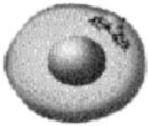
B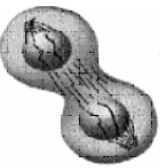
C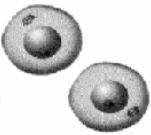
D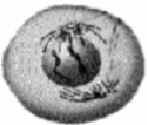
Solution
(B) Telophase is the final stage of mitosis.
In this stage,the chromosomes that have reached their respective poles decondense and lose their individuality.
The individual chromosomes can no longer be seen as distinct structures,and a chromatin material tends to collect in a mass at the two poles.
This is the stage which shows the formation of two daughter nuclei at opposite poles of the cell.
Looking at the given figures,Figure $B$ clearly shows two distinct nuclei forming at opposite ends of the cell,which is the characteristic feature of telophase.
In this stage,the chromosomes that have reached their respective poles decondense and lose their individuality.
The individual chromosomes can no longer be seen as distinct structures,and a chromatin material tends to collect in a mass at the two poles.
This is the stage which shows the formation of two daughter nuclei at opposite poles of the cell.
Looking at the given figures,Figure $B$ clearly shows two distinct nuclei forming at opposite ends of the cell,which is the characteristic feature of telophase.
0 likes
View Solution60
MediumMCQ
Based on the figures given below,select the option that shows the correct sequence of cell division.
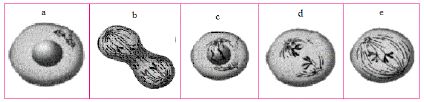
A
$(a) \rightarrow (b) \rightarrow (c) \rightarrow (d) \rightarrow (e)$
B
$(a) \rightarrow (e) \rightarrow (d) \rightarrow (b) \rightarrow (c)$
C
$(b) \rightarrow (e) \rightarrow (c) \rightarrow (a) \rightarrow (d)$
D
$(a) \rightarrow (c) \rightarrow (d) \rightarrow (e) \rightarrow (b)$
Solution
(B) The stages of mitosis are as follows:
$(a)$ Interphase: The cell is in its resting state,with a distinct nucleus.
$(e)$ Prophase: Chromatin condenses into chromosomes,and the nuclear envelope begins to disappear.
$(d)$ Metaphase: Chromosomes align at the equatorial plate.
$(c)$ Anaphase: Sister chromatids separate and move towards opposite poles.
$(b)$ Telophase/Cytokinesis: Chromosomes reach the poles,nuclear envelopes reform,and the cell begins to divide (cytokinesis).
Therefore,the correct sequence is $(a) \rightarrow (e) \rightarrow (d) \rightarrow (c) \rightarrow (b)$. However,based on the provided options and the visual representation of the stages,the sequence $(a) \rightarrow (e) \rightarrow (d) \rightarrow (b) \rightarrow (c)$ is the most appropriate representation of the mitotic process.
$(a)$ Interphase: The cell is in its resting state,with a distinct nucleus.
$(e)$ Prophase: Chromatin condenses into chromosomes,and the nuclear envelope begins to disappear.
$(d)$ Metaphase: Chromosomes align at the equatorial plate.
$(c)$ Anaphase: Sister chromatids separate and move towards opposite poles.
$(b)$ Telophase/Cytokinesis: Chromosomes reach the poles,nuclear envelopes reform,and the cell begins to divide (cytokinesis).
Therefore,the correct sequence is $(a) \rightarrow (e) \rightarrow (d) \rightarrow (c) \rightarrow (b)$. However,based on the provided options and the visual representation of the stages,the sequence $(a) \rightarrow (e) \rightarrow (d) \rightarrow (b) \rightarrow (c)$ is the most appropriate representation of the mitotic process.
0 likes
View Solution61
MediumMCQ
What occurs during mitosis?
A
Sequence of nuclear division
B
Cytoplasmic cleavage
C
Cytokinesis follows nuclear division
D
Formation of daughter nucleoli
Solution
(C) Mitosis ($M$ phase) is the process of cell division where a eukaryotic cell separates its chromosomes into two identical sets in two separate nuclei.
$1$. The process begins with Karyokinesis (nuclear division),which involves stages like Prophase,Metaphase,Anaphase,and Telophase.
$2$. Karyokinesis is typically followed by Cytokinesis,which is the physical division of the cytoplasm into two daughter cells.
$3$. Therefore,the complete process of mitosis involves nuclear division followed by cytoplasmic division.
$1$. The process begins with Karyokinesis (nuclear division),which involves stages like Prophase,Metaphase,Anaphase,and Telophase.
$2$. Karyokinesis is typically followed by Cytokinesis,which is the physical division of the cytoplasm into two daughter cells.
$3$. Therefore,the complete process of mitosis involves nuclear division followed by cytoplasmic division.
0 likes
View Solution62
MediumMCQ
Match the following columns correctly:
| Column-$I$ | Column-$II$ |
| $(A)$ Prophase | $(i)$ Nuclear envelope and other organelles reform |
| $(B)$ Metaphase | $(ii)$ Chromosomes align at the equator |
| $(C)$ Anaphase | $(iii)$ Formation of spindle fibers |
| $(D)$ Telophase | $(iv)$ Splitting of centromere and chromatid separation |
| $(E)$ Cytokinesis | $(v)$ Formation of multinucleated condition |
A
$A-iii, B-ii, C-iv, D-i, E-v$
B
$A-iii, B-iv, C-ii, D-i, E-v$
C
$A-v, B-iv, C-iii, D-ii, E-i$
D
$A-ii, B-iii, C-iv, D-v, E-i$
Solution
$(A)$ The correct matching is as follows:
$(A)$ Prophase: $(iii)$ Formation of spindle fibers (microtubules) occurs during this phase.
$(B)$ Metaphase: $(ii)$ Chromosomes align at the equatorial plate (metaphase plate).
$(C)$ Anaphase: $(iv)$ Centromeres split, and sister chromatids separate and move towards opposite poles.
$(D)$ Telophase: $(i)$ The nuclear envelope, nucleolus, Golgi complex, and $ER$ reform around the daughter chromosomes.
$(E)$ Cytokinesis: $(v)$ If karyokinesis is not followed by cytokinesis, it leads to the formation of a multinucleated condition (syncytium).
Therefore, the correct sequence is $A-iii, B-ii, C-iv, D-i, E-v$.
$(A)$ Prophase: $(iii)$ Formation of spindle fibers (microtubules) occurs during this phase.
$(B)$ Metaphase: $(ii)$ Chromosomes align at the equatorial plate (metaphase plate).
$(C)$ Anaphase: $(iv)$ Centromeres split, and sister chromatids separate and move towards opposite poles.
$(D)$ Telophase: $(i)$ The nuclear envelope, nucleolus, Golgi complex, and $ER$ reform around the daughter chromosomes.
$(E)$ Cytokinesis: $(v)$ If karyokinesis is not followed by cytokinesis, it leads to the formation of a multinucleated condition (syncytium).
Therefore, the correct sequence is $A-iii, B-ii, C-iv, D-i, E-v$.
0 likes
View Solution63
MediumMCQ
Identify the stage of cell division and name the structure labeled as $P$.
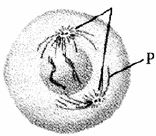
A
Spindle poles,Early Prophase
B
Spindle poles,Interphase
C
Centrioles,Early Prophase
D
Centrioles,Interphase
Solution
(C) The provided image shows a cell in the early prophase stage of mitosis.
In this stage,the chromatin material condenses to form compact mitotic chromosomes.
The centrosomes,which duplicated during the $S$-phase of interphase,begin to move towards opposite poles of the cell.
The structure labeled as $P$ represents the centrioles,which are the core components of the centrosome.
Therefore,the correct identification is Centrioles and Early Prophase.
In this stage,the chromatin material condenses to form compact mitotic chromosomes.
The centrosomes,which duplicated during the $S$-phase of interphase,begin to move towards opposite poles of the cell.
The structure labeled as $P$ represents the centrioles,which are the core components of the centrosome.
Therefore,the correct identification is Centrioles and Early Prophase.
0 likes
View Solution64
DifficultMCQ
Match the following columns:
| $I$. Interkinesis | $A$. Synapsis |
| $II$. Interphase | $B$. Formation of bipolar spindle |
| $III$. Zygotene | $C$. $DNA$ replication |
| $IV$. Diakinesis | $D$. Stage between two meiotic divisions |
A
$I-D, II-C, III-A, IV-B$
B
$I-C, II-A, III-B, IV-D$
C
$I-D, II-A, III-C, IV-B$
D
$I-B, II-C, III-D, IV-A$
Solution
(A) The correct matches are as follows:
$I$. Interkinesis $(D)$: It is the short-lived stage between Meiosis-$I$ and Meiosis-$II$.
$II$. Interphase $(C)$: This is the phase where $DNA$ replication occurs before the cell enters division.
$III$. Zygotene $(A)$: During this stage of Prophase-$I$, homologous chromosomes pair up, a process known as synapsis.
$IV$. Diakinesis $(B)$: This is the final stage of Prophase-$I$, characterized by the formation of the bipolar spindle apparatus.
Therefore, the correct sequence is $I-D, II-C, III-A, IV-B$.
$I$. Interkinesis $(D)$: It is the short-lived stage between Meiosis-$I$ and Meiosis-$II$.
$II$. Interphase $(C)$: This is the phase where $DNA$ replication occurs before the cell enters division.
$III$. Zygotene $(A)$: During this stage of Prophase-$I$, homologous chromosomes pair up, a process known as synapsis.
$IV$. Diakinesis $(B)$: This is the final stage of Prophase-$I$, characterized by the formation of the bipolar spindle apparatus.
Therefore, the correct sequence is $I-D, II-C, III-A, IV-B$.
0 likes
View Solution65
EasyMCQ
$S -$ Statement: Cells cannot maintain their efficient size through mitosis.
$R -$ Reason: Meiosis is an important process for evolution.
$R -$ Reason: Meiosis is an important process for evolution.
A
$S$ and $R$ are both true,and $R$ is the correct explanation of $S$.
B
$S$ and $R$ are both true,but $R$ is not the correct explanation of $S$.
C
$S$ is true and $R$ is false.
D
$S$ is false and $R$ is true.
Solution
(D) $S -$ Statement is false because mitosis is essential for maintaining the cell's surface area to volume ratio,which allows the cell to function efficiently. When a cell grows too large,its surface area becomes insufficient to support its volume,triggering division.
$R -$ Reason is true because meiosis introduces genetic variation through crossing over and independent assortment,which is the foundation of evolution.
$R -$ Reason is true because meiosis introduces genetic variation through crossing over and independent assortment,which is the foundation of evolution.
0 likes
View Solution66
EasyMCQ
$S -$ Statement: The efficient size of the cell is maintained by meiosis.
$R -$ Reason: The specific type and fixed number of chromosomes are maintained in organisms generation after generation by mitosis.
$R -$ Reason: The specific type and fixed number of chromosomes are maintained in organisms generation after generation by mitosis.
A
$S$ and $R$ are both true,and $R$ is the correct explanation of $S$.
B
$S$ and $R$ are both true,but $R$ is not the correct explanation of $S$.
C
$S$ is true and $R$ is false.
D
$S$ and $R$ are both false.
Solution
(D) Statement $S$ is false because the efficient size of the cell is maintained by mitosis,not meiosis. Meiosis is involved in the production of gametes for sexual reproduction.
Reason $R$ is false because the specific type and fixed number of chromosomes are maintained in organisms generation after generation by meiosis (which reduces the chromosome number to half in gametes,followed by fertilization to restore the diploid number),not by mitosis. Mitosis maintains the same number of chromosomes in daughter cells as in the parent cell,but it does not ensure the maintenance of chromosome number across generations in sexual reproduction.
Reason $R$ is false because the specific type and fixed number of chromosomes are maintained in organisms generation after generation by meiosis (which reduces the chromosome number to half in gametes,followed by fertilization to restore the diploid number),not by mitosis. Mitosis maintains the same number of chromosomes in daughter cells as in the parent cell,but it does not ensure the maintenance of chromosome number across generations in sexual reproduction.
0 likes
View Solution67
EasyMCQ
Which of the following is an incorrect pair?
A
Anaphase-$I$ - Homologous chromosomes move to opposite poles.
B
Metaphase-$II$ - Chromosomes align at the equatorial plate.
C
Telophase-$I$ - Nucleolus and nuclear membrane reappear.
D
Zygotene - Synapsis occurs.
Solution
(NONE) In Meiosis-$I$,during Anaphase-$I$,homologous chromosomes separate and move to opposite poles,while sister chromatids remain attached at their centromeres.
In Metaphase-$II$,chromosomes align at the equatorial plate.
In Telophase-$I$,the nuclear membrane and nucleolus reappear,and the chromosomes may undergo some dispersion.
In Zygotene,the process of pairing of homologous chromosomes,known as synapsis,occurs.
All the given pairs are biologically correct descriptions of the respective stages of meiosis. However,if this is a multiple-choice question where one must be incorrect,please re-examine the source. Based on standard $NCERT$ biology,all these statements are accurate.
In Metaphase-$II$,chromosomes align at the equatorial plate.
In Telophase-$I$,the nuclear membrane and nucleolus reappear,and the chromosomes may undergo some dispersion.
In Zygotene,the process of pairing of homologous chromosomes,known as synapsis,occurs.
All the given pairs are biologically correct descriptions of the respective stages of meiosis. However,if this is a multiple-choice question where one must be incorrect,please re-examine the source. Based on standard $NCERT$ biology,all these statements are accurate.
0 likes
View Solution68
EasyMCQ
Statement-$A$: Chromosomes are not clearly visible during telophase.
Statement-$B$: Chromosomes are clearly visible during metaphase.
Statement-$B$: Chromosomes are clearly visible during metaphase.
A
Both statement $A$ and $B$ are correct.
B
Statement $A$ is correct and $B$ is incorrect.
C
Statement $A$ is incorrect and $B$ is correct.
D
Both statement $A$ and $B$ are incorrect.
Solution
(A) During metaphase,chromosomes are highly condensed and align at the equatorial plate,making them most clearly visible under a microscope.
During telophase,chromosomes begin to decondense and lose their individual identity as they form chromatin material,making them less clearly visible.
Therefore,both statements are correct.
During telophase,chromosomes begin to decondense and lose their individual identity as they form chromatin material,making them less clearly visible.
Therefore,both statements are correct.
0 likes
View Solution69
EasyMCQ
Mitosis does not differ from meiosis in which of the following aspects?
A
Interphase
B
$DNA$ replication
C
Synapsis and crossing over
D
Long prophase
Solution
(B) Mitosis and meiosis both involve an interphase stage where $DNA$ replication occurs before the actual division process begins.
$DNA$ replication is a prerequisite for both types of cell division to ensure that daughter cells receive the correct amount of genetic material.
Synapsis and crossing over are unique to meiosis $I$ and do not occur in mitosis.
Prophase in meiosis $I$ is significantly longer and more complex than prophase in mitosis.
$DNA$ replication is a prerequisite for both types of cell division to ensure that daughter cells receive the correct amount of genetic material.
Synapsis and crossing over are unique to meiosis $I$ and do not occur in mitosis.
Prophase in meiosis $I$ is significantly longer and more complex than prophase in mitosis.
0 likes
View Solution70
EasyMCQ
Which of the following pairs is incorrect?
A
$S$-phase: $DNA$ synthesis
B
Meiosis-$I$: Formation of two daughter cells from a parent cell
C
Anaphase: Independent centromere
D
Zygotene: Synapsis
Solution
(C) In the cell cycle,the $S$-phase is characterized by $DNA$ replication ($DNA$ synthesis).
Meiosis-$I$ is a reductional division where one diploid parent cell divides to form two haploid daughter cells.
During Anaphase-$II$ of meiosis,the centromere of each chromosome splits,allowing sister chromatids to separate and move to opposite poles. However,in Anaphase-$I$ of meiosis,homologous chromosomes separate,but the centromeres do not split.
Zygotene is the second stage of Prophase-$I$ of meiosis,characterized by the pairing of homologous chromosomes,a process known as synapsis.
Therefore,the statement 'Anaphase: Independent centromere' is considered incorrect in the context of general mitotic or meiotic descriptions where the distinction between Anaphase-$I$ and Anaphase-$II$ is crucial,as centromeres do not split in Anaphase-$I$.
Meiosis-$I$ is a reductional division where one diploid parent cell divides to form two haploid daughter cells.
During Anaphase-$II$ of meiosis,the centromere of each chromosome splits,allowing sister chromatids to separate and move to opposite poles. However,in Anaphase-$I$ of meiosis,homologous chromosomes separate,but the centromeres do not split.
Zygotene is the second stage of Prophase-$I$ of meiosis,characterized by the pairing of homologous chromosomes,a process known as synapsis.
Therefore,the statement 'Anaphase: Independent centromere' is considered incorrect in the context of general mitotic or meiotic descriptions where the distinction between Anaphase-$I$ and Anaphase-$II$ is crucial,as centromeres do not split in Anaphase-$I$.
0 likes
View Solution71
MediumMCQ
Identify the correct statements.
$(i)$ Somatic cells undergo mitosis,and germ cells undergo meiosis.
$(ii)$ During mitosis,$DNA$ replicates once for one cell division,and in meiosis,$DNA$ replicates twice for two cell divisions.
$(iii)$ Meiosis and mitosis are observed in organisms that reproduce both sexually and asexually.
$(i)$ Somatic cells undergo mitosis,and germ cells undergo meiosis.
$(ii)$ During mitosis,$DNA$ replicates once for one cell division,and in meiosis,$DNA$ replicates twice for two cell divisions.
$(iii)$ Meiosis and mitosis are observed in organisms that reproduce both sexually and asexually.
A
Only $(i)$
B
Only $(ii)$
C
Only $(iii)$
D
$(i)$ and $(iii)$
Solution
(D) Statement $(i)$ is correct: Somatic cells divide by mitosis to maintain the diploid number,while germ cells undergo meiosis to produce haploid gametes.
Statement $(ii)$ is incorrect: In both mitosis and meiosis,$DNA$ replicates only once during the $S$-phase of interphase. In meiosis,although there are two successive nuclear divisions (Meiosis-$I$ and Meiosis-$II$),$DNA$ replication occurs only once before Meiosis-$I$.
Statement $(iii)$ is correct: Mitosis is essential for growth and repair in all eukaryotes,while meiosis is specific to the life cycle of sexually reproducing organisms. Organisms that reproduce both sexually and asexually utilize both processes at different stages of their life cycle.
Therefore,statements $(i)$ and $(iii)$ are correct.
Statement $(ii)$ is incorrect: In both mitosis and meiosis,$DNA$ replicates only once during the $S$-phase of interphase. In meiosis,although there are two successive nuclear divisions (Meiosis-$I$ and Meiosis-$II$),$DNA$ replication occurs only once before Meiosis-$I$.
Statement $(iii)$ is correct: Mitosis is essential for growth and repair in all eukaryotes,while meiosis is specific to the life cycle of sexually reproducing organisms. Organisms that reproduce both sexually and asexually utilize both processes at different stages of their life cycle.
Therefore,statements $(i)$ and $(iii)$ are correct.
0 likes
View Solution72
EasyMCQ
Identify the correct statements:
$(i)$ Synapsis occurs between homologous chromosomes during Prophase-$I$ of meiosis.
$(ii)$ Centromere division occurs during Anaphase-$II$ of meiosis.
$(iii)$ Spindle fibers completely disappear during Telophase of mitosis.
$(iv)$ The nucleus reappears at the Telophase-$I$ stage of meiosis.
$(i)$ Synapsis occurs between homologous chromosomes during Prophase-$I$ of meiosis.
$(ii)$ Centromere division occurs during Anaphase-$II$ of meiosis.
$(iii)$ Spindle fibers completely disappear during Telophase of mitosis.
$(iv)$ The nucleus reappears at the Telophase-$I$ stage of meiosis.
A
Only $(i)$
B
Only $(ii)$
C
Only $(i)$ and $(ii)$
D
Only $(i), (iii)$ and $(iv)$
Solution
(D) $(i)$ Synapsis is the pairing of homologous chromosomes,which is a characteristic feature of the Zygotene stage of Prophase-$I$ in meiosis. This statement is correct.
$(ii)$ During Anaphase-$II$ of meiosis,the centromere of each chromosome splits,allowing sister chromatids to separate and move toward opposite poles. This statement is correct.
$(iii)$ During Telophase of mitosis,the chromosomes decondense,and the nuclear envelope reforms. The spindle fibers disappear during this phase. This statement is correct.
$(iv)$ In Telophase-$I$ of meiosis,the nuclear membrane and nucleolus reappear,and the chromosomes may undergo some decondensation. This statement is correct.
Therefore,all statements $(i), (ii), (iii),$ and $(iv)$ are correct. However,based on the provided options,the most appropriate choice covering the primary correct statements is $(d)$.
$(ii)$ During Anaphase-$II$ of meiosis,the centromere of each chromosome splits,allowing sister chromatids to separate and move toward opposite poles. This statement is correct.
$(iii)$ During Telophase of mitosis,the chromosomes decondense,and the nuclear envelope reforms. The spindle fibers disappear during this phase. This statement is correct.
$(iv)$ In Telophase-$I$ of meiosis,the nuclear membrane and nucleolus reappear,and the chromosomes may undergo some decondensation. This statement is correct.
Therefore,all statements $(i), (ii), (iii),$ and $(iv)$ are correct. However,based on the provided options,the most appropriate choice covering the primary correct statements is $(d)$.
0 likes
View Solution73
MediumMCQ
Which of the following features is common to both mitosis and meiosis?
A
Pairing of homologous chromosomes occurs in both.
B
$DNA$ replication occurs before the division process.
C
Both processes occur in all types of cells.
D
Separation of paired chromosomes occurs in both.
Solution
(B) $Mitosis$ and $Meiosis$ both involve $DNA$ replication during the $S$-phase of $Interphase$ before the cell division process begins. Thus, the amount of $DNA$ doubles before division, which is common to both types of divisions. Pairing of homologous chromosomes and their separation is a characteristic of $Meiosis-I$ only, not $Mitosis$.
0 likes
View Solution74
EasyMCQ
Identify the correct sequence of processes occurring during cell division:
A
$G_1 \rightarrow S \rightarrow G_2 \rightarrow$ Karyokinesis $\rightarrow$ Cytokinesis
B
Interphase $\rightarrow$ Karyokinesis $\rightarrow$ Cytokinesis
C
Prophase $\rightarrow$ Metaphase $\rightarrow$ Anaphase $\rightarrow$ Telophase
D
All of the above $(a), (b),$ and $(c)$
Solution
(D) The cell cycle consists of two main phases: Interphase and $M$-phase (Mitotic phase).
$1$. Interphase is divided into $G_1, S,$ and $G_2$ phases,which prepare the cell for division.
$2$. The $M$-phase consists of Karyokinesis (division of the nucleus) and Cytokinesis (division of the cytoplasm).
$3$. Karyokinesis is further divided into four stages: Prophase,Metaphase,Anaphase,and Telophase.
Since all the given sequences correctly describe the progression of cell division,the correct option is $(d)$.
$1$. Interphase is divided into $G_1, S,$ and $G_2$ phases,which prepare the cell for division.
$2$. The $M$-phase consists of Karyokinesis (division of the nucleus) and Cytokinesis (division of the cytoplasm).
$3$. Karyokinesis is further divided into four stages: Prophase,Metaphase,Anaphase,and Telophase.
Since all the given sequences correctly describe the progression of cell division,the correct option is $(d)$.
0 likes
View Solution75
EasyMCQ
Identify the incorrect statement from the following.
A
Mitotic cell cycle is completed after karyokinesis and cytokinesis.
B
$A$ new mitotic cell cycle begins only after the completion of cytokinesis.
C
The period between two successive cell cycles is called $Gap\, 1$ ($G_1$ phase).
D
$DNA$ replication occurs in the $S$ phase.
Solution
(C) The cell cycle is a series of events that take place in a cell leading to its division and duplication.
$1$. Mitosis ($M$ phase) involves karyokinesis (division of the nucleus) followed by cytokinesis (division of the cytoplasm). Thus,statement $A$ is correct.
$2$. $A$ new cell cycle begins only after the completion of the previous cycle's cytokinesis. Thus,statement $B$ is correct.
$3$. The period between two successive cell divisions is called Interphase,which consists of $G_1$,$S$,and $G_2$ phases. The period between two successive cell cycles is not called $Gap\, 1$. $Gap\, 1$ ($G_1$ phase) is a specific stage within the Interphase. Thus,statement $C$ is incorrect.
$4$. During the $S$ phase (Synthesis phase) of Interphase,$DNA$ replication takes place. Thus,statement $D$ is correct.
$1$. Mitosis ($M$ phase) involves karyokinesis (division of the nucleus) followed by cytokinesis (division of the cytoplasm). Thus,statement $A$ is correct.
$2$. $A$ new cell cycle begins only after the completion of the previous cycle's cytokinesis. Thus,statement $B$ is correct.
$3$. The period between two successive cell divisions is called Interphase,which consists of $G_1$,$S$,and $G_2$ phases. The period between two successive cell cycles is not called $Gap\, 1$. $Gap\, 1$ ($G_1$ phase) is a specific stage within the Interphase. Thus,statement $C$ is incorrect.
$4$. During the $S$ phase (Synthesis phase) of Interphase,$DNA$ replication takes place. Thus,statement $D$ is correct.
0 likes
View Solution76
DifficultMCQ
Chromosomes become short,dense,and distinct,each chromosome consists of a centromere and two chromatids,and the nucleolus and nuclear envelope disappear. During which phase are these changes observed?
A
Prophase
B
Prophase $I$
C
Prophase $II$
D
Both $(a)$ and $(c)$
Solution
(D) The events described,such as the condensation of chromatin into short,dense,and distinct chromosomes,the presence of a centromere with two chromatids,and the disappearance of the nucleolus and nuclear envelope,are characteristic features of the prophase stage of cell division.
In mitosis,these events occur during prophase.
In meiosis $II$,these events occur during prophase $II$.
Therefore,both prophase (of mitosis) and prophase $II$ (of meiosis) exhibit these specific morphological changes.
Thus,the correct answer is $(d)$.
In mitosis,these events occur during prophase.
In meiosis $II$,these events occur during prophase $II$.
Therefore,both prophase (of mitosis) and prophase $II$ (of meiosis) exhibit these specific morphological changes.
Thus,the correct answer is $(d)$.
0 likes
View Solution77
MediumMCQ
Identify the correct statements: $(1)$ Synapsis occurs between homologous chromosomes during prophase $I$ of meiosis. $(2)$ Centromeres split during anaphase $I$ of meiosis. $(3)$ Spindle fibers completely disappear during telophase of mitosis. $(4)$ Nucleoli reappear during telophase $I$ of meiosis.
A
Only $(1)$
B
Only $(2)$
C
Only $(1)$ and $(2)$
D
Only $(1), (3)$ and $(4)$
Solution
(D) Statement $(1)$ is correct: Synapsis,the pairing of homologous chromosomes,occurs during the zygotene stage of prophase $I$ in meiosis.
Statement $(2)$ is incorrect: In meiosis $I$,homologous chromosomes separate,but the centromeres do not split. Centromeres split during anaphase $II$ of meiosis or anaphase of mitosis.
Statement $(3)$ is correct: During telophase of mitosis,the chromosomes cluster at opposite spindle poles and their identity is lost as discrete elements. The nuclear envelope assembles around each chromosome cluster,and nucleolus,Golgi complex,and $ER$ reform. Spindle fibers disappear.
Statement $(4)$ is correct: During telophase $I$ of meiosis,the nuclear membrane and nucleolus reappear,although the chromosomes may remain partially condensed.
Statement $(2)$ is incorrect: In meiosis $I$,homologous chromosomes separate,but the centromeres do not split. Centromeres split during anaphase $II$ of meiosis or anaphase of mitosis.
Statement $(3)$ is correct: During telophase of mitosis,the chromosomes cluster at opposite spindle poles and their identity is lost as discrete elements. The nuclear envelope assembles around each chromosome cluster,and nucleolus,Golgi complex,and $ER$ reform. Spindle fibers disappear.
Statement $(4)$ is correct: During telophase $I$ of meiosis,the nuclear membrane and nucleolus reappear,although the chromosomes may remain partially condensed.
0 likes
View Solution78
MediumMCQ
Select the correct match for $X$ and $Y$:
| Column $X$ | Column $Y$ |
| $(1)$ Attachment site of spindle fibers | $(P)$ Cell cycle |
| $(2)$ Pairing of homologous chromosomes | $(Q)$ Kinetochores |
| $(3)$ Exchange of genes | $(R)$ Synapsis |
| $(4)$ Interval between two successive cell divisions | $(S)$ Crossing over |
A
$(1-P), (2-Q), (3-R), (4-S)$
B
$(1-Q), (2-P), (3-S), (4-R)$
C
$(1-Q), (2-R), (3-S), (4-P)$
D
$(1-S), (2-R), (3-P), (4-Q)$
Solution
(C) The correct matches are:
$(1)$ Attachment site of spindle fibers is the Kinetochore $(Q)$.
$(2)$ Pairing of homologous chromosomes is Synapsis $(R)$.
$(3)$ Exchange of genes between non-sister chromatids is Crossing over $(S)$.
$(4)$ The interval between two successive cell divisions is the Cell cycle $(P)$.
Therefore, the correct sequence is $(1-Q), (2-R), (3-S), (4-P)$.
$(1)$ Attachment site of spindle fibers is the Kinetochore $(Q)$.
$(2)$ Pairing of homologous chromosomes is Synapsis $(R)$.
$(3)$ Exchange of genes between non-sister chromatids is Crossing over $(S)$.
$(4)$ The interval between two successive cell divisions is the Cell cycle $(P)$.
Therefore, the correct sequence is $(1-Q), (2-R), (3-S), (4-P)$.
0 likes
View Solution79
MediumMCQ
Select the correct match for $X$ and $Y$:
| Column $X$ | Column $Y$ |
| $(1)$ Karyokinesis | $(P)$ Completes cell division |
| $(2)$ Cytokinesis | $(Q)$ Formation of multinucleated condition |
| $(3)$ Interkinesis | $(R)$ Period from prophase to telophase |
| $(4)$ Syncytium | $(S)$ Stage between two meiotic divisions |
A
$(1-R), (2-P), (3-S), (4-Q)$
B
$(1-Q), (2-P), (3-S), (4-R)$
C
$(1-R), (2-S), (3-P), (4-Q)$
D
$(1-Q), (2-S), (3-P), (4-R)$
Solution
(A) $(1)$ Karyokinesis is the division of the nucleus, which occurs from prophase to telophase $(R)$.
$(2)$ Cytokinesis is the division of the cytoplasm, which completes the process of cell division $(P)$.
$(3)$ Interkinesis is the short-lived stage between Meiosis-$I$ and Meiosis-$II$ $(S)$.
$(4)$ Syncytium is a condition where karyokinesis is not followed by cytokinesis, resulting in a multinucleated cell $(Q)$.
Therefore, the correct matching is $(1-R), (2-P), (3-S), (4-Q)$.
$(2)$ Cytokinesis is the division of the cytoplasm, which completes the process of cell division $(P)$.
$(3)$ Interkinesis is the short-lived stage between Meiosis-$I$ and Meiosis-$II$ $(S)$.
$(4)$ Syncytium is a condition where karyokinesis is not followed by cytokinesis, resulting in a multinucleated cell $(Q)$.
Therefore, the correct matching is $(1-R), (2-P), (3-S), (4-Q)$.
0 likes
View Solution80
DifficultMCQ
Select the correct match for $X$ and $Y$:
| Column $X$ | Column $Y$ |
| $(1)$ Tetrad | $(P)$ Zygotene stage |
| $(2)$ Chiasmata | $(Q)$ Diplotene stage |
| $(3)$ Splitting of centromere | $(R)$ Meiosis |
| $(4)$ Bivalent | $(S)$ Pachytene stage |
| $(T)$ Anaphase | |
| $(U)$ Mitosis |
A
$(1-S), (2-Q), (3-T), (4-P)$
B
$(1-R), (2-S), (3-Q), (4-U)$
C
$(1-S), (2-T), (3-Q), (4-P)$
D
$(1-T), (2-R), (3-U), (4-Q)$
Solution
(A) The correct matching is as follows:
$(1)$ Tetrad: Formed during the Pachytene stage of Prophase-$I$ of meiosis $(1-S)$.
$(2)$ Chiasmata: These are $X$-shaped structures visible during the Diplotene stage of Prophase-$I$ $(2-Q)$.
$(3)$ Splitting of centromere: Occurs during Anaphase of mitosis or Anaphase-$II$ of meiosis $(3-T)$.
$(4)$ Bivalent: Formed during the Zygotene stage of Prophase-$I$ of meiosis $(4-P)$.
Therefore, the correct sequence is $(1-S), (2-Q), (3-T), (4-P)$.
$(1)$ Tetrad: Formed during the Pachytene stage of Prophase-$I$ of meiosis $(1-S)$.
$(2)$ Chiasmata: These are $X$-shaped structures visible during the Diplotene stage of Prophase-$I$ $(2-Q)$.
$(3)$ Splitting of centromere: Occurs during Anaphase of mitosis or Anaphase-$II$ of meiosis $(3-T)$.
$(4)$ Bivalent: Formed during the Zygotene stage of Prophase-$I$ of meiosis $(4-P)$.
Therefore, the correct sequence is $(1-S), (2-Q), (3-T), (4-P)$.
0 likes
View Solution81
MediumMCQ
$A$: Multicellular organisms begin their life from a single cell.
$R$: All somatic cells of a multicellular organism have the same number of chromosomes.
$R$: All somatic cells of a multicellular organism have the same number of chromosomes.
A
$A$ and $R$ are both true and $R$ is the correct explanation of $A$.
B
$A$ and $R$ are both true,but $R$ is not the correct explanation of $A$.
C
$A$ is true and $R$ is false.
D
$A$ is false and $R$ is true.
Solution
(B) Assertion $(A)$ is true because all multicellular organisms,including humans,start their life as a single-celled zygote.
Reason $(R)$ is also true because somatic cells are produced by mitosis,which maintains the same number of chromosomes as the parent cell.
However,the fact that somatic cells have the same number of chromosomes is a result of mitotic division,not the reason why life begins as a single cell. Therefore,$R$ is not the correct explanation of $A$.
Reason $(R)$ is also true because somatic cells are produced by mitosis,which maintains the same number of chromosomes as the parent cell.
However,the fact that somatic cells have the same number of chromosomes is a result of mitotic division,not the reason why life begins as a single cell. Therefore,$R$ is not the correct explanation of $A$.
0 likes
View Solution82
MediumMCQ
$A$: In telophase,the two daughter nuclei formed at opposite poles contain the same number of chromosomes as the parent nucleus.
$R$: In anaphase,the centromere of each chromosome splits,allowing the sister chromatids to separate.
$R$: In anaphase,the centromere of each chromosome splits,allowing the sister chromatids to separate.
A
$A$ and $R$ are both true and $R$ is the correct explanation of $A$.
B
$A$ and $R$ are both true,but $R$ is not the correct explanation of $A$.
C
$A$ is true and $R$ is false.
D
$A$ is false and $R$ is true.
Solution
(A) In mitosis,during anaphase,the centromere of each chromosome splits,which allows the sister chromatids to move toward opposite poles.
Because these chromatids (now considered individual chromosomes) are distributed equally to the two poles,the resulting daughter nuclei formed during telophase contain the same number of chromosomes as the parent nucleus.
Therefore,the splitting of the centromere in anaphase is the direct cause for the equal distribution of chromosomes in telophase.
Thus,both $A$ and $R$ are true,and $R$ is the correct explanation of $A$.
Because these chromatids (now considered individual chromosomes) are distributed equally to the two poles,the resulting daughter nuclei formed during telophase contain the same number of chromosomes as the parent nucleus.
Therefore,the splitting of the centromere in anaphase is the direct cause for the equal distribution of chromosomes in telophase.
Thus,both $A$ and $R$ are true,and $R$ is the correct explanation of $A$.
0 likes
View Solution83
MediumMCQ
Statement $P$: Centrioles duplicate during the $S$ phase.
Statement $Q$: During prophase,centrioles separate from each other and move towards opposite poles of the cell.
Statement $Q$: During prophase,centrioles separate from each other and move towards opposite poles of the cell.
A
Both Statement $P$ and $Q$ are true,but Statement $Q$ is not the correct explanation of Statement $P$.
B
Both Statement $P$ and $Q$ are false.
C
Both Statement $P$ and $Q$ are true and Statement $Q$ is the correct explanation of Statement $P$.
D
Statement $P$ is false and Statement $Q$ is true.
Solution
(A) Statement $P$ is true: During the $S$ phase (Synthesis phase) of interphase,$DNA$ replication occurs,and the centrioles within the centrosome also duplicate.
Statement $Q$ is true: During the prophase of mitosis,the duplicated centrioles move towards opposite poles of the cell to initiate the formation of the mitotic spindle.
However,Statement $Q$ describes the behavior of centrioles during prophase,whereas Statement $P$ describes their duplication during the $S$ phase. Therefore,Statement $Q$ is not the direct explanation for why centrioles duplicate in the $S$ phase. Thus,both are true,but $Q$ is not the correct explanation for $P$.
Statement $Q$ is true: During the prophase of mitosis,the duplicated centrioles move towards opposite poles of the cell to initiate the formation of the mitotic spindle.
However,Statement $Q$ describes the behavior of centrioles during prophase,whereas Statement $P$ describes their duplication during the $S$ phase. Therefore,Statement $Q$ is not the direct explanation for why centrioles duplicate in the $S$ phase. Thus,both are true,but $Q$ is not the correct explanation for $P$.
0 likes
View Solution84
MediumMCQ
Statement $P$: The phase between two successive meiotic divisions is called interkinesis.
Statement $Q$: The period between two successive cell divisions is called the cell cycle.
Statement $Q$: The period between two successive cell divisions is called the cell cycle.
A
Both statements $P$ and $Q$ are false.
B
Statement $P$ is true and statement $Q$ is false.
C
Statement $P$ is false and statement $Q$ is true.
D
Both statements $P$ and $Q$ are true.
Solution
(D) Statement $P$ is true: Interkinesis is the stage between Meiosis-$I$ and Meiosis-$II$. It is generally short-lived and does not involve $DNA$ replication.
Statement $Q$ is true: The cell cycle is the sequence of events by which a cell duplicates its genome,synthesizes other constituents of the cell,and eventually divides into two daughter cells. It represents the period between two successive cell divisions.
Therefore,both statements are correct.
Statement $Q$ is true: The cell cycle is the sequence of events by which a cell duplicates its genome,synthesizes other constituents of the cell,and eventually divides into two daughter cells. It represents the period between two successive cell divisions.
Therefore,both statements are correct.
0 likes
View Solution85
EasyMCQ
Statement $X$: During the process of meiosis,the genetic material replicates only once.
Statement $Y$: During interkinesis,there is no replication of genetic material.
Statement $Y$: During interkinesis,there is no replication of genetic material.
A
Statement $X$ is true and Statement $Y$ is false.
B
Both Statement $X$ and $Y$ are false.
C
Both Statement $X$ and $Y$ are true.
D
Statement $X$ is false and Statement $Y$ is true.
Solution
(C) Statement $X$ is true: In meiosis,$DNA$ replication occurs only once during the $S$-phase of interphase,preceding meiosis $I$.
Statement $Y$ is true: Interkinesis is the stage between meiosis $I$ and meiosis $II$. During this phase,there is no $DNA$ replication or synthesis of genetic material.
Therefore,both statements are correct.
Statement $Y$ is true: Interkinesis is the stage between meiosis $I$ and meiosis $II$. During this phase,there is no $DNA$ replication or synthesis of genetic material.
Therefore,both statements are correct.
0 likes
View Solution86
MediumMCQ
Statement $X$: The process of cell division is essential for the growth of an organism.
Statement $Y$: Replication of $DNA$ and division of $DNA$ are necessary for cell division.
Statement $Y$: Replication of $DNA$ and division of $DNA$ are necessary for cell division.
A
Both Statement $X$ and $Y$ are true. $Y$ is not the explanation of $X$.
B
Both Statement $X$ and $Y$ are true. $Y$ is the correct explanation of $X$.
C
Statement $X$ is true. Statement $Y$ is false.
D
Statement $X$ is false. Statement $Y$ is true.
Solution
(B) Statement $X$ is true because cell division is the fundamental process that allows organisms to grow,develop,and repair tissues.
Statement $Y$ is true because,for a cell to divide,it must first replicate its genetic material ($DNA$ replication) and then ensure that the replicated $DNA$ is equally distributed into the daughter cells ($DNA$ segregation).
Since the growth of an organism (Statement $X$) is a direct consequence of the increase in cell number,which is achieved through the processes described in Statement $Y$,Statement $Y$ provides the mechanistic explanation for Statement $X$.
Statement $Y$ is true because,for a cell to divide,it must first replicate its genetic material ($DNA$ replication) and then ensure that the replicated $DNA$ is equally distributed into the daughter cells ($DNA$ segregation).
Since the growth of an organism (Statement $X$) is a direct consequence of the increase in cell number,which is achieved through the processes described in Statement $Y$,Statement $Y$ provides the mechanistic explanation for Statement $X$.
0 likes
View Solution87
MediumMCQ
Match the following columns and select the correct option:
| Column-$I$ | Column-$II$ |
| $(1)$ $G_1$-phase | $(a)$ Interval between $DNA$ replication and $M$-phase |
| $(2)$ $G_2$-phase | $(b)$ Interval between $G_2$ and $G_1$ phase |
| $(3)$ $S$-phase | $(c)$ Interval between $M$ and $DNA$ replication |
| $(4)$ $M$-phase | $(d)$ Interval between the beginning and end of interphase |
A
$(1-d), (2-a), (3-c), (4-b)$
B
$(1-a), (2-c), (3-b), (4-d)$
C
$(1-b), (2-c), (3-a), (4-d)$
D
$(1-c), (2-a), (3-d), (4-b)$
Solution
(D) The cell cycle is divided into two main phases: Interphase and $M$-phase (Mitosis).
Interphase consists of three sub-phases: $G_1$, $S$, and $G_2$.
$(1)$ $G_1$-phase is the interval between mitosis ($M$-phase) and $DNA$ replication ($S$-phase). Thus, $(1-c)$.
$(2)$ $G_2$-phase is the interval between $DNA$ replication ($S$-phase) and mitosis ($M$-phase). Thus, $(2-a)$.
$(3)$ $S$-phase is the phase where $DNA$ synthesis occurs. It is the period between $G_1$ and $G_2$. In the context of the options provided, $(3-d)$ fits as it represents the period within interphase.
$(4)$ $M$-phase is the period of cell division, which occurs between $G_2$ and $G_1$ (the next cycle). Thus, $(4-b)$.
Therefore, the correct matching is $(1-c), (2-a), (3-d), (4-b)$.
Interphase consists of three sub-phases: $G_1$, $S$, and $G_2$.
$(1)$ $G_1$-phase is the interval between mitosis ($M$-phase) and $DNA$ replication ($S$-phase). Thus, $(1-c)$.
$(2)$ $G_2$-phase is the interval between $DNA$ replication ($S$-phase) and mitosis ($M$-phase). Thus, $(2-a)$.
$(3)$ $S$-phase is the phase where $DNA$ synthesis occurs. It is the period between $G_1$ and $G_2$. In the context of the options provided, $(3-d)$ fits as it represents the period within interphase.
$(4)$ $M$-phase is the period of cell division, which occurs between $G_2$ and $G_1$ (the next cycle). Thus, $(4-b)$.
Therefore, the correct matching is $(1-c), (2-a), (3-d), (4-b)$.
0 likes
View Solution88
MediumMCQ
Which of the following is mismatched?
A
$G_1$-phase: Synthesis of $RNA$ and enzymes occurs.
B
$S$-phase: Protein synthesis occurs.
C
$G_2$-phase: Synthesis of microtubules occurs.
D
$M$-phase: Cytokinesis occurs.
Solution
(B) In the cell cycle,the $S$-phase (Synthesis phase) is primarily characterized by the replication of $DNA$ and the synthesis of histone proteins. Protein synthesis,in general,occurs throughout the cell cycle,but the specific hallmark of the $S$-phase is $DNA$ replication. Therefore,the statement '$S$-phase: Protein synthesis occurs' is considered mismatched because it is not the defining event of this phase compared to $DNA$ replication.
0 likes
View Solution89
MediumMCQ
Which of the following statements is incorrect?
A
Interphase and $M$-phase are the two main phases of the cell cycle.
B
Interphase consists of three phases: $G_1$ (Growth-$1$),$S$ (Synthesis),and $G_2$ (Growth-$2$).
C
The $M$-phase consists of two stages: Karyokinesis and Cytokinesis.
D
Cytokinesis consists of four stages: Prophase,Metaphase,Anaphase,and Telophase.
Solution
(D) The cell cycle is divided into two main phases: Interphase and $M$-phase (Mitotic phase).
Interphase is further divided into $G_1$,$S$,and $G_2$ phases.
The $M$-phase involves Karyokinesis (division of the nucleus) and Cytokinesis (division of the cytoplasm).
Prophase,Metaphase,Anaphase,and Telophase are the four stages of Karyokinesis,not Cytokinesis.
Therefore,the statement in option $D$ is incorrect.
Interphase is further divided into $G_1$,$S$,and $G_2$ phases.
The $M$-phase involves Karyokinesis (division of the nucleus) and Cytokinesis (division of the cytoplasm).
Prophase,Metaphase,Anaphase,and Telophase are the four stages of Karyokinesis,not Cytokinesis.
Therefore,the statement in option $D$ is incorrect.
0 likes
View Solution90
EasyMCQ
Which of the following events is inconsistent with the events occurring during interphase?
A
Formation of chromosomes from chromatin
B
Disappearance of the nucleolus
C
Formation of the nuclear spindle
D
All of the above
Solution
(D) Interphase is the phase of the cell cycle where the cell prepares for division by replicating its $DNA$ and synthesizing proteins.
Events like the condensation of chromatin into chromosomes,the disappearance of the nucleolus,and the formation of the mitotic spindle are characteristic features of Prophase,which is the first stage of $M$-phase (Mitosis).
Therefore,none of these events occur during interphase.
Thus,all three options are inconsistent with interphase events.
Events like the condensation of chromatin into chromosomes,the disappearance of the nucleolus,and the formation of the mitotic spindle are characteristic features of Prophase,which is the first stage of $M$-phase (Mitosis).
Therefore,none of these events occur during interphase.
Thus,all three options are inconsistent with interphase events.
0 likes
View Solution91
MediumMCQ
What is a kinetochore?
A
$A$ small disc-shaped structure on the surface of the centromeres.
B
The attachment site of spindle fibers to the centromere.
C
$A$ structure located at the junction of chromosome arms.
D
All of the above.
Solution
(D) kinetochore is a complex protein structure that forms on the centromere of a chromosome during cell division.
It serves as the attachment point for spindle fibers (microtubules) to pull the sister chromatids apart during anaphase.
Since the kinetochore is located on the surface of the centromere and facilitates the attachment of spindle fibers,options $A$ and $B$ are correct.
Option $C$ is also a functional description of the centromeric region where the kinetochore is situated.
Therefore,all the given statements correctly describe aspects of the kinetochore.
It serves as the attachment point for spindle fibers (microtubules) to pull the sister chromatids apart during anaphase.
Since the kinetochore is located on the surface of the centromere and facilitates the attachment of spindle fibers,options $A$ and $B$ are correct.
Option $C$ is also a functional description of the centromeric region where the kinetochore is situated.
Therefore,all the given statements correctly describe aspects of the kinetochore.
0 likes
View Solution92
DifficultMCQ
Arrange the following events occurring during mitosis in the correct sequence: $(1)$ Chromatid,$(2)$ Monad,$(3)$ Dyad,$(4)$ Daughter chromosome.
A
$1, 2, 3, 4$
B
$2, 3, 1, 4$
C
$3, 2, 1, 4$
D
$4, 3, 2, 1$
Solution
(B) The sequence of events during mitosis involves the structural changes of chromosomes:
$1$. Initially,the $DNA$ replicates to form a Dyad $(3)$,which consists of two sister chromatids joined at the centromere.
$2$. During metaphase/anaphase,the structure is referred to as a Chromatid $(1)$ when considering the individual strands.
$3$. $A$ Monad $(2)$ represents a single chromosome structure before replication or after separation.
$4$. Finally,after the separation of sister chromatids during anaphase,they are referred to as Daughter chromosomes $(4)$.
However,in the context of the progression of chromosomal states during the cell cycle: $A$ chromosome exists as a Monad $(2)$ in $G_1$,becomes a Dyad $(3)$ after $S$ phase,the individual components are Chromatids $(1)$,and upon separation,they become Daughter chromosomes $(4)$.
Therefore,the correct sequence is $2, 3, 1, 4$.
$1$. Initially,the $DNA$ replicates to form a Dyad $(3)$,which consists of two sister chromatids joined at the centromere.
$2$. During metaphase/anaphase,the structure is referred to as a Chromatid $(1)$ when considering the individual strands.
$3$. $A$ Monad $(2)$ represents a single chromosome structure before replication or after separation.
$4$. Finally,after the separation of sister chromatids during anaphase,they are referred to as Daughter chromosomes $(4)$.
However,in the context of the progression of chromosomal states during the cell cycle: $A$ chromosome exists as a Monad $(2)$ in $G_1$,becomes a Dyad $(3)$ after $S$ phase,the individual components are Chromatids $(1)$,and upon separation,they become Daughter chromosomes $(4)$.
Therefore,the correct sequence is $2, 3, 1, 4$.
0 likes
View Solution93
MediumMCQ
Which of the following is true for a syncytium?
A
Repeated division of the nucleus occurs.
B
Karyokinesis occurs without cytokinesis.
C
Cell organelles are not distributed.
D
All of the above.
Solution
(D) $syncytium$ is a multinucleated cell that can result from multiple nuclear divisions without their accompanying cytokinesis.
In this process,the nucleus undergoes repeated rounds of division $(karyokinesis)$,but the cytoplasm does not divide ($cytokinesis$ does not occur).
As a result,a single large cell contains many nuclei.
Therefore,both the repeated division of the nucleus and the lack of cytoplasmic division are characteristic features of a $syncytium$.
In this process,the nucleus undergoes repeated rounds of division $(karyokinesis)$,but the cytoplasm does not divide ($cytokinesis$ does not occur).
As a result,a single large cell contains many nuclei.
Therefore,both the repeated division of the nucleus and the lack of cytoplasmic division are characteristic features of a $syncytium$.
0 likes
View Solution94
MediumMCQ
Match the following columns and select the correct option:
| Column-$I$ | Column-$II$ |
| $(1)$ Attachment of spindle fibers to kinetochores | $(a)$ Prophase |
| $(2)$ Formation of contractile ring in cytoplasm | $(b)$ Telophase |
| $(3)$ Decondensation of chromosomes | $(c)$ Cytokinesis |
| $(4)$ Condensation of chromosomal material | $(d)$ Metaphase |
A
$1-c, 2-b, 3-a, 4-d$
B
$1-b, 2-c, 3-d, 4-a$
C
$1-d, 2-c, 3-b, 4-a$
D
$1-a, 2-c, 3-b, 4-d$
Solution
$(C)$ $(1)$ Attachment of spindle fibers to kinetochores occurs during Metaphase $(d)$.
$(2)$ Formation of a contractile ring (cleavage furrow) in the cytoplasm occurs during Cytokinesis $(c)$.
$(3)$ Decondensation of chromosomes (chromosomes uncoil to form chromatin) occurs during Telophase $(b)$.
$(4)$ Condensation of chromosomal material occurs during Prophase $(a)$.
Therefore, the correct matching is $(1-d, 2-c, 3-b, 4-a)$.
$(2)$ Formation of a contractile ring (cleavage furrow) in the cytoplasm occurs during Cytokinesis $(c)$.
$(3)$ Decondensation of chromosomes (chromosomes uncoil to form chromatin) occurs during Telophase $(b)$.
$(4)$ Condensation of chromosomal material occurs during Prophase $(a)$.
Therefore, the correct matching is $(1-d, 2-c, 3-b, 4-a)$.
0 likes
View Solution95
MediumMCQ
Select the correct option for the following matches:
| List-$I$ | List-$II$ |
| $(1)$ Metaphase-$I$ | $(a)$ Number of chromosomes becomes half of the parent cell |
| $(2)$ Anaphase-$I$ | $(b)$ Each chromosome splits at the centromere to form chromatids |
| $(3)$ Anaphase-$II$ | $(c)$ Homologous chromosomes form pairs at the equatorial plate |
| $(4)$ Telophase-$II$ | $(d)$ Homologous chromosomes move towards opposite poles |
A
$1-c, 2-d, 3-b, 4-a$
B
$1-b, 2-c, 3-d, 4-a$
C
$1-c, 2-a, 3-d, 4-b$
D
$1-a, 2-b, 3-d, 4-c$
Solution
(A) The correct matching is as follows:
$(1)$ Metaphase-$I$: Homologous chromosomes align at the equatorial plate $(c)$.
$(2)$ Anaphase-$I$: Homologous chromosomes separate and move towards opposite poles $(d)$.
$(3)$ Anaphase-$II$: Centromeres split, and sister chromatids move towards opposite poles $(b)$.
$(4)$ Telophase-$II$: The chromosome number is halved compared to the parent cell after the completion of meiosis $(a)$.
Therefore, the correct sequence is $1-c, 2-d, 3-b, 4-a$.
$(1)$ Metaphase-$I$: Homologous chromosomes align at the equatorial plate $(c)$.
$(2)$ Anaphase-$I$: Homologous chromosomes separate and move towards opposite poles $(d)$.
$(3)$ Anaphase-$II$: Centromeres split, and sister chromatids move towards opposite poles $(b)$.
$(4)$ Telophase-$II$: The chromosome number is halved compared to the parent cell after the completion of meiosis $(a)$.
Therefore, the correct sequence is $1-c, 2-d, 3-b, 4-a$.
0 likes
View Solution96
DifficultMCQ
Identify the correct statements:
Statement $X$: Mitosis occurs in somatic cells and meiosis occurs in reproductive cells.
Statement $Y$: During mitosis,$DNA$ synthesis occurs once for one cell division,and in meiosis,$DNA$ synthesis occurs twice for two cell divisions.
Statement $Z$: Mitosis and meiosis occur in organisms that reproduce both sexually and asexually.
Statement $X$: Mitosis occurs in somatic cells and meiosis occurs in reproductive cells.
Statement $Y$: During mitosis,$DNA$ synthesis occurs once for one cell division,and in meiosis,$DNA$ synthesis occurs twice for two cell divisions.
Statement $Z$: Mitosis and meiosis occur in organisms that reproduce both sexually and asexually.
A
$X$
B
$Y$
C
$Z$
D
$X$ and $Y$ both
Solution
(A) Statement $X$ is correct: Mitosis is responsible for growth and repair in somatic cells,while meiosis is specialized for the production of gametes in reproductive cells.
Statement $Y$ is incorrect: In both mitosis and meiosis,$DNA$ replication occurs only once during the $S$-phase of interphase,regardless of the number of subsequent divisions.
Statement $Z$ is incorrect: Meiosis is specifically associated with sexual reproduction to maintain chromosome number across generations; it does not occur in organisms that reproduce exclusively asexually.
Therefore,only statement $X$ is correct.
Statement $Y$ is incorrect: In both mitosis and meiosis,$DNA$ replication occurs only once during the $S$-phase of interphase,regardless of the number of subsequent divisions.
Statement $Z$ is incorrect: Meiosis is specifically associated with sexual reproduction to maintain chromosome number across generations; it does not occur in organisms that reproduce exclusively asexually.
Therefore,only statement $X$ is correct.
0 likes
View Solution97
MediumMCQ
In the given figure,what are the stages $X$ and $Y$?
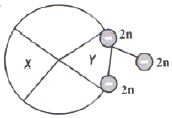
A
$X = G_1$ phase,$Y = G_2$ phase
B
$X = M$ phase,$Y = G_1$ phase
C
$X = M$ phase,$Y = S$ phase
D
$X = S$ phase,$Y = M$ phase
Solution
(D) The cell cycle consists of interphase $(G_1, S, G_2)$ and the $M$ phase (mitosis).
In the provided diagram,the cell cycle is represented as a circular process.
Stage $Y$ represents the $M$ phase (mitosis) because it leads to the formation of two daughter cells,each with a ploidy of $2n$,which is characteristic of mitotic division.
Stage $X$ represents the $S$ phase (synthesis phase) because it occurs after the $G_1$ phase and before the $G_2$ phase,where $DNA$ replication takes place.
Therefore,$X = S$ phase and $Y = M$ phase.
In the provided diagram,the cell cycle is represented as a circular process.
Stage $Y$ represents the $M$ phase (mitosis) because it leads to the formation of two daughter cells,each with a ploidy of $2n$,which is characteristic of mitotic division.
Stage $X$ represents the $S$ phase (synthesis phase) because it occurs after the $G_1$ phase and before the $G_2$ phase,where $DNA$ replication takes place.
Therefore,$X = S$ phase and $Y = M$ phase.
0 likes
View Solution98
MediumMCQ
Which of the following options gives the correct sequence of events during mitosis?
A
Condensation,Nuclear membrane disassembly,Arrangement at equator,Centromere division,Segregation,Telophase
B
Condensation,Crossing over,Nuclear membrane disassembly,Segregation,Telophase
C
Condensation,Arrangement at equator,Centromere division,Segregation,Telophase
D
Condensation,Nuclear membrane disassembly,Crossing over,Segregation,Telophase
Solution
(A) The correct sequence of events during mitosis is:
$1$. Condensation: During prophase,chromatin condenses into compact chromosomes.
$2$. Nuclear membrane disassembly: Occurs during prometaphase.
$3$. Arrangement at equator: Chromosomes align at the metaphase plate during metaphase.
$4$. Centromere division: Occurs at the start of anaphase.
$5$. Segregation: Sister chromatids move to opposite poles.
$6$. Telophase: Chromosomes decondense and the nuclear envelope reforms.
Crossing over is a characteristic feature of meiosis,not mitosis. Therefore,option $(A)$ provides the most complete and accurate sequence of events.
$1$. Condensation: During prophase,chromatin condenses into compact chromosomes.
$2$. Nuclear membrane disassembly: Occurs during prometaphase.
$3$. Arrangement at equator: Chromosomes align at the metaphase plate during metaphase.
$4$. Centromere division: Occurs at the start of anaphase.
$5$. Segregation: Sister chromatids move to opposite poles.
$6$. Telophase: Chromosomes decondense and the nuclear envelope reforms.
Crossing over is a characteristic feature of meiosis,not mitosis. Therefore,option $(A)$ provides the most complete and accurate sequence of events.
0 likes
View Solution99
MediumMCQ
$A$ somatic cell that has just completed the $S$ phase of its cell cycle,as compared to a gamete of the same species,has:
A
twice the number of chromosomes and four times the amount of $DNA$.
B
four times the number of chromosomes and twice the amount of $DNA$.
C
twice the number of chromosomes and twice the amount of $DNA$.
D
same number of chromosomes but twice the amount of $DNA$.
Solution
(A) In a diploid somatic cell during the $G_1$ phase,the $DNA$ content is $2C$ and the chromosome number is $2n$.
In a haploid gamete,the $DNA$ content is $1C$ and the chromosome number is $n$.
The $S$ phase is characterized by the replication of $DNA$,which doubles the amount of $DNA$ per cell.
Therefore,in a somatic cell after the $S$ phase,the $DNA$ content becomes $4C$,while the chromosome number remains $2n$.
Comparing this to a gamete ($1C$ $DNA$ and $n$ chromosomes),the somatic cell has $4$ times the $DNA$ ($4C$ vs $1C$) and $2$ times the number of chromosomes ($2n$ vs $n$).
In a haploid gamete,the $DNA$ content is $1C$ and the chromosome number is $n$.
The $S$ phase is characterized by the replication of $DNA$,which doubles the amount of $DNA$ per cell.
Therefore,in a somatic cell after the $S$ phase,the $DNA$ content becomes $4C$,while the chromosome number remains $2n$.
Comparing this to a gamete ($1C$ $DNA$ and $n$ chromosomes),the somatic cell has $4$ times the $DNA$ ($4C$ vs $1C$) and $2$ times the number of chromosomes ($2n$ vs $n$).
0 likes
View Solution100
MediumMCQ
Select the correct option by matching Column $I$ with Column $II$.
| Column $I$ | Column $II$ |
| $A$. Synapsis aligns homologous chromosomes | $(i)$ Anaphase $II$ |
| $B$. Synthesis of $RNA$ and protein | $(ii)$ Zygotene |
| $C$. Action of enzyme recombinase | $(iii)$ $G_2$ phase |
| $D$. Centromeres do not separate but chromatids move towards opposite poles | $(iv)$ Anaphase $I$ |
| $(v)$ Pachytene |
A
$A-(i), B-(ii), C-(v), D-(iv)$
B
$A-(ii), B-(iii), C-(iv), D-(v)$
C
$A-(ii), B-(i), C-(iii), D-(iv)$
D
$A-(ii), B-(iii), C-(v), D-(iv)$
Solution
(D) The correct matching is as follows:
$A$. Synapsis aligns homologous chromosomes occurs during the Zygotene stage of Prophase $I$ of Meiosis $(ii)$.
$B$. Synthesis of $RNA$ and protein occurs during the $G_2$ phase of the cell cycle $(iii)$.
$C$. The action of the enzyme recombinase occurs during the Pachytene stage of Prophase $I$ of Meiosis $(v)$.
$D$. During Anaphase $I$,homologous chromosomes separate,but centromeres do not split,and chromatids move towards opposite poles $(iv)$.
Therefore,the correct sequence is $A-(ii), B-(iii), C-(v), D-(iv)$.
$A$. Synapsis aligns homologous chromosomes occurs during the Zygotene stage of Prophase $I$ of Meiosis $(ii)$.
$B$. Synthesis of $RNA$ and protein occurs during the $G_2$ phase of the cell cycle $(iii)$.
$C$. The action of the enzyme recombinase occurs during the Pachytene stage of Prophase $I$ of Meiosis $(v)$.
$D$. During Anaphase $I$,homologous chromosomes separate,but centromeres do not split,and chromatids move towards opposite poles $(iv)$.
Therefore,the correct sequence is $A-(ii), B-(iii), C-(v), D-(iv)$.
0 likes
View SolutionCell Cycle and Cell Division — Mix Examples-Cell Cycle and Cell Division · Frequently Asked Questions
1Are these Cell Cycle and Cell Division questions useful for JEE and NEET?
Yes. All questions in this section are mapped to JEE Main and NEET exam patterns. Previous year questions from JEE Main, NEET, GUJCET and state-level exams are included with full solutions.
2Can I switch to Hindi or Gujarati for these questions?
Yes. Use the language tabs in the hero section or the sidebar to view the same questions and solutions in English, Hindi or Gujarati.
3How do I generate a question paper from this subtopic?
Use the Vedclass Exam Paper Generator — select the chapter and subtopic, set difficulty, and generate Sets A, B, C, D automatically. First 3 chapters of every subject are free.
Vedclass Products
For Students
Vedclass Test Series
Mock tests in real JEE/NEET style with performance analysis. 5-day free trial.
Start Free TrialFor Teachers
Exam Paper Generator
Generate Set A/B/C/D papers from this chapter in 2 minutes. 3 chapters free.
Try FreeFor Institutes
Online Exam Module
Live online exams with unlimited students, 360° analytics & white-label branding.
See DemoFor Teachers & Institutes
Generate a Cell Cycle and Cell Division Exam Paper in 2 Minutes
Select subtopic & difficulty — Sets A, B, C, D auto-generated with No Repeat logic.
First 3 chapters of every subject are free — no payment required.