
A English
Cell Cycle Questions in English
Class 11 Biology · Cell Cycle and Cell Division · Cell Cycle
261+
Questions
English
Language
100%
With Solutions
Showing 49 of 261 questions in English
151
EasyMCQ
Which phase is the last phase of interphase?
A
$M$
B
$G_1$
C
$S$
D
$G_2$
Solution
(D) The cell cycle is divided into two main phases: Interphase and $M$-phase (Mitosis/Meiosis).
Interphase is further divided into three sub-phases: $G_1$ phase (Gap $1$),$S$ phase (Synthesis),and $G_2$ phase (Gap $2$).
$G_1$ is the first phase,followed by the $S$ phase,and finally the $G_2$ phase.
Therefore,the $G_2$ phase is the last phase of interphase before the cell enters the $M$-phase.
Interphase is further divided into three sub-phases: $G_1$ phase (Gap $1$),$S$ phase (Synthesis),and $G_2$ phase (Gap $2$).
$G_1$ is the first phase,followed by the $S$ phase,and finally the $G_2$ phase.
Therefore,the $G_2$ phase is the last phase of interphase before the cell enters the $M$-phase.
0 likes
View Solution152
EasyMCQ
It is an inactive stage of cell division.
A
Prophase
B
Metaphase
C
Telophase
D
$G_0$ phase
Solution
(D) The $G_0$ phase,also known as the quiescent stage,is a period in the cell cycle where cells exist in a quiescent state.
Cells in this stage remain metabolically active but do not proliferate unless called upon to do so depending on the requirement of the organism.
Therefore,it is often referred to as the inactive stage of cell division.
Cells in this stage remain metabolically active but do not proliferate unless called upon to do so depending on the requirement of the organism.
Therefore,it is often referred to as the inactive stage of cell division.
0 likes
View Solution153
EasyMCQ
In cell cycle,the $G_1$ phase corresponds to the interval between mitosis and initiation of $DNA$ replication.
A
$G_1$
B
$G_2$
C
$M$
D
Interkinesis
Solution
(A) The cell cycle is divided into two main phases: Interphase and $M$ phase (Mitosis).
Interphase is further divided into three sub-phases: $G_1$ phase,$S$ phase,and $G_2$ phase.
$G_1$ phase (Gap $1$) is the period between the end of mitosis ($M$ phase) and the beginning of $DNA$ replication ($S$ phase).
During this phase,the cell is metabolically active and continuously grows in size but does not replicate its $DNA$.
Interphase is further divided into three sub-phases: $G_1$ phase,$S$ phase,and $G_2$ phase.
$G_1$ phase (Gap $1$) is the period between the end of mitosis ($M$ phase) and the beginning of $DNA$ replication ($S$ phase).
During this phase,the cell is metabolically active and continuously grows in size but does not replicate its $DNA$.
0 likes
View Solution154
MediumMCQ
In which phase are cells biosynthetically active but unable to divide?
A
$S$ phase
B
$G_1$ phase
C
$G_0$ phase
D
$G_2$ phase
Solution
(C) The $G_0$ phase,also known as the quiescent stage,is a state where cells remain metabolically active but do not proliferate unless called upon to do so depending on the requirement of the organism.
In this phase,cells exit the cell cycle from the $G_1$ phase and enter an inactive stage.
They continue to perform their specific functions but do not undergo $DNA$ replication or division.
In this phase,cells exit the cell cycle from the $G_1$ phase and enter an inactive stage.
They continue to perform their specific functions but do not undergo $DNA$ replication or division.
0 likes
View Solution155
MediumMCQ
Choose the correct sentence regarding the cell cycle.
A
The cell cycle is basically stimulating cell division with a series of changes that come out of the cell.
B
The cell cycle is basically stimulating cell differentiation and tissue formation with a series of changes that come out of the cell.
C
The cell cycle is basically stimulating cell division and cell differentiation with series of changes that come out of cell.
D
The cell cycle is the series of events that takes place inside a cell thus leading to cell division and cell duplication.
Solution
(D) The cell cycle is defined as the series of events that take place in a cell leading to its duplication and division.
It involves the replication of $DNA$ and the synthesis of other cell constituents,followed by the division of the cell into two daughter cells.
Option $D$ correctly describes this process as a series of events occurring inside the cell that result in cell division and duplication.
It involves the replication of $DNA$ and the synthesis of other cell constituents,followed by the division of the cell into two daughter cells.
Option $D$ correctly describes this process as a series of events occurring inside the cell that result in cell division and duplication.
0 likes
View Solution156
MediumMCQ
The interphase is often called the resting phase. In this phase:
A
The cell receives the necessary components for cell division.
B
The cell becomes bipolar.
C
Active cell division occurs.
D
Protein synthesis does not occur.
Solution
(A) Interphase is the phase between two successive $M$ phases. Although it is historically called the 'resting phase',it is actually a period of intense metabolic activity. During this phase,the cell prepares for division by replicating its $DNA$,synthesizing proteins,and accumulating the necessary components required for the subsequent cell division process.
0 likes
View Solution157
EasyMCQ
In animal cells,during the $S$ phase,$DNA$ replication begins in the ......... and the centriole duplicates in the cytoplasm.
A
Mitochondria,nucleus
B
Nucleus,cytoplasm
C
Cytoplasm,$DNA$
D
Chloroplast,Cytoplasm
Solution
(B) During the $S$ phase (Synthesis phase) of the cell cycle,the amount of $DNA$ per cell doubles.
In eukaryotic cells,including animal cells,$DNA$ replication occurs within the nucleus.
Simultaneously,the centriole pair,which is located in the cytoplasm near the nucleus,undergoes duplication to ensure proper spindle formation during mitosis.
In eukaryotic cells,including animal cells,$DNA$ replication occurs within the nucleus.
Simultaneously,the centriole pair,which is located in the cytoplasm near the nucleus,undergoes duplication to ensure proper spindle formation during mitosis.
0 likes
View Solution158
MediumMCQ
In the somatic cell cycle:
A
$DNA$ content in $G_1$ phase is double the amount present in the original cell.
B
$DNA$ replication occurs in the $S$ phase.
C
$A$ short interphase occurs due to a long mitotic phase.
D
$G_2$ phase follows the mitotic phase.
Solution
(B) The cell cycle consists of two main phases: Interphase and $M$-phase (Mitosis).
Interphase is further divided into $G_1$,$S$,and $G_2$ phases.
$1$. $G_1$ phase (Gap $1$): The cell grows and prepares for $DNA$ replication.
$2$. $S$ phase (Synthesis): $DNA$ replication occurs,doubling the amount of $DNA$ per cell.
$3$. $G_2$ phase (Gap $2$): The cell prepares for mitosis by synthesizing proteins and organelles.
$4$. $M$-phase: The actual division of the nucleus and cytoplasm occurs.
Therefore,the statement that $DNA$ replication occurs in the $S$ phase is correct.
Interphase is further divided into $G_1$,$S$,and $G_2$ phases.
$1$. $G_1$ phase (Gap $1$): The cell grows and prepares for $DNA$ replication.
$2$. $S$ phase (Synthesis): $DNA$ replication occurs,doubling the amount of $DNA$ per cell.
$3$. $G_2$ phase (Gap $2$): The cell prepares for mitosis by synthesizing proteins and organelles.
$4$. $M$-phase: The actual division of the nucleus and cytoplasm occurs.
Therefore,the statement that $DNA$ replication occurs in the $S$ phase is correct.
0 likes
View Solution159
EasyMCQ
What happens during the $S$ phase of the cell cycle?
A
The amount of $DNA$ in each cell doubles.
B
The amount of $DNA$ in each cell remains the same.
C
The number of chromosomes increases.
D
The amount of $DNA$ in each cell is halved.
Solution
(A) The $S$ phase (Synthesis phase) is a critical stage of the cell cycle occurring during interphase. During this phase,$DNA$ replication takes place. As a result,the amount of $DNA$ per cell doubles,although the number of chromosomes remains the same (the sister chromatids are formed).
0 likes
View Solution160
MediumMCQ
If the initial amount of $DNA$ in a cell is $2C$,in which phase of the cell cycle will its amount become $4C$?
A
$G_0$ and $G_1$
B
$G_1$ and $S$
C
Only $S$
D
$G_2$ and $M$
Solution
(C) In the cell cycle,the $S$ phase (Synthesis phase) is the period during which $DNA$ replication occurs.
During this phase,the amount of $DNA$ per cell doubles.
If the initial amount of $DNA$ is $2C$,it replicates during the $S$ phase to become $4C$.
Therefore,the amount of $DNA$ becomes $4C$ during the $S$ phase.
During this phase,the amount of $DNA$ per cell doubles.
If the initial amount of $DNA$ is $2C$,it replicates during the $S$ phase to become $4C$.
Therefore,the amount of $DNA$ becomes $4C$ during the $S$ phase.
0 likes
View Solution161
EasyMCQ
Which phase of the cell cycle is characterized by the replication of $DNA$ and the synthesis of histone proteins?
A
G1 phase
B
$S$ phase
C
G2 phase
D
$M$ phase
Solution
(B) The cell cycle consists of interphase and $M$ phase. Interphase is further divided into $G_1$,$S$,and $G_2$ phases.
During the $S$ phase (Synthesis phase),the replication of $DNA$ takes place.
Along with $DNA$ replication,the synthesis of histone proteins also occurs in the nucleus to package the newly synthesized $DNA$.
Therefore,the correct option is $B$.
During the $S$ phase (Synthesis phase),the replication of $DNA$ takes place.
Along with $DNA$ replication,the synthesis of histone proteins also occurs in the nucleus to package the newly synthesized $DNA$.
Therefore,the correct option is $B$.
0 likes
View Solution162
EasyMCQ
The correct sequence of phases of the cell cycle is:
A
$M \rightarrow G_{1} \rightarrow G_{2} \rightarrow S$
B
$G_{1} \rightarrow G_{2} \rightarrow S \rightarrow M$
C
$S \rightarrow G_{1} \rightarrow G_{2} \rightarrow M$
D
$G_{1} \rightarrow S \rightarrow G_{2} \rightarrow M$
Solution
(D) The cell cycle is a series of events that take place in a cell leading to its division and duplication of its $DNA$ to produce two daughter cells.
It is divided into two main phases: Interphase and $M$-phase (Mitosis).
Interphase is further divided into three sub-phases: $G_{1}$ phase (Gap $1$),$S$ phase (Synthesis),and $G_{2}$ phase (Gap $2$).
The sequence starts with $G_{1}$ phase,where the cell grows and prepares for $DNA$ replication.
This is followed by the $S$ phase,where $DNA$ replication occurs.
Next is the $G_{2}$ phase,where the cell prepares for mitosis.
Finally,the $M$ phase (Mitosis) occurs,where the cell divides.
Therefore,the correct sequence is $G_{1} \rightarrow S \rightarrow G_{2} \rightarrow M$.
It is divided into two main phases: Interphase and $M$-phase (Mitosis).
Interphase is further divided into three sub-phases: $G_{1}$ phase (Gap $1$),$S$ phase (Synthesis),and $G_{2}$ phase (Gap $2$).
The sequence starts with $G_{1}$ phase,where the cell grows and prepares for $DNA$ replication.
This is followed by the $S$ phase,where $DNA$ replication occurs.
Next is the $G_{2}$ phase,where the cell prepares for mitosis.
Finally,the $M$ phase (Mitosis) occurs,where the cell divides.
Therefore,the correct sequence is $G_{1} \rightarrow S \rightarrow G_{2} \rightarrow M$.
0 likes
View Solution163
EasyMCQ
Cells in $G_0$ phase:
A
exit the cell cycle
B
enter the cell cycle
C
suspend the cell cycle
D
terminate the cell cycle
Solution
(A) The $G_0$ phase,also known as the quiescent stage,is a state where cells exit the cell cycle.
In this phase,cells remain metabolically active but do not proliferate unless called upon to do so depending on the requirement of the organism.
Therefore,cells in the $G_0$ phase are considered to have exited the cell cycle.
In this phase,cells remain metabolically active but do not proliferate unless called upon to do so depending on the requirement of the organism.
Therefore,cells in the $G_0$ phase are considered to have exited the cell cycle.
0 likes
View Solution164
MediumMCQ
Assertion : Interphase is resting stage.
Reason : The interphase cell is metabolically inactive.
Reason : The interphase cell is metabolically inactive.
A
If both Assertion and Reason are correct and the Reason is a correct explanation of the Assertion.
B
If both Assertion and Reason are correct but Reason is not a correct explanation of the Assertion.
C
If the Assertion is correct but Reason is incorrect.
D
If both the Assertion and Reason are incorrect.
Solution
(D) Previously,interphase was called the resting stage because there is no apparent morphological activity related to cell division.
However,the interphase cell is metabolically quite active.
Interphase consists of three subphases ($G_1$,$S$,and $G_2$).
Synthesis of $DNA$ occurs in the $S$ phase.
$G_1$ is the period between the end of mitosis and the start of the $S$ phase.
$G_2$ is the phase between the $S$ phase and the next mitosis.
As the synthesis of $DNA$ and proteins occurs during interphase,it is considered a metabolically active phase.
Therefore,the Assertion is incorrect because it is not a resting stage,and the Reason is incorrect because the cell is metabolically active.
However,the interphase cell is metabolically quite active.
Interphase consists of three subphases ($G_1$,$S$,and $G_2$).
Synthesis of $DNA$ occurs in the $S$ phase.
$G_1$ is the period between the end of mitosis and the start of the $S$ phase.
$G_2$ is the phase between the $S$ phase and the next mitosis.
As the synthesis of $DNA$ and proteins occurs during interphase,it is considered a metabolically active phase.
Therefore,the Assertion is incorrect because it is not a resting stage,and the Reason is incorrect because the cell is metabolically active.
0 likes
View Solution165
EasyMCQ
What is the average cell cycle span for a mammalian cell?
A
$12$ hours
B
$24$ hours
C
$48$ hours
D
$90$ minutes
Solution
(B) The average cell cycle span for a typical cultured mammalian cell is approximately $24$ hours.
This duration includes the interphase ($G_1$,$S$,and $G_2$ phases) and the $M$ phase (mitosis).
This duration includes the interphase ($G_1$,$S$,and $G_2$ phases) and the $M$ phase (mitosis).
0 likes
View Solution166
Difficult
Describe the events taking place during interphase.
Solution
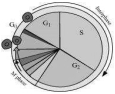
(N/A) Interphase involves a series of changes that prepare a cell for division. It is the period during which the cell experiences growth and $DNA$ replication in an orderly manner. Interphase is divided into three phases:
$G_{1}$ phase
$S$ phase
$G_{2}$ phase
$G_{1}$ phase: It is the stage during which the cell grows and prepares its $DNA$ for replication. In this phase,the cell is metabolically active.
$S$ phase: It is the stage during which $DNA$ synthesis occurs. In this phase,the amount of $DNA$ (per cell) doubles,but the chromosome number remains the same.
$G_{2}$ phase: In this phase,the cell continues to grow and prepares itself for division. The proteins and $RNA$ required for mitosis are synthesised during this stage.
$G_{1}$ phase
$S$ phase
$G_{2}$ phase
$G_{1}$ phase: It is the stage during which the cell grows and prepares its $DNA$ for replication. In this phase,the cell is metabolically active.
$S$ phase: It is the stage during which $DNA$ synthesis occurs. In this phase,the amount of $DNA$ (per cell) doubles,but the chromosome number remains the same.
$G_{2}$ phase: In this phase,the cell continues to grow and prepares itself for division. The proteins and $RNA$ required for mitosis are synthesised during this stage.
0 likes
View Solution167
DifficultMCQ
What is $G_{0}$ (quiescent phase) of the cell cycle?
A
$A$ stage where cells stop metabolic activity.
B
$A$ stage where cells proliferate continuously.
C
$A$ stage where cells remain metabolically active but do not proliferate unless required.
D
$A$ stage of rapid $DNA$ replication.
Solution
(C) $G_{0}$ or quiescent phase is the stage wherein cells remain metabolically active,but do not proliferate unless called to do so.
Such cells are used for replacing the cells lost during injury or tissue damage.
Such cells are used for replacing the cells lost during injury or tissue damage.
0 likes
View Solution168
MediumMCQ
Can there be mitosis without $DNA$ replication in $S$ phase?
A
Yes,it can occur.
B
No,it cannot occur.
C
Only in plant cells.
D
Only in animal cells.
Solution
(B) Mitotic cell division cannot take place without $DNA$ replication in the $S$ phase.
Two important events take place during the $S$ phase: one is the synthesis or duplication of $DNA$,and the other is the duplication of the centriole.
$DNA$ duplication is essential because it maintains the chromosome number in the daughter cells.
Mitosis is an equational division,meaning the chromosome number remains the same as the parent cell.
Therefore,the duplication of $DNA$ is a mandatory prerequisite for mitosis.
Two important events take place during the $S$ phase: one is the synthesis or duplication of $DNA$,and the other is the duplication of the centriole.
$DNA$ duplication is essential because it maintains the chromosome number in the daughter cells.
Mitosis is an equational division,meaning the chromosome number remains the same as the parent cell.
Therefore,the duplication of $DNA$ is a mandatory prerequisite for mitosis.
0 likes
View Solution169
EasyMCQ
Can there be $DNA$ replication without cell division?
A
Yes
B
No
C
Only in prokaryotes
D
Only in viruses
Solution
(A) Yes,there can be $DNA$ replication without cell division.
During normal cell division,the parent cell divides into two daughter cells.
However,if $DNA$ replication occurs repeatedly without subsequent cell division,the $DNA$ content accumulates within the nucleus.
This leads to an increase in the volume of the nucleus and the overall size of the cell.
$A$ classic example of this phenomenon is observed in the salivary glands of $Drosophila$ (fruit fly).
The chromosomes formed due to repeated $DNA$ replication without cell division are known as polytene chromosomes.
During normal cell division,the parent cell divides into two daughter cells.
However,if $DNA$ replication occurs repeatedly without subsequent cell division,the $DNA$ content accumulates within the nucleus.
This leads to an increase in the volume of the nucleus and the overall size of the cell.
$A$ classic example of this phenomenon is observed in the salivary glands of $Drosophila$ (fruit fly).
The chromosomes formed due to repeated $DNA$ replication without cell division are known as polytene chromosomes.
0 likes
View Solution170
Medium
What is meant by cell cycle? Explain.
Solution
(N/A) $\Rightarrow$ Cell division is a very important process in all living organisms.
$\Rightarrow$ $DNA$ replication and cell growth take place during cell division.
$\Rightarrow$ All processes like cell division,$DNA$ replication,and cell growth must occur in a coordinated manner to ensure correct division and the formation of progeny cells containing intact genomes.
$\Rightarrow$ Cell Cycle: The sequence of events by which a cell duplicates its genome,synthesizes the other constituents of the cell,and eventually divides into two daughter cells is termed the cell cycle.
$\Rightarrow$ Although cell growth (in terms of cytoplasmic increase) is a continuous process,$DNA$ synthesis occurs only during one specific stage in the cell cycle.
$\Rightarrow$ The replicated chromosomes $(2n)$ $(DNA)$ are then distributed to daughter nuclei by a complex series of events during cell division.
$\Rightarrow$ These events are under genetic control.
$\Rightarrow$ $DNA$ replication and cell growth take place during cell division.
$\Rightarrow$ All processes like cell division,$DNA$ replication,and cell growth must occur in a coordinated manner to ensure correct division and the formation of progeny cells containing intact genomes.
$\Rightarrow$ Cell Cycle: The sequence of events by which a cell duplicates its genome,synthesizes the other constituents of the cell,and eventually divides into two daughter cells is termed the cell cycle.
$\Rightarrow$ Although cell growth (in terms of cytoplasmic increase) is a continuous process,$DNA$ synthesis occurs only during one specific stage in the cell cycle.
$\Rightarrow$ The replicated chromosomes $(2n)$ $(DNA)$ are then distributed to daughter nuclei by a complex series of events during cell division.
$\Rightarrow$ These events are under genetic control.
0 likes
View Solution171
Medium
Explain the various phases of the cell cycle in detail.
Solution
(N/A) $ \Rightarrow $ $ A $ typical eukaryotic cell is illustrated by human cells in culture.
$ \Rightarrow $ The duration of the cell cycle can vary from organism to organism and also from cell type to cell type.
$ \Rightarrow $ $ A $ cell cycle is completed every $ 24 $ hours in human beings.
$ \Rightarrow $ Yeast can progress through the cell cycle in about $ 90 $ minutes.
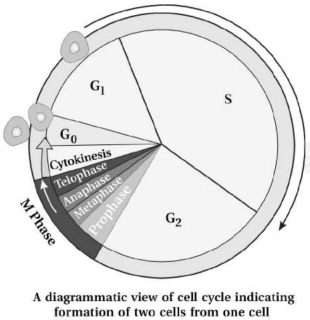
$ \Rightarrow $ The cell cycle is divided into two basic phases:
$ (1) $ Interphase
$ (2) $ $ M $-Phase (Mitosis phase)
$ \Rightarrow $ The $ M $-Phase represents the phase when the actual cell division or mitosis occurs.
$ \Rightarrow $ The interphase represents the phase between two successive $ M $-phases.
$ \Rightarrow $ It is significant to note that in the $ 24 $ hours average duration of the cell cycle of a human cell, cell division lasts for only about an hour.
$ \Rightarrow $ The interphase lasts for more than $ 95\% $ of the duration of the cell cycle.
$ \Rightarrow $ The $ M $-Phase starts with nuclear division, corresponding to the separation of daughter chromosomes (Karyokinesis), and usually ends with the division of the cytoplasm (Cytokinesis).
$ \Rightarrow $ The interphase, though called the resting phase, is the time during which the cell is preparing for division by undergoing both cell growth and $ DNA $ replication in an orderly manner. It is further divided into $ G_1 $, $ S $, and $ G_2 $ phases.
$ \Rightarrow $ The duration of the cell cycle can vary from organism to organism and also from cell type to cell type.
$ \Rightarrow $ $ A $ cell cycle is completed every $ 24 $ hours in human beings.
$ \Rightarrow $ Yeast can progress through the cell cycle in about $ 90 $ minutes.
$ \Rightarrow $ The cell cycle is divided into two basic phases:
$ (1) $ Interphase
$ (2) $ $ M $-Phase (Mitosis phase)
$ \Rightarrow $ The $ M $-Phase represents the phase when the actual cell division or mitosis occurs.
$ \Rightarrow $ The interphase represents the phase between two successive $ M $-phases.
$ \Rightarrow $ It is significant to note that in the $ 24 $ hours average duration of the cell cycle of a human cell, cell division lasts for only about an hour.
$ \Rightarrow $ The interphase lasts for more than $ 95\% $ of the duration of the cell cycle.
$ \Rightarrow $ The $ M $-Phase starts with nuclear division, corresponding to the separation of daughter chromosomes (Karyokinesis), and usually ends with the division of the cytoplasm (Cytokinesis).
$ \Rightarrow $ The interphase, though called the resting phase, is the time during which the cell is preparing for division by undergoing both cell growth and $ DNA $ replication in an orderly manner. It is further divided into $ G_1 $, $ S $, and $ G_2 $ phases.
0 likes
View Solution172
Medium
Explain the events occurring in $G_{1}$ phase in short.
Solution
(N/A) $\Rightarrow$ $G_{1}$ phase is the initial stage of interphase.
$\Rightarrow$ This phase corresponds to the interval between mitosis and the initiation of $DNA$ replication.
$\Rightarrow$ During the $G_{1}$ phase,necessary enzymes,$RNA$,and proteins are synthesized for the synthesis of $DNA$.
$\Rightarrow$ $DNA$ replication does not occur in this phase.
$\Rightarrow$ In the $G_{1}$ phase,cells are metabolically active and grow continuously.
$\Rightarrow$ This phase corresponds to the interval between mitosis and the initiation of $DNA$ replication.
$\Rightarrow$ During the $G_{1}$ phase,necessary enzymes,$RNA$,and proteins are synthesized for the synthesis of $DNA$.
$\Rightarrow$ $DNA$ replication does not occur in this phase.
$\Rightarrow$ In the $G_{1}$ phase,cells are metabolically active and grow continuously.
0 likes
View Solution173
Medium
What is called the quiescent stage? Give information.
Solution
(N/A) $\Rightarrow$ Some cells in adult animals do not appear to exhibit division (e.g.,heart cells,nerve cells),and many other cells divide only occasionally as needed to replace cells lost due to injury or cell death.
$\Rightarrow$ These cells that do not divide further exit the $G_{1}$ phase to enter an inactive stage called the quiescent stage $(G_{0})$ of the cell cycle.
$\Rightarrow$ Cells in this stage remain metabolically active but no longer proliferate unless called upon to do so,depending on the requirements of the organism.
$\Rightarrow$ Note: In animals,mitotic cell division is only seen in diploid somatic cells. Plants can show mitotic divisions in both haploid $(n)$ and diploid $(2n)$ cells.
$\Rightarrow$ These cells that do not divide further exit the $G_{1}$ phase to enter an inactive stage called the quiescent stage $(G_{0})$ of the cell cycle.
$\Rightarrow$ Cells in this stage remain metabolically active but no longer proliferate unless called upon to do so,depending on the requirements of the organism.
$\Rightarrow$ Note: In animals,mitotic cell division is only seen in diploid somatic cells. Plants can show mitotic divisions in both haploid $(n)$ and diploid $(2n)$ cells.
0 likes
View Solution174
Medium
$(1)$ Definition / Explanation: Cell cycle
$(2)$ Definition / Explanation: Interphase
$(2)$ Definition / Explanation: Interphase
Solution
(N/A) $(1)$ The sequence of events by which a cell duplicates its genome,synthesizes the other constituents of the cell,and eventually divides into two daughter cells is called the cell cycle.
$(2)$ Interphase is the phase between two successive $M$ phases. It is the period of preparation where the cell undergoes growth,$DNA$ replication,and synthesis of required materials for the subsequent cell division.
$(2)$ Interphase is the phase between two successive $M$ phases. It is the period of preparation where the cell undergoes growth,$DNA$ replication,and synthesis of required materials for the subsequent cell division.
0 likes
View Solution175
MediumMCQ
Two key events take place during $S$ phase in animal cells: $DNA$ replication and duplication of centriole. In which parts of the cell do these events occur?
A
Both in nucleus
B
Both in cytoplasm
C
$DNA$ replication in nucleus and centriole duplication in cytoplasm
D
$DNA$ replication in cytoplasm and centriole duplication in nucleus
Solution
(C) $\Rightarrow$ Replication of $DNA$ takes place in the nucleus,and the doubling (duplication) of the centriole is seen in the cytoplasm.
Centrioles are cylindrical structures that form spindle fibers during cell division in animal cells,which control chromosomal movement.
The $DNA$ is contained within the nucleus,hence its replication occurs there,while centrioles are organelles located in the cytoplasm near the nucleus.
Centrioles are cylindrical structures that form spindle fibers during cell division in animal cells,which control chromosomal movement.
The $DNA$ is contained within the nucleus,hence its replication occurs there,while centrioles are organelles located in the cytoplasm near the nucleus.
0 likes
View Solution176
EasyMCQ
Between a prokaryote and a eukaryote,which cell has a shorter cell division time?
A
Prokaryote
B
Eukaryote
C
Both have the same time
D
Depends on the environment
Solution
(A) Prokaryotic cells have a significantly shorter cell division time compared to eukaryotic cells.
For example,the bacterium $E. coli$ can divide in approximately $20$ minutes under optimal conditions.
In contrast,typical eukaryotic cells,such as those in humans,take about $24$ hours to complete a cell cycle.
Therefore,prokaryotes exhibit a much faster rate of cell division.
For example,the bacterium $E. coli$ can divide in approximately $20$ minutes under optimal conditions.
In contrast,typical eukaryotic cells,such as those in humans,take about $24$ hours to complete a cell cycle.
Therefore,prokaryotes exhibit a much faster rate of cell division.
0 likes
View Solution177
MediumMCQ
Which of the phases of the cell cycle is of the longest duration?
A
G1 phase
B
$S$ phase
C
$M$ phase
D
Interphase
Solution
(D) The cell cycle is divided into two main phases: $Interphase$ and $M$ phase (Mitosis/Meiosis).
$Interphase$ is the phase during which the cell prepares for division by growing and replicating its $DNA$.
It occupies more than $95\%$ of the total duration of the cell cycle.
Therefore, $Interphase$ is the longest phase of the cell cycle.
$Interphase$ is the phase during which the cell prepares for division by growing and replicating its $DNA$.
It occupies more than $95\%$ of the total duration of the cell cycle.
Therefore, $Interphase$ is the longest phase of the cell cycle.
0 likes
View Solution178
MediumMCQ
What attributes does a chromatid require to be classified as a chromosome?
A
Presence of a centromere
B
Presence of two sister chromatids
C
Presence of a telomere
D
Presence of a nucleolus
Solution
(A) chromatid is a single $DNA$ molecule that forms one-half of a duplicated chromosome.
During the cell cycle,specifically after $DNA$ replication,two identical chromatids are joined together at a region called the centromere.
Once these chromatids separate during cell division (such as in anaphase),each individual chromatid is then independently referred to as a chromosome.
Therefore,the primary attribute required for a chromatid to be classified as a chromosome is the presence of its own functional centromere,which allows it to be moved by spindle fibers.
During the cell cycle,specifically after $DNA$ replication,two identical chromatids are joined together at a region called the centromere.
Once these chromatids separate during cell division (such as in anaphase),each individual chromatid is then independently referred to as a chromosome.
Therefore,the primary attribute required for a chromatid to be classified as a chromosome is the presence of its own functional centromere,which allows it to be moved by spindle fibers.
0 likes
View Solution179
MediumMCQ
At what stage of the cell cycle does $DNA$ synthesis take place?
A
G1 phase
B
$S$ phase
C
G2 phase
D
$M$ phase
Solution
(B) $DNA$ synthesis occurs during the $S$ (synthetic) phase of the interphase of the cell cycle.
During this phase,the amount of $DNA$ per cell doubles,although the chromosome number remains the same.
During this phase,the amount of $DNA$ per cell doubles,although the chromosome number remains the same.
0 likes
View Solution180
EasyMCQ
It is said that one cycle of cell division in human cells (eukaryotic cells) takes $24$ hours. Which phase of the cycle do you think occupies the maximum part of the cell cycle?
A
Interphase
B
Prophase
C
Metaphase
D
Telophase
Solution
(A) The total duration of the cell cycle in human cells is approximately $24$ hours.
Interphase is the phase of the cell cycle during which the cell prepares for division by growing and replicating its $DNA$.
It is the longest phase of the cell cycle,occupying about $95 \%$ of the total time.
Therefore,the correct answer is Interphase.
Interphase is the phase of the cell cycle during which the cell prepares for division by growing and replicating its $DNA$.
It is the longest phase of the cell cycle,occupying about $95 \%$ of the total time.
Therefore,the correct answer is Interphase.
0 likes
View Solution181
MediumMCQ
It is observed that heart cells do not exhibit cell division. Such cells do not divide further and exit $G_{1}$ phase to enter an inactive stage called $G_{0}$ of cell cycle. Fill in the blanks.
A
$G_{1}, G_{0}$
B
$S, G_{1}$
C
$G_{2}, S$
D
$M, G_{1}$
Solution
(A) Heart cells are specialized cells that do not undergo further division once they reach maturity.
These cells exit the $G_{1}$ phase of the cell cycle and enter an inactive stage known as the $G_{0}$ phase (also called the quiescent stage).
In the $G_{0}$ phase,cells remain metabolically active but do not proliferate unless called upon to do so by specific signals.
These cells exit the $G_{1}$ phase of the cell cycle and enter an inactive stage known as the $G_{0}$ phase (also called the quiescent stage).
In the $G_{0}$ phase,cells remain metabolically active but do not proliferate unless called upon to do so by specific signals.
0 likes
View Solution182
EasyMCQ
Identify the correct statement with regard to $G_{1}$ phase $(Gap\,1)$ of interphase.
A
Nuclear division takes place.
B
$DNA$ synthesis or replication takes place.
C
Reorganisation of all cell components takes place.
D
Cell is metabolically active,grows but does not replicate its $DNA$.
Solution
(D) The $G_{1}$ phase,also known as the first gap phase,is the interval between mitosis and the initiation of $DNA$ replication. During this phase,the cell is metabolically active and continuously grows in size,but it does not replicate its $DNA$.
0 likes
View Solution183
EasyMCQ
Some dividing cells exit the cell cycle and enter a vegetative inactive stage. This is called the quiescent stage $(G_{0})$. This process occurs at the end of:
A
$G_{2}$ phase
B
$G_{1}$ phase
C
$G_{0}$ phase
D
$S$ phase
Solution
(B) Cells that do not divide further exit the $G_{1}$ phase to enter an inactive stage called the quiescent stage $(G_{0})$ of the cell cycle.
In this stage,cells remain metabolically active but no longer proliferate unless called upon to do so depending on the requirement of the organism.
In this stage,cells remain metabolically active but no longer proliferate unless called upon to do so depending on the requirement of the organism.
0 likes
View Solution184
EasyMCQ
Identify the correct statement regarding the $G_1$ phase (Gap $1$) of interphase:
A
$DNA$ synthesis or replication occurs.
B
All cellular components are reorganized.
C
The cell is metabolically active,grows,but does not replicate its $DNA$.
D
The nucleus undergoes division.
Solution
(C) The cell cycle is divided into two main phases: Interphase and $M$-phase.
Interphase is further divided into $G_1$ phase,$S$ phase,and $G_2$ phase.
In the $G_1$ phase (Gap $1$),the cell is metabolically active and continuously grows in size.
However,$DNA$ replication does not occur during this phase; $DNA$ replication takes place specifically during the $S$ phase (Synthesis phase).
Therefore,the correct statement is that the cell is metabolically active and grows,but does not replicate its $DNA$.
Interphase is further divided into $G_1$ phase,$S$ phase,and $G_2$ phase.
In the $G_1$ phase (Gap $1$),the cell is metabolically active and continuously grows in size.
However,$DNA$ replication does not occur during this phase; $DNA$ replication takes place specifically during the $S$ phase (Synthesis phase).
Therefore,the correct statement is that the cell is metabolically active and grows,but does not replicate its $DNA$.
0 likes
View Solution185
MediumMCQ
Some dividing cells exit the cell cycle and enter a vegetative,inactive stage called the quiescent stage $(G_{0})$. This process occurs at the end of:
A
$M$ phase
B
$G_{2}$ phase
C
$S$ phase
D
$G_{1}$ phase
Solution
(D) The cell cycle consists of the $G_{1}$ phase,$S$ phase,$G_{2}$ phase,and $M$ phase.
Cells that do not divide further exit the $G_{1}$ phase to enter an inactive stage called the quiescent stage $(G_{0})$.
Therefore,the $G_{0}$ stage occurs at the end of the $G_{1}$ phase.
Cells that do not divide further exit the $G_{1}$ phase to enter an inactive stage called the quiescent stage $(G_{0})$.
Therefore,the $G_{0}$ stage occurs at the end of the $G_{1}$ phase.
0 likes
View Solution186
MediumMCQ
Which process is essential for the formation of tissues?
A
Meiosis
B
Cell division
C
Differentiation
D
Binary fission
Solution
(B) The formation of tissues from a single cell (like a zygote) requires two fundamental processes: cell division (to increase the number of cells) and cell differentiation (where cells specialize to perform specific functions). Among the given options,cell division is the primary and essential process that provides the necessary cellular mass for tissue formation.
0 likes
View Solution187
EasyMCQ
In a mitotic cycle,the correct sequence of phases is
A
$G_{1}, G_{2}, S, M$
B
$S, G_{1}, G_{2}, M$
C
$G_{1}, S, G_{2}, M$
D
$M, G_{1}, G_{2}, S$
Solution
(C) The cell cycle is divided into two main phases: Interphase and $M$-phase (Mitosis).
Interphase is further subdivided into three stages: $G_{1}$ phase (Gap $1$),$S$ phase (Synthesis),and $G_{2}$ phase (Gap $2$).
Following Interphase,the cell enters the $M$-phase.
Therefore,the correct sequence is $G_{1} \rightarrow S \rightarrow G_{2} \rightarrow M$.
Interphase is further subdivided into three stages: $G_{1}$ phase (Gap $1$),$S$ phase (Synthesis),and $G_{2}$ phase (Gap $2$).
Following Interphase,the cell enters the $M$-phase.
Therefore,the correct sequence is $G_{1} \rightarrow S \rightarrow G_{2} \rightarrow M$.
0 likes
View Solution188
MediumMCQ
If the cell has $14$ chromosomes at interphase,then how many chromosomes will the cell have at $G_{1}$-phase of the cell cycle?
A
$28$
B
$14$
C
$7$
D
$21$
Solution
(B) The $G_{1}$-phase is the first gap phase of the cell cycle,occurring before the $S$-phase (Synthesis phase).
During the $S$-phase,$DNA$ replication occurs,which doubles the amount of $DNA$ per cell,but the number of chromosomes remains the same.
Since the cell has $14$ chromosomes during interphase,and the $G_{1}$-phase is a part of interphase,the number of chromosomes remains $14$ in the $G_{1}$-phase.
The chromosome number only changes during the $M$-phase (Mitosis or Meiosis) when sister chromatids or homologous chromosomes separate.
During the $S$-phase,$DNA$ replication occurs,which doubles the amount of $DNA$ per cell,but the number of chromosomes remains the same.
Since the cell has $14$ chromosomes during interphase,and the $G_{1}$-phase is a part of interphase,the number of chromosomes remains $14$ in the $G_{1}$-phase.
The chromosome number only changes during the $M$-phase (Mitosis or Meiosis) when sister chromatids or homologous chromosomes separate.
0 likes
View Solution189
MediumMCQ
Which of the following events occurs during $G_{1}$-phase?
A
$DNA$ replication
B
Growth and normal function of cell
C
Mutation
D
Fertilization
Solution
(B) $G_{1}$-phase is known as the pre-synthetic phase or post-mitotic phase.
It is the longest phase of the cell cycle.
During the $G_{1}$-phase,the cell undergoes metabolic activities,grows in size,and performs its normal physiological functions.
After this phase,the cell has two options:
$1.$ It continues the cell cycle and enters the $S$-phase for $DNA$ replication.
$2.$ It stops the cell cycle and enters the $G_{0}$-phase (quiescent stage) for differentiation or to remain metabolically active without dividing.
It is the longest phase of the cell cycle.
During the $G_{1}$-phase,the cell undergoes metabolic activities,grows in size,and performs its normal physiological functions.
After this phase,the cell has two options:
$1.$ It continues the cell cycle and enters the $S$-phase for $DNA$ replication.
$2.$ It stops the cell cycle and enters the $G_{0}$-phase (quiescent stage) for differentiation or to remain metabolically active without dividing.
0 likes
View Solution190
MediumMCQ
Differentiated cells remain at which stage?
A
$G_{1}$
B
$G_{2}$
C
$G_{0}$
D
$M$
Solution
(C) Cells that do not divide further do not proceed beyond the $G_{1}$ phase. Instead,they exit the cell cycle and enter an inactive stage called the quiescent stage or $G_{0}$ phase. In this stage,cells remain metabolically active but do not proliferate unless called upon to do so,often undergoing differentiation to perform specific functions in the organism.
0 likes
View Solution191
MediumMCQ
The number of $DNA$ strands (chromatids) in a chromosome at the $G_{2}$-stage is:
A
One
B
Two
C
Four
D
Eight
Solution
(B) During the $S$-phase (Synthesis phase) of the cell cycle,$DNA$ replication occurs,which doubles the amount of $DNA$ per chromosome.
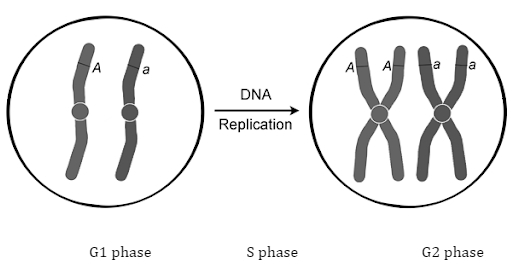
In the $G_{1}$-phase,each chromosome consists of a single chromatid (one $DNA$ molecule).
After $DNA$ replication in the $S$-phase,each chromosome consists of two sister chromatids,each containing one $DNA$ molecule.
Therefore,at the $G_{2}$-stage,each chromosome contains two $DNA$ strands (chromatids) held together by a centromere.
In the $G_{1}$-phase,each chromosome consists of a single chromatid (one $DNA$ molecule).
After $DNA$ replication in the $S$-phase,each chromosome consists of two sister chromatids,each containing one $DNA$ molecule.
Therefore,at the $G_{2}$-stage,each chromosome contains two $DNA$ strands (chromatids) held together by a centromere.
0 likes
View Solution192
MediumMCQ
Mature nerve cells are incapable of cell division. These cells are probably considered to be in:
A
$G_{2}$-phase
B
$S$-phase
C
Mitosis
D
$G_{0}$-phase
Solution
(D) Some cells in adult animals do not appear to exhibit division (e.g.,nerve cells,heart cells). Many other cells divide only occasionally,for example,when there is a need to replace cells that have been lost due to injury or cell death.
These cells that do not divide further exit the $G_{1}$-phase to enter an inactive stage called the quiescent stage $(G_{0})$ of the cell cycle.
Cells in this stage remain metabolically active but no longer proliferate.
These cells that do not divide further exit the $G_{1}$-phase to enter an inactive stage called the quiescent stage $(G_{0})$ of the cell cycle.
Cells in this stage remain metabolically active but no longer proliferate.
0 likes
View Solution193
MediumMCQ
The $S-$phase of the cell cycle is characterized by
A
Duplication of chromosome number
B
Shortening of chromosome
C
Duplication of $DNA$
D
Duplication of cell organelles
Solution
(C) The synthesis phase or $S-$phase is the period in the cell cycle during which $DNA$ replication occurs.
During this phase,the amount of $DNA$ per cell doubles,but the chromosome number remains the same.
Additionally,the synthesis of histone proteins occurs in this phase,and each chromosome consists of two sister chromatids.
During this phase,the amount of $DNA$ per cell doubles,but the chromosome number remains the same.
Additionally,the synthesis of histone proteins occurs in this phase,and each chromosome consists of two sister chromatids.
0 likes
View Solution194
MediumMCQ
$A$ plant cell has $12$ chromosomes at the end of mitosis. How many chromosomes would it have in the $G_{2}$-phase of its next cell cycle?
A
$6$
B
$8$
C
$12$
D
$24$
Solution
(C) Mitosis results in two daughter cells,each having the same number of chromosomes as the parent cell. If the cell has $12$ chromosomes at the end of mitosis,it means the diploid number $(2n)$ is $12$.
During the $S$-phase of the next cell cycle,the $DNA$ content doubles,but the number of chromosomes remains the same.
In the $G_{2}$-phase,the cell still contains the same number of chromosomes as it did after mitosis,although each chromosome now consists of two sister chromatids.
Therefore,the number of chromosomes in the $G_{2}$-phase remains $12$.
During the $S$-phase of the next cell cycle,the $DNA$ content doubles,but the number of chromosomes remains the same.
In the $G_{2}$-phase,the cell still contains the same number of chromosomes as it did after mitosis,although each chromosome now consists of two sister chromatids.
Therefore,the number of chromosomes in the $G_{2}$-phase remains $12$.
0 likes
View Solution195
MediumMCQ
$DNA$ replicates:
A
Twice in each cell cycle
B
Only once in each cell cycle
C
Once in mitotic cell cycle,once in meiotic-$I$ (reductional division) and once in meiotic-$II$ (equational division)
D
None of the above
Solution
(B) $DNA$ replication occurs only once during the $S$-phase (Synthesis phase) of the cell cycle. This ensures that the genetic material is duplicated exactly once before the cell undergoes division,whether it is mitosis or meiosis.
0 likes
View Solution196
MediumMCQ
Which of the following statements is true for cells in the $G_{0}$ stage of the cell cycle?
A
Cells in the $G_{0}$ stage are metabolically more active
B
Cells are metabolically inactive
C
Cells are metabolically active but no longer proliferate under normal conditions
D
None of the above
Solution
(C) The $G_{0}$ phase,also known as the quiescent stage,is a state where cells exit the cell cycle.
During this phase,cells remain metabolically active,meaning they continue to perform essential cellular functions such as protein synthesis and respiration.
However,they do not undergo further division or proliferation unless called upon to do so by specific signals in response to injury or other physiological requirements.
During this phase,cells remain metabolically active,meaning they continue to perform essential cellular functions such as protein synthesis and respiration.
However,they do not undergo further division or proliferation unless called upon to do so by specific signals in response to injury or other physiological requirements.
0 likes
View Solution197
MediumMCQ
In $G_{1}$-phase of cell cycle,what would be the change in $DNA$ content of the cell?
A
$DNA$ content increases to double
B
$DNA$ content gets reduced
C
Four fold increase of $DNA$ content
D
No change in $DNA$ content
Solution
(D) $G_{1}$-phase corresponds to the interval between mitosis and the initiation of $DNA$ replication.
During the $G_{1}$-phase,the cell is metabolically active and continuously grows in size,but it does not replicate its $DNA$.
Therefore,the amount of $DNA$ remains the same as it was at the end of the previous cell division.
During the $G_{1}$-phase,the cell is metabolically active and continuously grows in size,but it does not replicate its $DNA$.
Therefore,the amount of $DNA$ remains the same as it was at the end of the previous cell division.
0 likes
View Solution198
MediumMCQ
The sequence of the four phases of the cell cycle is:
A
$G_{1} \rightarrow S \rightarrow G_{2} \rightarrow M$
B
$G_{1} \rightarrow G_{2} \rightarrow S \rightarrow M$
C
$S \rightarrow G_{1} \rightarrow G_{2} \rightarrow M$
D
$M \rightarrow G_{1} \rightarrow G_{2} \rightarrow S$
Solution
(A) The cell cycle is divided into two main phases: Interphase and $M$-phase (Mitosis).
Interphase consists of three sub-phases: $G_{1}$ (Gap $1$),$S$ (Synthesis),and $G_{2}$ (Gap $2$).
Following Interphase,the cell enters the $M$-phase.
Therefore,the correct chronological sequence is $G_{1} \rightarrow S \rightarrow G_{2} \rightarrow M$.
Interphase consists of three sub-phases: $G_{1}$ (Gap $1$),$S$ (Synthesis),and $G_{2}$ (Gap $2$).
Following Interphase,the cell enters the $M$-phase.
Therefore,the correct chronological sequence is $G_{1} \rightarrow S \rightarrow G_{2} \rightarrow M$.
0 likes
View Solution199
MediumMCQ
What would be the change in the chromosome number during $S$-phase?
A
No change
B
The number of chromosomes doubles
C
The number of chromosomes doubles only in case of diploid cell
D
The number of chromosomes doubles only in case of haploid cell
Solution
(A) During the $S$-phase (Synthesis phase) of the cell cycle,$DNA$ replication occurs.
Although the amount of $DNA$ per cell doubles (from $2C$ to $4C$),the number of chromosomes remains the same.
This is because the sister chromatids remain attached at the centromere.
If a cell has $2n$ chromosomes at the $G_1$ phase,it will still have $2n$ chromosomes after the $S$-phase.
Although the amount of $DNA$ per cell doubles (from $2C$ to $4C$),the number of chromosomes remains the same.
This is because the sister chromatids remain attached at the centromere.
If a cell has $2n$ chromosomes at the $G_1$ phase,it will still have $2n$ chromosomes after the $S$-phase.
0 likes
View SolutionCell Cycle and Cell Division — Cell Cycle · Frequently Asked Questions
1Are these Cell Cycle and Cell Division questions useful for JEE and NEET?
Yes. All questions in this section are mapped to JEE Main and NEET exam patterns. Previous year questions from JEE Main, NEET, GUJCET and state-level exams are included with full solutions.
2Can I switch to Hindi or Gujarati for these questions?
Yes. Use the language tabs in the hero section or the sidebar to view the same questions and solutions in English, Hindi or Gujarati.
3How do I generate a question paper from this subtopic?
Use the Vedclass Exam Paper Generator — select the chapter and subtopic, set difficulty, and generate Sets A, B, C, D automatically. First 3 chapters of every subject are free.
Vedclass Products
For Students
Vedclass Test Series
Mock tests in real JEE/NEET style with performance analysis. 5-day free trial.
Start Free TrialFor Teachers
Exam Paper Generator
Generate Set A/B/C/D papers from this chapter in 2 minutes. 3 chapters free.
Try FreeFor Institutes
Online Exam Module
Live online exams with unlimited students, 360° analytics & white-label branding.
See DemoFor Teachers & Institutes
Generate a Cell Cycle and Cell Division Exam Paper in 2 Minutes
Select subtopic & difficulty — Sets A, B, C, D auto-generated with No Repeat logic.
First 3 chapters of every subject are free — no payment required.