
A English
Cell Cycle Questions in English
Class 11 Biology · Cell Cycle and Cell Division · Cell Cycle
261+
Questions
English
Language
100%
With Solutions
Showing 50 of 261 questions in English
101
MediumMCQ
In which phase does the synthesis of spindle fiber proteins occur?
A
$S$-phase
B
$G_1$-phase
C
$G_2$-phase
D
Metaphase
Solution
(C) The cell cycle consists of interphase ($G_1$,$S$,$G_2$) and the $M$-phase.
During the $G_2$-phase (Gap $2$ phase),the cell continues to grow and synthesizes essential proteins,such as tubulin,which are required for the formation of spindle fibers during mitosis.
Therefore,the synthesis of spindle fiber proteins occurs in the $G_2$-phase.
During the $G_2$-phase (Gap $2$ phase),the cell continues to grow and synthesizes essential proteins,such as tubulin,which are required for the formation of spindle fibers during mitosis.
Therefore,the synthesis of spindle fiber proteins occurs in the $G_2$-phase.
0 likes
View Solution102
EasyMCQ
The formation of new cells occurs through which cycle?
A
Calvin cycle
B
Krebs cycle
C
Cell cycle
D
Reproductive cycle
Solution
(C) The $Cell$ $cycle$ is the series of events that take place in a cell leading to its division and duplication of its $DNA$ to produce two daughter cells.
It consists of two main phases: $Interphase$ and $M-phase$ (Mitotic phase).
Calvin cycle is related to photosynthesis, Krebs cycle is related to cellular respiration, and the reproductive cycle is related to the biological process of reproduction.
Therefore, the correct answer is $Cell$ $cycle$.
It consists of two main phases: $Interphase$ and $M-phase$ (Mitotic phase).
Calvin cycle is related to photosynthesis, Krebs cycle is related to cellular respiration, and the reproductive cycle is related to the biological process of reproduction.
Therefore, the correct answer is $Cell$ $cycle$.
0 likes
View Solution103
EasyMCQ
How many cells initiate the process of cellular reproduction?
A
One cell
B
Two cells
C
Numerous cells
D
Somatic cell
Solution
(A) Cellular reproduction,or cell division,is a fundamental process by which a parent cell divides into two or more daughter cells. In all living organisms,this process is initiated by a single parent cell. Therefore,the correct answer is $A$.
0 likes
View Solution104
EasyMCQ
All cells undergo which of the following processes?
A
Calvin cycle
B
Cell cycle
C
Krebs cycle
D
Reproductive cycle
Solution
(B) The $Cell \ cycle$ is a series of events that take place in a cell leading to its division and duplication of its $DNA$ $(DNA \ replication)$ to produce two daughter cells. All living cells, whether prokaryotic or eukaryotic, must undergo the cell cycle to grow and divide. The Calvin cycle and Krebs cycle are metabolic pathways, while the reproductive cycle is specific to certain organisms.
0 likes
View Solution105
EasyMCQ
Which of the following terms is consistent with the statement: '$A$ series of events occurring within a cell that leads to cell division and duplication of the cell'?
A
Cell elongation
B
Cell cycle
C
Cell development
D
Cell differentiation
Solution
(B) The $Cell \ cycle$ is defined as the series of events that take place in a cell leading to its duplication and division.
It involves the replication of $DNA$ and the synthesis of other cell components, followed by the division of the cell into two daughter cells.
Therefore, the correct term is $Cell \ cycle$.
It involves the replication of $DNA$ and the synthesis of other cell components, followed by the division of the cell into two daughter cells.
Therefore, the correct term is $Cell \ cycle$.
0 likes
View Solution106
EasyMCQ
How much time is required for a typical human cell to divide in a culture medium?
A
Approximately $24$ hours
B
Approximately $12$ hours
C
Approximately $9$ hours
D
Approximately $48$ hours
Solution
(A) In a typical human cell culture,the cell cycle lasts for approximately $24$ hours. This duration represents the time taken for a cell to complete one cycle of division,including the $G_1$,$S$,$G_2$,and $M$ phases. While the duration of the cell cycle can vary significantly between different organisms and cell types,$24$ hours is the standard value cited for human cells in culture.
0 likes
View Solution107
MediumMCQ
Which of the following cells completes a cell cycle in $90$ minutes?
A
Plant cell
B
Animal cell
C
Yeast cell
D
Algal cell
Solution
(C) The duration of the cell cycle varies significantly among different organisms.
While a typical eukaryotic cell, such as a human cell, takes about $24$ hours to complete a cell cycle, yeast cells are known for their rapid division.
A yeast cell $(Saccharomyces \, cerevisiae)$ is a model organism that can complete its cell cycle in approximately $90$ minutes under optimal growth conditions.
Therefore, the correct answer is the yeast cell.
While a typical eukaryotic cell, such as a human cell, takes about $24$ hours to complete a cell cycle, yeast cells are known for their rapid division.
A yeast cell $(Saccharomyces \, cerevisiae)$ is a model organism that can complete its cell cycle in approximately $90$ minutes under optimal growth conditions.
Therefore, the correct answer is the yeast cell.
0 likes
View Solution108
EasyMCQ
What is the correct sequence of phases in the cell cycle?
A
$S, G_1, G_2, M$
B
$S, M, G_1, G_2, M$
C
$G_1, S, G_2, M$
D
$G_2, S, M, G_1$
Solution
(C) The cell cycle is a series of events that take place in a cell leading to its division and duplication.
It consists of two main phases: Interphase and $M$-phase (Mitosis).
Interphase is further divided into three sub-phases:
$1$. $G_1$ phase (Gap $1$): The cell grows and prepares for $DNA$ replication.
$2$. $S$ phase (Synthesis): $DNA$ replication occurs.
$3$. $G_2$ phase (Gap $2$): The cell prepares for mitosis.
After Interphase,the cell enters the $M$ phase (Mitosis),where the actual division occurs.
Therefore,the correct sequence is $G_1 \rightarrow S \rightarrow G_2 \rightarrow M$.
It consists of two main phases: Interphase and $M$-phase (Mitosis).
Interphase is further divided into three sub-phases:
$1$. $G_1$ phase (Gap $1$): The cell grows and prepares for $DNA$ replication.
$2$. $S$ phase (Synthesis): $DNA$ replication occurs.
$3$. $G_2$ phase (Gap $2$): The cell prepares for mitosis.
After Interphase,the cell enters the $M$ phase (Mitosis),where the actual division occurs.
Therefore,the correct sequence is $G_1 \rightarrow S \rightarrow G_2 \rightarrow M$.
0 likes
View Solution109
EasyMCQ
In which phase of the cell cycle do $RNA$ and protein synthesis occur?
A
$G_1$-phase
B
$M$-phase
C
$G_2$-phase
D
Quiescent stage $(G_0)$
Solution
(A) The cell cycle consists of interphase and $M$-phase. Interphase is further divided into $G_1$,$S$,and $G_2$ phases.
During the $G_1$-phase (Gap $1$),the cell is metabolically active and continuously grows.
It synthesizes $RNA$,proteins,and other macromolecules required for $DNA$ replication and cell division.
Therefore,$RNA$ and protein synthesis occur primarily during the $G_1$-phase.
During the $G_1$-phase (Gap $1$),the cell is metabolically active and continuously grows.
It synthesizes $RNA$,proteins,and other macromolecules required for $DNA$ replication and cell division.
Therefore,$RNA$ and protein synthesis occur primarily during the $G_1$-phase.
0 likes
View Solution110
EasyMCQ
Which is the longest phase in the cell cycle?
A
Telophase
B
Anaphase
C
Metaphase
D
Interphase
Solution
(D) The cell cycle consists of two main phases: $Interphase$ and $M-phase$ (Mitotic phase).
$Interphase$ is the preparatory phase where the cell grows, replicates its $DNA$, and prepares for division.
It occupies about $95\%$ of the total duration of the cell cycle.
$Interphase$ is further divided into $G_1$, $S$, and $G_2$ phases.
In contrast, $M-phase$ (which includes Prophase, Metaphase, Anaphase, and Telophase) is relatively short.
Therefore, $Interphase$ is the longest phase in the cell cycle.
$Interphase$ is the preparatory phase where the cell grows, replicates its $DNA$, and prepares for division.
It occupies about $95\%$ of the total duration of the cell cycle.
$Interphase$ is further divided into $G_1$, $S$, and $G_2$ phases.
In contrast, $M-phase$ (which includes Prophase, Metaphase, Anaphase, and Telophase) is relatively short.
Therefore, $Interphase$ is the longest phase in the cell cycle.
0 likes
View Solution111
EasyMCQ
In the cell cycle,$DNA$ synthesis occurs during which phase?
A
Throughout the cycle
B
$S$-phase
C
$G_1$ and $S$-phase
D
$G_2$ and $S$-phase
Solution
(B) The cell cycle is divided into two main phases: Interphase and $M$-phase (Mitosis).
Interphase is further divided into $G_1$ phase,$S$ phase (Synthesis phase),and $G_2$ phase.
During the $S$ phase,the replication of $DNA$ takes place.
Therefore,$DNA$ synthesis occurs specifically during the $S$-phase of the cell cycle.
Interphase is further divided into $G_1$ phase,$S$ phase (Synthesis phase),and $G_2$ phase.
During the $S$ phase,the replication of $DNA$ takes place.
Therefore,$DNA$ synthesis occurs specifically during the $S$-phase of the cell cycle.
0 likes
View Solution112
EasyMCQ
Which important metabolic process occurs during the interphase between two successive cell divisions?
A
$DNA$ replication
B
$RNA$ replication
C
$RNA$ translation
D
$DNA$ translation
Solution
(A) The interphase is the phase between two successive cell divisions. It is divided into three sub-phases: $G_1$ phase,$S$ phase,and $G_2$ phase. During the $S$ phase (Synthesis phase),the most critical metabolic process that occurs is the replication of $DNA$. The amount of $DNA$ per cell doubles,although the chromosome number remains the same. This ensures that each daughter cell receives an identical set of genetic material.
0 likes
View Solution113
EasyMCQ
In which of the following stages are the chromosomes least condensed?
A
Interphase
B
Metaphase
C
Prophase
D
Anaphase
Solution
(A) During $Interphase$,the genetic material exists in the form of a loose,thread-like network called $Chromatin$.
In this stage,the $DNA$ is actively involved in replication and transcription,requiring it to be in a decondensed state.
In contrast,during $Prophase$,$Metaphase$,and $Anaphase$,the chromatin undergoes significant coiling and condensation to form compact $Chromosomes$ to facilitate their segregation.
Therefore,chromosomes are least condensed during $Interphase$.
In this stage,the $DNA$ is actively involved in replication and transcription,requiring it to be in a decondensed state.
In contrast,during $Prophase$,$Metaphase$,and $Anaphase$,the chromatin undergoes significant coiling and condensation to form compact $Chromosomes$ to facilitate their segregation.
Therefore,chromosomes are least condensed during $Interphase$.
0 likes
View Solution114
EasyMCQ
Which of the following phases is non-divisional?
A
Interphase
B
Prophase
C
Metaphase
D
Telophase
Solution
(A) The cell cycle is divided into two main phases: $Interphase$ and $M-phase$ (Mitotic phase).
$Interphase$ is the phase between two successive $M-phases$. It is often called the 'resting phase' or 'non-divisional phase' because the cell is not actively dividing,but is instead preparing for division by replicating its $DNA$ and synthesizing proteins.
$Prophase$,$Metaphase$,and $Telophase$ are all stages of the $M-phase$,which is the actual phase of cell division.
Therefore,$Interphase$ is the correct answer.
$Interphase$ is the phase between two successive $M-phases$. It is often called the 'resting phase' or 'non-divisional phase' because the cell is not actively dividing,but is instead preparing for division by replicating its $DNA$ and synthesizing proteins.
$Prophase$,$Metaphase$,and $Telophase$ are all stages of the $M-phase$,which is the actual phase of cell division.
Therefore,$Interphase$ is the correct answer.
0 likes
View Solution115
EasyMCQ
What is the typical duration of the cell cycle in a yeast cell?
A
$90$ minutes
B
$70$ minutes
C
$85$ minutes
D
$120$ minutes
Solution
(A) The cell cycle duration varies significantly among different organisms. In the case of a yeast cell ($Saccharomyces$ $cerevisiae$), the typical duration of the cell cycle is approximately $90$ minutes under optimal laboratory conditions. This is a standard value often cited in cell biology to illustrate the rapid division rate of unicellular eukaryotes compared to human cells, which take about $24$ hours.
0 likes
View Solution116
MediumMCQ
Into how many sub-phases can the interphase be divided?
A
$2$
B
$3$
C
$4$
D
$5$
Solution
(B) The interphase is the phase of the cell cycle in which a typical eukaryotic cell spends most of its life. It is divided into three distinct sub-phases:
$1$. $G_1$ phase (Gap $1$ phase): This is the interval between mitosis and $DNA$ replication.
$2$. $S$ phase (Synthesis phase): During this phase,$DNA$ replication occurs.
$3$. $G_2$ phase (Gap $2$ phase): This is the interval between $DNA$ replication and the beginning of mitosis.
Therefore,the correct answer is $3$.
$1$. $G_1$ phase (Gap $1$ phase): This is the interval between mitosis and $DNA$ replication.
$2$. $S$ phase (Synthesis phase): During this phase,$DNA$ replication occurs.
$3$. $G_2$ phase (Gap $2$ phase): This is the interval between $DNA$ replication and the beginning of mitosis.
Therefore,the correct answer is $3$.
0 likes
View Solution117
MediumMCQ
During which phase of the cell cycle are the proteins and microtubule systems required for mitosis synthesized?
A
$G_2$ phase
B
$G_1$ phase
C
Interphase
D
$M$ phase
Solution
(A) The cell cycle consists of two main phases: Interphase and $M$ phase (Mitosis).
Interphase is further divided into $G_1$,$S$,and $G_2$ phases.
During the $G_1$ phase,the cell grows and prepares for $DNA$ replication.
During the $S$ phase,$DNA$ replication occurs.
During the $G_2$ phase,the cell continues to grow and synthesizes proteins,such as tubulin,which are essential for the formation of the spindle apparatus (microtubules) required for mitosis.
Therefore,the synthesis of proteins and microtubule systems for mitosis occurs in the $G_2$ phase.
Interphase is further divided into $G_1$,$S$,and $G_2$ phases.
During the $G_1$ phase,the cell grows and prepares for $DNA$ replication.
During the $S$ phase,$DNA$ replication occurs.
During the $G_2$ phase,the cell continues to grow and synthesizes proteins,such as tubulin,which are essential for the formation of the spindle apparatus (microtubules) required for mitosis.
Therefore,the synthesis of proteins and microtubule systems for mitosis occurs in the $G_2$ phase.
0 likes
View Solution118
MediumMCQ
If the amount of $DNA$ is $2C$,what will it become at the end of the $S-$phase (in $C$)?
A
$2$
B
$8$
C
$4$
D
$6$
Solution
(C) The cell cycle consists of $G_1$,$S$,$G_2$,and $M$ phases.
During the $S-$phase (Synthesis phase) of the cell cycle,$DNA$ replication occurs.
In this phase,the amount of $DNA$ per cell doubles because each chromosome replicates to form two sister chromatids.
If the initial amount of $DNA$ in the $G_1$ phase is $2C$,then after $DNA$ replication in the $S-$phase,the amount of $DNA$ becomes $4C$.
During the $S-$phase (Synthesis phase) of the cell cycle,$DNA$ replication occurs.
In this phase,the amount of $DNA$ per cell doubles because each chromosome replicates to form two sister chromatids.
If the initial amount of $DNA$ in the $G_1$ phase is $2C$,then after $DNA$ replication in the $S-$phase,the amount of $DNA$ becomes $4C$.
0 likes
View Solution119
MediumMCQ
$P -$ Statement: Interphase can be divided into three sub-phases.
$Q -$ Statement: The $G_1$ phase is the initial phase of interphase.
$Q -$ Statement: The $G_1$ phase is the initial phase of interphase.
A
Both statements $P$ and $Q$ are correct.
B
Statement $Q$ is incorrect and statement $P$ is correct.
C
Both statements $P$ and $Q$ are correct,but statement $Q$ is not the correct explanation of statement $P$.
D
Both statements $P$ and $Q$ are incorrect.
Solution
(A) Interphase is the phase between two successive $M$ phases. It is divided into three sub-phases: $G_1$ phase (Gap $1$),$S$ phase (Synthesis),and $G_2$ phase (Gap $2$).
Therefore,statement $P$ is correct.
The $G_1$ phase is the first phase of interphase,which occurs after the $M$ phase and before the $S$ phase. Thus,it is the initial phase of interphase.
Therefore,statement $Q$ is also correct.
Since both statements are factually correct,the correct option is $A$.
Therefore,statement $P$ is correct.
The $G_1$ phase is the first phase of interphase,which occurs after the $M$ phase and before the $S$ phase. Thus,it is the initial phase of interphase.
Therefore,statement $Q$ is also correct.
Since both statements are factually correct,the correct option is $A$.
0 likes
View Solution120
MediumMCQ
In the given figure,what does $G_2$ represent?
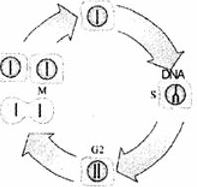
A
Replication of chromosomes
B
Separation of chromosomes
C
Cell with replicated chromosomes
D
Mitosis
Solution
(C) The cell cycle consists of $G_1$,$S$,$G_2$,and $M$ phases.
In the $S$ phase,$DNA$ replication occurs.
After the $S$ phase,the cell enters the $G_2$ phase,where it contains replicated chromosomes (each consisting of two sister chromatids).
Therefore,the $G_2$ phase represents a cell with replicated chromosomes.
In the $S$ phase,$DNA$ replication occurs.
After the $S$ phase,the cell enters the $G_2$ phase,where it contains replicated chromosomes (each consisting of two sister chromatids).
Therefore,the $G_2$ phase represents a cell with replicated chromosomes.
0 likes
View Solution121
EasyMCQ
What does $S$ represent in the given diagram?
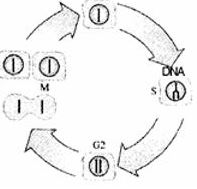
A
Nucleus with chromosomes in cells
B
Cells with duplicated chromosomes
C
Separation of chromosomes
D
Duplication of chromosomes
Solution
(D) In the cell cycle,the $S$ phase stands for the Synthesis phase.
During this phase,$DNA$ replication occurs within the nucleus.
This process results in the duplication of the genetic material $(DNA)$ and the chromosomes,preparing the cell for subsequent division.
Therefore,$S$ represents the duplication of chromosomes.
During this phase,$DNA$ replication occurs within the nucleus.
This process results in the duplication of the genetic material $(DNA)$ and the chromosomes,preparing the cell for subsequent division.
Therefore,$S$ represents the duplication of chromosomes.
0 likes
View Solution122
MediumMCQ
In the given diagram,what does $G$ represent?
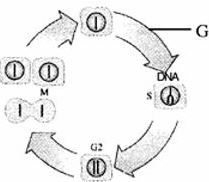
A
Separation of chromosomes
B
Nucleus with chromosomes in the cell
C
Replication of chromosomes
D
Cell with replicated chromosomes
Solution
(C) The provided diagram illustrates the cell cycle. The arrow labeled $G$ points to the transition from the $G_1$ phase to the $S$ phase (Synthesis phase). During the $S$ phase,$DNA$ replication occurs,which leads to the replication of chromosomes. Therefore,the process indicated by $G$ represents the replication of chromosomes.
0 likes
View Solution123
EasyMCQ
How are the gap phase before mitosis and the synthesis phase of the cell cycle sequentially represented?
A
$S$ and $G_1$
B
$G_1$ and $S$
C
$G_1$ and $G_2$
D
$S$ and $G_2$
Solution
(B) The cell cycle is divided into two main phases: Interphase and $M$ phase (Mitosis).
Interphase is further subdivided into three stages: $G_1$ phase (Gap $1$),$S$ phase (Synthesis),and $G_2$ phase (Gap $2$).
In the cell cycle,the sequence of events is $G_1 \rightarrow S \rightarrow G_2 \rightarrow M$.
The gap phase before mitosis (specifically the first gap phase) is $G_1$,and the synthesis phase is $S$.
Therefore,the sequential representation is $G_1$ and $S$.
Interphase is further subdivided into three stages: $G_1$ phase (Gap $1$),$S$ phase (Synthesis),and $G_2$ phase (Gap $2$).
In the cell cycle,the sequence of events is $G_1 \rightarrow S \rightarrow G_2 \rightarrow M$.
The gap phase before mitosis (specifically the first gap phase) is $G_1$,and the synthesis phase is $S$.
Therefore,the sequential representation is $G_1$ and $S$.
0 likes
View Solution124
EasyMCQ
The first growth phase ($G_1$ phase) is also known as which of the following?
A
First gap phase
B
Pre-mitotic phase
C
Post-mitotic phase
D
None of these
Solution
(C) The cell cycle is divided into two main phases: Interphase and $M$-phase (Mitosis).
Interphase is further divided into three sub-phases: $G_1$ phase,$S$ phase,and $G_2$ phase.
The $G_1$ phase stands for 'Gap $1$' phase.
It is the period between the end of mitosis and the initiation of $DNA$ replication.
Since it occurs after the completion of mitosis,it is also known as the post-mitotic phase.
Interphase is further divided into three sub-phases: $G_1$ phase,$S$ phase,and $G_2$ phase.
The $G_1$ phase stands for 'Gap $1$' phase.
It is the period between the end of mitosis and the initiation of $DNA$ replication.
Since it occurs after the completion of mitosis,it is also known as the post-mitotic phase.
0 likes
View Solution125
MediumMCQ
In a somatic cell cycle:
A
$DNA$ content is doubled in $G_1$ phase compared to the original cell.
B
$DNA$ replication occurs in $S$ phase.
C
Short interphase occurs due to a long mitotic phase.
D
Both $(A)$ and $(C)$.
Solution
(B) In a somatic cell cycle,the cell undergoes interphase and the $M$-phase (mitosis).
$1$. The $G_1$ phase is the first gap phase where the cell grows and prepares for replication,but $DNA$ content remains the same as the parent cell.
$2$. The $S$ phase (Synthesis phase) is the period where $DNA$ replication occurs,doubling the amount of $DNA$ in the nucleus.
$3$. The interphase (comprising $G_1, S, G_2$) is typically much longer than the $M$-phase,which contradicts option $(C)$.
Therefore,the correct statement is that $DNA$ replication occurs in the $S$ phase.
$1$. The $G_1$ phase is the first gap phase where the cell grows and prepares for replication,but $DNA$ content remains the same as the parent cell.
$2$. The $S$ phase (Synthesis phase) is the period where $DNA$ replication occurs,doubling the amount of $DNA$ in the nucleus.
$3$. The interphase (comprising $G_1, S, G_2$) is typically much longer than the $M$-phase,which contradicts option $(C)$.
Therefore,the correct statement is that $DNA$ replication occurs in the $S$ phase.
0 likes
View Solution126
MediumMCQ
In which of the following processes does chromosome replication occur?
A
Mitosis only
B
Mitosis and Meiosis
C
Meiosis only
D
None of these
Solution
(B) Chromosome replication ($DNA$ replication) occurs during the $S$-phase (Synthesis phase) of the cell cycle.
This $S$-phase is a preparatory stage that precedes both mitosis and meiosis.
Therefore,before a cell undergoes either mitosis or meiosis,it must replicate its $DNA$ to ensure that each daughter cell receives an identical or appropriate set of chromosomes.
Thus,chromosome replication is a prerequisite for both processes.
This $S$-phase is a preparatory stage that precedes both mitosis and meiosis.
Therefore,before a cell undergoes either mitosis or meiosis,it must replicate its $DNA$ to ensure that each daughter cell receives an identical or appropriate set of chromosomes.
Thus,chromosome replication is a prerequisite for both processes.
0 likes
View Solution127
EasyMCQ
$DNA$ replication occurs during which of the following?
A
Only in mitosis
B
Only in meiosis
C
Both in mitosis and meiosis
D
Only in amitosis
Solution
(C) $DNA$ replication is a fundamental process that occurs during the $S$-phase (Synthesis phase) of the cell cycle.
This phase precedes both mitosis and meiosis to ensure that each daughter cell receives an identical and complete set of chromosomes.
Therefore,$DNA$ replication is a prerequisite for both mitotic and meiotic cell divisions.
This phase precedes both mitosis and meiosis to ensure that each daughter cell receives an identical and complete set of chromosomes.
Therefore,$DNA$ replication is a prerequisite for both mitotic and meiotic cell divisions.
0 likes
View Solution128
MediumMCQ
During the cell cycle,when does $RNA$ synthesis occur?
A
Interphase
B
$G_1$ phase
C
$S$ phase
D
$M$ phase
Solution
(B) During the cell cycle,$RNA$ and protein synthesis occur throughout the interphase,which includes the $G_1$,$S$,and $G_2$ phases. However,the $G_1$ phase (Gap $1$) is characterized by intense metabolic activity,where the cell grows and synthesizes significant amounts of $RNA$ and proteins required for $DNA$ replication and subsequent cell division. Therefore,$RNA$ synthesis is most prominent during the $G_1$ phase.
0 likes
View Solution129
EasyMCQ
Which of the following is a characteristic of the $S$ phase?
A
Separation of homologous chromosomes
B
$RNA$ and protein synthesis
C
$RNA$ synthesis
D
Replication of chromosomal $DNA$
Solution
(D) The $S$ phase (Synthesis phase) is a period in the cell cycle that occurs during interphase,between the $G_1$ phase and the $G_2$ phase.
During this phase,the cell replicates its nuclear $DNA$.
If the initial amount of $DNA$ in the cell is denoted as $2C$,then after the $S$ phase,the amount of $DNA$ becomes $4C$.
However,there is no change in the chromosome number; if the cell had $2n$ chromosomes at the beginning,it remains $2n$ at the end of the $S$ phase.
Therefore,the primary characteristic of the $S$ phase is the replication of chromosomal $DNA$.
During this phase,the cell replicates its nuclear $DNA$.
If the initial amount of $DNA$ in the cell is denoted as $2C$,then after the $S$ phase,the amount of $DNA$ becomes $4C$.
However,there is no change in the chromosome number; if the cell had $2n$ chromosomes at the beginning,it remains $2n$ at the end of the $S$ phase.
Therefore,the primary characteristic of the $S$ phase is the replication of chromosomal $DNA$.
0 likes
View Solution130
MediumMCQ
During the interphase,which of the following occurs?
A
The cell is not physiologically active.
B
The nucleus is in a resting state.
C
Chromosomal $DNA$ is prepared for nuclear division.
D
None of the above.
Solution
(C) Interphase is the phase of the cell cycle between two successive $M$ phases. It is often called the 'resting phase',but this is a misnomer because the cell is highly metabolically active during this time. During interphase,the cell grows,performs its normal functions,and crucially,replicates its $DNA$ to prepare for nuclear division (mitosis or meiosis). Therefore,the chromosomal $DNA$ is prepared for nuclear division.
0 likes
View Solution131
EasyMCQ
The interphase is divided into which phases?
A
$Gap\, 1$ phase
B
Synthesis phase
C
$Gap\, 2$ phase
D
All of the above $(a), (b),$ and $(c)$
Solution
(D) The interphase is the phase of the cell cycle between two successive $M$ phases. It is divided into three distinct sub-phases:
$1$. $G_1$ phase ($Gap\, 1$ phase): This is the interval between mitosis and $DNA$ replication.
$2$. $S$ phase (Synthesis phase): During this phase,$DNA$ replication occurs.
$3$. $G_2$ phase ($Gap\, 2$ phase): This is the interval between $DNA$ replication and the onset of mitosis.
Therefore,all three phases are part of the interphase.
$1$. $G_1$ phase ($Gap\, 1$ phase): This is the interval between mitosis and $DNA$ replication.
$2$. $S$ phase (Synthesis phase): During this phase,$DNA$ replication occurs.
$3$. $G_2$ phase ($Gap\, 2$ phase): This is the interval between $DNA$ replication and the onset of mitosis.
Therefore,all three phases are part of the interphase.
0 likes
View Solution132
MediumMCQ
$A$: The duration of the cell cycle varies in different organisms.
$R$: The duration of the cell cycle varies in different types of cells.
$R$: The duration of the cell cycle varies in different types of cells.
A
$A$ and $R$ are both true and $R$ is the correct explanation of $A$.
B
$A$ and $R$ are both true,but $R$ is not the correct explanation of $A$.
C
$A$ is true and $R$ is false.
D
$A$ is false and $R$ is true.
Solution
(A) The duration of the cell cycle is not fixed and varies significantly between different organisms (e.g.,a typical eukaryotic cell cycle in yeast takes about $90$ minutes,whereas in humans it takes about $24$ hours).
Furthermore,even within the same organism,different types of cells have different cell cycle durations depending on their functional requirements and developmental stage.
Since both statements are scientifically accurate and describe the variability of the cell cycle,$R$ provides a logical context for the variation observed in $A$ by highlighting that cell cycle duration is dependent on the specific cell type.
Therefore,$A$ and $R$ are both true and $R$ is the correct explanation of $A$.
Furthermore,even within the same organism,different types of cells have different cell cycle durations depending on their functional requirements and developmental stage.
Since both statements are scientifically accurate and describe the variability of the cell cycle,$R$ provides a logical context for the variation observed in $A$ by highlighting that cell cycle duration is dependent on the specific cell type.
Therefore,$A$ and $R$ are both true and $R$ is the correct explanation of $A$.
0 likes
View Solution133
MediumMCQ
Which stage is indicated by the given figure?
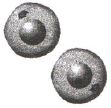
A
Early Prophase
B
Telophase
C
Interphase ($G_1$ phase)
D
Interphase ($G_2$ phase)
Solution
(C) The provided image shows two cells in a resting state,characterized by a distinct nucleus and a nucleolus,which is typical of the interphase stage of the cell cycle.
Specifically,the $G_1$ phase (Gap $1$) is the first growth phase of interphase where the cell is metabolically active and continuously grows,but does not replicate its $DNA$.
Since the chromosomes are not condensed and the nuclear envelope is intact,it represents the interphase stage,specifically the $G_1$ phase.
Specifically,the $G_1$ phase (Gap $1$) is the first growth phase of interphase where the cell is metabolically active and continuously grows,but does not replicate its $DNA$.
Since the chromosomes are not condensed and the nuclear envelope is intact,it represents the interphase stage,specifically the $G_1$ phase.
0 likes
View Solution134
MediumMCQ
What does the cell cycle represent?
A
The period between two successive cell divisions
B
The period between two interphases
C
The period between two synthesis $(S)$ phases
D
All of the above
Solution
(D) The cell cycle is the series of events that take place in a cell leading to its division and duplication of its $DNA$ to produce two daughter cells.
It is a continuous process that includes the interphase ($G_1$,$S$,and $G_2$ phases) and the $M$-phase (mitosis or meiosis).
Since the cell cycle is a repeating sequence,the period between two successive cell divisions,the period between two interphases,and the period between two synthesis $(S)$ phases all describe the same cyclical nature of the process.
Therefore,all the given options correctly represent the concept of the cell cycle.
It is a continuous process that includes the interphase ($G_1$,$S$,and $G_2$ phases) and the $M$-phase (mitosis or meiosis).
Since the cell cycle is a repeating sequence,the period between two successive cell divisions,the period between two interphases,and the period between two synthesis $(S)$ phases all describe the same cyclical nature of the process.
Therefore,all the given options correctly represent the concept of the cell cycle.
0 likes
View Solution135
EasyMCQ
What is the correct sequence of the various phases of the cell cycle?
A
$G_1 \to G_2 \to S \to M$
B
$G_1 \to S \to G_2 \to M$
C
$M \to G_2 \to S \to G_1$
D
$S \to M \to G_1 \to G_2$
Solution
(B) The cell cycle is a series of events that take place in a cell leading to its division and duplication of its $DNA$ to produce two daughter cells.
It is divided into two main phases: Interphase and $M$-phase (Mitosis).
Interphase is further divided into three sub-phases:
$1$. $G_1$ phase (Gap $1$): The cell grows and performs normal metabolic functions.
$2$. $S$ phase (Synthesis): $DNA$ replication occurs.
$3$. $G_2$ phase (Gap $2$): The cell prepares for mitosis by synthesizing proteins and organelles.
After Interphase,the cell enters the $M$-phase (Mitosis),where the actual division occurs.
Therefore,the correct sequence is $G_1 \to S \to G_2 \to M$.
It is divided into two main phases: Interphase and $M$-phase (Mitosis).
Interphase is further divided into three sub-phases:
$1$. $G_1$ phase (Gap $1$): The cell grows and performs normal metabolic functions.
$2$. $S$ phase (Synthesis): $DNA$ replication occurs.
$3$. $G_2$ phase (Gap $2$): The cell prepares for mitosis by synthesizing proteins and organelles.
After Interphase,the cell enters the $M$-phase (Mitosis),where the actual division occurs.
Therefore,the correct sequence is $G_1 \to S \to G_2 \to M$.
0 likes
View Solution136
EasyMCQ
Which phase is the initial phase of interphase?
A
$G_1$ phase
B
$S$ phase
C
$G_2$ phase
D
$M$ phase
Solution
(A) The cell cycle is divided into two main phases: Interphase and $M$ phase (Mitosis/Meiosis).
Interphase is further divided into three sub-phases: $G_1$ phase,$S$ phase,and $G_2$ phase.
$G_1$ phase (Gap $1$) is the first phase of interphase,which occurs after the $M$ phase and before the $S$ phase.
During $G_1$ phase,the cell grows and prepares for $DNA$ replication.
Therefore,$G_1$ is the initial phase of interphase.
Interphase is further divided into three sub-phases: $G_1$ phase,$S$ phase,and $G_2$ phase.
$G_1$ phase (Gap $1$) is the first phase of interphase,which occurs after the $M$ phase and before the $S$ phase.
During $G_1$ phase,the cell grows and prepares for $DNA$ replication.
Therefore,$G_1$ is the initial phase of interphase.
0 likes
View Solution137
EasyMCQ
Which is the final phase of interphase?
A
$G_1$ phase
B
$S$ phase
C
$G_2$ phase
D
$M$ phase
Solution
(C) The cell cycle is divided into two main phases: Interphase and the $M$ phase (Mitosis/Meiosis).
Interphase is further divided into three sub-phases: $G_1$ phase (Gap $1$),$S$ phase (Synthesis),and $G_2$ phase (Gap $2$).
$G_1$ phase is the first growth phase,$S$ phase is the $DNA$ replication phase,and $G_2$ phase is the second growth phase.
Therefore,the $G_2$ phase is the final phase of interphase before the cell enters the $M$ phase.
Interphase is further divided into three sub-phases: $G_1$ phase (Gap $1$),$S$ phase (Synthesis),and $G_2$ phase (Gap $2$).
$G_1$ phase is the first growth phase,$S$ phase is the $DNA$ replication phase,and $G_2$ phase is the second growth phase.
Therefore,the $G_2$ phase is the final phase of interphase before the cell enters the $M$ phase.
0 likes
View Solution138
EasyMCQ
In which phase does $2C$ $DNA$ become $4C$?
A
$G_1$
B
$S$
C
$G_2$
D
$M$
Solution
(B) During the cell cycle,the $S$ phase (Synthesis phase) is characterized by the replication of $DNA$.
Before the $S$ phase,the cell is in the $G_1$ phase where the $DNA$ content is $2C$.
During the $S$ phase,$DNA$ replication occurs,which doubles the amount of $DNA$ from $2C$ to $4C$.
Therefore,the transition from $2C$ to $4C$ $DNA$ content takes place during the $S$ phase.
Before the $S$ phase,the cell is in the $G_1$ phase where the $DNA$ content is $2C$.
During the $S$ phase,$DNA$ replication occurs,which doubles the amount of $DNA$ from $2C$ to $4C$.
Therefore,the transition from $2C$ to $4C$ $DNA$ content takes place during the $S$ phase.
0 likes
View Solution139
MediumMCQ
Which of the following is $NOT$ true for the $S$ phase?
A
$DNA$ synthesis occurs.
B
Chromosomes duplicate,but chromatids do not separate.
C
$2C$ amount of $DNA$ becomes $4C$.
D
The amount of genetic material does not change.
Solution
(D) The $S$ phase (Synthesis phase) is a critical stage of the cell cycle where $DNA$ replication occurs.
During this phase,the amount of $DNA$ per cell doubles (from $2C$ to $4C$),but the number of chromosomes remains the same.
Since $DNA$ replication increases the genetic material,the statement that 'the amount of genetic material does not change' is incorrect.
Therefore,option $D$ is the correct answer.
During this phase,the amount of $DNA$ per cell doubles (from $2C$ to $4C$),but the number of chromosomes remains the same.
Since $DNA$ replication increases the genetic material,the statement that 'the amount of genetic material does not change' is incorrect.
Therefore,option $D$ is the correct answer.
0 likes
View Solution140
EasyMCQ
Which event is inconsistent with the interphase of the cell cycle?
A
Centriole duplication.
B
Genetic material replication.
C
Chromosome formation.
D
Increase in cell size.
Solution
(C) The cell cycle consists of two main phases: Interphase and $M$-phase (Mitosis/Meiosis).
Interphase is the preparatory phase for cell division,which includes $G_1$,$S$,and $G_2$ phases.
$1$. During the $S$ phase,$DNA$ replication (genetic material duplication) occurs.
$2$. Centriole duplication also occurs during the interphase (specifically in the $S$ phase in animal cells).
$3$. The cell grows in size throughout the interphase.
$4$. Chromosome formation (condensation of chromatin into distinct chromosomes) is a characteristic event of the Prophase stage of the $M$-phase,not the interphase. Therefore,chromosome formation is inconsistent with interphase.
Interphase is the preparatory phase for cell division,which includes $G_1$,$S$,and $G_2$ phases.
$1$. During the $S$ phase,$DNA$ replication (genetic material duplication) occurs.
$2$. Centriole duplication also occurs during the interphase (specifically in the $S$ phase in animal cells).
$3$. The cell grows in size throughout the interphase.
$4$. Chromosome formation (condensation of chromatin into distinct chromosomes) is a characteristic event of the Prophase stage of the $M$-phase,not the interphase. Therefore,chromosome formation is inconsistent with interphase.
0 likes
View Solution141
MediumMCQ
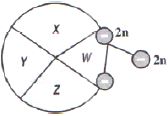
In the given diagram,in which of the phases $W, X, Y$ and $Z$ does the genetic material of chromosomes double?
A
$W$
B
$X$
C
$Y$
D
$Z$
Solution
(C) The cell cycle consists of $G_1$,$S$,$G_2$,and $M$ phases.
In the provided diagram,the cell cycle is represented as a circle divided into four parts: $W, X, Y,$ and $Z$.
$W$ represents the $M$ phase (Mitosis),where the cell divides.
$X$ represents the $G_1$ phase (Gap $1$),which is the first growth phase.
$Y$ represents the $S$ phase (Synthesis phase),where $DNA$ replication occurs,leading to the doubling of the genetic material.
$Z$ represents the $G_2$ phase (Gap $2$),which is the second growth phase.
Therefore,the genetic material doubles during the $S$ phase,which corresponds to $Y$ in the diagram.
In the provided diagram,the cell cycle is represented as a circle divided into four parts: $W, X, Y,$ and $Z$.
$W$ represents the $M$ phase (Mitosis),where the cell divides.
$X$ represents the $G_1$ phase (Gap $1$),which is the first growth phase.
$Y$ represents the $S$ phase (Synthesis phase),where $DNA$ replication occurs,leading to the doubling of the genetic material.
$Z$ represents the $G_2$ phase (Gap $2$),which is the second growth phase.
Therefore,the genetic material doubles during the $S$ phase,which corresponds to $Y$ in the diagram.
0 likes
View Solution142
MediumMCQ
When a cell has a stalled $DNA$ replication fork,which checkpoint should be predominantly activated?
A
$G_1/S$
B
$G_2/M$
C
$M$
D
Both $G_2/M$ and $M$
Solution
(B) The correct answer is $B$.
When a cell has a stalled $DNA$ replication fork,it indicates that the cell is currently in the $S$ phase of the cell cycle,where $DNA$ synthesis is occurring.
The $G_2/M$ checkpoint is the primary mechanism that monitors the completion of $DNA$ replication before the cell enters mitosis.
If $DNA$ replication is incomplete or stalled,the cell cycle is arrested at the $G_2/M$ transition to prevent the segregation of damaged or incomplete chromosomes.
When a cell has a stalled $DNA$ replication fork,it indicates that the cell is currently in the $S$ phase of the cell cycle,where $DNA$ synthesis is occurring.
The $G_2/M$ checkpoint is the primary mechanism that monitors the completion of $DNA$ replication before the cell enters mitosis.
If $DNA$ replication is incomplete or stalled,the cell cycle is arrested at the $G_2/M$ transition to prevent the segregation of damaged or incomplete chromosomes.
0 likes
View Solution143
MediumMCQ
In the $S$ phase of the cell cycle:
A
the amount of $DNA$ doubles in each cell.
B
the amount of $DNA$ remains the same in each cell.
C
the chromosome number increases.
D
the amount of $DNA$ is reduced to half in each cell.
Solution
(A) The correct answer is $A$.
During the $S$ phase (Synthesis phase) of the cell cycle,the replication of $DNA$ occurs.
As a result,the amount of $DNA$ per cell doubles,increasing from $2C$ to $4C$ in diploid cells.
However,the number of chromosomes remains the same because the sister chromatids remain attached at the centromere.
During the $S$ phase (Synthesis phase) of the cell cycle,the replication of $DNA$ occurs.
As a result,the amount of $DNA$ per cell doubles,increasing from $2C$ to $4C$ in diploid cells.
However,the number of chromosomes remains the same because the sister chromatids remain attached at the centromere.
0 likes
View Solution144
MediumMCQ
Which of the following processes occur during the cell cycle?
A
$DNA$ replication and cell growth
B
$RNA$ replication only
C
Only cell growth
D
Only $DNA$ replication
Solution
(A) The cell cycle is a series of events that take place in a cell leading to its division and duplication of its $DNA$ to produce two daughter cells.
Key events include:
$1$. $DNA$ replication: This occurs during the $S$-phase (Synthesis phase) of interphase,where the amount of $DNA$ in the cell doubles.
$2$. Cell growth: This occurs throughout the interphase ($G_1$,$S$,and $G_2$ phases),where the cell increases in size,synthesizes proteins,and prepares organelles for division.
Therefore,both $DNA$ replication and cell growth are essential processes that occur during the cell cycle.
Key events include:
$1$. $DNA$ replication: This occurs during the $S$-phase (Synthesis phase) of interphase,where the amount of $DNA$ in the cell doubles.
$2$. Cell growth: This occurs throughout the interphase ($G_1$,$S$,and $G_2$ phases),where the cell increases in size,synthesizes proteins,and prepares organelles for division.
Therefore,both $DNA$ replication and cell growth are essential processes that occur during the cell cycle.
0 likes
View Solution145
MediumMCQ
The cell cycle is divided into two basic phases. What are those phases?
A
Interphase and $M$ phase
B
$G_1$ and $G_2$ phase
C
$G_1$ and $M$ phase
D
$G_1$ and $M_1$ phase
Solution
(A) The cell cycle is the series of events that take place in a cell leading to its division and duplication of its $DNA$ to produce two daughter cells.
It is broadly divided into two main phases:
$1$. Interphase: This is the phase of preparation where the cell grows and replicates its $DNA$.
$2$. $M$ phase (Mitosis/Meiosis phase): This is the phase where actual cell division occurs.
Therefore,the correct answer is Interphase and $M$ phase.
It is broadly divided into two main phases:
$1$. Interphase: This is the phase of preparation where the cell grows and replicates its $DNA$.
$2$. $M$ phase (Mitosis/Meiosis phase): This is the phase where actual cell division occurs.
Therefore,the correct answer is Interphase and $M$ phase.
0 likes
View Solution146
MediumMCQ
During which phase is the cell metabolically active and continuously grows but does not replicate its $DNA$?
A
$G_1$ phase
B
$G_2$ phase
C
$S$ phase
D
$G_0$ phase
Solution
(A) The cell cycle is divided into two main phases: Interphase and $M$ phase (Mitosis). Interphase is further divided into $G_1$,$S$,and $G_2$ phases.
$1$. $G_1$ phase (Gap $1$): In this phase,the cell is metabolically active and continuously grows in size,but it does not replicate its $DNA$.
$2$. $S$ phase (Synthesis): During this phase,$DNA$ replication occurs.
$3$. $G_2$ phase (Gap $2$): In this phase,proteins are synthesized in preparation for mitosis,and the cell continues to grow.
Therefore,the phase where the cell grows but does not replicate $DNA$ is the $G_1$ phase.
$1$. $G_1$ phase (Gap $1$): In this phase,the cell is metabolically active and continuously grows in size,but it does not replicate its $DNA$.
$2$. $S$ phase (Synthesis): During this phase,$DNA$ replication occurs.
$3$. $G_2$ phase (Gap $2$): In this phase,proteins are synthesized in preparation for mitosis,and the cell continues to grow.
Therefore,the phase where the cell grows but does not replicate $DNA$ is the $G_1$ phase.
0 likes
View Solution147
EasyMCQ
In animal cells,during the $S$-phase,$DNA$ replication begins in the nucleus and the centrioles duplicate in the ..........
A
$DNA$ replication,cytoplasm
B
$RNA$ replication,cytoplasm
C
$DNA$ replication,protein synthesis
D
Cytoplasm,protein synthesis
Solution
(A) During the $S$-phase (Synthesis phase) of the cell cycle,the amount of $DNA$ per cell doubles. This $DNA$ replication occurs within the nucleus. Simultaneously,in animal cells,the centrioles,which are involved in spindle formation,duplicate within the cytoplasm.
0 likes
View Solution148
EasyMCQ
The last phase of interphase is
A
$G_1$ phase
B
$G_2$ phase
C
$S$ phase
D
$G_0$ phase
Solution
(B) Interphase is divided into three distinct sub-phases: $G_1$ phase,$S$ phase,and $G_2$ phase.
$1$. $G_1$ phase (Gap $1$) is the first growth phase where the cell prepares for $DNA$ replication.
$2$. $S$ phase (Synthesis phase) is the period where $DNA$ replication occurs.
$3$. $G_2$ phase (Gap $2$) is the final phase of interphase,during which the cell prepares for mitosis by synthesizing necessary proteins and organelles.
Therefore,the $G_2$ phase is the last phase of interphase before the cell enters the $M$ phase (mitosis).
$1$. $G_1$ phase (Gap $1$) is the first growth phase where the cell prepares for $DNA$ replication.
$2$. $S$ phase (Synthesis phase) is the period where $DNA$ replication occurs.
$3$. $G_2$ phase (Gap $2$) is the final phase of interphase,during which the cell prepares for mitosis by synthesizing necessary proteins and organelles.
Therefore,the $G_2$ phase is the last phase of interphase before the cell enters the $M$ phase (mitosis).
0 likes
View Solution149
EasyMCQ
Yeast can progress through the cell cycle in about ........ minutes.
A
$90$
B
$9$
C
$60$
D
$24$
Solution
(A) The cell cycle duration varies significantly among different organisms.
In the case of yeast $(Saccharomyces \text{ } cerevisiae)$, which is a unicellular eukaryote, the entire cell cycle is completed in approximately $90$ minutes under optimal laboratory conditions.
Therefore, the correct option is $A$.
In the case of yeast $(Saccharomyces \text{ } cerevisiae)$, which is a unicellular eukaryote, the entire cell cycle is completed in approximately $90$ minutes under optimal laboratory conditions.
Therefore, the correct option is $A$.
0 likes
View Solution150
EasyMCQ
In which stage of the cell cycle does the $DNA$ content increase from $2C$ to $4C$?
A
$S$ phase
B
$G_1$ phase
C
$G_2$ phase
D
$M$ phase
Solution
(A) The cell cycle consists of interphase ($G_1$,$S$,$G_2$) and the $M$ phase.
During the $S$ phase (Synthesis phase) of interphase,$DNA$ replication occurs.
As a result of $DNA$ replication,the amount of $DNA$ per cell doubles.
If the initial amount of $DNA$ is $2C$,it increases to $4C$ during the $S$ phase.
Therefore,the correct stage is the $S$ phase.
During the $S$ phase (Synthesis phase) of interphase,$DNA$ replication occurs.
As a result of $DNA$ replication,the amount of $DNA$ per cell doubles.
If the initial amount of $DNA$ is $2C$,it increases to $4C$ during the $S$ phase.
Therefore,the correct stage is the $S$ phase.
0 likes
View SolutionCell Cycle and Cell Division — Cell Cycle · Frequently Asked Questions
1Are these Cell Cycle and Cell Division questions useful for JEE and NEET?
Yes. All questions in this section are mapped to JEE Main and NEET exam patterns. Previous year questions from JEE Main, NEET, GUJCET and state-level exams are included with full solutions.
2Can I switch to Hindi or Gujarati for these questions?
Yes. Use the language tabs in the hero section or the sidebar to view the same questions and solutions in English, Hindi or Gujarati.
3How do I generate a question paper from this subtopic?
Use the Vedclass Exam Paper Generator — select the chapter and subtopic, set difficulty, and generate Sets A, B, C, D automatically. First 3 chapters of every subject are free.
Vedclass Products
For Students
Vedclass Test Series
Mock tests in real JEE/NEET style with performance analysis. 5-day free trial.
Start Free TrialFor Teachers
Exam Paper Generator
Generate Set A/B/C/D papers from this chapter in 2 minutes. 3 chapters free.
Try FreeFor Institutes
Online Exam Module
Live online exams with unlimited students, 360° analytics & white-label branding.
See DemoFor Teachers & Institutes
Generate a Cell Cycle and Cell Division Exam Paper in 2 Minutes
Select subtopic & difficulty — Sets A, B, C, D auto-generated with No Repeat logic.
First 3 chapters of every subject are free — no payment required.