
A English
Cell Cycle Questions in English
Class 11 Biology · Cell Cycle and Cell Division · Cell Cycle
261+
Questions
English
Language
100%
With Solutions
Showing 50 of 261 questions in English
201
MediumMCQ
In which of the following phases of the cell cycle is mitotic division arrested?
A
$G_{2}$-phase
B
$G_{0}$-phase
C
$S$-phase
D
$M$-phase
Solution
(B) The correct answer is $G_{0}$-phase.
Some cells in the adult animal do not appear to exhibit division (e.g.,heart cells) and many other cells divide only occasionally,as needed to replace cells that have been lost because of injury or cell death.
These cells that do not divide further exit the $G_{1}$-phase to enter an inactive stage called the quiescent stage $(G_{0})$ of the cell cycle.
Cells in this $G_{0}$ stage remain metabolically active but no longer proliferate unless called on to do so,depending on the requirement of the organism.
Some cells in the adult animal do not appear to exhibit division (e.g.,heart cells) and many other cells divide only occasionally,as needed to replace cells that have been lost because of injury or cell death.
These cells that do not divide further exit the $G_{1}$-phase to enter an inactive stage called the quiescent stage $(G_{0})$ of the cell cycle.
Cells in this $G_{0}$ stage remain metabolically active but no longer proliferate unless called on to do so,depending on the requirement of the organism.
0 likes
View Solution202
EasyMCQ
Select the correct sequence of a cell cycle.
A
$G_{2} \rightarrow M \rightarrow G_{1} \rightarrow S$
B
$S \rightarrow G_{2} \rightarrow M \rightarrow G_{1}$
C
$G_{1} \rightarrow S \rightarrow G_{2} \rightarrow M$
D
$M \rightarrow G_{1} \rightarrow G_{2} \rightarrow M$
Solution
(C) The cell cycle is divided into two basic phases:
$(i)$ Interphase
$(ii)$ $M$-phase (mitosis phase)
The interphase is further divided into three phases:
$(i)$ $G_{1}$-phase (Gap $1$)
$(ii)$ $S$-phase (Synthesis)
$(iii)$ $G_{2}$-phase (Gap $2$)
The correct sequence of a cell cycle is $G_{1} \rightarrow S \rightarrow G_{2} \rightarrow M$.
$(i)$ Interphase
$(ii)$ $M$-phase (mitosis phase)
The interphase is further divided into three phases:
$(i)$ $G_{1}$-phase (Gap $1$)
$(ii)$ $S$-phase (Synthesis)
$(iii)$ $G_{2}$-phase (Gap $2$)
The correct sequence of a cell cycle is $G_{1} \rightarrow S \rightarrow G_{2} \rightarrow M$.
0 likes
View Solution203
EasyMCQ
The interphase is divided into three main phases. These phases are:
A
$G_{1}$-phase,$M$-phase and $G_{2}$-phase
B
$M$-phase,$G_{1}$-phase,$S$-phase
C
$G_{1}$-phase,$S$-phase and $G_{2}$-phase
D
$M$-phase,$G_{2}$-phase and $G_{0}$-phase
Solution
(C) Interphase is the phase of the cell cycle between two successive $M$-phases. It is a period of intense metabolic activity and growth.
Interphase is divided into three sub-phases:
$1$. $G_{1}$-phase (First Gap phase): The cell grows and performs normal metabolic functions.
$2$. $S$-phase (Synthesis phase): $DNA$ replication occurs.
$3$. $G_{2}$-phase (Second Gap phase): The cell prepares for mitosis by synthesizing proteins and organelles.
Therefore,the correct sequence is $G_{1}$-phase,$S$-phase,and $G_{2}$-phase.
Interphase is divided into three sub-phases:
$1$. $G_{1}$-phase (First Gap phase): The cell grows and performs normal metabolic functions.
$2$. $S$-phase (Synthesis phase): $DNA$ replication occurs.
$3$. $G_{2}$-phase (Second Gap phase): The cell prepares for mitosis by synthesizing proteins and organelles.
Therefore,the correct sequence is $G_{1}$-phase,$S$-phase,and $G_{2}$-phase.
0 likes
View Solution204
MediumMCQ
The sequence of events by which a cell duplicates its genome,synthesizes the other constituents of the cell and eventually divides into two daughter cells is termed as
A
Cell division
B
Cell cycle
C
Cell growth
D
Cell duplication
Solution
(B) The cell cycle was described by Howard and Pelc in $1953$.
The sequence of events by which a cell duplicates its genome,synthesizes the other constituents of the cell,and eventually divides into two daughter cells is termed as the cell cycle.
The sequence of events by which a cell duplicates its genome,synthesizes the other constituents of the cell,and eventually divides into two daughter cells is termed as the cell cycle.
0 likes
View Solution205
MediumMCQ
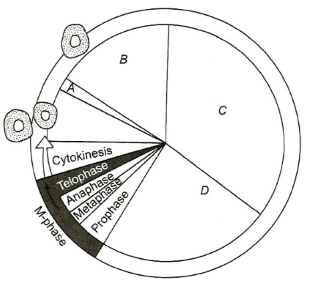
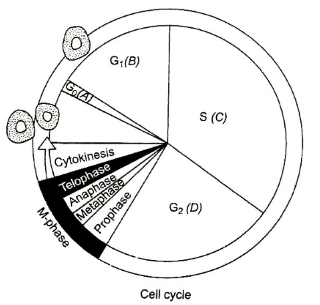
The given diagram represents the events occurring in the cell cycle. Identify $A, B, C$ and $D$ and select the correct option.
A
$G_{0}, G_{1}, S, G_{2}$
B
$G_{1}, G_{0}, S, G_{2}$
C
$S, G_{0}, G_{1}, G_{2}$
D
$G_{1}, S, G_{2}, G_{0}$
Solution
(A) The cell cycle is divided into two main phases: Interphase and $M$-phase (Mitosis). Interphase is further divided into $G_{1}$ phase,$S$ phase,and $G_{2}$ phase.
Some cells in the adult animals do not appear to exhibit division (e.g.,heart cells) and many other cells divide only occasionally,as needed to replace cells that have been lost because of injury or cell death. These cells that do not divide further exit $G_{1}$ phase to enter an inactive stage called quiescent stage $(G_{0})$ of the cell cycle.
Based on the provided diagram:
$A$ represents the quiescent stage $(G_{0})$,
$B$ represents the $G_{1}$ phase,
$C$ represents the $S$ phase,
$D$ represents the $G_{2}$ phase.
Therefore,the correct sequence is $A=G_{0}, B=G_{1}, C=S, D=G_{2}$.
Some cells in the adult animals do not appear to exhibit division (e.g.,heart cells) and many other cells divide only occasionally,as needed to replace cells that have been lost because of injury or cell death. These cells that do not divide further exit $G_{1}$ phase to enter an inactive stage called quiescent stage $(G_{0})$ of the cell cycle.
Based on the provided diagram:
$A$ represents the quiescent stage $(G_{0})$,
$B$ represents the $G_{1}$ phase,
$C$ represents the $S$ phase,
$D$ represents the $G_{2}$ phase.
Therefore,the correct sequence is $A=G_{0}, B=G_{1}, C=S, D=G_{2}$.
0 likes
View Solution206
MediumMCQ
Which of the following phases of the cell cycle is also known as the resting phase?
A
Karyokinesis
B
Cytokinesis
C
Interphase
D
All of these
Solution
(C) The interphase is also called the resting phase.
It is the period during which the cell prepares for division by undergoing cell growth and $DNA$ replication in an orderly manner.
It is the period during which the cell prepares for division by undergoing cell growth and $DNA$ replication in an orderly manner.
0 likes
View Solution207
MediumMCQ
Which is synthesized in $G_{1}$-phase?
A
$DNA$ polymerase
B
Histones
C
Nucleolar $DNA$
D
Tubulin protein
Solution
(A) During the $G_{1}$-phase of the cell cycle,the cell prepares for $DNA$ replication by synthesizing various biochemicals.
These include $RNAs$,regulatory proteins,and essential enzymes such as $DNA$ polymerase,which are required for the subsequent $S$-phase.
Histone proteins are synthesized during the $S$-phase along with $DNA$ replication.
Tubulin proteins are primarily synthesized during the $G_{2}$-phase to facilitate spindle fiber formation.
These include $RNAs$,regulatory proteins,and essential enzymes such as $DNA$ polymerase,which are required for the subsequent $S$-phase.
Histone proteins are synthesized during the $S$-phase along with $DNA$ replication.
Tubulin proteins are primarily synthesized during the $G_{2}$-phase to facilitate spindle fiber formation.
0 likes
View Solution208
MediumMCQ
In the process of mitotic division during interphase,chromosome material remains in the form of very loosely coiled threads called
A
Chromosome
B
Chromatin
C
Chromatid
D
Microtubules
Solution
(B) During interphase,the chromosome material ($DNA$ of chromosome) replicates and becomes doubled.
Chromosome material in the form of very loosely coiled threads is called chromatin.
Chromosome material in the form of very loosely coiled threads is called chromatin.
0 likes
View Solution209
MediumMCQ
Select the correct statements regarding $S$-phase of interphase:
$I.$ Occurs between $G_{1}$ and $G_{2}$ phases.
$II.$ $DNA$ replication begins in the nucleus.
$III.$ Centrioles duplicate in the cytoplasm.
$IV.$ As $DNA$ is doubled,the number of chromosomes also doubles.
The option with correct statements is:
$I.$ Occurs between $G_{1}$ and $G_{2}$ phases.
$II.$ $DNA$ replication begins in the nucleus.
$III.$ Centrioles duplicate in the cytoplasm.
$IV.$ As $DNA$ is doubled,the number of chromosomes also doubles.
The option with correct statements is:
A
$IV$ and $III$
B
$I, II, III$ and $IV$
C
$II, III$ and $IV$
D
$I, II$ and $III$
Solution
(D) $S$-phase is the sub-phase between $G_{1}$-phase and $G_{2}$-phase,during which $DNA$ synthesis or replication takes place.
In animal cells,during the $S$-phase,$DNA$ replication begins in the nucleus and centriole duplication occurs in the cytoplasm.
The amount of $DNA$ per cell doubles in the nucleus. If the initial amount of $DNA$ is denoted as $2C$,it increases to $4C$.
However,there is no increase in the chromosome number; the number of chromosomes remains the same as it was in the $G_{1}$-phase.
Therefore,statements $I, II,$ and $III$ are correct,while statement $IV$ is incorrect.
In animal cells,during the $S$-phase,$DNA$ replication begins in the nucleus and centriole duplication occurs in the cytoplasm.
The amount of $DNA$ per cell doubles in the nucleus. If the initial amount of $DNA$ is denoted as $2C$,it increases to $4C$.
However,there is no increase in the chromosome number; the number of chromosomes remains the same as it was in the $G_{1}$-phase.
Therefore,statements $I, II,$ and $III$ are correct,while statement $IV$ is incorrect.
0 likes
View Solution210
MediumMCQ
Which of the following statements are correct for $G_{1}$-phase?
$I.$ It is the last substage of interphase
$II.$ Cell organelles do not increase in number
$III.$ Cell grows in size and content both
$IV.$ It synthesizes $RNAs$,proteins and other biochemicals for cell growth and subsequent replication of $DNA$
Choose the correct option
$I.$ It is the last substage of interphase
$II.$ Cell organelles do not increase in number
$III.$ Cell grows in size and content both
$IV.$ It synthesizes $RNAs$,proteins and other biochemicals for cell growth and subsequent replication of $DNA$
Choose the correct option
A
$I$ and $II$
B
$III$ and $IV$
C
$I$ and $III$
D
$II$ and $III$
Solution
(B) The $G_{1}$-phase (Gap $1$) is the first phase of interphase,not the last. Therefore,statement $I$ is incorrect.
During the $G_{1}$-phase,the cell is metabolically active and continuously grows. Cell organelles increase in number,so statement $II$ is incorrect.
The cell grows in size and content,making statement $III$ correct.
In this phase,the cell synthesizes $RNAs$,proteins,and other biochemicals required for cell growth and the subsequent replication of $DNA$ in the $S$-phase. Thus,statement $IV$ is correct.
Since statements $III$ and $IV$ are correct,the correct option is $B$.
During the $G_{1}$-phase,the cell is metabolically active and continuously grows. Cell organelles increase in number,so statement $II$ is incorrect.
The cell grows in size and content,making statement $III$ correct.
In this phase,the cell synthesizes $RNAs$,proteins,and other biochemicals required for cell growth and the subsequent replication of $DNA$ in the $S$-phase. Thus,statement $IV$ is correct.
Since statements $III$ and $IV$ are correct,the correct option is $B$.
0 likes
View Solution211
MediumMCQ
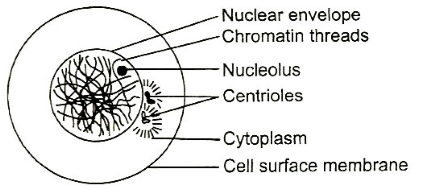
Identify the correct stage of mitosis by viewing the diagram carefully.
A
Interphase
B
Prophase
C
Metaphase
D
Anaphase
Solution
(A) The provided diagram shows a cell with a distinct nuclear envelope,a prominent nucleolus,and chromatin material in the form of a network of threads. The centrioles are present outside the nucleus. These features are characteristic of the interphase stage of the cell cycle,specifically the $G_2$ phase,where the cell prepares for division. During this period,the $DNA$ of chromosomes replicates. Chromosome material is in the form of very loosely coiled threads called chromatin. Centrioles have already replicated.
0 likes
View Solution212
MediumMCQ
Which of the following $CdKs$ and cyclins comes under the $G_{1}$ checkpoint?
A
$CdK_{4} / \text{Cyclin } D$
B
$CdK_{6} / \text{Cyclin } D$
C
Both $(a)$ and $(b)$
D
$CdK_{2} / \text{Cyclin } B$
Solution
(C) The cell cycle is regulated by enzymes known as cyclin-dependent kinases $(CdKs)$.
$CdKs$ phosphorylate specific amino acids, such as serine and threonine, which either initiate or inhibit activities related to the cell cycle.
Key checkpoints in the cell cycle include:
$1.$ The $G_{1}$ checkpoint (entry into the $S$ or synthesis phase) is controlled by $CdK_{4} / \text{Cyclin } D$ and $CdK_{6} / \text{Cyclin } D$.
$2.$ The $G_{2}$ checkpoint (entry into the $M$ phase or maturation-promoting factor) is controlled by $CdK_{2} / \text{Cyclin } B$.
$3.$ The metaphase checkpoint is controlled by the degradation of $\text{Cyclin } B$.
$CdKs$ phosphorylate specific amino acids, such as serine and threonine, which either initiate or inhibit activities related to the cell cycle.
Key checkpoints in the cell cycle include:
$1.$ The $G_{1}$ checkpoint (entry into the $S$ or synthesis phase) is controlled by $CdK_{4} / \text{Cyclin } D$ and $CdK_{6} / \text{Cyclin } D$.
$2.$ The $G_{2}$ checkpoint (entry into the $M$ phase or maturation-promoting factor) is controlled by $CdK_{2} / \text{Cyclin } B$.
$3.$ The metaphase checkpoint is controlled by the degradation of $\text{Cyclin } B$.
0 likes
View Solution213
EasyMCQ
The sequence of events by which cells duplicate their genome, synthesize the other components of the cell, and eventually distribute them into two daughter cells is called:
A
Quiescent stage
B
Generation time
C
Cell cycle
D
Kinetochore
Solution
(C) The sequence of events by which a cell duplicates its genome, synthesizes other constituents of the cell, and eventually divides into two daughter cells is termed the $Cell \ cycle$.
$A$. $Quiescent \ stage$ ($G_0$ phase): In this phase, cells remain metabolically active but do not proliferate unless called upon to do so.
$B$. $Generation \ time$: The time taken by a cell to complete one cell cycle, i.e., the time required for the number of cells to double.
$C$. $Cell \ cycle$: The correct term for the entire process of genome duplication and cell division.
$D$. $Kinetochore$: $A$ trilamellar proteinaceous structure present at the centromere, which serves as the attachment site for spindle fibers.
$A$. $Quiescent \ stage$ ($G_0$ phase): In this phase, cells remain metabolically active but do not proliferate unless called upon to do so.
$B$. $Generation \ time$: The time taken by a cell to complete one cell cycle, i.e., the time required for the number of cells to double.
$C$. $Cell \ cycle$: The correct term for the entire process of genome duplication and cell division.
$D$. $Kinetochore$: $A$ trilamellar proteinaceous structure present at the centromere, which serves as the attachment site for spindle fibers.
0 likes
View Solution214
EasyMCQ
$DNA$ replication occurs in
A
$S$ phase
B
$G_{1}$ phase
C
$G_{2}$ phase
D
$M$ phase
Solution
(A) $DNA$ replication occurs during the $S$ phase (Synthesis phase) of the cell cycle.
$G_{1}$ phase: In this phase,the cell grows and organelles duplicate.
$S$ phase: $DNA$ replication and histone protein synthesis occur.
$G_{2}$ phase: Tubulin protein synthesis and preparation for mitosis occur.
$M$ phase: Mitotic phase where cell division takes place.
$G_{1}$ phase: In this phase,the cell grows and organelles duplicate.
$S$ phase: $DNA$ replication and histone protein synthesis occur.
$G_{2}$ phase: Tubulin protein synthesis and preparation for mitosis occur.
$M$ phase: Mitotic phase where cell division takes place.
0 likes
View Solution215
EasyMCQ
The phase between the two successive $M$ phases is called as
A
Metaphase
B
Anaphase
C
Interphase
D
Prophase
Solution
(C) The cell cycle is divided into two main phases: the $M$ phase (Mitosis) and the Interphase.
Interphase is the period between two successive $M$ phases.
During Interphase,the cell prepares for division by undergoing growth,$DNA$ replication,and protein synthesis.
Therefore,the phase between two successive $M$ phases is known as Interphase.
Interphase is the period between two successive $M$ phases.
During Interphase,the cell prepares for division by undergoing growth,$DNA$ replication,and protein synthesis.
Therefore,the phase between two successive $M$ phases is known as Interphase.
0 likes
View Solution216
MediumMCQ
$A$ biosynthetic phase where cell organelles duplicate themselves is:
A
Interphase
B
Anaphase
C
Metaphase
D
Telophase
Solution
(A) The biosynthetic phase is the $G_1$ phase,$S$ phase,and $G_2$ phase,which collectively constitute the $Interphase$.
During $Interphase$,the cell prepares for division by synthesizing proteins,replicating $DNA$,and duplicating cell organelles.
$Prophase$: Chromatin condenses into chromosomes.
$Anaphase$: Centromeres split and sister chromatids separate.
$Metaphase$: Chromosomes align at the equatorial plate.
During $Interphase$,the cell prepares for division by synthesizing proteins,replicating $DNA$,and duplicating cell organelles.
$Prophase$: Chromatin condenses into chromosomes.
$Anaphase$: Centromeres split and sister chromatids separate.
$Metaphase$: Chromosomes align at the equatorial plate.
0 likes
View Solution217
EasyMCQ
Yeast can progress through the cell cycle in about
A
$90$ sec
B
$90$ min
C
$90$ hrs
D
$90$ days
Solution
(B) The cell cycle is the series of events that take place in a cell leading to its division and duplication of its $DNA$ to produce two daughter cells.
In the case of yeast $(Saccharomyces \text{ } cerevisiae)$, the entire cell cycle is completed in approximately $90$ minutes under optimal growth conditions.
In the case of yeast $(Saccharomyces \text{ } cerevisiae)$, the entire cell cycle is completed in approximately $90$ minutes under optimal growth conditions.
0 likes
View Solution218
MediumMCQ
........................... represents the most active stage of the cell cycle.
A
Metaphase
B
Anaphase
C
Telophase
D
Interphase
Solution
(D) Interphase is considered the most active stage of the cell cycle because the cell undergoes intense metabolic activity,$DNA$ replication,and synthesis of proteins and organelles to prepare itself for cell division. During this phase,the cell grows in size and duplicates its genetic material,which is essential for the subsequent division phases.
0 likes
View Solution219
MediumMCQ
Interphase is called the resting phase because
A
It is the most active phase of the cell cycle
B
There is no apparent activity related to cell division
C
It does not prepare cell for cell division
D
It is the phase where cell rests before entering into mitosis
Solution
(B) Interphase is known as the resting phase because,although the cell is metabolically very active and undergoes growth,there is no visible or apparent activity related to the actual process of cell division (mitosis or meiosis) during this stage. The cell is preparing for division by replicating its $DNA$ and synthesizing proteins,but the morphological changes associated with division are absent.
0 likes
View Solution220
EasyMCQ
. . . . . . phase synthesizes enzymes required during $S$ phase.
A
$G_2$
B
$M$
C
$S$
D
$G_1$
Solution
(D) The $G_1$ phase (Gap $1$ phase) is the first growth phase of the cell cycle.
During this phase,the cell is metabolically active and continuously grows.
It synthesizes the necessary enzymes,proteins,and $RNA$ required for $DNA$ replication,which occurs in the subsequent $S$ phase.
Therefore,the $G_1$ phase prepares the cell for $DNA$ synthesis.
During this phase,the cell is metabolically active and continuously grows.
It synthesizes the necessary enzymes,proteins,and $RNA$ required for $DNA$ replication,which occurs in the subsequent $S$ phase.
Therefore,the $G_1$ phase prepares the cell for $DNA$ synthesis.
0 likes
View Solution221
MediumMCQ
Non-dividing cells enter the
A
$G_S$ phase
B
$M$ phase
C
$G_0$ phase
D
$S$ phase
Solution
(C) Cells that do not divide further exit the $G_1$ phase to enter an inactive stage called the $G_0$ phase ($G_0$ phase),also known as the Quiescent phase. In this stage,cells remain metabolically active but do not proliferate unless called upon to do so depending on the requirement of the organism.
0 likes
View Solution222
EasyMCQ
The cells which enter $G_0$ phase start differentiating into specific types of cells.
A
$G_1$
B
$G_2$
C
$S$
D
$G_0$
Solution
(D) The $G_0$ phase,also known as the quiescent stage,is a state where cells remain metabolically active but do not proliferate unless called upon to do so. In this phase,cells exit the cell cycle and start differentiating into specific types of cells to perform specialized functions in the organism.
0 likes
View Solution223
MediumMCQ
If the initial amount of $DNA$ is $8$ $C$,then after $S$ phase the amount of $DNA$ would be (in $C$)
A
$4$
B
$8$
C
$64$
D
$16$
Solution
(D) During the $S$ phase (Synthesis phase) of the cell cycle,the $DNA$ content of the cell doubles.
If the initial amount of $DNA$ is $8$ $C$,then after the replication process in the $S$ phase,the amount of $DNA$ will become $8 \times 2 = 16$ $C$.
If the initial amount of $DNA$ is $8$ $C$,then after the replication process in the $S$ phase,the amount of $DNA$ will become $8 \times 2 = 16$ $C$.
0 likes
View Solution224
MediumMCQ
The number of chromosomes in $G_1$ phase is $36$. What is the number of chromosomes in $S$ phase?
A
$36$
B
$18$
C
$22$
D
$37$
Solution
(A) During the $S$ phase (Synthesis phase) of the cell cycle,the $DNA$ content of the cell doubles,but the number of chromosomes remains the same.
In the $G_1$ phase,the cell has $36$ chromosomes.
Since the $S$ phase involves $DNA$ replication but not the separation of centromeres,the number of chromosomes remains $36$ throughout the $S$ phase.
Each chromosome will consist of two sister chromatids after replication.
In the $G_1$ phase,the cell has $36$ chromosomes.
Since the $S$ phase involves $DNA$ replication but not the separation of centromeres,the number of chromosomes remains $36$ throughout the $S$ phase.
Each chromosome will consist of two sister chromatids after replication.
0 likes
View Solution225
MediumMCQ
$A$ phase of the cell cycle which lasts more than $95\%$ of the total duration is
A
Prophase
B
Interphase
C
Anaphase
D
Telophase
Solution
(B) The cell cycle consists of two main phases: Interphase and $M$-phase. Interphase is the phase of preparation where the cell grows,replicates its $DNA$,and synthesizes proteins required for division. It is the longest phase of the cell cycle,accounting for more than $95\%$ of the total duration of the cell cycle.
0 likes
View Solution226
MediumMCQ
The major checkpoint of the cell cycle is:
A
$G_1 \rightarrow S$ transition
B
$S \rightarrow G_1$ transition
C
$G_2 \rightarrow M$ transition
D
$M \rightarrow G_2$ transition
Solution
(A) The cell cycle is regulated by specific control points known as checkpoints.
The most critical checkpoint,often referred to as the 'restriction point' or 'start',occurs at the $G_1 \rightarrow S$ transition.
At this stage,the cell commits to $DNA$ replication and division based on internal and external signals.
Another significant checkpoint exists at the $G_2 \rightarrow M$ transition,which ensures that $DNA$ replication is complete and accurate before the cell enters mitosis.
The most critical checkpoint,often referred to as the 'restriction point' or 'start',occurs at the $G_1 \rightarrow S$ transition.
At this stage,the cell commits to $DNA$ replication and division based on internal and external signals.
Another significant checkpoint exists at the $G_2 \rightarrow M$ transition,which ensures that $DNA$ replication is complete and accurate before the cell enters mitosis.
0 likes
View Solution227
MediumMCQ
$G_1$ $\rightarrow$ $S$ transition is regulated by
A
Cyclins only
B
Cyclin independent kinases
C
Mitotic cyclin and cdc$2$ kinase
D
$G_1$ cyclin and cdc$2$ kinase
Solution
(D) The transition from the $G_1$ phase to the $S$ phase in the cell cycle is a critical checkpoint. This transition is primarily regulated by the formation of a complex between $G_1$ cyclins and cyclin-dependent kinases (specifically cdc$2$ kinase or its homologs). These complexes phosphorylate target proteins that initiate $DNA$ replication,thereby allowing the cell to progress from the $G_1$ phase into the $S$ phase.
0 likes
View Solution228
EasyMCQ
What is the primary function of Cyclin Dependent Kinases ($CDK$s)?
A
Act as mitotic poisons
B
Cause disassembly of the microtubules
C
Control various phases of cell cycle
D
Arrest cell division due to non-formation of spindle
Solution
(C) Cyclin Dependent Kinases ($CDK$s) are a family of protein kinases that are activated by binding to specific cyclins. They play a crucial role in regulating the progression of the cell cycle by phosphorylating target proteins that drive the cell through various checkpoints and phases (such as $G_1/S$ and $G_2/M$ transitions). Therefore,they control the various phases of the cell cycle.
0 likes
View Solution229
MediumMCQ
What is not true about the cell cycle?
A
$a$. During $G_1$ phase,there is active synthesis of $RNA$ and proteins,but no change in its $DNA$ content.
B
$b$. In the synthesis or $S$ phase,each chromosome carries a duplicate set of genes.
C
$c$. During $G_2$ phase,a cell contains double the amount $(4C)$ of $DNA$ present in the original diploid cell $(2C)$.
D
$d$. In $S$-phase,a cell doubles the original diploid $(2n)$ chromosome number.
Solution
(C) In the $S$-phase (synthesis phase) of the cell cycle,the amount of $DNA$ per cell doubles,but the chromosome number remains the same.
- Statement $a$ is true: $G_1$ phase involves metabolic activity and protein synthesis without $DNA$ replication.
- Statement $b$ is true: $S$-phase involves $DNA$ replication,resulting in sister chromatids carrying duplicate genes.
- Statement $c$ is true: After $S$-phase,the $DNA$ content becomes $4C$ compared to the initial $2C$.
- Statement $d$ is false: The chromosome number does not double during the $S$-phase; it remains $2n$ because the sister chromatids remain attached at the centromere.
Therefore,only statement $d$ is incorrect.
- Statement $a$ is true: $G_1$ phase involves metabolic activity and protein synthesis without $DNA$ replication.
- Statement $b$ is true: $S$-phase involves $DNA$ replication,resulting in sister chromatids carrying duplicate genes.
- Statement $c$ is true: After $S$-phase,the $DNA$ content becomes $4C$ compared to the initial $2C$.
- Statement $d$ is false: The chromosome number does not double during the $S$-phase; it remains $2n$ because the sister chromatids remain attached at the centromere.
Therefore,only statement $d$ is incorrect.
0 likes
View Solution230
MediumMCQ
Which phase of interphase is the most important point in regulation of the cell cycle,during which it must decide whether the cell will start a new cycle or will enter in $G_0$ phase?
A
$G_1$ phase
B
$S$ phase
C
$G_2$ phase
D
Quiescent stage
Solution
(A) The $G_1$ phase (Gap $1$) is the most critical checkpoint in the cell cycle. During this phase,the cell assesses its internal and external environment to determine whether to proceed with $DNA$ replication ($S$ phase) or exit the cycle and enter the $G_0$ phase (quiescent stage). In the $G_0$ phase,cells remain metabolically active but do not proliferate unless signaled to re-enter the cell cycle.
0 likes
View Solution231
MediumMCQ
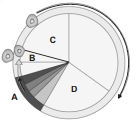
Identify the mismatched pair based on the provided cell cycle diagram.
A
$A$ - Starts with karyokinesis and ends with cytokinesis.
B
$B$ - Stage where cells are inactive metabolically.
C
$C$ - Cell grows and carries out normal metabolism.
D
$D$ - Period of cytoplasmic growth.
Solution
(D) Based on the cell cycle diagram:
$A$ represents the $M$-phase (Mitosis),which starts with karyokinesis and ends with cytokinesis.
$B$ represents the $G_0$ phase (Quiescent stage). In this stage,cells remain metabolically active but do not proliferate unless called upon to do so.
$C$ represents the $G_1$ phase,where the cell grows and carries out normal metabolism.
$D$ represents the $S$ phase (Synthesis phase),where $DNA$ replication occurs,not cytoplasmic growth (which occurs primarily in $G_1$ and $G_2$).
Therefore,the statement '$D$ - Period of cytoplasmic growth' is incorrect as it typically refers to the $G_1$ or $G_2$ phases,making option $D$ the mismatched pair.
$A$ represents the $M$-phase (Mitosis),which starts with karyokinesis and ends with cytokinesis.
$B$ represents the $G_0$ phase (Quiescent stage). In this stage,cells remain metabolically active but do not proliferate unless called upon to do so.
$C$ represents the $G_1$ phase,where the cell grows and carries out normal metabolism.
$D$ represents the $S$ phase (Synthesis phase),where $DNA$ replication occurs,not cytoplasmic growth (which occurs primarily in $G_1$ and $G_2$).
Therefore,the statement '$D$ - Period of cytoplasmic growth' is incorrect as it typically refers to the $G_1$ or $G_2$ phases,making option $D$ the mismatched pair.
0 likes
View Solution232
MediumMCQ
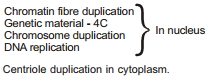
Chromatin fibres duplication,Genetic material-$4C$,Histone protein synthesis,Membranous organelle duplication,$DNA$ replication,centriole duplication. How many of the above features are associated with the synthesis $(S)$ phase of the cell cycle?
A
Three
B
Five
C
Four
D
Six
Solution
(C) The synthesis $(S)$ phase of the cell cycle is characterized by the following events:
$1$. $DNA$ replication: The amount of $DNA$ per cell doubles (from $2C$ to $4C$).
$2$. Chromatin fibre duplication: As $DNA$ replicates,the chromatin fibres also duplicate.
$3$. Histone protein synthesis: Histones are synthesized in the cytoplasm and transported to the nucleus to package the newly replicated $DNA$.
$4$. Centriole duplication: In animal cells,the centriole duplicates in the cytoplasm during the $S$ phase.
Membranous organelle duplication (like mitochondria and Golgi bodies) typically occurs during the $G_1$ and $G_2$ phases,not the $S$ phase.
Therefore,the features associated with the $S$ phase are: $DNA$ replication,chromatin fibre duplication,histone protein synthesis,and centriole duplication. This makes a total of four features.
$1$. $DNA$ replication: The amount of $DNA$ per cell doubles (from $2C$ to $4C$).
$2$. Chromatin fibre duplication: As $DNA$ replicates,the chromatin fibres also duplicate.
$3$. Histone protein synthesis: Histones are synthesized in the cytoplasm and transported to the nucleus to package the newly replicated $DNA$.
$4$. Centriole duplication: In animal cells,the centriole duplicates in the cytoplasm during the $S$ phase.
Membranous organelle duplication (like mitochondria and Golgi bodies) typically occurs during the $G_1$ and $G_2$ phases,not the $S$ phase.
Therefore,the features associated with the $S$ phase are: $DNA$ replication,chromatin fibre duplication,histone protein synthesis,and centriole duplication. This makes a total of four features.
0 likes
View Solution233
MediumMCQ
How many generations are required by a cell of meristem to produce $128$ cells?
A
$127$
B
$64$
C
$32$
D
$7$
Solution
(D) cell undergoes mitotic division where one cell produces $2$ daughter cells in each generation.
This follows the formula $2^n = N$,where $n$ is the number of generations and $N$ is the total number of cells.
Given $N = 128$,we have $2^n = 128$.
Since $128 = 2^7$,it follows that $n = 7$.
Therefore,$7$ generations are required to produce $128$ cells.
$1 \xrightarrow{1} 2 \xrightarrow{2} 4 \xrightarrow{3} 8 \xrightarrow{4} 16 \xrightarrow{5} 32 \xrightarrow{6} 64 \xrightarrow{7} 128$
This follows the formula $2^n = N$,where $n$ is the number of generations and $N$ is the total number of cells.
Given $N = 128$,we have $2^n = 128$.
Since $128 = 2^7$,it follows that $n = 7$.
Therefore,$7$ generations are required to produce $128$ cells.
$1 \xrightarrow{1} 2 \xrightarrow{2} 4 \xrightarrow{3} 8 \xrightarrow{4} 16 \xrightarrow{5} 32 \xrightarrow{6} 64 \xrightarrow{7} 128$
0 likes
View Solution234
MediumMCQ
If an egg of an organism has $10 \; pg$ of $DNA$ in its nucleus,how much $DNA$ would a diploid cell of the same organism have in the $G_2$ phase of the cell cycle (in $; pg$)?
A
$10$
B
$5$
C
$20$
D
$40$
Solution
(D) An egg is a haploid cell $(n)$,and its $DNA$ content is represented as $C$.
Given that the egg has $10 \; pg$ of $DNA$,we have $C = 10 \; pg$.
$A$ diploid cell $(2n)$ in the $G_1$ phase has $2C$ amount of $DNA$.
During the $S$ phase of the cell cycle,$DNA$ replication occurs,doubling the $DNA$ content.
Therefore,in the $G_2$ phase,the $DNA$ content of a diploid cell becomes $4C$.
Substituting the value of $C$: $4 \times 10 \; pg = 40 \; pg$.
Given that the egg has $10 \; pg$ of $DNA$,we have $C = 10 \; pg$.
$A$ diploid cell $(2n)$ in the $G_1$ phase has $2C$ amount of $DNA$.
During the $S$ phase of the cell cycle,$DNA$ replication occurs,doubling the $DNA$ content.
Therefore,in the $G_2$ phase,the $DNA$ content of a diploid cell becomes $4C$.
Substituting the value of $C$: $4 \times 10 \; pg = 40 \; pg$.
0 likes
View Solution235
MediumMCQ
What will be the content of $DNA$ in a somatic cell at $G_2$ phase if its meiotic products have $20 \; pg$ of $DNA$ (in $; pg$)?
A
$40$
B
$20$
C
$80$
D
$160$
Solution
(C) Meiotic products (gametes) are haploid $(n)$ and contain $C$ amount of $DNA$. Given that $C = 20 \; pg$.
$A$ somatic cell is diploid $(2n)$ and contains $2C$ amount of $DNA$ in the $G_1$ phase.
During the $S$ phase,the $DNA$ content doubles,so in the $G_2$ phase,the cell contains $4C$ amount of $DNA$.
Therefore,the $DNA$ content in the $G_2$ phase = $4 \times 20 \; pg = 80 \; pg$.
$A$ somatic cell is diploid $(2n)$ and contains $2C$ amount of $DNA$ in the $G_1$ phase.
During the $S$ phase,the $DNA$ content doubles,so in the $G_2$ phase,the cell contains $4C$ amount of $DNA$.
Therefore,the $DNA$ content in the $G_2$ phase = $4 \times 20 \; pg = 80 \; pg$.
0 likes
View Solution236
EasyMCQ
Most organelles show duplication in cell cycle during
A
$G_1$-phase
B
$G_0$-phase
C
$S$-phase
D
$G_2$-phase
Solution
(A) During the $G_1$-phase (Gap $1$ phase),the cell grows in size and synthesizes various proteins and $RNA$. Most of the cell organelles,such as mitochondria,chloroplasts,and the endoplasmic reticulum,undergo duplication during this phase to prepare for cell division.
0 likes
View Solution237
MediumMCQ
$A :$ $G_2$-phase is the pre-mitotic phase.
$R :$ Chromosomes undergo condensation in this phase.
$R :$ Chromosomes undergo condensation in this phase.
A
Assertion and Reason both are correct and Reason is the correct explanation of Assertion.
B
Assertion and Reason both are correct but Reason is not the correct explanation of Assertion.
C
Assertion is correct,but Reason is incorrect.
D
Both Assertion and Reason are incorrect.
Solution
(C) The $G_2$-phase is known as the pre-mitotic phase or the second growth phase,during which the cell prepares for mitosis by synthesizing proteins and duplicating organelles like mitochondria and chloroplasts.
Chromosome condensation does not occur in the $G_2$-phase; it is a characteristic feature of the prophase stage of mitosis.
Therefore,the Assertion is correct,but the Reason is incorrect.
Chromosome condensation does not occur in the $G_2$-phase; it is a characteristic feature of the prophase stage of mitosis.
Therefore,the Assertion is correct,but the Reason is incorrect.
0 likes
View Solution238
MediumMCQ
The structure that duplicates in the synthesis phase ($S$ phase) of cell division is/are:
A
$RNA$
B
Proteins
C
$DNA$
D
All of these
Solution
(C) During the cell cycle,the synthesis phase ($S$ phase) is the period where $DNA$ replication occurs. In this phase,the amount of $DNA$ per cell doubles,although the number of chromosomes remains the same. This ensures that each daughter cell receives an identical set of genetic material after mitosis.
0 likes
View Solution239
MediumMCQ
The centriole undergoes duplication during:
A
$S-$phase
B
Prophase
C
Metaphase
D
$G_{2}$ phase
Solution
(A) In animal cells,the centriole is a crucial organelle involved in the formation of the spindle apparatus during cell division.
During the $S-$phase (Synthesis phase) of the cell cycle,$DNA$ replication occurs in the nucleus.
Simultaneously,the centriole pair in the cytoplasm also undergoes duplication to ensure that each daughter cell receives a pair of centrioles.
Therefore,the correct phase for centriole duplication is the $S-$phase.
During the $S-$phase (Synthesis phase) of the cell cycle,$DNA$ replication occurs in the nucleus.
Simultaneously,the centriole pair in the cytoplasm also undergoes duplication to ensure that each daughter cell receives a pair of centrioles.
Therefore,the correct phase for centriole duplication is the $S-$phase.
0 likes
View Solution240
MediumMCQ
The fruit fly has $8$ chromosomes $(2n)$ in each cell. During interphase of mitosis,if the number of chromosomes at $G_1$ phase is $8$,what would be the number of chromosomes after $S$ phase?
A
$8$
B
$16$
C
$4$
D
$32$
Solution
(A) In the cell cycle,the $S$ phase (Synthesis phase) is characterized by the replication of $DNA$.
During this phase,the amount of $DNA$ per cell doubles (from $2C$ to $4C$),but the number of chromosomes remains the same.
Since the number of chromosomes at the $G_1$ phase is $8$,after the $S$ phase,the number of chromosomes remains $8$ because the sister chromatids remain attached at the centromere.
Therefore,the correct answer is $8$.
During this phase,the amount of $DNA$ per cell doubles (from $2C$ to $4C$),but the number of chromosomes remains the same.
Since the number of chromosomes at the $G_1$ phase is $8$,after the $S$ phase,the number of chromosomes remains $8$ because the sister chromatids remain attached at the centromere.
Therefore,the correct answer is $8$.
0 likes
View Solution241
EasyMCQ
In which phase of the cell cycle does the genetic material double?
A
$G_1$ phase
B
$S$ phase
C
$G_2$ phase
D
$M$ phase
Solution
(B) The cell cycle consists of two main phases: Interphase and $M$ phase (Mitosis). Interphase is further divided into $G_1$,$S$,and $G_2$ phases.
During the $S$ phase (Synthesis phase),$DNA$ replication occurs,which means the amount of genetic material $(DNA)$ in the cell doubles.
If the initial amount of $DNA$ is denoted as $2C$,it becomes $4C$ at the end of the $S$ phase,although the chromosome number remains the same.
During the $S$ phase (Synthesis phase),$DNA$ replication occurs,which means the amount of genetic material $(DNA)$ in the cell doubles.
If the initial amount of $DNA$ is denoted as $2C$,it becomes $4C$ at the end of the $S$ phase,although the chromosome number remains the same.
0 likes
View Solution242
MediumMCQ
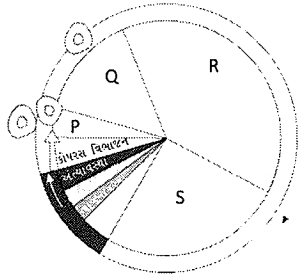
In the given diagram of the cell cycle,in which phase is the $DNA$ polymerase enzyme required?
A
$P$
B
$Q$
C
$R$
D
$S$
Solution
(B) The cell cycle consists of two main phases: Interphase and $M$-phase (Mitosis). Interphase is further divided into $G_1$,$S$,and $G_2$ phases.
In the provided diagram,$P$ represents the $G_1$ phase,$Q$ represents the $S$ phase (Synthesis phase),$R$ represents the $G_2$ phase,and $S$ represents the $M$-phase.
$DNA$ polymerase is the primary enzyme responsible for $DNA$ replication.
$DNA$ replication occurs specifically during the $S$ phase (Synthesis phase) of the cell cycle.
Therefore,the enzyme is required in phase $Q$.
In the provided diagram,$P$ represents the $G_1$ phase,$Q$ represents the $S$ phase (Synthesis phase),$R$ represents the $G_2$ phase,and $S$ represents the $M$-phase.
$DNA$ polymerase is the primary enzyme responsible for $DNA$ replication.
$DNA$ replication occurs specifically during the $S$ phase (Synthesis phase) of the cell cycle.
Therefore,the enzyme is required in phase $Q$.
0 likes
View Solution243
EasyMCQ
Which phase of the cell cycle lasts for the longest duration?
A
Interphase
B
$M$ phase
C
Both have the same duration
D
None of these
Solution
(A) The cell cycle is divided into two main phases: $Interphase$ and $M$ phase (Mitotic phase).
$Interphase$ is the preparatory phase where the cell grows, replicates its $DNA$, and prepares for division.
It occupies more than $95\%$ of the total duration of the cell cycle.
In contrast, the $M$ phase is the actual division phase, which is relatively short.
Therefore, $Interphase$ lasts for the longest duration.
$Interphase$ is the preparatory phase where the cell grows, replicates its $DNA$, and prepares for division.
It occupies more than $95\%$ of the total duration of the cell cycle.
In contrast, the $M$ phase is the actual division phase, which is relatively short.
Therefore, $Interphase$ lasts for the longest duration.
0 likes
View Solution244
MediumMCQ
Match the following columns:
| Column-$I$ (Cell) | Column-$II$ (Cell Cycle Duration) |
|---|---|
| $P$. Yeast | $I$. $20$ minutes |
| $Q$. $E. coli$ | $II$. $1.5$ hours |
| $R$. Human cell | $III$. $24$ hours |
A
$(P-I), (Q-II), (R-III)$
B
$(P-II), (Q-I), (R-III)$
C
$(P-III), (Q-II), (R-I)$
D
$(P-I), (Q-III), (R-II)$
Solution
(B) The cell cycle duration varies significantly among different organisms:
$1$. Yeast ($Saccharomyces$ $cerevisiae$) typically completes its cell cycle in approximately $90$ minutes or $1.5$ hours.
$2$. $E. coli$ (a bacterium) has a very rapid cell cycle,often dividing every $20$ minutes under optimal conditions.
$3$. Human cells in culture typically have a cell cycle duration of about $24$ hours.
Matching these:
$P$ (Yeast) matches with $II$ ($1.5$ hours).
$Q$ $(E. coli)$ matches with $I$ ($20$ minutes).
$R$ (Human cell) matches with $III$ ($24$ hours).
Therefore,the correct sequence is $(P-II), (Q-I), (R-III)$.
$1$. Yeast ($Saccharomyces$ $cerevisiae$) typically completes its cell cycle in approximately $90$ minutes or $1.5$ hours.
$2$. $E. coli$ (a bacterium) has a very rapid cell cycle,often dividing every $20$ minutes under optimal conditions.
$3$. Human cells in culture typically have a cell cycle duration of about $24$ hours.
Matching these:
$P$ (Yeast) matches with $II$ ($1.5$ hours).
$Q$ $(E. coli)$ matches with $I$ ($20$ minutes).
$R$ (Human cell) matches with $III$ ($24$ hours).
Therefore,the correct sequence is $(P-II), (Q-I), (R-III)$.
0 likes
View Solution245
MediumMCQ
Which of the following represents the stage between two successive $M$ phases?
A
$G_1$ phase
B
$S$ phase
C
$G_2$ phase
D
Interphase
Solution
(D) The cell cycle is divided into two main phases: the $M$ phase (Mitosis) and the Interphase.
Interphase is the period between two successive $M$ phases.
It is further divided into three sub-phases: $G_1$ phase (Gap $1$),$S$ phase (Synthesis),and $G_2$ phase (Gap $2$).
Since Interphase encompasses the entire duration between two $M$ phases,it is the correct representation of the stage between them.
Interphase is the period between two successive $M$ phases.
It is further divided into three sub-phases: $G_1$ phase (Gap $1$),$S$ phase (Synthesis),and $G_2$ phase (Gap $2$).
Since Interphase encompasses the entire duration between two $M$ phases,it is the correct representation of the stage between them.
0 likes
View Solution246
EasyMCQ
Identify the subphases of interphase.
A
$G_1$
B
$S$
C
$G_2$
D
All of the above
Solution
(D) The interphase is the phase of the cell cycle in which a typical cell spends most of its life.
It is divided into three distinct subphases:
$1$. $G_1$ phase (Gap $1$): The cell grows and performs its normal metabolic functions.
$2$. $S$ phase (Synthesis): $DNA$ replication occurs.
$3$. $G_2$ phase (Gap $2$): The cell prepares for mitosis by synthesizing proteins and organelles.
Therefore,all the listed options are subphases of interphase.
It is divided into three distinct subphases:
$1$. $G_1$ phase (Gap $1$): The cell grows and performs its normal metabolic functions.
$2$. $S$ phase (Synthesis): $DNA$ replication occurs.
$3$. $G_2$ phase (Gap $2$): The cell prepares for mitosis by synthesizing proteins and organelles.
Therefore,all the listed options are subphases of interphase.
0 likes
View Solution247
MediumMCQ
What change occurs in the nucleus of a cell as it progresses from the $G_1$ phase to the $G_2$ phase?
A
$2C \rightarrow 2C, 2n \rightarrow 2n$
B
$2C \rightarrow 4C, 2n \rightarrow 4n$
C
$2C \rightarrow 4C, 2n \rightarrow 2n$
D
$2C \rightarrow 4C, 2n \rightarrow 4n$
Solution
(C) In the cell cycle,the $G_1$ phase represents the initial growth phase where the $DNA$ content is $2C$ and the chromosome number is $2n$.
During the $S$ phase (Synthesis phase),$DNA$ replication occurs,which doubles the $DNA$ content from $2C$ to $4C$,while the chromosome number remains $2n$ because the sister chromatids remain attached at the centromere.
Following the $S$ phase,the cell enters the $G_2$ phase.
Therefore,in the $G_2$ phase,the $DNA$ content is $4C$ and the chromosome number remains $2n$.
Thus,the transition from $G_1$ to $G_2$ involves a change in $DNA$ content from $2C$ to $4C$,while the ploidy $(2n)$ remains constant.
During the $S$ phase (Synthesis phase),$DNA$ replication occurs,which doubles the $DNA$ content from $2C$ to $4C$,while the chromosome number remains $2n$ because the sister chromatids remain attached at the centromere.
Following the $S$ phase,the cell enters the $G_2$ phase.
Therefore,in the $G_2$ phase,the $DNA$ content is $4C$ and the chromosome number remains $2n$.
Thus,the transition from $G_1$ to $G_2$ involves a change in $DNA$ content from $2C$ to $4C$,while the ploidy $(2n)$ remains constant.
0 likes
View Solution248
EasyMCQ
In which phase of the cell cycle does the centriole duplicate?
A
$G_1$ phase
B
$S$ phase
C
$G_2$ phase
D
$M$ phase
Solution
(B) In animal cells,the centriole duplicates during the $S$ phase (Synthesis phase) of the cell cycle,alongside the replication of nuclear $DNA$. This ensures that each daughter cell receives a pair of centrioles during cell division.
0 likes
View Solution249
EasyMCQ
During the cell cycle,in which phase does $DNA$ synthesis occur?
A
$G_1$ phase
B
$S$ phase
C
$G_2$ phase
D
$M$ phase
Solution
(B) The cell cycle is divided into two main phases: Interphase and $M$ phase (Mitosis).
Interphase is further divided into three sub-phases: $G_1$ phase,$S$ phase,and $G_2$ phase.
During the $S$ phase (Synthesis phase),the replication of $DNA$ takes place.
In this phase,the amount of $DNA$ per cell doubles,although the chromosome number remains the same.
Interphase is further divided into three sub-phases: $G_1$ phase,$S$ phase,and $G_2$ phase.
During the $S$ phase (Synthesis phase),the replication of $DNA$ takes place.
In this phase,the amount of $DNA$ per cell doubles,although the chromosome number remains the same.
0 likes
View Solution250
MediumMCQ
Among eukaryotes,replication of $DNA$ takes place in:
A
$G_2$ phase
B
$M$ phase
C
$S$ phase
D
$G_1$ phase
Solution
(C) In eukaryotes,the replication of $DNA$ occurs during the $S$ phase (Synthesis phase) of the cell cycle.
During this phase,the amount of $DNA$ per cell doubles,although the chromosome number remains the same.
In contrast,the $G_1$ phase involves cell growth and the duplication of most cell organelles,while the $G_2$ phase involves protein synthesis and preparation for mitosis.
During this phase,the amount of $DNA$ per cell doubles,although the chromosome number remains the same.
In contrast,the $G_1$ phase involves cell growth and the duplication of most cell organelles,while the $G_2$ phase involves protein synthesis and preparation for mitosis.
0 likes
View SolutionCell Cycle and Cell Division — Cell Cycle · Frequently Asked Questions
1Are these Cell Cycle and Cell Division questions useful for JEE and NEET?
Yes. All questions in this section are mapped to JEE Main and NEET exam patterns. Previous year questions from JEE Main, NEET, GUJCET and state-level exams are included with full solutions.
2Can I switch to Hindi or Gujarati for these questions?
Yes. Use the language tabs in the hero section or the sidebar to view the same questions and solutions in English, Hindi or Gujarati.
3How do I generate a question paper from this subtopic?
Use the Vedclass Exam Paper Generator — select the chapter and subtopic, set difficulty, and generate Sets A, B, C, D automatically. First 3 chapters of every subject are free.
Vedclass Products
For Students
Vedclass Test Series
Mock tests in real JEE/NEET style with performance analysis. 5-day free trial.
Start Free TrialFor Teachers
Exam Paper Generator
Generate Set A/B/C/D papers from this chapter in 2 minutes. 3 chapters free.
Try FreeFor Institutes
Online Exam Module
Live online exams with unlimited students, 360° analytics & white-label branding.
See DemoFor Teachers & Institutes
Generate a Cell Cycle and Cell Division Exam Paper in 2 Minutes
Select subtopic & difficulty — Sets A, B, C, D auto-generated with No Repeat logic.
First 3 chapters of every subject are free — no payment required.