
A English
Cell Cycle Questions in English
Class 11 Biology · Cell Cycle and Cell Division · Cell Cycle
261+
Questions
English
Language
100%
With Solutions
Showing 50 of 261 questions in English
51
MediumMCQ
During which phase of the cell cycle does histone protein synthesis occur in a eukaryotic cell?
A
During telophase
B
During $S-$phase
C
During $G_2-$phase of prophase
D
During the entire prophase
Solution
(B) In eukaryotic cells,the synthesis of histone proteins is tightly coupled with $DNA$ replication. Since $DNA$ replication occurs during the $S-$phase (Synthesis phase) of the cell cycle,the production of histone proteins also takes place during the $S-$phase to ensure that newly synthesized $DNA$ can be immediately packaged into chromatin.
0 likes
View Solution52
MediumMCQ
If a dividing cell is placed in a medium containing radioactive thymidine,the radioactivity will first be observed in:
A
Euchromatin
B
Heterochromatin
C
Both simultaneously
D
None of the above
Solution
(A) Radioactive thymidine is a precursor for $DNA$ synthesis. During the $S$-phase of the cell cycle,$DNA$ replication occurs. Euchromatin is the loosely packed,transcriptionally active region of chromatin that replicates early during the $S$-phase. Heterochromatin is the tightly packed,transcriptionally inactive region that replicates late during the $S$-phase. Therefore,the radioactivity will first be observed in the euchromatin.
0 likes
View Solution53
EasyMCQ
In which phase does $DNA$ synthesis occur?
A
$G_1$ phase
B
$G_2$ phase
C
$S$ phase
D
None of these
Solution
(C) The cell cycle is divided into two main phases: Interphase and $M$-phase (Mitosis).
Interphase is further divided into $G_1$,$S$,and $G_2$ phases.
During the $S$ phase (Synthesis phase),the replication of $DNA$ takes place.
In this phase,the amount of $DNA$ per cell doubles,although the chromosome number remains the same.
Interphase is further divided into $G_1$,$S$,and $G_2$ phases.
During the $S$ phase (Synthesis phase),the replication of $DNA$ takes place.
In this phase,the amount of $DNA$ per cell doubles,although the chromosome number remains the same.
0 likes
View Solution54
EasyMCQ
The duration of the cell cycle in yeast is approximately ........
A
$90$ minutes
B
$80$ minutes
C
$60$ minutes
D
$120$ minutes
Solution
(A) The cell cycle duration varies significantly among different organisms.
In the case of yeast $(Saccharomyces cerevisiae)$, which is a unicellular eukaryote, the cell cycle is completed in approximately $90$ minutes under optimal growth conditions.
This is a standard biological fact mentioned in the context of cell division studies.
In the case of yeast $(Saccharomyces cerevisiae)$, which is a unicellular eukaryote, the cell cycle is completed in approximately $90$ minutes under optimal growth conditions.
This is a standard biological fact mentioned in the context of cell division studies.
0 likes
View Solution55
DifficultMCQ
Which phase of the cell cycle is also known as the resting phase?
A
$S$-phase
B
Telophase
C
$M$-phase
D
Interphase
Solution
(D) The cell cycle is divided into two main phases: Interphase and $M$-phase (Mitosis/Meiosis).
Interphase is the period during which the cell prepares for division by growing and replicating its $DNA$.
Historically,because the cell is not actively dividing during this period,it was referred to as the 'resting phase'.
However,it is a highly metabolically active phase where the cell is preparing for the next division cycle.
Therefore,the correct option is $D$.
Interphase is the period during which the cell prepares for division by growing and replicating its $DNA$.
Historically,because the cell is not actively dividing during this period,it was referred to as the 'resting phase'.
However,it is a highly metabolically active phase where the cell is preparing for the next division cycle.
Therefore,the correct option is $D$.
0 likes
View Solution56
EasyMCQ
The period between the end of the division phase and the initiation of $DNA$ replication is called .......
A
$G_1$ phase
B
$G_2$ phase
C
$M$ phase
D
Interphase
Solution
(A) The cell cycle is divided into two main phases: Interphase and $M$ phase (Mitosis).
Interphase is further divided into three sub-phases: $G_1$ phase,$S$ phase,and $G_2$ phase.
$G_1$ phase (Gap $1$) corresponds to the interval between mitosis ($M$ phase) and the initiation of $DNA$ replication ($S$ phase).
During this phase,the cell is metabolically active and continuously grows in size but does not replicate its $DNA$.
Interphase is further divided into three sub-phases: $G_1$ phase,$S$ phase,and $G_2$ phase.
$G_1$ phase (Gap $1$) corresponds to the interval between mitosis ($M$ phase) and the initiation of $DNA$ replication ($S$ phase).
During this phase,the cell is metabolically active and continuously grows in size but does not replicate its $DNA$.
0 likes
View Solution57
EasyMCQ
What occurs during the synthesis phase ($S$ phase) of the cell cycle?
A
$DNA$ replication
B
Doubling of chromosome number
C
Formation of two nuclei
D
Synthesis of proteins and $RNA$
Solution
(A) The synthesis phase,or $S$ phase,is a critical period of the cell cycle that occurs during interphase.
During this phase,the cell undergoes $DNA$ replication,resulting in the duplication of the genetic material.
While the amount of $DNA$ per cell doubles,the actual number of chromosomes remains the same because the sister chromatids remain attached at the centromere.
Therefore,the correct event is $DNA$ replication.
During this phase,the cell undergoes $DNA$ replication,resulting in the duplication of the genetic material.
While the amount of $DNA$ per cell doubles,the actual number of chromosomes remains the same because the sister chromatids remain attached at the centromere.
Therefore,the correct event is $DNA$ replication.
0 likes
View Solution58
MediumMCQ
During the $G_2$ phase,the number of $DNA$ molecules per chromosome is:
A
One
B
Two
C
Four
D
Eight
Solution
(B) In the cell cycle,the $S$ phase (Synthesis phase) is responsible for $DNA$ replication.
Before the $S$ phase,each chromosome consists of one chromatid (one $DNA$ molecule).
During the $S$ phase,$DNA$ replication occurs,resulting in each chromosome consisting of two sister chromatids,each containing one $DNA$ molecule.
Therefore,after $DNA$ replication,each chromosome contains two $DNA$ molecules.
Since the $G_2$ phase occurs after the $S$ phase,the number of $DNA$ molecules per chromosome remains two.
Before the $S$ phase,each chromosome consists of one chromatid (one $DNA$ molecule).
During the $S$ phase,$DNA$ replication occurs,resulting in each chromosome consisting of two sister chromatids,each containing one $DNA$ molecule.
Therefore,after $DNA$ replication,each chromosome contains two $DNA$ molecules.
Since the $G_2$ phase occurs after the $S$ phase,the number of $DNA$ molecules per chromosome remains two.
0 likes
View Solution59
MediumMCQ
Assertion $A$: During interphase,the genetic material exists as chromatin.
Reason $R$: During interphase,chromosomes are present as thread-like structures.
Which option is correct for Assertion $A$ and Reason $R$?
Reason $R$: During interphase,chromosomes are present as thread-like structures.
Which option is correct for Assertion $A$ and Reason $R$?
A
$A$ and $R$ are both true and $R$ is the correct explanation of $A$.
B
$A$ and $R$ are both true but $R$ is not the correct explanation of $A$.
C
$A$ is true and $R$ is false.
D
$A$ is false and $R$ is true.
Solution
(A) During the interphase stage of the cell cycle,the genetic material is in a decondensed state known as chromatin.
Chromatin consists of long,thin,thread-like structures of $DNA$ and proteins.
These structures are not yet condensed into the compact,distinct chromosomes seen during mitosis.
Therefore,both the assertion that genetic material exists as chromatin and the reason that they are present as thread-like structures are correct.
Furthermore,the reason $R$ correctly explains why the genetic material is referred to as chromatin in assertion $A$.
Chromatin consists of long,thin,thread-like structures of $DNA$ and proteins.
These structures are not yet condensed into the compact,distinct chromosomes seen during mitosis.
Therefore,both the assertion that genetic material exists as chromatin and the reason that they are present as thread-like structures are correct.
Furthermore,the reason $R$ correctly explains why the genetic material is referred to as chromatin in assertion $A$.
0 likes
View Solution60
MediumMCQ
In which phase of the cell cycle are chromosomes found as a diffused network of chromatin?
A
Interphase
B
Prophase
C
Metaphase
D
Telophase
Solution
(A) During the $Interphase$ of the cell cycle,the genetic material exists in the form of a loose,thread-like network known as chromatin.
In this state,the chromosomes are not condensed and are therefore not visible as distinct structures under a light microscope.
As the cell enters $Prophase$,the chromatin fibers undergo condensation to form compact,distinct chromosomes.
In this state,the chromosomes are not condensed and are therefore not visible as distinct structures under a light microscope.
As the cell enters $Prophase$,the chromatin fibers undergo condensation to form compact,distinct chromosomes.
0 likes
View Solution61
EasyMCQ
Which of the following is $NOT$ true for the $G_1$ phase?
A
$RNA$ and protein synthesis occurs.
B
Synthesis of enzymes required for $DNA$ replication occurs.
C
Chromatids separate.
D
Biosynthetic processes occur.
Solution
(C) The $G_1$ phase (Gap $1$ phase) is the first phase of interphase in the cell cycle.
During this phase,the cell is metabolically active and continuously grows.
$RNA$ and protein synthesis occur,and the cell prepares for $DNA$ replication by synthesizing necessary enzymes.
Chromatid separation occurs during the Anaphase stage of Mitosis,not during the $G_1$ phase.
Therefore,the statement that chromatids separate during the $G_1$ phase is incorrect.
During this phase,the cell is metabolically active and continuously grows.
$RNA$ and protein synthesis occur,and the cell prepares for $DNA$ replication by synthesizing necessary enzymes.
Chromatid separation occurs during the Anaphase stage of Mitosis,not during the $G_1$ phase.
Therefore,the statement that chromatids separate during the $G_1$ phase is incorrect.
0 likes
View Solution62
EasyMCQ
What is the period between two successive cell divisions called?
A
Cell cycle
B
Interphase
C
Division phase
D
Differentiation phase
Solution
(B) The period between two successive cell divisions is known as the $Interphase$. During this phase,the cell prepares for division by undergoing growth and $DNA$ replication. It is the most active phase of the cell cycle.
0 likes
View Solution63
EasyMCQ
During which phase of the cell cycle does the $DNA$ content of the cell double?
A
Prophase
B
Metaphase
C
Interphase
D
Telophase
Solution
(C) The cell cycle consists of two main phases: $Interphase$ and $M-phase$ (Mitotic phase).
$Interphase$ is further divided into $G_1$ phase,$S$ phase (Synthesis phase),and $G_2$ phase.
During the $S$ phase of $Interphase$,the replication of $DNA$ occurs,which leads to the doubling of the $DNA$ content in the cell.
Therefore,the correct phase is $Interphase$.
$Interphase$ is further divided into $G_1$ phase,$S$ phase (Synthesis phase),and $G_2$ phase.
During the $S$ phase of $Interphase$,the replication of $DNA$ occurs,which leads to the doubling of the $DNA$ content in the cell.
Therefore,the correct phase is $Interphase$.
0 likes
View Solution64
EasyMCQ
In which phase does $DNA$ replication occur?
A
Prophase
B
Telophase
C
Metaphase
D
Interphase
Solution
(D) $DNA$ replication occurs during the $S$ phase (Synthesis phase) of the cell cycle. The $S$ phase is a part of the Interphase,which is the period between two successive cell divisions. During this phase,the amount of $DNA$ per cell doubles,while the chromosome number remains the same.
0 likes
View Solution65
MediumMCQ
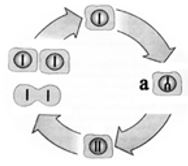
In the given figure,which phase is represented by '$a$'?
A
$G_1$ phase
B
$G_2$ phase
C
$S$ phase
D
$M$ phase
Solution
(C) The cell cycle consists of interphase $(G_1, S, G_2)$ and the $M$ phase (mitosis).
In the provided diagram,the cell is shown undergoing $DNA$ replication,where the amount of $DNA$ doubles within the nucleus.
This process of $DNA$ synthesis occurs specifically during the $S$ phase (Synthesis phase) of the interphase.
Therefore,'$a$' represents the $S$ phase.
In the provided diagram,the cell is shown undergoing $DNA$ replication,where the amount of $DNA$ doubles within the nucleus.
This process of $DNA$ synthesis occurs specifically during the $S$ phase (Synthesis phase) of the interphase.
Therefore,'$a$' represents the $S$ phase.
0 likes
View Solution66
EasyMCQ
What does every newly formed cell follow?
A
Only chromosome segregation
B
Only $DNA$ synthesis
C
Only $G_1$ phase
D
Cell cycle
Solution
(D) Every newly formed cell undergoes a series of events known as the cell cycle. The cell cycle is a sequence of events by which a cell duplicates its genome,synthesizes the other constituents of the cell,and eventually divides into two daughter cells. This process includes interphase ($G_1$,$S$,and $G_2$ phases) and the $M$-phase (mitosis or meiosis).
0 likes
View Solution67
EasyMCQ
Which of the following is true for the $S$ phase of the cell cycle?
A
Synthesis of enzymes required for $DNA$ replication
B
Alignment of chromosomes at the equator
C
Separation of chromosomes
D
Replication of $DNA$ and duplication of chromosomes
Solution
(D) The $S$ phase (Synthesis phase) is a critical stage of interphase in the cell cycle.
During this phase,$DNA$ replication occurs,meaning the amount of $DNA$ per cell doubles.
If the initial amount of $DNA$ is denoted as $2C$,it increases to $4C$ at the end of the $S$ phase.
Additionally,the centrioles in the cytoplasm also duplicate during this phase.
Therefore,the replication of $DNA$ and the duplication of chromosomes (in terms of chromatid content) are the defining characteristics of the $S$ phase.
During this phase,$DNA$ replication occurs,meaning the amount of $DNA$ per cell doubles.
If the initial amount of $DNA$ is denoted as $2C$,it increases to $4C$ at the end of the $S$ phase.
Additionally,the centrioles in the cytoplasm also duplicate during this phase.
Therefore,the replication of $DNA$ and the duplication of chromosomes (in terms of chromatid content) are the defining characteristics of the $S$ phase.
0 likes
View Solution68
EasyMCQ
In which of the following cells is the cell cycle completed in $90$ minutes?
A
Yeast cell
B
Human germ cell
C
Male gamete
D
Bacterial cell
Solution
(A) The duration of the cell cycle varies significantly among different organisms and cell types.
In the case of yeast $(Saccharomyces \ cerevisiae)$,the cell cycle is completed in approximately $90$ minutes under optimal growth conditions.
In contrast,a typical human cell takes about $24$ hours to complete its cell cycle.
Therefore,the correct option is $A$.
In the case of yeast $(Saccharomyces \ cerevisiae)$,the cell cycle is completed in approximately $90$ minutes under optimal growth conditions.
In contrast,a typical human cell takes about $24$ hours to complete its cell cycle.
Therefore,the correct option is $A$.
0 likes
View Solution69
MediumMCQ
If the amount of $DNA$ is recorded as $2C$ at the beginning of the $S$ phase,what will be its amount at the end of the $S$ phase?
A
$4C$
B
$2C$
C
$C$
D
$8C$
Solution
(A) The $S$ phase (Synthesis phase) of the cell cycle is characterized by the replication of $DNA$.
During this phase,the amount of $DNA$ per cell doubles.
If the initial amount of $DNA$ at the beginning of the $S$ phase is $2C$,then after the completion of $DNA$ replication,the amount of $DNA$ becomes $4C$.
Therefore,at the end of the $S$ phase,the amount of $DNA$ is $4C$.
During this phase,the amount of $DNA$ per cell doubles.
If the initial amount of $DNA$ at the beginning of the $S$ phase is $2C$,then after the completion of $DNA$ replication,the amount of $DNA$ becomes $4C$.
Therefore,at the end of the $S$ phase,the amount of $DNA$ is $4C$.
0 likes
View Solution70
EasyMCQ
At the end of which phase in interphase are all chromosomes replicated?
A
$G_2$ phase
B
$S$ phase
C
$M$ phase
D
$G_1$ phase
Solution
(B) The cell cycle is divided into two main phases: Interphase and $M$ phase (Mitosis). Interphase is further divided into $G_1$,$S$,and $G_2$ phases.
During the $S$ phase (Synthesis phase),$DNA$ replication occurs within the nucleus.
As a result of $DNA$ replication,the amount of $DNA$ per cell doubles,and the chromosomes are replicated,meaning each chromosome now consists of two sister chromatids.
Therefore,at the end of the $S$ phase,all chromosomes are replicated.
During the $S$ phase (Synthesis phase),$DNA$ replication occurs within the nucleus.
As a result of $DNA$ replication,the amount of $DNA$ per cell doubles,and the chromosomes are replicated,meaning each chromosome now consists of two sister chromatids.
Therefore,at the end of the $S$ phase,all chromosomes are replicated.
0 likes
View Solution71
MediumMCQ
Which of the following is applicable to the $G_1$ phase of the cell cycle?
A
Synthesis of enzymes required for $DNA$ synthesis
B
Replication of chromosomes
C
Cell with replicated chromosomes
D
Separation of chromosomes
Solution
(A) The $G_1$ phase (Gap $1$ phase) is the first phase of interphase in the cell cycle.
During this phase,the cell is metabolically active and continuously grows.
It involves the synthesis of various proteins,$RNA$,and enzymes (such as $DNA$ polymerase) that are essential for the subsequent $S$ phase (Synthesis phase) where $DNA$ replication occurs.
Therefore,the synthesis of enzymes required for $DNA$ synthesis is the correct characteristic of the $G_1$ phase.
During this phase,the cell is metabolically active and continuously grows.
It involves the synthesis of various proteins,$RNA$,and enzymes (such as $DNA$ polymerase) that are essential for the subsequent $S$ phase (Synthesis phase) where $DNA$ replication occurs.
Therefore,the synthesis of enzymes required for $DNA$ synthesis is the correct characteristic of the $G_1$ phase.
0 likes
View Solution72
EasyMCQ
Which of the following phases is not a part of interphase?
A
$C$ phase
B
$S$ phase
C
$G_1$ phase
D
$G_2$ phase
Solution
(A) The cell cycle is divided into two main phases: Interphase and $M$ phase (Mitosis/Meiosis).
Interphase is the period of preparation for cell division and consists of three sub-phases: $G_1$ phase (Gap $1$),$S$ phase (Synthesis),and $G_2$ phase (Gap $2$).
There is no phase known as the $C$ phase in the cell cycle.
Therefore,the $C$ phase is not a part of interphase.
Interphase is the period of preparation for cell division and consists of three sub-phases: $G_1$ phase (Gap $1$),$S$ phase (Synthesis),and $G_2$ phase (Gap $2$).
There is no phase known as the $C$ phase in the cell cycle.
Therefore,the $C$ phase is not a part of interphase.
0 likes
View Solution73
MediumMCQ
During which phase of interphase do biosynthetic processes occur?
A
$G_1$ phase
B
$S$ phase
C
$G_2$ phase
D
$M$ phase
Solution
(A) The interphase is divided into three phases: $G_1$,$S$,and $G_2$.
During the $G_1$ phase (Gap $1$),the cell is metabolically active and continuously grows.
It synthesizes various proteins,enzymes,and organelles required for $DNA$ replication and cell division.
Therefore,the $G_1$ phase is characterized by intense biosynthetic activity.
During the $G_1$ phase (Gap $1$),the cell is metabolically active and continuously grows.
It synthesizes various proteins,enzymes,and organelles required for $DNA$ replication and cell division.
Therefore,the $G_1$ phase is characterized by intense biosynthetic activity.
0 likes
View Solution74
EasyMCQ
Which phase of the interphase represents the interval between the previous mitosis and the current $DNA$ synthesis?
A
$G_1$ phase
B
$G_2$ phase
C
$S$ phase
D
$M$ phase
Solution
(A) The cell cycle is divided into two main phases: Interphase and $M$ phase (Mitosis).
Interphase is further divided into three sub-phases: $G_1$ phase,$S$ phase,and $G_2$ phase.
$1$. The $G_1$ phase (Gap $1$) is the period between the end of the previous mitosis ($M$ phase) and the beginning of $DNA$ replication ($S$ phase).
$2$. During the $G_1$ phase,the cell is metabolically active and continuously grows in size but does not replicate its $DNA$.
$3$. The $S$ phase (Synthesis phase) is when $DNA$ replication occurs.
$4$. The $G_2$ phase (Gap $2$) is the period between $DNA$ synthesis and the next mitosis.
Therefore,the interval between the previous mitosis and the current $DNA$ synthesis is the $G_1$ phase.
Interphase is further divided into three sub-phases: $G_1$ phase,$S$ phase,and $G_2$ phase.
$1$. The $G_1$ phase (Gap $1$) is the period between the end of the previous mitosis ($M$ phase) and the beginning of $DNA$ replication ($S$ phase).
$2$. During the $G_1$ phase,the cell is metabolically active and continuously grows in size but does not replicate its $DNA$.
$3$. The $S$ phase (Synthesis phase) is when $DNA$ replication occurs.
$4$. The $G_2$ phase (Gap $2$) is the period between $DNA$ synthesis and the next mitosis.
Therefore,the interval between the previous mitosis and the current $DNA$ synthesis is the $G_1$ phase.
0 likes
View Solution75
EasyMCQ
In which phase is the centrosome observed to be duplicated?
A
Prophase
B
Interphase
C
Metaphase
D
Telophase
Solution
(B) The centrosome duplicates during the $S$-phase of the $Interphase$ in the cell cycle.
During the $S$-phase (Synthesis phase),the cell replicates its $DNA$ and also duplicates its centrosome to ensure that each daughter cell receives a pair of centrioles during mitosis.
During the $S$-phase (Synthesis phase),the cell replicates its $DNA$ and also duplicates its centrosome to ensure that each daughter cell receives a pair of centrioles during mitosis.
0 likes
View Solution76
EasyMCQ
In humans, how many hours does it take to complete one full cell cycle (in $hours$)?
A
$48$
B
$12$
C
$36$
D
$24$
Solution
(D) The duration of the cell cycle varies from organism to organism and also from cell type to cell type. In humans, a typical eukaryotic cell cycle, such as that of a cultured human cell, takes approximately $24$ hours to complete one full cycle. This includes the $G_1$ phase, $S$ phase, $G_2$ phase, and $M$ phase.
0 likes
View Solution77
EasyMCQ
Which phase of the interphase is known as the growth phase?
A
$M$ phase
B
$G_1$ phase
C
$G_2$ phase
D
$S$ phase
Solution
(B) The interphase is divided into three sub-phases: $G_1$ phase,$S$ phase,and $G_2$ phase.
$G_1$ phase (Gap $1$) corresponds to the interval between mitosis and the initiation of $DNA$ replication.
During the $G_1$ phase,the cell is metabolically active and continuously grows in size,hence it is known as the growth phase.
$S$ phase is the synthesis phase where $DNA$ replication occurs.
$G_2$ phase (Gap $2$) is the phase where proteins are synthesized in preparation for mitosis.
$G_1$ phase (Gap $1$) corresponds to the interval between mitosis and the initiation of $DNA$ replication.
During the $G_1$ phase,the cell is metabolically active and continuously grows in size,hence it is known as the growth phase.
$S$ phase is the synthesis phase where $DNA$ replication occurs.
$G_2$ phase (Gap $2$) is the phase where proteins are synthesized in preparation for mitosis.
0 likes
View Solution78
MediumMCQ
What is the average cell cycle duration for a human cell (in $hours$)?
A
$17$
B
$12$
C
$24$
D
$30$
Solution
(C) The average cell cycle duration for a human cell in culture is approximately $24$ hours.
Although the duration of the cell cycle can vary significantly depending on the organism and the type of cell, the $24$-hour period is the standard reference value provided in biological studies for human cells.
Although the duration of the cell cycle can vary significantly depending on the organism and the type of cell, the $24$-hour period is the standard reference value provided in biological studies for human cells.
0 likes
View Solution79
EasyMCQ
During the cell cycle,in which phase does $DNA$ replication occur?
A
$G_1$ phase
B
$S$ phase
C
$G_2$ phase
D
$M$ phase
Solution
(B) The cell cycle is divided into two main phases: Interphase and $M$ phase (Mitosis).
Interphase is further divided into three sub-phases: $G_1$ phase,$S$ phase,and $G_2$ phase.
$DNA$ replication occurs specifically during the $S$ phase (Synthesis phase) of the interphase.
During this phase,the amount of $DNA$ per cell doubles,although the chromosome number remains the same.
Interphase is further divided into three sub-phases: $G_1$ phase,$S$ phase,and $G_2$ phase.
$DNA$ replication occurs specifically during the $S$ phase (Synthesis phase) of the interphase.
During this phase,the amount of $DNA$ per cell doubles,although the chromosome number remains the same.
0 likes
View Solution80
EasyMCQ
What is the period between two successive cell divisions called?
A
Cell cycle
B
Cell division
C
Cell differentiation
D
Cell duration
Solution
(A) The period between two successive cell divisions is known as the $Cell$ $cycle$. It consists of two main phases: $Interphase$ (the preparatory phase) and $M-phase$ (the mitotic phase). During the $Interphase$,the cell grows and replicates its $DNA$ in preparation for the next division.
0 likes
View Solution81
EasyMCQ
In which phase does the cell prepare for division?
A
$M$ phase
B
$G_1$ phase
C
$G_2$ phase
D
$S$ phase
Solution
(C) The cell cycle consists of two main phases: Interphase and $M$ phase (Mitosis).
Interphase is further divided into three sub-phases: $G_1$ phase,$S$ phase,and $G_2$ phase.
$G_1$ phase (Gap $1$) is the period during which the cell grows and prepares for $DNA$ replication.
$S$ phase (Synthesis phase) is when $DNA$ replication occurs.
$G_2$ phase (Gap $2$) is the phase where the cell continues to grow and synthesizes proteins and organelles necessary for cell division.
Therefore,the $G_2$ phase is specifically the final preparation phase before the cell enters the $M$ phase (mitosis) for actual division.
Interphase is further divided into three sub-phases: $G_1$ phase,$S$ phase,and $G_2$ phase.
$G_1$ phase (Gap $1$) is the period during which the cell grows and prepares for $DNA$ replication.
$S$ phase (Synthesis phase) is when $DNA$ replication occurs.
$G_2$ phase (Gap $2$) is the phase where the cell continues to grow and synthesizes proteins and organelles necessary for cell division.
Therefore,the $G_2$ phase is specifically the final preparation phase before the cell enters the $M$ phase (mitosis) for actual division.
0 likes
View Solution82
EasyMCQ
During which phase does the cellular content double and the cell size increase?
A
Prophase
B
Interphase
C
Anaphase
D
Metaphase
Solution
(B) The cell cycle consists of two main phases: $Interphase$ and $M-phase$ (Mitotic phase).
$Interphase$ is the period during which the cell prepares for division.
It is further divided into $G_1$,$S$,and $G_2$ phases.
During $Interphase$,the cell grows in size,and the cellular contents (such as organelles and proteins) are synthesized and doubled to prepare for the subsequent division.
Therefore,the correct answer is $Interphase$.
$Interphase$ is the period during which the cell prepares for division.
It is further divided into $G_1$,$S$,and $G_2$ phases.
During $Interphase$,the cell grows in size,and the cellular contents (such as organelles and proteins) are synthesized and doubled to prepare for the subsequent division.
Therefore,the correct answer is $Interphase$.
0 likes
View Solution83
EasyMCQ
Which of the following events does not occur during interphase?
A
$DNA$ replication
B
Centriole duplication
C
Cell growth (increase in cell size)
D
Complete disappearance of the nucleolus
Solution
(D) Interphase is the phase between two successive $M$ phases,consisting of $G_1$,$S$,and $G_2$ phases.
During interphase,the cell prepares for division by replicating its $DNA$ ($S$ phase),duplicating organelles like centrioles,and increasing its overall size.
The nucleolus typically begins to disappear during the prophase stage of mitosis,not during interphase.
Therefore,the complete disappearance of the nucleolus is a characteristic event of the prophase stage of mitosis,not interphase.
During interphase,the cell prepares for division by replicating its $DNA$ ($S$ phase),duplicating organelles like centrioles,and increasing its overall size.
The nucleolus typically begins to disappear during the prophase stage of mitosis,not during interphase.
Therefore,the complete disappearance of the nucleolus is a characteristic event of the prophase stage of mitosis,not interphase.
0 likes
View Solution84
EasyMCQ
During which phase are chromosomes referred to as chromatin?
A
Interphase
B
Prophase
C
Metaphase
D
Anaphase
Solution
(A) During $Interphase$,the genetic material exists in a loose,thread-like form known as $chromatin$ network.
As the cell enters $Prophase$ of mitosis,this chromatin condenses to form distinct,compact $chromosomes$.
Therefore,the term $chromatin$ is specifically used to describe the state of $DNA$ during $Interphase$.
As the cell enters $Prophase$ of mitosis,this chromatin condenses to form distinct,compact $chromosomes$.
Therefore,the term $chromatin$ is specifically used to describe the state of $DNA$ during $Interphase$.
0 likes
View Solution85
EasyMCQ
Which of the following statements is incorrect?
A
The cell cycle has two main phases.
B
Interphase can be divided into three sub-phases.
C
$DNA$ synthesis occurs in the $G_1$ phase.
D
Protein synthesis occurs in the $G_2$ phase.
Solution
(C) The cell cycle consists of two main phases: Interphase and $M$-phase (Mitosis/Meiosis).
Interphase is further divided into three sub-phases: $G_1$ phase,$S$ phase,and $G_2$ phase.
In the $G_1$ phase,the cell grows and prepares for $DNA$ replication,but $DNA$ synthesis does not occur here.
$DNA$ synthesis (replication) specifically occurs during the $S$ phase (Synthesis phase).
Therefore,the statement that $DNA$ synthesis occurs in the $G_1$ phase is incorrect.
Interphase is further divided into three sub-phases: $G_1$ phase,$S$ phase,and $G_2$ phase.
In the $G_1$ phase,the cell grows and prepares for $DNA$ replication,but $DNA$ synthesis does not occur here.
$DNA$ synthesis (replication) specifically occurs during the $S$ phase (Synthesis phase).
Therefore,the statement that $DNA$ synthesis occurs in the $G_1$ phase is incorrect.
0 likes
View Solution86
EasyMCQ
In which phase does the centriole duplicate?
A
$M$ phase
B
Interphase
C
Division phase
D
Prophase
Solution
(B) The centriole duplicates during the $S$ phase of the Interphase.
Interphase is the phase between two successive cell divisions,which includes $G_1$,$S$,and $G_2$ phases.
During the $S$ phase (Synthesis phase),$DNA$ replication occurs,and the centriole also duplicates in the cytoplasm of animal cells.
Interphase is the phase between two successive cell divisions,which includes $G_1$,$S$,and $G_2$ phases.
During the $S$ phase (Synthesis phase),$DNA$ replication occurs,and the centriole also duplicates in the cytoplasm of animal cells.
0 likes
View Solution87
EasyMCQ
The initial phase of interphase is:
A
$M$ phase
B
$G_1$ phase
C
$G_2$ phase
D
$S$ phase
Solution
(B) The cell cycle is divided into two main phases: Interphase and $M$ phase (Mitosis/Meiosis).
Interphase is further divided into three sub-phases: $G_1$ phase,$S$ phase,and $G_2$ phase.
$G_1$ phase (Gap $1$) is the first stage of interphase,which occurs after the $M$ phase and before the $S$ phase.
During this phase,the cell is metabolically active and continuously grows in size but does not replicate its $DNA$.
Interphase is further divided into three sub-phases: $G_1$ phase,$S$ phase,and $G_2$ phase.
$G_1$ phase (Gap $1$) is the first stage of interphase,which occurs after the $M$ phase and before the $S$ phase.
During this phase,the cell is metabolically active and continuously grows in size but does not replicate its $DNA$.
0 likes
View Solution88
MediumMCQ
The phase between the previous mitosis and the current $DNA$ synthesis is:
A
$G_1$ phase
B
$S$ phase
C
$G_2$ phase
D
Interphase
Solution
(A) The cell cycle is divided into two main phases: Interphase and $M$ phase (Mitosis).
Interphase is further divided into three sub-phases: $G_1$ phase,$S$ phase,and $G_2$ phase.
$1$. The $G_1$ phase (Gap $1$) is the period between the end of the previous mitosis and the beginning of $DNA$ synthesis ($S$ phase).
$2$. During the $S$ phase,$DNA$ replication occurs.
$3$. The $G_2$ phase is the period between $DNA$ synthesis and the next mitosis.
Therefore,the phase between the previous mitosis and the current $DNA$ synthesis is the $G_1$ phase.
Interphase is further divided into three sub-phases: $G_1$ phase,$S$ phase,and $G_2$ phase.
$1$. The $G_1$ phase (Gap $1$) is the period between the end of the previous mitosis and the beginning of $DNA$ synthesis ($S$ phase).
$2$. During the $S$ phase,$DNA$ replication occurs.
$3$. The $G_2$ phase is the period between $DNA$ synthesis and the next mitosis.
Therefore,the phase between the previous mitosis and the current $DNA$ synthesis is the $G_1$ phase.
0 likes
View Solution89
EasyMCQ
Which of the following processes is not associated with the $G_1$ phase?
A
Synthesis of enzymes required for $DNA$ synthesis
B
Synthesis of $RNA$
C
Protein synthesis
D
$DNA$ synthesis
Solution
(D) The cell cycle consists of two main phases: Interphase and $M$-phase. Interphase is further divided into $G_1$,$S$,and $G_2$ phases.
During the $G_1$ phase (Gap $1$),the cell is metabolically active and continuously grows. It synthesizes various enzymes required for $DNA$ replication,as well as $RNA$ and proteins.
$DNA$ synthesis (replication) occurs specifically during the $S$ phase (Synthesis phase) of the cell cycle.
Therefore,$DNA$ synthesis is not associated with the $G_1$ phase.
During the $G_1$ phase (Gap $1$),the cell is metabolically active and continuously grows. It synthesizes various enzymes required for $DNA$ replication,as well as $RNA$ and proteins.
$DNA$ synthesis (replication) occurs specifically during the $S$ phase (Synthesis phase) of the cell cycle.
Therefore,$DNA$ synthesis is not associated with the $G_1$ phase.
0 likes
View Solution90
MediumMCQ
In which of the following phases does the synthesis of enzymes required for $DNA$ replication occur?
A
$S$ phase
B
$G_2$ phase
C
$G_1$ phase
D
$M$ phase
Solution
(C) The cell cycle consists of $G_1$,$S$,$G_2$,and $M$ phases.
During the $G_1$ phase (Gap $1$),the cell grows in size and synthesizes various proteins,$RNA$,and enzymes necessary for $DNA$ replication.
$DNA$ replication itself occurs during the $S$ (Synthesis) phase.
Therefore,the enzymes required for $DNA$ replication are synthesized during the $G_1$ phase.
During the $G_1$ phase (Gap $1$),the cell grows in size and synthesizes various proteins,$RNA$,and enzymes necessary for $DNA$ replication.
$DNA$ replication itself occurs during the $S$ (Synthesis) phase.
Therefore,the enzymes required for $DNA$ replication are synthesized during the $G_1$ phase.
0 likes
View Solution91
EasyMCQ
Which of the following processes occurs during the $G_1$ phase?
A
$DNA$ synthesis occurs.
B
The amount of genetic material doubles.
C
$RNA$ and protein synthesis occurs.
D
The nuclear envelope and nucleolus disappear.
Solution
(C) The $G_1$ phase,also known as the first gap phase,is the period between the end of mitosis and the start of $DNA$ replication ($S$ phase).
During this phase,the cell is metabolically active and continuously grows.
It synthesizes $RNA$ and various proteins required for cell growth and preparation for $DNA$ replication.
$DNA$ synthesis and the doubling of genetic material occur during the $S$ phase.
The disappearance of the nuclear envelope and nucleolus occurs during prophase of mitosis.
During this phase,the cell is metabolically active and continuously grows.
It synthesizes $RNA$ and various proteins required for cell growth and preparation for $DNA$ replication.
$DNA$ synthesis and the doubling of genetic material occur during the $S$ phase.
The disappearance of the nuclear envelope and nucleolus occurs during prophase of mitosis.
0 likes
View Solution92
MediumMCQ
During which phase does $DNA$ replication occur?
A
$G_1$ phase
B
$S$ phase
C
$G_2$ phase
D
$M$ phase
Solution
(B) The cell cycle is divided into two main phases: Interphase and $M$ phase (Mitosis).
Interphase is further divided into three sub-phases: $G_1$ phase,$S$ phase,and $G_2$ phase.
The $S$ phase (Synthesis phase) is the period during which $DNA$ replication takes place.
During this phase,the amount of $DNA$ per cell doubles,although the chromosome number remains the same.
Interphase is further divided into three sub-phases: $G_1$ phase,$S$ phase,and $G_2$ phase.
The $S$ phase (Synthesis phase) is the period during which $DNA$ replication takes place.
During this phase,the amount of $DNA$ per cell doubles,although the chromosome number remains the same.
0 likes
View Solution93
MediumMCQ
In which of the following phases does the amount of genetic material double?
A
$G_2$ phase
B
$S$ phase
C
$G_1$ phase
D
$M$ phase
Solution
(B) During the cell cycle,the $S$ phase (Synthesis phase) is the period where $DNA$ replication occurs.
As a result of $DNA$ replication,the amount of genetic material ($DNA$ content) in the cell doubles from $2C$ to $4C$,although the number of chromosomes remains the same.
Therefore,the correct phase is the $S$ phase.
As a result of $DNA$ replication,the amount of genetic material ($DNA$ content) in the cell doubles from $2C$ to $4C$,although the number of chromosomes remains the same.
Therefore,the correct phase is the $S$ phase.
0 likes
View Solution94
MediumMCQ
Which of the following is the final phase of interphase?
A
$G_1$ phase
B
$S$ phase
C
$G_2$ phase
D
$M$ phase
Solution
(C) The cell cycle is divided into two main phases: Interphase and $M$ phase (Mitosis/Meiosis).
Interphase is further divided into three sub-phases: $G_1$ phase (Gap $1$),$S$ phase (Synthesis),and $G_2$ phase (Gap $2$).
$G_1$ phase is the first growth phase,$S$ phase is the phase of $DNA$ replication,and $G_2$ phase is the second growth phase.
Since $G_2$ phase occurs after the $S$ phase and immediately precedes the $M$ phase,it is considered the final phase of interphase.
Interphase is further divided into three sub-phases: $G_1$ phase (Gap $1$),$S$ phase (Synthesis),and $G_2$ phase (Gap $2$).
$G_1$ phase is the first growth phase,$S$ phase is the phase of $DNA$ replication,and $G_2$ phase is the second growth phase.
Since $G_2$ phase occurs after the $S$ phase and immediately precedes the $M$ phase,it is considered the final phase of interphase.
0 likes
View Solution95
MediumMCQ
After which phase does the cell enter mitosis?
A
$G_2$ phase
B
$S$ phase
C
$M$ phase
D
Prophase
Solution
(A) The cell cycle is divided into two main phases: Interphase and $M$ phase (Mitosis). Interphase is further subdivided into $G_1$ phase,$S$ phase,and $G_2$ phase. The $G_2$ phase is the final stage of interphase,during which the cell prepares for division by synthesizing proteins and organelles. Once the $G_2$ phase is complete,the cell enters the $M$ phase (Mitosis) to undergo division.
0 likes
View Solution96
EasyMCQ
Which of the following statements is incorrect?
A
Mitosis is divided into four main stages.
B
$G_1$ phase is the initial phase of interphase.
C
$S$ phase is the final phase of interphase.
D
Interphase can be divided into three sub-phases.
Solution
(C) The cell cycle is divided into two main phases: Interphase and $M$-phase (Mitosis).
Interphase is further divided into three sub-phases: $G_1$ phase (Gap $1$),$S$ phase (Synthesis),and $G_2$ phase (Gap $2$).
$G_1$ phase is the first phase of interphase,followed by the $S$ phase,and then the $G_2$ phase.
Therefore,the statement '$S$ phase is the final phase of interphase' is incorrect because the $G_2$ phase is the final phase of interphase.
Interphase is further divided into three sub-phases: $G_1$ phase (Gap $1$),$S$ phase (Synthesis),and $G_2$ phase (Gap $2$).
$G_1$ phase is the first phase of interphase,followed by the $S$ phase,and then the $G_2$ phase.
Therefore,the statement '$S$ phase is the final phase of interphase' is incorrect because the $G_2$ phase is the final phase of interphase.
0 likes
View Solution97
EasyMCQ
Which of the following is an incorrect pair?
A
Number of cells in an adult human body: $10^{14}$
B
Time taken to complete one cell cycle in yeast: $90$ minutes
C
Time taken to complete one cell cycle in human cells: $24$ minutes
D
Time taken for one complete cell division in humans: $24$ hours
Solution
(C) The correct answer is $C$.
In the human cell cycle,the duration of one complete cell cycle is approximately $24$ hours,not $24$ minutes.
Option $A$ is correct as the human body contains approximately $10^{14}$ cells.
Option $B$ is correct as yeast cells divide in about $90$ minutes.
Option $D$ is also correct as it refers to the same $24$-hour duration for the human cell cycle.
In the human cell cycle,the duration of one complete cell cycle is approximately $24$ hours,not $24$ minutes.
Option $A$ is correct as the human body contains approximately $10^{14}$ cells.
Option $B$ is correct as yeast cells divide in about $90$ minutes.
Option $D$ is also correct as it refers to the same $24$-hour duration for the human cell cycle.
0 likes
View Solution98
EasyMCQ
What is the cell cycle?
A
$A$ series of events involving cell growth and cell division.
B
The period from the formation of a cell to its death.
C
The growth of a cell until it attains sufficient size for re-division.
D
The phase until each daughter cell receives the same number of chromosomes as the parent cell.
Solution
(A) The cell cycle is a series of events that take place in a cell leading to its duplication and division. It involves the replication of $DNA$ and the synthesis of other cell constituents,followed by the division of the cell into two daughter cells. This process is essential for growth and development in organisms.
0 likes
View Solution99
EasyMCQ
Which is the most active phase of the cell cycle with respect to gene expression?
A
Metaphase
B
Prophase
C
Telophase
D
$S$-phase of Interphase
Solution
(D) The interphase is the phase between two successive $M$-phases. During interphase,the cell prepares for division by synthesizing necessary proteins,enzymes,and replicating its $DNA$.
Specifically,the $G_1$ phase (part of interphase) is characterized by high metabolic activity and continuous gene expression to synthesize proteins and $RNA$ required for cell growth and $DNA$ replication.
While the $S$-phase is crucial for $DNA$ replication,the overall interphase is the most metabolically active period where gene expression is at its peak to support cellular functions and preparation for mitosis.
Specifically,the $G_1$ phase (part of interphase) is characterized by high metabolic activity and continuous gene expression to synthesize proteins and $RNA$ required for cell growth and $DNA$ replication.
While the $S$-phase is crucial for $DNA$ replication,the overall interphase is the most metabolically active period where gene expression is at its peak to support cellular functions and preparation for mitosis.
0 likes
View Solution100
EasyMCQ
Which of the following replicates during cell division?
A
Protein molecules
B
Fat molecules
C
Carbohydrate molecules
D
$DNA$ molecules
Solution
(D) During the cell cycle,specifically in the $S$-phase (Synthesis phase) of interphase,the cell replicates its genetic material. This process is known as $DNA$ replication. This ensures that each daughter cell receives an identical copy of the genetic information during cell division.
0 likes
View SolutionCell Cycle and Cell Division — Cell Cycle · Frequently Asked Questions
1Are these Cell Cycle and Cell Division questions useful for JEE and NEET?
Yes. All questions in this section are mapped to JEE Main and NEET exam patterns. Previous year questions from JEE Main, NEET, GUJCET and state-level exams are included with full solutions.
2Can I switch to Hindi or Gujarati for these questions?
Yes. Use the language tabs in the hero section or the sidebar to view the same questions and solutions in English, Hindi or Gujarati.
3How do I generate a question paper from this subtopic?
Use the Vedclass Exam Paper Generator — select the chapter and subtopic, set difficulty, and generate Sets A, B, C, D automatically. First 3 chapters of every subject are free.
Vedclass Products
For Students
Vedclass Test Series
Mock tests in real JEE/NEET style with performance analysis. 5-day free trial.
Start Free TrialFor Teachers
Exam Paper Generator
Generate Set A/B/C/D papers from this chapter in 2 minutes. 3 chapters free.
Try FreeFor Institutes
Online Exam Module
Live online exams with unlimited students, 360° analytics & white-label branding.
See DemoFor Teachers & Institutes
Generate a Cell Cycle and Cell Division Exam Paper in 2 Minutes
Select subtopic & difficulty — Sets A, B, C, D auto-generated with No Repeat logic.
First 3 chapters of every subject are free — no payment required.