
A English
Mechanism of Breathing Questions in English
Class 11 Biology · Breathing and Exchange of Gases · Mechanism of Breathing
90+
Questions
English
Language
100%
With Solutions
Showing 50 of 90 questions in English
1
MediumMCQ
Guard cell movement furnishes an example of
A
Turgor movement
B
Tactic movement
C
Nastic movement
D
Cyclosis movement
Solution
(A) The movement of guard cells is primarily driven by changes in their turgor pressure. When water enters the guard cells,they become turgid and the stomatal pore opens. When water leaves,they become flaccid and the pore closes. This type of plant movement,which is caused by changes in turgor pressure,is known as turgor movement.
0 likes
View Solution2
MediumMCQ
Sugar is converted into starch when the $pH$ of guard cells increases,which is associated with:
A
$H^+$ ions concentration of guard cells decreases
B
$H^+$ ions concentration of guard cells increases
C
$H^+$ ions concentration remains the same
D
None of these
Solution
(A) According to the starch-sugar interconversion theory proposed by Sayre,the opening and closing of stomata are regulated by the $pH$ of guard cells.
When the $pH$ of guard cells increases (becomes more alkaline),the enzyme phosphorylase converts glucose$-1-$phosphate into starch,which is insoluble and leads to the closing of stomata.
An increase in $pH$ corresponds to a decrease in the concentration of $H^+$ ions in the guard cells.
Therefore,sugar is converted into starch when the $H^+$ ion concentration decreases.
When the $pH$ of guard cells increases (becomes more alkaline),the enzyme phosphorylase converts glucose$-1-$phosphate into starch,which is insoluble and leads to the closing of stomata.
An increase in $pH$ corresponds to a decrease in the concentration of $H^+$ ions in the guard cells.
Therefore,sugar is converted into starch when the $H^+$ ion concentration decreases.
0 likes
View Solution3
MediumMCQ
During forced expiration,which muscles actively contract?
A
Diaphragm
B
External intercostals
C
Abdominal muscles
D
Diaphragm and intestinal muscles
Solution
(C) During normal breathing,expiration is a passive process. However,during forced expiration,the process becomes active. This involves the contraction of the internal intercostal muscles and the abdominal muscles. These muscles work to increase the pressure within the thoracic cavity by reducing its volume,thereby pushing air out of the lungs more forcefully. Therefore,the correct option is $C$.
0 likes
View Solution4
MediumMCQ
The normal shape of the diaphragm is
A
Flat
B
Dome-like
C
Spherical
D
Cone-like
Solution
(B) The diaphragm is a primary muscle of respiration that separates the thoracic cavity from the abdominal cavity. In its relaxed state,the diaphragm is dome-shaped,with the convex side facing the thoracic cavity. During inhalation,it contracts and flattens,which increases the volume of the thoracic cavity and facilitates air intake.
0 likes
View Solution5
MediumMCQ
The most important function of the diaphragm in mammals is:
A
To divide the body cavity into compartments
B
To protect the lungs
C
To aid in respiration
D
To aid in ventilation
Solution
(D) The diaphragm is a dome-shaped muscular partition that separates the thoracic cavity from the abdominal cavity.
Its primary and most critical function is to facilitate the process of breathing (ventilation).
When the diaphragm contracts,it flattens,increasing the volume of the thoracic cavity,which decreases the pressure inside the lungs,allowing air to flow in (inhalation).
When it relaxes,it returns to its dome shape,decreasing the thoracic volume and forcing air out (exhalation).
Therefore,it is the primary muscle responsible for pulmonary ventilation.
Its primary and most critical function is to facilitate the process of breathing (ventilation).
When the diaphragm contracts,it flattens,increasing the volume of the thoracic cavity,which decreases the pressure inside the lungs,allowing air to flow in (inhalation).
When it relaxes,it returns to its dome shape,decreasing the thoracic volume and forcing air out (exhalation).
Therefore,it is the primary muscle responsible for pulmonary ventilation.
0 likes
View Solution6
MediumMCQ
What structures are responsible for the breathing process?
A
The trachea and alveoli
B
Larynx and bronchi
C
Ribs and intercostal muscles
D
Intercostal muscles and diaphragm
Solution
(D) The breathing process, or pulmonary ventilation, involves the movement of air into and out of the lungs.
This process is primarily driven by changes in the volume of the thoracic cavity.
The $2$ main structures responsible for creating these pressure gradients are the $intercostal muscles$ (located between the ribs) and the $diaphragm$ (a dome-shaped muscle at the base of the thoracic cavity).
Contraction and relaxation of these muscles alter the thoracic volume, which in turn changes the intrapulmonary pressure, allowing air to flow in or out.
This process is primarily driven by changes in the volume of the thoracic cavity.
The $2$ main structures responsible for creating these pressure gradients are the $intercostal muscles$ (located between the ribs) and the $diaphragm$ (a dome-shaped muscle at the base of the thoracic cavity).
Contraction and relaxation of these muscles alter the thoracic volume, which in turn changes the intrapulmonary pressure, allowing air to flow in or out.
0 likes
View Solution7
MediumMCQ
Lung ventilation movements are due to
A
Costal muscles and diaphragm
B
Costal muscles
C
Diaphragm
D
Wall of the lungs
Solution
(A) The ventilation of the lungs (breathing) is primarily driven by changes in the volume of the thoracic cavity.
This process is facilitated by the contraction and relaxation of the diaphragm and the external and internal intercostal muscles (costal muscles).
The diaphragm moves downward during inspiration to increase the thoracic volume,while the costal muscles move the ribs and sternum to further expand the thoracic cavity.
Therefore,both the diaphragm and costal muscles are essential for lung ventilation.
This process is facilitated by the contraction and relaxation of the diaphragm and the external and internal intercostal muscles (costal muscles).
The diaphragm moves downward during inspiration to increase the thoracic volume,while the costal muscles move the ribs and sternum to further expand the thoracic cavity.
Therefore,both the diaphragm and costal muscles are essential for lung ventilation.
0 likes
View Solution8
MediumMCQ
Bucket-handle movement is seen in
A
$1^{st}$ rib
B
$3^{rd}$ rib to $5^{th}$ rib
C
$6^{th}$ rib to $10^{th}$ rib
D
$11^{th}$ and $12^{th}$ rib
Solution
(C) The bucket-handle movement refers to the elevation of the ribs during inspiration.
This movement occurs in the $6^{th}$ to $10^{th}$ ribs.
These ribs move along an oblique anteroposterior axis,which results in an increase in the transverse diameter of the thoracic cavity.
This movement occurs in the $6^{th}$ to $10^{th}$ ribs.
These ribs move along an oblique anteroposterior axis,which results in an increase in the transverse diameter of the thoracic cavity.
0 likes
View Solution9
MediumMCQ
In the expiration condition,the diaphragm becomes
A
Circular
B
Relaxed
C
Fully contracted
D
Expanded
Solution
(B) During expiration,the diaphragm relaxes and returns to its original dome-shaped position. This relaxation reduces the intrathoracic volume,which increases the pressure inside the thoracic cavity,forcing the air to move out of the lungs.
0 likes
View Solution10
MediumMCQ
Which of the following activities does not take place during pulmonary respiration in amphibians (e.g.,frogs)?
A
Movement of the buccal cavity
B
Contraction and relaxation of sternohyal and pterohyal muscles
C
Successive opening and closing of the mouth and external nostrils
D
All of the above
Solution
(C) Pulmonary respiration in amphibians like frogs involves a buccal pump mechanism. During this process,the mouth remains closed at all times. The external nostrils open and close in a coordinated manner to allow air intake and expulsion. Specifically,the buccal cavity moves,and the sternohyal and pterohyal muscles contract and relax to change the volume of the buccal cavity. Therefore,the activity of 'successive opening and closing of the mouth' does not occur because the mouth remains closed throughout the process.
0 likes
View Solution11
MediumMCQ
In a minute, a normal healthy human adult respires: (in $times$)
A
$10$
B
$16$
C
$30$
D
$4$
Solution
(B) The average respiratory rate in a healthy adult human at rest is approximately $12$ to $16$ times per minute. Therefore, $16$ times is the standard value considered for a normal adult.
0 likes
View Solution12
MediumMCQ
Air moves into the lungs when
A
Atmospheric pressure is less than pressure within the lungs
B
Atmospheric pressure is greater than pressure within the lungs
C
Atmospheric pressure is equal to the pressure within the lungs
D
None of these
Solution
(B) Air moves into the lungs during inspiration (inhalation).
Inspiration occurs when the pressure within the lungs (intra-pulmonary pressure) is less than the atmospheric pressure.
This pressure gradient is created by the contraction of the diaphragm and external intercostal muscles,which increases the volume of the thoracic cavity.
According to Boyle's Law,an increase in volume leads to a decrease in pressure,causing air to flow from the high-pressure atmosphere into the low-pressure lungs.
Inspiration occurs when the pressure within the lungs (intra-pulmonary pressure) is less than the atmospheric pressure.
This pressure gradient is created by the contraction of the diaphragm and external intercostal muscles,which increases the volume of the thoracic cavity.
According to Boyle's Law,an increase in volume leads to a decrease in pressure,causing air to flow from the high-pressure atmosphere into the low-pressure lungs.
0 likes
View Solution13
MediumMCQ
In rabbits,expiration occurs by the:
A
Contraction of the external intercostal muscles and the relaxation of the muscles of the diaphragm
B
Contraction of the internal intercostal muscles and the relaxation of the muscles of the diaphragm
C
Contraction of the internal intercostal muscles only
D
Relaxation of the muscles of the diaphragm only
Solution
(B) Expiration in mammals,including rabbits,is a passive process during quiet breathing.
It occurs primarily due to the relaxation of the diaphragm muscles (which return to their dome-shaped position) and the external intercostal muscles.
However,during forced expiration,the internal intercostal muscles contract to pull the rib cage downward and inward,further decreasing the thoracic volume and increasing thoracic pressure to expel air.
It occurs primarily due to the relaxation of the diaphragm muscles (which return to their dome-shaped position) and the external intercostal muscles.
However,during forced expiration,the internal intercostal muscles contract to pull the rib cage downward and inward,further decreasing the thoracic volume and increasing thoracic pressure to expel air.
0 likes
View Solution14
MediumMCQ
In rabbits,inspiration occurs by the contraction of:
A
External intercostal muscles and muscles of the diaphragm
B
Internal intercostal muscles and muscles of the diaphragm
C
External intercostal muscles only
D
Muscles of the diaphragm only
Solution
(A) During inspiration,the diaphragm and external intercostal muscles contract simultaneously.
This contraction increases the volume of the thoracic cavity in the anteroposterior and dorsoventral axes.
The diaphragm contraction flattens it,while the external intercostal muscles lift the ribs and sternum,moving the thoracic walls outward and upward.
This creates a negative pressure in the lungs,causing air to rush in.
This contraction increases the volume of the thoracic cavity in the anteroposterior and dorsoventral axes.
The diaphragm contraction flattens it,while the external intercostal muscles lift the ribs and sternum,moving the thoracic walls outward and upward.
This creates a negative pressure in the lungs,causing air to rush in.
0 likes
View Solution15
MediumMCQ
In mammals,the ventilation movements of the lungs are governed by:
A
Muscular wall of the lungs
B
Costal muscles
C
Diaphragm
D
Costal muscles and diaphragm
Solution
(D) The ventilation of lungs in mammals is a mechanical process that involves the movement of air into and out of the lungs. This process is primarily driven by changes in the volume of the thoracic cavity.
These volume changes are brought about by the coordinated contraction and relaxation of the diaphragm and the external and internal intercostal muscles (costal muscles) attached to the ribs.
The diaphragm,a dome-shaped muscular partition,flattens during contraction to increase the thoracic volume vertically,while the costal muscles move the rib cage upward and outward to increase the thoracic volume in the dorso-ventral and lateral axes.
Therefore,both the diaphragm and the costal muscles are essential for pulmonary ventilation.
These volume changes are brought about by the coordinated contraction and relaxation of the diaphragm and the external and internal intercostal muscles (costal muscles) attached to the ribs.
The diaphragm,a dome-shaped muscular partition,flattens during contraction to increase the thoracic volume vertically,while the costal muscles move the rib cage upward and outward to increase the thoracic volume in the dorso-ventral and lateral axes.
Therefore,both the diaphragm and the costal muscles are essential for pulmonary ventilation.
0 likes
View Solution16
MediumMCQ
The intake and output of air from the lungs is helped by
A
Air sacs and trachea
B
Larynx and bronchi
C
Muscles of ribs and diaphragm
D
Ribs and intercostal muscles
Solution
(C) The process of breathing involves the movement of air into and out of the lungs,which is primarily driven by changes in the volume of the thoracic cavity.
These volume changes are created by the contraction and relaxation of the diaphragm and the external and internal intercostal muscles associated with the ribs.
When the diaphragm and external intercostal muscles contract,the thoracic volume increases,leading to inspiration.
When these muscles relax,the thoracic volume decreases,leading to expiration.
These volume changes are created by the contraction and relaxation of the diaphragm and the external and internal intercostal muscles associated with the ribs.
When the diaphragm and external intercostal muscles contract,the thoracic volume increases,leading to inspiration.
When these muscles relax,the thoracic volume decreases,leading to expiration.
0 likes
View Solution17
MediumMCQ
During inspiration,the diaphragm:
A
Relaxes to become dome-shaped
B
Contracts and flattens
C
Expands
D
Shows no change
Solution
(B) During inspiration,the diaphragm contracts and flattens,which increases the volume of the thoracic cavity in the antero-posterior axis. This contraction creates a negative pressure in the lungs,allowing air to flow in.
0 likes
View Solution18
MediumMCQ
During respiration,if the volume of the thoracic cavity of a rabbit is maximum,then:
A
Inspiration is impossible
B
Expiration is impossible
C
Both are impossible
D
None of the above
Solution
(A) During respiration,the volume of the thoracic cavity increases during inspiration due to the contraction of the diaphragm and external intercostal muscles.
When the thoracic volume reaches its maximum,the lungs are fully inflated with air.
At this point,the process of inspiration is complete,and the next phase,which is expiration,is about to begin.
Therefore,at the moment of maximum thoracic volume,further inspiration is not possible because the lungs have reached their maximum capacity.
When the thoracic volume reaches its maximum,the lungs are fully inflated with air.
At this point,the process of inspiration is complete,and the next phase,which is expiration,is about to begin.
Therefore,at the moment of maximum thoracic volume,further inspiration is not possible because the lungs have reached their maximum capacity.
0 likes
View Solution19
DifficultMCQ
If a person breathes with maximal effort but with his nose and mouth closed,the alveolar pressure can be decreased to as low as
A
$ - 80\;\text{mm Hg}$
B
$ + 10\;\text{mm Hg}$
C
$ - 180\;\text{mm Hg}$
D
$ - 250\;\text{mm Hg}$
Solution
(A) When a person attempts to inhale with maximal effort while the nose and mouth are closed,the thoracic cavity expands,which significantly increases the volume of the alveoli.
According to Boyle's Law,for a fixed amount of gas at a constant temperature,pressure is inversely proportional to volume $(P \propto 1/V)$.
As the volume of the alveoli increases rapidly due to the strong contraction of the respiratory muscles (diaphragm and external intercostals),the pressure inside the alveoli drops significantly below atmospheric pressure.
In such a forced maneuver,the alveolar pressure can decrease to as low as $-80\;\text{mm Hg}$ relative to atmospheric pressure.
According to Boyle's Law,for a fixed amount of gas at a constant temperature,pressure is inversely proportional to volume $(P \propto 1/V)$.
As the volume of the alveoli increases rapidly due to the strong contraction of the respiratory muscles (diaphragm and external intercostals),the pressure inside the alveoli drops significantly below atmospheric pressure.
In such a forced maneuver,the alveolar pressure can decrease to as low as $-80\;\text{mm Hg}$ relative to atmospheric pressure.
0 likes
View Solution20
MediumMCQ
Breathing rate is lowered during eating because
A
Our lungs do not get enough supply of blood
B
Swallowing and breathing cannot go together at the same time
C
Lungs are compressed as stomach enlarges
D
More energy is required during eating
Solution
(B) The breathing rate is lowered during eating because swallowing and breathing cannot occur simultaneously. During the process of swallowing (deglutition),the epiglottis closes the glottis to prevent food from entering the trachea,which temporarily inhibits the intake of air.
0 likes
View Solution21
MediumMCQ
In an accident,a man dies immediately although there was no injury to the brain,kidney,stomach,or heart. The probable cause of death may be:
A
Coagulation of $RBC$
B
Digestion stopped
C
Diaphragm got punctured
D
Larynx got punctured
Solution
(C) The diaphragm is the primary muscle of respiration. It plays a crucial role in the process of breathing by creating a pressure gradient between the lungs and the atmosphere.
If the diaphragm is punctured,the thoracic cavity loses its ability to maintain the negative pressure required for inspiration.
This leads to immediate respiratory failure,preventing the exchange of gases,which results in rapid death due to asphyxiation,even if other vital organs remain intact.
If the diaphragm is punctured,the thoracic cavity loses its ability to maintain the negative pressure required for inspiration.
This leads to immediate respiratory failure,preventing the exchange of gases,which results in rapid death due to asphyxiation,even if other vital organs remain intact.
0 likes
View Solution22
DifficultMCQ
When does blood pressure increase during the respiratory cycle?
A
During the early part of inspiration
B
During the later part of inspiration
C
During the early part of expiration
D
During the later part of expiration
Solution
(B) During the later part of inspiration,the thoracic cavity volume reaches its maximum,which leads to a decrease in intrathoracic pressure. This pressure change facilitates increased venous return to the heart. According to the Frank-Starling law,increased venous return leads to an increased stroke volume,which subsequently causes a transient increase in systolic blood pressure.
0 likes
View Solution23
MediumMCQ
Expiration occurs only when.....
A
Intra-pulmonary pressure is less than the atmospheric pressure.
B
Intra-pulmonary pressure is greater than the atmospheric pressure.
C
Intra-pulmonary pressure is equal to the atmospheric pressure.
D
Pressure has no effect on expiration.
Solution
(B) Expiration (exhalation) is the process of moving air out of the lungs.
This process occurs when the intra-pulmonary pressure (pressure inside the lungs) becomes higher than the atmospheric pressure.
When the diaphragm and external intercostal muscles relax,the thoracic volume decreases,which increases the pressure inside the lungs relative to the outside atmosphere,forcing air to move out.
This process occurs when the intra-pulmonary pressure (pressure inside the lungs) becomes higher than the atmospheric pressure.
When the diaphragm and external intercostal muscles relax,the thoracic volume decreases,which increases the pressure inside the lungs relative to the outside atmosphere,forcing air to move out.
0 likes
View Solution24
EasyMCQ
What happens to the diaphragm muscles during the process of inspiration?
A
They contract
B
They relax
C
They remain unaffected
D
They coil like a string
Solution
(A) During the process of inspiration (inhalation),the diaphragm muscles contract.
This contraction causes the diaphragm to flatten and move downwards,which increases the volume of the thoracic cavity in the antero-posterior axis.
This increase in volume leads to a decrease in intrapulmonary pressure,causing air to rush into the lungs from the atmosphere.
This contraction causes the diaphragm to flatten and move downwards,which increases the volume of the thoracic cavity in the antero-posterior axis.
This increase in volume leads to a decrease in intrapulmonary pressure,causing air to rush into the lungs from the atmosphere.
0 likes
View Solution25
MediumMCQ
Which muscles undergo contraction during normal expiration?
A
$a$ and $b$
B
$c$ and $d$
C
$a$ and $c$
D
No muscles contract during normal expiration
Solution
(D) Normal expiration is a passive process in humans. During normal breathing,the diaphragm and external intercostal muscles $(EICM)$ relax,which causes the thoracic volume to decrease and leads to the expulsion of air from the lungs. No active muscle contraction is required for normal expiration. Therefore,the correct answer is that no muscles contract during normal expiration.
0 likes
View Solution26
MediumMCQ
The movement of air in and out of the lungs is caused by which of the following?
A
Intercostal muscles and diaphragm
B
Intercostal muscles
C
Diaphragm
D
Lung walls
Solution
(A) Breathing involves two stages: inspiration and expiration.
These processes are facilitated by the creation of pressure gradients between the lungs and the atmosphere.
The diaphragm and a specialized set of muscles,known as external and internal intercostal muscles between the ribs,help generate these pressure gradients.
Contraction of the diaphragm increases the volume of the thoracic chamber in the antero-posterior axis,while the contraction of external intercostal muscles lifts up the ribs and the sternum,increasing the volume in the dorso-ventral axis.
Therefore,the coordinated action of the diaphragm and intercostal muscles is responsible for the movement of air in and out of the lungs.
These processes are facilitated by the creation of pressure gradients between the lungs and the atmosphere.
The diaphragm and a specialized set of muscles,known as external and internal intercostal muscles between the ribs,help generate these pressure gradients.
Contraction of the diaphragm increases the volume of the thoracic chamber in the antero-posterior axis,while the contraction of external intercostal muscles lifts up the ribs and the sternum,increasing the volume in the dorso-ventral axis.
Therefore,the coordinated action of the diaphragm and intercostal muscles is responsible for the movement of air in and out of the lungs.
0 likes
View Solution27
EasyMCQ
Hiccups are caused by the activity of which of the following?
A
Intercostal muscles
B
Food in the respiratory tract
C
Diaphragm
D
Insufficient oxygen in the environment
Solution
(C) Hiccups occur due to involuntary, spasmodic contractions of the $Diaphragm$.
These contractions are followed by the rapid closure of the vocal cords, which produces the characteristic '$hic$' sound.
Therefore, the correct option is $C$.
These contractions are followed by the rapid closure of the vocal cords, which produces the characteristic '$hic$' sound.
Therefore, the correct option is $C$.
0 likes
View Solution28
MediumMCQ
What happens during expiration?
A
Relaxation of the diaphragm and external intercostal muscles
B
Contraction of the diaphragm and external intercostal muscles
C
Contraction of the diaphragm muscles
D
Contraction of the intercostal muscles
Solution
(A) Expiration occurs when the diaphragm and external intercostal muscles relax.
$1$. During expiration,the diaphragm and the external intercostal muscles return to their resting positions.
$2$. This movement reduces the volume of the thoracic cavity.
$3$. The decrease in thoracic volume leads to an increase in pulmonary pressure relative to atmospheric pressure.
$4$. Consequently,air is expelled from the lungs to the outside environment.
$1$. During expiration,the diaphragm and the external intercostal muscles return to their resting positions.
$2$. This movement reduces the volume of the thoracic cavity.
$3$. The decrease in thoracic volume leads to an increase in pulmonary pressure relative to atmospheric pressure.
$4$. Consequently,air is expelled from the lungs to the outside environment.
0 likes
View Solution29
MediumMCQ
Due to the presence of which structure is the pulmonary ventilation system in humans better developed than in reptiles and birds?
A
Ribs and intercostal muscles
B
Ribs only
C
Intercostal muscles only
D
Diaphragm
Solution
(D) In humans, the $diaphragm$ is a dome-shaped muscular structure that separates the thoracic cavity from the abdominal cavity.
It plays a crucial role in the mechanism of breathing by contracting and flattening, which increases the volume of the thoracic cavity, thereby facilitating inspiration.
While reptiles and birds also possess ribs and intercostal muscles for breathing, the presence of a well-developed $diaphragm$ in mammals significantly enhances the efficiency of pulmonary ventilation compared to other vertebrates.
It plays a crucial role in the mechanism of breathing by contracting and flattening, which increases the volume of the thoracic cavity, thereby facilitating inspiration.
While reptiles and birds also possess ribs and intercostal muscles for breathing, the presence of a well-developed $diaphragm$ in mammals significantly enhances the efficiency of pulmonary ventilation compared to other vertebrates.
0 likes
View Solution30
MediumMCQ
The contraction of the diaphragm increases the volume of the thoracic cavity in which axis?
A
Dorso-ventral axis
B
Antero-posterior axis
C
Dorso-posterior axis
D
Anterior-ventral axis
Solution
(B) The process of breathing involves two stages: inspiration and expiration.
During inspiration,the diaphragm contracts,which flattens its dome-shaped structure.
This contraction increases the volume of the thoracic cavity in the $Antero-posterior$ axis.
Simultaneously,the contraction of external intercostal muscles lifts the ribs and the sternum,causing an increase in the volume of the thoracic cavity in the $Dorso-ventral$ axis.
Therefore,the contraction of the diaphragm specifically increases the thoracic volume along the $Antero-posterior$ axis.
During inspiration,the diaphragm contracts,which flattens its dome-shaped structure.
This contraction increases the volume of the thoracic cavity in the $Antero-posterior$ axis.
Simultaneously,the contraction of external intercostal muscles lifts the ribs and the sternum,causing an increase in the volume of the thoracic cavity in the $Dorso-ventral$ axis.
Therefore,the contraction of the diaphragm specifically increases the thoracic volume along the $Antero-posterior$ axis.
0 likes
View Solution31
MediumMCQ
What is the difference between pulmonary respiration in frogs and human respiration?
A
Diaphragm and ribs participate in respiration.
B
Lungs are the respiratory organs.
C
Respiration occurs due to pressure gradients.
D
None of the above.
Solution
(A) In humans,the diaphragm and ribs play a crucial role in the mechanism of breathing by changing the volume of the thoracic cavity,which creates a pressure gradient.
In frogs,the diaphragm is absent,and they use a buccal pump mechanism to force air into the lungs.
Therefore,the participation of the diaphragm and ribs in respiration is a key difference between the two.
In frogs,the diaphragm is absent,and they use a buccal pump mechanism to force air into the lungs.
Therefore,the participation of the diaphragm and ribs in respiration is a key difference between the two.
0 likes
View Solution32
MediumMCQ
What is the most important function of the diaphragm in mammals?
A
To divide the body cavity into compartments
B
To protect the lungs
C
To participate in respiration
D
To play an important role in the movement of air
Solution
(C) The diaphragm is a dome-shaped muscular partition that separates the thoracic cavity from the abdominal cavity in mammals. Its primary and most important function is to facilitate breathing. During inhalation,the diaphragm contracts and flattens,increasing the volume of the thoracic cavity,which creates negative pressure and draws air into the lungs. During exhalation,it relaxes and moves upward,decreasing the thoracic volume and forcing air out of the lungs. Thus,it is essential for the mechanism of breathing.
0 likes
View Solution33
MediumMCQ
If there is a puncture in the thoracic cavity but not in the lungs,then...
A
The lungs get swollen.
B
The person dies due to the rupture of the lungs.
C
The breathing rate decreases.
D
The breathing rate increases.
Solution
(D) The thoracic cavity is a closed,airtight chamber. The lungs are kept inflated by the negative intrapleural pressure (pressure lower than atmospheric pressure) within the pleural cavity. If a puncture occurs in the thoracic wall (thoracic cavity) without damaging the lungs,air enters the pleural space from the outside. This leads to the loss of the negative pressure,causing the lungs to collapse (a condition known as pneumothorax). As the lungs collapse,the body attempts to compensate for the reduced gas exchange by increasing the breathing rate to maintain oxygen levels. Therefore,the breathing rate increases.
0 likes
View Solution34
MediumMCQ
In whom is costal (rib-based) respiration more prominent?
A
Males
B
Females
C
Pregnant women
D
None of the above
Solution
(B) Respiration is primarily of two types: diaphragmatic (abdominal) and costal (thoracic/rib-based).
In males,diaphragmatic breathing is more dominant,where the diaphragm plays a major role in changing the thoracic volume.
In females,especially during pregnancy,the movement of the diaphragm is restricted due to the pressure exerted by the growing fetus in the abdominal cavity.
Therefore,to compensate for the limited diaphragmatic movement,females rely more on the movement of the rib cage (costal respiration) to facilitate breathing.
In males,diaphragmatic breathing is more dominant,where the diaphragm plays a major role in changing the thoracic volume.
In females,especially during pregnancy,the movement of the diaphragm is restricted due to the pressure exerted by the growing fetus in the abdominal cavity.
Therefore,to compensate for the limited diaphragmatic movement,females rely more on the movement of the rib cage (costal respiration) to facilitate breathing.
0 likes
View Solution35
EasyMCQ
Which is the most important muscular structure in the respiratory system of a rabbit?
A
External intercostal muscle
B
Internal intercostal muscle
C
Diaphragm
D
Vertebral column
Solution
(C) The $Diaphragm$ is a dome-shaped muscular structure that separates the thoracic cavity from the abdominal cavity in mammals,including rabbits.
It plays the most critical role in the mechanism of breathing by contracting and flattening to increase the volume of the thoracic cavity,thereby facilitating inspiration.
Therefore,the correct option is $C$.
It plays the most critical role in the mechanism of breathing by contracting and flattening to increase the volume of the thoracic cavity,thereby facilitating inspiration.
Therefore,the correct option is $C$.
0 likes
View Solution36
MediumMCQ
The thoracic cavity increases in volume primarily due to the contraction of which of the following?
A
Intercostal muscles
B
Diaphragm
C
Lungs
D
All of the above
Solution
(B) The process of breathing involves the movement of air into and out of the lungs,which is driven by pressure gradients created by the thoracic cavity.
$1$. The thoracic cavity is an airtight chamber.
$2$. The diaphragm is a dome-shaped muscular partition that separates the thorax from the abdomen.
$3$. During inspiration,the contraction of the diaphragm muscle flattens it,which increases the volume of the thoracic cavity in the antero-posterior axis.
$4$. This increase in volume leads to a decrease in pressure within the lungs,causing air to flow in.
$5$. While external intercostal muscles also assist by lifting the ribs and sternum,the primary increase in thoracic volume is attributed to the contraction of the diaphragm.
$1$. The thoracic cavity is an airtight chamber.
$2$. The diaphragm is a dome-shaped muscular partition that separates the thorax from the abdomen.
$3$. During inspiration,the contraction of the diaphragm muscle flattens it,which increases the volume of the thoracic cavity in the antero-posterior axis.
$4$. This increase in volume leads to a decrease in pressure within the lungs,causing air to flow in.
$5$. While external intercostal muscles also assist by lifting the ribs and sternum,the primary increase in thoracic volume is attributed to the contraction of the diaphragm.
0 likes
View Solution37
MediumMCQ
What is the shape of the diaphragm during expiration?
A
Oblique
B
Normal
C
Flat
D
Dome-shaped
Solution
(D) During expiration,the diaphragm and the external intercostal muscles relax. As the diaphragm relaxes,it moves upward and returns to its original dome-shaped position. This decreases the thoracic volume and increases the thoracic pressure,causing air to be expelled from the lungs.
0 likes
View Solution38
MediumMCQ
When do the expiratory muscles contract?
A
Deep breathing
B
Normal breathing
C
Forced expiration
D
Normal expiration
Solution
(C) Normal breathing and normal expiration are passive processes that rely on the elastic recoil of the lungs and the relaxation of the diaphragm and external intercostal muscles. However,forced expiration is an active process that requires the contraction of expiratory muscles,specifically the internal intercostal muscles and abdominal muscles,to decrease the thoracic volume rapidly.
0 likes
View Solution39
MediumMCQ
Lungs do not collapse between breaths and some air always remains in the lungs which can never be expelled because
A
there is a negative pressure in the lungs
B
there is a negative intrapleural pressure pulling at the lung walls
C
there is a positive intrapleural pressure
D
pressure in the lungs is higher than the atmospheric pressure.
Solution
(B) : Intrapleural pressure is the pressure within the pleural cavity.
Intrapleural pressure is always negative,which acts like a suction to keep the lungs inflated and prevent them from collapsing.
The negative intrapleural pressure is due to three main factors: surface tension of the alveolar fluid,elasticity of the lungs,and elasticity of the thoracic wall.
Normally,there is a difference between intrapleural and intrapulmonary pressure,which is called transpulmonary pressure.
This transpulmonary pressure creates the suction to keep the lungs inflated.
If there is no pressure difference,there is no suction and the lungs will collapse.
Intrapleural pressure is always negative,which acts like a suction to keep the lungs inflated and prevent them from collapsing.
The negative intrapleural pressure is due to three main factors: surface tension of the alveolar fluid,elasticity of the lungs,and elasticity of the thoracic wall.
Normally,there is a difference between intrapleural and intrapulmonary pressure,which is called transpulmonary pressure.
This transpulmonary pressure creates the suction to keep the lungs inflated.
If there is no pressure difference,there is no suction and the lungs will collapse.
0 likes
View Solution40
MediumMCQ
Which one of the following is a possibility for most of us in regard to breathing,by making a conscious effort?
A
One can breathe out air totally without oxygen.
B
One can breathe out air through Eustachian tube by closing both nose and mouth.
C
One can consciously breathe in and breathe out by moving the diaphragm alone,without moving the ribs at all.
D
The lungs can be made fully empty by forcefully breathing out all air from them.
Solution
(C) The correct answer is $C$.
Breathing is primarily an involuntary process controlled by the respiratory rhythm center in the medulla oblongata. However,we can exert conscious control over our breathing to a limited extent.
It is possible to consciously breathe by using the diaphragm as the primary muscle of respiration while keeping the rib cage relatively still.
Option $A$ is incorrect because we cannot remove all oxygen from the lungs.
Option $B$ is incorrect as the Eustachian tube connects the middle ear to the pharynx and is not involved in breathing.
Option $D$ is incorrect because even after forceful expiration,some air remains in the lungs,known as residual volume $(RV)$.
Breathing is primarily an involuntary process controlled by the respiratory rhythm center in the medulla oblongata. However,we can exert conscious control over our breathing to a limited extent.
It is possible to consciously breathe by using the diaphragm as the primary muscle of respiration while keeping the rib cage relatively still.
Option $A$ is incorrect because we cannot remove all oxygen from the lungs.
Option $B$ is incorrect as the Eustachian tube connects the middle ear to the pharynx and is not involved in breathing.
Option $D$ is incorrect because even after forceful expiration,some air remains in the lungs,known as residual volume $(RV)$.
0 likes
View Solution41
MediumMCQ
An increase in pulmonary volume decreases the intra-pulmonary pressure to less than the atmospheric pressure,which forces the air from outside to move into the lungs. This process is known as:
A
Respiration
B
Expiration
C
Inspiration
D
None of the above
Solution
(C) The process of breathing involves two stages: Inspiration and Expiration.
$1$. Inspiration (Inhalation) occurs when the intra-pulmonary pressure is less than the atmospheric pressure.
$2$. This pressure gradient is created by an increase in the pulmonary volume (thoracic cavity volume),which is primarily achieved by the contraction of the diaphragm and external intercostal muscles.
$3$. Because the pressure inside the lungs is lower than the outside atmospheric pressure,air rushes into the lungs.
$4$. Therefore,the described mechanism corresponds to Inspiration.
$1$. Inspiration (Inhalation) occurs when the intra-pulmonary pressure is less than the atmospheric pressure.
$2$. This pressure gradient is created by an increase in the pulmonary volume (thoracic cavity volume),which is primarily achieved by the contraction of the diaphragm and external intercostal muscles.
$3$. Because the pressure inside the lungs is lower than the outside atmospheric pressure,air rushes into the lungs.
$4$. Therefore,the described mechanism corresponds to Inspiration.
0 likes
View Solution42
MediumMCQ
On an average,a healthy human breathes $......$ times per minute.
A
$8 - 10$
B
$10 - 16$
C
$12 - 16$
D
$14 - 18$
Solution
(C) healthy human adult breathes at an average rate of $12$ to $16$ times per minute.
This rate is known as the respiratory rate or breathing rate.
It is regulated by the respiratory center located in the medulla oblongata of the brain.
This rate is known as the respiratory rate or breathing rate.
It is regulated by the respiratory center located in the medulla oblongata of the brain.
0 likes
View Solution43
MediumMCQ
Which of the following statements is false regarding the process of inspiration?
A
Inspiration can occur if the pressure within the lungs (intra-pulmonary pressure) is less than the atmospheric pressure.
B
There is a positive pressure in the lungs with respect to the atmosphere.
C
Intra-pulmonary pressure is lower than atmospheric pressure.
D
Inspiration is initiated by the contraction of the diaphragm.
Solution
(B) Inspiration is the process by which atmospheric air is drawn into the lungs.
For air to move into the lungs,the pressure inside the lungs (intra-pulmonary pressure) must be less than the atmospheric pressure,creating a negative pressure gradient.
Option $A$ is true because inspiration requires lower intra-pulmonary pressure.
Option $C$ is true as it describes the same condition as $A$.
Option $D$ is true because the contraction of the diaphragm increases the volume of the thoracic cavity,which decreases the intra-pulmonary pressure.
Option $B$ is false because if there were positive pressure in the lungs relative to the atmosphere,air would move out of the lungs (expiration) rather than into them.
For air to move into the lungs,the pressure inside the lungs (intra-pulmonary pressure) must be less than the atmospheric pressure,creating a negative pressure gradient.
Option $A$ is true because inspiration requires lower intra-pulmonary pressure.
Option $C$ is true as it describes the same condition as $A$.
Option $D$ is true because the contraction of the diaphragm increases the volume of the thoracic cavity,which decreases the intra-pulmonary pressure.
Option $B$ is false because if there were positive pressure in the lungs relative to the atmosphere,air would move out of the lungs (expiration) rather than into them.
0 likes
View Solution44
MediumMCQ
The lungs do not collapse during breathing and some air always remains in the lungs which can never be expelled because:
A
There is positive pressure in the lungs.
B
Pressure in the lungs is higher than the atmospheric pressure.
C
There is negative pressure in the lungs.
D
There is negative intrapleural pressure acting on the lung wall.
Solution
(D) The lungs do not collapse even after forceful expiration because of the presence of negative intrapleural pressure.
This negative pressure is generated by the pleural membranes,which act as a suction force that keeps the lungs expanded against the chest wall.
Because of this constant negative pressure,the lungs are held in a stretched state,preventing them from collapsing completely.
Consequently,a certain volume of air,known as the $Residual Volume$ $(RV)$,always remains in the lungs and cannot be expelled.
This negative pressure is generated by the pleural membranes,which act as a suction force that keeps the lungs expanded against the chest wall.
Because of this constant negative pressure,the lungs are held in a stretched state,preventing them from collapsing completely.
Consequently,a certain volume of air,known as the $Residual Volume$ $(RV)$,always remains in the lungs and cannot be expelled.
0 likes
View Solution45
MediumMCQ
Assertion : Inspiration occurs due to muscular relaxation.
Reason : During inspiration,the diaphragm and external intercostal muscle contract simultaneously.
Reason : During inspiration,the diaphragm and external intercostal muscle contract simultaneously.
A
If both Assertion and Reason are correct and the Reason is a correct explanation of the Assertion.
B
If both Assertion and Reason are correct but Reason is not a correct explanation of the Assertion.
C
If both the Assertion and Reason are incorrect.
D
If the Assertion is correct but Reason is incorrect.
Solution
(D) Inspiration is an active process that occurs due to the contraction of muscles.
The diaphragm and external intercostal muscles contract simultaneously during inspiration.
This contraction increases the volume of the thoracic cavity in the antero-posterior and dorso-ventral axes,leading to a decrease in intrapulmonary pressure,which allows air to flow into the lungs.
Since the assertion states that inspiration occurs due to muscular relaxation,it is incorrect.
However,the reason correctly states that the diaphragm and external intercostal muscles contract during inspiration.
Therefore,the assertion is incorrect,but the reason is correct.
The diaphragm and external intercostal muscles contract simultaneously during inspiration.
This contraction increases the volume of the thoracic cavity in the antero-posterior and dorso-ventral axes,leading to a decrease in intrapulmonary pressure,which allows air to flow into the lungs.
Since the assertion states that inspiration occurs due to muscular relaxation,it is incorrect.
However,the reason correctly states that the diaphragm and external intercostal muscles contract during inspiration.
Therefore,the assertion is incorrect,but the reason is correct.
0 likes
View Solution46
EasyMCQ
Select the correct statement.
A
Expiration occurs due to external intercostal muscles.
B
Intrapulmonary pressure is lower than the atmospheric pressure during inspiration.
C
Inspiration occurs when atmospheric pressure is less than intrapulmonary pressure.
D
Expiration is initiated due to contraction of diaphragm.
Solution
(B) The process of breathing involves two main phases: inspiration and expiration.
$1$. Inspiration occurs when the intrapulmonary pressure is less than the atmospheric pressure,creating a negative pressure in the lungs with respect to the atmosphere,which forces air into the lungs.
$2$. Expiration takes place when the intrapulmonary pressure is higher than the atmospheric pressure.
$3$. During inspiration,the diaphragm and external intercostal muscles contract,increasing the volume of the thoracic cavity.
$4$. During expiration,the diaphragm and external intercostal muscles relax,decreasing the thoracic volume and increasing intrapulmonary pressure,which pushes air out.
Therefore,option $B$ is the correct statement.
$1$. Inspiration occurs when the intrapulmonary pressure is less than the atmospheric pressure,creating a negative pressure in the lungs with respect to the atmosphere,which forces air into the lungs.
$2$. Expiration takes place when the intrapulmonary pressure is higher than the atmospheric pressure.
$3$. During inspiration,the diaphragm and external intercostal muscles contract,increasing the volume of the thoracic cavity.
$4$. During expiration,the diaphragm and external intercostal muscles relax,decreasing the thoracic volume and increasing intrapulmonary pressure,which pushes air out.
Therefore,option $B$ is the correct statement.
0 likes
View Solution47
Medium
Explain the process of inspiration under normal conditions.
Solution
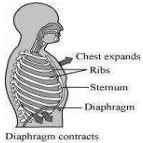
(N/A) Inspiration or inhalation is the process by which atmospheric air is drawn into the lungs.
It is initiated by the contraction of the diaphragm,which increases the volume of the thoracic chamber in the anteroposterior axis.
The contraction of external intercostal muscles lifts up the ribs and the sternum,causing an increase in the volume of the thoracic chamber in the dorsoventral axis.
The overall increase in thoracic volume leads to a corresponding increase in pulmonary volume.
An increase in pulmonary volume decreases the intra-pulmonary pressure to less than the atmospheric pressure,which forces the air from outside to move into the lungs,i.e.,inspiration.
It is initiated by the contraction of the diaphragm,which increases the volume of the thoracic chamber in the anteroposterior axis.
The contraction of external intercostal muscles lifts up the ribs and the sternum,causing an increase in the volume of the thoracic chamber in the dorsoventral axis.
The overall increase in thoracic volume leads to a corresponding increase in pulmonary volume.
An increase in pulmonary volume decreases the intra-pulmonary pressure to less than the atmospheric pressure,which forces the air from outside to move into the lungs,i.e.,inspiration.
0 likes
View Solution48
Easy
Explain the mechanism of breathing.
Solution
(N/A) Breathing involves two stages:
$(1)$ Inspiration: The process during which atmospheric air is drawn into the lungs.
$(2)$ Expiration: The process by which the alveolar air is released out into the atmosphere.
The movement of air into and out of the lungs is carried out by creating a pressure gradient between the lungs and the atmosphere.
- Inspiration occurs if the pressure within the lungs (intra-pulmonary pressure) is less than the atmospheric pressure,i.e.,there is a negative pressure in the lungs with respect to atmospheric pressure.
- Expiration takes place when the intra-pulmonary pressure is higher than the atmospheric pressure.
The diaphragm and a specialised set of muscles—external and internal intercostals between the ribs—help in the generation of these pressure gradients.
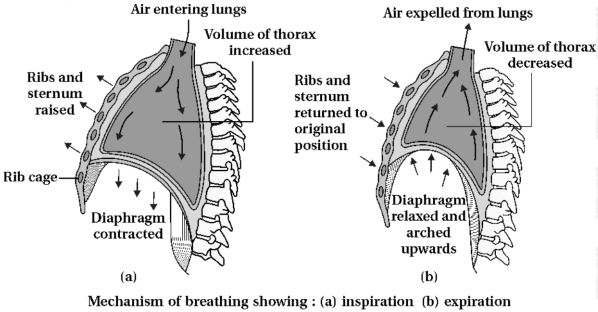
Inspiration is initiated by the contraction of the diaphragm,which increases the volume of the thoracic chamber in the antero-posterior axis.
The contraction of external intercostal muscles lifts up the ribs and the sternum,causing an increase in the volume of the thoracic chamber in the dorso-ventral axis.
The overall increase in the thoracic volume causes a similar increase in pulmonary volume. An increase in pulmonary volume decreases the intra-pulmonary pressure to a level lower than the atmospheric pressure,which forces air from outside to move into the lungs (inspiration).
Relaxation of the diaphragm and the intercostal muscles returns the diaphragm and sternum to their normal positions and reduces the thoracic volume,and thereby the pulmonary volume. This leads to an increase in intra-pulmonary pressure to slightly above the atmospheric pressure,causing the expulsion of air from the lungs (expiration).
We have the ability to increase the strength of inspiration and expiration with the help of additional muscles in the abdomen.
On an average,a healthy human breathes $12-16$ times/minute.
The volume of air involved in breathing movements can be estimated by using a spirometer,which helps in the clinical assessment of pulmonary functions.
$(1)$ Inspiration: The process during which atmospheric air is drawn into the lungs.
$(2)$ Expiration: The process by which the alveolar air is released out into the atmosphere.
The movement of air into and out of the lungs is carried out by creating a pressure gradient between the lungs and the atmosphere.
- Inspiration occurs if the pressure within the lungs (intra-pulmonary pressure) is less than the atmospheric pressure,i.e.,there is a negative pressure in the lungs with respect to atmospheric pressure.
- Expiration takes place when the intra-pulmonary pressure is higher than the atmospheric pressure.
The diaphragm and a specialised set of muscles—external and internal intercostals between the ribs—help in the generation of these pressure gradients.
Inspiration is initiated by the contraction of the diaphragm,which increases the volume of the thoracic chamber in the antero-posterior axis.
The contraction of external intercostal muscles lifts up the ribs and the sternum,causing an increase in the volume of the thoracic chamber in the dorso-ventral axis.
The overall increase in the thoracic volume causes a similar increase in pulmonary volume. An increase in pulmonary volume decreases the intra-pulmonary pressure to a level lower than the atmospheric pressure,which forces air from outside to move into the lungs (inspiration).
Relaxation of the diaphragm and the intercostal muscles returns the diaphragm and sternum to their normal positions and reduces the thoracic volume,and thereby the pulmonary volume. This leads to an increase in intra-pulmonary pressure to slightly above the atmospheric pressure,causing the expulsion of air from the lungs (expiration).
We have the ability to increase the strength of inspiration and expiration with the help of additional muscles in the abdomen.
On an average,a healthy human breathes $12-16$ times/minute.
The volume of air involved in breathing movements can be estimated by using a spirometer,which helps in the clinical assessment of pulmonary functions.
0 likes
View Solution49
Easy
Define the following terms:
$(1)$ Inspiration
$(2)$ Expiration
$(1)$ Inspiration
$(2)$ Expiration
Solution
(N/A) $(1)$ Inspiration: The process during which atmospheric air is drawn into the lungs is called inspiration.
$(2)$ Expiration: The process by which the alveolar air is released out into the atmosphere is called expiration.
$(2)$ Expiration: The process by which the alveolar air is released out into the atmosphere is called expiration.
0 likes
View Solution50
Easy
Explain the mechanism of breathing with neat labelled sketches.
Solution
(N/A) Breathing involves two stages:
$(1)$ Inspiration: During which atmospheric air is drawn in.
$(2)$ Expiration: By which the alveolar air is released out.
The movement of air into and out of the lungs is carried out by creating a pressure gradient between the lungs and the atmosphere.
- Inspiration occurs if the pressure within the lungs (intra-pulmonary pressure) is less than the atmospheric pressure,i.e.,there is a negative pressure in the lungs with respect to atmospheric pressure.
- Similarly,expiration takes place when the intra-pulmonary pressure is higher than the atmospheric pressure.
The diaphragm and a specialised set of muscles - external and internal intercostals between the ribs,help in the generation of such gradients.
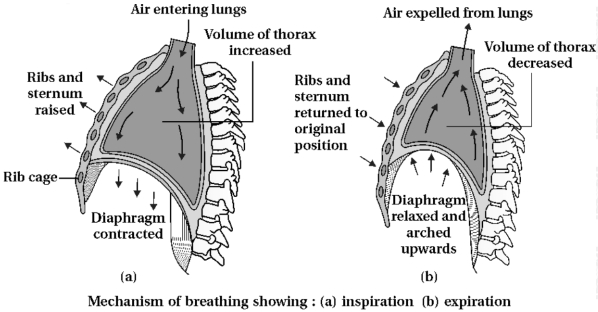
Inspiration is initiated by the contraction of the diaphragm,which increases the volume of the thoracic chamber in the antero-posterior axis.
The contraction of external inter-costal muscles lifts up the ribs and the sternum,causing an increase in the volume of the thoracic chamber in the dorso-ventral axis.
The overall increase in the thoracic volume causes a similar increase in pulmonary volume.
An increase in pulmonary volume decreases the intra-pulmonary pressure to less than the atmospheric pressure,which forces the air from outside to move into the lungs,i.e.,inspiration.
Relaxation of the diaphragm and the inter-costal muscles returns the diaphragm and sternum to their normal positions and reduces the thoracic volume and thereby the pulmonary volume. This leads to an increase in intra-pulmonary pressure to slightly above the atmospheric pressure,causing the expulsion of air from the lungs,i.e.,expiration.
We have the ability to increase the strength of inspiration and expiration with the help of additional muscles in the abdomen.
On an average,a healthy human breathes $12-16$ times/minute.
The volume of air involved in breathing movements can be estimated by using a spirometer,which helps in the clinical assessment of pulmonary functions.
$(1)$ Inspiration: During which atmospheric air is drawn in.
$(2)$ Expiration: By which the alveolar air is released out.
The movement of air into and out of the lungs is carried out by creating a pressure gradient between the lungs and the atmosphere.
- Inspiration occurs if the pressure within the lungs (intra-pulmonary pressure) is less than the atmospheric pressure,i.e.,there is a negative pressure in the lungs with respect to atmospheric pressure.
- Similarly,expiration takes place when the intra-pulmonary pressure is higher than the atmospheric pressure.
The diaphragm and a specialised set of muscles - external and internal intercostals between the ribs,help in the generation of such gradients.
Inspiration is initiated by the contraction of the diaphragm,which increases the volume of the thoracic chamber in the antero-posterior axis.
The contraction of external inter-costal muscles lifts up the ribs and the sternum,causing an increase in the volume of the thoracic chamber in the dorso-ventral axis.
The overall increase in the thoracic volume causes a similar increase in pulmonary volume.
An increase in pulmonary volume decreases the intra-pulmonary pressure to less than the atmospheric pressure,which forces the air from outside to move into the lungs,i.e.,inspiration.
Relaxation of the diaphragm and the inter-costal muscles returns the diaphragm and sternum to their normal positions and reduces the thoracic volume and thereby the pulmonary volume. This leads to an increase in intra-pulmonary pressure to slightly above the atmospheric pressure,causing the expulsion of air from the lungs,i.e.,expiration.
We have the ability to increase the strength of inspiration and expiration with the help of additional muscles in the abdomen.
On an average,a healthy human breathes $12-16$ times/minute.
The volume of air involved in breathing movements can be estimated by using a spirometer,which helps in the clinical assessment of pulmonary functions.
0 likes
View SolutionBreathing and Exchange of Gases — Mechanism of Breathing · Frequently Asked Questions
1Are these Breathing and Exchange of Gases questions useful for JEE and NEET?
Yes. All questions in this section are mapped to JEE Main and NEET exam patterns. Previous year questions from JEE Main, NEET, GUJCET and state-level exams are included with full solutions.
2Can I switch to Hindi or Gujarati for these questions?
Yes. Use the language tabs in the hero section or the sidebar to view the same questions and solutions in English, Hindi or Gujarati.
3How do I generate a question paper from this subtopic?
Use the Vedclass Exam Paper Generator — select the chapter and subtopic, set difficulty, and generate Sets A, B, C, D automatically. First 3 chapters of every subject are free.
Vedclass Products
For Students
Vedclass Test Series
Mock tests in real JEE/NEET style with performance analysis. 5-day free trial.
Start Free TrialFor Teachers
Exam Paper Generator
Generate Set A/B/C/D papers from this chapter in 2 minutes. 3 chapters free.
Try FreeFor Institutes
Online Exam Module
Live online exams with unlimited students, 360° analytics & white-label branding.
See DemoFor Teachers & Institutes
Generate a Breathing and Exchange of Gases Exam Paper in 2 Minutes
Select subtopic & difficulty — Sets A, B, C, D auto-generated with No Repeat logic.
First 3 chapters of every subject are free — no payment required.