
A English
Mechanism of Breathing Questions in English
Class 11 Biology · Breathing and Exchange of Gases · Mechanism of Breathing
90+
Questions
English
Language
100%
With Solutions
Showing 40 of 90 questions in English
51
MediumMCQ
Choose the correct option:
$(1)$ The volume of gases involved in breathing movements is measured by $Sphygmomanometer / Spirometer$.
$(2)$ Inspiration is initiated by the $relaxation / contraction$ of the diaphragm.
$(1)$ The volume of gases involved in breathing movements is measured by $Sphygmomanometer / Spirometer$.
$(2)$ Inspiration is initiated by the $relaxation / contraction$ of the diaphragm.
A
$(1)$ Sphygmomanometer,$(2)$ Relaxation
B
$(1)$ Spirometer,$(2)$ Contraction
C
$(1)$ Spirometer,$(2)$ Relaxation
D
$(1)$ Sphygmomanometer,$(2)$ Contraction
Solution
(B) $(1)$ The volume of air involved in breathing is measured using an instrument called a $Spirometer$.
$(2)$ Inspiration (breathing in) is initiated by the contraction of the diaphragm,which increases the volume of the thoracic cavity in the antero-posterior axis,thereby decreasing the intra-pulmonary pressure and allowing air to flow into the lungs.
Therefore,the correct sequence is $Spirometer$ and $Contraction$.
$(2)$ Inspiration (breathing in) is initiated by the contraction of the diaphragm,which increases the volume of the thoracic cavity in the antero-posterior axis,thereby decreasing the intra-pulmonary pressure and allowing air to flow into the lungs.
Therefore,the correct sequence is $Spirometer$ and $Contraction$.
0 likes
View Solution52
MediumMCQ
When do inspiration and expiration take place?
A
Inspiration occurs when intra-pulmonary pressure is higher than atmospheric pressure.
B
Inspiration occurs when intra-pulmonary pressure is less than atmospheric pressure.
C
Expiration occurs when intra-pulmonary pressure is less than atmospheric pressure.
D
Expiration occurs when intra-pulmonary pressure is equal to atmospheric pressure.
Solution
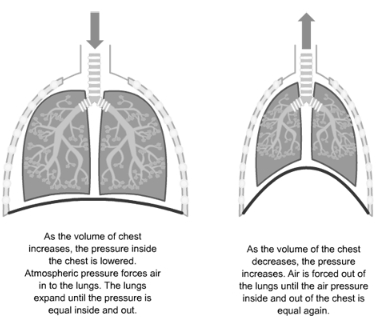
(B) Inspiration occurs if the pressure within the lungs (intra-pulmonary pressure) is less than the atmospheric pressure,i.e.,there is a negative pressure in the lungs with respect to atmospheric pressure.
Similarly,expiration takes place when the intra-pulmonary pressure is higher than the atmospheric pressure.
Similarly,expiration takes place when the intra-pulmonary pressure is higher than the atmospheric pressure.
0 likes
View Solution53
Medium
Explain the mechanism of expiration.
Solution
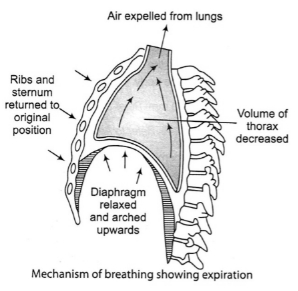
(N/A) Expiration occurs when the diaphragm and the external intercostal muscles relax.
This relaxation causes the diaphragm and the sternum to return to their normal positions.
As a result,the thoracic volume decreases,which leads to a decrease in pulmonary volume.
This reduction in volume causes the intra-pulmonary pressure to increase to a level slightly above the atmospheric pressure.
Consequently,air is forced out of the lungs,a process known as expiration.
This relaxation causes the diaphragm and the sternum to return to their normal positions.
As a result,the thoracic volume decreases,which leads to a decrease in pulmonary volume.
This reduction in volume causes the intra-pulmonary pressure to increase to a level slightly above the atmospheric pressure.
Consequently,air is forced out of the lungs,a process known as expiration.
0 likes
View Solution54
Medium
Name the important parts involved in creating a pressure gradient between the lungs and the atmosphere during normal respiration.
Solution
(N/A) During normal respiration,the creation of a pressure gradient between the lungs and the atmosphere is primarily facilitated by the diaphragm and the external intercostal muscles.
$1$. The diaphragm contracts and flattens,increasing the volume of the thoracic cavity in the anteroposterior axis.
$2$. The external intercostal muscles contract,lifting the ribs and the sternum,which increases the volume of the thoracic cavity in the dorsoventral axis.
$3$. These combined actions increase the overall thoracic volume,which leads to a decrease in intrapulmonary pressure below atmospheric pressure,allowing air to flow into the lungs.
$1$. The diaphragm contracts and flattens,increasing the volume of the thoracic cavity in the anteroposterior axis.
$2$. The external intercostal muscles contract,lifting the ribs and the sternum,which increases the volume of the thoracic cavity in the dorsoventral axis.
$3$. These combined actions increase the overall thoracic volume,which leads to a decrease in intrapulmonary pressure below atmospheric pressure,allowing air to flow into the lungs.
0 likes
View Solution55
EasyMCQ
Select the correct events that occur during inspiration.
$(a)$ Contraction of diaphragm
$(b)$ Contraction of external inter-costal muscles
$(c)$ Pulmonary volume decreases
$(d)$ Intra pulmonary pressure increases
$(a)$ Contraction of diaphragm
$(b)$ Contraction of external inter-costal muscles
$(c)$ Pulmonary volume decreases
$(d)$ Intra pulmonary pressure increases
A
only $(d)$
B
$(a)$ and $(b)$
C
$(c)$ and $(d)$
D
$(a), (b)$ and $(d)$
Solution
(B) Inspiration is the process by which atmospheric air is drawn in.
$(1)$ During inspiration,the diaphragm contracts,which increases the thoracic volume in the antero-posterior axis.
$(2)$ The external inter-costal muscles contract,lifting up the ribs and the sternum,which increases the thoracic volume in the dorso-ventral axis.
$(3)$ An increase in thoracic volume leads to an increase in pulmonary volume.
$(4)$ According to Boyle's Law,an increase in pulmonary volume causes a decrease in intra-pulmonary pressure to less than atmospheric pressure,forcing air from outside into the lungs.
Therefore,events $(a)$ and $(b)$ are correct.
$(1)$ During inspiration,the diaphragm contracts,which increases the thoracic volume in the antero-posterior axis.
$(2)$ The external inter-costal muscles contract,lifting up the ribs and the sternum,which increases the thoracic volume in the dorso-ventral axis.
$(3)$ An increase in thoracic volume leads to an increase in pulmonary volume.
$(4)$ According to Boyle's Law,an increase in pulmonary volume causes a decrease in intra-pulmonary pressure to less than atmospheric pressure,forcing air from outside into the lungs.
Therefore,events $(a)$ and $(b)$ are correct.
0 likes
View Solution56
MediumMCQ
Select the correct process that occurs during inspiration (inhalation):
$(a)$ Contraction of the diaphragm
$(b)$ Contraction of external intercostal muscles
$(c)$ Decrease in pulmonary volume
$(d)$ Increase in intra-pulmonary pressure
$(a)$ Contraction of the diaphragm
$(b)$ Contraction of external intercostal muscles
$(c)$ Decrease in pulmonary volume
$(d)$ Increase in intra-pulmonary pressure
A
$(a)$ and $(b)$
B
$(c)$ and $(d)$
C
$(a), (b)$ and $(d)$
D
Only $(d)$
Solution
(A) Inspiration (inhalation) is an active process that involves the following steps:
$1$. The diaphragm contracts,which increases the volume of the thoracic cavity in the anterior-posterior axis.
$2$. The external intercostal muscles contract,lifting the ribs and the sternum,which increases the volume of the thoracic cavity in the dorso-ventral axis.
$3$. These actions lead to an overall increase in pulmonary volume.
$4$. According to Boyle's Law,an increase in volume leads to a decrease in intra-pulmonary pressure compared to atmospheric pressure,which forces air into the lungs.
Therefore,statements $(a)$ and $(b)$ are correct,while $(c)$ and $(d)$ describe the process of expiration.
$1$. The diaphragm contracts,which increases the volume of the thoracic cavity in the anterior-posterior axis.
$2$. The external intercostal muscles contract,lifting the ribs and the sternum,which increases the volume of the thoracic cavity in the dorso-ventral axis.
$3$. These actions lead to an overall increase in pulmonary volume.
$4$. According to Boyle's Law,an increase in volume leads to a decrease in intra-pulmonary pressure compared to atmospheric pressure,which forces air into the lungs.
Therefore,statements $(a)$ and $(b)$ are correct,while $(c)$ and $(d)$ describe the process of expiration.
0 likes
View Solution57
MediumMCQ
What is the cause of altitude sickness?
A
Temperature control in low-lying areas
B
Excessive heat loss in deserts
C
Decrease in atmospheric pressure at high altitudes
D
All of the above
Solution
(C) Altitude sickness occurs when a person travels to high altitudes (e.g.,Rohtang Pass near Manali or Mansarovar in Tibet).
At high altitudes,the atmospheric pressure is low,which results in a decrease in the partial pressure of oxygen $(pO_2)$.
Due to this low oxygen availability,the body does not get enough oxygen,leading to symptoms like nausea,fatigue,and heart palpitations.
Therefore,the correct cause is the decrease in atmospheric pressure at high altitudes.
At high altitudes,the atmospheric pressure is low,which results in a decrease in the partial pressure of oxygen $(pO_2)$.
Due to this low oxygen availability,the body does not get enough oxygen,leading to symptoms like nausea,fatigue,and heart palpitations.
Therefore,the correct cause is the decrease in atmospheric pressure at high altitudes.
0 likes
View Solution58
EasyMCQ
During inspiration,the diaphragm
A
Expands
B
Shows no change
C
Contracts and flattens
D
Relaxes to become dome-shaped
Solution
(C) Breathing involves the process of filling the lungs with atmospheric air and then emptying them. Breathing in is known as inspiration or inhalation,while breathing out is known as expiration or exhalation.
During inspiration,the diaphragm muscles contract,which causes the diaphragm to flatten. This movement increases the volume of the thoracic cavity in the antero-posterior axis,facilitating the entry of air into the lungs.
During inspiration,the diaphragm muscles contract,which causes the diaphragm to flatten. This movement increases the volume of the thoracic cavity in the antero-posterior axis,facilitating the entry of air into the lungs.
0 likes
View Solution59
MediumMCQ
Inspiration is initiated by
A
Relaxation of the diaphragm
B
Contraction of the diaphragm
C
Relaxation of the intercostal muscles
D
Contraction of the lungs
Solution
(B) Inspiration is initiated by the contraction of the diaphragm,which increases the volume of the thoracic chamber in the antero-posterior axis.
The contraction of the external intercostal muscles lifts up the ribs and the sternum,causing an increase in the volume of the thoracic chamber in the dorso-ventral axis.
The overall increase in the thoracic volume causes a similar increase in the pulmonary volume,leading to a decrease in intrapulmonary pressure,which draws air into the lungs.
The contraction of the external intercostal muscles lifts up the ribs and the sternum,causing an increase in the volume of the thoracic chamber in the dorso-ventral axis.
The overall increase in the thoracic volume causes a similar increase in the pulmonary volume,leading to a decrease in intrapulmonary pressure,which draws air into the lungs.
0 likes
View Solution60
EasyMCQ
During expiration,the diaphragm becomes
A
Normal
B
Flattened
C
Dome-shaped
D
Oblique
Solution
(C) Expiration is the process by which $CO_{2}$ is expelled from the lungs.
During this process,the muscle fibres of the diaphragm relax,causing it to return to its original dome-shaped structure.
This relaxation decreases the volume of the thoracic cavity,which increases the pressure inside the lungs,forcing air out.
During this process,the muscle fibres of the diaphragm relax,causing it to return to its original dome-shaped structure.
This relaxation decreases the volume of the thoracic cavity,which increases the pressure inside the lungs,forcing air out.
0 likes
View Solution61
MediumMCQ
The ventilation movements of the lungs in mammals are governed by:
A
Diaphragm
B
Intercostal muscles
C
Both $(A)$ and $(B)$
D
None of these
Solution
(C) The ventilation movements of the lungs (breathing) in mammals are primarily governed by the diaphragm and the intercostal muscles.
$1$. The diaphragm is a dome-shaped muscular sheet that separates the thoracic cavity from the abdominal cavity. Its contraction increases the volume of the thoracic cavity in the antero-posterior axis.
$2$. The intercostal muscles (external and internal) are present between the ribs. The contraction of external intercostal muscles lifts up the ribs and the sternum,causing an increase in the volume of the thoracic cavity in the dorso-ventral axis.
$3$. Together,these movements create a pressure gradient that allows air to move in and out of the lungs.
$1$. The diaphragm is a dome-shaped muscular sheet that separates the thoracic cavity from the abdominal cavity. Its contraction increases the volume of the thoracic cavity in the antero-posterior axis.
$2$. The intercostal muscles (external and internal) are present between the ribs. The contraction of external intercostal muscles lifts up the ribs and the sternum,causing an increase in the volume of the thoracic cavity in the dorso-ventral axis.
$3$. Together,these movements create a pressure gradient that allows air to move in and out of the lungs.
0 likes
View Solution62
MediumMCQ
Additional muscles in the ...... impact the ability of humans to increase the strength of inspiration and expiration. Complete the given $NCERT$ statement with an appropriate option.
A
Chest
B
Diaphragm
C
Abdomen
D
Lungs
Solution
(C) Humans have the ability to increase the strength of inspiration and expiration with the help of additional muscles in the abdomen.
During forced breathing,the abdominal muscles contract to push the diaphragm upward,which helps in increasing the strength of expiration.
Similarly,the relaxation of these muscles and the use of accessory muscles allow for deeper inspiration.
During forced breathing,the abdominal muscles contract to push the diaphragm upward,which helps in increasing the strength of expiration.
Similarly,the relaxation of these muscles and the use of accessory muscles allow for deeper inspiration.
0 likes
View Solution63
MediumMCQ
Breathing involves ...$A$... during which atmospheric air is drawn in and ...$B$... by which the alveolar air is released out.
Choose the correct option for $A$ and $B$ to complete the given $NCERT$ statement.
Choose the correct option for $A$ and $B$ to complete the given $NCERT$ statement.
A
$A-$ expiration; $B-$ osmosis
B
$A-$ expiration; $B-$ inspiration
C
$A-$ inspiration; $B-$ expiration
D
$A-$ inspiration; $B-$ diffusion
Solution
(C) Breathing,commonly known as pulmonary ventilation,consists of two main stages:
$1$. $A-$ Inspiration (Inhalation): This is the process during which atmospheric air is drawn into the lungs.
$2$. $B-$ Expiration (Exhalation): This is the process by which the alveolar air (air rich in $CO_2$) is released out into the atmosphere.
Therefore,the correct sequence is $A-$ inspiration and $B-$ expiration.
$1$. $A-$ Inspiration (Inhalation): This is the process during which atmospheric air is drawn into the lungs.
$2$. $B-$ Expiration (Exhalation): This is the process by which the alveolar air (air rich in $CO_2$) is released out into the atmosphere.
Therefore,the correct sequence is $A-$ inspiration and $B-$ expiration.
0 likes
View Solution64
EasyMCQ
Hiccup occurs due to
A
Contraction of the air passage
B
Contraction of the diaphragm
C
Extension of the abdomen
D
Extension of the lungs
Solution
(B) Hiccups occur due to the spasmodic contraction of the diaphragm. This is often caused by the irritation of the phrenic nerve,which controls the movement of the diaphragm.
0 likes
View Solution65
MediumMCQ
State whether the given statements are true or false.
$I.$ Ventilation in humans is an active process.
$II.$ Diaphragm helps in generating the pressure gradient in the lungs.
Choose the correct option.
$I.$ Ventilation in humans is an active process.
$II.$ Diaphragm helps in generating the pressure gradient in the lungs.
Choose the correct option.
A
$I -$ True,$II -$ False
B
$I -$ True,$II -$ True
C
$I -$ False,$II -$ True
D
$I -$ False,$II -$ False
Solution
(B) $1$. Breathing (ventilation) involves inhalation,which is an active process requiring the contraction of the diaphragm and external intercostal muscles. Although exhalation is generally a passive process under normal conditions,the overall process of ventilation is considered active because it requires energy expenditure for the inhalation phase.
$2$. The contraction of the diaphragm muscle pulls the diaphragm downwards,which increases the anteroposterior volume of the thoracic cavity. This increase in volume leads to a decrease in intrapulmonary pressure compared to atmospheric pressure,thereby generating the pressure gradient necessary for air to flow into the lungs.
$2$. The contraction of the diaphragm muscle pulls the diaphragm downwards,which increases the anteroposterior volume of the thoracic cavity. This increase in volume leads to a decrease in intrapulmonary pressure compared to atmospheric pressure,thereby generating the pressure gradient necessary for air to flow into the lungs.
0 likes
View Solution66
MediumMCQ
Arrange the given steps of expiration in the sequence of events occurring first:
$I.$ Relaxation of the diaphragm and sternum
$II.$ Reduction of the pulmonary volume
$III.$ Expulsion of air from the lungs
$IV.$ Increase in intra-pulmonary pressure
Choose the correct option.
$I.$ Relaxation of the diaphragm and sternum
$II.$ Reduction of the pulmonary volume
$III.$ Expulsion of air from the lungs
$IV.$ Increase in intra-pulmonary pressure
Choose the correct option.
A
$I \rightarrow II \rightarrow IV \rightarrow III$
B
$I \rightarrow II \rightarrow III \rightarrow IV$
C
$IV \rightarrow III \rightarrow II \rightarrow I$
D
$IV \rightarrow II \rightarrow III \rightarrow I$
Solution
(A) The process of expiration occurs in the following sequence:
$1.$ Relaxation of the diaphragm and the intercostal muscles returns the diaphragm and sternum to their normal positions $(I)$.
$2.$ This movement reduces the thoracic volume and,consequently,the pulmonary volume $(II)$.
$3.$ The reduction in pulmonary volume leads to an increase in intra-pulmonary pressure to a level slightly above the atmospheric pressure $(IV)$.
$4.$ This pressure gradient causes the air to be expelled from the lungs,which is known as expiration $(III)$.
Therefore,the correct sequence is $I \rightarrow II \rightarrow IV \rightarrow III$.
$1.$ Relaxation of the diaphragm and the intercostal muscles returns the diaphragm and sternum to their normal positions $(I)$.
$2.$ This movement reduces the thoracic volume and,consequently,the pulmonary volume $(II)$.
$3.$ The reduction in pulmonary volume leads to an increase in intra-pulmonary pressure to a level slightly above the atmospheric pressure $(IV)$.
$4.$ This pressure gradient causes the air to be expelled from the lungs,which is known as expiration $(III)$.
Therefore,the correct sequence is $I \rightarrow II \rightarrow IV \rightarrow III$.
0 likes
View Solution67
MediumMCQ
Hiccups can be best described as
A
Forceful sudden expiration
B
Jerky incomplete inspiration
C
Vibration of the soft palate during breathing
D
Sign of indigestion
Solution
(B) Hiccups are the spasmodic contraction of the diaphragm followed by a spasmodic closure of the glottis,resulting in a sharp inspiratory sound.
This phenomenon is typically triggered by the irritation of sensory nerve endings in the digestive tract or the diaphragm.
This phenomenon is typically triggered by the irritation of sensory nerve endings in the digestive tract or the diaphragm.
0 likes
View Solution68
MediumMCQ
$I.$ Intra-pulmonary pressure remains less than the atmospheric pressure.
$II.$ There is negative pressure in the lungs compared to the atmospheric pressure.
In which of the above two situations does inspiration take place? Choose the correct option.
$II.$ There is negative pressure in the lungs compared to the atmospheric pressure.
In which of the above two situations does inspiration take place? Choose the correct option.
A
Only $I$
B
Only $II$
C
Both $I$ and $II$
D
$I$ or $II$
Solution
(C) The movement of air into and out of the lungs is carried out by creating a pressure gradient between the lungs and the atmosphere.
Inspiration occurs when the pressure within the lungs (intra-pulmonary pressure) is less than the atmospheric pressure.
This condition is equivalent to saying that there is a negative pressure in the lungs with respect to the atmospheric pressure.
Therefore,both statements $I$ and $II$ describe the same physical condition required for inspiration to occur.
Thus,inspiration takes place in both situations.
Inspiration occurs when the pressure within the lungs (intra-pulmonary pressure) is less than the atmospheric pressure.
This condition is equivalent to saying that there is a negative pressure in the lungs with respect to the atmospheric pressure.
Therefore,both statements $I$ and $II$ describe the same physical condition required for inspiration to occur.
Thus,inspiration takes place in both situations.
0 likes
View Solution69
MediumMCQ
An $A$ in the pulmonary volume $B$ the intra-pulmonary pressure to less than the atmospheric pressure which forces the air from $C$ to move into the lungs,i.e.,$D$. Choose the correct options for the blanks $A, B, C$ and $D$ to complete the above statement with reference to $NCERT$ textbook.
A
$A-$ increase,$B-$ decrease,$C-$ outside,$D-$ expiration
B
$A-$ decrease,$B-$ increase,$C-$ outside,$D-$ expiration
C
$A-$ decrease,$B-$ increase,$C-$ inside,$D-$ inspiration
D
$A-$ increase,$B-$ decrease,$C-$ outside,$D-$ inspiration
Solution
(D) According to the mechanism of breathing described in the $NCERT$ textbook:
$1$. Inspiration occurs when there is an $A-$ increase in the pulmonary volume.
$2$. This increase in volume leads to a $B-$ decrease in the intra-pulmonary pressure compared to the atmospheric pressure.
$3$. Because the pressure inside the lungs is lower than the pressure $C-$ outside,air is forced to move into the lungs.
$4$. This process is known as $D-$ inspiration.
Therefore,the correct sequence is $A-$ increase,$B-$ decrease,$C-$ outside,$D-$ inspiration.
$1$. Inspiration occurs when there is an $A-$ increase in the pulmonary volume.
$2$. This increase in volume leads to a $B-$ decrease in the intra-pulmonary pressure compared to the atmospheric pressure.
$3$. Because the pressure inside the lungs is lower than the pressure $C-$ outside,air is forced to move into the lungs.
$4$. This process is known as $D-$ inspiration.
Therefore,the correct sequence is $A-$ increase,$B-$ decrease,$C-$ outside,$D-$ inspiration.
0 likes
View Solution70
MediumMCQ
Pick the correct statement.
A
The contraction of internal intercostal muscles lifts up the ribs.
B
The $RBCs$ transport oxygen only.
C
The thoracic cavity is anatomically an air-tight chamber.
D
$A$ healthy man can inspire approximately $500 \; mL$ of air per minute.
Solution
(C) The thoracic cavity is anatomically an air-tight chamber. This is essential because any change in the volume of the thoracic cavity will be reflected in the lung (pulmonary) cavity. Such an arrangement is crucial for breathing,as we cannot directly alter pulmonary volume. The contraction of external intercostal muscles (not internal) lifts the ribs. $RBCs$ transport both oxygen and carbon dioxide. $A$ healthy man inspires $500 \; mL$ of air per breath (Tidal Volume),not per minute.
0 likes
View Solution71
MediumMCQ
Exhalation is the process of expulsion of air through the respiratory tract. Which of the following figures illustrates the process of exhalation?
A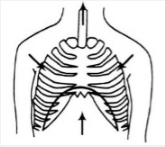
B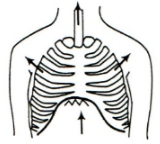
C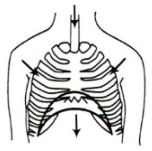
D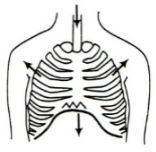
Solution
(A) Exhalation (expiration) is the process by which air is expelled from the lungs.
During exhalation:
$(i)$ The diaphragm relaxes and moves upward to its dome-shaped position.
$(ii)$ The external intercostal muscles relax,causing the ribs and sternum to move downward and inward,which reduces the volume of the thoracic cavity.
$(iii)$ This increase in pressure inside the lungs relative to atmospheric pressure forces air out of the lungs.
Looking at the provided figures,Figure $A$ shows the diaphragm moving upward and the ribs moving inward/downward,which correctly represents the process of exhalation.
During exhalation:
$(i)$ The diaphragm relaxes and moves upward to its dome-shaped position.
$(ii)$ The external intercostal muscles relax,causing the ribs and sternum to move downward and inward,which reduces the volume of the thoracic cavity.
$(iii)$ This increase in pressure inside the lungs relative to atmospheric pressure forces air out of the lungs.
Looking at the provided figures,Figure $A$ shows the diaphragm moving upward and the ribs moving inward/downward,which correctly represents the process of exhalation.
0 likes
View Solution72
MediumMCQ
Arrange the given steps by which the lungs show inspiration,in the sequence of events occurring first:
$I.$ Increase in the volume of the thoracic chamber in the dorsoventral axis
$II.$ Upward and outward movement of the ribs
$III.$ Contraction of intercostal muscles
$IV.$ Entry of air inside the lungs
$V.$ Contraction of the diaphragm
$VI.$ Increase in the volume of the thoracic chamber in the anteroposterior axis
Choose the correct option.
$I.$ Increase in the volume of the thoracic chamber in the dorsoventral axis
$II.$ Upward and outward movement of the ribs
$III.$ Contraction of intercostal muscles
$IV.$ Entry of air inside the lungs
$V.$ Contraction of the diaphragm
$VI.$ Increase in the volume of the thoracic chamber in the anteroposterior axis
Choose the correct option.
A
$I \rightarrow II \rightarrow III \rightarrow IV \rightarrow V \rightarrow VI$
B
$IV \rightarrow I \rightarrow II \rightarrow III \rightarrow V \rightarrow VI$
C
$III \rightarrow II \rightarrow I \rightarrow V \rightarrow VI \rightarrow IV$
D
$VI \rightarrow III \rightarrow IV \rightarrow II \rightarrow V \rightarrow I$
Solution
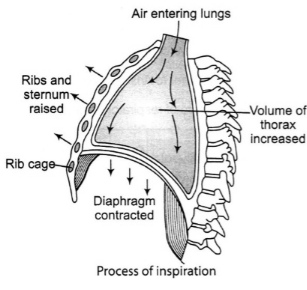
(C) The process of inspiration involves the following sequence of events:
$1$. Contraction of intercostal muscles $(III)$ leads to the upward and outward movement of the ribs $(II)$,which increases the volume of the thoracic chamber in the dorsoventral axis $(I)$.
$2$. Simultaneously,the contraction of the diaphragm $(V)$ increases the volume of the thoracic cavity in the anteroposterior axis $(VI)$.
$3$. These combined increases in thoracic volume lead to a decrease in intrapulmonary pressure,which causes the entry of air inside the lungs $(IV)$.
Therefore,the correct sequence is $III \rightarrow II \rightarrow I \rightarrow V \rightarrow VI \rightarrow IV$.
$1$. Contraction of intercostal muscles $(III)$ leads to the upward and outward movement of the ribs $(II)$,which increases the volume of the thoracic chamber in the dorsoventral axis $(I)$.
$2$. Simultaneously,the contraction of the diaphragm $(V)$ increases the volume of the thoracic cavity in the anteroposterior axis $(VI)$.
$3$. These combined increases in thoracic volume lead to a decrease in intrapulmonary pressure,which causes the entry of air inside the lungs $(IV)$.
Therefore,the correct sequence is $III \rightarrow II \rightarrow I \rightarrow V \rightarrow VI \rightarrow IV$.
0 likes
View Solution73
MediumMCQ
Inspiration occurs when intra-pulmonary pressure is
A
Higher than atmospheric pressure
B
Lower than atmospheric pressure
C
Equal to atmospheric pressure
D
Zero compared to atmospheric pressure
Solution
(B) Inspiration is the process of breathing in air.
It occurs when the intra-pulmonary pressure (pressure within the lungs) is lower than the atmospheric pressure.
This pressure gradient forces air from the outside environment into the lungs.
It occurs when the intra-pulmonary pressure (pressure within the lungs) is lower than the atmospheric pressure.
This pressure gradient forces air from the outside environment into the lungs.
0 likes
View Solution74
MediumMCQ
Which muscles help us to increase the strength of inspiration and expiration?
A
Cardiac muscles
B
Abdominal muscles
C
Internal intercostal muscles
D
Both $(b)$ and $(c)$
Solution
(D) Cardiac muscles,which are the muscles of the heart,have no role in the process of inspiration and expiration.
Abdominal muscles and internal intercostal muscles are accessory muscles that assist in forced breathing.
During forced expiration,the contraction of abdominal muscles and internal intercostal muscles increases the strength of expiration,thereby increasing the volume of air exhaled.
Abdominal muscles and internal intercostal muscles are accessory muscles that assist in forced breathing.
During forced expiration,the contraction of abdominal muscles and internal intercostal muscles increases the strength of expiration,thereby increasing the volume of air exhaled.
0 likes
View Solution75
EasyMCQ
The breathing rate of a normal healthy man is
A
$8-18$ times/min
B
$6-12$ times/min
C
$16-24$ times/min
D
$12-16$ times/min
Solution
(D) The breathing rate (or respiratory rate) of a normal healthy adult human at rest is approximately $12-16$ times per minute. This rate can increase significantly during physical exercise or stress.
0 likes
View Solution76
MediumMCQ
During inspiration,the volume of thoracic cavity increases because of
A
Contraction of diaphragm and external intercostal muscles
B
Relaxation of diaphragm and external intercostal muscles
C
Contraction of diaphragm and relaxation of external intercostal muscles
D
Relaxation of diaphragm and contraction of external intercostal muscles
Solution
(A) During inspiration,the contraction of the diaphragm muscle causes it to become flat and lowered,thereby increasing the volume of the thoracic cavity in the antero-posterior axis.
Simultaneously,the contraction of the external intercostal muscles lifts the ribs and sternum up and outward,causing an increase in the volume of the thoracic cavity in the dorso-ventral axis.
Simultaneously,the contraction of the external intercostal muscles lifts the ribs and sternum up and outward,causing an increase in the volume of the thoracic cavity in the dorso-ventral axis.
0 likes
View Solution77
MediumMCQ
Volume of thoracic chamber increases in antero-posterior and dorso-ventral axis in rabbit by
A
Contraction of diaphragm and external intercostal muscles respectively
B
Relaxation of diaphragm and external intercostal muscles respectively
C
Relaxation of diaphragm and abdominal muscles respectively
D
Contraction of abdominal muscles and relaxation of external intercostal muscles respectively
Solution
(A) During inspiration,the contraction of the diaphragm muscle causes it to become flat and lowered,thereby increasing the volume of the thoracic cavity in the antero-posterior axis.
The contraction of the external intercostal muscles lifts the ribs and sternum up and outward,causing an increase in the volume of the thoracic cavity in the dorso-ventral axis,i.e.,the backward-forward direction.
The contraction of the external intercostal muscles lifts the ribs and sternum up and outward,causing an increase in the volume of the thoracic cavity in the dorso-ventral axis,i.e.,the backward-forward direction.
0 likes
View Solution78
MediumMCQ
Expiration occurs due to
A
Relaxation of diaphragm and external intercostal muscle
B
Contraction of internal intercostal muscles and diaphragm
C
Relaxation of abdominal and internal intercostal muscles
D
Contraction of diaphragm and relaxation of abdominal muscles
Solution
(A) Expiration is the process of moving air out of the lungs when the pressure within the lungs is higher than the atmospheric pressure.
During normal quiet breathing,expiration occurs due to the relaxation of the diaphragm and the external intercostal muscles.
This relaxation causes the diaphragm and sternum to return to their normal positions,which decreases the thoracic volume and consequently the pulmonary volume,leading to an increase in intrapulmonary pressure and the expulsion of air.
During normal quiet breathing,expiration occurs due to the relaxation of the diaphragm and the external intercostal muscles.
This relaxation causes the diaphragm and sternum to return to their normal positions,which decreases the thoracic volume and consequently the pulmonary volume,leading to an increase in intrapulmonary pressure and the expulsion of air.
0 likes
View Solution79
MediumMCQ
What happens to the volume of the pulmonary cavity when there is an increase in the volume of the thoracic chamber?
A
It decreases
B
It increases
C
It remains same
D
First decreases and then increases
Solution
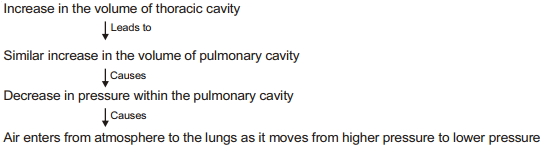
(B) The mechanism of breathing involves changes in the volume of the thoracic cavity.
An increase in the volume of the thoracic chamber leads to a similar increase in the volume of the pulmonary cavity (lungs).
This increase in volume causes a decrease in the intrapulmonary pressure compared to the atmospheric pressure.
Consequently,air moves from the atmosphere into the lungs to equalize the pressure.
An increase in the volume of the thoracic chamber leads to a similar increase in the volume of the pulmonary cavity (lungs).
This increase in volume causes a decrease in the intrapulmonary pressure compared to the atmospheric pressure.
Consequently,air moves from the atmosphere into the lungs to equalize the pressure.
0 likes
View Solution80
MediumMCQ
What happens when the pressure within the pulmonary cavity is higher than the atmospheric pressure?
A
Inhalation of air
B
Expulsion of air
C
No inhalation and expulsion of air occurs
D
Lungs inflate and rupture
Solution
(B) When the pressure within the pulmonary cavity (intra-pulmonary pressure) is higher than the atmospheric pressure,air moves from the lungs to the outside environment.
This process is known as expiration or the expulsion of air.
Air naturally moves from a region of higher pressure to a region of lower pressure.
This process is known as expiration or the expulsion of air.
Air naturally moves from a region of higher pressure to a region of lower pressure.
0 likes
View Solution81
MediumMCQ
$A$: Normal expiration during quiet breathing,unlike inspiration,is a passive process because no muscular contractions are involved.
$R$: Normal expiration results from the elastic recoil of the chest wall and lungs.
$R$: Normal expiration results from the elastic recoil of the chest wall and lungs.
A
Assertion and Reason both are correct and Reason is the correct explanation of Assertion.
B
Assertion and Reason both are correct but Reason is not the correct explanation of Assertion.
C
Assertion is correct,but Reason is incorrect.
D
Both Assertion and Reason are incorrect.
Solution
(A) During quiet breathing,inspiration is an active process that requires the contraction of the diaphragm and external intercostal muscles.
Conversely,normal expiration is a passive process.
It occurs when the diaphragm and external intercostal muscles relax,allowing the lungs and chest wall to return to their original position due to their inherent elastic recoil.
Therefore,both the Assertion and the Reason are correct,and the Reason provides the correct explanation for why expiration is a passive process.
Conversely,normal expiration is a passive process.
It occurs when the diaphragm and external intercostal muscles relax,allowing the lungs and chest wall to return to their original position due to their inherent elastic recoil.
Therefore,both the Assertion and the Reason are correct,and the Reason provides the correct explanation for why expiration is a passive process.
0 likes
View Solution82
MediumMCQ
Which of the following statements is incorrect regarding the human lungs?
A
They are situated in an airtight chamber.
B
They are located in the thoracic cavity.
C
We can directly alter the volume of the lungs.
D
The lungs are covered by a double-layered pleura.
Solution
(C) The human lungs are situated in the thoracic cavity,which is an anatomically airtight chamber.
Because the lungs are located in this airtight space,we cannot directly alter the pulmonary volume.
Instead,any change in the volume of the thoracic cavity will be reflected in the lung (pulmonary) cavity.
Therefore,the statement that we can directly alter the volume of the lungs is incorrect.
Because the lungs are located in this airtight space,we cannot directly alter the pulmonary volume.
Instead,any change in the volume of the thoracic cavity will be reflected in the lung (pulmonary) cavity.
Therefore,the statement that we can directly alter the volume of the lungs is incorrect.
0 likes
View Solution83
EasyMCQ
$A$ healthy human breathes $........$ times per minute.
A
$10-16$
B
$12-16$
C
$14-18$
D
$12-18$
Solution
(D) healthy human adult breathes approximately $12$ to $18$ times per minute at rest. This rate is known as the respiratory rate or breathing rate.
0 likes
View Solution84
MediumMCQ
Which muscles are involved during forced breathing?
A
Abdominal muscles
B
Diaphragm muscles
C
Neck muscles
D
All of the above
Solution
(D) Forced breathing or forced expiration is an active process that requires the contraction of additional muscles beyond those used in quiet breathing.
$1$. The $Diaphragm$ and $External Intercostal$ muscles are primarily involved in normal inspiration.
$2$. During forced expiration,the $Abdominal$ muscles contract to push the diaphragm upward,and the $Internal Intercostal$ muscles pull the rib cage downward.
$3$. During forced inspiration,accessory muscles in the $Neck$ (such as the $Sternocleidomastoid$ and $Scalene$ muscles) help to further elevate the rib cage.
Therefore,all the mentioned muscle groups are involved in forced breathing processes.
$1$. The $Diaphragm$ and $External Intercostal$ muscles are primarily involved in normal inspiration.
$2$. During forced expiration,the $Abdominal$ muscles contract to push the diaphragm upward,and the $Internal Intercostal$ muscles pull the rib cage downward.
$3$. During forced inspiration,accessory muscles in the $Neck$ (such as the $Sternocleidomastoid$ and $Scalene$ muscles) help to further elevate the rib cage.
Therefore,all the mentioned muscle groups are involved in forced breathing processes.
0 likes
View Solution85
MediumMCQ
Select the incorrect option for the given diagram (representing inspiration).
A
Relaxation of the diaphragm.
B
Increase in the volume of the thoracic cavity.
C
Inspiration process is shown.
D
Ribs move outwards.
Solution
(A) The given diagram represents the process of inspiration. During inspiration,the diaphragm undergoes contraction,which causes it to flatten and increases the volume of the thoracic cavity. In this process,the ribs and sternum move outwards and upwards. Therefore,'Relaxation of the diaphragm' is the incorrect statement because the diaphragm contracts during inspiration.
0 likes
View Solution86
MediumMCQ
Select the correct option for the given figure (assuming the figure shows expiration).
A
Expiration process is shown.
B
Volume of the thoracic cavity decreases.
C
Diaphragm relaxes.
D
All of the above.
0 likes
View Solution87
MediumMCQ
State the sequence of events for inspiration (breathing in).
$I$ - Increase in lung volume
$II$ - Decrease in intrapulmonary pressure
$III$ - Contraction of respiratory muscles
$IV$ - Increase in thoracic volume
$V$ - Air rushes into the lungs
$I$ - Increase in lung volume
$II$ - Decrease in intrapulmonary pressure
$III$ - Contraction of respiratory muscles
$IV$ - Increase in thoracic volume
$V$ - Air rushes into the lungs
A
$V \rightarrow IV \rightarrow I \rightarrow II \rightarrow III$
B
$V \rightarrow IV \rightarrow I \rightarrow III \rightarrow II$
C
$III \rightarrow V \rightarrow I \rightarrow IV \rightarrow II$
D
$III \rightarrow IV \rightarrow I \rightarrow II \rightarrow V$
Solution
(D) The process of inspiration (breathing in) follows a specific physiological sequence:
$1$. $III$ - Contraction of the diaphragm and external intercostal muscles (respiratory muscles) occurs first.
$2$. $IV$ - This contraction leads to an increase in the thoracic volume.
$3$. $I$ - The increase in thoracic volume causes a corresponding increase in lung volume.
$4$. $II$ - According to Boyle's Law,an increase in volume leads to a decrease in intrapulmonary pressure compared to atmospheric pressure.
$5$. $V$ - Consequently,air rushes into the lungs from the outside to equalize the pressure.
Therefore,the correct sequence is $III \rightarrow IV \rightarrow I \rightarrow II \rightarrow V$.
$1$. $III$ - Contraction of the diaphragm and external intercostal muscles (respiratory muscles) occurs first.
$2$. $IV$ - This contraction leads to an increase in the thoracic volume.
$3$. $I$ - The increase in thoracic volume causes a corresponding increase in lung volume.
$4$. $II$ - According to Boyle's Law,an increase in volume leads to a decrease in intrapulmonary pressure compared to atmospheric pressure.
$5$. $V$ - Consequently,air rushes into the lungs from the outside to equalize the pressure.
Therefore,the correct sequence is $III \rightarrow IV \rightarrow I \rightarrow II \rightarrow V$.
0 likes
View Solution88
MediumMCQ
Which of the following statements is correct about the mechanism of breathing?
A
Inspiration is initiated by the relaxation of the diaphragm.
B
Contraction of the diaphragm increases the volume of the thoracic chamber in the anteroposterior axis.
C
$IICM$ and the diaphragm are the chief muscles for inspiration.
D
Normal expiration is an active process.
Solution
(B) $1$. Inspiration is initiated by the contraction of the diaphragm,which increases the volume of the thoracic chamber in the anteroposterior axis.
$2$. The contraction of external intercostal muscles $(EICM)$ lifts up the ribs and the sternum,causing an increase in the volume of the thoracic chamber in the dorsoventral axis.
$3$. The diaphragm and external intercostal muscles $(EICM)$ are the primary muscles involved in inspiration.
$4$. Normal expiration is a passive process because it occurs due to the relaxation of the diaphragm and intercostal muscles,which returns the thorax to its original position.
$2$. The contraction of external intercostal muscles $(EICM)$ lifts up the ribs and the sternum,causing an increase in the volume of the thoracic chamber in the dorsoventral axis.
$3$. The diaphragm and external intercostal muscles $(EICM)$ are the primary muscles involved in inspiration.
$4$. Normal expiration is a passive process because it occurs due to the relaxation of the diaphragm and intercostal muscles,which returns the thorax to its original position.
0 likes
View Solution89
MediumMCQ
The diagram above shows which phenomenon of respiration?
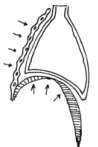
A
Inspiration: Contraction in diaphragm and external intercostal muscles
B
Expiration: Contraction in diaphragm and external intercostal muscles
C
Expiration: Relaxation in diaphragm and external intercostal muscles
D
Inspiration: Contraction in diaphragm and relaxation in internal intercostal muscles
Solution
(C) The diagram shows the diaphragm moving upwards (dome-shaped) and the rib cage moving inwards and downwards. This indicates a decrease in the thoracic volume,which leads to an increase in thoracic pressure,causing air to be expelled from the lungs. This process is known as expiration. Expiration occurs when the diaphragm and external intercostal muscles relax,returning the diaphragm and sternum to their normal positions.
0 likes
View Solution90
EasyMCQ
Given below are events occurring during inspiration. Select the correct order of sequence from the options given below.
$(I)$ Air from atmosphere rushes into lungs.
$(II)$ Thoracic volume increases.
$(III)$ Intercostal muscles contract and ribs along with sternum move upward and outward.
$(IV)$ Diaphragm becomes flat and goes downwards.
$(I)$ Air from atmosphere rushes into lungs.
$(II)$ Thoracic volume increases.
$(III)$ Intercostal muscles contract and ribs along with sternum move upward and outward.
$(IV)$ Diaphragm becomes flat and goes downwards.
A
$III \rightarrow I \rightarrow IV \rightarrow II$
B
$III \rightarrow I \rightarrow II \rightarrow IV$
C
$IV \rightarrow III \rightarrow II \rightarrow I$
D
$III \rightarrow IV \rightarrow II \rightarrow I$
Solution
(C) The process of inspiration (inhalation) occurs in the following sequence:
$1$. The contraction of the diaphragm makes it flat and moves it downwards $(IV)$.
$2$. Simultaneously,the contraction of external intercostal muscles causes the ribs and sternum to move upward and outward $(III)$.
$3$. These two actions combined lead to an increase in the thoracic volume $(II)$.
$4$. An increase in thoracic volume leads to a decrease in intrapulmonary pressure compared to atmospheric pressure,causing air from the atmosphere to rush into the lungs $(I)$.
Therefore,the correct sequence is $IV \rightarrow III \rightarrow II \rightarrow I$.
$1$. The contraction of the diaphragm makes it flat and moves it downwards $(IV)$.
$2$. Simultaneously,the contraction of external intercostal muscles causes the ribs and sternum to move upward and outward $(III)$.
$3$. These two actions combined lead to an increase in the thoracic volume $(II)$.
$4$. An increase in thoracic volume leads to a decrease in intrapulmonary pressure compared to atmospheric pressure,causing air from the atmosphere to rush into the lungs $(I)$.
Therefore,the correct sequence is $IV \rightarrow III \rightarrow II \rightarrow I$.
0 likes
View SolutionBreathing and Exchange of Gases — Mechanism of Breathing · Frequently Asked Questions
1Are these Breathing and Exchange of Gases questions useful for JEE and NEET?
Yes. All questions in this section are mapped to JEE Main and NEET exam patterns. Previous year questions from JEE Main, NEET, GUJCET and state-level exams are included with full solutions.
2Can I switch to Hindi or Gujarati for these questions?
Yes. Use the language tabs in the hero section or the sidebar to view the same questions and solutions in English, Hindi or Gujarati.
3How do I generate a question paper from this subtopic?
Use the Vedclass Exam Paper Generator — select the chapter and subtopic, set difficulty, and generate Sets A, B, C, D automatically. First 3 chapters of every subject are free.
Vedclass Products
For Students
Vedclass Test Series
Mock tests in real JEE/NEET style with performance analysis. 5-day free trial.
Start Free TrialFor Teachers
Exam Paper Generator
Generate Set A/B/C/D papers from this chapter in 2 minutes. 3 chapters free.
Try FreeFor Institutes
Online Exam Module
Live online exams with unlimited students, 360° analytics & white-label branding.
See DemoFor Teachers & Institutes
Generate a Breathing and Exchange of Gases Exam Paper in 2 Minutes
Select subtopic & difficulty — Sets A, B, C, D auto-generated with No Repeat logic.
First 3 chapters of every subject are free — no payment required.