
A English
Viruses, Viroids, Prions and Lichens Questions in English
Class 11 Biology · Biological Classification · Viruses, Viroids, Prions and Lichens
529+
Questions
English
Language
100%
With Solutions
Showing 50 of 529 questions in English
201
MediumMCQ
Bacteriophages are usually $...$
A
$ss\,DNA$ viruses
B
$ds\,DNA$ viruses
C
$ss\,RNA$ viruses
D
$ds\,RNA$ viruses
Solution
(B) Bacteriophages are viruses that infect bacteria. Most known bacteriophages contain double-stranded $DNA$ $(ds\,DNA)$ as their genetic material. Examples include the $T$-even bacteriophages like $T2$,$T4$,and $T6$.
0 likes
View Solution202
MediumMCQ
Which of the following is an exception in the Kingdom Monera?
A
Bacteria
B
Viruses
C
Cyanobacteria
D
Mycoplasma
Solution
(B) The Kingdom $Monera$ consists of unicellular prokaryotic organisms.
$Bacteria$,$Cyanobacteria$ (blue-green algae),and $Mycoplasma$ are all classified under the Kingdom $Monera$ as they are prokaryotic.
$Viruses$ are considered non-cellular entities that exist at the border of living and non-living things.
They do not possess a cellular structure,metabolism,or independent replication machinery,and therefore,they are not classified under the Kingdom $Monera$ or any other biological kingdom in the $Whittaker$ classification system.
$Bacteria$,$Cyanobacteria$ (blue-green algae),and $Mycoplasma$ are all classified under the Kingdom $Monera$ as they are prokaryotic.
$Viruses$ are considered non-cellular entities that exist at the border of living and non-living things.
They do not possess a cellular structure,metabolism,or independent replication machinery,and therefore,they are not classified under the Kingdom $Monera$ or any other biological kingdom in the $Whittaker$ classification system.
0 likes
View Solution203
MediumMCQ
Enzymes are $NOT$ found in ......... .
A
Fungi
B
Algae
C
Viruses
D
Cyanobacteria
Solution
(C) Viruses are considered to be at the border of living and non-living organisms. They lack their own metabolic machinery,including the enzymes required for protein synthesis,energy production,or replication. They rely entirely on the host cell's machinery to perform these functions. Therefore,enzymes are not found in viruses.
0 likes
View Solution204
EasyMCQ
Viroids were discovered by $..........$.
A
Haeckel
B
Pasteur
C
$T$.$O$. Diener
D
Theophrastus
Solution
(C) In $1971$,$T.O. Diener$ discovered a new infectious agent that was smaller than viruses and caused potato spindle tuber disease. This agent was named a viroid. Viroids consist of a short chain of circular,single-stranded $RNA$ without a protein coat.
0 likes
View Solution205
MediumMCQ
The name 'virus' means venom or poisonous fluid. This name was given by:
A
Pasteur
B
Ivanowsky
C
Stanley
D
Both $(B)$ and $(C)$
Solution
(A) The term 'virus' means 'venom' or 'poisonous fluid'. This name was given by Louis Pasteur.
$D.J.$ Ivanowsky recognized certain microbes as causal organisms of the mosaic disease of tobacco.
$W$.$M$. Stanley showed that viruses could be crystallized and crystals consist largely of proteins.
$D.J.$ Ivanowsky recognized certain microbes as causal organisms of the mosaic disease of tobacco.
$W$.$M$. Stanley showed that viruses could be crystallized and crystals consist largely of proteins.
0 likes
View Solution206
MediumMCQ
Select the correct statement.
A
Viruses are obligate parasites.
B
The algal component in lichens is called phycobiont.
C
The fungal component in lichens is called mycobiont.
D
All of the above.
Solution
(D) $1$. Viruses are obligate parasites because they require a living host cell to replicate their genetic material and produce new viral particles.
$2$. Lichens represent a symbiotic association between algae and fungi. The algal component is known as the phycobiont,which is autotrophic and provides food.
$3$. The fungal component is known as the mycobiont,which is heterotrophic and provides protection,anchorage,and absorption of minerals for the algae.
$4$. Since all three statements are scientifically accurate,the correct option is $D$.
$2$. Lichens represent a symbiotic association between algae and fungi. The algal component is known as the phycobiont,which is autotrophic and provides food.
$3$. The fungal component is known as the mycobiont,which is heterotrophic and provides protection,anchorage,and absorption of minerals for the algae.
$4$. Since all three statements are scientifically accurate,the correct option is $D$.
0 likes
View Solution207
MediumMCQ
Which of the following is $NOT$ included in the five-kingdom system of classification?
A
Lichens
B
Viruses
C
Viroids
D
All of the above
Solution
(D) The five-kingdom system of classification,proposed by $R.H. Whittaker$,includes Monera,Protista,Fungi,Plantae,and Animalia.
Viruses,viroids,and prions are acellular entities and are not considered true organisms,hence they are not placed in any of these five kingdoms.
Lichens are symbiotic associations between algae and fungi,and while they are biological entities,they are not classified as a separate kingdom in this system.
Therefore,all of the mentioned entities ($Viruses$,$Viroids$,and $Lichens$) are not included in the five-kingdom classification system.
Viruses,viroids,and prions are acellular entities and are not considered true organisms,hence they are not placed in any of these five kingdoms.
Lichens are symbiotic associations between algae and fungi,and while they are biological entities,they are not classified as a separate kingdom in this system.
Therefore,all of the mentioned entities ($Viruses$,$Viroids$,and $Lichens$) are not included in the five-kingdom classification system.
0 likes
View Solution208
EasyMCQ
Prions are primarily composed of ...... .
A
Protein
B
$DNA$
C
$RNA$
D
$DNA$ and $RNA$ both
Solution
(A) Prions are infectious agents that are composed entirely of protein material.
They do not contain any nucleic acids like $DNA$ or $RNA$.
These proteins are misfolded forms of normal cellular proteins that can induce other normal proteins to adopt the same misfolded,infectious conformation.
Therefore,the correct option is $A$.
They do not contain any nucleic acids like $DNA$ or $RNA$.
These proteins are misfolded forms of normal cellular proteins that can induce other normal proteins to adopt the same misfolded,infectious conformation.
Therefore,the correct option is $A$.
0 likes
View Solution209
EasyMCQ
What is the genetic material of $TMV$?
A
$RNA$
B
$DNA$
C
$DNA$ and $RNA$
D
None of the above
Solution
(A) $TMV$ stands for Tobacco Mosaic Virus. It is a plant virus that infects a wide range of plants,especially tobacco. The genetic material of $TMV$ is a single-stranded $RNA$ molecule. It does not contain $DNA$ as its genetic material.
0 likes
View Solution210
EasyMCQ
$DNA$ is absent in:
A
Mitochondria
B
Chloroplast
C
Bacteriophage
D
$TMV$ (Tobacco Mosaic Virus)
Solution
(D) $1$. Mitochondria and Chloroplast are semi-autonomous organelles that contain their own circular $DNA$.
$2$. Bacteriophage is a virus that infects bacteria and contains $DNA$ as its genetic material.
$3$. $TMV$ (Tobacco Mosaic Virus) is a plant virus that contains $RNA$ as its genetic material,not $DNA$.
$4$. Therefore,$DNA$ is absent in $TMV$.
$2$. Bacteriophage is a virus that infects bacteria and contains $DNA$ as its genetic material.
$3$. $TMV$ (Tobacco Mosaic Virus) is a plant virus that contains $RNA$ as its genetic material,not $DNA$.
$4$. Therefore,$DNA$ is absent in $TMV$.
0 likes
View Solution211
EasyMCQ
$TMV$ (Tobacco Mosaic Virus) consists of:
A
$DNA$
B
$RNA$ + Protein
C
$DNA + RNA$
D
$DNA$ + Protein
Solution
(B) $TMV$ stands for Tobacco Mosaic Virus. It is a plant virus that infects tobacco and other members of the Solanaceae family. Like all viruses,it consists of genetic material enclosed within a protein coat (capsid). The genetic material of $TMV$ is single-stranded $RNA$ $(ssRNA)$. Therefore,$TMV$ is composed of $RNA$ and protein.
0 likes
View Solution212
MediumMCQ
Lichens are useful as:
A
Bio-indicators for water and air pollution
B
Pioneer species for barren land
C
Sources of wood
D
Indicators of air pollution only
Solution
(A) Lichens are symbiotic associations between algae and fungi.
They are very sensitive to sulfur dioxide $(SO_2)$ and do not grow in polluted areas,making them excellent bio-indicators for air pollution.
Additionally,they are known as pioneer species in primary succession on barren rocks,as they secrete acids to dissolve rocks and help in soil formation.
Since option $A$ covers both roles (bio-indicators and pioneers),it is the most comprehensive answer.
They are very sensitive to sulfur dioxide $(SO_2)$ and do not grow in polluted areas,making them excellent bio-indicators for air pollution.
Additionally,they are known as pioneer species in primary succession on barren rocks,as they secrete acids to dissolve rocks and help in soil formation.
Since option $A$ covers both roles (bio-indicators and pioneers),it is the most comprehensive answer.
0 likes
View Solution213
MediumMCQ
Lichens are a well-known association between algae and fungi,where the fungus .........
A
has a saprophytic relationship with algae
B
has a parasitic relationship with algae
C
has a symbiotic relationship with algae
D
has a saprotrophic relationship with algae
Solution
(C) Lichens represent a classic example of $Mutualism$ or $Symbiosis$. In this association,the fungal component (mycobiont) and the algal component (phycobiont) live together in a mutually beneficial relationship. The fungus provides protection,anchorage,and absorbs water and minerals from the environment,while the algae perform photosynthesis to provide food for both. Therefore,they share a $Symbiotic$ relationship.
0 likes
View Solution214
EasyMCQ
Lichens indicate ........ in the habitat.
A
Zinc in soil
B
Copper in soil
C
Carbon monoxide in air
D
Air pollution
Solution
(D) Lichens are highly sensitive to air pollutants,especially sulfur dioxide $(SO_2)$. They do not grow in polluted areas,making them excellent bio-indicators of air pollution. Therefore,their presence or absence indicates the level of air quality in a given habitat.
0 likes
View Solution215
EasyMCQ
Pox viruses contain which of the following vitamins?
A
Riboflavin
B
Biotin
C
Both $(A)$ and $(B)$
D
Transcriptase
Solution
(C) Pox viruses,such as the Vaccinia virus,are complex $DNA$ viruses. Scientific studies have demonstrated that these viruses contain certain vitamins,specifically Riboflavin and Biotin,within their viral structure. Therefore,both $(A)$ and $(B)$ are correct.
0 likes
View Solution216
EasyMCQ
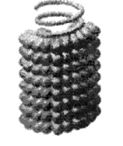
What is true regarding the virus shown in the given figure?
A
Ivanovsky
B
$D$.$J$. Ivanowsky
C
Theophrastus
D
Pasteur
Solution
(B) The figure shows the Tobacco Mosaic Virus $(TMV)$.
$D$.$J$. Ivanowsky $(1892)$ recognized certain microbes as causal organisms of the mosaic disease of tobacco.
These were found to be smaller than bacteria because they passed through bacteria-proof filters.
Therefore,the correct association with the discovery of the virus is Ivanowsky.
$D$.$J$. Ivanowsky $(1892)$ recognized certain microbes as causal organisms of the mosaic disease of tobacco.
These were found to be smaller than bacteria because they passed through bacteria-proof filters.
Therefore,the correct association with the discovery of the virus is Ivanowsky.
0 likes
View Solution217
MediumMCQ
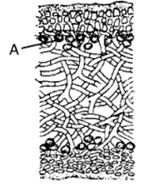
What is the part labeled '$A$' in the given cross-section of a foliose lichen?
A
Phycobiont
B
Mycobiont
C
Fruiting body
D
Ascospore
Solution
(A) Lichens are symbiotic associations between algae and fungi.
In the cross-section of a foliose lichen,the algal component is known as the phycobiont,while the fungal component is the mycobiont.
The part labeled '$A$' represents the algal cells located just below the upper cortex,which is the phycobiont layer.
In the cross-section of a foliose lichen,the algal component is known as the phycobiont,while the fungal component is the mycobiont.
The part labeled '$A$' represents the algal cells located just below the upper cortex,which is the phycobiont layer.
0 likes
View Solution218
EasyMCQ
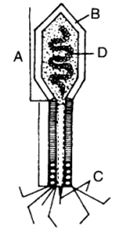
Identify the part labeled '$C$' in the given figure of a bacteriophage.
A
Head
B
Sheath
C
Tail fibers
D
Collar
Solution
(C) The given figure represents a bacteriophage,a virus that infects bacteria.
In the diagram,the labels represent the following parts:
$A$ = Head (Capsid)
$B$ = Collar
$C$ = Tail fibers
$D$ = Genetic material $(DNA)$
Therefore,the part labeled '$C$' represents the tail fibers,which are used by the bacteriophage to attach to the surface of the host bacterium.
In the diagram,the labels represent the following parts:
$A$ = Head (Capsid)
$B$ = Collar
$C$ = Tail fibers
$D$ = Genetic material $(DNA)$
Therefore,the part labeled '$C$' represents the tail fibers,which are used by the bacteriophage to attach to the surface of the host bacterium.
0 likes
View Solution219
EasyMCQ
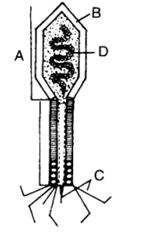
Identify the part labeled as $'D'$ in the given figure.
A
$DNA$
B
Capsid
C
Head
D
Tail
Solution
(A) The given figure represents a bacteriophage,which is a virus that infects bacteria.
In the diagram:
- $'A'$ represents the head.
- $'B'$ represents the capsid (protein coat).
- $'C'$ represents the tail fibers.
- $'D'$ represents the genetic material,which is $DNA$ in this specific bacteriophage.
In the diagram:
- $'A'$ represents the head.
- $'B'$ represents the capsid (protein coat).
- $'C'$ represents the tail fibers.
- $'D'$ represents the genetic material,which is $DNA$ in this specific bacteriophage.
0 likes
View Solution220
EasyMCQ
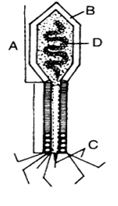
What is the part labeled '$B$' in the given figure?
A
Plasmid
B
Capsid
C
Cosmid
D
Fimbriae
Solution
(B) The figure represents a bacteriophage,which is a virus that infects bacteria.
In the structure of a bacteriophage:
- '$A$' represents the head.
- '$B$' represents the protein coat known as the capsid,which encloses the genetic material.
- '$C$' represents the tail fibers.
- '$D$' represents the genetic material $(DNA)$.
Therefore,the part labeled '$B$' is the capsid.
In the structure of a bacteriophage:
- '$A$' represents the head.
- '$B$' represents the protein coat known as the capsid,which encloses the genetic material.
- '$C$' represents the tail fibers.
- '$D$' represents the genetic material $(DNA)$.
Therefore,the part labeled '$B$' is the capsid.
0 likes
View Solution221
MediumMCQ
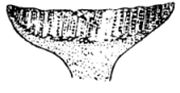
What is the fruiting body of the lichen shown in the given figure called?
A
Apothecium
B
Perithecium
C
Phycobiont
D
Capitulum
Solution
(A) The figure shows an open,cup-shaped fruiting body of a lichen,which is characteristic of an apothecium.
An apothecium is a wide,open,disc-shaped or cup-shaped ascocarp in which the hymenium is exposed at maturity.
Phycobiont refers to the algal component of the lichen,not a fruiting body.
Perithecium is a flask-shaped fruiting body with a small pore.
Capitulum is a different type of structure found in some fungi.
An apothecium is a wide,open,disc-shaped or cup-shaped ascocarp in which the hymenium is exposed at maturity.
Phycobiont refers to the algal component of the lichen,not a fruiting body.
Perithecium is a flask-shaped fruiting body with a small pore.
Capitulum is a different type of structure found in some fungi.
0 likes
View Solution222
EasyMCQ
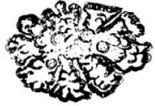
Identify the organism shown in the given figure.
A
Usnea
B
Parmelia
C
Riccia
D
Strigula
Solution
(B) The figure shows a foliose lichen,which is a symbiotic association between an alga and a fungus. Among the given options,$Parmelia$ is a well-known genus of foliose lichen,characterized by its leaf-like,flattened thallus that attaches to the substrate. $Usnea$ is a fruticose lichen,$Riccia$ is a liverwort (bryophyte),and $Strigula$ is a crustose lichen. Therefore,the correct identification is $Parmelia$.
0 likes
View Solution223
MediumMCQ
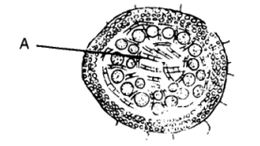
What is the part labeled '$A$' in the given figure?
A
Mycobiont
B
Phycobiont
C
Soredia
D
Fruiting body
Solution
(A) The given figure represents the internal structure of a lichen. Lichens are symbiotic associations between algae and fungi. The algal component is known as the phycobiont,while the fungal component is known as the mycobiont. In the diagram,the fungal hyphae (mycobiont) are shown surrounding the algal cells (phycobiont). The label '$A$' points to the fungal hyphae,which constitute the mycobiont.
0 likes
View Solution224
EasyMCQ
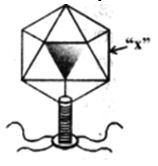
What does the part labeled as $''X''$ represent in the given figure?
A
Head
B
Tail
C
Collar
D
Tail fibers
Solution
(A) The given figure represents a bacteriophage,which is a virus that infects bacteria.
In the structure of a bacteriophage,the polyhedral protein coat that encloses the genetic material is known as the head.
The part labeled as $''X''$ points to this polyhedral head structure.
Therefore,the correct option is $A$.
In the structure of a bacteriophage,the polyhedral protein coat that encloses the genetic material is known as the head.
The part labeled as $''X''$ points to this polyhedral head structure.
Therefore,the correct option is $A$.
0 likes
View Solution225
EasyMCQ
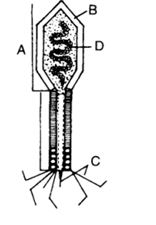
Identify the part labeled as '$B$' in the given diagram.
A
Protein coat
B
Head
C
Tail
D
$DNA$
Solution
(B) The given diagram represents a bacteriophage,which is a virus that infects bacteria.
In the diagram:
- '$A$' represents the overall structure or the sheath/tail region.
- '$B$' represents the head of the bacteriophage,which contains the genetic material.
- '$C$' represents the tail fibers.
- '$D$' represents the genetic material,which is $DNA$.
Therefore,'$B$' is the head.
In the diagram:
- '$A$' represents the overall structure or the sheath/tail region.
- '$B$' represents the head of the bacteriophage,which contains the genetic material.
- '$C$' represents the tail fibers.
- '$D$' represents the genetic material,which is $DNA$.
Therefore,'$B$' is the head.
0 likes
View Solution226
EasyMCQ
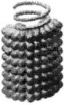
Which virus is shown in the given figure?
A
Adenovirus
B
Bacteriophage
C
$TMV$ (Tobacco Mosaic Virus)
D
$HIV$
Solution
(C) The figure shows the structure of the Tobacco Mosaic Virus $(TMV)$.
$TMV$ is a rod-shaped virus with a helical symmetry.
It consists of a single-stranded $RNA$ molecule surrounded by a protein coat called a capsid,which is made up of capsomeres.
This specific helical structure is a classic representation of $TMV$ found in biology textbooks.
$TMV$ is a rod-shaped virus with a helical symmetry.
It consists of a single-stranded $RNA$ molecule surrounded by a protein coat called a capsid,which is made up of capsomeres.
This specific helical structure is a classic representation of $TMV$ found in biology textbooks.
0 likes
View Solution227
EasyMCQ
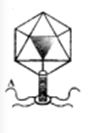
What does the part labeled $''A''$ in the given figure represent?
A
Head
B
Tail
C
Collar
D
Tail fibers
Solution
(D) The given figure represents a bacteriophage,which is a virus that infects bacteria.
In the diagram,the part labeled $''A''$ points to the tail fibers.
These tail fibers are essential for the attachment of the bacteriophage to the specific receptor sites on the surface of the host bacterial cell.
In the diagram,the part labeled $''A''$ points to the tail fibers.
These tail fibers are essential for the attachment of the bacteriophage to the specific receptor sites on the surface of the host bacterial cell.
0 likes
View Solution228
EasyMCQ
Identify the part labeled as '$A$' in the given figure.
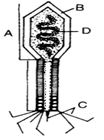
A
Capsid
B
Head
C
$DNA$
D
Tail
Solution
(B) The given figure represents a bacteriophage.
In the diagram,'$A$' points to the entire upper portion of the virus,which is the 'Head' (or capsid-containing region).
'$B$' represents the capsid,'$C$' represents the tail fibers,and '$D$' represents the genetic material $(DNA)$.
Therefore,'$A$' represents the Head.
In the diagram,'$A$' points to the entire upper portion of the virus,which is the 'Head' (or capsid-containing region).
'$B$' represents the capsid,'$C$' represents the tail fibers,and '$D$' represents the genetic material $(DNA)$.
Therefore,'$A$' represents the Head.
0 likes
View Solution229
EasyMCQ
Identify the virus shown in the given figure.
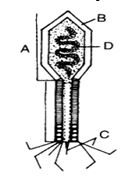
A
Tobacco Mosaic Virus
B
Bacteriophage
C
Polio Virus
D
$HIV$ Virus
Solution
(B) The figure represents a $Bacteriophage$.
Bacteriophages are viruses that infect bacteria.
The structure consists of a head containing genetic material $(D)$,a collar,a tail $(A)$,and tail fibers $(C)$.
The head is protected by a protein coat called a capsid $(B)$.
This specific structure is characteristic of a $Bacteriophage$.
Bacteriophages are viruses that infect bacteria.
The structure consists of a head containing genetic material $(D)$,a collar,a tail $(A)$,and tail fibers $(C)$.
The head is protected by a protein coat called a capsid $(B)$.
This specific structure is characteristic of a $Bacteriophage$.
0 likes
View Solution230
EasyMCQ
Which scientist discovered the virus shown in the given figure?
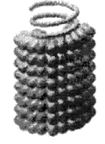
A
Pasteur
B
Diener
C
Theophrastus
D
Ivanowsky
Solution
(D) The figure shows the Tobacco Mosaic Virus $(TMV)$.
Dmitri Ivanowsky $(1892)$ recognized certain microbes as causal organisms of the mosaic disease of tobacco. These were found to be smaller than bacteria because they passed through bacteria-proof filters.
Dmitri Ivanowsky $(1892)$ recognized certain microbes as causal organisms of the mosaic disease of tobacco. These were found to be smaller than bacteria because they passed through bacteria-proof filters.
0 likes
View Solution231
MediumMCQ
Identify the type of lichen shown in the given figure.
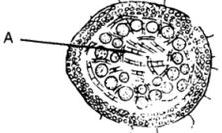
A
Crustose lichen
B
Foliose lichen
C
Fruticose lichen
D
Filamentous lichen
Solution
(C) The provided figure shows a cross-section of a lichen thallus.
Based on the structural organization,specifically the radial symmetry and the arrangement of algal and fungal components,this represents a Fruticose lichen.
Fruticose lichens are branched,shrub-like,and often grow attached to a substrate at a single point.
In the cross-section,the algal cells are distributed throughout the medulla,which is characteristic of this type.
Based on the structural organization,specifically the radial symmetry and the arrangement of algal and fungal components,this represents a Fruticose lichen.
Fruticose lichens are branched,shrub-like,and often grow attached to a substrate at a single point.
In the cross-section,the algal cells are distributed throughout the medulla,which is characteristic of this type.
0 likes
View Solution232
EasyMCQ
Identify the odd one out in the context of living organisms.
A
Protozoa
B
Bacteria
C
Virus
D
Spirogyra
Solution
(C) The correct answer is $C$ (Virus).
Viruses are considered to be at the border of living and non-living organisms because they lack a cellular structure and cannot replicate independently without a host cell.
Protozoa,Bacteria,and Spirogyra are all considered true living organisms as they possess cellular machinery and can perform metabolic activities independently.
Viruses are considered to be at the border of living and non-living organisms because they lack a cellular structure and cannot replicate independently without a host cell.
Protozoa,Bacteria,and Spirogyra are all considered true living organisms as they possess cellular machinery and can perform metabolic activities independently.
0 likes
View Solution233
EasyMCQ
Which of the following is not included in any of the five kingdoms proposed by Whittaker?
A
Viruses
B
Viroids and Prions
C
Bacteriophages
D
All of the above
Solution
(D) $R$.$H$. Whittaker proposed the five-kingdom classification system,which includes Monera,Protista,Fungi,Plantae,and Animalia.
Viruses,viroids,prions,and bacteriophages are acellular entities that lack a cellular structure and metabolic machinery of their own.
Because they do not possess the characteristics of living cells,they were not placed in any of the five kingdoms by Whittaker.
Viruses,viroids,prions,and bacteriophages are acellular entities that lack a cellular structure and metabolic machinery of their own.
Because they do not possess the characteristics of living cells,they were not placed in any of the five kingdoms by Whittaker.
0 likes
View Solution234
EasyMCQ
Assertion $A$: Bacteriophages are bacteria-eating viruses.
Reason $R$: Bacterial viruses are obligate parasites in bacterial cells.
Which option is correct for Assertion $A$ and Reason $R$?
Reason $R$: Bacterial viruses are obligate parasites in bacterial cells.
Which option is correct for Assertion $A$ and Reason $R$?
A
$A$ and $R$ are both true and $R$ is the correct explanation of $A$.
B
$A$ and $R$ are both true but $R$ is not the correct explanation of $A$.
C
$A$ is true and $R$ is false.
D
$A$ and $R$ are both false.
Solution
(A) Bacteriophages are viruses that infect bacteria. The term 'phage' means 'to eat',hence they are known as bacteria-eating viruses. This makes Assertion $A$ true.
Bacteriophages are obligate intracellular parasites,meaning they require a living bacterial host cell to replicate and survive. They inject their genetic material into the bacterial cell,hijack the host's machinery,and produce more viral particles. This makes Reason $R$ true.
Since the definition of a bacteriophage as a 'bacteria-eating virus' is directly based on its nature as an obligate parasite of bacteria,Reason $R$ is the correct explanation for Assertion $A$.
Bacteriophages are obligate intracellular parasites,meaning they require a living bacterial host cell to replicate and survive. They inject their genetic material into the bacterial cell,hijack the host's machinery,and produce more viral particles. This makes Reason $R$ true.
Since the definition of a bacteriophage as a 'bacteria-eating virus' is directly based on its nature as an obligate parasite of bacteria,Reason $R$ is the correct explanation for Assertion $A$.
0 likes
View Solution235
EasyMCQ
Which of the following structures contains a short strand of $RNA$?
A
Viroid
B
$E$. coli
C
Bacteria
D
Amoeba
Solution
(A) $Viroid$ is an infectious agent that consists solely of a short strand of circular, single-stranded $RNA$ without a protein coat.
Unlike viruses, they lack a capsid.
$E. coli$ and other bacteria are prokaryotic organisms with double-stranded $DNA$ genomes.
$Amoeba$ is a eukaryotic protist with a complex cellular structure containing $DNA$ within a nucleus.
Therefore, the correct answer is $Viroid$.
Unlike viruses, they lack a capsid.
$E. coli$ and other bacteria are prokaryotic organisms with double-stranded $DNA$ genomes.
$Amoeba$ is a eukaryotic protist with a complex cellular structure containing $DNA$ within a nucleus.
Therefore, the correct answer is $Viroid$.
0 likes
View Solution236
EasyMCQ
Which of the following statements is incorrect regarding viruses?
A
They are ubiquitous and extremely small in size.
B
The main structural component is nucleoprotein.
C
They lack a capsid coat.
D
They exhibit active and living behavior inside a living cell.
Solution
(C) Viruses are obligate parasites that consist of genetic material ($DNA$ or $RNA$) enclosed within a protein coat called a capsid. Statement $C$ is incorrect because viruses possess a protein coat known as a capsid,which protects the genetic material. Statements $A$,$B$,and $D$ are correct characteristics of viruses.
0 likes
View Solution237
EasyMCQ
From which plants did $D.J. Ivanowsky$ discover viruses?
A
Maize
B
Tobacco
C
Sugarcane
D
Sunflower
Solution
(B) In $1892$,$D.J. Ivanowsky$ recognized certain microbes as causal organisms of the mosaic disease of tobacco. These were found to be smaller than bacteria because they passed through bacteria-proof filters. Hence,the correct answer is tobacco.
0 likes
View Solution238
EasyMCQ
Which of the following scientists gave the name 'virus'?
A
Ivanowsky
B
Beijerinck
C
Pasteur
D
Dyer
Solution
(C) The name 'virus' which means 'venom' or 'poisonous fluid' was given by Louis Pasteur.
$D.J. Ivanowsky$ $(1892)$ recognized certain microbes as causal organisms of the mosaic disease of tobacco.
$M.W. Beijerinck$ $(1898)$ demonstrated that the extract of the infected plants of tobacco could cause infection in healthy plants and called the fluid as 'Contagium vivum fluidum'.
However,the term 'virus' itself is attributed to Louis Pasteur.
$D.J. Ivanowsky$ $(1892)$ recognized certain microbes as causal organisms of the mosaic disease of tobacco.
$M.W. Beijerinck$ $(1898)$ demonstrated that the extract of the infected plants of tobacco could cause infection in healthy plants and called the fluid as 'Contagium vivum fluidum'.
However,the term 'virus' itself is attributed to Louis Pasteur.
0 likes
View Solution239
EasyMCQ
Which is the correct option for the given figures?
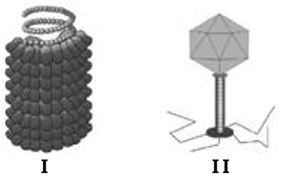
A
$I$ Plant virus,$II$ Animal virus
B
$I$ Phage virus,$II$ $TMV$
C
$I$ Plant virus,$II$ Bacteriophage
D
$I$ Animal virus,$II$ Bacteriophage
Solution
(C) Figure $I$ represents the Tobacco Mosaic Virus $(TMV)$,which is a well-known plant virus characterized by its helical symmetry.
Figure $II$ represents a Bacteriophage,which is a virus that infects bacteria,characterized by its complex structure consisting of a head and a tail.
Therefore,the correct identification is $I$ as a plant virus and $II$ as a bacteriophage.
Figure $II$ represents a Bacteriophage,which is a virus that infects bacteria,characterized by its complex structure consisting of a head and a tail.
Therefore,the correct identification is $I$ as a plant virus and $II$ as a bacteriophage.
0 likes
View Solution240
EasyMCQ
Which of the following is smaller than a virus?
A
Protozoa
B
Viroid
C
$E$. coli
D
Mucor
Solution
(B) Viroids are infectious agents that are smaller than viruses. They consist solely of a short strand of circular,single-stranded $RNA$ without a protein coat (capsid). In contrast,viruses consist of genetic material ($DNA$ or $RNA$) enclosed in a protein coat. Protozoa,$E$. coli (a bacterium),and Mucor (a fungus) are all significantly larger than viruses.
0 likes
View Solution241
EasyMCQ
Who discovered viroids?
A
Viruses
B
Viroids
C
Bacteria
D
Protozoa
Solution
(B) In $1971$,$T.O. Diener$ discovered a new infectious agent that was smaller than viruses and caused potato spindle tuber disease. This infectious agent was named 'viroid'. Viroids consist of a short strand of low molecular weight $RNA$ and lack a protein coat.
0 likes
View Solution242
EasyMCQ
Which of the following is the composition of a virus?
A
Proteins and $DNA$ or $RNA$
B
Proteins,$DNA$ and $RNA$
C
Proteins,$DNA, RNA$ and lipids
D
Carbohydrates,nucleic acids and lipids
Solution
(A) virus is a nucleoprotein entity,which means it consists of a genetic material core surrounded by a protein coat called a capsid.
The genetic material can be either $DNA$ or $RNA$,but never both in the same virus.
Therefore,the basic composition of a virus is proteins and $DNA$ or $RNA$.
The genetic material can be either $DNA$ or $RNA$,but never both in the same virus.
Therefore,the basic composition of a virus is proteins and $DNA$ or $RNA$.
0 likes
View Solution243
MediumMCQ
What is mainly responsible for Alzheimer's disease in humans?
A
Viroids
B
Viruses
C
Fungi
D
Bacteria
Solution
(NONE) Alzheimer's disease is a progressive neurodegenerative disorder characterized by the accumulation of misfolded proteins,specifically $amyloid-beta$ plaques and $tau$ tangles in the brain.
None of the options provided ($Viroids$,$Viruses$,$Fungi$,or $Bacteria$) are the primary causative agents of Alzheimer's disease.
$Viroids$ are small circular $RNA$ molecules that infect plants.
$Viruses$,$Fungi$,and $Bacteria$ are infectious pathogens that cause various diseases,but they are not the cause of Alzheimer's.
Neurodegenerative diseases like $Creutzfeldt-Jakob$ disease are caused by $Prions$ (misfolded proteins),which are distinct from the options listed.
Therefore,this question is technically inaccurate as none of the provided options are responsible for Alzheimer's disease.
None of the options provided ($Viroids$,$Viruses$,$Fungi$,or $Bacteria$) are the primary causative agents of Alzheimer's disease.
$Viroids$ are small circular $RNA$ molecules that infect plants.
$Viruses$,$Fungi$,and $Bacteria$ are infectious pathogens that cause various diseases,but they are not the cause of Alzheimer's.
Neurodegenerative diseases like $Creutzfeldt-Jakob$ disease are caused by $Prions$ (misfolded proteins),which are distinct from the options listed.
Therefore,this question is technically inaccurate as none of the provided options are responsible for Alzheimer's disease.
0 likes
View Solution244
EasyMCQ
Which of the following organisms contains only one type of genetic material,either $DNA$ or $RNA$?
A
Moss
B
Virus
C
Lichen
D
Fungi
Solution
(B) Viruses are unique biological entities that contain either $DNA$ or $RNA$ as their genetic material,but never both.
In contrast,all cellular organisms like moss (plants),fungi,and lichens contain both $DNA$ and $RNA$ within their cells.
Therefore,the correct answer is $B$ (Virus).
In contrast,all cellular organisms like moss (plants),fungi,and lichens contain both $DNA$ and $RNA$ within their cells.
Therefore,the correct answer is $B$ (Virus).
0 likes
View Solution245
EasyMCQ
What is a capsomere?
A
$RNA$
B
$DNA$
C
Protein
D
Lipid
Solution
(C) capsomere is a subunit of the capsid,which is the outer protein shell of a virus particle.
These capsomeres are composed of protein molecules that self-assemble to protect the viral genetic material ($DNA$ or $RNA$).
Therefore,a capsomere is essentially a protein subunit.
These capsomeres are composed of protein molecules that self-assemble to protect the viral genetic material ($DNA$ or $RNA$).
Therefore,a capsomere is essentially a protein subunit.
0 likes
View Solution246
EasyMCQ
Who discovered the Tobacco Mosaic Virus $(TMV)$?
A
Diener
B
Ivanowsky
C
Pasteur
D
Tatum
Solution
(B) In $1892$,$D.I. Ivanowsky$ recognized certain microbes as causal organisms of the mosaic disease of tobacco. These were found to be smaller than bacteria because they passed through bacteria-proof filters. Thus,$Ivanowsky$ is credited with the discovery of the Tobacco Mosaic Virus $(TMV)$.
0 likes
View Solution247
EasyMCQ
What type of virus is the Tobacco Mosaic Virus $(TMV)$?
A
Bacteriophage
B
Animal virus
C
Plant virus
D
Viroid
Solution
(C) The Tobacco Mosaic Virus $(TMV)$ is a well-known plant virus that infects a wide range of plants,especially tobacco.
It was the first virus to be discovered and crystallized.
It consists of a single-stranded $RNA$ genome enclosed in a protein coat (capsid).
Since it specifically infects plants,it is classified as a plant virus.
It was the first virus to be discovered and crystallized.
It consists of a single-stranded $RNA$ genome enclosed in a protein coat (capsid).
Since it specifically infects plants,it is classified as a plant virus.
0 likes
View Solution248
EasyMCQ
The capsid is a ....
A
strand of $DNA$.
B
short strand of $RNA$.
C
protein.
D
gene.
Solution
(C) capsid is the protein shell of a virus.
It consists of several oligomeric structural subunits made of protein called protomers.
The capsid encloses the genetic material of the virus,which can be either $DNA$ or $RNA$.
It consists of several oligomeric structural subunits made of protein called protomers.
The capsid encloses the genetic material of the virus,which can be either $DNA$ or $RNA$.
0 likes
View Solution249
EasyMCQ
Assertion $A$: Viruses are considered as a link between living and non-living organisms.
Reason $R$: Viruses are non-living,but they are obligate parasites in living cells.
Which option is correct for Assertion $A$ and Reason $R$?
Reason $R$: Viruses are non-living,but they are obligate parasites in living cells.
Which option is correct for Assertion $A$ and Reason $R$?
A
$A$ and $R$ are both true and $R$ is the correct explanation of $A$.
B
$A$ and $R$ are both true but $R$ is not the correct explanation of $A$.
C
$A$ is true and $R$ is false.
D
$A$ and $R$ are both false.
Solution
(A) Assertion $A$ is true because viruses exhibit characteristics of both living (e.g.,replication,genetic material) and non-living (e.g.,lack of cellular structure,inert outside host) entities.
Reason $R$ is also true. Viruses are considered non-living outside a host because they lack metabolic machinery. However,they become active and replicate only when they enter a living host cell,making them obligate parasites.
Since the reason explains why viruses are considered a link (because they are inert outside but active inside),$R$ is the correct explanation of $A$.
Reason $R$ is also true. Viruses are considered non-living outside a host because they lack metabolic machinery. However,they become active and replicate only when they enter a living host cell,making them obligate parasites.
Since the reason explains why viruses are considered a link (because they are inert outside but active inside),$R$ is the correct explanation of $A$.
0 likes
View Solution250
MediumMCQ
Which of the following diseases is caused by the Tobacco Mosaic Virus $(TMV)$?
A
Fibrous nodule
B
Alzheimer's
C
Mosaic disease
D
Ringworm
Solution
(C) The Tobacco Mosaic Virus $(TMV)$ is a plant virus that infects a wide range of plants,especially tobacco.
It causes the characteristic 'mosaic' pattern of mottling and discoloration on the leaves.
Therefore,the disease caused by $TMV$ is known as Mosaic disease.
It causes the characteristic 'mosaic' pattern of mottling and discoloration on the leaves.
Therefore,the disease caused by $TMV$ is known as Mosaic disease.
0 likes
View SolutionBiological Classification — Viruses, Viroids, Prions and Lichens · Frequently Asked Questions
1Are these Biological Classification questions useful for JEE and NEET?
Yes. All questions in this section are mapped to JEE Main and NEET exam patterns. Previous year questions from JEE Main, NEET, GUJCET and state-level exams are included with full solutions.
2Can I switch to Hindi or Gujarati for these questions?
Yes. Use the language tabs in the hero section or the sidebar to view the same questions and solutions in English, Hindi or Gujarati.
3How do I generate a question paper from this subtopic?
Use the Vedclass Exam Paper Generator — select the chapter and subtopic, set difficulty, and generate Sets A, B, C, D automatically. First 3 chapters of every subject are free.
Vedclass Products
For Students
Vedclass Test Series
Mock tests in real JEE/NEET style with performance analysis. 5-day free trial.
Start Free TrialFor Teachers
Exam Paper Generator
Generate Set A/B/C/D papers from this chapter in 2 minutes. 3 chapters free.
Try FreeFor Institutes
Online Exam Module
Live online exams with unlimited students, 360° analytics & white-label branding.
See DemoFor Teachers & Institutes
Generate a Biological Classification Exam Paper in 2 Minutes
Select subtopic & difficulty — Sets A, B, C, D auto-generated with No Repeat logic.
First 3 chapters of every subject are free — no payment required.