
A English
Protista (Unicellular eukaryotes) Questions in English
Class 11 Biology · Biological Classification · Protista (Unicellular eukaryotes)
434+
Questions
English
Language
100%
With Solutions
Showing 46 of 434 questions in English
301
MediumMCQ
The thalloid body of a slime mould $(Myxomycetes)$ is known as
A
Plasmodium
B
fruiting body
C
mycelium
D
protonema
Solution
(A) The vegetative phase of acellular slime moulds $(Myxomycetes)$ consists of a multinucleated,amoeboid,and naked mass of protoplasm called a $Plasmodium$.
This $Plasmodium$ can grow to several feet in size and moves by amoeboid movement,engulfing organic matter.
Under unfavorable conditions,the $Plasmodium$ differentiates and forms fruiting bodies bearing spores.
This $Plasmodium$ can grow to several feet in size and moves by amoeboid movement,engulfing organic matter.
Under unfavorable conditions,the $Plasmodium$ differentiates and forms fruiting bodies bearing spores.
0 likes
View Solution302
MediumMCQ
Trypanosoma belongs to the class ..........
A
Sarcodina
B
Flagellated
C
Ciliated
D
Sporozoan
Solution
(B) Trypanosoma is a parasitic protozoan that belongs to the class Flagellated (Mastigophora) protozoans.
These organisms are either free-living or parasitic and possess flagella for locomotion.
Trypanosoma is the causative agent of sleeping sickness.
These organisms are either free-living or parasitic and possess flagella for locomotion.
Trypanosoma is the causative agent of sleeping sickness.
0 likes
View Solution303
MediumMCQ
Which of the following is true for $Trypanosoma$?
A
Polymorphic
B
Monogenetic
C
Obligate parasite
D
Non-pathogenic
Solution
(A) $Trypanosoma$ is a genus of kinetoplastids,a monophyletic group of unicellular parasitic flagellate protozoa.
It is known to be polymorphic,meaning it exhibits different morphological forms during its life cycle (e.g.,trypomastigote,epimastigote,amastigote).
It is digenetic,requiring two hosts (an insect vector and a vertebrate host) to complete its life cycle.
It is an obligate parasite,meaning it cannot complete its life cycle without a host.
It is highly pathogenic,causing diseases such as African sleeping sickness and Chagas disease.
Therefore,the most distinct characteristic among the given options is that it is polymorphic.
It is known to be polymorphic,meaning it exhibits different morphological forms during its life cycle (e.g.,trypomastigote,epimastigote,amastigote).
It is digenetic,requiring two hosts (an insect vector and a vertebrate host) to complete its life cycle.
It is an obligate parasite,meaning it cannot complete its life cycle without a host.
It is highly pathogenic,causing diseases such as African sleeping sickness and Chagas disease.
Therefore,the most distinct characteristic among the given options is that it is polymorphic.
0 likes
View Solution304
MediumMCQ
The malaria parasite,$Plasmodium$,belongs to which class?
A
Sarcodina
B
Ciliata
C
Sporozoa
D
Dinophyceae
Solution
(C) The malaria parasite,$Plasmodium$,is a member of the kingdom $Protista$.
Within the group of protozoan protists,$Plasmodium$ is classified under the class $Sporozoa$ (also known as $Apicomplexa$).
These organisms are characterized by having an infectious spore-like stage in their life cycle.
Therefore,the correct option is $C$.
Within the group of protozoan protists,$Plasmodium$ is classified under the class $Sporozoa$ (also known as $Apicomplexa$).
These organisms are characterized by having an infectious spore-like stage in their life cycle.
Therefore,the correct option is $C$.
0 likes
View Solution305
MediumMCQ
In $Paramecium$,genetic information is contained in:
A
Micronucleus
B
Macronucleus
C
Both $(a)$ and $(b)$
D
Mitochondria
Solution
(A) $Paramecium$ exhibits nuclear dimorphism,meaning it possesses two types of nuclei: the micronucleus and the macronucleus.
The micronucleus is diploid and contains the germline genetic information,which is responsible for reproduction and genetic recombination during conjugation.
The macronucleus is polyploid and controls the metabolic activities and vegetative functions of the cell.
Therefore,the primary genetic information for inheritance is stored in the micronucleus.
The micronucleus is diploid and contains the germline genetic information,which is responsible for reproduction and genetic recombination during conjugation.
The macronucleus is polyploid and controls the metabolic activities and vegetative functions of the cell.
Therefore,the primary genetic information for inheritance is stored in the micronucleus.
0 likes
View Solution306
EasyMCQ
In $Amoeba$ and $Paramecium$,osmoregulation occurs through . . . . . . .
A
Pseudopodia
B
Nucleus
C
Contractile vacuole
D
General body surface
Solution
(C) Osmoregulation is the process of maintaining the water and salt balance within an organism. In freshwater protozoans like $Amoeba$ and $Paramecium$,the contractile vacuole is the specialized organelle responsible for osmoregulation. It collects excess water from the cytoplasm and expels it out of the cell to prevent the organism from bursting due to the influx of water by osmosis.
0 likes
View Solution307
EasyMCQ
African sleeping sickness is caused by $..........$.
A
$Plasmodium$ $vivax$ transmitted by tsetse fly.
B
$Trypanosoma$ $lewisi$ transmitted by fleas.
C
$Trypanosoma$ $gambiense$ transmitted by $Glossina$ $palpalis$.
D
$Entamoeba$ $gingivalis$ spread by housefly.
Solution
(C) African sleeping sickness is a parasitic disease caused by the protozoan $Trypanosoma$ $gambiense$ (or $Trypanosoma$ $brucei$ $gambiense$).
It is transmitted to humans through the bite of the tsetse fly,which belongs to the genus $Glossina$ (specifically $Glossina$ $palpalis$ or $Glossina$ $morsitans$).
Therefore,the correct option is $C$.
It is transmitted to humans through the bite of the tsetse fly,which belongs to the genus $Glossina$ (specifically $Glossina$ $palpalis$ or $Glossina$ $morsitans$).
Therefore,the correct option is $C$.
0 likes
View Solution308
MediumMCQ
Protists obtain their food in which of the following ways?
A
Photosynthetic,symbiotic,and holotrophic
B
Photosynthetic
C
Chemosynthetic
D
Holotrophic
Solution
(A) Protists are a diverse group of eukaryotic organisms. Their mode of nutrition is highly varied:
$1$. Photosynthetic: Many protists like diatoms and dinoflagellates perform photosynthesis.
$2$. Symbiotic: Some live in symbiotic relationships with other organisms.
$3$. Holotrophic (Holozoic): Many protists like Amoeba ingest food particles through phagocytosis.
Therefore,protists exhibit a combination of these nutritional strategies.
$1$. Photosynthetic: Many protists like diatoms and dinoflagellates perform photosynthesis.
$2$. Symbiotic: Some live in symbiotic relationships with other organisms.
$3$. Holotrophic (Holozoic): Many protists like Amoeba ingest food particles through phagocytosis.
Therefore,protists exhibit a combination of these nutritional strategies.
0 likes
View Solution309
MediumMCQ
In the genome of a protozoan,the genetic material is organized as:
A
Membrane-bound nucleoproteins embedded in the cytoplasm.
B
Free nucleic acids aggregated together.
C
Genes containing nucleoproteins organized in a free mass.
D
Nucleoproteins in direct contact with the cellular material.
Solution
(C) Protozoans are eukaryotic organisms. In eukaryotes,the genetic material $(DNA)$ is associated with histone proteins to form nucleoproteins,which are organized into chromatin within the nucleus. The genome of a protozoan consists of genes associated with nucleoproteins,which are organized within the nuclear structure. Among the given options,option $C$ is the most appropriate description of this organization.
0 likes
View Solution310
EasyMCQ
The presence of macronucleus and micronucleus is a characteristic feature of $......$.
A
Paramecium and Vorticella
B
Opalina and Nyctotherus
C
Hydra and Balantidium
D
Vorticella and Nyctotherus
Solution
(A) The presence of two types of nuclei,a large macronucleus and a small micronucleus,is a characteristic feature of the phylum $Ciliophora$ (ciliates).
$Paramecium$,$Vorticella$,$Nyctotherus$,and $Balantidium$ are all examples of ciliates.
However,among the given options,$Paramecium$ and $Vorticella$ are the most classic examples of organisms exhibiting nuclear dimorphism (macronucleus and micronucleus).
Therefore,the correct option is $A$.
$Paramecium$,$Vorticella$,$Nyctotherus$,and $Balantidium$ are all examples of ciliates.
However,among the given options,$Paramecium$ and $Vorticella$ are the most classic examples of organisms exhibiting nuclear dimorphism (macronucleus and micronucleus).
Therefore,the correct option is $A$.
0 likes
View Solution311
MediumMCQ
Which of the following organisms exhibits characteristics of both plants and animals?
A
Bacteria
B
Mycoplasma
C
Euglena
D
Paramecium
Solution
(C) The organism $Euglena$ is a unique member of the kingdom $Protista$.
It possesses characteristics of both plants and animals.
Like plants,$Euglena$ contains chlorophyll and performs photosynthesis in the presence of sunlight (autotrophic nutrition).
In the absence of sunlight,it behaves like a heterotroph by feeding on other organic matter (holozoic or saprophytic nutrition).
Additionally,it lacks a rigid cell wall,which is a characteristic feature of animal cells.
It possesses characteristics of both plants and animals.
Like plants,$Euglena$ contains chlorophyll and performs photosynthesis in the presence of sunlight (autotrophic nutrition).
In the absence of sunlight,it behaves like a heterotroph by feeding on other organic matter (holozoic or saprophytic nutrition).
Additionally,it lacks a rigid cell wall,which is a characteristic feature of animal cells.
0 likes
View Solution312
MediumMCQ
When a freshwater protozoan possessing a contractile vacuole is placed in a glass containing seawater,the vacuole will:
A
Increase in number
B
Disappear
C
Increase in size
D
Decrease in size
Solution
(B) Freshwater protozoans like $Amoeba$ possess a contractile vacuole to perform osmoregulation,which involves expelling excess water that enters the cell due to the hypotonic environment.
When placed in seawater,which is a hypertonic solution,the external environment has a higher solute concentration than the cytoplasm of the protozoan.
Due to exosmosis,water moves out of the cell into the surrounding seawater.
As a result,there is no excess water to be expelled,and the contractile vacuole,which functions to remove water,becomes inactive and eventually disappears.
When placed in seawater,which is a hypertonic solution,the external environment has a higher solute concentration than the cytoplasm of the protozoan.
Due to exosmosis,water moves out of the cell into the surrounding seawater.
As a result,there is no excess water to be expelled,and the contractile vacuole,which functions to remove water,becomes inactive and eventually disappears.
0 likes
View Solution313
MediumMCQ
Auxospores and hormocysts are produced by $ \dots $ respectively.
A
Some diatoms and a few cyanobacteria
B
Many cyanobacteria and many diatoms
C
Certain diatoms and many cyanobacteria
D
Certain cyanobacteria and many diatoms
Solution
(C) Auxospores are specialized cells produced by certain diatoms to restore their normal size after repeated asexual divisions lead to a reduction in cell size.
Hormocysts are thick-walled, resting structures produced by many cyanobacteria (such as $Westiellopsis$ and $Hapalosiphon$) under unfavorable conditions to survive and propagate.
Therefore, auxospores are produced by certain diatoms and hormocysts are produced by many cyanobacteria.
Hormocysts are thick-walled, resting structures produced by many cyanobacteria (such as $Westiellopsis$ and $Hapalosiphon$) under unfavorable conditions to survive and propagate.
Therefore, auxospores are produced by certain diatoms and hormocysts are produced by many cyanobacteria.
0 likes
View Solution314
MediumMCQ
What is common among $Trypanosoma$,$Noctiluca$,$Monocystis$,and $Giardia$?
A
They are unicellular protists.
B
They are flagellates.
C
They form spores.
D
They are all parasites.
Solution
(A) All the organisms mentioned ($Trypanosoma$,$Noctiluca$,$Monocystis$,and $Giardia$) belong to the Kingdom $Protista$.
$Trypanosoma$ is a flagellated protozoan.
$Noctiluca$ is a dinoflagellate.
$Monocystis$ is a sporozoan.
$Giardia$ is a flagellated protozoan.
While they have different modes of locomotion or life cycles,the common characteristic among all these organisms is that they are all unicellular eukaryotic organisms classified under the Kingdom $Protista$.
$Trypanosoma$ is a flagellated protozoan.
$Noctiluca$ is a dinoflagellate.
$Monocystis$ is a sporozoan.
$Giardia$ is a flagellated protozoan.
While they have different modes of locomotion or life cycles,the common characteristic among all these organisms is that they are all unicellular eukaryotic organisms classified under the Kingdom $Protista$.
0 likes
View Solution315
EasyMCQ
In which group of organisms does the cell wall form two thin overlapping shells that fit together?
A
Chrysophytes
B
Euglenoids
C
Dinoflagellates
D
Slime moulds
Solution
(A) Chrysophytes,which include diatoms and golden algae,are characterized by cell walls that form two thin overlapping shells,which fit together like a soap box.
These walls are embedded with silica,making them indestructible.
These walls are embedded with silica,making them indestructible.
0 likes
View Solution316
MediumMCQ
Select the incorrect statement.
A
The cell walls of diatoms are easily destructible.
B
'Diatomaceous earth' is formed by the cell walls of diatoms.
C
Diatoms are the chief producers in the oceans.
D
Diatoms are microscopic and float passively in water.
Solution
(A) The cell walls of diatoms are embedded with silica and thus are indestructible. They form large deposits of 'diatomaceous earth' over billions of years. Diatoms are the chief producers in the oceans and are microscopic organisms that float passively in water currents (plankton). Therefore,the statement that their cell walls are easily destructible is incorrect.
0 likes
View Solution317
EasyMCQ
Chrysophytes,euglenoids,dinoflagellates,and slime molds are included in the kingdom ............ .
A
Protista
B
Fungi
C
Animalia
D
Monera
Solution
(A) According to the $5$-kingdom classification system proposed by $R.H. Whittaker$,the kingdom $Protista$ includes all unicellular eukaryotic organisms.
Chrysophytes,euglenoids,dinoflagellates,and slime molds are all examples of unicellular eukaryotes.
Therefore,they are classified under the kingdom $Protista$.
Chrysophytes,euglenoids,dinoflagellates,and slime molds are all examples of unicellular eukaryotes.
Therefore,they are classified under the kingdom $Protista$.
0 likes
View Solution318
MediumMCQ
The thalloid body of a slime mold is called:
A
Plasmodium
B
Fruiting body
C
Mycelium
D
Protonema
Solution
(A) Slime molds are saprophytic protists. Under suitable conditions,they form an aggregation called $Plasmodium$ which may grow and spread over several feet. This $Plasmodium$ is the vegetative,thalloid body of the slime mold. During unfavorable conditions,the $Plasmodium$ differentiates and forms fruiting bodies bearing spores at their tips.
0 likes
View Solution319
EasyMCQ
Which of the following is a slime mould?
A
Rhizopus
B
Physarum
C
Thiobacillus
D
Anabaena
Solution
(B) Slime moulds are saprophytic protists. The body moves along decaying twigs and leaves engulfing organic material. Under suitable conditions,they form an aggregation called plasmodium which may grow and spread over several feet. During unfavourable conditions,the plasmodium differentiates and forms fruiting bodies bearing spores at their tips. $Physarum$ is a well-known example of a slime mould. $Rhizopus$ is a fungus,$Thiobacillus$ is a bacterium,and $Anabaena$ is a cyanobacterium.
0 likes
View Solution320
MediumMCQ
In which of the following is cellulose a major component of the cell walls?
A
Pythium
B
Xanthomonas
C
Pseudomonas
D
Saccharomyces
Solution
(A) The cell walls of most fungi are composed of chitin. However,$Pythium$ is a member of the Oomycetes (water molds),which are fungus-like protists.
Unlike true fungi,the cell walls of Oomycetes are primarily composed of cellulose and glucans,not chitin.
$Xanthomonas$ and $Pseudomonas$ are bacteria,whose cell walls are made of peptidoglycan.
$Saccharomyces$ (yeast) is a true fungus,and its cell wall is composed of chitin and glucans.
Therefore,$Pythium$ is the correct answer.
Unlike true fungi,the cell walls of Oomycetes are primarily composed of cellulose and glucans,not chitin.
$Xanthomonas$ and $Pseudomonas$ are bacteria,whose cell walls are made of peptidoglycan.
$Saccharomyces$ (yeast) is a true fungus,and its cell wall is composed of chitin and glucans.
Therefore,$Pythium$ is the correct answer.
0 likes
View Solution321
EasyMCQ
In which organism is a dimorphic nucleus found?
A
Amoeba
B
Trypanosoma gambiense
C
Plasmodium vivax
D
Paramecium caudatum
Solution
(D) Dimorphic nucleus refers to the presence of two types of nuclei within a single cell, specifically a large macronucleus and a small micronucleus.
This condition is a characteristic feature of the phylum Ciliophora.
Among the given options, $Paramecium \text{ } caudatum$ belongs to the class Ciliata (Ciliophora) and exhibits nuclear dimorphism.
The macronucleus controls vegetative functions, while the micronucleus is involved in reproductive processes.
This condition is a characteristic feature of the phylum Ciliophora.
Among the given options, $Paramecium \text{ } caudatum$ belongs to the class Ciliata (Ciliophora) and exhibits nuclear dimorphism.
The macronucleus controls vegetative functions, while the micronucleus is involved in reproductive processes.
0 likes
View Solution322
EasyMCQ
In which of the following unicellular organisms is a large macronucleus found for nutritional functions and a smaller micronucleus for reproductive functions?
A
Euglena
B
Amoeba
C
Paramecium
D
Trypanosoma
Solution
(C) The organism $Paramecium$ exhibits nuclear dimorphism,meaning it possesses two types of nuclei:
$1$. $A$ large $macronucleus$ (vegetative nucleus) which controls metabolic and nutritional activities.
$2$. $A$ small $micronucleus$ (generative nucleus) which is involved in reproduction and genetic exchange during conjugation.
Therefore,the correct option is $C$.
$1$. $A$ large $macronucleus$ (vegetative nucleus) which controls metabolic and nutritional activities.
$2$. $A$ small $micronucleus$ (generative nucleus) which is involved in reproduction and genetic exchange during conjugation.
Therefore,the correct option is $C$.
0 likes
View Solution323
MediumMCQ
When freshwater protozoans possessing contractile vacuoles are placed in a beaker containing seawater,the vacuoles will:
A
Increase in number
B
Disappear
C
Increase in size
D
Decrease in size
Solution
(B) Freshwater protozoans like $Amoeba$ possess contractile vacuoles to perform osmoregulation by expelling excess water that enters the cell via osmosis.
Seawater is a hypertonic environment compared to the cytoplasm of freshwater protozoans.
When placed in seawater,the external environment has a higher solute concentration,causing water to move out of the protozoan cell into the surrounding medium due to exosmosis.
Since there is no excess water entering the cell,the contractile vacuole is no longer required for osmoregulation and eventually disappears.
Seawater is a hypertonic environment compared to the cytoplasm of freshwater protozoans.
When placed in seawater,the external environment has a higher solute concentration,causing water to move out of the protozoan cell into the surrounding medium due to exosmosis.
Since there is no excess water entering the cell,the contractile vacuole is no longer required for osmoregulation and eventually disappears.
0 likes
View Solution324
MediumMCQ
Ciliates differ from all other protozoans in
A
Using flagella for locomotion
B
Having two types of nuclei
C
Using pseudopodia for capturing prey
D
Having a contractile vacuole for removing excess water
Solution
(B) Ciliates,such as $Paramecium$,are unique among protozoans because they possess two types of nuclei: a large macronucleus and a small micronucleus.
The macronucleus controls vegetative functions,while the micronucleus is involved in reproduction and genetic exchange.
Other protozoans like amoeboids,flagellates,and sporozoans do not exhibit this specific nuclear dimorphism.
The macronucleus controls vegetative functions,while the micronucleus is involved in reproduction and genetic exchange.
Other protozoans like amoeboids,flagellates,and sporozoans do not exhibit this specific nuclear dimorphism.
0 likes
View Solution325
MediumMCQ
Which of the following organisms are known as chief producers in the oceans?
A
Euglenoids
B
Dinoflagellates
C
Diatoms
D
Cyanobacteria
Solution
(C) Diatoms are microscopic,photosynthetic organisms belonging to the kingdom $Protista$ (class $Bacillariophyceae$).
They are found in both fresh water and marine environments.
In the oceans,they are the primary source of food for many aquatic organisms and are responsible for a significant portion of global photosynthesis.
Due to their massive abundance and photosynthetic activity,they are famously known as the 'chief producers' in the oceans.
They are found in both fresh water and marine environments.
In the oceans,they are the primary source of food for many aquatic organisms and are responsible for a significant portion of global photosynthesis.
Due to their massive abundance and photosynthetic activity,they are famously known as the 'chief producers' in the oceans.
0 likes
View Solution326
MediumMCQ
Select the $wrong$ statement:
A
Mitochondria are the powerhouse of the cell in all kingdoms except Monera.
B
Cell wall is present in members of Fungi and Plantae.
C
Mushrooms belong to Basidiomycetes.
D
Pseudopodia are locomotory and feeding structures in Sporozoans.
Solution
(D) The correct answer is $D$.
$A$: Mitochondria are absent in prokaryotes (Monera) and present in all eukaryotes. This statement is correct.
$B$: Fungi have cell walls made of chitin,and plants have cell walls made of cellulose. This statement is correct.
$C$: Mushrooms (Agaricus) are well-known examples of Basidiomycetes. This statement is correct.
$D$: Sporozoans (like Plasmodium) lack locomotory structures like pseudopodia,flagella,or cilia. Pseudopodia are characteristic of Sarcodines (Amoeboid protozoans). Therefore,this statement is incorrect.
$A$: Mitochondria are absent in prokaryotes (Monera) and present in all eukaryotes. This statement is correct.
$B$: Fungi have cell walls made of chitin,and plants have cell walls made of cellulose. This statement is correct.
$C$: Mushrooms (Agaricus) are well-known examples of Basidiomycetes. This statement is correct.
$D$: Sporozoans (like Plasmodium) lack locomotory structures like pseudopodia,flagella,or cilia. Pseudopodia are characteristic of Sarcodines (Amoeboid protozoans). Therefore,this statement is incorrect.
0 likes
View Solution327
MediumMCQ
Myxomycetes are
A
saprobes or parasites,having mycelia,asexual reproduction by fragmentation
B
slimy mass of multinucleate protoplasm,having pseudopodia like structures for engulfing food,reproduction through fragmentation or zoospores
C
prokaryotic organisms,cellular or acellular,saprobes or autotrophic,reproduce by binary fission
D
eukaryotic,single-celled or filamentous,saprobes or autotrophic,asexual reproduction by division of haploid individuals,sexual reproduction by fusion of two cells or their nuclei.
Solution
(B) Myxomycetes,commonly known as acellular slime molds,consist of a slimy mass of multinucleate protoplasm called a plasmodium. They exhibit amoeboid movement using pseudopodia to engulf food particles. Their reproduction occurs through the formation of spores or by fragmentation of the plasmodium.
0 likes
View Solution328
DifficultMCQ
Which of the following statements are correct about slime moulds?
$(i)$ Its thalloid body,Plasmodium,has pseudopodia for locomotion and engulfing organic matter.
$(ii)$ During unfavourable conditions,Plasmodium differentiates and produces fruiting bodies,sporangia.
$(iii)$ Spores possess no true cell wall.
$(iv)$ They are dispersed by air currents.
$(v)$ Being extremely resistant,spores survive for many years.
$(vi)$ Plasmodium can grow up to several feet.
Choose the correct answer from the following options:
$(i)$ Its thalloid body,Plasmodium,has pseudopodia for locomotion and engulfing organic matter.
$(ii)$ During unfavourable conditions,Plasmodium differentiates and produces fruiting bodies,sporangia.
$(iii)$ Spores possess no true cell wall.
$(iv)$ They are dispersed by air currents.
$(v)$ Being extremely resistant,spores survive for many years.
$(vi)$ Plasmodium can grow up to several feet.
Choose the correct answer from the following options:
A
$(i), (ii), (iv), (v)$ and $(vi)$
B
$(i), (ii)$ and $(iii)$
C
$(i), (ii), (iii)$ and $(vi)$
D
$(ii), (iii)$ and $(vi)$
Solution
(A) Slime moulds are saprophytic protists.
$(i)$ The body moves along decaying twigs and leaves engulfing organic material,which is correct.
$(ii)$ Under suitable conditions,they form an aggregation called Plasmodium which may grow and spread over several feet. When conditions become unfavourable,the Plasmodium differentiates and forms fruiting bodies bearing spores at their tips,which is correct.
$(iii)$ The spores possess true walls (cellulosic),so statement $(iii)$ is incorrect.
$(iv)$ The spores are dispersed by air currents,which is correct.
$(v)$ The spores are extremely resistant and survive for many years,even under adverse conditions,which is correct.
$(vi)$ Plasmodium can grow up to several feet,which is correct.
Therefore,statements $(i), (ii), (iv), (v)$ and $(vi)$ are correct.
$(i)$ The body moves along decaying twigs and leaves engulfing organic material,which is correct.
$(ii)$ Under suitable conditions,they form an aggregation called Plasmodium which may grow and spread over several feet. When conditions become unfavourable,the Plasmodium differentiates and forms fruiting bodies bearing spores at their tips,which is correct.
$(iii)$ The spores possess true walls (cellulosic),so statement $(iii)$ is incorrect.
$(iv)$ The spores are dispersed by air currents,which is correct.
$(v)$ The spores are extremely resistant and survive for many years,even under adverse conditions,which is correct.
$(vi)$ Plasmodium can grow up to several feet,which is correct.
Therefore,statements $(i), (ii), (iv), (v)$ and $(vi)$ are correct.
0 likes
View Solution329
MediumMCQ
The presence of cilia, an oral groove, and food vacuoles, and the absence of chloroplasts in a unicellular organism indicate that the organism carries on
A
sexual reproduction
B
autotrophic nutrition
C
extracellular digestion
D
heterotrophic nutrition
Solution
(D) Cilia are hair-like structures on a $Paramecium$ used for locomotion and capturing food.
An oral groove acts as a mouth, and food vacuoles are involved in the digestion of ingested food particles.
The absence of chloroplasts confirms that the organism cannot perform photosynthesis.
These features collectively indicate that the organism relies on preformed organic matter for energy, which is defined as $heterotrophic \text{ nutrition}$.
An oral groove acts as a mouth, and food vacuoles are involved in the digestion of ingested food particles.
The absence of chloroplasts confirms that the organism cannot perform photosynthesis.
These features collectively indicate that the organism relies on preformed organic matter for energy, which is defined as $heterotrophic \text{ nutrition}$.
0 likes
View Solution330
MediumMCQ
What is the nature of cell-walls in diatoms?
A
They are made of cellulose.
B
They are made of silica.
C
They are made of chitin.
D
They are made of calcium carbonate.
Solution
(B) The cell walls of diatoms are composed of silica,which makes them indestructible.
Their cell wall structure is known as a $frustule$.
It consists of two thin overlapping shells that fit into each other like a soap box.
When diatoms die,the silica in their cell walls accumulates over billions of years to form $diatomaceous$ $earth$.
This $diatomaceous$ $earth$ is gritty,soft,and chemically inert,making it useful for the filtration of oils,syrups,and various industrial applications.
Their cell wall structure is known as a $frustule$.
It consists of two thin overlapping shells that fit into each other like a soap box.
When diatoms die,the silica in their cell walls accumulates over billions of years to form $diatomaceous$ $earth$.
This $diatomaceous$ $earth$ is gritty,soft,and chemically inert,making it useful for the filtration of oils,syrups,and various industrial applications.
0 likes
View Solution331
Difficult
Describe briefly the four major groups of Protozoa.
Solution
(A-D) Protozoa are microscopic unicellular protists with a heterotrophic mode of nutrition. They may be holozoic,saprobic,or parasitic. They are divided into four major groups:
$(1)$ Amoeboid protozoa: These are unicellular,jelly-like organisms found in fresh water,sea water,or moist soil. They lack a periplast and may be naked or covered by a calcareous shell. They use temporary protoplasmic outgrowths called pseudopodia for movement and capturing prey. Examples include $Amoeba$ (free-living) and $Entamoeba$ (parasitic).
$(2)$ Flagellated protozoa: These are free-living or parasitic,non-photosynthetic organisms that possess flagella for locomotion and capturing prey. An example is $Trypanosoma$,which causes sleeping sickness in humans.
$(3)$ Ciliated protozoa: These are aquatic organisms characterized by the presence of numerous cilia on their entire body surface and two types of nuclei. Cilia beat in a coordinated manner to move food-laden water into a cavity called the gullet. Examples include $Paramoecium$ and $Vorticella$.
$(4)$ Sporozoans: These include diverse organisms,most of which are disease-causing endoparasites. They are uninucleate,covered by a pellicle,and lack locomotory organelles like cilia or flagella. $A$ well-known example is $Plasmodium$,which causes malaria.
$(1)$ Amoeboid protozoa: These are unicellular,jelly-like organisms found in fresh water,sea water,or moist soil. They lack a periplast and may be naked or covered by a calcareous shell. They use temporary protoplasmic outgrowths called pseudopodia for movement and capturing prey. Examples include $Amoeba$ (free-living) and $Entamoeba$ (parasitic).
$(2)$ Flagellated protozoa: These are free-living or parasitic,non-photosynthetic organisms that possess flagella for locomotion and capturing prey. An example is $Trypanosoma$,which causes sleeping sickness in humans.
$(3)$ Ciliated protozoa: These are aquatic organisms characterized by the presence of numerous cilia on their entire body surface and two types of nuclei. Cilia beat in a coordinated manner to move food-laden water into a cavity called the gullet. Examples include $Paramoecium$ and $Vorticella$.
$(4)$ Sporozoans: These include diverse organisms,most of which are disease-causing endoparasites. They are uninucleate,covered by a pellicle,and lack locomotory organelles like cilia or flagella. $A$ well-known example is $Plasmodium$,which causes malaria.
0 likes
View Solution332
Medium
What are the characteristic features of Euglenoids?
Solution
(N/A) Some characteristic features of Euglenoids are as follows:
$1$. Euglenoids (such as $Euglena$) are unicellular protists commonly found in stagnant fresh water.
$2$. Instead of a cell wall,they have a protein-rich layer called a $pellicle$ which makes their body flexible.
$3$. They possess two flagella,a short one and a long one,at the anterior end of the body.
$4$. They contain a light-sensitive eyespot $(stigma)$ that helps in detecting light.
$5$. They are photosynthetic in the presence of sunlight due to the presence of chlorophyll pigments identical to those in higher plants. However,in the absence of sunlight,they behave like heterotrophs by predating on other smaller organisms.
$6$. Due to the presence of both plant-like (photosynthesis) and animal-like (heterotrophy/flexibility) features,they are considered a connecting link between plants and animals.
$1$. Euglenoids (such as $Euglena$) are unicellular protists commonly found in stagnant fresh water.
$2$. Instead of a cell wall,they have a protein-rich layer called a $pellicle$ which makes their body flexible.
$3$. They possess two flagella,a short one and a long one,at the anterior end of the body.
$4$. They contain a light-sensitive eyespot $(stigma)$ that helps in detecting light.
$5$. They are photosynthetic in the presence of sunlight due to the presence of chlorophyll pigments identical to those in higher plants. However,in the absence of sunlight,they behave like heterotrophs by predating on other smaller organisms.
$6$. Due to the presence of both plant-like (photosynthesis) and animal-like (heterotrophy/flexibility) features,they are considered a connecting link between plants and animals.
0 likes
View Solution333
Easy
Describe the characteristic features of kingdom Protista and also describe its groups.
Solution
(N/A) $\rightarrow$ All single-celled eukaryotes are placed under Protista,but the boundaries of this kingdom are not well-defined.
$\rightarrow$ Habitat: Members of Protista are primarily aquatic.
$\rightarrow$ This kingdom forms a link with others dealing with plants,animals,and fungi.
$\rightarrow$ Structure: Being eukaryotes,the protistan cell body contains a well-defined nucleus and other membrane-bound organelles.
$\rightarrow$ Some have flagella or cilia for locomotion.
$\rightarrow$ Reproduction: Protists reproduce asexually and sexually by a process involving cell fusion and zygote formation.
$\rightarrow$ Groups of Protista: The kingdom includes Chrysophytes,Dinoflagellates,Euglenoids,Slime moulds,and Protozoans.
$\rightarrow$ Habitat: Members of Protista are primarily aquatic.
$\rightarrow$ This kingdom forms a link with others dealing with plants,animals,and fungi.
$\rightarrow$ Structure: Being eukaryotes,the protistan cell body contains a well-defined nucleus and other membrane-bound organelles.
$\rightarrow$ Some have flagella or cilia for locomotion.
$\rightarrow$ Reproduction: Protists reproduce asexually and sexually by a process involving cell fusion and zygote formation.
$\rightarrow$ Groups of Protista: The kingdom includes Chrysophytes,Dinoflagellates,Euglenoids,Slime moulds,and Protozoans.
0 likes
View Solution334
EasyMCQ
Describe the characteristic features of kingdom Protozoa and also describe its groups.
A
Amoeboid protozoans
B
Flagellated protozoans
C
Ciliated protozoans
D
Sporozoans
Solution
(A-D) Protozoans are heterotrophic organisms that live as predators or parasites and are believed to be primitive relatives of animals.
They are classified into four major groups based on their locomotory organelles:
$1$. Amoeboid protozoans: These organisms live in fresh water,sea water,or moist soil. They move and capture their prey by putting out pseudopodia (false feet),e.g.,$Amoeba$.
$2$. Flagellated protozoans: These members are either free-living or parasitic. They possess flagella for locomotion. Parasitic forms cause diseases such as sleeping sickness,e.g.,$Trypanosoma$.
$3$. Ciliated protozoans: These are aquatic,actively moving organisms because of the presence of thousands of cilia. They have a cavity (gullet) that opens to the outside of the cell surface,e.g.,$Paramecium$.
$4$. Sporozoans: This group includes organisms that have an infectious spore-like stage in their life cycle. The most notorious is $Plasmodium$ (malarial parasite) which causes malaria in humans.
They are classified into four major groups based on their locomotory organelles:
$1$. Amoeboid protozoans: These organisms live in fresh water,sea water,or moist soil. They move and capture their prey by putting out pseudopodia (false feet),e.g.,$Amoeba$.
$2$. Flagellated protozoans: These members are either free-living or parasitic. They possess flagella for locomotion. Parasitic forms cause diseases such as sleeping sickness,e.g.,$Trypanosoma$.
$3$. Ciliated protozoans: These are aquatic,actively moving organisms because of the presence of thousands of cilia. They have a cavity (gullet) that opens to the outside of the cell surface,e.g.,$Paramecium$.
$4$. Sporozoans: This group includes organisms that have an infectious spore-like stage in their life cycle. The most notorious is $Plasmodium$ (malarial parasite) which causes malaria in humans.
0 likes
View Solution335
EasyMCQ
What are the characteristics and examples of chrysophytes?
A
Cell wall forms two thin overlapping shells,e.g.,Diatoms and Desmids.
B
Presence of pellicle,e.g.,Euglena.
C
Presence of two flagella,e.g.,Dinoflagellates.
D
Presence of saprophytic nutrition,e.g.,Slime molds.
Solution
(A) Chrysophytes include diatoms and golden algae (desmids).
$1$. Habitat: They are found in both fresh water and marine environments.
$2$. Nature: They are mostly photosynthetic and microscopic,floating passively in water currents (plankton).
$3$. Cell Wall: Their cell walls form two thin overlapping shells,which fit together like a soap box. These walls are embedded with silica,making them indestructible.
$4$. Diatomaceous Earth: Due to the accumulation of these cell walls over billions of years,they form 'diatomaceous earth'.
$5$. Examples: $Diatoms$ and $Desmids$ (golden algae).
$1$. Habitat: They are found in both fresh water and marine environments.
$2$. Nature: They are mostly photosynthetic and microscopic,floating passively in water currents (plankton).
$3$. Cell Wall: Their cell walls form two thin overlapping shells,which fit together like a soap box. These walls are embedded with silica,making them indestructible.
$4$. Diatomaceous Earth: Due to the accumulation of these cell walls over billions of years,they form 'diatomaceous earth'.
$5$. Examples: $Diatoms$ and $Desmids$ (golden algae).
0 likes
View Solution336
Medium
Write the characteristics of Slime moulds.
Solution
(N/A) Slime moulds are saprophytic protists. Their characteristics are as follows:
$1$. The body moves along decaying twigs and leaves engulfing organic material.
$2$. Under suitable conditions,they form an aggregation called $Plasmodium$ which may grow and spread over several feet.
$3$. During unfavorable conditions,the $Plasmodium$ differentiates and forms fruiting bodies bearing spores at their tips.
$4$. The spores possess true walls,which are extremely resistant and survive for many years,even under adverse conditions.
$5$. The spores are dispersed by air currents.
$1$. The body moves along decaying twigs and leaves engulfing organic material.
$2$. Under suitable conditions,they form an aggregation called $Plasmodium$ which may grow and spread over several feet.
$3$. During unfavorable conditions,the $Plasmodium$ differentiates and forms fruiting bodies bearing spores at their tips.
$4$. The spores possess true walls,which are extremely resistant and survive for many years,even under adverse conditions.
$5$. The spores are dispersed by air currents.
0 likes
View Solution337
MediumMCQ
Give the characteristics of flagellate protozoans.
A
They are free-living or parasitic.
B
They possess flagella for locomotion.
C
The parasitic forms cause diseases such as sleeping sickness.
D
All of the above.
Solution
(D) Flagellate protozoans are a group of protists characterized by the following features:
$1$. Locomotion: They possess one or more flagella,which are whip-like structures used for movement.
$2$. Lifestyle: They can be free-living in aquatic environments or parasitic,living inside other organisms.
$3$. Pathogenicity: Many parasitic forms are known to cause serious diseases in humans and animals. For example,$Trypanosoma$ is a flagellate protozoan that causes sleeping sickness.
$4$. Nutrition: They can be autotrophic,heterotrophic,or saprophytic depending on the species.
Therefore,all the given statements are correct.
$1$. Locomotion: They possess one or more flagella,which are whip-like structures used for movement.
$2$. Lifestyle: They can be free-living in aquatic environments or parasitic,living inside other organisms.
$3$. Pathogenicity: Many parasitic forms are known to cause serious diseases in humans and animals. For example,$Trypanosoma$ is a flagellate protozoan that causes sleeping sickness.
$4$. Nutrition: They can be autotrophic,heterotrophic,or saprophytic depending on the species.
Therefore,all the given statements are correct.
0 likes
View Solution338
Medium
Write the characteristics of Ciliated protozoans.
Solution
(N/A) Ciliated protozoans are aquatic,actively moving organisms because of the presence of thousands of cilia.
$1$. They possess a cavity (gullet) that opens to the outside of the cell surface.
$2$. The coordinated movement of rows of cilia causes the water laden with food to be steered into the gullet.
$3$. An example of a ciliated protozoan is $Paramoecium$.
$1$. They possess a cavity (gullet) that opens to the outside of the cell surface.
$2$. The coordinated movement of rows of cilia causes the water laden with food to be steered into the gullet.
$3$. An example of a ciliated protozoan is $Paramoecium$.
0 likes
View Solution339
Medium
Describe the characteristics of Euglenoids with an example.
Solution
(N/A) Euglenoids are a group of freshwater organisms found in stagnant water. Their key characteristics are as follows:
$1$. Pellicle: Instead of a cell wall,they have a protein-rich layer called a $Pellicle$ which makes their body flexible.
$2$. Photosynthetic and Heterotrophic: They possess chlorophyll $a$ and $b$ identical to higher plants,allowing them to perform photosynthesis in the presence of sunlight. However,in the absence of sunlight,they behave like heterotrophs by predating on other smaller organisms.
$3$. Flagella: They typically possess two flagella,one short and one long.
$4$. Mixotrophic Nutrition: Due to their dual mode of nutrition (autotrophic and heterotrophic),they are described as mixotrophic.
Example: $Euglena$.
$1$. Pellicle: Instead of a cell wall,they have a protein-rich layer called a $Pellicle$ which makes their body flexible.
$2$. Photosynthetic and Heterotrophic: They possess chlorophyll $a$ and $b$ identical to higher plants,allowing them to perform photosynthesis in the presence of sunlight. However,in the absence of sunlight,they behave like heterotrophs by predating on other smaller organisms.
$3$. Flagella: They typically possess two flagella,one short and one long.
$4$. Mixotrophic Nutrition: Due to their dual mode of nutrition (autotrophic and heterotrophic),they are described as mixotrophic.
Example: $Euglena$.
0 likes
View Solution340
EasyMCQ
Give scientific reasons: Euglena contains the characteristics of both algae and protozoans.
A
It possesses a cell wall made of cellulose.
B
It lacks a pellicle and has flagella.
C
It is autotrophic in the presence of light and heterotrophic in the absence of light.
D
It reproduces only by sexual reproduction.
Solution
(C) Euglena is considered a connecting link between plants and animals because it exhibits dual characteristics.
$1$. Algal characteristics: It contains chlorophyll pigments and performs photosynthesis in the presence of sunlight,making it autotrophic.
$2$. Protozoan characteristics: In the absence of sunlight,it behaves like a heterotroph by feeding on organic matter. It also lacks a rigid cell wall,possessing instead a flexible protein-rich layer called a pellicle,which allows for amoeboid movement.
$1$. Algal characteristics: It contains chlorophyll pigments and performs photosynthesis in the presence of sunlight,making it autotrophic.
$2$. Protozoan characteristics: In the absence of sunlight,it behaves like a heterotroph by feeding on organic matter. It also lacks a rigid cell wall,possessing instead a flexible protein-rich layer called a pellicle,which allows for amoeboid movement.
0 likes
View Solution341
MediumMCQ
What is the ecological and economic importance of the following organisms?
$(i)$ Diatoms
$(ii)$ Mycorrhiza
$(i)$ Diatoms
$(ii)$ Mycorrhiza
A
Diatoms are primary producers; Mycorrhiza helps in phosphorus absorption.
B
Diatoms cause red tides; Mycorrhiza fixes nitrogen.
C
Diatoms are decomposers; Mycorrhiza causes plant diseases.
D
Diatoms are parasites; Mycorrhiza helps in photosynthesis.
Solution
(A) Diatoms are the chief producers in the oceans and are very important photosynthesizers.
Their cell walls are embedded with silica,forming large deposits known as 'diatomaceous earth' or 'diatomite'.
Diatomite deposits are often accompanied by petroleum fields.
Due to their gritty nature,they are used in polishing,filtration of oils and syrups,and as an abrasive in toothpastes.
Mycorrhiza is a symbiotic association between fungi and the roots of higher plants.
It helps the plant in the absorption of phosphorus from the soil and provides resistance to root-borne pathogens.
Their cell walls are embedded with silica,forming large deposits known as 'diatomaceous earth' or 'diatomite'.
Diatomite deposits are often accompanied by petroleum fields.
Due to their gritty nature,they are used in polishing,filtration of oils and syrups,and as an abrasive in toothpastes.
Mycorrhiza is a symbiotic association between fungi and the roots of higher plants.
It helps the plant in the absorption of phosphorus from the soil and provides resistance to root-borne pathogens.
0 likes
View Solution342
Easy
Diatoms are also called as 'Pearls of Ocean',why? What is diatomaceous earth?
Solution
(N/A) Diatoms are called 'Pearls of Ocean' because they are the primary producers in the ocean,forming the base of the aquatic food chain,and their cell walls are impregnated with silica,which gives them a glass-like,shimmering appearance under light.
Diatomaceous earth is the accumulation of the cell walls of diatoms over billions of years. Since these cell walls are made of silica and are indestructible,they form large deposits on the ocean floor. This soil is gritty,chemically inert,and used in polishing,filtration of oils and syrups,and as an insulating material.
Diatomaceous earth is the accumulation of the cell walls of diatoms over billions of years. Since these cell walls are made of silica and are indestructible,they form large deposits on the ocean floor. This soil is gritty,chemically inert,and used in polishing,filtration of oils and syrups,and as an insulating material.
0 likes
View Solution343
Medium
What observable features in Trypanosoma would make you classify it under Kingdom Protista?
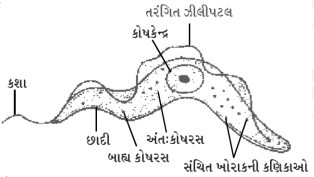
Solution
(N/A) The observable features in Trypanosoma that justify its classification under Kingdom Protista are:
$(i)$ It is a unicellular eukaryotic organism.
$(ii)$ It possesses a well-defined nucleus enclosed by a nuclear membrane.
$(iii)$ It contains membrane-bound organelles.
$(iv)$ It exhibits locomotion through a flagellum,which is a characteristic feature of many protists.
$(v)$ It stores food material in the form of granules within the cytoplasm.
$(i)$ It is a unicellular eukaryotic organism.
$(ii)$ It possesses a well-defined nucleus enclosed by a nuclear membrane.
$(iii)$ It contains membrane-bound organelles.
$(iv)$ It exhibits locomotion through a flagellum,which is a characteristic feature of many protists.
$(v)$ It stores food material in the form of granules within the cytoplasm.
0 likes
View Solution344
EasyMCQ
Select the correct option for the following statements:
$(i)$ The sea appears red or golden when red dinoflagellates multiply rapidly.
$(ii)$ $Euglena$ / $Slime$ $molds$ are saprophytic protists.
$(i)$ The sea appears red or golden when red dinoflagellates multiply rapidly.
$(ii)$ $Euglena$ / $Slime$ $molds$ are saprophytic protists.
A
$(i)$ Red,$(ii)$ $Euglena$
B
$(i)$ Red,$(ii)$ $Slime$ $molds$
C
$(i)$ Golden,$(ii)$ $Euglena$
D
$(i)$ Golden,$(ii)$ $Slime$ $molds$
Solution
(B) $(i)$ Red dinoflagellates (e.g.,$Gonyaulax$) undergo rapid multiplication,making the sea appear red. This phenomenon is known as red tides.
$(ii)$ $Slime$ $molds$ are saprophytic protists. They feed on decaying twigs and leaves by engulfing organic material. $Euglena$ is a mixotrophic protist (photosynthetic in the presence of light and heterotrophic in the absence of light).
$(ii)$ $Slime$ $molds$ are saprophytic protists. They feed on decaying twigs and leaves by engulfing organic material. $Euglena$ is a mixotrophic protist (photosynthetic in the presence of light and heterotrophic in the absence of light).
0 likes
View Solution345
EasyMCQ
Select the correct option for the following statements:
$(i)$ All protozoans are heterotrophs and live as predators or parasites.
$(ii)$ $Trypanosoma$ causes sleeping sickness.
$(i)$ All protozoans are heterotrophs and live as predators or parasites.
$(ii)$ $Trypanosoma$ causes sleeping sickness.
A
$(i)$ True,$(ii)$ True
B
$(i)$ True,$(ii)$ False
C
$(i)$ False,$(ii)$ True
D
$(i)$ False,$(ii)$ False
Solution
(A) $(i)$ All protozoans are heterotrophs and live as predators or parasites. This statement is correct.
$(ii)$ $Trypanosoma$ is a flagellated protozoan that causes sleeping sickness. This statement is correct.
Therefore,both statements are true.
$(ii)$ $Trypanosoma$ is a flagellated protozoan that causes sleeping sickness. This statement is correct.
Therefore,both statements are true.
0 likes
View Solution346
Medium
Explain the characteristic features of the group Chrysophytes and provide examples.
Solution
(N/A) $\rightarrow$ This group includes diatoms and golden algae (desmids).
$\rightarrow$ Habitat: They are microscopic and float passively in water currents (plankton).
$\rightarrow$ Mode of nutrition: Most of them are photosynthetic.
$\rightarrow$ Body organization: In diatoms, the cell wall forms two thin overlapping shells, which fit together like a soap box.
$\rightarrow$ The walls are embedded with silica, making them indestructible.
$\rightarrow$ Diatoms have left behind large amounts of cell wall deposits in their habitat; this accumulation over billions of years is referred to as "diatomaceous earth".
$\rightarrow$ Function: Being gritty, this soil is used in polishing and the filtration of oils and syrups.
$\rightarrow$ Diatoms are the chief 'producers' in the oceans.
$\rightarrow$ Habitat: They are microscopic and float passively in water currents (plankton).
$\rightarrow$ Mode of nutrition: Most of them are photosynthetic.
$\rightarrow$ Body organization: In diatoms, the cell wall forms two thin overlapping shells, which fit together like a soap box.
$\rightarrow$ The walls are embedded with silica, making them indestructible.
$\rightarrow$ Diatoms have left behind large amounts of cell wall deposits in their habitat; this accumulation over billions of years is referred to as "diatomaceous earth".
$\rightarrow$ Function: Being gritty, this soil is used in polishing and the filtration of oils and syrups.
$\rightarrow$ Diatoms are the chief 'producers' in the oceans.
0 likes
View SolutionBiological Classification — Protista (Unicellular eukaryotes) · Frequently Asked Questions
1Are these Biological Classification questions useful for JEE and NEET?
Yes. All questions in this section are mapped to JEE Main and NEET exam patterns. Previous year questions from JEE Main, NEET, GUJCET and state-level exams are included with full solutions.
2Can I switch to Hindi or Gujarati for these questions?
Yes. Use the language tabs in the hero section or the sidebar to view the same questions and solutions in English, Hindi or Gujarati.
3How do I generate a question paper from this subtopic?
Use the Vedclass Exam Paper Generator — select the chapter and subtopic, set difficulty, and generate Sets A, B, C, D automatically. First 3 chapters of every subject are free.
Vedclass Products
For Students
Vedclass Test Series
Mock tests in real JEE/NEET style with performance analysis. 5-day free trial.
Start Free TrialFor Teachers
Exam Paper Generator
Generate Set A/B/C/D papers from this chapter in 2 minutes. 3 chapters free.
Try FreeFor Institutes
Online Exam Module
Live online exams with unlimited students, 360° analytics & white-label branding.
See DemoFor Teachers & Institutes
Generate a Biological Classification Exam Paper in 2 Minutes
Select subtopic & difficulty — Sets A, B, C, D auto-generated with No Repeat logic.
First 3 chapters of every subject are free — no payment required.