
A English
Protista (Unicellular eukaryotes) Questions in English
Class 11 Biology · Biological Classification · Protista (Unicellular eukaryotes)
434+
Questions
English
Language
100%
With Solutions
Showing 50 of 434 questions in English
251
EasyMCQ
Which of the following organisms possesses cilia?
A
Paramecium
B
Euglena
C
Amoeba
D
Opalina
Solution
(A) Cilia are hair-like outgrowths of the cell membrane.
$Paramecium$ is a ciliated protozoan that uses cilia for locomotion and to steer food into its gullet.
$Euglena$ moves using flagella.
$Amoeba$ moves using pseudopodia.
$Opalina$ is a ciliate,but $Paramecium$ is the most classic textbook example of a ciliated organism.
$Paramecium$ is a ciliated protozoan that uses cilia for locomotion and to steer food into its gullet.
$Euglena$ moves using flagella.
$Amoeba$ moves using pseudopodia.
$Opalina$ is a ciliate,but $Paramecium$ is the most classic textbook example of a ciliated organism.
0 likes
View Solution252
MediumMCQ
Which of the following is an example of a unicellular organism?
A
Paramecium
B
Yeast
C
Chlamydomonas
D
Bacteria
Solution
(A) unicellular organism is an organism that consists of a single cell.
$A$. $Paramecium$ is a unicellular eukaryotic organism belonging to the kingdom $Protista$.
$B$. $Yeast$ is a unicellular fungus.
$C$. $Chlamydomonas$ is a unicellular green alga.
$D$. $Bacteria$ are unicellular prokaryotic organisms.
Since all the given options represent unicellular organisms,in the context of biological classification and typical textbook questions,$Paramecium$ is the classic example of a unicellular protist.
$A$. $Paramecium$ is a unicellular eukaryotic organism belonging to the kingdom $Protista$.
$B$. $Yeast$ is a unicellular fungus.
$C$. $Chlamydomonas$ is a unicellular green alga.
$D$. $Bacteria$ are unicellular prokaryotic organisms.
Since all the given options represent unicellular organisms,in the context of biological classification and typical textbook questions,$Paramecium$ is the classic example of a unicellular protist.
0 likes
View Solution253
MediumMCQ
Which of the following organisms possesses two nuclei?
A
Amoeba
B
Paramecium
C
Euglena
D
White blood cells
Solution
(B) $Paramecium$ is a ciliated protozoan that exhibits nuclear dimorphism.
It contains two types of nuclei: a large,kidney-shaped macronucleus,which controls metabolic activities,and a small,spherical micronucleus,which is involved in reproduction.
Therefore,$Paramecium$ is the correct answer.
It contains two types of nuclei: a large,kidney-shaped macronucleus,which controls metabolic activities,and a small,spherical micronucleus,which is involved in reproduction.
Therefore,$Paramecium$ is the correct answer.
0 likes
View Solution254
MediumMCQ
Which life forms are observed in Protista?
A
Non-motile plants
B
Motile animals
C
Non-motile plants and motile animals
D
Motile plants and non-motile animals
Solution
(D) The kingdom $Protista$ includes a diverse group of eukaryotic organisms. These organisms exhibit a wide range of life forms,including those that resemble plants (like algae,which are often motile) and those that resemble animals (like protozoans,which are also often motile). However,in the context of biological classification,$Protista$ is characterized by having both plant-like (photosynthetic) and animal-like (heterotrophic) members,many of which possess structures for motility such as cilia,flagella,or pseudopodia. Therefore,the most accurate description of the diversity within $Protista$ is the presence of both motile plant-like and animal-like forms.
0 likes
View Solution255
MediumMCQ
Dinoflagellates are...
A
Microorganisms included in Kingdom Monera.
B
Prokaryotic autotrophs.
C
Eukaryotic protists.
D
Eukaryotic fungi.
Solution
(C) Dinoflagellates are unicellular,eukaryotic organisms that belong to the Kingdom Protista. They are mostly marine and photosynthetic,possessing two flagella,which is why they are called 'dinoflagellates' (dino = whirling). They are not Monerans (which are prokaryotic) nor Fungi (which are heterotrophic and have cell walls made of chitin).
0 likes
View Solution256
MediumMCQ
Which kingdom includes both unicellular and multicellular eukaryotic organisms?
A
Monera
B
Fungi
C
Protista
D
Metazoa
Solution
(C) The kingdom $Protista$ includes primarily aquatic, eukaryotic organisms. While most members are unicellular, some forms like certain algae are multicellular. Kingdom $Monera$ consists of prokaryotes. Kingdom $Fungi$ is primarily multicellular (except for yeast). Kingdom $Metazoa$ (Animalia) is multicellular. Therefore, $Protista$ is the correct answer as it encompasses both unicellular and multicellular eukaryotic forms.
0 likes
View Solution257
EasyMCQ
Which kingdom consists of organisms that are simple,predominantly aquatic,and unicellular eukaryotes?
A
Monera
B
Protista
C
Fungi
D
Plantae
Solution
(B) The kingdom $Protista$ includes all single-celled eukaryotes. These organisms are primarily aquatic and represent a link with other organisms dealing with plants,animals,and fungi. They are simple in structure compared to multicellular eukaryotes.
0 likes
View Solution258
EasyMCQ
Which of the following kingdoms includes $Euglena$ and $Dinoflagellates$?
A
Animalia
B
Fungi
C
Protista
D
Plantae
Solution
(C) According to the $Whittaker's$ five-kingdom classification system,$Euglena$ (a euglenoid) and $Dinoflagellates$ (a group of photosynthetic protists) are classified under the kingdom $Protista$.
$Protista$ includes all unicellular eukaryotic organisms.
Therefore,the correct option is $C$.
$Protista$ includes all unicellular eukaryotic organisms.
Therefore,the correct option is $C$.
0 likes
View Solution259
EasyMCQ
In which of the following kingdoms is the plant body differentiated into holdfast,stipe,and frond?
A
Fungi
B
Plantae
C
Protista
D
Monera
Solution
(C) The plant body is differentiated into holdfast,stipe,and frond in certain algae,specifically brown algae (Phaeophyceae).
These organisms belong to the Kingdom $Protista$ in the $Whittaker$ five-kingdom classification system,as algae are classified under $Protista$ (specifically photosynthetic protists).
$Holdfast$ attaches the plant to the substratum,$stipe$ acts as a stalk,and $frond$ is the leaf-like photosynthetic organ.
These organisms belong to the Kingdom $Protista$ in the $Whittaker$ five-kingdom classification system,as algae are classified under $Protista$ (specifically photosynthetic protists).
$Holdfast$ attaches the plant to the substratum,$stipe$ acts as a stalk,and $frond$ is the leaf-like photosynthetic organ.
0 likes
View Solution260
EasyMCQ
Which of the following are included in the Kingdom $Protista$?
A
Unicellular protozoans and primary aquatic organisms
B
Bacteria and cyanobacteria
C
Unicellular and multicellular fungi
D
All of the above
Solution
(A) The Kingdom $Protista$ includes all single-celled eukaryotes.
These organisms are primarily aquatic.
They form a link with others dealing with plants,animals,and fungi.
$A$ is correct because $Protista$ includes chrysophytes,dinoflagellates,euglenoids,slime moulds,and protozoans,which are unicellular eukaryotes and mostly aquatic.
$B$ is incorrect because bacteria and cyanobacteria belong to Kingdom $Monera$.
$C$ is incorrect because fungi belong to Kingdom $Fungi$.
These organisms are primarily aquatic.
They form a link with others dealing with plants,animals,and fungi.
$A$ is correct because $Protista$ includes chrysophytes,dinoflagellates,euglenoids,slime moulds,and protozoans,which are unicellular eukaryotes and mostly aquatic.
$B$ is incorrect because bacteria and cyanobacteria belong to Kingdom $Monera$.
$C$ is incorrect because fungi belong to Kingdom $Fungi$.
0 likes
View Solution261
EasyMCQ
Which of the following kingdoms does $Paramecium$ belong to?
A
Monera
B
Protista
C
Fungi
D
Metaphyta
Solution
(B) $Paramecium$ is a unicellular eukaryotic organism. According to the five-kingdom classification system proposed by $R.H. Whittaker$,all unicellular eukaryotic organisms are placed in the kingdom $Protista$. Therefore,$Paramecium$ belongs to the kingdom $Protista$.
0 likes
View Solution262
EasyMCQ
Which kingdom includes unicellular protozoans and primary aquatic eukaryotes?
A
Monera
B
Protista
C
Fungi
D
Metaphyta
Solution
(B) The kingdom $Protista$ includes all single-celled eukaryotes.
These organisms are primarily aquatic and form a link with other eukaryotes like plants, animals, and fungi.
This group includes chrysophytes, dinoflagellates, euglenoids, slime moulds, and protozoans.
These organisms are primarily aquatic and form a link with other eukaryotes like plants, animals, and fungi.
This group includes chrysophytes, dinoflagellates, euglenoids, slime moulds, and protozoans.
0 likes
View Solution263
EasyMCQ
Which of the following organisms is included in the kingdom $Protista$?
A
Blue-green algae
B
Slime molds
C
Dinoflagellates
D
Mushrooms
Solution
(C) According to the $Whittaker$ classification system,the kingdom $Protista$ includes all single-celled eukaryotes.
$Slime$ $molds$ and $Dinoflagellates$ are both members of the kingdom $Protista$.
However,in the context of multiple-choice questions where one must identify the most appropriate group,$Dinoflagellates$ and $Slime$ $molds$ are both $Protists$.
Given the standard options,$Dinoflagellates$ $(C)$ and $Slime$ $molds$ $(B)$ are both correct.
Assuming this is a single-choice question,$Dinoflagellates$ are a primary group of photosynthetic $Protists$.
Blue-green algae are $Monerans$ (Cyanobacteria),and Mushrooms are $Fungi$.
$Slime$ $molds$ and $Dinoflagellates$ are both members of the kingdom $Protista$.
However,in the context of multiple-choice questions where one must identify the most appropriate group,$Dinoflagellates$ and $Slime$ $molds$ are both $Protists$.
Given the standard options,$Dinoflagellates$ $(C)$ and $Slime$ $molds$ $(B)$ are both correct.
Assuming this is a single-choice question,$Dinoflagellates$ are a primary group of photosynthetic $Protists$.
Blue-green algae are $Monerans$ (Cyanobacteria),and Mushrooms are $Fungi$.
0 likes
View Solution264
EasyMCQ
To which of the following kingdoms does $Paramecium$ belong?
A
Monera
B
Protista
C
Fungi
D
Metaphyta
Solution
(B) $Paramecium$ is a unicellular eukaryotic organism.
According to the $Whittaker's$ five-kingdom classification system,all unicellular eukaryotic organisms are placed under the kingdom $Protista$.
$Paramecium$ is a ciliated protozoan,which is a group within the kingdom $Protista$.
According to the $Whittaker's$ five-kingdom classification system,all unicellular eukaryotic organisms are placed under the kingdom $Protista$.
$Paramecium$ is a ciliated protozoan,which is a group within the kingdom $Protista$.
0 likes
View Solution265
MediumMCQ
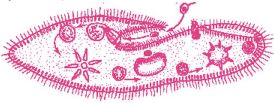
The organism shown in the figure is .........
A
contains nucleoprotein.
B
lacks membrane-bound organelles.
C
has a well-organized nucleus and membrane-bound organelles.
D
is a cyanobacteria.
Solution
(C) The organism shown in the figure is Paramecium,which belongs to the kingdom Protista.
As a protist,it is a eukaryotic organism.
Eukaryotic cells are characterized by the presence of a well-organized nucleus and membrane-bound organelles (such as mitochondria,contractile vacuoles,etc.).
Therefore,option $C$ is the correct statement.
As a protist,it is a eukaryotic organism.
Eukaryotic cells are characterized by the presence of a well-organized nucleus and membrane-bound organelles (such as mitochondria,contractile vacuoles,etc.).
Therefore,option $C$ is the correct statement.
0 likes
View Solution266
EasyMCQ
Which of the following organisms are simple,predominantly aquatic,unicellular,and eukaryotic?
A
Slime molds
B
Euglenoids
C
Protozoans
D
All of the above
Solution
(D) The kingdom $Protista$ includes all single-celled eukaryotes.
These organisms are primarily aquatic and form a link with other organisms dealing with plants,animals,and fungi.
$Slime$ $molds$,$Euglenoids$,and $Protozoans$ are all members of the kingdom $Protista$.
Therefore,they are all simple,predominantly aquatic,unicellular,and eukaryotic organisms.
These organisms are primarily aquatic and form a link with other organisms dealing with plants,animals,and fungi.
$Slime$ $molds$,$Euglenoids$,and $Protozoans$ are all members of the kingdom $Protista$.
Therefore,they are all simple,predominantly aquatic,unicellular,and eukaryotic organisms.
0 likes
View Solution267
EasyMCQ
Which of the following statements is incorrect?
A
Fungi obtain nutrition through absorption.
B
Euglenoids are predominantly multicellular and eukaryotic organisms.
C
Conifers are multicellular organisms composed of eukaryotic cells.
D
Animals primarily obtain nutrition through ingestion.
Solution
(B) The incorrect statement is that Euglenoids are multicellular. In reality,Euglenoids (such as $Euglena$) are unicellular,eukaryotic protists. They possess a protein-rich layer called a pellicle instead of a cell wall. Fungi are heterotrophic and absorb nutrients from organic matter. Conifers are complex multicellular plants with eukaryotic cells. Animals are heterotrophic and typically ingest their food.
0 likes
View Solution268
EasyMCQ
These are simple,predominantly aquatic,unicellular,eukaryotic organisms.
A
Protista
B
Fungi
C
Plantae
D
Animalia
Solution
(A) The kingdom $Protista$ includes all single-celled eukaryotes. These organisms are primarily aquatic and represent a link with other eukaryotes like plants,animals,and fungi. They possess a defined nucleus and membrane-bound organelles.
0 likes
View Solution269
MediumMCQ
Which of the following belongs to the Kingdom Protista?
A
Algae
B
Bryophytes
C
Mosses
D
Yeast
Solution
(A) The Kingdom Protista includes all single-celled eukaryotes.
Among the given options,Algae (specifically unicellular forms like Chlamydomonas) are classified under Protista in the five-kingdom classification system.
Bryophytes and Mosses belong to the Kingdom Plantae.
Yeast is a unicellular fungus belonging to the Kingdom Fungi.
Among the given options,Algae (specifically unicellular forms like Chlamydomonas) are classified under Protista in the five-kingdom classification system.
Bryophytes and Mosses belong to the Kingdom Plantae.
Yeast is a unicellular fungus belonging to the Kingdom Fungi.
0 likes
View Solution270
MediumMCQ
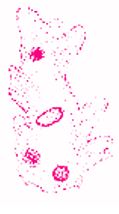
The organism shown in the figure:
A
contains nucleoprotein.
B
lacks membrane-bound organelles.
C
has a well-defined nucleus and membrane-bound organelles.
D
is a cyanobacterium.
Solution
(C) The figure shows an organism with a well-defined nucleus and distinct organelles,which is characteristic of a eukaryotic cell (specifically,it resembles an amoeboid protozoan).
Eukaryotic cells are defined by the presence of a well-defined nucleus enclosed by a nuclear membrane and various membrane-bound organelles such as mitochondria,endoplasmic reticulum,and Golgi apparatus.
Option $C$ is correct because it accurately describes the eukaryotic nature of the organism shown.
Eukaryotic cells are defined by the presence of a well-defined nucleus enclosed by a nuclear membrane and various membrane-bound organelles such as mitochondria,endoplasmic reticulum,and Golgi apparatus.
Option $C$ is correct because it accurately describes the eukaryotic nature of the organism shown.
0 likes
View Solution271
MediumMCQ
Statement $X$: Presence of a rigid cell wall and nucleoprotein as genetic material.
Statement $Y$: Examples include $Euglena$,$Dinoflagellates$,$Amoeba$,and $Paramecium$.
Statement $Y$: Examples include $Euglena$,$Dinoflagellates$,$Amoeba$,and $Paramecium$.
A
Statement $X$ is true and Statement $Y$ is false.
B
Statement $X$ is false and Statement $Y$ is true.
C
Both Statement $X$ and $Y$ are true,and $Y$ is the correct explanation of $X$.
D
Both Statement $X$ and $Y$ are true,and $Y$ is not the correct explanation of $X$.
Solution
(B) Statement $X$ is false because the description provided (rigid cell wall and nucleoprotein as genetic material) is characteristic of viruses or specific prokaryotic structures,not a general group of organisms like Protista.
Statement $Y$ is true as $Euglena$,$Dinoflagellates$,$Amoeba$,and $Paramecium$ are all members of the Kingdom $Protista$.
Since Statement $X$ is scientifically inaccurate in the context of the provided examples,the correct choice is that Statement $X$ is false and Statement $Y$ is true.
Statement $Y$ is true as $Euglena$,$Dinoflagellates$,$Amoeba$,and $Paramecium$ are all members of the Kingdom $Protista$.
Since Statement $X$ is scientifically inaccurate in the context of the provided examples,the correct choice is that Statement $X$ is false and Statement $Y$ is true.
0 likes
View Solution272
MediumMCQ
Which of the following is an incorrect pair?
A
Bacteria - Possess a rigid cell wall
B
Slime molds - Formation of embryos occurs
C
Theophrastus - Father of Botany
D
Moss - Cell wall is made of cellulose
Solution
(B) The correct answer is $B$.
Slime molds are saprophytic protists. They do not form embryos; embryo formation is a characteristic feature of plants (Kingdom Plantae).
Bacteria possess a rigid cell wall made of peptidoglycan.
Theophrastus is known as the 'Father of Botany' for his early classification of plants.
Mosses belong to the Kingdom Plantae,and their cell walls are composed of cellulose.
Slime molds are saprophytic protists. They do not form embryos; embryo formation is a characteristic feature of plants (Kingdom Plantae).
Bacteria possess a rigid cell wall made of peptidoglycan.
Theophrastus is known as the 'Father of Botany' for his early classification of plants.
Mosses belong to the Kingdom Plantae,and their cell walls are composed of cellulose.
0 likes
View Solution273
EasyMCQ
Assertion $(A)$: Bacteria and Anabaena algae contain nucleoprotein as their genetic material.
Reason $(R)$: Euglena possesses a well-organized nucleus.
Reason $(R)$: Euglena possesses a well-organized nucleus.
A
$A$ and $R$ are both true,and $R$ is the correct explanation of $A$.
B
$A$ and $R$ are both true,but $R$ is not the correct explanation of $A$.
C
$A$ is true,but $R$ is false.
D
$A$ is false,but $R$ is true.
Solution
(D) Assertion $(A)$ is false because bacteria and Anabaena (cyanobacteria) are prokaryotes. They do not have a membrane-bound nucleus,and their genetic material is not a 'nucleoprotein' in the sense of eukaryotic chromatin; rather,they have a naked circular $DNA$ called a nucleoid.
Reason $(R)$ is true because Euglena is a protist (eukaryote) and possesses a well-defined,membrane-bound nucleus.
Therefore,the correct option is $D$.
Reason $(R)$ is true because Euglena is a protist (eukaryote) and possesses a well-defined,membrane-bound nucleus.
Therefore,the correct option is $D$.
0 likes
View Solution274
MediumMCQ
In which forms are Protista visible?
A
Non-motile plants
B
Non-motile animals
C
Motile animals
D
Both $(A)$ and $(C)$
Solution
(D) Protists are a diverse group of eukaryotic organisms. They exhibit various modes of nutrition and locomotion. Many protists are motile,using structures like cilia,flagella,or pseudopodia for movement (often referred to as protozoans or animal-like protists). Some protists are non-motile and photosynthetic,resembling plants (e.g.,certain algae). Therefore,Protista includes both non-motile plant-like forms and motile animal-like forms.
0 likes
View Solution275
MediumMCQ
In which form are Protista $NOT$ observed?
A
Motile animals
B
Non-motile plants
C
Non-motile animals
D
None of these
Solution
(D) Protista is a diverse group of eukaryotic organisms. They exhibit various forms of nutrition and locomotion.
$1$. Protists can be motile (using cilia,flagella,or pseudopodia) or non-motile.
$2$. They can resemble animals (protozoans),plants (algae),or fungi (slime molds).
$3$. Since Protista includes a wide variety of organisms that can be motile or non-motile and can exhibit characteristics of animals,plants,or fungi,they are observed in all the mentioned forms.
Therefore,the correct answer is $D$ (None of these).
$1$. Protists can be motile (using cilia,flagella,or pseudopodia) or non-motile.
$2$. They can resemble animals (protozoans),plants (algae),or fungi (slime molds).
$3$. Since Protista includes a wide variety of organisms that can be motile or non-motile and can exhibit characteristics of animals,plants,or fungi,they are observed in all the mentioned forms.
Therefore,the correct answer is $D$ (None of these).
0 likes
View Solution276
EasyMCQ
Which of the following is true for aquatic eukaryotic organisms?
A
They possess an organized nucleus.
B
They possess a nuclear membrane.
C
They possess membrane-bound organelles.
D
All of the above $(A), (B),$ and $(C)$.
Solution
(D) Eukaryotic organisms are defined by the presence of a well-organized nucleus enclosed within a nuclear membrane.
They also contain membrane-bound organelles such as mitochondria,endoplasmic reticulum,Golgi apparatus,etc.
Since aquatic eukaryotes (like algae,protozoans,etc.) are true eukaryotes,they exhibit all these characteristics.
Therefore,options $(A), (B),$ and $(C)$ are all correct.
They also contain membrane-bound organelles such as mitochondria,endoplasmic reticulum,Golgi apparatus,etc.
Since aquatic eukaryotes (like algae,protozoans,etc.) are true eukaryotes,they exhibit all these characteristics.
Therefore,options $(A), (B),$ and $(C)$ are all correct.
0 likes
View Solution277
MediumMCQ
Which of the following groups is considered to have evolved from Protista?
A
Viruses
B
Bacteria
C
Plants
D
Animals
Solution
(C, D) According to the evolutionary theory of biological classification,the kingdom $Protista$ acts as a connecting link between prokaryotes and complex multicellular eukaryotes. It is widely accepted that multicellular organisms such as plants,animals,and fungi have evolved from different groups of protists. Therefore,among the given options,plants,animals,and fungi (not listed) are considered to have evolved from Protista.
0 likes
View Solution278
MediumMCQ
Mobile animal forms are derived from which of the following?
A
Plants
B
Protista
C
Thallophyta
D
Algae
Solution
(B) The kingdom $Protista$ includes diverse eukaryotic organisms. It is considered a link between plants,animals,and fungi. Many mobile animal-like organisms,such as protozoans,are believed to have evolved from ancestral protists. Therefore,mobile animal forms are derived from $Protista$.
0 likes
View Solution279
EasyMCQ
In which kingdom did Whittaker place the dinoflagellates?
A
Monera
B
Cyanobacteria
C
Protista
D
Fungi
Solution
(C) $R$.$H$. Whittaker proposed the five-kingdom classification system in $1969$.
According to this system,the five kingdoms are Monera,Protista,Fungi,Plantae,and Animalia.
Dinoflagellates are unicellular,eukaryotic,photosynthetic organisms.
Since they are eukaryotic and unicellular,they are placed under the kingdom Protista.
According to this system,the five kingdoms are Monera,Protista,Fungi,Plantae,and Animalia.
Dinoflagellates are unicellular,eukaryotic,photosynthetic organisms.
Since they are eukaryotic and unicellular,they are placed under the kingdom Protista.
0 likes
View Solution280
MediumMCQ
Which kingdom obtains nutrition through photosynthesis and absorption?
A
Plantae
B
Protista
C
Fungi
D
Animalia
Solution
(B) The kingdom $Protista$ is a diverse group of eukaryotic organisms. Members of this kingdom exhibit various modes of nutrition. Some protists,like algae,are photosynthetic (autotrophic),while others,like slime molds,obtain nutrients through absorption (saprophytic). Therefore,the kingdom that includes organisms capable of both photosynthesis and absorption is $Protista$.
0 likes
View Solution281
MediumMCQ
Select the wrong statement.
A
The walls of diatoms are easily destructible.
B
'Diatomaceous earth' is formed by the cell walls of diatoms.
C
Diatoms are chief producers in the oceans.
D
Diatoms are microscopic and float passively in water.
Solution
(A) : The cell walls of diatoms are composed of silica,which makes them indestructible and resistant to decay.
Because of this,they accumulate over billions of years to form 'diatomaceous earth'.
Therefore,the statement that the walls of diatoms are easily destructible is incorrect.
Because of this,they accumulate over billions of years to form 'diatomaceous earth'.
Therefore,the statement that the walls of diatoms are easily destructible is incorrect.
0 likes
View Solution282
MediumMCQ
Chrysophytes,Euglenoids,Dinoflagellates and Slime moulds are included in the Kingdom
A
Fungi
B
Animalia
C
Monera
D
Protista
Solution
(D) The correct answer is $D$.
Kingdom $Protista$ includes all unicellular eukaryotic organisms.
This group consists of photosynthetic protists such as chrysophytes,dinoflagellates,and euglenoids,as well as saprophytic protists like slime moulds and various protozoan protists.
Kingdom $Protista$ includes all unicellular eukaryotic organisms.
This group consists of photosynthetic protists such as chrysophytes,dinoflagellates,and euglenoids,as well as saprophytic protists like slime moulds and various protozoan protists.
0 likes
View Solution283
MediumMCQ
In which group of organisms do the cell walls form two thin overlapping shells that fit together?
A
Dinoflagellates
B
Slime moulds
C
Chrysophytes
D
Euglenoids
Solution
(C) The correct answer is $C$. Chrysophytes include diatoms and golden algae (desmids).
In diatoms,the cell walls form two thin overlapping shells,which fit together as in a soap box.
The walls are embedded with silica and thus the walls are indestructible.
The two shells are known as the epitheca (upper) and the hypotheca (lower).
In diatoms,the cell walls form two thin overlapping shells,which fit together as in a soap box.
The walls are embedded with silica and thus the walls are indestructible.
The two shells are known as the epitheca (upper) and the hypotheca (lower).
0 likes
View Solution284
MediumMCQ
In the five kingdom classification,Chlamydomonas and Chlorella have been included in
A
Protista
B
Algae
C
Plantae
D
Monera
Solution
(A) $(A) :$ In order to develop phylogenetic classification,$R.H. Whittaker$ $(1969)$,an American taxonomist,divided all organisms into five kingdoms based on five criteria:
$(i)$ Complexity of cell structure (prokaryotic and eukaryotic).
$(ii)$ Complexity of body structure (unicellular and multicellular).
$(iii)$ Mode of nutrition.
$(iv)$ Ecological lifestyle (producers,decomposers,and consumers).
$(v)$ Phylogenetic relationship.
All prokaryotic organisms were grouped under Kingdom $Monera$,and all unicellular eukaryotic organisms were placed in Kingdom $Protista$. Kingdom $Protista$ brought together $Chlamydomonas$ and $Chlorella$ (which were earlier placed in $Algae$ within $Plantae$ due to the presence of cell walls) along with $Paramecium$ and $Amoeba$ (which were earlier placed in $Animalia$ due to the absence of cell walls). This reclassification occurred because the criteria for classification changed.
$(i)$ Complexity of cell structure (prokaryotic and eukaryotic).
$(ii)$ Complexity of body structure (unicellular and multicellular).
$(iii)$ Mode of nutrition.
$(iv)$ Ecological lifestyle (producers,decomposers,and consumers).
$(v)$ Phylogenetic relationship.
All prokaryotic organisms were grouped under Kingdom $Monera$,and all unicellular eukaryotic organisms were placed in Kingdom $Protista$. Kingdom $Protista$ brought together $Chlamydomonas$ and $Chlorella$ (which were earlier placed in $Algae$ within $Plantae$ due to the presence of cell walls) along with $Paramecium$ and $Amoeba$ (which were earlier placed in $Animalia$ due to the absence of cell walls). This reclassification occurred because the criteria for classification changed.
0 likes
View Solution285
MediumMCQ
Single-celled eukaryotes are included in
A
Protista
B
Fungi
C
Archaea
D
Monera
Solution
(A) : Protista includes all unicellular and colonial eukaryotes. The protistan cells are typically eukaryotic,possessing membrane-bound organelles like mitochondria,chloroplasts,Golgi bodies,endoplasmic reticulum,and a nucleus.
Protista is commonly known as the kingdom of unicellular eukaryotes.
Kingdom Fungi contains achlorophyllous,spore-producing,heterotrophic,multicellular,or multinucleate eukaryotic organisms (unicellular yeasts are also included in Fungi because their sexual reproduction is similar to that of some fungi).
Monerans are basically unicellular prokaryotes.
Archaea (ancient bacteria) are also a type of monerans which live in extreme environments like high temperature,high salt content,and acidic $pH$.
Protista is commonly known as the kingdom of unicellular eukaryotes.
Kingdom Fungi contains achlorophyllous,spore-producing,heterotrophic,multicellular,or multinucleate eukaryotic organisms (unicellular yeasts are also included in Fungi because their sexual reproduction is similar to that of some fungi).
Monerans are basically unicellular prokaryotes.
Archaea (ancient bacteria) are also a type of monerans which live in extreme environments like high temperature,high salt content,and acidic $pH$.
0 likes
View Solution286
EasyMCQ
Which one of the following is a slime mould?
A
Physarum
B
Thiobacillus
C
Anabaena
D
Rhizopus
Solution
(A) : Slime moulds are peculiar protists that normally take the form of amoebae,but under certain conditions,they develop fruiting bodies that release spores,which are superficially similar to the sporangia of fungi.
The order $Physarales$ includes $Physarum$ species.
The fruiting bodies (sporangia) are characterized by the presence of an abundant amount of calcium salt.
The order comprises $142$ species which are placed under $12$ genera.
$Physarum$ $polycephalum$ is the best-known species.
The somatic phase is a multinucleate,diploid,holocarpic plasmodium,which is the product of syngamy.
The order $Physarales$ includes $Physarum$ species.
The fruiting bodies (sporangia) are characterized by the presence of an abundant amount of calcium salt.
The order comprises $142$ species which are placed under $12$ genera.
$Physarum$ $polycephalum$ is the best-known species.
The somatic phase is a multinucleate,diploid,holocarpic plasmodium,which is the product of syngamy.
0 likes
View Solution287
MediumMCQ
What is common among $Trypanosoma$,$Noctiluca$,$Monocystis$,and $Giardia$?
A
These are all parasites.
B
These are all unicellular protists.
C
They have flagella.
D
They produce spores.
Solution
(B) is the correct answer.
$Protista$ is the kingdom of unicellular eukaryotes.
The group includes heterotrophs,autotrophs,and some organisms that can vary their nutritional mode depending upon environmental conditions.
$Protists$ occur in freshwater,saltwater,soil,and as symbionts within other organisms.
$Trypanosoma$,$Noctiluca$,$Monocystis$,and $Giardia$ are all unicellular protists.
$Protista$ is the kingdom of unicellular eukaryotes.
The group includes heterotrophs,autotrophs,and some organisms that can vary their nutritional mode depending upon environmental conditions.
$Protists$ occur in freshwater,saltwater,soil,and as symbionts within other organisms.
$Trypanosoma$,$Noctiluca$,$Monocystis$,and $Giardia$ are all unicellular protists.
0 likes
View Solution288
MediumMCQ
In ...............,cilia help in the movement of food through the cytopharynx and in locomotion.
A
Amoeba
B
Paramoecium
C
Hydra
D
Plant
Solution
(B) The organism $Paramoecium$ is a ciliated protozoan.
It possesses thousands of cilia on its body surface.
These cilia perform two primary functions:
$1$. They facilitate locomotion by beating in a coordinated manner.
$2$. They create water currents that help in the movement of food into the cytopharynx (gullet).
It possesses thousands of cilia on its body surface.
These cilia perform two primary functions:
$1$. They facilitate locomotion by beating in a coordinated manner.
$2$. They create water currents that help in the movement of food into the cytopharynx (gullet).
0 likes
View Solution289
MediumMCQ
Pseudopodia in $Amoeba$ are formed by the streaming of
A
Stroma
B
Protoplasm
C
Cell membrane
D
Cell wall
Solution
(B) Pseudopodia (false feet) in $Amoeba$ are temporary extensions of the cell body.
These structures are formed due to the streaming or cytoplasmic streaming of the $Protoplasm$.
This movement involves the sol-gel transition of the cytoplasm,where the endoplasm flows into the pseudopodial extension,allowing the organism to move and capture food.
These structures are formed due to the streaming or cytoplasmic streaming of the $Protoplasm$.
This movement involves the sol-gel transition of the cytoplasm,where the endoplasm flows into the pseudopodial extension,allowing the organism to move and capture food.
0 likes
View Solution290
MediumMCQ
Which of the following are considered the primitive relatives of animals?
A
Euglenoids
B
Diatoms
C
Slime moulds
D
Protozoans
Solution
(D) Protozoans are considered the primitive relatives of animals because they are heterotrophic and live as predators or parasites. They are unicellular eukaryotes that lack a cell wall and exhibit animal-like characteristics,such as motility and ingestion of food.
0 likes
View Solution291
MediumMCQ
Trypanosoma is
A
Flagellated organism
B
Ciliated organism
C
Amoeboid protozoans
D
Sporozoan
Solution
(A) $Trypanosoma$ is a parasitic protozoan that belongs to the group of flagellated protozoans.
These organisms possess flagella for locomotion.
They are known to cause diseases such as sleeping sickness in humans.
These organisms possess flagella for locomotion.
They are known to cause diseases such as sleeping sickness in humans.
0 likes
View Solution292
MediumMCQ
They are responsible for sleeping sickness.
A
Entamoeba
B
Euglena
C
Trypanosoma
D
Paramecium
Solution
(C) Sleeping sickness (African trypanosomiasis) is a parasitic disease caused by protozoans of the genus $Trypanosoma$. Specifically, $Trypanosoma$ $brucei$ is the causative agent. These organisms are flagellated protists that live in the blood and tissues of the host and are transmitted by the tsetse fly.
0 likes
View Solution293
MediumMCQ
Which of the following is not a characteristic of dinoflagellates?
A
Mostly marine
B
Cell wall has stiff cellulose plates
C
They have two flagella
D
The walls are embedded with silica
Solution
(D) Dinoflagellates are mostly marine and photosynthetic organisms.
Their cell walls are characterized by the presence of stiff cellulose plates on the outer surface.
They typically possess two flagella: one lies longitudinally and the other transversely in a furrow between the wall plates.
The characteristic of having walls embedded with silica is a feature of diatoms (Chrysophytes),not dinoflagellates.
Therefore,option $D$ is not a characteristic of dinoflagellates.
Their cell walls are characterized by the presence of stiff cellulose plates on the outer surface.
They typically possess two flagella: one lies longitudinally and the other transversely in a furrow between the wall plates.
The characteristic of having walls embedded with silica is a feature of diatoms (Chrysophytes),not dinoflagellates.
Therefore,option $D$ is not a characteristic of dinoflagellates.
0 likes
View Solution294
MediumMCQ
Which group includes diverse organisms that have an infectious spore-like stage in their life cycle?
A
Ciliated protozoans
B
Sporozoans
C
Slime molds
D
Amoeboid protozoans
Solution
(B) The group of protozoans known as $Sporozoans$ includes diverse organisms that have an infectious spore-like stage in their life cycle.
$Plasmodium$ (malarial parasite) is the most well-known example of a sporozoan,which causes malaria in humans.
These organisms are endoparasites and lack locomotory organelles in their mature stage.
$Plasmodium$ (malarial parasite) is the most well-known example of a sporozoan,which causes malaria in humans.
These organisms are endoparasites and lack locomotory organelles in their mature stage.
0 likes
View Solution295
MediumMCQ
What are the similarities between Entamoeba and Plasmodium?
A
Both are bacteria
B
Both live in moist soil
C
Both are only decomposer organisms
D
Both are protozoans
Solution
(D) Entamoeba and Plasmodium both belong to the Kingdom Protista.
Specifically,they are classified as protozoans.
Entamoeba histolytica is an amoeboid protozoan,while Plasmodium is a sporozoan protozoan.
Both are unicellular eukaryotic organisms and are known to be pathogenic parasites in humans.
Specifically,they are classified as protozoans.
Entamoeba histolytica is an amoeboid protozoan,while Plasmodium is a sporozoan protozoan.
Both are unicellular eukaryotic organisms and are known to be pathogenic parasites in humans.
0 likes
View Solution296
MediumMCQ
Which of the following are the chief 'producers' in the oceans?
A
Amoeba
B
Pteridophytes
C
Diatoms
D
Gymnosperms
Solution
(C) Diatoms are microscopic,photosynthetic organisms belonging to the class $Chrysophyceae$ (Kingdom $Protista$).
They are found in both fresh water and marine environments.
In the oceans,diatoms are the chief producers,forming the base of the aquatic food chain.
They are often referred to as the 'jewels of the sea' due to their beautiful,silica-embedded cell walls.
They are found in both fresh water and marine environments.
In the oceans,diatoms are the chief producers,forming the base of the aquatic food chain.
They are often referred to as the 'jewels of the sea' due to their beautiful,silica-embedded cell walls.
0 likes
View Solution297
MediumMCQ
Plant-like nutrition is present in
A
Amoeba
B
Paramoecium
C
Euglena
D
Plasmodium
Solution
(C) $Euglena$ exhibits mixotrophic nutrition. In the presence of sunlight,it performs photosynthesis like plants due to the presence of chloroplasts (holophytic nutrition). In the absence of sunlight,it behaves like a heterotroph by feeding on organic matter (saprophytic or holozoic nutrition). Therefore,it is considered to have plant-like nutrition.
0 likes
View Solution298
MediumMCQ
Chrysophytes are
A
planktons
B
Fungi
C
bryophytes
D
Lichen
Solution
(A) Chrysophytes include diatoms and golden algae (desmids). They are found in fresh water as well as in marine environments. They are microscopic and float passively in water currents,which is why they are collectively referred to as planktons.
0 likes
View Solution299
MediumMCQ
Which of the following is a red dinoflagellate?
A
Euglena
B
Diatoms
C
Gonyaulax
D
Plasmodium
Solution
(C) Dinoflagellates are mostly marine and photosynthetic.
$Gonyaulax$ is a type of dinoflagellate that undergoes rapid multiplication,making the sea appear red,which is commonly known as 'red tides'.
Therefore,$Gonyaulax$ is the correct answer.
$Gonyaulax$ is a type of dinoflagellate that undergoes rapid multiplication,making the sea appear red,which is commonly known as 'red tides'.
Therefore,$Gonyaulax$ is the correct answer.
0 likes
View Solution300
MediumMCQ
What is correct for $Euglena$?
A
Shows saprophytic nutrition
B
Presence of proteinaceous pellicle
C
Mostly marine
D
Silica shells on their surface
Solution
(B) $Euglena$ is a member of the kingdom $Protista$ and belongs to the group $Euglenoids$.
$1$. $Euglena$ possesses a protein-rich layer called a $pellicle$ instead of a cell wall,which makes their body flexible.
$2$. They are primarily found in stagnant freshwater,not marine environments.
$3$. They exhibit mixotrophic nutrition (photosynthetic in the presence of sunlight and saprophytic/heterotrophic in the absence of sunlight),but the most distinct structural feature is the $pellicle$.
$4$. Silica shells are characteristic of $Chrysophytes$ (diatoms),not $Euglenoids$.
$1$. $Euglena$ possesses a protein-rich layer called a $pellicle$ instead of a cell wall,which makes their body flexible.
$2$. They are primarily found in stagnant freshwater,not marine environments.
$3$. They exhibit mixotrophic nutrition (photosynthetic in the presence of sunlight and saprophytic/heterotrophic in the absence of sunlight),but the most distinct structural feature is the $pellicle$.
$4$. Silica shells are characteristic of $Chrysophytes$ (diatoms),not $Euglenoids$.
0 likes
View SolutionBiological Classification — Protista (Unicellular eukaryotes) · Frequently Asked Questions
1Are these Biological Classification questions useful for JEE and NEET?
Yes. All questions in this section are mapped to JEE Main and NEET exam patterns. Previous year questions from JEE Main, NEET, GUJCET and state-level exams are included with full solutions.
2Can I switch to Hindi or Gujarati for these questions?
Yes. Use the language tabs in the hero section or the sidebar to view the same questions and solutions in English, Hindi or Gujarati.
3How do I generate a question paper from this subtopic?
Use the Vedclass Exam Paper Generator — select the chapter and subtopic, set difficulty, and generate Sets A, B, C, D automatically. First 3 chapters of every subject are free.
Vedclass Products
For Students
Vedclass Test Series
Mock tests in real JEE/NEET style with performance analysis. 5-day free trial.
Start Free TrialFor Teachers
Exam Paper Generator
Generate Set A/B/C/D papers from this chapter in 2 minutes. 3 chapters free.
Try FreeFor Institutes
Online Exam Module
Live online exams with unlimited students, 360° analytics & white-label branding.
See DemoFor Teachers & Institutes
Generate a Biological Classification Exam Paper in 2 Minutes
Select subtopic & difficulty — Sets A, B, C, D auto-generated with No Repeat logic.
First 3 chapters of every subject are free — no payment required.