
A English
Protista (Unicellular eukaryotes) Questions in English
Class 11 Biology · Biological Classification · Protista (Unicellular eukaryotes)
434+
Questions
English
Language
100%
With Solutions
Showing 50 of 434 questions in English
351
Medium
Write the characteristic features of the group Dinoflagellates.
Solution
(N/A) $\rightarrow$ Habitat: These organisms are mostly marine and photosynthetic.
$\rightarrow$ Body organization: They appear yellow,green,brown,blue,or red depending on the main pigments present in their cells.
$\rightarrow$ Cell wall: The cell wall has stiff cellulose plates on the outer surface.
$\rightarrow$ Flagella: Most of them have two flagella; one lies longitudinally and the other transversely in a furrow between the wall plates.
$\rightarrow$ Special features: Very often,red dinoflagellates (e.g.,$Gonyaulax$) undergo such rapid multiplication that they make the sea appear red (red tides). Toxins released by such large numbers may even kill other marine animals such as fishes.
$\rightarrow$ Reproduction: Dinoflagellates reproduce asexually through cell division or by the formation of zoospores and cysts.
$\rightarrow$ Reserve food: Reserve food is stored in the form of starch and oils. Examples include $Gonyaulax$,$Ceratium$,$Noctiluca$,$Peridinium$,and $Gymnodinium$.
$\rightarrow$ Body organization: They appear yellow,green,brown,blue,or red depending on the main pigments present in their cells.
$\rightarrow$ Cell wall: The cell wall has stiff cellulose plates on the outer surface.
$\rightarrow$ Flagella: Most of them have two flagella; one lies longitudinally and the other transversely in a furrow between the wall plates.
$\rightarrow$ Special features: Very often,red dinoflagellates (e.g.,$Gonyaulax$) undergo such rapid multiplication that they make the sea appear red (red tides). Toxins released by such large numbers may even kill other marine animals such as fishes.
$\rightarrow$ Reproduction: Dinoflagellates reproduce asexually through cell division or by the formation of zoospores and cysts.
$\rightarrow$ Reserve food: Reserve food is stored in the form of starch and oils. Examples include $Gonyaulax$,$Ceratium$,$Noctiluca$,$Peridinium$,and $Gymnodinium$.
0 likes
View Solution352
Medium
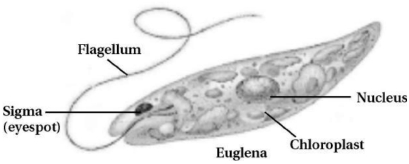
Write the general characteristics of Euglenoids.
Solution
(N/A) $\rightarrow$ Habitat: Majority of them are freshwater organisms found in stagnant water.
$\rightarrow$ Body organization: Instead of a cell wall,they have a protein-rich layer called pellicle,which makes their body flexible.
$\rightarrow$ Flagella: They have two flagella,one short and one long.
$\rightarrow$ Mode of nutrition: Nutrition is holophytic,saprobic,or holozoic. This mode of nutrition is called mixotrophic.
$\rightarrow$ Photosynthesis: Though they are photosynthetic in the presence of sunlight,when deprived of sunlight,they behave like heterotrophs by preying on other smaller organisms.
$\rightarrow$ Pigments: The pigments of euglenoids are identical to those present in higher plants,including chlorophyll '$a$' and '$b$'.
$\rightarrow$ Feeding: Prey such as bacteria and small flagellates are ingested through a cytostome,supported by microtubules.
$\rightarrow$ Reserve food: Reserve food is stored as carbohydrates in the form of paramylon or paramylum bodies.
$\rightarrow$ Reproduction: Euglenoids reproduce by longitudinal binary fission under favourable conditions.
$\rightarrow$ Unfavourable conditions: The palmella stage is found during unfavourable conditions.
$\rightarrow$ Examples: Euglena,Peranema,Eutreptia,Phacus,etc.
$\rightarrow$ Body organization: Instead of a cell wall,they have a protein-rich layer called pellicle,which makes their body flexible.
$\rightarrow$ Flagella: They have two flagella,one short and one long.
$\rightarrow$ Mode of nutrition: Nutrition is holophytic,saprobic,or holozoic. This mode of nutrition is called mixotrophic.
$\rightarrow$ Photosynthesis: Though they are photosynthetic in the presence of sunlight,when deprived of sunlight,they behave like heterotrophs by preying on other smaller organisms.
$\rightarrow$ Pigments: The pigments of euglenoids are identical to those present in higher plants,including chlorophyll '$a$' and '$b$'.
$\rightarrow$ Feeding: Prey such as bacteria and small flagellates are ingested through a cytostome,supported by microtubules.
$\rightarrow$ Reserve food: Reserve food is stored as carbohydrates in the form of paramylon or paramylum bodies.
$\rightarrow$ Reproduction: Euglenoids reproduce by longitudinal binary fission under favourable conditions.
$\rightarrow$ Unfavourable conditions: The palmella stage is found during unfavourable conditions.
$\rightarrow$ Examples: Euglena,Peranema,Eutreptia,Phacus,etc.
0 likes
View Solution353
Difficult
Write a short note on Slime Moulds.
Solution
(N/A) $\rightarrow$ Slime moulds are saprophytic protists.
$\rightarrow$ The body moves along decaying twigs and leaves,engulfing organic material.
$\rightarrow$ Under suitable conditions,they form an aggregation called $Plasmodium$ which may grow and spread over several feet.
$\rightarrow$ During unfavourable conditions,the $Plasmodium$ differentiates and forms fruiting bodies bearing spores at their tips.
$\rightarrow$ The spores possess true walls.
$\rightarrow$ They are extremely resistant and survive for many years even under adverse conditions.
$\rightarrow$ Body organization: The body of slime moulds is covered with mucilage having a gelatinous consistency; they do not have chlorophyll.
$\rightarrow$ They are surrounded by a plasma membrane. However,the spores have cellulosic cell walls.
$\rightarrow$ Special features: Anton De Bary related them to animals and called them $Mycetozoa$.
$\rightarrow$ These are also named as 'fungus animals' because they share common characters of both animals and fungi due to their protistian nature.
$\rightarrow$ They are like protozoa in their amoeboid plasmodial stage and similar to true fungi in spore formation. Acellular slime moulds ($Plasmodial$ slime moulds) are commonly found on dead and decaying plant matter.
$\rightarrow$ The cellular slime moulds occur in all humus-containing upper layers of damp soil.
$\rightarrow$ When the food supply is short or conditions are not favourable,the amoeboid cells form an aggregate without any fusion.
$\rightarrow$ This aggregated mass is called $pseudoplasmodium$.
$\rightarrow$ Examples of cellular slime moulds are $Dictyostelium$ and $Polysphondylium$.
$\rightarrow$ Economic importance: Slime moulds are beneficial as they cause the decomposition of organic matter in the soil.
$\rightarrow$ Examples: $Physarum$,$Stemonitis$,$Comatricha$,$Trichia$.
$\rightarrow$ The body moves along decaying twigs and leaves,engulfing organic material.
$\rightarrow$ Under suitable conditions,they form an aggregation called $Plasmodium$ which may grow and spread over several feet.
$\rightarrow$ During unfavourable conditions,the $Plasmodium$ differentiates and forms fruiting bodies bearing spores at their tips.
$\rightarrow$ The spores possess true walls.
$\rightarrow$ They are extremely resistant and survive for many years even under adverse conditions.
$\rightarrow$ Body organization: The body of slime moulds is covered with mucilage having a gelatinous consistency; they do not have chlorophyll.
$\rightarrow$ They are surrounded by a plasma membrane. However,the spores have cellulosic cell walls.
$\rightarrow$ Special features: Anton De Bary related them to animals and called them $Mycetozoa$.
$\rightarrow$ These are also named as 'fungus animals' because they share common characters of both animals and fungi due to their protistian nature.
$\rightarrow$ They are like protozoa in their amoeboid plasmodial stage and similar to true fungi in spore formation. Acellular slime moulds ($Plasmodial$ slime moulds) are commonly found on dead and decaying plant matter.
$\rightarrow$ The cellular slime moulds occur in all humus-containing upper layers of damp soil.
$\rightarrow$ When the food supply is short or conditions are not favourable,the amoeboid cells form an aggregate without any fusion.
$\rightarrow$ This aggregated mass is called $pseudoplasmodium$.
$\rightarrow$ Examples of cellular slime moulds are $Dictyostelium$ and $Polysphondylium$.
$\rightarrow$ Economic importance: Slime moulds are beneficial as they cause the decomposition of organic matter in the soil.
$\rightarrow$ Examples: $Physarum$,$Stemonitis$,$Comatricha$,$Trichia$.
0 likes
View Solution354
Medium
Explain the main features of protozoans and their groups.
Solution
(N/A) $\rightarrow$ All protozoans are heterotrophs and live as predators or parasites.
$\rightarrow$ They are believed to be primitive relatives of animals.
$\rightarrow$ They were first studied by Leeuwenhoek.
$\rightarrow$ They can cause several diseases in humans and animals.
$\rightarrow$ General characteristics of protozoans:
$\rightarrow$ They are microscopic,unicellular,and colourless organisms with diverse shapes.
$\rightarrow$ Locomotion occurs with the help of finger-like pseudopodia,flagella,or hair-like cilia.
$\rightarrow$ Respiration occurs through the general body surface.
$\rightarrow$ Reproduction occurs by binary fission,multiple fission,or budding.
$\rightarrow$ Sexual reproduction occurs by syngamy and conjugation.
$\rightarrow$ Amoeboid protozoans: These organisms live in freshwater,seawater,or moist soil. They move and capture prey by extending pseudopodia (false feet),as in Amoeba. Marine forms often have silica shells on their surface. Nutrition is holozoic. Some,such as Entamoeba,are parasites.
$\rightarrow$ Flagellated protozoans: Members are either free-living or parasitic. They possess flagella for locomotion. Nutrition is holozoic,saprobic,or parasitic. Examples include Trypanosoma (sleeping sickness) and Leishmania (kala-azar).
$\rightarrow$ Ciliated protozoans: These are aquatic,actively moving organisms due to the presence of thousands of cilia. They have a cavity (gullet) that opens to the outside of the cell surface. Examples include Paramecium.
$\rightarrow$ They are believed to be primitive relatives of animals.
$\rightarrow$ They were first studied by Leeuwenhoek.
$\rightarrow$ They can cause several diseases in humans and animals.
$\rightarrow$ General characteristics of protozoans:
$\rightarrow$ They are microscopic,unicellular,and colourless organisms with diverse shapes.
$\rightarrow$ Locomotion occurs with the help of finger-like pseudopodia,flagella,or hair-like cilia.
$\rightarrow$ Respiration occurs through the general body surface.
$\rightarrow$ Reproduction occurs by binary fission,multiple fission,or budding.
$\rightarrow$ Sexual reproduction occurs by syngamy and conjugation.
$\rightarrow$ Amoeboid protozoans: These organisms live in freshwater,seawater,or moist soil. They move and capture prey by extending pseudopodia (false feet),as in Amoeba. Marine forms often have silica shells on their surface. Nutrition is holozoic. Some,such as Entamoeba,are parasites.
$\rightarrow$ Flagellated protozoans: Members are either free-living or parasitic. They possess flagella for locomotion. Nutrition is holozoic,saprobic,or parasitic. Examples include Trypanosoma (sleeping sickness) and Leishmania (kala-azar).
$\rightarrow$ Ciliated protozoans: These are aquatic,actively moving organisms due to the presence of thousands of cilia. They have a cavity (gullet) that opens to the outside of the cell surface. Examples include Paramecium.
0 likes
View Solution355
EasyMCQ
What is common between Amoeba and Paramecium?
A
Both are unicellular organisms.
B
Both are protozoans.
C
Both organisms reproduce by binary fission.
D
All of the above.
Solution
(D) Amoeba and Paramecium are both unicellular eukaryotic organisms belonging to the kingdom Protista,specifically classified as protozoans. Both organisms primarily reproduce asexually through the process of binary fission,where a single cell divides into two identical daughter cells. Therefore,all the given statements are correct.
0 likes
View Solution356
MediumMCQ
Protozoans are not included in kingdom $Animalia$ because they are
A
mostly asymmetrical.
B
unicellular eukaryotes.
C
heterotrophic in nature.
D
multicellular prokaryotes.
Solution
(B) Protozoans are classified under the kingdom $Protista$ because they are unicellular eukaryotes.
Kingdom $Animalia$ consists of multicellular,eukaryotic organisms that lack cell walls.
Since protozoans are single-celled,they do not meet the criteria for being classified as animals.
They are heterotrophs and live as predators or parasites,and are divided into four major groups: $Zooflagellata$,$Sarcodina$,$Sporozoa$,and $Ciliata$.
Kingdom $Animalia$ consists of multicellular,eukaryotic organisms that lack cell walls.
Since protozoans are single-celled,they do not meet the criteria for being classified as animals.
They are heterotrophs and live as predators or parasites,and are divided into four major groups: $Zooflagellata$,$Sarcodina$,$Sporozoa$,and $Ciliata$.
0 likes
View Solution357
MediumMCQ
An $X$ reproduces in such great numbers that the water may appear red,producing red tides and killing large marine animals like $Z$. $X$ belongs to $Y$. Identify $X$,$Y$,and $Z$.
A
$X$-Gonyaulax; $Y$-Dinoflagellates; $Z$-Fishes
B
$X$-Paramecium; $Y$-Protozoa; $Z$-Crocodiles
C
$X$-Trypanosoma; $Y$-Protozoa; $Z$-Frogs
D
$X$-Plasmodium; $Y$-Euglenoids; $Z$-Oysters
Solution
(A) The organism $X$ is $Gonyaulax$,which is a type of dinoflagellate $(Y)$.
These organisms multiply rapidly in the ocean,causing a phenomenon known as 'red tides' due to their red pigments.
These blooms release toxins that can kill large marine animals,such as fishes $(Z)$.
These organisms multiply rapidly in the ocean,causing a phenomenon known as 'red tides' due to their red pigments.
These blooms release toxins that can kill large marine animals,such as fishes $(Z)$.
0 likes
View Solution358
MediumMCQ
Protists are
A
single-celled eukaryotes.
B
multicellular eukaryotes.
C
single-celled prokaryotes.
D
single-celled akaryote.
Solution
(A) Haeckel created the kingdom $Protista$ to include all unicellular eukaryotic micro-organisms.
They possess a typical eukaryotic structure with membrane-bound organelles and a well-defined nucleus.
They possess a typical eukaryotic structure with membrane-bound organelles and a well-defined nucleus.
0 likes
View Solution359
EasyMCQ
Which of the following processes are involved in the reproduction of protists?
A
Binary fission and budding
B
Cell fusion and zygote formation
C
Spore formation and cyst formation
D
All of the above
Solution
(D) In protists,reproduction occurs through both asexual and sexual methods.
Asexual reproduction includes processes such as binary fission (e.g.,$Euglena$),budding,and the formation of spores or cysts (e.g.,$Entamoeba$).
Sexual reproduction involves the fusion of cells (syngamy) and conjugation,leading to the formation of a zygote.
Therefore,all the mentioned processes are involved in the reproduction of protists.
Asexual reproduction includes processes such as binary fission (e.g.,$Euglena$),budding,and the formation of spores or cysts (e.g.,$Entamoeba$).
Sexual reproduction involves the fusion of cells (syngamy) and conjugation,leading to the formation of a zygote.
Therefore,all the mentioned processes are involved in the reproduction of protists.
0 likes
View Solution360
MediumMCQ
Which of the following pairs come under the group chrysophytes?
A
Diatoms and Euglena
B
Euglena and Trypanosoma
C
Diatoms and Desmids
D
Gonyaulax and Desmids
Solution
(C) Chrysophytes are a group of organisms that include diatoms and golden algae (desmids).
These are microscopic,photosynthetic protists.
Their cell walls are embedded with silica,forming two thin overlapping shells that fit together like a soap box.
These are microscopic,photosynthetic protists.
Their cell walls are embedded with silica,forming two thin overlapping shells that fit together like a soap box.
0 likes
View Solution361
MediumMCQ
Which of the following is an example of amoeboid protozoans?
A
Trypanosoma
B
Paramecium
C
Plasmodium
D
Entamoeba
Solution
(D) Amoeboid protozoans are organisms that live in fresh water,sea water,or moist soil.
They move and capture their prey by putting out pseudopodia (false feet),for example,$Amoeba$.
Some of them,such as $Entamoeba$,are parasites.
Therefore,$Entamoeba$ is an example of an amoeboid protozoan.
They move and capture their prey by putting out pseudopodia (false feet),for example,$Amoeba$.
Some of them,such as $Entamoeba$,are parasites.
Therefore,$Entamoeba$ is an example of an amoeboid protozoan.
0 likes
View Solution362
MediumMCQ
Match the type of protozoans given in column-$I$ with their examples given in column-$II$ and choose the correct option.
| Column-$I$ (Type of Protozoans) | Column-$II$ (Examples) |
| $A$. Amoeboid protozoans | $I$. Paramecium |
| $B$. Ciliated protozoans | $II$. Plasmodium |
| $C$. Flagellated protozoa | $III$. Amoeba |
| $D$. Sporozoans | $IV$. Trypanosoma |
A
$A-I, B-III, C-IV, D-II$
B
$A-III, B-I, C-II, D-IV$
C
$A-III, B-I, C-IV, D-II$
D
$A-III, B-IV, C-I, D-II$
Solution
(C) Protozoans are single-celled microscopic eukaryotic organisms that are classified based on their mode of locomotion:
$1$. Amoeboid protozoans: These move using pseudopodia, e.g., $Amoeba$ $(A-III)$.
$2$. Ciliated protozoans: These possess thousands of cilia for movement, e.g., $Paramecium$ $(B-I)$.
$3$. Flagellated protozoans: These possess flagella for movement, e.g., $Trypanosoma$ $(C-IV)$.
$4$. Sporozoans: These include organisms that have an infectious spore-like stage in their life cycle, e.g., $Plasmodium$ $(D-II)$.
Therefore, the correct matching is $A-III, B-I, C-IV, D-II$.
$1$. Amoeboid protozoans: These move using pseudopodia, e.g., $Amoeba$ $(A-III)$.
$2$. Ciliated protozoans: These possess thousands of cilia for movement, e.g., $Paramecium$ $(B-I)$.
$3$. Flagellated protozoans: These possess flagella for movement, e.g., $Trypanosoma$ $(C-IV)$.
$4$. Sporozoans: These include organisms that have an infectious spore-like stage in their life cycle, e.g., $Plasmodium$ $(D-II)$.
Therefore, the correct matching is $A-III, B-I, C-IV, D-II$.
0 likes
View Solution363
MediumMCQ
Which of the following groups of protozoan is not correctly matched with its feature?
A
Amoeboid - Marine forms that ingest or capture prey by false feet.
B
Flagellated - Either free living or parasitic.
C
Ciliated - Actively moving organisms due to presence of cilia.
D
Sporozoans - Move and capture their prey with the help of hooks & suckers.
Solution
(D) Sporozoans are characterized by having an infectious spore-like stage in their life cycle and they do not possess locomotor organelles like cilia or flagella in their mature stage. Hooks and suckers are specialized attachment structures typically found in parasitic helminths (worms),not in protozoan sporozoans. Therefore,option $D$ is incorrectly matched.
0 likes
View Solution364
MediumMCQ
Which of the following statements is a characteristic feature of chrysophytes?
A
They are parasitic forms which cause diseases in animals.
B
They have a protein rich layer called pellicle.
C
They have indestructible cell wall layer deposited with silica.
D
They are commonly called dinoflagellates.
Solution
(C) Chrysophytes belong to the kingdom $Protista$. Examples include diatoms and golden algae (desmids). $A$ key characteristic of chrysophytes is that their cell walls form two thin overlapping shells,which fit together like a soap box. These walls are embedded with silica,making them indestructible and leading to the accumulation of large amounts of cell wall deposits in their habitat over billions of years.
0 likes
View Solution365
MediumMCQ
Which of the following statements is correct for dinoflagellates flagella?
A
$A$ single flagellum lies in the transverse groove between the cell plates.
B
$A$ single flagellum lies in the longitudinal groove between the cell plates.
C
Two flagella,one lies longitudinally and the other transversely in a furrow between the wall plates.
D
Flagella are absent.
Solution
(C) Dinoflagellates are mostly marine and photosynthetic organisms. They appear yellow,green,brown,blue,or red depending on the main pigments present in their cells. Most of them have two flagella; one lies longitudinally and the other transversely in a furrow between the cell plates.
0 likes
View Solution366
MediumMCQ
Which of the following are the characters of dinoflagellates?
$(i)$ They are planktonic golden yellow algae with soap box like structure.
$(ii)$ They are marine biflagellated protista.
$(iii)$ They appear yellow,green,brown,blue and red in colour.
$(iv)$ The cell wall has stiff cellulose plates on the outer surface.
$(v)$ They are saprophytic (or) parasitic unicellular forms.
$(i)$ They are planktonic golden yellow algae with soap box like structure.
$(ii)$ They are marine biflagellated protista.
$(iii)$ They appear yellow,green,brown,blue and red in colour.
$(iv)$ The cell wall has stiff cellulose plates on the outer surface.
$(v)$ They are saprophytic (or) parasitic unicellular forms.
A
$(i), (ii) \text{ and } (iii)$
B
$(i), (ii) \text{ and } (v)$
C
$(ii), (iii) \text{ and } (iv)$
D
$(ii), (iv) \text{ and } (v)$
Solution
(C) Dinoflagellates are primarily marine,photosynthetic,and biflagellated protists.
$(i)$ Incorrect: Soap box-like structure is a characteristic of diatoms (Chrysophytes).
$(ii)$ Correct: They are mostly marine and possess two flagella (biflagellated).
$(iii)$ Correct: They appear yellow,green,brown,blue,or red depending on the main pigments present in their cells.
$(iv)$ Correct: Their cell wall is characterized by stiff cellulose plates on the outer surface.
$(v)$ Incorrect: Dinoflagellates are typically photosynthetic,not saprophytic or parasitic.
Therefore,the correct statements are $(ii), (iii),$ and $(iv)$.
$(i)$ Incorrect: Soap box-like structure is a characteristic of diatoms (Chrysophytes).
$(ii)$ Correct: They are mostly marine and possess two flagella (biflagellated).
$(iii)$ Correct: They appear yellow,green,brown,blue,or red depending on the main pigments present in their cells.
$(iv)$ Correct: Their cell wall is characterized by stiff cellulose plates on the outer surface.
$(v)$ Incorrect: Dinoflagellates are typically photosynthetic,not saprophytic or parasitic.
Therefore,the correct statements are $(ii), (iii),$ and $(iv)$.
0 likes
View Solution367
MediumMCQ
Which of the following groups of kingdom $Protista$ is being described in the statements given below?
$(i)$ This group includes diatoms and golden algae.
$(ii)$ They are microscopic and float passively in water currents (plankton).
$(iii)$ Most of them are photosynthetic.
$(iv)$ They have deposits in their habitat; this accumulation over billions of years is referred to as 'diatomaceous earth'.
$(i)$ This group includes diatoms and golden algae.
$(ii)$ They are microscopic and float passively in water currents (plankton).
$(iii)$ Most of them are photosynthetic.
$(iv)$ They have deposits in their habitat; this accumulation over billions of years is referred to as 'diatomaceous earth'.
A
Dinoflagellates
B
Chrysophytes
C
Euglenoids
D
Slime moulds
Solution
(B) The characteristics described in the statements correspond to $Chrysophytes$.
$1$. $Chrysophytes$ include diatoms and golden algae (desmids).
$2$. They are microscopic and float passively in water currents,hence they are known as plankton.
$3$. Most of them are photosynthetic.
$4$. In diatoms,the cell walls form two thin overlapping shells which fit together as in a soap box. Since these walls are embedded with silica,they are indestructible. Thus,diatoms have left behind large amounts of cell wall deposits in their habitat; this accumulation over billions of years is referred to as 'diatomaceous earth'.
$1$. $Chrysophytes$ include diatoms and golden algae (desmids).
$2$. They are microscopic and float passively in water currents,hence they are known as plankton.
$3$. Most of them are photosynthetic.
$4$. In diatoms,the cell walls form two thin overlapping shells which fit together as in a soap box. Since these walls are embedded with silica,they are indestructible. Thus,diatoms have left behind large amounts of cell wall deposits in their habitat; this accumulation over billions of years is referred to as 'diatomaceous earth'.
0 likes
View Solution368
MediumMCQ
The given statements are some characters of a particular group of Kingdom $Protista$.
$(i)$ Most of them are freshwater organisms found in standing water.
$(ii)$ They have a protein-rich layer (called pellicle) which makes their body flexible.
$(iii)$ They have two flagella,a short and a long one.
$(iv)$ Though they are photosynthetic in the presence of sunlight,but in the absence of sunlight they behave like heterotrophs by predating on other smaller organisms.
Identify the correct group on the basis of these characters.
$(i)$ Most of them are freshwater organisms found in standing water.
$(ii)$ They have a protein-rich layer (called pellicle) which makes their body flexible.
$(iii)$ They have two flagella,a short and a long one.
$(iv)$ Though they are photosynthetic in the presence of sunlight,but in the absence of sunlight they behave like heterotrophs by predating on other smaller organisms.
Identify the correct group on the basis of these characters.
A
Protozoans
B
Chrysophytes
C
Slime moulds
D
Euglenoids
Solution
(D) The characteristics described belong to $Euglenoids$.
$1$. $Euglenoids$ are primarily freshwater organisms found in stagnant water.
$2$. Instead of a cell wall,they possess a protein-rich layer called a $pellicle$,which provides flexibility to their body.
$3$. They typically have two flagella,one short and one long.
$4$. They exhibit mixotrophic nutrition; they are photosynthetic in the presence of sunlight but act as heterotrophs by preying on smaller organisms in the absence of sunlight.
$1$. $Euglenoids$ are primarily freshwater organisms found in stagnant water.
$2$. Instead of a cell wall,they possess a protein-rich layer called a $pellicle$,which provides flexibility to their body.
$3$. They typically have two flagella,one short and one long.
$4$. They exhibit mixotrophic nutrition; they are photosynthetic in the presence of sunlight but act as heterotrophs by preying on smaller organisms in the absence of sunlight.
0 likes
View Solution369
MediumMCQ
Read the following statements and answer the question given below:
$(i)$ They are saprophytic protists.
$(ii)$ Under suitable conditions,they form an aggregation (called plasmodium) which may grow and spread over several feet.
$(iii)$ During unfavourable conditions,the plasmodium differentiates and forms fruiting bodies bearing spores at their tips.
Which of the following class of protists is being described by the above statements?
$(i)$ They are saprophytic protists.
$(ii)$ Under suitable conditions,they form an aggregation (called plasmodium) which may grow and spread over several feet.
$(iii)$ During unfavourable conditions,the plasmodium differentiates and forms fruiting bodies bearing spores at their tips.
Which of the following class of protists is being described by the above statements?
A
Euglenoids
B
Dinoflagellates
C
Slime moulds
D
Protozoans
Solution
(C) The given statements describe the characteristics of slime moulds.
$(i)$ Slime moulds are saprophytic protists that feed on decaying organic matter.
$(ii)$ Under suitable conditions,they form an aggregation called a plasmodium,which can grow and spread over several feet.
$(iii)$ During unfavourable conditions,the plasmodium differentiates and forms fruiting bodies,which bear spores at their tips. These spores possess extremely resistant walls and survive for many years even under adverse conditions.
$(i)$ Slime moulds are saprophytic protists that feed on decaying organic matter.
$(ii)$ Under suitable conditions,they form an aggregation called a plasmodium,which can grow and spread over several feet.
$(iii)$ During unfavourable conditions,the plasmodium differentiates and forms fruiting bodies,which bear spores at their tips. These spores possess extremely resistant walls and survive for many years even under adverse conditions.
0 likes
View Solution370
MediumMCQ
Select the correct statement.
A
Cholera,typhoid,and tetanus are well-known diseases caused by viruses.
B
Dinoflagellates,euglenoids,and slime moulds are placed under kingdom Monera.
C
Members of kingdom Protista are primarily aquatic.
D
Dinoflagellates are the chief 'producers' in the oceans.
Solution
(C) Cholera,Typhoid,and Tetanus are bacterial diseases,not viral.
Dinoflagellates,Euglenoids,and Slime moulds are classified under the kingdom Protista,not Monera.
Members of the kingdom Protista are primarily aquatic,forming a link with plants,animals,and fungi.
Diatoms are the chief producers in the oceans,not Dinoflagellates.
Dinoflagellates,Euglenoids,and Slime moulds are classified under the kingdom Protista,not Monera.
Members of the kingdom Protista are primarily aquatic,forming a link with plants,animals,and fungi.
Diatoms are the chief producers in the oceans,not Dinoflagellates.
0 likes
View Solution371
MediumMCQ
Which of the following statements is correct?
A
All slime moulds are haploid
B
Protozoans lack cell walls
C
Dinoflagellates are non-motile
D
Pellicle is absent in Euglena
Solution
(B) Slime moulds exist in both haploid and diploid states during their life cycle.
Dinoflagellates are typically motile,possessing two flagella.
Euglena possesses a protein-rich layer called a pellicle,which makes its body flexible.
Protozoans are heterotrophs and live as predators or parasites; they lack a rigid cell wall,which is a characteristic feature of this group.
Dinoflagellates are typically motile,possessing two flagella.
Euglena possesses a protein-rich layer called a pellicle,which makes its body flexible.
Protozoans are heterotrophs and live as predators or parasites; they lack a rigid cell wall,which is a characteristic feature of this group.
0 likes
View Solution372
MediumMCQ
Which is not a feature of dinoflagellates?
A
They cause red tides
B
Their cell wall has stiff cellulose plates on the outer surface
C
They release toxins
D
These are mostly fresh water and non-photosynthetic
Solution
(D) The characteristics of dinoflagellates are as follows:
$\bullet$ Their cell wall typically has stiff cellulose plates on the outer surface.
$\bullet$ Many species,such as $Gonyaulax$,release toxins that can kill marine animals.
$\bullet$ Rapid multiplication of certain species (like $Gonyaulax$) causes 'red tides' in the sea.
$\bullet$ They are mostly marine and photosynthetic organisms.
Therefore,the statement that they are mostly fresh water and non-photosynthetic is incorrect.
$\bullet$ Their cell wall typically has stiff cellulose plates on the outer surface.
$\bullet$ Many species,such as $Gonyaulax$,release toxins that can kill marine animals.
$\bullet$ Rapid multiplication of certain species (like $Gonyaulax$) causes 'red tides' in the sea.
$\bullet$ They are mostly marine and photosynthetic organisms.
Therefore,the statement that they are mostly fresh water and non-photosynthetic is incorrect.
0 likes
View Solution373
MediumMCQ
. . . . . . are saprophytic protists,whose body moves along decaying twigs and leaves engulfing organic material.
A
Euglenoids
B
Dinoflagellates
C
Chrysophytes
D
Slime moulds
Solution
(D) Slime moulds are saprophytic protists. Their body moves along decaying twigs and leaves,engulfing organic material. Under suitable conditions,they form an aggregation called plasmodium,which may grow and spread over several feet. During unfavorable conditions,the plasmodium differentiates and forms fruiting bodies bearing spores at their tips.
0 likes
View Solution374
MediumMCQ
Being photosynthetic,which organism in absence of sunlight behaves like a heterotroph?
A
Slime moulds
B
Euglenoids
C
Sporozoans
D
Ciliated protozoans
Solution
(B) Euglenoids are unique organisms that exhibit mixotrophic nutrition.
In the presence of sunlight,they perform photosynthesis like plants due to the presence of chlorophyll.
However,in the absence of sunlight,they behave as heterotrophs by predating on other smaller organisms.
Therefore,the correct option is $B$.
In the presence of sunlight,they perform photosynthesis like plants due to the presence of chlorophyll.
However,in the absence of sunlight,they behave as heterotrophs by predating on other smaller organisms.
Therefore,the correct option is $B$.

0 likes
View Solution375
EasyMCQ
Diatomaceous earth is formed due to which substance?
A
Phosphorus
B
Calcium
C
Silicon
D
Copper
Solution
(C) Diatoms are microscopic algae that have cell walls composed of silica $(SiO_2)$.
When these organisms die,their cell walls accumulate at the bottom of oceans and lakes over millions of years.
This accumulation forms a sedimentary rock known as diatomaceous earth,which is rich in silicon.
When these organisms die,their cell walls accumulate at the bottom of oceans and lakes over millions of years.
This accumulation forms a sedimentary rock known as diatomaceous earth,which is rich in silicon.
0 likes
View Solution376
EasyMCQ
Sea water glows during the night mainly due to the occurrence of:
A
$Gonyaulax$
B
$Noctiluca$
C
$Euglena$
D
$Cyclotella$
Solution
(B) The phenomenon of bioluminescence,where sea water appears to glow at night,is primarily caused by marine dinoflagellates. Among the given options,$Noctiluca$ (often called the 'sea sparkle') is a well-known dinoflagellate capable of bioluminescence. While $Gonyaulax$ is also bioluminescent,$Noctiluca$ is the most classic example associated with this phenomenon in marine biology.
0 likes
View Solution377
MediumMCQ
The rejuvenescent spore of a diatom is:
A
Haploid and exospore
B
Diploid and statospore
C
Haploid and statospore
D
Diploid and auxospore
Solution
(D) Diatoms have a rigid cell wall made of silica,which restricts their growth. When a diatom reaches a minimum size due to repeated cell divisions,it undergoes sexual reproduction to form a specialized cell called an auxospore. The auxospore is diploid and serves to restore the original size of the diatom cell. Therefore,the rejuvenescent spore of a diatom is diploid and an auxospore.
0 likes
View Solution378
EasyMCQ
Leucosin $(Chrysolaminarin)$ is a carbohydrate which is stored as reserve food in which of the following organisms?
A
Diatom
B
Euglena
C
Dinoflagellates
D
Paramoecium
Solution
(A) The reserve food material in various protists is as follows:
$1$. Diatoms: Store food in the form of Leucosin $(Chrysolaminarin)$ and oils.
$2$. Euglena: Stores food in the form of Paramylon granules.
$3$. Dinoflagellates: Store food in the form of carbohydrates and oils.
$4$. Paramoecium: Stores food in the form of glycogen granules.
Therefore,Leucosin is the reserve food found in Diatoms.
$1$. Diatoms: Store food in the form of Leucosin $(Chrysolaminarin)$ and oils.
$2$. Euglena: Stores food in the form of Paramylon granules.
$3$. Dinoflagellates: Store food in the form of carbohydrates and oils.
$4$. Paramoecium: Stores food in the form of glycogen granules.
Therefore,Leucosin is the reserve food found in Diatoms.
0 likes
View Solution379
MediumMCQ
Flagellation in $Euglena$ is:
A
Uniflagellation and stichonematic
B
Isokont and whiplash type
C
Heterokont and whiplash type
D
Heterokont and stichonematic
Solution
(D) The flagellation in $Euglena$ is characterized by the following features:
$1$. $Euglena$ possesses two flagella of unequal lengths,which is referred to as $Heterokont$.
$2$. The flagella are of the $Stichonematic$ type,meaning they have a single row of mastigonemes (fine hair-like projections) on one side of the flagellum.
$1$. $Euglena$ possesses two flagella of unequal lengths,which is referred to as $Heterokont$.
$2$. The flagella are of the $Stichonematic$ type,meaning they have a single row of mastigonemes (fine hair-like projections) on one side of the flagellum.
0 likes
View Solution380
EasyMCQ
Special type of red pigment present in the eye-spot of Euglena and Crustacea is called:
A
Phycoerythrin
B
Astaxanthin
C
Carotene
D
Xanthophyll
Solution
(B) The eye-spot (stigma) in $Euglena$ and various Crustaceans contains a specialized red-colored carotenoid pigment known as $Astaxanthin$.
This pigment is responsible for the characteristic red appearance of the eye-spot,which functions as a photoreceptor to help the organism detect light intensity and direction.
This pigment is responsible for the characteristic red appearance of the eye-spot,which functions as a photoreceptor to help the organism detect light intensity and direction.
0 likes
View Solution381
EasyMCQ
The paraflagellar body of $Euglena$ helps in:
A
Locomotion
B
Photoreception
C
Reproduction
D
Osmoregulation
Solution
(B) The paraflagellar body is a specialized structure located at the base of the flagellum in $Euglena$.
It acts as a photoreceptor,which is sensitive to light.
This structure works in conjunction with the stigma (eyespot) to help the organism detect light intensity and direction,facilitating phototaxis.
It acts as a photoreceptor,which is sensitive to light.
This structure works in conjunction with the stigma (eyespot) to help the organism detect light intensity and direction,facilitating phototaxis.
0 likes
View Solution382
MediumMCQ
The structure formed in the life cycle of cellular slime mould due to chemotactic movement is
A
Pseudoplasmodium
B
Swarm cells
C
Macrocyst
D
Capillitia
Solution
(A) In the life cycle of cellular slime moulds (e.g.,Dictyostelium),individual amoeboid cells exist in the somatic phase $(n)$.
When food becomes scarce,these cells secrete a chemical signal,cyclic $AMP$ $(cAMP)$.
This chemical signal induces chemotactic movement,causing the individual cells to aggregate together.
This aggregation of cells forms a multicellular,slug-like structure known as a Pseudoplasmodium.
When food becomes scarce,these cells secrete a chemical signal,cyclic $AMP$ $(cAMP)$.
This chemical signal induces chemotactic movement,causing the individual cells to aggregate together.
This aggregation of cells forms a multicellular,slug-like structure known as a Pseudoplasmodium.

0 likes
View Solution383
EasyMCQ
Myxamoeba are formed in the life cycle of
A
Physarum
B
Amoeba
C
Entamoeba
D
Diatoms
Solution
(A) Myxamoebae are amoeboid cells formed during the life cycle of acellular slime moulds,such as $Physarum$. These cells are produced by the germination of spores and can function as gametes or undergo division.
0 likes
View Solution384
MediumMCQ
What is the difference between a Red Sea and a red tide?
A
Red tide takes place in the Red Sea.
B
They are associated with a cyanobacteria and a protist,respectively.
C
One is caused by a virus and the other by a bacteria.
D
They are associated with Rhodophyceae and diatoms,respectively.
Solution
(B) The Red Sea gets its name due to the presence of the cyanobacteria $Trichodesmium$ $erythraeum$,which imparts a reddish color to the water.
$A$ red tide is a phenomenon caused by the rapid multiplication (bloom) of certain marine protists,specifically dinoflagellates like $Gonyaulax$ and $Gymnodinium$,which make the sea appear red.
$A$ red tide is a phenomenon caused by the rapid multiplication (bloom) of certain marine protists,specifically dinoflagellates like $Gonyaulax$ and $Gymnodinium$,which make the sea appear red.
0 likes
View Solution385
MediumMCQ
Consider the following statements and select the correct set of features with respect to the life cycle of acellular slime moulds:
$a.$ Haploid vegetative stage as myxamoebae
$b.$ Diploid vegetative stage as plasmodium
$c.$ Capillitium
$d.$ Photosynthetic protists
$e.$ Sporic meiosis
$f.$ Isogamous sexual reproduction
$g.$ Anisogamous sexual reproduction with zygotic meiosis
$a.$ Haploid vegetative stage as myxamoebae
$b.$ Diploid vegetative stage as plasmodium
$c.$ Capillitium
$d.$ Photosynthetic protists
$e.$ Sporic meiosis
$f.$ Isogamous sexual reproduction
$g.$ Anisogamous sexual reproduction with zygotic meiosis
A
$a, c, g$
B
$b, c, g$
C
$b, d, e, f$
D
$b, c, e, f$
Solution
(D) Acellular slime moulds (Myxomycetes) exhibit the following characteristics:
$\bullet$ They possess a diploid vegetative stage known as the plasmodium.
$\bullet$ They form a structure called capillitium which helps in the dispersal of spores.
$\bullet$ They undergo sporic meiosis,where meiosis occurs during the formation of spores.
$\bullet$ They exhibit isogamous sexual reproduction.
Therefore,the correct features are $b, c, e,$ and $f$.
$\bullet$ They possess a diploid vegetative stage known as the plasmodium.
$\bullet$ They form a structure called capillitium which helps in the dispersal of spores.
$\bullet$ They undergo sporic meiosis,where meiosis occurs during the formation of spores.
$\bullet$ They exhibit isogamous sexual reproduction.
Therefore,the correct features are $b, c, e,$ and $f$.
0 likes
View Solution386
MediumMCQ
$A$: Slime moulds have the characters of both plants and animals.
$R$: Reproductive phase is animal-like and vegetative phase is plant-like.
$R$: Reproductive phase is animal-like and vegetative phase is plant-like.
A
Assertion and Reason both are correct and Reason is the correct explanation of Assertion.
B
Assertion and Reason both are correct but Reason is not the correct explanation of Assertion.
C
Assertion is correct,but Reason is incorrect.
D
Both Assertion and Reason are incorrect.
Solution
(C) Slime moulds are saprophytic protists that exhibit characteristics of both plants and animals.
- The vegetative phase is animal-like because the body consists of a naked mass of protoplasm (plasmodium) without a cell wall.
- The reproductive phase is plant-like because they produce spores that possess true cell walls (made of cellulose).
- Therefore,the statement in the Reason is reversed; the vegetative phase is animal-like and the reproductive phase is plant-like.
- The vegetative phase is animal-like because the body consists of a naked mass of protoplasm (plasmodium) without a cell wall.
- The reproductive phase is plant-like because they produce spores that possess true cell walls (made of cellulose).
- Therefore,the statement in the Reason is reversed; the vegetative phase is animal-like and the reproductive phase is plant-like.
0 likes
View Solution387
MediumMCQ
$A$: Slime moulds form fruiting bodies under unfavourable conditions.
$R$: Naked plasmodium is formed during favourable conditions.
$R$: Naked plasmodium is formed during favourable conditions.
A
Assertion and Reason both are correct and Reason is the correct explanation of Assertion.
B
Assertion and Reason both are correct but Reason is not the correct explanation of Assertion.
C
Assertion is correct,but Reason is incorrect.
D
Both Assertion and Reason are incorrect.
Solution
(A) Slime moulds are saprophytic protists. Under suitable (favourable) conditions,they form an aggregation called plasmodium,which may grow and spread over several feet. When conditions become unfavourable,the plasmodium differentiates and forms fruiting bodies bearing spores at their tips. Therefore,both the Assertion $(A)$ and the Reason $(R)$ are correct statements.
0 likes
View Solution388
MediumMCQ
$A$: Holophytic protistans are important phytoplanktons and they contribute $80\%$ of the total photosynthesis.
$R$: They lack chemosynthetic nutrition and utilize non-sulphur organic compounds as the source of electron and proton in carbon assimilation.
$R$: They lack chemosynthetic nutrition and utilize non-sulphur organic compounds as the source of electron and proton in carbon assimilation.
A
Assertion and Reason both are correct and Reason is the correct explanation of Assertion.
B
Assertion and Reason both are correct but Reason is not the correct explanation of Assertion.
C
Assertion is correct,but Reason is incorrect.
D
Both Assertion and Reason are incorrect.
Solution
(C) The Assertion is correct because holophytic protistans (like diatoms and dinoflagellates) are major producers in aquatic ecosystems,contributing significantly to global photosynthesis.
The Reason is incorrect because holophytic protistans are photoautotrophs that use $H_{2}O$ as the source of electrons and protons during photosynthesis,not non-sulphur organic compounds. Chemosynthetic organisms use inorganic chemical energy,which is not the primary mode of nutrition for these protists.
The Reason is incorrect because holophytic protistans are photoautotrophs that use $H_{2}O$ as the source of electrons and protons during photosynthesis,not non-sulphur organic compounds. Chemosynthetic organisms use inorganic chemical energy,which is not the primary mode of nutrition for these protists.
0 likes
View Solution389
MediumMCQ
The function of the contractile vacuole in $Amoeba$ is
A
excretion and osmoregulation.
B
digestion and respiration.
C
osmoregulation and transportation.
D
none of the above.
Solution
(A) The contractile vacuole is a sub-cellular organelle found primarily in protists (e.g.,$Amoeba$) and unicellular algae.
It is primarily responsible for osmoregulation and excretion.
It functions by collecting excess water and dissolved metabolic wastes from the cytoplasm and expelling them into the external environment through a process of contraction.
This periodic cycle of expansion (filling) and contraction (emptying) helps the organism maintain its internal water balance and remove waste products.
It is primarily responsible for osmoregulation and excretion.
It functions by collecting excess water and dissolved metabolic wastes from the cytoplasm and expelling them into the external environment through a process of contraction.
This periodic cycle of expansion (filling) and contraction (emptying) helps the organism maintain its internal water balance and remove waste products.
0 likes
View Solution390
MediumMCQ
Pseudopodia in Protozoa is formed by the streaming of
A
Cytoskeleton
B
Protoplasm
C
Cell membrane
D
Cell wall
Solution
(B) Pseudopodia are temporary extensions of the cell surface found in certain protozoans like $Amoeba$.
These structures are formed by the streaming of the protoplasm (specifically the cytoplasm) within the cell.
This movement is often referred to as amoeboid movement,which involves the sol-gel transition of the cytoplasm,allowing the organism to change its shape and move.
These structures are formed by the streaming of the protoplasm (specifically the cytoplasm) within the cell.
This movement is often referred to as amoeboid movement,which involves the sol-gel transition of the cytoplasm,allowing the organism to change its shape and move.
0 likes
View Solution391
Easy
Describe the body organisation of chrysophytes.
Solution
(N/A) $\rightarrow$ In chrysophytes, specifically diatoms, the cell wall forms two thin overlapping shells that fit together like a soap box.
$\rightarrow$ The cell walls are embedded with silica, making them indestructible.
$\rightarrow$ Due to this, diatoms have left behind large amounts of cell wall deposits in their habitat over billions of years, which is known as "diatomaceous earth".
$\rightarrow$ The cell walls are embedded with silica, making them indestructible.
$\rightarrow$ Due to this, diatoms have left behind large amounts of cell wall deposits in their habitat over billions of years, which is known as "diatomaceous earth".
0 likes
View Solution392
Easy
Describe the body organisation of Dinoflagellates.
Solution
(N/A) $\rightarrow$ They appear yellow,green,brown,blue,or red depending on the main pigments present in their cells.
$\rightarrow$ The cell wall has stiff cellulose plates on the outer surface.
$\rightarrow$ Most of them have two flagella; one lies longitudinally and the other transversely in a furrow between the wall plates.
$\rightarrow$ The cell wall has stiff cellulose plates on the outer surface.
$\rightarrow$ Most of them have two flagella; one lies longitudinally and the other transversely in a furrow between the wall plates.
0 likes
View Solution393
Medium
Describe the mode of nutrition in Euglena.
Solution
(N/A) $\rightarrow$ Nutrition in $Euglena$ is holophytic (photosynthetic),saprobic,or holozoic. This diverse mode of nutrition is known as mixotrophic.
$\rightarrow$ Although they are photosynthetic in the presence of sunlight,they behave as heterotrophs by feeding on smaller organisms when sunlight is absent.
$\rightarrow$ The pigments of euglenoids are identical to those present in higher plants,including chlorophyll '$a$' and '$b$'.
$\rightarrow$ Prey,such as bacteria and small flagellates,are ingested through a cytostome (cell mouth),which is supported by microtubules.
$\rightarrow$ Reserve food is stored as carbohydrates in the form of paramylon or paramylum bodies.
$\rightarrow$ Although they are photosynthetic in the presence of sunlight,they behave as heterotrophs by feeding on smaller organisms when sunlight is absent.
$\rightarrow$ The pigments of euglenoids are identical to those present in higher plants,including chlorophyll '$a$' and '$b$'.
$\rightarrow$ Prey,such as bacteria and small flagellates,are ingested through a cytostome (cell mouth),which is supported by microtubules.
$\rightarrow$ Reserve food is stored as carbohydrates in the form of paramylon or paramylum bodies.
0 likes
View Solution394
Medium
What is Plasmodium and what does it form?
Solution
(N/A) $\rightarrow$ Slime moulds are saprophytic protists.
$\rightarrow$ The body moves along decaying twigs and leaves,engulfing organic material.
$\rightarrow$ Under suitable conditions,they form an aggregation called $Plasmodium$,which may grow and spread over several feet.
$\rightarrow$ During unfavourable conditions,the $Plasmodium$ differentiates and forms fruiting bodies bearing spores at their tips.
$\rightarrow$ The body moves along decaying twigs and leaves,engulfing organic material.
$\rightarrow$ Under suitable conditions,they form an aggregation called $Plasmodium$,which may grow and spread over several feet.
$\rightarrow$ During unfavourable conditions,the $Plasmodium$ differentiates and forms fruiting bodies bearing spores at their tips.
0 likes
View Solution395
Easy
Describe amoeboid protozoans.
Solution
(N/A) $\rightarrow$ These organisms live in freshwater,seawater,or moist soil.
$\rightarrow$ They move and capture their prey by extending $Pseudopodia$ (false feet),as seen in $Amoeba$ (since a mouth is absent).
$\rightarrow$ Marine forms often have silica shells on their surface.
$\rightarrow$ Nutrition is holozoic.
$\rightarrow$ Some species,such as $Entamoeba$,are parasites.
$\rightarrow$ Asexual reproduction occurs by binary fission,multiple fission,or spore formation,while sexual reproduction occurs by syngamy.
$\rightarrow$ Examples: $Amoeba$,$Entamoeba$,$Radiolarians$,$Pelomyxa$,$Foraminiferans$,and $Heliozoans$.
$\rightarrow$ They move and capture their prey by extending $Pseudopodia$ (false feet),as seen in $Amoeba$ (since a mouth is absent).
$\rightarrow$ Marine forms often have silica shells on their surface.
$\rightarrow$ Nutrition is holozoic.
$\rightarrow$ Some species,such as $Entamoeba$,are parasites.
$\rightarrow$ Asexual reproduction occurs by binary fission,multiple fission,or spore formation,while sexual reproduction occurs by syngamy.
$\rightarrow$ Examples: $Amoeba$,$Entamoeba$,$Radiolarians$,$Pelomyxa$,$Foraminiferans$,and $Heliozoans$.
0 likes
View Solution396
Medium
With the help of examples,describe flagellated protozoans.
Solution
(N/A) $\rightarrow$ The members of this group are either free-living or parasitic.
$\rightarrow$ They possess flagella for locomotion,as their name suggests.
$\rightarrow$ They can be aquatic,free-living,parasitic,commensals,or symbiotic.
$\rightarrow$ Nutrition is holozoic,saprobic,or parasitic.
$\rightarrow$ Asexual reproduction occurs by binary fission.
$\rightarrow$ Sexual reproduction is observed in some forms only.
$\rightarrow$ Example: $Trypanosoma$ $brucei$,which causes sleeping sickness.
$\rightarrow$ They possess flagella for locomotion,as their name suggests.
$\rightarrow$ They can be aquatic,free-living,parasitic,commensals,or symbiotic.
$\rightarrow$ Nutrition is holozoic,saprobic,or parasitic.
$\rightarrow$ Asexual reproduction occurs by binary fission.
$\rightarrow$ Sexual reproduction is observed in some forms only.
$\rightarrow$ Example: $Trypanosoma$ $brucei$,which causes sleeping sickness.
0 likes
View Solution397
Easy
Describe the body organization of ciliated protozoans.
Solution
(N/A) $\rightarrow$ They possess a cavity (gullet) that opens to the outside of the cell surface.
$\rightarrow$ The coordinated movement of rows of cilia causes water laden with food to be steered into the gullet.
$\rightarrow$ Many ciliates live as free-living individuals in fresh and marine water (e.g.,$Paramecium$).
$\rightarrow$ Nutrition is holozoic,except in some parasitic forms.
$\rightarrow$ The body is covered with a flexible pellicle.
$\rightarrow$ There are definite regions for ingestion (cytostome) and egestion (cytoproct).
$\rightarrow$ Ciliates possess a large macronucleus and a smaller micronucleus.
$\rightarrow$ They have small ejectable trichocysts for defense.
$\rightarrow$ Osmoregulation occurs via contractile vacuoles.
$\rightarrow$ The coordinated movement of rows of cilia causes water laden with food to be steered into the gullet.
$\rightarrow$ Many ciliates live as free-living individuals in fresh and marine water (e.g.,$Paramecium$).
$\rightarrow$ Nutrition is holozoic,except in some parasitic forms.
$\rightarrow$ The body is covered with a flexible pellicle.
$\rightarrow$ There are definite regions for ingestion (cytostome) and egestion (cytoproct).
$\rightarrow$ Ciliates possess a large macronucleus and a smaller micronucleus.
$\rightarrow$ They have small ejectable trichocysts for defense.
$\rightarrow$ Osmoregulation occurs via contractile vacuoles.
0 likes
View Solution398
Medium
Differentiate between Dinoflagellates and Euglenoids.
Solution
(N/A)
| Dinoflagellates | Euglenoids |
|---|---|
| $(1)$ They are mostly marine. | $(1)$ They are freshwater forms found in stagnant water. |
| $(2)$ They have a cell wall with stiff cellulose plates on the outer surface. | $(2)$ They lack a cell wall but possess a protein-rich layer called pellicle,which makes their body flexible. |
| $(3)$ They are typically photoautotrophic. | $(3)$ They are photoautotrophic in the presence of sunlight but behave as heterotrophs when deprived of sunlight. |
| $(4)$ They have two flagella: one lies transversely and the other longitudinally. | $(4)$ They have two flagella,both of which are located at the anterior end. |
0 likes
View Solution399
Difficult
Give scientific reasons: Diatoms are called the pearls of the ocean.
Solution
(N/A) Diatoms possess a unique,shining,two-valved cell wall made of silica,known as a frustule.
Due to this distinctive,glass-like,and shimmering appearance of their cell walls,they are often referred to as the 'pearls of the ocean'.
Due to this distinctive,glass-like,and shimmering appearance of their cell walls,they are often referred to as the 'pearls of the ocean'.
0 likes
View Solution400
Medium
Give scientific reasons: Euglena is also called a plant-animal.
Solution
(N/A) $1$. $Euglena$ is considered a taxonomic puzzle because it exhibits both plant-like and animal-like characteristics.
$2$. The absence of a rigid cell wall is an animal-like feature,while the presence of chloroplasts for photosynthesis is a plant-like characteristic.
$3$. $Euglena$ exhibits mixotrophic nutrition. In the presence of sunlight,it performs photosynthesis to produce its own food (autotrophic),and in the absence of sunlight,it acts as a heterotroph by preying on other smaller organisms.
$2$. The absence of a rigid cell wall is an animal-like feature,while the presence of chloroplasts for photosynthesis is a plant-like characteristic.
$3$. $Euglena$ exhibits mixotrophic nutrition. In the presence of sunlight,it performs photosynthesis to produce its own food (autotrophic),and in the absence of sunlight,it acts as a heterotroph by preying on other smaller organisms.
0 likes
View SolutionBiological Classification — Protista (Unicellular eukaryotes) · Frequently Asked Questions
1Are these Biological Classification questions useful for JEE and NEET?
Yes. All questions in this section are mapped to JEE Main and NEET exam patterns. Previous year questions from JEE Main, NEET, GUJCET and state-level exams are included with full solutions.
2Can I switch to Hindi or Gujarati for these questions?
Yes. Use the language tabs in the hero section or the sidebar to view the same questions and solutions in English, Hindi or Gujarati.
3How do I generate a question paper from this subtopic?
Use the Vedclass Exam Paper Generator — select the chapter and subtopic, set difficulty, and generate Sets A, B, C, D automatically. First 3 chapters of every subject are free.
Vedclass Products
For Students
Vedclass Test Series
Mock tests in real JEE/NEET style with performance analysis. 5-day free trial.
Start Free TrialFor Teachers
Exam Paper Generator
Generate Set A/B/C/D papers from this chapter in 2 minutes. 3 chapters free.
Try FreeFor Institutes
Online Exam Module
Live online exams with unlimited students, 360° analytics & white-label branding.
See DemoFor Teachers & Institutes
Generate a Biological Classification Exam Paper in 2 Minutes
Select subtopic & difficulty — Sets A, B, C, D auto-generated with No Repeat logic.
First 3 chapters of every subject are free — no payment required.