
A English
Protista (Unicellular eukaryotes) Questions in English
Class 11 Biology · Biological Classification · Protista (Unicellular eukaryotes)
434+
Questions
English
Language
100%
With Solutions
Showing 34 of 434 questions in English
401
Medium
Give scientific reasons: Slime moulds are called fungus animals.
Solution
(N/A) Slime moulds are referred to as fungus animals because they exhibit characteristics of both animals and fungi.
$1$. They resemble protozoa (animals) during their vegetative phase,where they exist as a free-living,amoeboid,multinucleated mass of protoplasm called a plasmodium.
$2$. They resemble true fungi during their reproductive phase,as they produce spores that are dispersed by air currents and possess cell walls,which is a characteristic feature of fungi.
Due to this dual nature,they are often classified as protistan fungi.
$1$. They resemble protozoa (animals) during their vegetative phase,where they exist as a free-living,amoeboid,multinucleated mass of protoplasm called a plasmodium.
$2$. They resemble true fungi during their reproductive phase,as they produce spores that are dispersed by air currents and possess cell walls,which is a characteristic feature of fungi.
Due to this dual nature,they are often classified as protistan fungi.
0 likes
View Solution402
Medium
Give scientific reasons: Chrysophytes are considered as the chief producers in the ocean.
Solution
(N/A) $\rightarrow$ Chrysophytes include diatoms and golden algae (desmids). They are microscopic and float passively in water currents as phytoplanktons. Because they are photosynthetic and present in massive numbers in both marine and freshwater environments,they serve as the primary source of energy for aquatic food chains,making them the chief producers in the oceans.
0 likes
View Solution403
Medium
Provide definitions/explanations for the following terms:
$(1)$ Paramylon
$(2)$ Ascocarp
$(1)$ Paramylon
$(2)$ Ascocarp
Solution
(N/A) $(1)$ Paramylon: These are carbohydrate storage granules found in euglenoids. They are the products of photosynthesis that are stored in the cytoplasm.
$(2)$ Ascocarp: In Ascomycetes,sexual spores called ascospores are produced endogenously within sac-like structures known as asci. These asci are organized into various types of fruiting bodies,which are collectively referred to as ascocarps.
$(2)$ Ascocarp: In Ascomycetes,sexual spores called ascospores are produced endogenously within sac-like structures known as asci. These asci are organized into various types of fruiting bodies,which are collectively referred to as ascocarps.
0 likes
View Solution404
EasyMCQ
What is the importance of diatoms?
A
They are primary producers in oceans.
B
They are used in filtration of oils and syrups.
C
Their cell walls are used in polishing and toothpaste.
D
All of the above.
Solution
(D) Diatoms are significant photosynthetic organisms in aquatic environments,acting as primary producers.
Their cell walls are composed of silica,which makes them indestructible and leads to the formation of 'diatomaceous earth' or 'diatomite' deposits over billions of years.
These deposits are often found near petroleum fields.
Due to their gritty nature,diatomite is widely used in polishing agents,metal polishes,and as an abrasive in toothpastes.
Therefore,all the mentioned points are correct.
Their cell walls are composed of silica,which makes them indestructible and leads to the formation of 'diatomaceous earth' or 'diatomite' deposits over billions of years.
These deposits are often found near petroleum fields.
Due to their gritty nature,diatomite is widely used in polishing agents,metal polishes,and as an abrasive in toothpastes.
Therefore,all the mentioned points are correct.
0 likes
View Solution405
EasyMCQ
What is the ecological importance of slime moulds?
A
They act as primary producers in aquatic ecosystems.
B
They cause the decomposition of organic matter in the soil.
C
They are responsible for nitrogen fixation in plants.
D
They act as pathogens causing diseases in crops.
Solution
(B) Slime moulds are saprophytic protists.
They play a crucial role in the ecosystem by decomposing decaying twigs and leaves.
They break down complex organic matter into simpler substances,thereby contributing to nutrient recycling in the soil.
They play a crucial role in the ecosystem by decomposing decaying twigs and leaves.
They break down complex organic matter into simpler substances,thereby contributing to nutrient recycling in the soil.
0 likes
View Solution406
Medium
Suppose you accidentally find an old preserved permanent slide without a label. In your effort to identify it,you place the slide under a microscope and observe the following features:
$(a)$ Unicellular
$(b)$ Well-defined nucleus
$(c)$ Biflagellate - one flagellum lying longitudinally and the other transversely.
What would you identify it as? Can you name the kingdom it belongs to?
$(a)$ Unicellular
$(b)$ Well-defined nucleus
$(c)$ Biflagellate - one flagellum lying longitudinally and the other transversely.
What would you identify it as? Can you name the kingdom it belongs to?
Solution
(A) $\rightarrow$ The organism described is a Dinoflagellate. Dinoflagellates are unicellular eukaryotic organisms that possess two flagella,typically arranged with one lying longitudinally and the other transversely in a furrow between the cell wall plates.
$\rightarrow$ Dinoflagellates belong to the Kingdom Protista.
$\rightarrow$ Dinoflagellates belong to the Kingdom Protista.
0 likes
View Solution407
Medium
Diatoms are also called 'Pearls of Ocean'. Why? What is diatomaceous earth?
Solution
(N/A) $1$. Diatoms possess a shining,silicified,two-valved cell wall known as a frustule. Due to this unique,glass-like appearance,they are often referred to as the 'Pearls of Ocean'.
$2$. Diatomaceous earth: It is the accumulation of the siliceous cell walls (skeletons) of diatoms that have deposited over billions of years in their habitats. Because these cell walls are composed of silica,they are resistant to decay.
$3$. Diatomaceous earth is gritty in nature,which makes it highly useful for polishing,filtration of oils,syrups,and in various industrial applications.
$2$. Diatomaceous earth: It is the accumulation of the siliceous cell walls (skeletons) of diatoms that have deposited over billions of years in their habitats. Because these cell walls are composed of silica,they are resistant to decay.
$3$. Diatomaceous earth is gritty in nature,which makes it highly useful for polishing,filtration of oils,syrups,and in various industrial applications.
0 likes
View Solution408
EasyMCQ
Which kingdom consists of unicellular eukaryotic organisms?
A
Monera
B
Protista
C
Fungi
D
Plantae
Solution
(B) The kingdom $Protista$ includes all single-celled (unicellular) eukaryotes.
$Monera$ consists of unicellular prokaryotes.
$Fungi$ are mostly multicellular (except yeast) and eukaryotic.
$Plantae$ consists of multicellular eukaryotic organisms.
$Monera$ consists of unicellular prokaryotes.
$Fungi$ are mostly multicellular (except yeast) and eukaryotic.
$Plantae$ consists of multicellular eukaryotic organisms.
0 likes
View Solution409
MediumMCQ
Amoeba and Paramecium are included in the kingdom ....... according to the two-kingdom classification and in the kingdom ....... according to the five-kingdom classification.
A
Animalia,Monera
B
Animalia,Protista
C
Monera,Animalia
D
Protista,Animalia
Solution
(B) In the two-kingdom classification system proposed by Carolus Linnaeus,all organisms were divided into two kingdoms: Plantae and Animalia. Amoeba and Paramecium were placed under the kingdom Animalia due to their motility and heterotrophic mode of nutrition.
In the five-kingdom classification system proposed by $R$.$H$. Whittaker,organisms are classified into Monera,Protista,Fungi,Plantae,and Animalia. Amoeba and Paramecium are unicellular eukaryotic organisms,which are placed under the kingdom Protista.
In the five-kingdom classification system proposed by $R$.$H$. Whittaker,organisms are classified into Monera,Protista,Fungi,Plantae,and Animalia. Amoeba and Paramecium are unicellular eukaryotic organisms,which are placed under the kingdom Protista.
0 likes
View Solution410
MediumMCQ
Select the correct option for $Protista$:
A
Unicellular,eukaryotic organisms
B
Multicellular,eukaryotic organisms
C
Unicellular,prokaryotic organisms
D
Multicellular,prokaryotic organisms
Solution
(A) The kingdom $Protista$ includes all single-celled or unicellular eukaryotes.
These organisms are primarily aquatic and form a link with other organisms dealing with plants,animals,and fungi.
They possess a well-defined nucleus and membrane-bound organelles.
Therefore,the correct description is unicellular,eukaryotic organisms.
These organisms are primarily aquatic and form a link with other organisms dealing with plants,animals,and fungi.
They possess a well-defined nucleus and membrane-bound organelles.
Therefore,the correct description is unicellular,eukaryotic organisms.
0 likes
View Solution411
MediumMCQ
The boundaries of this kingdom are not well defined.
A
Monera
B
Protista
C
Fungi
D
Plantae
Solution
(B) The kingdom $Protista$ includes a diverse group of unicellular eukaryotic organisms. Because it acts as a link between plants,animals,and fungi,its boundaries are not well defined. For example,some photosynthetic protists like $Chlamydomonas$ and $Chlorella$ were previously placed in algae (plants) in earlier classification systems,while others like $Paramecium$ and $Amoeba$ lack a cell wall,showing animal-like characteristics.
0 likes
View Solution412
MediumMCQ
Match the following columns:
| Column-$I$ (Group) | Column-$II$ (Example/Characteristic) |
| $P$. Chrysophytes | $I$. Euglena |
| $Q$. Dinoflagellates | $II$. Diatoms,Desmids |
| $R$. Euglenoids | $III$. Physarum (Slime mold) |
| $S$. Slime molds | $IV$. Gonyaulax |
A
$(P-II), (Q-III), (R-I), (S-IV)$
B
$(P-IV), (Q-II), (R-I), (S-III)$
C
$(P-II), (Q-IV), (R-I), (S-III)$
D
$(P-III), (Q-IV), (R-I), (S-II)$
Solution
(C) The correct matches are as follows:
$P$. Chrysophytes include diatoms and desmids (golden algae). Thus, $P-II$.
$Q$. Dinoflagellates are marine organisms like Gonyaulax that cause red tides. Thus, $Q-IV$.
$R$. Euglenoids are represented by Euglena, which possess a protein-rich layer called pellicle. Thus, $R-I$.
$S$. Slime molds are saprophytic protists, for example, Physarum. Thus, $S-III$.
Therefore, the correct sequence is $(P-II), (Q-IV), (R-I), (S-III)$.
$P$. Chrysophytes include diatoms and desmids (golden algae). Thus, $P-II$.
$Q$. Dinoflagellates are marine organisms like Gonyaulax that cause red tides. Thus, $Q-IV$.
$R$. Euglenoids are represented by Euglena, which possess a protein-rich layer called pellicle. Thus, $R-I$.
$S$. Slime molds are saprophytic protists, for example, Physarum. Thus, $S-III$.
Therefore, the correct sequence is $(P-II), (Q-IV), (R-I), (S-III)$.
0 likes
View Solution413
MediumMCQ
In which organisms is the cell wall found to be embedded like a soap box?
A
Chrysophytes
B
Dinoflagellates
C
Slime moulds
D
Euglenoids
Solution
(A) Chrysophytes include diatoms and golden algae (desmids).
In diatoms,the cell walls form two thin overlapping shells,which fit together as in a soap box.
The walls are embedded with silica and thus the walls are indestructible.
In diatoms,the cell walls form two thin overlapping shells,which fit together as in a soap box.
The walls are embedded with silica and thus the walls are indestructible.
0 likes
View Solution414
MediumMCQ
Select the incorrect statement for Chrysophytes:
A
They are found in fresh water as well as in marine environments.
B
They are actively swimming planktons in water currents.
C
They are the chief producers in the oceans.
D
Their cell walls are embedded with silica,making them indestructible.
Solution
(B) Chrysophytes include diatoms and golden algae (desmids).
They are found in fresh water as well as in marine environments.
They are microscopic and float passively in water currents (plankton),not actively.
They are the chief producers in the oceans.
Their cell walls form two thin overlapping shells,which fit together as in a soap box.
The walls are embedded with silica and thus the walls are indestructible.
They are found in fresh water as well as in marine environments.
They are microscopic and float passively in water currents (plankton),not actively.
They are the chief producers in the oceans.
Their cell walls form two thin overlapping shells,which fit together as in a soap box.
The walls are embedded with silica and thus the walls are indestructible.
0 likes
View Solution415
MediumMCQ
What are the uses of diatomaceous earth?
A
Polishing
B
Filtration of oils
C
Filtration of syrups
D
All of the above
Solution
(D) Diatomaceous earth is a siliceous sedimentary rock formed from the accumulation of cell walls of diatoms over billions of years.
Due to the presence of silica in their cell walls,they are gritty and hard.
These properties make diatomaceous earth highly useful for:
$1$. Polishing (due to its abrasive nature).
$2$. Filtration of oils and syrups (due to its porous structure).
Therefore,all the given options are correct.
Due to the presence of silica in their cell walls,they are gritty and hard.
These properties make diatomaceous earth highly useful for:
$1$. Polishing (due to its abrasive nature).
$2$. Filtration of oils and syrups (due to its porous structure).
Therefore,all the given options are correct.
0 likes
View Solution416
MediumMCQ
Select the correct statements for Dinoflagellates:
$I -$ Mostly found in freshwater.
$II -$ Photosynthetic.
$III -$ Possess two flagella - one longitudinal and one transverse.
$IV -$ Cell wall has stiff cellulose plates on the outer surface.
$V -$ Dinoflagellates appear in different colors.
$I -$ Mostly found in freshwater.
$II -$ Photosynthetic.
$III -$ Possess two flagella - one longitudinal and one transverse.
$IV -$ Cell wall has stiff cellulose plates on the outer surface.
$V -$ Dinoflagellates appear in different colors.
A
$II, IV, V$
B
$II, III, IV, V$
C
$I, II, III, IV, V$
D
$I, II, IV, V$
Solution
(B) Dinoflagellates are mostly marine and photosynthetic. Statement $I$ is incorrect because they are primarily marine,not freshwater. Statement $II$ is correct as they contain pigments like chlorophyll. Statement $III$ is correct; they possess two flagella,one lies longitudinally and the other transversely in a furrow between the wall plates. Statement $IV$ is correct; they have stiff cellulose plates on the outer surface of the cell wall. Statement $V$ is correct; they appear yellow,green,brown,blue,or red depending on the main pigments present in their cells. Therefore,statements $II, III, IV,$ and $V$ are correct.
0 likes
View Solution417
MediumMCQ
Which of the following is responsible for the 'Red tide' phenomenon?
A
Chrysophytes
B
Euglenoids
C
Slime moulds
D
Dinoflagellates
Solution
(D) The 'Red tide' phenomenon is caused by the rapid multiplication of marine dinoflagellates,specifically species like $Gonyaulax$.
These organisms contain red pigments that make the sea appear red.
They also release toxins that can kill marine animals such as fish.
These organisms contain red pigments that make the sea appear red.
They also release toxins that can kill marine animals such as fish.
0 likes
View Solution418
MediumMCQ
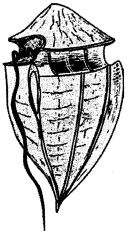
To which group does the organism shown in the figure belong?
A
Chrysophytes
B
Euglenoids
C
Slime moulds
D
Dinoflagellates
Solution
(D) The organism shown in the figure is a $Dinoflagellate$.
Dinoflagellates are mostly marine and photosynthetic.
They appear yellow,green,brown,blue,or red depending on the main pigments present in their cells.
The cell wall has stiff cellulose plates on the outer surface.
Most of them have two flagella; one lies longitudinally and the other transversely in a furrow between the wall plates.
Dinoflagellates are mostly marine and photosynthetic.
They appear yellow,green,brown,blue,or red depending on the main pigments present in their cells.
The cell wall has stiff cellulose plates on the outer surface.
Most of them have two flagella; one lies longitudinally and the other transversely in a furrow between the wall plates.
0 likes
View Solution419
EasyMCQ
Which organism is considered a connecting link between plants and animals?
A
Desmids
B
Euglena
C
Gonyaulax
D
Diatoms
Solution
(B) $Euglena$ is considered a connecting link between plants and animals because it possesses characteristics of both kingdoms.
$1$. Plant-like characteristics: It contains chlorophyll and performs photosynthesis in the presence of sunlight (autotrophic nutrition).
$2$. Animal-like characteristics: In the absence of sunlight,it behaves like a heterotroph by feeding on other organic matter. It also lacks a rigid cell wall,which is a characteristic feature of plants,and instead possesses a protein-rich layer called a pellicle,which makes its body flexible.
$1$. Plant-like characteristics: It contains chlorophyll and performs photosynthesis in the presence of sunlight (autotrophic nutrition).
$2$. Animal-like characteristics: In the absence of sunlight,it behaves like a heterotroph by feeding on other organic matter. It also lacks a rigid cell wall,which is a characteristic feature of plants,and instead possesses a protein-rich layer called a pellicle,which makes its body flexible.
0 likes
View Solution420
MediumMCQ
Select the correct option for the pellicle.
A
It is a protein-rich layer.
B
It makes the body soft.
C
It is a characteristic of euglenoids.
D
All of the above.
Solution
(D) The pellicle is a thin,flexible,protein-rich layer that covers the cell membrane of euglenoids (e.g.,Euglena).
It provides structural support while maintaining flexibility,which allows the organism to change its shape.
Since it is a defining characteristic of euglenoids and is composed of proteins,options $A$ and $C$ are correct.
Option $B$ is incorrect because the pellicle provides structural integrity rather than making the body soft; however,in the context of multiple-choice questions where $A$ and $C$ are both correct,the most appropriate choice is $D$ (All of the above) if the question implies the properties associated with the pellicle's function in euglenoids.
It provides structural support while maintaining flexibility,which allows the organism to change its shape.
Since it is a defining characteristic of euglenoids and is composed of proteins,options $A$ and $C$ are correct.
Option $B$ is incorrect because the pellicle provides structural integrity rather than making the body soft; however,in the context of multiple-choice questions where $A$ and $C$ are both correct,the most appropriate choice is $D$ (All of the above) if the question implies the properties associated with the pellicle's function in euglenoids.
0 likes
View Solution421
MediumMCQ
During unfavorable and favorable conditions,slime molds form $..........$ and $..........$,respectively.
A
Plasmodium,spores
B
Spores,Plasmodium
C
Fruiting bodies,spores
D
Spores,fruiting bodies
Solution
(D) Slime molds are saprophytic protists.
During unfavorable conditions,the plasmodium differentiates and forms fruiting bodies bearing spores at their tips.
During favorable conditions,these spores disperse and germinate to form new plasmodium or amoeboid cells.
Therefore,under unfavorable conditions,they form fruiting bodies (which contain spores),and under favorable conditions,they exist as plasmodium.
However,in the context of standard $NCERT$ biology,slime molds form an aggregation called $Plasmodium$ under suitable conditions and form fruiting bodies bearing spores under unfavorable conditions.
Thus,the correct sequence is $Plasmodium$ (favorable) and spores/fruiting bodies (unfavorable).
Given the options,the question asks for unfavorable then favorable: Unfavorable = $Fruiting bodies/Spores$,Favorable = $Plasmodium$.
During unfavorable conditions,the plasmodium differentiates and forms fruiting bodies bearing spores at their tips.
During favorable conditions,these spores disperse and germinate to form new plasmodium or amoeboid cells.
Therefore,under unfavorable conditions,they form fruiting bodies (which contain spores),and under favorable conditions,they exist as plasmodium.
However,in the context of standard $NCERT$ biology,slime molds form an aggregation called $Plasmodium$ under suitable conditions and form fruiting bodies bearing spores under unfavorable conditions.
Thus,the correct sequence is $Plasmodium$ (favorable) and spores/fruiting bodies (unfavorable).
Given the options,the question asks for unfavorable then favorable: Unfavorable = $Fruiting bodies/Spores$,Favorable = $Plasmodium$.
0 likes
View Solution422
MediumMCQ
Select the incorrect statement regarding the spores of slime molds.
A
They possess true walls.
B
They are extremely resistant.
C
They survive even under adverse conditions.
D
The spores are dispersed by water currents.
Solution
(D) Slime molds are saprophytic protists. During unfavorable conditions,the plasmodium differentiates and forms fruiting bodies bearing spores at their tips. These spores possess true walls,which make them extremely resistant and capable of surviving for many years even under adverse conditions. The spores are dispersed by air currents,not water currents. Therefore,the statement that spores are dispersed by water currents is incorrect.
0 likes
View Solution423
MediumMCQ
Match the following columns:
| Column-$I$ (Protozoans) | Column-$II$ (Examples) |
| $P$. Amoeboid | $I$. Plasmodium |
| $Q$. Flagellated | $II$. Amoeba,Entamoeba |
| $R$. Ciliated | $III$. Paramoecium |
| $S$. Sporozoans | $IV$. Trypanosoma |
A
$(P-II), (Q-IV), (R-III), (S-I)$
B
$(P-II), (Q-I), (R-III), (S-IV)$
C
$(P-II), (Q-I), (R-IV), (S-III)$
D
$(P-III), (Q-IV), (R-II), (S-II)$
Solution
(A) The classification of protozoans is based on their mode of locomotion:
$1$. Amoeboid protozoans $(P)$: These move using pseudopodia. Examples include $Amoeba$ and $Entamoeba$. Thus,$P-II$.
$2$. Flagellated protozoans $(Q)$: These possess flagella for movement. An example is $Trypanosoma$. Thus,$Q-IV$.
$3$. Ciliated protozoans $(R)$: These have thousands of cilia for movement. An example is $Paramoecium$. Thus,$R-III$.
$4$. Sporozoans $(S)$: These have an infectious spore-like stage in their life cycle. An example is $Plasmodium$. Thus,$S-I$.
Therefore,the correct matching is $(P-II), (Q-IV), (R-III), (S-I)$.
$1$. Amoeboid protozoans $(P)$: These move using pseudopodia. Examples include $Amoeba$ and $Entamoeba$. Thus,$P-II$.
$2$. Flagellated protozoans $(Q)$: These possess flagella for movement. An example is $Trypanosoma$. Thus,$Q-IV$.
$3$. Ciliated protozoans $(R)$: These have thousands of cilia for movement. An example is $Paramoecium$. Thus,$R-III$.
$4$. Sporozoans $(S)$: These have an infectious spore-like stage in their life cycle. An example is $Plasmodium$. Thus,$S-I$.
Therefore,the correct matching is $(P-II), (Q-IV), (R-III), (S-I)$.
0 likes
View Solution424
MediumMCQ
Which of the following parasites causes the disease known as $Sleeping \text{ } Sickness$?
A
Amoeboid protozoans
B
Ciliated protozoans
C
Flagellated protozoans
D
Sporozoan protozoans
Solution
(C) The disease known as $Sleeping \text{ } Sickness$ (African sleeping sickness) is caused by the parasite $Trypanosoma \text{ } brucei$.
$Trypanosoma$ belongs to the group of flagellated protozoans, as they possess flagella for locomotion.
Therefore, the correct category is flagellated protozoans.
$Trypanosoma$ belongs to the group of flagellated protozoans, as they possess flagella for locomotion.
Therefore, the correct category is flagellated protozoans.
0 likes
View Solution425
MediumMCQ
The organism belonging to this group causes the disease amoebiasis.
A
Amoeboid protozoans
B
Ciliated protozoans
C
Flagellated protozoans
D
Sporozoans
Solution
(A) Amoebiasis is caused by the protozoan parasite $Entamoeba histolytica$.
This organism belongs to the group of amoeboid protozoans.
Amoeboid protozoans move and capture their prey by putting out pseudopodia (false feet),as seen in $Amoeba$ and $Entamoeba$.
This organism belongs to the group of amoeboid protozoans.
Amoeboid protozoans move and capture their prey by putting out pseudopodia (false feet),as seen in $Amoeba$ and $Entamoeba$.
0 likes
View Solution426
EasyMCQ
Which of the following organisms possesses two nuclei?
A
Entamoeba
B
Trypanosoma
C
Paramecium
D
Plasmodium
Solution
(C) Paramecium is a ciliated protozoan that exhibits nuclear dimorphism. It contains two types of nuclei: a large kidney-shaped macronucleus,which controls metabolic activities,and a small spherical micronucleus,which is involved in reproduction and genetic exchange.
0 likes
View Solution427
MediumMCQ
The $Plasmodium$ $vivax$,$Plasmodium$ $malariae$,and $Plasmodium$ $falciparum$ responsible for malaria are ........ .
A
Species
B
Genus
C
Family
D
Order
Solution
(A) In biological classification,the scientific name of an organism consists of two parts: the genus name and the species name. For example,in $Plasmodium$ $vivax$,$Plasmodium$ is the genus and $vivax$ is the species. Similarly,$malariae$ and $falciparum$ are also specific epithets representing different species of the genus $Plasmodium$. Therefore,$vivax$,$malariae$,and $falciparum$ are species.
0 likes
View Solution428
MediumMCQ
Which of the following is the locomotory organ in the pathogen $Plasmodium$?
A
Pseudopodia
B
Cilia
C
Flagella
D
None of these
Solution
(D) $Plasmodium$ is a member of the phylum $Apicomplexa$ (also known as $Sporozoa$).
These organisms are characterized by the absence of specialized locomotory organelles like pseudopodia,cilia,or flagella in their mature stages.
They move primarily by gliding motility,which is facilitated by the cytoskeleton and specific proteins,but they do not possess distinct locomotory structures like those found in other protozoans.
Therefore,the correct answer is $D$ (None of these).
These organisms are characterized by the absence of specialized locomotory organelles like pseudopodia,cilia,or flagella in their mature stages.
They move primarily by gliding motility,which is facilitated by the cytoskeleton and specific proteins,but they do not possess distinct locomotory structures like those found in other protozoans.
Therefore,the correct answer is $D$ (None of these).
0 likes
View Solution429
MediumMCQ
Which of the following is odd one with respect to algal members according to the five kingdom classification system?
A
Ulothrix
B
Spirogyra
C
Volvox
D
Chlamydomonas
Solution
(D) According to the five kingdom classification system proposed by $R.H. Whittaker$,all unicellular eukaryotic organisms are placed in the kingdom $Protista$.
$Chlamydomonas$ is a unicellular green alga,and therefore,it is classified under the kingdom $Protista$.
$Ulothrix$,$Spirogyra$,and $Volvox$ are multicellular green algae,which are classified under the kingdom $Plantae$.
Thus,$Chlamydomonas$ is the odd one out as it belongs to kingdom $Protista$ while the others belong to kingdom $Plantae$.
$Chlamydomonas$ is a unicellular green alga,and therefore,it is classified under the kingdom $Protista$.
$Ulothrix$,$Spirogyra$,and $Volvox$ are multicellular green algae,which are classified under the kingdom $Plantae$.
Thus,$Chlamydomonas$ is the odd one out as it belongs to kingdom $Protista$ while the others belong to kingdom $Plantae$.
0 likes
View Solution430
EasyMCQ
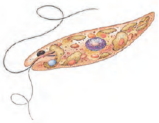
Identify the given organism and select the true statement about it.
A
Euglena; always heterotrophic
B
Dinoflagellate; always autotrophic
C
Euglena; have two unequal flagella
D
Dinoflagellate; has cell wall plates made up of cellulose
Solution
(C) The organism shown in the image is $Euglena$.
$Euglena$ belongs to the group Euglenoids.
They possess two flagella,a short one and a long one,which are unequal in length.
They are photosynthetic in the presence of sunlight but behave as heterotrophs by predating on other smaller organisms in the absence of sunlight.
Therefore,the statement 'Euglena; have two unequal flagella' is correct.
Option $D$ is a correct statement about Dinoflagellates,but the organism in the image is $Euglena$,not a Dinoflagellate.
$Euglena$ belongs to the group Euglenoids.
They possess two flagella,a short one and a long one,which are unequal in length.
They are photosynthetic in the presence of sunlight but behave as heterotrophs by predating on other smaller organisms in the absence of sunlight.
Therefore,the statement 'Euglena; have two unequal flagella' is correct.
Option $D$ is a correct statement about Dinoflagellates,but the organism in the image is $Euglena$,not a Dinoflagellate.
0 likes
View Solution431
EasyMCQ
The walls are embedded with silica and thus the walls are indestructible in $:-$
A
Slime moulds
B
Euglenoids
C
Diatoms
D
Dinoflagellates
Solution
(C) Diatoms belong to the group Chrysophytes.
Their cell walls form two thin overlapping shells,which fit together as in a soap box.
The walls are embedded with silica and are thus indestructible.
Because of this,diatoms have left behind a large amount of cell wall deposits in their habitat; this accumulation over billions of years is referred to as 'diatomaceous earth'.
Their cell walls form two thin overlapping shells,which fit together as in a soap box.
The walls are embedded with silica and are thus indestructible.
Because of this,diatoms have left behind a large amount of cell wall deposits in their habitat; this accumulation over billions of years is referred to as 'diatomaceous earth'.
0 likes
View Solution432
MediumMCQ
Saprophytic protists having an aggregation called $plasmodium$ are $:-$
A
Chrysophytes
B
Dinoflagellates
C
Slime moulds
D
Protozoans
Solution
(C) Slime moulds are saprophytic protists.
Under suitable conditions,they form an aggregation called $plasmodium$ which may grow and spread over several feet.
During unfavorable conditions,the $plasmodium$ differentiates and forms fruiting bodies bearing spores at their tips.
Under suitable conditions,they form an aggregation called $plasmodium$ which may grow and spread over several feet.
During unfavorable conditions,the $plasmodium$ differentiates and forms fruiting bodies bearing spores at their tips.
0 likes
View Solution433
EasyMCQ
Osmoregulation in $Paramecium$ is a function of . . . . . .
A
Trichocysts
B
Contractile vacuole
C
Cytostome
D
Cytopyge
Solution
(B) Contractile vacuole
In $Paramecium$,the contractile vacuole is responsible for osmoregulation.
It functions by collecting excess water from the cytoplasm and periodically expelling it out of the cell to maintain the internal osmotic balance.
In $Paramecium$,the contractile vacuole is responsible for osmoregulation.
It functions by collecting excess water from the cytoplasm and periodically expelling it out of the cell to maintain the internal osmotic balance.
0 likes
View Solution434
EasyMCQ
The function of the contractile vacuole in $Amoeba$ is:
A
Digestion and excretion
B
Excretion and osmoregulation
C
Digestion and respiration
D
Osmoregulation and movement
Solution
(B) The correct option is $B$.
In $Amoeba$,the contractile vacuole plays a vital role in maintaining water balance within the cell,a process known as osmoregulation.
It also helps in the removal of metabolic waste products,thus performing the function of excretion.
Therefore,the primary functions of the contractile vacuole are excretion and osmoregulation.
In $Amoeba$,the contractile vacuole plays a vital role in maintaining water balance within the cell,a process known as osmoregulation.
It also helps in the removal of metabolic waste products,thus performing the function of excretion.
Therefore,the primary functions of the contractile vacuole are excretion and osmoregulation.
0 likes
View SolutionBiological Classification — Protista (Unicellular eukaryotes) · Frequently Asked Questions
1Are these Biological Classification questions useful for JEE and NEET?
Yes. All questions in this section are mapped to JEE Main and NEET exam patterns. Previous year questions from JEE Main, NEET, GUJCET and state-level exams are included with full solutions.
2Can I switch to Hindi or Gujarati for these questions?
Yes. Use the language tabs in the hero section or the sidebar to view the same questions and solutions in English, Hindi or Gujarati.
3How do I generate a question paper from this subtopic?
Use the Vedclass Exam Paper Generator — select the chapter and subtopic, set difficulty, and generate Sets A, B, C, D automatically. First 3 chapters of every subject are free.
Vedclass Products
For Students
Vedclass Test Series
Mock tests in real JEE/NEET style with performance analysis. 5-day free trial.
Start Free TrialFor Teachers
Exam Paper Generator
Generate Set A/B/C/D papers from this chapter in 2 minutes. 3 chapters free.
Try FreeFor Institutes
Online Exam Module
Live online exams with unlimited students, 360° analytics & white-label branding.
See DemoFor Teachers & Institutes
Generate a Biological Classification Exam Paper in 2 Minutes
Select subtopic & difficulty — Sets A, B, C, D auto-generated with No Repeat logic.
First 3 chapters of every subject are free — no payment required.