
A English
Protista (Unicellular eukaryotes) Questions in English
Class 11 Biology · Biological Classification · Protista (Unicellular eukaryotes)
434+
Questions
English
Language
100%
With Solutions
Showing 50 of 434 questions in English
201
EasyMCQ
Oil and leucosin are characteristic stored food in ....
A
Dinoflagellates
B
Euglenoids
C
Diatoms
D
None of these
Solution
(C) In $Chrysophytes$ (which include diatoms and golden algae),the food is stored in the form of oil droplets and a carbohydrate called leucosin (chrysolaminarin).
Therefore,oil and leucosin are characteristic stored food materials in diatoms.
Therefore,oil and leucosin are characteristic stored food materials in diatoms.
0 likes
View Solution202
EasyMCQ
"Diatomite" (Kieselguhr) is obtained from which of the following?
A
Myxophyceae
B
Bacillariophyceae
C
Phaeophyceae
D
Rhodophyceae
Solution
(B) Diatoms belong to the class $Bacillariophyceae$ (also known as $Diatomophyceae$).
These organisms have cell walls embedded with silica, which form indestructible shells.
When diatoms die, their silica-rich cell walls accumulate at the bottom of the sea or lakes over billions of years, forming thick deposits known as 'diatomaceous earth' or 'Kieselguhr'.
This material is porous, chemically inert, and is used in filtration, polishing, and soundproofing.
These organisms have cell walls embedded with silica, which form indestructible shells.
When diatoms die, their silica-rich cell walls accumulate at the bottom of the sea or lakes over billions of years, forming thick deposits known as 'diatomaceous earth' or 'Kieselguhr'.
This material is porous, chemically inert, and is used in filtration, polishing, and soundproofing.
0 likes
View Solution203
MediumMCQ
Some dinoflagellates secrete toxins (saxitoxin) that enter the human body through the food chain and result in ........
A
Insanity
B
Paralysis
C
Syphilis
D
Plague
Solution
(B) Some marine dinoflagellates,such as $Gonyaulax$,undergo rapid multiplication and cause 'red tides' in the sea. These organisms secrete potent toxins known as saxitoxins. When these toxins are ingested by marine organisms like shellfish,they accumulate in their tissues. When humans consume these contaminated shellfish,the saxitoxin enters the human food chain and causes paralytic shellfish poisoning,which results in paralysis.
0 likes
View Solution204
EasyMCQ
Paramylum is the stored food of .........
A
Dinoflagellates
B
Euglenoids
C
Diatoms
D
Slime molds
Solution
(B) Paramylum is a carbohydrate (a type of $\beta-1,3$-glucan) that serves as the primary storage polysaccharide in $Euglenoids$. Unlike plants that store food as starch,$Euglenoids$ store food in the form of $Paramylum$ granules,which are typically found in the cytoplasm.
0 likes
View Solution205
DifficultMCQ
The 'naked' slime molds are naked -
A
When they reproduce.
B
When they do not reproduce.
C
They are always naked.
D
They are never naked.
Solution
(B) Slime molds are saprophytic protists. Under suitable conditions,they form an aggregation called $Plasmodium$ which may grow and spread over several feet. When conditions become unfavorable,the $Plasmodium$ differentiates and forms fruiting bodies bearing spores at their tips. These spores possess true walls. They are extremely resistant and survive for many years,even under adverse conditions. The term 'naked' refers to the vegetative phase (the $Plasmodium$),which lacks a cell wall. Therefore,they are naked during their vegetative phase,i.e.,when they are not reproducing.
0 likes
View Solution206
EasyMCQ
Which of the following algae secretes 'saxitoxin'?
A
$Gonyaulax$
B
$Oscillatoria$
C
$Noctiluca$
D
$Pyrocystis$
Solution
(A) The dinoflagellate $Gonyaulax$ is known to produce a potent neurotoxin called 'saxitoxin'.
This toxin accumulates in shellfish that feed on these dinoflagellates.
When humans consume these contaminated shellfish,it leads to paralytic shellfish poisoning $(PSP)$.
Therefore,the correct option is $A$.
This toxin accumulates in shellfish that feed on these dinoflagellates.
When humans consume these contaminated shellfish,it leads to paralytic shellfish poisoning $(PSP)$.
Therefore,the correct option is $A$.
0 likes
View Solution207
DifficultMCQ
What type of movement do diatoms exhibit in water?
A
Swimming
B
Amoeboid
C
Floating
D
Ciliary
Solution
(C) Diatoms are microscopic,unicellular photosynthetic organisms belonging to the group Chrysophytes under the Kingdom Protista.
They possess a cell wall made of silica,which makes them heavy.
Due to their heavy cell wall and lack of locomotory organelles like cilia or flagella,they cannot swim actively.
Instead,they float passively in water currents,a mode of movement known as planktonic or floating.
They possess a cell wall made of silica,which makes them heavy.
Due to their heavy cell wall and lack of locomotory organelles like cilia or flagella,they cannot swim actively.
Instead,they float passively in water currents,a mode of movement known as planktonic or floating.
0 likes
View Solution208
MediumMCQ
Why do diatoms float on the surface of water?
A
Stored fats
B
Gas vacuoles
C
Flagella
D
Air chambers
Solution
(A) Diatoms are photosynthetic protists that store their food reserves in the form of oil droplets (fats) and leucosin (a carbohydrate).
These oil droplets are lighter than water,which provides buoyancy to the diatoms,allowing them to float on the surface of the water to maximize light absorption for photosynthesis.
These oil droplets are lighter than water,which provides buoyancy to the diatoms,allowing them to float on the surface of the water to maximize light absorption for photosynthesis.
0 likes
View Solution209
MediumMCQ
$A$ stiff cell wall and biflagellate cells are characteristic features of which group?
A
Chrysophyta
B
Pyrrophyta
C
Euglenophyta
D
Cyanophyta
Solution
(B) The group $Pyrrophyta$ (also known as Dinoflagellates) is characterized by the presence of a stiff cellulosic cell wall on the outer surface,often forming plates. They typically possess two flagella $(biflagellate)$,one lying longitudinally and the other transversely in a furrow between the wall plates. Therefore,these features are diagnostic of $Pyrrophyta$.
0 likes
View Solution210
EasyMCQ
In Euglenoids, the stored food is $Paramylum$, which is a .........
A
Modified product of glycogen
B
Modified product of starch
C
Type of lipid
D
Type of protein
Solution
(B) Euglenoids are a group of protists that possess a protein-rich layer called a pellicle instead of a cell wall. They store their food in the form of $Paramylum$ (or $Paramylon$) granules. $Paramylum$ is a polysaccharide that is chemically similar to starch, specifically a $\beta-1,3-glucan$. Therefore, it is considered a modified product of starch.
0 likes
View Solution211
EasyMCQ
"Fire algae" belongs to which group?
A
Pyrrophyta
B
Chrysophyta
C
Euglenophyta
D
Rhodophyta
Solution
(A) The term "Fire algae" refers to the members of the group $Pyrrophyta$ (also known as $Dinoflagellates$).
These organisms are called "Fire algae" because many species exhibit bioluminescence, emitting a glowing light in the ocean, and some species cause "red tides" which can appear fiery or reddish in color.
Therefore, the correct option is $A$.
These organisms are called "Fire algae" because many species exhibit bioluminescence, emitting a glowing light in the ocean, and some species cause "red tides" which can appear fiery or reddish in color.
Therefore, the correct option is $A$.
0 likes
View Solution212
DifficultMCQ
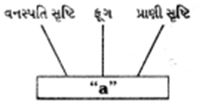
What does '$A$' represent in the given figure?
A
Bryophyta
B
Protista
C
Tracheophyta
D
Metaphyta
Solution
(B) The provided figure represents the five-kingdom classification system proposed by $R$.$H$. Whittaker. In this system,the kingdom Protista acts as a connecting link between the prokaryotic Monera and the complex multicellular eukaryotic kingdoms (Plantae,Fungi,and Animalia). Therefore,'$A$' represents the kingdom Protista.
0 likes
View Solution213
MediumMCQ
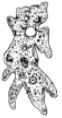
The organism shown in the figure:
A
contains nucleoprotein.
B
lacks membrane-bound organelles.
C
possesses a well-defined nucleus and membrane-bound organelles.
D
is a cyanobacterium.
Solution
(C) The organism shown in the figure is an $Amoeba$,which is a unicellular eukaryotic organism belonging to the kingdom $Protista$.
As a eukaryote,it possesses a well-defined nucleus and various membrane-bound organelles such as mitochondria,vacuoles,and lysosomes.
Therefore,option $C$ is the correct statement.
As a eukaryote,it possesses a well-defined nucleus and various membrane-bound organelles such as mitochondria,vacuoles,and lysosomes.
Therefore,option $C$ is the correct statement.
0 likes
View Solution214
MediumMCQ
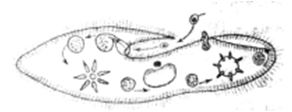
The organism shown in the figure is ......
A
contains nucleoprotein.
B
lacks membrane-bound organelles.
C
possesses a well-defined nucleus and membrane-bound organelles.
D
is a cyanobacteria.
Solution
(C) The figure shows $Paramecium$,which is a ciliated protozoan belonging to the Kingdom Protista.
$Paramecium$ is a eukaryotic organism.
Eukaryotic cells are characterized by the presence of a well-defined nucleus and membrane-bound organelles (such as mitochondria,contractile vacuoles,etc.).
Therefore,option $C$ is the correct statement.
$Paramecium$ is a eukaryotic organism.
Eukaryotic cells are characterized by the presence of a well-defined nucleus and membrane-bound organelles (such as mitochondria,contractile vacuoles,etc.).
Therefore,option $C$ is the correct statement.
0 likes
View Solution215
EasyMCQ
Which group of animals is unicellular in terms of structure and function?
A
Protozoa
B
Porifera
C
Coelenterata
D
Platyhelminthes
Solution
(A) The organisms belonging to the group $Protozoa$ are unicellular eukaryotes. They perform all vital life functions such as respiration,excretion,and reproduction within a single cell. In contrast,$Porifera$,$Coelenterata$,and $Platyhelminthes$ are multicellular organisms with varying levels of body organization.
0 likes
View Solution216
MediumMCQ
Which type of symmetry is observed in the phylum Protozoa?
A
Bilateral
B
Radial
C
Asymmetry
D
All of the above
Solution
(D) Protozoa is a diverse group of unicellular eukaryotic organisms. Due to their varied body forms and structures,different species of Protozoa exhibit different types of symmetry. For example,some species like Amoeba are asymmetrical,while others like certain flagellates or ciliates may show radial or bilateral symmetry. Therefore,all types of symmetry can be observed within the phylum Protozoa.
0 likes
View Solution217
EasyMCQ
Which of the following phyla consists of unicellular organisms in terms of structure and function?
A
Coelenterata
B
Protozoa
C
Platyhelminthes
D
Nematoda
Solution
(B) The phylum $Protozoa$ consists of organisms that are unicellular and eukaryotic. In these organisms,a single cell performs all the vital life functions,such as respiration,excretion,digestion,and reproduction. Other options like $Coelenterata$,$Platyhelminthes$,and $Nematoda$ belong to the kingdom $Animalia$ and are multicellular organisms.
0 likes
View Solution218
EasyMCQ
Which of the following belongs to the kingdom Protista?
A
Protozoa
B
Porifera
C
Platyhelminthes
D
Nematoda
Solution
(A) The kingdom Protista includes all single-celled eukaryotes. Protozoans are unicellular eukaryotic organisms that are classified under the kingdom Protista. Porifera,Platyhelminthes,and Nematoda belong to the kingdom Animalia.
0 likes
View Solution219
EasyMCQ
The term $...........$ means 'first animals'.
A
Protozoa
B
Porifera
C
Vertebrata
D
Arthropoda
Solution
(A) The term $Protozoa$ is derived from the Greek words $protos$ meaning 'first' and $zoon$ meaning 'animal'. Thus,$Protozoa$ literally translates to 'first animals'. These are unicellular eukaryotic organisms that were traditionally considered the simplest animals.
0 likes
View Solution220
EasyMCQ
Microscopic unicellular animals that lack tissues and organs are:
A
Porifera
B
Protozoa
C
Coelenterata
D
Platyhelminthes
Solution
(B) Protozoa are microscopic,unicellular eukaryotic organisms. Since they are unicellular,they consist of a single cell and therefore lack tissues,organs,or organ systems. Porifera are multicellular (cellular level of organization),while Coelenterata and Platyhelminthes exhibit tissue and organ-level organization,respectively.
0 likes
View Solution221
MediumMCQ
The group Protozoa includes which of the following modes of nutrition?
A
Holozoic
B
Saprophytic
C
Parasitic
D
All of the above
Solution
(D) Protozoa are heterotrophic organisms that exhibit diverse modes of nutrition.
$1$. Holozoic nutrition: Many protozoans like Amoeba ingest solid food particles.
$2$. Saprophytic nutrition: Some protozoans absorb dissolved organic matter from the environment.
$3$. Parasitic nutrition: Many protozoans like Plasmodium and Trypanosoma live inside or on other organisms to derive nutrients.
Therefore,all these modes of nutrition are found within the group Protozoa.
$1$. Holozoic nutrition: Many protozoans like Amoeba ingest solid food particles.
$2$. Saprophytic nutrition: Some protozoans absorb dissolved organic matter from the environment.
$3$. Parasitic nutrition: Many protozoans like Plasmodium and Trypanosoma live inside or on other organisms to derive nutrients.
Therefore,all these modes of nutrition are found within the group Protozoa.
0 likes
View Solution222
EasyMCQ
Organisms belonging to the phylum Protozoa move using which of the following structures?
A
Tentacles
B
Pseudopodia
C
Cilia
D
Flagella
Solution
(B) Protozoa are unicellular eukaryotic organisms. They exhibit various modes of locomotion depending on the group:
$1$. Amoeboid protozoans move using $Pseudopodia$ (false feet).
$2$. Flagellated protozoans move using $Flagella$.
$3$. Ciliated protozoans move using $Cilia$.
$4$. Sporozoans lack specialized locomotory structures.
Since $Pseudopodia$ is the most characteristic locomotory structure associated with the general definition of protozoan movement in many contexts,option $B$ is the correct answer.
$1$. Amoeboid protozoans move using $Pseudopodia$ (false feet).
$2$. Flagellated protozoans move using $Flagella$.
$3$. Ciliated protozoans move using $Cilia$.
$4$. Sporozoans lack specialized locomotory structures.
Since $Pseudopodia$ is the most characteristic locomotory structure associated with the general definition of protozoan movement in many contexts,option $B$ is the correct answer.
0 likes
View Solution223
MediumMCQ
Which of the following is $NOT$ a method of asexual reproduction in the kingdom Protista?
A
Binary fission
B
Budding
C
Conjugation
D
Multiple fission
Solution
(C) In the kingdom Protista,asexual reproduction occurs through methods such as binary fission,multiple fission,and budding. Conjugation is a process of sexual reproduction observed in certain protists like Paramecium,where two individuals exchange genetic material. Therefore,conjugation is not a method of asexual reproduction.
0 likes
View Solution224
EasyMCQ
Which of the following animals belongs to the phylum Protozoa?
A
Hyalonema
B
Opalina
C
Spongilla
D
Coral
Solution
(B) Protozoa is a group of unicellular eukaryotic organisms.
Among the given options,$Opalina$ is a ciliated protozoan that lives as a commensal in the rectum of amphibians.
$Hyalonema$ (Glass sponge),$Spongilla$ (Freshwater sponge),and $Coral$ (Cnidarian) belong to the kingdom Animalia,specifically the phyla Porifera and Cnidaria,respectively.
Among the given options,$Opalina$ is a ciliated protozoan that lives as a commensal in the rectum of amphibians.
$Hyalonema$ (Glass sponge),$Spongilla$ (Freshwater sponge),and $Coral$ (Cnidarian) belong to the kingdom Animalia,specifically the phyla Porifera and Cnidaria,respectively.
0 likes
View Solution225
EasyMCQ
Which of the following is true for the phylum Protozoa?
A
The body of the animals is either asymmetrical or radially symmetrical.
B
They possess a layer of cnidoblasts.
C
The excretory system consists of flame cells and tubules.
D
They are unicellular,containing one or more nuclei.
Solution
(D) Protozoa are classified as unicellular eukaryotic organisms. They are characterized by a simple body organization where all life activities occur within a single cell. They may contain one or more nuclei (e.g.,Paramecium has a macronucleus and a micronucleus). Option $D$ is correct. Option $A$ is incorrect as symmetry varies widely. Option $B$ is a characteristic of Phylum Cnidaria. Option $C$ is a characteristic of Phylum Platyhelminthes.
0 likes
View Solution226
EasyMCQ
Which organism is considered a connecting link between plants and animals?
A
Entamoeba
B
Monocystis
C
Paramecium
D
Euglena
Solution
(D) $Euglena$ is considered a connecting link between plants and animals because it possesses both plant-like and animal-like characteristics.
It contains chlorophyll and performs photosynthesis in the presence of sunlight (autotrophic nutrition),which is a plant-like feature.
In the absence of sunlight,it behaves like a heterotroph by ingesting organic matter,which is an animal-like feature.
Additionally,it lacks a rigid cell wall,which is a characteristic feature of animal cells.
It contains chlorophyll and performs photosynthesis in the presence of sunlight (autotrophic nutrition),which is a plant-like feature.
In the absence of sunlight,it behaves like a heterotroph by ingesting organic matter,which is an animal-like feature.
Additionally,it lacks a rigid cell wall,which is a characteristic feature of animal cells.
0 likes
View Solution227
MediumMCQ
What is the function of the contractile vacuole in $Amoeba$?
A
Reproduction
B
Digestion of food
C
Storage of food
D
Osmoregulation and excretion
Solution
(D) In $Amoeba$,the contractile vacuole is a specialized organelle responsible for osmoregulation.
It collects excess water from the cytoplasm and expels it out of the cell to maintain the internal water balance and osmotic pressure.
This process is essential for the survival of $Amoeba$ in freshwater environments where water constantly enters the cell via osmosis.
It collects excess water from the cytoplasm and expels it out of the cell to maintain the internal water balance and osmotic pressure.
This process is essential for the survival of $Amoeba$ in freshwater environments where water constantly enters the cell via osmosis.
0 likes
View Solution228
EasyMCQ
In $Paramecium$,the nucleus is characterized by:
A
$A$ single nucleus
B
Two nuclei of equal size
C
Two nuclei,one macronucleus and one micronucleus
D
Four nuclei
Solution
(C) $Paramecium$ is a ciliated protozoan that exhibits nuclear dimorphism.
It contains two types of nuclei:
$1$. $A$ large,kidney-shaped macronucleus,which controls vegetative functions and metabolic activities.
$2$. $A$ small,spherical micronucleus,which is involved in reproduction and genetic recombination during conjugation.
Therefore,the correct configuration is one macronucleus and one micronucleus.
It contains two types of nuclei:
$1$. $A$ large,kidney-shaped macronucleus,which controls vegetative functions and metabolic activities.
$2$. $A$ small,spherical micronucleus,which is involved in reproduction and genetic recombination during conjugation.
Therefore,the correct configuration is one macronucleus and one micronucleus.
0 likes
View Solution229
MediumMCQ
What is the mode of nutrition in the group Protista?
A
Photosynthetic
B
Chemosynthetic
C
Heterotrophic
D
Holozoic,saprophytic,and parasitic
Solution
(D) The kingdom $Protista$ includes diverse organisms that exhibit various modes of nutrition.
$1$. Some protists like $Chrysophytes$ and $Dinoflagellates$ are photosynthetic (autotrophic).
$2$. Many protists like $Protozoans$ exhibit holozoic nutrition (ingesting food particles).
$3$. Some protists are saprophytic (absorbing nutrients from dead organic matter).
$4$. Others are parasitic (living on or inside other organisms).
Therefore,the group $Protista$ shows a combination of these modes,making option $D$ the most comprehensive answer.
$1$. Some protists like $Chrysophytes$ and $Dinoflagellates$ are photosynthetic (autotrophic).
$2$. Many protists like $Protozoans$ exhibit holozoic nutrition (ingesting food particles).
$3$. Some protists are saprophytic (absorbing nutrients from dead organic matter).
$4$. Others are parasitic (living on or inside other organisms).
Therefore,the group $Protista$ shows a combination of these modes,making option $D$ the most comprehensive answer.
0 likes
View Solution230
EasyMCQ
What is the primary basis for classification within the kingdom $Protista$?
A
Locomotory organelles
B
Size
C
Number of nuclei
D
Shape
Solution
(A) The kingdom $Protista$ includes a diverse group of unicellular eukaryotic organisms. Because these organisms exhibit a wide variety of structural and functional differences,they are primarily classified based on their mode of locomotion or the presence of specific locomotory organelles. For example,$Protists$ are categorized into groups like flagellates (using flagella),ciliates (using cilia),and amoeboids (using pseudopodia).
0 likes
View Solution231
MediumMCQ
Which of the following characteristics is common to all protists?
A
Heterotrophic nutrition
B
Contractile vacuole
C
Pseudopodia
D
Eukaryotic organization
Solution
(D) Protists are defined as unicellular eukaryotic organisms.
All members of the Kingdom Protista possess a eukaryotic cell organization,meaning they have a well-defined nucleus and membrane-bound organelles.
Other options like heterotrophic nutrition,contractile vacuoles,and pseudopodia are not present in all protists (e.g.,photosynthetic protists like diatoms do not have pseudopodia or contractile vacuoles).
All members of the Kingdom Protista possess a eukaryotic cell organization,meaning they have a well-defined nucleus and membrane-bound organelles.
Other options like heterotrophic nutrition,contractile vacuoles,and pseudopodia are not present in all protists (e.g.,photosynthetic protists like diatoms do not have pseudopodia or contractile vacuoles).
0 likes
View Solution232
EasyMCQ
The first evolved eukaryotes are:
A
Protista
B
Cyanobacteria
C
Green algae
D
Bryophytes
Solution
(A) The first eukaryotes to evolve on Earth were unicellular organisms belonging to the kingdom Protista. They evolved from prokaryotic ancestors approximately $1.5$ to $2$ billion years ago through the process of endosymbiosis. Cyanobacteria are prokaryotes,while green algae and bryophytes are multicellular or more complex eukaryotic groups that evolved much later.
0 likes
View Solution233
EasyMCQ
Unicellular eukaryotes are included in:
A
Fungi
B
Algae
C
Monera
D
Protista
Solution
(D) According to the $5$-kingdom classification system proposed by $R.H. Whittaker$,the kingdom $Protista$ includes all unicellular eukaryotic organisms.
$Monera$ consists of unicellular prokaryotes.
$Fungi$ are mostly multicellular (except yeast) and heterotrophic.
$Algae$ is a diverse group that spans across different kingdoms,but unicellular eukaryotes are specifically classified under $Protista$.
$Monera$ consists of unicellular prokaryotes.
$Fungi$ are mostly multicellular (except yeast) and heterotrophic.
$Algae$ is a diverse group that spans across different kingdoms,but unicellular eukaryotes are specifically classified under $Protista$.
0 likes
View Solution234
EasyMCQ
The organisms of this group exhibit holozoic,saprophytic,and some parasitic modes of nutrition.
A
Nematoda
B
Annelida
C
Echinodermata
D
Protista
Solution
(D) The kingdom $Protista$ includes diverse eukaryotic organisms.
Members of this group exhibit various modes of nutrition:
$1$. Holozoic nutrition (e.g.,$Amoeba$).
$2$. Saprophytic nutrition (e.g.,Slime molds).
$3$. Parasitic nutrition (e.g.,$Plasmodium$,$Trypanosoma$).
Therefore,the correct option is $D$.
Members of this group exhibit various modes of nutrition:
$1$. Holozoic nutrition (e.g.,$Amoeba$).
$2$. Saprophytic nutrition (e.g.,Slime molds).
$3$. Parasitic nutrition (e.g.,$Plasmodium$,$Trypanosoma$).
Therefore,the correct option is $D$.
0 likes
View Solution235
MediumMCQ
Which structure is associated with both locomotion and the ingestion of food?
A
Pseudopodia
B
Cilia
C
Flagella
D
Both $A$ and $B$
Solution
(D) Pseudopodia (false feet) are temporary cytoplasmic extensions found in organisms like $Amoeba$. They are primarily used for locomotion and the engulfment of food particles through phagocytosis. Cilia are hair-like projections that also assist in locomotion and the movement of food particles towards the cytostome in organisms like $Paramecium$. Therefore,both structures are involved in these processes.
0 likes
View Solution236
EasyMCQ
What is the meaning of the term $Protozoa$?
A
Secondary animals
B
Autotrophic animals
C
Prokaryotic animals
D
First animals
Solution
(D) The term $Protozoa$ is derived from the Greek words $protos$ meaning 'first' and $zoon$ meaning 'animal'. Therefore,$Protozoa$ are considered the 'first animals' in the evolutionary hierarchy. They are unicellular,eukaryotic organisms that exhibit animal-like behavior,such as motility and heterotrophic nutrition.
0 likes
View Solution237
MediumMCQ
Which organism is structurally and functionally unicellular?
A
Opalina
B
Hyalonema
C
Leucosolenia
D
Vaucheria
Solution
(A) $Opalina$ is a genus of parasitic protozoans found in the intestines of amphibians. Although they are multinucleated,they are considered structurally and functionally unicellular because they lack cellular differentiation into tissues or organs and do not have cell boundaries between nuclei within the single cell body. In contrast,$Hyalonema$ and $Leucosolenia$ are multicellular sponges (Porifera),and $Vaucheria$ is a coenocytic alga (multinucleated but not considered unicellular in the same sense as $Opalina$ due to its complex filamentous structure).
0 likes
View Solution238
EasyMCQ
Which protozoan possesses a whip-like flagellum?
A
Amoeba
B
Paramecium
C
Euglena
D
Plasmodium
Solution
(C) Protozoans are classified based on their locomotory organelles.
$Amoeba$ uses pseudopodia for locomotion.
$Paramecium$ is a ciliated protozoan that uses cilia for movement.
$Euglena$ is a flagellated protozoan that possesses a whip-like flagellum for locomotion.
$Plasmodium$ is a sporozoan and does not possess locomotory organelles in its infective stage.
Therefore,the correct answer is $Euglena$.
$Amoeba$ uses pseudopodia for locomotion.
$Paramecium$ is a ciliated protozoan that uses cilia for movement.
$Euglena$ is a flagellated protozoan that possesses a whip-like flagellum for locomotion.
$Plasmodium$ is a sporozoan and does not possess locomotory organelles in its infective stage.
Therefore,the correct answer is $Euglena$.
0 likes
View Solution239
MediumMCQ
What type of body symmetry is exhibited by protozoans?
A
Asymmetry
B
Bilateral
C
Radial
D
All of the above
Solution
(D) Protozoans are a diverse group of unicellular eukaryotic organisms.
They exhibit various types of body symmetry depending on the species.
Some protozoans like $Amoeba$ are asymmetrical.
Some like $Paramecium$ exhibit bilateral symmetry.
Others like $Actinosphaerium$ exhibit radial symmetry.
Therefore,protozoans can exhibit all these types of symmetry.
They exhibit various types of body symmetry depending on the species.
Some protozoans like $Amoeba$ are asymmetrical.
Some like $Paramecium$ exhibit bilateral symmetry.
Others like $Actinosphaerium$ exhibit radial symmetry.
Therefore,protozoans can exhibit all these types of symmetry.
0 likes
View Solution240
MediumMCQ
Which structure is used by $Amoeba$ for locomotion?
A
Pseudopodia
B
Flagella
C
Cilia
D
Tentacles
Solution
(A) $Amoeba$ belongs to the group of amoeboid protozoans.
These organisms move and capture their prey by putting out pseudopodia (false feet).
Pseudopodia are temporary cytoplasmic extensions formed by the streaming of protoplasm.
Flagella and cilia are characteristic of flagellated and ciliated protozoans,respectively.
These organisms move and capture their prey by putting out pseudopodia (false feet).
Pseudopodia are temporary cytoplasmic extensions formed by the streaming of protoplasm.
Flagella and cilia are characteristic of flagellated and ciliated protozoans,respectively.
0 likes
View Solution241
EasyMCQ
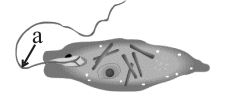
What does $a$ indicate in the given figure?
A
Cilia
B
Pili
C
Flagellum
D
Fimbriae
Solution
(C) The given figure represents a Euglena,which is a unicellular protist.
The structure labeled as $a$ is a long,whip-like appendage used for locomotion,known as a flagellum.
Cilia are short,hair-like structures,while pili and fimbriae are surface appendages found in bacteria.
Therefore,the correct option is $C$.
The structure labeled as $a$ is a long,whip-like appendage used for locomotion,known as a flagellum.
Cilia are short,hair-like structures,while pili and fimbriae are surface appendages found in bacteria.
Therefore,the correct option is $C$.
0 likes
View Solution242
MediumMCQ
By what process do organisms of the phylum Protozoa exhibit sexual reproduction?
A
Conjugation
B
Budding
C
Sexual reproductive organs
D
Sexual reproductive cells
Solution
(A) Protozoans,such as Paramecium,exhibit sexual reproduction primarily through a process called $Conjugation$. During this process,two individuals come together and exchange genetic material through a cytoplasmic bridge,which leads to genetic recombination. Budding is a form of asexual reproduction,and protozoans generally lack complex multicellular sexual reproductive organs.
0 likes
View Solution243
MediumMCQ
Which of the following organisms uses a flagellum as an organ of locomotion?
A
Planaria
B
Euglena
C
Plasmodium
D
Wuchereria
Solution
(B) The organism that uses a flagellum for locomotion is $Euglena$.
$Euglena$ belongs to the group of flagellated protozoans under the kingdom $Protista$.
These organisms possess one or more flagella,which are whip-like structures that help in movement.
$Planaria$ uses cilia for movement,$Plasmodium$ lacks specialized locomotory structures in its infective stage,and $Wuchereria$ is a parasitic nematode.
$Euglena$ belongs to the group of flagellated protozoans under the kingdom $Protista$.
These organisms possess one or more flagella,which are whip-like structures that help in movement.
$Planaria$ uses cilia for movement,$Plasmodium$ lacks specialized locomotory structures in its infective stage,and $Wuchereria$ is a parasitic nematode.
0 likes
View Solution244
EasyMCQ
In which animal phylum is the organism $Opalina$ classified?
A
Porifera
B
Echinodermata
C
Protozoa
D
Coelenterata
Solution
(C) $Opalina$ is a genus of parasitic ciliate-like protists. Historically,they were classified under the phylum $Protozoa$ (specifically under the class $Ciliata$ or $Opalinata$) because they are unicellular,eukaryotic organisms. Although modern taxonomy classifies them under the supergroup $Chromalveolata$ (or $Stramenopiles$),in the context of traditional biological classification questions,they are categorized as $Protozoa$.
0 likes
View Solution245
EasyMCQ
Which of the following is an example of a unicellular organism?
A
Moss
B
Chlamydomonas
C
Fern
D
Sea anemone
Solution
(B) $Chlamydomonas$ is a genus of unicellular green algae. It is a microscopic organism that possesses a flagellum for motility. In contrast,mosses are multicellular bryophytes,ferns are multicellular pteridophytes,and sea anemones are multicellular animals belonging to the phylum $Cnidaria$.
0 likes
View Solution246
MediumMCQ
In which of the following is a contractile vacuole present?
A
Ciliated protozoans
B
Ciliated bacteria
C
Flagellated bacteria
D
Ciliated algae
Solution
(A) contractile vacuole is an organelle involved in osmoregulation and excretion in many freshwater protists.
Among the given options,ciliated protozoans (such as $Paramecium$) possess contractile vacuoles to pump out excess water that enters the cell via osmosis.
Bacteria and algae do not possess contractile vacuoles as they have cell walls that provide structural support against osmotic pressure.
Among the given options,ciliated protozoans (such as $Paramecium$) possess contractile vacuoles to pump out excess water that enters the cell via osmosis.
Bacteria and algae do not possess contractile vacuoles as they have cell walls that provide structural support against osmotic pressure.
0 likes
View Solution247
EasyMCQ
Which of the following is a ciliate?
A
Paramecium
B
Euglena
C
Earthworm
D
Fungi
Solution
(A) Ciliates are a group of protozoans characterized by the presence of hair-like organelles called cilia on their surface.
$Paramecium$ is a well-known example of a ciliate protozoan.
$Euglena$ is a flagellate,$Earthworm$ is an annelid,and $Fungi$ belong to a separate kingdom.
$Paramecium$ is a well-known example of a ciliate protozoan.
$Euglena$ is a flagellate,$Earthworm$ is an annelid,and $Fungi$ belong to a separate kingdom.
0 likes
View Solution248
EasyMCQ
Which of the following organisms possesses cilia?
A
Paramecium
B
Euglena
C
Sponge
D
Ascaris
Solution
(A) The organism that possesses cilia is $Paramecium$.
$Paramecium$ belongs to the group of ciliated protozoans under the kingdom $Protista$.
These organisms have thousands of cilia on their body surface,which help in locomotion and in steering food into the gullet.
$Euglena$ possesses flagella,sponges are multicellular animals,and $Ascaris$ is a parasitic roundworm.
$Paramecium$ belongs to the group of ciliated protozoans under the kingdom $Protista$.
These organisms have thousands of cilia on their body surface,which help in locomotion and in steering food into the gullet.
$Euglena$ possesses flagella,sponges are multicellular animals,and $Ascaris$ is a parasitic roundworm.
0 likes
View Solution249
MediumMCQ
$S -$ Statement: Paramecium is a ciliate.
$R -$ Reason: Euglena is a flagellate.
$R -$ Reason: Euglena is a flagellate.
A
$S$ and $R$ are both true,and $R$ is the correct explanation of $S$.
B
$S$ and $R$ are both true,but $R$ is not the correct explanation of $S$.
C
$S$ is true and $R$ is false.
D
$S$ is false and $R$ is true.
Solution
(B) $S -$ Statement: Paramecium belongs to the group of ciliated protozoans (Ciliates) because it possesses thousands of cilia on its body surface,which help in locomotion and food capture.
$R -$ Reason: Euglena belongs to the group of flagellated protozoans (Flagellates) because it possesses flagella for movement.
Both statements are biologically correct facts regarding the classification of protozoans under the kingdom Protista.
However,the fact that Euglena is a flagellate does not explain why Paramecium is a ciliate. They are independent characteristics of different organisms.
Therefore,both are true,but $R$ is not the correct explanation of $S$.
$R -$ Reason: Euglena belongs to the group of flagellated protozoans (Flagellates) because it possesses flagella for movement.
Both statements are biologically correct facts regarding the classification of protozoans under the kingdom Protista.
However,the fact that Euglena is a flagellate does not explain why Paramecium is a ciliate. They are independent characteristics of different organisms.
Therefore,both are true,but $R$ is not the correct explanation of $S$.
0 likes
View Solution250
MediumMCQ
Which of the following is involved in both excretion and osmoregulation?
A
Vacuole
B
Contractile vacuole
C
Food vacuole
D
All of the above $(A, B, C)$
Solution
(B) The contractile vacuole is a specialized organelle found in many freshwater protists like $Amoeba$.
It functions to collect excess water from the cytoplasm and expel it from the cell, a process known as osmoregulation.
Additionally, it helps in the excretion of metabolic waste products dissolved in the water.
Therefore, the contractile vacuole is involved in both excretion and osmoregulation.
It functions to collect excess water from the cytoplasm and expel it from the cell, a process known as osmoregulation.
Additionally, it helps in the excretion of metabolic waste products dissolved in the water.
Therefore, the contractile vacuole is involved in both excretion and osmoregulation.
0 likes
View SolutionBiological Classification — Protista (Unicellular eukaryotes) · Frequently Asked Questions
1Are these Biological Classification questions useful for JEE and NEET?
Yes. All questions in this section are mapped to JEE Main and NEET exam patterns. Previous year questions from JEE Main, NEET, GUJCET and state-level exams are included with full solutions.
2Can I switch to Hindi or Gujarati for these questions?
Yes. Use the language tabs in the hero section or the sidebar to view the same questions and solutions in English, Hindi or Gujarati.
3How do I generate a question paper from this subtopic?
Use the Vedclass Exam Paper Generator — select the chapter and subtopic, set difficulty, and generate Sets A, B, C, D automatically. First 3 chapters of every subject are free.
Vedclass Products
For Students
Vedclass Test Series
Mock tests in real JEE/NEET style with performance analysis. 5-day free trial.
Start Free TrialFor Teachers
Exam Paper Generator
Generate Set A/B/C/D papers from this chapter in 2 minutes. 3 chapters free.
Try FreeFor Institutes
Online Exam Module
Live online exams with unlimited students, 360° analytics & white-label branding.
See DemoFor Teachers & Institutes
Generate a Biological Classification Exam Paper in 2 Minutes
Select subtopic & difficulty — Sets A, B, C, D auto-generated with No Repeat logic.
First 3 chapters of every subject are free — no payment required.