
A English
Monera (Prokaryotes) Questions in English
Class 11 Biology · Biological Classification · Monera (Prokaryotes)
632+
Questions
English
Language
100%
With Solutions
Showing 50 of 632 questions in English
301
EasyMCQ
The main difference between $Gram\text{-positive}$ and $Gram\text{-negative}$ bacteria is found in the composition of their:
A
Cilia
B
Cell wall
C
Cell membrane
D
Cytoplasm
Solution
(B) The primary distinction between $Gram\text{-positive}$ and $Gram\text{-negative}$ bacteria lies in the structure and composition of their cell wall.
$Gram\text{-positive}$ bacteria possess a thick layer of peptidoglycan (murein) in their cell wall,which retains the crystal violet stain.
In contrast,$Gram\text{-negative}$ bacteria have a much thinner layer of peptidoglycan and an additional outer membrane containing lipopolysaccharides,which prevents them from retaining the crystal violet stain.
$Gram\text{-positive}$ bacteria possess a thick layer of peptidoglycan (murein) in their cell wall,which retains the crystal violet stain.
In contrast,$Gram\text{-negative}$ bacteria have a much thinner layer of peptidoglycan and an additional outer membrane containing lipopolysaccharides,which prevents them from retaining the crystal violet stain.
0 likes
View Solution302
MediumMCQ
Maximum nutritional diversity is found in the group $........$.
A
Monera
B
Plantae
C
Fungi
D
Animalia
Solution
(A) The kingdom $Monera$ exhibits the most extensive nutritional diversity among all biological kingdoms.
Members of this group can be autotrophic (photosynthetic or chemosynthetic) or heterotrophic (saprophytic,parasitic,or symbiotic).
This diversity is not seen to the same extent in other kingdoms like $Plantae$ (mostly autotrophic),$Fungi$ (heterotrophic),or $Animalia$ (heterotrophic).
Members of this group can be autotrophic (photosynthetic or chemosynthetic) or heterotrophic (saprophytic,parasitic,or symbiotic).
This diversity is not seen to the same extent in other kingdoms like $Plantae$ (mostly autotrophic),$Fungi$ (heterotrophic),or $Animalia$ (heterotrophic).
0 likes
View Solution303
MediumMCQ
The harmful process caused by blue-green algae is .........
A
Denitrification
B
Water bloom
C
Increases soil salinity
D
Decreases soil fertility
Solution
(B) Blue-green algae, also known as cyanobacteria, are photosynthetic prokaryotes. When they grow excessively in water bodies due to nutrient enrichment (eutrophication), they form dense mats on the water surface known as $Water \text{ bloom}$. These blooms are harmful because they deplete dissolved oxygen in the water, which can lead to the death of aquatic organisms like fish and other invertebrates. Therefore, the correct answer is $Water \text{ bloom}$.
0 likes
View Solution304
MediumMCQ
The current classification of organisms is into three domains of life ($Bacteria$,$Archaea$,and $Eukarya$). Which of the following statements is true for $Archaea$?
A
$Archaea$ are completely different from both prokaryotes and eukaryotes.
B
$Archaea$ are completely different from prokaryotes.
C
$Archaea$ resemble $Eukarya$ in every aspect.
D
$Archaea$ possess some novel features that are absent in other prokaryotes and eukaryotes.
Solution
(D) The three-domain system proposed by $Carl$ $Woese$ classifies life into $Bacteria$,$Archaea$,and $Eukarya$.
$Archaea$ are prokaryotic in nature but are genetically and biochemically distinct from $Bacteria$.
They possess unique features such as cell walls lacking peptidoglycan and membrane lipids with ether-linked branched chains,which are not found in other prokaryotes or eukaryotes.
Therefore,$Archaea$ possess some novel features that are absent in other prokaryotes and eukaryotes.
$Archaea$ are prokaryotic in nature but are genetically and biochemically distinct from $Bacteria$.
They possess unique features such as cell walls lacking peptidoglycan and membrane lipids with ether-linked branched chains,which are not found in other prokaryotes or eukaryotes.
Therefore,$Archaea$ possess some novel features that are absent in other prokaryotes and eukaryotes.
0 likes
View Solution305
MediumMCQ
Plant pathogenic bacteria are mostly .........
A
Gram $(+Ve)$ non-spore forming
B
Gram $(-Ve)$ non-spore forming
C
Gram $(+Ve)$ spore forming
D
Gram $(-Ve)$ spore forming
Solution
(B) Most plant pathogenic bacteria belong to the group of Gram-negative bacteria. These bacteria do not form spores (non-spore forming) and are typically rod-shaped. Examples include species of $Agrobacterium$,$Pseudomonas$,$Xanthomonas$,and $Erwinia$. Therefore,the correct description is Gram $(-Ve)$ non-spore forming.
0 likes
View Solution306
EasyMCQ
In blue-green algae,photosynthesis occurs in .........
A
Chromatophores
B
Chloroplasts
C
Photosynthetic lamellae or thylakoids
D
Plastids
Solution
(C) Blue-green algae,also known as cyanobacteria,are prokaryotic organisms.
They lack membrane-bound organelles such as chloroplasts or plastids.
Instead,their photosynthetic pigments are located in specialized membrane structures called photosynthetic lamellae or thylakoids,which are distributed in the peripheral cytoplasm.
They lack membrane-bound organelles such as chloroplasts or plastids.
Instead,their photosynthetic pigments are located in specialized membrane structures called photosynthetic lamellae or thylakoids,which are distributed in the peripheral cytoplasm.
0 likes
View Solution307
EasyMCQ
Which of the following organisms contain $Muramic$ $acid$ in their cell wall?
A
Bacteria and Blue-green algae
B
Green algae
C
Yeast
D
All fungi
Solution
(A) The cell wall of $Bacteria$ and $Cyanobacteria$ (Blue-green algae) is composed of $Peptidoglycan$ (also known as $Murein$).
$Peptidoglycan$ consists of a polymer of sugars and amino acids,specifically $N-acetylglucosamine$ $(NAG)$ and $N-acetylmuramic$ $acid$ $(NAM)$,cross-linked by short peptides.
$Muramic$ $acid$ is a characteristic component of the bacterial cell wall and is not found in the cell walls of fungi (which contain $Chitin$) or plants (which contain $Cellulose$).
Therefore,the correct option is $A$.
$Peptidoglycan$ consists of a polymer of sugars and amino acids,specifically $N-acetylglucosamine$ $(NAG)$ and $N-acetylmuramic$ $acid$ $(NAM)$,cross-linked by short peptides.
$Muramic$ $acid$ is a characteristic component of the bacterial cell wall and is not found in the cell walls of fungi (which contain $Chitin$) or plants (which contain $Cellulose$).
Therefore,the correct option is $A$.
0 likes
View Solution308
EasyMCQ
Which of the following statements is true regarding Archaebacteria?
A
All are halophiles.
B
All are photosynthetic.
C
All are fossils.
D
They are the oldest living organisms.
Solution
(D) Archaebacteria are considered to be the most ancient living organisms because they can survive in some of the most harsh habitats,such as extreme salty areas (halophiles),hot springs (thermoacidophiles),and marshy areas (methanogens).
Their cell wall structure is different from other bacteria,which is responsible for their survival in extreme conditions.
Therefore,they are often referred to as the oldest living organisms.
Their cell wall structure is different from other bacteria,which is responsible for their survival in extreme conditions.
Therefore,they are often referred to as the oldest living organisms.
0 likes
View Solution309
MediumMCQ
Which of the following organisms derives energy for $N_2$ fixation through photosynthesis?
A
Anabaena
B
Azotobacter
C
Rhizobium
D
Bacillus
Solution
(A) $1$. $N_2$ fixation is the process of converting atmospheric nitrogen into ammonia.
$2$. $Anabaena$ is a cyanobacterium (blue-green alga) that performs oxygenic photosynthesis.
$3$. It utilizes the energy derived from photosynthesis to fuel the energy-intensive process of nitrogen fixation.
$4$. $Azotobacter$ and $Bacillus$ are free-living aerobic bacteria that obtain energy from organic compounds (chemoheterotrophs).
$5$. $Rhizobium$ is a symbiotic bacterium that obtains energy from the host plant's carbohydrates.
$6$. Therefore,$Anabaena$ is the correct answer as it is a photosynthetic nitrogen fixer.
$2$. $Anabaena$ is a cyanobacterium (blue-green alga) that performs oxygenic photosynthesis.
$3$. It utilizes the energy derived from photosynthesis to fuel the energy-intensive process of nitrogen fixation.
$4$. $Azotobacter$ and $Bacillus$ are free-living aerobic bacteria that obtain energy from organic compounds (chemoheterotrophs).
$5$. $Rhizobium$ is a symbiotic bacterium that obtains energy from the host plant's carbohydrates.
$6$. Therefore,$Anabaena$ is the correct answer as it is a photosynthetic nitrogen fixer.
0 likes
View Solution310
EasyMCQ
Which category includes the most abundant prokaryotes,which are useful in making curd from milk and in the production of antibiotics?
A
Chemosynthetic autotrophs
B
Heterotrophic bacteria
C
Cyanobacteria
D
Archaebacteria
Solution
(B) Heterotrophic bacteria are the most abundant prokaryotes in nature.
They play a significant role in human life,such as in the production of curd from milk (e.g.,$Lactobacillus$) and the production of antibiotics (e.g.,$Streptomyces$).
Therefore,the correct category is heterotrophic bacteria.
They play a significant role in human life,such as in the production of curd from milk (e.g.,$Lactobacillus$) and the production of antibiotics (e.g.,$Streptomyces$).
Therefore,the correct category is heterotrophic bacteria.
0 likes
View Solution311
MediumMCQ
Which of the following is a characteristic of blue-green algae?
A
Lack of histones in $DNA$
B
Absence of a true nucleus
C
Absence of a nuclear membrane
D
All of the above
Solution
(D) Blue-green algae (Cyanobacteria) are prokaryotic organisms.
Prokaryotic cells are characterized by the following features:
$1$. They lack a well-defined nucleus (nucleoid is present).
$2$. They lack a nuclear membrane surrounding the genetic material.
$3$. Their $DNA$ is circular and lacks histone proteins,which are typically found in eukaryotic $DNA$.
Since all the given options are characteristic features of prokaryotes,the correct answer is $D$.
Prokaryotic cells are characterized by the following features:
$1$. They lack a well-defined nucleus (nucleoid is present).
$2$. They lack a nuclear membrane surrounding the genetic material.
$3$. Their $DNA$ is circular and lacks histone proteins,which are typically found in eukaryotic $DNA$.
Since all the given options are characteristic features of prokaryotes,the correct answer is $D$.
0 likes
View Solution312
EasyMCQ
Cell division in blue-green algae (Cyanobacteria) resembles which of the following?
A
Bacteria
B
Brown algae
C
Green algae
D
Higher plants
Solution
(A) Blue-green algae, also known as $Cyanobacteria$, are prokaryotic organisms. Like all prokaryotes, they lack a membrane-bound nucleus and complex organelles. Their cell division occurs through a simple process known as binary fission. Since bacteria are also prokaryotes that reproduce via binary fission, the cell division in blue-green algae shows a strong resemblance to that of bacteria.
0 likes
View Solution313
EasyMCQ
What are organisms that obtain energy from reduced inorganic compounds called?
A
Photosynthetic autotrophs
B
Chemosynthetic autotrophs
C
Saprophytes
D
Heterotrophs
Solution
(B) Organisms that derive energy from the oxidation of reduced inorganic compounds (such as $NH_3$, $NO_2^-$, $H_2S$, or $Fe^{2+}$) are known as $Chemosynthetic$ $autotrophs$. These organisms use this chemical energy to synthesize organic compounds from inorganic carbon sources like $CO_2$. Unlike photosynthetic autotrophs, they do not require light energy.
0 likes
View Solution314
EasyMCQ
The bacteria that produce botulinum are ........
A
Facultative aerobes
B
Obligate aerobes
C
Facultative anaerobes
D
Obligate anaerobes
Solution
(D) The bacterium responsible for producing botulinum toxin is $Clostridium$ $botulinum$.
$Clostridium$ $botulinum$ is an $Obligate$ $anaerobe$,meaning it can only grow and produce toxins in the absence of oxygen.
Therefore,the correct option is $D$.
$Clostridium$ $botulinum$ is an $Obligate$ $anaerobe$,meaning it can only grow and produce toxins in the absence of oxygen.
Therefore,the correct option is $D$.
0 likes
View Solution315
EasyMCQ
The formation of $Akinetes$ occurs in ..........
A
Diatoms
B
Euglenoids
C
Dinoflagellates
D
Bacteria
Solution
(D) Akinetes are thick-walled,dormant cells that are formed by certain types of filamentous cyanobacteria (a group of bacteria) under unfavorable environmental conditions.
They serve as a survival structure that allows the organism to withstand harsh conditions such as desiccation or extreme temperatures.
Therefore,the correct option is $D$.
They serve as a survival structure that allows the organism to withstand harsh conditions such as desiccation or extreme temperatures.
Therefore,the correct option is $D$.
0 likes
View Solution316
MediumMCQ
$Thermococcus$,$Methanococcus$,and $Methanobacterium$ are examples of:
A
Bacteria whose $DNA$ is relaxed or positively supercoiled but have a cytoskeleton and mitochondria.
B
Bacteria that contain a cytoskeleton and ribosomes.
C
Archaebacteria that contain protein homologous to eukaryotic core histones.
D
Archaebacteria that lack histones resembling those found in eukaryotes but whose $DNA$ is negatively supercoiled.
Solution
(C) $Thermococcus$,$Methanococcus$,and $Methanobacterium$ are members of the domain Archaea (Archaebacteria).
Archaebacteria are unique because they possess proteins that are homologous to eukaryotic core histones,which help in the packaging of their $DNA$.
These histone-like proteins stabilize the $DNA$ in these organisms,which is a characteristic feature distinguishing them from true bacteria.
Archaebacteria are unique because they possess proteins that are homologous to eukaryotic core histones,which help in the packaging of their $DNA$.
These histone-like proteins stabilize the $DNA$ in these organisms,which is a characteristic feature distinguishing them from true bacteria.
0 likes
View Solution317
MediumMCQ
Biochemical similarities are used in the identification of which of the following?
A
Protista species
B
Monera species
C
Fungi species
D
Higher plants
Solution
(B) Biochemical similarities,such as the composition of cell walls,metabolic pathways,and specific protein sequences,are primarily used in the classification and identification of microorganisms,especially within the kingdom $Monera$. Since members of the kingdom $Monera$ (bacteria) lack complex morphological structures,biochemical testing is the standard method for their identification and differentiation.
0 likes
View Solution318
EasyMCQ
$Trichodesmium\, erythraeum$,which gives the Red Sea its characteristic red color,is a/an ........
A
Cyanobacterium
B
Red alga
C
Diatom
D
Red coral
Solution
(A) $Trichodesmium\, erythraeum$ is a filamentous marine cyanobacterium (blue-green alga).
It contains a red pigment called phycoerythrin in high concentrations.
When these organisms bloom in the sea,they impart a reddish-brown color to the water,which is why the Red Sea is named so.
Therefore,it is classified as a cyanobacterium.
It contains a red pigment called phycoerythrin in high concentrations.
When these organisms bloom in the sea,they impart a reddish-brown color to the water,which is why the Red Sea is named so.
Therefore,it is classified as a cyanobacterium.
0 likes
View Solution319
MediumMCQ
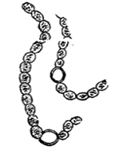
Which of the following statements is correct for the given figure?
A
Cell wall absent
B
Lacks membrane-bound organelles
C
Nucleolus present
D
Well-organized nucleus present
Solution
(B) The given figure represents a filamentous cyanobacterium (blue-green algae),specifically Nostoc,which contains heterocysts.
Cyanobacteria are prokaryotic organisms.
Prokaryotic cells lack membrane-bound organelles such as mitochondria,chloroplasts,and a well-defined nucleus.
Therefore,the correct statement is that it lacks membrane-bound organelles.
Cyanobacteria are prokaryotic organisms.
Prokaryotic cells lack membrane-bound organelles such as mitochondria,chloroplasts,and a well-defined nucleus.
Therefore,the correct statement is that it lacks membrane-bound organelles.
0 likes
View Solution320
EasyMCQ
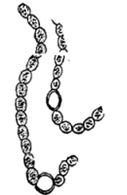
The organism shown in the given figure belongs to which kingdom according to the Whittaker classification system?
A
Protista
B
Fungi
C
Monera
D
Plantae
Solution
(C) The figure shows a filamentous cyanobacterium,specifically $Nostoc$.
$Nostoc$ is a prokaryotic organism that performs oxygenic photosynthesis.
According to the Whittaker five-kingdom classification system,all prokaryotic organisms are placed in the kingdom $Monera$.
Therefore,the correct option is $C$.
$Nostoc$ is a prokaryotic organism that performs oxygenic photosynthesis.
According to the Whittaker five-kingdom classification system,all prokaryotic organisms are placed in the kingdom $Monera$.
Therefore,the correct option is $C$.
0 likes
View Solution321
EasyMCQ
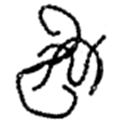
To which kingdom does the organism in the given figure belong?
A
Protista
B
Monera
C
Fungi
D
Plantae
Solution
(B) The figure shows a filamentous cyanobacterium (blue-green alga),such as Nostoc or Anabaena.
Cyanobacteria are prokaryotic organisms that perform oxygenic photosynthesis.
According to the five-kingdom classification system,all prokaryotic organisms are placed under the Kingdom Monera.
Cyanobacteria are prokaryotic organisms that perform oxygenic photosynthesis.
According to the five-kingdom classification system,all prokaryotic organisms are placed under the Kingdom Monera.
0 likes
View Solution322
MediumMCQ
Methanogens are present in the $\dots$ of the digestive tract of cattle.
A
Reticulum
B
Omasum
C
Rumen
D
Abomasum
Solution
(C) Methanogens are a group of anaerobic bacteria that produce methane $(CH_4)$ as a metabolic byproduct in hypoxic conditions. These bacteria are abundantly found in the $Rumen$ (a part of the stomach) of cattle. In the $Rumen$, these bacteria help in the breakdown of cellulose, which is a major component of the food eaten by cattle. Therefore, the correct option is $C$.
0 likes
View Solution323
EasyMCQ
Which bacteria are responsible for the digestion of cellulose in the food of ruminant animals?
A
Heterotrophs
B
Lactogens
C
Methanogens
D
Bacillus
Solution
(C) Ruminant animals,such as cattle,have a specialized stomach compartment called the rumen.
In the rumen,a group of bacteria known as methanogens is present.
These methanogens are anaerobic bacteria that break down cellulose,a complex carbohydrate found in plant cell walls,through fermentation.
This process produces methane $(CH_4)$ as a byproduct,which is why these bacteria are called methanogens.
In the rumen,a group of bacteria known as methanogens is present.
These methanogens are anaerobic bacteria that break down cellulose,a complex carbohydrate found in plant cell walls,through fermentation.
This process produces methane $(CH_4)$ as a byproduct,which is why these bacteria are called methanogens.
0 likes
View Solution324
MediumMCQ
Which group of organisms is both $CO_2$-fixing and $N_2$-fixing?
A
Anabaena,Nostoc,Oscillatoria
B
Anabaena,Azotobacter,Azospirillum
C
Oscillatoria,Azotobacter,Azospirillum
D
Oscillatoria,Azotobacter,Anabaena
Solution
(A) Cyanobacteria such as $Anabaena$,$Nostoc$,and $Oscillatoria$ are photosynthetic,meaning they fix $CO_2$ into organic compounds.
Additionally,these organisms possess specialized cells called heterocysts (in $Anabaena$ and $Nostoc$) or have the enzymatic machinery to fix atmospheric nitrogen $(N_2)$ into ammonia.
Therefore,these cyanobacteria are capable of both $CO_2$ fixation and $N_2$ fixation.
$Azotobacter$ and $Azospirillum$ are free-living nitrogen-fixing bacteria but are not photosynthetic $CO_2$ fixers.
Additionally,these organisms possess specialized cells called heterocysts (in $Anabaena$ and $Nostoc$) or have the enzymatic machinery to fix atmospheric nitrogen $(N_2)$ into ammonia.
Therefore,these cyanobacteria are capable of both $CO_2$ fixation and $N_2$ fixation.
$Azotobacter$ and $Azospirillum$ are free-living nitrogen-fixing bacteria but are not photosynthetic $CO_2$ fixers.
0 likes
View Solution325
MediumMCQ
What type of microorganism is $Oscillatoria$?
A
Heterotrophic
B
Autotrophic
C
Symbiotic
D
Parasitic
Solution
(B) $Oscillatoria$ is a genus of filamentous cyanobacteria (blue-green algae).
Cyanobacteria are photosynthetic organisms that contain chlorophyll $a$,allowing them to perform oxygenic photosynthesis.
Therefore,they are classified as autotrophic organisms because they synthesize their own food using light energy.
Cyanobacteria are photosynthetic organisms that contain chlorophyll $a$,allowing them to perform oxygenic photosynthesis.
Therefore,they are classified as autotrophic organisms because they synthesize their own food using light energy.
0 likes
View Solution326
MediumMCQ
What type of microorganism is $Nostoc$?
A
Heterotrophic
B
Symbiotic
C
Parasitic
D
Autotrophic
Solution
(D) $Nostoc$ is a genus of cyanobacteria (blue-green algae) that performs oxygenic photosynthesis.
Because it contains chlorophyll $a$ and other pigments,it can synthesize its own food using light energy.
Therefore,$Nostoc$ is classified as an autotrophic organism.
While some species of $Nostoc$ can live in symbiotic associations (e.g.,with $Anthoceros$ or $Cycas$),its fundamental nutritional mode is autotrophic.
Because it contains chlorophyll $a$ and other pigments,it can synthesize its own food using light energy.
Therefore,$Nostoc$ is classified as an autotrophic organism.
While some species of $Nostoc$ can live in symbiotic associations (e.g.,with $Anthoceros$ or $Cycas$),its fundamental nutritional mode is autotrophic.
0 likes
View Solution327
MediumMCQ
Which of the following statements is false?
A
Anabaena is an autotrophic microorganism.
B
Cyanobacteria produce biofertilizers in paddy fields.
C
Blue-green algae increase the organic matter in the soil.
D
Rhizobium bacteria are free-living.
Solution
(D) The correct answer is $D$.
$1$. $Anabaena$ is an autotrophic cyanobacterium capable of nitrogen fixation.
$2$. Cyanobacteria,such as $Anabaena$ and $Nostoc$,are widely used as biofertilizers in paddy fields to enhance soil fertility.
$3$. Blue-green algae (cyanobacteria) add organic matter to the soil and increase its fertility.
$4$. $Rhizobium$ is a symbiotic bacterium that lives in the root nodules of leguminous plants,not a free-living bacterium. Therefore,the statement that $Rhizobium$ is free-living is false.
$1$. $Anabaena$ is an autotrophic cyanobacterium capable of nitrogen fixation.
$2$. Cyanobacteria,such as $Anabaena$ and $Nostoc$,are widely used as biofertilizers in paddy fields to enhance soil fertility.
$3$. Blue-green algae (cyanobacteria) add organic matter to the soil and increase its fertility.
$4$. $Rhizobium$ is a symbiotic bacterium that lives in the root nodules of leguminous plants,not a free-living bacterium. Therefore,the statement that $Rhizobium$ is free-living is false.
0 likes
View Solution328
EasyMCQ
Which process involves the pili and fimbriae that arise from the surface of bacteria?
A
Transformation
B
Conjugation
C
Protection
D
Cell division
Solution
(B) Pili are elongated,tubular structures made of a special protein called pilin. They are primarily involved in the process of $Conjugation$,where they help in the transfer of genetic material between bacteria.
Fimbriae are small bristle-like fibers sprouting out of the cell. They are known to help bacteria attach to rocks in streams and also to the host tissues.
Among the given options,$Conjugation$ is the process directly associated with the function of pili.
Fimbriae are small bristle-like fibers sprouting out of the cell. They are known to help bacteria attach to rocks in streams and also to the host tissues.
Among the given options,$Conjugation$ is the process directly associated with the function of pili.
0 likes
View Solution329
EasyMCQ
What are bacteria that absorb the Gram stain called?
A
Gram-positive
B
Gram-negative
C
Gram-sensitive
D
Gram-resistant
Solution
(A) Bacteria are classified into two groups based on the differences in their cell envelopes and the manner in which they respond to the staining procedure developed by Christian Gram.
Bacteria that take up and retain the Gram stain (crystal violet) appear purple or blue under a microscope and are called Gram-positive bacteria.
Bacteria that do not retain the stain are called Gram-negative bacteria.
Bacteria that take up and retain the Gram stain (crystal violet) appear purple or blue under a microscope and are called Gram-positive bacteria.
Bacteria that do not retain the stain are called Gram-negative bacteria.
0 likes
View Solution330
MediumMCQ
Which bacteria are found only in a solitary form?
A
Bacillus-Coccus
B
Coccus-Vibrio
C
Bacillus-Vibrio
D
Vibrio-Spirillum
Solution
(D) Bacteria exhibit various shapes such as coccus (spherical),bacillus (rod-shaped),vibrio (comma-shaped),and spirillum (spiral).
Among these,$Vibrio$ and $Spirillum$ are typically found in a solitary (single) form.
$Coccus$ and $Bacillus$ forms often exist in chains or clusters (e.g.,$Streptococcus$,$Staphylococcus$,$Diplobacillus$).
Therefore,the pair consisting of $Vibrio$ and $Spirillum$ represents bacteria that are generally found in a solitary form.
Among these,$Vibrio$ and $Spirillum$ are typically found in a solitary (single) form.
$Coccus$ and $Bacillus$ forms often exist in chains or clusters (e.g.,$Streptococcus$,$Staphylococcus$,$Diplobacillus$).
Therefore,the pair consisting of $Vibrio$ and $Spirillum$ represents bacteria that are generally found in a solitary form.
0 likes
View Solution331
MediumMCQ
Assertion $A$: Some bacteria possess unique phenotypic characters.
Reason $R$: Many bacterial cells contain plasmid $DNA$ in addition to genomic $DNA$.
Which option is correct for Assertion $A$ and Reason $R$?
Reason $R$: Many bacterial cells contain plasmid $DNA$ in addition to genomic $DNA$.
Which option is correct for Assertion $A$ and Reason $R$?
A
$A$ and $R$ are both true and $R$ is the correct explanation of $A$.
B
$A$ and $R$ are both true but $R$ is not the correct explanation of $A$.
C
$A$ is true and $R$ is false.
D
$A$ is false and $R$ is true.
Solution
(B) Assertion $A$ is true because bacteria exhibit diverse phenotypic traits,such as antibiotic resistance or metabolic capabilities,often determined by extra-chromosomal genetic elements.
Reason $R$ is true because many bacteria contain small,circular,extra-chromosomal $DNA$ molecules known as plasmids,which are distinct from the genomic $DNA$.
However,while plasmids provide unique phenotypic characters (like antibiotic resistance),the presence of plasmid $DNA$ is not the sole reason for all unique phenotypic characters in bacteria. Therefore,$R$ is a true statement but does not provide the complete or direct explanation for the general phenotypic diversity mentioned in $A$.
Reason $R$ is true because many bacteria contain small,circular,extra-chromosomal $DNA$ molecules known as plasmids,which are distinct from the genomic $DNA$.
However,while plasmids provide unique phenotypic characters (like antibiotic resistance),the presence of plasmid $DNA$ is not the sole reason for all unique phenotypic characters in bacteria. Therefore,$R$ is a true statement but does not provide the complete or direct explanation for the general phenotypic diversity mentioned in $A$.
0 likes
View Solution332
EasyMCQ
On what basis are bacteria classified into Gram-positive and Gram-negative types?
A
Based on the mass of bacteria in grams
B
Based on the staining procedure developed by Gram
C
Based on the growth measurement method developed by Gram
D
Based on the ability to utilize nutrients in grams
Solution
(B) The classification of bacteria into Gram-positive and Gram-negative types is based on the differences in their cell wall structure and their response to the Gram staining procedure.
This technique was developed by the Danish bacteriologist Hans Christian Gram in $1884$.
Gram-positive bacteria retain the crystal violet stain and appear purple,while Gram-negative bacteria do not retain the stain and appear pink or red after counterstaining with safranin.
This technique was developed by the Danish bacteriologist Hans Christian Gram in $1884$.
Gram-positive bacteria retain the crystal violet stain and appear purple,while Gram-negative bacteria do not retain the stain and appear pink or red after counterstaining with safranin.
0 likes
View Solution333
EasyMCQ
Assertion $A$: Some bacteria are motile.
Reason $R$: Some bacteria have tubular pili or fimbriae extensions arising from their surface.
Which option is correct for Assertion $A$ and Reason $R$?
Reason $R$: Some bacteria have tubular pili or fimbriae extensions arising from their surface.
Which option is correct for Assertion $A$ and Reason $R$?
A
$A$ and $R$ are both true and $R$ is the correct explanation of $A$.
B
$A$ and $R$ are both true but $R$ is not the correct explanation of $A$.
C
$A$ is true and $R$ is false.
D
$A$ is false and $R$ is true.
Solution
(B) Assertion $A$ is true because many bacteria possess flagella,which are responsible for their motility.
Reason $R$ is also true because pili and fimbriae are surface structures found in many bacteria. However,pili and fimbriae are not involved in motility; they are primarily involved in attachment to surfaces or other bacteria (conjugation).
Therefore,while both statements are factually correct,the presence of pili or fimbriae does not explain why some bacteria are motile. Thus,$R$ is not the correct explanation of $A$.
Reason $R$ is also true because pili and fimbriae are surface structures found in many bacteria. However,pili and fimbriae are not involved in motility; they are primarily involved in attachment to surfaces or other bacteria (conjugation).
Therefore,while both statements are factually correct,the presence of pili or fimbriae does not explain why some bacteria are motile. Thus,$R$ is not the correct explanation of $A$.
0 likes
View Solution334
EasyMCQ
Where is the $Flagellin$ protein found?
A
In the basal body of the bacterial flagella
B
In the filament structure of the bacterial flagella
C
In the structure of the tubular pili
D
In the loose surface slime layer
Solution
(B) The bacterial flagellum is composed of three main parts: the basal body,the hook,and the filament.
The filament is the longest portion of the flagellum and extends from the cell surface to the exterior.
It is composed of a single type of protein called $Flagellin$,which is arranged in a helical manner to form a hollow cylinder.
Therefore,$Flagellin$ protein is specifically found in the filament structure of the bacterial flagella.
The filament is the longest portion of the flagellum and extends from the cell surface to the exterior.
It is composed of a single type of protein called $Flagellin$,which is arranged in a helical manner to form a hollow cylinder.
Therefore,$Flagellin$ protein is specifically found in the filament structure of the bacterial flagella.
0 likes
View Solution335
EasyMCQ
In which of the following are gas vacuoles found?
A
Blue-green algae
B
Mycoplasma
C
Pleuro-pneumonia-like organisms $(PPLO)$
D
Bacillus bacteria
Solution
(A) Gas vacuoles (also known as gas vesicles) are specialized structures found in certain prokaryotic organisms that allow them to regulate buoyancy in aquatic environments.
They are commonly found in blue-green algae (cyanobacteria),purple and green photosynthetic bacteria,and some halophilic archaea.
Among the given options,blue-green algae are the organisms that possess gas vacuoles to float at specific depths in water.
They are commonly found in blue-green algae (cyanobacteria),purple and green photosynthetic bacteria,and some halophilic archaea.
Among the given options,blue-green algae are the organisms that possess gas vacuoles to float at specific depths in water.
0 likes
View Solution336
EasyMCQ
Bacteria are not found in which of the following shapes?
A
Rod-shaped
B
Comma-shaped
C
Spiral-shaped
D
Tadpole-shaped
Solution
(D) Bacteria are classified into four basic shapes based on their morphology:
$1$. Bacillus (rod-shaped)
$2$. Coccus (spherical)
$3$. Vibrio (comma-shaped)
$4$. Spirillum (spiral-shaped)
Tadpole-shaped structures are typically associated with certain bacteriophages (viruses that infect bacteria),not bacteria themselves. Therefore,bacteria are not found in a tadpole shape.
$1$. Bacillus (rod-shaped)
$2$. Coccus (spherical)
$3$. Vibrio (comma-shaped)
$4$. Spirillum (spiral-shaped)
Tadpole-shaped structures are typically associated with certain bacteriophages (viruses that infect bacteria),not bacteria themselves. Therefore,bacteria are not found in a tadpole shape.
0 likes
View Solution337
EasyMCQ
Which of the following organisms are prokaryotic and unicellular?
A
Pleuro Pneumonia-Like Organisms $(PPLO)$
B
Blue-green algae
C
Mycoplasma
D
All of the above
Solution
(D) Prokaryotic cells are characterized by the absence of a membrane-bound nucleus and membrane-bound organelles.
$PPLO$ (Pleuro Pneumonia-Like Organisms) are the smallest known living cells and are prokaryotic.
Blue-green algae (Cyanobacteria) are photosynthetic prokaryotes.
Mycoplasma are bacteria that lack a cell wall and are also prokaryotic.
Since all the given options represent unicellular prokaryotic organisms,the correct answer is $D$.
$PPLO$ (Pleuro Pneumonia-Like Organisms) are the smallest known living cells and are prokaryotic.
Blue-green algae (Cyanobacteria) are photosynthetic prokaryotes.
Mycoplasma are bacteria that lack a cell wall and are also prokaryotic.
Since all the given options represent unicellular prokaryotic organisms,the correct answer is $D$.
0 likes
View Solution338
MediumMCQ
Which bacteria do not exist in colonial forms?
A
Bacillus-Coccus
B
Coccus-Vibrio
C
Bacillus-Vibrio
D
Vibrio-Spirillum
Solution
(D) Bacteria are classified based on their shapes: $Coccus$ (spherical),$Bacillus$ (rod-shaped),$Vibrio$ (comma-shaped),and $Spirillum$ (spiral-shaped).
Colonial forms are typically observed in $Coccus$ (e.g.,$Diplococcus$,$Streptococcus$,$Staphylococcus$) and $Bacillus$ (e.g.,$Diplobacillus$,$Streptobacillus$).
$Vibrio$ and $Spirillum$ are generally found as single,free-living cells and do not form colonies.
Therefore,the pair consisting of $Vibrio$ and $Spirillum$ represents bacteria that do not exist in colonial forms.
Colonial forms are typically observed in $Coccus$ (e.g.,$Diplococcus$,$Streptococcus$,$Staphylococcus$) and $Bacillus$ (e.g.,$Diplobacillus$,$Streptobacillus$).
$Vibrio$ and $Spirillum$ are generally found as single,free-living cells and do not form colonies.
Therefore,the pair consisting of $Vibrio$ and $Spirillum$ represents bacteria that do not exist in colonial forms.
0 likes
View Solution339
MediumMCQ
Assertion $A$: Bacillus and Coccus types of bacteria are found in colonial forms.
Reason $R$: In bacteria,cells formed by cell division remain surrounded by a secreted mucilaginous substance.
Which option is correct for Assertion $A$ and Reason $R$?
Reason $R$: In bacteria,cells formed by cell division remain surrounded by a secreted mucilaginous substance.
Which option is correct for Assertion $A$ and Reason $R$?
A
$A$ and $R$ are both true and $R$ is the correct explanation of $A$.
B
$A$ and $R$ are both true but $R$ is not the correct explanation of $A$.
C
$A$ is true and $R$ is false.
D
$A$ is false and $R$ is true.
Solution
(A) Assertion $A$ is true because many bacteria,such as those of the $Bacillus$ and $Coccus$ shapes,often remain attached to each other after cell division to form colonies or filaments.
Reason $R$ is also true because these cells are held together by a secreted mucilaginous or slimy sheath (glycocalyx) that surrounds the group of cells.
Since the colonial form is a direct result of the cells remaining attached due to this mucilaginous substance,$R$ is the correct explanation of $A$.
Reason $R$ is also true because these cells are held together by a secreted mucilaginous or slimy sheath (glycocalyx) that surrounds the group of cells.
Since the colonial form is a direct result of the cells remaining attached due to this mucilaginous substance,$R$ is the correct explanation of $A$.
0 likes
View Solution340
EasyMCQ
What is the shape of $Vibrio$ $cholerae$?
A
Columnar
B
Spiral
C
Spherical
D
Comma-shaped
Solution
(D) $Vibrio$ $cholerae$ is a Gram-negative,facultative anaerobic bacterium that causes cholera.
It is characterized by its distinct curved or comma-like shape.
Therefore,the correct option is $D$.
It is characterized by its distinct curved or comma-like shape.
Therefore,the correct option is $D$.
0 likes
View Solution341
EasyMCQ
Which of the following is $NOT$ a shape of bacteria?
A
Bacillus
B
Spherical
C
Spiral
D
Cylindrical
Solution
(D) Bacteria are classified based on their shapes into four basic categories:
$1$. Bacillus (rod-shaped)
$2$. Coccus (spherical)
$3$. Vibrio (comma-shaped)
$4$. Spirillum (spiral-shaped)
'Cylindrical' is not a standard morphological classification for bacteria,as 'Bacillus' already covers rod-shaped bacteria. Therefore,'Cylindrical' is the correct answer.
$1$. Bacillus (rod-shaped)
$2$. Coccus (spherical)
$3$. Vibrio (comma-shaped)
$4$. Spirillum (spiral-shaped)
'Cylindrical' is not a standard morphological classification for bacteria,as 'Bacillus' already covers rod-shaped bacteria. Therefore,'Cylindrical' is the correct answer.
0 likes
View Solution342
EasyMCQ
Bacteria that retain the Gram stain are known as:
A
Gram-absorbent
B
Gram-positive
C
Gram-negative
D
Gram-adsorbent
Solution
(B) Bacteria are classified into two groups based on the differences in their cell envelopes and the manner in which they respond to the staining procedure developed by Christian Gram.
Bacteria that take up and retain the Gram stain (crystal violet) appear purple or blue under a microscope and are called $Gram-positive$ bacteria.
Bacteria that do not retain the stain are called $Gram-negative$ bacteria.
Bacteria that take up and retain the Gram stain (crystal violet) appear purple or blue under a microscope and are called $Gram-positive$ bacteria.
Bacteria that do not retain the stain are called $Gram-negative$ bacteria.
0 likes
View Solution343
EasyMCQ
What are Gram-negative bacteria?
A
Bacteria with a negative charge
B
Bacteria with a positive charge
C
Bacteria that retain the Gram stain
D
Bacteria that do not retain the Gram stain
Solution
(D) Gram staining is a technique used to differentiate bacterial species into two large groups: Gram-positive and Gram-negative.
Gram-positive bacteria have a thick peptidoglycan layer in their cell wall,which retains the crystal violet stain even after washing with alcohol,appearing purple.
Gram-negative bacteria have a thinner peptidoglycan layer and an outer membrane,which causes them to lose the crystal violet stain during the decolorization process with alcohol.
Therefore,Gram-negative bacteria are those that do not retain the Gram stain (crystal violet) and appear pink or red when counterstained with safranin.
Gram-positive bacteria have a thick peptidoglycan layer in their cell wall,which retains the crystal violet stain even after washing with alcohol,appearing purple.
Gram-negative bacteria have a thinner peptidoglycan layer and an outer membrane,which causes them to lose the crystal violet stain during the decolorization process with alcohol.
Therefore,Gram-negative bacteria are those that do not retain the Gram stain (crystal violet) and appear pink or red when counterstained with safranin.
0 likes
View Solution344
MediumMCQ
Gas vacuoles are found in which of the following?
A
Blue-green algae
B
Fungi
C
Photosynthetic bacteria
D
Both $(A)$ and $(C)$
Solution
(D) Gas vacuoles (also known as gas vesicles) are specialized structures found in certain prokaryotic organisms.
They provide buoyancy to the cells,allowing them to float at specific depths in aquatic environments.
These structures are commonly observed in blue-green algae (cyanobacteria),purple bacteria,and green photosynthetic bacteria.
Since both blue-green algae and photosynthetic bacteria possess these structures,the correct answer is $(D)$.
They provide buoyancy to the cells,allowing them to float at specific depths in aquatic environments.
These structures are commonly observed in blue-green algae (cyanobacteria),purple bacteria,and green photosynthetic bacteria.
Since both blue-green algae and photosynthetic bacteria possess these structures,the correct answer is $(D)$.
0 likes
View Solution345
MediumMCQ
$S$ - Statement: Bacteria are divided into two groups based on the staining procedure developed by Gram.
$R$ - Reason: Bacteria that take up the Gram stain are called Gram-negative.
$R$ - Reason: Bacteria that take up the Gram stain are called Gram-negative.
A
$S$ and $R$ are both true,and $R$ is the correct explanation of $S$.
B
$S$ and $R$ are both true,but $R$ is not the correct explanation of $S$.
C
$S$ is true and $R$ is false.
D
$S$ is false and $R$ is true.
Solution
(C) The statement $S$ is true because Christian Gram developed the Gram staining technique to classify bacteria into two groups: Gram-positive and Gram-negative.
The reason $R$ is false because bacteria that take up and retain the Gram stain (crystal violet) are called Gram-positive,not Gram-negative. Gram-negative bacteria do not retain the crystal violet stain when washed with alcohol or acetone.
The reason $R$ is false because bacteria that take up and retain the Gram stain (crystal violet) are called Gram-positive,not Gram-negative. Gram-negative bacteria do not retain the crystal violet stain when washed with alcohol or acetone.
0 likes
View Solution346
MediumMCQ
$P -$ Assertion: Blue-green algae are prokaryotic algae.
$Q -$ Reason: Ribosomes in blue-green algae are of the $70S$ type.
$Q -$ Reason: Ribosomes in blue-green algae are of the $70S$ type.
A
$P$ (Assertion) and $Q$ (Reason) are both true,and $P$ is the correct explanation of $Q$.
B
$P$ (Assertion) and $Q$ (Reason) are both true,but $P$ is not the correct explanation of $Q$.
C
$P$ (Assertion) is true,but $Q$ (Reason) is false.
D
$P$ (Assertion) is false,but $Q$ (Reason) is true.
Solution
(A) Blue-green algae (Cyanobacteria) are prokaryotic organisms because they lack a well-defined nucleus and membrane-bound organelles.
They possess $70S$ ribosomes,which is a characteristic feature of prokaryotic cells.
Since both the assertion $(P)$ and the reason $(Q)$ are true,and the presence of $70S$ ribosomes is a fundamental reason why blue-green algae are classified as prokaryotes,$P$ is the correct explanation of $Q$.
They possess $70S$ ribosomes,which is a characteristic feature of prokaryotic cells.
Since both the assertion $(P)$ and the reason $(Q)$ are true,and the presence of $70S$ ribosomes is a fundamental reason why blue-green algae are classified as prokaryotes,$P$ is the correct explanation of $Q$.
0 likes
View Solution347
MediumMCQ
$P$ - Assertion: Some bacteria are Gram-negative.
$Q$ - Reason: Gram-negative bacteria do not retain the Gram stain.
$Q$ - Reason: Gram-negative bacteria do not retain the Gram stain.
A
$P$ and $Q$ are true,and $P$ is the correct explanation of $Q$.
B
$P$ and $Q$ are true,but $P$ is not the correct explanation of $Q$.
C
$P$ is true,but $Q$ is false.
D
$P$ is false,but $Q$ is true.
Solution
(A) Gram staining is a technique used to differentiate bacteria into two groups: Gram-positive and Gram-negative.
Gram-positive bacteria retain the crystal violet stain (appearing purple),while Gram-negative bacteria do not retain the crystal violet stain and take up the counterstain (safranin),appearing pink or red.
Therefore,the assertion that some bacteria are Gram-negative is true.
The reason that Gram-negative bacteria do not retain the Gram stain (crystal violet) is also true and serves as the definition/explanation for why they are classified as Gram-negative.
Thus,both statements are true,and $P$ explains $Q$.
Gram-positive bacteria retain the crystal violet stain (appearing purple),while Gram-negative bacteria do not retain the crystal violet stain and take up the counterstain (safranin),appearing pink or red.
Therefore,the assertion that some bacteria are Gram-negative is true.
The reason that Gram-negative bacteria do not retain the Gram stain (crystal violet) is also true and serves as the definition/explanation for why they are classified as Gram-negative.
Thus,both statements are true,and $P$ explains $Q$.
0 likes
View Solution348
MediumMCQ
The structure that participates in bacterial sexual reproduction is called .........
A
Flagella
B
Plasma membrane
C
Cell wall
D
Pili
Solution
(D) In bacteria,$Pili$ (singular: $Pilus$) are elongated,tubular structures made of a special protein called $pilin$. These structures are primarily involved in the process of conjugation,which is a form of bacterial sexual reproduction where genetic material is transferred from one bacterium to another. Therefore,$Pili$ play a crucial role in bacterial sexual reproduction.
0 likes
View Solution349
MediumMCQ
Which of the following contains gas vacuoles?
A
Mycoplasma
B
$PPLO$
C
Blue-green algae
D
Both $(A)$ and $(B)$
Solution
(C) Gas vacuoles (or gas vesicles) are specialized structures found in certain prokaryotic organisms,such as blue-green algae (cyanobacteria),purple and green photosynthetic bacteria,and some halophilic archaea.
They provide buoyancy to the cells,allowing them to float at specific depths in the water column where light and nutrient conditions are optimal.
Mycoplasma and $PPLO$ (Pleuropneumonia-like organisms) are the smallest known living cells and lack a cell wall; they do not possess gas vacuoles.
They provide buoyancy to the cells,allowing them to float at specific depths in the water column where light and nutrient conditions are optimal.
Mycoplasma and $PPLO$ (Pleuropneumonia-like organisms) are the smallest known living cells and lack a cell wall; they do not possess gas vacuoles.
0 likes
View Solution350
MediumMCQ
$A$: Bacillus and Coccus types of bacteria are found in colonial forms.
$R$: In bacteria,cells formed by cell division remain surrounded by a secreted slimy substance.
$R$: In bacteria,cells formed by cell division remain surrounded by a secreted slimy substance.
A
$A$ and $R$ are both true and $R$ is the correct explanation of $A$.
B
$A$ and $R$ are both true,but $R$ is not the correct explanation of $A$.
C
$A$ is true and $R$ is false.
D
$A$ is false and $R$ is true.
Solution
(A) Bacteria are prokaryotic organisms that can exist as single cells or in colonies.
Many bacteria,after cell division,do not separate completely but remain attached to each other due to the secretion of a slimy or mucilaginous substance (glycocalyx).
This results in the formation of colonial structures,such as chains (e.g.,in Streptococci) or clusters (e.g.,in Staphylococci).
Therefore,both the assertion $(A)$ and the reason $(R)$ are correct,and the reason $(R)$ correctly explains why bacteria are found in colonial forms.
Many bacteria,after cell division,do not separate completely but remain attached to each other due to the secretion of a slimy or mucilaginous substance (glycocalyx).
This results in the formation of colonial structures,such as chains (e.g.,in Streptococci) or clusters (e.g.,in Staphylococci).
Therefore,both the assertion $(A)$ and the reason $(R)$ are correct,and the reason $(R)$ correctly explains why bacteria are found in colonial forms.
0 likes
View SolutionBiological Classification — Monera (Prokaryotes) · Frequently Asked Questions
1Are these Biological Classification questions useful for JEE and NEET?
Yes. All questions in this section are mapped to JEE Main and NEET exam patterns. Previous year questions from JEE Main, NEET, GUJCET and state-level exams are included with full solutions.
2Can I switch to Hindi or Gujarati for these questions?
Yes. Use the language tabs in the hero section or the sidebar to view the same questions and solutions in English, Hindi or Gujarati.
3How do I generate a question paper from this subtopic?
Use the Vedclass Exam Paper Generator — select the chapter and subtopic, set difficulty, and generate Sets A, B, C, D automatically. First 3 chapters of every subject are free.
Vedclass Products
For Students
Vedclass Test Series
Mock tests in real JEE/NEET style with performance analysis. 5-day free trial.
Start Free TrialFor Teachers
Exam Paper Generator
Generate Set A/B/C/D papers from this chapter in 2 minutes. 3 chapters free.
Try FreeFor Institutes
Online Exam Module
Live online exams with unlimited students, 360° analytics & white-label branding.
See DemoFor Teachers & Institutes
Generate a Biological Classification Exam Paper in 2 Minutes
Select subtopic & difficulty — Sets A, B, C, D auto-generated with No Repeat logic.
First 3 chapters of every subject are free — no payment required.