
A English
Monera (Prokaryotes) Questions in English
Class 11 Biology · Biological Classification · Monera (Prokaryotes)
632+
Questions
English
Language
100%
With Solutions
Showing 32 of 632 questions in English
601
MediumMCQ
Heat-stable enzymes (active at $80^{\circ}C - 90^{\circ}C$) are typically isolated from which group of organisms?
A
Archaebacteria
B
Eubacteria
C
Fungi
D
Animals
Solution
(A) Heat-stable enzymes are isolated from organisms that thrive in extreme environmental conditions,such as high temperatures.
These organisms are known as thermophiles.
Archaebacteria,specifically those belonging to the group of thermophilic archaea,possess unique cell wall structures and specialized enzymes that allow them to remain functional at extremely high temperatures $(80^{\circ}C - 90^{\circ}C)$.
Therefore,the correct group is Archaebacteria.
These organisms are known as thermophiles.
Archaebacteria,specifically those belonging to the group of thermophilic archaea,possess unique cell wall structures and specialized enzymes that allow them to remain functional at extremely high temperatures $(80^{\circ}C - 90^{\circ}C)$.
Therefore,the correct group is Archaebacteria.
0 likes
View Solution602
EasyMCQ
What is the nutritional mode of $Nitrosomonas$,$Nitrococcus$,and $Nitrobacter$ bacteria?
A
Chemosynthetic autotrophs
B
Photosynthetic autotrophs
C
Chemosynthetic heterotrophs
D
Decomposers
Solution
(A) $Nitrosomonas$,$Nitrococcus$,and $Nitrobacter$ are nitrifying bacteria.
These bacteria obtain energy for their metabolic activities by oxidizing inorganic substances like ammonia and nitrites.
Since they synthesize their own food using energy derived from chemical reactions rather than sunlight,they are classified as chemosynthetic autotrophs.
These bacteria obtain energy for their metabolic activities by oxidizing inorganic substances like ammonia and nitrites.
Since they synthesize their own food using energy derived from chemical reactions rather than sunlight,they are classified as chemosynthetic autotrophs.
0 likes
View Solution603
EasyMCQ
Which kingdom do nitrogen-fixing organisms belong to?
A
Monera
B
Protista
C
Fungi
D
Plantae
Solution
(A) Nitrogen fixation is a biological process carried out by certain prokaryotic organisms. These organisms include bacteria such as $Rhizobium$,$Azotobacter$,and cyanobacteria like $Anabaena$ and $Nostoc$. All these organisms belong to the kingdom $Monera$ because they are unicellular prokaryotes.
0 likes
View Solution604
EasyMCQ
In which kingdom is $Methylophilus$ $methylotrophus$ classified?
A
Monera
B
Protista
C
Fungi
D
Animalia
Solution
(A) $Methylophilus$ $methylotrophus$ is a type of bacterium.
Bacteria are prokaryotic,unicellular organisms that belong to the kingdom $Monera$.
These organisms are often used as a source of Single Cell Protein $(SCP)$ due to their high rate of biomass production and protein content.
Bacteria are prokaryotic,unicellular organisms that belong to the kingdom $Monera$.
These organisms are often used as a source of Single Cell Protein $(SCP)$ due to their high rate of biomass production and protein content.
0 likes
View Solution605
MediumMCQ
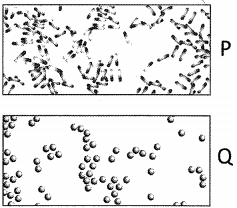
Identify the microorganisms shown in the image.
$P$ and $Q$
$P$ and $Q$
A
Spherical bacteria,Rod-shaped bacteria
B
Spherical viruses,Rod-shaped viruses
C
Rod-shaped bacteria,Spherical bacteria
D
Rod-shaped viruses,Spherical viruses
Solution
(C) In the provided image:
$P$ shows rod-shaped bacteria (bacilli).
$Q$ shows spherical bacteria (cocci).
Therefore,the correct identification is $P$ as rod-shaped bacteria and $Q$ as spherical bacteria.
$P$ shows rod-shaped bacteria (bacilli).
$Q$ shows spherical bacteria (cocci).
Therefore,the correct identification is $P$ as rod-shaped bacteria and $Q$ as spherical bacteria.
0 likes
View Solution606
EasyMCQ
In which kingdom are methanogens classified?
A
Monera
B
Protista
C
Animalia
D
Fungi
Solution
(A) Methanogens are a group of archaebacteria that produce methane as a metabolic byproduct in hypoxic conditions.
According to the $5$-kingdom classification system,archaebacteria are included under the kingdom $Monera$.
Therefore,methanogens are classified in the kingdom $Monera$.
According to the $5$-kingdom classification system,archaebacteria are included under the kingdom $Monera$.
Therefore,methanogens are classified in the kingdom $Monera$.
0 likes
View Solution607
EasyMCQ
Methanogens belong to which group of bacteria?
A
Eubacteria
B
Archaebacteria
C
Fungi
D
Protozoa
Solution
(B) Methanogens are a group of microorganisms that produce methane as a metabolic byproduct in hypoxic conditions. They belong to the domain Archaea and are classified under the group Archaebacteria. These bacteria are commonly found in the gut of ruminant animals like cows and buffaloes,where they help in the breakdown of cellulose.
0 likes
View Solution608
MediumMCQ
Where are methanogenic bacteria found?
A
Rumen of cattle
B
Marshy areas
C
Dung of cattle
D
All of the above
Solution
(D) Methanogens are a group of anaerobic bacteria that produce methane $(CH_4)$ as a metabolic byproduct in anoxic conditions.
$1$. They are commonly found in the rumen (a part of the stomach) of cattle,where they help in the breakdown of cellulose.
$2$. They are also present in marshy areas (waterlogged soils) where they decompose organic matter.
$3$. Since they are present in the rumen,they are also found in the dung of cattle,which is rich in these bacteria.
Therefore,all the given options are correct.
$1$. They are commonly found in the rumen (a part of the stomach) of cattle,where they help in the breakdown of cellulose.
$2$. They are also present in marshy areas (waterlogged soils) where they decompose organic matter.
$3$. Since they are present in the rumen,they are also found in the dung of cattle,which is rich in these bacteria.
Therefore,all the given options are correct.
0 likes
View Solution609
DifficultMCQ
Which of the following are nitrogen-fixing cyanobacteria?
A
Anabaena
B
Nostoc
C
Oscillatoria
D
All of the above
Solution
(D) Cyanobacteria are autotrophic microbes widely distributed in aquatic and terrestrial environments,many of which can fix atmospheric nitrogen.
$Anabaena$ and $Nostoc$ are well-known nitrogen-fixing cyanobacteria that contain specialized cells called heterocysts for this purpose.
$Oscillatoria$ is also a genus of filamentous cyanobacteria that contributes to nitrogen fixation in various ecosystems.
Therefore,all the given options are correct examples of nitrogen-fixing cyanobacteria.
$Anabaena$ and $Nostoc$ are well-known nitrogen-fixing cyanobacteria that contain specialized cells called heterocysts for this purpose.
$Oscillatoria$ is also a genus of filamentous cyanobacteria that contributes to nitrogen fixation in various ecosystems.
Therefore,all the given options are correct examples of nitrogen-fixing cyanobacteria.
0 likes
View Solution610
MediumMCQ
Choose the correct option regarding the diversity of prokaryotes.
A
The number of prokaryotic species is not known with certainty.
B
Conventional taxonomic methods are not suitable for identifying microbial species,and many species cannot be cultured in the laboratory.
C
If biochemical or molecular criteria are used for defining prokaryotic species,their diversity alone might run into millions.
D
All of the above.
Solution
(D) The diversity of prokaryotes is vast and difficult to estimate for several reasons:
$1$. The exact number of prokaryotic species remains unknown because many are yet to be discovered.
$2$. Conventional taxonomic methods (based on morphological characteristics) are often inadequate for identifying microorganisms.
$3$. $A$ large proportion of microbial species cannot be cultured in the laboratory using standard techniques.
$4$. When modern molecular or biochemical criteria (such as $16S$ $rRNA$ sequencing) are applied,the estimated diversity of prokaryotes is found to be in the millions.
Therefore,all the given statements are correct.
$1$. The exact number of prokaryotic species remains unknown because many are yet to be discovered.
$2$. Conventional taxonomic methods (based on morphological characteristics) are often inadequate for identifying microorganisms.
$3$. $A$ large proportion of microbial species cannot be cultured in the laboratory using standard techniques.
$4$. When modern molecular or biochemical criteria (such as $16S$ $rRNA$ sequencing) are applied,the estimated diversity of prokaryotes is found to be in the millions.
Therefore,all the given statements are correct.
0 likes
View Solution611
MediumMCQ
Read the following statements:
$A.$ Mango is included under order 'Poales'.
$B.$ Chemosynthetic autotrophic bacteria oxidize various inorganic substances such as nitrite and ammonia and use the released energy for their $ATP$ production.
$C.$ Members of Ascomycetes are parasitic only.
$D.$ In one citric acid cycle,$2 NADH_2$ and $1 FADH_2$ are formed.
$E.$ Pyruvic acid $+ CoA + NAD^+ \xrightarrow{\text{Pyruvate dehydrogenase}} \text{Acetyl } CoA + CO_2 + NADH + H^+$.
Choose the correct option:
$A.$ Mango is included under order 'Poales'.
$B.$ Chemosynthetic autotrophic bacteria oxidize various inorganic substances such as nitrite and ammonia and use the released energy for their $ATP$ production.
$C.$ Members of Ascomycetes are parasitic only.
$D.$ In one citric acid cycle,$2 NADH_2$ and $1 FADH_2$ are formed.
$E.$ Pyruvic acid $+ CoA + NAD^+ \xrightarrow{\text{Pyruvate dehydrogenase}} \text{Acetyl } CoA + CO_2 + NADH + H^+$.
Choose the correct option:
A
All statements are incorrect.
B
Only $A, C, D$ are correct.
C
Only $E$ is correct.
D
Only $B$ is correct.
Solution
(D) $A.$ Incorrect: Mango (Mangifera indica) is placed in the order 'Sapindales',not 'Poales'.
$B.$ Correct: Chemosynthetic autotrophic bacteria use the energy released from the oxidation of inorganic substances like nitrites and ammonia for $ATP$ production.
$C.$ Incorrect: Members of Ascomycetes can be saprophytic,decomposers,parasitic,or coprophilous.
$D.$ Incorrect: In one citric acid cycle,$3 NADH + H^+$,$1 FADH_2$,and $1 GTP$ (or $ATP$) are formed.
$E.$ Incorrect: The equation is technically incorrect because the product should be $NADH + H^+$,and the stoichiometry of the reaction is specific. While the reaction shown is the link reaction,the notation $NADH$ without $H^+$ as a product is incomplete,and the statement is generally considered incorrect in the context of standard biological equations.
$B.$ Correct: Chemosynthetic autotrophic bacteria use the energy released from the oxidation of inorganic substances like nitrites and ammonia for $ATP$ production.
$C.$ Incorrect: Members of Ascomycetes can be saprophytic,decomposers,parasitic,or coprophilous.
$D.$ Incorrect: In one citric acid cycle,$3 NADH + H^+$,$1 FADH_2$,and $1 GTP$ (or $ATP$) are formed.
$E.$ Incorrect: The equation is technically incorrect because the product should be $NADH + H^+$,and the stoichiometry of the reaction is specific. While the reaction shown is the link reaction,the notation $NADH$ without $H^+$ as a product is incomplete,and the statement is generally considered incorrect in the context of standard biological equations.
0 likes
View Solution612
EasyMCQ
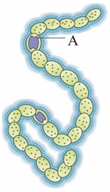
Identify '$A$' in the figure given below and to which process it is related?
A
Holdfast $-$ Nitrogen fixation
B
Heterocyst $-$ Nitrogen fixation
C
Heterocyst $-$ Production of methane
D
Pyrenoids $-$ Storage bodies
Solution
(B) The figure shows a filament of the cyanobacterium Nostoc.
The structure labeled '$A$' is a heterocyst.
Heterocysts are specialized,thick-walled cells found in certain filamentous cyanobacteria like Nostoc and Anabaena.
These cells provide an anaerobic environment suitable for the enzyme nitrogenase,which is essential for atmospheric nitrogen fixation.
Therefore,heterocysts are specialized for nitrogen fixation.
The structure labeled '$A$' is a heterocyst.
Heterocysts are specialized,thick-walled cells found in certain filamentous cyanobacteria like Nostoc and Anabaena.
These cells provide an anaerobic environment suitable for the enzyme nitrogenase,which is essential for atmospheric nitrogen fixation.
Therefore,heterocysts are specialized for nitrogen fixation.
0 likes
View Solution613
MediumMCQ
Chemosynthetic autotrophic bacteria like $Nitrosomonas$ obtain energy from $........$ for their $\text{ATP}$ production.
A
Oxidation of organic substances
B
Reduction of organic substances
C
Oxidation of inorganic substances
D
Reduction of inorganic substances
Solution
(C) Chemosynthetic autotrophic bacteria are organisms that synthesize their own food using energy derived from chemical reactions rather than sunlight.
These bacteria oxidize various inorganic substances such as nitrates,nitrites,or ammonia.
The energy released during the oxidation of these inorganic compounds is used to produce $\text{ATP}$ and to fix carbon dioxide into organic molecules.
For example,$Nitrosomonas$ oxidizes ammonia $(NH_3)$ to nitrite $(NO_2^-)$ to obtain energy.
Therefore,the correct option is $C$.
These bacteria oxidize various inorganic substances such as nitrates,nitrites,or ammonia.
The energy released during the oxidation of these inorganic compounds is used to produce $\text{ATP}$ and to fix carbon dioxide into organic molecules.
For example,$Nitrosomonas$ oxidizes ammonia $(NH_3)$ to nitrite $(NO_2^-)$ to obtain energy.
Therefore,the correct option is $C$.
0 likes
View Solution614
MediumMCQ
In the five-kingdom classification of Whittaker,kingdom $Monera$ is the group of microorganisms. Among the following statements,find out the incorrect statement for bacteria.
A
Bacteria are grouped under four categories based on their shape.
B
They are simple in structure,but complex in behaviour.
C
They show most extensive metabolic diversity.
D
The vast majority of bacteria are autotrophs.
Solution
(D) In the five-kingdom classification system,kingdom $Monera$ consists of prokaryotic organisms,primarily bacteria.
$1$. Bacteria are classified into four categories based on their shape: coccus (spherical),bacillus (rod-shaped),vibrio (comma-shaped),and spirillum (spiral).
$2$. Bacteria are simple in structure but exhibit complex behaviour,often showing the most extensive metabolic diversity among all organisms.
$3$. While some bacteria are autotrophic (photosynthetic or chemosynthetic),the vast majority of bacteria are heterotrophs,meaning they depend on other organisms or dead organic matter for food.
Therefore,the statement that the vast majority of bacteria are autotrophs is incorrect.
$1$. Bacteria are classified into four categories based on their shape: coccus (spherical),bacillus (rod-shaped),vibrio (comma-shaped),and spirillum (spiral).
$2$. Bacteria are simple in structure but exhibit complex behaviour,often showing the most extensive metabolic diversity among all organisms.
$3$. While some bacteria are autotrophic (photosynthetic or chemosynthetic),the vast majority of bacteria are heterotrophs,meaning they depend on other organisms or dead organic matter for food.
Therefore,the statement that the vast majority of bacteria are autotrophs is incorrect.
0 likes
View Solution615
MediumMCQ
Consider the following four statements $(A-D)$ and select the option which includes all the correct ones only.
$(A)$ Archaebacteria differ from other bacteria in having a different cell wall structure.
$(B)$ Bacteria as a group show the most extensive metabolic diversity.
$(C)$ All Eubacteria have chlorophyll ' $a$' pigment similar to green plants.
$(D)$ Mycoplasma can survive without oxygen.
$(A)$ Archaebacteria differ from other bacteria in having a different cell wall structure.
$(B)$ Bacteria as a group show the most extensive metabolic diversity.
$(C)$ All Eubacteria have chlorophyll ' $a$' pigment similar to green plants.
$(D)$ Mycoplasma can survive without oxygen.
A
Statements $B, C$ and $D$
B
Statements $A, C$ only
C
Statements $B, D$ only
D
Statements $A, B$ and $D$
Solution
(D) Statement $(A)$ is correct: Archaebacteria have a unique cell wall structure (lacking peptidoglycan) which allows them to survive in extreme conditions.
Statement $(B)$ is correct: Bacteria exhibit the most extensive metabolic diversity among all organisms,utilizing various inorganic and organic sources for energy.
Statement $(C)$ is incorrect: Only photosynthetic autotrophic bacteria (like Cyanobacteria) possess chlorophyll '$a$'. Other Eubacteria do not have this pigment.
Statement $(D)$ is correct: Mycoplasma are facultative anaerobes and can survive without oxygen.
Therefore,statements $(A), (B),$ and $(D)$ are correct.
Statement $(B)$ is correct: Bacteria exhibit the most extensive metabolic diversity among all organisms,utilizing various inorganic and organic sources for energy.
Statement $(C)$ is incorrect: Only photosynthetic autotrophic bacteria (like Cyanobacteria) possess chlorophyll '$a$'. Other Eubacteria do not have this pigment.
Statement $(D)$ is correct: Mycoplasma are facultative anaerobes and can survive without oxygen.
Therefore,statements $(A), (B),$ and $(D)$ are correct.
0 likes
View Solution616
EasyMCQ
Prokaryotic organisms are included under:
A
Monera
B
Protista
C
Animalia
D
Fungi
Solution
(A) According to the $5$-kingdom classification system proposed by $R.H. Whittaker$,organisms are classified into $5$ kingdoms: $Monera$,$Protista$,$Fungi$,$Plantae$,and $Animalia$.
Kingdom $Monera$ is the only kingdom that consists exclusively of prokaryotic organisms,such as bacteria and cyanobacteria.
Kingdoms $Protista$,$Fungi$,$Plantae$,and $Animalia$ consist of eukaryotic organisms.
Therefore,prokaryotic organisms are included under Kingdom $Monera$.
Kingdom $Monera$ is the only kingdom that consists exclusively of prokaryotic organisms,such as bacteria and cyanobacteria.
Kingdoms $Protista$,$Fungi$,$Plantae$,and $Animalia$ consist of eukaryotic organisms.
Therefore,prokaryotic organisms are included under Kingdom $Monera$.
0 likes
View Solution617
MediumMCQ
Find out the incorrect statement in the following $:-$
A
Heterotrophic bacteria are most abundant in nature.
B
Bacteria are very complex in structure and they have very simple behaviour.
C
Bacteria reproduce mainly by fission.
D
Archaebacteria differ from other bacteria in having a different cell wall structure.
Solution
(B) The incorrect statement is that bacteria have very simple behavior. In reality,bacteria are very simple in structure but exhibit very complex behavior. They show the most extensive metabolic diversity among all organisms. Heterotrophic bacteria are indeed the most abundant in nature. Bacteria primarily reproduce by fission under favorable conditions. Archaebacteria are distinct from other bacteria because their cell wall structure lacks peptidoglycan,which allows them to survive in extreme environments.
0 likes
View Solution618
EasyMCQ
$......$ bacteria oxidise various inorganic substances such as nitrites,ammonia and use the released energy for $\text{ATP}$ production $:-$
A
Photosynthetic heterotrophs
B
Heterotrophs
C
Chemosynthetic autotrophs
D
Photosynthetic autotrophs
Solution
(C) Chemosynthetic autotrophic bacteria are organisms that obtain energy for their metabolic activities by oxidizing various inorganic substances such as nitrates,nitrites,or ammonia.
This energy is then utilized for the production of $\text{ATP}$ and the synthesis of organic compounds from inorganic carbon sources like $\text{CO}_2$.
Unlike photosynthetic autotrophs,they do not rely on light energy.
Therefore,the correct answer is $C$.
This energy is then utilized for the production of $\text{ATP}$ and the synthesis of organic compounds from inorganic carbon sources like $\text{CO}_2$.
Unlike photosynthetic autotrophs,they do not rely on light energy.
Therefore,the correct answer is $C$.
0 likes
View Solution619
EasyMCQ
Which of the following monerans are found in the gut of cows and buffaloes?
A
Thermoacidophiles
B
Halophiles
C
Methanogens
D
Autotrophic bacteria
Solution
(C) Methanogens are a group of archaebacteria that are strictly anaerobic.
They are found in the gut of several ruminant animals such as cows and buffaloes.
These bacteria are responsible for the production of methane (biogas) from the dung of these animals.
Therefore,the correct option is $C$.
They are found in the gut of several ruminant animals such as cows and buffaloes.
These bacteria are responsible for the production of methane (biogas) from the dung of these animals.
Therefore,the correct option is $C$.
0 likes
View Solution620
EasyMCQ
Statement-$I$: Nuclear membrane is absent in bacteria.
Statement-$II$: Methanogens are responsible for the production of methane.
Statement-$II$: Methanogens are responsible for the production of methane.
A
Both statements $I$ and $II$ are correct
B
Only statement $I$ is incorrect
C
Both statements $I$ and $II$ are incorrect
D
Only statement $II$ is incorrect
Solution
(A) Statement-$I$ is correct because bacteria are prokaryotic organisms,and a defining characteristic of prokaryotes is the absence of a well-defined membrane-bound nucleus.
Statement-$II$ is correct because methanogens are a group of Archaebacteria found in anaerobic environments (like the gut of ruminant animals or marshy areas) that produce methane $(CH_4)$ as a metabolic byproduct.
Since both statements are factually accurate,the correct option is $A$.
Statement-$II$ is correct because methanogens are a group of Archaebacteria found in anaerobic environments (like the gut of ruminant animals or marshy areas) that produce methane $(CH_4)$ as a metabolic byproduct.
Since both statements are factually accurate,the correct option is $A$.
0 likes
View Solution621
EasyMCQ
Most extensive metabolic diversity is found in $:-$
A
Members of Protista
B
Members of Monera
C
Members of Fungi
D
Members of Plantae
Solution
(B) The kingdom $Monera$ consists of prokaryotic organisms,primarily bacteria.
These organisms exhibit the most extensive metabolic diversity among all living organisms.
They can be autotrophic (photosynthetic or chemosynthetic) or heterotrophic (saprophytic or parasitic).
Some bacteria can survive in extreme environments like hot springs,deserts,snow,and deep oceans,utilizing various chemical substances for their energy requirements,which is not observed to the same extent in other kingdoms.
These organisms exhibit the most extensive metabolic diversity among all living organisms.
They can be autotrophic (photosynthetic or chemosynthetic) or heterotrophic (saprophytic or parasitic).
Some bacteria can survive in extreme environments like hot springs,deserts,snow,and deep oceans,utilizing various chemical substances for their energy requirements,which is not observed to the same extent in other kingdoms.
0 likes
View Solution622
MediumMCQ
Find out the incorrect statement in the following $:-$
A
Heterotrophic bacteria are most abundant in nature.
B
Bacterial structure is very complex and they have very simple behaviour.
C
Bacteria reproduce mainly by fission.
D
Archaebacteria differ from other bacteria in having different cell wall structure.
Solution
(B) The incorrect statement is that bacterial structure is very complex and they have very simple behaviour. In reality,bacteria have a very simple structure but exhibit complex behaviour. Heterotrophic bacteria are indeed the most abundant in nature. Bacteria primarily reproduce by fission. Archaebacteria are distinct from other bacteria due to their unique cell wall structure,which allows them to survive in extreme environments.
0 likes
View Solution623
EasyMCQ
Rhizobia are . . . . . . shaped.
A
Spiral
B
Rod
C
Spherical
D
Comma
Solution
(B) Rhizobia are soil bacteria that fix nitrogen after becoming established inside root nodules of legumes. Morphologically,they are classified as $Rod$-shaped bacteria (bacilli).
0 likes
View Solution624
EasyMCQ
Given below are two statements. Based on them,select the correct option given below.
Statement $I$: $N_2$ fixing heterocystic cyanobacteria is Anabaena.
Statement $II$: $N_2$ fixing Anabaena is symbiotic with lichens.
Statement $I$: $N_2$ fixing heterocystic cyanobacteria is Anabaena.
Statement $II$: $N_2$ fixing Anabaena is symbiotic with lichens.
A
Statement $I$ is correct but Statement $II$ is incorrect.
B
Both Statement $I$ and Statement $II$ are correct.
C
Both Statement $I$ and Statement $II$ are incorrect.
D
Statement $I$ is incorrect but Statement $II$ is correct.
Solution
(A) Statement $I$ is correct because $Anabaena$ is a well-known heterocystous cyanobacterium capable of nitrogen fixation.
Statement $II$ is incorrect because $Anabaena$ typically forms symbiotic associations with plants like $Azolla$ (a water fern) and $Cycas$ (a gymnosperm),whereas cyanobacteria like $Nostoc$ or $Tolypothrix$ are more commonly associated with lichens.
Statement $II$ is incorrect because $Anabaena$ typically forms symbiotic associations with plants like $Azolla$ (a water fern) and $Cycas$ (a gymnosperm),whereas cyanobacteria like $Nostoc$ or $Tolypothrix$ are more commonly associated with lichens.
0 likes
View Solution625
EasyMCQ
In $Aulosira$,$Tolypothrix$ and $Nostoc$, . . . . . . are the sites for Nitrogen fixation.
A
vesicles
B
arbuscules
C
akinetes
D
heterocysts
Solution
(D) In cyanobacteria like $Aulosira$,$Tolypothrix$,and $Nostoc$,specialized cells called $heterocysts$ are responsible for nitrogen fixation.
These cells have thick walls and an anaerobic environment,which protects the enzyme $nitrogenase$ from oxygen,allowing it to function efficiently in the conversion of atmospheric nitrogen into ammonia.
These cells have thick walls and an anaerobic environment,which protects the enzyme $nitrogenase$ from oxygen,allowing it to function efficiently in the conversion of atmospheric nitrogen into ammonia.
0 likes
View Solution626
EasyMCQ
Match Column-$I$ with Column-$II$ and choose the correct option given below:
| Column-$I$ (Bacteria) | Column-$II$ (Shape) |
|---|---|
| $A$. Coccus | $iii$. Spherical |
| $B$. Bacillus | $i$. Rod-shaped |
| $C$. Vibrio | $iv$. Comma-shaped |
| $D$. Spirillum | $ii$. Spiral |
A
$A-iii, B-ii, C-iv, D-i$
B
$A-iv, B-iii, C-ii, D-i$
C
$A-iv, B-i, C-ii, D-iii$
D
$A-iii, B-i, C-iv, D-ii$
Solution
(D) The shapes of bacteria are classified based on their morphology:
$1$. $A$. Coccus: These are spherical or oval-shaped bacteria.
$2$. $B$. Bacillus: These are rod-shaped bacteria.
$3$. $C$. Vibrio: These are comma-shaped bacteria.
$4$. $D$. Spirillum: These are spiral-shaped bacteria.
Therefore,the correct matching is $A-iii, B-i, C-iv, D-ii$.
$1$. $A$. Coccus: These are spherical or oval-shaped bacteria.
$2$. $B$. Bacillus: These are rod-shaped bacteria.
$3$. $C$. Vibrio: These are comma-shaped bacteria.
$4$. $D$. Spirillum: These are spiral-shaped bacteria.
Therefore,the correct matching is $A-iii, B-i, C-iv, D-ii$.
0 likes
View Solution627
EasyMCQ
The cell wall-less prokaryote among the following is:
A
Cyanobacteria
B
Mycoplasma
C
Bacteria
D
Blue-Green Algae
Solution
(B) $Mycoplasma$ is the correct answer.
$Mycoplasma$ are the smallest living cells known and are unique because they completely lack a cell wall,which makes them naturally resistant to antibiotics like penicillin that target cell wall synthesis.
$Mycoplasma$ are the smallest living cells known and are unique because they completely lack a cell wall,which makes them naturally resistant to antibiotics like penicillin that target cell wall synthesis.
0 likes
View Solution628
EasyMCQ
Which of the following options shows the characteristics of $Mycoplasma$?
A
Smallest living cell without cell wall,survives with oxygen.
B
Smallest living cell with cell wall,survives with oxygen.
C
Smallest living cell without cell wall,survives without oxygen.
D
Smallest living cell with cell wall,survives without oxygen.
Solution
(C) $Mycoplasma$ are the smallest known living cells.
They completely lack a cell wall,which makes them naturally resistant to antibiotics that target cell wall synthesis (like penicillin).
They are facultative anaerobes,meaning they can survive without oxygen.
Therefore,option $C$ is the correct description.
They completely lack a cell wall,which makes them naturally resistant to antibiotics that target cell wall synthesis (like penicillin).
They are facultative anaerobes,meaning they can survive without oxygen.
Therefore,option $C$ is the correct description.
0 likes
View Solution629
EasyMCQ
The organisms which completely lack a cell wall and can live without oxygen are
A
mycoplasmas
B
archaebacteria
C
methanogens
D
thermoacidophiles
Solution
(A) $Mycoplasmas$ are the smallest living cells known and they completely lack a cell wall.
They are pleomorphic,meaning they can change their shape.
Many $Mycoplasmas$ are pathogenic in animals and plants.
They are facultative anaerobes,meaning they can survive and grow in the absence of oxygen.
They are pleomorphic,meaning they can change their shape.
Many $Mycoplasmas$ are pathogenic in animals and plants.
They are facultative anaerobes,meaning they can survive and grow in the absence of oxygen.
0 likes
View Solution630
EasyMCQ
Which of the following statements is not true for $Nostoc$?
A
It is prokaryotic
B
It is autotrophic
C
It is filamentous
D
It is macroscopic
Solution
(D) is the correct answer.
$Nostoc$ is a genus of cyanobacteria that is prokaryotic,autotrophic,and filamentous.
However,it is not macroscopic.
Although it forms colonies that appear as gelatinous masses visible to the naked eye,these masses are composed of microscopic filaments of cells.
Therefore,the individual organism $Nostoc$ remains microscopic.
$Nostoc$ is a genus of cyanobacteria that is prokaryotic,autotrophic,and filamentous.
However,it is not macroscopic.
Although it forms colonies that appear as gelatinous masses visible to the naked eye,these masses are composed of microscopic filaments of cells.
Therefore,the individual organism $Nostoc$ remains microscopic.
0 likes
View Solution631
EasyMCQ
$A$ bacterium is capable of withstanding extreme heat,dryness,and toxic chemicals. This indicates that it is probably able to form
A
endotoxins
B
endogenous buds
C
a thick peptidoglycan wall
D
endospores
Solution
(D) endospores.
Endospores are highly resistant,dormant structures formed by certain bacteria under unfavorable environmental conditions.
These structures are capable of withstanding extreme heat,radiation,desiccation (dryness),and toxic chemicals.
They protect the bacterial $DNA$ and essential cellular components until favorable conditions return,allowing the bacterium to germinate and resume normal activity.
Endospores are highly resistant,dormant structures formed by certain bacteria under unfavorable environmental conditions.
These structures are capable of withstanding extreme heat,radiation,desiccation (dryness),and toxic chemicals.
They protect the bacterial $DNA$ and essential cellular components until favorable conditions return,allowing the bacterium to germinate and resume normal activity.
0 likes
View Solution632
EasyMCQ
Which of the following groups of algae does not have eukaryotic organization?
A
Blue-green algae
B
Green algae
C
Golden brown algae
D
Red algae
Solution
(A) The correct answer is $A$.
Blue-green algae (Cyanobacteria) are prokaryotic organisms.
They lack a well-defined nucleus and membrane-bound cell organelles,which are characteristic features of eukaryotic cells.
In contrast,Green algae,Golden brown algae,and Red algae are all eukaryotic organisms.
Blue-green algae (Cyanobacteria) are prokaryotic organisms.
They lack a well-defined nucleus and membrane-bound cell organelles,which are characteristic features of eukaryotic cells.
In contrast,Green algae,Golden brown algae,and Red algae are all eukaryotic organisms.
0 likes
View SolutionBiological Classification — Monera (Prokaryotes) · Frequently Asked Questions
1Are these Biological Classification questions useful for JEE and NEET?
Yes. All questions in this section are mapped to JEE Main and NEET exam patterns. Previous year questions from JEE Main, NEET, GUJCET and state-level exams are included with full solutions.
2Can I switch to Hindi or Gujarati for these questions?
Yes. Use the language tabs in the hero section or the sidebar to view the same questions and solutions in English, Hindi or Gujarati.
3How do I generate a question paper from this subtopic?
Use the Vedclass Exam Paper Generator — select the chapter and subtopic, set difficulty, and generate Sets A, B, C, D automatically. First 3 chapters of every subject are free.
Vedclass Products
For Students
Vedclass Test Series
Mock tests in real JEE/NEET style with performance analysis. 5-day free trial.
Start Free TrialFor Teachers
Exam Paper Generator
Generate Set A/B/C/D papers from this chapter in 2 minutes. 3 chapters free.
Try FreeFor Institutes
Online Exam Module
Live online exams with unlimited students, 360° analytics & white-label branding.
See DemoFor Teachers & Institutes
Generate a Biological Classification Exam Paper in 2 Minutes
Select subtopic & difficulty — Sets A, B, C, D auto-generated with No Repeat logic.
First 3 chapters of every subject are free — no payment required.