
A English
Fungi (Multicellular decomposers) Questions in English
Class 11 Biology · Biological Classification · Fungi (Multicellular decomposers)
511+
Questions
English
Language
100%
With Solutions
Showing 50 of 511 questions in English
351
MediumMCQ
Which pair of the following belongs to $Basidiomycetes$?
A
puffballs and $Claviceps$
B
$Albugo$ and $Mucor$
C
$Penicillium$ and mushrooms
D
$Puccinia$ and puffballs
Solution
(D) The class $Basidiomycetes$ includes mushrooms,bracket fungi,puffballs,and smut fungi (e.g.,$Puccinia$).
$Claviceps$ belongs to $Ascomycetes$.
$Albugo$ belongs to $Phycomycetes$ (or $Oomycetes$).
$Mucor$ belongs to $Phycomycetes$ (or $Zygomycetes$).
$Penicillium$ belongs to $Ascomycetes$.
Therefore,the pair consisting of $Puccinia$ and puffballs belongs to $Basidiomycetes$.
$Claviceps$ belongs to $Ascomycetes$.
$Albugo$ belongs to $Phycomycetes$ (or $Oomycetes$).
$Mucor$ belongs to $Phycomycetes$ (or $Zygomycetes$).
$Penicillium$ belongs to $Ascomycetes$.
Therefore,the pair consisting of $Puccinia$ and puffballs belongs to $Basidiomycetes$.
0 likes
View Solution352
EasyMCQ
Glycogen is the stored food in :
A
Porphyra
B
Fucus
C
Gracillaria
D
Fungi
Solution
(D) In biological organisms,the storage form of carbohydrates varies significantly.
$Porphyra$,$Fucus$,and $Gracillaria$ are types of algae (Red and Brown algae) that typically store food as starch (floridean starch in red algae and laminarin/mannitol in brown algae).
$Fungi$ are heterotrophic organisms that store their reserve food material in the form of $Glycogen$ and oil globules.
Therefore,the correct answer is $D$.
$Porphyra$,$Fucus$,and $Gracillaria$ are types of algae (Red and Brown algae) that typically store food as starch (floridean starch in red algae and laminarin/mannitol in brown algae).
$Fungi$ are heterotrophic organisms that store their reserve food material in the form of $Glycogen$ and oil globules.
Therefore,the correct answer is $D$.
0 likes
View Solution353
MediumMCQ
Mucor is a
A
Ascomycetes
B
Phycomycetes
C
Mycorrhiza
D
Basidiomycetes
Solution
(B) $Mucor$ is a genus of fungi that belongs to the class $Phycomycetes$ (also known as $Zygomycetes$).
These fungi are characterized by having aseptate and coenocytic mycelium.
They reproduce asexually by forming sporangiospores and sexually by forming zygospores.
Therefore,the correct classification for $Mucor$ is $Phycomycetes$.
These fungi are characterized by having aseptate and coenocytic mycelium.
They reproduce asexually by forming sporangiospores and sexually by forming zygospores.
Therefore,the correct classification for $Mucor$ is $Phycomycetes$.
0 likes
View Solution354
MediumMCQ
Absorptive heterotrophic nutrition is exhibited by .....
A
Algae
B
Fungi
C
Bryophytes
D
Pteridophytes
Solution
(B) Absorptive heterotrophic nutrition is a characteristic feature of $Fungi$.
$Fungi$ are heterotrophic organisms that obtain their nutrients by absorbing dissolved organic compounds from their environment.
They secrete digestive enzymes into their surroundings,which break down complex organic matter into simpler substances,which are then absorbed through their cell walls.
In contrast,$Algae$,$Bryophytes$,and $Pteridophytes$ are primarily autotrophic,as they contain chlorophyll and perform photosynthesis.
$Fungi$ are heterotrophic organisms that obtain their nutrients by absorbing dissolved organic compounds from their environment.
They secrete digestive enzymes into their surroundings,which break down complex organic matter into simpler substances,which are then absorbed through their cell walls.
In contrast,$Algae$,$Bryophytes$,and $Pteridophytes$ are primarily autotrophic,as they contain chlorophyll and perform photosynthesis.
0 likes
View Solution355
EasyMCQ
Plant diseases caused by $Ustilago$ are called smuts because ......
A
They are parasitic on cereals.
B
The mycelium is black.
C
They develop a black mass of spores.
D
The affected parts become completely black.
Solution
(C) The genus $Ustilago$ belongs to the class $Basidiomycetes$ and is known for causing smut diseases in various plants,particularly cereals.
These fungi are called 'smuts' because they produce large quantities of dark-colored,powdery teliospores (resting spores) that replace the host tissues.
This accumulation of black,soot-like spores gives the infected plant parts a charred or 'smutty' appearance.
Therefore,the correct reason is that they develop a black mass of spores.
These fungi are called 'smuts' because they produce large quantities of dark-colored,powdery teliospores (resting spores) that replace the host tissues.
This accumulation of black,soot-like spores gives the infected plant parts a charred or 'smutty' appearance.
Therefore,the correct reason is that they develop a black mass of spores.
0 likes
View Solution356
MediumMCQ
White rust disease is caused by $....$.
A
Claviceps
B
Alternaria
C
Phytophthora
D
Albugo candida
Solution
(D) White rust of crucifers is a common plant disease caused by the parasitic fungus $Albugo \ candida$ (also known as $Cystopus \ candidus$).
It belongs to the class Oomycetes within the kingdom Fungi.
This pathogen infects members of the Brassicaceae family,such as mustard and radish,leading to the formation of white,powdery pustules on the leaves and stems.
It belongs to the class Oomycetes within the kingdom Fungi.
This pathogen infects members of the Brassicaceae family,such as mustard and radish,leading to the formation of white,powdery pustules on the leaves and stems.
0 likes
View Solution357
MediumMCQ
$Puccinia$ produces which of the following on wheat leaves?
A
Uredia and Aecia on wheat leaves
B
Uredia and Telia on wheat leaves
C
Uredia and Aecia on barberry leaves
D
Uredia and Pycnia on barberry leaves
Solution
(B) $Puccinia$ $graminis$ $tritici$ is a heteroecious fungus that completes its life cycle on two hosts: wheat and barberry.
On wheat leaves,it produces two types of spores: urediospores (in uredia) and teliospores (in telia).
On barberry leaves,it produces pycniospores (in pycnia) and aeciospores (in aecia).
Therefore,the structures produced on wheat leaves are uredia and telia.
On wheat leaves,it produces two types of spores: urediospores (in uredia) and teliospores (in telia).
On barberry leaves,it produces pycniospores (in pycnia) and aeciospores (in aecia).
Therefore,the structures produced on wheat leaves are uredia and telia.
0 likes
View Solution358
MediumMCQ
Black rust in wheat is caused by $..........$.
A
$Puccinia$
B
$Mucor$
C
$Aspergillus$
D
$Rhizopus$
Solution
(A) Black rust of wheat is a fungal disease caused by the pathogen $Puccinia \, graminis \, tritici$.
It belongs to the class Basidiomycetes.
This fungus infects wheat plants, leading to the formation of reddish-brown (rust-colored) pustules on the leaves and stems, which eventually turn black as the teliospores develop.
Therefore, the correct option is $A$.
It belongs to the class Basidiomycetes.
This fungus infects wheat plants, leading to the formation of reddish-brown (rust-colored) pustules on the leaves and stems, which eventually turn black as the teliospores develop.
Therefore, the correct option is $A$.
0 likes
View Solution359
EasyMCQ
The stored food material in fungi is $........$.
A
Glycogen
B
Starch
C
Sucrose
D
Glucose
Solution
(A) Fungi are heterotrophic organisms that obtain nutrients through absorption.
Unlike plants,which store food as starch,fungi store their reserve food material in the form of $Glycogen$ and oil droplets.
$Glycogen$ is a polysaccharide of glucose,similar to the storage form found in animals.
Unlike plants,which store food as starch,fungi store their reserve food material in the form of $Glycogen$ and oil droplets.
$Glycogen$ is a polysaccharide of glucose,similar to the storage form found in animals.
0 likes
View Solution360
MediumMCQ
The adhesive pad of a fungus enters the host with the help of ........
A
Mechanical pressure and enzymes
B
Hooks and suckers
C
Softening by enzymes
D
Mechanical pressure only
Solution
(A) Fungal pathogens often use specialized structures like adhesive pads or appressoria to attach to the host surface.
To penetrate the host cell wall,the fungus exerts mechanical pressure through the growth of the infection peg and simultaneously secretes cell wall-degrading enzymes (such as cellulases,pectinases,and proteases).
These enzymes soften the host cell wall,making it easier for the mechanical pressure to force the penetration peg into the host tissue.
Therefore,the process involves both mechanical pressure and enzymatic action.
To penetrate the host cell wall,the fungus exerts mechanical pressure through the growth of the infection peg and simultaneously secretes cell wall-degrading enzymes (such as cellulases,pectinases,and proteases).
These enzymes soften the host cell wall,making it easier for the mechanical pressure to force the penetration peg into the host tissue.
Therefore,the process involves both mechanical pressure and enzymatic action.
0 likes
View Solution361
MediumMCQ
Which of the following environmental conditions are required for the maximum growth of $Mucor$ on a piece of bread?
$(i)$ Temperature of about $25^{\circ}C$
$(ii)$ Temperature of about $5^{\circ}C$
$(iii)$ Relative humidity of about $5\%$
$(iv)$ Relative humidity of about $95\%$
$(v)$ Shady place
$(vi)$ Brightly lit place
Choose the correct option from the following.
$(i)$ Temperature of about $25^{\circ}C$
$(ii)$ Temperature of about $5^{\circ}C$
$(iii)$ Relative humidity of about $5\%$
$(iv)$ Relative humidity of about $95\%$
$(v)$ Shady place
$(vi)$ Brightly lit place
Choose the correct option from the following.
A
Only $(i), (iv)$ and $(v)$
B
Only $(i), (iii)$ and $(vi)$
C
Only $(ii), (iii)$ and $(vi)$
D
Only $(i), (iii)$ and $(v)$
Solution
(A) $Mucor$ is a saprophytic fungus that grows well on moist,organic matter like bread.
$1$. Temperature: Fungi generally prefer moderate temperatures for growth. $25^{\circ}C$ is an optimal temperature for $Mucor$ growth,whereas $5^{\circ}C$ is too cold.
$2$. Humidity: Fungi require high moisture content to thrive. $A$ relative humidity of $95\%$ provides the necessary moisture,while $5\%$ is too dry.
$3$. Light: Fungi are heterotrophs and do not require light for photosynthesis. They grow better in dark or shady places rather than brightly lit areas.
Therefore,the conditions $(i)$,$(iv)$,and $(v)$ are ideal for the growth of $Mucor$.
$1$. Temperature: Fungi generally prefer moderate temperatures for growth. $25^{\circ}C$ is an optimal temperature for $Mucor$ growth,whereas $5^{\circ}C$ is too cold.
$2$. Humidity: Fungi require high moisture content to thrive. $A$ relative humidity of $95\%$ provides the necessary moisture,while $5\%$ is too dry.
$3$. Light: Fungi are heterotrophs and do not require light for photosynthesis. They grow better in dark or shady places rather than brightly lit areas.
Therefore,the conditions $(i)$,$(iv)$,and $(v)$ are ideal for the growth of $Mucor$.
0 likes
View Solution362
MediumMCQ
Which of the following pairs belongs to the class $Basidiomycetes$?
A
Bird's nest fungi and Puffballs
B
Puffballs and $Claviceps$
C
$Peziza$ and Stinkhorns
D
$Morchella$ and Mushrooms
Solution
(A) The class $Basidiomycetes$ includes mushrooms,bracket fungi,puffballs,and bird's nest fungi.
$Claviceps$,$Peziza$,and $Morchella$ belong to the class $Ascomycetes$.
Therefore,the pair consisting of bird's nest fungi and puffballs is correctly classified under $Basidiomycetes$.
$Claviceps$,$Peziza$,and $Morchella$ belong to the class $Ascomycetes$.
Therefore,the pair consisting of bird's nest fungi and puffballs is correctly classified under $Basidiomycetes$.
0 likes
View Solution363
EasyMCQ
Ergot of rye is caused by a species of which of the following?
A
Phytophthora
B
Uncinula
C
Ustilago
D
Claviceps
Solution
(D) Ergot of rye is a plant disease caused by the fungus $Claviceps \text{ purpurea}$.
This fungus belongs to the class Ascomycetes.
It infects the ovaries of rye and other cereal grasses, replacing the grain with a dark, hard fungal mass known as an ergot or sclerotium.
These sclerotia contain toxic alkaloids that can cause ergotism in humans and animals if consumed.
This fungus belongs to the class Ascomycetes.
It infects the ovaries of rye and other cereal grasses, replacing the grain with a dark, hard fungal mass known as an ergot or sclerotium.
These sclerotia contain toxic alkaloids that can cause ergotism in humans and animals if consumed.
0 likes
View Solution364
MediumMCQ
Which pair of disease and its causative organism is incorrectly matched?
A
Late blight of potato $-$ Alternaria solani
B
Black rust of wheat $-$ Puccinia graminis
C
Loose smut of wheat $-$ Ustilago nuda
D
Root knot of vegetables $-$ Meloidogyne sp.
Solution
(A) The correct answer is $A$.
Late blight of potato is caused by the oomycete $Phytophthora infestans$, not $Alternaria solani$.
$Alternaria solani$ causes early blight of potato.
Black rust of wheat is caused by $Puccinia graminis$, which is a correct match.
Loose smut of wheat is caused by $Ustilago nuda$, which is a correct match.
Root knot of vegetables is caused by the nematode $Meloidogyne sp.$, which is a correct match.
Late blight of potato is caused by the oomycete $Phytophthora infestans$, not $Alternaria solani$.
$Alternaria solani$ causes early blight of potato.
Black rust of wheat is caused by $Puccinia graminis$, which is a correct match.
Loose smut of wheat is caused by $Ustilago nuda$, which is a correct match.
Root knot of vegetables is caused by the nematode $Meloidogyne sp.$, which is a correct match.
0 likes
View Solution365
EasyMCQ
The imperfect fungi which are decomposers of litter and help in mineral cycling belong to:
A
Deuteromycetes
B
Basidiomycetes
C
Phycomycetes
D
Ascomycetes
Solution
(A) The fungi belonging to the class $Deuteromycetes$ are commonly known as 'imperfect fungi' because only their asexual or vegetative phases are known.
Many members of this group are saprophytes or parasites,while a large number of them are decomposers of litter and help in mineral cycling.
Therefore,the correct option is $A$.
Many members of this group are saprophytes or parasites,while a large number of them are decomposers of litter and help in mineral cycling.
Therefore,the correct option is $A$.
0 likes
View Solution366
MediumMCQ
Select the incorrect statement.
A
$Penicillium$ is multicellular and produces antibiotics.
B
$Neurospora$ is used in the study of biochemical genetics.
C
Morels and truffles are poisonous mushrooms.
D
Yeast is unicellular and useful in fermentation.
Solution
(C) The incorrect statement is that morels and truffles are poisonous mushrooms.
In reality,morels and truffles are edible fungi belonging to the class Ascomycetes and are considered delicacies.
$Penicillium$ is a multicellular fungus known for producing the antibiotic penicillin.
$Neurospora$ is widely used in biochemical and genetic research.
Yeast $(Saccharomyces)$ is a unicellular fungus essential for the process of fermentation.
In reality,morels and truffles are edible fungi belonging to the class Ascomycetes and are considered delicacies.
$Penicillium$ is a multicellular fungus known for producing the antibiotic penicillin.
$Neurospora$ is widely used in biochemical and genetic research.
Yeast $(Saccharomyces)$ is a unicellular fungus essential for the process of fermentation.
0 likes
View Solution367
MediumMCQ
Which of the following is incorrect regarding fungi?
A
They are eukaryotic.
B
All fungi possess a cell wall made of pure cellulose.
C
They are heterotrophic.
D
They are unicellular and multicellular.
Solution
(B) Fungi are eukaryotic organisms that are heterotrophic in nature. They can be unicellular (e.g.,yeast) or multicellular. The cell wall of fungi is primarily composed of chitin,not pure cellulose. Cellulose is the primary component of plant cell walls. Therefore,the statement that all fungi possess a cell wall made of pure cellulose is incorrect.
0 likes
View Solution368
EasyMCQ
The main component of the cell wall of most fungi is ...........
A
Peptidoglycan
B
Cellulose
C
Hemicellulose
D
Chitin
Solution
(D) The cell wall of fungi is distinct from that of plants. While plant cell walls are primarily composed of cellulose,the cell wall of most fungi is composed of a complex polysaccharide called $Chitin$. $Chitin$ is a polymer of $N-acetylglucosamine$ units. Peptidoglycan is found in the cell walls of bacteria,and cellulose/hemicellulose are primary components of plant cell walls. Therefore,the correct option is $D$.
0 likes
View Solution369
EasyMCQ
In the sporangium of $..........$,a specialized structure called columella is found.
A
$Ulothrix$
B
$Rhizopus$
C
$Spirogyra$
D
None of the above
Solution
(B) The columella is a sterile,dome-shaped structure found inside the sporangium of certain fungi,particularly in the order $Mucorales$.
$Rhizopus$,commonly known as the bread mold,belongs to this group.
In $Rhizopus$,the sporangium contains a central,sterile,dome-shaped portion known as the columella,which provides support and helps in the dispersal of spores.
$Rhizopus$,commonly known as the bread mold,belongs to this group.
In $Rhizopus$,the sporangium contains a central,sterile,dome-shaped portion known as the columella,which provides support and helps in the dispersal of spores.
0 likes
View Solution370
MediumMCQ
Which of the following fungi contains hallucinogens?
A
Morchella esculenta
B
Amanita muscaria
C
Neurospora
D
Ustilago
Solution
(B) The fungus $Amanita \ muscaria$,commonly known as the fly agaric,contains hallucinogenic compounds such as muscimol and ibotenic acid.
These compounds act on the central nervous system to produce hallucinogenic effects.
$Morchella \ esculenta$ is an edible mushroom (morel).
$Neurospora$ is a model organism used in genetic research.
$Ustilago$ is a genus of fungi that causes smut diseases in plants.
Therefore,the correct option is $B$.
These compounds act on the central nervous system to produce hallucinogenic effects.
$Morchella \ esculenta$ is an edible mushroom (morel).
$Neurospora$ is a model organism used in genetic research.
$Ustilago$ is a genus of fungi that causes smut diseases in plants.
Therefore,the correct option is $B$.
0 likes
View Solution371
MediumMCQ
After karyogamy followed by meiosis,spores are produced exogenously in
A
Saccharomyces
B
Neurospora
C
Alternaria
D
Agaricus
Solution
(D) In $Agaricus$ (a member of Basidiomycetes),the sexual spores are called basidiospores.
These spores are produced exogenously on club-shaped structures called basidia.
Following karyogamy and meiosis within the basidium,the resulting nuclei migrate into outgrowths called sterigmata to form basidiospores externally.
In contrast,$Saccharomyces$ and $Neurospora$ are Ascomycetes,where spores (ascospores) are produced endogenously within an ascus.
$Alternaria$ belongs to Deuteromycetes and does not produce sexual spores.
These spores are produced exogenously on club-shaped structures called basidia.
Following karyogamy and meiosis within the basidium,the resulting nuclei migrate into outgrowths called sterigmata to form basidiospores externally.
In contrast,$Saccharomyces$ and $Neurospora$ are Ascomycetes,where spores (ascospores) are produced endogenously within an ascus.
$Alternaria$ belongs to Deuteromycetes and does not produce sexual spores.
2 likes
View Solution372
EasyMCQ
Which of the following statements is incorrect?
A
Morels and truffles are edible delicacies.
B
Claviceps is a source of many alkaloids and $LSD$.
C
Conidia are produced exogenously and ascospores endogenously.
D
Yeasts have filamentous bodies with long threadlike hyphae.
Solution
(D) The correct answer is $D$.
$1$. Morels and truffles are edible fungi belonging to the class Ascomycetes,which are considered delicacies.
$2$. $Claviceps$ is a genus of fungi that produces various alkaloids and is the source of $LSD$ (Lysergic acid diethylamide).
$3$. In Ascomycetes,conidia are asexual spores produced exogenously (outside) on conidiophores,while ascospores are sexual spores produced endogenously (inside) within asci.
$4$. Yeasts are unicellular fungi and do not possess filamentous bodies or hyphae. Filamentous bodies with threadlike hyphae are characteristic of multicellular fungi like molds (e.g.,$Rhizopus$ or $Penicillium$).
$1$. Morels and truffles are edible fungi belonging to the class Ascomycetes,which are considered delicacies.
$2$. $Claviceps$ is a genus of fungi that produces various alkaloids and is the source of $LSD$ (Lysergic acid diethylamide).
$3$. In Ascomycetes,conidia are asexual spores produced exogenously (outside) on conidiophores,while ascospores are sexual spores produced endogenously (inside) within asci.
$4$. Yeasts are unicellular fungi and do not possess filamentous bodies or hyphae. Filamentous bodies with threadlike hyphae are characteristic of multicellular fungi like molds (e.g.,$Rhizopus$ or $Penicillium$).
0 likes
View Solution373
MediumMCQ
Among rust,smut and mushroom,all the three
A
are pathogens
B
are saprobes
C
bear ascocarps
D
bear basidiocarps
Solution
(D) Rust,smut and mushroom belong to the class Basidiomycetes.
Members of this class are characterized by the production of reproductive bodies known as basidiocarps,which bear basidia and basidiospores.
Members of this class are characterized by the production of reproductive bodies known as basidiocarps,which bear basidia and basidiospores.
0 likes
View Solution374
MediumMCQ
"Fairy rings" in lawns result from outward-spreading circles of mycelia of mushrooms producing, at their periphery, fruiting bodies called
A
ascocarps
B
basidiocarps
C
sorocarps
D
pseudocarps
Solution
(B) Some $Basidiomycetes$ or club fungi (e.g., $Agaricus$ $campestris$) produce $basidiocarps$.
These aerial structures are also called mushrooms.
They occur in rings known as 'fairy rings' due to the outward radial growth of the mycelium.
$Basidiocarps$ of some fungi are edible.
These aerial structures are also called mushrooms.
They occur in rings known as 'fairy rings' due to the outward radial growth of the mycelium.
$Basidiocarps$ of some fungi are edible.
0 likes
View Solution375
MediumMCQ
Match Column-$I$ with Column-$II$ and select the correct option:
| Column-$I$ (Classes of fungi) | Column-$II$ (Common name) |
| $A$. Phycomycetes | $I$. Sac fungi |
| $B$. Ascomycetes | $II$. Algal fungi |
| $C$. Basidiomycetes | $III$. Fungi imperfecti |
| $D$. Deuteromycetes | $IV$. Club fungi |
A
$A-II, B-I, C-IV, D-III$
B
$A-II, B-IV, C-I, D-III$
C
$A-IV, B-I, C-II, D-III$
D
$A-IV, B-III, C-II, D-I$
Solution
(A) The correct matches are as follows:
$1$. Phycomycetes are commonly known as Algal fungi $(A-II)$.
$2$. Ascomycetes are commonly known as Sac fungi $(B-I)$.
$3$. Basidiomycetes are commonly known as Club fungi $(C-IV)$.
$4$. Deuteromycetes are commonly known as Fungi imperfecti $(D-III)$.
Therefore, the correct combination is $A-II, B-I, C-IV, D-III$.
$1$. Phycomycetes are commonly known as Algal fungi $(A-II)$.
$2$. Ascomycetes are commonly known as Sac fungi $(B-I)$.
$3$. Basidiomycetes are commonly known as Club fungi $(C-IV)$.
$4$. Deuteromycetes are commonly known as Fungi imperfecti $(D-III)$.
Therefore, the correct combination is $A-II, B-I, C-IV, D-III$.
0 likes
View Solution376
EasyMCQ
Fungi are filamentous with the exception of $X$ which is unicellular. Identify $X$.
A
Yeast
B
Albugo
C
Mucor
D
Lichen
Solution
(A) Yeast is a unicellular fungus and does not exhibit a filamentous structure. It is a microscopic fungus consisting of a single oval cell that reproduces primarily by budding.
0 likes
View Solution377
MediumMCQ
Assertion : $Neurospora$ is commonly called water mould.
Reason : It belongs to basidiomycetes fungi.
Reason : It belongs to basidiomycetes fungi.
A
If both Assertion and Reason are correct and the Reason is a correct explanation of the Assertion.
B
If both Assertion and Reason are correct but Reason is not a correct explanation of the Assertion.
C
If the Assertion is correct but Reason is incorrect.
D
If both the Assertion and Reason are incorrect.
Solution
(D) $Neurospora$ belongs to the class $Ascomycetes$,in which ascospores are produced in sac-like structures called $asci$.
$Neurospora$ is commonly known as the pink or red bread mould.
It is widely used in genetic experiments because it can be grown easily in laboratory conditions.
Water moulds are typically members of the class $Oomycetes$ (e.g.,$Phytophthora$ or $Saprolegnia$),not $Neurospora$.
Therefore,both the Assertion and the Reason are incorrect.
$Neurospora$ is commonly known as the pink or red bread mould.
It is widely used in genetic experiments because it can be grown easily in laboratory conditions.
Water moulds are typically members of the class $Oomycetes$ (e.g.,$Phytophthora$ or $Saprolegnia$),not $Neurospora$.
Therefore,both the Assertion and the Reason are incorrect.
0 likes
View Solution378
DifficultMCQ
Assertion: The fungi are widespread in distribution and they even live on or inside other plants and animals.
Reason: Fungi are able to grow anywhere on land,water or on other organisms because they have a variety of pigments,including chlorophyll,carotenoids,fucoxanthin and phycoerythrin.
Reason: Fungi are able to grow anywhere on land,water or on other organisms because they have a variety of pigments,including chlorophyll,carotenoids,fucoxanthin and phycoerythrin.
A
If both Assertion and Reason are correct and the Reason is a correct explanation of the Assertion.
B
If both Assertion and Reason are correct but Reason is not a correct explanation of the Assertion.
C
If the Assertion is correct but Reason is incorrect.
D
If both the Assertion and Reason are incorrect.
Solution
(C) The Assertion is correct because fungi are cosmopolitan and found in air,water,soil,and on animals and plants.
However,the Reason is incorrect because fungi are heterotrophic organisms that completely lack photosynthetic pigments such as chlorophyll,carotenoids,fucoxanthin,and phycoerythrin.
These pigments are characteristic of algae,not fungi.
Fungi obtain nutrients through saprophytic,parasitic,or symbiotic modes of nutrition.
However,the Reason is incorrect because fungi are heterotrophic organisms that completely lack photosynthetic pigments such as chlorophyll,carotenoids,fucoxanthin,and phycoerythrin.
These pigments are characteristic of algae,not fungi.
Fungi obtain nutrients through saprophytic,parasitic,or symbiotic modes of nutrition.
0 likes
View Solution379
Medium
Give a comparative account of the classes of Kingdom Fungi under the following:
$(i)$ Mode of nutrition
$(ii)$ Mode of reproduction
$(i)$ Mode of nutrition
$(ii)$ Mode of reproduction
Solution
(N/A) Phycomycetes: Includes members like $Rhizopus$,$Albugo$,etc.
$(i)$ Mode of nutrition: They are obligate parasites on plants or saprophytes found on decaying matter.
$(ii)$ Mode of reproduction: Asexual reproduction occurs via motile zoospores or non-motile aplanospores produced endogenously in a sporangium. Sexual reproduction is isogamous,anisogamous,or oogamous,resulting in a thick-walled zygospore.
$(B)$ Ascomycetes: Includes members like $Penicillium$,$Aspergillus$,$Claviceps$,and $Neurospora$.
$(i)$ Mode of nutrition: They are saprophytic,decomposers,parasitic,or coprophilous (growing on dung).
$(ii)$ Mode of reproduction: Asexual reproduction occurs via exogenous spores called conidia. Sexual reproduction occurs via ascospores produced endogenously in sac-like asci,arranged within ascocarps.
$(C)$ Basidiomycetes: Includes members like $Ustilago$,$Agaricus$,and $Puccinia$.
$(i)$ Mode of nutrition: They grow as decomposers in soil or on logs and tree stumps,or as parasites causing diseases like rusts and smuts.
$(ii)$ Mode of reproduction: Asexual reproduction occurs commonly through fragmentation; asexual spores are absent. Sexual reproduction involves plasmogamy (fusion of two different strains of hyphae),forming a dikaryon that gives rise to a basidium,which produces four basidiospores.
$(D)$ Deuteromycetes: Includes members like $Alternaria$,$Trichoderma$,and $Colletotrichum$.
$(i)$ Mode of nutrition: They are saprophytes,parasites,or decomposers of leaf litter.
$(ii)$ Mode of reproduction: Asexual reproduction occurs only through conidia. Sexual reproduction is absent.
$(i)$ Mode of nutrition: They are obligate parasites on plants or saprophytes found on decaying matter.
$(ii)$ Mode of reproduction: Asexual reproduction occurs via motile zoospores or non-motile aplanospores produced endogenously in a sporangium. Sexual reproduction is isogamous,anisogamous,or oogamous,resulting in a thick-walled zygospore.
$(B)$ Ascomycetes: Includes members like $Penicillium$,$Aspergillus$,$Claviceps$,and $Neurospora$.
$(i)$ Mode of nutrition: They are saprophytic,decomposers,parasitic,or coprophilous (growing on dung).
$(ii)$ Mode of reproduction: Asexual reproduction occurs via exogenous spores called conidia. Sexual reproduction occurs via ascospores produced endogenously in sac-like asci,arranged within ascocarps.
$(C)$ Basidiomycetes: Includes members like $Ustilago$,$Agaricus$,and $Puccinia$.
$(i)$ Mode of nutrition: They grow as decomposers in soil or on logs and tree stumps,or as parasites causing diseases like rusts and smuts.
$(ii)$ Mode of reproduction: Asexual reproduction occurs commonly through fragmentation; asexual spores are absent. Sexual reproduction involves plasmogamy (fusion of two different strains of hyphae),forming a dikaryon that gives rise to a basidium,which produces four basidiospores.
$(D)$ Deuteromycetes: Includes members like $Alternaria$,$Trichoderma$,and $Colletotrichum$.
$(i)$ Mode of nutrition: They are saprophytes,parasites,or decomposers of leaf litter.
$(ii)$ Mode of reproduction: Asexual reproduction occurs only through conidia. Sexual reproduction is absent.
1 likes
View Solution380
Medium
Write the general characteristics of Kingdom Fungi.
Solution
(N/A) The general characteristics of Kingdom Fungi are as follows:
$1$. Habitat: They are cosmopolitan and occur in air,water,soil,and on animals and plants.
$2$. Nutrition: They are heterotrophic,absorbing organic matter from dead substrates (saprophytic),living plants/animals (parasitic),or living in symbiosis (e.g.,lichens,mycorrhiza).
$3$. Cell Wall: The cell wall is composed of chitin ($C_8H_{13}O_5N)_n$ and polysaccharides.
$4$. Body Organization: Except for unicellular yeasts,they are filamentous. Their bodies consist of long,slender thread-like structures called hyphae. $A$ network of hyphae is known as mycelium.
$5$. Reproduction: They reproduce by vegetative (fragmentation,fission,budding),asexual (spores like conidia,sporangiospores,zoospores),and sexual (oospores,ascospores,basidiospores) methods.
$1$. Habitat: They are cosmopolitan and occur in air,water,soil,and on animals and plants.
$2$. Nutrition: They are heterotrophic,absorbing organic matter from dead substrates (saprophytic),living plants/animals (parasitic),or living in symbiosis (e.g.,lichens,mycorrhiza).
$3$. Cell Wall: The cell wall is composed of chitin ($C_8H_{13}O_5N)_n$ and polysaccharides.
$4$. Body Organization: Except for unicellular yeasts,they are filamentous. Their bodies consist of long,slender thread-like structures called hyphae. $A$ network of hyphae is known as mycelium.
$5$. Reproduction: They reproduce by vegetative (fragmentation,fission,budding),asexual (spores like conidia,sporangiospores,zoospores),and sexual (oospores,ascospores,basidiospores) methods.
0 likes
View Solution381
Medium
Describe various classes of Kingdom Fungi.
Solution
(N/A) The morphology of the mycelium,mode of spore formation,and fruiting bodies form the basis for the division of the kingdom into various classes.
$(A)$ Phycomycetes:
- Habitats: Members of Phycomycetes are found in aquatic habitats and on decaying wood in moist and damp places or as obligate parasites on plants.
- Body organization: The mycelium is aseptate and coenocytic.
- Hyphal wall contains microfibrils of cellulose,chitin,or both.
- Reproduction: Asexual reproduction takes place by zoospores (motile) or by aplanospores (non-motile). These spores are endogenously produced in a sporangium. $A$ zygospore is formed by the fusion of two gametes. These gametes are similar in morphology (isogamous) or dissimilar (anisogamous or oogamous).
- Examples: Mucor,Rhizopus (the bread mould),and Albugo (the parasitic fungi on mustard). Diseases caused include white rust (Albugo),late blight of potato (Phytophthora infestans),and downy mildew (Peronospora parasitica).
$(B)$ Ascomycetes:
- Commonly known as sac-fungi,they are mostly multicellular (e.g.,Penicillium) or rarely unicellular (e.g.,yeast,Saccharomyces).
- Mode of nutrition: They are saprophytic,decomposers,parasitic,or coprophilous (growing on dung).
- Body organization: Mycelium is branched and septate.
- Reproduction: Asexual spores are conidia produced exogenously on special mycelium called conidiophores. Sexual spores are called ascospores,which are produced endogenously in sac-like asci. These asci are arranged in different types of fruiting bodies called ascocarps.
- Examples: Aspergillus,Claviceps,and Neurospora.
$(C)$ Basidiomycetes:
- Commonly known as club fungi. They grow in soil,on logs and tree stumps,and in living plant bodies as parasites (rusts and smuts).
- Body organization: Mycelium is branched and septate.
- Reproduction: Asexual spores are generally not found,but vegetative reproduction by fragmentation is common. Sex organs are absent,but plasmogamy is brought about by fusion of two vegetative or somatic cells of different strains or genotypes. The resulting structure is dikaryotic which ultimately gives rise to basidium. Karyogamy and meiosis take place in the basidium producing four basidiospores exogenously.
- Examples: Agaricus (mushroom),Ustilago (smut),and Puccinia (rust fungus).
$(D)$ Deuteromycetes:
- Commonly known as imperfect fungi because only the asexual or vegetative phases of these fungi are known.
- Body organization: Mycelium is septate and branched.
- Nutrition: Some are saprophytes or parasites,while a large number of them are decomposers of litter and help in mineral cycling.
- Examples: Alternaria,Colletotrichum,and Trichoderma.
$(A)$ Phycomycetes:
- Habitats: Members of Phycomycetes are found in aquatic habitats and on decaying wood in moist and damp places or as obligate parasites on plants.
- Body organization: The mycelium is aseptate and coenocytic.
- Hyphal wall contains microfibrils of cellulose,chitin,or both.
- Reproduction: Asexual reproduction takes place by zoospores (motile) or by aplanospores (non-motile). These spores are endogenously produced in a sporangium. $A$ zygospore is formed by the fusion of two gametes. These gametes are similar in morphology (isogamous) or dissimilar (anisogamous or oogamous).
- Examples: Mucor,Rhizopus (the bread mould),and Albugo (the parasitic fungi on mustard). Diseases caused include white rust (Albugo),late blight of potato (Phytophthora infestans),and downy mildew (Peronospora parasitica).
$(B)$ Ascomycetes:
- Commonly known as sac-fungi,they are mostly multicellular (e.g.,Penicillium) or rarely unicellular (e.g.,yeast,Saccharomyces).
- Mode of nutrition: They are saprophytic,decomposers,parasitic,or coprophilous (growing on dung).
- Body organization: Mycelium is branched and septate.
- Reproduction: Asexual spores are conidia produced exogenously on special mycelium called conidiophores. Sexual spores are called ascospores,which are produced endogenously in sac-like asci. These asci are arranged in different types of fruiting bodies called ascocarps.
- Examples: Aspergillus,Claviceps,and Neurospora.
$(C)$ Basidiomycetes:
- Commonly known as club fungi. They grow in soil,on logs and tree stumps,and in living plant bodies as parasites (rusts and smuts).
- Body organization: Mycelium is branched and septate.
- Reproduction: Asexual spores are generally not found,but vegetative reproduction by fragmentation is common. Sex organs are absent,but plasmogamy is brought about by fusion of two vegetative or somatic cells of different strains or genotypes. The resulting structure is dikaryotic which ultimately gives rise to basidium. Karyogamy and meiosis take place in the basidium producing four basidiospores exogenously.
- Examples: Agaricus (mushroom),Ustilago (smut),and Puccinia (rust fungus).
$(D)$ Deuteromycetes:
- Commonly known as imperfect fungi because only the asexual or vegetative phases of these fungi are known.
- Body organization: Mycelium is septate and branched.
- Nutrition: Some are saprophytes or parasites,while a large number of them are decomposers of litter and help in mineral cycling.
- Examples: Alternaria,Colletotrichum,and Trichoderma.
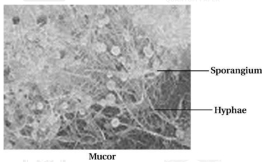
0 likes
View Solution382
Easy
Give differences: Ascocarp and Basidiocarp.
Solution
(N/A)
| Ascocarp | Basidiocarp |
| $(1)$ It is a fruiting body found in Ascomycetes. | $(1)$ It is a fruiting body found in Basidiomycetes. |
| $(2)$ It is simpler in construction. | $(2)$ It is more elaborate in construction. |
| $(3)$ Ascocarp contains numerous asci. | $(3)$ Basidiocarp contains several basidia. |
| $(4)$ Ascus is generally aseptate. | $(4)$ Basidium may be septate or aseptate. |
| $(5)$ An ascus generally forms eight ascospores. | $(5)$ $A$ basidium produces four basidiospores. |
| $(6)$ Ascospores are formed endogenously. | $(6)$ Basidiospores are formed exogenously. |
0 likes
View Solution383
Medium
Describe the nutrition method of fungi.
Solution
(N/A) Fungi are heterotrophic organisms that obtain their nutrients through a process known as absorptive nutrition.
$1$. Saprophytic Nutrition: Most fungi are saprophytes,meaning they feed on dead and decaying organic matter. They secrete extracellular enzymes (such as cellulases,proteases,and lipases) into the environment to break down complex organic molecules into simpler,soluble forms.
$2$. Absorption: Once the organic matter is broken down into simpler nutrients like glucose,amino acids,and fatty acids,the fungal hyphae absorb these nutrients directly through their cell walls.
$3$. Parasitic Nutrition: Some fungi live as parasites on living plants or animals,absorbing nutrients directly from the host tissues using specialized structures called haustoria.
$4$. Symbiotic Nutrition: Certain fungi exist in symbiotic relationships,such as lichens (fungi with algae) or mycorrhizae (fungi with plant roots),where they exchange nutrients with their partners.
$1$. Saprophytic Nutrition: Most fungi are saprophytes,meaning they feed on dead and decaying organic matter. They secrete extracellular enzymes (such as cellulases,proteases,and lipases) into the environment to break down complex organic molecules into simpler,soluble forms.
$2$. Absorption: Once the organic matter is broken down into simpler nutrients like glucose,amino acids,and fatty acids,the fungal hyphae absorb these nutrients directly through their cell walls.
$3$. Parasitic Nutrition: Some fungi live as parasites on living plants or animals,absorbing nutrients directly from the host tissues using specialized structures called haustoria.
$4$. Symbiotic Nutrition: Certain fungi exist in symbiotic relationships,such as lichens (fungi with algae) or mycorrhizae (fungi with plant roots),where they exchange nutrients with their partners.
0 likes
View Solution384
Medium
Describe the reproduction of fungus.
Solution
(N/A) Fungi reproduce through three main methods:
$1$. Vegetative reproduction: This occurs through fragmentation,fission,and budding.
$2$. Asexual reproduction: This occurs through the formation of spores such as conidia,sporangiospores,or zoospores.
$3$. Sexual reproduction: This involves the fusion of two haploid hyphae of compatible mating types. The process includes three distinct steps:
$(i)$ Plasmogamy: Fusion of protoplasm between two motile or non-motile gametes.
(ii) Karyogamy: Fusion of two nuclei.
(iii) Meiosis: Zygote undergoes meiosis to produce haploid spores.
$1$. Vegetative reproduction: This occurs through fragmentation,fission,and budding.
$2$. Asexual reproduction: This occurs through the formation of spores such as conidia,sporangiospores,or zoospores.
$3$. Sexual reproduction: This involves the fusion of two haploid hyphae of compatible mating types. The process includes three distinct steps:
$(i)$ Plasmogamy: Fusion of protoplasm between two motile or non-motile gametes.
(ii) Karyogamy: Fusion of two nuclei.
(iii) Meiosis: Zygote undergoes meiosis to produce haploid spores.
0 likes
View Solution385
Medium
Describe the steps of sexual reproduction in fungi.
Solution
(N/A) Sexual reproduction in fungi involves three distinct stages:
$1$. Plasmogamy: This is the fusion of protoplasm between two motile or non-motile gametes. It brings two haploid nuclei together in the same cell.
$2$. Karyogamy: This is the fusion of two nuclei,which results in the formation of a diploid zygote $(2n)$.
$3$. Meiosis: The diploid zygote undergoes meiosis to produce haploid spores,which then germinate to form new fungal mycelia.
$1$. Plasmogamy: This is the fusion of protoplasm between two motile or non-motile gametes. It brings two haploid nuclei together in the same cell.
$2$. Karyogamy: This is the fusion of two nuclei,which results in the formation of a diploid zygote $(2n)$.
$3$. Meiosis: The diploid zygote undergoes meiosis to produce haploid spores,which then germinate to form new fungal mycelia.
0 likes
View Solution386
MediumMCQ
What is bipolar centralization?
A
$A$ process where two nuclei fuse in the center of the cell.
B
$A$ phenomenon in fungi where two compatible nuclei migrate to the center of the cell before fusion.
C
The movement of chromosomes to the poles during mitosis.
D
The formation of a central vacuole in bipolar cells.
Solution
(B) Bipolar centralization is a specific biological phenomenon observed in certain fungi,particularly during the process of plasmogamy and karyogamy.
It refers to the migration of two genetically compatible nuclei toward the center of the fungal cell or hyphal compartment.
Once these nuclei reach the central region,they eventually fuse to form a diploid nucleus,a process known as karyogamy.
This mechanism ensures that the nuclei are positioned correctly for successful sexual reproduction.
It refers to the migration of two genetically compatible nuclei toward the center of the fungal cell or hyphal compartment.
Once these nuclei reach the central region,they eventually fuse to form a diploid nucleus,a process known as karyogamy.
This mechanism ensures that the nuclei are positioned correctly for successful sexual reproduction.
0 likes
View Solution387
MediumMCQ
Give differences between Phycomycetes and Basidiomycetes.
A
Mycelium is aseptate and coenocytic in Phycomycetes,whereas it is septate and branched in Basidiomycetes.
B
Asexual reproduction occurs by zoospores or aplanospores in Phycomycetes; asexual spores are generally not found in Basidiomycetes.
C
Sexual reproduction in Phycomycetes involves fusion of gametes to form zygospores; in Basidiomycetes,it involves plasmogamy between two vegetative or somatic cells.
D
Examples of Phycomycetes include Mucor and Rhizopus; examples of Basidiomycetes include Agaricus and Ustilago.
Solution
(N/A) The differences between Phycomycetes and Basidiomycetes are as follows:
$1$. Mycelium: In Phycomycetes,the mycelium is aseptate and coenocytic (multinucleate). In Basidiomycetes,the mycelium is septate and branched.
$2$. Asexual Reproduction: Phycomycetes reproduce asexually by zoospores (motile) or aplanospores (non-motile). In Basidiomycetes,asexual spores are generally not found,though vegetative reproduction by fragmentation is common.
$3$. Sexual Reproduction: In Phycomycetes,sexual reproduction occurs by fusion of gametes to form zygospores. In Basidiomycetes,sexual organs are absent,and plasmogamy is brought about by fusion of two vegetative or somatic cells of different strains or genotypes.
$4$. Examples: Phycomycetes include $Mucor$,$Rhizopus$,and $Albugo$. Basidiomycetes include $Agaricus$ (mushroom),$Ustilago$ (smut),and $Puccinia$ (rust fungus).
$1$. Mycelium: In Phycomycetes,the mycelium is aseptate and coenocytic (multinucleate). In Basidiomycetes,the mycelium is septate and branched.
$2$. Asexual Reproduction: Phycomycetes reproduce asexually by zoospores (motile) or aplanospores (non-motile). In Basidiomycetes,asexual spores are generally not found,though vegetative reproduction by fragmentation is common.
$3$. Sexual Reproduction: In Phycomycetes,sexual reproduction occurs by fusion of gametes to form zygospores. In Basidiomycetes,sexual organs are absent,and plasmogamy is brought about by fusion of two vegetative or somatic cells of different strains or genotypes.
$4$. Examples: Phycomycetes include $Mucor$,$Rhizopus$,and $Albugo$. Basidiomycetes include $Agaricus$ (mushroom),$Ustilago$ (smut),and $Puccinia$ (rust fungus).
0 likes
View Solution388
EasyMCQ
Is the common edible mushroom an autotroph or a heterotroph?
A
Autotroph
B
Heterotroph
C
Both
D
None of these
Solution
(B) The common edible mushroom (e.g.,$Agaricus$) lacks chlorophyll,which is the pigment required for photosynthesis.
Because it cannot synthesize its own food through photosynthesis,it obtains nutrients by decomposing organic matter.
Therefore,mushrooms are classified as heterotrophs.
Because it cannot synthesize its own food through photosynthesis,it obtains nutrients by decomposing organic matter.
Therefore,mushrooms are classified as heterotrophs.
0 likes
View Solution389
Easy
Give scientific reasons: Whittaker placed fungi in a separate Kingdom Fungi,distinct from the Kingdom Plantae in his classification system.
Solution
(N/A) $1$. Fungi lack chlorophyll,meaning they cannot perform photosynthesis and thus cannot produce their own food. They are heterotrophic,obtaining nutrients as saprophytes or parasites.
$2$. The cell wall of fungi is composed of chitin,whereas the cell wall of plants is composed of cellulose.
$3$. Fungi store food in the form of glycogen and oil droplets,unlike plants which store food primarily as starch.
Due to these fundamental differences in nutrition,cell wall composition,and food storage,fungi were separated from the Kingdom Plantae and placed into a distinct Kingdom Fungi.
$2$. The cell wall of fungi is composed of chitin,whereas the cell wall of plants is composed of cellulose.
$3$. Fungi store food in the form of glycogen and oil droplets,unlike plants which store food primarily as starch.
Due to these fundamental differences in nutrition,cell wall composition,and food storage,fungi were separated from the Kingdom Plantae and placed into a distinct Kingdom Fungi.
0 likes
View Solution390
Medium
Define the following terms:
$(i)$ Plasmogamy
$(ii)$ Karyogamy
$(i)$ Plasmogamy
$(ii)$ Karyogamy
Solution
(N/A) $(i)$ Plasmogamy: The fusion of protoplasms between two motile or non-motile gametes is called plasmogamy.
$(ii)$ Karyogamy: The fusion of two nuclei is called karyogamy.
$(ii)$ Karyogamy: The fusion of two nuclei is called karyogamy.
0 likes
View Solution391
MediumMCQ
Identify the importance of the following fungi:
$(i)$ $Penicillium$
$(ii)$ $Neurospora$
$(i)$ $Penicillium$
$(ii)$ $Neurospora$
A
$(i)$ Source of antibiotics,$(ii)$ Used in biochemical and genetic work.
B
$(i)$ Used in baking,$(ii)$ Source of antibiotics.
C
$(i)$ Used in genetic work,$(ii)$ Source of antibiotics.
D
$(i)$ Decomposer,$(ii)$ Used in baking.
Solution
(A) $(i)$ $Penicillium$ is a well-known source of the antibiotic penicillin.
$(ii)$ $Neurospora$ is used extensively in biochemical and genetic research due to its short life cycle and ease of cultivation.
$(ii)$ $Neurospora$ is used extensively in biochemical and genetic research due to its short life cycle and ease of cultivation.
0 likes
View Solution392
Easy
There is a myth that immediately after heavy rains in forests, mushrooms appear in large numbers and form a very large ring or circle, which may be several metres in diameter. These are called as "fairy rings". Can you explain this phenomenon of fairy rings in biological terms? Discuss the mycelial structure in $Agaricus$ and its soil-borne nature.
Solution
(N/A) $1$. Biological Explanation of Fairy Rings: The phenomenon of "fairy rings" is caused by the radial growth of the mycelium of certain fungi, such as $Agaricus$ $campestris$, in the soil. As the mycelium grows outward from a central point in search of nutrients, it depletes the soil of organic matter and nitrogen in the center. The fungus continues to grow at the periphery where nutrients are available, forming a circular pattern. When the environmental conditions (like heavy rain) are favorable, the fruiting bodies (mushrooms) emerge from the peripheral mycelium, creating a visible ring.
$2$. Mycelial Structure in $Agaricus$: The mycelium of $Agaricus$ is composed of branched, septate, and filamentous hyphae. It consists of two types: primary mycelium (monokaryotic) and secondary mycelium (dikaryotic). The secondary mycelium is the dominant, long-lived, and vegetative phase that forms the complex fruiting body (basidiocarp).
$3$. Soil-borne Nature: $Agaricus$ is a saprophytic fungus. It lives in the soil, feeding on decaying organic matter (humus). Its mycelium spreads extensively through the soil substrate, secreting extracellular enzymes to break down complex organic compounds into simpler absorbable nutrients.
$2$. Mycelial Structure in $Agaricus$: The mycelium of $Agaricus$ is composed of branched, septate, and filamentous hyphae. It consists of two types: primary mycelium (monokaryotic) and secondary mycelium (dikaryotic). The secondary mycelium is the dominant, long-lived, and vegetative phase that forms the complex fruiting body (basidiocarp).
$3$. Soil-borne Nature: $Agaricus$ is a saprophytic fungus. It lives in the soil, feeding on decaying organic matter (humus). Its mycelium spreads extensively through the soil substrate, secreting extracellular enzymes to break down complex organic compounds into simpler absorbable nutrients.
0 likes
View Solution393
EasyMCQ
Neurospora,an ascomycetes fungus,has been used as a biological tool to understand the mechanism of plant genetics in much the same way as Drosophila has been used to study animal genetics. What makes Neurospora so important as a genetic tool?
A
It has a short life cycle and produces many offspring.
B
It is a haploid organism,making it easy to observe recessive mutations.
C
It can be easily grown in a laboratory on simple culture media.
D
All of the above.
Solution
(D) Neurospora crassa is often referred to as the 'Drosophila of the plant kingdom' because it is an ideal model organism for genetic studies.
$1$. It has a short life cycle,allowing for rapid generation of data.
$2$. It is a haploid organism,which means that recessive mutations are immediately expressed in the phenotype,making them easy to detect and study.
$3$. It can be easily cultured in a laboratory on simple,defined media.
$4$. It produces ordered ascospores,which allow for the analysis of meiotic products (tetrad analysis),facilitating the study of recombination and gene mapping.
$1$. It has a short life cycle,allowing for rapid generation of data.
$2$. It is a haploid organism,which means that recessive mutations are immediately expressed in the phenotype,making them easy to detect and study.
$3$. It can be easily cultured in a laboratory on simple,defined media.
$4$. It produces ordered ascospores,which allow for the analysis of meiotic products (tetrad analysis),facilitating the study of recombination and gene mapping.
0 likes
View Solution394
Medium
At a stage of their life cycle,Ascomycetes fungi produce fruiting bodies known as ascocarps,which include apothecium,perithecium,and cleistothecium. How are these three types of fruiting bodies different from each other? Discuss the types of fruiting bodies formed by Ascomycetes fungi and differentiate them based on their structures.
Solution
(N/A) The fruiting bodies of Ascomycetes are called ascocarps. $A$ fertile layer called the hymenium bears the asci. These fruiting bodies differ based on their structure:
$1$. Apothecium: It is an open,cup-shaped or saucer-shaped structure. The hymenium is exposed on the upper surface. Example: $Peziza$.
$2$. Perithecium: It is a flask-shaped structure with a small pore called an ostiole at the top through which ascospores are released. Example: $Neurospora$.
$3$. Cleistothecium: It is a completely closed,spherical structure with no opening. The asci are released only upon the decay or rupture of the wall. Example: $Penicillium$.
$1$. Apothecium: It is an open,cup-shaped or saucer-shaped structure. The hymenium is exposed on the upper surface. Example: $Peziza$.
$2$. Perithecium: It is a flask-shaped structure with a small pore called an ostiole at the top through which ascospores are released. Example: $Neurospora$.
$3$. Cleistothecium: It is a completely closed,spherical structure with no opening. The asci are released only upon the decay or rupture of the wall. Example: $Penicillium$.
0 likes
View Solution395
Medium
Fungi are cosmopolitan. Write the role of fungi in your daily life.
Solution
(N/A) The roles of fungi in daily life are as follows:
$(i)$ Some fungi cause the spoilage of food materials like stale bread,fruits,and vegetables.
$(ii)$ Fermentation processes,such as in baking and brewing,are possible due to yeast ($Saccharomyces$ $cerevisiae$).
$(iii)$ Some fungi act as pathogens and cause dangerous diseases in plants (e.g.,rust and smut) and animals (e.g.,ringworm).
$(iv)$ Certain fungi are essential for the production of antibiotics,such as Penicillin,which is derived from $Penicillium$ $notatum$.
$(i)$ Some fungi cause the spoilage of food materials like stale bread,fruits,and vegetables.
$(ii)$ Fermentation processes,such as in baking and brewing,are possible due to yeast ($Saccharomyces$ $cerevisiae$).
$(iii)$ Some fungi act as pathogens and cause dangerous diseases in plants (e.g.,rust and smut) and animals (e.g.,ringworm).
$(iv)$ Certain fungi are essential for the production of antibiotics,such as Penicillin,which is derived from $Penicillium$ $notatum$.
0 likes
View Solution396
EasyMCQ
Identify the correct terms for the following analogy-based questions:
$(i)$ Bacteria : Nucleoid :: Yeast : ......
$(ii)$ Multicellular producers : Plants :: Multicellular decomposers : ......
$(i)$ Bacteria : Nucleoid :: Yeast : ......
$(ii)$ Multicellular producers : Plants :: Multicellular decomposers : ......
A
$(i)$ Nucleus,$(ii)$ Fungi
B
$(i)$ Nucleoid,$(ii)$ Bacteria
C
$(i)$ Nucleus,$(ii)$ Protista
D
$(i)$ Nucleoid,$(ii)$ Fungi
Solution
(A) $(i)$ Bacteria are prokaryotic organisms that lack a membrane-bound nucleus; their genetic material is found in a region called the nucleoid. Yeast is a eukaryotic organism that possesses a well-defined membrane-bound nucleus.
$(ii)$ Plants are multicellular producers (autotrophs). Fungi are multicellular decomposers (heterotrophs) that obtain nutrients by breaking down organic matter.
$(ii)$ Plants are multicellular producers (autotrophs). Fungi are multicellular decomposers (heterotrophs) that obtain nutrients by breaking down organic matter.
0 likes
View Solution397
EasyMCQ
Select the correct option for the following statements:
$(i)$ The symbiotic association of fungi with algae is called $Lichens$ / $Mycorrhiza$.
$(ii)$ $Puccinia$ is the fungus responsible for $Rust$ / $Smut$.
$(i)$ The symbiotic association of fungi with algae is called $Lichens$ / $Mycorrhiza$.
$(ii)$ $Puccinia$ is the fungus responsible for $Rust$ / $Smut$.
A
$(i) - \text{Lichens}, (ii) - \text{Rust}$
B
$(i) - \text{Lichens}, (ii) - \text{Smut}$
C
$(i) - \text{Mycorrhiza}, (ii) - \text{Rust}$
D
$(i) - \text{Mycorrhiza}, (ii) - \text{Smut}$
Solution
(A) $(i)$ The symbiotic association between fungi and algae is known as $Lichens$. $Mycorrhiza$ is the symbiotic association between fungi and the roots of higher plants.
$(ii)$ $Puccinia$ is a genus of fungi that causes $Rust$ diseases in plants (e.g., wheat rust). $Smut$ diseases are typically caused by fungi of the genus $Ustilago$.
$(ii)$ $Puccinia$ is a genus of fungi that causes $Rust$ diseases in plants (e.g., wheat rust). $Smut$ diseases are typically caused by fungi of the genus $Ustilago$.
0 likes
View Solution398
EasyMCQ
Red rot of sugarcane is caused by which organism?
A
Virus
B
Bacteria
C
Fungi
D
Both $B$ and $C$
Solution
(C) Red rot of sugarcane is a serious disease caused by the fungus $Colletotrichum$ $falcatum$.
This fungus infects the sugarcane plant,leading to the reddening of the internal tissues and the production of an alcoholic odor due to fermentation.
Therefore,the correct option is $C$ (Fungi).
This fungus infects the sugarcane plant,leading to the reddening of the internal tissues and the production of an alcoholic odor due to fermentation.
Therefore,the correct option is $C$ (Fungi).
0 likes
View Solution399
MediumMCQ
Select the appropriate option regarding $Penicillium$ $notatum$.
A
Bacteria
B
Yeast
C
Prions
D
Mold
Solution
(D) $Penicillium$ $notatum$ is a species of fungus belonging to the kingdom $Fungi$.
It is commonly known as a type of mold.
It is historically significant as the source from which the first antibiotic,penicillin,was discovered by Alexander Fleming.
Therefore,the correct classification for $Penicillium$ $notatum$ is mold.
It is commonly known as a type of mold.
It is historically significant as the source from which the first antibiotic,penicillin,was discovered by Alexander Fleming.
Therefore,the correct classification for $Penicillium$ $notatum$ is mold.
0 likes
View Solution400
MediumMCQ
Match the following columns regarding the classification of fungi:
| Column $I$ | Column $II$ |
|---|---|
| $(i)$ $Trichoderma$ | $(a)$ $Deuteromycetes$ |
| $(ii)$ $Yeast$ | $(b)$ $Basidiomycetes$ |
| $(iii)$ $Bread \text{ } mould$ $(Rhizopus)$ | $(c)$ $Phycomycetes$ |
| $(iv)$ $Smut$ $(Ustilago)$ | $(d)$ $Ascomycetes$ |
A
$i-d, ii-a, iii-c, iv-b$
B
$i-a, ii-d, iii-b, iv-c$
C
$i-a, ii-d, iii-c, iv-b$
D
$i-a, ii-c, iii-b, iv-d$
Solution
(C) The correct matching is as follows:
$1$. $Trichoderma$ belongs to the class $Deuteromycetes$ (imperfect fungi).
$2$. $Yeast$ $(Saccharomyces)$ belongs to the class $Ascomycetes$ (sac fungi).
$3$. $Bread \text{ } mould$ $(Rhizopus)$ belongs to the class $Phycomycetes$ (algal fungi).
$4$. $Smut$ $(Ustilago)$ belongs to the class $Basidiomycetes$ (club fungi).
Therefore, the correct sequence is $(i-a, ii-d, iii-c, iv-b)$. The correct option is $(C)$.
$1$. $Trichoderma$ belongs to the class $Deuteromycetes$ (imperfect fungi).
$2$. $Yeast$ $(Saccharomyces)$ belongs to the class $Ascomycetes$ (sac fungi).
$3$. $Bread \text{ } mould$ $(Rhizopus)$ belongs to the class $Phycomycetes$ (algal fungi).
$4$. $Smut$ $(Ustilago)$ belongs to the class $Basidiomycetes$ (club fungi).
Therefore, the correct sequence is $(i-a, ii-d, iii-c, iv-b)$. The correct option is $(C)$.
0 likes
View SolutionBiological Classification — Fungi (Multicellular decomposers) · Frequently Asked Questions
1Are these Biological Classification questions useful for JEE and NEET?
Yes. All questions in this section are mapped to JEE Main and NEET exam patterns. Previous year questions from JEE Main, NEET, GUJCET and state-level exams are included with full solutions.
2Can I switch to Hindi or Gujarati for these questions?
Yes. Use the language tabs in the hero section or the sidebar to view the same questions and solutions in English, Hindi or Gujarati.
3How do I generate a question paper from this subtopic?
Use the Vedclass Exam Paper Generator — select the chapter and subtopic, set difficulty, and generate Sets A, B, C, D automatically. First 3 chapters of every subject are free.
Vedclass Products
For Students
Vedclass Test Series
Mock tests in real JEE/NEET style with performance analysis. 5-day free trial.
Start Free TrialFor Teachers
Exam Paper Generator
Generate Set A/B/C/D papers from this chapter in 2 minutes. 3 chapters free.
Try FreeFor Institutes
Online Exam Module
Live online exams with unlimited students, 360° analytics & white-label branding.
See DemoFor Teachers & Institutes
Generate a Biological Classification Exam Paper in 2 Minutes
Select subtopic & difficulty — Sets A, B, C, D auto-generated with No Repeat logic.
First 3 chapters of every subject are free — no payment required.