
A English
Fungi (Multicellular decomposers) Questions in English
Class 11 Biology · Biological Classification · Fungi (Multicellular decomposers)
511+
Questions
English
Language
100%
With Solutions
Showing 50 of 511 questions in English
401
MediumMCQ
Match the Column-$I$ and Column-$II$:
| Column-$I$ | Column-$II$ |
| $(i)$ Agaricus | $(a)$ Ascomycetes |
| $(ii)$ Colletotrichum | $(b)$ Deuteromycetes |
| $(iii)$ Albugo | $(c)$ Phycomycetes |
| $(iv)$ Neurospora | $(d)$ Basidiomycetes |
A
$i-b, ii-a, iii-c, iv-d$
B
$i-a, ii-b, iii-d, iv-c$
C
$i-c, ii-b, iii-d, iv-a$
D
$i-d, ii-b, iii-c, iv-a$
Solution
(D) The correct classification of the given fungi is as follows:
$(i)$ Agaricus is a member of the class Basidiomycetes.
$(ii)$ Colletotrichum belongs to the class Deuteromycetes.
$(iii)$ Albugo belongs to the class Phycomycetes.
$(iv)$ Neurospora belongs to the class Ascomycetes.
Therefore, the correct matching is $(i-d, ii-b, iii-c, iv-a)$.
$(i)$ Agaricus is a member of the class Basidiomycetes.
$(ii)$ Colletotrichum belongs to the class Deuteromycetes.
$(iii)$ Albugo belongs to the class Phycomycetes.
$(iv)$ Neurospora belongs to the class Ascomycetes.
Therefore, the correct matching is $(i-d, ii-b, iii-c, iv-a)$.
0 likes
View Solution402
MediumMCQ
Yeast is not included in protozoans but is placed in fungi because
A
it has no chlorophyll.
B
some fungal hyphae grow in such a way that they give the appearance of pseudomycelium.
C
it has eukaryotic organization.
D
cell wall is made up of cellulose and reserve food material is starch.
Solution
(B) The plant body of fungi typically consists of branched and filamentous hyphae,which form a net-like structure known as mycelium.
In yeast,the plant body is unicellular,but sometimes cells remain attached in short chains,forming a structure called pseudomycelium,which is a characteristic feature of certain fungi.
In yeast,the plant body is unicellular,but sometimes cells remain attached in short chains,forming a structure called pseudomycelium,which is a characteristic feature of certain fungi.
0 likes
View Solution403
MediumMCQ
When moist bread is kept exposed in air,it becomes mouldy and black because:
A
spores are present in the water.
B
spores are present in the bread.
C
spores are present in the air.
D
the bread decomposes.
Solution
(C) When moist bread is kept exposed to the air,it becomes mouldy and black because fungal spores are present in the air. When these spores land on the moist bread,they find suitable conditions (moisture and nutrients) to germinate,grow,and multiply,forming a network of hyphae called mycelium,which appears as black mould.
0 likes
View Solution404
MediumMCQ
Plant diseases caused by $Ustilago$ fungus are called $SMUTS$ because
A
they parasitize on cereals.
B
they lack mycelium.
C
they develop sooty masses of spores.
D
the affected parts become completely black.
Solution
(C) $Ustilago$ is a genus of fungi belonging to the class $Basidiomycetes$. These fungi cause diseases known as $SMUTS$. The name $SMUT$ is derived from the fact that these fungi produce large,sooty,black-colored masses of spores (chlamydospores or teleutospores) on the infected parts of the host plant,giving the affected areas a charred or blackened appearance.
0 likes
View Solution405
MediumMCQ
$A$ fungus contains cells with two nuclei from different genomes. The nuclei do not fuse but divide independently to form a dikaryotic secondary mycelium. The fungus belongs to
A
phycomycetes
B
zygomycetes
C
deuteromycetes
D
basidiomycetes
Solution
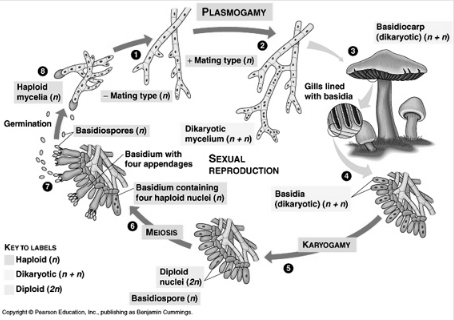
(D) In the life cycle of Basidiomycetes,plasmogamy (fusion of protoplasm) occurs between two vegetative or somatic cells of different strains or genotypes. This results in the formation of a dikaryotic cell,where each cell contains two nuclei $(n+n)$ from different parents. These nuclei do not fuse immediately; instead,they divide independently along with the cell division,leading to the formation of a dikaryotic secondary mycelium. This prolonged dikaryotic phase is a characteristic feature of Basidiomycetes.
0 likes
View Solution406
MediumMCQ
$A$ specimen of fungus is brought by a student for identification. Upon close examination,he discovered that its hyphae are completely septate and it has gills on the underside of the pileus. To which fungal group does it most likely belong?
A
Basidiomycetes
B
Zygomycetes
C
Ascomycetes
D
Chytrids
Solution
(A) The presence of a $pileus$ (cap) and gills (lamellae) on the underside is a characteristic feature of mushrooms,which belong to the class $Basidiomycetes$.
In $Basidiomycetes$,the mycelium is well-developed,branched,and septate.
$Zygomycetes$ typically have aseptate and coenocytic hyphae.
$Ascomycetes$ have septate hyphae but do not typically form the complex gill-bearing pileus structure seen in mushrooms.
$Chytrids$ are mostly aquatic and have different structural characteristics.
In $Basidiomycetes$,the mycelium is well-developed,branched,and septate.
$Zygomycetes$ typically have aseptate and coenocytic hyphae.
$Ascomycetes$ have septate hyphae but do not typically form the complex gill-bearing pileus structure seen in mushrooms.
$Chytrids$ are mostly aquatic and have different structural characteristics.
0 likes
View Solution407
MediumMCQ
Fungi show asexual reproduction by all of the following kinds of spores except
A
conidia
B
oospores
C
sporangiospores
D
zoospores
Solution
(B) In fungi,asexual reproduction occurs through spores such as $conidia$,$sporangiospores$,or $zoospores$.
Sexual reproduction in fungi involves the formation of $oospores$,$ascospores$,and $basidiospores$.
Therefore,$oospores$ are a product of sexual reproduction,not asexual reproduction.
Sexual reproduction in fungi involves the formation of $oospores$,$ascospores$,and $basidiospores$.
Therefore,$oospores$ are a product of sexual reproduction,not asexual reproduction.
0 likes
View Solution408
MediumMCQ
Assume that two normal hyphal cells of different fungal mating types unite to form:
A
haploid primary mycelium
B
fruiting body
C
zygote
D
dikaryotic cell forming secondary mycelium
Solution
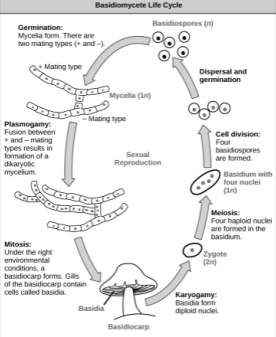
(D) In fungi,specifically in Basidiomycetes and Ascomycetes,the fusion of two haploid hyphal cells of compatible mating types is known as plasmogamy. This process results in the formation of a dikaryotic cell,where each cell contains two genetically distinct nuclei $(n + n)$. This dikaryotic cell then undergoes repeated divisions to form the secondary mycelium (dikaryotic mycelium).
0 likes
View Solution409
EasyMCQ
Which of the following is the correct sequence of three steps in the sexual cycle of fungi?
A
Plasmogamy,meiosis,and karyogamy
B
Karyogamy,plasmogamy,and meiosis
C
Plasmogamy,karyogamy,and meiosis
D
Meiosis,plasmogamy,and karyogamy
Solution
(C) The sexual cycle in fungi involves the following three steps: plasmogamy,karyogamy,and meiosis.
$(i)$ Plasmogamy: The fusion of protoplasm between two motile or non-motile gametes.
$(ii)$ Karyogamy: The fusion of two nuclei.
$(iii)$ Meiosis: The process occurring in the zygote resulting in the formation of haploid spores.
$(i)$ Plasmogamy: The fusion of protoplasm between two motile or non-motile gametes.
$(ii)$ Karyogamy: The fusion of two nuclei.
$(iii)$ Meiosis: The process occurring in the zygote resulting in the formation of haploid spores.
0 likes
View Solution410
MediumMCQ
Identify the basis of classification of fungi into phycomycetes,ascomycetes,basidiomycetes and deuteromycetes.
$i$. Fruiting bodies
$ii$. Nature of habitat
$iii$. Morphology of mycelium
$iv$. Mode of spore formation
$i$. Fruiting bodies
$ii$. Nature of habitat
$iii$. Morphology of mycelium
$iv$. Mode of spore formation
A
$i$ & $ii$ only
B
$ii$ & $iii$ only
C
$i$,$iii$,& $iv$ only
D
All of these
Solution
(C) The classification of fungi into $Phycomycetes$,$Ascomycetes$,$Basidiomycetes$,and $Deuteromycetes$ is primarily based on the following criteria:
$1$. Morphology of the mycelium: Whether it is septate or aseptate,branched or unbranched.
$2$. Mode of spore formation: The type of spores produced (sexual or asexual) and how they are formed.
$3$. Fruiting bodies: The structures in which spores are produced.
Nature of habitat is not a primary criterion for this classification. Therefore,the correct basis includes $i$,$iii$,and $iv$.
$1$. Morphology of the mycelium: Whether it is septate or aseptate,branched or unbranched.
$2$. Mode of spore formation: The type of spores produced (sexual or asexual) and how they are formed.
$3$. Fruiting bodies: The structures in which spores are produced.
Nature of habitat is not a primary criterion for this classification. Therefore,the correct basis includes $i$,$iii$,and $iv$.
0 likes
View Solution411
MediumMCQ
Which class of fungi lacks sex organs but the process of plasmogamy is brought about by fusion of two vegetative or somatic cells of different strains or genotypes?
A
Sac fungi
B
Club fungi
C
Imperfect fungi
D
Ray fungi
Solution
(B) Club fungi,also known as $Basidiomycetes$,is the class of fungi that lacks distinct sex organs.
In this group,sexual reproduction occurs through the process of plasmogamy,which is achieved by the fusion of two vegetative or somatic cells of different strains or genotypes.
In this group,sexual reproduction occurs through the process of plasmogamy,which is achieved by the fusion of two vegetative or somatic cells of different strains or genotypes.
0 likes
View Solution412
MediumMCQ
Refer to the statement and answer the question. "Once the sexual stages of members of Deuteromycetes were discovered, they were often moved to $X$ and $Y$." Identify $X$ and $Y$.
A
$X -$ Monera; $Y -$ Protista
B
$X -$ Basidiomycetes; $Y -$ Phycomycetes
C
$X -$ Ascomycetes; $Y -$ Basidiomycetes
D
$X -$ Phycomycetes; $Y -$ Archaebacteria
Solution
(C) Deuteromycetes are commonly known as $Fungi \text{ imperfecti}$ because only their asexual or vegetative phases are known.
When the sexual forms of these fungi were discovered, they were moved into classes where they rightly belong, which are Ascomycetes and Basidiomycetes.
Therefore, $X$ and $Y$ represent Ascomycetes and Basidiomycetes.
When the sexual forms of these fungi were discovered, they were moved into classes where they rightly belong, which are Ascomycetes and Basidiomycetes.
Therefore, $X$ and $Y$ represent Ascomycetes and Basidiomycetes.
0 likes
View Solution413
MediumMCQ
Which of the following is a parasitic fungi on the mustard plant?
A
Albugo
B
Puccinia
C
Yeast
D
Ustilago
Solution
(A) $Albugo$ is the parasitic fungus that causes white rust in mustard plants. It belongs to the class $Phycomycetes$ within the kingdom $Fungi$.
0 likes
View Solution414
MediumMCQ
Which of the following is used extensively in biochemical and genetic work?
A
Agaricus
B
Alternaria
C
Neurospora
D
Mucor
Solution
(C) $Neurospora$ belongs to the class $Ascomycetes$ and kingdom $Fungi$. It is used extensively in biochemical and genetic research because of its short life cycle and ease of cultivation in the laboratory.
0 likes
View Solution415
MediumMCQ
Which of the following is/are example$(s)$ of deuteromycetes?
A
Alternaria
B
Colletotrichum
C
Trichoderma
D
All of these
Solution
(D) Deuteromycetes are commonly known as fungi imperfecti because their sexual stage (perfect stage) is either absent or has not been reported yet.
Alternaria,Colletotrichum,and Trichoderma are all well-known examples of fungi belonging to the class Deuteromycetes.
Alternaria,Colletotrichum,and Trichoderma are all well-known examples of fungi belonging to the class Deuteromycetes.
0 likes
View Solution416
MediumMCQ
Which group of fungi is commonly known as imperfect fungi?
A
Phycomycetes
B
Ascomycetes
C
Basidiomycetes
D
Deuteromycetes
Solution
(D) Deuteromycetes are commonly known as fungi imperfecti because their sexual stage (perfect stage) is either absent or has not been reported yet.
They are classified based on the color and structure of their conidia.
Since many of their reproductive structures resemble those of Ascomycetes,it is believed that they may have evolved from Ascomycetes that lost the ability to reproduce sexually.
They are classified based on the color and structure of their conidia.
Since many of their reproductive structures resemble those of Ascomycetes,it is believed that they may have evolved from Ascomycetes that lost the ability to reproduce sexually.
0 likes
View Solution417
MediumMCQ
Dikaryon formation is the characteristic feature of
A
ascomycetes and basidiomycetes.
B
phycomycetes and basidiomycetes.
C
ascomycetes and deuteromycetes
D
phycomycetes and deuteromycetes
Solution
(A) In fungi,specifically in $Ascomycetes$ and $Basidiomycetes$,the process of karyogamy is delayed and occurs just before meiosis.
In the stage intervening between plasmogamy and karyogamy,the cells often contain two nuclei per cell,which is known as a dikaryon $(n+n)$.
Such cells are called dikaryotic cells,and this specific phase is known as the dikaryophase.
In the stage intervening between plasmogamy and karyogamy,the cells often contain two nuclei per cell,which is known as a dikaryon $(n+n)$.
Such cells are called dikaryotic cells,and this specific phase is known as the dikaryophase.
0 likes
View Solution418
MediumMCQ
Clamp connection is found in
A
basidiomycetes
B
ascomycetes
C
saccharomycetes
D
haplomycetes
Solution
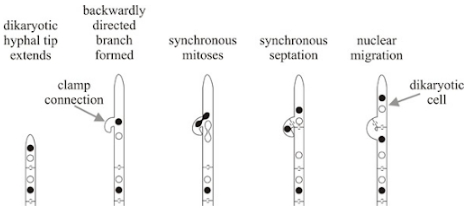
(A) In many members of $Basidiomycetes$,cell division is accompanied by a clamp connection.
These are bridge-like or hook-like structures formed during the division of dikaryotic cells.
They function as bypass hyphae,ensuring that each new cell receives one nucleus of each mating type,thereby maintaining the dikaryotic condition of the mycelium.
These are bridge-like or hook-like structures formed during the division of dikaryotic cells.
They function as bypass hyphae,ensuring that each new cell receives one nucleus of each mating type,thereby maintaining the dikaryotic condition of the mycelium.
0 likes
View Solution419
MediumMCQ
Plasmogamy is the fusion of
A
two haploid somatic cells including their nuclei.
B
two haploid cell cytoplasm without nuclear fusion.
C
sperm and egg
D
sperm and two polar nuclei.
Solution
(B) Plasmogamy is the first stage of sexual reproduction in fungi in which the cytoplasm of two motile or non-motile gametes fuses with each other.
In this process,the nuclei of the two sex cells come close to each other but do not fuse immediately.
Thus,the resulting cell contains two nuclei $(n+n)$ and is referred to as a dikaryon or binucleate cell.
In this process,the nuclei of the two sex cells come close to each other but do not fuse immediately.
Thus,the resulting cell contains two nuclei $(n+n)$ and is referred to as a dikaryon or binucleate cell.
0 likes
View Solution420
MediumMCQ
Match the class of fungi given in column-$I$ with their common name given in column-$II$ and select the correct option.
| Column-$I$ (Class of fungi) | Column-$II$ (Common name) |
| $A$. Phycomycetes | $I$. Sac fungi |
| $B$. Ascomycetes | $II$. Algal fungi |
| $C$. Basidiomycetes | $III$. Fungi imperfecti |
| $D$. Deuteromycetes | $IV$. Club fungi |
A
$A-II, B-I, C-IV, D-III$
B
$A-II, B-IV, C-I, D-III$
C
$A-IV, B-I, C-II, D-III$
D
$A-IV, B-III, C-II, D-I$
Solution
(A) The classification of fungi into four major classes is based on the morphology of the mycelium, mode of spore formation, and fruiting bodies.
$1$. Phycomycetes are commonly known as algal fungi because their mycelium is aseptate and coenocytic, resembling some algae.
$2$. Ascomycetes are known as sac fungi because their spores (ascospores) are produced inside a sac-like structure called an ascus.
$3$. Basidiomycetes are known as club fungi because their spores (basidiospores) are produced on a club-shaped structure called a basidium.
$4$. Deuteromycetes are known as fungi imperfecti because only their asexual or vegetative phases are known, and the sexual cycle is absent or not yet discovered.
Therefore, the correct matching is $A-II, B-I, C-IV, D-III$.
$1$. Phycomycetes are commonly known as algal fungi because their mycelium is aseptate and coenocytic, resembling some algae.
$2$. Ascomycetes are known as sac fungi because their spores (ascospores) are produced inside a sac-like structure called an ascus.
$3$. Basidiomycetes are known as club fungi because their spores (basidiospores) are produced on a club-shaped structure called a basidium.
$4$. Deuteromycetes are known as fungi imperfecti because only their asexual or vegetative phases are known, and the sexual cycle is absent or not yet discovered.
Therefore, the correct matching is $A-II, B-I, C-IV, D-III$.
0 likes
View Solution421
MediumMCQ
Match the class of fungi given in column $I$ with their examples given in column $II$ and choose the correct option.
| Column-$I$ (Class of fungi) | Column-$II$ (Examples) |
| $A$. Ascomycetes | $I$. Rhizopus |
| $B$. Basidiomycetes | $II$. Penicillium |
| $C$. Deuteromycetes | $III$. Ustilago |
| $D$. Phycomycetes | $IV$. Alternaria |
A
$A-IV, B-III, C-I, D-II$
B
$A-II, B-III, C-IV, D-I$
C
$A-IV, B-I, C-II, D-III$
D
$A-III, B-IV, C-II, D-I$
Solution
(B) The correct matching is as follows:
$A$. Ascomycetes: $II$. Penicillium (Sac fungi).
$B$. Basidiomycetes: $III$. Ustilago (Smut fungi).
$C$. Deuteromycetes: $IV$. Alternaria (Fungi imperfecti).
$D$. Phycomycetes: $I$. Rhizopus (Bread mould).
Therefore, the correct sequence is $A-II, B-III, C-IV, D-I$.
$A$. Ascomycetes: $II$. Penicillium (Sac fungi).
$B$. Basidiomycetes: $III$. Ustilago (Smut fungi).
$C$. Deuteromycetes: $IV$. Alternaria (Fungi imperfecti).
$D$. Phycomycetes: $I$. Rhizopus (Bread mould).
Therefore, the correct sequence is $A-II, B-III, C-IV, D-I$.
0 likes
View Solution422
MediumMCQ
Match column $I$ (containing fungus name) with column $II$ (common name) and choose the correct options.
| Column-$I$ (Fungus name) | Column-$II$ (Commonly called) |
| $A$. Puccinia | $I$. Yeast |
| $B$. Ustilago | $II$. Mushroom |
| $C$. Agaricus | $III$. Smut fungus |
| $D$. Saccharomyces | $IV$. Rust fungus |
A
$A-I, B-II, C-III, D-IV$
B
$A-II, B-III, C-IV, D-I$
C
$A-III, B-IV, C-I, D-II$
D
$A-IV, B-III, C-II, D-I$
Solution
(D) The correct matches are as follows:
$A$. Puccinia is commonly known as the rust fungus $(IV)$.
$B$. Ustilago is commonly known as the smut fungus $(III)$.
$C$. Agaricus is commonly known as the mushroom $(II)$.
$D$. Saccharomyces is commonly known as the yeast $(I)$.
Therefore, the correct matching is $A-IV, B-III, C-II, D-I$.
$A$. Puccinia is commonly known as the rust fungus $(IV)$.
$B$. Ustilago is commonly known as the smut fungus $(III)$.
$C$. Agaricus is commonly known as the mushroom $(II)$.
$D$. Saccharomyces is commonly known as the yeast $(I)$.
Therefore, the correct matching is $A-IV, B-III, C-II, D-I$.
0 likes
View Solution423
MediumMCQ
Select the correct match from the given options.
A
Occurrence of dikaryotic stage - $Ascomycetes$ and $Basidiomycetes$.
B
Saprophytes - They are autotrophic and absorb soluble organic matter from dead substrates.
C
Vegetative means of reproduction in fungi - fragmentation,budding and gemmae cup.
D
Steps involved in asexual cycle of fungi - plasmogamy,karyogamy and meiosis in zygote resulting in haploid spores.
Solution
(A) The correct match is the occurrence of the dikaryotic stage in $Ascomycetes$ and $Basidiomycetes$.
Saprophytes are heterotrophic,not autotrophic,and they absorb soluble organic matter from dead substrates.
Vegetative reproduction in fungi occurs through fragmentation,budding,and fission; gemmae cups are characteristic of liverworts (bryophytes),not fungi.
Plasmogamy,karyogamy,and meiosis are the steps involved in the sexual cycle of fungi,not the asexual cycle.
Saprophytes are heterotrophic,not autotrophic,and they absorb soluble organic matter from dead substrates.
Vegetative reproduction in fungi occurs through fragmentation,budding,and fission; gemmae cups are characteristic of liverworts (bryophytes),not fungi.
Plasmogamy,karyogamy,and meiosis are the steps involved in the sexual cycle of fungi,not the asexual cycle.
0 likes
View Solution424
MediumMCQ
Read the given statements and answer the question.
$(i)$ It includes unicellular as well as multicellular fungi.
$(ii)$ In multicellular forms,hyphae are branched and septate.
$(iii)$ Conidiophore produces conidia (spores) exogenously in chain.
$(iv)$ Sexual spores are ascospores produced endogenously in chain.
$(v)$ Fruiting body is called ascocarp. Identify the correct class of fungi which have all the above given characteristics.
$(i)$ It includes unicellular as well as multicellular fungi.
$(ii)$ In multicellular forms,hyphae are branched and septate.
$(iii)$ Conidiophore produces conidia (spores) exogenously in chain.
$(iv)$ Sexual spores are ascospores produced endogenously in chain.
$(v)$ Fruiting body is called ascocarp. Identify the correct class of fungi which have all the above given characteristics.
A
Phycomycetes
B
Sac fungi
C
Club fungi
D
Fungi imperfecti
Solution
(B) The characteristics provided describe the class Ascomycetes,commonly known as Sac fungi.
$(i)$ Ascomycetes include both unicellular (e.g.,yeast) and multicellular (e.g.,Penicillium) forms.
$(ii)$ In multicellular forms,the mycelium consists of branched and septate hyphae.
$(iii)$ Asexual reproduction occurs via conidia produced exogenously on special hyphae called conidiophores.
$(iv)$ Sexual spores are called ascospores,which are produced endogenously within a sac-like structure called an ascus.
$(v)$ The fruiting bodies in which these asci are organized are known as ascocarps.
Therefore,the correct option is $B$.
$(i)$ Ascomycetes include both unicellular (e.g.,yeast) and multicellular (e.g.,Penicillium) forms.
$(ii)$ In multicellular forms,the mycelium consists of branched and septate hyphae.
$(iii)$ Asexual reproduction occurs via conidia produced exogenously on special hyphae called conidiophores.
$(iv)$ Sexual spores are called ascospores,which are produced endogenously within a sac-like structure called an ascus.
$(v)$ The fruiting bodies in which these asci are organized are known as ascocarps.
Therefore,the correct option is $B$.
0 likes
View Solution425
MediumMCQ
Which of the following class of fungi is being described by the given statements?
$(i)$ They are found in aquatic habitats and on decaying wood in moist and damp places.
$(ii)$ Mycelium is aseptate and coenocytic.
$(iii)$ Asexual reproduction takes place by zoospores (motile) or by aplanospores (non-motile).
$(iv)$ Some common examples are Mucor,Rhizopus and Albugo.
$(i)$ They are found in aquatic habitats and on decaying wood in moist and damp places.
$(ii)$ Mycelium is aseptate and coenocytic.
$(iii)$ Asexual reproduction takes place by zoospores (motile) or by aplanospores (non-motile).
$(iv)$ Some common examples are Mucor,Rhizopus and Albugo.
A
Ascomycetes
B
Phycomycetes
C
Basidiomycetes
D
Deuteromycetes
Solution
(B) The characteristics described belong to the class Phycomycetes.
$1$. Phycomycetes are found in aquatic habitats,on decaying wood,in moist and damp places,or as obligate parasites on plants.
$2$. Their mycelium is aseptate (without cross-walls) and coenocytic (multinucleate).
$3$. Asexual reproduction occurs via motile zoospores or non-motile aplanospores.
$4$. Examples include Mucor,Rhizopus (the bread mould),and Albugo (the parasitic fungi on mustard).
$1$. Phycomycetes are found in aquatic habitats,on decaying wood,in moist and damp places,or as obligate parasites on plants.
$2$. Their mycelium is aseptate (without cross-walls) and coenocytic (multinucleate).
$3$. Asexual reproduction occurs via motile zoospores or non-motile aplanospores.
$4$. Examples include Mucor,Rhizopus (the bread mould),and Albugo (the parasitic fungi on mustard).
0 likes
View Solution426
MediumMCQ
Which of the following statement$(s)$ is/are correct about ascomycetes?
$(i)$ Neurospora,which is used in biochemical and genetic work is a member of this class.
$(ii)$ They are mostly multicellular,e.g.,Yeast,or rarely unicellular,e.g.,Penicillium.
$(iii)$ They are saprophytic,decomposers,parasitic or coprophilous.
$(iv)$ Some examples are Aspergillus,Claviceps and Neurospora.
$(i)$ Neurospora,which is used in biochemical and genetic work is a member of this class.
$(ii)$ They are mostly multicellular,e.g.,Yeast,or rarely unicellular,e.g.,Penicillium.
$(iii)$ They are saprophytic,decomposers,parasitic or coprophilous.
$(iv)$ Some examples are Aspergillus,Claviceps and Neurospora.
A
$Both (i) \;and \;(ii)$
B
$Only \;(ii)$
C
$(i), (iii) \;and \;(iv)$
D
All of these
Solution
(C) Statement $(i)$ is correct: $Neurospora$ is extensively used in biochemical and genetic research.
Statement $(ii)$ is incorrect: Ascomycetes are mostly multicellular (e.g.,$Penicillium$) and rarely unicellular (e.g.,$Yeast$). The statement provided in the question incorrectly swapped these examples.
Statement $(iii)$ is correct: Ascomycetes can be saprophytic,decomposers,parasitic,or coprophilous (growing on dung).
Statement $(iv)$ is correct: $Aspergillus$,$Claviceps$,and $Neurospora$ are well-known examples of this class.
Therefore,statements $(i), (iii),$ and $(iv)$ are correct.
Statement $(ii)$ is incorrect: Ascomycetes are mostly multicellular (e.g.,$Penicillium$) and rarely unicellular (e.g.,$Yeast$). The statement provided in the question incorrectly swapped these examples.
Statement $(iii)$ is correct: Ascomycetes can be saprophytic,decomposers,parasitic,or coprophilous (growing on dung).
Statement $(iv)$ is correct: $Aspergillus$,$Claviceps$,and $Neurospora$ are well-known examples of this class.
Therefore,statements $(i), (iii),$ and $(iv)$ are correct.
0 likes
View Solution427
MediumMCQ
Which of the following statement$(s)$ is/are correct about class Basidiomycetes?
$(i)$ They are commonly known as imperfect fungi because only the asexual or vegetative phases of these fungi are known.
$(ii)$ They grow in soil,on logs and tree stumps.
$(iii)$ They live inside plant bodies as parasites,e.g.,rusts and smuts.
$(iv)$ Some common members are Agaricus,Ustilago,and Puccinia.
$(i)$ They are commonly known as imperfect fungi because only the asexual or vegetative phases of these fungi are known.
$(ii)$ They grow in soil,on logs and tree stumps.
$(iii)$ They live inside plant bodies as parasites,e.g.,rusts and smuts.
$(iv)$ Some common members are Agaricus,Ustilago,and Puccinia.
A
Only $(i)$
B
Both $(i)$ and $(ii)$
C
$(ii), (iii)$ and $(iv)$
D
All of these
Solution
(C) Statement $(i)$ is incorrect because fungi known only by their asexual or vegetative phases are called Deuteromycetes (imperfect fungi),not Basidiomycetes.
Statement $(ii)$ is correct: Basidiomycetes grow in soil,on logs,and tree stumps.
Statement $(iii)$ is correct: Many Basidiomycetes are parasitic,such as rusts $(Puccinia)$ and smuts $(Ustilago)$.
Statement $(iv)$ is correct: $Agaricus$ (mushroom),$Ustilago$ (smut),and $Puccinia$ (rust) are well-known members of this class.
Therefore,statements $(ii), (iii),$ and $(iv)$ are correct.
Statement $(ii)$ is correct: Basidiomycetes grow in soil,on logs,and tree stumps.
Statement $(iii)$ is correct: Many Basidiomycetes are parasitic,such as rusts $(Puccinia)$ and smuts $(Ustilago)$.
Statement $(iv)$ is correct: $Agaricus$ (mushroom),$Ustilago$ (smut),and $Puccinia$ (rust) are well-known members of this class.
Therefore,statements $(ii), (iii),$ and $(iv)$ are correct.
0 likes
View Solution428
MediumMCQ
Read the following statements and answer the question.
$(i)$ Some members are saprophytes or parasites while a large number of them are decomposers of litter and help in mineral cycling.
$(ii)$ They reproduce only by asexual spores known as conidia.
$(iii)$ Mycelium is septate and branched.
$(iv)$ Alternaria,Colletotrichum and Trichoderma are examples of this class.
Which of the following class of fungi is being described by the above statements?
$(i)$ Some members are saprophytes or parasites while a large number of them are decomposers of litter and help in mineral cycling.
$(ii)$ They reproduce only by asexual spores known as conidia.
$(iii)$ Mycelium is septate and branched.
$(iv)$ Alternaria,Colletotrichum and Trichoderma are examples of this class.
Which of the following class of fungi is being described by the above statements?
A
Phycomycetes
B
Deuteromycetes
C
Basidiomycetes
D
Ascomycetes
Solution
(B) The statements describe the class Deuteromycetes.
$1$. Deuteromycetes are commonly known as 'fungi imperfecti' because only their asexual or vegetative phases are known.
$2$. They reproduce only by asexual spores called conidia.
$3$. Their mycelium is septate and branched.
$4$. Many members are saprophytes or parasites,while a large number are decomposers of litter,playing a vital role in mineral cycling.
$5$. Examples include Alternaria,Colletotrichum,and Trichoderma.
$1$. Deuteromycetes are commonly known as 'fungi imperfecti' because only their asexual or vegetative phases are known.
$2$. They reproduce only by asexual spores called conidia.
$3$. Their mycelium is septate and branched.
$4$. Many members are saprophytes or parasites,while a large number are decomposers of litter,playing a vital role in mineral cycling.
$5$. Examples include Alternaria,Colletotrichum,and Trichoderma.
0 likes
View Solution429
MediumMCQ
Which of the following statement$(s)$ is/are correct?
$(i)$ Reproduction in fungi can take place by vegetative means - fragmentation and budding.
$(ii)$ Fusion of two nuclei is called plasmogamy.
$(iii)$ Fusion of protoplasms between two motile or non-motile gametes is called karyogamy.
$(iv)$ Meiosis in zygote results in diploid spores.
$(i)$ Reproduction in fungi can take place by vegetative means - fragmentation and budding.
$(ii)$ Fusion of two nuclei is called plasmogamy.
$(iii)$ Fusion of protoplasms between two motile or non-motile gametes is called karyogamy.
$(iv)$ Meiosis in zygote results in diploid spores.
A
Only $(i)$
B
Both $(ii)$ and $(iii)$
C
$(ii), (iii)$ and $(iv)$
D
All of these
Solution
(A) Statement $(i)$ is correct: Reproduction in fungi occurs by vegetative means such as fragmentation,fission,and budding.
Statement $(ii)$ is incorrect: The fusion of two nuclei is called karyogamy,not plasmogamy.
Statement $(iii)$ is incorrect: The fusion of protoplasms between two motile or non-motile gametes is called plasmogamy,not karyogamy.
Statement $(iv)$ is incorrect: Meiosis in the zygote results in haploid spores,not diploid spores.
Therefore,only statement $(i)$ is correct.
Statement $(ii)$ is incorrect: The fusion of two nuclei is called karyogamy,not plasmogamy.
Statement $(iii)$ is incorrect: The fusion of protoplasms between two motile or non-motile gametes is called plasmogamy,not karyogamy.
Statement $(iv)$ is incorrect: Meiosis in the zygote results in haploid spores,not diploid spores.
Therefore,only statement $(i)$ is correct.
0 likes
View Solution430
MediumMCQ
Which is the incorrect statement regarding fungi?
A
Wheat rust causing agent is Puccinia
B
Penicillium is a source of antibiotic
C
The cell wall of fungi are composed of peptidoglycan
D
Fungi prefer to grow in warm and humid places
Solution
(C) The cell wall of fungi is composed of chitin and polysaccharides,not peptidoglycan. Peptidoglycan is a characteristic component of the bacterial cell wall.
0 likes
View Solution431
MediumMCQ
$Statement-1$: Yeast is a multicellular fungus.
$Statement-2$: Penicillium is a unicellular fungus.
$Statement-3$: Albugo is a parasitic fungus on mustard.
$Statement-2$: Penicillium is a unicellular fungus.
$Statement-3$: Albugo is a parasitic fungus on mustard.
A
Only $Statement-1$ and $Statement-2$ are correct
B
All the above statements are incorrect
C
Only $Statement-3$ is correct
D
Both $Statement-1$ and $Statement-3$ are correct
Solution
(C) $Statement-1$ is incorrect because Yeast is a unicellular fungus.
$Statement-2$ is incorrect because Penicillium is a multicellular fungus.
$Statement-3$ is correct because Albugo is a parasitic fungus that causes white rust disease in mustard (a crucifer).
$Statement-2$ is incorrect because Penicillium is a multicellular fungus.
$Statement-3$ is correct because Albugo is a parasitic fungus that causes white rust disease in mustard (a crucifer).
0 likes
View Solution432
MediumMCQ
Mark the correct statement.
A
Phycomycetes include mushrooms,bracket fungi or puff balls.
B
The mycelium of basidiomycetes is branched and septate.
C
Neurospora is used extensively in biochemical and genetic work,it belongs to group basidiomycetes.
D
Morels and truffles are non-edible.
Solution
(B) Basidiomycetes include mushrooms,bracket fungi,or puff balls.
Neurospora belongs to the group Ascomycetes,not Basidiomycetes.
Morels and truffles are edible fungi belonging to the group Ascomycetes.
The mycelium of Basidiomycetes is branched and septate,which is a correct statement.
Neurospora belongs to the group Ascomycetes,not Basidiomycetes.
Morels and truffles are edible fungi belonging to the group Ascomycetes.
The mycelium of Basidiomycetes is branched and septate,which is a correct statement.
0 likes
View Solution433
EasyMCQ
With respect to the fungal sexual cycle,choose the correct sequence of events.
A
Karyogamy,plasmogamy and meiosis
B
Meiosis,plasmogamy and karyogamy
C
Plasmogamy,karyogamy and meiosis
D
Meiosis,karyogamy and plasmogamy
Solution
(C) The sexual cycle in fungi involves three distinct stages:
$(a)$ Plasmogamy: This is the fusion of protoplasm between two motile or non-motile gametes.
$(b)$ Karyogamy: This is the fusion of two nuclei,resulting in the formation of a diploid zygote $(2n)$.
$(c)$ Meiosis: This is a reductional division that occurs in the zygote,leading to the formation of haploid spores $(n)$.
Therefore,the correct sequence is Plasmogamy $\rightarrow$ Karyogamy $\rightarrow$ Meiosis.
$(a)$ Plasmogamy: This is the fusion of protoplasm between two motile or non-motile gametes.
$(b)$ Karyogamy: This is the fusion of two nuclei,resulting in the formation of a diploid zygote $(2n)$.
$(c)$ Meiosis: This is a reductional division that occurs in the zygote,leading to the formation of haploid spores $(n)$.
Therefore,the correct sequence is Plasmogamy $\rightarrow$ Karyogamy $\rightarrow$ Meiosis.
0 likes
View Solution434
MediumMCQ
Mark the odd one $w.r.t.$ kingdom Fungi.
A
They reproduce asexually and sexually.
B
They show a great diversity in structure and habitat.
C
Most of fungi are saprophytic in their mode of nutrition.
D
They do not reproduce by zoospores.
Solution
(D) Kingdom Fungi exhibits the following characteristics:
$1$. Fungi reproduce both asexually and sexually.
$2$. They show a great diversity in morphology and habitat.
$3$. Most fungi are saprophytic,meaning they absorb soluble organic matter from dead substrates.
$4$. While many fungi reproduce by various types of spores,lower fungi (such as Phycomycetes) reproduce by motile spores called zoospores.
Therefore,the statement 'They do not reproduce by zoospores' is incorrect,making it the odd one out.
$1$. Fungi reproduce both asexually and sexually.
$2$. They show a great diversity in morphology and habitat.
$3$. Most fungi are saprophytic,meaning they absorb soluble organic matter from dead substrates.
$4$. While many fungi reproduce by various types of spores,lower fungi (such as Phycomycetes) reproduce by motile spores called zoospores.
Therefore,the statement 'They do not reproduce by zoospores' is incorrect,making it the odd one out.
0 likes
View Solution435
MediumMCQ
The sex organs are absent,but plasmogamy is brought about by the fusion of two vegetative or somatic cells of different genotypes. This is a characteristic feature of:
A
Phycomycetes
B
Basidiomycetes
C
Ascomycetes
D
All of these
Solution
(B) The correct answer is $B$ (Basidiomycetes).
In $Basidiomycetes$,sex organs are typically absent.
Plasmogamy is achieved through the fusion of two vegetative or somatic cells of different strains or genotypes.
This process leads to the formation of a dikaryotic mycelium,which is a characteristic phase in the life cycle of $Basidiomycetes$.
In $Basidiomycetes$,sex organs are typically absent.
Plasmogamy is achieved through the fusion of two vegetative or somatic cells of different strains or genotypes.
This process leads to the formation of a dikaryotic mycelium,which is a characteristic phase in the life cycle of $Basidiomycetes$.
0 likes
View Solution436
MediumMCQ
The fungi form fruiting bodies in which . . . . . . division occurs,leading to formation of . . . . . . spores.
A
Mitotic,diploid
B
Reduction,haploid
C
Mitotic,haploid
D
Reduction,diploid
Solution
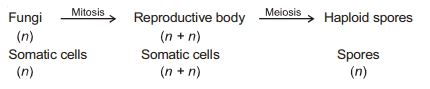
(B) In fungi,the sexual cycle involves the fusion of two nuclei (karyogamy) within the fruiting bodies. This results in a diploid state. Subsequently,a reduction division (meiosis) occurs in these fruiting bodies to produce haploid spores. As shown in the diagram,the reproductive body undergoes meiosis to form haploid $(n)$ spores.
0 likes
View Solution437
MediumMCQ
Vegetative reproduction by fragmentation is common in
A
Agaricus
B
Saccharomyces
C
Euglena
D
Gonyaulax
Solution
(A) Vegetative reproduction by fragmentation is a common method of asexual reproduction in fungi. Among the given options,$Agaricus$ is a fungus (a member of Basidiomycetes),whereas $Saccharomyces$ is a yeast,$Euglena$ is a protist,and $Gonyaulax$ is a dinoflagellate. Therefore,$Agaricus$ is the correct answer.
0 likes
View Solution438
MediumMCQ
Select the incorrect match.
A
Phycomycetes - Albugo
B
Basidiomycetes - Claviceps
C
Ascomycetes - Penicillium
D
Deuteromycetes - Trichoderma
Solution
(B) The correct classification of the given fungi is as follows:
$1$. Phycomycetes: Includes members like Albugo,Mucor,and Rhizopus.
$2$. Ascomycetes: Includes members like Penicillium,Aspergillus,and Claviceps.
$3$. Basidiomycetes: Includes members like Agaricus (mushroom),Ustilago (smut),and Puccinia (rust fungus).
$4$. Deuteromycetes: Includes members like Trichoderma,Colletotrichum,and Alternaria.
In the given options,Claviceps belongs to the class Ascomycetes,not Basidiomycetes. Therefore,the match 'Basidiomycetes - Claviceps' is incorrect.
$1$. Phycomycetes: Includes members like Albugo,Mucor,and Rhizopus.
$2$. Ascomycetes: Includes members like Penicillium,Aspergillus,and Claviceps.
$3$. Basidiomycetes: Includes members like Agaricus (mushroom),Ustilago (smut),and Puccinia (rust fungus).
$4$. Deuteromycetes: Includes members like Trichoderma,Colletotrichum,and Alternaria.
In the given options,Claviceps belongs to the class Ascomycetes,not Basidiomycetes. Therefore,the match 'Basidiomycetes - Claviceps' is incorrect.
0 likes
View Solution439
MediumMCQ
Which of the following is a haploid sexual spore produced exogenously?
A
Ascospore
B
Basidiospore
C
Oospore
D
Zygospore
Solution
(B) In fungi, sexual spores are classified based on their site of production.
$1$. $Basidiospores$ are haploid sexual spores produced exogenously on the surface of a structure called the $basidium$.
$2$. $Ascospores$ are haploid sexual spores produced endogenously within a sac-like structure called the $ascus$.
$3$. $Oospores$ and $Zygospores$ are diploid spores formed by the fusion of gametes.
$1$. $Basidiospores$ are haploid sexual spores produced exogenously on the surface of a structure called the $basidium$.
$2$. $Ascospores$ are haploid sexual spores produced endogenously within a sac-like structure called the $ascus$.
$3$. $Oospores$ and $Zygospores$ are diploid spores formed by the fusion of gametes.
0 likes
View Solution440
MediumMCQ
Coenocytic mycelium is found in
A
Deuteromycetes
B
Phycomycetes
C
Ascomycetes
D
All of these
Solution
(B) Coenocytic mycelium refers to a multinucleated hyphae that lacks septa (cross-walls).
In the kingdom Fungi,Phycomycetes (which includes classes like Oomycetes and Zygomycetes) are characterized by having aseptate and coenocytic mycelium.
In contrast,Deuteromycetes,Ascomycetes,and Basidiomycetes possess septate and branched mycelium.
In the kingdom Fungi,Phycomycetes (which includes classes like Oomycetes and Zygomycetes) are characterized by having aseptate and coenocytic mycelium.
In contrast,Deuteromycetes,Ascomycetes,and Basidiomycetes possess septate and branched mycelium.
0 likes
View Solution441
MediumMCQ
The members of which group are commonly known as sac fungi?
A
Phycomycetes
B
Deuteromycetes
C
Basidiomycetes
D
Ascomycetes
Solution
(D) The members of the group $Ascomycetes$ are commonly known as sac fungi.
$1$. $Ascomycetes$ are called sac fungi because they produce spores in sac-like structures called $asci$.
$2$. $Basidiomycetes$ are commonly known as club fungi.
$3$. $Deuteromycetes$ are known as fungi imperfecti because only their asexual or vegetative phases are known.
$4$. $Phycomycetes$ (which include $Oomycetes$ and $Zygomycetes$) are often referred to as algal fungi or conjugated fungi.
$1$. $Ascomycetes$ are called sac fungi because they produce spores in sac-like structures called $asci$.
$2$. $Basidiomycetes$ are commonly known as club fungi.
$3$. $Deuteromycetes$ are known as fungi imperfecti because only their asexual or vegetative phases are known.
$4$. $Phycomycetes$ (which include $Oomycetes$ and $Zygomycetes$) are often referred to as algal fungi or conjugated fungi.
0 likes
View Solution442
MediumMCQ
Identify $A, B$ and $C$ in the given diagram.
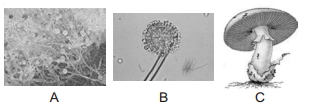
A
$A = \text{Mucor}, B = \text{Aspergillus}, C = \text{Agaricus}$
B
$A = \text{Mucor}, B = \text{Agaricus}, C = \text{Aspergillus}$
C
$A = \text{Agaricus}, B = \text{Mucor}, C = \text{Aspergillus}$
D
$A = \text{Agaricus}, B = \text{Aspergillus}, C = \text{Mucor}$
Solution
(A) Based on the provided diagram:
$A$ represents $\text{Mucor}$,which is a member of the class $\text{Zygomycetes}$.
$B$ represents $\text{Aspergillus}$,which is a member of the class $\text{Ascomycetes}$.
$C$ represents $\text{Agaricus}$,which is a member of the class $\text{Basidiomycetes}$.
Therefore,the correct identification is $A = \text{Mucor}, B = \text{Aspergillus}, C = \text{Agaricus}$.
$A$ represents $\text{Mucor}$,which is a member of the class $\text{Zygomycetes}$.
$B$ represents $\text{Aspergillus}$,which is a member of the class $\text{Ascomycetes}$.
$C$ represents $\text{Agaricus}$,which is a member of the class $\text{Basidiomycetes}$.
Therefore,the correct identification is $A = \text{Mucor}, B = \text{Aspergillus}, C = \text{Agaricus}$.
0 likes
View Solution443
MediumMCQ
Which one is correctly matched?
A
Agaricus - Smut
B
Ustilago - Mushroom
C
Puccinia - Insectivorous plant
D
Deuteromycetes - Imperfect fungi
Solution
(D) $Agaricus$ is commonly known as a mushroom.
$Ustilago$ causes smut disease in plants.
$Puccinia$ causes rust disease in plants.
$Deuteromycetes$ are known as imperfect fungi because only their asexual or vegetative phases are known.
$Ustilago$ causes smut disease in plants.
$Puccinia$ causes rust disease in plants.
$Deuteromycetes$ are known as imperfect fungi because only their asexual or vegetative phases are known.
0 likes
View Solution444
EasyMCQ
The association of fungi with the roots of higher plants is called:
A
Lichens
B
Mycorrhiza
C
Slime mould
D
Neurospora
Solution
(B) Mycorrhiza is a symbiotic association between fungi and the roots of higher plants. In this relationship,the fungi help the plant in the absorption of essential nutrients like phosphorus from the soil,while the plant provides carbohydrates to the fungi.
0 likes
View Solution445
MediumMCQ
Find the correct match:
| Column $I$ | Column $II$ |
| $a.$ Gill fungi | $(i)$ Salmon disease |
| $b.$ Cup fungi | $(ii)$ Trama |
| $c.$ Black mould | $(iii)$ Penicillin |
| $d.$ Blue / green mould | $(iv)$ Zygophore |
| $(v)$ Apothecium |
A
$a-ii, b-iii, c-i, d-v$
B
$a-ii, b-v, c-iv, d-i$
C
$a-ii, b-v, c-iv, d-iii$
D
$a-ii, b-iii, c-i, d-iv$
Solution
(C) The correct matches are as follows:
$a.$ Gill fungi (Basidiomycetes) possess a central tissue structure known as the $Trama$ $(ii)$.
$b.$ Cup fungi (Ascomycetes) produce a cup-shaped fruiting body called an $Apothecium$ $(v)$.
$c.$ Black mould (e.g., $Rhizopus$) is characterized by the formation of a $Zygophore$ $(iv)$ during sexual reproduction.
$d.$ Blue/green mould (e.g., $Penicillium$) is the source of the antibiotic $Penicillin$ $(iii)$.
Therefore, the correct sequence is $a-ii, b-v, c-iv, d-iii$.
$a.$ Gill fungi (Basidiomycetes) possess a central tissue structure known as the $Trama$ $(ii)$.
$b.$ Cup fungi (Ascomycetes) produce a cup-shaped fruiting body called an $Apothecium$ $(v)$.
$c.$ Black mould (e.g., $Rhizopus$) is characterized by the formation of a $Zygophore$ $(iv)$ during sexual reproduction.
$d.$ Blue/green mould (e.g., $Penicillium$) is the source of the antibiotic $Penicillin$ $(iii)$.
Therefore, the correct sequence is $a-ii, b-v, c-iv, d-iii$.
0 likes
View Solution446
MediumMCQ
Select the incorrectly matched pair.
A
$Mucor$ $mucedo$ - Coprophilous
B
$Albugo$ $candida$ - Facultative parasite
C
$Agaricus$ $bisporus$ - Edible basidiocarp
D
$Puccinia$ $graminis$ - Black rust fungi
Solution
(B) $Albugo$ $candida$ is an obligate parasite,not a facultative parasite. An obligate parasite is an organism that can only grow and reproduce within a living host. Therefore,the pair $Albugo$ $candida$ - Facultative parasite is incorrectly matched.
0 likes
View Solution447
EasyMCQ
The fruiting body in $Aspergillus$ (or $Penicillium$) is known as:
A
Cleistothecium
B
Apothecium
C
Perithecium
D
Ascus
Solution
(A) The fruiting body of Ascomycetes fungi is called an ascocarp. In the genera $Aspergillus$ and $Penicillium$,the ascocarp is completely closed and is specifically referred to as a $Cleistothecium$.
0 likes
View Solution448
EasyMCQ
The famous Irish famine is related to a disease of potato known as
A
Late blight of potato
B
Early blight of potato
C
Dry rot of potato
D
Potato scab
Solution
(A) The famous Irish potato famine, which occurred between $1845$ and $1852$, was caused by the oomycete pathogen $Phytophthora$ $\text{infestans}$. This pathogen causes the disease known as the Late blight of potato. The rapid spread of this disease led to massive crop failure, resulting in widespread starvation and death in Ireland.
0 likes
View Solution449
EasyMCQ
$A$ dolipore septum is a characteristic feature of
A
Phycomycetes
B
Ascomycetes
C
Basidiomycetes
D
Zygomycetes
Solution
(C) dolipore septum is a specialized type of septal structure found in the hyphae of fungi belonging to the class $Basidiomycetes$.
It consists of a barrel-shaped swelling around the central pore of the septum,which is covered by a perforated cap called a parenthesome.
This structure allows for the controlled movement of cytoplasm and organelles between adjacent cells while preventing the passage of nuclei.
It consists of a barrel-shaped swelling around the central pore of the septum,which is covered by a perforated cap called a parenthesome.
This structure allows for the controlled movement of cytoplasm and organelles between adjacent cells while preventing the passage of nuclei.
0 likes
View Solution450
MediumMCQ
Which one of the following combinations of characters is correct for the given fungal group?
A
Algal fungi: Coenocytic,cellulosic wall,zoospore,zygospore,dikaryophase present
B
Conjugating fungi: Septate mycelium,chitinous cell wall,sporangiospore,shorter $(n + n)$ phase
C
Sac fungi: Septate mycelium,Ascogonium,Crozier stage,meiospores as ascospores,shorter dikaryophase
D
Club fungi: Shorter primary mycelium stage,no sex organs,dominant dikaryophase,zygosporic meiosis
Solution
(C) The correct option is $C$.
$1$. Sac fungi (Ascomycetes) possess septate mycelium.
$2$. They exhibit the formation of an Ascogonium,which is the female sex organ.
$3$. The Crozier stage is a characteristic feature of Ascomycetes during the formation of the ascus.
$4$. They produce meiospores known as ascospores within the ascus.
$5$. The dikaryophase is relatively shorter compared to Basidiomycetes.
$1$. Sac fungi (Ascomycetes) possess septate mycelium.
$2$. They exhibit the formation of an Ascogonium,which is the female sex organ.
$3$. The Crozier stage is a characteristic feature of Ascomycetes during the formation of the ascus.
$4$. They produce meiospores known as ascospores within the ascus.
$5$. The dikaryophase is relatively shorter compared to Basidiomycetes.
0 likes
View SolutionBiological Classification — Fungi (Multicellular decomposers) · Frequently Asked Questions
1Are these Biological Classification questions useful for JEE and NEET?
Yes. All questions in this section are mapped to JEE Main and NEET exam patterns. Previous year questions from JEE Main, NEET, GUJCET and state-level exams are included with full solutions.
2Can I switch to Hindi or Gujarati for these questions?
Yes. Use the language tabs in the hero section or the sidebar to view the same questions and solutions in English, Hindi or Gujarati.
3How do I generate a question paper from this subtopic?
Use the Vedclass Exam Paper Generator — select the chapter and subtopic, set difficulty, and generate Sets A, B, C, D automatically. First 3 chapters of every subject are free.
Vedclass Products
For Students
Vedclass Test Series
Mock tests in real JEE/NEET style with performance analysis. 5-day free trial.
Start Free TrialFor Teachers
Exam Paper Generator
Generate Set A/B/C/D papers from this chapter in 2 minutes. 3 chapters free.
Try FreeFor Institutes
Online Exam Module
Live online exams with unlimited students, 360° analytics & white-label branding.
See DemoFor Teachers & Institutes
Generate a Biological Classification Exam Paper in 2 Minutes
Select subtopic & difficulty — Sets A, B, C, D auto-generated with No Repeat logic.
First 3 chapters of every subject are free — no payment required.