
A English
Fungi (Multicellular decomposers) Questions in English
Class 11 Biology · Biological Classification · Fungi (Multicellular decomposers)
511+
Questions
English
Language
100%
With Solutions
Showing 49 of 511 questions in English
301
EasyMCQ
Which of the following plants does not show embryo formation as a result of sexual reproduction?
A
Mucor
B
Riccia
C
Fern
D
Sunflower
Solution
(A) In the plant kingdom,the formation of an embryo is a characteristic feature of Embryophyta,which includes Bryophytes,Pteridophytes,Gymnosperms,and Angiosperms.
$Mucor$ belongs to the kingdom Fungi.
Fungi do not form embryos during their sexual reproduction cycle.
Therefore,$Mucor$ is the correct answer as it does not show embryo formation.
$Mucor$ belongs to the kingdom Fungi.
Fungi do not form embryos during their sexual reproduction cycle.
Therefore,$Mucor$ is the correct answer as it does not show embryo formation.
0 likes
View Solution302
EasyMCQ
Which mode of nutrition is observed in the Kingdom Fungi?
A
Absorptive
B
Saprophytic
C
Photosynthetic
D
Both $(A)$ and $(B)$
Solution
(D) Kingdom Fungi consists of heterotrophic organisms that exhibit absorptive nutrition.
They secrete digestive enzymes into their environment to break down complex organic matter into simpler substances,which are then absorbed by the fungal hyphae.
Most fungi are saprophytes,meaning they obtain nutrients from dead and decaying organic matter.
Therefore,fungi exhibit both absorptive and saprophytic modes of nutrition.
They secrete digestive enzymes into their environment to break down complex organic matter into simpler substances,which are then absorbed by the fungal hyphae.
Most fungi are saprophytes,meaning they obtain nutrients from dead and decaying organic matter.
Therefore,fungi exhibit both absorptive and saprophytic modes of nutrition.
0 likes
View Solution303
MediumMCQ
Which kingdom does not consist of organisms that are organized into tissues and are autotrophic?
A
Kingdom Fungi
B
Kingdom Animalia
C
Kingdom Plantae
D
All of $(A), (B)$ and $(C)$
Solution
(A) $1$. Kingdom Plantae consists of organisms that are autotrophic and have tissues.
$2$. Kingdom Animalia consists of organisms that are heterotrophic and have tissues (except Porifera).
$3$. Kingdom Fungi consists of organisms that are heterotrophic and are not organized into true tissues (they have mycelium).
$4$. Therefore,Kingdom Fungi is the correct answer as it is not autotrophic and lacks true tissue organization.
$2$. Kingdom Animalia consists of organisms that are heterotrophic and have tissues (except Porifera).
$3$. Kingdom Fungi consists of organisms that are heterotrophic and are not organized into true tissues (they have mycelium).
$4$. Therefore,Kingdom Fungi is the correct answer as it is not autotrophic and lacks true tissue organization.
0 likes
View Solution304
EasyMCQ
Which of the following methods of vegetative reproduction occur in fungi?
A
Fragmentation
B
Budding
C
Both $A$ and $B$
D
By spores
Solution
(C) Vegetative reproduction in fungi occurs through various methods such as fragmentation,budding,and fission.
Fragmentation involves the breaking of the mycelium into smaller pieces,each capable of growing into a new individual.
Budding is commonly observed in unicellular fungi like yeast $(Saccharomyces)$.
Therefore,both fragmentation and budding are methods of vegetative reproduction in fungi.
Fragmentation involves the breaking of the mycelium into smaller pieces,each capable of growing into a new individual.
Budding is commonly observed in unicellular fungi like yeast $(Saccharomyces)$.
Therefore,both fragmentation and budding are methods of vegetative reproduction in fungi.
0 likes
View Solution305
MediumMCQ
Which types of sexual reproduction occur in fungi?
A
Oogamous
B
Anisogamous
C
Isogamous
D
All of the above $(A), (B)$ and $(C)$
Solution
(D) Sexual reproduction in fungi occurs by the following methods:
$1$. Isogamy: Fusion of two morphologically similar gametes.
$2$. Anisogamy: Fusion of two morphologically dissimilar gametes.
$3$. Oogamy: Fusion of a large non-motile female gamete and a small motile male gamete.
Since fungi exhibit all these modes of sexual reproduction,the correct option is $(D)$.
$1$. Isogamy: Fusion of two morphologically similar gametes.
$2$. Anisogamy: Fusion of two morphologically dissimilar gametes.
$3$. Oogamy: Fusion of a large non-motile female gamete and a small motile male gamete.
Since fungi exhibit all these modes of sexual reproduction,the correct option is $(D)$.
0 likes
View Solution306
EasyMCQ
In fungi,sexual reproduction takes place in how many stages?
A
One
B
Two
C
Three
D
Four
Solution
(C) Sexual reproduction in fungi occurs in three distinct stages:
$1$. Plasmogamy: The fusion of protoplasm between two motile or non-motile gametes.
$2$. Karyogamy: The fusion of two nuclei.
$3$. Meiosis: The zygote undergoes meiosis to produce haploid spores.
$1$. Plasmogamy: The fusion of protoplasm between two motile or non-motile gametes.
$2$. Karyogamy: The fusion of two nuclei.
$3$. Meiosis: The zygote undergoes meiosis to produce haploid spores.
0 likes
View Solution307
MediumMCQ
$A :$ Whittaker placed fungi in a separate kingdom from Protista. $R :$ The cell wall of fungi is composed of fungal-cellulose (chitin).
A
$A$ and $R$ are both true and $R$ is the correct explanation of $A$.
B
$A$ and $R$ are both true,but $R$ is not the correct explanation of $A$.
C
$A$ is true and $R$ is false.
D
$A$ is false and $R$ is true.
Solution
(A) Whittaker proposed a five-kingdom classification system.
He placed fungi in a separate kingdom,Kingdom Fungi,because they are heterotrophic,eukaryotic organisms with a unique cell wall composition.
Protists are primarily unicellular eukaryotes,whereas fungi are mostly multicellular (except yeasts) and have a distinct mode of nutrition (saprophytic/parasitic).
The cell wall of fungi is made of chitin,which is a complex polysaccharide,unlike the cell walls of plants (cellulose) or protists (variable).
Since the distinct cell wall composition is a primary reason for separating fungi from other eukaryotic groups like Protista,$R$ is the correct explanation for $A$.
He placed fungi in a separate kingdom,Kingdom Fungi,because they are heterotrophic,eukaryotic organisms with a unique cell wall composition.
Protists are primarily unicellular eukaryotes,whereas fungi are mostly multicellular (except yeasts) and have a distinct mode of nutrition (saprophytic/parasitic).
The cell wall of fungi is made of chitin,which is a complex polysaccharide,unlike the cell walls of plants (cellulose) or protists (variable).
Since the distinct cell wall composition is a primary reason for separating fungi from other eukaryotic groups like Protista,$R$ is the correct explanation for $A$.
0 likes
View Solution308
EasyMCQ
Statement $X$: Fungi are heterotrophic because they cannot synthesize their own food.
Statement $Y$: Fungi lack chlorophyll.
Statement $Y$: Fungi lack chlorophyll.
A
Both Statement $X$ and $Y$ are true.
B
Statement $X$ is true and $Y$ is false.
C
Both Statement $X$ and $Y$ are true. Statement $Y$ is the correct explanation of $X$.
D
Statement $X$ is false and $Y$ is true.
Solution
(C) Fungi are heterotrophic organisms because they lack chlorophyll,which is the pigment required for photosynthesis.
Since they cannot perform photosynthesis,they are unable to synthesize their own food and must obtain nutrients from organic matter.
Therefore,Statement $Y$ (lack of chlorophyll) is the direct biological reason for Statement $X$ (heterotrophic nature).
Thus,both statements are true,and $Y$ is the correct explanation of $X$.
Since they cannot perform photosynthesis,they are unable to synthesize their own food and must obtain nutrients from organic matter.
Therefore,Statement $Y$ (lack of chlorophyll) is the direct biological reason for Statement $X$ (heterotrophic nature).
Thus,both statements are true,and $Y$ is the correct explanation of $X$.
0 likes
View Solution309
EasyMCQ
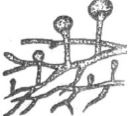
To which group of organisms does the given figure belong?
A
Thallophyta
B
Bryophyta
C
Pteridophyta
D
Angiosperms
Solution
(A) The provided figure shows the mycelial structure of a fungus,specifically a mold like Rhizopus. Fungi are classified under the kingdom Fungi,which is distinct from the plant kingdom. However,in older classification systems or broad biological contexts,fungi were often grouped with the Thallophyta (organisms with a thallus-like body that is not differentiated into roots,stems,and leaves). Among the given options,Thallophyta is the most appropriate category as it includes organisms with simple,undifferentiated bodies.
0 likes
View Solution310
EasyMCQ
What is the cell wall of the organism shown in the figure made of?
A
Chitin
B
Cellulose
C
Pectin
D
All of the above
Solution
(A) The figure shows a fungus,specifically a mold like Rhizopus.
Fungi are heterotrophic organisms that have a cell wall made of chitin.
Chitin is a complex polysaccharide.
Therefore,the correct answer is chitin.
Fungi are heterotrophic organisms that have a cell wall made of chitin.
Chitin is a complex polysaccharide.
Therefore,the correct answer is chitin.
0 likes
View Solution311
MediumMCQ
What is the mode of nutrition of the organism shown in the given figure?
A
Heterotrophic
B
Autotrophic
C
Self-sustaining
D
Photosynthetic
Solution
(A) The figure shows the structure of a fungus,specifically a bread mold like Rhizopus.
Fungi are achlorophyllous organisms,meaning they lack chlorophyll and cannot perform photosynthesis.
Therefore,they cannot produce their own food and are heterotrophic in their mode of nutrition.
They typically obtain nutrients by absorbing organic matter from dead and decaying materials (saprophytic nutrition).
Fungi are achlorophyllous organisms,meaning they lack chlorophyll and cannot perform photosynthesis.
Therefore,they cannot produce their own food and are heterotrophic in their mode of nutrition.
They typically obtain nutrients by absorbing organic matter from dead and decaying materials (saprophytic nutrition).
0 likes
View Solution312
MediumMCQ
In the organism shown in the given figure,how does asexual reproduction occur?
A
Zoospore
B
Aplanospore
C
Budding
D
Both $(A)$ and $(B)$
Solution
(D) The figure shows the fungus $Rhizopus$,which belongs to the class $Phycomycetes$ (Zygomycetes).
In $Rhizopus$,asexual reproduction occurs through the formation of spores.
These spores can be motile (zoospores) or non-motile (aplanospores).
Therefore,asexual reproduction in this organism can occur through both zoospores and aplanospores.
In $Rhizopus$,asexual reproduction occurs through the formation of spores.
These spores can be motile (zoospores) or non-motile (aplanospores).
Therefore,asexual reproduction in this organism can occur through both zoospores and aplanospores.
0 likes
View Solution313
EasyMCQ
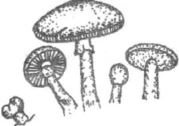
Identify the organism shown in the given figure.
A
Agaricus (Mushroom)
B
Mucor
C
Bread mould
D
Penicillium
Solution
(A) The figure shows the structure of Agaricus,commonly known as a mushroom. It belongs to the class Basidiomycetes of the kingdom Fungi. The characteristic features include a pileus (cap) and a stipe (stalk) with gills underneath the cap.
0 likes
View Solution314
EasyMCQ
Fungal cellulose is .........
A
Hemicellulose
B
Cutin
C
Chitin
D
Suberin
Solution
(C) The cell wall of fungi is primarily composed of $Chitin$. $Chitin$ is a complex polysaccharide,specifically a polymer of $N$-acetylglucosamine. Because of its structural role in fungi,it is often referred to as 'fungal cellulose'.
0 likes
View Solution315
MediumMCQ
Identify the incorrect pair from the following:
A
Phycobiont - Algal component
B
Ascospore - Sexual reproduction
C
Apothecium - Cup-shaped lichen fruiting body
D
Perithecium - Flask-shaped lichen fruiting body
Solution
(NONE) In the study of lichens and fungi,the reproductive structures are classified based on their shape.
$A$. Phycobiont refers to the algal component of a lichen,which is correct.
$B$. Ascospore is a spore produced in an ascus during sexual reproduction in Ascomycetes,which is correct.
$C$. Apothecium is a cup-shaped or saucer-shaped fruiting body,which is correct.
$D$. Perithecium is a flask-shaped fruiting body with a small pore (ostiole) at the top. While this structure is associated with Ascomycetes fungi,it is not a 'lichen fruiting body' in the sense that the entire structure is not a lichen; rather,it is a fungal structure. However,in the context of typical biology MCQs,the term 'lichen fruiting body' is often used loosely to describe the fungal component's reproductive structure within the lichen. Upon closer inspection,all options are technically correct in their definitions. If we must identify an 'incorrect' pair,it is often a trick question where all are correct. However,if the question implies which is $NOT$ a lichen structure,all are associated with the fungal partner. Given standard curriculum,all these pairs are scientifically accurate definitions.
$A$. Phycobiont refers to the algal component of a lichen,which is correct.
$B$. Ascospore is a spore produced in an ascus during sexual reproduction in Ascomycetes,which is correct.
$C$. Apothecium is a cup-shaped or saucer-shaped fruiting body,which is correct.
$D$. Perithecium is a flask-shaped fruiting body with a small pore (ostiole) at the top. While this structure is associated with Ascomycetes fungi,it is not a 'lichen fruiting body' in the sense that the entire structure is not a lichen; rather,it is a fungal structure. However,in the context of typical biology MCQs,the term 'lichen fruiting body' is often used loosely to describe the fungal component's reproductive structure within the lichen. Upon closer inspection,all options are technically correct in their definitions. If we must identify an 'incorrect' pair,it is often a trick question where all are correct. However,if the question implies which is $NOT$ a lichen structure,all are associated with the fungal partner. Given standard curriculum,all these pairs are scientifically accurate definitions.
0 likes
View Solution316
MediumMCQ
In fungi,the oogamous type of sexual reproduction refers to .......
A
Sexual reproduction by similar gametes
B
Sexual reproduction by dissimilar gametes
C
Sexual reproduction involving a large non-motile female gamete and a small motile male gamete
D
Sexual reproduction by spores and gametes
Solution
(C) In fungi,sexual reproduction can be isogamous,anisogamous,or oogamous.
$1$. Isogamous: Fusion of two morphologically similar gametes.
$2$. Anisogamous: Fusion of two morphologically dissimilar gametes.
$3$. Oogamous: Fusion of a large,non-motile female gamete (egg) and a small,motile male gamete (antherozoid).
Therefore,the correct definition of oogamous reproduction is the fusion of a large non-motile female gamete and a small motile male gamete.
$1$. Isogamous: Fusion of two morphologically similar gametes.
$2$. Anisogamous: Fusion of two morphologically dissimilar gametes.
$3$. Oogamous: Fusion of a large,non-motile female gamete (egg) and a small,motile male gamete (antherozoid).
Therefore,the correct definition of oogamous reproduction is the fusion of a large non-motile female gamete and a small motile male gamete.
0 likes
View Solution317
EasyMCQ
Perithecium is a ........
A
Flask-shaped fruiting body of lichens
B
Cup-shaped fruiting body of lichens
C
Asexual reproductive structure of lichens
D
Type of lichen spore
Solution
(A) $Perithecium$ is a type of flask-shaped fruiting body (ascocarp) found in certain fungi and lichens. It is characterized by a small pore or opening at the top called an $ostiole$,through which spores are released. Therefore,it is a flask-shaped fruiting body.
0 likes
View Solution318
MediumMCQ
Flask-shaped fruit body and cup-shaped thalamus are respectively called ......... and .........?
A
Perithecium,Calyciflorae
B
Apothecium,Calyciflorae
C
Perithecium,Disciflorae
D
Apothecium,Thalamiflorae
Solution
(A) $1$. $A$ flask-shaped fruiting body (ascocarp) found in certain fungi is known as a $Perithecium$.
$2$. In plant morphology,specifically in the classification of flowers based on the shape of the thalamus,a cup-shaped thalamus where the floral parts are situated on the rim is characteristic of the group $Calyciflorae$.
$3$. Therefore,the correct terms are $Perithecium$ and $Calyciflorae$.
$2$. In plant morphology,specifically in the classification of flowers based on the shape of the thalamus,a cup-shaped thalamus where the floral parts are situated on the rim is characteristic of the group $Calyciflorae$.
$3$. Therefore,the correct terms are $Perithecium$ and $Calyciflorae$.
0 likes
View Solution319
MediumMCQ
Which polysaccharides are found in fungi?
A
Cellulose-Lignin
B
Glycogen-Chitin
C
Chitin-Cellulose
D
Dextrin-Chitin
Solution
(B) Fungi store their reserve food material in the form of $Glycogen$.
Their cell walls are primarily composed of $Chitin$,which is a complex polysaccharide made of $N$-acetylglucosamine units.
Therefore,the polysaccharides found in fungi are $Glycogen$ and $Chitin$.
Their cell walls are primarily composed of $Chitin$,which is a complex polysaccharide made of $N$-acetylglucosamine units.
Therefore,the polysaccharides found in fungi are $Glycogen$ and $Chitin$.
0 likes
View Solution320
MediumMCQ
Chitin is present in the cell wall of which of the following?
A
Algae
B
Bacteria
C
Fungi
D
Yeast
Solution
(C) Chitin is a complex polysaccharide,specifically a polymer of $N$-acetylglucosamine. It is a major structural component found in the cell walls of $Fungi$. While $Yeast$ is a type of fungus,the term $Fungi$ is the broader and more accurate biological classification for organisms possessing chitinous cell walls. Bacteria have cell walls made of peptidoglycan,and algae have cell walls primarily composed of cellulose,galactans,and mannans.
0 likes
View Solution321
MediumMCQ
Which one of the following is wrong for fungi?
A
They are eukaryotic.
B
All fungi possess a purely cellulosic cell wall.
C
They are heterotrophic.
D
They are both unicellular and multicellular.
Solution
(B) The correct answer is $B$. Fungi are eukaryotic,heterotrophic organisms that can be unicellular (e.g.,yeast) or multicellular. The cell wall of fungi is primarily composed of $Chitin$,which is a complex polysaccharide of $N$-acetyl-$D$-glucosamine,not cellulose. Cellulose is the primary component of the cell wall in plants.
0 likes
View Solution322
MediumMCQ
One of the major components of the cell wall of most fungi is
A
cellulose
B
hemicellulose
C
chitin
D
peptidoglycan
Solution
(C) The correct answer is $C$. The cell wall of most fungi is primarily composed of $chitin$,which is a complex polysaccharide made of $N$-acetylglucosamine units. In addition to $chitin$,the fungal cell wall may also contain other polysaccharides,proteins,lipids,and various other substances.
0 likes
View Solution323
MediumMCQ
Choose the wrong statement.
A
Morels and truffles are poisonous mushrooms.
B
Yeast is unicellular and useful in fermentation.
C
Penicillium is multicellular and produces antibiotics.
D
Neurospora is used in the study of biochemical genetics.
Solution
(A) : Morels are Ascomycetes with edible ascocarps that have a fleshy,sponge-like conical cap or pileus and a stalk-like stipe,e.g.,$Morchella$ $esculenta$.
Truffles are also edible members of Ascomycetes with tuber-like subterranean ascocarps that are often dug out with the help of trained dogs and pigs,e.g.,$Tuber$ $aestivum$.
Therefore,the statement that morels and truffles are poisonous is incorrect,as they are considered delicacies.
Truffles are also edible members of Ascomycetes with tuber-like subterranean ascocarps that are often dug out with the help of trained dogs and pigs,e.g.,$Tuber$ $aestivum$.
Therefore,the statement that morels and truffles are poisonous is incorrect,as they are considered delicacies.
0 likes
View Solution324
MediumMCQ
Which one of the following matches is correct?
| $Mucor$ | Reproduction by Conjugation | $Ascomycetes$ |
| $Agaricus$ | Parasitic fungus | $Basidiomycetes$ |
| $Phytophthora$ | Aseptate mycelium | $Basidiomycetes$ |
| $Alternaria$ | Sexual reproduction absent | $Deuteromycetes$ |
A
$Mucor$ - Reproduction by Conjugation - $Ascomycetes$
B
$Agaricus$ - Parasitic fungus - $Basidiomycetes$
C
$Phytophthora$ - Aseptate mycelium - $Basidiomycetes$
D
$Alternaria$ - Sexual reproduction absent - $Deuteromycetes$
Solution
(D) $Alternaria$ is a member of $Deuteromycetes$, which are commonly known as 'fungi imperfecti'.
In $Deuteromycetes$, the sexual reproduction stage is either absent or not yet discovered, which is why they are classified as imperfect fungi.
$Mucor$ belongs to $Phycomycetes$ (Zygomycetes).
$Agaricus$ is a saprophytic fungus, not parasitic.
$Phytophthora$ belongs to $Phycomycetes$ (Oomycetes), not $Basidiomycetes$.
In $Deuteromycetes$, the sexual reproduction stage is either absent or not yet discovered, which is why they are classified as imperfect fungi.
$Mucor$ belongs to $Phycomycetes$ (Zygomycetes).
$Agaricus$ is a saprophytic fungus, not parasitic.
$Phytophthora$ belongs to $Phycomycetes$ (Oomycetes), not $Basidiomycetes$.
0 likes
View Solution325
MediumMCQ
Which one of the following is true for fungi?
A
They lack a rigid cell wall.
B
They are heterotrophs.
C
They lack nuclear membrane.
D
They are phagotrophs.
Solution
(B) : Fungi are achlorophyllous,heterotrophic,spore-forming,non-vascular,eukaryotic organisms. They possess a rigid cell wall primarily composed of chitin. Since they lack chlorophyll,they cannot perform photosynthesis and are therefore heterotrophic,obtaining nutrients through absorption.
0 likes
View Solution326
MediumMCQ
Which one single organism or the pair of organisms is correctly assigned to its or their named taxonomic group?
A
$Paramecium$ and $Plasmodium$ belong to the same kingdom as that of $Penicillium$.
B
Lichen is a composite organism formed from the symbiotic association of an algae and a protozoan.
C
Yeast used in making bread and beer is a fungus.
D
$Nostoc$ and $Anabaena$ are examples of protista.
Solution
(C) : Yeast is a group of unicellular fungi belonging to the class Ascomycetes.
They occur as single cells,groups,or chains of cells.
Yeast of the genus $Saccharomyces$ ferments sugar and is widely used in the production of bread and beer.
$Paramecium$ and $Plasmodium$ are Protists,while $Penicillium$ is a Fungus.
Lichen is a symbiotic association between algae and fungi,not protozoans.
$Nostoc$ and $Anabaena$ are Cyanobacteria (Monera),not Protista.
They occur as single cells,groups,or chains of cells.
Yeast of the genus $Saccharomyces$ ferments sugar and is widely used in the production of bread and beer.
$Paramecium$ and $Plasmodium$ are Protists,while $Penicillium$ is a Fungus.
Lichen is a symbiotic association between algae and fungi,not protozoans.
$Nostoc$ and $Anabaena$ are Cyanobacteria (Monera),not Protista.
0 likes
View Solution327
MediumMCQ
Which one of the following is incorrectly matched?
A
Root pressure - Guttation
B
Puccinia - Smut
C
Root - Exarch protoxylem
D
Cassia - Imbricate aestivation
Solution
(B) $Puccinia$ is a genus of fungi that causes rust disease in plants,not smut. Smut diseases are typically caused by fungi of the genus $Ustilago$. Therefore,the pair $Puccinia - Smut$ is incorrectly matched. Root pressure is responsible for guttation,roots exhibit exarch protoxylem,and $Cassia$ shows imbricate aestivation,making the other options correct.
0 likes
View Solution328
MediumMCQ
The pathogen $Microsporum$,responsible for ringworm disease in humans,belongs to the same kingdom of organisms as that of
A
$Taenia$,a tapeworm
B
$Wuchereria$,a filarial worm
C
$Rhizopus$,a mould
D
$Ascaris$,a round worm
Solution
(C) : The pathogen $Microsporum$ is a genus of Kingdom $Fungi$ that causes diseases of the skin and hair in humans and animals like dogs,cats,and monkeys.
Ringworm is caused by dermatophyte fungi,specifically species of $Microsporum$,$Trichophyton$,and $Epidermophyton$.
$Rhizopus$,a black bread mould,belongs to the group $Zygomycetes$ of Kingdom $Fungi$.
Ringworm is caused by dermatophyte fungi,specifically species of $Microsporum$,$Trichophyton$,and $Epidermophyton$.
$Rhizopus$,a black bread mould,belongs to the group $Zygomycetes$ of Kingdom $Fungi$.
0 likes
View Solution329
MediumMCQ
Black (stem) rust of wheat is caused by
A
Alternaria solani
B
Ustilago nuda
C
Puccinia graminis
D
Xanthomonas oryzae
Solution
(C) : Black stem rust is caused by $Puccinia graminis tritici$. The genus $Puccinia$ includes $700$ species, which cause rust diseases of many economic plants such as wheat, barley, oats, etc.
It is called a rust because of the reddish-brown color of the spores that are found chiefly upon the surface of the host leaves and stems.
$P. graminis$ is heteroecious, $i.e.$, requiring two hosts, wheat and barberry, for the completion of its normal life cycle.
According to the nature of the spores, the life cycle of $P. graminis$ is divided into five stages.
It is during the teleuto stage that the teliospores produce dark brown to black pustules on the surface of stems and leaves of the wheat, which results in 'black stem rust of wheat'.
It is called a rust because of the reddish-brown color of the spores that are found chiefly upon the surface of the host leaves and stems.
$P. graminis$ is heteroecious, $i.e.$, requiring two hosts, wheat and barberry, for the completion of its normal life cycle.
According to the nature of the spores, the life cycle of $P. graminis$ is divided into five stages.
It is during the teleuto stage that the teliospores produce dark brown to black pustules on the surface of stems and leaves of the wheat, which results in 'black stem rust of wheat'.
0 likes
View Solution330
MediumMCQ
Which one is the wrong pairing for the disease and its causal organism?
A
Black rust of wheat - Puccinia graminis
B
Loose smut of wheat - Ustilago nuda
C
Root knot of vegetables - Meloidogyne sp.
D
Late blight of potato - Alternaria solani
Solution
(D) : Late blight of potato is caused by $Phytophthora \text{ } infestans$. It is a phycomycetes fungus. $Alternaria \text{ } solani$ is the causal organism of early blight of potato disease.
0 likes
View Solution331
MediumMCQ
Which pair of the following belongs to basidiomycetes?
A
Puffballs and Claviceps
B
Peziza and stink horns
C
Morchella and mushrooms
D
Birds nest fungi and puffballs
Solution
(D) $Cyathus$ is known as bird's nest fungi,and $Lycoperdon$ is called puffballs. Both these fungi belong to the group of club fungi or basidiomycetes.
These fungi produce spores inside club-shaped fruit bodies called basidium.
Typically,a basidium has $4$ basidiospores produced exogenously.
$Peziza$,$Morchella$,and $Claviceps$ belong to ascomycetes (which produce ascospores in ascocarps).
Mushrooms are also basidiomycetes,but the pair in option $D$ consists entirely of basidiomycetes.
These fungi produce spores inside club-shaped fruit bodies called basidium.
Typically,a basidium has $4$ basidiospores produced exogenously.
$Peziza$,$Morchella$,and $Claviceps$ belong to ascomycetes (which produce ascospores in ascocarps).
Mushrooms are also basidiomycetes,but the pair in option $D$ consists entirely of basidiomycetes.
0 likes
View Solution332
MediumMCQ
Which of the following environmental conditions are essential for optimum growth of $Mucor$ on a piece of bread?
$A.$ Temperature of about $25^{\circ}C$
$B.$ Temperature of about $5^{\circ}C$
$C.$ Relative humidity of about $5\%$
$D.$ Relative humidity of about $95\%$
$E.$ $A$ shady place
$F.$ $A$ brightly illuminated place
Choose the answer from the following options.
$A.$ Temperature of about $25^{\circ}C$
$B.$ Temperature of about $5^{\circ}C$
$C.$ Relative humidity of about $5\%$
$D.$ Relative humidity of about $95\%$
$E.$ $A$ shady place
$F.$ $A$ brightly illuminated place
Choose the answer from the following options.
A
$B, C$ and $F$ only
B
$A, C$ and $E$ only
C
$A, D$ and $E$ only
D
$B, D$ and $E$ only
Solution
(C) $Mucor$ is a filamentous fungus commonly known as black mould,found in humus-rich soil,decaying fruits,and vegetables.
For optimal growth,$Mucor$ requires:
$1$. $A$ moderate temperature,typically around $25^{\circ}C$ to $30^{\circ}C$ $(A)$.
$2$. High relative humidity,typically around $90-95\%$ $(D)$.
$3$. $A$ moist and shady environment $(E)$.
It does not grow well at low temperatures $(5^{\circ}C)$ or in very dry conditions ($5\%$ humidity),and it prefers dark or shady areas over brightly illuminated ones.
Therefore,the correct conditions are $A, D,$ and $E$.
For optimal growth,$Mucor$ requires:
$1$. $A$ moderate temperature,typically around $25^{\circ}C$ to $30^{\circ}C$ $(A)$.
$2$. High relative humidity,typically around $90-95\%$ $(D)$.
$3$. $A$ moist and shady environment $(E)$.
It does not grow well at low temperatures $(5^{\circ}C)$ or in very dry conditions ($5\%$ humidity),and it prefers dark or shady areas over brightly illuminated ones.
Therefore,the correct conditions are $A, D,$ and $E$.
0 likes
View Solution333
MediumMCQ
Which one of the following has a haplontic life cycle?
A
Polytrichum
B
Funaria
C
Wheat
D
Ustilago
Solution
(D) The correct answer is $D$.
In a haplontic life cycle,the sporophytic generation is represented only by the one-celled zygote. There are no free-living sporophytes.
$A$,$B$,and $C$ (Polytrichum,Funaria,and Wheat) exhibit a diplohaplontic life cycle (haplodiplontic),where both haploid and diploid phases are multicellular.
$Ustilago$ (a smut fungus) is a member of Basidiomycetes. In many fungi,the dominant phase is haploid,and the zygote undergoes meiosis immediately to produce haploid spores,representing a haplontic life cycle.
In a haplontic life cycle,the sporophytic generation is represented only by the one-celled zygote. There are no free-living sporophytes.
$A$,$B$,and $C$ (Polytrichum,Funaria,and Wheat) exhibit a diplohaplontic life cycle (haplodiplontic),where both haploid and diploid phases are multicellular.
$Ustilago$ (a smut fungus) is a member of Basidiomycetes. In many fungi,the dominant phase is haploid,and the zygote undergoes meiosis immediately to produce haploid spores,representing a haplontic life cycle.
0 likes
View Solution334
MediumMCQ
Cellulose is the major component of cell walls of
A
Pseudomonas
B
Saccharomyces
C
Pythium
D
Xanthomonas
Solution
(C) : The cell wall of most fungi consists of chitin,but some groups like Oomycetes contain cellulose. In $Pythium$,the hyphal wall contains cellulose.
In yeast $(Saccharomyces)$,the cell wall is composed of chitin in combination with other compounds like glucan and mannan.
Bacteria such as $Pseudomonas$ and $Xanthomonas$ have cell walls composed of peptidoglycan ($N$-acetyl glucosamine and $N$-acetyl muramic acid).
In yeast $(Saccharomyces)$,the cell wall is composed of chitin in combination with other compounds like glucan and mannan.
Bacteria such as $Pseudomonas$ and $Xanthomonas$ have cell walls composed of peptidoglycan ($N$-acetyl glucosamine and $N$-acetyl muramic acid).
0 likes
View Solution335
EasyMCQ
Which one of the following fungi contains hallucinogens?
A
Morchella esculenta
B
Amanita muscaria
C
Neurospora sp.
D
Ustilago sp.
Solution
(B) $Amanita \ muscaria$ is a member of Class $Basidiomycetes$.
It is a poisonous mushroom and possesses hallucinogenic properties.
It produces toxic alkaloids such as muscarine,which mimics the effects of acetylcholine and binds to muscarinic receptors,as well as ibotenic acid,which binds to different receptors.
This interaction leads to the excitation of neurons bearing these receptors,resulting in hallucinations.
It is a poisonous mushroom and possesses hallucinogenic properties.
It produces toxic alkaloids such as muscarine,which mimics the effects of acetylcholine and binds to muscarinic receptors,as well as ibotenic acid,which binds to different receptors.
This interaction leads to the excitation of neurons bearing these receptors,resulting in hallucinations.
0 likes
View Solution336
MediumMCQ
Fungi reproduce through
A
Fragmentation
B
Spores
C
Both $(A)$ & $(B)$ correct
D
Both $(A)$ & $(B)$ incorrect
Solution
(C) Fungi exhibit diverse modes of reproduction.
$1$. Vegetative reproduction occurs through fragmentation,where the mycelium breaks into smaller pieces,each capable of growing into a new individual.
$2$. Asexual reproduction occurs through the production of various types of spores such as conidia,sporangiospores,or zoospores.
$3$. Sexual reproduction also involves the formation of spores (e.g.,oospores,ascospores,and basidiospores).
Therefore,both fragmentation and spore formation are valid methods of reproduction in fungi.
$1$. Vegetative reproduction occurs through fragmentation,where the mycelium breaks into smaller pieces,each capable of growing into a new individual.
$2$. Asexual reproduction occurs through the production of various types of spores such as conidia,sporangiospores,or zoospores.
$3$. Sexual reproduction also involves the formation of spores (e.g.,oospores,ascospores,and basidiospores).
Therefore,both fragmentation and spore formation are valid methods of reproduction in fungi.
0 likes
View Solution337
MediumMCQ
Which of the following is a parasite on mustard plants?
A
Pinus
B
Albugo
C
Cycas
D
Banana
Solution
(B) $Albugo$ $candida$ is a parasitic fungus that causes white rust disease in mustard plants. It belongs to the class Oomycetes. Pinus and Cycas are gymnosperms,and Banana is an angiosperm,none of which are parasites on mustard.
0 likes
View Solution338
MediumMCQ
Who is responsible for wheat rust?
A
Plasmodium
B
Bacteria
C
Fungi
D
Algae
Solution
(C) Wheat rust is a plant disease caused by fungi of the genus $Puccinia$.
Specifically, $Puccinia$ $\text{graminis}$ is the most common species responsible for stem rust in wheat.
Fungi are heterotrophic organisms that can act as parasites on plants, causing various diseases like rusts, smuts, and blights.
Therefore, the correct option is $C$.
Specifically, $Puccinia$ $\text{graminis}$ is the most common species responsible for stem rust in wheat.
Fungi are heterotrophic organisms that can act as parasites on plants, causing various diseases like rusts, smuts, and blights.
Therefore, the correct option is $C$.
0 likes
View Solution339
MediumMCQ
What does the term $Basidiocarp$ refer to?
A
Basidiospores
B
Dedinucleated cell
C
Fruiting bodies
D
Branched thallus
Solution
(C) In the kingdom $Fungi$,specifically within the class $Basidiomycetes$,the $Basidiocarp$ is the multicellular structure that produces the sexual spores known as $Basidiospores$.
These structures are commonly referred to as the fruiting bodies of the fungus.
They are formed after the process of plasmogamy and karyogamy,leading to the development of the basidia where meiosis occurs.
These structures are commonly referred to as the fruiting bodies of the fungus.
They are formed after the process of plasmogamy and karyogamy,leading to the development of the basidia where meiosis occurs.
0 likes
View Solution340
MediumMCQ
Which of the following is incorrect for Phycomycetes?
A
Asexual reproduction takes place by zoospores or by aplanospores.
B
Common examples are Claviceps and Neurospora.
C
Mycelium is aseptate and coenocytic.
D
Parasitic fungi on mustard is an example of Phycomycetes.
Solution
(B) Phycomycetes are a class of fungi characterized by an aseptate and coenocytic mycelium.
They reproduce asexually by motile zoospores or non-motile aplanospores.
$Albugo$ (a parasitic fungus on mustard) is a member of Phycomycetes.
$Claviceps$ and $Neurospora$ belong to the class Ascomycetes,not Phycomycetes. Therefore,option $B$ is incorrect.
They reproduce asexually by motile zoospores or non-motile aplanospores.
$Albugo$ (a parasitic fungus on mustard) is a member of Phycomycetes.
$Claviceps$ and $Neurospora$ belong to the class Ascomycetes,not Phycomycetes. Therefore,option $B$ is incorrect.
0 likes
View Solution341
MediumMCQ
Which is the correct group for Basidiomycetes?
A
Aspergillus,Ustilago,Rhizopus
B
Mucor,Rhizopus,Albugo
C
Alternaria,Colletotrichum,Trichoderma
D
Agaricus,Ustilago
Solution
(D) Basidiomycetes are commonly known as club fungi.
Common members of this class include mushrooms,bracket fungi,or puffballs.
$Agaricus$ (mushroom) and $Ustilago$ (smut fungus) are well-known examples of Basidiomycetes.
$Aspergillus$,$Rhizopus$,$Mucor$,$Albugo$,$Alternaria$,$Colletotrichum$,and $Trichoderma$ belong to other classes of fungi (Ascomycetes,Phycomycetes,or Deuteromycetes).
Common members of this class include mushrooms,bracket fungi,or puffballs.
$Agaricus$ (mushroom) and $Ustilago$ (smut fungus) are well-known examples of Basidiomycetes.
$Aspergillus$,$Rhizopus$,$Mucor$,$Albugo$,$Alternaria$,$Colletotrichum$,and $Trichoderma$ belong to other classes of fungi (Ascomycetes,Phycomycetes,or Deuteromycetes).
0 likes
View Solution342
MediumMCQ
What does coenocytic hyphae mean?
A
Fungi possess a cell wall made up of polysaccharides.
B
Continuous tubes filled with multinucleated cytoplasm.
C
Symbiosis in higher plants between roots and fungi.
D
Long and thin body of fungi which contains one nucleus in its cytoplasm.
Solution
(B) Coenocytic hyphae are a characteristic feature of certain fungi,such as those in the class Phycomycetes (e.g.,Rhizopus).
These hyphae are continuous tubes that are not divided by septa (cross-walls).
As a result,the cytoplasm within these tubes contains many nuclei,a condition known as a multinucleated or coenocytic state.
These hyphae are continuous tubes that are not divided by septa (cross-walls).
As a result,the cytoplasm within these tubes contains many nuclei,a condition known as a multinucleated or coenocytic state.
0 likes
View Solution343
DifficultMCQ
Match the correct class for the given examples:
$(1)$ Puccinia,$(2)$ Colletotrichum,$(3)$ Albugo,$(4)$ Claviceps,$(5)$ Agaricus.
$(1)$ Puccinia,$(2)$ Colletotrichum,$(3)$ Albugo,$(4)$ Claviceps,$(5)$ Agaricus.
A
$1$ - Ascomycetes,$2$ - Basidiomycetes,$3$ - Deuteromycetes,$4$ - Basidiomycetes,$5$ - Phycomycetes
B
$1$ - Basidiomycetes,$2$ - Deuteromycetes,$3$ - Phycomycetes,$4$ - Ascomycetes,$5$ - Basidiomycetes
C
$1$ - Ascomycetes,$2$ - Basidiomycetes,$3$ - Phycomycetes,$4$ - Deuteromycetes,$5$ - Basidiomycetes
D
$1$ - Deuteromycetes,$2$ - Phycomycetes,$3$ - Ascomycetes,$4$ - Basidiomycetes,$5$ - Basidiomycetes
Solution
(B) The classification of the given fungi is as follows:
$(1)$ Puccinia belongs to the class Basidiomycetes (rust fungi).
$(2)$ Colletotrichum belongs to the class Deuteromycetes (imperfect fungi).
$(3)$ Albugo belongs to the class Phycomycetes (parasitic fungi on mustard).
$(4)$ Claviceps belongs to the class Ascomycetes (sac fungi).
$(5)$ Agaricus belongs to the class Basidiomycetes (mushroom).
Therefore,the correct matching is: $1$ - Basidiomycetes,$2$ - Deuteromycetes,$3$ - Phycomycetes,$4$ - Ascomycetes,$5$ - Basidiomycetes.
$(1)$ Puccinia belongs to the class Basidiomycetes (rust fungi).
$(2)$ Colletotrichum belongs to the class Deuteromycetes (imperfect fungi).
$(3)$ Albugo belongs to the class Phycomycetes (parasitic fungi on mustard).
$(4)$ Claviceps belongs to the class Ascomycetes (sac fungi).
$(5)$ Agaricus belongs to the class Basidiomycetes (mushroom).
Therefore,the correct matching is: $1$ - Basidiomycetes,$2$ - Deuteromycetes,$3$ - Phycomycetes,$4$ - Ascomycetes,$5$ - Basidiomycetes.
0 likes
View Solution344
MediumMCQ
Choose the correct pair of Class and Example.
A
Deuteromycetes - Neurospora
B
Ascomycetes - Trichoderma
C
Phycomycetes - Agaricus
D
Basidiomycetes - Puccinia
Solution
(D) The correct pair is $D$ (Basidiomycetes - Puccinia).
$1$. $Deuteromycetes$ are known as fungi imperfecti; examples include $Alternaria$,$Colletotrichum$,and $Trichoderma$.
$2$. $Ascomycetes$ are sac fungi; examples include $Aspergillus$,$Claviceps$,and $Neurospora$.
$3$. $Phycomycetes$ include fungi like $Mucor$,$Rhizopus$,and $Albugo$. $Agaricus$ belongs to $Basidiomycetes$.
$4$. $Basidiomycetes$ include mushrooms,bracket fungi,or puffballs; examples include $Agaricus$ (mushroom),$Ustilago$ (smut),and $Puccinia$ (rust fungus).
$1$. $Deuteromycetes$ are known as fungi imperfecti; examples include $Alternaria$,$Colletotrichum$,and $Trichoderma$.
$2$. $Ascomycetes$ are sac fungi; examples include $Aspergillus$,$Claviceps$,and $Neurospora$.
$3$. $Phycomycetes$ include fungi like $Mucor$,$Rhizopus$,and $Albugo$. $Agaricus$ belongs to $Basidiomycetes$.
$4$. $Basidiomycetes$ include mushrooms,bracket fungi,or puffballs; examples include $Agaricus$ (mushroom),$Ustilago$ (smut),and $Puccinia$ (rust fungus).
0 likes
View Solution345
EasyMCQ
Which of the following is true for fungi?
A
They are phagotrophs
B
They lack a rigid cell wall
C
They are heterotrophs
D
They lack nuclear membrane
Solution
(C) Fungi are eukaryotic organisms that are heterotrophic in nature.
They obtain nutrients through absorption (absorptive nutrition) by secreting digestive enzymes into their environment.
They possess a rigid cell wall made of chitin.
Since they are eukaryotes,they have a well-defined nucleus enclosed by a nuclear membrane.
Therefore,the statement that they are heterotrophs is correct.
They obtain nutrients through absorption (absorptive nutrition) by secreting digestive enzymes into their environment.
They possess a rigid cell wall made of chitin.
Since they are eukaryotes,they have a well-defined nucleus enclosed by a nuclear membrane.
Therefore,the statement that they are heterotrophs is correct.
0 likes
View Solution346
MediumMCQ
The cell wall of all fungi is composed of:
A
Chitin + Polysaccharide
B
Cellulose + Chitin
C
Pectin + Starch
D
Silica + Lipid
Solution
(A) The cell walls of fungi are unique because they are composed of chitin,which is a complex polysaccharide (a polymer of $N$-acetylglucosamine).
In addition to chitin,fungal cell walls also contain other polysaccharides such as glucans and mannans.
Therefore,the correct composition is chitin and other polysaccharides.
In addition to chitin,fungal cell walls also contain other polysaccharides such as glucans and mannans.
Therefore,the correct composition is chitin and other polysaccharides.
0 likes
View Solution347
MediumMCQ
Which of the following matches is correct?
A
$Alternaria$ - Sexual reproduction absent - $Deuteromycetes$
B
$Mucor$ - Reproduction by conjugation - $Ascomycetes$
C
$Agaricus$ - Parasitic fungus - $Ascomycetes$
D
$Phytophthora$ - Parasitic fungus - $Basidiomycetes$
Solution
(A) $Alternaria$ belongs to the class $Deuteromycetes$,which are commonly known as 'fungi imperfecti' because their sexual stage is either absent or not yet discovered.
$Mucor$ belongs to $Phycomycetes$ (Zygomycetes),not $Ascomycetes$.
$Agaricus$ is a saprophytic or parasitic fungus belonging to $Basidiomycetes$,not $Ascomycetes$.
$Phytophthora$ is a parasitic fungus belonging to $Phycomycetes$,not $Basidiomycetes$.
Therefore,the correct match is $Alternaria$ - Sexual reproduction absent - $Deuteromycetes$.
$Mucor$ belongs to $Phycomycetes$ (Zygomycetes),not $Ascomycetes$.
$Agaricus$ is a saprophytic or parasitic fungus belonging to $Basidiomycetes$,not $Ascomycetes$.
$Phytophthora$ is a parasitic fungus belonging to $Phycomycetes$,not $Basidiomycetes$.
Therefore,the correct match is $Alternaria$ - Sexual reproduction absent - $Deuteromycetes$.
0 likes
View Solution348
MediumMCQ
Choose the correct pair.
A
Phycomycetes - Ustilago
B
Ascomycetes - Rhizopus
C
Basidiomycetes - Aspergillus
D
Deuteromycetes - Trichoderma
Solution
(D) The classification of fungi is based on their morphology,mode of spore formation,and fruiting bodies.
$1$. $Phycomycetes$ (e.g.,$Rhizopus$,$Mucor$,$Albugo$) are characterized by aseptate and coenocytic mycelium.
$2$. $Ascomycetes$ (e.g.,$Aspergillus$,$Claviceps$,$Neurospora$) are known as sac fungi.
$3$. $Basidiomycetes$ (e.g.,$Agaricus$,$Ustilago$,$Puccinia$) are known as club fungi.
$4$. $Deuteromycetes$ (e.g.,$Alternaria$,$Colletotrichum$,$Trichoderma$) are known as fungi imperfecti because only their asexual or vegetative phases are known.
Therefore,the correct pair is $Deuteromycetes - Trichoderma$.
$1$. $Phycomycetes$ (e.g.,$Rhizopus$,$Mucor$,$Albugo$) are characterized by aseptate and coenocytic mycelium.
$2$. $Ascomycetes$ (e.g.,$Aspergillus$,$Claviceps$,$Neurospora$) are known as sac fungi.
$3$. $Basidiomycetes$ (e.g.,$Agaricus$,$Ustilago$,$Puccinia$) are known as club fungi.
$4$. $Deuteromycetes$ (e.g.,$Alternaria$,$Colletotrichum$,$Trichoderma$) are known as fungi imperfecti because only their asexual or vegetative phases are known.
Therefore,the correct pair is $Deuteromycetes - Trichoderma$.
0 likes
View Solution349
MediumMCQ
Choose the correct pair:
A
Rusts + Smuts - Basidiomycetes
B
Agaricus + Puccinia - Deuteromycetes
C
Alternaria + Trichoderma - Ascomycetes
D
Aspergillus + Claviceps - Phycomycetes
Solution
(A) The kingdom Fungi is classified into classes based on their morphology of mycelium,mode of spore formation,and fruiting bodies.
$1$. Basidiomycetes include mushrooms,bracket fungi,or puffballs. They grow in soil,on logs and tree stumps,and in living plant bodies as parasites,e.g.,rusts and smuts.
$2$. Agaricus and Puccinia belong to Basidiomycetes,not Deuteromycetes.
$3$. Alternaria and Trichoderma belong to Deuteromycetes,not Ascomycetes.
$4$. Aspergillus and Claviceps belong to Ascomycetes,not Phycomycetes.
Therefore,the correct pair is Rusts and Smuts belonging to Basidiomycetes.
$1$. Basidiomycetes include mushrooms,bracket fungi,or puffballs. They grow in soil,on logs and tree stumps,and in living plant bodies as parasites,e.g.,rusts and smuts.
$2$. Agaricus and Puccinia belong to Basidiomycetes,not Deuteromycetes.
$3$. Alternaria and Trichoderma belong to Deuteromycetes,not Ascomycetes.
$4$. Aspergillus and Claviceps belong to Ascomycetes,not Phycomycetes.
Therefore,the correct pair is Rusts and Smuts belonging to Basidiomycetes.
0 likes
View SolutionBiological Classification — Fungi (Multicellular decomposers) · Frequently Asked Questions
1Are these Biological Classification questions useful for JEE and NEET?
Yes. All questions in this section are mapped to JEE Main and NEET exam patterns. Previous year questions from JEE Main, NEET, GUJCET and state-level exams are included with full solutions.
2Can I switch to Hindi or Gujarati for these questions?
Yes. Use the language tabs in the hero section or the sidebar to view the same questions and solutions in English, Hindi or Gujarati.
3How do I generate a question paper from this subtopic?
Use the Vedclass Exam Paper Generator — select the chapter and subtopic, set difficulty, and generate Sets A, B, C, D automatically. First 3 chapters of every subject are free.
Vedclass Products
For Students
Vedclass Test Series
Mock tests in real JEE/NEET style with performance analysis. 5-day free trial.
Start Free TrialFor Teachers
Exam Paper Generator
Generate Set A/B/C/D papers from this chapter in 2 minutes. 3 chapters free.
Try FreeFor Institutes
Online Exam Module
Live online exams with unlimited students, 360° analytics & white-label branding.
See DemoFor Teachers & Institutes
Generate a Biological Classification Exam Paper in 2 Minutes
Select subtopic & difficulty — Sets A, B, C, D auto-generated with No Repeat logic.
First 3 chapters of every subject are free — no payment required.