
A English
Fungi (Multicellular decomposers) Questions in English
Class 11 Biology · Biological Classification · Fungi (Multicellular decomposers)
511+
Questions
English
Language
100%
With Solutions
Showing 50 of 511 questions in English
251
MediumMCQ
Despite being multicellular,its cells are not organized into tissues.
A
Protista
B
Fungi
C
Plantae
D
Animalia
Solution
(B) The correct answer is $B$.
Fungi are eukaryotic,multicellular organisms (except for yeasts which are unicellular).
However,they lack true tissue organization.
Their body consists of a network of filaments called hyphae,which form a mycelium.
Unlike plants and animals,fungi do not possess complex tissue differentiation.
Fungi are eukaryotic,multicellular organisms (except for yeasts which are unicellular).
However,they lack true tissue organization.
Their body consists of a network of filaments called hyphae,which form a mycelium.
Unlike plants and animals,fungi do not possess complex tissue differentiation.
0 likes
View Solution252
EasyMCQ
Which organisms do not perform photosynthesis and obtain their nutrition through absorption?
A
Fungi
B
Protista
C
Plantae
D
Animalia
Solution
(A) Fungi are heterotrophic organisms that lack chlorophyll and therefore cannot perform photosynthesis. They obtain their nutrients by secreting digestive enzymes into their environment and absorbing the resulting dissolved organic matter,a process known as absorptive nutrition.
0 likes
View Solution253
EasyMCQ
Which of the following organisms exhibits absorptive mode of nutrition?
A
Plants
B
Fungi
C
Animals
D
All of the above
Solution
(B) The absorptive mode of nutrition is a characteristic feature of $Fungi$.
In this mode, organisms secrete digestive enzymes outside their body onto the food source (extracellular digestion) and then absorb the broken-down nutrients through their cell walls.
Plants primarily exhibit autotrophic (photosynthetic) nutrition.
Animals primarily exhibit holozoic (ingestive) nutrition.
Therefore, the correct option is $B$.
In this mode, organisms secrete digestive enzymes outside their body onto the food source (extracellular digestion) and then absorb the broken-down nutrients through their cell walls.
Plants primarily exhibit autotrophic (photosynthetic) nutrition.
Animals primarily exhibit holozoic (ingestive) nutrition.
Therefore, the correct option is $B$.
0 likes
View Solution254
MediumMCQ
Which of the following organisms possesses a cell wall made of cellulose?
A
Molds
B
Protozoa
C
Oomycetes (Water molds)
D
Conifers
Solution
(C) The cell wall of most fungi is composed of chitin. However,$Oomycetes$ (commonly known as water molds) are a group of fungus-like organisms that possess cell walls made of cellulose rather than chitin. Among the given options,$Oomycetes$ (water molds) is the correct answer. Molds (true fungi) have chitinous walls,Protozoa lack cell walls,and Conifers are plants (not fungi).
0 likes
View Solution255
MediumMCQ
Which of the following organisms is characterized by a lack of tissue-level organization?
A
Bryophytes
B
Insects
C
Yeast
D
Mosses
Solution
(C) The level of biological organization refers to the complexity of an organism's structure.
$1$. Insects are animals belonging to the phylum Arthropoda,which exhibit organ-system level organization.
$2$. Bryophytes and Mosses (which are a type of bryophyte) are plants that exhibit tissue-level organization.
$3$. Yeast is a unicellular fungus. Unicellular organisms consist of a single cell and therefore lack tissue-level organization,as tissues are groups of cells working together.
Thus,yeast is the correct answer.
$1$. Insects are animals belonging to the phylum Arthropoda,which exhibit organ-system level organization.
$2$. Bryophytes and Mosses (which are a type of bryophyte) are plants that exhibit tissue-level organization.
$3$. Yeast is a unicellular fungus. Unicellular organisms consist of a single cell and therefore lack tissue-level organization,as tissues are groups of cells working together.
Thus,yeast is the correct answer.
0 likes
View Solution256
EasyMCQ
What type of nutrition do fungi exhibit?
A
Parasitic or saprophytic
B
Autotrophic or parasitic
C
Autotrophic or saprophytic
D
All types
Solution
(A) Fungi are heterotrophic organisms that obtain their nutrients through absorption. They primarily exhibit two modes of nutrition:
$1$. Saprophytic: They absorb soluble organic matter from dead substrates.
$2$. Parasitic: They live on or inside living plants and animals to obtain nutrients.
They lack chlorophyll and therefore cannot perform photosynthesis,making them non-autotrophic.
$1$. Saprophytic: They absorb soluble organic matter from dead substrates.
$2$. Parasitic: They live on or inside living plants and animals to obtain nutrients.
They lack chlorophyll and therefore cannot perform photosynthesis,making them non-autotrophic.
0 likes
View Solution257
EasyMCQ
Which of the following plant bodies is referred to as a mycelium?
A
Spirogyra
B
Oscillatoria
C
Mucor
D
Parmelia
Solution
(C) The plant body of fungi is composed of a network of thread-like filaments called hyphae. This network of hyphae is collectively known as the mycelium. Among the given options,$Mucor$ is a fungus belonging to the class Zygomycetes,which possesses a filamentous mycelial body. $Spirogyra$ is an alga,$Oscillatoria$ is a cyanobacterium,and $Parmelia$ is a lichen.
0 likes
View Solution258
EasyMCQ
In which of the following ways does sexual reproduction occur in fungi?
A
Isogamous
B
Anisogamous
C
Oogamous
D
All of the above
Solution
(D) Sexual reproduction in fungi occurs by the following methods:
$1$. $Isogamous$: Fusion of two morphologically similar gametes.
$2$. $Anisogamous$: Fusion of two morphologically dissimilar gametes.
$3$. $Oogamous$: Fusion of a large non-motile female gamete and a small motile male gamete.
Since fungi exhibit all these modes of sexual reproduction,the correct answer is $D$.
$1$. $Isogamous$: Fusion of two morphologically similar gametes.
$2$. $Anisogamous$: Fusion of two morphologically dissimilar gametes.
$3$. $Oogamous$: Fusion of a large non-motile female gamete and a small motile male gamete.
Since fungi exhibit all these modes of sexual reproduction,the correct answer is $D$.
0 likes
View Solution259
EasyMCQ
In which form is the stored food reserved in fungi?
A
$(i)$ and $(ii)$
B
$(ii)$ and $(iv)$
C
$(i)$ and $(iii)$
D
$(i)$ and $(v)$
Solution
(C) Fungi are heterotrophic organisms that store their food reserves primarily in the form of glycogen and oil droplets.
Glycogen is a polysaccharide that serves as a form of energy storage in fungi,similar to animals.
Oil droplets (lipids) are also commonly stored as energy reserves in fungal cells.
Starch is the storage form in plants,and cellulose is a structural component of cell walls,not a storage food.
Therefore,the correct combination is $(i)$ and $(iii)$ (or $(i)$ and $(v)$ depending on the context of lipid storage,but $(i)$ and $(iii)$ is the standard textbook answer for storage forms).
Glycogen is a polysaccharide that serves as a form of energy storage in fungi,similar to animals.
Oil droplets (lipids) are also commonly stored as energy reserves in fungal cells.
Starch is the storage form in plants,and cellulose is a structural component of cell walls,not a storage food.
Therefore,the correct combination is $(i)$ and $(iii)$ (or $(i)$ and $(v)$ depending on the context of lipid storage,but $(i)$ and $(iii)$ is the standard textbook answer for storage forms).
0 likes
View Solution260
EasyMCQ
What is the mycelium composed of?
A
Hyphae
B
Conidia
C
Zoospores
D
Spores
Solution
(A) The body of a fungus is composed of long,slender,thread-like structures called hyphae. The network of these hyphae is known as the mycelium. Therefore,the mycelium is essentially a mass or network of hyphae.
0 likes
View Solution261
EasyMCQ
Which type of nutrition is exhibited by fungi?
A
Parasitic and Autotrophic
B
Saprophytic and Holozoic
C
Parasitic and Saprophytic
D
Holozoic and Saprophytic
Solution
(C) Fungi are heterotrophic organisms that obtain their nutrients through absorption.
They primarily exhibit two modes of nutrition:
$1$. Saprophytic: They absorb soluble organic matter from dead substrates.
$2$. Parasitic: They can live as parasites on living plants and animals.
Therefore,fungi exhibit both parasitic and saprophytic modes of nutrition.
They primarily exhibit two modes of nutrition:
$1$. Saprophytic: They absorb soluble organic matter from dead substrates.
$2$. Parasitic: They can live as parasites on living plants and animals.
Therefore,fungi exhibit both parasitic and saprophytic modes of nutrition.
0 likes
View Solution262
EasyMCQ
Asexual reproduction in fungi occurs through which of the following?
A
Zoospore and Conidia
B
Aplanospore and Sporangiospore
C
Zoospore and Aplanospore
D
Conidia and Sporangiospore
Solution
(A) In fungi,asexual reproduction occurs by several types of spores.
$1$. Zoospores are motile spores produced in zoosporangia.
$2$. Conidia are non-motile spores produced exogenously on conidiophores.
$3$. Sporangiospores (also known as aplanospores) are non-motile spores produced endogenously within sporangia.
Since both zoospores and conidia are common methods of asexual reproduction in various fungal groups,the most comprehensive answer covering these types is $A$.
$1$. Zoospores are motile spores produced in zoosporangia.
$2$. Conidia are non-motile spores produced exogenously on conidiophores.
$3$. Sporangiospores (also known as aplanospores) are non-motile spores produced endogenously within sporangia.
Since both zoospores and conidia are common methods of asexual reproduction in various fungal groups,the most comprehensive answer covering these types is $A$.
0 likes
View Solution263
EasyMCQ
Which of the following organisms consists of cells that lack chloroplasts?
A
Fungi
B
Bryophytes
C
Algae
D
Pteridophytes
Solution
(A) Fungi are heterotrophic organisms that lack chlorophyll and chloroplasts. They obtain nutrients through absorption from organic matter. In contrast,Bryophytes,Algae,and Pteridophytes are autotrophic plants that contain chloroplasts for photosynthesis.
0 likes
View Solution264
MediumMCQ
Which of the following is not a mold-type fungus?
A
Mucor
B
Yeast
C
Mushroom
D
All of the above
Solution
(C) Fungi are classified based on their morphology and mode of spore formation.
$1$. Molds are filamentous fungi that grow as multicellular hyphal networks (e.g.,$Mucor$,$Rhizopus$).
$2$. Yeasts are unicellular fungi that reproduce by budding (e.g.,$Saccharomyces$).
$3$. Mushrooms are macroscopic,fleshy fruiting bodies of certain fungi (e.g.,$Agaricus$).
Since the question asks which is not a mold-type fungus,both $Yeast$ and $Mushroom$ are not molds. However,in the context of typical biological classification questions where a single best answer is required,$Mushroom$ is the most distinct macroscopic form compared to the microscopic mold and yeast. Given the options provided,$Mushroom$ is the most appropriate answer as it represents a complex basidiocarp structure.
$1$. Molds are filamentous fungi that grow as multicellular hyphal networks (e.g.,$Mucor$,$Rhizopus$).
$2$. Yeasts are unicellular fungi that reproduce by budding (e.g.,$Saccharomyces$).
$3$. Mushrooms are macroscopic,fleshy fruiting bodies of certain fungi (e.g.,$Agaricus$).
Since the question asks which is not a mold-type fungus,both $Yeast$ and $Mushroom$ are not molds. However,in the context of typical biological classification questions where a single best answer is required,$Mushroom$ is the most distinct macroscopic form compared to the microscopic mold and yeast. Given the options provided,$Mushroom$ is the most appropriate answer as it represents a complex basidiocarp structure.
0 likes
View Solution265
MediumMCQ
What are the stages of sexual reproduction in fungi? $(i)$ Plasmogamy $(ii)$ Mitosis $(iii)$ Meiosis $(iv)$ Karyogamy $(v)$ Fragmentation
A
$(iv)$ and $(v)$
B
$(i), (ii)$ and $(iii)$
C
$(i), (ii)$ and $(iv)$
D
$(i), (iii)$ and $(iv)$
Solution
(D) Sexual reproduction in fungi involves three distinct stages:
$1$. Plasmogamy: The fusion of protoplasm between two motile or non-motile gametes.
$2$. Karyogamy: The fusion of two nuclei.
$3$. Meiosis: The process of reduction division in the zygote,resulting in haploid spores.
Therefore,the correct sequence of stages is $(i), (iii),$ and $(iv)$.
$1$. Plasmogamy: The fusion of protoplasm between two motile or non-motile gametes.
$2$. Karyogamy: The fusion of two nuclei.
$3$. Meiosis: The process of reduction division in the zygote,resulting in haploid spores.
Therefore,the correct sequence of stages is $(i), (iii),$ and $(iv)$.
0 likes
View Solution266
EasyMCQ
Which of the following is a unicellular fungus?
A
Mycorrhiza
B
Yeast
C
Penicillium
D
Mucor
Solution
(B) Most fungi are multicellular and filamentous (hyphae). However,$Saccharomyces$ $cerevisiae$,commonly known as yeast,is a notable exception as it is a unicellular fungus. Mycorrhiza is a symbiotic association between fungi and plant roots. Penicillium and Mucor are multicellular filamentous fungi.
0 likes
View Solution267
EasyMCQ
Plant cells without chloroplasts are a characteristic feature of which of the following?
A
Fungi
B
Bryophytes
C
Algae
D
Pteridophytes
Solution
(A) The presence of chloroplasts is a defining characteristic of photosynthetic plants. Fungi are heterotrophic organisms that lack chlorophyll and chloroplasts. They obtain nutrients through absorption from organic matter. In contrast,Algae,Bryophytes,and Pteridophytes are autotrophic and contain chloroplasts for photosynthesis. Therefore,the correct answer is $A$ (Fungi).
0 likes
View Solution268
EasyMCQ
What is the study of fungi called?
A
Phycology
B
Mycology
C
Fungology
D
Mycelium
Solution
(B) The scientific study of fungi is known as $Mycology$.
$Phycology$ is the study of algae.
$Mycelium$ is the vegetative part of a fungus,consisting of a network of fine white filaments (hyphae).
Therefore,the correct term for the study of fungi is $Mycology$.
$Phycology$ is the study of algae.
$Mycelium$ is the vegetative part of a fungus,consisting of a network of fine white filaments (hyphae).
Therefore,the correct term for the study of fungi is $Mycology$.
0 likes
View Solution269
EasyMCQ
What are the thread-like filaments of the mycelium called?
A
Thallus
B
Hyphae
C
Mycelial strands
D
Septa
Solution
(B) The body of a fungus consists of long,slender,thread-like structures called $Hyphae$. The network of these $Hyphae$ is known as the $Mycelium$. Therefore,the individual thread-like filaments that make up the mycelium are called $Hyphae$.
0 likes
View Solution270
EasyMCQ
Which fungi obtain their nutrition from living organisms?
A
Symbiotic
B
Parasitic
C
Saprophytic
D
Decomposer
Solution
(B) Fungi exhibit different modes of nutrition based on their interaction with the environment.
$1$. Parasitic fungi obtain their nutrition directly from living host organisms,often causing diseases in them.
$2$. Saprophytic fungi obtain their nutrition from dead and decaying organic matter.
$3$. Symbiotic fungi live in association with other organisms (e.g.,lichens or mycorrhiza) and share nutrients.
$4$. Decomposers break down complex organic matter into simpler substances.
Therefore,fungi that obtain nutrition from living organisms are classified as parasitic.
$1$. Parasitic fungi obtain their nutrition directly from living host organisms,often causing diseases in them.
$2$. Saprophytic fungi obtain their nutrition from dead and decaying organic matter.
$3$. Symbiotic fungi live in association with other organisms (e.g.,lichens or mycorrhiza) and share nutrients.
$4$. Decomposers break down complex organic matter into simpler substances.
Therefore,fungi that obtain nutrition from living organisms are classified as parasitic.
0 likes
View Solution271
EasyMCQ
Which fungi obtain their nutrition from decaying organic matter?
A
Symbiotic
B
Parasitic
C
Saprophytic
D
Autotrophic
Solution
(C) Fungi that obtain their nutrition from dead and decaying organic matter are known as saprophytes or saprophytic fungi. They secrete digestive enzymes onto the organic material to break it down into simpler substances,which are then absorbed by the fungal hyphae. Therefore,the correct option is $C$.
0 likes
View Solution272
EasyMCQ
Which of the following is a method of vegetative reproduction in fungi?
A
Zoospore
B
Aplanospore
C
Budding
D
Conjugation
Solution
(C) Vegetative reproduction in fungi occurs by fragmentation,fission,and budding. Among the given options,budding is a well-known method of vegetative reproduction,commonly observed in yeast (Saccharomyces). Zoospores and aplanospores are types of asexual spores,while conjugation is a method of sexual reproduction.
0 likes
View Solution273
EasyMCQ
Name the method of asexual reproduction in fungi.
A
Zoospore
B
Fragmentation
C
Aplanospore
D
Both $(A)$ and $(C)$
Solution
(D) Fungi reproduce asexually by various types of spores.
$1$. Zoospores are motile,flagellated spores.
$2$. Aplanospores are non-motile spores.
$3$. Since both zoospores and aplanospores are types of asexual spores produced by fungi,the correct answer is both $(A)$ and $(C)$.
$1$. Zoospores are motile,flagellated spores.
$2$. Aplanospores are non-motile spores.
$3$. Since both zoospores and aplanospores are types of asexual spores produced by fungi,the correct answer is both $(A)$ and $(C)$.
0 likes
View Solution274
EasyMCQ
Which of the following is $NOT$ a type of sexual reproduction in fungi?
A
Isogamy
B
Anisogamy
C
Oogamy
D
Zoogamy
Solution
(D) Sexual reproduction in fungi occurs by the following methods:
$1$. $Isogamy$: Fusion of two morphologically similar gametes.
$2$. $Anisogamy$: Fusion of two morphologically dissimilar gametes.
$3$. $Oogamy$: Fusion of a large,non-motile female gamete with a small,motile male gamete.
$Zoogamy$ is not a recognized term for a mode of sexual reproduction in fungi. Therefore,option $D$ is the correct answer.
$1$. $Isogamy$: Fusion of two morphologically similar gametes.
$2$. $Anisogamy$: Fusion of two morphologically dissimilar gametes.
$3$. $Oogamy$: Fusion of a large,non-motile female gamete with a small,motile male gamete.
$Zoogamy$ is not a recognized term for a mode of sexual reproduction in fungi. Therefore,option $D$ is the correct answer.
0 likes
View Solution275
MediumMCQ
What is oogamy in fungi?
A
Vegetative reproduction
B
$A$ type of sexual reproduction
C
Stages of sexual reproduction
D
Asexual reproduction
Solution
(B) Oogamy is a form of sexual reproduction in which the female gamete is large and non-motile (egg),while the male gamete is small and motile (antherozoid or sperm). In fungi,this process involves the fusion of these distinct gametes,representing a specialized type of sexual reproduction.
0 likes
View Solution276
EasyMCQ
In fungi,sexual reproduction takes place in how many stages?
A
Three
B
Two
C
Four
D
Five
Solution
(A) Sexual reproduction in fungi involves three distinct stages:
$1$. Plasmogamy: The fusion of protoplasm between two motile or non-motile gametes.
$2$. Karyogamy: The fusion of two nuclei.
$3$. Meiosis: The zygote undergoes meiosis to produce haploid spores.
$1$. Plasmogamy: The fusion of protoplasm between two motile or non-motile gametes.
$2$. Karyogamy: The fusion of two nuclei.
$3$. Meiosis: The zygote undergoes meiosis to produce haploid spores.
0 likes
View Solution277
MediumMCQ
Which of the following is $NOT$ a stage of sexual reproduction in fungi?
A
Plasmogamy
B
Karyogamy
C
Meiosis
D
Isogamy
Solution
(D) Sexual reproduction in fungi involves three distinct stages:
$1$. $Plasmogamy$: Fusion of protoplasm between two motile or non-motile gametes.
$2$. $Karyogamy$: Fusion of two nuclei.
$3$. $Meiosis$: Reduction division in zygote resulting in haploid spores.
$Isogamy$ is a type of sexual reproduction based on the morphology of gametes (where gametes are morphologically similar),not a stage of the reproductive process itself.
$1$. $Plasmogamy$: Fusion of protoplasm between two motile or non-motile gametes.
$2$. $Karyogamy$: Fusion of two nuclei.
$3$. $Meiosis$: Reduction division in zygote resulting in haploid spores.
$Isogamy$ is a type of sexual reproduction based on the morphology of gametes (where gametes are morphologically similar),not a stage of the reproductive process itself.
0 likes
View Solution278
MediumMCQ
Assertion $(S)$: Fungi exhibit heterotrophic mode of nutrition.
Reason $(R)$: Fungi lack chlorophyll.
Reason $(R)$: Fungi lack chlorophyll.
A
$S$ and $R$ are both true,and $R$ is the correct explanation of $S$.
B
$S$ and $R$ are both true,but $R$ is not the correct explanation of $S$.
C
$S$ is true and $R$ is false.
D
$S$ is false and $R$ is true.
Solution
(A) Fungi are heterotrophic organisms because they cannot synthesize their own food through photosynthesis.
This is primarily because they lack chlorophyll,the pigment required to capture light energy for the production of organic compounds.
Since they lack chlorophyll,they must obtain nutrients from external organic sources,which defines the heterotrophic mode of nutrition.
Therefore,the absence of chlorophyll $(R)$ is the direct reason why fungi exhibit heterotrophic nutrition $(S)$.
This is primarily because they lack chlorophyll,the pigment required to capture light energy for the production of organic compounds.
Since they lack chlorophyll,they must obtain nutrients from external organic sources,which defines the heterotrophic mode of nutrition.
Therefore,the absence of chlorophyll $(R)$ is the direct reason why fungi exhibit heterotrophic nutrition $(S)$.
0 likes
View Solution279
MediumMCQ
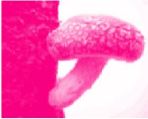
What is true for the given figure?
A
First plant group to exist on Earth
B
Extremely small in size
C
Asexual reproduction by conidia or zoospores
D
Cell wall is made of chitin
Solution
(D) The figure shows a mushroom,which is a member of the Kingdom Fungi (Basidiomycetes).
$1$. Fungi are heterotrophic organisms.
$2$. Their cell walls are composed of chitin.
$3$. They are not the first plant group to exist on Earth (that would be algae/bryophytes).
$4$. They are not microscopic (they are macroscopic).
$5$. Asexual reproduction in fungi occurs through various spores like conidia,sporangiospores,or zoospores.
Therefore,both option $C$ and option $D$ are characteristics of fungi. However,in the context of standard biology questions regarding mushrooms,the cell wall composition is a defining feature.
$1$. Fungi are heterotrophic organisms.
$2$. Their cell walls are composed of chitin.
$3$. They are not the first plant group to exist on Earth (that would be algae/bryophytes).
$4$. They are not microscopic (they are macroscopic).
$5$. Asexual reproduction in fungi occurs through various spores like conidia,sporangiospores,or zoospores.
Therefore,both option $C$ and option $D$ are characteristics of fungi. However,in the context of standard biology questions regarding mushrooms,the cell wall composition is a defining feature.
0 likes
View Solution280
EasyMCQ
What is absent in yeast?
A
Chlorophyll
B
Nucleus
C
Cell wall
D
Cytoplasm
Solution
(A) Yeast is a unicellular fungus belonging to the kingdom $Fungi$.
Like all fungi,yeast cells are eukaryotic,meaning they possess a well-defined nucleus,a cell wall made of chitin,and cytoplasm.
However,fungi are heterotrophic organisms and do not perform photosynthesis.
Therefore,they lack chlorophyll,which is the pigment required for photosynthesis found in plants and algae.
Like all fungi,yeast cells are eukaryotic,meaning they possess a well-defined nucleus,a cell wall made of chitin,and cytoplasm.
However,fungi are heterotrophic organisms and do not perform photosynthesis.
Therefore,they lack chlorophyll,which is the pigment required for photosynthesis found in plants and algae.
0 likes
View Solution281
EasyMCQ
What is the body of a fungus called?
A
Capsid
B
Mycelium
C
Penicillium
D
Thallus
Solution
(B) The body of a fungus is composed of a network of thread-like filaments called hyphae. This entire network of hyphae is collectively known as the mycelium. Therefore,the correct term for the fungal body is mycelium.
0 likes
View Solution282
EasyMCQ
What is the mycelium composed of?
A
Hyphae
B
Phage
C
Capsid
D
Cosmid
Solution
(A) The mycelium is the vegetative part of a fungus,consisting of a network of fine,white filaments called hyphae. These hyphae are thread-like structures that grow and branch out to absorb nutrients from the environment. Therefore,the mycelium is composed of hyphae.
0 likes
View Solution283
EasyMCQ
Which of the following is a characteristic of hyphae?
A
Autotrophic and heterotrophic
B
Photosynthesis
C
Septate and aseptate
D
None of these
Solution
(C) Hyphae are the thread-like filaments that make up the mycelium of fungi.
Depending on the species,hyphae can be classified based on the presence or absence of cross-walls (septa).
If cross-walls are present,they are called $septate$ hyphae.
If cross-walls are absent,they are called $aseptate$ or $coenocytic$ hyphae.
Therefore,being $septate$ and $aseptate$ is a fundamental characteristic of hyphae.
Depending on the species,hyphae can be classified based on the presence or absence of cross-walls (septa).
If cross-walls are present,they are called $septate$ hyphae.
If cross-walls are absent,they are called $aseptate$ or $coenocytic$ hyphae.
Therefore,being $septate$ and $aseptate$ is a fundamental characteristic of hyphae.
0 likes
View Solution284
EasyMCQ
What is the cell wall of fungi composed of?
A
Cellulose
B
Chitin
C
Suberin
D
Cutin
Solution
(B) The cell wall of fungi is primarily composed of $Chitin$,which is a complex polysaccharide consisting of $N$-acetylglucosamine units.
Cellulose is typically found in plant cell walls.
Suberin and Cutin are waxy substances found in plant tissues for protection and water retention.
Therefore,the correct option is $B$.
Cellulose is typically found in plant cell walls.
Suberin and Cutin are waxy substances found in plant tissues for protection and water retention.
Therefore,the correct option is $B$.
0 likes
View Solution285
EasyMCQ
Which of the following is a characteristic of fungi?
A
Saprophytic
B
Parasitic
C
Both $(A)$ and $(B)$
D
None of these
Solution
(C) Fungi are heterotrophic organisms that obtain their nutrition by absorbing dissolved molecules.
They can be saprophytic,meaning they feed on dead and decaying organic matter.
They can also be parasitic,meaning they live on or inside a living host and derive nutrients from it.
Therefore,fungi exhibit both saprophytic and parasitic modes of nutrition.
They can be saprophytic,meaning they feed on dead and decaying organic matter.
They can also be parasitic,meaning they live on or inside a living host and derive nutrients from it.
Therefore,fungi exhibit both saprophytic and parasitic modes of nutrition.
0 likes
View Solution286
MediumMCQ
Which phase is $NOT$ correct for fungi?
A
Plasmogamy
B
Mitosis
C
Karyogamy
D
Meiosis
Solution
(B) The sexual cycle of fungi involves three distinct steps:
$1$. Plasmogamy: The fusion of protoplasm between two motile or non-motile gametes.
$2$. Karyogamy: The fusion of two nuclei.
$3$. Meiosis: The process occurring in the zygote resulting in haploid spores.
Mitosis is a process of somatic cell division and is not a specific phase of the sexual reproductive cycle in fungi.
$1$. Plasmogamy: The fusion of protoplasm between two motile or non-motile gametes.
$2$. Karyogamy: The fusion of two nuclei.
$3$. Meiosis: The process occurring in the zygote resulting in haploid spores.
Mitosis is a process of somatic cell division and is not a specific phase of the sexual reproductive cycle in fungi.
0 likes
View Solution287
EasyMCQ
Which of the following is $NOT$ a method of sexual reproduction in fungi?
A
Isogamy
B
Anisogamy
C
Oogamy
D
Monogamy
Solution
(D) Sexual reproduction in fungi involves the fusion of gametes. The three main methods are:
$1$. $Isogamy$: Fusion of morphologically similar gametes.
$2$. $Anisogamy$: Fusion of morphologically dissimilar gametes.
$3$. $Oogamy$: Fusion of a large non-motile female gamete and a small motile male gamete.
$Monogamy$ is a term used in animal behavior to describe a mating system where an individual has only one mate,and it is not a method of sexual reproduction in fungi.
$1$. $Isogamy$: Fusion of morphologically similar gametes.
$2$. $Anisogamy$: Fusion of morphologically dissimilar gametes.
$3$. $Oogamy$: Fusion of a large non-motile female gamete and a small motile male gamete.
$Monogamy$ is a term used in animal behavior to describe a mating system where an individual has only one mate,and it is not a method of sexual reproduction in fungi.
0 likes
View Solution288
EasyMCQ
What is the common name of bread mold?
A
Mucor
B
Rhizopus
C
Penicillium
D
Yeast
Solution
(B) The common name for bread mold is $Rhizopus$ $stolonifer$. It belongs to the phylum Zygomycota within the kingdom Fungi. It is commonly found growing on bread and other starchy food items.
0 likes
View Solution289
EasyMCQ
The mode of nutrition in all fungi is .......... .
A
Autotrophic
B
Parasitic
C
Saprophytic
D
Heterotrophic
Solution
(D) Fungi are achlorophyllous organisms,meaning they lack chlorophyll and cannot perform photosynthesis. Therefore,they cannot produce their own food and are classified as heterotrophs. Among heterotrophs,they primarily obtain nutrients by absorbing dissolved organic material from dead and decaying matter,which is known as saprophytic nutrition. While some fungi can be parasitic or symbiotic,the fundamental mode of nutrition that characterizes the kingdom Fungi as a whole is heterotrophic.
0 likes
View Solution290
EasyMCQ
Which of the following organisms is characterized by plant cells that lack chloroplasts?
A
Fungi
B
Bryophytes
C
Algae
D
Pteridophytes
Solution
(A) Fungi are heterotrophic organisms that lack chlorophyll and chloroplasts. Unlike plants,algae,bryophytes,and pteridophytes,which are autotrophic and possess chloroplasts for photosynthesis,fungi obtain their nutrients through absorption from organic matter.
0 likes
View Solution291
EasyMCQ
What is the shape of a perithecium?
A
Flask-shaped
B
Cup-shaped
C
Tufted
D
Ribbon-shaped
Solution
(A) perithecium is a type of fungal fruiting body (ascocarp) found in certain Ascomycetes. It is characterized by its flask-shaped structure,which has a small pore at the top called an ostiole through which ascospores are released. Therefore,the correct shape is flask-shaped.
0 likes
View Solution292
MediumMCQ
Assertion $(A)$: Fungi are either parasitic or saprophytic.
Reason $(R)$: Some fungi obtain nutrients from living organisms,while others obtain them from decaying organic matter.
Reason $(R)$: Some fungi obtain nutrients from living organisms,while others obtain them from decaying organic matter.
A
$A$ and $R$ are both true,and $R$ is the correct explanation of $A$.
B
$A$ and $R$ are both true,but $R$ is not the correct explanation of $A$.
C
$A$ is true,but $R$ is false.
D
$A$ is false,but $R$ is true.
Solution
(A) Fungi are heterotrophic organisms that exhibit diverse modes of nutrition.
Parasitic fungi obtain their nutrients by living on or inside other living organisms (hosts),causing harm to them.
Saprophytic fungi obtain their nutrients by absorbing dissolved organic matter from dead and decaying organic substances.
Since the definition of parasitic and saprophytic modes of nutrition perfectly explains why fungi are classified as such,$R$ is the correct explanation of $A$.
Parasitic fungi obtain their nutrients by living on or inside other living organisms (hosts),causing harm to them.
Saprophytic fungi obtain their nutrients by absorbing dissolved organic matter from dead and decaying organic substances.
Since the definition of parasitic and saprophytic modes of nutrition perfectly explains why fungi are classified as such,$R$ is the correct explanation of $A$.
0 likes
View Solution293
MediumMCQ
Assertion $(A)$: Yeast is included in the multicellular decomposer kingdom.
Reason $(R)$: Fungi exhibit parasitic or saprophytic nutrition.
Reason $(R)$: Fungi exhibit parasitic or saprophytic nutrition.
A
$A$ and $R$ are both true,and $R$ is the correct explanation of $A$.
B
$A$ and $R$ are both true,but $R$ is not the correct explanation of $A$.
C
$A$ is true,but $R$ is false.
D
$A$ is false,but $R$ is true.
Solution
(D) Assertion $(A)$ is false because Yeast ($Saccharomyces$ $cerevisiae$) is a unicellular fungus,not a multicellular one.
Reason $(R)$ is true because fungi are heterotrophic organisms that obtain nutrients through absorption,typically by acting as saprophytes (decomposers) or parasites.
Therefore,$A$ is false and $R$ is true.
Reason $(R)$ is true because fungi are heterotrophic organisms that obtain nutrients through absorption,typically by acting as saprophytes (decomposers) or parasites.
Therefore,$A$ is false and $R$ is true.
0 likes
View Solution294
EasyMCQ
They do not perform photosynthesis and obtain nutrition through absorption.
A
Fungi
B
Protista
C
Plantae
D
Animalia
Solution
(A) Fungi are heterotrophic organisms that do not perform photosynthesis. They obtain their nutrition by absorbing dissolved organic matter from their environment through their mycelium,a process known as absorptive nutrition.
0 likes
View Solution295
EasyMCQ
Assertion $(A)$: $Mucor$ is a heterotroph.
Reason $(R)$: $Mucor$ lacks chlorophyll.
Reason $(R)$: $Mucor$ lacks chlorophyll.
A
$A$ and $R$ are both true,and $R$ is the correct explanation of $A$.
B
$A$ and $R$ are both true,but $R$ is not the correct explanation of $A$.
C
$A$ is true,but $R$ is false.
D
$A$ is false,but $R$ is true.
Solution
(A) $Mucor$ is a type of fungus belonging to the class Zygomycetes.
Fungi are eukaryotic,achlorophyllous organisms that cannot synthesize their own food,making them heterotrophs.
Since $Mucor$ lacks chlorophyll,it cannot perform photosynthesis and must obtain nutrients from organic matter,which confirms it is a heterotroph.
Therefore,both the assertion and the reason are true,and the reason correctly explains why $Mucor$ is a heterotroph.
Fungi are eukaryotic,achlorophyllous organisms that cannot synthesize their own food,making them heterotrophs.
Since $Mucor$ lacks chlorophyll,it cannot perform photosynthesis and must obtain nutrients from organic matter,which confirms it is a heterotroph.
Therefore,both the assertion and the reason are true,and the reason correctly explains why $Mucor$ is a heterotroph.
0 likes
View Solution296
MediumMCQ
Assertion $(A)$: Sac fungi are not photosynthetic.
Reason $(R)$: They obtain nutrition through absorption.
Reason $(R)$: They obtain nutrition through absorption.
A
$A$ and $R$ are both true,and $R$ is the correct explanation of $A$.
B
$A$ and $R$ are both true,but $R$ is not the correct explanation of $A$.
C
$A$ is true,but $R$ is false.
D
$A$ is false,but $R$ is true.
Solution
(A) Sac fungi (Ascomycetes) are heterotrophic organisms that lack chlorophyll,which is why they are not photosynthetic.
They obtain their nutrition by absorbing organic matter from their environment,which is known as absorptive nutrition.
Since they are heterotrophs,they rely on external organic sources for food,and the reason provided correctly explains why they are not photosynthetic.
Therefore,both $A$ and $R$ are true,and $R$ is the correct explanation of $A$.
They obtain their nutrition by absorbing organic matter from their environment,which is known as absorptive nutrition.
Since they are heterotrophs,they rely on external organic sources for food,and the reason provided correctly explains why they are not photosynthetic.
Therefore,both $A$ and $R$ are true,and $R$ is the correct explanation of $A$.
0 likes
View Solution297
MediumMCQ
Which of the following groups produces spores but lacks vascular tissues?
A
Pteridophytes
B
Gymnosperms
C
Monocots
D
Fungi
Solution
(D) Fungi are eukaryotic,heterotrophic organisms that reproduce through the formation of spores. They are non-vascular,meaning they lack specialized tissues like xylem and phloem for the transport of water and nutrients. Pteridophytes possess vascular tissues. Gymnosperms and Monocots are seed-bearing plants that also possess vascular tissues. Therefore,the correct group is Fungi.
0 likes
View Solution298
MediumMCQ
Assertion $(A)$: In bread mold $(Rhizopus)$,sexual reproduction does not result in the formation of an embryo.
Reason $(R)$: In sponges $(Porifera)$,the cell wall is made of cellulose.
Reason $(R)$: In sponges $(Porifera)$,the cell wall is made of cellulose.
A
Both $A$ and $R$ are true,and $R$ is the correct explanation of $A$.
B
Both $A$ and $R$ are true,but $R$ is not the correct explanation of $A$.
C
$A$ is true,but $R$ is false.
D
$A$ is false,but $R$ is true.
Solution
(C) Assertion $(A)$ is true: Bread mold $(Rhizopus)$ belongs to the kingdom Fungi. In fungi,sexual reproduction involves the fusion of gametes to form a zygote,which undergoes meiosis to produce spores. There is no embryo stage in the life cycle of fungi.
Reason $(R)$ is false: Sponges belong to the kingdom Animalia. Animals do not have cell walls; they are characterized by the absence of a cell wall. Therefore,the statement that sponges have a cell wall made of cellulose is incorrect.
Conclusion: Since $A$ is true and $R$ is false,the correct option is $C$.
Reason $(R)$ is false: Sponges belong to the kingdom Animalia. Animals do not have cell walls; they are characterized by the absence of a cell wall. Therefore,the statement that sponges have a cell wall made of cellulose is incorrect.
Conclusion: Since $A$ is true and $R$ is false,the correct option is $C$.
0 likes
View Solution299
MediumMCQ
What is the correct sequence of stages in the sexual cycle of fungi?
A
Karyogamy $\rightarrow$ Meiosis $\rightarrow$ Plasmogamy
B
Plasmogamy $\rightarrow$ Karyogamy $\rightarrow$ Meiosis
C
Meiosis $\rightarrow$ Karyogamy $\rightarrow$ Plasmogamy
D
Meiosis $\rightarrow$ Plasmogamy $\rightarrow$ Karyogamy
Solution
(B) The sexual cycle of fungi involves three distinct stages:
$1$. Plasmogamy: The fusion of protoplasm between two motile or non-motile gametes.
$2$. Karyogamy: The fusion of two nuclei.
$3$. Meiosis: The reduction division in the zygote resulting in haploid spores.
Therefore,the correct sequence is Plasmogamy $\rightarrow$ Karyogamy $\rightarrow$ Meiosis.
$1$. Plasmogamy: The fusion of protoplasm between two motile or non-motile gametes.
$2$. Karyogamy: The fusion of two nuclei.
$3$. Meiosis: The reduction division in the zygote resulting in haploid spores.
Therefore,the correct sequence is Plasmogamy $\rightarrow$ Karyogamy $\rightarrow$ Meiosis.
0 likes
View Solution300
MediumMCQ
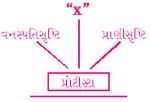
In the given diagram, what does "x" represent?
A
Bryophyta
B
Fungi
C
Pteridophyta
D
Metaphyta
Solution
(B) The provided diagram represents the three-kingdom classification system proposed by Ernst Haeckel. In this system, Haeckel added the kingdom Protista to the existing two kingdoms, Plantae (Vanaspatisrushti) and Animalia (Pranisrushti). Therefore, "x" represents the kingdom Fungi, which was later separated from the plant kingdom in the five-kingdom classification system.
0 likes
View SolutionBiological Classification — Fungi (Multicellular decomposers) · Frequently Asked Questions
1Are these Biological Classification questions useful for JEE and NEET?
Yes. All questions in this section are mapped to JEE Main and NEET exam patterns. Previous year questions from JEE Main, NEET, GUJCET and state-level exams are included with full solutions.
2Can I switch to Hindi or Gujarati for these questions?
Yes. Use the language tabs in the hero section or the sidebar to view the same questions and solutions in English, Hindi or Gujarati.
3How do I generate a question paper from this subtopic?
Use the Vedclass Exam Paper Generator — select the chapter and subtopic, set difficulty, and generate Sets A, B, C, D automatically. First 3 chapters of every subject are free.
Vedclass Products
For Students
Vedclass Test Series
Mock tests in real JEE/NEET style with performance analysis. 5-day free trial.
Start Free TrialFor Teachers
Exam Paper Generator
Generate Set A/B/C/D papers from this chapter in 2 minutes. 3 chapters free.
Try FreeFor Institutes
Online Exam Module
Live online exams with unlimited students, 360° analytics & white-label branding.
See DemoFor Teachers & Institutes
Generate a Biological Classification Exam Paper in 2 Minutes
Select subtopic & difficulty — Sets A, B, C, D auto-generated with No Repeat logic.
First 3 chapters of every subject are free — no payment required.