
A English
Fungi (Multicellular decomposers) Questions in English
Class 11 Biology · Biological Classification · Fungi (Multicellular decomposers)
511+
Questions
English
Language
100%
With Solutions
Showing 50 of 511 questions in English
451
EasyMCQ
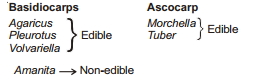
Find the set of edible basidiocarps.
A
Agaricus,Pleurotus
B
Agaricus,Morchella
C
Volvariella,Tuber
D
Amanita,Morchella
Solution
(A) Basidiocarps are the fruiting bodies of fungi belonging to the class Basidiomycetes.
Common examples of edible basidiocarps include $Agaricus$ (mushroom),$Pleurotus$ (oyster mushroom),and $Volvariella$ (paddy straw mushroom).
$Morchella$ and $Tuber$ are edible fungi,but they are classified as Ascomycetes (producing ascocarps),not Basidiomycetes.
$Amanita$ is a genus that contains many poisonous (non-edible) species.
Therefore,the set containing only edible basidiocarps is $Agaricus$ and $Pleurotus$.
Common examples of edible basidiocarps include $Agaricus$ (mushroom),$Pleurotus$ (oyster mushroom),and $Volvariella$ (paddy straw mushroom).
$Morchella$ and $Tuber$ are edible fungi,but they are classified as Ascomycetes (producing ascocarps),not Basidiomycetes.
$Amanita$ is a genus that contains many poisonous (non-edible) species.
Therefore,the set containing only edible basidiocarps is $Agaricus$ and $Pleurotus$.
0 likes
View Solution452
MediumMCQ
Read the statements carefully:
$a.$ Hartig net is the network of intracellular mycelium of Boletus.
$b.$ Ectomycorrhiza forms ten percent of total mycorrhiza.
$c.$ Fungal partner of endomycorrhiza belongs to Zygomycetes or Phycomycetes.
$a.$ Hartig net is the network of intracellular mycelium of Boletus.
$b.$ Ectomycorrhiza forms ten percent of total mycorrhiza.
$c.$ Fungal partner of endomycorrhiza belongs to Zygomycetes or Phycomycetes.
A
Only $a$ and $c$ are correct.
B
Only $b$ and $c$ are correct.
C
Only $c$ is correct.
D
All are correct.
Solution
(B) Statement $a$ is incorrect because the Hartig net is a network of intercellular (not intracellular) mycelium found in ectomycorrhiza,typically associated with Basidiomycetes like Boletus and Amanita.
Statement $b$ is correct as ectomycorrhiza constitutes about $10\%$ of the total mycorrhizal associations in plants.
Statement $c$ is correct because the fungal partners in endomycorrhiza (specifically Arbuscular Mycorrhiza or $AM$ fungi) belong to the class Glomeromycetes,which were previously classified under Zygomycetes or Phycomycetes.
Therefore,statements $b$ and $c$ are correct.
Statement $b$ is correct as ectomycorrhiza constitutes about $10\%$ of the total mycorrhizal associations in plants.
Statement $c$ is correct because the fungal partners in endomycorrhiza (specifically Arbuscular Mycorrhiza or $AM$ fungi) belong to the class Glomeromycetes,which were previously classified under Zygomycetes or Phycomycetes.
Therefore,statements $b$ and $c$ are correct.
0 likes
View Solution453
MediumMCQ
$A$: Secondary mycelium of $Agaricus$ is binucleated.
$R$: Secondary mycelium is formed by somatogamy of primary mycelium.
$R$: Secondary mycelium is formed by somatogamy of primary mycelium.
A
Assertion and Reason both are correct and Reason is the correct explanation of Assertion.
B
Assertion and Reason both are correct but Reason is not the correct explanation of Assertion.
C
Assertion is correct,but Reason is incorrect.
D
Both Assertion and Reason are incorrect.
Solution
(A) In $Agaricus$ (a member of Basidiomycetes),the primary mycelium is monokaryotic and haploid,which is formed by the germination of basidiospores.
When two compatible primary mycelia fuse through a process called somatogamy (plasmogamy),they form a secondary mycelium.
This secondary mycelium is dikaryotic (binucleated),meaning each cell contains two nuclei of different mating types.
Therefore,both the Assertion and the Reason are correct,and the Reason provides the correct explanation for the formation of the binucleated secondary mycelium.
When two compatible primary mycelia fuse through a process called somatogamy (plasmogamy),they form a secondary mycelium.
This secondary mycelium is dikaryotic (binucleated),meaning each cell contains two nuclei of different mating types.
Therefore,both the Assertion and the Reason are correct,and the Reason provides the correct explanation for the formation of the binucleated secondary mycelium.
0 likes
View Solution454
MediumMCQ
$A$: Sexual spores in pink mould are meiospores produced endogenously.
$R$: They develop flask-shaped fruiting bodies in their sexual life cycle.
$R$: They develop flask-shaped fruiting bodies in their sexual life cycle.
A
Assertion and Reason both are correct and Reason is the correct explanation of Assertion.
B
Assertion and Reason both are correct but Reason is not the correct explanation of Assertion.
C
Assertion is correct,but Reason is incorrect.
D
Both Assertion and Reason are incorrect.
Solution
(A) Pink mould refers to the fungus $Neurospora$ $crassa$.
$Neurospora$ belongs to the class Ascomycetes.
In Ascomycetes,sexual spores are called ascospores,which are meiospores produced endogenously within a sac-like structure called an ascus.
Therefore,the Assertion is correct.
Ascomycetes produce fruiting bodies called ascocarps,which can be flask-shaped (perithecium),cup-shaped (apothecium),or closed (cleistothecium).
$Neurospora$ produces flask-shaped fruiting bodies (perithecia) during its sexual life cycle.
Therefore,the Reason is also correct and explains why these spores are produced endogenously within a specific structure.
$Neurospora$ belongs to the class Ascomycetes.
In Ascomycetes,sexual spores are called ascospores,which are meiospores produced endogenously within a sac-like structure called an ascus.
Therefore,the Assertion is correct.
Ascomycetes produce fruiting bodies called ascocarps,which can be flask-shaped (perithecium),cup-shaped (apothecium),or closed (cleistothecium).
$Neurospora$ produces flask-shaped fruiting bodies (perithecia) during its sexual life cycle.
Therefore,the Reason is also correct and explains why these spores are produced endogenously within a specific structure.
0 likes
View Solution455
EasyMCQ
The main chemical component of the fungal cell wall is
A
Peptidoglycan
B
Chitin
C
Hemicellulose
D
Pectin
Solution
(B) The fungal cell wall is primarily composed of $Chitin$,which is a complex polysaccharide consisting of $N$-acetylglucosamine units.
$1$. $Peptidoglycan$ is the main component of the bacterial cell wall.
$2$. $Hemicellulose$ and $Pectin$ are major components of the plant cell wall.
Therefore,the correct answer is $Chitin$.
$1$. $Peptidoglycan$ is the main component of the bacterial cell wall.
$2$. $Hemicellulose$ and $Pectin$ are major components of the plant cell wall.
Therefore,the correct answer is $Chitin$.
0 likes
View Solution456
EasyMCQ
Fungi are dependent on dead and decaying matter for feeding; this mode of nutrition is called:
A
Saprophytes
B
Halophytes
C
Xerophytes
D
Nanophytes
Solution
(A) Organisms that obtain their nutrients from dead and decaying organic matter are known as saprophytes. Fungi,such as mushrooms and molds,secrete digestive enzymes onto the substrate and absorb the broken-down nutrients,which is why they are classified as saprophytic organisms.
0 likes
View Solution457
EasyMCQ
Rhizopus reproduces asexually by:
A
Conidia
B
Spores
C
Gemma
D
Bulbil
Solution
(B) $Rhizopus$,commonly known as bread mold,belongs to the group of fungi called Zygomycetes.
It reproduces asexually primarily through the formation of specialized structures called sporangia.
Inside these sporangia,numerous microscopic,non-motile,asexual spores (specifically sporangiospores) are produced.
These spores are released upon the rupture of the sporangial wall and are dispersed by wind or water to germinate into new mycelia under favorable conditions.
Therefore,the correct method of asexual reproduction in $Rhizopus$ is by spores.
It reproduces asexually primarily through the formation of specialized structures called sporangia.
Inside these sporangia,numerous microscopic,non-motile,asexual spores (specifically sporangiospores) are produced.
These spores are released upon the rupture of the sporangial wall and are dispersed by wind or water to germinate into new mycelia under favorable conditions.
Therefore,the correct method of asexual reproduction in $Rhizopus$ is by spores.
0 likes
View Solution458
MediumMCQ
Which organism has great importance in genetics?
A
Penicillium
B
Claviceps
C
Neurospora
D
None of these
Solution
(C) Neurospora completes its sexual life cycle in a few days and thus,makes an ideal organism for the study of the laws of heredity.
Penicillin,a potent antibiotic,is obtained from Penicillium notatum.
$LSD$ is obtained from Claviceps purpurea.
Penicillin,a potent antibiotic,is obtained from Penicillium notatum.
$LSD$ is obtained from Claviceps purpurea.
0 likes
View Solution459
MediumMCQ
$A$: Nutritional mutant strain of pink mould is auxotroph.
$R$: It is not able to prepare its own metabolites from the raw materials obtained from outside.
$R$: It is not able to prepare its own metabolites from the raw materials obtained from outside.
A
Assertion and Reason both are correct and Reason is the correct explanation of Assertion.
B
Assertion and Reason both are correct but Reason is not the correct explanation of Assertion.
C
Assertion is correct,but Reason is incorrect.
D
Both Assertion and Reason are incorrect.
Solution
(A) An auxotroph is a mutant organism that has lost the ability to synthesize a specific essential nutrient (such as an amino acid or vitamin) required for its growth.
Because it cannot synthesize these metabolites from basic raw materials,it must be supplied with the specific nutrient in its growth medium.
Pink mould,such as $Neurospora$ $crassa$,is a classic model organism used in genetics to study such nutritional mutants.
Therefore,both the assertion and the reason are correct,and the reason provides the correct explanation for why the strain is termed an auxotroph.
Because it cannot synthesize these metabolites from basic raw materials,it must be supplied with the specific nutrient in its growth medium.
Pink mould,such as $Neurospora$ $crassa$,is a classic model organism used in genetics to study such nutritional mutants.
Therefore,both the assertion and the reason are correct,and the reason provides the correct explanation for why the strain is termed an auxotroph.
0 likes
View Solution460
EasyMCQ
Powdery mildew of wheat is caused by species of
A
Puccinia
B
Erysiphe
C
Ustilago
D
Albugo
Solution
(B) The powdery mildew disease of wheat is caused by the fungus $Erysiphe$ $graminis$.
$Puccinia$ species are responsible for wheat rust diseases.
$Ustilago$ $tritici$ causes loose smut of wheat.
$Albugo$ $candida$ causes white rust of crucifers.
$Puccinia$ species are responsible for wheat rust diseases.
$Ustilago$ $tritici$ causes loose smut of wheat.
$Albugo$ $candida$ causes white rust of crucifers.
0 likes
View Solution461
MediumMCQ
Which of the following statements is correct?
A
Fusion of two cells is called Karyogamy.
B
Fusion of protoplasms between two motile or non-motile gametes is called plasmogamy.
C
Organisms that depend on living plants are called saprophytes.
D
Some of the organisms can fix atmospheric nitrogen in specialized cells called sheath cells.
Solution
(B) The correct statement is $B$.
$1$. Plasmogamy is defined as the fusion of protoplasm between two motile or non-motile gametes.
$2$. Karyogamy is the fusion of two nuclei,not two cells.
$3$. Organisms that depend on dead organic matter are called saprophytes,not those depending on living plants (which are parasites).
$4$. Atmospheric nitrogen fixation occurs in specialized cells called heterocysts,not sheath cells.
$1$. Plasmogamy is defined as the fusion of protoplasm between two motile or non-motile gametes.
$2$. Karyogamy is the fusion of two nuclei,not two cells.
$3$. Organisms that depend on dead organic matter are called saprophytes,not those depending on living plants (which are parasites).
$4$. Atmospheric nitrogen fixation occurs in specialized cells called heterocysts,not sheath cells.
0 likes
View Solution462
Medium
Describe Kingdom-Fungi.
Solution
(N/A) $\rightarrow$ The Kingdom-Fungi or Mycota constitutes a unique kingdom of heterotrophic organisms.
$\rightarrow$ They show great diversity in morphology and habitat.
$\rightarrow$ Mycology is the branch of science that deals with the study of various fungi.
$\rightarrow$ $A$ scientist having specialization in the study of fungi is called a mycologist.
$\rightarrow$ Examples of fungi:
$(1)$ When your bread develops a mould or your orange rots,it is because of fungi.
$(2)$ The common mushroom you eat and toadstools are also fungi.
$(3)$ White spots seen on mustard leaves are due to a parasitic fungus.
$(4)$ Some unicellular fungi,e.g.,yeast,are used to make bread and beer.
$(5)$ Other fungi cause diseases in plants and animals; wheat rust-causing $Puccinia$ is an important example.
$(6)$ Some are the source of antibiotics,e.g.,$Penicillium$.
$\rightarrow$ Habitat: Fungi are cosmopolitan and occur in air,water,soil,and on animals and plants.
$\rightarrow$ They prefer to grow in warm and humid places.
$\rightarrow$ Body organization: With the exception of yeasts,which are unicellular,fungi are filamentous.
$\rightarrow$ Their bodies consist of long,slender,thread-like structures.
$\rightarrow$ Fungal hyphae are thin,tubular,transparent threads or filaments filled with protoplasm and covered by a cell wall.
$\rightarrow$ The network of hyphae is known as mycelium.
$\rightarrow$ Some hyphae are continuous tubes filled with multinucleated cytoplasm; these are coenocytic hyphae.
$\rightarrow$ Others have septa or cross-walls in their hyphae.
$\rightarrow$ The hyphae found in fungi are of the following types:
$(i)$ Aseptate hyphae: In aseptate hyphae,cross-walls or septa are not formed at the time of nuclear division.
$\rightarrow$ Such hyphae are multinucleate.
$\rightarrow$ It is called coenocytic if the mycelium contains aseptate and multinucleate hyphae.
$(ii)$ Septate hyphae: In this type,cross-walls or septa form after the nuclear division.
$\rightarrow$ The cells may have one,two,or many nuclei.
$\rightarrow$ These have septal pores or cross-walls in their hyphae,which allow the movement of substances between adjacent cells.
$\rightarrow$ They show great diversity in morphology and habitat.
$\rightarrow$ Mycology is the branch of science that deals with the study of various fungi.
$\rightarrow$ $A$ scientist having specialization in the study of fungi is called a mycologist.
$\rightarrow$ Examples of fungi:
$(1)$ When your bread develops a mould or your orange rots,it is because of fungi.
$(2)$ The common mushroom you eat and toadstools are also fungi.
$(3)$ White spots seen on mustard leaves are due to a parasitic fungus.
$(4)$ Some unicellular fungi,e.g.,yeast,are used to make bread and beer.
$(5)$ Other fungi cause diseases in plants and animals; wheat rust-causing $Puccinia$ is an important example.
$(6)$ Some are the source of antibiotics,e.g.,$Penicillium$.
$\rightarrow$ Habitat: Fungi are cosmopolitan and occur in air,water,soil,and on animals and plants.
$\rightarrow$ They prefer to grow in warm and humid places.
$\rightarrow$ Body organization: With the exception of yeasts,which are unicellular,fungi are filamentous.
$\rightarrow$ Their bodies consist of long,slender,thread-like structures.
$\rightarrow$ Fungal hyphae are thin,tubular,transparent threads or filaments filled with protoplasm and covered by a cell wall.
$\rightarrow$ The network of hyphae is known as mycelium.
$\rightarrow$ Some hyphae are continuous tubes filled with multinucleated cytoplasm; these are coenocytic hyphae.
$\rightarrow$ Others have septa or cross-walls in their hyphae.
$\rightarrow$ The hyphae found in fungi are of the following types:
$(i)$ Aseptate hyphae: In aseptate hyphae,cross-walls or septa are not formed at the time of nuclear division.
$\rightarrow$ Such hyphae are multinucleate.
$\rightarrow$ It is called coenocytic if the mycelium contains aseptate and multinucleate hyphae.
$(ii)$ Septate hyphae: In this type,cross-walls or septa form after the nuclear division.
$\rightarrow$ The cells may have one,two,or many nuclei.
$\rightarrow$ These have septal pores or cross-walls in their hyphae,which allow the movement of substances between adjacent cells.
0 likes
View Solution463
Medium
Describe asexual reproduction in Phycomycetes.
Solution
(N/A) $\rightarrow$ Asexual reproduction in Phycomycetes takes place by means of zoospores (motile) or aplanospores (non-motile).
$\rightarrow$ These spores are produced endogenously within a structure called the sporangium.
$\rightarrow$ The zygospore is formed by the fusion of two gametes.
$\rightarrow$ These gametes can be similar in morphology (isogamous) or dissimilar (anisogamous or oogamous).
$\rightarrow$ These spores are produced endogenously within a structure called the sporangium.
$\rightarrow$ The zygospore is formed by the fusion of two gametes.
$\rightarrow$ These gametes can be similar in morphology (isogamous) or dissimilar (anisogamous or oogamous).
0 likes
View Solution464
Medium
Give differences between Phycomycetes and Ascomycetes.
Solution
(N/A)
| Phycomycetes | Ascomycetes |
| $(1)$ Hyphae are aseptate and coenocytic. | $(1)$ Hyphae are septate and branched. |
| $(2)$ Asexual spores are zoospores (motile) or aplanospores (non-motile). | $(2)$ Asexual spores are conidia produced exogenously. |
| $(3)$ Sexual spores are zygospores. | $(3)$ Sexual spores are ascospores produced endogenously. |
0 likes
View Solution465
Medium
Give scientific reasons: The members of class $Deuteromycetes$ are considered the fungi imperfecti.
Solution
(N/A) $\rightarrow$ $Deuteromycetes$ is an artificial class of fungi created to include all those fungi in which the sexual stage is either absent or not yet discovered.
$\rightarrow$ Because they lack a sexual cycle,they are often referred to as 'fungi imperfecti' or imperfect fungi.
$\rightarrow$ Their mycelium is usually septate and branched.
$\rightarrow$ They reproduce asexually primarily by conidia.
$\rightarrow$ Because they lack a sexual cycle,they are often referred to as 'fungi imperfecti' or imperfect fungi.
$\rightarrow$ Their mycelium is usually septate and branched.
$\rightarrow$ They reproduce asexually primarily by conidia.
0 likes
View Solution466
Medium
Provide definitions/explanations for the following terms:
$(1)$ Pseudoplasmodia
$(2)$ Sac fungi
$(1)$ Pseudoplasmodia
$(2)$ Sac fungi
Solution
(N/A) $(1)$ Pseudoplasmodia are found in cellular slime moulds. They are formed as an aggregation of individual amoeboid cells when the food supply in the medium is exhausted.
$(2)$ Sac fungi is the common name for members of the class Ascomycetes. They are mostly multicellular (e.g.,Penicillium) or rarely unicellular (e.g.,yeast).
$(2)$ Sac fungi is the common name for members of the class Ascomycetes. They are mostly multicellular (e.g.,Penicillium) or rarely unicellular (e.g.,yeast).
0 likes
View Solution467
Medium
Provide definitions/explanations for the following terms:
$(1)$ Heterocysts
$(2)$ Conidiophores
$(1)$ Heterocysts
$(2)$ Conidiophores
Solution
(N/A) $(1)$ Heterocysts are specialized cells found in certain filamentous cyanobacteria like $Nostoc$ and $Anabaena$. They are the primary sites of nitrogen fixation,where the enzyme nitrogenase functions in an anaerobic environment.
$(2)$ Conidiophores are specialized hyphal branches found in $Ascomycetes$ (sac fungi). They produce asexual spores called conidia exogenously (externally) at their tips. Upon germination,these conidia give rise to new mycelia.
$(2)$ Conidiophores are specialized hyphal branches found in $Ascomycetes$ (sac fungi). They produce asexual spores called conidia exogenously (externally) at their tips. Upon germination,these conidia give rise to new mycelia.
0 likes
View Solution468
MediumMCQ
What are Club fungi?
A
Ascomycetes
B
Basidiomycetes
C
Phycomycetes
D
Deuteromycetes
Solution
(B) $\rightarrow$ Basidiomycetes are commonly known as club fungi. They are primarily terrestrial and include saprophytic,parasitic,or decomposer forms. Their characteristic feature is the production of basidiospores on a club-shaped structure called a basidium.
0 likes
View Solution469
EasyMCQ
What is the importance of $Neurospora$?
A
It is used in the production of antibiotics.
B
It is used extensively in biochemical and genetic work.
C
It is a source of edible mushrooms.
D
It causes serious diseases in cereal crops.
Solution
(B) $Neurospora$ is a genus of Ascomycetes fungi.
It is widely known as the 'Drosophila of the plant kingdom' because it has been used extensively in biochemical and genetic research due to its short life cycle and ease of cultivation in the laboratory.
It is widely known as the 'Drosophila of the plant kingdom' because it has been used extensively in biochemical and genetic research due to its short life cycle and ease of cultivation in the laboratory.
0 likes
View Solution470
Medium
There is a myth that immediately after heavy rains in the forest, mushrooms appear in large numbers and form a very large ring or circle, which may be several metres in diameter. These are called "fairy rings". Can you explain this myth of fairy rings in biological terms? Discuss the mycelial structure in $Agaricus$ and its soil-borne nature.
Solution
(N/A) $\rightarrow$ The 'fairy rings' form as the mycelium of the mushroom fungus spreads in the soil from a central point.
$\rightarrow$ It grows peripherally, so that the younger hyphae appear in a circular pattern.
$\rightarrow$ The mycelium of mushrooms absorbs nutrients from the soil.
$\rightarrow$ As nutrients at the center become exhausted, the mycelium expands outward in diameter, forming a circle.
$\rightarrow$ The ring grows in diameter every year, and the mushrooms seen are the fruiting bodies (basidiocarps) of the fungus.
$\rightarrow$ This phenomenon is commonly referred to as a 'Fairy Ring', especially in Europe.
$\rightarrow$ It grows peripherally, so that the younger hyphae appear in a circular pattern.
$\rightarrow$ The mycelium of mushrooms absorbs nutrients from the soil.
$\rightarrow$ As nutrients at the center become exhausted, the mycelium expands outward in diameter, forming a circle.
$\rightarrow$ The ring grows in diameter every year, and the mushrooms seen are the fruiting bodies (basidiocarps) of the fungus.
$\rightarrow$ This phenomenon is commonly referred to as a 'Fairy Ring', especially in Europe.
0 likes
View Solution471
MediumMCQ
Neurospora,an ascomycetes fungus,has been used as a biological tool to understand the mechanism of plant genetics in much the same way as Drosophila has been used to study animal genetics. What makes Neurospora so important as a genetic tool?
A
It is a diploid organism.
B
It is a haploid organism,allowing mutations to express immediately.
C
It has a very long life cycle.
D
It is difficult to culture in the laboratory.
Solution
(B) $\rightarrow$ Neurospora (Pink bread mould) is often referred to as the Drosophila of the plant kingdom.
$\rightarrow$ It is haploid in nature,which means that every mutation can express itself immediately in the phenotype.
$\rightarrow$ Several characteristics of this organism make it ideal for genetic studies.
$\rightarrow$ Some of these key features include:
$(a)$ Rapid reproduction cycle.
$(b)$ Ease of culturing in the laboratory.
$(c)$ Simple nutritional requirements.
$\rightarrow$ It is haploid in nature,which means that every mutation can express itself immediately in the phenotype.
$\rightarrow$ Several characteristics of this organism make it ideal for genetic studies.
$\rightarrow$ Some of these key features include:
$(a)$ Rapid reproduction cycle.
$(b)$ Ease of culturing in the laboratory.
$(c)$ Simple nutritional requirements.
0 likes
View Solution472
EasyMCQ
Which kingdom is known as multicellular decomposers?
A
Protista
B
Fungi
C
Plantae
D
Animalia
Solution
(B) The kingdom $Fungi$ consists of organisms that are primarily multicellular (except for yeast) and heterotrophic. They obtain their nutrients by absorbing dissolved organic material from their environment,which is why they are known as decomposers or saprotrophs. They play a crucial role in the ecosystem by breaking down complex organic matter into simpler substances.
0 likes
View Solution473
MediumMCQ
Which of the following fungi is unicellular?
A
Penicillium
B
Mushroom
C
Puccinia
D
Yeast
Solution
(D) Most fungi are multicellular and filamentous (hyphae). However,$Yeast$ (Saccharomyces cerevisiae) is a well-known example of a unicellular fungus. Penicillium,Mushrooms (Agaricus),and Puccinia are all multicellular organisms.
0 likes
View Solution474
MediumMCQ
Which of the following fungi produces an antibiotic?
A
Penicillium
B
Mushroom
C
Puccinia
D
Yeast
Solution
(A) The fungus $Penicillium$ is well-known for producing the first antibiotic, penicillin.
Alexander Fleming discovered penicillin from the mold $Penicillium$ $notatum$.
Therefore, the correct option is $A$.
Alexander Fleming discovered penicillin from the mold $Penicillium$ $notatum$.
Therefore, the correct option is $A$.
0 likes
View Solution475
MediumMCQ
Select the correct statements regarding fungi:
$I$ - They are heterotrophic organisms.
$II$ - They show a great diversity in morphology and habitat.
$III$ - White rust in mustard is caused by parasitic fungi.
$IV$ - Bread mold (Rhizopus) causes the white cottony growth on bread.
$V$ - Yeast is used to make bread and beer.
$VI$ - They prefer to grow in warm and humid places.
$I$ - They are heterotrophic organisms.
$II$ - They show a great diversity in morphology and habitat.
$III$ - White rust in mustard is caused by parasitic fungi.
$IV$ - Bread mold (Rhizopus) causes the white cottony growth on bread.
$V$ - Yeast is used to make bread and beer.
$VI$ - They prefer to grow in warm and humid places.
A
$I, II, III, IV, V, VI$
B
$I, II, III, IV, VI$
C
$I, II, III, V, VI$
D
$I, II, III, IV$
Solution
(C) Let's analyze the statements:
$I$ - Fungi are heterotrophic (saprophytic,parasitic,or symbiotic). This is correct.
$II$ - Fungi exhibit significant diversity in morphology and habitat. This is correct.
$III$ - White rust in mustard is caused by the parasitic fungus Albugo candida. This is correct.
$IV$ - The white cottony growth on bread is caused by the bread mold Rhizopus,not Puccinia. This statement is incorrect.
$V$ - Yeast (Saccharomyces cerevisiae) is used to make bread and beer. This is correct.
$VI$ - Fungi prefer to grow in warm and humid places. This is correct.
Therefore,statements $I, II, III, V,$ and $VI$ are correct.
$I$ - Fungi are heterotrophic (saprophytic,parasitic,or symbiotic). This is correct.
$II$ - Fungi exhibit significant diversity in morphology and habitat. This is correct.
$III$ - White rust in mustard is caused by the parasitic fungus Albugo candida. This is correct.
$IV$ - The white cottony growth on bread is caused by the bread mold Rhizopus,not Puccinia. This statement is incorrect.
$V$ - Yeast (Saccharomyces cerevisiae) is used to make bread and beer. This is correct.
$VI$ - Fungi prefer to grow in warm and humid places. This is correct.
Therefore,statements $I, II, III, V,$ and $VI$ are correct.
0 likes
View Solution476
EasyMCQ
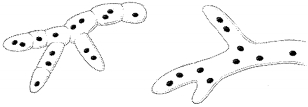
Identify the structures shown below.
A
Coenocytic hyphae $\quad$ Septate hyphae
B
Septate hyphae $\quad$ Coenocytic hyphae
C
Aseptate yeast $\quad$ Septate yeast
D
Septate yeast $\quad$ Aseptate yeast
Solution
(B) The image shows two types of fungal hyphae.
$1$. The left structure shows cross-walls or septa dividing the hyphae into distinct cells,which is characteristic of septate hyphae.
$2$. The right structure shows a continuous tube filled with cytoplasm and multiple nuclei without any cross-walls,which is characteristic of coenocytic (aseptate) hyphae.
Therefore,the correct identification is Septate hyphae and Coenocytic hyphae.
$1$. The left structure shows cross-walls or septa dividing the hyphae into distinct cells,which is characteristic of septate hyphae.
$2$. The right structure shows a continuous tube filled with cytoplasm and multiple nuclei without any cross-walls,which is characteristic of coenocytic (aseptate) hyphae.
Therefore,the correct identification is Septate hyphae and Coenocytic hyphae.
0 likes
View Solution477
EasyMCQ
The cell wall of fungi is composed of $.......$.
A
Cellulose
B
Chitin
C
Protein
D
All of the above
Solution
(B) The cell wall of fungi is primarily composed of a complex polysaccharide called $Chitin$.
$Chitin$ is a polymer of $N$-acetylglucosamine.
While plants have cell walls made of $Cellulose$, fungi are distinct in their composition, utilizing $Chitin$ to provide structural support and protection to the fungal cells.
$Chitin$ is a polymer of $N$-acetylglucosamine.
While plants have cell walls made of $Cellulose$, fungi are distinct in their composition, utilizing $Chitin$ to provide structural support and protection to the fungal cells.
0 likes
View Solution478
MediumMCQ
Identify the asexual spores and sexual spores from the following list:
$I$ - Oospores,$II$ - Zygospores,$III$ - Conidia,
$IV$ - Basidiospores,$V$ - Zoospores
Asexual spores $\quad$ Sexual spores
$I$ - Oospores,$II$ - Zygospores,$III$ - Conidia,
$IV$ - Basidiospores,$V$ - Zoospores
Asexual spores $\quad$ Sexual spores
A
$I, II, III \quad IV, V$
B
$I, II, IV \quad III, V$
C
$III, V \quad I, II, IV$
D
$IV, V \quad I, II, III$
Solution
(C) In fungi,reproduction occurs by vegetative,asexual,and sexual methods.
$1$. Asexual spores are produced by mitosis and include structures like $III$ (Conidia) and $V$ (Zoospores).
$2$. Sexual spores are produced by meiosis and include structures like $I$ (Oospores),$II$ (Zygospores),and $IV$ (Basidiospores).
Therefore,the correct classification is: Asexual spores $(III, V)$ and Sexual spores $(I, II, IV)$.
$1$. Asexual spores are produced by mitosis and include structures like $III$ (Conidia) and $V$ (Zoospores).
$2$. Sexual spores are produced by meiosis and include structures like $I$ (Oospores),$II$ (Zygospores),and $IV$ (Basidiospores).
Therefore,the correct classification is: Asexual spores $(III, V)$ and Sexual spores $(I, II, IV)$.
0 likes
View Solution479
EasyMCQ
Identify the correct sequence of stages in sexual reproduction.
A
Plasmogamy $\rightarrow$ Karyogamy $\rightarrow$ Meiosis
B
Karyogamy $\rightarrow$ Plasmogamy $\rightarrow$ Meiosis
C
Meiosis $\rightarrow$ Plasmogamy $\rightarrow$ Karyogamy
D
Meiosis $\rightarrow$ Karyogamy $\rightarrow$ Plasmogamy
Solution
(A) Sexual reproduction in fungi and many other organisms typically involves three distinct steps:
$1$. Plasmogamy: The fusion of protoplasm between two motile or non-motile gametes.
$2$. Karyogamy: The fusion of two nuclei.
$3$. Meiosis: The zygote undergoes meiosis to produce haploid spores,restoring the haploid state.
$1$. Plasmogamy: The fusion of protoplasm between two motile or non-motile gametes.
$2$. Karyogamy: The fusion of two nuclei.
$3$. Meiosis: The zygote undergoes meiosis to produce haploid spores,restoring the haploid state.
0 likes
View Solution480
MediumMCQ
What is the nature of cells in the dikaryotic phase of Ascomycetes and Basidiomycetes?
A
Haploid nucleus + Diploid nucleus
B
Diploid nucleus + Haploid nucleus
C
Diploid nucleus + Diploid nucleus
D
Haploid nucleus + Haploid nucleus
Solution
(D) In fungi belonging to Ascomycetes and Basidiomycetes,a phenomenon called plasmogamy occurs where the fusion of protoplasm of two motile or non-motile gametes takes place.
However,the nuclei do not fuse immediately.
This results in an intermediate stage where each cell contains two nuclei $(n + n)$.
This condition is known as the dikaryotic phase or dikaryon.
Therefore,the cells in this phase contain two haploid nuclei.
However,the nuclei do not fuse immediately.
This results in an intermediate stage where each cell contains two nuclei $(n + n)$.
This condition is known as the dikaryotic phase or dikaryon.
Therefore,the cells in this phase contain two haploid nuclei.
0 likes
View Solution481
EasyMCQ
Which of the following classes of organisms possess aseptate and coenocytic hyphae?
A
Basidiomycetes
B
Deuteromycetes
C
Phycomycetes
D
Ascomycetes
Solution
(C) In the kingdom Fungi,the class Phycomycetes is characterized by the presence of mycelium that is aseptate and coenocytic (multinucleate).
Other classes like Ascomycetes,Basidiomycetes,and Deuteromycetes possess septate and branched mycelium.
Therefore,the correct option is $C$.
Other classes like Ascomycetes,Basidiomycetes,and Deuteromycetes possess septate and branched mycelium.
Therefore,the correct option is $C$.
0 likes
View Solution482
EasyMCQ
Coprophilous fungi belong to which class?
A
Basidiomycetes
B
Deuteromycetes
C
Phycomycetes
D
Ascomycetes
Solution
(D) Coprophilous fungi are those that grow on dung. Many members of the class $Ascomycetes$ are coprophilous. Examples include $Peziza$ and $Ascobolus$.
0 likes
View Solution483
MediumMCQ
Morels and truffles are included in the class ......
A
Basidiomycetes
B
Deuteromycetes
C
Phycomycetes
D
Ascomycetes
Solution
(D) Morels and truffles belong to the class $Ascomycetes$ (commonly known as sac-fungi).
These fungi are edible and are considered delicacies.
$Ascomycetes$ are characterized by the presence of an $ascus$ (sac-like structure) in which sexual spores called $ascospores$ are produced.
These fungi are edible and are considered delicacies.
$Ascomycetes$ are characterized by the presence of an $ascus$ (sac-like structure) in which sexual spores called $ascospores$ are produced.
0 likes
View Solution484
EasyMCQ
Which group of fungi is known as 'fungi imperfecti'?
A
Basidiomycetes
B
Deuteromycetes
C
Phycomycetes
D
Ascomycetes
Solution
(B) The fungi belonging to the class $Deuteromycetes$ are commonly known as 'fungi imperfecti'.
This is because only the asexual or vegetative phases of these fungi are known.
When the sexual forms of these fungi were discovered,they were moved to classes like $Ascomycetes$ or $Basidiomycetes$.
This is because only the asexual or vegetative phases of these fungi are known.
When the sexual forms of these fungi were discovered,they were moved to classes like $Ascomycetes$ or $Basidiomycetes$.
0 likes
View Solution485
MediumMCQ
Asexual spores are not found in this class of fungi.
A
Basidiomycetes
B
Deuteromycetes
C
Phycomycetes
D
Ascomycetes
Solution
(A) In the class $Basidiomycetes$,asexual spores are generally not found. Reproduction in this class primarily occurs through vegetative methods like fragmentation and sexual reproduction through the formation of basidiospores after plasmogamy and karyogamy. In contrast,$Phycomycetes$,$Ascomycetes$,and $Deuteromycetes$ produce various types of asexual spores such as zoospores,aplanospores,conidia,etc.
0 likes
View Solution486
MediumMCQ
Mushrooms,bracket fungi,and puffballs are included in this class.
A
Basidiomycetes
B
Deuteromycetes
C
Phycomycetes
D
Ascomycetes
Solution
(A) The class $Basidiomycetes$ includes mushrooms,bracket fungi,and puffballs. These fungi grow in soil,on logs and tree stumps,and in living plant bodies as parasites (e.g.,rusts and smuts). The mycelium is branched and septate. Therefore,the correct option is $A$.
0 likes
View Solution487
EasyMCQ
Which fungus is a parasite on mustard?
A
Rhizopus
B
Penicillium
C
Albugo
D
Mucor
Solution
(C) $Albugo$ $candida$ is a parasitic fungus that causes white rust disease in mustard plants. It belongs to the class Oomycetes within the kingdom Fungi.
0 likes
View Solution488
EasyMCQ
Which of the following is inconsistent with the nutrition of fungi?
A
Decomposer
B
Autotrophic
C
Saprophytic
D
Parasitic
Solution
(B) Fungi are heterotrophic organisms that obtain their nutrients through absorption.
They are primarily saprophytic (feeding on dead organic matter),parasitic (living on or in a host),or symbiotic.
They are never autotrophic because they lack chlorophyll and cannot perform photosynthesis.
Therefore,'Autotrophic' is inconsistent with the nutrition of fungi.
They are primarily saprophytic (feeding on dead organic matter),parasitic (living on or in a host),or symbiotic.
They are never autotrophic because they lack chlorophyll and cannot perform photosynthesis.
Therefore,'Autotrophic' is inconsistent with the nutrition of fungi.
0 likes
View Solution489
EasyMCQ
In which group is the aseptate and coenocytic mycelium found?
A
Basidiomycetes
B
Deuteromycetes
C
Phycomycetes
D
Ascomycetes
Solution
(C) The mycelium in fungi can be septate or aseptate.
In $Phycomycetes$,the mycelium is aseptate and coenocytic (multinucleate).
$Basidiomycetes$,$Ascomycetes$,and $Deuteromycetes$ typically possess septate and branched mycelium.
Therefore,the correct option is $C$.
In $Phycomycetes$,the mycelium is aseptate and coenocytic (multinucleate).
$Basidiomycetes$,$Ascomycetes$,and $Deuteromycetes$ typically possess septate and branched mycelium.
Therefore,the correct option is $C$.
0 likes
View Solution490
MediumMCQ
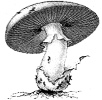
Identify the organism given below.
A
Aspergillus
B
Mucor
C
Agaricus
D
Penicillium
Solution
(C) The image provided shows a mushroom,which is a characteristic fruiting body of the fungus $Agaricus$.
$Agaricus$ belongs to the class Basidiomycetes.
It is commonly known as a mushroom or toadstool.
Other options like $Aspergillus$ and $Penicillium$ belong to Ascomycetes,and $Mucor$ belongs to Phycomycetes (Zygomycetes).
$Agaricus$ belongs to the class Basidiomycetes.
It is commonly known as a mushroom or toadstool.
Other options like $Aspergillus$ and $Penicillium$ belong to Ascomycetes,and $Mucor$ belongs to Phycomycetes (Zygomycetes).
0 likes
View Solution491
MediumMCQ
Match the following columns:
| Column-$I$ (Class) | Column-$II$ (Examples) |
| $P$. Ascomycetes | $I$. Alternaria,Colletotrichum,Trichoderma |
| $Q$. Phycomycetes | $II$. Aspergillus,Claviceps,Neurospora |
| $R$. Basidiomycetes | $III$. Agaricus,Ustilago,Puccinia |
| $S$. Deuteromycetes | $IV$. Mucor,Rhizopus,Albugo |
A
$(P-IV), (Q-I), (R-III), (S-II)$
B
$(P-II), (Q-IV), (R-III), (S-I)$
C
$(P-II), (Q-III), (R-IV), (S-I)$
D
$(P-II), (Q-IV), (R-I), (S-III)$
Solution
(B) The correct matching is as follows:
$P$. Ascomycetes: Includes fungi like $Aspergillus$,$Claviceps$,and $Neurospora$ $(II)$.
$Q$. Phycomycetes: Includes fungi like $Mucor$,$Rhizopus$,and $Albugo$ $(IV)$.
$R$. Basidiomycetes: Includes fungi like $Agaricus$ (mushroom),$Ustilago$ (smut),and $Puccinia$ (rust) $(III)$.
$S$. Deuteromycetes: Includes fungi like $Alternaria$,$Colletotrichum$,and $Trichoderma$ $(I)$.
Therefore,the correct sequence is $(P-II), (Q-IV), (R-III), (S-I)$.
$P$. Ascomycetes: Includes fungi like $Aspergillus$,$Claviceps$,and $Neurospora$ $(II)$.
$Q$. Phycomycetes: Includes fungi like $Mucor$,$Rhizopus$,and $Albugo$ $(IV)$.
$R$. Basidiomycetes: Includes fungi like $Agaricus$ (mushroom),$Ustilago$ (smut),and $Puccinia$ (rust) $(III)$.
$S$. Deuteromycetes: Includes fungi like $Alternaria$,$Colletotrichum$,and $Trichoderma$ $(I)$.
Therefore,the correct sequence is $(P-II), (Q-IV), (R-III), (S-I)$.
0 likes
View Solution492
MediumMCQ
The organism used in the production of bread and beer belongs to which of the following classes?
A
Phycomycetes
B
Deuteromycetes
C
Basidiomycetes
D
Ascomycetes
Solution
(D) The organism used in the production of bread and beer is $Saccharomyces \text{ } cerevisiae$, commonly known as Brewer's yeast or Baker's yeast.
$Saccharomyces \text{ } cerevisiae$ belongs to the class $Ascomycetes$ (sac fungi) within the kingdom $Fungi$.
Therefore, the correct option is $D$.
$Saccharomyces \text{ } cerevisiae$ belongs to the class $Ascomycetes$ (sac fungi) within the kingdom $Fungi$.
Therefore, the correct option is $D$.
0 likes
View Solution493
MediumMCQ
Match the following columns:
| Column-$I$ (Class) | Column-$II$ (Origin of asexual spores) |
| $P$. Phycomycetes | $I$. Spores are produced exogenously. |
| $Q$. Basidiomycetes | $II$. Absent |
| $R$. Ascomycetes | $III$. Spores are produced endogenously. |
A
$(P-II), (Q-III), (R-I)$
B
$(P-I), (Q-III), (R-II)$
C
$(P-I), (Q-II), (R-III)$
D
$(P-III), (Q-II), (R-I)$
Solution
(D) The correct matching is based on the asexual reproduction characteristics of fungi:
$1$. Phycomycetes: Asexual reproduction occurs by zoospores (motile) or aplanospores (non-motile). These spores are produced endogenously in sporangia. Thus, $P-III$.
$2$. Basidiomycetes: Asexual spores are generally not found in this class. Vegetative reproduction by fragmentation is common. Thus, $Q-II$.
$3$. Ascomycetes: Asexual spores are conidia produced exogenously on the special mycelium called conidiophores. Thus, $R-I$.
Therefore, the correct sequence is $(P-III), (Q-II), (R-I)$.
$1$. Phycomycetes: Asexual reproduction occurs by zoospores (motile) or aplanospores (non-motile). These spores are produced endogenously in sporangia. Thus, $P-III$.
$2$. Basidiomycetes: Asexual spores are generally not found in this class. Vegetative reproduction by fragmentation is common. Thus, $Q-II$.
$3$. Ascomycetes: Asexual spores are conidia produced exogenously on the special mycelium called conidiophores. Thus, $R-I$.
Therefore, the correct sequence is $(P-III), (Q-II), (R-I)$.
0 likes
View Solution494
MediumMCQ
Mycorrhiza $= .......$
A
Symbiotic association of bacteria and plants
B
Symbiotic association of fungi and plants
C
Symbiotic association of fungi and algae
D
Symbiotic association of bacteria and fungi
Solution
(B) Mycorrhiza is a symbiotic association between a fungus and the roots of higher plants.
In this association,the fungal hyphae absorb phosphorus from the soil and pass it to the plant.
In return,the plant provides the fungus with carbohydrates and a suitable environment for growth.
Therefore,the correct option is $B$.
In this association,the fungal hyphae absorb phosphorus from the soil and pass it to the plant.
In return,the plant provides the fungus with carbohydrates and a suitable environment for growth.
Therefore,the correct option is $B$.
0 likes
View Solution495
MediumMCQ
Match List $I$ with List $II$:
Choose the correct answer from the options given below:
| List $I$ | List $II$ |
|---|---|
| $A$. Rhizopus | $I$. Mushroom |
| $B$. Ustilago | $II$. Smut fungus |
| $C$. Puccinia | $III$. Bread mould |
| $D$. Agaricus | $IV$. Rust fungus |
Choose the correct answer from the options given below:
A
$A-I, B-III, C-II, D-IV$
B
$A-III, B-II, C-I, D-IV$
C
$A-IV, B-III, C-II, D-I$
D
$A-III, B-II, C-IV, D-I$
Solution
(D) $Rhizopus$ is commonly known as bread mould.
$Ustilago$ is a parasitic fungus that causes smut disease in plants,hence called smut fungus.
$Puccinia$ is a parasitic fungus that causes rust disease in plants,hence called rust fungus.
$Agaricus$ is a basidiomycete commonly known as mushroom.
Therefore,the correct matching is $A-III, B-II, C-IV, D-I$.
$Ustilago$ is a parasitic fungus that causes smut disease in plants,hence called smut fungus.
$Puccinia$ is a parasitic fungus that causes rust disease in plants,hence called rust fungus.
$Agaricus$ is a basidiomycete commonly known as mushroom.
Therefore,the correct matching is $A-III, B-II, C-IV, D-I$.
0 likes
View Solution496
MediumMCQ
Which one of the following is not a criterion for classification of fungi?
A
Mode of nutrition
B
Mode of spore formation
C
Fruiting body
D
Morphology of mycelium
Solution
(A) The classification of the kingdom $Fungi$ into various classes is primarily based on the morphology of the mycelium,the mode of spore formation,and the structure of the fruiting bodies. While all fungi are heterotrophic,the mode of nutrition is not used as a primary criterion for distinguishing between the different classes of fungi.
1 likes
View Solution497
MediumMCQ
Which of the following is not a basis for the classification of fungi?
A
Morphology of mycelium
B
Mode of spore formation
C
Mode of nutrition
D
Fruiting bodies
Solution
(C) The classification of the kingdom $Fungi$ is primarily based on the morphology of the mycelium,the mode of spore formation,and the development of fruiting bodies. While fungi are heterotrophic and generally saprophytic,parasitic,or symbiotic in their mode of nutrition,this is a general characteristic of the kingdom rather than a specific criterion used to classify them into different classes (such as $Phycomycetes$,$Ascomycetes$,$Basidiomycetes$,and $Deuteromycetes$). Therefore,the mode of nutrition is not a basis for their classification.
0 likes
View Solution498
DifficultMCQ
Match the column-$I$ with column-$II$:
| Column-$I$ | Column-$II$ |
| $A$. Deuteromycetes | $I$. $Rhizopus \&$ $Mucor$ |
| $B$. Phycomycetes | $II$. Sac fungi |
| $C$. Basidiomycetes | $III$. Bracket fungi |
| $D$. Ascomycetes | $IV$. Fungi imperfecti |
A
$A-III, B-II, C-I, D-IV$
B
$A-IV, B-I, C-II, D-III$
C
$A-IV, B-I, C-III, D-II$
D
$A-IV, B-III, C-I, D-II$
Solution
(C) The correct matching is as follows:
$A$. Deuteromycetes are known as $Fungi$ $imperfecti$ because only their asexual or vegetative phases are known $(A-IV)$.
$B$. Phycomycetes include fungi like $Rhizopus$ and $Mucor$ $(B-I)$.
$C$. Basidiomycetes are commonly known as bracket fungi or puffballs $(C-III)$.
$D$. Ascomycetes are commonly known as sac fungi $(D-II)$.
Therefore, the correct sequence is $A-IV, B-I, C-III, D-II$.
$A$. Deuteromycetes are known as $Fungi$ $imperfecti$ because only their asexual or vegetative phases are known $(A-IV)$.
$B$. Phycomycetes include fungi like $Rhizopus$ and $Mucor$ $(B-I)$.
$C$. Basidiomycetes are commonly known as bracket fungi or puffballs $(C-III)$.
$D$. Ascomycetes are commonly known as sac fungi $(D-II)$.
Therefore, the correct sequence is $A-IV, B-I, C-III, D-II$.
0 likes
View Solution499
MediumMCQ
In the sexual cycle of fungi,the event of meiosis takes place?
A
Before plasmogamy
B
After karyogamy
C
Before karyogamy
D
Just after plasmogamy
Solution
(B) The sexual cycle of fungi involves three distinct steps:
$1$. Plasmogamy: The fusion of protoplasm between two motile or non-motile gametes.
$2$. Karyogamy: The fusion of two nuclei.
$3$. Meiosis: The process of reduction division that occurs in the zygote resulting in haploid spores.
Therefore,meiosis occurs after karyogamy to restore the haploid state of the fungal cells.
$1$. Plasmogamy: The fusion of protoplasm between two motile or non-motile gametes.
$2$. Karyogamy: The fusion of two nuclei.
$3$. Meiosis: The process of reduction division that occurs in the zygote resulting in haploid spores.
Therefore,meiosis occurs after karyogamy to restore the haploid state of the fungal cells.
0 likes
View Solution500
MediumMCQ
Fungi reproduce by only asexual methods in$-$
A
Phycomycetes
B
Ascomycetes
C
Basidiomycetes
D
Deuteromycetes
Solution
(D) The fungi belonging to the class $Deuteromycetes$ are commonly known as imperfect fungi because only their asexual or vegetative phases are known. When the sexual forms of these fungi were discovered,they were moved into classes they rightly belong to (either $Ascomycetes$ or $Basidiomycetes$). Therefore,$Deuteromycetes$ reproduce only by asexual spores such as conidia.
0 likes
View SolutionBiological Classification — Fungi (Multicellular decomposers) · Frequently Asked Questions
1Are these Biological Classification questions useful for JEE and NEET?
Yes. All questions in this section are mapped to JEE Main and NEET exam patterns. Previous year questions from JEE Main, NEET, GUJCET and state-level exams are included with full solutions.
2Can I switch to Hindi or Gujarati for these questions?
Yes. Use the language tabs in the hero section or the sidebar to view the same questions and solutions in English, Hindi or Gujarati.
3How do I generate a question paper from this subtopic?
Use the Vedclass Exam Paper Generator — select the chapter and subtopic, set difficulty, and generate Sets A, B, C, D automatically. First 3 chapters of every subject are free.
Vedclass Products
For Students
Vedclass Test Series
Mock tests in real JEE/NEET style with performance analysis. 5-day free trial.
Start Free TrialFor Teachers
Exam Paper Generator
Generate Set A/B/C/D papers from this chapter in 2 minutes. 3 chapters free.
Try FreeFor Institutes
Online Exam Module
Live online exams with unlimited students, 360° analytics & white-label branding.
See DemoFor Teachers & Institutes
Generate a Biological Classification Exam Paper in 2 Minutes
Select subtopic & difficulty — Sets A, B, C, D auto-generated with No Repeat logic.
First 3 chapters of every subject are free — no payment required.