
A English
Fungi (Multicellular decomposers) Questions in English
Class 11 Biology · Biological Classification · Fungi (Multicellular decomposers)
511+
Questions
English
Language
100%
With Solutions
Showing 50 of 511 questions in English
201
EasyMCQ
Which of the following is known as a "toadstool"?
A
All mushrooms
B
Edible mushrooms
C
Poisonous mushrooms
D
None of these
Solution
(C) The term "toadstool" is commonly used to refer to poisonous or inedible mushrooms. While many mushrooms are edible, those that are toxic or potentially harmful to humans are colloquially called toadstools. Therefore, the correct option is $C$.
0 likes
View Solution202
MediumMCQ
Fungi are ........
A
Autotrophic
B
Holotrophic
C
Chemotrophic
D
Heterotrophic
Solution
(D) Fungi are achlorophyllous organisms,meaning they lack chlorophyll and cannot perform photosynthesis. Therefore,they cannot produce their own food. They obtain nutrients by absorbing organic matter from dead and decaying substances,which classifies them as heterotrophs. Specifically,they are saprophytes or parasites.
0 likes
View Solution203
EasyMCQ
The cell wall of fungi is composed of ...........
A
Chitin
B
Cellulose
C
Mucopeptide
D
Pseudomurein
Solution
(A) The cell wall of fungi is primarily composed of $Chitin$,which is a complex polysaccharide consisting of $N$-acetylglucosamine units.
$Cellulose$ is the primary component of the cell wall in plants.
$Mucopeptide$ (also known as peptidoglycan) is found in the cell walls of bacteria.
$Pseudomurein$ is found in the cell walls of certain archaea.
Therefore,the correct option is $A$.
$Cellulose$ is the primary component of the cell wall in plants.
$Mucopeptide$ (also known as peptidoglycan) is found in the cell walls of bacteria.
$Pseudomurein$ is found in the cell walls of certain archaea.
Therefore,the correct option is $A$.
0 likes
View Solution204
EasyMCQ
The group of organisms that exhibits a heterotrophic mode of nutrition is .......
A
Algae
B
Fungi
C
Bryophytes
D
Pteridophytes
Solution
(B) The kingdom $Fungi$ consists of organisms that are heterotrophic in their mode of nutrition. They obtain nutrients by absorbing dissolved organic material from their environment,often through the secretion of digestive enzymes. In contrast,$Algae$,$Bryophytes$,and $Pteridophytes$ are primarily autotrophic,as they contain chlorophyll and perform photosynthesis.
0 likes
View Solution205
MediumMCQ
Basidiomycetes include ..........
A
Rusts
B
Smuts
C
Mushrooms
D
All of the above
Solution
(D) Basidiomycetes are a group of fungi commonly known as club fungi.
They include mushrooms,bracket fungi,puffballs,rusts,and smuts.
These fungi grow in soil,on logs and tree stumps,and in living plant bodies as parasites.
Therefore,all the given options are examples of Basidiomycetes.
They include mushrooms,bracket fungi,puffballs,rusts,and smuts.
These fungi grow in soil,on logs and tree stumps,and in living plant bodies as parasites.
Therefore,all the given options are examples of Basidiomycetes.
0 likes
View Solution206
EasyMCQ
Fungi that require two different hosts to complete their life cycle are called .........
A
Homothallic
B
Heterothallic
C
Heteroecious
D
Autoecious
Solution
(C) Fungi that require two different hosts to complete their life cycle are known as $Heteroecious$ fungi. For example,$Puccinia$ $graminis$ $tritici$ (wheat rust fungus) requires wheat and barberry as its two hosts. In contrast,$Autoecious$ fungi complete their life cycle on a single host.
0 likes
View Solution207
MediumMCQ
The appressorium of a fungus penetrates the host with the help of:
A
Mechanical pressure and enzymes
B
Control and haustoria
C
Softening by enzymes
D
Mechanical pressure only
Solution
(A) An appressorium is a specialized hyphal structure that is used by some parasitic fungi to infect host plants.
It adheres to the host surface and generates significant mechanical pressure.
Simultaneously,the fungus secretes specific enzymes (such as cellulases and pectinases) to degrade the host cell wall.
Therefore,the penetration is achieved through a combination of mechanical pressure and enzymatic action.
It adheres to the host surface and generates significant mechanical pressure.
Simultaneously,the fungus secretes specific enzymes (such as cellulases and pectinases) to degrade the host cell wall.
Therefore,the penetration is achieved through a combination of mechanical pressure and enzymatic action.
0 likes
View Solution208
MediumMCQ
Sac fungi are included in ..........
A
Ascomycetes
B
Basidiomycetes
C
Phycomycetes
D
Deuteromycetes
Solution
(A) The members of the class $Ascomycetes$ are commonly known as sac fungi.
They are mostly multicellular (e.g.,$Penicillium$) or rarely unicellular (e.g.,yeast).
They form sac-like structures called $asci$ (singular: $ascus$) in which sexual spores called $ascospores$ are produced endogenously.
Therefore,the correct option is $A$.
They are mostly multicellular (e.g.,$Penicillium$) or rarely unicellular (e.g.,yeast).
They form sac-like structures called $asci$ (singular: $ascus$) in which sexual spores called $ascospores$ are produced endogenously.
Therefore,the correct option is $A$.
0 likes
View Solution209
MediumMCQ
Sexual reproduction is absent in .........
A
Phycomycetes
B
Deuteromycetes
C
Zygomycetes
D
Basidiomycetes
Solution
(B) Deuteromycetes are commonly known as imperfect fungi because only the asexual or vegetative phases of these fungi are known. When the sexual forms of these fungi were discovered,they were moved into classes they rightly belong to,i.e.,Ascomycetes and Basidiomycetes. Therefore,in the class Deuteromycetes,sexual reproduction is considered absent.
0 likes
View Solution210
MediumMCQ
The pathogen $Microsporum$ responsible for ringworm disease in humans belongs to the same kingdom as:
A
$Ascaris$,roundworm
B
$Taenia$,tapeworm
C
$Wuchereria$,filarial worm
D
$Rhizopus$,mold
Solution
(D) $Microsporum$ is a genus of fungi that causes ringworm infections in humans. Fungi are eukaryotic,heterotrophic organisms that belong to the Kingdom $Fungi$. Among the given options,$Rhizopus$ is also a type of fungus (commonly known as bread mold) and belongs to the Kingdom $Fungi$. $Ascaris$,$Taenia$,and $Wuchereria$ are helminths (worms) belonging to the Kingdom $Animalia$.
0 likes
View Solution211
MediumMCQ
In $Ascomycetes$ and $Basidiomycetes$,the dikaryotic cell is .....
A
Haploid
B
Diploid
C
Triploid
D
Polyploid
Solution
(A) In $Ascomycetes$ and $Basidiomycetes$,a dikaryotic stage occurs where two nuclei $(n+n)$ are present in a single cell. This phase is known as the dikaryophase. Since each nucleus is haploid $(n)$,the cell containing two such nuclei is considered to have a $n+n$ condition,which is functionally distinct from a true diploid $(2n)$ cell where the nuclei have fused. However,in the context of ploidy levels provided in the options,the dikaryotic cell is often associated with the $n+n$ state,which is effectively haploid in terms of genetic contribution per nucleus before karyogamy. Among the given options,the most accurate description of the dikaryotic state $(n+n)$ in these fungi is that it is not diploid $(2n)$ until karyogamy occurs. Therefore,it is considered haploid in the sense of having two separate haploid nuclei.
0 likes
View Solution212
EasyMCQ
The fungus $Claviceps$ (ergot fungus) belongs to which class?
A
Ascomycetes
B
Basidiomycetes
C
Phycomycetes
D
Deuteromycetes
Solution
(A) The fungus $Claviceps$ is commonly known as the ergot fungus.
It belongs to the class $Ascomycetes$ (sac fungi) within the kingdom $Fungi$.
$Ascomycetes$ are characterized by the production of spores in a sac-like structure called an $ascus$.
Therefore,the correct option is $A$.
It belongs to the class $Ascomycetes$ (sac fungi) within the kingdom $Fungi$.
$Ascomycetes$ are characterized by the production of spores in a sac-like structure called an $ascus$.
Therefore,the correct option is $A$.
0 likes
View Solution213
MediumMCQ
Coenocytic (aseptate) mycelium is found in:
A
$Rhizopus$
B
$Mucor$
C
$Penicillium$
D
Both $(A)$ and $(B)$
Solution
(D) The mycelium of fungi belonging to the class Phycomycetes (such as $Rhizopus$ and $Mucor$) is aseptate and coenocytic.
Coenocytic means the hyphae contain multiple nuclei within a continuous cytoplasm without cross-walls (septa).
$Penicillium$ belongs to the class Ascomycetes,which has septate and branched mycelium.
Coenocytic means the hyphae contain multiple nuclei within a continuous cytoplasm without cross-walls (septa).
$Penicillium$ belongs to the class Ascomycetes,which has septate and branched mycelium.
0 likes
View Solution214
EasyMCQ
Fungi that grow on dung are called ..........
A
$Epixylic$
B
$Coprophilous$
C
$Keratinophilic$
D
$Xylophilous$
Solution
(B) Fungi that grow on dung or fecal matter are known as $Coprophilous$ fungi.
$Epixylic$ fungi grow on wood.
$Keratinophilic$ fungi grow on keratin-rich substrates like hair,nails,or horns.
$Xylophilous$ fungi are those that live on or in wood.
$Epixylic$ fungi grow on wood.
$Keratinophilic$ fungi grow on keratin-rich substrates like hair,nails,or horns.
$Xylophilous$ fungi are those that live on or in wood.
0 likes
View Solution215
MediumMCQ
In which of the following is the sexual cycle absent?
A
Phycomycetes
B
Deuteromycetes
C
Ascomycetes
D
Basidiomycetes
Solution
(B) The $Deuteromycetes$ are commonly known as imperfect fungi because only their asexual or vegetative phases are known.
When the sexual forms of these fungi are discovered,they are moved into classes they rightly belong to,i.e.,$Ascomycetes$ and $Basidiomycetes$.
Therefore,in $Deuteromycetes$,the sexual cycle is absent or not yet observed.
When the sexual forms of these fungi are discovered,they are moved into classes they rightly belong to,i.e.,$Ascomycetes$ and $Basidiomycetes$.
Therefore,in $Deuteromycetes$,the sexual cycle is absent or not yet observed.
0 likes
View Solution216
MediumMCQ
In the class Phycomycetes,the mycelium is .........
A
Aseptate and coenocytic
B
Aseptate and septate
C
Uninucleate and aseptate
D
Multinucleate and septate
Solution
(A) The members of the class $Phycomycetes$ are found in aquatic habitats and on decaying wood in moist and damp places or as obligate parasites on plants.
Their mycelium is $aseptate$ (lacking cross-walls) and $coenocytic$ (multinucleate,where many nuclei are present in a common cytoplasm).
Therefore,the correct description for the mycelium in $Phycomycetes$ is $aseptate$ and $coenocytic$.
Their mycelium is $aseptate$ (lacking cross-walls) and $coenocytic$ (multinucleate,where many nuclei are present in a common cytoplasm).
Therefore,the correct description for the mycelium in $Phycomycetes$ is $aseptate$ and $coenocytic$.
0 likes
View Solution217
MediumMCQ
Which of the following is a correct match?
A
$Claviceps$ - Ascomycetes
B
$Morels$ - Ascomycetes
C
$Agaricus$ - Basidiomycetes
D
All of the above
Solution
(D) $Claviceps$ is a genus of fungi in the class Ascomycetes.
$Morels$ (Morchella) are edible fungi belonging to the class Ascomycetes.
$Agaricus$ (mushroom) belongs to the class Basidiomycetes.
Since all the given pairs are correctly matched,the correct option is $D$.
$Morels$ (Morchella) are edible fungi belonging to the class Ascomycetes.
$Agaricus$ (mushroom) belongs to the class Basidiomycetes.
Since all the given pairs are correctly matched,the correct option is $D$.
0 likes
View Solution218
EasyMCQ
Which of the following organisms possesses a cell wall?
A
Euglena
B
Mucor
C
Mycoplasma
D
Amoeba
Solution
(B) The correct answer is $Mucor$.
$Mucor$ is a type of fungus (Zygomycetes),and all fungi possess a rigid cell wall primarily composed of chitin.
$Euglena$ is a protist that lacks a cell wall,possessing instead a protein-rich layer called a pellicle.
$Mycoplasma$ is a genus of bacteria that completely lacks a cell wall.
$Amoeba$ is a protozoan that lacks a cell wall,allowing it to change its shape.
$Mucor$ is a type of fungus (Zygomycetes),and all fungi possess a rigid cell wall primarily composed of chitin.
$Euglena$ is a protist that lacks a cell wall,possessing instead a protein-rich layer called a pellicle.
$Mycoplasma$ is a genus of bacteria that completely lacks a cell wall.
$Amoeba$ is a protozoan that lacks a cell wall,allowing it to change its shape.
0 likes
View Solution219
MediumMCQ
In $Neurospora$,all alleles express their effect because.....
A
Each gene has many alleles.
B
Many genes have only one allele.
C
It has only one allele of a gene.
D
There are two alleles of a gene.
Solution
(C) $Neurospora$ is a haploid organism,meaning it contains only one set of chromosomes in its vegetative state.
Because it is haploid,each gene is represented by only a single allele.
In diploid organisms,there are two alleles for each gene,where one might be dominant and mask the expression of the other (recessive).
However,in $Neurospora$,since there is only one allele present for any given gene,that allele will always express its phenotype regardless of whether it would be considered 'dominant' or 'recessive' in a diploid organism.
Because it is haploid,each gene is represented by only a single allele.
In diploid organisms,there are two alleles for each gene,where one might be dominant and mask the expression of the other (recessive).
However,in $Neurospora$,since there is only one allele present for any given gene,that allele will always express its phenotype regardless of whether it would be considered 'dominant' or 'recessive' in a diploid organism.
0 likes
View Solution220
EasyMCQ
$A$ multinucleated cell is called .......
A
Syncytium
B
Thallus
C
Coenocyte
D
Multinucleate
Solution
(C) multinucleated cell is a cell that contains more than one nucleus.
In fungi and some algae,this condition is specifically referred to as a $Coenocyte$.
In animals,a similar condition where a single cell membrane encloses multiple nuclei is known as a $Syncytium$ (e.g.,skeletal muscle fibers).
However,in the context of general biological terminology for a multinucleated mass of cytoplasm,$Coenocyte$ is the standard term used for such structures.
In fungi and some algae,this condition is specifically referred to as a $Coenocyte$.
In animals,a similar condition where a single cell membrane encloses multiple nuclei is known as a $Syncytium$ (e.g.,skeletal muscle fibers).
However,in the context of general biological terminology for a multinucleated mass of cytoplasm,$Coenocyte$ is the standard term used for such structures.
0 likes
View Solution221
EasyMCQ
In which plant does the fungus $Claviceps purpurea$ (ergot) occur?
A
Datura
B
Rye
C
Neem
D
Cannabis
Solution
(B) The fungus $Claviceps purpurea$ is responsible for causing ergot disease in cereal crops, most notably in rye $(Secale cereale)$.
This fungus produces alkaloids known as ergot alkaloids, which are toxic and can cause ergotism in humans and animals if contaminated grain is consumed.
Therefore, the correct plant associated with ergot is rye.
This fungus produces alkaloids known as ergot alkaloids, which are toxic and can cause ergotism in humans and animals if contaminated grain is consumed.
Therefore, the correct plant associated with ergot is rye.
0 likes
View Solution222
EasyMCQ
The fungus $Claviceps$ $\text{purpurea}$ (ergot) infects which of the following plants?
A
Datura
B
Rye
C
Neem
D
Cannabis
Solution
(B) The fungus $Claviceps$ $\text{purpurea}$ is responsible for causing ergot disease in cereal crops, most notably in rye $(Secale$ $\text{cereale})$.
This fungus produces alkaloids known as ergot alkaloids, which are toxic to humans and animals if consumed.
Therefore, the correct option is $B$ (Rye).
This fungus produces alkaloids known as ergot alkaloids, which are toxic to humans and animals if consumed.
Therefore, the correct option is $B$ (Rye).
0 likes
View Solution223
MediumMCQ
The pathogen $Microsporum$,responsible for ringworm disease in humans,belongs to the same kingdom as which of the following?
A
$Taenia$ - a tapeworm
B
$Wuchereria$ - a filarial worm
C
$Rhizopus$ - a mold
D
$Ascaris$ - a roundworm
Solution
(C) $Microsporum$ is a genus of fungi that causes ringworm in humans. Fungi belong to the Kingdom $Fungi$. Among the given options,$Rhizopus$ is also a fungus (a bread mold) and belongs to the Kingdom $Fungi$. $Taenia$ (tapeworm) belongs to Kingdom $Animalia$,$Wuchereria$ (filarial worm) belongs to Kingdom $Animalia$,and $Ascaris$ (roundworm) belongs to Kingdom $Animalia$. Therefore,$Microsporum$ and $Rhizopus$ share the same kingdom.
0 likes
View Solution224
MediumMCQ
Clamp connection is present in .........
A
Basidiomycetes
B
Ascomycetes
C
Deuteromycetes
D
Phycomycetes
Solution
(A) Clamp connections are specialized structures formed by certain fungi to ensure that each cell of the hypha receives a set of nuclei during cell division.
These structures are characteristic of the dikaryotic mycelium of $Basidiomycetes$.
They function similarly to the crozier formation found in $Ascomycetes$ but are morphologically distinct.
Therefore,the correct option is $A$.
These structures are characteristic of the dikaryotic mycelium of $Basidiomycetes$.
They function similarly to the crozier formation found in $Ascomycetes$ but are morphologically distinct.
Therefore,the correct option is $A$.
0 likes
View Solution225
MediumMCQ
Which of the following fungi secretes toxins during the storage conditions of cereal crops?
A
$Aspergillus$
B
$Penicillium$
C
$Fusarium$
D
$Colletotrichum$
Solution
(A) The fungus $Aspergillus$ (specifically $Aspergillus \text{ flavus}$ and $Aspergillus \text{ parasiticus}$) is well-known for producing toxic substances called aflatoxins.
These toxins are secreted when cereal crops, oilseeds, and nuts are stored under improper conditions, such as high humidity and temperature.
Aflatoxins are highly toxic and carcinogenic to humans and animals, making $Aspergillus$ a significant concern in food storage.
These toxins are secreted when cereal crops, oilseeds, and nuts are stored under improper conditions, such as high humidity and temperature.
Aflatoxins are highly toxic and carcinogenic to humans and animals, making $Aspergillus$ a significant concern in food storage.
0 likes
View Solution226
MediumMCQ
The "dolipore septum" is a characteristic feature of .......
A
Myxomycetes
B
Phycomycetes
C
Deuteromycetes
D
Basidiomycetes
Solution
(D) The "dolipore septum" is a specialized type of septum found in the hyphae of fungi belonging to the class $Basidiomycetes$.
It is a barrel-shaped swelling around the central pore of the septum, which allows for the movement of cytoplasm and organelles between adjacent cells while preventing the passage of nuclei.
This structure is a diagnostic feature used to identify members of the $Basidiomycetes$ group.
It is a barrel-shaped swelling around the central pore of the septum, which allows for the movement of cytoplasm and organelles between adjacent cells while preventing the passage of nuclei.
This structure is a diagnostic feature used to identify members of the $Basidiomycetes$ group.
0 likes
View Solution227
MediumMCQ
Aeciospores of $Puccinia$ are produced on........
A
Leaves of $Berberis$
B
Leaves of wheat
C
Leaves of rye
D
Leaves of $Raphanus$
Solution
(A) $Puccinia$ is a heteroecious fungus that requires two different hosts to complete its life cycle.
$1$. The primary host is wheat ($Triticum$ $aestivum$),where it produces urediniospores and teliospores.
$2$. The secondary or alternate host is $Berberis$ $vulgaris$ (barberry).
$3$. On the leaves of $Berberis$,the fungus produces pycniospores (spermatia) and aeciospores.
Therefore,aeciospores are specifically produced on the leaves of $Berberis$.
$1$. The primary host is wheat ($Triticum$ $aestivum$),where it produces urediniospores and teliospores.
$2$. The secondary or alternate host is $Berberis$ $vulgaris$ (barberry).
$3$. On the leaves of $Berberis$,the fungus produces pycniospores (spermatia) and aeciospores.
Therefore,aeciospores are specifically produced on the leaves of $Berberis$.
0 likes
View Solution228
EasyMCQ
Which Indian scientist worked on $Puccinia$?
A
$J.C. Luthra$
B
$K.C. Mehta$
C
$C.V. Subramanian$
D
$K.G. Mukerji$
Solution
(B) The Indian scientist $K.C. Mehta$ is well-known for his extensive research on $Puccinia$ graminis tritici,which causes wheat rust disease.
His work provided significant insights into the life cycle of the fungus and the epidemiology of wheat rust in India,which was crucial for developing disease-resistant wheat varieties.
His work provided significant insights into the life cycle of the fungus and the epidemiology of wheat rust in India,which was crucial for developing disease-resistant wheat varieties.
0 likes
View Solution229
EasyMCQ
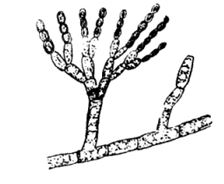
Identify the organism shown in the given figure.
A
Mucor
B
Penicillium
C
Agaricus
D
Strigula
Solution
(B) The figure shows a branched conidiophore with chains of conidia at the tips,which is a characteristic feature of the genus $Penicillium$.
$Penicillium$ belongs to the class Ascomycetes.
$Mucor$ is a Zygomycete with sporangia.
$Agaricus$ is a Basidiomycete (mushroom).
$Strigula$ is a lichen-forming fungus.
Therefore,the correct option is $B$.
$Penicillium$ belongs to the class Ascomycetes.
$Mucor$ is a Zygomycete with sporangia.
$Agaricus$ is a Basidiomycete (mushroom).
$Strigula$ is a lichen-forming fungus.
Therefore,the correct option is $B$.
0 likes
View Solution230
EasyMCQ
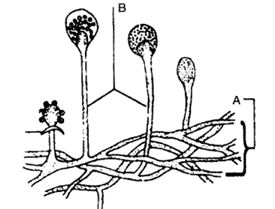
Identify the part labeled as '$A$' in the given figure.
A
Hyphae
B
Mycelium
C
Columella
D
Collar
Solution
(B) The provided figure represents the structure of the fungus $Rhizopus$.
In this diagram,the label '$A$' points to the network of thread-like structures known as the mycelium.
The mycelium is a mass of hyphae that forms the vegetative body of the fungus.
Therefore,the correct option is $B$.
In this diagram,the label '$A$' points to the network of thread-like structures known as the mycelium.
The mycelium is a mass of hyphae that forms the vegetative body of the fungus.
Therefore,the correct option is $B$.
0 likes
View Solution231
MediumMCQ
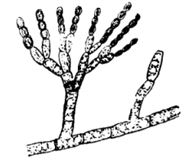
Which of the following is a characteristic of the given organism?
A
Stored food as starch
B
Presence of fruiting bodies
C
Cell wall made of fungal cellulose
D
Haplodiplontic life cycle
Solution
(B) The given image shows $Penicillium$,which is a fungus belonging to the class Ascomycetes.
Fungi are characterized by the presence of fruiting bodies (e.g.,ascocarps in Ascomycetes) that produce spores.
They store food as glycogen or oil droplets,not starch.
Their cell wall is composed of chitin,not cellulose.
They typically exhibit a haplontic life cycle.
Fungi are characterized by the presence of fruiting bodies (e.g.,ascocarps in Ascomycetes) that produce spores.
They store food as glycogen or oil droplets,not starch.
Their cell wall is composed of chitin,not cellulose.
They typically exhibit a haplontic life cycle.
0 likes
View Solution232
MediumMCQ
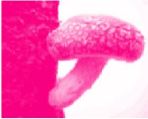
What is true for the organism shown in the figure?
A
It is the first plant group to exist on Earth.
B
They are extremely small in size.
C
Asexual reproduction occurs through conidia or zoospores.
D
The cell wall is made of chitin.
Solution
(D) The figure shows a mushroom,which belongs to the Kingdom Fungi (specifically Basidiomycetes).
Fungi are heterotrophic organisms.
$A$ key characteristic of fungi is that their cell wall is composed of chitin,a complex polysaccharide.
Therefore,option $D$ is the correct statement.
Fungi are heterotrophic organisms.
$A$ key characteristic of fungi is that their cell wall is composed of chitin,a complex polysaccharide.
Therefore,option $D$ is the correct statement.
0 likes
View Solution233
EasyMCQ
Identify the part labeled as '$B$' in the given figure.
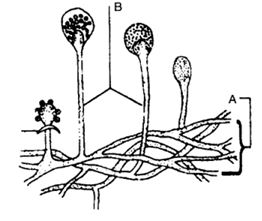
A
Spore
B
Sporangium
C
Sporangiophore
D
Columella
Solution
(C) The provided figure represents the structure of the fungus $Rhizopus$.
In this diagram:
- '$A$' represents the mycelium (hyphae).
- '$B$' points to the stalk-like structure that supports the sporangium,known as the sporangiophore.
Therefore,the correct option is '$C$'.
In this diagram:
- '$A$' represents the mycelium (hyphae).
- '$B$' points to the stalk-like structure that supports the sporangium,known as the sporangiophore.
Therefore,the correct option is '$C$'.
0 likes
View Solution234
EasyMCQ
Identify the organism shown in the given figure.
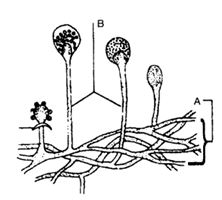
A
Penicillium
B
Mucor
C
Mushroom
D
Yeast
Solution
(B) The provided figure shows the structure of the fungus $Mucor$.
$Mucor$ is a genus of filamentous fungi in the family $Mucoraceae$.
In the figure,label $A$ represents the mycelium (hyphae),and label $B$ represents the sporangiophore bearing a sporangium.
$Penicillium$ has a brush-like conidiophore structure,$Mushroom$ is a basidiocarp,and $Yeast$ is unicellular.
Therefore,the correct option is $B$.
$Mucor$ is a genus of filamentous fungi in the family $Mucoraceae$.
In the figure,label $A$ represents the mycelium (hyphae),and label $B$ represents the sporangiophore bearing a sporangium.
$Penicillium$ has a brush-like conidiophore structure,$Mushroom$ is a basidiocarp,and $Yeast$ is unicellular.
Therefore,the correct option is $B$.
0 likes
View Solution235
MediumMCQ
What does $''x''$ represent in the given figure?
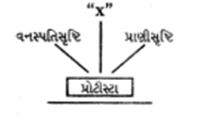
A
Bryophyta
B
Fungi
C
Pteridophyta
D
Metaphyta
Solution
(B) The figure represents the phylogenetic relationship of the Kingdom Protista. According to the evolutionary classification,the Kingdom Protista acts as a common ancestor or a link from which the Kingdom Plantae (Vanaspati Srushti),Kingdom Animalia (Prani Srushti),and Kingdom Fungi evolved. Therefore,$''x''$ represents the Kingdom Fungi.
0 likes
View Solution236
MediumMCQ
What is $Aspergillus$ $niger$?
A
Bacteria
B
Algae
C
Fungus
D
Lichen
Solution
(C) $Aspergillus$ $niger$ is a species of fungus. It is widely used in the industry for the commercial production of citric acid. It is a saprophytic fungus commonly found in soil and on decaying organic matter.
0 likes
View Solution237
MediumMCQ
Which of the following organisms has a cell wall composed of chitin?
A
Algae
B
Fungi
C
Bacteria
D
Plants
Solution
(B) The cell wall of fungi is composed of chitin,which is a complex polysaccharide ($N$-acetylglucosamine polymer).
In contrast,the cell wall of plants is primarily made of cellulose.
Algal cell walls are composed of cellulose,galactans,and mannans.
Bacterial cell walls are composed of peptidoglycan (murein).
In contrast,the cell wall of plants is primarily made of cellulose.
Algal cell walls are composed of cellulose,galactans,and mannans.
Bacterial cell walls are composed of peptidoglycan (murein).
0 likes
View Solution238
EasyMCQ
Which of the following organisms has a cell wall composed of chitin?
A
Algae
B
Fungi
C
Animal cell
D
Bacteria
Solution
(B) The cell wall of fungi is composed of chitin,which is a complex polysaccharide made of $N$-acetylglucosamine units.
Algae have cell walls made of cellulose,galactans,and mannans.
Bacteria have cell walls made of peptidoglycan (murein).
Animal cells lack a cell wall entirely.
Algae have cell walls made of cellulose,galactans,and mannans.
Bacteria have cell walls made of peptidoglycan (murein).
Animal cells lack a cell wall entirely.
0 likes
View Solution239
EasyMCQ
What is the mode of nutrition in mushrooms?
A
Autotrophic
B
Parasitic
C
Holozoic
D
Saprophytic
Solution
(D) Mushrooms are fungi that lack chlorophyll and cannot perform photosynthesis.
They obtain their nutrients by secreting digestive enzymes onto decaying organic matter and absorbing the broken-down nutrients.
This mode of nutrition is known as saprophytic nutrition.
Therefore,mushrooms are saprophytes.
They obtain their nutrients by secreting digestive enzymes onto decaying organic matter and absorbing the broken-down nutrients.
This mode of nutrition is known as saprophytic nutrition.
Therefore,mushrooms are saprophytes.
0 likes
View Solution240
EasyMCQ
The cell wall of fungi is composed of which substance?
A
Pectin
B
Chitin
C
Amylase
D
Cellulose
Solution
(B) The cell wall of fungi is primarily composed of $Chitin$,which is a complex polysaccharide consisting of $N$-acetylglucosamine units.
$Chitin$ provides structural strength and protection to the fungal cells.
$Pectin$ is typically found in plant cell walls.
$Cellulose$ is the primary component of plant cell walls.
$Amylase$ is an enzyme,not a structural component of the cell wall.
$Chitin$ provides structural strength and protection to the fungal cells.
$Pectin$ is typically found in plant cell walls.
$Cellulose$ is the primary component of plant cell walls.
$Amylase$ is an enzyme,not a structural component of the cell wall.
0 likes
View Solution241
EasyMCQ
Which of the following organisms is unicellular?
A
Slime mold
B
Yeast
C
Mucor
D
Mushroom
Solution
(B) Yeast $(Saccharomyces \text{ } cerevisiae)$ is a unicellular fungus belonging to the class Ascomycetes.
Slime molds are protists that can be acellular or cellular but are generally considered distinct from typical unicellular fungi.
Mucor and mushrooms are multicellular fungi.
Therefore, yeast is the correct answer as it is a well-known unicellular organism.
Slime molds are protists that can be acellular or cellular but are generally considered distinct from typical unicellular fungi.
Mucor and mushrooms are multicellular fungi.
Therefore, yeast is the correct answer as it is a well-known unicellular organism.
0 likes
View Solution242
EasyMCQ
What is the name of the fungal cell wall component?
A
Cuticle
B
Keratin
C
Chitin
D
Carotene
Solution
(C) The cell walls of fungi are composed of a complex polysaccharide known as $Chitin$.
$Chitin$ is a polymer of $N$-acetylglucosamine,which provides structural strength and rigidity to the fungal hyphae.
Unlike plants,which have cell walls made of cellulose,fungi utilize $Chitin$ as their primary structural component.
$Chitin$ is a polymer of $N$-acetylglucosamine,which provides structural strength and rigidity to the fungal hyphae.
Unlike plants,which have cell walls made of cellulose,fungi utilize $Chitin$ as their primary structural component.
0 likes
View Solution243
EasyMCQ
Which of the following fungi is a type of mold?
A
Ganoderma
B
Mucor
C
Yeast
D
Mushroom
Solution
(B) Fungi are classified into different groups based on their morphology and mode of reproduction.
$Mucor$ is a well-known genus of filamentous fungi commonly referred to as bread mold.
$Ganoderma$ is a bracket fungus (basidiomycete).
$Yeast$ is a unicellular fungus.
$Mushroom$ refers to the fruiting body of certain basidiomycetes.
Therefore,$Mucor$ is the correct example of a mold.
$Mucor$ is a well-known genus of filamentous fungi commonly referred to as bread mold.
$Ganoderma$ is a bracket fungus (basidiomycete).
$Yeast$ is a unicellular fungus.
$Mushroom$ refers to the fruiting body of certain basidiomycetes.
Therefore,$Mucor$ is the correct example of a mold.
0 likes
View Solution244
EasyMCQ
Which of the following is included in the multicellular decomposer kingdom?
A
Plantae
B
Animalia
C
Fungi
D
Protista
Solution
(C) The kingdom $Fungi$ consists of organisms that are primarily multicellular (except for yeasts) and heterotrophic. They obtain nutrients by absorbing organic matter from their environment,which classifies them as decomposers or saprophytes. Therefore,$Fungi$ is the correct answer.
0 likes
View Solution245
EasyMCQ
The multicellular decomposer kingdom is .........
A
Monera
B
Protista
C
Fungi
D
Metaphyta
Solution
(C) The kingdom $Fungi$ consists of organisms that are primarily multicellular (except for yeasts) and heterotrophic. They obtain their nutrition by absorbing dissolved organic molecules from their environment,which makes them the primary decomposers in the ecosystem. Therefore,they are known as the multicellular decomposer kingdom.
0 likes
View Solution246
EasyMCQ
The cell wall of this organism is composed of fungal cellulose (chitin).
A
Paramecium
B
Cyanobacteria
C
Euglena
D
Bread mold
Solution
(D) The cell wall of fungi is composed of chitin, which is a complex polysaccharide often referred to as fungal cellulose. Among the given options, $Bread \text{ } mold$ (Rhizopus) belongs to the kingdom Fungi. Paramecium is a protozoan, Cyanobacteria are prokaryotic bacteria, and Euglena is a protist. Therefore, the correct answer is $D$.
0 likes
View Solution247
MediumMCQ
Which of the following statements is consistent with the Kingdom Fungi?
A
Their body is simple,thalloid,or differentiated into root,stem,and leaves.
B
They lack membrane-bound organelles.
C
They lack a cell wall.
D
They exhibit absorptive nutrition,being either parasitic or saprophytic.
Solution
(D) Kingdom Fungi consists of heterotrophic organisms that exhibit absorptive nutrition.
They obtain nutrients by secreting digestive enzymes into their environment and absorbing the resulting organic molecules,which is characteristic of saprophytic or parasitic modes of life.
Option $A$ describes plants (thalloid or differentiated body).
Option $B$ describes prokaryotes (Monera).
Option $C$ is incorrect because fungi possess a cell wall made of chitin.
They obtain nutrients by secreting digestive enzymes into their environment and absorbing the resulting organic molecules,which is characteristic of saprophytic or parasitic modes of life.
Option $A$ describes plants (thalloid or differentiated body).
Option $B$ describes prokaryotes (Monera).
Option $C$ is incorrect because fungi possess a cell wall made of chitin.
0 likes
View Solution248
EasyMCQ
In which of the following forms are fungi found?
A
Sac-like
B
Tufted
C
Umbrella-shaped
D
All of the above
Solution
(D) Fungi exhibit a great diversity in morphology and habitat.
$1$. Sac-like: Many fungi,such as those in the class Ascomycetes,produce sac-like structures called asci.
$2$. Tufted: Many molds and mycelial fungi grow in tufted or filamentous forms.
$3$. Umbrella-shaped: Basidiomycetes,such as mushrooms (Agaricus),typically exhibit an umbrella-shaped fruiting body.
Since fungi can manifest in all these diverse morphological forms,the correct answer is $D$.
$1$. Sac-like: Many fungi,such as those in the class Ascomycetes,produce sac-like structures called asci.
$2$. Tufted: Many molds and mycelial fungi grow in tufted or filamentous forms.
$3$. Umbrella-shaped: Basidiomycetes,such as mushrooms (Agaricus),typically exhibit an umbrella-shaped fruiting body.
Since fungi can manifest in all these diverse morphological forms,the correct answer is $D$.
0 likes
View Solution249
EasyMCQ
Which of the following characteristics is $NOT$ possessed by fungi?
A
Presence of prokaryotic cells
B
Lack of tissue organization
C
Nutrition through absorption
D
Cell wall made of chitin
Solution
(A) Fungi are eukaryotic organisms,meaning they possess a true nucleus and membrane-bound organelles.
Option $A$ states the presence of prokaryotic cells,which is incorrect for fungi.
Fungi lack tissue organization,meaning they do not form complex tissues like plants or animals.
They obtain nutrition through absorption (saprophytic or parasitic mode) by secreting digestive enzymes into their environment.
Their cell walls are composed of chitin,a complex polysaccharide.
Option $A$ states the presence of prokaryotic cells,which is incorrect for fungi.
Fungi lack tissue organization,meaning they do not form complex tissues like plants or animals.
They obtain nutrition through absorption (saprophytic or parasitic mode) by secreting digestive enzymes into their environment.
Their cell walls are composed of chitin,a complex polysaccharide.
0 likes
View Solution250
MediumMCQ
In which of the following is the cell wall composed of cellulose or fungal-cellulose?
A
Eukarya domain
B
Bacteria domain
C
Archaea domain
D
Metazoa
Solution
(A) The domain $Eukarya$ includes organisms whose cells contain a nucleus and membrane-bound organelles.
Within this domain,plants have cell walls made of cellulose,while fungi have cell walls composed of chitin (often referred to as fungal-cellulose).
Bacteria and Archaea have cell walls made of peptidoglycan or pseudomurein,respectively,not cellulose.
Metazoa (animals) lack cell walls entirely.
Within this domain,plants have cell walls made of cellulose,while fungi have cell walls composed of chitin (often referred to as fungal-cellulose).
Bacteria and Archaea have cell walls made of peptidoglycan or pseudomurein,respectively,not cellulose.
Metazoa (animals) lack cell walls entirely.
0 likes
View SolutionBiological Classification — Fungi (Multicellular decomposers) · Frequently Asked Questions
1Are these Biological Classification questions useful for JEE and NEET?
Yes. All questions in this section are mapped to JEE Main and NEET exam patterns. Previous year questions from JEE Main, NEET, GUJCET and state-level exams are included with full solutions.
2Can I switch to Hindi or Gujarati for these questions?
Yes. Use the language tabs in the hero section or the sidebar to view the same questions and solutions in English, Hindi or Gujarati.
3How do I generate a question paper from this subtopic?
Use the Vedclass Exam Paper Generator — select the chapter and subtopic, set difficulty, and generate Sets A, B, C, D automatically. First 3 chapters of every subject are free.
Vedclass Products
For Students
Vedclass Test Series
Mock tests in real JEE/NEET style with performance analysis. 5-day free trial.
Start Free TrialFor Teachers
Exam Paper Generator
Generate Set A/B/C/D papers from this chapter in 2 minutes. 3 chapters free.
Try FreeFor Institutes
Online Exam Module
Live online exams with unlimited students, 360° analytics & white-label branding.
See DemoFor Teachers & Institutes
Generate a Biological Classification Exam Paper in 2 Minutes
Select subtopic & difficulty — Sets A, B, C, D auto-generated with No Repeat logic.
First 3 chapters of every subject are free — no payment required.