
A English
Phylum-Porifera Questions in English
Class 11 Biology · Animal Kingdom · Phylum-Porifera
187+
Questions
English
Language
100%
With Solutions
Showing 36 of 187 questions in English
151
MediumMCQ
Assertion : Sponges have body organization of "cellular level".
Reason : There is some physiological division of labour.
Reason : There is some physiological division of labour.
A
If both Assertion and Reason are correct and the Reason is a correct explanation of the Assertion.
B
If both Assertion and Reason are correct but Reason is not a correct explanation of the Assertion.
C
If the Assertion is correct but Reason is incorrect.
D
If both the Assertion and Reason are incorrect.
Solution
(A) Sponges are multicellular organisms, but they exhibit a "cellular level" of body organization, meaning they do not possess true tissues, organs, or organ systems.
Although sponges lack tissues, there is a degree of physiological division of labour among the various types of cells (e.g., choanocytes, amoebocytes) present in their body.
These cells perform specific functions such as digestion, respiration, and reproduction, but they are not organized into permanent layers or masses to form tissues.
Therefore, both the Assertion and the Reason are correct, and the Reason provides a valid explanation for why the organization is considered "cellular level" despite the presence of functional specialization.
Although sponges lack tissues, there is a degree of physiological division of labour among the various types of cells (e.g., choanocytes, amoebocytes) present in their body.
These cells perform specific functions such as digestion, respiration, and reproduction, but they are not organized into permanent layers or masses to form tissues.
Therefore, both the Assertion and the Reason are correct, and the Reason provides a valid explanation for why the organization is considered "cellular level" despite the presence of functional specialization.
0 likes
View Solution152
MediumMCQ
Assertion : Sponges belong to Porifera.
Reason : Sponges have a canal system.
Reason : Sponges have a canal system.
A
If both Assertion and Reason are correct and the Reason is a correct explanation of the Assertion.
B
If both Assertion and Reason are correct but Reason is not a correct explanation of the Assertion.
C
If the Assertion is correct but Reason is incorrect.
D
If both the Assertion and Reason are incorrect.
Solution
(A) Sponges are multicellular organisms that belong to the phylum $Porifera$.
They possess a unique water transport or canal system,which is a defining characteristic of this phylum.
Water enters through minute pores called $ostia$ in the body wall into a central cavity,the $spongocoel$,and goes out through the $osculum$.
This pathway of water transport is helpful in food gathering,respiratory exchange,and removal of waste.
Since the canal system is a diagnostic feature that defines the phylum $Porifera$,the Reason correctly explains the Assertion.
They possess a unique water transport or canal system,which is a defining characteristic of this phylum.
Water enters through minute pores called $ostia$ in the body wall into a central cavity,the $spongocoel$,and goes out through the $osculum$.
This pathway of water transport is helpful in food gathering,respiratory exchange,and removal of waste.
Since the canal system is a diagnostic feature that defines the phylum $Porifera$,the Reason correctly explains the Assertion.
0 likes
View Solution153
EasyMCQ
Give the characteristics of Phylum Porifera.
A
Cellular level of organization,presence of ostia and osculum.
B
Presence of cnidoblasts,radial symmetry.
C
Presence of flame cells,bilateral symmetry.
D
Presence of water vascular system,radial symmetry.
Solution
(A) The members of Phylum $Porifera$ are commonly known as sponges.
They are primitive multicellular animals with a cellular level of organization.
They have a water transport or canal system.
Water enters through minute pores called $ostia$ in the body wall into a central cavity,$spongocoel$,from where it goes out through the $osculum$.
This pathway of water transport is helpful in food gathering,respiratory exchange,and removal of waste.
$Choanocytes$ or collar cells line the spongocoel and the canals.
Digestion is intracellular.
The body is supported by a skeleton made up of $spicules$ or $spongin$ fibers.
They are hermaphrodite,i.e.,eggs and sperm are produced by the same individual.
They are primitive multicellular animals with a cellular level of organization.
They have a water transport or canal system.
Water enters through minute pores called $ostia$ in the body wall into a central cavity,$spongocoel$,from where it goes out through the $osculum$.
This pathway of water transport is helpful in food gathering,respiratory exchange,and removal of waste.
$Choanocytes$ or collar cells line the spongocoel and the canals.
Digestion is intracellular.
The body is supported by a skeleton made up of $spicules$ or $spongin$ fibers.
They are hermaphrodite,i.e.,eggs and sperm are produced by the same individual.
0 likes
View Solution154
Medium
State the location and function of the following:
$(i)$ Contractile vacuole
$(ii)$ Ostia
$(i)$ Contractile vacuole
$(ii)$ Ostia
Solution
(N/A) $(i)$
Location: In Protozoa (e.g.,Amoeba).
Function: Osmoregulation and excretion.
$(ii)$
Location: In Porifera (sponges).
Function: These are minute pores on the body wall through which water enters the body cavity (spongocoel).
Location: In Protozoa (e.g.,Amoeba).
Function: Osmoregulation and excretion.
$(ii)$
Location: In Porifera (sponges).
Function: These are minute pores on the body wall through which water enters the body cavity (spongocoel).
0 likes
View Solution155
Medium
Give the general characteristics of phylum Porifera.
Solution
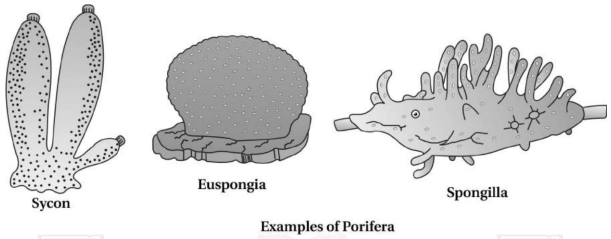
(N/A) $\rightarrow$ Phylum Porifera (Latin: porus = pore, ferre = to bear) includes the first and most primitive group of multicellular animals, commonly referred to as sponges.
$\rightarrow$ They are primitive, multicellular animals with a cellular level of organization.
$\rightarrow$ They are generally marine and mostly asymmetrical.
$\rightarrow$ Sponges possess a unique water transport or canal system.
$\rightarrow$ Water enters through minute pores (ostia) in the body wall into a central cavity, the spongocoel, from where it exits through the osculum.
$\rightarrow$ This pathway of water transport is essential for food gathering, respiratory exchange, and the removal of waste products.
$\rightarrow$ Choanocytes or collar cells line the spongocoel and the canals.
$\rightarrow$ Digestion is intracellular.
$\rightarrow$ The body is supported by a skeleton made up of spicules or spongin fibres.
$\rightarrow$ They are hermaphrodite (sexes are not separate), and reproduction occurs both asexually (by fragmentation) and sexually (by formation of gametes).
$\rightarrow$ They are primitive, multicellular animals with a cellular level of organization.
$\rightarrow$ They are generally marine and mostly asymmetrical.
$\rightarrow$ Sponges possess a unique water transport or canal system.
$\rightarrow$ Water enters through minute pores (ostia) in the body wall into a central cavity, the spongocoel, from where it exits through the osculum.
$\rightarrow$ This pathway of water transport is essential for food gathering, respiratory exchange, and the removal of waste products.
$\rightarrow$ Choanocytes or collar cells line the spongocoel and the canals.
$\rightarrow$ Digestion is intracellular.
$\rightarrow$ The body is supported by a skeleton made up of spicules or spongin fibres.
$\rightarrow$ They are hermaphrodite (sexes are not separate), and reproduction occurs both asexually (by fragmentation) and sexually (by formation of gametes).
0 likes
View Solution156
Medium
The body of sponges does not possess tissue level of organisation,though it is made of thousands of cells. Comment.
Solution
(N/A) $\Rightarrow$ Sponges exhibit cellular level of organization,meaning their cells are not organized into tissues.
$\Rightarrow$ Although they consist of thousands of cells,these cells function relatively independently or in loose aggregates.
$\Rightarrow$ There is a division of labor among the cells,where different types of cells perform specific functions,but they do not form complex,integrated tissue layers.
$\Rightarrow$ Although they consist of thousands of cells,these cells function relatively independently or in loose aggregates.
$\Rightarrow$ There is a division of labor among the cells,where different types of cells perform specific functions,but they do not form complex,integrated tissue layers.
0 likes
View Solution157
EasyMCQ
Undifferentiated totipotent cells of sponges are:
A
Archaeocytes
B
Porocytes
C
Trophocytes
D
Myocytes
Solution
(A) Archaeocytes are undifferentiated embryonic amoebocytes of sponges with blunt pseudopodia and a large nucleus. These cells exhibit totipotency,meaning they have the ability to differentiate into any other type of cell required by the sponge body.
0 likes
View Solution158
MediumMCQ
Choanocytes in an ascon type of canal system are found lining the:
A
Porocyte
B
Incurrent canal
C
Apopyle
D
Spongocoel
Solution
(D) The ascon type of canal system is the simplest form found in sponges,such as $Leucosolenia$.
In this system,the water enters through the ostia into the central cavity known as the spongocoel.
The spongocoel is lined by flagellated collar cells called choanocytes.
From the spongocoel,water exits through the osculum.
Therefore,the choanocytes line the spongocoel.
In this system,the water enters through the ostia into the central cavity known as the spongocoel.
The spongocoel is lined by flagellated collar cells called choanocytes.
From the spongocoel,water exits through the osculum.
Therefore,the choanocytes line the spongocoel.
0 likes
View Solution159
MediumMCQ
Which of the following is not a Porifera?
A
Sycon
B
Spirulina
C
Euspongia
D
Spongilla
Solution
(B) $Spirulina$ is a cyanobacterium (blue-green algae) and belongs to the kingdom Monera,not the phylum Porifera.
$Sycon$,$Euspongia$,and $Spongilla$ are all members of the phylum Porifera,commonly known as sponges.
$Sycon$,$Euspongia$,and $Spongilla$ are all members of the phylum Porifera,commonly known as sponges.
0 likes
View Solution160
EasyMCQ
Which type of cells are absent in sponges?
A
Trophocytes
B
Myocytes
C
Archaeocytes
D
Cnidocytes
Solution
(D) Cnidocytes,also known as stinging cells,are specialized cells found exclusively in the phylum $Cnidaria$. They are used for prey capture,defense,and anchorage. They are not present in sponges (phylum $Porifera$).
Archaeocytes are totipotent cells in sponges involved in regeneration and food storage.
Trophocytes are nurse cells in sponges that provide nutrients to developing oocytes.
Myocytes are contractile cells found around the osculum in sponges that regulate water flow.
Archaeocytes are totipotent cells in sponges involved in regeneration and food storage.
Trophocytes are nurse cells in sponges that provide nutrients to developing oocytes.
Myocytes are contractile cells found around the osculum in sponges that regulate water flow.
0 likes
View Solution161
EasyMCQ
The peculiarity of sponges is
A
Canal system
B
Water vascular system
C
Central gastrovascular cavity
D
Bioluminescence
Solution
(A) The $Canal$ $system$ is a unique and peculiar characteristic of sponges (Phylum $Porifera$). It is a complex network of interconnected chambers, canals, and openings that facilitate water circulation for feeding, respiration, and excretion.
Also:
- $Water$ $vascular$ $system$ is a characteristic feature of $Echinoderms$.
- $Central$ $gastrovascular$ $cavity$ is a characteristic feature of $Cnidarians$.
- $Bioluminescence$ is a characteristic feature of $Ctenophora$.
Also:
- $Water$ $vascular$ $system$ is a characteristic feature of $Echinoderms$.
- $Central$ $gastrovascular$ $cavity$ is a characteristic feature of $Cnidarians$.
- $Bioluminescence$ is a characteristic feature of $Ctenophora$.
0 likes
View Solution162
EasyMCQ
Choanocytes are present in
A
Physalia
B
Sycon
C
Pleurobrachia
D
Echinus
Solution
(B) Choanocytes,also known as collar cells,are the characteristic cells of the phylum $Porifera$ (sponges).
In sponges,the internal lining of the canal system and the $spongocoel$ is formed by these choanocytes.
Among the given options:
$A$. $Physalia$ belongs to the phylum $Cnidaria$ (Coelenterata).
$B$. $Sycon$ belongs to the phylum $Porifera$ (sponges),thus it possesses choanocytes.
$C$. $Pleurobrachia$ belongs to the phylum $Ctenophora$.
$D$. $Echinus$ (sea urchin) belongs to the phylum $Echinodermata$.
Therefore,the correct option is $B$.
In sponges,the internal lining of the canal system and the $spongocoel$ is formed by these choanocytes.
Among the given options:
$A$. $Physalia$ belongs to the phylum $Cnidaria$ (Coelenterata).
$B$. $Sycon$ belongs to the phylum $Porifera$ (sponges),thus it possesses choanocytes.
$C$. $Pleurobrachia$ belongs to the phylum $Ctenophora$.
$D$. $Echinus$ (sea urchin) belongs to the phylum $Echinodermata$.
Therefore,the correct option is $B$.
0 likes
View Solution163
EasyMCQ
In $Poriferans$,the skeleton is made up of
A
Spongin fibres and spicules
B
Calcareous ossicles
C
Chitinous spicules
D
Cartilage
Solution
(A) In $Porifera$,the skeleton is formed by two types of structures:
$1$. $Spicules$: These are secreted by $Scleroblast$ cells. In calcareous sponges,these are called $calcoblasts$,and in siliceous sponges,they are called $silicoblasts$.
$2$. $Spongin$ $fibres$: These are secreted by $Spongioblast$ cells present in the $mesohyal$ layer of the sponge body.
Therefore,the skeleton of $Poriferans$ is composed of $spongin$ $fibres$ and $spicules$.
$1$. $Spicules$: These are secreted by $Scleroblast$ cells. In calcareous sponges,these are called $calcoblasts$,and in siliceous sponges,they are called $silicoblasts$.
$2$. $Spongin$ $fibres$: These are secreted by $Spongioblast$ cells present in the $mesohyal$ layer of the sponge body.
Therefore,the skeleton of $Poriferans$ is composed of $spongin$ $fibres$ and $spicules$.
0 likes
View Solution164
EasyMCQ
Water enters the body of sponges through
A
Osculum
B
Hypostome
C
Muscular pharynx
D
Ostia
Solution
(D) Sponges are also known as $Porifera$,which means pore-bearing animals.
Sponges have a perforated body with numerous small openings called $Ostia$.
Water enters the body of sponges through these $Ostia$.
$A$ larger opening through which water flows out of the sponge is called the $Osculum$.
Therefore,$Porifera$ have numerous mouth-like pores called $Ostia$ for the entry of water and a single large pore for the exit of water called the $Osculum$.
Sponges have a perforated body with numerous small openings called $Ostia$.
Water enters the body of sponges through these $Ostia$.
$A$ larger opening through which water flows out of the sponge is called the $Osculum$.
Therefore,$Porifera$ have numerous mouth-like pores called $Ostia$ for the entry of water and a single large pore for the exit of water called the $Osculum$.
0 likes
View Solution165
MediumMCQ
All of the following statements are correct for Poriferans,except
A
Eggs and sperms are produced by the same individual
B
They are generally marine and mostly asymmetrical animals
C
They reproduce sexually as well as asexually
D
They have an extracellular type of digestion
Solution
(D) Sponges are hermaphrodites,meaning male and female gametes are produced by the same individual.
Most sponges are marine and asymmetrical animals.
Both sexual and asexual reproduction occur in them.
Sponges exhibit intracellular digestion,where food is digested within food vacuoles inside the cells.
There is no extracellular digestion in sponges.
Most sponges are marine and asymmetrical animals.
Both sexual and asexual reproduction occur in them.
Sponges exhibit intracellular digestion,where food is digested within food vacuoles inside the cells.
There is no extracellular digestion in sponges.
0 likes
View Solution166
EasyMCQ
The canal system of Porifera is not connected with:
A
Food gathering
B
Respiratory gas exchange
C
Removal of waste
D
Locomotion
Solution
(D) Poriferans are sessile organisms and remain attached to a substratum. They do not exhibit locomotion. In sponges,the canal system performs the functions of food gathering,gas exchange during respiration,and the removal of waste products. Therefore,the canal system does not help in locomotion.
0 likes
View Solution167
MediumMCQ
The formation of the canal system in sponges is due to
A
Folding of inner walls
B
Gastro-vascular system
C
Reproduction
D
Modification of coelom
Solution
(A) The canal system in sponges is a unique feature of the phylum $Porifera$. It is formed by the complex folding of the body wall,which includes the outer ectoderm (pinacoderm) and the inner endoderm (choanoderm). This system facilitates water circulation,which is essential for nutrition,respiration,and excretion.
0 likes
View Solution168
MediumMCQ
Which of the following statements is without exception for sponges?
A
They all have calcareous spicules
B
They have high regenerative power
C
They are found only in marine water
D
They are all radially symmetric
Solution
(B) Sponges (Phylum $Porifera$) possess a remarkable ability for regeneration. If a sponge is fragmented due to mechanical injury or decay,each fragment has the potential to develop into a complete,new sponge. Even individual cells from a crushed sponge can reaggregate and reorganize to form a functional sponge. This high regenerative power is a characteristic feature observed across the phylum.
0 likes
View Solution169
Easy
Describe reproduction in Porifera.
Solution
(N/A) $\rightarrow$ Sponges reproduce asexually by fragmentation and sexually by the formation of gametes.
$\rightarrow$ Fertilisation is internal,and development is indirect,involving a larval stage that is morphologically distinct from the adult.
$\rightarrow$ Development is mostly indirect,with larval stages known as parenchymula (e.g.,Leucosolenia) or amphiblastula (e.g.,Sycon).
$\rightarrow$ Examples: Sycon (Scypha),Spongilla (freshwater sponge),Euspongia (bath sponge).
$\rightarrow$ Fertilisation is internal,and development is indirect,involving a larval stage that is morphologically distinct from the adult.
$\rightarrow$ Development is mostly indirect,with larval stages known as parenchymula (e.g.,Leucosolenia) or amphiblastula (e.g.,Sycon).
$\rightarrow$ Examples: Sycon (Scypha),Spongilla (freshwater sponge),Euspongia (bath sponge).
0 likes
View Solution170
EasyMCQ
What is the location and function of collar cells?
A
Location: Outer surface; Function: Protection
B
Location: Body wall of Porifera; Function: Water circulation and food capture
C
Location: Nervous system; Function: Impulse transmission
D
Location: Reproductive organs; Function: Gamete production
Solution
(B) $\rightarrow$ Location: Collar cells,also known as choanocytes,are found lining the spongocoel and the canals of the body wall in sponges (Phylum Porifera).
$\rightarrow$ Function: These cells possess a flagellum that beats to create a water current,which brings in food particles and oxygen. The collar structure helps in trapping food particles from the water current,which are then ingested by the cell.
$\rightarrow$ Function: These cells possess a flagellum that beats to create a water current,which brings in food particles and oxygen. The collar structure helps in trapping food particles from the water current,which are then ingested by the cell.
0 likes
View Solution171
EasyMCQ
What is the location and function of choanocytes?
A
Lining of spongocoel and canals; water circulation
B
Outer surface of body; protection
C
Inside the mesohyl; digestion
D
Near the osculum; excretion
Solution
(A) $\rightarrow$ Location: In sponges,the canals and the spongocoel are lined by specialized flagellated cells called choanocytes (collar cells).
$\rightarrow$ Function: The beating of flagella on choanocytes maintains a constant flow of water from the ostia to the osculum through the spongocoel,which is essential for food capture,respiration,and excretion.
$\rightarrow$ Function: The beating of flagella on choanocytes maintains a constant flow of water from the ostia to the osculum through the spongocoel,which is essential for food capture,respiration,and excretion.
0 likes
View Solution172
MediumMCQ
Collar cells (choanocytes) are found in:
A
Cnidaria
B
Ctenophora
C
Porifera
D
All of the above
Solution
(C) Collar cells,also known as $choanocytes$,are specialized flagellated cells that line the internal cavity (spongocoel) and canals of sponges.
These cells are a characteristic feature of the phylum $Porifera$.
They help in water circulation,capturing food particles,and respiration.
Therefore,the correct option is $C$.
These cells are a characteristic feature of the phylum $Porifera$.
They help in water circulation,capturing food particles,and respiration.
Therefore,the correct option is $C$.
0 likes
View Solution173
EasyMCQ
What is the direction of the water flow in organisms belonging to the phylum Porifera?
A
Ostia $\rightarrow$ Spongocoel $\rightarrow$ Osculum
B
Osculum $\rightarrow$ Spongocoel $\rightarrow$ Ostia
C
Ostia $\rightarrow$ Osculum $\rightarrow$ Spongocoel
D
Spongocoel $\rightarrow$ Osculum $\rightarrow$ Ostia
Solution
(A) In the phylum Porifera (sponges),water enters the body through minute pores called $Ostia$ in the body wall into a central cavity called the $Spongocoel$.
From the $Spongocoel$,the water exits the body through a large opening called the $Osculum$.
Therefore,the correct pathway of water flow is $Ostia \rightarrow Spongocoel \rightarrow Osculum$.
From the $Spongocoel$,the water exits the body through a large opening called the $Osculum$.
Therefore,the correct pathway of water flow is $Ostia \rightarrow Spongocoel \rightarrow Osculum$.
0 likes
View Solution174
MediumMCQ
In which of the following organisms does digestion occur only intracellularly?
A
Porifera
B
Cnidaria
C
Ctenophora
D
Platyhelminthes
Solution
(A) In the phylum $Porifera$ (sponges),digestion is strictly intracellular. This means that food particles are engulfed by choanocytes and digestion takes place within the cells. In contrast,phyla like $Cnidaria$,$Ctenophora$,and $Platyhelminthes$ exhibit both extracellular and intracellular digestion.
0 likes
View Solution175
MediumMCQ
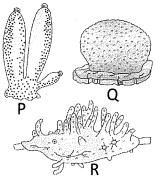
Identify the animals of the phylum Porifera given below.
A
Spongilla,Euspongia,Sycon
B
Sycon,Euspongia,Spongilla
C
Sycon,Spongilla,Euspongia
D
Euspongia,Spongilla,Sycon
Solution
(B) Based on the provided image:
$P$ represents $Sycon$,which is a tubular sponge.
$Q$ represents $Euspongia$,which is commonly known as the bath sponge.
$R$ represents $Spongilla$,which is a freshwater sponge.
Therefore,the correct sequence is $P = Sycon$,$Q = Euspongia$,$R = Spongilla$.
$P$ represents $Sycon$,which is a tubular sponge.
$Q$ represents $Euspongia$,which is commonly known as the bath sponge.
$R$ represents $Spongilla$,which is a freshwater sponge.
Therefore,the correct sequence is $P = Sycon$,$Q = Euspongia$,$R = Spongilla$.
0 likes
View Solution176
MediumMCQ
What is the function of the water canal system in sponges?
A
Food gathering
B
Respiratory gas exchange
C
Removal of waste products
D
All of the above
Solution
(D) The water canal system (or water transport system) is a characteristic feature of the phylum $Porifera$.
Water enters through minute pores called $ostia$ into a central cavity called $spongocoel$ and goes out through the $osculum$.
This pathway of water transport is helpful in:
$1$. Food gathering: Food particles are filtered from the water.
$2$. Respiratory gas exchange: Oxygen is taken in and carbon dioxide is released.
$3$. Removal of waste products: Metabolic wastes are flushed out of the body.
Therefore,all these functions are performed by the water canal system.
Water enters through minute pores called $ostia$ into a central cavity called $spongocoel$ and goes out through the $osculum$.
This pathway of water transport is helpful in:
$1$. Food gathering: Food particles are filtered from the water.
$2$. Respiratory gas exchange: Oxygen is taken in and carbon dioxide is released.
$3$. Removal of waste products: Metabolic wastes are flushed out of the body.
Therefore,all these functions are performed by the water canal system.
0 likes
View Solution177
MediumMCQ
In which of the following types of organisms are tissues $NOT$ found?
A
Cnidaria
B
Platyhelminthes
C
Porifera
D
All of the above
Solution
(C) The level of organization in the animal kingdom progresses from cellular to tissue,organ,and organ system levels.
$1$. In the phylum $Porifera$ (sponges),the cells are arranged as loose cell aggregates,exhibiting a cellular level of organization. They do not possess tissues.
$2$. In the phylum $Cnidaria$ (Coelenterata),the arrangement of cells is more complex,and they exhibit a tissue level of organization.
$3$. In the phylum $Platyhelminthes$ (flatworms),the organization reaches the organ level.
Therefore,tissues are not found in $Porifera$.
$1$. In the phylum $Porifera$ (sponges),the cells are arranged as loose cell aggregates,exhibiting a cellular level of organization. They do not possess tissues.
$2$. In the phylum $Cnidaria$ (Coelenterata),the arrangement of cells is more complex,and they exhibit a tissue level of organization.
$3$. In the phylum $Platyhelminthes$ (flatworms),the organization reaches the organ level.
Therefore,tissues are not found in $Porifera$.
0 likes
View Solution178
EasyMCQ
Cellular grade of organisation is found in $:-$
A
Sponges
B
Coelenterates
C
Platyhelminthes
D
Ctenophora
Solution
(A) In the animal kingdom,the level of organization refers to the complexity of the body structure.
$1$. Cellular level of organization: This is the simplest level where cells are arranged as loose cell aggregates,but they do not form tissues. This is characteristic of the phylum $Porifera$ (sponges).
$2$. Tissue level of organization: Cells performing the same function are arranged into tissues,as seen in $Coelenterata$ and $Ctenophora$.
$3$. Organ level of organization: Tissues are grouped together to form organs,specialized for particular functions,as seen in $Platyhelminthes$.
$4$. Organ system level of organization: Organs are associated to form functional systems,as seen in higher phyla starting from $Aschelminthes$ to $Chordata$.
Therefore,the cellular grade of organization is found in sponges.
$1$. Cellular level of organization: This is the simplest level where cells are arranged as loose cell aggregates,but they do not form tissues. This is characteristic of the phylum $Porifera$ (sponges).
$2$. Tissue level of organization: Cells performing the same function are arranged into tissues,as seen in $Coelenterata$ and $Ctenophora$.
$3$. Organ level of organization: Tissues are grouped together to form organs,specialized for particular functions,as seen in $Platyhelminthes$.
$4$. Organ system level of organization: Organs are associated to form functional systems,as seen in higher phyla starting from $Aschelminthes$ to $Chordata$.
Therefore,the cellular grade of organization is found in sponges.
0 likes
View Solution179
EasyMCQ
Which statement is true for $Spongilla$?
A
Occurs exclusively in fresh water
B
Is a triploblastic poriferan
C
Has numerous osculum for entry of water
D
Lacks flagellated collar cells in body
Solution
(A) $Spongilla$ is a well-known genus of freshwater sponges belonging to the phylum $Porifera$.
Most members of the phylum $Porifera$ are marine,but $Spongilla$ is an exception as it is found exclusively in freshwater habitats.
$Porifera$ are diploblastic,not triploblastic.
They have a single large opening called the $osculum$ for the exit of water,while water enters through numerous minute pores called $ostia$.
They possess characteristic flagellated collar cells known as $choanocytes$ that line the spongocoel and canals.
Most members of the phylum $Porifera$ are marine,but $Spongilla$ is an exception as it is found exclusively in freshwater habitats.
$Porifera$ are diploblastic,not triploblastic.
They have a single large opening called the $osculum$ for the exit of water,while water enters through numerous minute pores called $ostia$.
They possess characteristic flagellated collar cells known as $choanocytes$ that line the spongocoel and canals.
0 likes
View Solution180
MediumMCQ
Assertion $(A):$ The body of sponges is supported by a skeleton.
Reason $(R):$ The skeleton of sponges is made up of spicules and spongin fibres.
Reason $(R):$ The skeleton of sponges is made up of spicules and spongin fibres.
A
Both $(A)$ and $(R)$ are incorrect.
B
Both $(A)$ and $(R)$ are true,and $(R)$ is the correct explanation of $(A)$.
C
Both $(A)$ and $(R)$ are true,and $(R)$ is not the correct explanation of $(A)$.
D
$(A)$ is true,but $(R)$ is false.
Solution
(B) Sponges (Phylum $Porifera$) possess a characteristic internal skeleton that provides structural support to their body.
This skeleton is composed of either calcareous or siliceous spicules,or proteinaceous spongin fibres,or a combination of both.
Therefore,the assertion that the body of sponges is supported by a skeleton is true.
The reason correctly explains that this support is provided by spicules and spongin fibres.
Thus,both $(A)$ and $(R)$ are true,and $(R)$ is the correct explanation of $(A)$.
This skeleton is composed of either calcareous or siliceous spicules,or proteinaceous spongin fibres,or a combination of both.
Therefore,the assertion that the body of sponges is supported by a skeleton is true.
The reason correctly explains that this support is provided by spicules and spongin fibres.
Thus,both $(A)$ and $(R)$ are true,and $(R)$ is the correct explanation of $(A)$.
0 likes
View Solution181
MediumMCQ
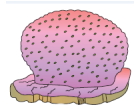
Identify the member of Phylum Porifera shown in the given diagram.
A
Sycon
B
Euspongia
C
Spongilla
D
Scypha
Solution
(B) The diagram provided shows a sponge with a massive,rounded body shape,which is characteristic of the genus $Euspongia$ (commonly known as the bath sponge).
$Sycon$ typically has a tubular,branched body structure.
$Spongilla$ is a freshwater sponge that often exhibits a branching or encrusting growth form.
$Scypha$ is a synonym for $Sycon$.
Therefore,the correct identification for the given diagram is $Euspongia$.
$Sycon$ typically has a tubular,branched body structure.
$Spongilla$ is a freshwater sponge that often exhibits a branching or encrusting growth form.
$Scypha$ is a synonym for $Sycon$.
Therefore,the correct identification for the given diagram is $Euspongia$.
0 likes
View Solution182
EasyMCQ
The correct path of the flow of water in sponges is:
A
Spongocoel $-$ Ostia $-$ Osculum
B
Osculum $-$ Ostia $-$ Spongocoel
C
Spongocoel $-$ Osculum $-$ Ostia
D
Ostia $-$ Spongocoel $-$ Osculum
Solution
(D) In sponges (Phylum Porifera),water enters the body through minute pores called $Ostia$ present on the body wall.
From the $Ostia$,water enters a central cavity known as the $Spongocoel$.
Finally,the water leaves the body through a large opening called the $Osculum$.
Therefore,the correct path of water flow is $Ostia \rightarrow Spongocoel \rightarrow Osculum$.
From the $Ostia$,water enters a central cavity known as the $Spongocoel$.
Finally,the water leaves the body through a large opening called the $Osculum$.
Therefore,the correct path of water flow is $Ostia \rightarrow Spongocoel \rightarrow Osculum$.
0 likes
View Solution183
EasyMCQ
Which one is incorrect for phylum $Porifera$?
A
Sponges are primitive multicellular animals
B
$Porifera$ are commonly called sponges
C
Poriferans have $ostia$
D
Sponges have tissue level of body organisation
Solution
(D) The phylum $Porifera$ includes organisms commonly known as sponges.
These are primitive multicellular animals with a cellular level of body organization,not a tissue level.
They possess numerous pores on their body called $ostia$ for water entry and a central cavity called $spongocoel$.
Therefore,the statement that sponges have a tissue level of body organization is incorrect.
These are primitive multicellular animals with a cellular level of body organization,not a tissue level.
They possess numerous pores on their body called $ostia$ for water entry and a central cavity called $spongocoel$.
Therefore,the statement that sponges have a tissue level of body organization is incorrect.
0 likes
View Solution184
EasyMCQ
Collar cells form the lining of spongocoel in$-$
A
Jelly fish
B
Sycon
C
Taenia
D
Pila
Solution
(B) Collar cells,also known as $choanocytes$,are specialized flagellated cells that line the $spongocoel$ and the canals of sponges ($Phylum$ $Porifera$).
These cells help in creating water currents and capturing food particles.
$Sycon$ is a member of $Phylum$ $Porifera$,whereas $Jelly$ $fish$ belongs to $Phylum$ $Cnidaria$,$Taenia$ to $Phylum$ $Platyhelminthes$,and $Pila$ to $Phylum$ $Mollusca$.
Therefore,the correct answer is $Sycon$.
These cells help in creating water currents and capturing food particles.
$Sycon$ is a member of $Phylum$ $Porifera$,whereas $Jelly$ $fish$ belongs to $Phylum$ $Cnidaria$,$Taenia$ to $Phylum$ $Platyhelminthes$,and $Pila$ to $Phylum$ $Mollusca$.
Therefore,the correct answer is $Sycon$.
0 likes
View Solution185
MediumMCQ
Water transport or water canal system is a characteristic of
A
Sycon
B
Physalia
C
Ctenoplana
D
Taenia
Solution
(A) The water transport system,also known as the water canal system,is a unique and defining characteristic of the phylum $Porifera$ (sponges).
In this system,water enters through minute pores called $ostia$ in the body wall into a central cavity called $spongocoel$,and from there,it goes out through the $osculum$.
$Sycon$ is a member of the phylum $Porifera$.
$Physalia$ belongs to the phylum $Cnidaria$.
$Ctenoplana$ belongs to the phylum $Ctenophora$.
$Taenia$ belongs to the phylum $Platyhelminthes$.
In this system,water enters through minute pores called $ostia$ in the body wall into a central cavity called $spongocoel$,and from there,it goes out through the $osculum$.
$Sycon$ is a member of the phylum $Porifera$.
$Physalia$ belongs to the phylum $Cnidaria$.
$Ctenoplana$ belongs to the phylum $Ctenophora$.
$Taenia$ belongs to the phylum $Platyhelminthes$.
0 likes
View Solution186
MediumMCQ
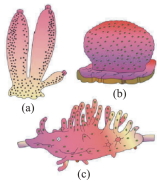
Identify the following animals $a, b$ and $c:-$
A
$(a) \rightarrow$ Sycon,$(b) \rightarrow$ Spongilla,$(c) \rightarrow$ Euspongia
B
$(a) \rightarrow$ Euspongia,$(b) \rightarrow$ Sycon,$(c) \rightarrow$ Spongilla
C
$(a) \rightarrow$ Spongilla,$(b) \rightarrow$ Sycon,$(c) \rightarrow$ Euspongia
D
$(a) \rightarrow$ Sycon,$(b) \rightarrow$ Euspongia,$(c) \rightarrow$ Spongilla
Solution
(A) Based on the standard diagrams provided in the $NCERT$ Biology textbook for Class $11$ (Chapter $4$: Animal Kingdom,Figure $4.3$):
$1$. Image $(a)$ represents $Sycon$,which is a marine sponge with a branched,tubular body structure.
$2$. Image $(b)$ represents $Spongilla$,which is a freshwater sponge typically having a massive,encrusting,or globular body form.
$3$. Image $(c)$ represents $Euspongia$,commonly known as the bath sponge,which has a complex,branching,or irregular body structure.
Therefore,the correct identification is $(a) \rightarrow$ Sycon,$(b) \rightarrow$ Spongilla,$(c) \rightarrow$ Euspongia.
$1$. Image $(a)$ represents $Sycon$,which is a marine sponge with a branched,tubular body structure.
$2$. Image $(b)$ represents $Spongilla$,which is a freshwater sponge typically having a massive,encrusting,or globular body form.
$3$. Image $(c)$ represents $Euspongia$,commonly known as the bath sponge,which has a complex,branching,or irregular body structure.
Therefore,the correct identification is $(a) \rightarrow$ Sycon,$(b) \rightarrow$ Spongilla,$(c) \rightarrow$ Euspongia.
0 likes
View SolutionAnimal Kingdom — Phylum-Porifera · Frequently Asked Questions
1Are these Animal Kingdom questions useful for JEE and NEET?
Yes. All questions in this section are mapped to JEE Main and NEET exam patterns. Previous year questions from JEE Main, NEET, GUJCET and state-level exams are included with full solutions.
2Can I switch to Hindi or Gujarati for these questions?
Yes. Use the language tabs in the hero section or the sidebar to view the same questions and solutions in English, Hindi or Gujarati.
3How do I generate a question paper from this subtopic?
Use the Vedclass Exam Paper Generator — select the chapter and subtopic, set difficulty, and generate Sets A, B, C, D automatically. First 3 chapters of every subject are free.
Vedclass Products
For Students
Vedclass Test Series
Mock tests in real JEE/NEET style with performance analysis. 5-day free trial.
Start Free TrialFor Teachers
Exam Paper Generator
Generate Set A/B/C/D papers from this chapter in 2 minutes. 3 chapters free.
Try FreeFor Institutes
Online Exam Module
Live online exams with unlimited students, 360° analytics & white-label branding.
See DemoFor Teachers & Institutes
Generate a Animal Kingdom Exam Paper in 2 Minutes
Select subtopic & difficulty — Sets A, B, C, D auto-generated with No Repeat logic.
First 3 chapters of every subject are free — no payment required.