
A English
Phylum-Porifera Questions in English
Class 11 Biology · Animal Kingdom · Phylum-Porifera
187+
Questions
English
Language
100%
With Solutions
Showing 50 of 187 questions in English
101
EasyMCQ
Which animal possesses choanocytes?
A
Sponges
B
Corals
C
Roundworms
D
Amoeba
Solution
(A) Choanocytes,also known as collar cells,are specialized flagellated cells that line the internal chambers of sponges (Phylum $Porifera$).
These cells are responsible for creating water currents and capturing food particles,which is a characteristic feature of sponges.
Corals belong to Phylum $Cnidaria$,roundworms belong to Phylum $Aschelminthes$,and $Amoeba$ is a unicellular protist.
These cells are responsible for creating water currents and capturing food particles,which is a characteristic feature of sponges.
Corals belong to Phylum $Cnidaria$,roundworms belong to Phylum $Aschelminthes$,and $Amoeba$ is a unicellular protist.
0 likes
View Solution102
EasyMCQ
Which animal group exhibits cellular level of organization despite being multicellular?
A
Protozoa
B
Platyhelminthes
C
Porifera
D
Annelida
Solution
(C) The animal kingdom is classified based on the level of body organization.
$1$. In $Porifera$ (sponges),the cells are arranged as loose cell aggregates,which is known as the cellular level of organization.
$2$. $Protozoa$ are unicellular organisms,not multicellular.
$3$. $Platyhelminthes$ exhibit organ-level organization.
$4$. $Annelida$ exhibit organ-system level organization.
Therefore,the correct answer is $Porifera$.
$1$. In $Porifera$ (sponges),the cells are arranged as loose cell aggregates,which is known as the cellular level of organization.
$2$. $Protozoa$ are unicellular organisms,not multicellular.
$3$. $Platyhelminthes$ exhibit organ-level organization.
$4$. $Annelida$ exhibit organ-system level organization.
Therefore,the correct answer is $Porifera$.
0 likes
View Solution103
MediumMCQ
Sponges are multicellular,yet they exhibit a cellular level of organization because ..........
A
they are unicellular in terms of structure and function.
B
tissues combine to form organs.
C
cells are tightly integrated with each other.
D
cells are not integrated into tissues.
Solution
(D) Sponges (Phylum $Porifera$) are the simplest multicellular animals.
They possess a cellular level of organization,which means that their cells are arranged as loose cell aggregates.
Unlike higher animals,these cells do not form tissues or organs to perform specialized functions.
Therefore,the cells are not integrated into tissues,allowing each cell to maintain a degree of independence in its physiological activities.
They possess a cellular level of organization,which means that their cells are arranged as loose cell aggregates.
Unlike higher animals,these cells do not form tissues or organs to perform specialized functions.
Therefore,the cells are not integrated into tissues,allowing each cell to maintain a degree of independence in its physiological activities.
0 likes
View Solution104
EasyMCQ
Which animal group is characterized by a body with pores?
A
Protozoa
B
Porifera
C
Coelenterata
D
Platyhelminthes
Solution
(B) The phylum $Porifera$ (derived from Latin 'porus' meaning pore and 'ferre' meaning to bear) consists of organisms commonly known as sponges.
These animals are characterized by the presence of numerous pores called $ostia$ on their body surface,which allow water to enter the central cavity $(spongocoel)$.
Therefore,the group characterized by a body with pores is $Porifera$.
These animals are characterized by the presence of numerous pores called $ostia$ on their body surface,which allow water to enter the central cavity $(spongocoel)$.
Therefore,the group characterized by a body with pores is $Porifera$.
0 likes
View Solution105
EasyMCQ
In animals of the phylum Porifera,through which structure does excess water exit the body?
A
Ostia
B
Spongocoel
C
Osculum
D
Canals
Solution
(C) In the phylum $Porifera$,water enters the body through minute pores called $Ostia$ in the body wall into a central cavity called the $Spongocoel$. From the $Spongocoel$,the water goes out through the $Osculum$. Therefore,the $Osculum$ is the structure through which excess water exits the body.
0 likes
View Solution106
EasyMCQ
The endoskeleton of Porifera is composed of:
A
Chitin
B
Calcium
C
Spongin fibers
D
Calcium carbonate
Solution
(C) The body of sponges (Phylum Porifera) is supported by an endoskeleton made up of spicules or spongin fibers.
Spicules are composed of either silica or calcium carbonate.
Spongin fibers are proteinaceous fibers found in the mesohyl of many sponges.
Therefore,spongin fibers are a characteristic component of the endoskeleton in many members of this phylum.
Spicules are composed of either silica or calcium carbonate.
Spongin fibers are proteinaceous fibers found in the mesohyl of many sponges.
Therefore,spongin fibers are a characteristic component of the endoskeleton in many members of this phylum.
0 likes
View Solution107
EasyMCQ
Which of the following is an asexual reproductive method in sponges?
A
Binary fission
B
Multiple fission
C
Conjugation
D
Gemmules
Solution
(D) Sponges (Phylum $Porifera$) reproduce asexually through the formation of internal buds known as $gemmules$.
These $gemmules$ are resistant structures that allow the sponge to survive harsh environmental conditions and develop into a new sponge when conditions become favorable.
These $gemmules$ are resistant structures that allow the sponge to survive harsh environmental conditions and develop into a new sponge when conditions become favorable.
0 likes
View Solution108
EasyMCQ
Which of the following organisms possesses the power of regeneration?
A
Euglena
B
Ascaris
C
Spongilla
D
Plasmodium
Solution
(C) Regeneration is the ability of an organism to regrow lost or damaged body parts.
Among the given options,$Spongilla$ (a freshwater sponge) belongs to the phylum $Porifera$.
Sponges exhibit a high power of regeneration,where even a small fragment of the body can develop into a complete new organism.
$Euglena$ is a protozoan,$Ascaris$ is a roundworm,and $Plasmodium$ is a malarial parasite,none of which exhibit regeneration to the same extent as sponges.
Among the given options,$Spongilla$ (a freshwater sponge) belongs to the phylum $Porifera$.
Sponges exhibit a high power of regeneration,where even a small fragment of the body can develop into a complete new organism.
$Euglena$ is a protozoan,$Ascaris$ is a roundworm,and $Plasmodium$ is a malarial parasite,none of which exhibit regeneration to the same extent as sponges.
0 likes
View Solution109
EasyMCQ
Which of the following is the larva of Porifera?
A
Gemmules
B
Ostia
C
Parenchymula
D
Planula
Solution
(C) The phylum $Porifera$ (sponges) exhibits specific larval stages during their life cycle.
$Parenchymula$ is a free-swimming,ciliated larva found in many sponges,particularly in the class $Demospongiae$ and $Calcarea$.
$Gemmules$ are internal buds used for asexual reproduction.
$Ostia$ are the small pores on the body of a sponge through which water enters.
$Planula$ is the characteristic larva of the phylum $Cnidaria$.
Therefore,the correct answer is $Parenchymula$.
$Parenchymula$ is a free-swimming,ciliated larva found in many sponges,particularly in the class $Demospongiae$ and $Calcarea$.
$Gemmules$ are internal buds used for asexual reproduction.
$Ostia$ are the small pores on the body of a sponge through which water enters.
$Planula$ is the characteristic larva of the phylum $Cnidaria$.
Therefore,the correct answer is $Parenchymula$.
0 likes
View Solution110
EasyMCQ
To which phylum does $Leucosolenia$ belong?
A
Protozoa
B
Porifera
C
Coelenterata
D
Platyhelminthes
Solution
(B) $Leucosolenia$ is a genus of calcareous sponges belonging to the phylum $Porifera$. Members of this phylum are commonly known as sponges. They are multicellular,asymmetrical,and possess a water transport or canal system.
0 likes
View Solution111
MediumMCQ
$S$ - Statement: $Leucosolenia$ is an animal belonging to the phylum Porifera.
$R$ - Reason: Animals in this phylum are multicellular and possess a porous body.
$R$ - Reason: Animals in this phylum are multicellular and possess a porous body.
A
$S$ and $R$ are both true,and $R$ is the correct explanation of $S$.
B
$S$ and $R$ are both true,but $R$ is not the correct explanation of $S$.
C
$S$ is true and $R$ is false.
D
$S$ is false and $R$ is true.
Solution
(A) $Leucosolenia$ is a genus of calcareous sponges that belongs to the phylum Porifera.
Phylum Porifera is characterized by organisms that are multicellular and possess a body with numerous pores (ostia) and canals for water circulation.
Since $Leucosolenia$ is a sponge,it naturally exhibits these characteristics.
Therefore,both the statement $(S)$ and the reason $(R)$ are true,and the reason correctly explains why $Leucosolenia$ is classified under Porifera.
Phylum Porifera is characterized by organisms that are multicellular and possess a body with numerous pores (ostia) and canals for water circulation.
Since $Leucosolenia$ is a sponge,it naturally exhibits these characteristics.
Therefore,both the statement $(S)$ and the reason $(R)$ are true,and the reason correctly explains why $Leucosolenia$ is classified under Porifera.
0 likes
View Solution112
EasyMCQ
What is an $Amphiblastula$?
A
$A$ method of asexual reproduction
B
$A$ blastula
C
$A$ larva of $Cnidaria$
D
$A$ larva of $Porifera$
Solution
(D) The $Amphiblastula$ is a free-swimming,flagellated larval stage found in the life cycle of certain sponges,specifically belonging to the phylum $Porifera$. It is formed after the fertilization of the egg by sperm,resulting in a hollow,oval-shaped larva where the anterior half consists of flagellated cells and the posterior half consists of non-flagellated cells. Therefore,it is a characteristic larval form of $Porifera$.
0 likes
View Solution113
EasyMCQ
Most sponges exhibit:
A
Bilateral symmetry.
B
Radial symmetry.
C
Asymmetry.
D
$B$ or $C$.
Solution
(C) Sponges (Phylum $Porifera$) are primarily primitive multicellular organisms.
Most sponges are asymmetrical,meaning their body cannot be divided into two equal halves by any plane passing through the center.
Some sponges may exhibit radial symmetry,but asymmetry is the most characteristic feature of the majority of species in this phylum.
Most sponges are asymmetrical,meaning their body cannot be divided into two equal halves by any plane passing through the center.
Some sponges may exhibit radial symmetry,but asymmetry is the most characteristic feature of the majority of species in this phylum.
0 likes
View Solution114
EasyMCQ
The presence of ostia,canals,cavities,and choanocytes is a characteristic feature of which of the following animals?
A
Hyalonema
B
Vaucheria
C
Nereis
D
Sepia
Solution
(A) The features mentioned,such as ostia (pores),canals,a central cavity (spongocoel),and choanocytes (collar cells),are characteristic of the phylum $Porifera$.
$Hyalonema$ is a genus of glass sponges belonging to the phylum $Porifera$.
$Vaucheria$ is a genus of algae.
$Nereis$ is a genus of polychaete worms belonging to the phylum $Annelida$.
$Sepia$ is a genus of cuttlefish belonging to the phylum $Mollusca$.
Therefore,the correct answer is $Hyalonema$.
$Hyalonema$ is a genus of glass sponges belonging to the phylum $Porifera$.
$Vaucheria$ is a genus of algae.
$Nereis$ is a genus of polychaete worms belonging to the phylum $Annelida$.
$Sepia$ is a genus of cuttlefish belonging to the phylum $Mollusca$.
Therefore,the correct answer is $Hyalonema$.
0 likes
View Solution115
EasyMCQ
In the animals of this phylum,the formation of gametes and internal fertilization are observed.
A
Porifera
B
Protozoa
C
Amphibia
D
Echinodermata
Solution
(A) The phylum $Porifera$ (sponges) is characterized by the presence of a water transport or canal system. In these animals,the sexes are not separate (hermaphrodite),meaning eggs and sperm are produced by the same individual. Fertilization is internal,and development is indirect having a larval stage which is morphologically distinct from the adult. Therefore,the correct option is $A$.
0 likes
View Solution116
EasyMCQ
Which phylum is characterized by the presence of a central cavity known as the spongocoel?
A
Cnidaria
B
Protozoa
C
Porifera
D
Arthropoda
Solution
(C) The phylum $Porifera$ (sponges) is characterized by a unique water transport or canal system.
Water enters through minute pores called $ostia$ in the body wall into a central cavity,the $spongocoel$,and goes out through the $osculum$.
This pathway of water transport is helpful in food gathering,respiratory exchange,and removal of waste.
Therefore,the presence of a $spongocoel$ is a diagnostic feature of the phylum $Porifera$.
Water enters through minute pores called $ostia$ in the body wall into a central cavity,the $spongocoel$,and goes out through the $osculum$.
This pathway of water transport is helpful in food gathering,respiratory exchange,and removal of waste.
Therefore,the presence of a $spongocoel$ is a diagnostic feature of the phylum $Porifera$.
0 likes
View Solution117
EasyMCQ
Which is the first phylum of the Animal Kingdom?
A
Porifera
B
Protozoa
C
Chordata
D
Arthropoda
Solution
(A) The Animal Kingdom $(Animalia)$ is classified into various phyla based on their body organization and evolutionary complexity. The phylum $Porifera$ (sponges) is considered the most primitive and the first phylum in the classification of the Animal Kingdom,as they exhibit a cellular level of organization and lack true tissues or organs.
0 likes
View Solution118
MediumMCQ
Which animal possesses choanocytes?
A
Sponge
B
Coral
C
Roundworm
D
Amoeba
Solution
(A) Choanocytes,also known as collar cells,are specialized flagellated cells that line the internal chambers of sponges (Phylum $Porifera$).
These cells are responsible for creating water currents and capturing food particles through phagocytosis.
Corals belong to Phylum $Cnidaria$,roundworms belong to Phylum $Aschelminthes$,and $Amoeba$ is a unicellular protist.
These cells are responsible for creating water currents and capturing food particles through phagocytosis.
Corals belong to Phylum $Cnidaria$,roundworms belong to Phylum $Aschelminthes$,and $Amoeba$ is a unicellular protist.
0 likes
View Solution119
EasyMCQ
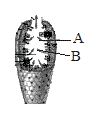
In the given figure,what do '$A$' and '$B$' represent respectively?
A
Spongocoel,Choanocyte
B
Choanocyte,Spongocoel
C
Osculum,Spongocoel
D
Spongocoel,Osculum
Solution
(A) The figure represents the body organization of a sponge (Phylum Porifera).
'$A$' points to the central cavity of the sponge,known as the spongocoel.
'$B$' points to the flagellated cells lining the spongocoel and canals,known as choanocytes (or collar cells).
Therefore,'$A$' is the spongocoel and '$B$' is the choanocyte.
'$A$' points to the central cavity of the sponge,known as the spongocoel.
'$B$' points to the flagellated cells lining the spongocoel and canals,known as choanocytes (or collar cells).
Therefore,'$A$' is the spongocoel and '$B$' is the choanocyte.
0 likes
View Solution120
EasyMCQ
The body of a sponge is primarily composed of what?
A
Spongin fibers
B
Mesoglea
C
Spicules
D
Threads
Solution
(A) The body wall of sponges (Phylum $Porifera$) is supported by a skeleton that may be made of calcareous or siliceous spicules or spongin fibers. However,the structural framework that provides the primary support and shape to the body is composed of spicules or spongin fibers. Among the given options,$Spongin$ $fibers$ are a major structural component in many sponges,particularly in the class $Demospongiae$.
0 likes
View Solution121
MediumMCQ
Which of the following groups is taxonomically correct?
A
Dentalium,Octopus,Nereis
B
Starfish,Petromyzon,Solen
C
Spongilla,Hyalonema,Leucosolenia
D
Ascaris,Cockroach,Grasshopper
Solution
(C) The correct group is $Spongilla$,$Hyalonema$,and $Leucosolenia$.
All three organisms belong to the phylum $Porifera$.
$Dentalium$ is a mollusk,$Octopus$ is a mollusk,and $Nereis$ is an annelid.
$Starfish$ is an echinoderm,$Petromyzon$ is a chordate (cyclostome),and $Solen$ is a mollusk.
$Ascaris$ is an aschelminthes,while $Cockroach$ and $Grasshopper$ are arthropods.
All three organisms belong to the phylum $Porifera$.
$Dentalium$ is a mollusk,$Octopus$ is a mollusk,and $Nereis$ is an annelid.
$Starfish$ is an echinoderm,$Petromyzon$ is a chordate (cyclostome),and $Solen$ is a mollusk.
$Ascaris$ is an aschelminthes,while $Cockroach$ and $Grasshopper$ are arthropods.
0 likes
View Solution122
EasyMCQ
Which of the following is a freshwater sponge?
A
Spongilla
B
Hyalonema
C
Leucosolenia
D
All of the above
Solution
(A) The phylum $Porifera$ includes organisms commonly known as sponges.
Most sponges are marine,but a few species are found in freshwater.
$Spongilla$ is a well-known example of a freshwater sponge.
$Hyalonema$ (Glass rope sponge) and $Leucosolenia$ are marine sponges.
Therefore,the correct option is $A$.
Most sponges are marine,but a few species are found in freshwater.
$Spongilla$ is a well-known example of a freshwater sponge.
$Hyalonema$ (Glass rope sponge) and $Leucosolenia$ are marine sponges.
Therefore,the correct option is $A$.
0 likes
View Solution123
EasyMCQ
In sponges,the water enters the body through minute pores and leaves through the ....
A
Ostia
B
Canal
C
Osculum
D
Spongocoel
Solution
(C) In the phylum $Porifera$ (sponges),water enters the body through minute pores called $Ostia$ in the body wall into a central cavity called $Spongocoel$. From the $Spongocoel$,the water exits the body through a large opening called the $Osculum$. This water transport system is helpful in gathering food,respiratory exchange,and removal of waste.
0 likes
View Solution124
EasyMCQ
What do animals of the phylum Porifera possess on their body?
A
Shell
B
Skin
C
Ostia
D
Spines
Solution
(C) Animals belonging to the phylum $Porifera$ are commonly known as sponges. Their body is characterized by the presence of numerous minute pores called $ostia$ on the body wall. These pores allow the entry of water into the body cavity $(spongocoel)$,which facilitates the transport of food,oxygen,and the removal of waste products.
0 likes
View Solution125
EasyMCQ
Which type of larva is found in sponges?
A
Tornaria
B
Leucoblastula
C
Amphiblastula
D
Planula
Solution
(C) Sponges (Phylum $Porifera$) exhibit indirect development,which involves a free-swimming larval stage. The common larval forms found in sponges are $Amphiblastula$ and $Parenchymula$. Among the given options,$Amphiblastula$ is the correct larval form associated with sponges (e.g.,$Sycon$). $Tornaria$ is found in $Hemichordata$,and $Planula$ is found in $Cnidaria$.
0 likes
View Solution126
MediumMCQ
Which of the following is $NOT$ present in the body of sponges (Phylum Porifera)?
A
Flame cells
B
Spongin fibers
C
Ostia
D
Spongocoel
Solution
(A) Sponges belong to the Phylum $Porifera$.
Their body organization includes $Ostia$ (pores for water entry),a central cavity called $Spongocoel$,and an internal skeleton made of $Spicules$ or $Spongin$ fibers.
$Flame$ $cells$ (also known as $Protonephridia$) are specialized excretory cells found in Phylum $Platyhelminthes$ (flatworms),not in $Porifera$.
Therefore,$Flame$ $cells$ are not present in sponges.
Their body organization includes $Ostia$ (pores for water entry),a central cavity called $Spongocoel$,and an internal skeleton made of $Spicules$ or $Spongin$ fibers.
$Flame$ $cells$ (also known as $Protonephridia$) are specialized excretory cells found in Phylum $Platyhelminthes$ (flatworms),not in $Porifera$.
Therefore,$Flame$ $cells$ are not present in sponges.
0 likes
View Solution127
EasyMCQ
The layer of cells surrounding which structure is a characteristic feature of poriferans?
A
Canal
B
Spongocoel
C
Ostia
D
Osculum
Solution
(B) In the phylum $Porifera$,the body wall encloses a central cavity known as the $Spongocoel$. This cavity is lined by specialized flagellated cells called $Choanocytes$ or collar cells. The $Spongocoel$ is a characteristic feature of sponges,which helps in the water transport system.
0 likes
View Solution128
EasyMCQ
In $Porifera$ (sponges),the formation of internal buds is which type of reproduction?
A
Asexual
B
Vegetative
C
Sexual
D
Fragmentation
Solution
(A) In $Porifera$,internal buds are known as $gemmules$.
$Gemmule$ formation is a specialized method of asexual reproduction that allows sponges to survive unfavorable environmental conditions.
During this process,a mass of cells is enclosed within a protective coat,which later develops into a new sponge.
Therefore,it is a type of asexual reproduction.
$Gemmule$ formation is a specialized method of asexual reproduction that allows sponges to survive unfavorable environmental conditions.
During this process,a mass of cells is enclosed within a protective coat,which later develops into a new sponge.
Therefore,it is a type of asexual reproduction.
0 likes
View Solution129
EasyMCQ
To which phylum does the animal $Hyalonema$ belong?
A
Protozoa
B
Porifera
C
Platyhelminthes
D
Coelenterata
Solution
(B) $Hyalonema$,commonly known as the glass rope sponge,belongs to the phylum $Porifera$.
Members of the phylum $Porifera$ are commonly known as sponges.
They are primitive multicellular animals with a cellular level of organization and possess a water transport or canal system.
Therefore,the correct option is $B$.
Members of the phylum $Porifera$ are commonly known as sponges.
They are primitive multicellular animals with a cellular level of organization and possess a water transport or canal system.
Therefore,the correct option is $B$.
0 likes
View Solution130
EasyMCQ
What do sponges exhibit?
A
Tissue level of organization
B
Metagenesis
C
Regeneration
D
Polymorphism
Solution
(C) Sponges $(Phylum-Porifera)$ are the simplest multicellular animals. They exhibit a cellular level of organization,meaning they lack true tissues or organs. However,they possess a remarkable capacity for regeneration,where they can regrow lost or damaged body parts. While they do not exhibit tissue-level organization,metagenesis (alternation of generations),or polymorphism (as seen in $Cnidaria$),regeneration is a characteristic feature of sponges.
0 likes
View Solution131
EasyMCQ
What type of body organization is found in animals of the phylum $Porifera$?
A
Organ level
B
Tissue level
C
Organ-system level
D
Cellular level
Solution
$(D)$ Animals belonging to the phylum $Porifera$ are commonly known as sponges. They are the most primitive multicellular animals. Their body organization is at the $Cellular$ $level$, where cells are arranged as loose cell aggregates and do not form tissues or organs.
0 likes
View Solution132
EasyMCQ
Which of the following is absent in animals of the phylum Porifera?
A
Spongin fibers
B
Choanocytes
C
Spongocoel
D
Nerve cells
Solution
(D) Animals belonging to the phylum $Porifera$ (sponges) are the most primitive multicellular organisms.
They exhibit a cellular level of organization.
They possess a unique water transport system (canal system) and specialized cells called $Choanocytes$ (collar cells) that line the $Spongocoel$ and canals.
They often have a skeleton made of spicules or $Spongin$ fibers.
However,they lack a nervous system,meaning they do not possess $Nerve$ $cells$ or sensory organs.
Therefore,the correct answer is $D$.
They exhibit a cellular level of organization.
They possess a unique water transport system (canal system) and specialized cells called $Choanocytes$ (collar cells) that line the $Spongocoel$ and canals.
They often have a skeleton made of spicules or $Spongin$ fibers.
However,they lack a nervous system,meaning they do not possess $Nerve$ $cells$ or sensory organs.
Therefore,the correct answer is $D$.
0 likes
View Solution133
EasyMCQ
What type of symmetry is exhibited by the body of poriferans?
A
Bilateral symmetry
B
Asymmetry
C
Cylindrical symmetry
D
Radial symmetry
Solution
(B) Poriferans (sponges) are the most primitive multicellular animals. Their body organization is cellular level. Most of the sponges are asymmetrical,meaning their body cannot be divided into two identical halves by any plane passing through the center. Therefore,the correct option is $B$.
0 likes
View Solution134
EasyMCQ
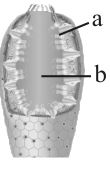
What do $a$ and $b$ represent in the given figure?
A
Choanocyte,Spongocoel
B
Flame cell,Spongocoel
C
Choanocyte,Coelom
D
Flame cell,Haemocoel
Solution
(A) The provided figure represents the body structure of a sponge (Phylum Porifera).
In this diagram,'$a$' points to the collar cells or choanocytes,which line the spongocoel and the canals.
'$b$' points to the central cavity of the sponge,known as the spongocoel.
Therefore,'$a$' represents choanocytes and '$b$' represents the spongocoel.
In this diagram,'$a$' points to the collar cells or choanocytes,which line the spongocoel and the canals.
'$b$' points to the central cavity of the sponge,known as the spongocoel.
Therefore,'$a$' represents choanocytes and '$b$' represents the spongocoel.
0 likes
View Solution135
EasyMCQ
Amphiblastula is the larva of which phylum?
A
Porifera
B
Echinodermata
C
Cnidaria
D
Platyhelminthes
Solution
(A) The $Amphiblastula$ is a free-swimming larval stage found in the life cycle of certain sponges.
Sponges belong to the phylum $Porifera$.
Therefore,the correct answer is $Porifera$.
Sponges belong to the phylum $Porifera$.
Therefore,the correct answer is $Porifera$.
0 likes
View Solution136
EasyMCQ
Which phylum consists entirely of aquatic animals?
A
Porifera
B
Mollusca
C
Annelida
D
Arthropoda
Solution
(A) The phylum $Porifera$ (sponges) consists entirely of aquatic animals. Most of them are marine,while some are found in freshwater environments. Other phyla like $Mollusca$,$Annelida$,and $Arthropoda$ contain both aquatic and terrestrial species.
0 likes
View Solution137
MediumMCQ
Assertion $(A)$: Animals are multicellular organisms composed of eukaryotic cells.
Reason $(R)$: Sponges do not perform photosynthesis and obtain nutrition by absorption.
Reason $(R)$: Sponges do not perform photosynthesis and obtain nutrition by absorption.
A
$A$ and $R$ are both true,and $R$ is the correct explanation of $A$.
B
$A$ and $R$ are both true,but $R$ is not the correct explanation of $A$.
C
$A$ is true,but $R$ is false.
D
$A$ is false,but $R$ is true.
Solution
(C) Assertion $(A)$ is true because animals are defined as multicellular,eukaryotic organisms that lack cell walls.
Reason $(R)$ is false because while sponges do not perform photosynthesis,they obtain nutrition by ingestion (filter feeding),not by absorption. Absorption is characteristic of fungi,whereas animals are holozoic or ingestive feeders.
Reason $(R)$ is false because while sponges do not perform photosynthesis,they obtain nutrition by ingestion (filter feeding),not by absorption. Absorption is characteristic of fungi,whereas animals are holozoic or ingestive feeders.
0 likes
View Solution138
EasyMCQ
In case of poriferans,the spongocoel is lined with flagellated cells called
A
oscula
B
choanocytes
C
mesenchymal cells
D
ostia
Solution
(B) : The spongocoel is the central body cavity found in sponges ($Phylum$ $Porifera$). This cavity is lined by highly specialized flagellated cells known as choanocytes or collar cells. These cells play a crucial role in creating water currents and capturing food particles.
0 likes
View Solution139
MediumMCQ
Body having meshwork of cells,internal cavities lined with food filtering flagellated cells and indirect development are the characteristics of Phylum
A
Mollusca
B
Protozoa
C
Coelenterata
D
Porifera
Solution
(D) The correct answer is $D$.
Phylum $Porifera$ (sponges) is characterized by a cellular level of body organization.
Their body wall contains a meshwork of cells and internal cavities (spongocoel) lined with specialized flagellated cells known as $choanocytes$ or collar cells,which are responsible for filtering food particles from the water.
The development in this phylum is indirect,meaning it includes a free-swimming larval stage (such as $amphiblastula$ or $parenchymula$) before reaching the adult form,which aids in the dispersal of the species.
Phylum $Porifera$ (sponges) is characterized by a cellular level of body organization.
Their body wall contains a meshwork of cells and internal cavities (spongocoel) lined with specialized flagellated cells known as $choanocytes$ or collar cells,which are responsible for filtering food particles from the water.
The development in this phylum is indirect,meaning it includes a free-swimming larval stage (such as $amphiblastula$ or $parenchymula$) before reaching the adult form,which aids in the dispersal of the species.
0 likes
View Solution140
MediumMCQ
Which one of the following statements about all the four of $Spongilla$,leech,dolphin and penguin is correct?
A
Penguin is homoiothermic while the remaining three are poikilothermic.
B
Leech is a fresh water form while all others are marine.
C
$Spongilla$ has special collared cells called choanocytes,not found in the remaining three.
D
All are bilaterally symmetrical.
Solution
(C) $Spongilla$ is a common,widely distributed fresh water sponge belonging to the phylum $Porifera$.
$Spongilla$ possesses special flagellated cells known as choanocytes (collar cells) which line the spongocoel and the canals.
These cells are characteristic of sponges and are not found in the leech (annelid),dolphin (mammal),or penguin (bird).
$Spongilla$ possesses special flagellated cells known as choanocytes (collar cells) which line the spongocoel and the canals.
These cells are characteristic of sponges and are not found in the leech (annelid),dolphin (mammal),or penguin (bird).
0 likes
View Solution141
MediumMCQ
Sponges reproduce by
A
Asexually
B
Sexually
C
$A$ and $B$ both
D
None of the above
Solution
(C) Sponges (Phylum $Porifera$) exhibit both asexual and sexual modes of reproduction.
$1$. Asexual reproduction occurs through processes like fragmentation,budding,or the formation of specialized structures called gemmules.
$2$. Sexual reproduction involves the production of gametes (sperm and eggs). Most sponges are hermaphroditic (monoecious),meaning they produce both types of gametes,though cross-fertilization is common.
Therefore,the correct option is $C$.
$1$. Asexual reproduction occurs through processes like fragmentation,budding,or the formation of specialized structures called gemmules.
$2$. Sexual reproduction involves the production of gametes (sperm and eggs). Most sponges are hermaphroditic (monoecious),meaning they produce both types of gametes,though cross-fertilization is common.
Therefore,the correct option is $C$.
0 likes
View Solution142
MediumMCQ
Spongilla is....
A
An animal of $Coelenterata$ phylum having polyp form.
B
An animal of $Coelenterata$ phylum having medusa form.
C
An animal of $Porifera$ phylum.
D
An animal of $Porifera$ phylum having $cnidoblast$ cells.
Solution
(C) $Spongilla$ is a freshwater sponge that belongs to the phylum $Porifera$.
$Porifera$ are characterized by a cellular level of organization,the presence of a water transport or canal system,and the absence of $cnidoblasts$ (which are characteristic of $Cnidaria$).
Therefore,$Spongilla$ is an animal of the phylum $Porifera$.
$Porifera$ are characterized by a cellular level of organization,the presence of a water transport or canal system,and the absence of $cnidoblasts$ (which are characteristic of $Cnidaria$).
Therefore,$Spongilla$ is an animal of the phylum $Porifera$.
0 likes
View Solution143
MediumMCQ
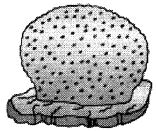
Identify the organism shown in the figure:
A
Jellyfish
B
Nereis
C
Euspongia
D
Sycon
Solution
(C) The figure shows a sponge,which is a member of the phylum Porifera.
Specifically,this image represents $Euspongia$,commonly known as the bath sponge.
$Euspongia$ is characterized by its massive,rounded body with numerous pores on its surface.
Therefore,the correct option is $C$.
Specifically,this image represents $Euspongia$,commonly known as the bath sponge.
$Euspongia$ is characterized by its massive,rounded body with numerous pores on its surface.
Therefore,the correct option is $C$.
0 likes
View Solution144
MediumMCQ
In $Sycon$,which pathway is correct for water circulation into the body?
A
Ostia $\rightarrow$ spongocoel $\rightarrow$ osculum
B
Osculum $\rightarrow$ spongocoel $\rightarrow$ ostia
C
Ostia $\rightarrow$ osculum $\rightarrow$ spongocoel
D
Spongocoel $\rightarrow$ osculum $\rightarrow$ ostia
Solution
(A) In sponges like $Sycon$,the water transport system (or canal system) is a characteristic feature.
Water enters the body through minute pores called $ostia$ in the body wall into a central cavity called the $spongocoel$.
From the $spongocoel$,it goes out through the $osculum$.
Therefore,the correct pathway is $Ostia \rightarrow$ $spongocoel \rightarrow$ $osculum$.
Water enters the body through minute pores called $ostia$ in the body wall into a central cavity called the $spongocoel$.
From the $spongocoel$,it goes out through the $osculum$.
Therefore,the correct pathway is $Ostia \rightarrow$ $spongocoel \rightarrow$ $osculum$.
0 likes
View Solution145
EasyMCQ
The classification of $Porifera$ is based on $..........$.
A
Branching
B
Spicules
C
Reproduction
D
Symmetry
Solution
(B) The classification of the phylum $Porifera$ (sponges) is primarily based on the nature and composition of their endoskeleton,which consists of $spicules$ or $spongin$ fibers. These $spicules$ can be calcareous or siliceous,and their structure and arrangement are key taxonomic features used to classify sponges into different classes.
0 likes
View Solution146
EasyMCQ
Which is the simplest canal system in Porifera?
A
Ascon type
B
Leucon type
C
Sycon type
D
Radial type
Solution
(A) The canal system in Porifera (sponges) is a characteristic feature that facilitates water circulation for feeding,respiration,and excretion.
There are three main types of canal systems:
$1$. $Ascon$ type: This is the simplest type of canal system,found in sponges like $Leucosolenia$. In this system,water enters through ostia directly into the spongocoel and exits through the osculum.
$2$. $Sycon$ type: This is more complex than the $Ascon$ type,involving radial canals.
$3$. $Leucon$ type: This is the most complex type of canal system,characterized by flagellated chambers.
Therefore,the $Ascon$ type is the simplest.
There are three main types of canal systems:
$1$. $Ascon$ type: This is the simplest type of canal system,found in sponges like $Leucosolenia$. In this system,water enters through ostia directly into the spongocoel and exits through the osculum.
$2$. $Sycon$ type: This is more complex than the $Ascon$ type,involving radial canals.
$3$. $Leucon$ type: This is the most complex type of canal system,characterized by flagellated chambers.
Therefore,the $Ascon$ type is the simplest.
0 likes
View Solution147
MediumMCQ
Which of the following statements is true for all sponges,without exception?
A
They are all marine.
B
They possess flagellated collar cells (choanocytes).
C
Their skeleton is made up of a mixture of spicules and spongin fibers.
D
They reproduce asexually by budding.
Solution
(B) Sponges (Phylum $Porifera$) are characterized by the presence of a water transport or canal system.
$1$. They possess flagellated collar cells,also known as $choanocytes$,which line the spongocoel and the canals. This is a defining feature of all sponges.
$2$. Option $A$ is incorrect because some sponges,like $Spongilla$,are freshwater.
$3$. Option $C$ is incorrect because the skeleton varies; some have only spicules,some only spongin fibers,and some have neither.
$4$. Option $D$ is incorrect because while many reproduce by budding,it is not a universal feature for all species in the phylum.
$1$. They possess flagellated collar cells,also known as $choanocytes$,which line the spongocoel and the canals. This is a defining feature of all sponges.
$2$. Option $A$ is incorrect because some sponges,like $Spongilla$,are freshwater.
$3$. Option $C$ is incorrect because the skeleton varies; some have only spicules,some only spongin fibers,and some have neither.
$4$. Option $D$ is incorrect because while many reproduce by budding,it is not a universal feature for all species in the phylum.
0 likes
View Solution148
MediumMCQ
To which group does the animal $Sycon$ belong?
A
Multicellular,with tissue-level organization but without a body cavity.
B
Unicellular or acellular.
C
Multicellular,without tissue-level organization.
D
Multicellular and with a coelenteron cavity.
Solution
(C) $Sycon$ belongs to the phylum $Porifera$.
Members of the phylum $Porifera$ are commonly known as sponges.
They are multicellular organisms but exhibit a cellular level of organization,meaning they lack true tissues or organs.
Therefore,they are characterized as multicellular without tissue-level organization.
Members of the phylum $Porifera$ are commonly known as sponges.
They are multicellular organisms but exhibit a cellular level of organization,meaning they lack true tissues or organs.
Therefore,they are characterized as multicellular without tissue-level organization.
0 likes
View Solution149
MediumMCQ
Which phylum is characterized by a body with an internal cavity lined by food-filtering flagellated cells (choanocytes) and indirect development?
A
Protozoa
B
Cnidaria
C
Porifera
D
Mollusca
Solution
(C) The phylum $Porifera$ (sponges) is characterized by the presence of a central cavity called the $spongocoel$.
This cavity is lined by specialized flagellated cells known as $choanocytes$ or $collar$ $cells$.
These cells are responsible for filtering food particles from the water current that enters through the $ostia$.
Furthermore,sponges exhibit indirect development,which involves a free-swimming larval stage (such as $amphiblastula$ or $parenchymula$) before transforming into the adult form.
This cavity is lined by specialized flagellated cells known as $choanocytes$ or $collar$ $cells$.
These cells are responsible for filtering food particles from the water current that enters through the $ostia$.
Furthermore,sponges exhibit indirect development,which involves a free-swimming larval stage (such as $amphiblastula$ or $parenchymula$) before transforming into the adult form.
0 likes
View Solution150
EasyMCQ
In Porifera,the spongocoel is lined by flagellated cells called . . . . . . .
A
Ostia
B
Oscula
C
Choanocytes
D
Mesenchymal cells
Solution
(C) In the phylum $Porifera$,the body wall consists of two layers. The inner layer,which lines the central cavity known as the $spongocoel$,is composed of specialized flagellated cells called $choanocytes$ (or collar cells). These cells are responsible for creating water currents,which help in food capture and respiration.
0 likes
View SolutionAnimal Kingdom — Phylum-Porifera · Frequently Asked Questions
1Are these Animal Kingdom questions useful for JEE and NEET?
Yes. All questions in this section are mapped to JEE Main and NEET exam patterns. Previous year questions from JEE Main, NEET, GUJCET and state-level exams are included with full solutions.
2Can I switch to Hindi or Gujarati for these questions?
Yes. Use the language tabs in the hero section or the sidebar to view the same questions and solutions in English, Hindi or Gujarati.
3How do I generate a question paper from this subtopic?
Use the Vedclass Exam Paper Generator — select the chapter and subtopic, set difficulty, and generate Sets A, B, C, D automatically. First 3 chapters of every subject are free.
Vedclass Products
For Students
Vedclass Test Series
Mock tests in real JEE/NEET style with performance analysis. 5-day free trial.
Start Free TrialFor Teachers
Exam Paper Generator
Generate Set A/B/C/D papers from this chapter in 2 minutes. 3 chapters free.
Try FreeFor Institutes
Online Exam Module
Live online exams with unlimited students, 360° analytics & white-label branding.
See DemoFor Teachers & Institutes
Generate a Animal Kingdom Exam Paper in 2 Minutes
Select subtopic & difficulty — Sets A, B, C, D auto-generated with No Repeat logic.
First 3 chapters of every subject are free — no payment required.