
A English
Phylum - Aschelminthes Questions in English
Class 11 Biology · Animal Kingdom · Phylum - Aschelminthes
150+
Questions
English
Language
100%
With Solutions
Showing 50 of 150 questions in English
101
MediumMCQ
In which group of animals is the larval form mostly similar to the adult?
A
Porifera
B
Coelenterata
C
Platyhelminthes
D
Nematoda
Solution
(D) In most animal phyla,the larval stage is morphologically very different from the adult (indirect development).
However,in the phylum $Nematoda$ (roundworms),the larval stages are generally similar in body plan and structure to the adult form,showing direct or nearly direct development.
Therefore,the correct option is $D$.
However,in the phylum $Nematoda$ (roundworms),the larval stages are generally similar in body plan and structure to the adult form,showing direct or nearly direct development.
Therefore,the correct option is $D$.
0 likes
View Solution102
MediumMCQ
In pseudocoelomate organisms,excretion occurs through which of the following structures?
A
Malpighian tubule
B
Green gland
C
Flame cell
D
Branched excretory canal
Solution
(D) Pseudocoelomates are organisms that possess a pseudocoelom (a false body cavity). The most prominent group of pseudocoelomates is the Phylum $Aschelminthes$ (also known as $Nematoda$ or roundworms). In these organisms,the excretory system consists of a specialized structure known as the $Renette$ cell or a system of canals. Specifically,the excretory system in $Aschelminthes$ is represented by a $Renette$ cell or a branched excretory canal that removes body wastes from the body cavity through the excretory pore. Therefore,the correct structure is the branched excretory canal.
0 likes
View Solution103
MediumMCQ
$A$: In $Aschelminthes$,the young ones resemble the adults.
$R$: Indirect development is observed in $Aschelminthes$.
$R$: Indirect development is observed in $Aschelminthes$.
A
$A$ and $R$ are true and $R$ is the correct explanation of $A$.
B
$A$ and $R$ are true,but $R$ is not the correct explanation of $A$.
C
$A$ is true and $R$ is false.
D
$A$ is false and $R$ is true.
Solution
(C) In $Aschelminthes$ (roundworms),the development may be direct or indirect.
However,the statement $A$ is true because in many species,the young ones (juveniles) resemble the adults.
The statement $R$ is false because indirect development implies a larval stage that is morphologically distinct from the adult,whereas $Aschelminthes$ often show direct development or development where the juvenile is similar to the adult.
Therefore,$A$ is true and $R$ is false.
However,the statement $A$ is true because in many species,the young ones (juveniles) resemble the adults.
The statement $R$ is false because indirect development implies a larval stage that is morphologically distinct from the adult,whereas $Aschelminthes$ often show direct development or development where the juvenile is similar to the adult.
Therefore,$A$ is true and $R$ is false.
0 likes
View Solution104
MediumMCQ
Which of the following endoparasites of humans shows viviparity?
A
Trichinella spiralis
B
Ascaris lumbricoides
C
Ancylostoma duodenale
D
Enterobius vermicularis
Solution
(A) : $Trichinella$ $spiralis$ is a minute nematode parasite that exhibits viviparity,meaning it produces live young (larvae) instead of eggs.
The adults of $T. spiralis$ reside in the human small intestine,where the females release large numbers of larvae directly.
These larvae penetrate the intestinal wall and migrate through the bloodstream to muscles,causing trichinosis or trichiniasis,which presents with symptoms such as diarrhea,nausea,vertigo,muscle pain,and fever.
Humans typically become infected after consuming undercooked meat containing the parasite's larval cysts.
The adults of $T. spiralis$ reside in the human small intestine,where the females release large numbers of larvae directly.
These larvae penetrate the intestinal wall and migrate through the bloodstream to muscles,causing trichinosis or trichiniasis,which presents with symptoms such as diarrhea,nausea,vertigo,muscle pain,and fever.
Humans typically become infected after consuming undercooked meat containing the parasite's larval cysts.
0 likes
View Solution105
EasyMCQ
$Ascaris$ is characterized by:
A
presence of true coelom but absence of metamerism
B
presence of true coelom and metamerism (metamerisation)
C
absence of true coelom but presence of metamerism
D
presence of neither true coelom nor metamerism
Solution
(D) $Ascaris$ belongs to the Phylum $Nematoda$ (also known as $Aschelminthes$).
These organisms possess a pseudocoelom (false coelom),which is a body cavity not lined by mesoderm.
They do not exhibit metamerism (true segmentation of the body).
Although the cuticle may show transverse striations that give a pseudosegmented appearance,they lack true metameric segmentation.
Therefore,they are characterized by the absence of both a true coelom and metamerism.
These organisms possess a pseudocoelom (false coelom),which is a body cavity not lined by mesoderm.
They do not exhibit metamerism (true segmentation of the body).
Although the cuticle may show transverse striations that give a pseudosegmented appearance,they lack true metameric segmentation.
Therefore,they are characterized by the absence of both a true coelom and metamerism.
0 likes
View Solution106
MediumMCQ
Infection of $Ascaris$ usually occurs by
A
Tse-tse fly
B
mosquito bite
C
drinking water containing eggs of $Ascaris$
D
eating imperfectly cooked pork
Solution
(C) $Ascaris$ infection is acquired by humans through the direct ingestion of $Ascaris$ eggs,which contain the infective second-stage larva,via contaminated food or water.
$Ascaris$ has a monogenetic life cycle.
There is no vector or intermediate host involved in its transmission.
$Ascaris$ has a monogenetic life cycle.
There is no vector or intermediate host involved in its transmission.
0 likes
View Solution107
EasyMCQ
Which of the following phyla is pseudocoelomate?
A
Porifera
B
Aschelminthes
C
Platyhelminthes
D
Annelida
Solution
(B) The phylum $Aschelminthes$ (also known as $Nematoda$) is characterized by the presence of a pseudocoelom,which is a body cavity that is not completely lined by mesoderm.
In $Aschelminthes$,the mesoderm is present as scattered pouches between the ectoderm and endoderm.
$Porifera$ are acoelomate (lacking a body cavity).
$Platyhelminthes$ are also acoelomate.
$Annelida$ are true coelomates (possessing a true coelom lined by mesoderm).
In $Aschelminthes$,the mesoderm is present as scattered pouches between the ectoderm and endoderm.
$Porifera$ are acoelomate (lacking a body cavity).
$Platyhelminthes$ are also acoelomate.
$Annelida$ are true coelomates (possessing a true coelom lined by mesoderm).
0 likes
View Solution108
EasyMCQ
Which is the correct pair?
A
Platyhelminthes - Branched excretory tube
B
Porifera - Organ level organization
C
Aschelminthes - Round worm
D
Annelida - Segmentation is absent
Solution
(C) The correct pair is $C$.
$A$: Platyhelminthes possess flame cells (protonephridia) for excretion,which are not typically described as 'branched excretory tubes' in the same way as other systems.
$B$: Porifera exhibit cellular level of organization,not organ level.
$C$: Aschelminthes are commonly known as roundworms due to their circular cross-section.
$D$: Annelida are characterized by metameric segmentation (true segmentation).
$A$: Platyhelminthes possess flame cells (protonephridia) for excretion,which are not typically described as 'branched excretory tubes' in the same way as other systems.
$B$: Porifera exhibit cellular level of organization,not organ level.
$C$: Aschelminthes are commonly known as roundworms due to their circular cross-section.
$D$: Annelida are characterized by metameric segmentation (true segmentation).
0 likes
View Solution109
MediumMCQ
Choose the correct option for characters of roundworm.
$(I)$ Body is circular in cross-section.
$(II)$ Parasite found in animals and plants.
$(III)$ Organ-system level of body organization.
$(IV)$ Incomplete digestive system.
$(I)$ Body is circular in cross-section.
$(II)$ Parasite found in animals and plants.
$(III)$ Organ-system level of body organization.
$(IV)$ Incomplete digestive system.
A
Only $I$
B
$I$ and $II$
C
$I, II$ and $III$
D
$II, III$ and $IV$
Solution
(C) The phylum Aschelminthes is commonly known as roundworms.
$(I)$ Their body is circular in cross-section,hence the name roundworms. This statement is correct.
$(II)$ They may be free-living,aquatic,terrestrial,or parasitic in plants and animals. This statement is correct.
$(III)$ They exhibit an organ-system level of body organization. This statement is correct.
$(IV)$ They possess a complete digestive system with a well-developed muscular pharynx. Therefore,this statement is incorrect.
Thus,statements $(I), (II),$ and $(III)$ are correct.
$(I)$ Their body is circular in cross-section,hence the name roundworms. This statement is correct.
$(II)$ They may be free-living,aquatic,terrestrial,or parasitic in plants and animals. This statement is correct.
$(III)$ They exhibit an organ-system level of body organization. This statement is correct.
$(IV)$ They possess a complete digestive system with a well-developed muscular pharynx. Therefore,this statement is incorrect.
Thus,statements $(I), (II),$ and $(III)$ are correct.
0 likes
View Solution110
MediumMCQ
Which one of the following animals is bilaterally symmetrical and triploblastic?
A
Aschelminthes (round worms)
B
Ctenophores
C
Sponges
D
Coelenterates (Cnidarians)
Solution
(A) $1$. Bilateral symmetry refers to an organism that can be divided into identical left and right halves through a single plane.
$2$. Triploblastic refers to organisms that possess three germ layers: ectoderm,mesoderm,and endoderm.
$3$. Sponges (Porifera) are asymmetrical and diploblastic (or lack true tissue organization).
$4$. Ctenophores and Coelenterates (Cnidarians) are radially symmetrical and diploblastic.
$5$. Aschelminthes (round worms) are the first group in the animal kingdom to exhibit bilateral symmetry and are triploblastic (pseudocoelomates).
$2$. Triploblastic refers to organisms that possess three germ layers: ectoderm,mesoderm,and endoderm.
$3$. Sponges (Porifera) are asymmetrical and diploblastic (or lack true tissue organization).
$4$. Ctenophores and Coelenterates (Cnidarians) are radially symmetrical and diploblastic.
$5$. Aschelminthes (round worms) are the first group in the animal kingdom to exhibit bilateral symmetry and are triploblastic (pseudocoelomates).
0 likes
View Solution111
EasyMCQ
The larva of $Ascaris$ is known as:
A
$Cysticercus$
B
$Rhabditiform$
C
$Hexacanth$
D
$Oncosphere$
Solution
(B) The life cycle of $Ascaris$ $lumbricoides$ involves a larval stage that hatches from the egg. This specific larval stage is known as the $Rhabditiform$ larva. It is the first-stage larva that is infective to the host after undergoing further development within the egg.
0 likes
View Solution112
MediumMCQ
The body cavity formed from the blastocoel is known as ...........
A
Enterocoelom
B
Schizocoelom
C
Pseudocoelom
D
Haemocoelom
Solution
(C) The body cavity that is derived from the blastocoel during embryonic development is called a $Pseudocoelom$.
In organisms like $Aschelminthes$ (roundworms),the mesoderm is present as scattered pouches between the ectoderm and endoderm,and the body cavity is not lined by mesoderm,which is why it is termed a false body cavity or $Pseudocoelom$.
In organisms like $Aschelminthes$ (roundworms),the mesoderm is present as scattered pouches between the ectoderm and endoderm,and the body cavity is not lined by mesoderm,which is why it is termed a false body cavity or $Pseudocoelom$.
0 likes
View Solution113
MediumMCQ
Which of the following characteristics is exhibited by Ascaris (roundworm)?
A
Absence of true coelom but presence of metamerism
B
Absence of both true coelom and metamerism
C
Presence of true coelom but absence of metamerism
D
Presence of both true coelom and metamerism
Solution
(B) Ascaris,commonly known as roundworm,belongs to the phylum $Aschelminthes$ (or $Nematoda$).
$1$. $Aschelminthes$ are pseudocoelomates,meaning they possess a false body cavity (pseudocoelom) rather than a true coelom.
$2$. They do not exhibit metamerism (true segmentation of the body).
$3$. Therefore,they lack both a true coelom and metamerism.
$1$. $Aschelminthes$ are pseudocoelomates,meaning they possess a false body cavity (pseudocoelom) rather than a true coelom.
$2$. They do not exhibit metamerism (true segmentation of the body).
$3$. Therefore,they lack both a true coelom and metamerism.
0 likes
View Solution114
MediumMCQ
Which of the following groups of animals are bilaterally symmetrical and triploblastic?
A
Aschelminthes (Roundworms)
B
Ctenophora
C
Porifera
D
Coelenterata
Solution
(A) $1$. $Porifera$ (sponges) are asymmetrical and diploblastic (or cellular level of organization).
$2$. $Coelenterata$ (Cnidaria) and $Ctenophora$ are radially symmetrical and diploblastic.
$3$. $Aschelminthes$ (Roundworms) are the first group in the animal kingdom to exhibit bilateral symmetry and are triploblastic (they are pseudocoelomates).
$4$. Therefore,$Aschelminthes$ is the correct group that is both bilaterally symmetrical and triploblastic.
$2$. $Coelenterata$ (Cnidaria) and $Ctenophora$ are radially symmetrical and diploblastic.
$3$. $Aschelminthes$ (Roundworms) are the first group in the animal kingdom to exhibit bilateral symmetry and are triploblastic (they are pseudocoelomates).
$4$. Therefore,$Aschelminthes$ is the correct group that is both bilaterally symmetrical and triploblastic.
0 likes
View Solution115
Easy
Give the characteristics of Phylum Aschelminthes.
Solution
(N/A) The characteristics of Phylum Aschelminthes are as follows:
$1$. Body Shape: They are circular in cross-section,hence the name roundworms.
$2$. Symmetry and Organization: They are bilaterally symmetrical,triploblastic,and pseudocoelomate animals.
$3$. Digestive System: The alimentary canal is complete with a well-developed muscular pharynx.
$4$. Excretion: An excretory tube removes body wastes from the body cavity through the excretory pore.
$5$. Reproduction: Sexes are separate (dioecious),i.e.,males and females are distinct. Often,females are longer than males.
$6$. Fertilization: Fertilization is internal and development may be direct or indirect.
$1$. Body Shape: They are circular in cross-section,hence the name roundworms.
$2$. Symmetry and Organization: They are bilaterally symmetrical,triploblastic,and pseudocoelomate animals.
$3$. Digestive System: The alimentary canal is complete with a well-developed muscular pharynx.
$4$. Excretion: An excretory tube removes body wastes from the body cavity through the excretory pore.
$5$. Reproduction: Sexes are separate (dioecious),i.e.,males and females are distinct. Often,females are longer than males.
$6$. Fertilization: Fertilization is internal and development may be direct or indirect.
0 likes
View Solution116
Medium
Write the general characteristics of Aschelminthes.
Solution
(N/A) $\rightarrow$ Phylum Aschelminthes (also known as Nematoda) includes roundworms.
$\rightarrow$ They are commonly called nematodes.
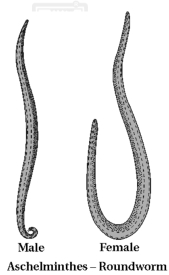
$\rightarrow$ The body of Aschelminthes is circular in cross-section, hence the name roundworms.
$\rightarrow$ They may be free-living, aquatic, terrestrial, or parasitic in plants and animals.
$\rightarrow$ Roundworms exhibit an organ-system level of body organization.
$\rightarrow$ They are bilaterally symmetrical, triploblastic, and pseudocoelomate animals.
$\rightarrow$ The alimentary canal is complete with a well-developed muscular pharynx.
$\rightarrow$ An excretory tube removes body wastes from the body cavity through the excretory pore.
$\rightarrow$ Sexes are separate (dioecious), i.e., males and females are distinct. Often, females are longer than males.
$\rightarrow$ Fertilization is internal, and development may be direct (the young ones resemble the adult) or indirect.
$\rightarrow$ Examples: Ascaris (Roundworm), Wuchereria (Filarial worm), Ancylostoma (Hookworm).
$\rightarrow$ They are commonly called nematodes.
$\rightarrow$ The body of Aschelminthes is circular in cross-section, hence the name roundworms.
$\rightarrow$ They may be free-living, aquatic, terrestrial, or parasitic in plants and animals.
$\rightarrow$ Roundworms exhibit an organ-system level of body organization.
$\rightarrow$ They are bilaterally symmetrical, triploblastic, and pseudocoelomate animals.
$\rightarrow$ The alimentary canal is complete with a well-developed muscular pharynx.
$\rightarrow$ An excretory tube removes body wastes from the body cavity through the excretory pore.
$\rightarrow$ Sexes are separate (dioecious), i.e., males and females are distinct. Often, females are longer than males.
$\rightarrow$ Fertilization is internal, and development may be direct (the young ones resemble the adult) or indirect.
$\rightarrow$ Examples: Ascaris (Roundworm), Wuchereria (Filarial worm), Ancylostoma (Hookworm).
0 likes
View Solution117
MediumMCQ
Megalecithal eggs are a characteristic of ..........
A
Plasmodium
B
Ascaris
C
Filarial worm
D
Polio
Solution
(B) Megalecithal eggs (also known as macrolecithal or polylecithal eggs) contain a very large amount of yolk.
These eggs are typically found in organisms where the embryo requires significant nutritional reserves for development,such as birds,reptiles,and certain insects.
Among the given options,$Ascaris$ (a roundworm) produces eggs that are characterized by a large amount of yolk,making them megalecithal.
$Plasmodium$ is a protozoan,$Filarial$ worms are nematodes with different egg characteristics,and $Polio$ is a virus,which does not produce eggs.
These eggs are typically found in organisms where the embryo requires significant nutritional reserves for development,such as birds,reptiles,and certain insects.
Among the given options,$Ascaris$ (a roundworm) produces eggs that are characterized by a large amount of yolk,making them megalecithal.
$Plasmodium$ is a protozoan,$Filarial$ worms are nematodes with different egg characteristics,and $Polio$ is a virus,which does not produce eggs.
0 likes
View Solution118
EasyMCQ
Which of the following is a monogenetic parasite?
A
Taenia solium
B
Ascaris
C
Fasciola hepatica
D
Plasmodium vivax
Solution
(B) monogenetic parasite is one that completes its life cycle in a single host.
$Ascaris$ $lumbricoides$ is a monogenetic parasite because it requires only one host (human) to complete its life cycle.
In contrast,$Taenia$ $solium$,$Fasciola$ $hepatica$,and $Plasmodium$ $vivax$ are digenetic parasites,meaning they require two hosts to complete their life cycle.
$Ascaris$ $lumbricoides$ is a monogenetic parasite because it requires only one host (human) to complete its life cycle.
In contrast,$Taenia$ $solium$,$Fasciola$ $hepatica$,and $Plasmodium$ $vivax$ are digenetic parasites,meaning they require two hosts to complete their life cycle.
0 likes
View Solution119
EasyMCQ
Thigmotaxis is not shown by
A
Paramecium
B
Amoeba
C
Ascaris
D
Hydra
Solution
(C) Thigmotaxis is a directional movement or response of an organism to touch or physical contact.
$Paramecium$, $Amoeba$, and $Hydra$ exhibit thigmotaxis as a response to physical stimuli in their environment.
$Ascaris$, being an endoparasite living within the host's intestine, does not exhibit thigmotaxis as it is adapted to a stable internal environment.
$Paramecium$, $Amoeba$, and $Hydra$ exhibit thigmotaxis as a response to physical stimuli in their environment.
$Ascaris$, being an endoparasite living within the host's intestine, does not exhibit thigmotaxis as it is adapted to a stable internal environment.
0 likes
View Solution120
MediumMCQ
From the $Ascaris$ egg,the first larva hatches out in the:
A
Intestine of host
B
Stomach of host
C
Outside the body
D
Uterus of female $Ascaris$
Solution
(A) In the intestine of the human host,the protective covering of the ingested eggs is digested by digestive enzymes. As a result,the $0.25$ to $0.3 \; mm$ long juveniles (first-stage larvae) are released into the intestinal lumen.
0 likes
View Solution121
EasyMCQ
The $Aschelminthes$ are commonly called roundworms because:
A
They have a round body
B
Their body is circular in cross-section
C
They have bilaterally symmetric body
D
Their body have a round visceral hump
Solution
(B) In $Aschelminthes$,the body is commonly cylindrical and elongated,tapering at both ends.
In a cross-section,the body appears round or circular.
Because of this specific body form,these animals are commonly called roundworms.
In a cross-section,the body appears round or circular.
Because of this specific body form,these animals are commonly called roundworms.
0 likes
View Solution122
MediumMCQ
Hookworm is the common name of
A
Wuchereria
B
Ancylostoma
C
Taenia
D
Fasciola
Solution
(B) The common name for $Wuchereria$ is filarial worm.
The common name for $Ancylostoma$ is hookworm.
The common name for $Taenia$ $solium$ is pork tapeworm.
The common name for $Fasciola$ is liver fluke.
The common name for $Ancylostoma$ is hookworm.
The common name for $Taenia$ $solium$ is pork tapeworm.
The common name for $Fasciola$ is liver fluke.
0 likes
View Solution123
MediumMCQ
Mesoderm is present as scattered pouches in between the ectoderm and endoderm in
A
Annelids
B
Echinoderms
C
Molluscs
D
Aschelminthes
Solution
(D) Aschelminthes are pseudocoelomate animals. In these organisms,the body cavity is present,but it is not completely lined by the mesoderm. Instead,the mesoderm is present as scattered pouches in between the ectoderm and endoderm.
0 likes
View Solution124
EasyMCQ
In $Aschelminthes$,the excretory tube removes body wastes from the body cavity through:
A
Excretory pore
B
Malpighian tubules
C
Flame cells
D
Diffusion from body surface
Solution
(A) In $Aschelminthes$ (roundworms),an excretory system is present which consists of an excretory tube.
This excretory tube collects metabolic wastes from the body cavity (pseudocoelom).
The collected waste is then eliminated from the body through a single opening known as the excretory pore.
This excretory tube collects metabolic wastes from the body cavity (pseudocoelom).
The collected waste is then eliminated from the body through a single opening known as the excretory pore.
0 likes
View Solution125
EasyMCQ
The only phylum bearing pseudocoelom is
A
Annelida
B
Porifera
C
Aschelminthes
D
Platyhelminthes
Solution
(C) The phylum $Aschelminthes$ is the only group of animals that are pseudocoelomate. In these organisms,the body cavity is present but is not completely lined by the mesoderm. Instead,the mesoderm is present as scattered pouches between the ectoderm and the endoderm.
0 likes
View Solution126
MediumMCQ
Ascaris has all of the following features,except
A
Complete digestive system
B
Indirect development
C
External fertilisation
D
Parasitic life
Solution
(C) $Ascaris$ belongs to the phylum $Aschelminthes$ (Roundworms).
$Ascaris$ possesses a complete digestive system with a well-developed muscular pharynx and two distinct openings: the mouth and the anus.
Development in $Ascaris$ is indirect,involving a larval stage known as the rhabditiform larva.
$Ascaris$ is a common endoparasite found in the small intestine of humans and exhibits internal fertilization.
Therefore,external fertilization is not a feature of $Ascaris$.
$Ascaris$ possesses a complete digestive system with a well-developed muscular pharynx and two distinct openings: the mouth and the anus.
Development in $Ascaris$ is indirect,involving a larval stage known as the rhabditiform larva.
$Ascaris$ is a common endoparasite found in the small intestine of humans and exhibits internal fertilization.
Therefore,external fertilization is not a feature of $Ascaris$.
0 likes
View Solution127
EasyMCQ
Which of the following groups of animals is bilaterally symmetrical and triploblastic?
A
Sponges
B
Coelenterates (Cnidarians)
C
Aschelminthes (Round worms)
D
Ctenophores
Solution
(C) Sponges are generally asymmetrical and diploblastic (or lack true tissues).
Coelenterates (Cnidarians) are radially symmetrical and diploblastic.
Aschelminthes (Round worms) are bilaterally symmetrical and triploblastic.
Ctenophores are radially symmetrical and diploblastic.
Therefore,the correct group is Aschelminthes.
Coelenterates (Cnidarians) are radially symmetrical and diploblastic.
Aschelminthes (Round worms) are bilaterally symmetrical and triploblastic.
Ctenophores are radially symmetrical and diploblastic.
Therefore,the correct group is Aschelminthes.
0 likes
View Solution128
MediumMCQ
Which of the following is not a digenetic worm?
A
Fasciola
B
Wuchereria
C
Enterobius
D
Taenia
Solution
(C) Digenetic worms are parasites that require two different hosts to complete their life cycle.
$Fasciola$ (liver fluke) has a primary host (sheep/goat) and a secondary host (snail like $Limnaea$ or $Planorbis$).
$Wuchereria$ (filarial worm) has a primary host (human) and a secondary host (female $Culex$ mosquito).
$Taenia$ (tapeworm) has a primary host (human) and a secondary host (pig,cow,or buffalo).
$Enterobius$ (pinworm) is a monogenetic parasite,meaning it completes its entire life cycle within a single host,which is humans.
$Fasciola$ (liver fluke) has a primary host (sheep/goat) and a secondary host (snail like $Limnaea$ or $Planorbis$).
$Wuchereria$ (filarial worm) has a primary host (human) and a secondary host (female $Culex$ mosquito).
$Taenia$ (tapeworm) has a primary host (human) and a secondary host (pig,cow,or buffalo).
$Enterobius$ (pinworm) is a monogenetic parasite,meaning it completes its entire life cycle within a single host,which is humans.
0 likes
View Solution129
MediumMCQ
Which of the following is not a characteristic feature of phylum $Nemathelminthes$?
A
Bilateral symmetry,triploblastic,pseudocoelomate.
B
They are possibly most abundant amongst the animals.
C
The false body cavity allows body wall muscles and digestive tract muscles to act independently of each other.
D
The body wall has longitudinal muscles,circular muscles and an elastic cuticle.
Solution
(D) In phylum $Nemathelminthes$ (also known as $Aschelminthes$),the body wall contains only longitudinal muscle fibres. Circular muscle fibres are absent in this phylum. Therefore,the statement that the body wall has longitudinal and circular muscles is incorrect.
0 likes
View Solution130
EasyMCQ
Syncytial epidermis is present in
A
Aurelia
B
Ascaris
C
Asterias
D
Astraea
Solution
(B) Syncytial epidermis is present in $Ascaris$ (Phylum $Aschelminthes$).
In the body wall of $Ascaris$,a syncytial epidermis is located just below the cuticle.
$A$ syncytial epidermis consists of fused cells where individual cell boundaries are not distinct,resulting in a multinucleated layer.
In the body wall of $Ascaris$,a syncytial epidermis is located just below the cuticle.
$A$ syncytial epidermis consists of fused cells where individual cell boundaries are not distinct,resulting in a multinucleated layer.
0 likes
View Solution131
MediumMCQ
Which of the following statements are correct about the life cycle of $Ascaris \; lumbricoides$?
$(A)$. Infective agent - Embryonated egg with $II$ Juvenile
$(B)$. Fertilised eggs containing the unsegmented ovum are passed with faeces
$(C)$. Four moultings of the larva occur: two outside in soil within the egg-shell, one in lungs and one in intestine
$(D)$. Site of location of worm - small intestine.
$(A)$. Infective agent - Embryonated egg with $II$ Juvenile
$(B)$. Fertilised eggs containing the unsegmented ovum are passed with faeces
$(C)$. Four moultings of the larva occur: two outside in soil within the egg-shell, one in lungs and one in intestine
$(D)$. Site of location of worm - small intestine.
A
$A \; and \; B$
B
$A \; only$
C
$A, B \; and \; D$
D
$A, B, C \; and \; D$
Solution
(C) Statement $(A)$ is correct: The infective stage of $Ascaris \; lumbricoides$ is the embryonated egg containing the second-stage juvenile ($L_2$ larva).
Statement $(B)$ is correct: Fertilised eggs are passed out of the host's body along with the faeces. At this stage, the egg contains an unsegmented ovum.
Statement $(C)$ is incorrect: In $Ascaris$, the $1^{st}$ moult occurs within the egg in the soil. The $2^{nd}$ moult also occurs in the soil (making it infective). The $3^{rd}$ and $4^{th}$ moults occur within the host's body (specifically in the lungs and intestine).
Statement $(D)$ is correct: The adult $Ascaris$ worm resides in the small intestine of the human host.
Therefore, statements $(A), (B),$ and $(D)$ are correct.
Statement $(B)$ is correct: Fertilised eggs are passed out of the host's body along with the faeces. At this stage, the egg contains an unsegmented ovum.
Statement $(C)$ is incorrect: In $Ascaris$, the $1^{st}$ moult occurs within the egg in the soil. The $2^{nd}$ moult also occurs in the soil (making it infective). The $3^{rd}$ and $4^{th}$ moults occur within the host's body (specifically in the lungs and intestine).
Statement $(D)$ is correct: The adult $Ascaris$ worm resides in the small intestine of the human host.
Therefore, statements $(A), (B),$ and $(D)$ are correct.
0 likes
View Solution132
EasyMCQ
$Wuchereria bancrofti$,the filarial worm that causes elephantiasis,belongs to which phylum?
A
Platyhelminthes
B
Aschelminthes
C
Coelenterata
D
Arthropoda
Solution
(B) $Wuchereria bancrofti$ is a parasitic nematode commonly known as the filarial worm.
It is the causative agent of filariasis,also known as elephantiasis,a condition characterized by the chronic inflammation of the organs in which they live for many years,usually the lymphatic vessels of the lower limbs.
According to the biological classification system,$Wuchereria bancrofti$ belongs to the phylum $Aschelminthes$ (also known as $Nematoda$).
It is the causative agent of filariasis,also known as elephantiasis,a condition characterized by the chronic inflammation of the organs in which they live for many years,usually the lymphatic vessels of the lower limbs.
According to the biological classification system,$Wuchereria bancrofti$ belongs to the phylum $Aschelminthes$ (also known as $Nematoda$).
0 likes
View Solution133
Medium
Give a scientific reason: Aschelminthes are called pseudocoelomates.
Solution
(N/A) In the animals of phylum $Aschelminthes$,the body cavity is not lined by mesoderm. Instead,the mesoderm is present as scattered pouches between the ectoderm and endoderm. This type of body cavity is called a pseudocoelom,and the animals possessing it are known as pseudocoelomates.
0 likes
View Solution134
EasyMCQ
Pseudocoelomate animals are a characteristic of this phylum.
A
Platyhelminthes
B
Annelida
C
Arthropoda
D
Aschelminthes
Solution
(D) Pseudocoelomate animals are those in which the body cavity is not lined by mesoderm; instead,the mesoderm is present as scattered pouches in between the ectoderm and endoderm.
This condition is a characteristic feature of the phylum $Aschelminthes$ (also known as $Nematoda$ or roundworms).
$Platyhelminthes$ are acoelomate,while $Annelida$ and $Arthropoda$ are true coelomates.
This condition is a characteristic feature of the phylum $Aschelminthes$ (also known as $Nematoda$ or roundworms).
$Platyhelminthes$ are acoelomate,while $Annelida$ and $Arthropoda$ are true coelomates.
0 likes
View Solution135
MediumMCQ
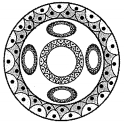
Select the incorrect option for the animal having the following body structure.
A
Animals with a complete digestive system
B
Pseudocoelomate animals
C
Animals that excrete through excretory tubes
D
Hermaphrodite animals
Solution
(D) The provided image shows a cross-section of a roundworm (Aschelminthes),which is characterized by a pseudocoelom (a body cavity that is not lined by mesoderm).
$1$. Aschelminthes have a complete digestive system with a well-developed muscular pharynx.
$2$. They are pseudocoelomates.
$3$. Excretion in these animals occurs through an excretory tube (renette cells/excretory pore).
$4$. They are dioecious (sexes are separate),meaning they are not hermaphrodites. Therefore,the option stating they are hermaphrodite animals is incorrect.
$1$. Aschelminthes have a complete digestive system with a well-developed muscular pharynx.
$2$. They are pseudocoelomates.
$3$. Excretion in these animals occurs through an excretory tube (renette cells/excretory pore).
$4$. They are dioecious (sexes are separate),meaning they are not hermaphrodites. Therefore,the option stating they are hermaphrodite animals is incorrect.
0 likes
View Solution136
EasyMCQ
In animals of this phylum,the female is often longer than the male.
A
Platyhelminthes
B
Aschelminthes
C
Annelida
D
Arthropoda
Solution
(B) In the phylum $Aschelminthes$ (also known as $Nematoda$ or roundworms),the organisms exhibit sexual dimorphism.
Specifically,the females are generally longer and larger than the males.
$A$ common example is $Ascaris$ $lumbricoides$,where the male is smaller and has a curved posterior end,while the female is longer and has a straight posterior end.
Specifically,the females are generally longer and larger than the males.
$A$ common example is $Ascaris$ $lumbricoides$,where the male is smaller and has a curved posterior end,while the female is longer and has a straight posterior end.
0 likes
View Solution137
EasyMCQ
The first complete digestive tract is found in the phylum .........
A
Platyhelminthes
B
Aschelminthes
C
Annelida
D
Arthropoda
Solution
(B) complete digestive tract consists of two openings: a mouth and an anus.
In the animal kingdom,the phylum $Aschelminthes$ (also known as $Nematoda$) is the first group to exhibit a complete alimentary canal with a well-developed muscular pharynx.
$Platyhelminthes$ possess an incomplete digestive system (a single opening serving as both mouth and anus),while $Annelida$ and $Arthropoda$ also possess complete digestive tracts,but they appear later in the evolutionary sequence.
In the animal kingdom,the phylum $Aschelminthes$ (also known as $Nematoda$) is the first group to exhibit a complete alimentary canal with a well-developed muscular pharynx.
$Platyhelminthes$ possess an incomplete digestive system (a single opening serving as both mouth and anus),while $Annelida$ and $Arthropoda$ also possess complete digestive tracts,but they appear later in the evolutionary sequence.
0 likes
View Solution138
EasyMCQ
Match the following columns:
| Column-$I$ (Animal) | Column-$II$ (Genus) |
| $P$. Roundworm | $I$. Wuchereria |
| $Q$. Filarial worm | $II$. Ascaris |
| $R$. Hookworm | $III$. Ancylostoma |
A
$(P-I), (Q-II), (R-III)$
B
$(P-III), (Q-I), (R-II)$
C
$(P-II), (Q-I), (R-III)$
D
$(P-III), (Q-II), (R-I)$
Solution
(C) The correct matches are as follows:
$1$. Roundworm is scientifically known as $Ascaris$ $(P-II)$.
$2$. Filarial worm is scientifically known as $Wuchereria$ $(Q-I)$.
$3$. Hookworm is scientifically known as $Ancylostoma$ $(R-III)$.
Therefore, the correct sequence is $(P-II), (Q-I), (R-III)$.
$1$. Roundworm is scientifically known as $Ascaris$ $(P-II)$.
$2$. Filarial worm is scientifically known as $Wuchereria$ $(Q-I)$.
$3$. Hookworm is scientifically known as $Ancylostoma$ $(R-III)$.
Therefore, the correct sequence is $(P-II), (Q-I), (R-III)$.
0 likes
View Solution139
MediumMCQ
The animals of this phylum are dioecious.
A
Cnidaria
B
Ctenophora
C
Platyhelminthes
D
Aschelminthes
Solution
(D) The phylum $Aschelminthes$ (also known as $Nematoda$ or roundworms) consists of animals that are dioecious,meaning the sexes are separate.
In $Aschelminthes$,males and females are distinct (sexual dimorphism is often present).
In contrast,$Cnidaria$,$Ctenophora$,and $Platyhelminthes$ (with some exceptions in $Platyhelminthes$) are generally hermaphroditic or monoecious.
In $Aschelminthes$,males and females are distinct (sexual dimorphism is often present).
In contrast,$Cnidaria$,$Ctenophora$,and $Platyhelminthes$ (with some exceptions in $Platyhelminthes$) are generally hermaphroditic or monoecious.
0 likes
View Solution140
EasyMCQ
The organism $Meloidogyne$ $incognita$ belongs to which phylum?
A
Platyhelminthes
B
Nematoda
C
Annelida
D
Arthropoda
Solution
(B) $Meloidogyne$ $incognita$ is a species of root-knot nematode.
It is a parasitic organism that infects the roots of tobacco plants,causing a significant reduction in yield.
Since it belongs to the group of roundworms,it is classified under the phylum $Nematoda$ (also known as $Aschelminthes$).
It is a parasitic organism that infects the roots of tobacco plants,causing a significant reduction in yield.
Since it belongs to the group of roundworms,it is classified under the phylum $Nematoda$ (also known as $Aschelminthes$).
0 likes
View Solution141
EasyMCQ
Some nematodes are parasitic on .......... .
A
Humans
B
Some animals
C
Some plants
D
All of the above
Solution
(D) Nematodes are a diverse group of organisms that occupy a very broad range of environments. Many species of nematodes are known to be parasitic. They can infect humans (e.g., $Ascaris$), various animals (e.g., livestock parasites), and many species of plants (e.g., $Meloidogyne \text{ } incognita$). Therefore, all the given options are correct.
0 likes
View Solution142
MediumMCQ
While trying to find out the characteristics of a newly found animal,a researcher performed histology on the adult animal and observed a cavity with the presence of mesodermal tissue towards the body wall,but no mesodermal tissue was observed towards the alimentary canal. What could be the possible coelom of that animal?
A
Acoelomate
B
Pseudocoelomate
C
Schizocoelomate
D
Spongocoelomate
Solution
(B) In animals,the body cavity which is lined by mesoderm is called the coelom.
$1$. Acoelomates: These animals lack a body cavity (e.g.,Platyhelminthes).
$2$. Pseudocoelomates: In these animals,the body cavity is not lined by mesoderm; instead,the mesoderm is present as scattered pouches in between the ectoderm and endoderm. Specifically,the mesoderm is present towards the body wall but absent towards the alimentary canal (e.g.,Aschelminthes).
$3$. Schizocoelomates: These are true coelomates where the coelom is formed by the splitting of the mesodermal mass.
Since the description states that mesoderm is present only towards the body wall and not towards the gut,it matches the definition of a pseudocoelom.
$1$. Acoelomates: These animals lack a body cavity (e.g.,Platyhelminthes).
$2$. Pseudocoelomates: In these animals,the body cavity is not lined by mesoderm; instead,the mesoderm is present as scattered pouches in between the ectoderm and endoderm. Specifically,the mesoderm is present towards the body wall but absent towards the alimentary canal (e.g.,Aschelminthes).
$3$. Schizocoelomates: These are true coelomates where the coelom is formed by the splitting of the mesodermal mass.
Since the description states that mesoderm is present only towards the body wall and not towards the gut,it matches the definition of a pseudocoelom.
0 likes
View Solution143
MediumMCQ
First phylum to have a complete digestive tract can be represented by $:-$
A
Hydra
B
Taenia
C
Ancylostoma
D
Pheretima
Solution
(C) The phylum $Aschelminthes$ (also known as $Nematoda$) is the first group of animals to exhibit a complete digestive tract,which includes a mouth and an anus.
$Ancylostoma$ (hookworm) belongs to the phylum $Aschelminthes$.
$Hydra$ belongs to $Cnidaria$ (incomplete digestive tract).
$Taenia$ belongs to $Platyhelminthes$ (incomplete digestive tract).
$Pheretima$ belongs to $Annelida$,which also has a complete digestive tract,but it appears later in the evolutionary sequence than $Aschelminthes$.
$Ancylostoma$ (hookworm) belongs to the phylum $Aschelminthes$.
$Hydra$ belongs to $Cnidaria$ (incomplete digestive tract).
$Taenia$ belongs to $Platyhelminthes$ (incomplete digestive tract).
$Pheretima$ belongs to $Annelida$,which also has a complete digestive tract,but it appears later in the evolutionary sequence than $Aschelminthes$.
0 likes
View Solution144
MediumMCQ
Ancylostoma,also known as $.....(A).....$,belongs to the phylum $.....(B)....$. Identify $A$ and $B$ respectively and choose the correct option.
A
$A \rightarrow$ Filarial worm,$B \rightarrow$ Aschelminthes
B
$A \rightarrow$ Hookworm,$B \rightarrow$ Aschelminthes
C
$A \rightarrow$ Flatworm,$B \rightarrow$ Platyhelminthes
D
$A \rightarrow$ Pinworm,$B \rightarrow$ Aschelminthes
Solution
(B) $Ancylostoma$ is commonly known as the hookworm.
It belongs to the phylum Aschelminthes (also known as Nematoda).
Therefore,$A$ is Hookworm and $B$ is Aschelminthes.
The correct option is $B$.
It belongs to the phylum Aschelminthes (also known as Nematoda).
Therefore,$A$ is Hookworm and $B$ is Aschelminthes.
The correct option is $B$.
0 likes
View Solution145
MediumMCQ
Which of the following statements is correct?
A
In sponges,cells are arranged as loose cell aggregates,so they perform tissue-grade organization.
B
The digestive system of Platyhelminthes is complete because they have a blind-sac body plan.
C
In roundworms (Aschelminthes),mesoderm is present as scattered pouches between the ectoderm and endoderm,so they have a pseudocoelom.
D
Platyhelminthes have mesoderm,so they are coelomates.
Solution
(C) Option $A$ is incorrect because sponges exhibit cellular-grade organization,not tissue-grade.
Option $B$ is incorrect because Platyhelminthes have an incomplete digestive system (a single opening serves as both mouth and anus),which is characteristic of a blind-sac body plan.
Option $C$ is correct. In Aschelminthes,the mesoderm is present as scattered pouches between the ectoderm and endoderm,resulting in a pseudocoelom.
Option $D$ is incorrect because Platyhelminthes are acoelomates,meaning they lack a body cavity,despite being triploblastic (having mesoderm).
Option $B$ is incorrect because Platyhelminthes have an incomplete digestive system (a single opening serves as both mouth and anus),which is characteristic of a blind-sac body plan.
Option $C$ is correct. In Aschelminthes,the mesoderm is present as scattered pouches between the ectoderm and endoderm,resulting in a pseudocoelom.
Option $D$ is incorrect because Platyhelminthes are acoelomates,meaning they lack a body cavity,despite being triploblastic (having mesoderm).
0 likes
View Solution146
MediumMCQ
Sexual dimorphism is found in:
A
Platyhelminthes
B
Aschelminthes
C
Porifera
D
Ctenophora
Solution
(B) Sexual dimorphism refers to the condition where the two sexes of the same species exhibit different characteristics beyond the differences in their sexual organs. In the animal kingdom,members of the phylum $Aschelminthes$ (also known as $Nematoda$ or roundworms) exhibit distinct sexual dimorphism. In these organisms,males and females are separate (dioecious),and the males are often smaller than the females. In contrast,most members of $Platyhelminthes$,$Porifera$,and $Ctenophora$ are hermaphrodites (monoecious),meaning both male and female reproductive organs are present in the same individual.
0 likes
View Solution147
EasyMCQ
The cross-section of an animal body is given below:
Which of the following animals will satisfy the above cross-section?
Which of the following animals will satisfy the above cross-section?

A
Fasciola
B
Pleurobrachia
C
Ascaris
D
Nereis
Solution
(C) The provided cross-section shows an outer body wall (ectoderm),a middle layer (mesoderm),and an inner gut tube (endoderm) with a fluid-filled cavity between the body wall and the gut. This indicates a pseudocoelomate body plan,where the body cavity is not lined by mesoderm on all sides.
$1$. $Fasciola$ (Liver fluke) is an acoelomate (Platyhelminthes).
$2$. $Pleurobrachia$ (Ctenophora) is an acoelomate.
$3$. $Ascaris$ (Roundworm) belongs to the phylum Aschelminthes (Nematoda),which are characteristically pseudocoelomate.
$4$. $Nereis$ (Annelida) is a true coelomate.
Therefore,the correct answer is $Ascaris$.
$1$. $Fasciola$ (Liver fluke) is an acoelomate (Platyhelminthes).
$2$. $Pleurobrachia$ (Ctenophora) is an acoelomate.
$3$. $Ascaris$ (Roundworm) belongs to the phylum Aschelminthes (Nematoda),which are characteristically pseudocoelomate.
$4$. $Nereis$ (Annelida) is a true coelomate.
Therefore,the correct answer is $Ascaris$.
0 likes
View Solution148
MediumMCQ
Sexual dimorphism is found in $:-$
A
Platyhelminthes
B
Aschelminthes
C
Porifera
D
Ctenophora
Solution
(B) Sexual dimorphism refers to the distinct morphological differences between males and females of the same species.
In the phylum $Aschelminthes$ (also known as $Nematoda$ or roundworms),the sexes are separate $(dioecious)$.
Females are generally longer than males,and males often possess a curved posterior end,making them easily distinguishable from females.
Therefore,$Aschelminthes$ exhibit clear sexual dimorphism.
In the phylum $Aschelminthes$ (also known as $Nematoda$ or roundworms),the sexes are separate $(dioecious)$.
Females are generally longer than males,and males often possess a curved posterior end,making them easily distinguishable from females.
Therefore,$Aschelminthes$ exhibit clear sexual dimorphism.
0 likes
View Solution149
EasyMCQ
$Caenorhabditis elegans$ is a . . . . . . .
A
virus
B
cyanobacterium
C
fungus
D
nematode
Solution
(D) $Caenorhabditis elegans$ is a free-living,transparent nematode (roundworm) that is widely used as a model organism in biological research,particularly in developmental biology and genetics. It was the first multicellular organism to have its entire genome sequenced.
0 likes
View Solution150
EasyMCQ
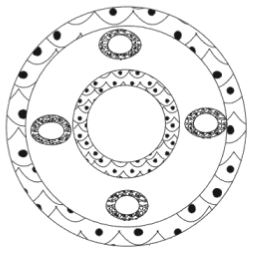
Which of the following phyla possess the body cavity as shown in the diagram below?
A
Annelida
B
Porifera
C
Aschelminthes
D
Coelenterata
Solution
(C) The diagram illustrates a pseudocoelomate body plan,where the body cavity is not lined by mesoderm but instead,the mesoderm is present as scattered pouches in between the ectoderm and endoderm.
This type of body cavity is a characteristic feature of the phylum $Aschelminthes$ (also known as roundworms).
This type of body cavity is a characteristic feature of the phylum $Aschelminthes$ (also known as roundworms).
0 likes
View SolutionAnimal Kingdom — Phylum - Aschelminthes · Frequently Asked Questions
1Are these Animal Kingdom questions useful for JEE and NEET?
Yes. All questions in this section are mapped to JEE Main and NEET exam patterns. Previous year questions from JEE Main, NEET, GUJCET and state-level exams are included with full solutions.
2Can I switch to Hindi or Gujarati for these questions?
Yes. Use the language tabs in the hero section or the sidebar to view the same questions and solutions in English, Hindi or Gujarati.
3How do I generate a question paper from this subtopic?
Use the Vedclass Exam Paper Generator — select the chapter and subtopic, set difficulty, and generate Sets A, B, C, D automatically. First 3 chapters of every subject are free.
Vedclass Products
For Students
Vedclass Test Series
Mock tests in real JEE/NEET style with performance analysis. 5-day free trial.
Start Free TrialFor Teachers
Exam Paper Generator
Generate Set A/B/C/D papers from this chapter in 2 minutes. 3 chapters free.
Try FreeFor Institutes
Online Exam Module
Live online exams with unlimited students, 360° analytics & white-label branding.
See DemoFor Teachers & Institutes
Generate a Animal Kingdom Exam Paper in 2 Minutes
Select subtopic & difficulty — Sets A, B, C, D auto-generated with No Repeat logic.
First 3 chapters of every subject are free — no payment required.