
A English
Phylum - Aschelminthes Questions in English
Class 11 Biology · Animal Kingdom · Phylum - Aschelminthes
150+
Questions
English
Language
100%
With Solutions
Showing 50 of 150 questions in English
51
MediumMCQ
Choose the correct statement with reference to $Ascaris$.
A
Hatching of embryos takes place in the stomach due to lytic enzyme.
B
Adulthood is reached inside the body of the host in ten days time.
C
Development and moulting takes place in the alveoli of lungs.
D
Hatching of embryo takes places within ten hours.
Solution
(C) The life cycle of $Ascaris$ involves a complex migration pattern within the human host.
After ingestion of embryonated eggs,the larvae hatch in the small intestine.
These larvae then penetrate the intestinal wall and migrate through the circulatory system to the liver,heart,and eventually the lungs.
In the alveoli of the lungs,the larvae undergo development and moulting (specifically the third and fourth moults) before migrating up the trachea to be swallowed again,eventually reaching the small intestine to mature into adults.
After ingestion of embryonated eggs,the larvae hatch in the small intestine.
These larvae then penetrate the intestinal wall and migrate through the circulatory system to the liver,heart,and eventually the lungs.
In the alveoli of the lungs,the larvae undergo development and moulting (specifically the third and fourth moults) before migrating up the trachea to be swallowed again,eventually reaching the small intestine to mature into adults.
0 likes
View Solution52
MediumMCQ
Which one of the following phyla is characterized by the absence of a true coelom?
A
Echinodermata
B
Mollusca
C
Annelida
D
Nematoda
Solution
(D) true coelom is a body cavity which is lined by mesoderm on all sides.
Phylum $Nematoda$ (also known as $Aschelminthes$) is characterized by the presence of a pseudocoelom,where the body cavity is not lined by mesoderm but instead,the mesoderm is present as scattered pouches in between the ectoderm and endoderm.
Phyla $Echinodermata$,$Mollusca$,and $Annelida$ are all coelomates,meaning they possess a true coelom.
Therefore,$Nematoda$ is the correct answer as it lacks a true coelom.
Phylum $Nematoda$ (also known as $Aschelminthes$) is characterized by the presence of a pseudocoelom,where the body cavity is not lined by mesoderm but instead,the mesoderm is present as scattered pouches in between the ectoderm and endoderm.
Phyla $Echinodermata$,$Mollusca$,and $Annelida$ are all coelomates,meaning they possess a true coelom.
Therefore,$Nematoda$ is the correct answer as it lacks a true coelom.
0 likes
View Solution53
EasyMCQ
The musculature of $Ascaris$ consists of:
A
Circular muscles only
B
Outer longitudinal and inner circular
C
Outer circular and inner longitudinal
D
Longitudinal muscles only
Solution
(D) The body wall of $Ascaris$ (a roundworm) consists of a cuticle,epidermis,and a muscle layer.
The muscle layer is composed of a single layer of longitudinal muscle cells.
$Ascaris$ lacks circular muscles in its body wall.
Therefore,the musculature consists of longitudinal muscles only.
The muscle layer is composed of a single layer of longitudinal muscle cells.
$Ascaris$ lacks circular muscles in its body wall.
Therefore,the musculature consists of longitudinal muscles only.
0 likes
View Solution54
MediumMCQ
During its journey through the body,the juvenile $Ascaris$ passes through:
A
Spleen
B
Kidney
C
Skeletal muscles
D
Lung
Solution
(D) The life cycle of $Ascaris$ $lumbricoides$ involves a complex migration pattern within the host body.
After ingestion,the larvae hatch in the intestine and penetrate the intestinal wall to enter the bloodstream.
They are then carried to the liver and subsequently to the heart,from where they are pumped into the pulmonary circulation.
During this phase,the juvenile $Ascaris$ larvae pass through the lungs,where they break into the alveoli,migrate up the trachea,and are eventually swallowed to return to the small intestine to mature into adults.
After ingestion,the larvae hatch in the intestine and penetrate the intestinal wall to enter the bloodstream.
They are then carried to the liver and subsequently to the heart,from where they are pumped into the pulmonary circulation.
During this phase,the juvenile $Ascaris$ larvae pass through the lungs,where they break into the alveoli,migrate up the trachea,and are eventually swallowed to return to the small intestine to mature into adults.
0 likes
View Solution55
MediumMCQ
The sites of the first,second,and third moulting of the $Ascaris$ larva are:
A
Soil,lung,intestine
B
Soil,alveoli,lung
C
Soil,intestine,lung
D
Liver,stomach,intestine
Solution
(B) The life cycle of $Ascaris$ $lumbricoides$ involves several stages of moulting:
$1$. The first moulting occurs in the soil within the egg.
$2$. The second moulting occurs in the lungs (specifically in the alveoli) after the larvae migrate through the circulatory system.
$3$. The third moulting also occurs in the lungs.
$4$. The fourth moulting occurs in the intestine,where the larvae develop into adults.
Therefore,the sites for the first,second,and third moulting are soil,lung,and lung respectively. However,based on the provided options,the most accurate sequence representing the progression is soil,lung,and lung. Since the question asks for the sites of the first,second,and third moulting,the correct sequence is soil,lung,lung.
$1$. The first moulting occurs in the soil within the egg.
$2$. The second moulting occurs in the lungs (specifically in the alveoli) after the larvae migrate through the circulatory system.
$3$. The third moulting also occurs in the lungs.
$4$. The fourth moulting occurs in the intestine,where the larvae develop into adults.
Therefore,the sites for the first,second,and third moulting are soil,lung,and lung respectively. However,based on the provided options,the most accurate sequence representing the progression is soil,lung,and lung. Since the question asks for the sites of the first,second,and third moulting,the correct sequence is soil,lung,lung.
0 likes
View Solution56
MediumMCQ
Find out the correct sequence in the body wall of $Ascaris$.
A
Cuticle,epidermis,longitudinal muscles and circular muscles
B
Cuticle,epidermis and longitudinal muscles
C
Epidermis,cuticle,longitudinal muscles and circular muscles
D
Epidermis,longitudinal muscles,cuticle and circular muscles
Solution
(B) The body wall of $Ascaris$ (a roundworm) is composed of three primary layers from the outside to the inside:
$1$. An outer,tough,non-cellular,and resistant $Cuticle$.
$2$. $A$ middle layer known as the $Epidermis$ (or hypodermis),which is syncytial in nature.
$3$. An inner layer of $Longitudinal$ $muscles$. Note that $Ascaris$ lacks circular muscles in its body wall.
Therefore,the correct sequence from outside to inside is: $Cuticle \rightarrow Epidermis \rightarrow Longitudinal$ $muscles$.
$1$. An outer,tough,non-cellular,and resistant $Cuticle$.
$2$. $A$ middle layer known as the $Epidermis$ (or hypodermis),which is syncytial in nature.
$3$. An inner layer of $Longitudinal$ $muscles$. Note that $Ascaris$ lacks circular muscles in its body wall.
Therefore,the correct sequence from outside to inside is: $Cuticle \rightarrow Epidermis \rightarrow Longitudinal$ $muscles$.
0 likes
View Solution57
MediumMCQ
The larva of $Ascaris$ undergoes migration in which of the following courses?
A
Alimentary canal,liver,intestine
B
Alimentary canal,heart,lungs,trachea,intestine
C
Alimentary canal,heart,liver,lungs,trachea,mouth,intestine
D
Alimentary canal,liver,heart,lungs,trachea,pharynx,intestine
Solution
(D) The migration of $Ascaris$ larvae occurs as follows:
Embryonated eggs ($2^{nd}$ stage larva) $\rightarrow$ Mouth $\rightarrow$ Intestine $\rightarrow$ Liver $\rightarrow$ Heart $\rightarrow$ Lungs ($4^{th}$ stage larva) $\rightarrow$ Trachea $\rightarrow$ Pharynx $\rightarrow$ Intestine.
Therefore,the correct sequence is: Alimentary canal $\rightarrow$ Liver $\rightarrow$ Heart $\rightarrow$ Lungs $\rightarrow$ Trachea $\rightarrow$ Pharynx $\rightarrow$ Intestine.
Embryonated eggs ($2^{nd}$ stage larva) $\rightarrow$ Mouth $\rightarrow$ Intestine $\rightarrow$ Liver $\rightarrow$ Heart $\rightarrow$ Lungs ($4^{th}$ stage larva) $\rightarrow$ Trachea $\rightarrow$ Pharynx $\rightarrow$ Intestine.
Therefore,the correct sequence is: Alimentary canal $\rightarrow$ Liver $\rightarrow$ Heart $\rightarrow$ Lungs $\rightarrow$ Trachea $\rightarrow$ Pharynx $\rightarrow$ Intestine.
0 likes
View Solution58
MediumMCQ
Roundworms differ from flatworms in having a
A
Circulatory system
B
Pseudocoel
C
Dorsal nerve cord
D
Circular muscle layer
Solution
(B) Roundworms (Phylum $Aschelminthes$) possess a $Pseudocoel$,which is a body cavity that is not fully lined by mesoderm.
In contrast,flatworms (Phylum $Platyhelminthes$) are $Acoelomate$,meaning they lack a body cavity entirely.
Therefore,the presence of a $Pseudocoel$ is a distinguishing feature of roundworms compared to flatworms.
In contrast,flatworms (Phylum $Platyhelminthes$) are $Acoelomate$,meaning they lack a body cavity entirely.
Therefore,the presence of a $Pseudocoel$ is a distinguishing feature of roundworms compared to flatworms.
0 likes
View Solution59
MediumMCQ
In which of the following is the body cavity surrounding the alimentary canal not lined by a cellular layer?
A
Nematodes
B
Platyhelminthes
C
Annelids
D
Echinoderms
Solution
(A) The body cavity that is not lined by a mesodermal cellular layer is known as a pseudocoelom.
In $Nematodes$ (Phylum $Aschelminthes$),the body cavity is formed from the blastocoel and is not lined by mesoderm,hence they are called pseudocoelomates.
$Platyhelminthes$ are acoelomates (no body cavity).
$Annelids$ and $Echinoderms$ are true coelomates (possess a body cavity lined by mesoderm).
In $Nematodes$ (Phylum $Aschelminthes$),the body cavity is formed from the blastocoel and is not lined by mesoderm,hence they are called pseudocoelomates.
$Platyhelminthes$ are acoelomates (no body cavity).
$Annelids$ and $Echinoderms$ are true coelomates (possess a body cavity lined by mesoderm).
0 likes
View Solution60
EasyMCQ
The excretory system of $Ascaris$ $lumbricoides$ is made up of:
A
$4$ cells
B
Many cells
C
One cell
D
Two cells
Solution
(C) The excretory system of $Ascaris$ is a simple $H$-shaped tubular system. It consists of a single,large,multinucleated cell known as the renette cell. Therefore,the excretory system is considered to be formed by a single cell.
0 likes
View Solution61
EasyMCQ
Coelom derived from blastocoel is known as
A
Pseudocoelom
B
Enterocoelom
C
Haemocoel
D
Schizocoel
Solution
(A) The body cavity that is derived from the embryonic blastocoel is called a $Pseudocoelom$.
It is found in organisms like $Aschelminthes$ (roundworms).
Unlike a true coelom,a $Pseudocoelom$ is not lined by a mesodermal epithelium; instead,the mesoderm is present as scattered pouches between the ectoderm and endoderm.
It is found in organisms like $Aschelminthes$ (roundworms).
Unlike a true coelom,a $Pseudocoelom$ is not lined by a mesodermal epithelium; instead,the mesoderm is present as scattered pouches between the ectoderm and endoderm.
0 likes
View Solution62
MediumMCQ
Which of the following is not a hermaphrodite?
A
Earthworm
B
Leech
C
Taenia
D
Ascaris
Solution
(D) Hermaphrodites (bisexual organisms) are those that possess both male and female reproductive organs in the same individual.
$A$. Earthworm (Pheretima) is hermaphrodite.
$B$. Leech (Hirudinaria) is hermaphrodite.
$C$. Taenia (Tapeworm) is hermaphrodite.
$D$. Ascaris (Roundworm) is dioecious,meaning the sexes are separate (male and female individuals are distinct). Therefore,it is not a hermaphrodite.
$A$. Earthworm (Pheretima) is hermaphrodite.
$B$. Leech (Hirudinaria) is hermaphrodite.
$C$. Taenia (Tapeworm) is hermaphrodite.
$D$. Ascaris (Roundworm) is dioecious,meaning the sexes are separate (male and female individuals are distinct). Therefore,it is not a hermaphrodite.
0 likes
View Solution63
EasyMCQ
Which of the following is a pseudocoelomate animal?
A
Roundworm
B
Sandworm
C
Flatworm
D
Tapeworm
Solution
(A) Pseudocoelomates are animals in which the body cavity is not lined by mesoderm. Instead,the mesoderm is present as scattered pouches between the ectoderm and endoderm. $Aschelminthes$ (also known as $Nematoda$ or roundworms) are the classic examples of pseudocoelomates. $Flatworms$ $(Platyhelminthes)$ are acoelomate,while $Sandworms$ $(Annelida)$ are true coelomates.
0 likes
View Solution64
EasyMCQ
The presence of a pseudocoelom is a characteristic feature of which phylum?
A
Platyhelminthes
B
Mollusca
C
Annelida
D
Aschelminthes
Solution
(D) The phylum $Aschelminthes$ (also known as $Nematoda$) is characterized by the presence of a $pseudocoelom$.
In these organisms,the body cavity is not lined by mesoderm; instead,the mesoderm is present as scattered pouches between the ectoderm and endoderm.
$Platyhelminthes$ are acoelomates,while $Mollusca$ and $Annelida$ are true coelomates.
In these organisms,the body cavity is not lined by mesoderm; instead,the mesoderm is present as scattered pouches between the ectoderm and endoderm.
$Platyhelminthes$ are acoelomates,while $Mollusca$ and $Annelida$ are true coelomates.
0 likes
View Solution65
MediumMCQ
Which of the following organisms is a pseudocoelomate?
A
Hookworm
B
Liver fluke
C
Jellyfish
D
Leech
Solution
(A) Pseudocoelomates are organisms in which the body cavity is not lined by mesoderm but is present as scattered pouches between the ectoderm and endoderm.
Among the given options,$A$ (Hookworm,$Ancylostoma$) belongs to the phylum $Aschelminthes$ (or $Nematoda$),which are characterized by the presence of a pseudocoelom.
$B$ (Liver fluke,$Fasciola$) belongs to the phylum $Platyhelminthes$,which are acoelomate.
$C$ (Jellyfish) belongs to the phylum $Cnidaria$,which are acoelomate.
$D$ (Leech) belongs to the phylum $Annelida$,which are true coelomates.
Among the given options,$A$ (Hookworm,$Ancylostoma$) belongs to the phylum $Aschelminthes$ (or $Nematoda$),which are characterized by the presence of a pseudocoelom.
$B$ (Liver fluke,$Fasciola$) belongs to the phylum $Platyhelminthes$,which are acoelomate.
$C$ (Jellyfish) belongs to the phylum $Cnidaria$,which are acoelomate.
$D$ (Leech) belongs to the phylum $Annelida$,which are true coelomates.
0 likes
View Solution66
EasyMCQ
In the filarial worm $(Wuchereria \text{ } bancrofti)$, which of the following statements is true regarding their size?
A
The female is longer than the male.
B
The female is shorter than the male.
C
The male and female are of the same length.
D
The female is half the length of the male.
Solution
(A) In $Wuchereria \text{ } bancrofti$ (the filarial worm), the species exhibits sexual dimorphism.
The female worms are significantly longer than the male worms.
Typically, the female measures about $80-100 \text{ } mm$ in length, while the male measures about $40 \text{ } mm$ in length.
Therefore, the female is longer than the male.
The female worms are significantly longer than the male worms.
Typically, the female measures about $80-100 \text{ } mm$ in length, while the male measures about $40 \text{ } mm$ in length.
Therefore, the female is longer than the male.
0 likes
View Solution67
EasyMCQ
In filarial worms $(Wuchereria \text{ } bancrofti)$, the males are ......... in length compared to the females.
A
shorter
B
longer
C
equal
D
variable
Solution
(A) Filarial worms, specifically $Wuchereria \text{ } bancrofti$, exhibit sexual dimorphism.
In these organisms, the females are significantly longer than the males.
The male worms are shorter and possess a curved posterior end, which helps in copulation.
Therefore, the males are shorter in length compared to the females.
In these organisms, the females are significantly longer than the males.
The male worms are shorter and possess a curved posterior end, which helps in copulation.
Therefore, the males are shorter in length compared to the females.
0 likes
View Solution68
EasyMCQ
What are the characteristics of a filarial worm?
A
Long thread-like
B
Tapering at both ends
C
White-bodied
D
All of the above
Solution
(D) The filarial worm, $Wuchereria \text{ } bancrofti$, is a parasitic nematode that causes filariasis (elephantiasis).
Its physical characteristics include:
$1$. It is long and thread-like in appearance.
$2$. It has a body that tapers at both ends.
$3$. It possesses a whitish body color.
Therefore, all the given options are correct characteristics of the filarial worm.
Its physical characteristics include:
$1$. It is long and thread-like in appearance.
$2$. It has a body that tapers at both ends.
$3$. It possesses a whitish body color.
Therefore, all the given options are correct characteristics of the filarial worm.
0 likes
View Solution69
EasyMCQ
What is the mode of reproduction for filarial worms in terms of giving birth to offspring?
A
Oviparous
B
Viviparous
C
Ovoviviparous
D
None of these
Solution
(B) Filarial worms, such as $Wuchereria$ $\text{bancrofti}$, are viviparous.
This means they give birth to live young ones known as microfilariae, rather than laying eggs.
Therefore, the correct mode of reproduction is viviparous.
This means they give birth to live young ones known as microfilariae, rather than laying eggs.
Therefore, the correct mode of reproduction is viviparous.
0 likes
View Solution70
MediumMCQ
Which animal phylum possesses a mouth at the anterior end and an anus at the posterior end?
A
Aschelminthes
B
Coelenterata
C
Porifera
D
Protozoa
Solution
(A) The phylum $Aschelminthes$ (also known as $Nematoda$) is the first group of animals in the evolutionary sequence to exhibit a complete alimentary canal with a well-developed muscular pharynx.
This means they possess a distinct mouth at the anterior end and an anus at the posterior end,which is a characteristic feature of a tube-within-a-tube body plan.
$Coelenterata$ and $Porifera$ have an incomplete digestive system (blind-sac body plan),and $Protozoa$ are unicellular organisms.
This means they possess a distinct mouth at the anterior end and an anus at the posterior end,which is a characteristic feature of a tube-within-a-tube body plan.
$Coelenterata$ and $Porifera$ have an incomplete digestive system (blind-sac body plan),and $Protozoa$ are unicellular organisms.
0 likes
View Solution71
MediumMCQ
Which of the following animals possesses a complete digestive tract?
A
Tapeworm
B
Liver fluke
C
Planaria
D
Wuchereria
Solution
(D) complete digestive tract is defined by the presence of both a mouth and an anus.
$1$. Tapeworms $(Taenia)$ and Liver flukes $(Fasciola)$ belong to the phylum Platyhelminthes, which possess an incomplete digestive system (blind sac body plan).
$2$. Planaria also belongs to Platyhelminthes and has an incomplete digestive system.
$3$. Wuchereria $(Wuchereria \text{ bancrofti})$ belongs to the phylum Aschelminthes (Nematoda).
$4$. Aschelminthes are the first group of animals to exhibit a complete alimentary canal with a well-developed muscular pharynx, a mouth, and an anus.
Therefore, the correct answer is $D$.
$1$. Tapeworms $(Taenia)$ and Liver flukes $(Fasciola)$ belong to the phylum Platyhelminthes, which possess an incomplete digestive system (blind sac body plan).
$2$. Planaria also belongs to Platyhelminthes and has an incomplete digestive system.
$3$. Wuchereria $(Wuchereria \text{ bancrofti})$ belongs to the phylum Aschelminthes (Nematoda).
$4$. Aschelminthes are the first group of animals to exhibit a complete alimentary canal with a well-developed muscular pharynx, a mouth, and an anus.
Therefore, the correct answer is $D$.
0 likes
View Solution72
MediumMCQ
Which of the following organisms is a pseudocoelomate?
A
Wuchereria
B
Nereis
C
Chiton
D
Peripatus
Solution
(A) The body cavity that is not lined by mesoderm but instead has scattered pouches of mesoderm between the ectoderm and endoderm is known as a pseudocoelom.
Organisms belonging to the phylum Aschelminthes (Nematoda) exhibit this type of body cavity.
$Wuchereria$ (filarial worm) belongs to the phylum Aschelminthes and is therefore a pseudocoelomate.
$Nereis$ is an annelid (coelomate),$Chiton$ is a mollusc (coelomate),and $Peripatus$ is an arthropod (coelomate).
Organisms belonging to the phylum Aschelminthes (Nematoda) exhibit this type of body cavity.
$Wuchereria$ (filarial worm) belongs to the phylum Aschelminthes and is therefore a pseudocoelomate.
$Nereis$ is an annelid (coelomate),$Chiton$ is a mollusc (coelomate),and $Peripatus$ is an arthropod (coelomate).
0 likes
View Solution73
EasyMCQ
In animals of the phylum Aschelminthes,which layer is present in the form of scattered pouches?
A
Endoderm
B
Ectoderm
C
Mesoglea
D
Mesoderm
Solution
(D) The animals belonging to the phylum $Aschelminthes$ (roundworms) are $pseudocoelomates$.
In these organisms,the body cavity is not lined by mesoderm.
Instead,the mesoderm is present as scattered pouches between the ectoderm and endoderm.
This characteristic arrangement of the mesoderm is a defining feature of $pseudocoelomates$.
In these organisms,the body cavity is not lined by mesoderm.
Instead,the mesoderm is present as scattered pouches between the ectoderm and endoderm.
This characteristic arrangement of the mesoderm is a defining feature of $pseudocoelomates$.
0 likes
View Solution74
MediumMCQ
Which of the following animals is a pseudocoelomate?
A
Fasciola (Liver fluke)
B
Wuchereria
C
Balanoglossus
D
Nereis
Solution
(B) Pseudocoelomates are animals in which the body cavity is not lined by mesoderm but is present as scattered pouches between the ectoderm and endoderm.
Phylum Aschelminthes (also known as Nematoda) is characterized by the presence of a pseudocoelom.
$Wuchereria$ (filarial worm) belongs to the phylum Aschelminthes.
$Fasciola$ (Platyhelminthes) is acoelomate.
$Balanoglossus$ (Hemichordata) and $Nereis$ (Annelida) are true coelomates.
Phylum Aschelminthes (also known as Nematoda) is characterized by the presence of a pseudocoelom.
$Wuchereria$ (filarial worm) belongs to the phylum Aschelminthes.
$Fasciola$ (Platyhelminthes) is acoelomate.
$Balanoglossus$ (Hemichordata) and $Nereis$ (Annelida) are true coelomates.
0 likes
View Solution75
EasyMCQ
Which of the following phyla consists of pseudocoelomate animals?
A
Aschelminthes
B
Annelida
C
Platyhelminthes
D
Chordata
Solution
(A) The body cavity of animals is classified based on the presence or absence of a cavity between the body wall and the gut wall.
$1$. Platyhelminthes are acoelomates (no body cavity).
$2$. Aschelminthes (roundworms) are pseudocoelomates,meaning the body cavity is not lined by mesoderm but is present as scattered pouches between the ectoderm and endoderm.
$3$. Annelida,Chordata,and other higher phyla are true coelomates (possessing a body cavity lined by mesoderm).
Therefore,the correct option is $A$.
$1$. Platyhelminthes are acoelomates (no body cavity).
$2$. Aschelminthes (roundworms) are pseudocoelomates,meaning the body cavity is not lined by mesoderm but is present as scattered pouches between the ectoderm and endoderm.
$3$. Annelida,Chordata,and other higher phyla are true coelomates (possessing a body cavity lined by mesoderm).
Therefore,the correct option is $A$.
0 likes
View Solution76
MediumMCQ
In which of the following,the mesoderm is present as scattered pouches in between the ectoderm and endoderm?
A
Coelomates
B
Acoelomates
C
Pseudocoelomates
D
None of these
Solution
(C) In $Pseudocoelomates$,the body cavity is not lined by mesoderm. Instead,the mesoderm is present as scattered pouches in between the ectoderm and endoderm. This type of body cavity is called a $pseudocoelom$. Examples include $Aschelminthes$ (roundworms).
0 likes
View Solution77
MediumMCQ
In the given figure,what does the part labeled '$a$' represent?
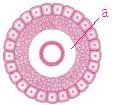
A
Ectoderm
B
Mesoderm
C
Endoderm
D
Pseudocoelom
Solution
(D) The provided figure represents a cross-section of a pseudocoelomate organism (like Aschelminthes).
In this diagram,the outer layer is the ectoderm,the inner layer is the endoderm,and the space between them,labeled '$a$',represents the pseudocoelom (a body cavity that is not lined by mesoderm).
Therefore,the correct option is $D$.
In this diagram,the outer layer is the ectoderm,the inner layer is the endoderm,and the space between them,labeled '$a$',represents the pseudocoelom (a body cavity that is not lined by mesoderm).
Therefore,the correct option is $D$.
0 likes
View Solution78
MediumMCQ
Which of the following statements is correct for the specific animal group mentioned?
A
Molluscs are acoelomates.
B
Insects are pseudocoelomates.
C
Platyhelminthes are coelomates.
D
Wuchereria is a pseudocoelomate.
Solution
(D) $1$. $Molluscs$ (Phylum $Mollusca$) are true coelomates,not acoelomates.
$2$. $Insects$ (Phylum $Arthropoda$) are true coelomates,not pseudocoelomates.
$3$. $Platyhelminthes$ (Flatworms) are acoelomates,not coelomates.
$4$. $Wuchereria$ (Phylum $Aschelminthes$ or $Nematoda$) is a pseudocoelomate organism. Therefore,the statement '$Wuchereria$ is a pseudocoelomate' is correct.
$2$. $Insects$ (Phylum $Arthropoda$) are true coelomates,not pseudocoelomates.
$3$. $Platyhelminthes$ (Flatworms) are acoelomates,not coelomates.
$4$. $Wuchereria$ (Phylum $Aschelminthes$ or $Nematoda$) is a pseudocoelomate organism. Therefore,the statement '$Wuchereria$ is a pseudocoelomate' is correct.
0 likes
View Solution79
EasyMCQ
The first animal group to possess a complete digestive system is .........
A
Platyhelminthes
B
Aschelminthes
C
Annelida
D
Arthropoda
Solution
(B) The phylum $Aschelminthes$ (also known as $Nematoda$) is the first group of animals to exhibit a complete digestive system,which includes a well-developed muscular pharynx and distinct mouth and anus openings.
In contrast,$Platyhelminthes$ possess an incomplete digestive system (a single opening serving as both mouth and anus).
$Annelida$ and $Arthropoda$ also possess complete digestive systems,but they evolved after $Aschelminthes$.
In contrast,$Platyhelminthes$ possess an incomplete digestive system (a single opening serving as both mouth and anus).
$Annelida$ and $Arthropoda$ also possess complete digestive systems,but they evolved after $Aschelminthes$.
0 likes
View Solution80
MediumMCQ
These are animals that are pseudocoelomate, triploblastic, and exhibit bilateral symmetry:
A
Platyhelminthes
B
Aschelminthes
C
Annelida
D
Arthropoda
Solution
(B) $1$. $Platyhelminthes$ are acoelomate, triploblastic, and bilaterally symmetrical.
$2$. $Aschelminthes$ (roundworms) are pseudocoelomate, triploblastic, and bilaterally symmetrical.
$3$. $Annelida$ and $Arthropoda$ are coelomate, triploblastic, and bilaterally symmetrical.
$4$. Therefore, the correct answer is $Aschelminthes$.
$2$. $Aschelminthes$ (roundworms) are pseudocoelomate, triploblastic, and bilaterally symmetrical.
$3$. $Annelida$ and $Arthropoda$ are coelomate, triploblastic, and bilaterally symmetrical.
$4$. Therefore, the correct answer is $Aschelminthes$.
0 likes
View Solution81
EasyMCQ
Which of the following phyla is the first to possess a complete digestive system?
A
Platyhelminthes
B
Annelida
C
Aschelminthes
D
Protozoa
Solution
(C) The phylum $Aschelminthes$ (also known as $Nematoda$ or roundworms) is the first group in the animal kingdom to exhibit a complete digestive system.
This means they possess a distinct alimentary canal with both a mouth and an anus.
In contrast,$Platyhelminthes$ have an incomplete digestive system (a single opening serving as both mouth and anus),while $Protozoa$ are unicellular and do not have a digestive system in the multicellular sense.
This means they possess a distinct alimentary canal with both a mouth and an anus.
In contrast,$Platyhelminthes$ have an incomplete digestive system (a single opening serving as both mouth and anus),while $Protozoa$ are unicellular and do not have a digestive system in the multicellular sense.
0 likes
View Solution82
EasyMCQ
The excretory organ in the phylum Aschelminthes is:
A
Flame cells
B
Renette cells (Excretory pore)
C
Nephridia
D
Green glands
Solution
(B) In the phylum $Aschelminthes$ (also known as $Nematoda$ or roundworms), the excretory system is relatively simple.
An excretory tube removes body wastes from the body cavity through the excretory pore.
These specialized cells or structures involved in excretion are often referred to as $Renette$ cells.
$Flame$ $cells$ are characteristic of $Platyhelminthes$.
$Nephridia$ are characteristic of $Annelida$.
$Green$ $glands$ (or antennary glands) are characteristic of $Arthropoda$ (specifically crustaceans).
An excretory tube removes body wastes from the body cavity through the excretory pore.
These specialized cells or structures involved in excretion are often referred to as $Renette$ cells.
$Flame$ $cells$ are characteristic of $Platyhelminthes$.
$Nephridia$ are characteristic of $Annelida$.
$Green$ $glands$ (or antennary glands) are characteristic of $Arthropoda$ (specifically crustaceans).
0 likes
View Solution83
EasyMCQ
Which of the following is true for $Aschelminthes$?
A
Internal fertilization,indirect development.
B
Complete alimentary canal and extracellular digestion.
C
Internal fertilization,development is often direct,young ones resemble the adults.
D
Excretion occurs through nephridia.
Solution
(B) In $Aschelminthes$ (roundworms),the alimentary canal is complete with a well-developed muscular pharynx.
Digestion is extracellular.
Fertilization is internal,and development may be direct (the young ones resemble the adults) or indirect.
Option $A$ is incorrect because development is not always indirect.
Option $B$ is correct as they possess a complete alimentary canal and exhibit extracellular digestion.
Option $C$ is partially true but $B$ is a more fundamental characteristic defined in the $NCERT$.
Option $D$ is incorrect because excretion in $Aschelminthes$ occurs through an excretory pore,not nephridia (which are found in $Annelida$).
Digestion is extracellular.
Fertilization is internal,and development may be direct (the young ones resemble the adults) or indirect.
Option $A$ is incorrect because development is not always indirect.
Option $B$ is correct as they possess a complete alimentary canal and exhibit extracellular digestion.
Option $C$ is partially true but $B$ is a more fundamental characteristic defined in the $NCERT$.
Option $D$ is incorrect because excretion in $Aschelminthes$ occurs through an excretory pore,not nephridia (which are found in $Annelida$).
0 likes
View Solution84
EasyMCQ
Which of the following is another characteristic of the animal group that first possesses a complete digestive system?
A
Males are smaller than females in size.
B
They are dorso-ventrally flattened acoelomate animals.
C
Closed type of circulatory system.
D
Planula larva is present.
Solution
(A) The animal group that first possesses a complete digestive system with a muscular pharynx is $Aschelminthes$ (Roundworms).
Key characteristics of $Aschelminthes$ include:
$1$. They are pseudocoelomate animals.
$2$. They exhibit sexual dimorphism,where males are smaller than females.
$3$. They have a complete alimentary canal with a well-developed muscular pharynx.
$4$. Therefore,the correct characteristic is that males are smaller than females.
Key characteristics of $Aschelminthes$ include:
$1$. They are pseudocoelomate animals.
$2$. They exhibit sexual dimorphism,where males are smaller than females.
$3$. They have a complete alimentary canal with a well-developed muscular pharynx.
$4$. Therefore,the correct characteristic is that males are smaller than females.
0 likes
View Solution85
EasyMCQ
Which of the following systems are not well-developed in $Aschelminthes$ (roundworms)?
A
Respiratory and digestive
B
Circulatory and respiratory
C
Excretory and nervous
D
Reproductive and excretory
Solution
(B) In $Aschelminthes$ (roundworms),the body organization is organ-system level.
However,they lack a well-developed circulatory system and a respiratory system.
They respire through the general body surface by diffusion.
Therefore,the correct option is $B$.
However,they lack a well-developed circulatory system and a respiratory system.
They respire through the general body surface by diffusion.
Therefore,the correct option is $B$.
0 likes
View Solution86
EasyMCQ
Which of the following characteristics is present in $Ascaris$?
A
Presence of true coelom and metamerism.
B
Absence of true coelom and absence of metamerism.
C
Absence of true coelom and presence of metamerism.
D
Presence of true coelom and absence of metamerism.
Solution
(B) $Ascaris$ belongs to the phylum $Aschelminthes$ (also known as $Nematoda$).
$1$. $Aschelminthes$ are pseudocoelomates,meaning they possess a false coelom (pseudocoelom) rather than a true coelom.
$2$. They do not exhibit metamerism (true segmentation of the body).
Therefore,$Ascaris$ lacks both a true coelom and metamerism.
$1$. $Aschelminthes$ are pseudocoelomates,meaning they possess a false coelom (pseudocoelom) rather than a true coelom.
$2$. They do not exhibit metamerism (true segmentation of the body).
Therefore,$Ascaris$ lacks both a true coelom and metamerism.
0 likes
View Solution87
EasyMCQ
Which of the following organisms possesses a pseudocoelom?
A
Ascaris
B
Tapeworm
C
Liver fluke
D
Planaria
Solution
(A) The organisms belonging to the phylum $Aschelminthes$ (also known as $Nematoda$) are characterized by the presence of a pseudocoelom, where the body cavity is not lined by mesoderm but is present as scattered pouches between the ectoderm and endoderm.
$Ascaris$ (roundworm) belongs to the phylum $Aschelminthes$.
$Tapeworm$ $(Taenia)$, $Liver \text{ } fluke$ $(Fasciola)$, and $Planaria$ belong to the phylum $Platyhelminthes$, which are acoelomate (lacking a body cavity).
$Ascaris$ (roundworm) belongs to the phylum $Aschelminthes$.
$Tapeworm$ $(Taenia)$, $Liver \text{ } fluke$ $(Fasciola)$, and $Planaria$ belong to the phylum $Platyhelminthes$, which are acoelomate (lacking a body cavity).
0 likes
View Solution88
EasyMCQ
In which phylum is the male smaller in size than the female?
A
Annelida
B
Arthropoda
C
Aschelminthes
D
Mollusca
Solution
(C) In the phylum $Aschelminthes$ (also known as $Nematoda$ or roundworms),the organisms exhibit sexual dimorphism.
Specifically,the males are typically smaller in size than the females,and the posterior end of the male is often curved.
Specifically,the males are typically smaller in size than the females,and the posterior end of the male is often curved.
0 likes
View Solution89
EasyMCQ
In which of the following animals is a pseudocoelom found?
A
Ascaris
B
Tapeworm
C
Liver fluke
D
Planaria
Solution
(A) pseudocoelom is a body cavity that is not completely lined by mesoderm. It is a characteristic feature of the phylum $Aschelminthes$ (also known as $Nematoda$).
$Ascaris$ (roundworm) belongs to the phylum $Aschelminthes$ and therefore possesses a pseudocoelom.
$Tapeworm$ $(Taenia)$,$Liver fluke$ $(Fasciola)$,and $Planaria$ belong to the phylum $Platyhelminthes$,which are acoelomate (lacking a body cavity).
$Ascaris$ (roundworm) belongs to the phylum $Aschelminthes$ and therefore possesses a pseudocoelom.
$Tapeworm$ $(Taenia)$,$Liver fluke$ $(Fasciola)$,and $Planaria$ belong to the phylum $Platyhelminthes$,which are acoelomate (lacking a body cavity).
0 likes
View Solution90
EasyMCQ
Which of the following is a characteristic of Ascaris (roundworm)?
A
Presence of true coelom and metamerism.
B
Absence of both true coelom and metamerism.
C
Absence of true coelom but presence of metamerism.
D
Presence of true coelom but absence of metamerism.
Solution
(B) Ascaris belongs to the phylum $Aschelminthes$ (also known as $Nematoda$).
$Aschelminthes$ are characterized by being pseudocoelomates,meaning they possess a false body cavity (pseudocoel) rather than a true coelom.
They also lack metamerism (true segmentation of the body).
Therefore,$Ascaris$ lacks both a true coelom and metamerism.
$Aschelminthes$ are characterized by being pseudocoelomates,meaning they possess a false body cavity (pseudocoel) rather than a true coelom.
They also lack metamerism (true segmentation of the body).
Therefore,$Ascaris$ lacks both a true coelom and metamerism.
0 likes
View Solution91
MediumMCQ
Which of the following groups of animals is bilaterally symmetrical and triploblastic?
A
Aschelminthes
B
Protozoa
C
Porifera
D
Coelenterata
Solution
(A) $1$. Bilateral symmetry refers to the body plan where the body can be divided into identical left and right halves only in one plane.
$2$. Triploblastic refers to animals whose body wall is made up of three germ layers: ectoderm,mesoderm,and endoderm.
$3$. $Aschelminthes$ (roundworms) are the first group in the animal kingdom to exhibit bilateral symmetry and are triploblastic.
$4$. $Protozoa$ are unicellular,$Porifera$ are asymmetrical and diploblastic (or cellular level),and $Coelenterata$ are radially symmetrical and diploblastic.
$5$. Therefore,the correct option is $A$.
$2$. Triploblastic refers to animals whose body wall is made up of three germ layers: ectoderm,mesoderm,and endoderm.
$3$. $Aschelminthes$ (roundworms) are the first group in the animal kingdom to exhibit bilateral symmetry and are triploblastic.
$4$. $Protozoa$ are unicellular,$Porifera$ are asymmetrical and diploblastic (or cellular level),and $Coelenterata$ are radially symmetrical and diploblastic.
$5$. Therefore,the correct option is $A$.
0 likes
View Solution92
MediumMCQ
Which characteristic is possessed by Ascaris (roundworm)?
A
Absence of true coelom but presence of metamerism
B
Absence of both true coelom and metamerism
C
Presence of true coelom but absence of metamerism
D
Presence of both true coelom and metamerism
Solution
(B) $Ascaris$ belongs to the phylum $Aschelminthes$ (also known as $Nematoda$).
$Aschelminthes$ are characterized by being pseudocoelomates,meaning they possess a false body cavity (pseudocoelom) rather than a true coelom.
Furthermore,they do not exhibit metamerism (true segmentation of the body).
Therefore,they lack both a true coelom and metamerism.
$Aschelminthes$ are characterized by being pseudocoelomates,meaning they possess a false body cavity (pseudocoelom) rather than a true coelom.
Furthermore,they do not exhibit metamerism (true segmentation of the body).
Therefore,they lack both a true coelom and metamerism.
0 likes
View Solution93
MediumMCQ
Which of the following statements is correct for the given animal group?
A
Roundworms (Aschelminthes) are pseudocoelomates.
B
Molluscs are acoelomates.
C
Insects are pseudocoelomates.
D
Flatworms (Platyhelminthes) are coelomates.
Solution
(A) $1$. Roundworms (Phylum $Aschelminthes$) possess a body cavity that is not lined by mesoderm,which is known as a pseudocoelom. Thus,they are pseudocoelomates.
$2$. Molluscs are coelomates,not acoelomates.
$3$. Insects (Phylum $Arthropoda$) are coelomates,not pseudocoelomates.
$4$. Flatworms (Phylum $Platyhelminthes$) are acoelomates,not coelomates.
Therefore,the correct statement is that roundworms are pseudocoelomates.
$2$. Molluscs are coelomates,not acoelomates.
$3$. Insects (Phylum $Arthropoda$) are coelomates,not pseudocoelomates.
$4$. Flatworms (Phylum $Platyhelminthes$) are acoelomates,not coelomates.
Therefore,the correct statement is that roundworms are pseudocoelomates.
0 likes
View Solution94
EasyMCQ
In animals belonging to the phylum $Aschelminthes$ (Nematoda), which of the following is true?
A
They are hermaphrodites, so they do not show sexual dimorphism.
B
Males and females are of the same size.
C
Males are smaller in size than females.
D
Males are larger in size than females.
Solution
(C) The phylum $Aschelminthes$ (also known as $Nematoda$ or roundworms) exhibits sexual dimorphism.
In these organisms, the sexes are separate (dioecious).
A key characteristic of sexual dimorphism in this phylum is that the males are typically smaller in size compared to the females.
Therefore, the correct statement is that males are smaller in size than females.
In these organisms, the sexes are separate (dioecious).
A key characteristic of sexual dimorphism in this phylum is that the males are typically smaller in size compared to the females.
Therefore, the correct statement is that males are smaller in size than females.
0 likes
View Solution95
EasyMCQ
In Filaria,the digestive system is complete,which means ........... .
A
Closed at both ends
B
Open at one end
C
Closed at one end
D
Open at both ends
Solution
(D) complete digestive system is defined by the presence of two separate openings: a mouth for ingestion and an anus for egestion. This allows for a one-way flow of food through the alimentary canal. Therefore,a complete digestive system is open at both ends.
0 likes
View Solution96
EasyMCQ
What is the body cavity status of $Vaucheria$?
A
Pseudocoelomate
B
Coelomate
C
Acoelomate
D
Vertebrate
Solution
(A) $Vaucheria$ is a genus of algae (Xanthophyceae). However,in the context of animal classification questions often found in biology,if the question refers to the phylum $Aschelminthes$ (Nematoda) to which $Wuchereria$ (a parasitic roundworm) belongs,it is a pseudocoelomate. Assuming the question intended to ask about $Wuchereria$ (a common organism in the $Aschelminthes$ chapter),the correct answer is Pseudocoelomate. $Vaucheria$ is an alga and does not have a body cavity,but in the context of the provided options and the $Aschelminthes$ topic,$Wuchereria$ is the intended subject.
0 likes
View Solution97
MediumMCQ
Assertion $A$: In $Aschelminthes$, the juvenile form resembles the adult.
Reason $R$: Indirect development is observed in $Aschelminthes$.
Which option is correct for Assertion $A$ and Reason $R$?
Reason $R$: Indirect development is observed in $Aschelminthes$.
Which option is correct for Assertion $A$ and Reason $R$?
A
$A$ and $R$ are both true and $R$ is the correct explanation of $A$.
B
$A$ and $R$ are both true but $R$ is not the correct explanation of $A$.
C
$A$ is true and $R$ is false.
D
$A$ is false and $R$ is true.
Solution
(C) In $Aschelminthes$ (roundworms), the development may be direct or indirect. However, the juvenile form often resembles the adult, which is a characteristic of direct development.
Assertion $A$ is true because the young ones (juveniles) look similar to the adults.
Reason $R$ is false because indirect development involves a larval stage that is morphologically distinct from the adult, whereas $Aschelminthes$ generally exhibit direct development or development where the juvenile resembles the adult. Therefore, $A$ is true and $R$ is false.
Assertion $A$ is true because the young ones (juveniles) look similar to the adults.
Reason $R$ is false because indirect development involves a larval stage that is morphologically distinct from the adult, whereas $Aschelminthes$ generally exhibit direct development or development where the juvenile resembles the adult. Therefore, $A$ is true and $R$ is false.
0 likes
View Solution98
MediumMCQ
Which system is branched in $Ascaris$ (roundworm)?
A
Respiratory system
B
Digestive system
C
Excretory system
D
Circulatory system
Solution
(C) $Ascaris$ belongs to the phylum $Aschelminthes$ (Nematoda).
In $Ascaris$,the digestive system is complete with a well-developed muscular pharynx.
The excretory system in $Ascaris$ consists of an excretory pore and a canal system that is branched throughout the body,which helps in the removal of metabolic wastes.
Therefore,the excretory system is the branched system in $Ascaris$.
In $Ascaris$,the digestive system is complete with a well-developed muscular pharynx.
The excretory system in $Ascaris$ consists of an excretory pore and a canal system that is branched throughout the body,which helps in the removal of metabolic wastes.
Therefore,the excretory system is the branched system in $Ascaris$.
0 likes
View Solution99
EasyMCQ
In $Ascaris$ (roundworm),excretion occurs through which of the following?
A
Excretory canal
B
Flame cells
C
Nephridia
D
Malpighian tubules
Solution
(A) $Ascaris$ belongs to the phylum $Aschelminthes$ (also known as $Nematoda$).
In these organisms,the excretory system consists of an excretory pore and an excretory canal.
The excretory canal removes body wastes from the body cavity through the excretory pore.
Flame cells are characteristic of $Platyhelminthes$ (flatworms).
Nephridia are characteristic of $Annelida$ (earthworms).
Malpighian tubules are characteristic of $Arthropoda$ (insects).
In these organisms,the excretory system consists of an excretory pore and an excretory canal.
The excretory canal removes body wastes from the body cavity through the excretory pore.
Flame cells are characteristic of $Platyhelminthes$ (flatworms).
Nephridia are characteristic of $Annelida$ (earthworms).
Malpighian tubules are characteristic of $Arthropoda$ (insects).
0 likes
View Solution100
EasyMCQ
What type of symmetry do Nematoda (roundworms) exhibit?
A
Radial
B
Biradial
C
Bilateral
D
Asymmetry
Solution
(C) Nematodes, commonly known as roundworms, belong to the phylum $Aschelminthes$ (or $Nematoda$).
These organisms possess a body plan that can be divided into two identical left and right halves through a single plane.
This type of body organization is known as $Bilateral$ symmetry.
Therefore, the correct option is $C$.
These organisms possess a body plan that can be divided into two identical left and right halves through a single plane.
This type of body organization is known as $Bilateral$ symmetry.
Therefore, the correct option is $C$.
0 likes
View SolutionAnimal Kingdom — Phylum - Aschelminthes · Frequently Asked Questions
1Are these Animal Kingdom questions useful for JEE and NEET?
Yes. All questions in this section are mapped to JEE Main and NEET exam patterns. Previous year questions from JEE Main, NEET, GUJCET and state-level exams are included with full solutions.
2Can I switch to Hindi or Gujarati for these questions?
Yes. Use the language tabs in the hero section or the sidebar to view the same questions and solutions in English, Hindi or Gujarati.
3How do I generate a question paper from this subtopic?
Use the Vedclass Exam Paper Generator — select the chapter and subtopic, set difficulty, and generate Sets A, B, C, D automatically. First 3 chapters of every subject are free.
Vedclass Products
For Students
Vedclass Test Series
Mock tests in real JEE/NEET style with performance analysis. 5-day free trial.
Start Free TrialFor Teachers
Exam Paper Generator
Generate Set A/B/C/D papers from this chapter in 2 minutes. 3 chapters free.
Try FreeFor Institutes
Online Exam Module
Live online exams with unlimited students, 360° analytics & white-label branding.
See DemoFor Teachers & Institutes
Generate a Animal Kingdom Exam Paper in 2 Minutes
Select subtopic & difficulty — Sets A, B, C, D auto-generated with No Repeat logic.
First 3 chapters of every subject are free — no payment required.