
A English
Phylum-Annelida Questions in English
Class 11 Biology · Animal Kingdom · Phylum-Annelida
131+
Questions
English
Language
100%
With Solutions
Showing 31 of 131 questions in English
101
MediumMCQ
In which of the following is the respiratory pigment $Chlorocruorin$ found?
A
Earthworm
B
Echinoderms
C
Annelids
D
Lower chordates
Solution
(C) $Chlorocruorin$ is a respiratory pigment found in the blood of certain marine polychaete worms,which belong to the phylum $Annelida$.
It is a green-colored iron-containing protein that functions similarly to hemoglobin in transporting oxygen.
Among the given options,$Annelids$ is the correct group where this pigment is observed.
It is a green-colored iron-containing protein that functions similarly to hemoglobin in transporting oxygen.
Among the given options,$Annelids$ is the correct group where this pigment is observed.
0 likes
View Solution102
MediumMCQ
Which of the following animals does $not$ undergo metamorphosis?
A
Starfish
B
Earthworm
C
Moth
D
Tunicate
Solution
(B) Metamorphosis is a biological process by which an animal physically develops after birth or hatching,involving a conspicuous and relatively abrupt change in the animal's body structure through cell growth and differentiation.
$A$. Starfish undergo indirect development involving a larval stage (e.g.,bipinnaria larva),which is a form of metamorphosis.
$B$. Earthworms exhibit direct development. They hatch from cocoons as miniature versions of the adult,meaning they do not undergo a larval stage or metamorphosis.
$C$. Moths undergo complete metamorphosis,which includes four stages: egg,larva (caterpillar),pupa,and adult.
$D$. Tunicates (Urochordates) undergo retrogressive metamorphosis,where the free-swimming larva possesses a notochord,which is lost in the sessile adult form.
Therefore,the correct answer is $B$.
$A$. Starfish undergo indirect development involving a larval stage (e.g.,bipinnaria larva),which is a form of metamorphosis.
$B$. Earthworms exhibit direct development. They hatch from cocoons as miniature versions of the adult,meaning they do not undergo a larval stage or metamorphosis.
$C$. Moths undergo complete metamorphosis,which includes four stages: egg,larva (caterpillar),pupa,and adult.
$D$. Tunicates (Urochordates) undergo retrogressive metamorphosis,where the free-swimming larva possesses a notochord,which is lost in the sessile adult form.
Therefore,the correct answer is $B$.
0 likes
View Solution103
EasyMCQ
Which of the following animals are true coelomates with bilateral symmetry?
A
Adult Echinoderms
B
Aschelminthes
C
Platyhelminthes
D
Annelids
Solution
(D) $1$. $Annelids$ are $triploblastic$,$bilaterally$ $symmetrical$,and possess a true $coelom$ (schizocoelom).
$2$. $Adult$ $Echinoderms$ exhibit radial symmetry.
$3$. $Aschelminthes$ are $pseudocoelomates$.
$4$. $Platyhelminthes$ are $acoelomates$.
Therefore,the correct option is $D$.
$2$. $Adult$ $Echinoderms$ exhibit radial symmetry.
$3$. $Aschelminthes$ are $pseudocoelomates$.
$4$. $Platyhelminthes$ are $acoelomates$.
Therefore,the correct option is $D$.
0 likes
View Solution104
EasyMCQ
Segmentation in the body is first observed in which of the following:
A
Annelida
B
Aschelminthes
C
Platyhelminthes
D
Arthropoda
Solution
(A) The phenomenon of metameric segmentation,where the body is externally and internally divided into segments with a serial repetition of at least some organs,is first observed in the phylum $Annelida$. The term $Annelida$ is derived from the Latin word $annulus$,meaning 'little ring',referring to the ring-like segments found in these organisms.
0 likes
View Solution105
Medium
Describe the characteristics of Phylum $Annelida$.
Solution
(N/A) The key characteristics of Phylum $Annelida$ are as follows:
$1$. Body Organization: They exhibit organ-system level of body organization and are bilaterally symmetrical.
$2$. Germ Layers: They are triploblastic,coelomate,and protostome animals.
$3$. Segmentation: Their body surface is distinctly marked out into segments or metameres,hence the name $Annelida$ (Latin,$annulus$: little ring).
$4$. Locomotion: They possess longitudinal and circular muscles which help in locomotion. Aquatic annelids like $Nereis$ possess lateral appendages,called parapodia,which help in swimming.
$5$. Circulatory System: $A$ closed circulatory system is present.
$6$. Excretion: Nephridia (singular: nephridium) help in osmoregulation and excretion.
$7$. Nervous System: Neural system consists of paired ganglia connected by lateral nerves to a double ventral nerve cord.
$8$. Reproduction: $Nereis$ (an aquatic form) is dioecious,but earthworms and leeches are monoecious. Reproduction is sexual.
$1$. Body Organization: They exhibit organ-system level of body organization and are bilaterally symmetrical.
$2$. Germ Layers: They are triploblastic,coelomate,and protostome animals.
$3$. Segmentation: Their body surface is distinctly marked out into segments or metameres,hence the name $Annelida$ (Latin,$annulus$: little ring).
$4$. Locomotion: They possess longitudinal and circular muscles which help in locomotion. Aquatic annelids like $Nereis$ possess lateral appendages,called parapodia,which help in swimming.
$5$. Circulatory System: $A$ closed circulatory system is present.
$6$. Excretion: Nephridia (singular: nephridium) help in osmoregulation and excretion.
$7$. Nervous System: Neural system consists of paired ganglia connected by lateral nerves to a double ventral nerve cord.
$8$. Reproduction: $Nereis$ (an aquatic form) is dioecious,but earthworms and leeches are monoecious. Reproduction is sexual.
0 likes
View Solution106
EasyMCQ
Select the correct option:
$(1)$ Annelids are the first animals to possess a circulatory system.
$(2)$ The heart is called myogenic.
$(1)$ Annelids are the first animals to possess a circulatory system.
$(2)$ The heart is called myogenic.
A
Both $(1)$ and $(2)$ are correct.
B
Only $(1)$ is correct.
C
Only $(2)$ is correct.
D
Both $(1)$ and $(2)$ are incorrect.
Solution
(A) $(1)$ Annelids (phylum Annelida) are indeed the first group of animals in the evolutionary hierarchy to possess a closed circulatory system.
$(2)$ $A$ heart is called myogenic when the heartbeat originates from specialized muscle cells (like the $SA$ node in humans) rather than from nerve impulses. This is true for vertebrates.
$(2)$ $A$ heart is called myogenic when the heartbeat originates from specialized muscle cells (like the $SA$ node in humans) rather than from nerve impulses. This is true for vertebrates.
0 likes
View Solution107
EasyMCQ
Which class of animals possesses a closed circulatory system?
A
Arthropoda
B
Mollusca
C
Annelida
D
Echinodermata
Solution
(C) In a closed circulatory system,blood is pumped by the heart into vessels that are separate from the interstitial fluid of the body.
Among the given options,members of the phylum $Annelida$ (e.g.,earthworms) possess a closed circulatory system.
Chordates also possess a closed circulatory system,but among the provided choices,$Annelida$ is the correct representative.
Among the given options,members of the phylum $Annelida$ (e.g.,earthworms) possess a closed circulatory system.
Chordates also possess a closed circulatory system,but among the provided choices,$Annelida$ is the correct representative.
0 likes
View Solution108
Medium
Write the general characters of Phylum Annelida.
Solution
(N/A) $\rightarrow$ Annelids may be aquatic (marine and fresh water) or terrestrial; free-living and sometimes parasitic.
$\rightarrow$ They exhibit organ-system level of body organisation and bilateral symmetry.
$\rightarrow$ They are triploblastic,metamerically segmented,and coelomate animals.
$\rightarrow$ Their body surface is distinctly marked out into segments or metameres and,hence,the phylum name Annelida (Latin,annulus - little ring).
$\rightarrow$ They possess longitudinal and circular muscles which help in locomotion.
$\rightarrow$ Aquatic annelids like $Nereis$ possess lateral appendages,parapodia,which help in swimming.
$\rightarrow$ $A$ closed circulatory system is present.
$\rightarrow$ Nephridia (sing. nephridium) help in osmoregulation and excretion.
$\rightarrow$ Neural system consists of paired ganglia (sing. ganglion) connected by lateral nerves to a double ventral nerve cord.
$\rightarrow$ $Nereis$,an aquatic form,is dioecious,but earthworms and leeches are monoecious.
$\rightarrow$ Reproduction is sexual.
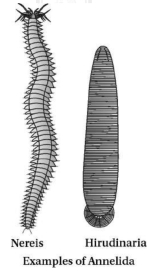
$\rightarrow$ Examples: $Nereis$,$Pheretima$ (Earthworm),and $Hirudinaria$ (Blood-sucking leech).
$\rightarrow$ They exhibit organ-system level of body organisation and bilateral symmetry.
$\rightarrow$ They are triploblastic,metamerically segmented,and coelomate animals.
$\rightarrow$ Their body surface is distinctly marked out into segments or metameres and,hence,the phylum name Annelida (Latin,annulus - little ring).
$\rightarrow$ They possess longitudinal and circular muscles which help in locomotion.
$\rightarrow$ Aquatic annelids like $Nereis$ possess lateral appendages,parapodia,which help in swimming.
$\rightarrow$ $A$ closed circulatory system is present.
$\rightarrow$ Nephridia (sing. nephridium) help in osmoregulation and excretion.
$\rightarrow$ Neural system consists of paired ganglia (sing. ganglion) connected by lateral nerves to a double ventral nerve cord.
$\rightarrow$ $Nereis$,an aquatic form,is dioecious,but earthworms and leeches are monoecious.
$\rightarrow$ Reproduction is sexual.
$\rightarrow$ Examples: $Nereis$,$Pheretima$ (Earthworm),and $Hirudinaria$ (Blood-sucking leech).
0 likes
View Solution109
EasyMCQ
Which of the following options correctly represents the characteristic features of phylum $Annelida$?
A
Diploblastic,mostly marine and radially symmetrical.
B
Triploblastic,unsegmented body and bilaterally symmetrical.
C
Triploblastic,segmented body and bilaterally symmetrical.
D
Triploblastic,flattened body and acoelomate condition.
Solution
(C) Option $C$ is the correct answer.
$1$. Members of phylum $Annelida$ are triploblastic,meaning they possess three germ layers (ectoderm,mesoderm,and endoderm).
$2$. They exhibit bilateral symmetry,where the body can be divided into two identical left and right halves.
$3$. $A$ key characteristic of $Annelida$ is metameric segmentation,where the body is divided into segments or metameres.
$4$. They are also coelomates,possessing a true body cavity.
Option $A$ describes features of phylum $Cnidaria$. Option $B$ describes features of some other invertebrates but lacks segmentation. Option $D$ describes the characteristics of phylum $Platyhelminthes$.
$1$. Members of phylum $Annelida$ are triploblastic,meaning they possess three germ layers (ectoderm,mesoderm,and endoderm).
$2$. They exhibit bilateral symmetry,where the body can be divided into two identical left and right halves.
$3$. $A$ key characteristic of $Annelida$ is metameric segmentation,where the body is divided into segments or metameres.
$4$. They are also coelomates,possessing a true body cavity.
Option $A$ describes features of phylum $Cnidaria$. Option $B$ describes features of some other invertebrates but lacks segmentation. Option $D$ describes the characteristics of phylum $Platyhelminthes$.
0 likes
View Solution110
MediumMCQ
Which one of the following exhibits a concentric '$tube\; within\; tube$' body plan?
A
Cnidaria
B
Annelida
C
Platyhelminthes
D
Nematoda
Solution
(B) In $Annelida$,the alimentary canal is a straight tube extending from the anterior mouth to the posterior anus.
Because they possess a true coelom (a fluid-filled body cavity) between the body wall and the alimentary canal,their body structure is described as a '$tube\; within\; a\; tube$' plan.
This indicates a complete digestive system with two separate openings.
Because they possess a true coelom (a fluid-filled body cavity) between the body wall and the alimentary canal,their body structure is described as a '$tube\; within\; a\; tube$' plan.
This indicates a complete digestive system with two separate openings.
0 likes
View Solution111
EasyMCQ
Annelids have a central nerve cord that is
A
Impermeable to $K^+$
B
Hollow
C
Dorsal
D
Ventral
Solution
(D) In $Annelida$,the nervous system consists of paired ganglia connected by lateral nerves to a double ventral nerve cord. Unlike chordates,which possess a dorsal hollow nerve cord,annelids possess a ventral nerve cord.
0 likes
View Solution112
MediumMCQ
The phylum $Annelida$ is named so because of:
A
More organs are placed towards the anterior part of the body
B
The presence of antenna
C
Anteriorly placed neural system
D
The presence of metameres
Solution
(D) The phylum $Annelida$ derives its name from the Latin word '$annulus$',which means 'little ring'.
This is because the bodies of animals belonging to this phylum are divided into distinct segments or metameres,a phenomenon known as metamerism.
This is because the bodies of animals belonging to this phylum are divided into distinct segments or metameres,a phenomenon known as metamerism.
0 likes
View Solution113
EasyMCQ
Metameric segmentation is exhibited by which of the following animals?
A
Adamsia
B
Euspongia
C
Ascaris
D
Pheretima
Solution
(D) Metameric segmentation is a condition where the animal body is divided both externally and internally into distinct,repeating units called metameres or segments.
In the phylum $Annelida$,both external and internal segmentation is present,meaning the body of annelids is metamerically segmented.
$Pheretima$,commonly known as the earthworm,is an annelid belonging to the class $Oligochaeta$.
In the phylum $Annelida$,both external and internal segmentation is present,meaning the body of annelids is metamerically segmented.
$Pheretima$,commonly known as the earthworm,is an annelid belonging to the class $Oligochaeta$.
0 likes
View Solution114
MediumMCQ
$A$: True coelom originated for the first time in phylum $Annelida$.
$R$: It allowed the animal to have an alimentary canal longer than the body and space for storing gametes.
$R$: It allowed the animal to have an alimentary canal longer than the body and space for storing gametes.
A
Assertion and Reason both are correct and Reason is the correct explanation of Assertion.
B
Assertion and Reason both are correct but Reason is not the correct explanation of Assertion.
C
Assertion is correct,but Reason is incorrect.
D
Both Assertion and Reason are incorrect.
Solution
(B) Assertion is true: $A$ true coelom (a body cavity lined by mesoderm on all sides) originated for the first time in the phylum $Annelida$.
Reason is true: The development of a true coelom provides space for the development of complex organ systems,allows the alimentary canal to be longer than the body (coiling),and provides space for storing gametes.
However,the reason provided is a consequence of having a coelom,but it does not explain why the coelom originated for the first time in $Annelida$. Therefore,both are correct,but the reason is not the correct explanation for the assertion.
Reason is true: The development of a true coelom provides space for the development of complex organ systems,allows the alimentary canal to be longer than the body (coiling),and provides space for storing gametes.
However,the reason provided is a consequence of having a coelom,but it does not explain why the coelom originated for the first time in $Annelida$. Therefore,both are correct,but the reason is not the correct explanation for the assertion.
0 likes
View Solution115
MediumMCQ
$A$ student was given a specimen to identify on the basis of the characteristics given below.
$(i)$ They are metamerically segmented.
$(ii)$ Presence of closed circulatory system.
$(iii)$ They have circular and longitudinal muscles for locomotion.
Identify the specimen.
$(i)$ They are metamerically segmented.
$(ii)$ Presence of closed circulatory system.
$(iii)$ They have circular and longitudinal muscles for locomotion.
Identify the specimen.
A
Frog
B
Pheretima
C
Cockroach
D
Rabbit
Solution
(B) The given characteristics describe an earthworm $(Pheretima)$.
$(i)$ Earthworms belong to the phylum $Annelida$,which is characterized by metameric segmentation (true segmentation).
$(ii)$ They possess a closed circulatory system,where blood flows through vessels.
$(iii)$ They utilize circular and longitudinal muscles in their body wall to facilitate locomotion through burrowing.
Therefore,the correct specimen is $Pheretima$.
$(i)$ Earthworms belong to the phylum $Annelida$,which is characterized by metameric segmentation (true segmentation).
$(ii)$ They possess a closed circulatory system,where blood flows through vessels.
$(iii)$ They utilize circular and longitudinal muscles in their body wall to facilitate locomotion through burrowing.
Therefore,the correct specimen is $Pheretima$.
0 likes
View Solution116
EasyMCQ
Which of the following is hermaphrodite?
A
Ant
B
Aphids
C
Earthworm
D
Cockroach
Solution
(C) Hermaphrodite organisms,also known as bisexual or monoecious,are those that possess both male and female reproductive organs in the same individual.
Among the given options,the earthworm $(Pheretima)$ is a classic example of a hermaphrodite.
Ants,aphids,and cockroaches are unisexual (dioecious) organisms,meaning they have separate male and female individuals.
Among the given options,the earthworm $(Pheretima)$ is a classic example of a hermaphrodite.
Ants,aphids,and cockroaches are unisexual (dioecious) organisms,meaning they have separate male and female individuals.
0 likes
View Solution117
EasyMCQ
What is the location and function of parapodia or chitinous setae?
A
Location: Arthropods; Function: Respiration
B
Location: Annelids; Function: Locomotion
C
Location: Mollusks; Function: Feeding
D
Location: Echinoderms; Function: Protection
Solution
(B) $\rightarrow$ Location: Parapodia are lateral appendages found in members of the phylum $Annelida$ (e.g.,$Nereis$).
$\rightarrow$ Function: They primarily assist in locomotion and sometimes in respiration.
$\rightarrow$ Function: They primarily assist in locomotion and sometimes in respiration.
0 likes
View Solution118
EasyMCQ
What is the location and function of nephridia?
A
Excretion in Arthropoda
B
Excretion in Annelida
C
Respiration in Mollusca
D
Digestion in Platyhelminthes
Solution
(B) Location: Nephridia are the excretory organs found in members of the phylum $Annelida$ (e.g., earthworms).
Function: They play a crucial role in excretion (removal of nitrogenous waste) and osmoregulation (maintaining the water and salt balance) within the organism.
Function: They play a crucial role in excretion (removal of nitrogenous waste) and osmoregulation (maintaining the water and salt balance) within the organism.
0 likes
View Solution119
EasyMCQ
Animals of this phylum excrete through nephridia.
A
Platyhelminthes
B
Annelida
C
Arthropoda
D
Aschelminthes
Solution
(B) In the phylum $Annelida$, the excretory organs are known as nephridia $(singular: nephridium)$.
These structures help in osmoregulation and excretion of nitrogenous wastes.
$Platyhelminthes$ use flame cells for excretion.
$Arthropoda$ use Malpighian tubules or green glands.
$Aschelminthes$ use the renette cell or excretory pore system.
These structures help in osmoregulation and excretion of nitrogenous wastes.
$Platyhelminthes$ use flame cells for excretion.
$Arthropoda$ use Malpighian tubules or green glands.
$Aschelminthes$ use the renette cell or excretory pore system.
0 likes
View Solution120
EasyMCQ
The first circulatory system is observed in the members of this phylum.
A
Aschelminthes
B
Annelida
C
Arthropoda
D
Mollusca
Solution
(B) The phylum $Annelida$ is the first group of animals in the evolutionary sequence to possess a true circulatory system. $Annelids$ exhibit a closed circulatory system, which includes blood vessels and a heart, allowing for efficient transport of nutrients and gases throughout the body. Lower phyla such as $Aschelminthes$ lack a specialized circulatory system and rely on diffusion.
0 likes
View Solution121
MediumMCQ
Match the following columns:
| Column-$I$ (Animal) | Column-$II$ (Genus) |
| $P$. Sandworm | $I$. Nereis |
| $Q$. Earthworm | $II$. Hirudinaria |
| $R$. Leech | $III$. Pheretima |
A
$(P-I), (Q-III), (R-II)$
B
$(P-III), (Q-I), (R-II)$
C
$(P-II), (Q-I), (R-III)$
D
$(P-II), (Q-III), (R-I)$
Solution
(A) The correct matches are as follows:
$1$. Sandworm is scientifically known as $Nereis$ $(P-I)$.
$2$. Earthworm is scientifically known as $Pheretima$ $(Q-III)$.
$3$. Leech is scientifically known as $Hirudinaria$ $(R-II)$.
Therefore, the correct sequence is $(P-I), (Q-III), (R-II)$.
$1$. Sandworm is scientifically known as $Nereis$ $(P-I)$.
$2$. Earthworm is scientifically known as $Pheretima$ $(Q-III)$.
$3$. Leech is scientifically known as $Hirudinaria$ $(R-II)$.
Therefore, the correct sequence is $(P-I), (Q-III), (R-II)$.
0 likes
View Solution122
MediumMCQ
The aquatic animals of this phylum possess parapodia for locomotion.
A
Platyhelminthes
B
Aschelminthes
C
Annelida
D
Arthropoda
Solution
(C) Parapodia are lateral appendages found in many annelids,particularly in the class Polychaeta (e.g.,Nereis). These structures are used for swimming,crawling,and respiration. Therefore,the correct phylum is Annelida.
0 likes
View Solution123
MediumMCQ
In $Leech$,excretion occurs through ...... .
A
Flame cells
B
Excretory tubules
C
Malpighian tubules
D
Nephridia
Solution
(D) The $Leech$ (Hirudinaria) belongs to the phylum $Annelida$.
In annelids,the primary excretory organs are segmentally arranged tubular structures called $Nephridia$.
These structures help in osmoregulation and the excretion of nitrogenous wastes.
Therefore,excretion in $Leech$ occurs through $Nephridia$.
In annelids,the primary excretory organs are segmentally arranged tubular structures called $Nephridia$.
These structures help in osmoregulation and the excretion of nitrogenous wastes.
Therefore,excretion in $Leech$ occurs through $Nephridia$.
0 likes
View Solution124
MediumMCQ
The term $Annulus$ is derived from which language?
A
Greek
B
Latin
C
English
D
French
Solution
(B) The term $Annulus$ is derived from the $Latin$ word $annulus$, which means 'little ring'.
This term is used to describe the segmented body structure characteristic of the phylum $Annelida$.
This term is used to describe the segmented body structure characteristic of the phylum $Annelida$.
0 likes
View Solution125
EasyMCQ
Which of the following species are earthworms?
$I-$ Nereis,$II-$ Pheretima
$III-$ Hirudinaria,$IV-$ Lumbricus
$V-$ Periplaneta
$I-$ Nereis,$II-$ Pheretima
$III-$ Hirudinaria,$IV-$ Lumbricus
$V-$ Periplaneta
A
$II, V$
B
$III, V$
C
$II, IV$
D
$I, II$
Solution
(C) The classification of the given organisms is as follows:
$I-$ Nereis is a marine annelid (polychaete).
$II-$ Pheretima is a genus of earthworm (oligochaete).
$III-$ Hirudinaria is a genus of leech (hirudinea).
$IV-$ Lumbricus is a genus of earthworm (oligochaete).
$V-$ Periplaneta is a genus of cockroach (arthropod).
Therefore,$II$ (Pheretima) and $IV$ (Lumbricus) are earthworms.
$I-$ Nereis is a marine annelid (polychaete).
$II-$ Pheretima is a genus of earthworm (oligochaete).
$III-$ Hirudinaria is a genus of leech (hirudinea).
$IV-$ Lumbricus is a genus of earthworm (oligochaete).
$V-$ Periplaneta is a genus of cockroach (arthropod).
Therefore,$II$ (Pheretima) and $IV$ (Lumbricus) are earthworms.
0 likes
View Solution126
MediumMCQ
Which annelid is dioecious?
A
Earthworm
B
Leech
C
Nereis
D
Ascaris
Solution
(C) In the phylum $Annelida$,most species are hermaphroditic (monoecious),meaning both male and female reproductive organs are present in the same individual. Examples include $Pheretima$ (Earthworm) and $Hirudinaria$ (Leech).
However,$Nereis$ is an aquatic annelid that is dioecious,meaning the sexes are separate (male and female individuals are distinct).
$Ascaris$ is not an annelid; it belongs to the phylum $Aschelminthes$ (Nematoda).
Therefore,the correct answer is $Nereis$.
However,$Nereis$ is an aquatic annelid that is dioecious,meaning the sexes are separate (male and female individuals are distinct).
$Ascaris$ is not an annelid; it belongs to the phylum $Aschelminthes$ (Nematoda).
Therefore,the correct answer is $Nereis$.
0 likes
View Solution127
MediumMCQ
Given below are two statements. One is labelled as Assertion $(A)$ and other is labelled as its Reason $(R)$.
Assertion $(A) :$ In $Nereis$,longitudinal and circular muscles help in locomotion.
Reason $(R) :$ $Nereis$ is an aquatic annelid which is monoecious and possesses lateral appendages called parapodia,which help in swimming.
Assertion $(A) :$ In $Nereis$,longitudinal and circular muscles help in locomotion.
Reason $(R) :$ $Nereis$ is an aquatic annelid which is monoecious and possesses lateral appendages called parapodia,which help in swimming.
A
$(A)$ is true but $(R)$ is false
B
$(A)$ is false,$(R)$ is true
C
Both $(A)$ and $(R)$ are true and $(R)$ is not the correct explanation of $(A)$
D
Both $(A)$ and $(R)$ are true and $(R)$ is the correct explanation of $(A)$
Solution
(A) Assertion $(A)$ is true because $Nereis$ uses both longitudinal and circular muscles for locomotion,which is a characteristic feature of annelids.
Reason $(R)$ is false because $Nereis$ is dioecious (unisexual),not monoecious. While it is an aquatic annelid that possesses parapodia for swimming,the statement regarding its reproductive nature is incorrect.
Reason $(R)$ is false because $Nereis$ is dioecious (unisexual),not monoecious. While it is an aquatic annelid that possesses parapodia for swimming,the statement regarding its reproductive nature is incorrect.
0 likes
View Solution128
MediumMCQ
In the animal kingdom,the first time appearance of a true coelom is present in:
A
Platyhelminthes
B
Annelida
C
Coelenterata
D
Protozoa
Solution
(B) true coelom is a body cavity that is lined by mesoderm on all sides.
In the animal kingdom,the phylum $Annelida$ is the first group to exhibit a true coelom (eucoelom).
$Platyhelminthes$ are acoelomate (lack a body cavity).
$Coelenterata$ (Cnidaria) are also acoelomate.
$Protozoa$ are unicellular organisms and do not possess a body cavity or tissue-level organization.
Therefore,the correct answer is $Annelida$.
In the animal kingdom,the phylum $Annelida$ is the first group to exhibit a true coelom (eucoelom).
$Platyhelminthes$ are acoelomate (lack a body cavity).
$Coelenterata$ (Cnidaria) are also acoelomate.
$Protozoa$ are unicellular organisms and do not possess a body cavity or tissue-level organization.
Therefore,the correct answer is $Annelida$.
0 likes
View Solution129
MediumMCQ
Closed circulatory system is found in?
A
Cockroach
B
Neopilina
C
Pila
D
Nereis
Solution
(D) closed circulatory system is one in which blood is confined to blood vessels and does not come into direct contact with the body tissues.
Among the given options:
$1$. $Cockroach$ (Phylum $Arthropoda$) has an open circulatory system.
$2$. $Neopilina$ (Phylum $Mollusca$) has an open circulatory system.
$3$. $Pila$ (Phylum $Mollusca$) has an open circulatory system.
$4$. $Nereis$ (Phylum $Annelida$) possesses a closed circulatory system,which is a characteristic feature of most annelids.
Among the given options:
$1$. $Cockroach$ (Phylum $Arthropoda$) has an open circulatory system.
$2$. $Neopilina$ (Phylum $Mollusca$) has an open circulatory system.
$3$. $Pila$ (Phylum $Mollusca$) has an open circulatory system.
$4$. $Nereis$ (Phylum $Annelida$) possesses a closed circulatory system,which is a characteristic feature of most annelids.
0 likes
View Solution130
EasyMCQ
Read the following four statements $(A-D)$:
$(A)$ Annelids possess only longitudinal muscles which help in locomotion.
$(B)$ Nephridia do not help in excretion and osmoregulation.
$(C)$ Closed type circulatory system is present in most of annelids.
$(D)$ Members of phylum Annelida are triploblastic,metamerically segmented,and acoelomate.
How many of the above statements are incorrect?
$(A)$ Annelids possess only longitudinal muscles which help in locomotion.
$(B)$ Nephridia do not help in excretion and osmoregulation.
$(C)$ Closed type circulatory system is present in most of annelids.
$(D)$ Members of phylum Annelida are triploblastic,metamerically segmented,and acoelomate.
How many of the above statements are incorrect?
A
$2$
B
$3$
C
$1$
D
$4$
Solution
(B) Let us analyze each statement:
$(A)$ Annelids possess both longitudinal and circular muscles which help in locomotion. Thus,statement $(A)$ is incorrect.
$(B)$ Nephridia are the excretory organs in annelids that help in excretion and osmoregulation. Thus,statement $(B)$ is incorrect.
$(C)$ $A$ closed type circulatory system is present in most annelids. Thus,statement $(C)$ is correct.
$(D)$ Members of phylum Annelida are triploblastic,metamerically segmented,and coelomate (not acoelomate). Thus,statement $(D)$ is incorrect.
Therefore,statements $(A)$,$(B)$,and $(D)$ are incorrect. The total number of incorrect statements is $3$.
$(A)$ Annelids possess both longitudinal and circular muscles which help in locomotion. Thus,statement $(A)$ is incorrect.
$(B)$ Nephridia are the excretory organs in annelids that help in excretion and osmoregulation. Thus,statement $(B)$ is incorrect.
$(C)$ $A$ closed type circulatory system is present in most annelids. Thus,statement $(C)$ is correct.
$(D)$ Members of phylum Annelida are triploblastic,metamerically segmented,and coelomate (not acoelomate). Thus,statement $(D)$ is incorrect.
Therefore,statements $(A)$,$(B)$,and $(D)$ are incorrect. The total number of incorrect statements is $3$.
0 likes
View Solution131
EasyMCQ
Solid,ventral,one pair of nerve cord found in the members of which phylum?
A
Coelenterata
B
Ctenophora
C
Protozoa
D
Annelida
Solution
(D) The presence of a solid,ventral,and double nerve cord is a characteristic feature of the phylum $Annelida$. In these organisms,the nervous system consists of a pair of cerebral ganglia connected by a nerve ring to a double ventral nerve cord that runs the length of the body,with ganglia present in each segment.
0 likes
View SolutionAnimal Kingdom — Phylum-Annelida · Frequently Asked Questions
1Are these Animal Kingdom questions useful for JEE and NEET?
Yes. All questions in this section are mapped to JEE Main and NEET exam patterns. Previous year questions from JEE Main, NEET, GUJCET and state-level exams are included with full solutions.
2Can I switch to Hindi or Gujarati for these questions?
Yes. Use the language tabs in the hero section or the sidebar to view the same questions and solutions in English, Hindi or Gujarati.
3How do I generate a question paper from this subtopic?
Use the Vedclass Exam Paper Generator — select the chapter and subtopic, set difficulty, and generate Sets A, B, C, D automatically. First 3 chapters of every subject are free.
Vedclass Products
For Students
Vedclass Test Series
Mock tests in real JEE/NEET style with performance analysis. 5-day free trial.
Start Free TrialFor Teachers
Exam Paper Generator
Generate Set A/B/C/D papers from this chapter in 2 minutes. 3 chapters free.
Try FreeFor Institutes
Online Exam Module
Live online exams with unlimited students, 360° analytics & white-label branding.
See DemoFor Teachers & Institutes
Generate a Animal Kingdom Exam Paper in 2 Minutes
Select subtopic & difficulty — Sets A, B, C, D auto-generated with No Repeat logic.
First 3 chapters of every subject are free — no payment required.