
A English
Phylum-Annelida Questions in English
Class 11 Biology · Animal Kingdom · Phylum-Annelida
131+
Questions
English
Language
100%
With Solutions
Showing 50 of 131 questions in English
51
MediumMCQ
$Parapodia$ are lateral appendages used for locomotion in which of the following organisms?
A
$Scolopendra$
B
$Nereis$
C
$Centipede$
D
$Earthworm$
Solution
(B) $Parapodia$ are lateral,fleshy,paired appendages found in the members of the phylum $Annelida$,specifically in the class $Polychaeta$.
$Nereis$ is a well-known example of a polychaete annelid that uses $parapodia$ for swimming and crawling (locomotion).
$Scolopendra$ and $Centipedes$ belong to the phylum $Arthropoda$ and possess jointed legs.
$Earthworms$ (like $Pheretima$) belong to the class $Oligochaeta$ and use $setae$ for locomotion,not $parapodia$.
$Nereis$ is a well-known example of a polychaete annelid that uses $parapodia$ for swimming and crawling (locomotion).
$Scolopendra$ and $Centipedes$ belong to the phylum $Arthropoda$ and possess jointed legs.
$Earthworms$ (like $Pheretima$) belong to the class $Oligochaeta$ and use $setae$ for locomotion,not $parapodia$.
0 likes
View Solution52
EasyMCQ
Aphrodite, known as the "Sea Mouse", is a/an .........
A
Annelid
B
Mollusc
C
Insect
D
Mammal
Solution
(A) Aphrodite is a genus of marine polychaete worms belonging to the phylum $Annelida$.
It is commonly known as the "Sea Mouse" because its body is covered with a dense mat of setae (bristles) that gives it a fuzzy, mouse-like appearance.
Therefore, it is classified as an annelid.
It is commonly known as the "Sea Mouse" because its body is covered with a dense mat of setae (bristles) that gives it a fuzzy, mouse-like appearance.
Therefore, it is classified as an annelid.
0 likes
View Solution53
MediumMCQ
Larval stages are absent in the life cycle of . . . . . . .
A
Pheretima
B
Taenia
C
Musca
D
Rana
Solution
(A) The life cycle of $Pheretima$ (earthworm) is direct,meaning it does not involve any larval stages. The young ones resemble the adults.
In contrast,$Taenia$ (tapeworm) has multiple larval stages like onchosphere and cysticercus.
$Musca$ (housefly) undergoes complete metamorphosis involving egg,larva,pupa,and adult stages.
$Rana$ (frog) has an aquatic larval stage known as a tadpole.
In contrast,$Taenia$ (tapeworm) has multiple larval stages like onchosphere and cysticercus.
$Musca$ (housefly) undergoes complete metamorphosis involving egg,larva,pupa,and adult stages.
$Rana$ (frog) has an aquatic larval stage known as a tadpole.
0 likes
View Solution54
EasyMCQ
Which type of metamerism is observed in earthworms?
A
Heteronomous metamerism
B
Homonomous metamerism
C
Pseudometamerism
D
Dimerism
Solution
(B) Earthworms exhibit homonomous metamerism.
In this type of segmentation,the body is divided into a series of similar segments called metameres or somites.
Each segment is externally and internally similar to the others,containing repeated sets of organs such as nephridia,ganglia,and blood vessels.
This is a characteristic feature of the phylum Annelida.
In this type of segmentation,the body is divided into a series of similar segments called metameres or somites.
Each segment is externally and internally similar to the others,containing repeated sets of organs such as nephridia,ganglia,and blood vessels.
This is a characteristic feature of the phylum Annelida.
0 likes
View Solution55
MediumMCQ
Which animal group exhibits metameric segmentation (true segmentation) of the body?
A
Mollusca
B
Annelida
C
Cnidaria
D
Porifera
Solution
(B) Metameric segmentation,also known as metamerism,is a characteristic feature where the body is externally and internally divided into segments with a serial repetition of at least some organs.
In the phylum $Annelida$,the body surface is distinctly marked out into segments or metameres,hence the name $Annelida$ (Latin,$annulus$: little ring).
$Mollusca$ are generally unsegmented,$Cnidaria$ exhibit radial symmetry without true segmentation,and $Porifera$ are cellular-level organisms without segmentation.
In the phylum $Annelida$,the body surface is distinctly marked out into segments or metameres,hence the name $Annelida$ (Latin,$annulus$: little ring).
$Mollusca$ are generally unsegmented,$Cnidaria$ exhibit radial symmetry without true segmentation,and $Porifera$ are cellular-level organisms without segmentation.
0 likes
View Solution56
EasyMCQ
What type of body cavity (coelom) is present in an earthworm?
A
Acoelomate
B
Pseudocoelomate
C
True coelomate (Schizocoelomate)
D
Haemocoelomate
Solution
(C) Earthworms belong to the phylum $Annelida$.
In $Annelida$,the body cavity is a true coelom,which is lined by mesoderm on both sides.
Specifically,it is a schizocoelom,formed by the splitting of the mesodermal bands during embryonic development.
Therefore,the correct type of body cavity in an earthworm is a true coelom.
In $Annelida$,the body cavity is a true coelom,which is lined by mesoderm on both sides.
Specifically,it is a schizocoelom,formed by the splitting of the mesodermal bands during embryonic development.
Therefore,the correct type of body cavity in an earthworm is a true coelom.
0 likes
View Solution57
MediumMCQ
Which of the following animals possesses a closed circulatory system containing blood capillaries?
A
Pheretima (Earthworm)
B
Dentalium
C
Nereis (Sandworm)
D
Chiton
Solution
(A) The animal $Pheretima$ (Earthworm) belongs to the phylum $Annelida$. Members of the phylum $Annelida$ possess a closed circulatory system,which includes a network of blood vessels and blood capillaries. $Dentalium$,$Chiton$,and $Nereis$ (with some exceptions) typically lack a well-developed closed circulatory system compared to the earthworm. Therefore,$Pheretima$ is the correct answer.
0 likes
View Solution58
EasyMCQ
Which of the following phyla is the first to possess a true coelom?
A
Amphibia
B
Arthropoda
C
Annelida
D
Pisces
Solution
(C) true coelom is a body cavity that is completely lined by mesoderm.
Among the given options,the phylum $Annelida$ is the first group of animals in the evolutionary sequence to exhibit a true coelom (eucoelomate condition).
$Platyhelminthes$ are acoelomate,and $Aschelminthes$ (Nematoda) are pseudocoelomate.
Therefore,$Annelida$ represents the first appearance of a true coelom in the animal kingdom.
Among the given options,the phylum $Annelida$ is the first group of animals in the evolutionary sequence to exhibit a true coelom (eucoelomate condition).
$Platyhelminthes$ are acoelomate,and $Aschelminthes$ (Nematoda) are pseudocoelomate.
Therefore,$Annelida$ represents the first appearance of a true coelom in the animal kingdom.
0 likes
View Solution59
EasyMCQ
Which of the following is a coelomate animal phylum?
A
Platyhelminthes
B
Aschelminthes
C
Protozoa
D
Annelida
Solution
(D) The classification of animals based on the presence or absence of a body cavity (coelom) is as follows:
$1$. Acoelomates: Animals in which the body cavity is absent,such as $Platyhelminthes$.
$2$. Pseudocoelomates: Animals in which the body cavity is not lined by mesoderm,such as $Aschelminthes$.
$3$. Coelomates: Animals possessing a true body cavity lined by mesoderm. $Annelida$,$Mollusca$,$Arthropoda$,$Echinodermata$,$Hemichordata$,and $Chordata$ are coelomates.
Therefore,$Annelida$ is a coelomate phylum.
$1$. Acoelomates: Animals in which the body cavity is absent,such as $Platyhelminthes$.
$2$. Pseudocoelomates: Animals in which the body cavity is not lined by mesoderm,such as $Aschelminthes$.
$3$. Coelomates: Animals possessing a true body cavity lined by mesoderm. $Annelida$,$Mollusca$,$Arthropoda$,$Echinodermata$,$Hemichordata$,and $Chordata$ are coelomates.
Therefore,$Annelida$ is a coelomate phylum.
0 likes
View Solution60
EasyMCQ
The first animal phylum to possess a true coelom is:
A
Arthropoda
B
Chordata
C
Annelida
D
Mollusca
Solution
(C) The $true \ coelom$ (or $eucoelom$) is a body cavity that is completely lined by mesoderm.
In the evolutionary hierarchy of animals,$Annelida$ is the first phylum to exhibit a true coelom.
$Platyhelminthes$ are acoelomate,$Aschelminthes$ (Nematoda) are pseudocoelomate,and $Annelida$ marks the beginning of the coelomate condition.
In the evolutionary hierarchy of animals,$Annelida$ is the first phylum to exhibit a true coelom.
$Platyhelminthes$ are acoelomate,$Aschelminthes$ (Nematoda) are pseudocoelomate,and $Annelida$ marks the beginning of the coelomate condition.
0 likes
View Solution61
EasyMCQ
Which animal's body is divided into similar segments both externally and internally?
A
Ascaris
B
Tapeworm
C
Liver fluke
D
Earthworm
Solution
(D) The phenomenon where the body is externally and internally divided into segments with a serial repetition of at least some organs is called metamerism. This is a characteristic feature of the phylum Annelida. Among the given options,the earthworm $(Pheretima)$ belongs to the phylum Annelida and exhibits true metameric segmentation. Ascaris is a roundworm (Aschelminthes),while Tapeworm and Liver fluke are flatworms (Platyhelminthes),which do not show true metamerism.
0 likes
View Solution62
EasyMCQ
What is the phenomenon called where the body of some animals is externally and internally divided into segments with a serial repetition of at least some organs?
A
Asymmetry
B
Symmetry
C
Metamerism
D
Assegmentation
Solution
(C) The phenomenon in which the body of an animal is externally and internally divided into segments with a serial repetition of at least some organs is known as $Metamerism$. This is a characteristic feature of the phylum $Annelida$ (e.g.,earthworm). Therefore,the correct option is $C$.
0 likes
View Solution63
EasyMCQ
What is the phenomenon called where the body of some animals is divided into identical segments both externally and internally?
A
Segmentation
B
Metamerism
C
Homonomy
D
Heteronomy
Solution
(B) The phenomenon where the body of an animal is externally and internally divided into repeated segments is known as $Metamerism$.
This is a characteristic feature of the phylum $Annelida$ (e.g.,earthworms).
In $Metamerism$,the body is divided into a series of similar segments called $metameres$ or $somites$.
This is a characteristic feature of the phylum $Annelida$ (e.g.,earthworms).
In $Metamerism$,the body is divided into a series of similar segments called $metameres$ or $somites$.
0 likes
View Solution64
EasyMCQ
The first phylum of animals to exhibit a true coelom is:
A
Platyhelminthes
B
Cnidaria
C
Annelida
D
Arthropoda
Solution
(C) The true coelom is a body cavity that is completely lined by mesoderm.
In the animal kingdom,the phylum $Annelida$ is the first group to possess a true coelom (eucoelom).
$Platyhelminthes$ are acoelomates,$Cnidaria$ are diploblastic and lack a body cavity,and while $Arthropoda$ are coelomates,they appear later in the evolutionary sequence than $Annelida$.
In the animal kingdom,the phylum $Annelida$ is the first group to possess a true coelom (eucoelom).
$Platyhelminthes$ are acoelomates,$Cnidaria$ are diploblastic and lack a body cavity,and while $Arthropoda$ are coelomates,they appear later in the evolutionary sequence than $Annelida$.
0 likes
View Solution65
EasyMCQ
Which of the following animal groups exhibits bilateral symmetry,is coelomate,triploblastic,and shows metameric segmentation?
A
Annelida
B
Protozoa
C
Aschelminthes
D
Platyhelminthes
Solution
(A) The characteristics provided are:
$1$. Bilateral symmetry: The body can be divided into identical left and right halves in only one plane.
$2$. Coelomate: Possesses a true body cavity lined by mesoderm.
$3$. Triploblastic: The body is derived from three germ layers (ectoderm,mesoderm,and endoderm).
$4$. Metameric segmentation: The body is externally and internally divided into segments with a serial repetition of at least some organs.
These features are diagnostic of the phylum $Annelida$ (e.g.,earthworms,leeches).
$Protozoa$ are unicellular,$Platyhelminthes$ are acoelomate,and $Aschelminthes$ are pseudocoelomate.
$1$. Bilateral symmetry: The body can be divided into identical left and right halves in only one plane.
$2$. Coelomate: Possesses a true body cavity lined by mesoderm.
$3$. Triploblastic: The body is derived from three germ layers (ectoderm,mesoderm,and endoderm).
$4$. Metameric segmentation: The body is externally and internally divided into segments with a serial repetition of at least some organs.
These features are diagnostic of the phylum $Annelida$ (e.g.,earthworms,leeches).
$Protozoa$ are unicellular,$Platyhelminthes$ are acoelomate,and $Aschelminthes$ are pseudocoelomate.
0 likes
View Solution66
EasyMCQ
Which is the locomotory organ of the sandworm $(Nereis)$?
A
Parapodia
B
Setae
C
Cilia
D
Flagella
Solution
(A) The sandworm $(Nereis)$ belongs to the phylum $Annelida$ and class $Polychaeta$.
It possesses lateral appendages called $Parapodia$ which are used for swimming and locomotion.
$Setae$ are chitinous bristles found on the body segments,but $Parapodia$ are the primary locomotory organs in $Nereis$.
It possesses lateral appendages called $Parapodia$ which are used for swimming and locomotion.
$Setae$ are chitinous bristles found on the body segments,but $Parapodia$ are the primary locomotory organs in $Nereis$.
0 likes
View Solution67
EasyMCQ
The first animal phylum to possess a circulatory system is: ........
A
Aschelminthes
B
Annelida
C
Platyhelminthes
D
Arthropoda
Solution
(B) The phylum $Annelida$ is the first group of animals in the evolutionary sequence to exhibit a true circulatory system.
They possess a closed circulatory system,which includes blood vessels and a heart,allowing for the efficient transport of nutrients and gases throughout their body.
In contrast,phyla like $Platyhelminthes$ and $Aschelminthes$ lack a specialized circulatory system and rely on diffusion for the transport of substances.
They possess a closed circulatory system,which includes blood vessels and a heart,allowing for the efficient transport of nutrients and gases throughout their body.
In contrast,phyla like $Platyhelminthes$ and $Aschelminthes$ lack a specialized circulatory system and rely on diffusion for the transport of substances.
0 likes
View Solution68
EasyMCQ
Which of the following organisms contains hemoglobin in its blood plasma?
A
Mammals
B
Arthropods
C
Annelids
D
Nematodes
Solution
(C) In most vertebrates,including mammals,hemoglobin is contained within red blood cells $(RBCs)$.
However,in many annelids (such as earthworms),hemoglobin is dissolved directly in the blood plasma.
Therefore,the correct answer is Annelids.
However,in many annelids (such as earthworms),hemoglobin is dissolved directly in the blood plasma.
Therefore,the correct answer is Annelids.
0 likes
View Solution69
EasyMCQ
What is the color of the blood in the phylum Annelida?
A
Red
B
Blue
C
Colorless
D
Black
Solution
(A) In the phylum $Annelida$,the blood is generally red because the respiratory pigment $hemoglobin$ is dissolved in the blood plasma. For example,in the earthworm $(Pheretima)$,the blood is red due to the presence of dissolved hemoglobin.
0 likes
View Solution70
EasyMCQ
Which structure serves as an organ for excretion and osmoregulation in the phylum $Annelida$?
A
Nephridia
B
Flame cells
C
Malpighian tubules
D
Kidneys
Solution
(A) In the phylum $Annelida$, the primary organs responsible for excretion and osmoregulation are the $Nephridia$ (singular: $Nephridium$).
These tubular structures help in removing metabolic wastes and maintaining the water and salt balance within the body of the organism.
Flame cells are characteristic of $Platyhelminthes$, Malpighian tubules are found in $Arthropoda$, and kidneys are the excretory organs in $Chordata$.
These tubular structures help in removing metabolic wastes and maintaining the water and salt balance within the body of the organism.
Flame cells are characteristic of $Platyhelminthes$, Malpighian tubules are found in $Arthropoda$, and kidneys are the excretory organs in $Chordata$.
0 likes
View Solution71
EasyMCQ
Which of the following annelids is dioecious (unisexual)?
A
Earthworm
B
Leech
C
Nereis (Sandworm)
D
Hydra
Solution
(C) In the phylum $Annelida$,most species are hermaphroditic (monoecious),such as earthworms $(Pheretima)$ and leeches $(Hirudinaria)$. However,$Nereis$ (a marine annelid) is dioecious,meaning it has separate male and female individuals. $Hydra$ belongs to the phylum $Cnidaria$,not $Annelida$.
0 likes
View Solution72
EasyMCQ
To which phylum does the 'Nereis' (Sandworm) belong?
A
Mammalia
B
Arthropoda
C
Annelida
D
Aschelminthes
Solution
(C) $Nereis$ is a genus of polychaete worms in the family $Nereididae$.
It belongs to the phylum $Annelida$.
These organisms are characterized by a segmented body,presence of parapodia for locomotion,and a closed circulatory system.
It belongs to the phylum $Annelida$.
These organisms are characterized by a segmented body,presence of parapodia for locomotion,and a closed circulatory system.
0 likes
View Solution73
EasyMCQ
Which of the following is an invertebrate,triploblastic,and coelomate organism?
A
Nereis
B
Ascaris
C
Planaria
D
Wuchereria
Solution
(A) The organism must be an invertebrate,triploblastic,and coelomate (possessing a true body cavity).
$1$. $Nereis$ belongs to the phylum $Annelida$,which are triploblastic,bilaterally symmetrical,and coelomate invertebrates.
$2$. $Ascaris$ and $Wuchereria$ belong to the phylum $Aschelminthes$ (Nematoda),which are pseudocoelomate.
$3$. $Planaria$ belongs to the phylum $Platyhelminthes$,which are acoelomate.
Therefore,$Nereis$ is the correct answer.
$1$. $Nereis$ belongs to the phylum $Annelida$,which are triploblastic,bilaterally symmetrical,and coelomate invertebrates.
$2$. $Ascaris$ and $Wuchereria$ belong to the phylum $Aschelminthes$ (Nematoda),which are pseudocoelomate.
$3$. $Planaria$ belongs to the phylum $Platyhelminthes$,which are acoelomate.
Therefore,$Nereis$ is the correct answer.
0 likes
View Solution74
EasyMCQ
In which of the following animals is hemoglobin dissolved in the blood plasma?
A
Frog
B
Earthworm
C
Human
D
Shark
Solution
(B) In most vertebrates,such as humans,frogs,and sharks,hemoglobin is contained within the red blood cells $(RBCs)$.
However,in annelids like the earthworm $(Pheretima)$,hemoglobin is dissolved directly in the blood plasma.
Therefore,the correct answer is $B$.
However,in annelids like the earthworm $(Pheretima)$,hemoglobin is dissolved directly in the blood plasma.
Therefore,the correct answer is $B$.
0 likes
View Solution75
EasyMCQ
$P$ (Assertion): The first circulatory system is observed in the phylum Annelida.
$Q$ (Reason): The first true coelom is observed in the phylum Annelida.
$Q$ (Reason): The first true coelom is observed in the phylum Annelida.
A
$P$ and $Q$ are both true,and $P$ is the correct explanation of $Q$.
B
$P$ and $Q$ are both true,but $P$ is not the correct explanation of $Q$.
C
$P$ is true,but $Q$ is false.
D
$P$ is false,but $Q$ is true.
Solution
(B) $1$. Phylum Annelida is the first group of animals to exhibit a closed circulatory system.
$2$. Phylum Annelida is also the first group of animals to possess a true coelom (eucoelom),which is a body cavity lined by mesoderm on both sides.
$3$. While both statements are scientifically accurate,the presence of a circulatory system is not the direct cause for the development of a true coelom. They are two distinct evolutionary advancements observed in this phylum.
$4$. Therefore,both statements are true,but $P$ is not the correct explanation for $Q$.
$2$. Phylum Annelida is also the first group of animals to possess a true coelom (eucoelom),which is a body cavity lined by mesoderm on both sides.
$3$. While both statements are scientifically accurate,the presence of a circulatory system is not the direct cause for the development of a true coelom. They are two distinct evolutionary advancements observed in this phylum.
$4$. Therefore,both statements are true,but $P$ is not the correct explanation for $Q$.
0 likes
View Solution76
MediumMCQ
In which of the following is true metamerism first observed?
A
Platyhelminthes
B
Cockroach
C
Annelida
D
Arthropoda
Solution
(C) True metamerism,or metameric segmentation,is a characteristic feature where the body is externally and internally divided into segments with a serial repetition of at least some organs.
This phenomenon is first observed in the phylum $Annelida$ (e.g.,earthworms).
While $Arthropoda$ (like the cockroach) also exhibit metamerism,it is considered a derived condition from the ancestral state first seen in $Annelida$.
$Platyhelminthes$ are acoelomate and do not show true metamerism.
This phenomenon is first observed in the phylum $Annelida$ (e.g.,earthworms).
While $Arthropoda$ (like the cockroach) also exhibit metamerism,it is considered a derived condition from the ancestral state first seen in $Annelida$.
$Platyhelminthes$ are acoelomate and do not show true metamerism.
0 likes
View Solution77
MediumMCQ
Which of the following characteristics is $NOT$ found in the phylum $Annelida$?
A
Metamerism
B
Pseudocoelom
C
Ventral nerve cord
D
Closed circulatory system
Solution
(B) The phylum $Annelida$ is characterized by metameric segmentation (metamerism),a closed circulatory system,and a ventral nerve cord.
Members of the phylum $Annelida$ are true coelomates $(eucoelomates)$,meaning they possess a true body cavity lined by mesoderm.
Pseudocoelom (a body cavity not fully lined by mesoderm) is a characteristic feature of the phylum $Aschelminthes$ $(Nematoda)$,not $Annelida$.
Therefore,the correct answer is $B$.
Members of the phylum $Annelida$ are true coelomates $(eucoelomates)$,meaning they possess a true body cavity lined by mesoderm.
Pseudocoelom (a body cavity not fully lined by mesoderm) is a characteristic feature of the phylum $Aschelminthes$ $(Nematoda)$,not $Annelida$.
Therefore,the correct answer is $B$.
0 likes
View Solution78
MediumMCQ
Which of the following is $NOT$ a characteristic of the phylum $Annelida$?
A
Closed circulatory system
B
Metamerically segmented body
C
Pseudocoelom
D
Ventral nerve cord
Solution
(C) The organisms of phylum $Annelida$ are true coelomates (possess a true coelom).
$Pseudocoelom$ is a characteristic feature of phylum $Aschelminthes$,not $Annelida$.
Therefore,option $C$ is the correct answer.
$Pseudocoelom$ is a characteristic feature of phylum $Aschelminthes$,not $Annelida$.
Therefore,option $C$ is the correct answer.
0 likes
View Solution79
EasyMCQ
Which respiratory pigment is present in the animals of the phylum Annelida?
A
Myoglobin
B
Hemocyanin
C
Xanthophyll
D
Hemoglobin
Solution
(D) In the phylum $Annelida$,the respiratory pigment is $Hemoglobin$.
Unlike vertebrates,where $Hemoglobin$ is contained within red blood cells,in many annelids (like earthworms),$Hemoglobin$ is dissolved directly in the blood plasma.
$Myoglobin$ is found in muscle tissues,$Hemocyanin$ is a copper-containing pigment found in mollusks and arthropods,and $Xanthophyll$ is a photosynthetic pigment found in plants.
Unlike vertebrates,where $Hemoglobin$ is contained within red blood cells,in many annelids (like earthworms),$Hemoglobin$ is dissolved directly in the blood plasma.
$Myoglobin$ is found in muscle tissues,$Hemocyanin$ is a copper-containing pigment found in mollusks and arthropods,and $Xanthophyll$ is a photosynthetic pigment found in plants.
0 likes
View Solution80
EasyMCQ
Assertion $A$: Annelids exhibit extracellular digestion.
Reason $R$: The digestive tract in annelids is complete.
Which option is correct for Assertion $A$ and Reason $R$?
Reason $R$: The digestive tract in annelids is complete.
Which option is correct for Assertion $A$ and Reason $R$?
A
$A$ and $R$ are both true and $R$ is the correct explanation of $A$.
B
$A$ and $R$ are both true but $R$ is not the correct explanation of $A$.
C
$A$ is true and $R$ is false.
D
$A$ is false and $R$ is true.
Solution
(A) Assertion $A$ is true because annelids possess a digestive system where enzymes are secreted into the lumen of the gut,facilitating extracellular digestion.
Reason $R$ is true because annelids have a complete digestive tract,which includes both a mouth and an anus.
Since the presence of a complete digestive tract allows for the compartmentalization of the gut,it supports the process of extracellular digestion. Therefore,$R$ is the correct explanation of $A$.
Reason $R$ is true because annelids have a complete digestive tract,which includes both a mouth and an anus.
Since the presence of a complete digestive tract allows for the compartmentalization of the gut,it supports the process of extracellular digestion. Therefore,$R$ is the correct explanation of $A$.
0 likes
View Solution81
EasyMCQ
Which organ do animals of the phylum $Annelida$ use for excretion?
A
Malpighian tubules
B
Nephridia
C
Green glands
D
Flame cells
Solution
(B) In the phylum $Annelida$,the primary excretory organs are $Nephridia$ (singular: $Nephridium$).
$Nephridia$ help in osmoregulation and excretion of nitrogenous wastes.
$Malpighian$ $tubules$ are found in $Arthropoda$ (insects).
$Green$ $glands$ (or antennary glands) are found in some $Crustaceans$.
$Flame$ $cells$ (protonephridia) are found in $Platyhelminthes$.
$Nephridia$ help in osmoregulation and excretion of nitrogenous wastes.
$Malpighian$ $tubules$ are found in $Arthropoda$ (insects).
$Green$ $glands$ (or antennary glands) are found in some $Crustaceans$.
$Flame$ $cells$ (protonephridia) are found in $Platyhelminthes$.
0 likes
View Solution82
EasyMCQ
What type of muscles are present in the body wall of animals belonging to the phylum $Annelida$?
A
Longitudinal and circular
B
Longitudinal and transverse
C
Circular and columnar
D
Longitudinal and columnar
Solution
(A) The body wall of animals in the phylum $Annelida$ (segmented worms) contains both longitudinal and circular muscles.
These muscles work in coordination to facilitate movement,such as burrowing and crawling,by changing the shape of the body segments.
These muscles work in coordination to facilitate movement,such as burrowing and crawling,by changing the shape of the body segments.
0 likes
View Solution83
EasyMCQ
Which animal in the phylum $Annelida$ exhibits separate sexes (dioecious)?
A
Leech
B
Nereis
C
Earthworm
D
None of these
Solution
(B) In the phylum $Annelida$,most organisms are hermaphrodites (monoecious),such as earthworms $(Pheretima)$ and leeches $(Hirudinaria)$.
However,$Nereis$ (an aquatic annelid) is dioecious,meaning it has separate sexes.
However,$Nereis$ (an aquatic annelid) is dioecious,meaning it has separate sexes.
0 likes
View Solution84
EasyMCQ
What does a sandworm (Nereis) possess for locomotion?
A
Cilia
B
Parapodia
C
Tentacles
D
Setae
Solution
(B) The sandworm,scientifically known as $Nereis$,belongs to the phylum $Annelida$ and class $Polychaeta$.
It possesses lateral appendages called $Parapodia$ which are used for swimming and locomotion.
$Parapodia$ are fleshy,paddle-like structures that help the organism move through its environment.
It possesses lateral appendages called $Parapodia$ which are used for swimming and locomotion.
$Parapodia$ are fleshy,paddle-like structures that help the organism move through its environment.
0 likes
View Solution85
EasyMCQ
In which phylum of animals do nephridia act as osmoregulatory organs?
A
Arthropoda
B
Annelida
C
Platyhelminthes
D
Aschelminthes
Solution
(B) Nephridia are the tubular excretory structures found in the phylum $Annelida$.
These structures help in osmoregulation and excretion.
In $Annelida$,nephridia remove nitrogenous wastes and maintain the fluid and electrolyte balance (osmoregulation) of the body.
These structures help in osmoregulation and excretion.
In $Annelida$,nephridia remove nitrogenous wastes and maintain the fluid and electrolyte balance (osmoregulation) of the body.
0 likes
View Solution86
EasyMCQ
In which phylum of animals is the digestive tract either straight or coiled?
A
Porifera
B
Cnidaria
C
Annelida
D
Echinodermata
Solution
(C) In the phylum $Annelida$,the digestive tract is complete,meaning it has both a mouth and an anus. The digestive tract is typically straight or coiled,allowing for efficient digestion and absorption of nutrients. In contrast,$Porifera$ lack a digestive system,$Cnidaria$ have an incomplete digestive system (blind sac body plan),and $Echinodermata$ have a complete digestive system,but the specific characteristic of a straight or coiled tube is a defining feature often associated with the $Annelida$ body plan.
0 likes
View Solution87
EasyMCQ
Assertion $A$: Metameric segmentation is observed in Annelids.
Reason $R$: The body of an Annelid is divided into two equal halves by a single axis.
Which option is correct for Assertion $A$ and Reason $R$?
Reason $R$: The body of an Annelid is divided into two equal halves by a single axis.
Which option is correct for Assertion $A$ and Reason $R$?
A
$A$ and $R$ are both true and $R$ is the correct explanation of $A$.
B
$A$ and $R$ are both true but $R$ is not the correct explanation of $A$.
C
$A$ is true and $R$ is false.
D
$A$ is false and $R$ is true.
Solution
(C) Assertion $A$ is true because Annelids exhibit metameric segmentation,where the body is externally and internally divided into segments called metameres.
Reason $R$ is false because the statement 'the body is divided into two equal halves by a single axis' describes bilateral symmetry,not metameric segmentation.
Therefore,$A$ is true and $R$ is false.
Reason $R$ is false because the statement 'the body is divided into two equal halves by a single axis' describes bilateral symmetry,not metameric segmentation.
Therefore,$A$ is true and $R$ is false.
0 likes
View Solution88
MediumMCQ
$A$: Annelids exhibit metameric segmentation.
$R$: The body of an annelid is divided into two equal halves by a single plane.
$R$: The body of an annelid is divided into two equal halves by a single plane.
A
$A$ and $R$ are both true and $R$ is the correct explanation of $A$.
B
$A$ and $R$ are both true,but $R$ is not the correct explanation of $A$.
C
$A$ is true and $R$ is false.
D
$A$ is false and $R$ is true.
Solution
(B) : Annelids (phylum Annelida) are characterized by metameric segmentation,where the body is externally and internally divided into segments called metameres.
$R$: The statement describes bilateral symmetry,not metameric segmentation. While annelids are bilaterally symmetrical,the definition provided in $R$ refers to symmetry,not the segmentation process described in $A$. Therefore,$R$ does not explain why annelids exhibit metameric segmentation.
Thus,both statements are true,but $R$ is not the correct explanation of $A$.
$R$: The statement describes bilateral symmetry,not metameric segmentation. While annelids are bilaterally symmetrical,the definition provided in $R$ refers to symmetry,not the segmentation process described in $A$. Therefore,$R$ does not explain why annelids exhibit metameric segmentation.
Thus,both statements are true,but $R$ is not the correct explanation of $A$.
0 likes
View Solution89
MediumMCQ
$A$: Annelids exhibit extracellular digestion.
$R$: The digestive tract in annelids is complete.
$R$: The digestive tract in annelids is complete.
A
$A$ and $R$ are both true and $R$ is the correct explanation of $A$.
B
$A$ and $R$ are both true,but $R$ is not the correct explanation of $A$.
C
$A$ is true and $R$ is false.
D
$A$ is false and $R$ is true.
Solution
(A) : Annelids (phylum Annelida) possess a complete digestive tract,which allows for extracellular digestion. Thus,the statement is true.
$R$: Annelids have a complete digestive tract with a mouth and an anus,which is a characteristic feature of their body plan. Thus,the statement is true.
Conclusion: Since the presence of a complete digestive tract is the structural basis that enables extracellular digestion in annelids,$R$ is the correct explanation of $A$.
$R$: Annelids have a complete digestive tract with a mouth and an anus,which is a characteristic feature of their body plan. Thus,the statement is true.
Conclusion: Since the presence of a complete digestive tract is the structural basis that enables extracellular digestion in annelids,$R$ is the correct explanation of $A$.
0 likes
View Solution90
MediumMCQ
$A$: The first circulatory system is observed in the phylum Annelida.
$R$: The first true coelom is observed in the phylum Annelida.
$R$: The first true coelom is observed in the phylum Annelida.
A
Both $A$ and $R$ are true.
B
Both $A$ and $R$ are false.
C
$A$ is true and $R$ is false.
D
$A$ is false and $R$ is true.
Solution
(A) $1$. Phylum Annelida is the first group of animals to exhibit a closed circulatory system. Thus,statement $A$ is true.
$2$. Phylum Annelida is the first group of animals to possess a true coelom (eucoelom),which is a body cavity lined by mesoderm on both sides. Thus,statement $R$ is true.
$3$. Therefore,both statements are correct.
$2$. Phylum Annelida is the first group of animals to possess a true coelom (eucoelom),which is a body cavity lined by mesoderm on both sides. Thus,statement $R$ is true.
$3$. Therefore,both statements are correct.
0 likes
View Solution91
EasyMCQ
Which animal has the respiratory pigment $Hb$ (hemoglobin) dissolved in its blood plasma?
A
Earthworm
B
Planaria
C
Pila
D
Wuchereria
Solution
(A) In most vertebrates,hemoglobin is contained within red blood cells (erythrocytes). However,in annelids like the earthworm $(Pheretima)$,hemoglobin is dissolved directly in the blood plasma. This is a characteristic feature of many annelids.
0 likes
View Solution92
MediumMCQ
In which of the following organisms is the genetic material organized into chromosomes?
A
Bacteria
B
Blue-green algae
C
Mycoplasma
D
Earthworm
Solution
(D) The genetic material is organized into chromosomes in eukaryotic organisms,which possess a well-defined nucleus enclosed by a nuclear membrane.
$A$,$B$,and $C$ (Bacteria,Blue-green algae,and Mycoplasma) are prokaryotic organisms that lack a membrane-bound nucleus and organized chromosomes.
$D$ (Earthworm) is a multicellular eukaryotic organism belonging to the kingdom Animalia,where the genetic material is organized into distinct chromosomes within the nucleus.
$A$,$B$,and $C$ (Bacteria,Blue-green algae,and Mycoplasma) are prokaryotic organisms that lack a membrane-bound nucleus and organized chromosomes.
$D$ (Earthworm) is a multicellular eukaryotic organism belonging to the kingdom Animalia,where the genetic material is organized into distinct chromosomes within the nucleus.
0 likes
View Solution93
EasyMCQ
Earthworm belongs to which of the following phyla?
A
Aschelminthes
B
Annelida
C
Platyhelminthes
D
Nematoda
Solution
(B) Earthworms belong to the phylum $Annelida$.
They are characterized by a segmented body,which is a hallmark feature of this phylum.
$Aschelminthes$ (or $Nematoda$) includes roundworms,while $Platyhelminthes$ includes flatworms.
They are characterized by a segmented body,which is a hallmark feature of this phylum.
$Aschelminthes$ (or $Nematoda$) includes roundworms,while $Platyhelminthes$ includes flatworms.
0 likes
View Solution94
EasyMCQ
Which organism belongs to the class Oligochaeta?
A
Cockroach
B
Earthworm
C
Frog
D
Pigeon
Solution
(B) The class $Oligochaeta$ belongs to the phylum $Annelida$. The most common example of an organism belonging to the class $Oligochaeta$ is the earthworm ($Pheretima$ $posthuma$). Cockroaches belong to the class $Insecta$,frogs belong to the class $Amphibia$,and pigeons belong to the class $Aves$.
0 likes
View Solution95
MediumMCQ
Which one of the following is not a characteristic of Phylum $Annelida$?
A
Pseudocoelom
B
Ventral nerve cord
C
Closed circulatory system
D
Segmentation
Solution
(A) : Phylum $Annelida$ comprises invertebrates,which are segmented worms having cylindrical soft bodies showing metameric segmentation. These are triploblastic animals showing bilateral symmetry. $A$ true coelom is present,which is filled with coelomic fluid containing cells. $Annelids$ are the first animals to have a true schizocoelic coelom. Therefore,they possess a true coelom,not a pseudocoelom.
0 likes
View Solution96
MediumMCQ
Which of the following organisms does not show an open circulatory system?
A
Aedes mosquitoes
B
Balanoglossus
C
Saccoglossus
D
Nereis
Solution
(D) An open circulatory system is characterized by blood flowing into open spaces or sinuses (hemocoel). This is typical of most arthropods (like $Aedes$ mosquitoes) and hemichordates (like $Balanoglossus$ and $Saccoglossus$).
$Nereis$ belongs to the phylum $Annelida$. Annelids are characterized by a closed circulatory system,where blood flows through a network of closed vessels (blood vessels and capillaries). Therefore,$Nereis$ does not show an open circulatory system.
$Nereis$ belongs to the phylum $Annelida$. Annelids are characterized by a closed circulatory system,where blood flows through a network of closed vessels (blood vessels and capillaries). Therefore,$Nereis$ does not show an open circulatory system.
0 likes
View Solution97
MediumMCQ
The distinctive feature of $Phylum$ $Annelida$ is:
A
Worm-like structure with proboscis
B
Body segmentation is like rings
C
Often worm-shaped
D
Flat body and sucker
Solution
(B) The name $Annelida$ is derived from the Latin word '$annulus$',which means 'little ring'.
The most distinctive feature of $Annelida$ is the presence of metameric segmentation,where the body is divided into segments or metameres that appear like rings externally.
This segmentation is a key characteristic that distinguishes annelids from other worm-like phyla.
The most distinctive feature of $Annelida$ is the presence of metameric segmentation,where the body is divided into segments or metameres that appear like rings externally.
This segmentation is a key characteristic that distinguishes annelids from other worm-like phyla.
0 likes
View Solution98
MediumMCQ
Which phylum does not show radial symmetry?
A
Coelenterates
B
Echinoderms
C
Annelids
D
Ctenophores
Solution
(C) Radial symmetry is a characteristic feature of phyla like $Coelenterata$ (Cnidaria),$Ctenophora$,and adult $Echinodermata$.
Annelids,on the other hand,exhibit bilateral symmetry,where the body can be divided into two identical left and right halves only in one plane.
Therefore,$Annelids$ do not show radial symmetry.
Annelids,on the other hand,exhibit bilateral symmetry,where the body can be divided into two identical left and right halves only in one plane.
Therefore,$Annelids$ do not show radial symmetry.
0 likes
View Solution99
DifficultMCQ
Which option shows the maximum number of correct characteristics for the given figure?
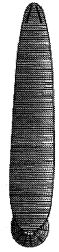
A
Aquatic,coelomate,tissue level organization,Nephridia
B
Metamerism,complete digestive tract,ganglia,Diploblastic,pseudocoelomate
C
Organ-system level organisation,Bilateral symmetry,longitudinal and circular muscles,aquatic
D
Pseudocoelomate,radial symmetry,dioecious,malpighian tubule,jointed appendages.
Solution
(C) The figure shows a leech $(Hirudinaria)$,which belongs to the Phylum $Annelida$.
Characteristics of Phylum $Annelida$ include:
$1$. They exhibit organ-system level of body organization.
$2$. They are bilaterally symmetrical and triploblastic.
$3$. They are coelomate animals.
$4$. Their body surface is distinctly marked out into segments or metameres (metamerism).
$5$. They possess longitudinal and circular muscles which help in locomotion.
$6$. They are mostly aquatic (marine and fresh water) or terrestrial.
Option $C$ correctly lists: Organ-system level organisation,Bilateral symmetry,longitudinal and circular muscles,and aquatic habitat.
Characteristics of Phylum $Annelida$ include:
$1$. They exhibit organ-system level of body organization.
$2$. They are bilaterally symmetrical and triploblastic.
$3$. They are coelomate animals.
$4$. Their body surface is distinctly marked out into segments or metameres (metamerism).
$5$. They possess longitudinal and circular muscles which help in locomotion.
$6$. They are mostly aquatic (marine and fresh water) or terrestrial.
Option $C$ correctly lists: Organ-system level organisation,Bilateral symmetry,longitudinal and circular muscles,and aquatic habitat.
0 likes
View Solution100
MediumMCQ
Which of the following helps in locomotion?
A
Trichocysts in Paramecium
B
Pedicellariae in Starfish
C
Clitellum in Pheretima
D
Posterior sucker in Hirudinaria
Solution
(D) Locomotion refers to the movement of an organism from one place to another.
$A$. Trichocysts in Paramecium are defensive organelles,not involved in locomotion.
$B$. Pedicellariae in Starfish are small wrench-like structures used for cleaning the body surface and protection,not for locomotion.
$C$. Clitellum in Pheretima (earthworm) is a glandular structure involved in cocoon formation,not locomotion.
$D$. Hirudinaria (leech) uses its anterior and posterior suckers for attachment and locomotion (looping movement). Therefore,the posterior sucker is involved in its locomotion.
$A$. Trichocysts in Paramecium are defensive organelles,not involved in locomotion.
$B$. Pedicellariae in Starfish are small wrench-like structures used for cleaning the body surface and protection,not for locomotion.
$C$. Clitellum in Pheretima (earthworm) is a glandular structure involved in cocoon formation,not locomotion.
$D$. Hirudinaria (leech) uses its anterior and posterior suckers for attachment and locomotion (looping movement). Therefore,the posterior sucker is involved in its locomotion.
0 likes
View SolutionAnimal Kingdom — Phylum-Annelida · Frequently Asked Questions
1Are these Animal Kingdom questions useful for JEE and NEET?
Yes. All questions in this section are mapped to JEE Main and NEET exam patterns. Previous year questions from JEE Main, NEET, GUJCET and state-level exams are included with full solutions.
2Can I switch to Hindi or Gujarati for these questions?
Yes. Use the language tabs in the hero section or the sidebar to view the same questions and solutions in English, Hindi or Gujarati.
3How do I generate a question paper from this subtopic?
Use the Vedclass Exam Paper Generator — select the chapter and subtopic, set difficulty, and generate Sets A, B, C, D automatically. First 3 chapters of every subject are free.
Vedclass Products
For Students
Vedclass Test Series
Mock tests in real JEE/NEET style with performance analysis. 5-day free trial.
Start Free TrialFor Teachers
Exam Paper Generator
Generate Set A/B/C/D papers from this chapter in 2 minutes. 3 chapters free.
Try FreeFor Institutes
Online Exam Module
Live online exams with unlimited students, 360° analytics & white-label branding.
See DemoFor Teachers & Institutes
Generate a Animal Kingdom Exam Paper in 2 Minutes
Select subtopic & difficulty — Sets A, B, C, D auto-generated with No Repeat logic.
First 3 chapters of every subject are free — no payment required.